This interview guide is for educational and informational purposes only. It is designed to help readers prepare, but it does not guarantee any interview result, hiring decision, offer, or outcome. Interview questions, hiring criteria, and preferred answers can vary by employer, interviewer, industry, location, and time. All answers, examples, and explanations in this guide are suggested examples for interview preparation, not definitive answers or instructions for professional practice. They are based on research and judgment, are provided without warranties of any kind, and should be adapted to the question, role, and applicable laws and professional requirements. Diagrams are simplified illustrations intended to highlight the main concepts and their relationships; actual situations, systems, and practices may be more complex. Alternative approaches may be equally valid or better suited to a particular question, context, or interviewer. To the fullest extent permitted by applicable law, the contributors and publisher are not liable for decisions made, actions taken, or losses incurred based on this guide.
State Laws and Professional Responsibilities
Laws and requirements governing an occupation vary by state and jurisdiction. You are responsible for checking the current laws, licensing requirements, and scope-of-practice rules that apply to your location and role, and for ensuring that your answers and actions comply with them. Adapt examples in this guide to those requirements. This guide is not legal advice.
Identity, Image, and Privacy Notice
To respect individual privacy, some names, profile photographs, avatars, biographical details, and other identifying information displayed in this guide may be replaced with pseudonyms, licensed stock images, illustrative avatars, composite images, or representative descriptions. Unless a person is expressly identified as an actual contributor, a displayed name, image, or profile should not be understood as depicting or identifying a specific candidate, interviewer, employee, or other real individual. These representations are provided for editorial and illustrative purposes only and do not imply endorsement, employment, participation, or affiliation with this guide or any company mentioned in it. Any resemblance to an actual person is coincidental.
Company Notice
This guide is an independent educational resource and is not affiliated with, endorsed by, sponsored by, or approved by the company named in this guide. Company names identify reported interview experiences or the employer context of clearly labeled original practice exercises. Interview practices can change without notice, and inclusion of company-specific content does not mean these questions are official, complete, or guaranteed to be asked. To the fullest extent permitted by law, the author, contributors, and publisher are not responsible for outcomes related to use of this material.
Content Accuracy and Verification
To the fullest extent permitted by applicable law, we do not represent or warrant that interview guides, questions, answers, examples, or diagrams are accurate, complete, current, error-free, or suitable for any particular purpose. You are responsible for independently reviewing and verifying the information before relying on it.
Questions or comments?
Contact us for general questions, or share feedback, technical corrections, and comments with the community.
1. Which joining methods can connect plastic to metal or plastic to plastic?NEWManufacturing Processes And DfmMediumFord
Short Interview Answer (30-60 seconds)
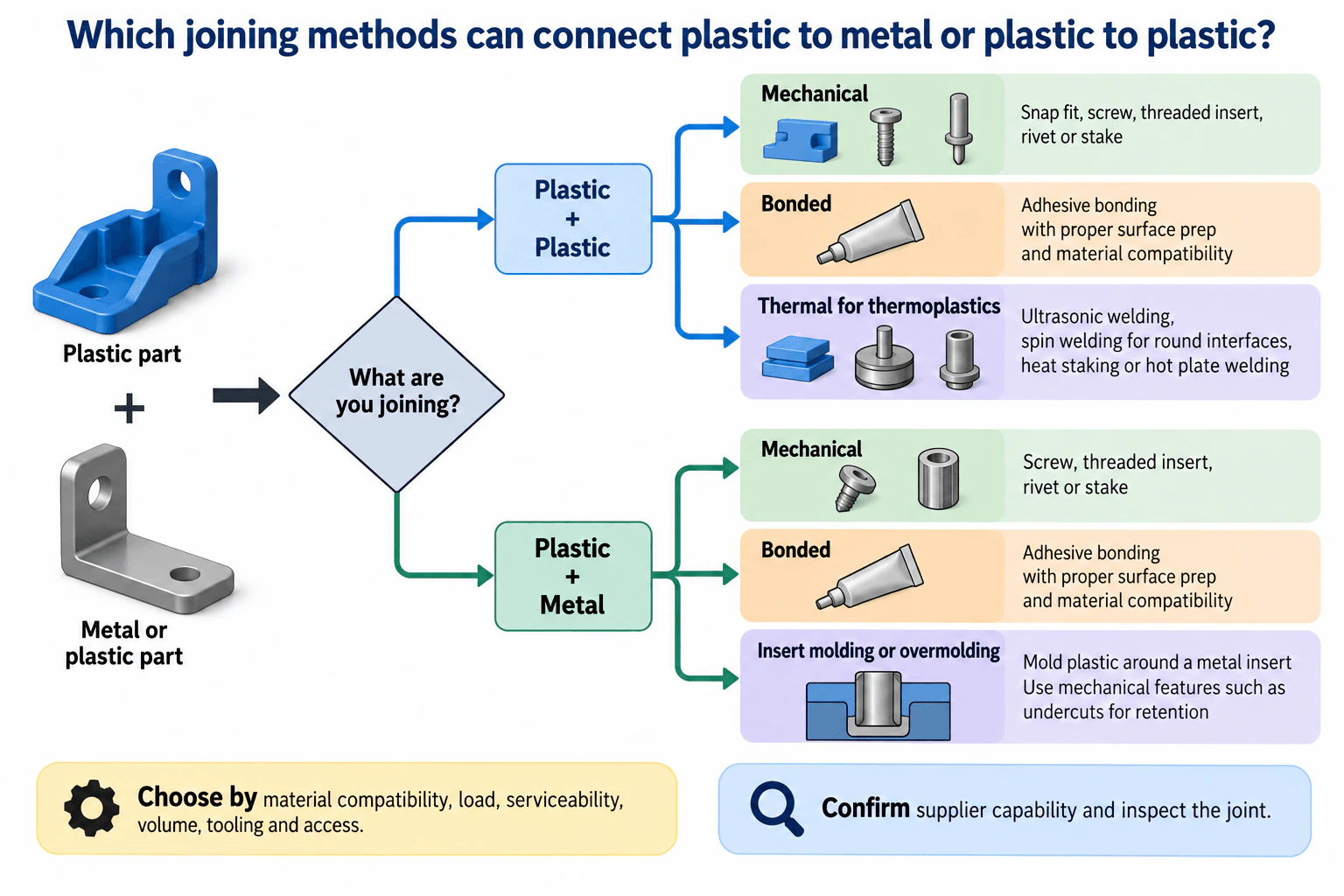
For plastic to plastic, common choices include snap fits, screws, threaded inserts, rivets or staking, adhesive bonding, and thermal joining for compatible thermoplastics such as ultrasonic welding, spin welding for round interfaces, heat staking, or hot plate welding. For plastic to metal, I would consider screws, threaded inserts, rivets or staking, adhesive bonding, and insert molding or overmolding around a suitably designed metal insert. I would choose among them based on material compatibility, load, serviceability, production volume, tooling access, assembly sequence, supplier capability, inspection, and cost.
Detailed Explanation
There is no single best joining method for every plastic assembly. I first separate plastic to plastic from plastic to metal because that immediately changes which processes are practical. I then choose the process from the actual assembly requirements rather than from preference.
Useful Questions to Ask the Interviewer
What plastic or plastics and metal are being joined, and are the plastic parts thermoplastic?
What loads, service conditions, tolerances, and serviceability requirements must the joint meet?
What production volume, tooling access, assembly sequence, inspection method, and cost constraints apply?
How to Explain It in an Interview
For plastic to plastic, I would start with three broad choices. Mechanical joining includes snap fits, screws, threaded inserts, rivets, and staking. It can provide simple assembly and, depending on the method, possible disassembly. Adhesive bonding can join compatible surfaces without concentrating load at a fastener, but the adhesive and surface preparation must suit both materials and the service environment. For compatible thermoplastics, thermal processes can create a direct joint. Examples include ultrasonic welding, spin welding for round interfaces, heat staking, and hot plate welding.
For plastic to metal, I would consider mechanical joining such as screws, threaded inserts, rivets, or staking when the geometry provides suitable access and load paths. Adhesive bonding is another option when the adhesive, surface preparation, and materials are compatible. For higher volume molded assemblies, insert molding or overmolding can place plastic around a metal insert. The metal insert needs retention geometry, such as appropriate undercuts or other mechanical features, so the molded plastic can mechanically engage it.
My DFM and DFA decision would consider production volume, material compatibility, joint load, required tolerances, serviceability, tool access, assembly sequence, mistake prevention, cycle time, and cost. I would also review whether the supplier can hold the required process capability and whether the joint can be inspected consistently.
I would validate the selected method with representative parts and the intended manufacturing process. I would inspect joint geometry and assembly quality, then perform appropriate mechanical and environmental validation based on the actual requirements. If testing shows inadequate strength, excessive variation, poor access, or unacceptable assembly cost, I would revisit the joining method or joint geometry before release.
Why Interviewers Ask This
Interviewers want to see whether I can select a joining process from material pairing, load, serviceability, production volume, tooling access, assembly sequence, supplier capability, inspection needs, and cost instead of naming a process without considering manufacturability.
Common interview mistakes
A common mistake is selecting a joining process before confirming the exact materials and production requirements. Other mistakes include assuming all plastics can be welded, ignoring adhesive surface preparation, using fasteners without checking tool access and local plastic geometry, designing an overmolded metal insert without adequate mechanical retention, and overlooking assembly sequence, inspection, supplier capability, serviceability, or total manufacturing cost.
Interview tip
Organize the answer by material pairing first, then explain the available joining families and the decision criteria. Mention why each method is appropriate rather than giving a long list. Finish with DFM, DFA, supplier capability, inspection, and validation to show that the joining choice is a manufacturing decision as well as a geometry decision.
Interviewer may ask next
How would you validate that the selected joining method is suitable for production?
I would build representative joints using the intended materials, geometry, tooling, and assembly process. I would inspect the joint and measure the characteristics tied to the requirements, then perform appropriate mechanical and environmental testing. I would also review process variation with the supplier and confirm that the inspection method can detect relevant defects. The exact tests and acceptance limits would come from the actual product requirements rather than assumed values.
How would your choice change if the assembly had to be serviced repeatedly?
I would give more weight to reversible mechanical joining, such as screws or another removable fastening approach, because repeated service favors controlled disassembly and reassembly. Permanent methods such as many adhesive bonds, welded thermoplastic joints, staking, or some overmolded constructions would become less attractive unless the service strategy allowed replacement of the complete assembly. I would still check access, joint load, plastic geometry, assembly time, and cost before selecting the final method.
2. How do implicit and explicit analysis differ?NEWSimulation And Engineering AnalysisMediumFord
Short Interview Answer (30-60 seconds)
Implicit analysis solves equilibrium at each load or time increment, usually using iterations. That makes each increment more expensive, but relatively large increments are often possible. Explicit analysis advances the response directly without iterative equilibrium at every increment. Each increment is cheaper, but the stable time increment is usually very small. I would typically consider implicit analysis for static, quasi static, and moderately nonlinear problems, while explicit analysis is often attractive for impact, crash, severe contact, and very large deformation. I would choose between them based on the actual physics, time scale, nonlinearities, contact behavior, and validation requirements.
Detailed Explanation
Implicit and explicit methods are two numerical ways of advancing an FEA solution. The important distinction is not that one is universally more accurate or faster. Their numerical formulations make them suitable for different physical problems.
Useful Questions to Ask the Interviewer
Is the event static or quasi static, or does inertia materially affect the response?
Are there severe contact changes, large deformation, material nonlinearities, or possible instability?
Is the objective a final equilibrium state, a transient response, or both?
How to Explain It in an Interview
Engineering Method
For an implicit solution, the solver seeks equilibrium at each increment. In simplified form, the structural equilibrium condition is F_internal = F_external. For a nonlinear problem, stiffness, contact, geometry, or material response can change during the increment, so the solver normally iterates until its convergence criteria are satisfied.
For an explicit solution, the equations of motion include inertia. A simplified form is M a = F_external − F_internal, where M is the mass matrix and a is acceleration. The solver calculates the current acceleration and advances velocity and displacement directly. It does not normally perform iterative equilibrium corrections within each increment.
The tradeoff is time increment size. Implicit methods can often take much larger increments, but each increment can require repeated matrix solution and nonlinear iterations. Explicit methods have inexpensive increments, but numerical stability generally limits the allowable increment to a very small value related to the smallest relevant element dimension and material wave speed.
Assumptions And Checks
I would first decide whether inertia is physically important. For a slowly applied structural load where the final equilibrium response matters, implicit analysis is often appropriate. For crash, impact, rapidly changing contact, severe deformation, or other short duration events, explicit analysis can be more practical.
For a quasi static problem solved explicitly, I would verify that artificial dynamic effects are acceptably small rather than assuming a slow applied load automatically makes the result static.
I would also check boundary conditions, contact definitions, material models, rigid body modes, singularities, mesh convergence or mesh sensitivity, and energy behavior where applicable.
Design Reasoning
Solver completion is only numerical evidence. I would compare the model with hand calculations, expected physical behavior, sensitivity studies, and test correlation when available. Mesh convergence demonstrates numerical consistency, not that the model represents reality. The final solver choice should therefore follow the engineering decision, the relevant physics, and the evidence needed to validate the result.
Why Interviewers Ask This
The interviewer is evaluating whether the candidate understands that solver selection must follow the physical problem, nonlinear behavior, characteristic time scale, contact conditions, and required accuracy. They also want to see whether the candidate can distinguish numerical convergence from physical validation and recognize that a converged finite element solution can still be wrong if the loads, supports, contacts, mesh, or material models do not represent reality.
Common interview mistakes
Common mistakes include saying that implicit means static and explicit means dynamic, assuming one formulation is inherently more accurate, choosing explicit only because nonlinear convergence is difficult, ignoring the stable time increment, and accepting a converged implicit result without checking the model physics. Another mistake is treating mesh convergence as validation. A model can converge numerically while still using unrealistic boundary conditions, contact definitions, loads, or material behavior.
Interview tip
Start with the numerical distinction: implicit solves equilibrium iteratively at each increment, while explicit advances the equations of motion directly using very small stable increments. Then connect that difference to engineering decisions such as event duration, inertia, contact, deformation, and nonlinearities. Finish by explaining how you would verify the model with mesh sensitivity, physical checks, hand calculations, and test correlation rather than relying only on solver convergence.
Interviewer may ask next
How would you verify that an explicit simulation intended to represent a quasi static event is actually behaving quasi statically?
I would check whether inertial effects remain small compared with the structural response of interest. I would review kinetic energy relative to the relevant internal energy, inspect acceleration and oscillation behavior, and repeat the analysis with a slower loading rate if practical to see whether the engineering result remains stable. I would also check contact behavior, mesh sensitivity, material response, and boundary conditions. The acceptance criterion should come from the required engineering accuracy and the physics of the problem rather than from one universal energy ratio.
If an implicit nonlinear contact analysis repeatedly fails to converge, would you automatically switch to explicit analysis?
No. I would first determine why the implicit model is failing. I would inspect contact definitions, constraints, rigid body motion, material behavior, load increments, mesh quality, and whether a real physical instability is occurring. If the event contains severe contact changes, large deformation, instability, or other behavior that makes explicit integration more suitable, then explicit analysis may be justified. If I use explicit analysis for a slowly loaded problem, I would also verify that the result is not being dominated by artificial dynamic effects.
3. Which checks would you use to assess an FEA mesh's quality?NEWSimulation And Engineering AnalysisMediumFord
i Question Details
Discuss measures such as element skew and the Jacobian.
Short Interview Answer (30-60 seconds)
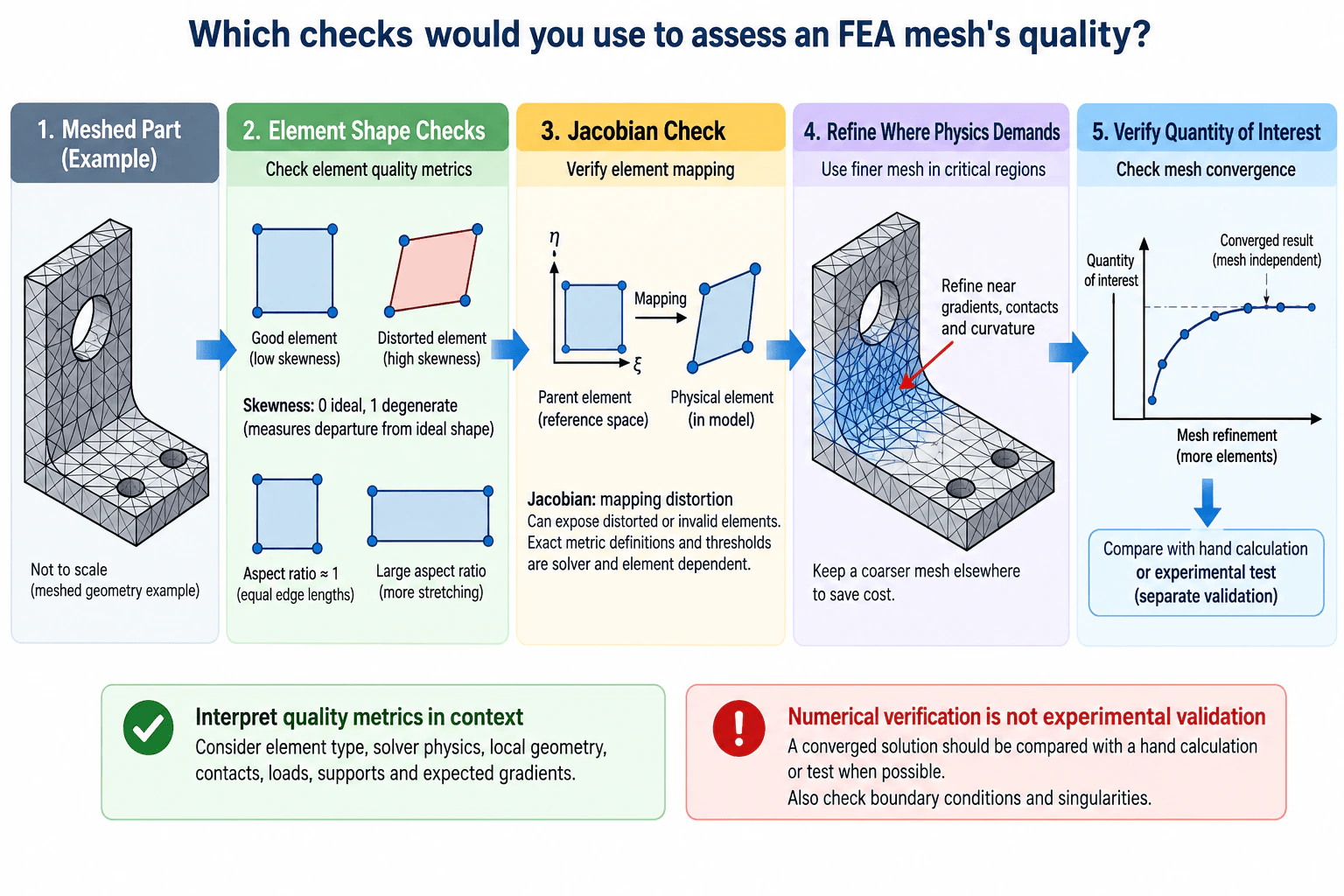
I would check element shape metrics first, especially skewness, aspect ratio, and a Jacobian based quality metric. For the skewness definition shown here, 0 represents an ideal element and 1 represents a degenerate element. Aspect ratio indicates element stretching, while the Jacobian assesses how the parent element maps into the physical element and can expose excessive distortion or invalid elements. I would then refine the mesh where the physics demands it and perform a mesh convergence study on the quantity of interest. Finally, I would review the modeling assumptions and compare the result with a hand calculation or experimental evidence when available.
Detailed Explanation
A good mesh is not defined by one metric. I would combine element shape checks with convergence and independent validation so the mesh is suitable for the engineering quantity I need to predict.
Useful Questions to Ask the Interviewer
What result matters most, such as stress, displacement, strain, contact pressure, or another quantity of interest?
What element type and solver formulation are being used?
Is there a hand calculation, test result, or previous validated model available for comparison?
How to Explain It in an Interview
I would start with element geometry. I would inspect skewness because it measures departure from the ideal element shape. For the normalized skewness definition shown in the diagram, 0 is ideal and 1 is degenerate. I would also inspect aspect ratio. A value near 1 represents similar element dimensions, while a large value indicates stronger stretching. Whether a stretched element is acceptable depends on the element formulation, local geometry, solution gradients, and quantity of interest.
Next I would inspect the Jacobian based quality measure. The Jacobian describes the transformation from parent element coordinates to the physical element. Excessive distortion in this mapping can make an element unreliable or invalid. The exact metric, sampling method, and acceptable limits depend on the solver and element type, so I would use the applicable solver definition rather than assume one universal threshold.
I would then refine where the physics demands it, such as near strong gradients, contacts, geometric curvature, and load introduction regions. Regions with smooth response can remain coarser to reduce computational cost.
I would perform a mesh convergence study by refining the mesh and tracking the actual quantity of interest. I want that result to approach a stable value rather than judging convergence only from element count or a smooth contour plot.
I would also review loads, supports, contacts, material models, nonlinearities, rigid body modes, boundary conditions, and singularities. A finer mesh cannot correct an incorrect physical model. Numerical convergence is verification, not experimental validation. I would therefore compare the model with a hand calculation or test evidence when available before treating the prediction as credible.
Why Interviewers Ask This
This tests whether the candidate can distinguish geometric mesh quality from numerical verification and can judge whether an FEA result is trustworthy rather than relying on a visually smooth contour plot.
Common interview mistakes
Common mistakes include accepting a mesh because it looks visually fine, using one quality threshold for every element type and solver, refining the entire model instead of critical regions, reporting peak stress at a singularity as a meaningful converged value, checking only solver convergence instead of mesh convergence, and treating a smooth contour plot as proof that the physical model is valid.
Interview tip
Separate three ideas clearly: element shape quality, mesh convergence of the quantity of interest, and validation against independent evidence. Explain that acceptable skewness, aspect ratio, or Jacobian values do not by themselves prove that the engineering result is correct.
Interviewer may ask next
What would you do if the peak stress keeps increasing as the mesh is refined?
I would first determine whether the peak is associated with a mathematical singularity, such as an idealized point load, perfectly sharp corner, or overly rigid support. If it is singular, the local peak may not converge even though displacement, strain energy, or stress away from the singularity does. I would revise the idealization where physically justified and evaluate a quantity that is meaningful for the design decision.
What if a stretched element has a high aspect ratio but is aligned with a smooth solution direction?
I would not reject it from aspect ratio alone. I would check the element formulation, orientation, local gradients, Jacobian quality, and sensitivity of the quantity of interest to further refinement. An elongated element can sometimes be efficient where the solution varies slowly along its long direction, but its suitability should be demonstrated through numerical sensitivity rather than assumed.
4. How would you approach designing a component you have not worked on before?NEWMechanical DesignMediumFord
Short Interview Answer (30-60 seconds)
I would treat an unfamiliar component as a requirements and risk problem first. I would define what the component must do, its loads, interfaces, environment, packaging limits, life, cost, manufacturing needs, serviceability, and measurable acceptance criteria. Then I would identify what I know, what I am assuming, and what I still need to learn. I would study comparable designs and the governing physics, involve subject matter experts where appropriate, develop several concepts, and compare them against the requirements. Once a concept is selected, I would refine its interfaces, load paths, materials, tolerances, manufacturing approach, and design margins. Finally, I would create a verification plan so every important requirement has evidence before the design is released.
Detailed Explanation
When I have not designed a particular component before, I would not start by copying an existing shape or immediately building detailed CAD. I would first reduce the unfamiliar problem into familiar engineering questions: what function must be achieved, what constraints control the design, what can fail, and what evidence will show that the final design meets its requirements.
Useful Questions to Ask the Interviewer
What are the most important functional requirements, loads, operating conditions, life expectations, and measurable acceptance criteria for this component?
What interfaces, packaging limits, manufacturing processes, cost targets, and service requirements are already fixed?
Are there existing designs, field issues, standards, or subject matter experts that should inform the design?
How to Explain It in an Interview
Engineering Method
I would begin with requirements traceability. I would define the component boundary and document its required function, mechanical interfaces, expected loads, operating environment, envelope, life, cost, manufacturing constraints, assembly needs, serviceability, and acceptance criteria. I would separate confirmed facts from assumptions and unknowns so uncertainty is visible.
Next, I would learn only the information needed to make sound design decisions. That could include reviewing comparable components, relevant engineering principles, previous failure information, applicable standards, manufacturing capability, and guidance from experienced engineers. I would confirm that any reference design actually operates under comparable conditions rather than assuming it can simply be reused.
I would then develop multiple concepts. For each concept, I would trace how loads enter and leave the component, how it interfaces with neighboring parts, how it is manufactured and assembled, and what major failure modes are possible. I would compare the concepts against the same requirements using a documented selection method rather than choosing the most familiar geometry.
Assumptions And Checks
After selecting a concept, I would refine material choice, joints, tolerances, load paths, design margins, durability, serviceability, and manufacturing details. Any calculation or simulation would use clearly stated loads, boundary conditions, material assumptions, and units. I would check whether simplified models are appropriate and identify where uncertainty requires additional evidence.
I would also review interface risks because an unfamiliar component can fail even when the individual part appears adequate. I would check fit, motion, thermal effects, tolerance accumulation, assembly access, neighboring loads, and likely misuse or abnormal conditions.
Design Reasoning
Before release, I would create a design verification plan that maps important requirements to evidence. Evidence might come from engineering calculations, analysis, dimensional inspection, prototype evaluation, or physical testing depending on the requirement. A passing simplified calculation alone would not prove the design is ready.
The key principle is that unfamiliarity changes how carefully I manage assumptions and learning, but it does not change the fundamental mechanical design process. I would make the problem traceable, reduce uncertainty systematically, involve the right expertise, and require evidence before committing to the design.
Why Interviewers Ask This
The interviewer is evaluating whether I can turn an unfamiliar mechanical problem into a disciplined design process by defining requirements, identifying unknowns, learning the relevant physics and interfaces, comparing concepts, managing risk, and creating traceable verification criteria instead of immediately jumping into detailed geometry.
Interviewer may ask next
How would you proceed if several important loads or operating conditions were still unknown?
I would identify those unknowns explicitly and determine which ones could materially change the concept, material, interfaces, or required design margin. I would seek better information from system owners, measurements, previous designs, field data, or subject matter experts. Where uncertainty remains, I would evaluate credible bounding conditions instead of silently choosing a convenient value. I would document the assumptions and make the verification plan specifically test or confirm the assumptions that carry the greatest design risk.
What would you change if the preferred concept met the functional requirements but was too expensive to manufacture?
I would keep the functional and safety related requirements fixed and revisit the concept against the cost and manufacturing constraints. I would look for opportunities such as simplifying geometry, reducing part count, changing joints, improving tolerance allocation, selecting a more appropriate manufacturing process, or changing material where requirements permit. I would compare the revised concepts against the complete requirement set so a cost reduction does not create unacceptable durability, assembly, serviceability, or interface risk.
5. How would you test a component's material and its performance in a vehicle?NEWTesting And ValidationMediumFord
Short Interview Answer (30-60 seconds)
I would start by translating the component requirements into measurable acceptance criteria, then separate material characterization from component and vehicle performance testing. For the material, I would select tests for the properties that control the design, such as strength, stiffness, fatigue, temperature response, corrosion resistance, or wear. For the component, I would reproduce representative loads, boundary conditions, temperatures, vibration, and environmental exposure using calibrated instrumentation. I would define sample coverage, repeatability, measurement uncertainty, and pass criteria before testing. Finally, I would compare the measured response with requirements and model predictions, investigate meaningful discrepancies, and document the evidence and limitations before concluding that the design is validated.
Detailed Explanation
I would treat this as a verification and validation problem. First I would identify what the component must do, the vehicle conditions it must survive, and the measurable criterion that defines success. I would then build evidence from material level testing, component level testing, and representative vehicle testing rather than relying on one test alone.
Useful Questions to Ask the Interviewer
What are the main functional requirements and critical failure modes for the component?
What vehicle loads, temperatures, vibration levels, environmental exposures, and expected service life should the test represent?
Are there existing specifications, material standards, or acceptance criteria that the test plan must satisfy?
How to Explain It in an Interview
Engineering Method
I would begin with a requirement traceability table. Each requirement would identify the operating condition, measured quantity, test method, and acceptance criterion.
For the material, I would test only properties relevant to the design. Depending on the component, that could include tensile strength, elastic modulus, fatigue behavior, hardness, impact resistance, thermal response, corrosion resistance, or wear. The specimen orientation, temperature, conditioning, and manufacturing state should represent the actual component as closely as practical.
Next I would test the complete component using fixtures that reproduce its real mounting and load paths. I would choose sensors with suitable range and resolution, define the sampling rate from the expected response frequency, and confirm calibration before the test. Measurements could include force, displacement, strain, acceleration, temperature, or pressure depending on the requirement.
Assumptions And Checks
I would define representative loading rather than simply applying an arbitrary high load. I would also establish sample coverage, repeated runs, and measurement uncertainty before interpreting the results. Repeatability helps distinguish real component behavior from fixture variation or measurement noise.
I would check that the fixture does not introduce unrealistic stiffness or load paths. I would also verify sensor placement, zero readings, calibration status, units, and data acquisition settings before the formal test.
Design Reasoning
After testing, I would compare measured quantities directly with the acceptance criteria and with analytical or simulation predictions where available. If the test and model disagree materially, I would examine assumptions, boundary conditions, material data, fixture behavior, and measurement uncertainty before changing the design.
Finally, I would use representative vehicle testing to confirm that the component behaves correctly in the integrated environment. I would document the test configuration, calibration, samples, results, uncertainty, deviations, and limitations so the verification evidence is traceable and repeatable.
Why Interviewers Ask This
Interviewers want to see whether I can turn a design requirement into a traceable verification plan, select appropriate material and component tests, control measurement uncertainty, reproduce representative vehicle loading, define objective acceptance criteria, and use evidence to decide whether the component meets its intended requirements.
Common interview mistakes
Common mistakes are testing without a defined acceptance criterion, choosing loads that do not represent the real vehicle condition, testing material coupons that do not represent the production material state, ignoring fixture stiffness, using sensors without suitable range or calibration, relying on a single sample, overlooking measurement uncertainty, and declaring success because a simulation and test appear visually similar without quantitatively comparing them.
Interview tip
Explain the sequence from requirement to measurable criterion, material test, component test, and representative vehicle validation. Emphasize calibrated measurements, realistic boundary conditions, repeatability, uncertainty, and traceable evidence. Avoid inventing specific loads or pass limits unless the interviewer provides them.
Interviewer may ask next
How would you know whether a difference between simulation and test is significant?
I would first compare the size of the difference with the measurement uncertainty, expected sample variation, and the engineering acceptance criterion. Then I would check whether the model and test use equivalent material properties, geometry, contacts, constraints, loads, and temperatures. I would also examine fixture compliance, sensor location, calibration, and repeatability. If the discrepancy remains larger than the combined uncertainty and matters to the requirement, I would investigate the model assumptions or physical behavior before using either result as the basis for a design decision.
What would you change if the component had to operate over a much wider temperature range?
I would expand the test matrix so material characterization and component testing cover the relevant temperature conditions rather than assuming room temperature behavior applies everywhere. I would consider temperature dependent stiffness, strength, dimensional change, interface behavior, seals, lubrication, and sensor suitability. I would condition the component as required, measure its actual temperature during testing, reproduce the combined thermal and mechanical loads when interaction matters, and define acceptance criteria for the required temperature range.
6. How would you carry out a design FMEA?NEWSafety And Design RiskMediumFord
i Question Details
Illustrate the process with a practical example.
Short Interview Answer (30-60 seconds)
I would start by defining the design boundary, intended functions, operating modes, users, interfaces, and applicable requirements. For each function, I would identify credible failure modes, determine their effects and severity, identify physical causes, and assess the existing prevention and detection controls. I would then prioritize the significant risks using the organization’s chosen DFMEA method, develop design actions that address causes rather than only detecting failures, verify those actions with analysis or testing, and update the DFMEA with objective evidence. I would also review residual risk and confirm that safety related protections remain effective under credible faults.
Detailed Explanation
A DFMEA is a structured way to ask what a design must do, how it could fail, what would happen if it failed, why it could fail, and what design action should prevent or detect that failure. I would treat it as a living engineering risk record, not a scoring exercise.
Useful Questions to Ask the Interviewer
What product boundary, operating conditions, and life cycle phases should the DFMEA cover?
Is there a required company or industry FMEA method for prioritizing actions?
Are there known safety requirements, field issues, interfaces, or validation limits that should be treated as inputs?
How to Explain It in an Interview
I would first define the scope clearly. That includes the component or subsystem boundary, functions, interfaces, exposed people, operating modes, environment, expected life, service conditions, and applicable jurisdiction or safety requirements. I would separate known requirements from assumptions and unresolved inputs.
Next, for each function, I would identify credible failure modes. For a mechanical design these could include fracture, excessive deformation, loosening, wear, leakage, binding, unintended motion, loss of retention, or inadequate guarding. I would then trace each failure mode to its effect at the component, next assembly, system, and user level where relevant. Safety effects such as pinch exposure, stored energy release, pressure release, sharp edges, or uncontrolled motion receive particular attention.
Then I would identify realistic physical causes such as insufficient section strength, tolerance interaction, fatigue loading, material degradation, poor joint retention, contamination, or an interface mismatch. I would document existing prevention controls and detection controls separately. Prevention controls reduce the likelihood that the cause occurs. Detection controls increase the likelihood that the cause or failure mode is found before release.
I would assign severity, occurrence, and detection assessments using the selected DFMEA method and its defined criteria. If the method uses an action priority or another prioritization scheme, I would follow that method rather than creating my own threshold. I would use the assessments to prioritize action, but I would not allow a numerical score to override a significant safety concern.
For a hypothetical powered access panel, suppose the closing linkage creates a finger pinch point. The failure effect could be user injury, and a contributing design cause could be insufficient clearance between moving parts. I would first try to eliminate or reduce the hazard through geometry, adequate separation, force limitation, guarding, or controlled motion rather than relying only on a warning. I would also consider safe isolation and stored energy during service.
Finally, I would assign each action to an owner, define objective verification, and close it only after evidence such as calculation, tolerance analysis, inspection, simulation, or physical validation supports the change. I would reassess the resulting risk, document residual risk, check whether the change introduced new failure modes, and maintain traceability between the DFMEA, design requirements, and validation evidence.
Why Interviewers Ask This
Interviewers want to see whether I can systematically identify design risks before release, connect failure modes to real effects and causes, prioritize risk using evidence, apply the hierarchy of controls, define effective prevention and detection controls, and verify that corrective actions reduce risk without creating new hazards.
Common interview mistakes
Common mistakes are starting with scores instead of functions and failure physics, treating every possible issue as equally important, confusing failure modes with causes, combining prevention and detection controls, inventing occurrence estimates without evidence, relying on inspection instead of improving the design, reducing a risk number without addressing the underlying cause, ignoring operating modes such as service or maintenance, overlooking stored energy, pressure release, pinch points, and guarding, and closing actions without verification evidence. Another mistake is assuming that a structural safety factor alone proves the overall design is safe.
Interview tip
Explain DFMEA as a cause and effect reasoning process rather than reciting a table. Use one practical failure chain from function to failure mode to effect to cause to control to corrective action. Emphasize that safety related risks are addressed through prevention and the hierarchy of controls, then verified with objective evidence and reviewed for residual risk.
Interviewer may ask next
How would you handle a DFMEA item when occurrence data is unavailable for a new design?
I would not invent a precise occurrence value. I would document that the design is new, use the defined FMEA criteria and the best available analogous evidence where appropriate, and clearly identify the uncertainty. I would examine the physical cause using calculations, tolerance analysis, material data, simulations, prototype testing, or other relevant evidence. If the effect has high safety significance, I would prioritize prevention even when occurrence is uncertain. As validation and production evidence becomes available, I would update the assessment and retain traceability to the supporting evidence.
What would you do if a proposed risk reduction made the mechanism heavier, more expensive, or harder to package?
I would compare alternatives against the required function, safety effect, technical risk, mass, cost, packaging, durability, and verification burden. I would first look for a design change that eliminates or reduces the hazard at its source. If that is not practical, I would move through the hierarchy of controls and document the remaining risk. I would not trade away a required safety function merely to improve cost or packaging. The final choice should have a clear engineering rationale, defined verification, and documented residual risk.
7. What would you do to fix a squeaky seat specifically? Give me a step by step process of your thinking.NEWTroubleshooting And Failure AnalysisMediumFord
i Question Details
Explain a step-by-step diagnostic approach for identifying the source of a squeak in a vehicle seat and deciding how to correct it.
Short Interview Answer (30-60 seconds)
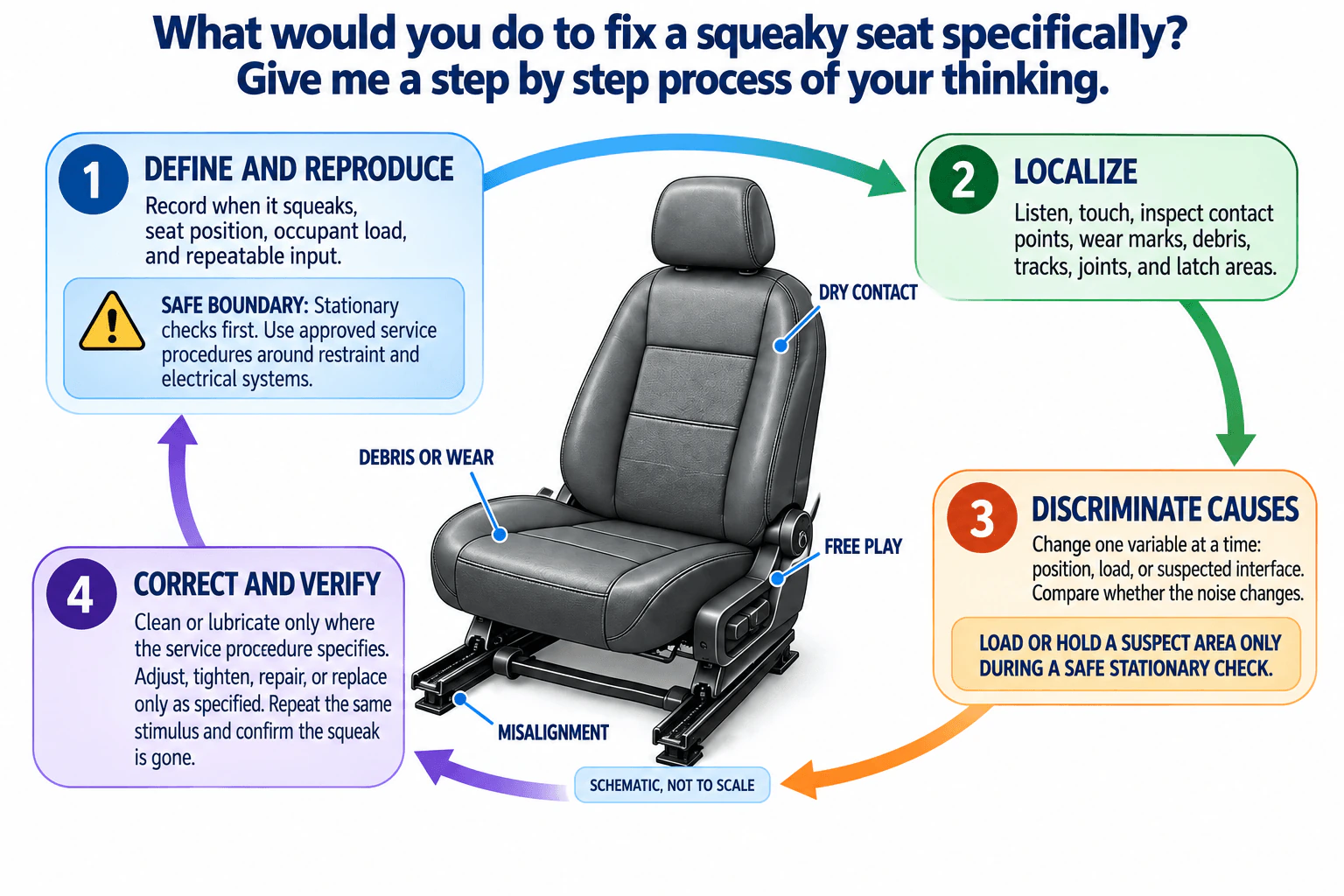
I would first reproduce the squeak under the same seat position, occupant load, and input so I have a repeatable symptom. Next I would localize the source around the seat tracks, joints, latch areas, fasteners, and contact surfaces while loading or holding suspect areas only during safe stationary checks. I would compare competing causes such as dry contact, free play, misalignment, or debris or wear by changing one variable at a time. After confirming the cause, I would apply only the corrective action specified for that interface and then repeat the original stimulus to verify that the squeak is gone.
Detailed Explanation
A squeaky seat is a good example of a problem where the fastest path is disciplined isolation rather than immediately replacing parts. I would move from a repeatable symptom, to a localized source, to competing causes, to a controlled test, and finally to corrective action verification.
Useful Questions to Ask the Interviewer
Under what condition does the squeak occur, such as a certain seat position, occupant load, road input, or adjustment movement?
Is the concern present while the vehicle is stationary, while driving, or both?
Has the seat recently been adjusted, removed, repaired, or exposed to debris or contamination?
How to Explain It in an Interview
I would start by defining and reproducing the symptom. I would record when the squeak occurs, the seat position, occupant load, and the repeatable input that causes it. I would not assume the first audible location is the root cause because noise can travel through the seat structure.
Next I would localize the source. During safe stationary checks, I would listen and feel for vibration while inspecting contact points, seat tracks, joints, latch areas, fasteners, debris, and visible wear patterns. Around restraint or electrical components, I would follow the applicable service procedure rather than improvising.
Then I would create a small root cause tree of plausible mechanisms. For this symptom, strong candidates are dry contact between surfaces, free play in a joint or fastener, misalignment that creates rubbing under load, and debris or wear at a contact interface.
I would discriminate between those causes by changing one variable at a time. For example, I could change seat position, change the applied load, or load or hold a suspected area only during a safe stationary check and observe whether the noise changes. The purpose is to choose tests that separate competing causes rather than simply confirm a preferred theory.
Once the evidence identifies the cause, I would apply only the corrective action appropriate to that interface. That could mean cleaning, lubrication where the service procedure specifies it, adjustment, tightening, repair, or replacement. I would not apply lubricant universally because the required correction depends on the confirmed interface and applicable procedure.
Finally, I would repeat the same stimulus that originally produced the squeak. Corrective action verification means confirming that the noise is gone under the representative condition and checking that the repair did not create free play, binding, misalignment, or another noise. If the symptom remains, I would update the root cause analysis and test the next most plausible mechanism.
Why Interviewers Ask This
They are evaluating whether I can troubleshoot a mechanical complaint systematically, separate symptoms from causes, use controlled evidence instead of guessing, respect the investigation boundary around restraint and electrical systems, and verify that a corrective action actually addresses the root cause.
Common interview mistakes
Common mistakes are lubricating everything before identifying the source, assuming the loudest location is the root cause, changing several variables at once, ignoring occupant load or seat position, tightening hardware without evidence, loading or holding moving mechanisms during an unsafe test, and declaring success without reproducing the original condition after the repair.
Interview tip
Walk through the sequence clearly: define and reproduce, localize, discriminate causes, correct, and verify. Name several competing mechanisms such as dry contact, free play, misalignment, and debris or wear, then explain one controlled test that would distinguish them. That demonstrates stronger troubleshooting judgment than jumping directly to a repair.
Interviewer may ask next
How would you verify that your repair actually solved the root cause rather than temporarily masking the squeak?
I would repeat the same seat position, occupant load, and stimulus that originally produced the noise. I would compare the result with the original symptom and check the repaired interface for proper motion, free play, alignment, and any new noise. If the squeak returns under the same condition, I would treat that as evidence that the original hypothesis was incomplete and continue the root cause analysis.
What would you do if the squeak occurred only with a passenger in the seat and disappeared when the seat was unloaded?
I would treat occupant load as an important discriminating variable. I would reproduce the condition safely, identify which interfaces deflect or make contact only under load, and compare likely causes such as dry contact, track movement, joint free play, misalignment, debris, wear, or latch contact. I would change one variable at a time so I could connect any change in the noise to a specific mechanism before choosing the corrective action.
8. Can you tell us about your experience and the technical test you took?NEWBehavioralEasyFord
Interview tip:
Use STAR to structure your answer: briefly explain the Situation and Task, make Action the most detailed part, and finish with the Result. For example, describe your mechanical design experience, the type of technical test you completed, how you approached the engineering problems, how you explained your assumptions and decisions, and what the experience showed about your problem solving and communication skills.
Situation
In my last role, I worked on mechanical design tasks that required me to turn design requirements into practical parts and assemblies. My work included reviewing requirements, creating and checking CAD models, thinking about material and manufacturing constraints, and working with other engineers to resolve design issues. During one interview process, I was also asked to complete a technical test that covered the same kind of engineering thinking.
Task
My responsibility in the test was to work through a mechanical design problem, explain the assumptions I was making, and show how I would reach a safe and practical design decision. I wanted to demonstrate not only that I could reach a reasonable answer, but also that I could explain my engineering process clearly.
Action
I first read the problem carefully and separated the known requirements from the information that was not provided. I stated reasonable assumptions instead of hiding them. Then I identified the main loads, interfaces, material concerns, and manufacturing limits that could affect the design. I worked through the problem in a logical order and checked whether each decision was consistent with the original requirements. When I considered a design choice, I explained why I selected it and what tradeoffs it created. For example, I considered whether a change that improved strength could also increase weight, cost, or manufacturing difficulty. I also checked my work before finishing because a technically correct method can still lead to a poor result if the assumptions, units, or boundary conditions are wrong. Throughout the test, I focused on making my reasoning easy to follow rather than trying to make the solution look more complicated than it needed to be.
Result
The test gave me a good opportunity to show how I approach mechanical engineering problems in practice. It reinforced that my strongest approach is to define the problem clearly, make assumptions visible, check important constraints, and communicate the reasoning behind the final decision. I also learned that explaining the process is just as important in an interview as reaching the final technical answer.
Why Interviewers Ask This
Interviewers ask this question to understand both the candidate's relevant mechanical design background and how the candidate performs when solving an unfamiliar technical problem under evaluation. A strong answer shows a structured engineering process, clear communication, sound judgment, awareness of assumptions and tradeoffs, and the ability to explain technical decisions in simple terms.
Interviewer may ask next
What part of the technical test did you find most important?
The most important part was defining the problem correctly before doing the detailed engineering work. I made sure I understood the requirements, identified missing information, and stated my assumptions clearly. That helped me avoid building the rest of the solution on an incorrect interpretation.
What would you do differently if you took a similar technical test again?
I would use the same structured approach, but I would spend a little more time at the beginning organizing the requirements, assumptions, and checks I planned to perform. That would make my reasoning even easier for the interviewer to follow while still leaving enough time to review the final solution.
9. Can you provide an example of a product report project that you successfully delivered meeting your own expectations?NEWBehavioralMediumFord
i Question Details
Describe a product-report project you delivered successfully and explain how the result compared with the expectations you set for the project.
Interview tip:
Use STAR to structure your answer: briefly explain the Situation and Task, make Action the most detailed part, and finish with the Result. For example, describe a product report you owned, the expectations you set for accuracy and usefulness, how you gathered and checked the engineering information, how you communicated findings and decisions, and how you confirmed that the final report met the goals you defined.
Situation
In my last role, I was responsible for preparing a product report after a mechanical component had completed a design and validation cycle. The report needed to bring together the design intent, analysis results, test observations, open concerns, and final recommendations so the engineering team could make a clear decision about the component.
Task
My responsibility was to deliver a report that I considered complete, technically accurate, and easy for other engineers to review. I set my own expectations before I started. Every important conclusion needed supporting evidence, the report needed to clearly separate confirmed results from remaining risks, and a reviewer needed to understand the main engineering decisions without searching through several separate files.
Action
I first created a simple report structure around the questions the team needed to answer. I included the design requirement, the selected design approach, analysis evidence, validation evidence, remaining concerns, and the recommended next action. I then collected the latest drawings, analysis outputs, test notes, and design review comments. I checked that each item represented the current design revision before using it. This mattered because an older result could make a correct report look convincing while supporting the wrong configuration. I compared the analysis conclusions with the physical test observations and investigated any area where they did not tell the same story. Instead of hiding uncertainty, I clearly stated what we knew, what still needed judgment, and why I believed the available evidence supported the recommendation. I also reviewed the report with the engineers who owned the related analysis and testing work. I asked them to verify the technical facts while I remained responsible for the overall report and final explanation. Before releasing it, I read the report from the point of view of someone who had not worked on the component. I simplified sections that required too much background knowledge and moved the most important evidence closer to the conclusions it supported.
Result
I delivered the report with the content and level of clarity I had expected from the start. The team was able to use it as a single reference for the product decision, and the review focused on the actual engineering judgment rather than missing information or unclear evidence. The project reinforced for me that meeting my own expectations means defining quality before I start, checking the evidence carefully, and making the final work useful to the people who must act on it.
Why Interviewers Ask This
Interviewers ask this question to understand how a candidate defines quality for their own work and whether they can carry a technical deliverable from planning through completion. A strong answer demonstrates ownership, attention to accuracy, practical judgment, clear communication, and the ability to evaluate a finished result against expectations that were established before the work was completed.
Interviewer may ask next
How did you decide whether the product report was complete enough to release?
I checked it against the expectations I had set at the beginning. Each important conclusion needed current supporting evidence, remaining risks had to be visible, and the report had to give a reviewer enough context to understand the recommendation. I also had the engineers responsible for related analysis and testing verify the technical facts. Once those checks were complete and the report could stand on its own for a reviewer, I considered it ready to release.
What would you do differently if you prepared a similar report today?
I would establish the report structure and evidence list even earlier in the project. In that case, I organized the information carefully at the reporting stage, but starting the structure earlier would make it easier to capture important decisions and supporting evidence as the design develops. I would still keep the same final checks for revision accuracy, agreement between analysis and testing, clear risks, and understandable conclusions.
Mechanical Design Engineer Resume Examples
Explore the resume examples below to find the one that best matches your target Mechanical Design Engineer role.
Disclaimer: This interview guide is for educational and informational purposes only. It is designed to help readers prepare, but it does not guarantee any interview result, hiring decision, offer, or outcome. Interview questions, hiring criteria, and preferred answers can vary by employer, interviewer, industry, location, and time. All answers, examples, and explanations in this guide are suggested examples for interview preparation, not definitive answers or instructions for professional practice. They are based on research and judgment, are provided without warranties of any kind, and should be adapted to the question, role, and applicable laws and professional requirements. Diagrams are simplified illustrations intended to highlight the main concepts and their relationships; actual situations, systems, and practices may be more complex. Alternative approaches may be equally valid or better suited to a particular question, context, or interviewer. To the fullest extent permitted by applicable law, the contributors and publisher are not liable for decisions made, actions taken, or losses incurred based on this guide.
State Laws and Professional Responsibilities: Laws and requirements governing an occupation vary by state and jurisdiction. You are responsible for checking the current laws, licensing requirements, and scope-of-practice rules that apply to your location and role, and for ensuring that your answers and actions comply with them. Adapt examples in this guide to those requirements. This guide is not legal advice.
Company Notice: This guide is an independent educational resource and is not affiliated with, endorsed by, sponsored by, or approved by the company named in this guide. Company names identify reported interview experiences or the employer context of clearly labeled original practice exercises. Interview practices can change without notice, and inclusion of company-specific content does not mean these questions are official, complete, or guaranteed to be asked. To the fullest extent permitted by law, the author, contributors, and publisher are not responsible for outcomes related to use of this material.
Content Accuracy and Verification: To the fullest extent permitted by applicable law, we do not represent or warrant that interview guides, questions, answers, examples, or diagrams are accurate, complete, current, error-free, or suitable for any particular purpose. You are responsible for independently reviewing and verifying the information before relying on it.