This interview guide is for educational and informational purposes only. It is designed to help readers prepare, but it does not guarantee any interview result, hiring decision, offer, or outcome. Interview questions, hiring criteria, and preferred answers can vary by employer, interviewer, industry, location, and time. All answers, examples, and explanations in this guide are suggested examples for interview preparation, not definitive answers or instructions for professional practice. They are based on research and judgment, are provided without warranties of any kind, and should be adapted to the question, role, and applicable laws and professional requirements. Diagrams are simplified illustrations intended to highlight the main concepts and their relationships; actual situations, systems, and practices may be more complex. Alternative approaches may be equally valid or better suited to a particular question, context, or interviewer. To the fullest extent permitted by applicable law, the contributors and publisher are not liable for decisions made, actions taken, or losses incurred based on this guide.
State Laws and Professional Responsibilities
Laws and requirements governing an occupation vary by state and jurisdiction. You are responsible for checking the current laws, licensing requirements, and scope-of-practice rules that apply to your location and role, and for ensuring that your answers and actions comply with them. Adapt examples in this guide to those requirements. This guide is not legal advice.
Identity, Image, and Privacy Notice
To respect individual privacy, some names, profile photographs, avatars, biographical details, and other identifying information displayed in this guide may be replaced with pseudonyms, licensed stock images, illustrative avatars, composite images, or representative descriptions. Unless a person is expressly identified as an actual contributor, a displayed name, image, or profile should not be understood as depicting or identifying a specific candidate, interviewer, employee, or other real individual. These representations are provided for editorial and illustrative purposes only and do not imply endorsement, employment, participation, or affiliation with this guide or any company mentioned in it. Any resemblance to an actual person is coincidental.
Company Notice
This guide is an independent educational resource and is not affiliated with, endorsed by, sponsored by, or approved by the company named in this guide. Company names identify reported interview experiences or the employer context of clearly labeled original practice exercises. Interview practices can change without notice, and inclusion of company-specific content does not mean these questions are official, complete, or guaranteed to be asked. To the fullest extent permitted by law, the author, contributors, and publisher are not responsible for outcomes related to use of this material.
Content Accuracy and Verification
To the fullest extent permitted by applicable law, we do not represent or warrant that interview guides, questions, answers, examples, or diagrams are accurate, complete, current, error-free, or suitable for any particular purpose. You are responsible for independently reviewing and verifying the information before relying on it.
Questions or comments?
Contact us for general questions, or share feedback, technical corrections, and comments with the community.
1. What is your thought process and methods in performing a root cause analysis?NEWTroubleshooting And Failure AnalysisMediumLockheed Martin
Short Interview Answer (30-60 seconds)
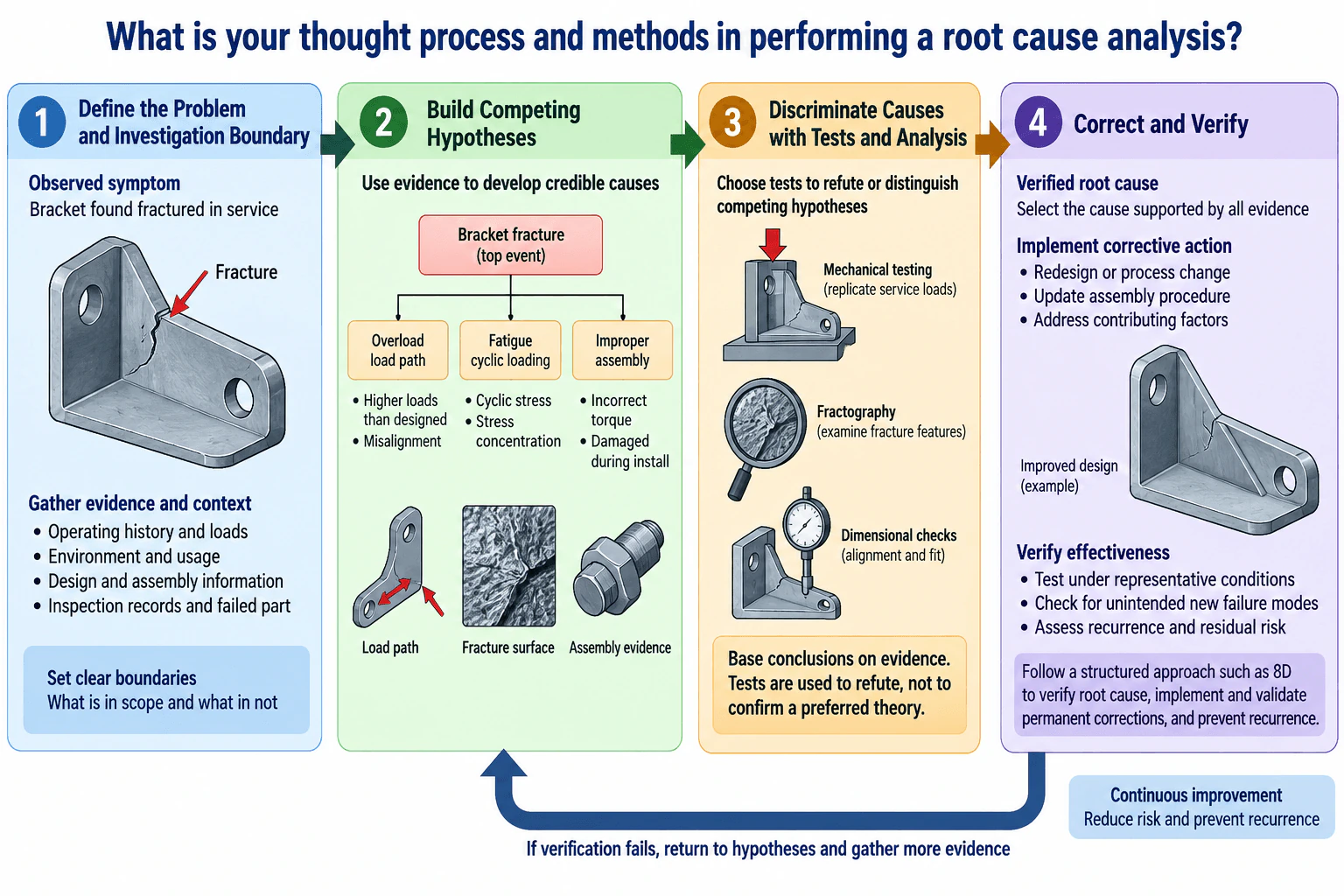
I start by defining the observed symptom, operating history, investigation boundary, and known evidence. Then I build competing hypotheses using the load path, fracture surface, wear pattern, alignment, tolerance, and assembly evidence rather than committing to one theory early. I use root cause analysis, fault tree reasoning, and an 8D structure to organize the investigation. Next I choose measurements or controlled tests that can distinguish or refute the competing causes. Once the evidence supports a root cause, I implement an appropriate corrective action and verify it under representative conditions. If verification fails, I return to the hypotheses and gather more evidence.
Detailed Explanation
My thought process is to move from observed evidence to competing explanations, then to discriminating tests, corrective action, and verification. I do not treat the first plausible explanation as the root cause. The objective is to create a traceable chain from the observed failure to the supported failure mechanism and then demonstrate that the corrective action addresses it.
Useful Questions to Ask the Interviewer
What is the observed failure symptom, and under what operating conditions did it occur?
What evidence is available, such as the failed part, inspection records, load history, alignment data, dimensions, or assembly information?
What investigation boundary and constraints should I assume for measurements or controlled testing?
How to Explain It in an Interview
I would first define exactly what failed, when it failed, the operating history, and the investigation boundary. I would separate known facts from assumptions and unknowns. If a bracket were found fractured in service, that observation alone would not prove whether the cause was overload, fatigue, misalignment, improper assembly, or another mechanism.
Next I would gather traceable evidence. I would review loads and operating history, environment and usage, design and assembly information, inspection records, and the failed hardware. For a mechanical failure I would examine the load path, fracture surface, wear pattern, alignment, tolerances, interfaces, and assembly condition.
Then I would build competing hypotheses. For the bracket example, credible branches could include an overload load path, fatigue from cyclic loading or stress concentration, and improper assembly such as incorrect torque or installation damage. A fault tree can organize those alternatives, while an 8D structure can organize the broader problem solving and corrective action process.
I would then select measurements and controlled tests that distinguish the hypotheses rather than merely confirm my preferred theory. Depending on the evidence, that could include fractography to examine fracture features, dimensional and alignment checks, assembly inspection, or representative mechanical testing that reproduces relevant service loads.
Once the evidence consistently supports a root cause, I would choose corrective action that addresses that mechanism. That could involve a redesign, process change, assembly procedure change, or action on contributing factors, depending on what the investigation actually shows.
Finally, I would verify effectiveness under representative conditions, check for unintended new failure modes, and assess recurrence and residual risk. If verification fails, I would return to the competing hypotheses, gather additional evidence, and continue the investigation rather than forcing the original conclusion.
Why Interviewers Ask This
Interviewers want to see whether I can investigate a mechanical failure systematically instead of jumping to a preferred explanation. They are evaluating how I define the problem, gather traceable evidence, develop competing causes, select measurements or controlled tests that distinguish those causes, and verify that corrective action addresses the supported root cause without creating unacceptable residual risk.
Common interview mistakes
Common mistakes include deciding on the root cause before collecting enough evidence, testing only the preferred theory, confusing a visible symptom with the underlying mechanism, ignoring load path or assembly evidence, changing the design before the cause is supported, inventing loads or material behavior that were not measured, and declaring the problem solved without verifying the corrective action under representative conditions.
Interview tip
Present the investigation as an evidence driven sequence. Clearly separate facts, assumptions, hypotheses, tests, conclusions, and corrective actions. A strong answer also explains what evidence would cause you to reject the current theory and what you would do if corrective action verification failed.
Interviewer may ask next
How would you proceed if the available evidence supported two plausible root causes?
I would keep both hypotheses active and identify observations or controlled tests that produce different expected results for each cause. Dimensional and alignment checks might distinguish an assembly or tolerance issue, while fracture surface evidence and representative loading could help distinguish fatigue from a single overload event. I would not select a root cause until the evidence meaningfully separates the alternatives. If the available evidence cannot do that, I would document the uncertainty and collect additional evidence.
What would you do if the corrective action appeared successful initially but the failure later recurred?
I would treat the recurrence as evidence that the original causal model or corrective action was incomplete. I would compare the recurrence with the original symptom and operating history, determine whether the same failure mechanism is present, revisit the fault tree and competing hypotheses, and look for contributing factors that may have been missed. I would then use new discriminating tests as needed. Any revised corrective action would again require verification under representative conditions together with an assessment of unintended failure modes, recurrence, and residual risk.
2. Tell me about yourself and your experience.NEWBehavioralMediumLockheed Martin
Interview tip:
Use STAR to structure your answer: briefly explain the Situation and Task, make Action the most detailed part, and finish with the Result. For example, describe a mechanical design project that shows your engineering background, your design responsibilities, how you worked through technical decisions with other teams, how you improved the design, and what the experience taught you about delivering reliable hardware.
Situation
I am a Mechanical Design Engineer with experience taking mechanical components from early requirements through detailed design and design review. On one of my previous projects, I worked on a mechanical assembly that had tight packaging limits and needed to support expected structural and thermal loads while remaining practical to manufacture and assemble.
Task
I was responsible for developing the mechanical design, checking that it met the main requirements, and coordinating with the engineers and manufacturing team who depended on the design. My goal was to create a solution that was strong, simple to build, and easy to verify before release.
Action
I started by reviewing the requirements and identifying the interfaces that controlled the design. I created the CAD model and focused first on the load path, mounting points, clearances, material choice, and access for assembly. I used engineering calculations and analysis results to check the areas that were most sensitive to stress and deflection. When I found features that added complexity without giving enough engineering value, I simplified them. I also reviewed tolerances so the parts could be manufactured and assembled without creating unnecessary fit problems. I worked closely with analysis, manufacturing, and other engineering functions throughout the process instead of waiting until the end of the design. When they raised concerns, I updated the model, explained the design tradeoffs, and checked the revised solution against the original requirements. Before release, I made sure the drawing and design documentation clearly communicated the dimensions, interfaces, materials, and important manufacturing requirements.
Result
The design moved through review with the major technical and manufacturing concerns addressed before release. The experience strengthened my ability to balance analysis, practical design, manufacturing needs, and communication with other engineering teams. It also taught me that strong mechanical design is not only about creating a part that works. It is about understanding the full system, making clear engineering decisions, and working with the team early enough to prevent problems later.
Why Interviewers Ask This
Interviewers ask this question to understand the candidate's engineering background, the kind of mechanical design work they have handled, and how clearly they can connect their experience to the role. A strong answer shows relevant technical experience, personal ownership, practical judgment, collaboration, and the ability to explain engineering work in a clear and organized way.
Interviewer may ask next
What part of that mechanical design project required the most engineering judgment?
The most judgment was needed when balancing structural needs with packaging, manufacturability, and assembly access. A design could have been made heavier or more complex to increase stiffness, but I wanted each feature to solve a real requirement. I reviewed the load path, the analysis results, the interfaces, and the manufacturing concerns together. That helped me choose changes that improved the design without adding unnecessary complexity.
What did you learn from working with the other engineering and manufacturing teams?
I learned that involving the right people early makes the design stronger and reduces late changes. Analysis engineers helped me understand where the design was most sensitive, while manufacturing feedback showed where geometry or tolerances could create practical problems. I still owned the mechanical design decisions, but those discussions gave me better information and helped me make choices that worked for the complete product instead of only the CAD model.
3. How do you go about solving a problem? (What is your thought process and what methods do you use?)NEWBehavioralMediumLockheed Martin
Interview tip:
Use STAR to structure your answer: briefly explain the Situation and Task, make Action the most detailed part, and finish with the Result. For example, describe a mechanical design problem where you first defined the symptoms and constraints, gathered evidence, broke the problem into smaller causes, compared possible solutions, involved the right team members, verified the chosen fix, and documented what you learned.
Situation
During a previous project, a mechanical assembly was not fitting consistently during prototype builds. The individual parts appeared acceptable when reviewed separately, but the completed assembly required adjustment during installation. That told me the problem could involve more than one part or tolerance.
Task
I was responsible for finding the cause and recommending a design solution that would improve assembly consistency without creating unnecessary changes to parts that were already working correctly.
Action
I start problem solving by making sure I understand the actual problem before choosing a solution. In this case, I first reviewed the drawings, interfaces, design requirements, inspection information, and assembly feedback. I separated what we knew from what we were assuming. Then I mapped the important dimensions from one mating feature to the next so I could see how variation could build through the assembly. I compared the nominal geometry with the allowed tolerances and looked for dimensions that had the greatest effect on final alignment. I also spoke with manufacturing and assembly team members because they could explain what they were seeing physically during the build. Based on that information, I narrowed the issue to a tolerance stack at a key interface rather than a single defective component. I considered several ways to address it, including tightening individual tolerances, changing the locating scheme, and adding more assembly adjustment. I preferred improving the locating scheme because it addressed the source of the variation instead of making every component more difficult to manufacture. Before releasing the change, I checked that the updated geometry still met functional, clearance, and manufacturing requirements. I also reviewed the proposed change with the affected team members so we could identify any practical concerns before updating the design documentation.
Result
The revised locating approach made the assembly more consistent and reduced the need for adjustment during installation. The experience reinforced the problem solving method I still use today. I define the problem clearly, collect evidence, break the system into smaller causes, test the most likely causes, compare solutions against the requirements, involve people who have useful information, and verify the result before considering the problem closed.
Why Interviewers Ask This
Interviewers ask this question to understand whether the candidate solves problems in a structured and repeatable way instead of jumping to the first possible answer. For a Mechanical Design Engineer, a strong response demonstrates careful problem definition, evidence based reasoning, technical judgment, collaboration, comparison of alternatives, and verification that the final solution actually addresses the cause.
Interviewer may ask next
Why did you choose to change the locating scheme instead of simply tightening the tolerances?
I wanted to solve the source of the variation rather than make several parts harder and potentially more expensive to manufacture. The tolerance review showed that the locating approach allowed variation from multiple dimensions to affect final alignment. Changing that interface gave us a more direct way to control the assembly while still respecting manufacturing needs.
What would you do differently if you faced a similar problem again?
I would bring assembly and manufacturing feedback into the investigation even earlier. Their observations helped connect the drawing level analysis with what was happening during the physical build. I would still use the same basic process, but I would involve those perspectives as soon as I began separating facts from assumptions.
Mechanical Design Engineer Resume Examples
Explore the resume examples below to find the one that best matches your target Mechanical Design Engineer role.
Disclaimer: This interview guide is for educational and informational purposes only. It is designed to help readers prepare, but it does not guarantee any interview result, hiring decision, offer, or outcome. Interview questions, hiring criteria, and preferred answers can vary by employer, interviewer, industry, location, and time. All answers, examples, and explanations in this guide are suggested examples for interview preparation, not definitive answers or instructions for professional practice. They are based on research and judgment, are provided without warranties of any kind, and should be adapted to the question, role, and applicable laws and professional requirements. Diagrams are simplified illustrations intended to highlight the main concepts and their relationships; actual situations, systems, and practices may be more complex. Alternative approaches may be equally valid or better suited to a particular question, context, or interviewer. To the fullest extent permitted by applicable law, the contributors and publisher are not liable for decisions made, actions taken, or losses incurred based on this guide.
State Laws and Professional Responsibilities: Laws and requirements governing an occupation vary by state and jurisdiction. You are responsible for checking the current laws, licensing requirements, and scope-of-practice rules that apply to your location and role, and for ensuring that your answers and actions comply with them. Adapt examples in this guide to those requirements. This guide is not legal advice.
Company Notice: This guide is an independent educational resource and is not affiliated with, endorsed by, sponsored by, or approved by the company named in this guide. Company names identify reported interview experiences or the employer context of clearly labeled original practice exercises. Interview practices can change without notice, and inclusion of company-specific content does not mean these questions are official, complete, or guaranteed to be asked. To the fullest extent permitted by law, the author, contributors, and publisher are not responsible for outcomes related to use of this material.
Content Accuracy and Verification: To the fullest extent permitted by applicable law, we do not represent or warrant that interview guides, questions, answers, examples, or diagrams are accurate, complete, current, error-free, or suitable for any particular purpose. You are responsible for independently reviewing and verifying the information before relying on it.