This interview guide is for educational and informational purposes only. It is designed to help readers prepare, but it does not guarantee any interview result, hiring decision, offer, or outcome. Interview questions, hiring criteria, and preferred answers can vary by employer, interviewer, industry, location, and time. All answers, examples, and explanations in this guide are suggested examples for interview preparation, not definitive answers or instructions for professional practice. They are based on research and judgment, are provided without warranties of any kind, and should be adapted to the question, role, and applicable laws and professional requirements. Diagrams are simplified illustrations intended to highlight the main concepts and their relationships; actual situations, systems, and practices may be more complex. Alternative approaches may be equally valid or better suited to a particular question, context, or interviewer. To the fullest extent permitted by applicable law, the contributors and publisher are not liable for decisions made, actions taken, or losses incurred based on this guide.
State Laws and Professional Responsibilities
Laws and requirements governing an occupation vary by state and jurisdiction. You are responsible for checking the current laws, licensing requirements, and scope-of-practice rules that apply to your location and role, and for ensuring that your answers and actions comply with them. Adapt examples in this guide to those requirements. This guide is not legal advice.
Identity, Image, and Privacy Notice
To respect individual privacy, some names, profile photographs, avatars, biographical details, and other identifying information displayed in this guide may be replaced with pseudonyms, licensed stock images, illustrative avatars, composite images, or representative descriptions. Unless a person is expressly identified as an actual contributor, a displayed name, image, or profile should not be understood as depicting or identifying a specific candidate, interviewer, employee, or other real individual. These representations are provided for editorial and illustrative purposes only and do not imply endorsement, employment, participation, or affiliation with this guide or any company mentioned in it. Any resemblance to an actual person is coincidental.
Company Notice
This guide is an independent educational resource and is not affiliated with, endorsed by, sponsored by, or approved by the company named in this guide. Company names identify reported interview experiences or the employer context of clearly labeled original practice exercises. Interview practices can change without notice, and inclusion of company-specific content does not mean these questions are official, complete, or guaranteed to be asked. To the fullest extent permitted by law, the author, contributors, and publisher are not responsible for outcomes related to use of this material.
Content Accuracy and Verification
To the fullest extent permitted by applicable law, we do not represent or warrant that interview guides, questions, answers, examples, or diagrams are accurate, complete, current, error-free, or suitable for any particular purpose. You are responsible for independently reviewing and verifying the information before relying on it.
Questions or comments?
Contact us for general questions, or share feedback, technical corrections, and comments with the community.
1. What is the difference between load and force?NEWEngineering MechanicsEasyBosch
Short Interview Answer (30-60 seconds)
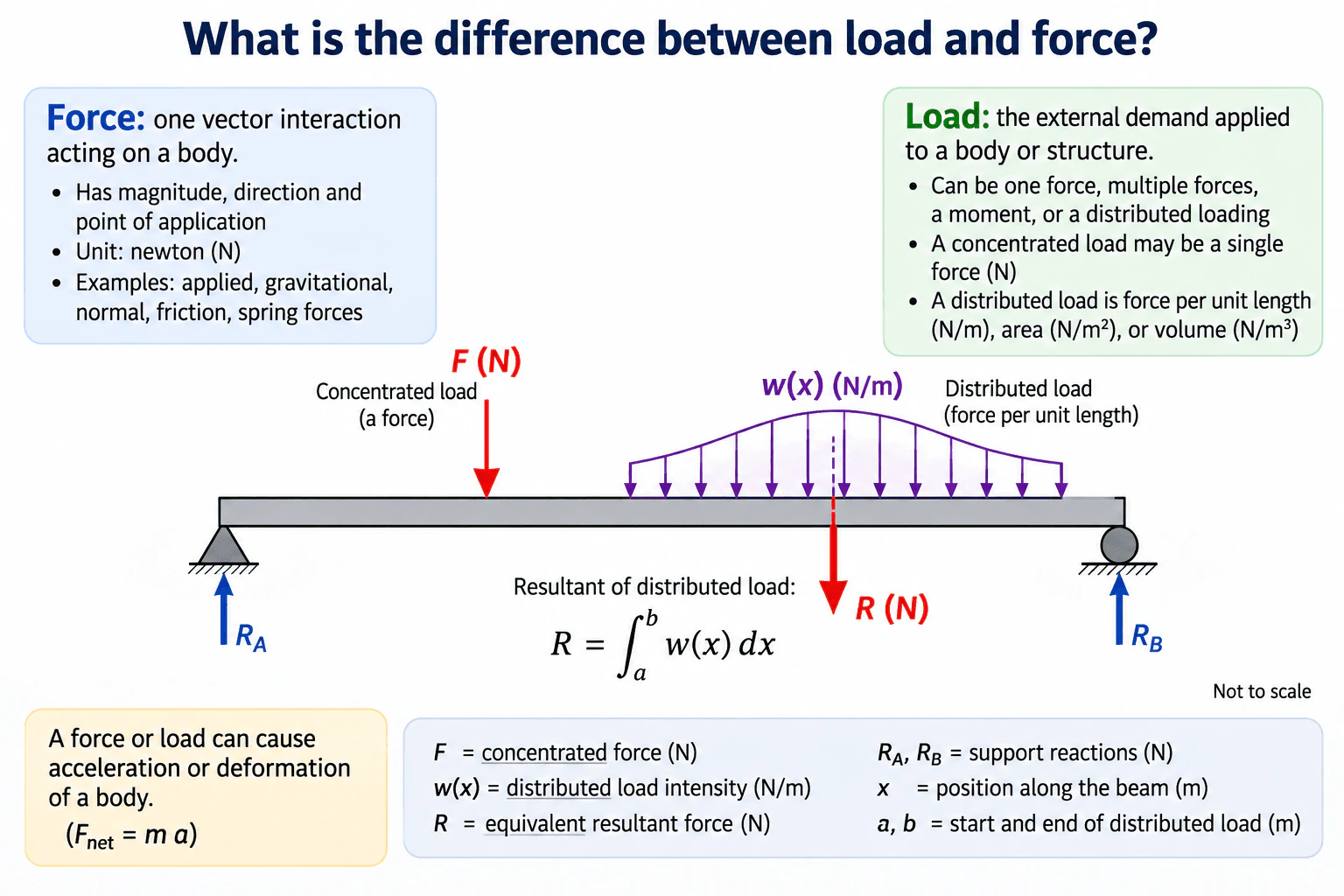
A force is a vector interaction acting on a body, with magnitude, direction, and point of application, and its SI unit is the newton. A load is the broader external demand applied to a body or structure. A load may be one concentrated force, several forces, a moment, or a distributed loading. For example, a distributed load w(x) in N/m can be replaced for equilibrium calculations by an equivalent resultant force R equal to the integral of w(x) over the loaded length.
Detailed Explanation
A force and a load are related, but they are not always identical. A force is one vector interaction acting on a body. It has a magnitude, direction, and point of application. In SI units, force is measured in newtons, N.
A load describes the external mechanical demand applied to a body or structure. A load can therefore be a single concentrated force, multiple forces, a moment, or a distributed loading. For example, a beam may carry both a concentrated force F in N and a distributed load intensity w(x) in N/m.
Useful Questions to Ask the Interviewer
Are we discussing a concentrated load, a distributed load, or a combination of both?
Should I describe the distinction only conceptually, or also show how a distributed load becomes an equivalent resultant force?
Are we assuming static equilibrium for the example?
How to Explain It in an Interview
I would start by defining the body and identifying every external interaction acting on it. A force is one vector quantity. For a beam, a downward applied force F is a force because it has a specified magnitude, direction, and location.
A load is the broader loading condition imposed on the beam. It can include that concentrated force, other applied forces, applied moments, or distributed loading. The support reactions are separate external forces that arise from the supports and balance the applied loading when the beam is in static equilibrium. A distributed load is commonly expressed as force per unit length, such as w(x) in N/m.
For equilibrium calculations, a distributed load can be replaced by an equivalent resultant force whose magnitude is
R = ∫ from a to b w(x) dx
where w(x) is the distributed load intensity, x is position along the beam, and a and b define the loaded region. The resultant acts through the centroid of the load distribution, although its exact location depends on the shape of w(x).
I would then draw the free body diagram, show the applied force, distributed load, equivalent resultant when useful, and support reactions, and check equilibrium using consistent units. The main distinction is that force describes an individual vector interaction, while load describes the broader external demand and can contain one or more applied forces, moments, or distributed effects.
This distinction also helps avoid confusing the loading description with the structural response. Forces and loads can cause acceleration or deformation, but stress, strain, deflection, and stiffness describe how the body responds rather than what is externally applied.
Why Interviewers Ask This
The interviewer is checking whether I understand basic engineering mechanics terminology and can translate a physical loading condition into a correct free body diagram. The distinction matters because a force is one vector quantity, while a load describes the broader external mechanical demand that may include forces, moments, and distributed effects.
Common interview mistakes
Common mistakes are treating load and force as exact synonyms in every context, forgetting that a load can include a moment or distributed loading, assigning newtons directly to a distributed load intensity that should use units such as N/m, treating support reactions as applied loads without distinguishing their role, and confusing external loading with responses such as stress, strain, or deflection.
Interview tip
Give the distinction first in one sentence, then use a simple beam example. Say that a force is one vector interaction, while a load is the broader external demand. Mention a concentrated force F in N and a distributed load w(x) in N/m, then explain that the distributed loading can be replaced by an equivalent resultant force for equilibrium.
Interviewer may ask next
How would you validate that the forces and loads in a free body diagram are represented correctly?
I would define the body boundary, confirm every external interaction crossing that boundary, verify force directions and points of application, check that distributed load units are correct, and calculate support reactions using equilibrium. I would also check dimensional consistency and confirm that the resulting load path is physically reasonable.
How does the treatment change if the load is distributed instead of concentrated?
A concentrated load is represented by a force acting at a specific point. A distributed load is represented by an intensity such as w(x) in N/m over a region. For equilibrium, I can replace that distribution with an equivalent resultant force R = ∫ from a to b w(x) dx acting through the centroid of the load distribution. For deformation or local stress calculations, I may need to retain the actual distribution rather than only its resultant.
2. What makes you better than the other candidates?NEWBehavioralEasyBosch
i Question Details
Focus on what distinguishes you from the other applicants.
Interview tip:
Use STAR to structure your answer: briefly explain the Situation and Task, make Action the most detailed part, and finish with the Result. For example, describe a mechanical design project where you combined sound engineering analysis with practical manufacturing judgment, took ownership of problems, communicated clearly with other teams, and delivered a design that was reliable and practical to build.
Situation
On one of my previous projects, our team was developing a mechanical assembly that had to meet strength, packaging, manufacturing, and service requirements at the same time. An early design met the basic functional need, but several details created concerns about stress concentration, assembly access, and manufacturing complexity.
Task
I was responsible for improving my part of the design while making sure the changes worked with the larger assembly. My goal was not only to make the component pass an engineering check. I also wanted to make the design practical to manufacture, easy for the team to review, and less likely to create problems later.
Action
I first separated the problem into the main engineering constraints instead of changing geometry immediately. I reviewed the load path, which is the route the forces follow through the part, and identified areas where sharp geometry could create higher local stress. I checked interfaces, clearances, fastening locations, and assembly access so that solving one issue would not create another. I then developed a simpler geometry and verified that the important dimensions still supported the functional requirements. I discussed the proposed changes with manufacturing and other engineers before finalizing them because they could see production and integration risks that were not obvious from the model alone. When they raised concerns, I went back to the design, compared the options, and explained why I accepted or rejected each change. I also documented the reasoning behind the final design so another engineer could understand the decisions without having to repeat the investigation. That combination of analysis, practical judgment, communication, and ownership is what I believe distinguishes the way I work.
Result
The team moved forward with a design that addressed the main engineering and manufacturing concerns and was easier to review and support. The experience reinforced that my strength is not just creating a CAD model. I try to understand the full problem, verify the important technical risks, involve the right people, and take responsibility for getting the design to a practical solution. That is the value I would bring to this Mechanical Design Engineer role at Bosch.
Why Interviewers Ask This
Interviewers ask this question to understand what genuinely distinguishes a candidate beyond basic qualifications. They are looking for clear evidence of strengths, self awareness, professional judgment, and an ability to explain how those strengths create value in real engineering work without simply making unsupported claims about being better than other applicants.
Interviewer may ask next
Which part of that experience best shows what distinguishes you as a Mechanical Design Engineer?
I think it was the way I connected technical analysis with practical implementation. I did not stop after identifying a stress or geometry issue. I also checked assembly access, manufacturing concerns, interfaces, and feedback from other engineers. That helped me make a decision that worked for the complete product instead of optimizing only my individual part.
What would you do differently if you handled a similar design problem today?
I would involve manufacturing and the engineers responsible for nearby components even earlier. Their feedback was valuable, and earlier discussion could expose integration or production concerns before the design becomes detailed. I would still perform the same engineering checks, but I would bring those different viewpoints into the process sooner.
3. Do you see yourself as a team player or lone wolf?NEWBehavioralEasyBosch
i Question Details
Discuss how you prefer to work.
Interview tip:
Use STAR to structure your answer: briefly explain the Situation and Task, make Action the most detailed part, and finish with the Result. For example, describe a mechanical design project where you owned your design work independently, coordinated closely with other engineers and manufacturing teams, shared concerns early, incorporated useful feedback, and helped the team reach a practical design decision.
Situation
During a previous project, I was responsible for part of a mechanical assembly that had to fit within a tight package while also being practical to manufacture. My work depended on inputs from other engineers, and changes to my design could affect nearby components and the manufacturing process.
Task
I needed to complete my design work independently while making sure it supported the larger team goal. I had to communicate changes clearly, listen to concerns from other functions, and avoid making decisions in isolation that could create problems later.
Action
I see myself primarily as a team player, but I am comfortable working independently when I own a specific task. On this project, I first developed the initial design and checked the main requirements myself. I then reviewed the interfaces with the engineers responsible for the surrounding parts. When one teammate raised a concern about assembly access, I did not treat it as someone else's problem. I reviewed the geometry with them and changed the component layout so the assembly sequence was easier. I also discussed the updated design with manufacturing because a feature that worked well in CAD could still be difficult to produce. I explained my reasoning, asked for practical feedback, and incorporated changes that improved manufacturability without losing the required function. At the same time, I kept ownership of my calculations, drawings, and design decisions instead of expecting the group to solve my part for me. This balance helped me move my own work forward while keeping the rest of the team informed.
Result
The team reached a design that fit the surrounding components and was easier to assemble and manufacture. The experience reinforced that my best work happens when I take clear ownership of my responsibilities but actively collaborate wherever my decisions affect other people. I can work alone when focused engineering work is needed, but I prefer solving the overall problem as part of a team.
Why Interviewers Ask This
Interviewers ask this question to understand how a candidate balances individual ownership with collaboration. A strong Mechanical Design Engineer needs to complete detailed engineering work independently while also coordinating interfaces, sharing information, accepting useful feedback, and supporting decisions that work for the entire product and manufacturing process.
Interviewer may ask next
How do you handle a situation when a teammate disagrees with one of your design decisions?
I focus on the technical reason behind the disagreement instead of defending my first idea. In this project, when assembly access became a concern, I reviewed the geometry with my teammate and looked at the issue from their point of view. If their concern improves the design, I am comfortable changing my approach. My goal is to reach the best engineering decision, not to prove that my original idea was right.
How do you make sure collaboration does not slow down your own work?
I separate the work I can complete independently from the decisions that need input from others. On this project, I completed my initial design checks and prepared the relevant geometry before asking for feedback. That made the discussions focused because the team could react to a concrete design instead of a vague idea. I kept ownership of my tasks while involving others early enough to prevent larger problems later.
4. What quality do you expect from a good boss?NEWBehavioralEasyBosch
i Question Details
Describe the quality you expect in a supervisor.
Interview tip:
Use STAR to structure your answer: briefly explain the Situation and Task, make Action the most detailed part, and finish with the Result. For example, describe a situation where a supervisor gave clear priorities, trusted you to make engineering decisions, stayed available when you needed guidance, and helped the team solve problems without taking ownership away from you.
Situation
In my last role, I worked on a mechanical design project where several design decisions were still open and the schedule was tight. My supervisor gave me responsibility for developing part of the design while also making it clear which requirements and interfaces could not change.
Task
My responsibility was to complete the design, coordinate with the people who depended on it, and raise issues early if a decision could affect performance, manufacturability, or the schedule. I needed enough independence to do the engineering work, but I also needed clear direction when priorities conflicted.
Action
The quality I valued most from my supervisor was clear guidance combined with trust. At the start, my supervisor explained the main priorities and what a successful result should look like, then gave me room to work through the details. I reviewed the requirements, developed the design, checked the main interfaces, and discussed manufacturing concerns with the appropriate team members. When I found a conflict between two requirements, I did not wait for my supervisor to solve it for me. I prepared the options, explained the tradeoffs in simple terms, and recommended the approach I thought was strongest. My supervisor asked questions, challenged my reasoning, and helped confirm the priority, but still expected me to own the final engineering work. That balance was useful because I had support when I needed it without being micromanaged.
Result
The design moved forward with clear decisions and good coordination across the team. I also became more confident taking ownership of technical work because I knew I could make decisions within clear boundaries and ask for guidance when the risk or priority was unclear. That experience showed me that the quality I value most in a good boss is clear direction with trust and support.
Why Interviewers Ask This
Interviewers ask this question to understand what kind of leadership helps you perform well and whether your expectations are practical in a professional engineering environment. A strong answer shows that you value clear priorities, accountability, communication, trust, and appropriate support rather than expecting constant supervision.
Interviewer may ask next
How do you handle a situation when your supervisor gives you very little direction?
I first make sure I understand the expected outcome, important requirements, and any limits on the decision. Then I move the work forward independently and document the assumptions I am making. If I reach a decision that could create significant technical, cost, manufacturing, or schedule risk, I bring the issue to my supervisor with clear options and a recommendation instead of only asking what to do.
What would you do if you disagreed with your supervisor's technical decision?
I would explain my concern respectfully and support it with the engineering reasoning behind it. In the project I described, I already used that approach when requirements conflicted. I would present the tradeoffs, listen to the supervisor's reasoning, and make sure any important risk was understood. Once a decision was made, I would support it and continue the work unless it created a serious safety, compliance, or engineering concern that needed further escalation.
5. Tell me about a time when you got bogged down in the details of a project.NEWBehavioralMediumBosch
i Question Details
Use a project from your own experience.
Interview tip:
Use STAR to structure your answer: briefly explain the Situation and Task, make Action the most detailed part, and finish with the Result. For example, describe a mechanical design project where you spent too much time refining small design details, recognized that it was affecting progress, reset your priorities around the main design risks, communicated with the team, made practical decisions, and completed the work with a clearer approach to balancing detail and progress.
Situation
During a previous mechanical design project, I was responsible for a mounting assembly that had several interacting parts, tight packaging constraints, and important tolerance requirements. I became very focused on refining small geometry details and checking many possible tolerance combinations. The work was useful, but I realized I was spending too much time on details that were not changing the main design decision.
Task
My responsibility was to deliver a design that was mechanically sound, manufacturable, and ready for the next review. I needed to make sure the important interfaces were correct without allowing lower risk details to slow the whole project.
Action
I first stepped back and separated the design questions into critical risks and lower priority details. I identified the interfaces that affected fit, load transfer, assembly, and manufacturing as the items that needed deeper analysis. For the remaining details, I asked whether additional work would actually change the design. If the answer was no, I documented the current decision and moved on. I also reviewed my priorities with the other engineers so they understood where I was spending time and could point out anything I had missed. For the tolerance work, I focused on the dimensions that controlled the functional interfaces instead of exploring every possible combination. I then created a short list of open items with clear decisions needed for each one. This helped me keep the technical rigor where it mattered while preventing minor details from consuming the schedule. I continued checking my work carefully, but I started using the project requirements and design risks to decide how much analysis each issue deserved.
Result
The design moved forward to review with the important mechanical and manufacturing risks addressed, and the team had a clearer view of the remaining open items. I learned that attention to detail is valuable only when it is connected to a meaningful design risk or decision. Since then, I have been more deliberate about defining the critical questions early and using them to decide where deeper analysis is worth the time.
Why Interviewers Ask This
Interviewers ask this question to understand whether a candidate can balance technical depth with project progress. They want to see self awareness, prioritization, practical engineering judgment, and the ability to recognize when additional analysis is no longer helping an important decision.
Interviewer may ask next
How did you decide which details were important enough to keep analyzing?
I connected each detail to the main design requirements and risks. If it could affect fit, load transfer, assembly, manufacturing, or another functional requirement, I treated it as important. If additional analysis was unlikely to change the design or reduce a meaningful risk, I documented the decision and moved forward.
What would you do differently if you faced the same situation again?
I would define the critical design questions earlier and review them with the team before going deeply into the analysis. I would also keep a simple list of decisions, risks, and open items from the start. That would help me recognize sooner when I was spending too much time on a detail that was not affecting the overall design.
6. What was a problem you encountered while at your recent co op?NEWBehavioralMediumBosch
i Question Details
How did you overcome it?
Interview tip:
Use STAR to structure your answer: briefly explain the Situation and Task, make Action the most detailed part, and finish with the Result. For example, describe a problem you found during your recent co op, what responsibility you had, how you investigated the cause, how you communicated with the team, what decision you made, and how your actions helped resolve the issue.
Situation
During my recent co op, I was supporting the design of a mechanical assembly. While reviewing a prototype, I noticed that one component was difficult to install because there was very little space for the tool needed to tighten a fastener. The design worked in the CAD model, but the assembly process was harder than expected in the physical build.
Task
My responsibility was to understand why the assembly was difficult and help find a practical design change without affecting the function of the surrounding parts. I also needed to make sure any change could be clearly communicated to the engineer responsible for the design.
Action
I first watched the assembly process and spoke with the technician to understand exactly where the difficulty occurred. I then checked the CAD model and confirmed that the fastener location did not provide enough tool access during installation. I considered several simple changes, including moving the fastener, changing its orientation, and creating more clearance around the area. I compared these options based on packaging space, ease of assembly, and the effect on nearby components. I prepared a revised CAD concept that improved tool access while keeping the main geometry and function unchanged. I reviewed the idea with my supervising engineer and explained both the problem and why I preferred that change. After receiving feedback, I updated the model and drawing so the revised design could be reviewed by the rest of the team.
Result
The revised design made the assembly process easier and reduced the risk of installation problems during future builds. The experience taught me that a design can look correct in CAD but still create practical issues during assembly. Since then, I pay more attention to tool access, assembly sequence, and technician feedback when reviewing mechanical designs.
Why Interviewers Ask This
Interviewers ask this question to understand how you respond when a real engineering problem appears during hands on work. They want to see whether you investigate the cause, communicate with others, make practical decisions, take ownership of your part of the solution, and learn from the experience.
Interviewer may ask next
Why did you choose to modify the fastener area instead of making a larger design change?
I wanted to solve the assembly problem with the smallest practical change. The main design was already meeting its functional needs, so changing more geometry could have created new packaging or manufacturing issues. Improving the fastener access addressed the actual cause while limiting the effect on the rest of the assembly.
What would you do differently if you faced a similar problem now?
I would review assembly access earlier in the design process instead of waiting for the prototype build to reveal the issue. I would check tool clearance, fastener access, and assembly sequence during the CAD review and ask for technician input when the design is still easy to change.
Mechanical Design Engineer Resume Examples
Explore the resume examples below to find the one that best matches your target Mechanical Design Engineer role.
Disclaimer: This interview guide is for educational and informational purposes only. It is designed to help readers prepare, but it does not guarantee any interview result, hiring decision, offer, or outcome. Interview questions, hiring criteria, and preferred answers can vary by employer, interviewer, industry, location, and time. All answers, examples, and explanations in this guide are suggested examples for interview preparation, not definitive answers or instructions for professional practice. They are based on research and judgment, are provided without warranties of any kind, and should be adapted to the question, role, and applicable laws and professional requirements. Diagrams are simplified illustrations intended to highlight the main concepts and their relationships; actual situations, systems, and practices may be more complex. Alternative approaches may be equally valid or better suited to a particular question, context, or interviewer. To the fullest extent permitted by applicable law, the contributors and publisher are not liable for decisions made, actions taken, or losses incurred based on this guide.
State Laws and Professional Responsibilities: Laws and requirements governing an occupation vary by state and jurisdiction. You are responsible for checking the current laws, licensing requirements, and scope-of-practice rules that apply to your location and role, and for ensuring that your answers and actions comply with them. Adapt examples in this guide to those requirements. This guide is not legal advice.
Company Notice: This guide is an independent educational resource and is not affiliated with, endorsed by, sponsored by, or approved by the company named in this guide. Company names identify reported interview experiences or the employer context of clearly labeled original practice exercises. Interview practices can change without notice, and inclusion of company-specific content does not mean these questions are official, complete, or guaranteed to be asked. To the fullest extent permitted by law, the author, contributors, and publisher are not responsible for outcomes related to use of this material.
Content Accuracy and Verification: To the fullest extent permitted by applicable law, we do not represent or warrant that interview guides, questions, answers, examples, or diagrams are accurate, complete, current, error-free, or suitable for any particular purpose. You are responsible for independently reviewing and verifying the information before relying on it.