This interview guide is for educational and informational purposes only. It is designed to help readers prepare, but it does not guarantee any interview result, hiring decision, offer, or outcome. Interview questions, hiring criteria, and preferred answers can vary by employer, interviewer, industry, location, and time. All answers, examples, and explanations in this guide are suggested examples for interview preparation, not definitive answers or instructions for professional practice. They are based on research and judgment, are provided without warranties of any kind, and should be adapted to the question, role, and applicable laws and professional requirements. Diagrams are simplified illustrations intended to highlight the main concepts and their relationships; actual situations, systems, and practices may be more complex. Alternative approaches may be equally valid or better suited to a particular question, context, or interviewer. To the fullest extent permitted by applicable law, the contributors and publisher are not liable for decisions made, actions taken, or losses incurred based on this guide.
State Laws and Professional Responsibilities
Laws and requirements governing an occupation vary by state and jurisdiction. You are responsible for checking the current laws, licensing requirements, and scope-of-practice rules that apply to your location and role, and for ensuring that your answers and actions comply with them. Adapt examples in this guide to those requirements. This guide is not legal advice.
Identity, Image, and Privacy Notice
To respect individual privacy, some names, profile photographs, avatars, biographical details, and other identifying information displayed in this guide may be replaced with pseudonyms, licensed stock images, illustrative avatars, composite images, or representative descriptions. Unless a person is expressly identified as an actual contributor, a displayed name, image, or profile should not be understood as depicting or identifying a specific candidate, interviewer, employee, or other real individual. These representations are provided for editorial and illustrative purposes only and do not imply endorsement, employment, participation, or affiliation with this guide or any company mentioned in it. Any resemblance to an actual person is coincidental.
Company Notice
This guide is an independent educational resource and is not affiliated with, endorsed by, sponsored by, or approved by the company named in this guide. Company names identify reported interview experiences or the employer context of clearly labeled original practice exercises. Interview practices can change without notice, and inclusion of company-specific content does not mean these questions are official, complete, or guaranteed to be asked. To the fullest extent permitted by law, the author, contributors, and publisher are not responsible for outcomes related to use of this material.
Content Accuracy and Verification
To the fullest extent permitted by applicable law, we do not represent or warrant that interview guides, questions, answers, examples, or diagrams are accurate, complete, current, error-free, or suitable for any particular purpose. You are responsible for independently reviewing and verifying the information before relying on it.
Questions or comments?
Contact us for general questions, or share feedback, technical corrections, and comments with the community.
1. What are the types of waste in a manufacturing process?NEWManufacturing Processes And DfmEasyJohn Deere
Short Interview Answer (30-60 seconds)
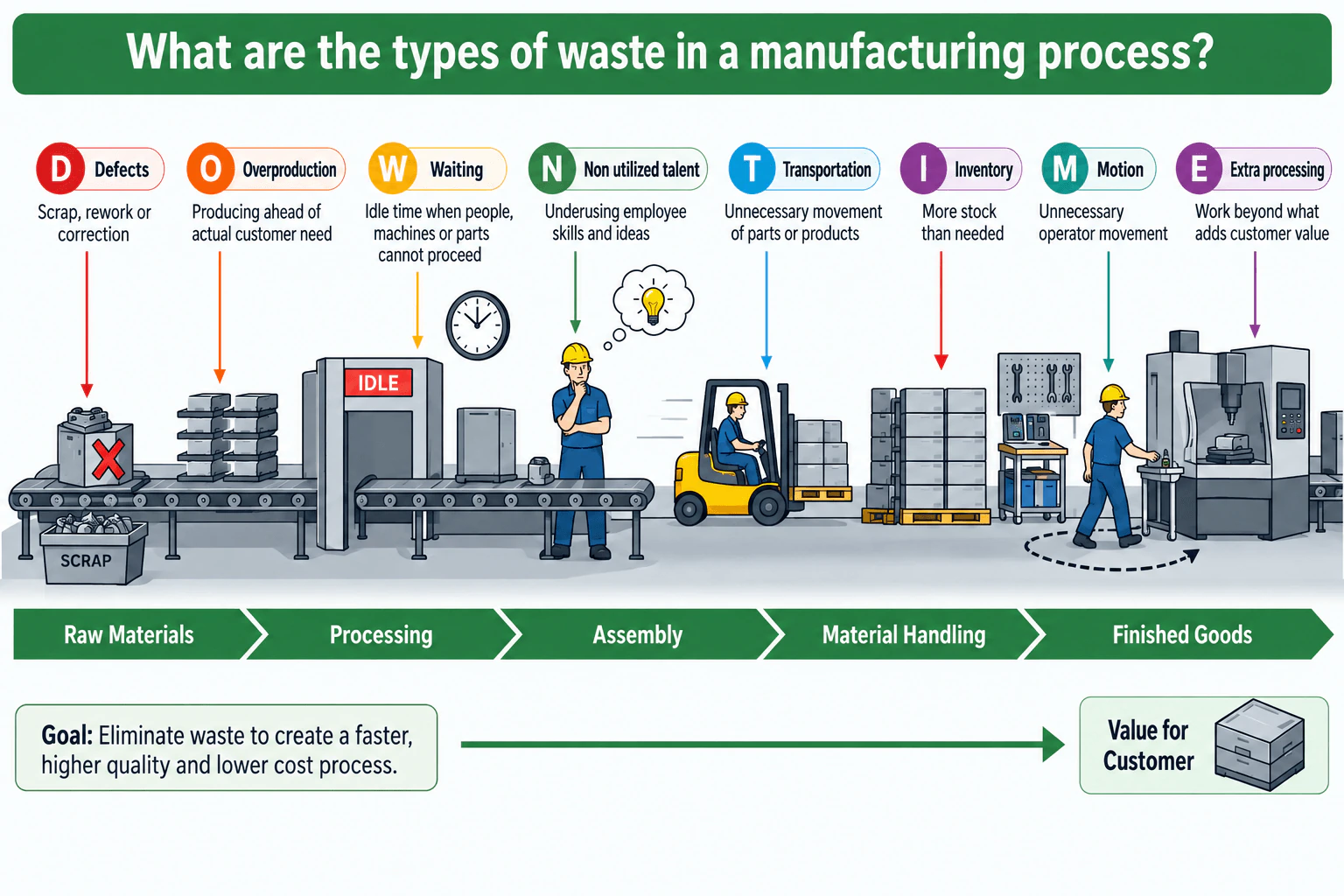
A common Lean framework uses the DOWNTIME mnemonic for eight types of manufacturing waste: defects, overproduction, waiting, non utilized talent, transportation, inventory, motion, and extra processing. Defects create scrap or rework. Overproduction means making more or earlier than needed. Waiting is idle time. Non utilized talent means not using employee skills effectively. Transportation and motion are unnecessary movement of material and people. Inventory is excess stock. Extra processing is work that does not add customer value.
Detailed Explanation
Manufacturing waste is any activity that uses resources without adding value needed by the customer. A practical way to remember the eight common categories is DOWNTIME: defects, overproduction, waiting, non utilized talent, transportation, inventory, motion, and extra processing. These wastes can appear throughout the production flow, including raw materials, processing, assembly, material handling, and finished goods. The goal is to reduce non value adding activity while improving flow, quality, cost, and customer value.
Useful Questions to Ask the Interviewer
Are you asking about the standard Lean waste categories or about waste in a specific manufacturing process?
Should I explain the wastes from a production perspective, a design for manufacturing perspective, or both?
Is there a particular process, such as machining, casting, welding, or assembly, that you want me to use as an example?
How to Explain It in an Interview
I would start by naming the eight wastes and then connect each one to a manufacturing example.
Defects are parts that require scrap, repair, or rework. In design work, poor tolerance choices, difficult inspection features, or unclear requirements can increase this waste.
Overproduction means producing more units or producing them earlier than customer demand requires. It can create excess inventory and additional handling.
Waiting is idle time when operators, machines, or parts cannot proceed. Causes can include unavailable material, long setup, missing information, or an upstream process that has not finished.
Non utilized talent means failing to use the skills, experience, and ideas of employees. Operators, technicians, suppliers, and manufacturing engineers often identify practical manufacturability issues that should be considered during design reviews.
Transportation is unnecessary movement of material or parts between operations. Layout, process sequence, and supplier location can affect this waste.
Inventory is material, work in process, or finished product beyond what is needed. Excess inventory ties up space and capital and can hide process problems.
Motion is unnecessary movement by people or equipment, such as reaching, walking, repositioning, or repeated handling. Good workstation and assembly design can reduce it.
Extra processing is work beyond what creates required customer value. Examples include unnecessary machining operations, tighter tolerances than the function requires, or redundant inspection.
As a mechanical design engineer, I would use DFM and DFA reviews to reduce these wastes by simplifying geometry, choosing suitable manufacturing processes, providing realistic tolerances, maintaining tool access, reducing part count where appropriate, planning assembly sequence, and reviewing supplier capability and process capability. I would validate changes with manufacturing and quality teams rather than assuming a design change improves production.
Why Interviewers Ask This
Interviewers want to know whether I can recognize activities that consume time, labor, material, equipment capacity, or space without adding customer value. For a mechanical design engineer, that judgment matters because design decisions can create or reduce unnecessary processing, movement, inventory, rework, waiting, and assembly effort.
Common interview mistakes
Common mistakes include confusing transportation with motion, treating every inventory quantity as waste without considering actual production needs, confusing overproduction with extra processing, and listing the categories without explaining how design decisions can create them. Another mistake is assuming waste can be eliminated by engineering alone without input from manufacturing, quality, operators, and suppliers.
Interview tip
State DOWNTIME first, define each category in one sentence, and then give one or two examples that connect the concept to mechanical design. Showing how tolerance choices, part count, tool access, assembly sequence, and process selection affect waste makes the answer more relevant to a Mechanical Design Engineer role.
Interviewer may ask next
How would you validate that a design change actually reduced manufacturing waste?
I would compare the process before and after the change using measurable evidence such as scrap, rework, handling steps, setup time, queue time, travel distance, work in process, inspection effort, and assembly time as applicable. I would also review the result with manufacturing, quality, operators, and suppliers because a change that reduces one waste can sometimes create another.
What happens if reducing one type of waste increases cost or creates another manufacturing problem?
I would treat it as a tradeoff rather than optimizing one waste in isolation. For example, reducing inventory might increase waiting if material availability becomes unreliable, or reducing part count might create a component that is harder to manufacture. I would compare the total effect on quality, cost, lead time, process capability, assembly effort, inspection, and supplier capability before selecting the design.
2. How did you design a chute?NEWMechanical DesignMediumJohn Deere
i Question Details
Describe your own chute-design work.
Short Interview Answer (30-60 seconds)
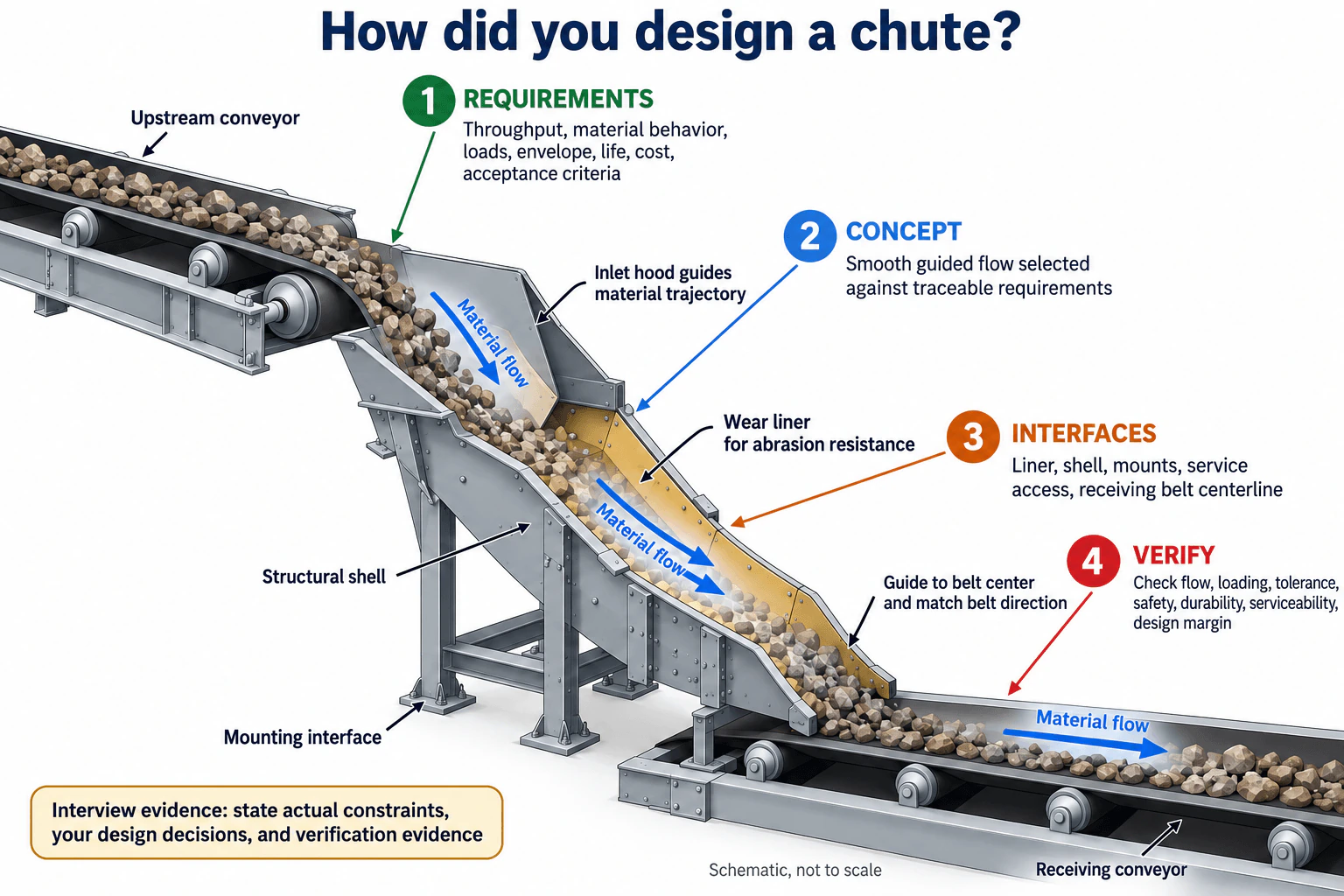
Because no project specific dimensions or results were supplied, I would not invent them. My chute design approach was to begin with throughput, material behavior, loads, available envelope, expected life, cost, and measurable acceptance criteria. I would then compare concepts and choose a smooth guided flow path that controls the incoming material trajectory. I would integrate the inlet hood, wear liner, structural shell, mounting interfaces, service access, and receiving belt geometry. Finally, I would verify material flow, loading, tolerances, safety, durability, serviceability, and design margin against the original requirements.
Detailed Explanation
The key idea is that I would treat the chute as one integrated mechanical system. The chute has to receive material from the upstream conveyor, guide its trajectory through the structure, and place it onto the receiving conveyor in the intended direction while also addressing structural support, abrasion, installation, maintenance access, durability, and uncertainty. Since no actual project dimensions, material properties, employer procedures, or measured results were supplied, I would use my real project values in an interview rather than inventing them here.
Useful Questions to Ask the Interviewer
What material, throughput range, and operating conditions must the chute handle?
What equipment envelope, conveyor geometry, expected life, and maintenance access constraints apply?
What measurable criteria define acceptable flow, loading, wear, reliability, and receiving belt performance?
How to Explain It in an Interview
I would start with requirements traceability. I would document throughput, material behavior, expected loads, available envelope, target life, cost constraints, maintenance needs, and measurable acceptance criteria. I would separate confirmed inputs from assumptions so every later design decision could be traced back to a requirement.
Next, I would compare practical chute concepts against those requirements. For the concept shown, I would select a smooth guided flow path. The inlet hood guides the incoming material trajectory, and the chute geometry continues that controlled path toward the receiving conveyor. I would avoid unnecessary abrupt changes in direction because the objective is controlled material movement rather than uncontrolled impact.
I would then integrate the main mechanical interfaces. The wear liner protects surfaces exposed to abrasion. The structural shell and supports carry the chute and transmitted loads. The mounting interfaces connect the assembly to the surrounding structure. I would include service access so wear components can be inspected and replaced without making routine maintenance unnecessarily difficult.
At the discharge, I would guide the material toward the receiving belt center and align the material flow with the belt travel direction as closely as practical. I would also check the chute geometry for interference, buildup risks, and installation tolerance effects.
Verification would trace back to the original requirements. I would check material flow, loading, tolerances, structural adequacy, safety, durability, serviceability, and design margin. Where appropriate, discrete element modeling could support the flow assessment, but I would not treat simulation alone as proof that the equipment is safe or acceptable.
The main tradeoff is balancing controlled flow, compact packaging, wear life, fabrication simplicity, service access, durability, and cost. In an interview, I would finish by stating the actual constraints I faced, the decisions I personally made, the evidence used to verify them, the limitations that remained, and what I learned.
Why Interviewers Ask This
Interviewers want to see whether I can translate operating needs into an integrated mechanical design, select a concept using traceable requirements, manage interfaces and wear, consider serviceability and design margin, and explain how I would verify the design without inventing unsupported results.
Interviewer may ask next
How would you validate that the chute performs as intended?
I would trace each acceptance criterion to a verification method. I would review the incoming material trajectory and the guided flow path, check expected loading and structural response, inspect critical tolerances and interfaces, and confirm that the wear liner and service access support the intended maintenance approach. For a higher risk transfer, discrete element modeling could provide additional evidence about material behavior. I would then compare actual operating observations with the original acceptance criteria rather than claiming success from calculation or simulation alone.
What would you change if throughput increased or the material became more abrasive?
I would reopen the affected requirements instead of simply increasing every component size. Higher throughput could change stream depth, material velocity, impact, structural loading, and receiving belt conditions. Greater abrasiveness could change liner selection, liner thickness, replacement strategy, and service access needs. I would reassess the flow geometry, structural loads, wear locations, mounting interfaces, maintenance plan, and design margin, then verify that the revised concept still satisfies the envelope, life, cost, and acceptance criteria.
3. What are 3 strengths and weaknesses?NEWBehavioralEasyJohn Deere
Interview tip:
Use STAR to structure your answer: briefly explain the Situation and Task, make Action the most detailed part, and finish with the Result. For example, describe a mechanical design project that shows three strengths through your actions, while also explaining three genuine weaknesses, how you recognized them, and what you did to improve them without presenting them as strengths in disguise.
Situation
During a previous mechanical design project, I was responsible for helping refine a component that had packaging, manufacturability, and reliability constraints. The work required close coordination with manufacturing and other engineers because several design decisions affected more than one function.
Task
My responsibility was to develop a practical design, explain my decisions clearly, and support the team through design reviews. The project also gave me a good example of three strengths I rely on and three weaknesses I continue to work on.
Action
My first strength is structured problem solving. I break a design problem into requirements, interfaces, loads, materials, manufacturing limits, and validation needs before changing geometry. This helps me avoid solving one issue while creating another. My second strength is attention to detail. On this project, I carefully reviewed interfaces, tolerances, assembly access, and drawing information before releasing changes. My third strength is collaboration. I asked manufacturing and other engineers for input early instead of waiting until the design was nearly complete. At the same time, I recognized three weaknesses. First, I can spend too much time refining details when an early concept only needs enough information for a decision. I have improved this by defining what level of detail is needed at each design stage before I begin. Second, I used to hold on to too many tasks because I wanted to make sure everything was done correctly. I now separate the work clearly, give teammates the information they need, and trust them to own their parts while I stay available for questions. Third, I can become too technical when explaining a design. I have worked on starting with the main problem, the decision, and the reason before discussing detailed engineering information. That makes reviews easier for people from different functions to follow.
Result
The project moved through the design review with clearer decisions and fewer late misunderstandings because the team had been involved early and the important details had been checked. I also learned that my strengths are most useful when I manage them carefully. Attention to detail needs good time judgment, ownership should not prevent delegation, and technical knowledge is more valuable when I can explain it simply.
Why Interviewers Ask This
Interviewers ask this question to understand a candidate's self awareness, judgment, and willingness to improve. A strong answer shows that the candidate can identify useful professional strengths, discuss real weaknesses without avoiding responsibility, and explain specific actions taken to improve those weaknesses.
Interviewer may ask next
Which of those weaknesses has been the hardest for you to improve?
Spending too much time on details has been the hardest because attention to detail is also important in mechanical design. I manage it by deciding the purpose of each design stage before I start. During early concept work, I focus on the information needed to compare options. I save detailed tolerance, drawing, and release work for the stage where those details are actually required.
How do you make sure your technical communication is clear to people outside engineering?
I start with the problem, the decision that needs to be made, and why it matters. Then I explain the main engineering reason in simple language. I only add deeper technical detail when it helps the audience make a decision or understand a risk. I used that approach during the same project when discussing design choices with manufacturing, and it helped keep the review focused.
4. Describe a time when communication was critical.NEWBehavioralMediumJohn Deere
i Question Details
Use an occasion in which communication mattered.
Interview tip:
Use STAR to structure your answer: briefly explain the Situation and Task, make Action the most detailed part, and finish with the Result. For example, describe a design issue that affected several teams, explain your responsibility for communicating the technical risk clearly, show how you confirmed that everyone understood the required actions, and explain how that communication helped the team make a sound decision.
Situation
During a previous project, I was preparing a mechanical assembly for design release when a review identified a possible clearance problem between a moving component and a nearby bracket. The issue could affect manufacturing, assembly, and testing, so clear communication was important before anyone continued working from the current design.
Task
I was responsible for evaluating the interference, deciding what design change was needed, and making sure the affected teams understood the problem and the updated direction. My goal was to avoid confusion between different drawing versions and prevent parts from being built from information that might soon change.
Action
I first reviewed the CAD model and tolerance conditions so I could explain the problem with facts instead of assumptions. I then prepared a simple view showing where the clearance became too small and what conditions could cause contact. I spoke directly with the manufacturing and test teams and explained what I knew, what I was still checking, and which design information they should temporarily avoid using. I asked questions to understand whether the proposed bracket change would create any new manufacturing or service concerns. After considering that feedback, I updated the design and reviewed the affected interfaces again. I then shared the revised model and drawing information with the team and clearly explained what had changed and why. I also confirmed that everyone was working from the current revision rather than assuming that sending an update was enough. This was important because the same technical message could affect each group differently, so I adjusted the level of detail while keeping the design decision consistent.
Result
The team moved forward with a common understanding of the issue and the revised design. We avoided unnecessary work based on the earlier configuration, and the updated assembly could proceed through the normal review process with the clearance concern addressed. I learned that good engineering communication is not just about sending technical information. It is about making the risk clear, listening to the people affected by the decision, and confirming that everyone understands the next action.
Why Interviewers Ask This
Interviewers ask this question to understand whether a candidate can communicate technical information clearly when several people depend on it. A strong answer shows that the candidate can explain risk, listen to other functions, prevent misunderstandings, confirm alignment, and use communication to support sound engineering decisions.
Interviewer may ask next
How did you make sure the other teams understood the design issue correctly?
I used a clear CAD view to show the exact area of concern and explained the issue in terms of the effect on each team. I also asked for questions and feedback instead of only sending an update. After the revision was released, I confirmed that the affected teams were using the current design information.
What would you do differently if you faced a similar situation now?
I would communicate the possible issue even earlier, before I completed the full technical evaluation, while clearly stating that the investigation was still in progress. That would give affected teams more time to pause dependent work and identify concerns that could influence the final design decision.
5. Describe a time when you learned something from a person who had a different background or nationality than you.NEWBehavioralEasyJohn Deere
Interview tip:
Use STAR to structure your answer: briefly explain the Situation and Task, make Action the most detailed part, and finish with the Result. For example, describe a design project where a colleague with a different professional or cultural background showed you another way to think about manufacturing, assembly, or service needs, explain how you listened and applied that perspective, and show how the experience improved both the design and the way you collaborate with people who approach engineering problems differently.
Situation
During a previous mechanical design project, I was developing a component that had to be easy to manufacture, assemble, and service. I worked closely with a manufacturing engineer who had spent most of his career in another country and had experience with different production and service practices. We approached the design from different perspectives.
Task
My responsibility was to complete the mechanical design while making sure it met the functional requirements and could be produced reliably. I also needed to review the design with manufacturing before releasing it.
Action
During our review, the manufacturing engineer pointed out that I was mainly thinking about how the component would be assembled during production. He asked me to also think about how a technician would remove and replace it later with limited access. He explained that in his previous work, service access was considered very early because equipment often stayed in operation for a long time and repairs had to be simple. Instead of defending my original layout, I asked him to walk me through the service sequence step by step. We looked at tool access, fastener locations, the order in which nearby parts would need to be removed, and the amount of space available for a technician's hands. I then adjusted the layout so the main fasteners could be reached more easily and the component could be removed without disturbing as many surrounding parts. I reviewed the revised design with him again before finalizing it. That discussion taught me that a design can meet its drawing requirements and still create problems if I do not consider how people will actually build and maintain it.
Result
The revised design was easier for the team to support from both an assembly and service point of view, and the review moved forward without the access concern. More importantly, I learned to actively seek perspectives from people whose experience is different from mine. Since then, I have tried to ask manufacturing and service focused questions earlier in the design process instead of waiting until the final review.
Why Interviewers Ask This
Interviewers ask this question to understand whether a candidate is open to different perspectives and can learn from people with different cultural, professional, or personal experiences. A strong answer shows respect, curiosity, good listening, and the ability to turn another person's perspective into better engineering decisions and stronger collaboration.
Interviewer may ask next
What specifically did you learn from that engineer that changed how you approach design reviews?
I learned to include service access as an early design consideration instead of treating it as something to check near the end. I now think through how a technician will reach fasteners, remove parts, use tools, and complete maintenance before I consider a layout finished.
How would you handle a similar difference in perspective today?
I would ask questions earlier and try to understand the experience behind the other person's recommendation before comparing solutions. I would then review the options against the actual design requirements, manufacturing needs, and service needs so the team can use the strongest parts of each perspective.
6. Planning Competency: Describe a time where you had to set out a plan and execute it.NEWBehavioralMediumJohn Deere
Interview tip:
Use STAR to structure your answer: briefly explain the Situation and Task, make Action the most detailed part, and finish with the Result. For example, describe a mechanical design assignment where you defined the required work, identified dependencies and risks, coordinated reviews and prototype activities, tracked progress against the plan, adjusted when an issue appeared, and delivered a design that was ready for the next stage.
Situation
In my last role, I was responsible for completing a mechanical component design that had to move from an early concept through analysis, design review, prototype preparation, and final drawing release. Several activities depended on each other, so starting the detailed design without a clear sequence could have caused rework or delayed the prototype build.
Task
My responsibility was to create a practical plan for the design work and then execute it. I needed to make sure the design met the functional requirements, could be manufactured, and was reviewed by the right people before the drawings were released.
Action
I started by listing the main deliverables and the decisions needed before each one could be completed. I broke the work into requirements review, concept selection, detailed CAD design, engineering calculations, finite element analysis where needed, design review, drawing preparation, and prototype support. I then identified dependencies. For example, I knew I needed agreement on the main interfaces before spending too much time on detailed geometry. I also checked which parts could require longer supplier lead times so those items would not become a late surprise. I reviewed the plan with the engineers and manufacturing team members who would provide input, and I made sure they understood when I would need their feedback. During execution, I tracked the open items and reviewed the plan regularly instead of treating it as fixed. When a manufacturing concern came up during the design review, I evaluated the issue, updated the geometry, repeated the necessary checks, and adjusted the remaining tasks so the change did not create confusion later. I kept ownership of the overall plan while using the team's expertise for manufacturing, analysis, and review decisions. Before releasing the design, I checked that the drawings, interfaces, material requirements, and design assumptions were consistent with the approved solution.
Result
The design progressed through review and into prototype preparation in an organized way, with the major technical and manufacturing questions resolved before release. The planning also made it easier for the team to see what was complete, what still needed attention, and where decisions were required. I learned that a useful engineering plan is not just a schedule. It should show dependencies, decision points, risks, and the people needed at each stage, while still being flexible enough to change when new information appears.
Why Interviewers Ask This
Interviewers ask this question to understand whether a candidate can turn a broad engineering objective into an organized sequence of work and then follow through on it. A strong answer demonstrates planning, ownership, awareness of dependencies and risks, communication with other functions, disciplined execution, and the ability to adjust the plan when technical issues appear.
Interviewer may ask next
How did you decide the order of the activities in your plan?
I ordered the activities based on dependencies and the cost of making a late change. I wanted the main requirements and interfaces agreed first because they affected the rest of the design. I then completed the detailed design and technical checks before drawing release. I also considered manufacturing input and supplier lead times early because those could affect the prototype even if the CAD work was finished.
What would you do differently if you had to plan a similar project again?
I would involve manufacturing even earlier during concept development. Their feedback was valuable during the design review, and getting that input sooner could reduce the chance of changing detailed geometry later. I would still use the same basic approach of defining deliverables, identifying dependencies, assigning review points, tracking open items, and updating the plan when new information appears.
7. Tell me a situation when you had to make a fast decision.NEWBehavioralMediumJohn Deere
Interview tip:
Use STAR to structure your answer: briefly explain the Situation and Task, make Action the most detailed part, and finish with the Result. For example, describe a time when an unexpected mechanical issue required a quick decision, how you identified the immediate risk, compared the practical options, communicated your choice to the team, and protected safety and design quality while keeping the work moving.
Situation
During a previous project, my team was preparing a mechanical assembly for a scheduled prototype build. Shortly before the build, I found that a purchased component did not fit correctly with the mounting feature in our design. We had limited time because delaying the build would affect other planned testing.
Task
I was responsible for the affected part of the design. I needed to decide quickly whether we could make a safe design adjustment for the build or whether we should stop and wait for a corrected component. My priority was to keep the project moving without accepting a change that could create a reliability or safety problem.
Action
I first checked the actual component dimensions against the drawing and our CAD model to confirm that the issue was real and not an assembly mistake. I then reviewed the surrounding geometry, load path, clearances, and fastener location to understand what could be changed without affecting the function of the assembly. I identified a small modification to our mounting feature that would provide the required fit while keeping the important interfaces unchanged. Before releasing the change, I spoke with the manufacturing and test team and explained the problem, the proposed correction, and the risks I had checked. I also made it clear that I did not want the team to make an informal shop floor adjustment without an updated design. After getting agreement from the people responsible for the build, I updated the model and drawing and made sure the revised information was available before fabrication continued.
Result
The team was able to continue the prototype build with a controlled design change instead of making an undocumented adjustment. The corrected assembly fit as intended and allowed the planned testing to continue. I learned that making a fast decision does not mean skipping the engineering process. It means quickly finding the facts that matter most, checking the main risks, communicating clearly, and making a controlled decision with the information available.
Why Interviewers Ask This
Interviewers ask this question to understand how a candidate handles time pressure and incomplete information. They want to see whether the candidate can identify the most important facts quickly, manage technical and safety risks, communicate with the right people, take ownership, and make a practical decision without becoming careless.
Interviewer may ask next
How did you make sure your quick design change would not create another problem?
I focused on the interfaces and risks that could be affected by the change. I checked the surrounding geometry, clearances, load path, fastener location, and the intended function of the assembly. I also reviewed the proposed change with the manufacturing and test team before releasing it. That gave me enough confidence to move forward without treating speed as a reason to skip the important checks.
What would you do differently if you faced a similar situation again?
I would use the same basic approach, but I would try to identify the fit risk earlier by checking purchased component information against the CAD model before the prototype build. If a fast decision were still required, I would again confirm the facts first, separate critical risks from less important details, involve the affected team members, and document the final decision before work continued.
8. Describe a time when you were not able to meet a customer's needs.NEWBehavioralHardJohn Deere
i Question Details
Use an experience in which customer needs went unmet.
Interview tip:
Use STAR to structure your answer: briefly explain the Situation and Task, make Action the most detailed part, and finish with the Result. For example, describe a project where a customer requested an important design change that could not be delivered within the required schedule, explain how you evaluated the request, communicated the limitation early, offered practical alternatives, and protected product quality and safety.
Situation
During a previous project, I was supporting the mechanical design of an equipment assembly that was already close to release. The customer requested a change to the mounting interface so the assembly would fit a different installation condition. After reviewing the request, I found that the change would affect several connected parts and would require additional analysis and verification before it could be released safely.
Task
I was responsible for evaluating whether we could make the change within the customer's required schedule. I also needed to explain the impact clearly and find the best practical option without creating an unverified design or hiding the schedule risk.
Action
I first reviewed the interface dimensions, loads, clearances, and the parts affected by the requested change. I traced how the new mounting geometry would change the load path, meaning the way forces moved through the assembly. I then checked which drawings and components would need revision and identified the verification work required before release. Based on that review, I concluded that we could not responsibly complete the full change within the customer's requested timing. I communicated this early rather than waiting until the deadline. I explained what was driving the delay in simple terms and separated the customer's most important functional need from the exact solution they had requested. I then worked with the broader team to evaluate alternatives. We identified an interim installation approach that could use the existing verified design while the permanent change went through the proper design and verification process. I documented the open requirements, kept the customer informed as decisions were made, and made sure the permanent design work continued with clear ownership.
Result
We were not able to meet the customer's original request in the exact form and timing they wanted. However, the customer understood the technical reason and had a practical path forward instead of receiving a rushed design with avoidable risk. The experience taught me that meeting customer needs does not always mean saying yes to the original request. Sometimes the better response is to communicate constraints early, understand the real need, and offer the safest workable option.
Why Interviewers Ask This
Interviewers ask this question to understand how a candidate responds when customer expectations cannot be fully met. They are looking for sound judgment, ownership, clear communication, and the ability to balance customer needs with engineering quality, safety, and realistic constraints.
Interviewer may ask next
Why did you decide not to push the design change through faster?
I did not want schedule pressure to remove necessary engineering checks. The requested change affected the mounting interface and load path, so releasing it without proper verification could have created fit, strength, or reliability problems. I believed it was better to explain the limitation early and provide a controlled alternative than to create a larger problem later.
What would you do differently if you faced a similar situation again?
I would involve the customer even earlier in reviewing possible installation variations and design assumptions. That could help expose interface needs before the design is close to release. I would still use the same basic approach of understanding the real need, checking the engineering impact, communicating constraints clearly, and offering practical alternatives.
Mechanical Design Engineer Resume Examples
Explore the resume examples below to find the one that best matches your target Mechanical Design Engineer role.
Disclaimer: This interview guide is for educational and informational purposes only. It is designed to help readers prepare, but it does not guarantee any interview result, hiring decision, offer, or outcome. Interview questions, hiring criteria, and preferred answers can vary by employer, interviewer, industry, location, and time. All answers, examples, and explanations in this guide are suggested examples for interview preparation, not definitive answers or instructions for professional practice. They are based on research and judgment, are provided without warranties of any kind, and should be adapted to the question, role, and applicable laws and professional requirements. Diagrams are simplified illustrations intended to highlight the main concepts and their relationships; actual situations, systems, and practices may be more complex. Alternative approaches may be equally valid or better suited to a particular question, context, or interviewer. To the fullest extent permitted by applicable law, the contributors and publisher are not liable for decisions made, actions taken, or losses incurred based on this guide.
State Laws and Professional Responsibilities: Laws and requirements governing an occupation vary by state and jurisdiction. You are responsible for checking the current laws, licensing requirements, and scope-of-practice rules that apply to your location and role, and for ensuring that your answers and actions comply with them. Adapt examples in this guide to those requirements. This guide is not legal advice.
Company Notice: This guide is an independent educational resource and is not affiliated with, endorsed by, sponsored by, or approved by the company named in this guide. Company names identify reported interview experiences or the employer context of clearly labeled original practice exercises. Interview practices can change without notice, and inclusion of company-specific content does not mean these questions are official, complete, or guaranteed to be asked. To the fullest extent permitted by law, the author, contributors, and publisher are not responsible for outcomes related to use of this material.
Content Accuracy and Verification: To the fullest extent permitted by applicable law, we do not represent or warrant that interview guides, questions, answers, examples, or diagrams are accurate, complete, current, error-free, or suitable for any particular purpose. You are responsible for independently reviewing and verifying the information before relying on it.