This interview guide is for educational and informational purposes only. It is designed to help readers prepare, but it does not guarantee any interview result, hiring decision, offer, or outcome. Interview questions, hiring criteria, and preferred answers can vary by employer, interviewer, industry, location, and time. All answers, examples, and explanations in this guide are suggested examples for interview preparation, not definitive answers or instructions for professional practice. They are based on research and judgment, are provided without warranties of any kind, and should be adapted to the question, role, and applicable laws and professional requirements. Diagrams are simplified illustrations intended to highlight the main concepts and their relationships; actual situations, systems, and practices may be more complex. Alternative approaches may be equally valid or better suited to a particular question, context, or interviewer. To the fullest extent permitted by applicable law, the contributors and publisher are not liable for decisions made, actions taken, or losses incurred based on this guide.
State Laws and Professional Responsibilities
Laws and requirements governing an occupation vary by state and jurisdiction. You are responsible for checking the current laws, licensing requirements, and scope-of-practice rules that apply to your location and role, and for ensuring that your answers and actions comply with them. Adapt examples in this guide to those requirements. This guide is not legal advice.
Identity, Image, and Privacy Notice
To respect individual privacy, some names, profile photographs, avatars, biographical details, and other identifying information displayed in this guide may be replaced with pseudonyms, licensed stock images, illustrative avatars, composite images, or representative descriptions. Unless a person is expressly identified as an actual contributor, a displayed name, image, or profile should not be understood as depicting or identifying a specific candidate, interviewer, employee, or other real individual. These representations are provided for editorial and illustrative purposes only and do not imply endorsement, employment, participation, or affiliation with this guide or any company mentioned in it. Any resemblance to an actual person is coincidental.
Company Notice
This guide is an independent educational resource and is not affiliated with, endorsed by, sponsored by, or approved by the company named in this guide. Company names identify reported interview experiences or the employer context of clearly labeled original practice exercises. Interview practices can change without notice, and inclusion of company-specific content does not mean these questions are official, complete, or guaranteed to be asked. To the fullest extent permitted by law, the author, contributors, and publisher are not responsible for outcomes related to use of this material.
Content Accuracy and Verification
To the fullest extent permitted by applicable law, we do not represent or warrant that interview guides, questions, answers, examples, or diagrams are accurate, complete, current, error-free, or suitable for any particular purpose. You are responsible for independently reviewing and verifying the information before relying on it.
Questions or comments?
Contact us for general questions, or share feedback, technical corrections, and comments with the community.
11. Write a Python program that summarizes HTTP 5xx responses in a 50 GB log file while using no more than 512 MB of RAM.Automation And ScriptingHardGoogle
i Question Details
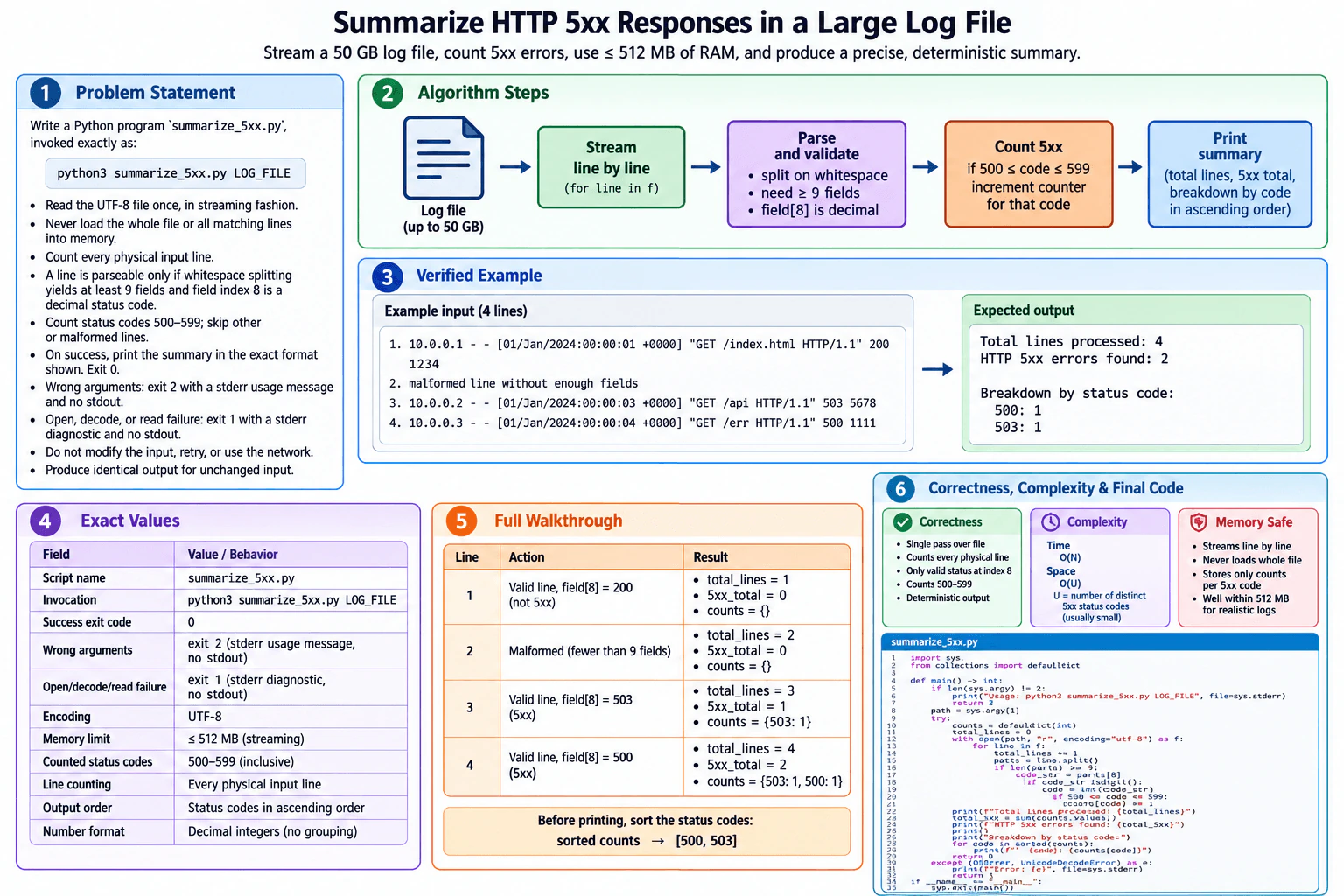
Create summarize_5xx.py, invoked exactly as python3 summarize_5xx.py LOG_FILE. Read the UTF-8 file once in streaming fashion; never load the complete file or all matching lines into memory. Count every physical input line. Treat a line as parseable for this task only when whitespace splitting yields at least nine fields and field index 8 is a decimal status code; count codes 500 through 599 and skip other or malformed lines. On success, print Total lines processed: N, then HTTP 5xx errors found: M, then a blank line, then Breakdown by status code:, followed by CODE: COUNT for each observed 5xx code in ascending order; use decimal integers without grouping separators. Wrong arguments exit 2 with a stderr usage message and no stdout; open, decode, or read failure exits 1 with a stderr diagnostic; success exits 0. Do not modify the input, retry, or use the network, and produce identical output for unchanged input. Example input containing one 200 line, one malformed line, one 503 line, and one 500 line must produce Total lines processed: 4, HTTP 5xx errors found: 2, a blank line, Breakdown by status code:, 500: 1, and 503: 1 on separate lines.
Short Interview Answer (30-60 seconds)
I would stream the log file one physical line at a time, so I never keep the 50 GB file in memory. For each line, I increment the total line count, split on whitespace, and inspect field 8 only when at least nine fields exist and the status is decimal. I count codes from 500 through 599 in a dictionary. After EOF, I print the totals and sorted status counts. The time is O(n), and auxiliary space is O(u), where u is at most 100 status codes.
The program must read a very large log file without keeping the complete file in memory. It reads one physical line, checks it, updates small counters, and then moves to the next line. Every physical line increases the total line count, including malformed lines. A usable status code must be the ninth whitespace-separated field and must contain decimal digits. Only values from 500 through 599 count as 5xx errors. After the whole file is read successfully, the program prints the totals and each observed 5xx status code in ascending order.
Useful Questions to Ask the Interviewer
Should I follow the stated parsing rule exactly and use field index 8 only when whitespace splitting produces at least nine fields?
Should malformed lines still count toward the total physical line count? The stated contract says yes.
Should stdout remain empty when opening, decoding, or reading the file fails? The stated contract says yes.
How to Explain It in an Interview
1. Understand the input and required output
The script is named summarize_5xx.py. It is invoked exactly as python3 summarize_5xx.py LOG_FILE.
The input is one UTF-8 log file that may be about 50 GB. Because the file is much larger than the allowed 512 MB of RAM, the program must not load the complete file or all matching lines into memory. It processes one physical line at a time and counts every physical line.
A line can contribute a status code only when whitespace splitting produces at least nine fields and field index 8 is decimal. Codes from 500 through 599 are counted as 5xx responses. Other status codes and malformed lines do not change the 5xx counters, but their physical lines still increase the total line count.
On success, the program prints Total lines processed: N, then HTTP 5xx errors found: M, then a blank line, then Breakdown by status code:, followed by each observed 5xx code and count in ascending numeric order.
2. Choose the streaming algorithm and dictionary
The main idea is streaming. Python gives the program one physical line at a time with for line in file_handle. The program does not create a list containing the whole file or all matching records.
A dictionary stores status code -> count. For example, after seeing one 503 response, the dictionary contains {503: 1}. Only codes 500 through 599 can be stored, so there can be at most 100 different keys.
The central invariant is: after each processed physical line, total_lines equals the number of physical lines read so far, total_5xx equals the number of qualifying 5xx lines seen so far, and counts[code] equals the number of times that 5xx code has appeared so far.
3. Initialize and process each line
Start with total_lines = 0, total_5xx = 0, and an empty defaultdict(int) named counts.
For every line read from the file, increment total_lines first. Then split the current line on whitespace. If there are fewer than nine fields, the line is malformed for this task, so continue to the next line.
If field 8 is not decimal, skip it. Otherwise convert it to an integer. When 500 <= status_code <= 599, increment both total_5xx and counts[status_code].
After line 1, total_lines = 1. Field 8 is 200, so it is not a 5xx response. total_5xx = 0 and counts = {}.
After line 2, total_lines = 2. It has fewer than nine fields, so it does not change the 5xx counters. total_5xx = 0 and counts = {}.
After line 3, total_lines = 3. Field 8 is 503. It is inside the 500 through 599 range, so total_5xx = 1 and counts = {503: 1}.
After line 4, total_lines = 4. Field 8 is 500. It is also a 5xx code, so total_5xx = 2 and the logical counts are 503 -> 1 and 500 -> 1.
Before printing the breakdown, the program sorts the numeric dictionary keys. The printed order is therefore 500 and then 503.
The exact successful output is: Total lines processed: 4HTTP 5xx errors found: 2
Breakdown by status code: 500: 1 503: 1
5. Explain why the result is correct
Every physical line increments total_lines exactly once because that update happens immediately after the line is read.
Only lines satisfying the required parsing rule can change the error counters. A line must have at least nine whitespace-separated fields, field 8 must be decimal, and its integer value must be between 500 and 599 inclusive.
Each qualifying 5xx line increments total_5xx once and increments exactly one per-code dictionary entry. Therefore, after EOF, the counters describe exactly the successfully processed file under the stated rules.
6. Explain the Python implementation, complexity, and failures
Argument validation happens before file processing. If the command does not contain exactly one log-file argument, the program writes a usage message to stderr, writes nothing to stdout, and exits with code 2.
The file is opened with strict UTF-8 decoding and read inside a try block. Opening, decoding, or reading failures write a diagnostic to stderr, write nothing to stdout, and exit with code 1. The program intentionally delays all successful stdout output until the complete file has been read. Success exits with code 0.
The main scan is O(n), where n is the amount of input data processed. Sorting the observed codes costs O(u log u), where u is the number of distinct observed 5xx status codes. Since u is at most 100, this sorting work is bounded, so the overall asymptotic time is O(n). Auxiliary counting space is O(u), plus temporary memory for the current physical line and its split fields.
Key Insight / Why This Solution Works
Use one streaming pass over the file. Increment the physical-line counter immediately after each line is read. Split only the current line on whitespace. If it has at least nine fields and field 8 is decimal, convert that field to an integer. When the code is between 500 and 599 inclusive, increment the total 5xx count and the dictionary count for that code. The invariant is that after every processed physical line, the counters describe exactly the prefix of the file already read. After EOF, sort only the observed status-code keys and print them. This design fits a huge file because it keeps only the current line, its split fields, counters, and at most 100 status-code entries.
Example
The program first checks sys.argv. Exactly one path must be supplied after the script name. Otherwise, it prints Usage: python3 summarize_5xx.py LOG_FILE to stderr and returns exit code 2 without writing to stdout.
It initializes total_lines, total_5xx, and counts. The counts object is a defaultdict(int), so a new status code starts with count zero automatically.
The file is opened in text mode with strict UTF-8 decoding. The for line in file_handle loop streams one physical line at a time. total_lines is incremented before parsing, so malformed lines are still counted.
The current line is split on whitespace. The code requires at least nine fields. It then checks parts[8].isdecimal() before converting that value to an integer. If the integer is from 500 through 599 inclusive, the code increments both total_5xx and the dictionary count for that status.
No successful report is written to stdout until the full streaming read finishes. This means an open, decode, or read failure can return exit code 1 with a stderr diagnostic and no partial stdout report. On success, the program prints the two totals, a blank line, the breakdown heading, and each observed code in ascending numeric order by iterating over sorted(counts). The main() function returns 0 for success, and the if __name__ == "__main__" guard passes that return code to sys.exit().
Code
import sys
from collections import defaultdict
defmain() -> int:
# The command must contain exactly one argument: the log-file path.# Argument errors use exit code 2 and must not write to stdout.iflen(sys.argv) != 2:
print("Usage: python3 summarize_5xx.py LOG_FILE", file=sys.stderr)
return2
log_path = sys.argv[1]
# These counters describe the physical lines processed successfully so far.
total_lines = 0
total_5xx = 0# Map each observed 5xx status code to the number of times it appears.# There are at most 100 possible keys: 500 through 599.
counts: defaultdict[int, int] = defaultdict(int)
try:
# Stream strict UTF-8 text instead of loading the complete file into RAM.withopen(log_path, "r", encoding="utf-8", errors="strict") as file_handle:
for line in file_handle:
# Count every physical input line, including malformed lines.
total_lines += 1# Keep only the fields for the current physical line in memory.
parts = line.split()
# The stated format requires at least nine fields.iflen(parts) < 9:
continue
status_text = parts[8]
# Only a decimal field is parseable as the status code.ifnot status_text.isdecimal():
continue
status_code = int(status_text)
# Only codes 500 through 599 contribute to the 5xx summary.if500 <= status_code <= 599:
total_5xx += 1
counts[status_code] += 1except (OSError, UnicodeDecodeError) as exc:
# Open, decode, or read failures use exit code 1.# No successful stdout output has been produced yet.print(f"Error: {exc}", file=sys.stderr)
return1# Print the report only after the complete file was read successfully.print(f"Total lines processed: {total_lines}")
print(f"HTTP 5xx errors found: {total_5xx}")
print()
print("Breakdown by status code:")
# Sorting numeric keys gives the required ascending status-code order.for status_code insorted(counts):
print(f" {status_code}: {counts[status_code]}")
return0if __name__ == "__main__":
# Propagate the exact success or failure code to the operating system.
sys.exit(main())
Where it is used
This pattern is useful for very large operational files that cannot safely fit in RAM. Examples include web-server access logs, reverse-proxy logs, application logs, batch-processing output, and production diagnostics. Streaming lets a DevOps script calculate useful summaries while memory use stays mostly independent of the total file size.
Why Interviewers Ask This
This question checks whether a candidate recognizes that a 50 GB input changes the implementation strategy. The interviewer is evaluating streaming I/O, exact parsing rules, bounded counting state, deterministic output, and careful command-line behavior. It also tests whether the candidate handles stdout and stderr correctly, returns the required exit codes, handles UTF-8 and file-read failures, counts malformed physical lines correctly, and reasons accurately about memory instead of assuming the entire input must be loaded first.
Common interview mistakes
A common mistake is using read() or readlines() and loading the 50 GB file into memory. Another is incrementing the total line counter only for parseable lines instead of every physical input line. Candidates may also inspect the wrong field, convert malformed status text without checking it, or count status codes outside 500 through 599. Printing totals before EOF is another mistake because a later decode or read error would leave partial stdout even though the required result is failure. Finally, printing dictionary entries without sorting their numeric keys would not satisfy the required ascending status-code order.
Interview tip
Explain the invariant after each physical line: one counter tracks all lines read, one tracks qualifying 5xx responses, and a small status code -> count dictionary tracks the breakdown. Then mention that successful stdout is delayed until EOF so a later read or decode failure cannot leave a partial report.
Interviewer may ask next
What would change if the log contained millions of different error identifiers instead of only the 100 possible HTTP 5xx status codes?
The streaming scan could remain, but the in-memory dictionary could now grow with the number of distinct identifiers. Auxiliary space would become O(u), where u might be very large. The scan would still take O(n) time, and sorting all identifiers for output would add O(u log u). If the 512 MB limit could no longer hold the counters, I would partition records into bounded temporary files and aggregate those partitions separately before merging the results. Correctness is preserved because every qualifying identifier still contributes exactly once to one partition and then to the final merged count. The tradeoff is extra disk I/O and more implementation complexity in exchange for bounded RAM.
What would change if one physical log line could itself be larger than the available RAM?
The diagram's line-by-line approach keeps the current physical line and its split fields in memory, so a single extremely large line could violate a strict memory bound. For that stronger requirement, I would use bounded chunk reads and maintain a small parsing state across chunks until the physical-line boundary is found. I would collect only enough information to identify the ninth whitespace-separated field and whether it is a decimal 5xx status. Every byte would still be processed in order, so the line count and status counts remain correct. Time stays O(n), while auxiliary memory is bounded by the chosen chunk size plus the small status-count dictionary. The tradeoff is substantially more complex parsing code.
12. Why do you want to leave your current job?BehavioralEasyGoogle
i Question Details
Describe your genuine reason in a professional way. Explain what you have learned, what growth or responsibility you now seek, why the change is timely, and how the move relates to this role without blaming your employer or inventing dissatisfaction.
Interview tip:
Use STAR to structure your answer: briefly explain the Situation and Task, make Action the most detailed part, and finish with the Result. For example, describe what you have learned in your current role, the additional growth or responsibility you now want, how you communicated and prepared for that next step, why the timing makes sense, and how this role supports your professional goals without criticizing your current employer.
Situation
In my current role, I have had the chance to build strong DevOps experience and work closely with development and operations teams. I have learned a lot about automation, deployment processes, cloud infrastructure, monitoring, and supporting reliable production systems. I value that experience and I am grateful for what the role has taught me.
Task
As I gained more experience, I started thinking carefully about the next stage of my growth. I want to take broader ownership of DevOps systems, work on larger reliability and automation challenges, and contribute more to technical decisions that affect how software is built, deployed, and operated.
Action
I first looked at whether I could continue growing in those areas within my current role. I spoke with my manager about taking on more responsibility and volunteered for work that gave me more exposure to infrastructure automation, deployment reliability, monitoring, and collaboration with engineering teams. I also paid attention to the type of work where I was learning the most. Over time, I realized that I am ready for a role with broader DevOps responsibility and more complex engineering problems. That is why I started looking carefully at opportunities that match the direction I want to grow. I am not leaving because of a negative experience. I am making a deliberate career decision based on what I have learned, the responsibilities I am ready to take on, and the kind of engineering environment where I can continue developing.
Result
This process gave me a clear reason for making a change. I appreciate what I have learned in my current job, but I now know that I am ready for broader ownership and deeper technical challenges. This role interests me because it would let me apply my current DevOps experience while continuing to grow in automation, reliability, infrastructure, and engineering collaboration.
Why Interviewers Ask This
Interviewers ask this question to understand the candidate's motivation, professionalism, judgment, and career direction. A strong answer shows that the candidate is moving toward meaningful growth and responsibility rather than simply running away from a difficult situation or criticizing a current employer.
Interviewer may ask next
What kind of additional responsibility are you looking for in your next role?
I am looking for broader ownership of DevOps systems from design through production operations. I want to contribute more to infrastructure automation, deployment reliability, monitoring, incident prevention, and technical decisions that help engineering teams deliver software safely and consistently.
Did you try to find those growth opportunities in your current role before deciding to leave?
Yes. I discussed my growth goals with my manager and volunteered for work that gave me more responsibility in automation, reliability, monitoring, and infrastructure. Those opportunities helped me learn, but they also confirmed that I am ready for a role where this broader level of ownership is a more central part of my responsibilities.
13. Why Google?BehavioralEasyGoogle
i Question Details
Ground your answer in your real motivations, the work and operating environment you are seeking, and the parts of this role that connect to your demonstrated experience. Distinguish thoughtful role and company fit from prestige, compensation, or a generic interest in large technology companies.
Interview tip:
Use STAR to structure your answer: briefly explain the Situation and Task, make Action the most detailed part, and finish with the Result. For example, describe how your experience running reliable systems shaped what you want in your next DevOps role, why Google's scale and engineering environment connect to that experience, and how you would contribute through automation, reliability, collaboration, and continuous improvement.
Situation
In my last role, I worked on systems where reliability, automation, and clear operational practices were important. I enjoyed improving how services were deployed, monitored, and supported. That experience helped me understand the kind of engineering environment where I do my best work.
Task
As I considered my next role, I wanted to find a place where DevOps work is closely connected to software engineering, system reliability, and large scale infrastructure. I also wanted an environment where engineers are expected to understand problems deeply, automate repeated work, and improve systems instead of only reacting to incidents.
Action
That is why I am interested in Google. The DevOps and reliability challenges at Google connect directly with the work I enjoy. I like building automation that makes deployments safer, improving monitoring so teams can understand system behavior, and removing manual operational work that can cause mistakes. I also value the engineering approach of using data and clear technical reasoning before making changes. In my previous work, I learned that reliable systems are not created by one tool or one team. They come from developers and operations engineers working together, defining clear expectations, learning from failures, and improving the system over time. I want to work in an environment where that way of thinking is part of everyday engineering. Google's scale also interests me because small improvements in automation, reliability, and efficiency can have a meaningful effect across many systems. My interest is therefore based on the work itself and the operating environment, rather than simply the company name.
Result
My previous experience has made me confident that this type of role matches both my strengths and the direction I want to continue growing. I can bring practical experience with automation, reliability, monitoring, and collaboration, while learning from engineers who solve infrastructure problems at very large scale. That combination is the main reason I want to work at Google.
Why Interviewers Ask This
Interviewers ask this question to understand whether the candidate has a thoughtful reason for choosing Google and this specific DevOps environment. A strong answer shows that the candidate understands the nature of the work, can connect the role to relevant experience, and is motivated by engineering challenges, collaboration, reliability, and growth rather than only prestige or compensation.
Interviewer may ask next
What part of Google's engineering environment is most important to you?
The most important part to me is the focus on building reliable systems through engineering rather than relying on repeated manual operations. I enjoy finding recurring operational problems, understanding their cause, and then using automation, monitoring, or better processes to reduce that work. I also value close collaboration between development and operations because that has helped me create more reliable solutions in my previous work.
How does your previous DevOps experience prepare you for this role?
My previous experience taught me to look at reliability as a complete system problem. I have worked on improving deployment processes, monitoring system behavior, automating repeated tasks, and working with other engineers when operational issues appeared. Those experiences taught me to investigate carefully, communicate clearly, and improve the underlying process after a problem is resolved. I would bring that same approach to this role while adapting it to Google's scale and engineering practices.
14. Tell me about a situation in which you demonstrated resilience.BehavioralMediumGoogle
i Question Details
Use a real setback or prolonged challenge. Describe the goal, what made the situation difficult, how you adapted your plan and maintained judgment, the support or feedback you used, the result, and what the experience changed about how you handle similar pressure.
Interview tip:
Use STAR to structure your answer: briefly explain the Situation and Task, make Action the most detailed part, and finish with the Result. For example, describe a difficult DevOps project where a serious setback disrupted the original plan, you stayed focused on the most important goal, adjusted your approach, asked for useful feedback, communicated risks clearly, and kept working until the team reached a reliable result.
Situation
In my last role, I was supporting a release that depended on a new deployment pipeline and several infrastructure changes. During final testing, we found that the deployment process was unstable. Some services started correctly, while others failed because the new configuration behaved differently across environments. The release was important, but pushing forward without understanding the problem could have created a production incident.
Task
I was responsible for helping make the release process reliable and giving the team a clear recommendation about whether we were ready to proceed. The difficult part was that we had already spent significant effort on the original approach, and the team was under pressure to complete the release. I needed to stay calm, protect production, and find a practical path forward instead of treating the setback as a reason to rush.
Action
I first separated the immediate release decision from the larger technical problem. I recommended that we stop promoting the unstable configuration until we understood the failure. I explained that delaying a risky change was safer than creating an outage that would take even longer to recover from. Then I reproduced the issue in a controlled environment and compared the deployment steps, environment variables, permissions, and service dependencies between the working and failing environments. I found that several assumptions in the pipeline were not consistent across environments. Instead of trying to repair everything at once, I divided the work into smaller parts. I fixed the configuration differences that directly affected the release and documented the remaining improvements for later work. I also asked application engineers to review the service startup requirements because they had deeper knowledge of those dependencies. Their feedback helped confirm which checks should happen before deployment. I added validation steps so the pipeline could detect missing configuration before attempting a release. Throughout the work, I gave the team short updates about what we knew, what was still uncertain, and what condition had to be met before I would recommend continuing. When one attempted fix did not solve the full problem, I did not keep repeating the same approach. I reviewed the evidence again, changed the plan, and tested each assumption separately until the deployment behaved consistently.
Result
We completed the release only after the deployment path was stable and the important configuration checks were in place. The team also had clearer documentation about the environment requirements and a safer process for future releases. The experience changed how I handle pressure. I learned that resilience is not simply continuing to work harder. It means staying calm after a setback, protecting the most important priority, using feedback, changing the plan when the evidence requires it, and continuing until the problem is understood well enough to make a responsible decision.
Why Interviewers Ask This
Interviewers ask this question to understand how a candidate responds when progress becomes difficult or a plan fails. They want to see whether the candidate can stay calm, maintain good judgment, adapt instead of giving up, use support effectively, and continue making responsible decisions under pressure.
Interviewer may ask next
Why did you choose to stop the release instead of continuing to troubleshoot while moving forward?
I chose to stop the release because we did not yet understand why the deployment behaved differently across environments. Continuing would have moved an unknown problem closer to production. I felt that protecting service reliability was more important than preserving the original schedule. I still kept the troubleshooting focused so the delay remained as small as possible.
What would you do differently if you faced a similar situation now?
I would add environment validation earlier in the delivery process instead of waiting until final testing. I would also confirm service dependencies and configuration assumptions with the application team before the release became time sensitive. The setback taught me that resilience also includes learning from the difficulty and reducing the chance of repeating the same problem.
15. Tell me about a time your actions had a positive impact on your team.BehavioralHardGoogle
i Question Details
Use a concrete example and distinguish your contribution from the group's work. Explain the team problem or opportunity, the action you personally initiated, how you earned participation, any tradeoff or resistance, the observable effect on the team, and evidence that the impact lasted beyond the immediate event.
Interview tip:
Use STAR to structure your answer: briefly explain the Situation and Task, make Action the most detailed part, and finish with the Result. For example, describe a time when your team was losing time because an important operational process was inconsistent, explain what improvement you personally initiated, how you earned the team's participation, how you handled concerns about changing the process, and how the improved way of working continued to help the team afterward.
Situation
In my last role, our team supported several services, but the process for responding to production alerts was inconsistent. Important troubleshooting knowledge was often kept in individual notes or learned through experience. This made incidents more stressful because engineers sometimes repeated the same investigation steps or had to wait for someone who knew a service well.
Task
I wanted to make incident response easier for the whole team without creating a heavy process that people would avoid. My responsibility was not to change the services themselves. My goal was to help the team share useful operational knowledge and make common response steps easier to follow.
Action
I started by reviewing several recent alerts and noting where we had lost time because the next troubleshooting step was unclear. I then created a simple runbook format for the most common alerts. A runbook is a short set of practical steps that explains what to check and what action to take. I kept the format small so engineers could update it during normal work. I wrote the first few runbooks myself using information from our existing monitoring, deployment, and service documentation. I also added links to the relevant dashboards and logs so engineers could move from an alert to useful evidence quickly. Instead of asking the team to adopt the process immediately, I shared the first examples and asked other engineers to test them during support work. Some people were concerned that documentation would become outdated and create more maintenance work. I agreed that this was a real risk, so I proposed that we treat each runbook as part of the service and update it whenever an alert or incident showed that a step was missing or incorrect. I also asked engineers who resolved an unfamiliar issue to add the useful learning afterward. I personally kept reviewing the runbooks during my support rotation and made small improvements when I found unclear instructions. Over time, the team contributed more because the process was simple and they could see that the information was useful during real incidents.
Result
The team became less dependent on individual memory when responding to common production problems. Engineers had a clearer starting point, and knowledge from one incident was easier to reuse during the next one. The runbooks continued to be updated by other team members instead of remaining something only I maintained, which showed me that the change had become part of the team's normal way of working. I learned that a positive team impact does not always require a large technical change. A small improvement can last when it solves a real problem, is easy for people to use, and gives everyone a reason to participate.
Why Interviewers Ask This
Interviewers ask this question to understand whether a candidate improves the team around them instead of focusing only on individual tasks. A strong answer shows ownership, practical judgment, collaboration, the ability to earn participation, and evidence that the candidate created a useful change that continued after the initial effort.
Interviewer may ask next
How did you handle the team's concern that the runbooks could become outdated?
I agreed with the concern because outdated instructions can be worse than having no instructions. I kept the runbooks short and connected their maintenance to normal support work. When an incident showed that a step was wrong or missing, I updated it and encouraged the engineer who found the issue to do the same. That made maintenance part of learning from incidents instead of a separate documentation project.
How did you know your actions had a lasting positive impact on the team?
The strongest evidence was that other engineers continued using and updating the runbooks without depending on me to manage them. The team also began adding useful troubleshooting knowledge after new incidents. That showed the idea had moved from something I initiated to a shared team practice.
Disclaimer: This interview guide is for educational and informational purposes only. It is designed to help readers prepare, but it does not guarantee any interview result, hiring decision, offer, or outcome. Interview questions, hiring criteria, and preferred answers can vary by employer, interviewer, industry, location, and time. All answers, examples, and explanations in this guide are suggested examples for interview preparation, not definitive answers or instructions for professional practice. They are based on research and judgment, are provided without warranties of any kind, and should be adapted to the question, role, and applicable laws and professional requirements. Diagrams are simplified illustrations intended to highlight the main concepts and their relationships; actual situations, systems, and practices may be more complex. Alternative approaches may be equally valid or better suited to a particular question, context, or interviewer. To the fullest extent permitted by applicable law, the contributors and publisher are not liable for decisions made, actions taken, or losses incurred based on this guide.
State Laws and Professional Responsibilities: Laws and requirements governing an occupation vary by state and jurisdiction. You are responsible for checking the current laws, licensing requirements, and scope-of-practice rules that apply to your location and role, and for ensuring that your answers and actions comply with them. Adapt examples in this guide to those requirements. This guide is not legal advice.
Company Notice: This guide is an independent educational resource and is not affiliated with, endorsed by, sponsored by, or approved by the company named in this guide. Company names identify reported interview experiences or the employer context of clearly labeled original practice exercises. Interview practices can change without notice, and inclusion of company-specific content does not mean these questions are official, complete, or guaranteed to be asked. To the fullest extent permitted by law, the author, contributors, and publisher are not responsible for outcomes related to use of this material.
Content Accuracy and Verification: To the fullest extent permitted by applicable law, we do not represent or warrant that interview guides, questions, answers, examples, or diagrams are accurate, complete, current, error-free, or suitable for any particular purpose. You are responsible for independently reviewing and verifying the information before relying on it.