12 NVIDIA DevOps Engineer Interview Questions & Answers

nvidia icon

Questions with Detailed ExplanationsWith Detailed Explanations

(Last Updated: September 1, 2026)

1. How would you autoscale GPU nodes for training workloads without wasting GPU hours on idle Pods?Cloud InfrastructureEasyNvidia

Question Details

Training demand is bursty and GPU nodes are expensive. Design the cloud capacity loop from queued or pending GPU work to node provisioning, scheduling, readiness, and safe scale-down; cover GPU type and topology constraints, minimum and maximum capacity, warm-up delay, checkpoints or job disruption, quotas, failed provisioning, utilization evidence, and safeguards against oscillation or stranded idle capacity.

Short Interview Answer (30-60 seconds)

At a high level, the goal is to add GPU capacity only when training work needs it. The hard part is that GPU nodes are expensive and slow to warm up. I would explain the design in three flows: detect pending GPU demand, provision and schedule the right nodes, then safely remove idle capacity. The control loop uses GPU type, topology, quotas, cooldowns, checkpoints, and utilization evidence. The trade-off is balancing faster startup against paying for warm idle GPUs.

Detailed Explanation

The goal is to give training jobs enough GPU capacity without paying for machines that sit unused. Demand can arrive in bursts, and GPU nodes need time before they are ready. The design uses one control loop. It watches waiting GPU work, adds the right capacity, waits for healthy nodes, schedules Pods, and later removes unused nodes safely. Quotas, cooldowns, checkpoints, and utilization data keep scaling stable.

Useful Questions to Ask the Interviewer
  1. Which GPU types and topologies must the training jobs support?
  2. What minimum and maximum capacity should each GPU node group allow?
  3. How much warm capacity is acceptable for faster startup?
  4. Can lower-priority training jobs be interrupted when a recent checkpoint exists?
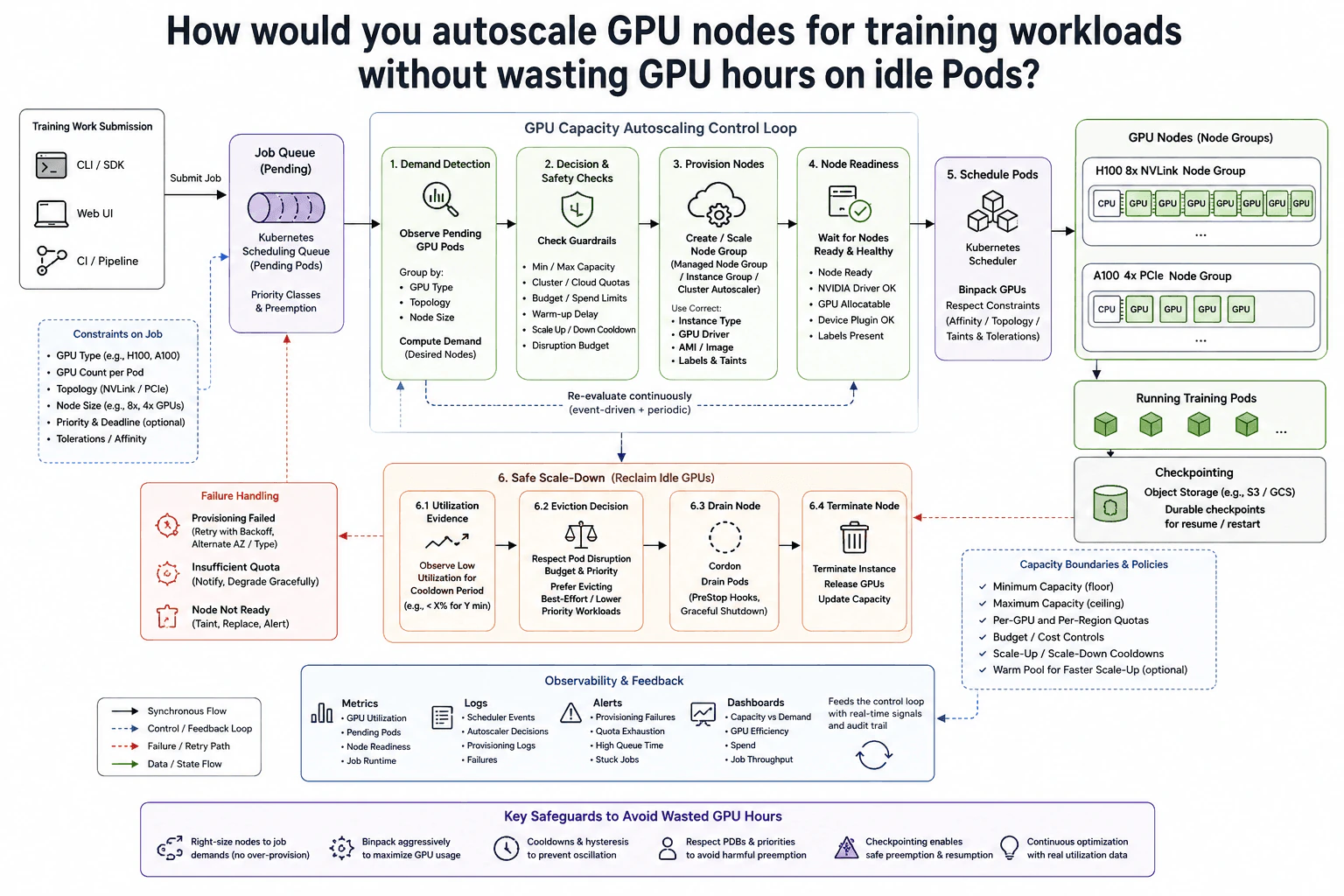
How would you autoscale GPU nodes for training workloads without wasting GPU hours on idle Pods? diagram
How to Explain It in an Interview
1. Start from the waiting training work

I would start from the demand signal. Training work enters through the CLI or SDK, Web UI, or CI pipeline. The job carries GPU type, GPU count, topology, node size, priority, and scheduling constraints.

Pending Pods wait in the Kubernetes scheduling queue. Priority classes and preemption rules help decide which work should run first.

2. Turn pending Pods into a safe scaling decision

The GPU Capacity Autoscaling Control Loop watches pending GPU Pods. It groups demand by GPU type, topology, and node size, then calculates the desired node count.

Before adding nodes, it checks minimum and maximum capacity, cluster or cloud quotas, budget limits, warm-up delay, cooldowns, and disruption limits. This prevents a short spike from causing repeated scaling.

3. Provision the correct nodes and wait for readiness

When more capacity is needed, the controller creates or scales the matching GPU node group. The node uses the required instance type, GPU driver, image, labels, and taints.

The control loop waits for Node Ready, a working NVIDIA driver, allocatable GPUs, a working device plugin, and the expected labels. If provisioning fails, it retries with backoff and may use an allowed alternate availability zone or GPU type. A node that never becomes ready can be tainted, replaced, and alerted on.

4. Schedule and use GPUs efficiently

The Kubernetes Scheduler places Pods after suitable nodes are ready. It respects GPU requests, affinity or topology rules, taints, and tolerations.

It also binpacks GPUs, meaning it fills suitable nodes well before spreading work. The diagram shows separate H100 NVLink and A100 PCIe node groups. Running training Pods periodically write durable checkpoints to object storage.

5. Scale down without losing useful work

For scale-down, the controller looks for low GPU utilization over a cooldown period. It checks disruption budgets and job priority before choosing a target.

The node is cordoned so no new Pods land there. Existing Pods are drained with graceful shutdown. The instance is then terminated and its GPUs are released. Checkpoints make restart safer when interruption is allowed.

6. Close the loop with evidence and guardrails

Metrics, logs, alerts, and dashboards feed real signals back into the control loop. These include GPU utilization, pending Pods, node readiness, job runtime, provisioning failures, quota exhaustion, queue time, and stuck jobs.

Cooldowns and hysteresis stop rapid scaling changes. Minimum capacity provides a floor, while maximum capacity and quotas limit growth. Warm capacity reduces startup delay, but idle warm GPUs cost money.

Practical Complexity & Trade-offs

The benefit is that GPU capacity follows real training demand instead of staying permanently large. Binpacking also helps use each node well before more machines are added. The downside is that new GPU nodes need warm-up time, so a job may wait when capacity is low. A warm pool makes startup faster, but idle GPUs cost money. Cooldowns and hysteresis stop rapid scaling changes, but they may keep extra capacity for a short time. Safe scale-down also takes longer because the controller must respect running jobs, checkpoints, priorities, and disruption rules before a node can be drained and terminated.

Why Interviewers Ask This

Interviewers want to see whether you can connect Kubernetes scheduling demand to expensive GPU capacity. They are testing judgment, not memorization. A strong answer shows that you can choose the right GPU type and topology, respect quotas and limits, wait for real node readiness, recover from provisioning failures, use utilization evidence for scale-down, protect long-running jobs with checkpoints, and explain the cost versus startup-time trade-off clearly.
Interviewer may ask next
What would you change if training jobs must start much faster during sudden demand spikes?

I would keep the same control loop, but I would use the warm-pool option shown in the Capacity Boundaries and Policies section. A small minimum capacity would keep the most important GPU node group ready before the next burst arrives.

The controller would still watch pending Pods and group demand by GPU type, topology, and node size. Warm nodes would handle the first jobs immediately. If demand grows beyond that floor, the normal provisioning path would add more nodes. Maximum capacity, quotas, budget limits, and cooldowns would still apply, so faster startup does not remove the existing safety checks.

I would use the existing observability signals to tune the warm pool. Queue time, pending Pods, GPU utilization, job runtime, and spend show whether too much or too little capacity is being kept ready.

The downside is cost. Faster startup means paying for some GPUs even when they are temporarily idle.

How would the design handle scale-down when a long-running training job cannot safely lose its current progress?

I would not terminate that node until the job can be disrupted safely. The existing Safe Scale-Down flow already checks utilization, disruption budgets, job priority, and whether the workload can be preempted before eviction.

For a long-running job, durable checkpointing is the key protection. The training Pod periodically writes checkpoints to object storage. If a recent checkpoint exists and interruption is allowed, the controller can cordon the node, drain the Pod with graceful shutdown, terminate the instance, and let the job resume later from saved progress.

If the job cannot be interrupted safely, the controller should leave that node running and choose another scale-down target. The low-utilization evidence still matters, but it does not override the job-protection rules.

The downside is lower GPU efficiency for a while. Some capacity may stay underused longer, but the design avoids throwing away valuable training progress.

2. How would you design AWS multi-tenancy with VPC peering, Route 53, IAM roles, and Argo CD?Cloud InfrastructureMediumNvidia

Question Details

Several tenants need isolated AWS environments while sharing an approved deployment platform. Define the account or VPC boundaries, non-overlapping addressing, peering routes and non-transitive limitations, private and public DNS ownership, cross-account IAM role trust, Argo CD cluster access, secret and audit boundaries, tenant-to-tenant denial, onboarding and offboarding, and recovery from a routing or identity misconfiguration.

Short Interview Answer (30-60 seconds)

At a high level, I would isolate every tenant in its own AWS account and VPC while sharing one approved Argo CD deployment platform. The main challenge is allowing safe deployments without creating tenant-to-tenant access. I would explain the design through network and DNS isolation, cross-account IAM access, and operations. Direct VPC peering connects the platform to each tenant. Tenant IAM roles control deployments. The trade-off is strong isolation, but every tenant needs careful routing, DNS, identity, and lifecycle setup.

Detailed Explanation

The goal is to let several tenants use one approved deployment platform while keeping their environments separate. Each tenant owns its network, workloads, private names, secrets, and data. The difficult part is giving Argo CD controlled access to each tenant without creating a path between tenants. The design handles this with separate AWS accounts, non-overlapping networks, direct VPC peering, tenant deployment roles, clear DNS ownership, and separate security boundaries. It also defines how tenants are added, removed, audited, and recovered after configuration mistakes.

Useful Questions to Ask the Interviewer
  1. How many tenant accounts and clusters do we expect?
  2. Should tenants reach any approved private services in the shared VPC?
  3. Who owns public platform DNS and tenant private DNS?
  4. How quickly must tenant onboarding and offboarding happen?
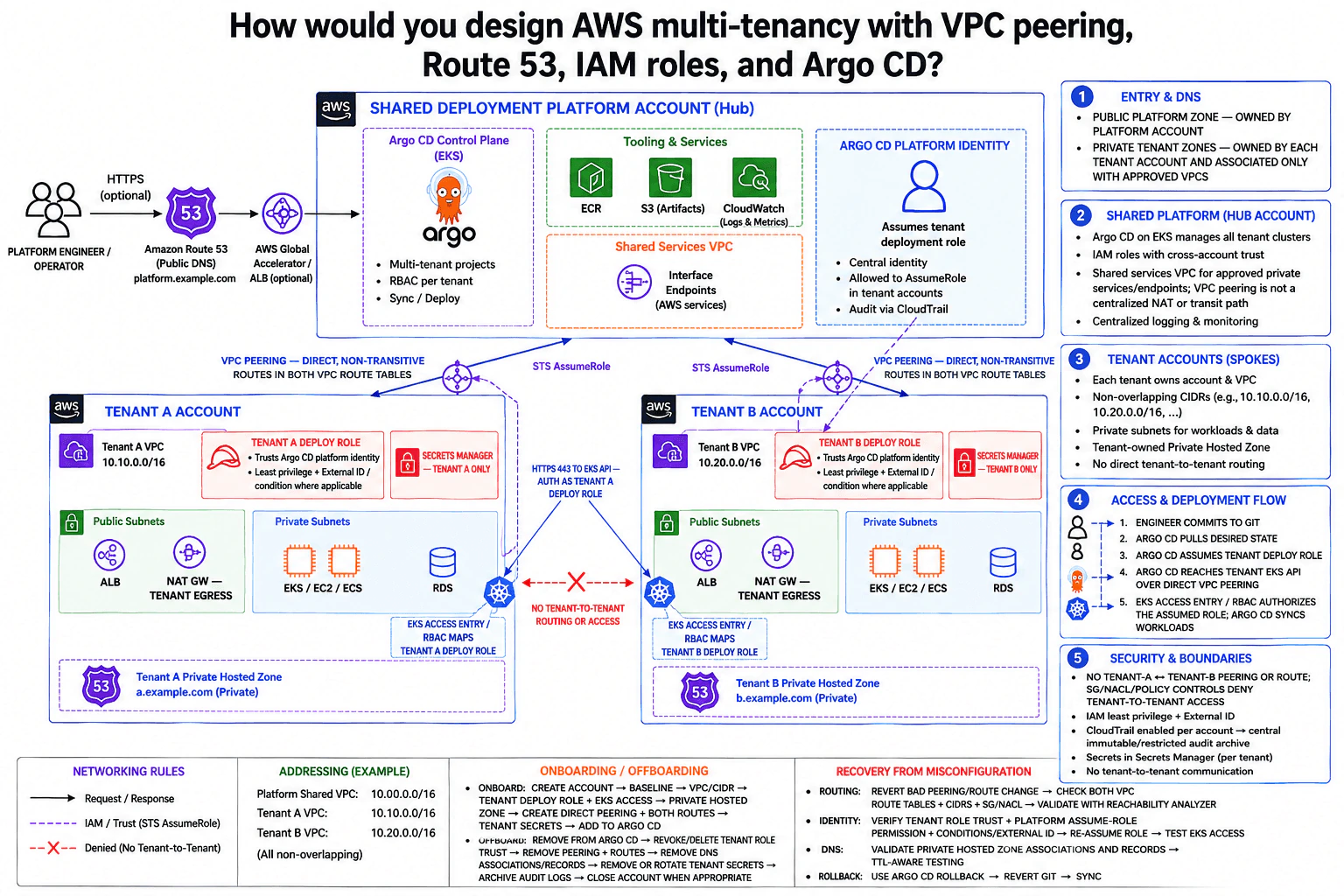
How would you design AWS multi-tenancy with VPC peering, Route 53, IAM roles, and Argo CD? diagram
How to Explain It in an Interview
1. Start with account and network isolation

I would give each tenant its own AWS account and VPC. Tenant A uses 10.10.0.0/16, and Tenant B uses 10.20.0.0/16. The platform shared VPC uses the separate range shown in the diagram. All ranges must be non-overlapping.

The shared deployment platform runs Argo CD on EKS. Argo CD uses multi-tenant projects and RBAC, which means permissions are separated by tenant. ECR stores container images. S3 stores deployment artifacts. CloudWatch collects platform logs and metrics.

Each tenant keeps public and private subnets. Its ALB can receive approved traffic. Its NAT gateway provides tenant-local internet egress. Workloads such as EKS, EC2, or ECS and the tenant RDS database stay inside that tenant account.

2. Use direct, non-transitive VPC peering

The platform creates one direct VPC peering connection to each tenant VPC. Routes must be configured in both VPC route tables. VPC peering is non-transitive, so Tenant A cannot use the platform VPC to reach Tenant B.

There is no direct tenant-to-tenant peering or route. Security groups, network ACLs, and policy controls also deny tenant-to-tenant access. The shared services VPC can expose approved private services through Interface Endpoints. It is not a centralized NAT or transit path.

3. Keep DNS ownership separate

The public platform zone is owned by the platform account in Route 53. The optional HTTPS management entry can use the public DNS path shown in the diagram.

Each tenant owns its own Route 53 Private Hosted Zone. That zone is associated only with approved VPCs. This keeps private tenant names inside the intended network boundary.

4. Let Argo CD deploy through tenant IAM roles

Argo CD uses a platform identity. That identity calls STS AssumeRole to enter a tenant deployment role. Each tenant role trusts the platform identity and follows least privilege. An External ID or another trust condition can further restrict access when appropriate.

Argo CD then reaches that tenant's EKS API over direct VPC peering using HTTPS on port 443. An EKS access entry and RBAC map the assumed tenant role to allowed cluster actions. Argo CD can then sync workloads without receiving access to another tenant.

Each tenant stores its own secrets in Secrets Manager. Secrets are not shared between tenants.

5. Explain onboarding, audit, and recovery

For onboarding, create the account baseline, choose a non-overlapping VPC range, create the tenant deployment role and EKS access, create the private hosted zone, add direct peering and routes, create tenant secrets, and then add the tenant to Argo CD.

For offboarding, remove the tenant from Argo CD, revoke the tenant role trust, remove peering and routes, remove DNS associations or records, remove or rotate tenant secrets, archive audit logs, and close the account when appropriate.

CloudTrail runs per account and sends audit records to a restricted central archive. For a routing mistake, revert the bad peering or route change, then check both route tables, CIDRs, security groups, and network ACLs. For an identity problem, verify both sides of AssumeRole, then test EKS access again. For DNS problems, validate hosted-zone associations and records. For a bad deployment, use Argo CD rollback, revert Git, and sync again.

Practical Complexity & Trade-offs

The benefit is strong tenant isolation. Each tenant owns its account, VPC, private DNS, IAM role, secrets, workloads, and data. Direct VPC peering also makes each approved network relationship explicit. The downside is more setup for every tenant. CIDR ranges cannot overlap, and routes must be added on both sides of each peering connection. Peering is non-transitive, so the shared VPC cannot become a general transit network. Cross-account IAM gives strong control, but both the platform permission and tenant trust policy must be correct. We accept the extra work because the security boundaries are easier to understand and audit.

Why Interviewers Ask This

Interviewers want to see whether you can share a deployment platform without weakening tenant isolation. They are testing your judgment around AWS account boundaries, VPC peering limits, DNS ownership, cross-account IAM, EKS authorization, secrets, auditing, and recovery. A strong answer also shows that you understand the difference between network reachability and identity permission, and that you can explain operational trade-offs clearly.

Interviewer may ask next
What would you do if the number of tenant accounts grew significantly but you still had to use direct VPC peering?

I would keep the same architecture, but I would automate the repeated tenant setup. The security model would not change. Every tenant would still have its own account, non-overlapping VPC, private hosted zone, deployment role, EKS access, secrets, and direct peering to the platform.

The main change would be operational. The onboarding process would automatically allocate an approved CIDR, create the peering connection, add routes on both sides, create the tenant IAM role, configure EKS access, and register the tenant with Argo CD. Offboarding would run the reverse steps.

I would also validate that no route creates tenant-to-tenant access before completing onboarding. Audit records would show every change.

The downside is that direct peering still creates more connections and route entries as tenant count grows. Automation reduces human mistakes, but it does not remove the basic scaling limit of managing many direct peer relationships.

How would you troubleshoot Argo CD if it suddenly could not deploy to one tenant cluster?

I would check the identity path and network path separately. Both must work before Argo CD can reach the tenant EKS API.

For identity, I would verify that the tenant deployment role still trusts the Argo CD platform identity. I would also check that the platform identity still has permission to call STS AssumeRole. Then I would verify any External ID or other trust condition. After assuming the role, I would check the EKS access entry and RBAC mapping.

For networking, I would inspect the direct VPC peering connection and both VPC route tables. I would confirm the CIDRs, security groups, and network ACLs. I would then validate reachability to the EKS API on HTTPS port 443.

If a recent change caused the problem, I would revert that change first. The downside is that deployment access depends on several independent controls, so troubleshooting must check both networking and identity.

3. How would you rebalance a live multi-cluster, multi-region training job after one cluster exhausts GPU memory?Cloud InfrastructureHardNvidia

Question Details

A distributed training job is already running across several clusters and regions when one cluster can no longer satisfy GPU-memory demand. Define the job and checkpoint state that can move, global scheduling and capacity discovery, rank or worker membership changes, data locality, network and collective-communication effects, consistency during handoff, partial-progress preservation, rollback, and the evidence required before the job resumes at full correctness and throughput.

Short Interview Answer (30-60 seconds)

At a high level, I would move the training job away from the exhausted cluster without losing valid progress. The hard part is changing workers and regions while keeping checkpoint, dataset, and collective state consistent. I would explain three flows: detect and replan capacity, quiesce and checkpoint before membership changes, then resume and validate. I would prefer data-local capacity because cross-region collectives add latency. If handoff fails, I would restore the last known-good checkpoint and placement.

Detailed Explanation

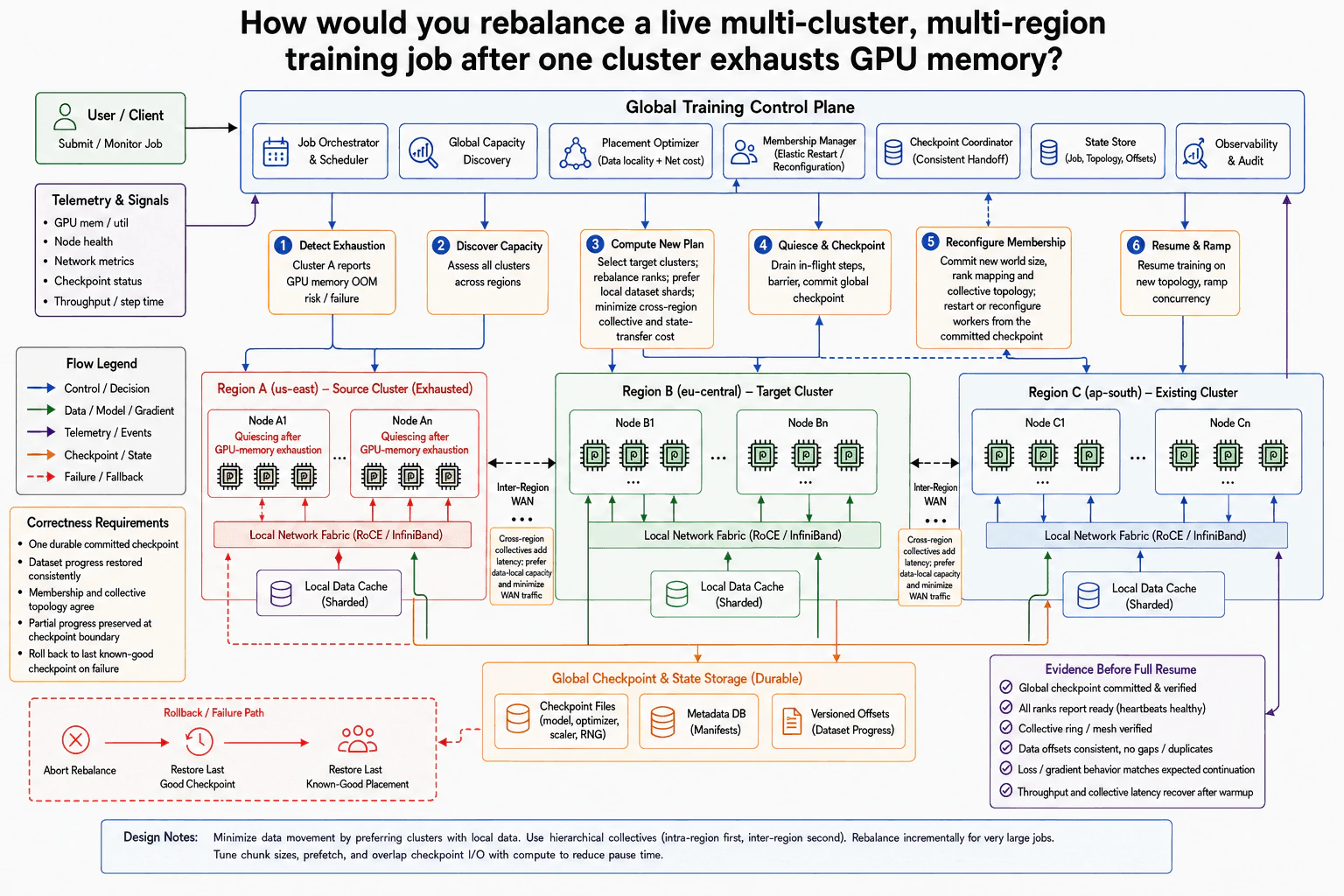
The job is already training across several clusters and regions when one cluster runs out of GPU memory. We need to move its work without losing useful progress. The hard part is making every worker restart from the same saved point, use the same dataset position, and agree on the same new group. The diagram handles this as a controlled handoff. It detects the problem, finds capacity, chooses a new placement, saves one consistent checkpoint, changes membership, resumes carefully, and checks correctness before returning to full speed.

Useful Questions to Ask the Interviewer
  1. Can the training framework restart or reconfigure workers when world size changes?
  2. Can every target region read the durable checkpoint and dataset progress state?
  3. May the new placement change world size, or must worker count stay fixed?
  4. How strongly should we prefer data-local capacity over immediately available remote GPUs?
How would you rebalance a live multi-cluster, multi-region training job after one cluster exhausts GPU memory? diagram
How to Explain It in an Interview
1. Detect exhaustion and discover capacity

I would start with the User / Client submitting or monitoring the job. Telemetry & Signals reports GPU memory, utilization, node health, network metrics, checkpoint status, and step time. Region A reports GPU-memory exhaustion. The Job Orchestrator & Scheduler starts recovery, and Global Capacity Discovery checks clusters across regions.

2. Compute a data-aware placement

The Placement Optimizer chooses target clusters and rebalances ranks. It prefers local dataset shards. It also minimizes cross-region collective and state-transfer cost. That matters because inter-region WAN traffic adds latency. Region B is the target cluster, while Region C can remain an existing cluster.

3. Quiesce and commit durable state

Before membership changes, the Quiesce & Checkpoint stage drains in-flight steps and reaches a barrier, which is a shared safe point. The Checkpoint Coordinator then performs a consistent handoff.

Global Checkpoint & State Storage keeps checkpoint files for the model, optimizer, scaler, and random-number state. Metadata DB stores manifests. Versioned Offsets stores dataset progress. The State Store keeps job, topology, and offset state. This preserves progress at the checkpoint boundary.

4. Reconfigure membership and resume

The Membership Manager uses an elastic restart or supported reconfiguration. It commits the new world size, rank mapping, and collective topology. Workers then restart or reconfigure from the committed checkpoint.

Each region uses its Local Network Fabric and shared Local Data Cache. The design prefers data-local capacity and minimizes WAN traffic. Hierarchical collectives communicate inside a region first, then across regions. Resume & Ramp increases concurrency gradually on the new topology.

5. Validate and roll back if needed

Observability & Audit checks the handoff before full resume. The checkpoint must be committed and verified. All ranks must report ready. The collective ring or mesh must be valid. Dataset offsets must have no gaps or duplicates. Loss and gradient behavior must match an expected continuation. Throughput and collective latency should recover after warmup.

If these checks fail, the rollback path aborts the rebalance. It restores the last known-good checkpoint and placement. The trade-off is extra pause time for checkpointing, restart, and warmup, but the job avoids continuing with mismatched state.

Practical Complexity & Trade-offs

The benefit is that the job can leave an exhausted cluster without losing all completed training. A durable committed checkpoint gives restarted workers the same model state and dataset position. The downside is a pause while workers quiesce, save state, change membership, and warm up again. Cross-region capacity can help when nearby GPUs are full, but WAN communication makes collectives slower. Data-local placement and hierarchical collectives reduce that cost. The design accepts checkpoint and restart overhead because continuing with mismatched ranks, offsets, or model state could corrupt training progress. Very large jobs may also need incremental rebalancing to keep the pause manageable.

Why Interviewers Ask This

Interviewers ask this to see whether you can change a running distributed system without losing correctness. They want judgment about capacity, checkpoints, worker membership, data locality, cross-region network cost, and rollback. They also want to see whether you know what evidence is needed before calling the recovery successful. The key skill is balancing speed, safety, and communication cost while explaining the handoff clearly.

Interviewer may ask next
What would you change if Region B has enough GPUs, but using it would make most collective communication cross-region?

I would keep the same control plane, but the Placement Optimizer would give more weight to data locality and inter-region network cost. Having enough GPUs in Region B does not automatically make it the best target.

I would prefer capacity that keeps dataset shards close to the workers and reduces cross-region collective traffic. If Region B is still required, I would keep the hierarchical collective pattern shown in the diagram. Workers communicate inside each region first, then use the inter-region WAN only for the cross-region part.

The checkpoint and membership flow does not change. Workers still quiesce, commit one durable checkpoint, agree on the new world size, rank mapping, and collective topology, then restart or reconfigure from that checkpoint. Before full resume, Observability & Audit checks collective latency, rank readiness, dataset offsets, and loss or gradient behavior.

The downside is a trade-off between recovery speed and steady training speed. Using remote GPUs sooner may restart faster, but every later training step may pay more WAN latency.

What would you do if the rebalance fails after the new membership is committed but before all workers become healthy?

I would stop the new resume attempt and use the rollback path. I would not let only the healthy workers continue because the job could then have mismatched membership or collective state.

The recovery point is the last known-good committed checkpoint. Global Checkpoint & State Storage contains the model, optimizer, scaler, random-number state, manifests, and versioned dataset offsets needed to restore a consistent point. The system then restores the last known-good placement instead of keeping a partly working new group.

The Membership Manager rebuilds membership and collective topology from that restored state. Resume happens only after all ranks report ready, the collective ring or mesh is verified, dataset offsets have no gaps or duplicates, and loss or gradient behavior matches expected continuation. Throughput and collective latency must also recover after warmup.

The downside is extra recovery time and losing work done after the last committed checkpoint. We accept that cost to avoid continuing from a partly configured training state.

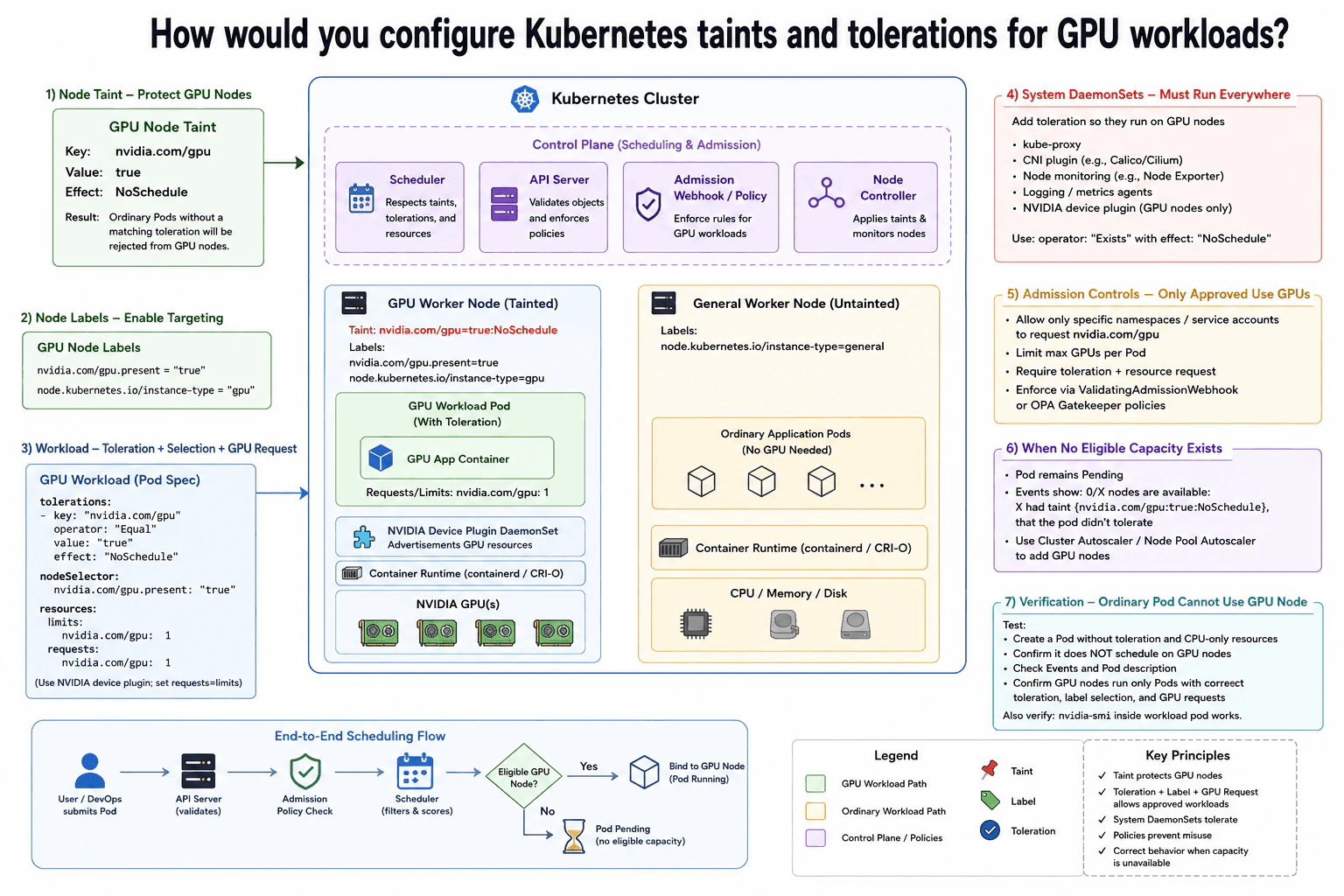
4. How would you configure Kubernetes taints and tolerations for GPU workloads?Containers And KubernetesEasyNvidia

Question Details

GPU nodes should reject ordinary application Pods while approved GPU workloads can be scheduled on them. Define the node taint key, value and effect, the matching workload toleration, labels or node selection, the GPU resource request, treatment of required system DaemonSets, admission controls, behavior when no eligible capacity exists, and the checks that prove an ordinary Pod cannot consume a protected GPU node.

Short Interview Answer (30-60 seconds)

At a high level, I want GPU nodes reserved for approved GPU workloads. The main challenge is blocking ordinary Pods while still allowing required system Pods. I would handle this with a GPU-node taint, matching toleration, node selection, GPU resource requests, and admission controls. GPU nodes use nvidia.com/gpu=true:NoSchedule. Approved workloads tolerate that taint, select GPU nodes, and request nvidia.com/gpu: 1. Required system DaemonSets also tolerate the taint. If no eligible capacity exists, the GPU Pod stays Pending.

Detailed Explanation

The goal is to keep expensive GPU nodes for workloads that really need GPUs. Ordinary application Pods should not accidentally run there. Approved GPU workloads must still be able to select those nodes and request GPU capacity. Required system Pods may also need to run on GPU nodes. The design handles this with node protection, workload permission, GPU resource requests, admission checks, and verification. The Kubernetes control plane validates the Pod, applies policy checks, and lets the scheduler choose only an eligible node. If no suitable GPU node has free capacity, the Pod waits instead of being placed incorrectly.

Useful Questions to Ask the Interviewer
  1. Should every GPU node use the same taint and labels?
  2. Which namespaces or service accounts may request GPUs?
  3. What is the maximum number of GPUs one Pod may request?
  4. Which system DaemonSets must run on GPU nodes?
  5. Should the GPU node pool automatically add nodes when Pods remain Pending?
How would you configure Kubernetes taints and tolerations for GPU workloads? diagram
How to Explain It in an Interview
1. Protect the GPU worker nodes

I would start by tainting each GPU worker node with nvidia.com/gpu=true:NoSchedule. A taint is a node rule that blocks Pods without matching permission. NoSchedule means the scheduler will not place a new ordinary Pod on that GPU node. The diagram also labels GPU nodes with nvidia.com/gpu.present=true and node.kubernetes.io/instance-type=gpu. General worker nodes remain untainted, so ordinary application Pods normally run there. The Node Controller monitors nodes, while the scheduler respects the taints, tolerations, labels, and available resources.

2. Give approved GPU workloads permission and target GPU nodes

An approved GPU workload gets a matching toleration. It uses key nvidia.com/gpu, operator Equal, value true, and effect NoSchedule. A toleration only allows the Pod to be considered for that tainted node. It does not force the scheduler to place the Pod there. The workload also uses nodeSelector with nvidia.com/gpu.present=true. This makes the workload target nodes identified as GPU nodes.

3. Request GPU capacity explicitly

The GPU App Container requests and limits nvidia.com/gpu: 1. The NVIDIA Device Plugin advertises GPU resources from the GPU worker node to Kubernetes. The API Server validates the Pod object, admission policy checks whether the workload is allowed, and the scheduler filters and scores eligible nodes. A node must satisfy the taint, toleration, node selection, and resource requirements. After scheduling, the container runtime such as containerd or CRI-O starts the Pod on the selected GPU worker node.

4. Handle system DaemonSets and admission controls

Required system DaemonSets must run on GPU nodes too. The diagram gives them a toleration using operator Exists with effect NoSchedule. Examples include kube-proxy, CNI components, node monitoring, logging or metrics agents, and the NVIDIA Device Plugin on GPU nodes. Admission controls add another safety layer. They can allow GPU requests only from approved namespaces or service accounts, limit GPUs per Pod, and require the expected toleration plus GPU resource request. The diagram shows a ValidatingAdmissionWebhook or OPA Gatekeeper policy for these checks.

5. Handle missing capacity and verify the protection

If no eligible GPU node exists, the Pod remains Pending. Kubernetes events can show 0/X nodes are available and explain that nodes have a taint the Pod did not tolerate or lack required capacity. A Cluster Autoscaler or node-pool autoscaler can add GPU nodes when configured to do so. To prove protection works, I would create an ordinary CPU-only Pod without the GPU toleration and confirm it does not schedule on GPU nodes. I would inspect Pod events and node placement. Then I would run an approved GPU Pod and confirm its GPU node placement, GPU request, and nvidia-smi access inside the workload.

Practical Complexity & Trade-offs

The benefit is strong separation between normal workloads and expensive GPU nodes. The NoSchedule taint blocks ordinary Pods unless they have the required toleration. Labels and the GPU resource request help approved workloads reach the correct nodes and consume real GPU capacity. Admission rules add another safety check before scheduling. The downside is more configuration to maintain. Required system DaemonSets need the correct broad toleration, and admission policies must stay aligned with workload rules. If every eligible GPU is busy, the Pod remains Pending until capacity becomes available or an autoscaler adds another GPU node.

Why Interviewers Ask This

Interviewers want to see whether you understand that taints, tolerations, node selection, GPU resource requests, and admission policies solve different scheduling problems. They also want to see how you protect costly GPU capacity without blocking required system DaemonSets. A strong answer explains control-plane checks, unavailable capacity, and practical verification that proves an ordinary Pod cannot consume a protected GPU node.

Interviewer may ask next
What would you change if several teams share the GPU cluster but only approved namespaces may use GPUs?

I would keep the same GPU-node taint, labels, toleration, and GPU resource request. I would make the admission controls stricter. Only approved namespaces or service accounts would be allowed to create Pods requesting nvidia.com/gpu.

The ValidatingAdmissionWebhook or OPA Gatekeeper policy would check the Pod before it is accepted. A GPU workload would need the expected GPU request and matching toleration. The policy could also limit how many GPUs one Pod may request. That reduces the chance that one workload consumes too much GPU capacity.

The scheduler would still check the taint, toleration, node selection, and available GPU resources. Required system DaemonSets would keep their Exists toleration so they can run on GPU nodes.

The main downside is additional policy management. Namespace permissions, service accounts, workload rules, and admission policies must stay consistent as teams change.

What happens when an approved GPU Pod has the correct toleration but every GPU node is full?

The Pod should remain Pending. The toleration only gives the Pod permission to use the tainted GPU nodes. It does not create GPU capacity and does not guarantee successful scheduling.

The scheduler still checks the GPU node selection and the nvidia.com/gpu request. If every eligible GPU is already allocated, no node can satisfy the Pod. Kubernetes events should explain that no eligible capacity is available. I would inspect those events and the current Pod and node placement before changing the configuration.

If the GPU node pool supports autoscaling, the Cluster Autoscaler or node-pool autoscaler can add GPU nodes. When new eligible capacity becomes available, the scheduler can place the Pending Pod normally.

The main downside is startup delay. Creating a GPU node can take time, so the workload may remain Pending while the additional capacity is being added.

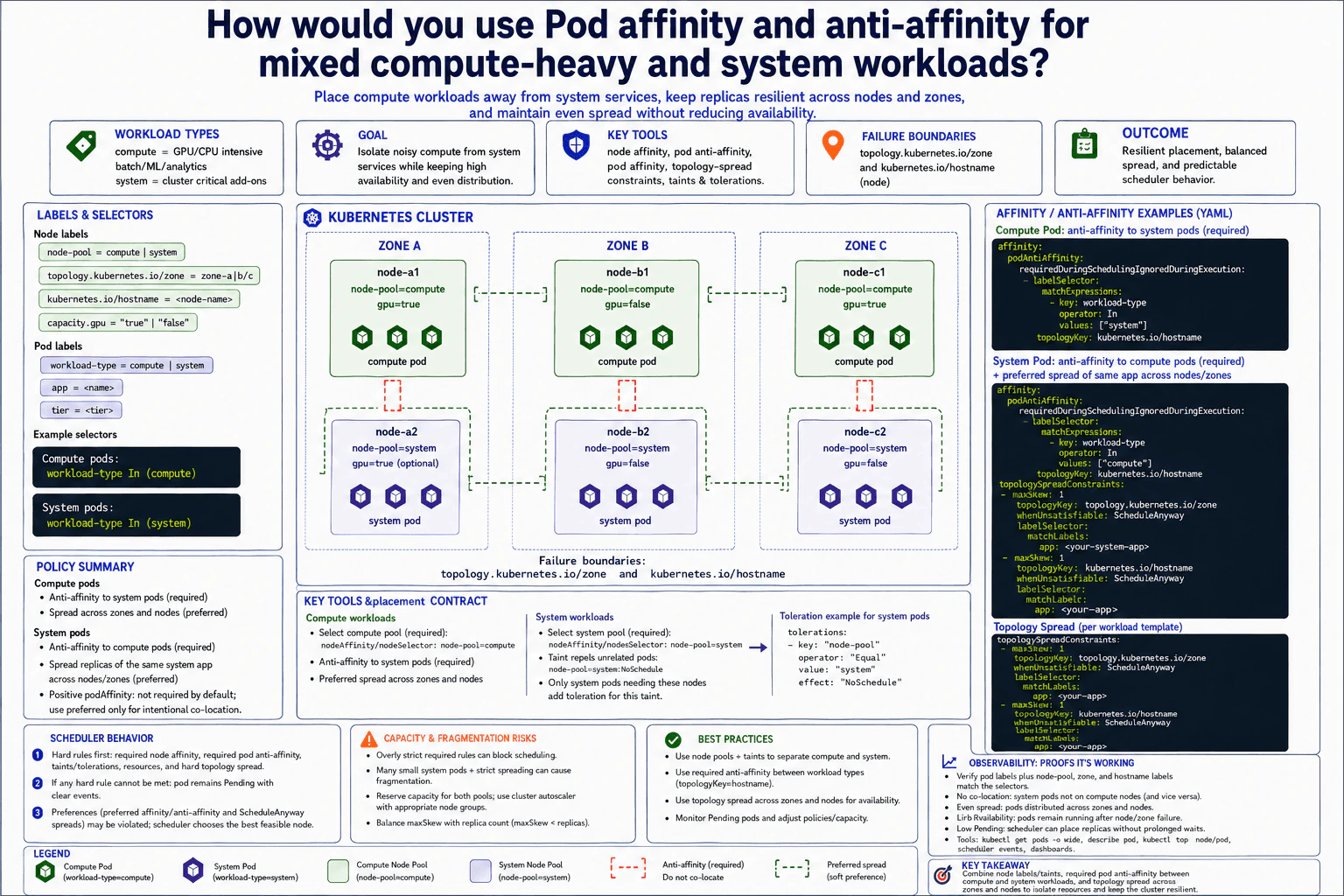
5. How would you use Pod affinity and anti-affinity for mixed compute-heavy and system workloads?Containers And KubernetesMediumNvidia

Question Details

Compute-intensive workloads and cluster system services share the same Kubernetes estate. Define the labels and selectors, required versus preferred affinity terms, topology keys, node and zone failure boundaries, topology-spread interaction, capacity and fragmentation risks, scheduler behavior when preferences cannot be met, and the observations that prove the intended placement without reducing availability.

Short Interview Answer (30-60 seconds)

At a high level, I would separate compute-heavy pods from cluster system pods while keeping both available during failures. The main challenge is preventing resource interference without making scheduling rules too strict. I would organize placement around labels and node pools, required anti-affinity for isolation, and preferred topology spreading across nodes and zones. Required rules protect important boundaries. Preferred rules let the scheduler choose the best feasible node when ideal placement is impossible. The trade-off is stronger isolation versus usable cluster capacity.

Detailed Explanation

The goal is to run compute-heavy work and important system services in one Kubernetes cluster without letting them interfere with each other. Compute jobs may consume large amounts of CPU or GPU capacity. System pods still need safe places to run when nodes or zones fail. The difficult part is keeping these workloads apart without creating so many hard rules that Kubernetes cannot place new pods. The diagram solves this with labels, separate node pools, required placement rules, preferred spreading rules, and checks that prove the intended placement.

Useful Questions to Ask the Interviewer
  1. Are compute and system workloads expected to use dedicated node pools?
  2. Which system services need the strongest isolation from compute workloads?
  3. How many zones and replicas should remain available during failures?
  4. Can preferred spreading become less even when cluster capacity is tight?
How would you use Pod affinity and anti-affinity for mixed compute-heavy and system workloads? diagram
How to Explain It in an Interview
1. Start with labels and failure boundaries

I would first label nodes and pods by their purpose. Nodes use labels such as node-pool=compute and node-pool=system. Pods use workload-type=compute or workload-type=system. An app label identifies replicas belonging to the same application.

The diagram also shows capacity.gpu as an optional node characteristic. The two placement failure boundaries are topology.kubernetes.io/zone for zones and kubernetes.io/hostname for individual nodes.

2. Select the correct node pool first

Compute pods select node-pool=compute with required node affinity or an equivalent required node selector. System pods select node-pool=system in the same way. This gives the scheduler the valid node set before it considers softer preferences.

Dedicated system nodes can also have a NoSchedule taint such as node-pool=system. System pods that need those nodes carry the matching toleration. A toleration only allows a pod onto a tainted node. It does not select that node by itself.

3. Use required anti-affinity as an isolation guardrail

The diagram uses required pod anti-affinity between compute and system pods with kubernetes.io/hostname. Compute pods reject hostnames containing matching system pods. System pods apply the matching protection against compute pods.

This is an extra guardrail around the separate node pools. Required rules are hard rules. If required node affinity, required pod anti-affinity, taints and tolerations, resources, or another hard placement rule cannot be satisfied, the pod stays Pending.

4. Prefer spreading replicas across nodes and zones

For replicas of the same workload, I would prefer spreading instead of making every distribution rule hard. The diagram uses topology spread constraints with maxSkew: 1 and whenUnsatisfiable: ScheduleAnyway for both zone and hostname boundaries.

ScheduleAnyway means Kubernetes tries to keep replicas balanced but does not block scheduling only because perfect balance is impossible. The scheduler can choose the best feasible node while still respecting hard rules. Positive pod affinity is not required by default. I would use preferred pod affinity only when intentional co-location has a real benefit.

5. Watch capacity and prove the placement works

The biggest risk is over-constraining the scheduler. Too many required rules can leave usable resources stranded and cause Pending pods. Small node pools plus strict placement can also fragment capacity, which means free resources exist but cannot satisfy the whole rule set.

I would verify pod labels plus node-pool, zone, and hostname labels. I would use kubectl get pods -o wide to check placement and kubectl describe pod to inspect scheduler decisions. I would also watch resource use, Pending pods, and scheduler events. After a node or zone failure, I would confirm that surviving replicas remain available and replacement pods can use the remaining valid capacity.

Practical Complexity & Trade-offs

The benefit is predictable placement. Compute-heavy work stays away from important system pods, and replicas are spread across nodes and zones. This reduces resource interference and limits the effect of one failure. The downside is that every hard rule removes scheduling choices. If required node affinity, anti-affinity, taints, resources, and other hard rules become too strict, pods can stay Pending even when some cluster resources are free. Preferred topology spreading gives Kubernetes more freedom. We accept temporary imbalance because keeping a pod running is usually better than blocking it only to maintain perfect distribution.

Why Interviewers Ask This

Interviewers want to see whether you understand Kubernetes scheduling as a mix of hard rules and preferences. They also want to see whether you can reason about workload isolation, node and zone failures, available capacity, and scheduling risk together. A strong answer shows good judgment about what must be required, what should stay preferred, how taints differ from node selection, and how you would prove that the placement policy works in practice.

Interviewer may ask next
What would you change if the cluster frequently runs out of valid nodes and pods remain Pending?

I would keep the hard rules that protect important system workloads, but I would inspect which constraint is removing the last feasible nodes. I would start with scheduler events from kubectl describe pod. Then I would check required node affinity, required pod anti-affinity, taints and tolerations, resource requests, and any other hard placement rule.

The topology spread rules in this design use ScheduleAnyway, so imperfect zone or hostname balance should not block a pod by itself. If capacity is genuinely too small, I would add capacity to the affected node pool. I would also check for fragmentation, where free CPU, memory, or GPU capacity exists but not on nodes that satisfy the complete rule set.

I would not remove important isolation just to make Pending pods disappear. The main downside of keeping strong hard boundaries is needing more spare capacity so Kubernetes still has valid placement choices during spikes or failures.

How would this placement design behave if one Kubernetes zone became unavailable?

I would keep the same policy and rely on the remaining zones to provide feasible scheduling locations. The important protection is that replicas were already encouraged to spread using topology.kubernetes.io/zone instead of concentrating in one zone.

Because the spread rule uses whenUnsatisfiable: ScheduleAnyway, the scheduler can accept temporary imbalance after the zone failure. Required node-pool selection and required compute-versus-system hostname anti-affinity still remain hard rules. Kubernetes therefore chooses the best node that satisfies those hard constraints.

I would check kubectl get pods -o wide, node and zone labels, scheduler events, Pending pods, and resource pressure. I would confirm surviving replicas remain available and replacement pods can run in the remaining zones.

The main downside is capacity. If the remaining compute or system node pools are too small, replacement pods may remain Pending. Strong failure isolation therefore needs enough spare capacity for the failure boundary we expect to survive.

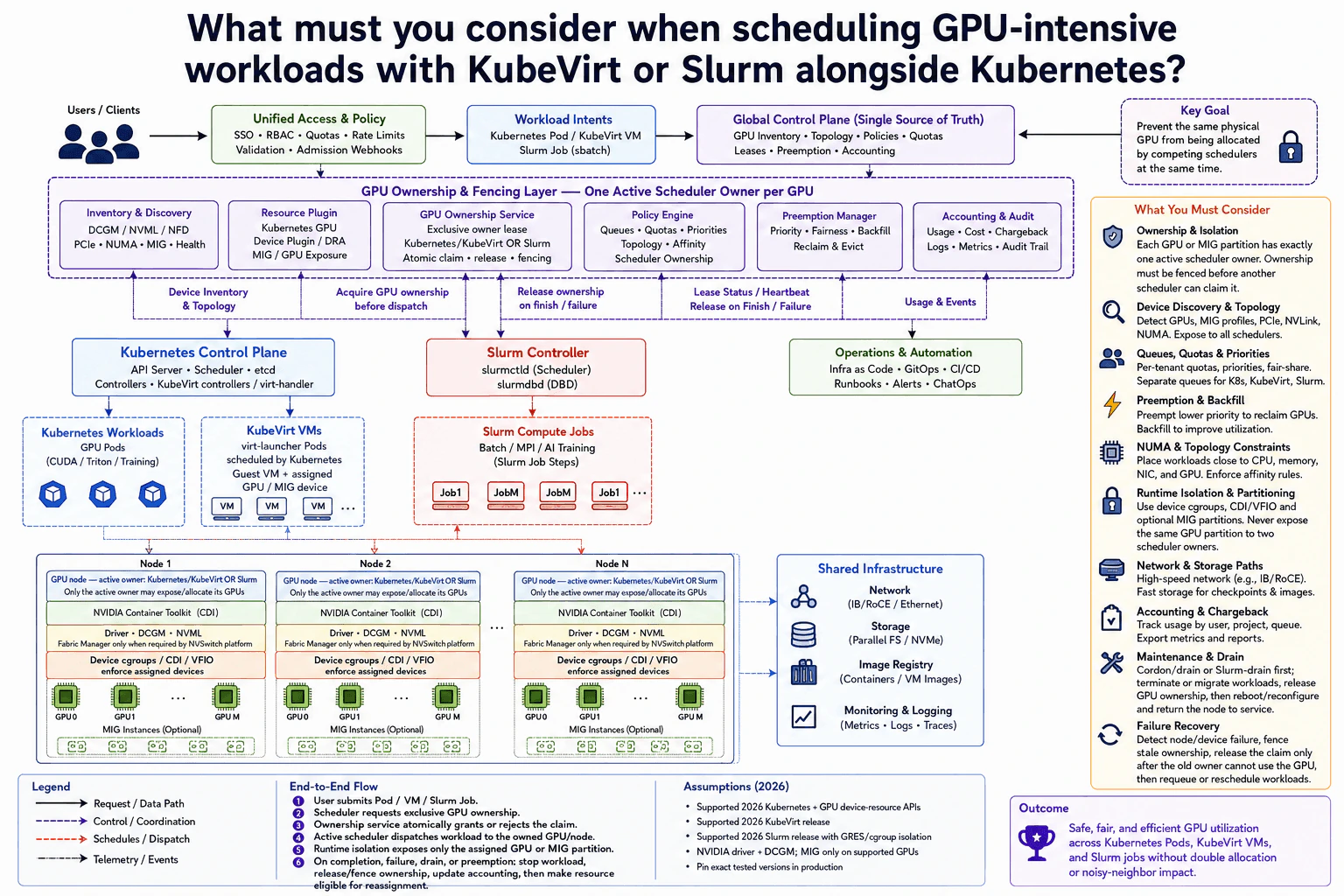
6. What must you consider when scheduling GPU-intensive workloads with KubeVirt or Slurm alongside Kubernetes?Containers And KubernetesHardNvidia

Question Details

A compute platform must support Kubernetes Pods together with virtual-machine or batch workloads that can request the same GPU-equipped hosts. Define ownership of nodes and devices, device discovery, queues and quotas, preemption, NUMA and topology constraints, runtime isolation, network and storage paths, accounting, maintenance, failure recovery, and the control that prevents one physical GPU from being allocated simultaneously by competing schedulers.

Short Interview Answer (30-60 seconds)

At a high level, the goal is to share GPU-equipped hosts safely between Kubernetes, KubeVirt, and Slurm. The main challenge is preventing two schedulers from claiming the same physical GPU or MIG partition. I would explain the design through submission, ownership, scheduling, and recovery. A shared control plane tracks inventory and policy, while the GPU Ownership Service grants one exclusive owner. Host-level isolation enforces that choice. The trade-off is safer sharing with extra coordination before scheduling.

Detailed Explanation

The platform must let Kubernetes Pods, KubeVirt virtual machines, and Slurm jobs use GPU-equipped hosts safely. The difficult part is that Kubernetes and Slurm make scheduling decisions independently. Without another control, both could think the same GPU is available. The diagram solves this by keeping one shared view of GPU state, giving each GPU or MIG partition one active scheduler owner, and enforcing that ownership on the host. I would explain the design from workload submission through ownership, placement, runtime isolation, shared infrastructure, and recovery.

Useful Questions to Ask the Interviewer
  1. Can Kubernetes, KubeVirt, and Slurm share the same physical nodes?
  2. Do workloads request full GPUs, MIG partitions, or both?
  3. Which workloads may preempt lower-priority GPU work?
  4. How important are NUMA, PCIe, NVLink, and network locality?
What must you consider when scheduling GPU-intensive workloads with KubeVirt or Slurm alongside Kubernetes? diagram
How to Explain It in an Interview
1. Start with access and workload intent

I would first control how work enters the platform. Users pass through Unified Access & Policy, which applies SSO, RBAC, quotas, rate limits, validation, and admission webhooks.

Workload Intents identifies whether the request is a Kubernetes Pod, KubeVirt VM, or Slurm batch job. The Global Control Plane keeps the shared GPU inventory, topology, policies, quotas, leases, preemption state, and accounting information.

2. Give every GPU one scheduler owner

The most important correctness rule is exclusive ownership. The GPU Ownership & Fencing Layer allows one active scheduler owner for each GPU or MIG partition.

The GPU Ownership Service creates an exclusive owner lease for Kubernetes/KubeVirt or Slurm. Claims and releases are atomic, so competing schedulers cannot successfully claim the same resource at the same time. The Policy Engine applies queues, quotas, priorities, topology rules, affinity, and scheduler ownership.

3. Discover resources and schedule the workload

Inventory & Discovery uses DCGM, NVML, and NFD information. It tracks GPU health, PCIe placement, NUMA placement, MIG state, and topology.

Kubernetes GPU Resource Exposure uses the Device Plugin or DRA when supported. Kubernetes schedules normal Pods and KubeVirt virt-launcher Pods. Slurm uses the Slurm Controller with slurmctld and slurmdbd. Each scheduler must acquire GPU ownership before dispatching work.

4. Enforce the decision on each GPU node

The control-plane decision must be enforced locally. Each GPU node has one active scheduler owner for its assigned devices.

The NVIDIA Container Toolkit, CDI, device cgroups, and VFIO restrict device access. MIG can create smaller GPU partitions on supported hardware. Fabric Manager is used only on NVSwitch platforms that require it. NUMA, PCIe, NVLink, affinity, and anti-affinity rules keep workloads close to the right CPU, memory, and GPU resources.

5. Include network, storage, monitoring, and accounting

GPU jobs also depend on fast shared infrastructure. The diagram uses IB/RoCE or Ethernet networking, Parallel FS or NVMe storage, an Image Registry, and Monitoring & Logging.

Accounting & Audit records usage, cost, chargeback, logs, metrics, and audit history. Operations & Automation supports infrastructure changes, GitOps, CI/CD, runbooks, alerts, and ChatOps.

6. Handle preemption, maintenance, and failures safely

Preemption can reclaim GPUs from lower-priority work according to policy. During maintenance, drain or stop workloads before releasing ownership and rebooting or reconfiguring the node.

After a failure, fence stale ownership first. Release the claim only after the old owner can no longer use the GPU. Then Slurm can requeue the job, or Kubernetes and KubeVirt can reschedule the workload. This adds coordination, but it prevents double allocation.

Practical Complexity & Trade-offs

The benefit is safe sharing of expensive GPUs across Kubernetes, KubeVirt, and Slurm. One ownership layer stops two schedulers from using the same GPU or MIG partition. Quotas, priorities, topology rules, and preemption also help place work fairly. The downside is more control logic. Schedulers must acquire ownership before dispatch, and failures need fencing before another scheduler can take over. Topology rules can also reduce the number of usable nodes. MIG adds flexibility, but it creates more resource units to track. We accept this complexity because wrong GPU ownership can break isolation and waste expensive hardware.

Why Interviewers Ask This

Interviewers want to see whether you understand that running several schedulers creates an ownership problem, not only a placement problem. They are testing your judgment around GPU discovery, quotas, topology, isolation, preemption, accounting, maintenance, and recovery. A strong answer also explains how fencing prevents stale or competing schedulers from allocating the same physical device.

Interviewer may ask next
What would you change if Kubernetes and Slurm had to share the same GPU nodes all the time?

I would keep the same design, but I would make the GPU Ownership & Fencing Layer the mandatory gate before every GPU dispatch. Each GPU or MIG partition would still have only one active scheduler owner.

Kubernetes or Slurm would first request an exclusive owner lease from the GPU Ownership Service. Only after the claim succeeds could that scheduler expose and allocate the device. The node would enforce the assignment with device cgroups, CDI, or VFIO, so another scheduler could not bypass the control-plane decision.

The Policy Engine would also matter more. Queues, quotas, priorities, and topology rules would decide which scheduler receives scarce GPUs. A handoff would require stopping or draining the current work, releasing ownership, and only then granting the device to another scheduler.

The downside is more coordination and slower scheduler handoffs.

How should the platform recover if a node fails while it still owns a GPU lease?

I would not immediately give that GPU to another scheduler. The platform must first make sure the old owner cannot still access the device.

The Global Control Plane uses lease status, heartbeat information, inventory, and health signals to detect the failure. The recovery path then fences the stale owner. Fencing means blocking the old scheduling domain from continuing to use that GPU.

Only after fencing succeeds should the GPU Ownership Service release the old claim. Accounting & Audit records the final usage and failure information. Slurm can then requeue its job, while Kubernetes or KubeVirt can reschedule their workload through the normal scheduling path.

This order protects correctness during slow failures or network splits. The downside is that reassignment may take longer because safe ownership transfer comes before fast recovery.

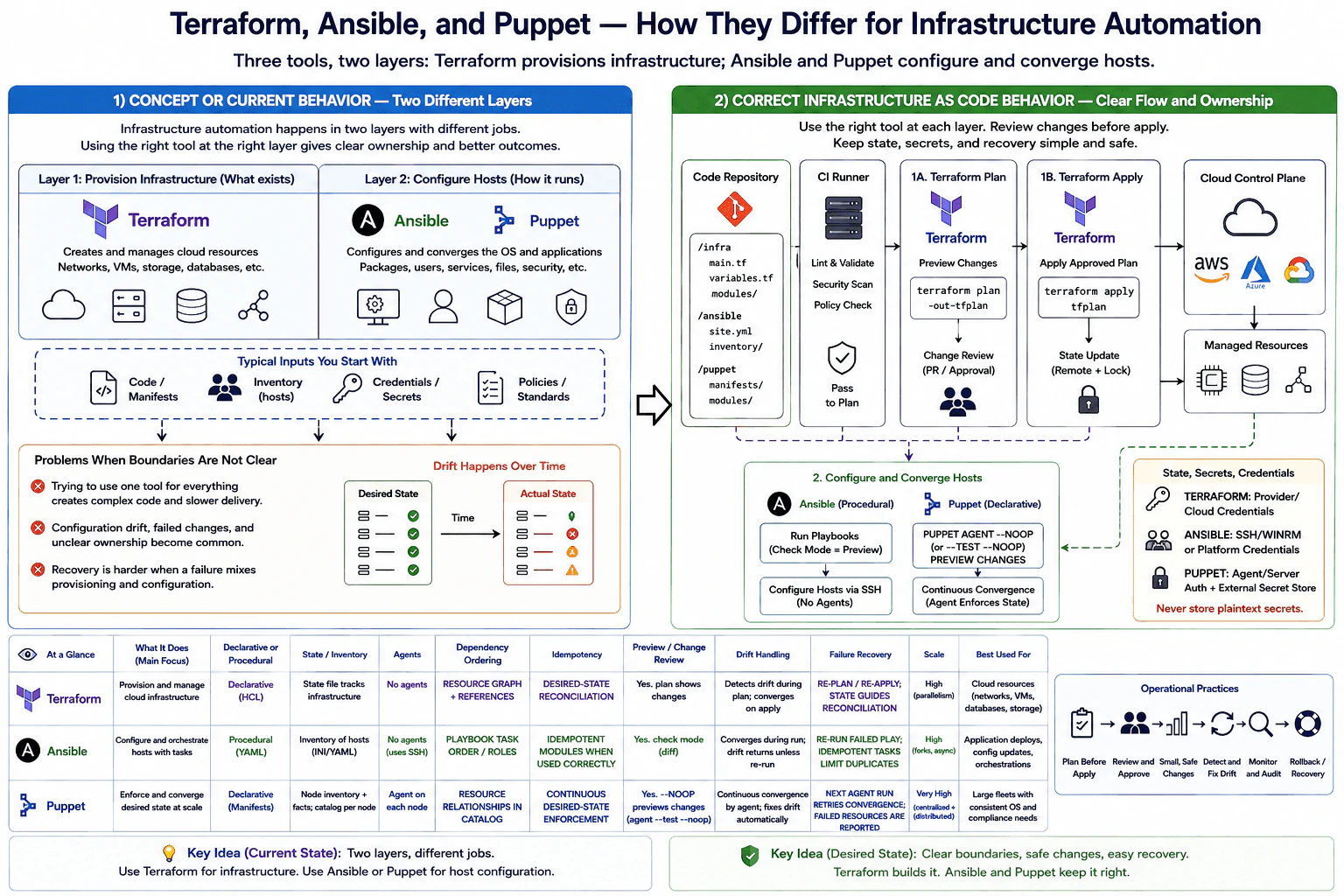
7. How do Terraform, Ansible, and Puppet differ for infrastructure automation?Infrastructure As CodeEasyNvidia

Question Details

Compare the three tools for provisioning cloud resources and converging host configuration. Address declarative and procedural boundaries, state and inventory, agents, dependency ordering, idempotency, drift, secrets, credentials, preview or change review, failure recovery, scale, and where combining tools creates a clearer ownership boundary than forcing one tool to manage everything.

Short Interview Answer (30-60 seconds)

Terraform is mainly for provisioning infrastructure, Ansible for agentless task-oriented host configuration, and Puppet for declarative continuous host convergence. Terraform tracks infrastructure state, Ansible uses inventory and ordered playbooks, and Puppet uses agents and catalogs. Combining them often creates a cleaner ownership boundary.

Detailed Explanation

Terraform, Ansible, and Puppet automate different parts of running computer systems. Terraform is mainly used to create and change things such as networks, servers, storage, and databases. Ansible is mainly used to install software, change settings, and run ordered tasks on machines that already exist. Puppet also manages machine settings, but it repeatedly checks them and brings them back to the expected condition. The important interview idea is not choosing one winner. It is deciding which tool should own each job so changes, mistakes, and recovery stay simple and understandable.

Useful Questions to Ask the Interviewer
  1. Are we comparing the tools mainly for cloud provisioning, host configuration, or both?
  2. Do hosts need continuous configuration enforcement, or are scheduled and on-demand configuration runs enough?
  3. Is an agentless model preferred, or are agents on managed hosts acceptable?
  4. Is an existing Terraform state backend, Ansible inventory, or Puppet server already part of the environment?
  5. How important are formal change reviews, drift detection, compliance enforcement, and recovery at the expected scale?
How do Terraform, Ansible, and Puppet differ for infrastructure automation? diagram
How to Explain It in an Interview

Start with the ownership boundary: Terraform normally owns the infrastructure layer, while Ansible or Puppet normally owns the host-configuration layer.

Terraform

Terraform is primarily declarative infrastructure provisioning. Declarative means you describe the desired infrastructure and Terraform determines dependency ordering from its resource graph and references so managed resources can move toward that configuration.

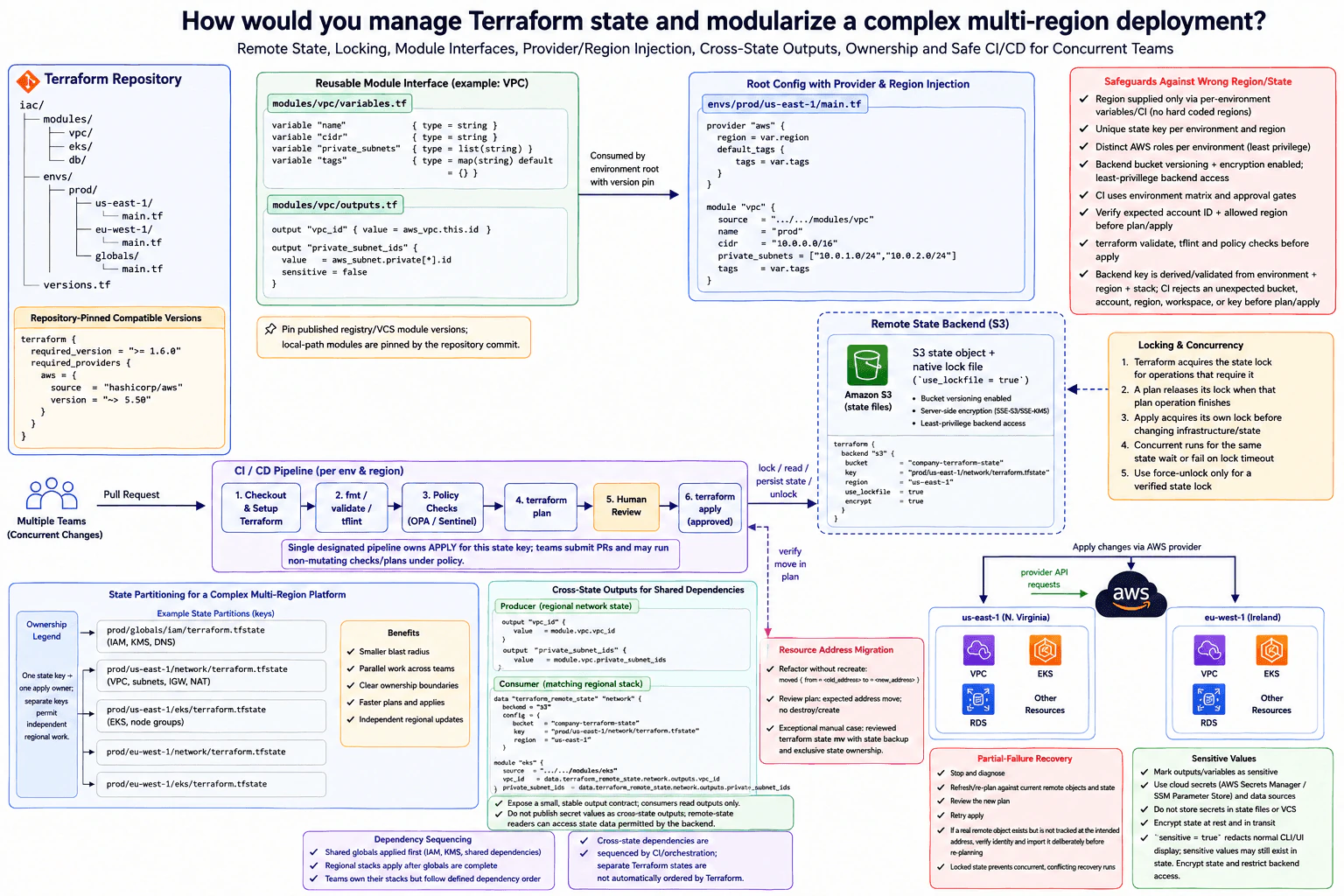
Terraform keeps state that maps configuration addresses to managed infrastructure objects. In team environments, state is normally kept in a remote backend with suitable locking or concurrency controls when the backend supports them. Terraform refreshes relevant resource information during planning and compares configuration with observed infrastructure to produce proposed changes.

A Terraform plan is a preview, not a guarantee. Infrastructure can change after planning, and provider or platform behavior can affect execution. If the team needs to apply the exact reviewed plan artifact, a typical workflow is terraform plan -out=tfplan, review that saved plan, and then run terraform apply tfplan. After a successful apply, Terraform records the resulting managed state.

Terraform normally does not require an agent on managed machines. It authenticates to cloud or other provider APIs with provider-specific credentials. Those credentials and other secrets should come from approved external secret mechanisms and should not be committed to source control, exposed in logs, placed on command lines unnecessarily, or deliberately written to outputs or state.

If an apply fails, inspect the failed resource and dependency, correct the underlying cause, generate a new plan when appropriate, and re-apply. State helps Terraform reconcile what it owns. Manual state edits should not be the default recovery method.

Ansible

Ansible is mainly task-oriented and procedural for host configuration and orchestration. Procedural means playbook tasks normally execute in an explicit order. Roles, includes, handlers, dependencies, and task ordering make that execution flow understandable.

Ansible commonly uses inventory to identify managed hosts and groups. Unlike Terraform, it does not normally maintain one persistent resource-state file representing the complete desired configuration of every managed host. It is commonly agentless and connects to hosts through mechanisms such as SSH or WinRM.

Many Ansible modules are designed to be idempotent. Idempotent means repeating the same desired task should not make unnecessary changes when the target is already correct. However, arbitrary shell commands, scripts, or poorly designed tasks may not be idempotent, so idempotency depends on the modules and automation used.

Ansible check mode can preview many changes, and diff mode can show differences for supported modules. Check mode is useful for review but is not a perfect simulation for every module. Configuration drift is normally corrected when the playbook runs again, so continuous convergence requires repeated or scheduled execution rather than happening automatically by default.

If a play fails, correct the cause and re-run it. Properly idempotent tasks limit duplicate or harmful changes during retries. Ansible commonly uses SSH, WinRM, API, or platform credentials. Secrets should come from Ansible Vault or another approved external secret store rather than plaintext inventory or playbooks.

Puppet

Puppet is declarative configuration management. Its manifests describe the desired configuration of resources such as packages, files, users, and services. Resource relationships in the compiled catalog define ordering where dependencies matter.

A typical Puppet deployment runs an agent on each managed node. The node provides facts, receives a compiled catalog describing desired configuration, applies that catalog, and reports results. This differs from Ansible's common agentless push-style operation.

Puppet resources are designed around idempotent desired-state enforcement. Because agents run repeatedly, Puppet can continuously detect configuration differences and converge hosts back toward the desired state. This makes Puppet a strong fit for large persistent fleets where configuration consistency and compliance need continuous enforcement.

For previewing Puppet agent changes without applying them, use noop behavior, for example puppet agent --test --noop. The critical flag is --noop; --test alone is not a no-change preview because a test run can apply changes.

If convergence fails, Puppet reports failed resources. After the underlying problem is corrected, a later agent run can retry convergence. Puppet environments normally use authenticated agent/server communication, while application secrets should still come from an appropriate secret-management mechanism rather than plaintext manifests.

State and Inventory

Terraform state tracks infrastructure resources that Terraform manages. It is part of Terraform's lifecycle and reconciliation model.

Ansible inventory identifies hosts and groups that playbooks target. Inventory is not equivalent to Terraform state.

Puppet works with node facts and compiled catalogs rather than one Terraform-like global infrastructure state file. The agent repeatedly applies the catalog that represents the node's desired configuration.

Dependency Ordering

Terraform derives dependencies from resource references and its dependency graph. Explicit dependencies can be added when a real dependency exists but is not visible through normal references.

Ansible normally follows playbook task order, with additional organization through roles, includes, handlers, and dependencies.

Puppet represents dependencies through relationships between resources in the catalog.

Idempotency

Terraform reconciles managed infrastructure toward the declared configuration using its state and provider operations.

Ansible commonly achieves idempotency through modules that first determine whether a change is needed. Non-idempotent commands can break that behavior.

Puppet repeatedly enforces declared desired state, so idempotent convergence is central to its model.

Drift

Terraform normally exposes infrastructure drift during refresh and planning and can reconcile approved differences during apply. Terraform does not continuously repair drift by itself.

Ansible corrects configuration drift when its playbooks run. Drift may remain until the next manual or scheduled run.

Puppet agents run repeatedly, so continuous host-configuration convergence and drift correction are core parts of its operating model.

Secrets and Credentials

Terraform commonly needs provider or cloud credentials. Ansible commonly needs SSH, WinRM, API, or platform credentials. Puppet uses agent/server authentication and may also need credentials or application secrets for managed systems.

Keep secrets outside normal source code. Use least-privilege credentials and approved secret stores. Avoid plaintext credentials in repositories, inventories, manifests, logs, command lines, outputs, or Terraform state whenever the design can prevent it.

Preview and Change Review

For Terraform, validate the configuration, run relevant security or policy checks, create a plan, review it, approve it, and then apply. If the exact approved plan must be executed, save the plan artifact and apply that artifact rather than creating a different plan later.

For Ansible, use check mode and diff support where supported before production changes, while remembering that some modules cannot fully predict behavior in check mode.

For Puppet, use noop mode to preview the changes an agent would make. Do not treat --test by itself as a dry-run guarantee.

Failure Recovery

Terraform recovery usually means correcting the failed dependency, credential, provider, API, quota, or platform problem, re-planning when needed, and re-applying so managed infrastructure and state can converge again.

Ansible recovery normally means correcting the failed task or dependency and re-running the play. Idempotent tasks make retries safer and reduce duplicate work.

Puppet reports failed resources and retries convergence on later agent runs after the underlying problem has been corrected.

Scale

Terraform can manage large infrastructure graphs and can execute independent operations concurrently, subject to provider and platform limits.

Ansible can operate across large inventories using forks, batching, roles, and orchestration patterns. The control node still has to manage many remote connections and task executions.

Puppet is well suited to very large persistent fleets because catalog compilation can be centralized while agents perform distributed convergence across nodes.

Why Combining Them Often Works Better

A clean production design often uses Terraform to provision infrastructure and Ansible or Puppet to configure hosts afterward. For example, Terraform can create networks, compute instances, storage, and databases. When those resources exist, Ansible can configure hosts through SSH or WinRM, or Puppet agents can continuously enforce their desired configuration.

This separation creates a clear ownership boundary. Terraform owns infrastructure lifecycle and state. Ansible can own configuration and orchestration tasks. Puppet can own continuous host configuration and compliance. Failures can be isolated to the correct layer, credentials can stay scoped to each tool's responsibilities, and change review and recovery become easier to understand than when one automation tool is forced to manage everything.

Technical Approach
  1. Separate the problem into infrastructure provisioning and host configuration.
  2. Give Terraform ownership of cloud or infrastructure resource lifecycle and Terraform state.
  3. Choose Ansible when agentless, ordered configuration or orchestration fits the requirement.
  4. Choose Puppet when hosts need declarative, repeated convergence through agents.
  5. Store Terraform state remotely with suitable concurrency protection for team workflows.
  6. Keep Ansible inventory and Puppet facts/catalog behavior conceptually separate from Terraform state.
  7. Model dependencies with Terraform resource graphs and references, Ansible task and role ordering, and Puppet resource relationships.
  8. Keep credentials and secrets outside normal source code and use least privilege.
  9. Preview and review production changes with Terraform plan, Ansible check mode where supported, and Puppet noop mode.
  10. After failures, correct the underlying problem and re-run the appropriate automation layer instead of mixing recovery responsibilities.
  11. Monitor drift and run reconciliation at the frequency appropriate for each tool.
Practical Insights

There is no useful Big-O code complexity for this conceptual question. The important costs are operational. Terraform must refresh infrastructure information, build its dependency graph, call providers, apply changes, and maintain state. Large graphs increase planning and apply work, although independent resources can run concurrently. Ansible runtime grows with the number of hosts and tasks, while forks and batching control concurrency. Puppet spreads convergence work across agents, but large fleets increase catalog compilation, reporting, and server-capacity needs. Using more than one tool adds operational knowledge and pipeline maintenance, but clear ownership can lower long-term complexity because each tool manages the layer it fits best.

Why Interviewers Ask This

This question tests whether the candidate understands that infrastructure provisioning and host configuration are different automation problems. The interviewer wants practical judgment about declarative versus procedural behavior, state and inventory, agents, dependency ordering, idempotency, drift, secrets, credentials, change review, recovery, and scale. A strong candidate should also recognize when combining Terraform with Ansible or Puppet creates clearer ownership, safer changes, and easier failure recovery than forcing one tool to control every layer.

Common interview mistakes

A common mistake is saying Terraform, Ansible, and Puppet are interchangeable because they all automate infrastructure work. Terraform normally owns infrastructure resource lifecycle, while Ansible and Puppet are primarily configuration-management tools. Another mistake is calling Ansible completely declarative; playbooks normally have meaningful procedural task ordering even though many modules express desired state. Do not claim every Ansible task is idempotent, because arbitrary commands and poorly designed automation may not be. Do not say Puppet --test alone is a dry run; --noop is needed for a no-change preview. Do not claim a Terraform plan guarantees the later apply result. Avoid mixing infrastructure lifecycle and host configuration into one tool without a clear reason, storing secrets in source code, performing unreviewed production applies, or treating manual Terraform state edits as normal rollback.

Interview tip

Start with the simple ownership boundary: Terraform builds and changes infrastructure; Ansible or Puppet configures hosts. Then compare declarative versus procedural behavior, state and inventory, agents, dependencies, idempotency, drift, secrets, review, recovery, and scale. Finish by explaining why clear ownership makes production changes and failures easier to reason about.

Interviewer may ask next
When would you choose Ansible instead of Puppet after Terraform provisions the infrastructure?

Choose Ansible when you want agentless configuration or orchestration, explicit ordered workflows, and changes that run on demand or on a schedule. It works well for software installation, deployments, patching, rolling changes, and operational tasks over SSH or WinRM. Choose Puppet when persistent hosts need an agent that repeatedly checks and converges configuration, especially when continuous compliance across a large fleet is important. Both can follow Terraform provisioning, but their operating models are different.

Why not use Terraform to provision the infrastructure and also configure everything inside each server?

Terraform can trigger external configuration mechanisms, but making it own detailed host configuration often mixes two different lifecycles. Infrastructure resources and operating-system settings change at different speeds, use different credentials, have different drift behavior, and fail in different ways. Keeping Terraform responsible for infrastructure and Ansible or Puppet responsible for hosts makes state ownership, dependency boundaries, change review, retries, drift handling, and recovery easier to reason about. Combine the tools when their ownership boundaries are clear, not simply because more tools are available.

8. How would you use Ansible or Salt to manage configuration across large enterprise infrastructure?Infrastructure As CodeMediumNvidia

Question Details

A heterogeneous fleet needs repeatable package, file, service, and policy configuration. Define inventory and host identity, reusable role or state boundaries, variables and secret references, idempotency, ordering and handlers, bounded concurrency, privilege, check or preview behavior, failure and retry rules, per-host evidence, drift detection, rollback, and how an interrupted run resumes without undoing already-converged hosts.

Short Interview Answer (30-60 seconds)

I would use version-controlled Ansible roles, reliable inventory, protected variables, idempotent tasks, handlers, least privilege, check mode, and bounded concurrency. I would collect per-host evidence, detect drift, use explicit rollback where needed, and safely rerun interrupted work because already-converged hosts remain correct.

Detailed Explanation

See the Code while reading this explanation.

A large company may have many different machines that all need the same approved settings. I would keep those settings in one reviewed place, organize machines by purpose, and reuse small building blocks instead of copying instructions. Before changing anything, I would preview and review the work. I would change machines in limited groups so one mistake cannot affect everything at once. Each machine would report what happened. Repeating the same work should leave correct machines alone. If a run stops, I can safely run it again and focus later work on machines that failed.

Useful Questions to Ask the Interviewer
  1. How large is the fleet, and what operating systems, databases, network devices, container or Kubernetes nodes, and cloud instances must be managed?
  2. Is inventory primarily static, dynamically generated from systems such as a CMDB, cloud API, or service discovery, or a combination of both?
  3. What rollout controls are required, such as fixed batches, maintenance windows, canaries, or different concurrency limits for different host groups?
  4. Which secret-management system and privilege-escalation model are already approved?
  5. What audit evidence, compliance checks, retention period, and drift-detection frequency are required?
  6. Which configuration changes need explicit reverse operations or external backups or snapshots for recovery?
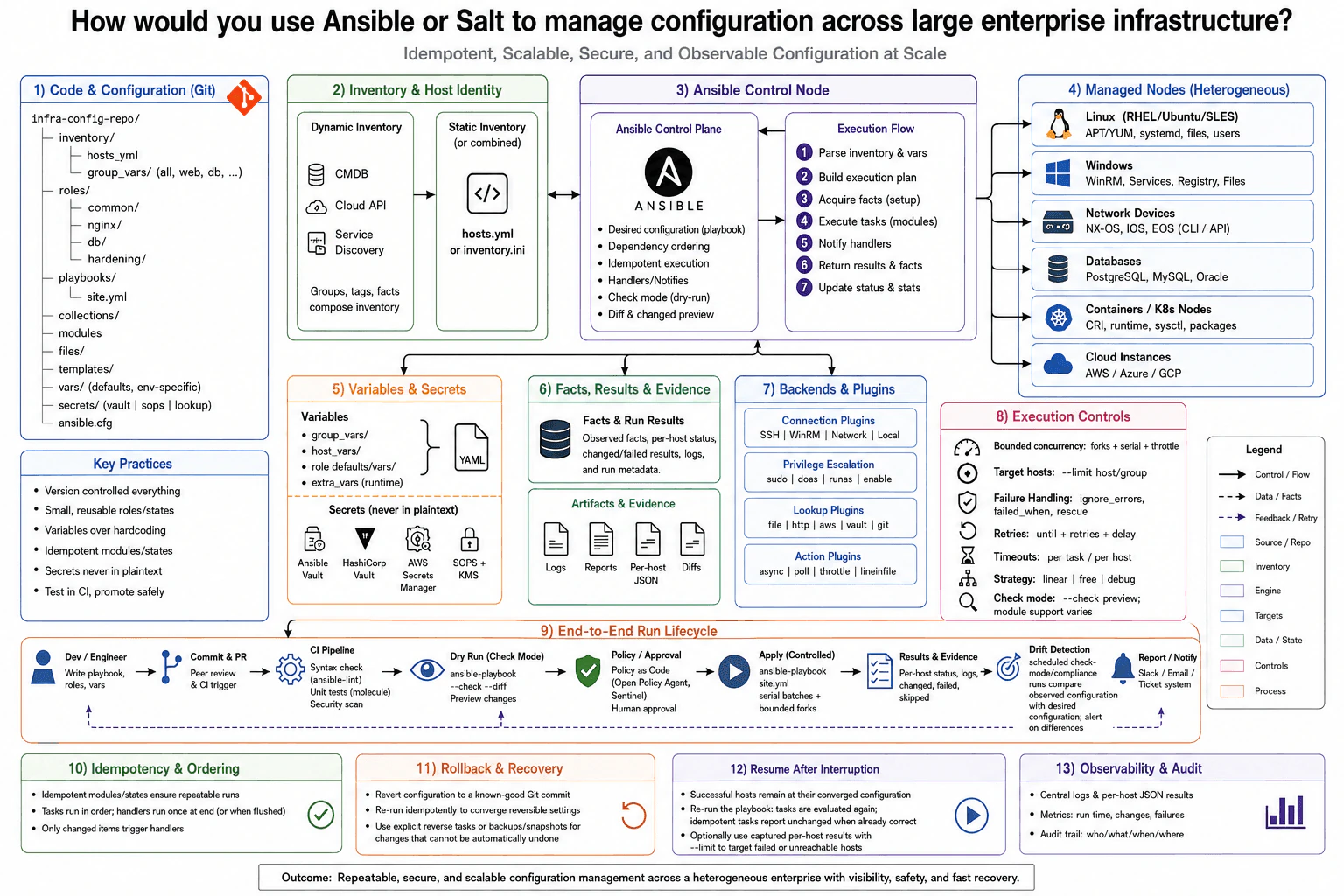
How would you use Ansible or Salt to manage configuration across large enterprise infrastructure? diagram
How to Explain It in an Interview

I would choose one configuration-management implementation and keep its operating model consistent. Using Ansible, I would keep playbooks, roles, inventory definitions, variables, templates, and Ansible configuration in Git. Because the prompt does not supply a repository-pinned Ansible version, I would use the organization's approved stable Ansible release in 2026 and pin that exact version in the repository and CI environment.

1. Inventory and Host Identity

Inventory maps automation to real managed hosts. I would use stable host identities and group hosts by function, environment, location, or another operational boundary. Static YAML or INI inventory works for stable systems. Dynamic inventory can obtain hosts from a CMDB, cloud API, or service-discovery source. The important point is that identity and grouping are deterministic so a host receives the intended configuration every time.

2. Reusable Roles and Configuration Boundaries

I would split configuration into small roles such as common baseline, web server, database, and hardening. Each role owns a narrow responsibility. Tasks then manage packages, files or templates, services, users, groups, and policy settings. This reduces duplication and makes each change easier to review, test, and reuse.

3. Variables and Secrets

Role defaults should contain safe defaults, group variables should hold values shared by inventory groups, host variables should contain true host-specific exceptions, and runtime extra variables should be used only when necessary. Secrets must never be stored as plaintext in Git. I would reference Ansible Vault or an approved external secret system such as HashiCorp Vault, a cloud secret manager, SOPS-protected values, or a KMS-backed workflow. Secret values should also be kept out of logs and command lines.

4. Idempotency, Ordering, and Handlers

Idempotency means that running the same automation again leaves an already-correct host unchanged. I would prefer Ansible modules that declare the required state instead of shell commands that blindly perform an action. Tasks execute in a defined order, and dependencies should be explicit in the role and play structure. A handler runs only when a notifying task reports a change, which avoids unnecessary service restarts.

5. Bounded Concurrency

A large fleet should not be changed everywhere at once. Ansible forks bound controller-side parallelism, serial limits a play to controlled host batches, and throttle can restrict concurrency for a specific task or block. The --limit option is different: it selects which hosts or groups participate and is not itself a concurrency control. For risky production changes, I would start with small serial batches and increase concurrency only after the results are healthy.

6. Privilege and Connectivity

The Ansible control node should connect using the transport appropriate for each managed system, such as SSH for many Unix-like hosts, WinRM for Windows, or supported network connection plugins for network devices. I would use restricted automation accounts and elevate privileges with become only for tasks that require it. This follows least privilege and avoids unnecessary permanent administrator access.

7. Preview, Validation, and Approval

Before production execution, CI should perform syntax checks, linting, available unit or integration tests, security checks, policy checks, and human review. Ansible check mode provides a preview for modules that support it, and --diff can show certain file changes. Check mode is not a guarantee that the real run will succeed because some modules have limited check-mode support and remote conditions can change between preview and execution.

8. Failure and Retry Rules

I would define failures deliberately instead of hiding them. failed_when can express the real failure condition. block and rescue can handle expected recovery paths. retries with until and delay can handle temporary conditions, and timeouts should prevent a task or host from blocking the rollout indefinitely. ignore_errors should be rare because continuing after an important failure can leave a host in an unsafe partial condition.

9. Per-Host Evidence

Every run should retain per-host results such as changed, unchanged, failed, skipped, and unreachable status, plus useful logs, timestamps, return codes, and run metadata. Central reporting should associate that evidence with the reviewed Git revision and automation run. These facts and run results are execution evidence; they are not a Terraform-style persistent desired-state backend.

10. Drift Detection

Drift means the observed configuration no longer matches the approved configuration. I would schedule check-mode or compliance runs and compare observed configuration with the desired configuration. Differences should create an alert or report. Depending on policy, the next approved run can converge the host back to the intended state.

11. Rollback and Recovery

Rollback is not automatically guaranteed. For reversible configuration, I can revert the repository to a known-good Git commit and rerun the playbook so idempotent tasks converge hosts toward that configuration. Changes that cannot be reversed declaratively need explicit reverse tasks or an external recovery mechanism such as a file backup, database backup, or platform snapshot. A Git revert alone does not undo every possible remote side effect.

12. Interrupted-Run Behavior

Ansible does not maintain a persistent task checkpoint that automatically resumes at the exact failed task. If a run is interrupted, hosts that already converged keep their resulting configuration. I rerun the playbook; Ansible evaluates the tasks again, and correctly written idempotent tasks report unchanged where the desired state is already present. Per-host results from the failed run can identify failed or unreachable hosts, and --limit can target those hosts for a focused rerun when dependency and batch semantics make that safe.

The main tradeoff is speed versus blast radius. Higher concurrency finishes faster but increases simultaneous impact, controller load, network load, and pressure on downstream dependencies. Smaller batches take longer but provide safer observation and easier recovery. My production default is therefore version-controlled configuration, reusable roles, least privilege, preview and policy review, bounded batches, per-host evidence, continuous drift checks, and idempotent reruns.

Technical Approach
  1. Store Ansible playbooks, roles, inventory definitions, templates, variable structure, and ansible.cfg in Git, and pin the organization's approved Ansible version in the repository and CI environment.
  2. Build deterministic inventory using static inventory, dynamic inventory, or both, with stable host identities and meaningful groups.
  3. Split package, file, service, user, and policy configuration into small reusable roles with clear ownership.
  4. Put normal values in role defaults, group variables, and host variables; reference secrets from Ansible Vault or an approved external secret manager instead of plaintext source files.
  5. Use idempotent Ansible modules and explicit task ordering. Notify handlers only when a relevant task reports a change.
  6. Validate in CI with syntax checks, linting, tests, security or policy checks, human review, and check-mode or diff previews where supported.
  7. Execute with least-privilege credentials and become only where elevated privileges are required.
  8. Bound rollout concurrency using forks, serial, and task-level throttle. Use --limit only to select hosts or groups.
  9. Define failure conditions, retries, delays, rescue paths, and timeouts intentionally. Avoid hiding important failures with broad ignore_errors behavior.
  10. Store per-host execution evidence and run metadata centrally so changed, unchanged, failed, skipped, and unreachable hosts are traceable.
  11. Run scheduled check-mode or compliance jobs for drift detection and alert when observed configuration differs from approved configuration.
  12. Recover by reverting to known-good configuration and reconverging reversible settings, while using explicit reverse tasks or backups and snapshots for non-reversible changes.
  13. After interruption, rerun the playbook. Idempotent tasks leave already-correct hosts unchanged, and captured per-host results plus --limit can target failed or unreachable hosts when appropriate.
Practical Insights

The main cost is operational rather than algorithmic. A run must evaluate tasks for every targeted host, so the amount of work grows with both the number of hosts and the number of tasks. Increasing forks or batch size can reduce elapsed time, but it also increases controller load, network connections, pressure on managed services, and blast radius. Small reusable roles reduce maintenance cost because one reviewed change can be reused across many hosts. Dynamic inventory and centralized evidence add supporting-system cost but improve accuracy and auditability. Drift checks create regular read traffic. Backups or snapshots consume storage but may be necessary for changes that configuration alone cannot safely reverse.

Code
code = '---\n# Target an inventory group so host identity and environment membership remain\n# owned by inventory rather than being hard-coded into the automation.\n- name: Converge web configuration safely\n  hosts: web\n\n  # Process a bounded number of hosts at a time to reduce production blast radius.\n  # Controller-side forks provide another independent limit on parallel execution.\n  serial: 10\n\n  # Elevate privileges only for tasks that require operating-system changes instead\n  # of running the automation account with unrestricted administrator privileges.\n  become: true\n\n  vars:\n    # This is only a reference to a secret variable. The real value must come from\n    # Ansible Vault or an approved external secret store and never plaintext Git.\n    app_secret: "{{ vault_app_secret }}"\n\n  tasks:\n    # The package module is idempotent. A host that already has the required package\n    # state reports unchanged when the playbook is safely rerun after interruption.\n    - name: Install the required web package\n      ansible.builtin.package:\n        name: nginx\n        state: present\n\n    # Template ownership and permissions are explicit. The handler is notified only\n    # when this task changes the file, preventing unnecessary service restarts.\n    - name: Render the reviewed web configuration\n      ansible.builtin.template:\n        src: nginx.conf.j2\n        dest: /etc/nginx/nginx.conf\n        owner: root\n        group: root\n        mode: "0644"\n      notify: Restart nginx\n\n    # Service state is declarative and idempotent, so a repeated execution converges\n    # the host instead of blindly issuing a start command on every run.\n    - name: Keep nginx enabled and running\n      ansible.builtin.service:\n        name: nginx\n        enabled: true\n        state: started\n\n    # This temporary readiness condition is retried deliberately. A permanent\n    # failure still fails the host instead of being hidden by ignore_errors.\n    - name: Wait for the local service to become ready\n      ansible.builtin.uri:\n        url: http://127.0.0.1/\n        status_code: 200\n      register: readiness\n      until: readiness.status == 200\n      retries: 5\n      delay: 3\n      changed_when: false\n\n  handlers:\n    # A handler runs only after notification from a changed task, preserving ordering\n    # and avoiding a restart when the managed configuration did not change.\n    - name: Restart nginx\n      ansible.builtin.service:\n        name: nginx\n        state: restarted'
Why Interviewers Ask This

The interviewer wants to see whether you can manage configuration safely across a large heterogeneous fleet rather than simply write a playbook. The key judgment areas are inventory and host identity, reusable configuration boundaries, variables and secrets, idempotency, dependency ordering, handlers, bounded concurrency, privilege control, preview behavior, failure recovery, per-host evidence, drift detection, rollback, and safe reruns after interruption.

Common interview mistakes

Common mistakes are treating --limit as a concurrency control instead of a host selector; running against the entire fleet at once instead of using bounded forks, serial batches, or throttle; storing secrets in Git, logs, or command lines; using non-idempotent shell commands unnecessarily; restarting services on every run instead of using handlers; assuming check mode perfectly predicts execution; ignoring module-specific preview limitations; using ignore_errors broadly; granting automation permanent unrestricted administrator privileges; failing to retain per-host evidence; confusing facts and run results with a Terraform-style persistent state backend; claiming that a Git revert automatically reverses every remote side effect; and claiming an interrupted Ansible run automatically resumes from a persistent checkpoint.

Interview tip

Present the design as one safe operating loop: identify hosts, compose reusable roles and variables, preview and review, execute in bounded batches with least privilege, collect per-host evidence, detect drift, and recover through idempotent reruns or explicit rollback. Emphasize that speed is traded against blast radius and that check mode is a preview, not a guarantee.

Interviewer may ask next
How would you safely resume an Ansible rollout if the controller stopped halfway through a large deployment?

I would use the previous run's per-host evidence to identify which hosts completed, failed, or became unreachable. After correcting the cause of the interruption, I would rerun the same reviewed playbook. Ansible evaluates the tasks again, and idempotent tasks on already-correct hosts should report unchanged rather than undoing or unnecessarily repeating the change. If a focused retry is operationally safe, I can use --limit to select failed or unreachable hosts after checking dependencies and batch ordering. I would not claim that Ansible automatically resumes from a persistent task checkpoint.

How would you balance rollout speed against safety when configuring thousands of hosts?

I would control three different forms of scope or parallelism separately. Forks bound controller-side parallelism, serial limits how many hosts are processed in each play batch, and throttle can restrict concurrency for a sensitive task or block. I would start production with small batches, inspect health and per-host evidence, and increase concurrency only when the infrastructure and downstream dependencies can tolerate it. --limit only chooses participating hosts or groups. Higher concurrency is faster, while smaller batches reduce blast radius and make failures easier to isolate and recover.

9. How would you manage Terraform state and modularize a complex multi-region deployment?Infrastructure As CodeHardNvidia

Question Details

A single platform spans several regions and shared dependencies while multiple teams may plan changes concurrently. Design module interfaces, provider and region injection, state partitioning, backend availability and locking, sensitive values, cross-state outputs, version pinning, migration of resource addresses, plan and apply ownership, dependency sequencing, partial-failure recovery, and safeguards against selecting the wrong region or state key.

Short Interview Answer (30-60 seconds)

I would use small reusable modules, regional root configurations, and separate state by environment, region, and stack. Each state key has one apply owner, encrypted S3 remote state with locking, validated CI targets, reviewed plans, small non-secret cross-state outputs, explicit dependency sequencing, and safe recovery procedures.

Detailed Explanation

This question asks how I would organize a large infrastructure setup that runs in several locations and is changed by several teams. The goal is to stop one team from accidentally changing another team's work or the wrong location. I would divide the setup into small reusable parts, keep change records separate where ownership is different, protect private information, and use a controlled review process before changes go live. I also need a safe way to share required information, rename managed items, recover from failed changes, and confirm that every change targets the correct place.

Useful Questions to Ask the Interviewer
  1. Which environments, regions, and infrastructure layers need separate ownership and deployment schedules?
  2. Which dependencies are truly global, and which belong to one regional stack?
  3. Can several teams plan against the same state, or should independently owned stacks always use separate state keys?
  4. Which CI/CD system is allowed to perform production applies, and what human or policy approvals are required?
  5. What encryption, retention, access-control, and availability requirements apply to the remote state backend?
  6. Are there existing Terraform resources whose addresses must be changed without recreating the real infrastructure?
  7. Which values must cross state boundaries, and could any of them contain sensitive data?
How would you manage Terraform state and modularize a complex multi-region deployment? diagram
How to Explain It in an Interview

I would avoid one monolithic Terraform state for the whole platform. I would partition state by environment, region, and stack. The diagram shows a global state for shared dependencies such as IAM and KMS, plus separate regional network and EKS states such as prod/us-east-1/network/terraform.tfstate and prod/us-east-1/eks/terraform.tfstate. This reduces blast radius, allows independent regional work, and creates clear ownership boundaries.

The ownership rule is simple: one state key has one designated apply-owning pipeline. Multiple teams can submit pull requests and run approved validation or planning workflows, but production mutation for that state is controlled by its owner. Separate state keys can be operated independently when their dependencies allow it.

I would keep reusable modules small. A module such as the VPC module exposes explicit typed inputs like name, CIDR, private subnets, and tags, and exposes a small stable output contract such as VPC ID and private subnet IDs. The environment root owns the provider configuration and region selection. The reusable module should not hard-code a production region. With the normal inherited-provider case shown in the diagram, the child module uses the provider configuration supplied by its root configuration; modules that require provider aliases would need explicit provider mappings.

For version control, I would pin compatible Terraform and provider versions in the repository. Published registry or VCS modules should use immutable version references. Local-path modules are pinned by the repository commit containing the root and module code. Because the design uses the S3 backend's native lock-file capability, the actual repository-pinned Terraform version must be one that supports use_lockfile = true; the lower-bound version example in the diagram should not be treated as sufficient by itself if it includes older unsupported releases.

For remote state, I would use an S3 backend with bucket versioning, encryption, and least-privilege access. Native state locking uses the S3 lock file with use_lockfile = true. Terraform acquires the lock for operations that require exclusive state access. A plan releases its lock when that plan operation ends. An approved apply later obtains its own lock before changing infrastructure and persisting updated state. Concurrent runs against the same state should wait or fail according to the configured lock timeout. I would use force-unlock only after verifying that the lock is stale and that no legitimate Terraform process still owns it.

The apply path and the state path are separate responsibilities. Terraform apply sends provider API requests to the cloud control plane to create or update resources such as regional VPC, EKS, and RDS resources. The S3 backend is used for state and lock operations: lock, read state, persist the new state, and unlock. The backend is not the mechanism that changes AWS resources.

To prevent the wrong state or region from being selected, CI should derive or validate the backend key from environment, region, and stack. Before plan and apply, CI should verify the expected cloud account, allowed region, workspace if workspaces are used, backend bucket, and state key. It should reject unexpected values instead of relying on a human to notice them later. Provider credentials and backend permissions should also follow least privilege.

The CI/CD flow should run formatting, validation, linting, and policy checks before Terraform plan. The plan is then reviewed by the required human or policy gate before an approved apply. A Terraform plan is a preview based on the observed remote objects and state at that time. It is not a guarantee that a later apply will succeed because infrastructure can drift, quotas can change, and provider or cloud behavior can produce new conditions between plan and apply.

For cross-state dependencies, I would expose only a small stable set of outputs. The diagram shows the regional network state producing values such as vpc_id and private_subnet_ids, and the matching regional EKS stack consuming them. I would not use remote state as a general data-sharing mechanism for secrets or internal implementation details. Consumers should depend only on intentionally exposed values. The sensitive flag reduces accidental CLI or UI display, but sensitive values can still exist in Terraform state, so state must remain encrypted and tightly access-controlled.

Separate states do not automatically create a Terraform dependency graph across those states. CI or another orchestration layer must sequence them explicitly. Shared global dependencies are applied first, regional network stacks follow when required, and workloads such as EKS are applied only after their required regional outputs are available. This sequencing belongs to the delivery workflow, not to an assumed automatic ordering between independent state files.

For resource-address refactoring, I would prefer Terraform moved blocks. A moved block records that an existing object changed from an old Terraform address to a new address. I would run a fresh plan and verify that it shows the expected address move rather than an unwanted destroy-and-create operation. For an exceptional manual migration using terraform state mv, I would require exclusive ownership of the state, a recoverable backup, exact source and destination address review, and a fresh plan immediately afterward.

For partial failures, I would not blindly rerun the old plan. I would stop and diagnose what actually succeeded, refresh or create a new plan against the current remote objects and state, review that new plan, and then retry or forward-fix the remaining work. If a real remote object exists but Terraform is not tracking it at the intended address, I would verify its identity and deliberately import it before re-planning. I would avoid manual state editing except for exceptional, controlled recovery procedures.

The main tradeoff is that more state partitions reduce blast radius, lock contention, and ownership conflicts, but they increase the number of backend keys, pipelines, permissions, outputs, and dependency relationships that must be maintained. I would therefore split state where lifecycle, ownership, failure domain, or deployment cadence is genuinely different rather than creating a separate state file for every individual resource.

Technical Approach
  1. Define small reusable modules with explicit typed inputs and a small stable output contract.
  2. Keep provider and region configuration in each environment or regional root instead of hard-coding regions inside reusable modules.
  3. Partition state by environment, region, and stack, while keeping truly shared dependencies in a separate global state.
  4. Assign exactly one production apply-owning pipeline to each state key.
  5. Store state in an encrypted, versioned S3 backend with least-privilege access and a Terraform version that supports native use_lockfile = true locking.
  6. Derive or validate the backend key from environment, region, and stack and verify the expected account and allowed region before plan or apply.
  7. Run formatting, validation, linting, policy checks, and Terraform plan in CI.
  8. Require the appropriate human or policy approval before production apply.
  9. Send infrastructure changes through the Terraform provider to the cloud control plane while independently reading, locking, persisting, and unlocking remote state in S3.
  10. Pass dependencies between states through small non-secret outputs and sequence separate states explicitly in CI or orchestration.
  11. Pin Terraform, provider, and published module versions; use the repository commit to pin local-path modules.
  12. Use moved blocks for normal resource-address refactoring and reserve reviewed terraform state mv for exceptional migrations.
  13. After a partial failure, diagnose the actual remote state, refresh or re-plan, review the new plan, and forward-fix or retry.
Practical Insights

There is no useful algorithmic Big-O complexity for this design. The important costs are operational. More state partitions reduce blast radius, lock contention, and the number of unrelated resources included in one plan, but they create more state keys, pipelines, permissions, outputs, and dependency relationships to manage. Smaller states are generally easier to review and allow more independent regional work. The remote backend also adds ongoing requirements for encryption, version retention, access control, locking, backup recovery, and availability.

Why Interviewers Ask This

This question tests whether a candidate can scale Terraform safely across multiple regions and teams. The interviewer is looking for sound module boundaries, correct provider and region handling, state partitioning, reliable remote-state locking, controlled apply ownership, safe cross-state dependencies, version pinning, secret protection, address migration, dependency sequencing, plan review, drift awareness, and recovery from partial failures. It also tests whether the candidate understands that separate state files reduce blast radius but require explicit orchestration and that a Terraform plan is only a point-in-time preview, not a guarantee that a later apply will succeed.

Common interview mistakes

Common mistakes include putting every region and service into one large state file; hard-coding regions inside reusable modules; allowing several pipelines to apply to the same state; assuming a plan keeps its state lock throughout a long approval period; treating separate state files as if Terraform automatically sequences them; routing infrastructure changes conceptually through the state backend instead of the provider; exposing secrets or unnecessary implementation details through cross-state outputs; assuming sensitive = true removes values from state; using broad backend permissions; failing to verify the selected account, region, workspace, bucket, or state key; using incompatible Terraform versions with native S3 locking; leaving provider or module versions effectively unpinned; using manual state commands when a reviewed moved block is sufficient; blindly retrying after a partial failure; and assuming an approved plan guarantees that a later apply will succeed.

Interview tip

Explain the design from boundaries to workflow: reusable module, regional root, state partition, remote backend and locking, apply ownership, provider API flow, cross-state outputs, dependency sequencing, safeguards, migration, and recovery. Emphasize that one state key has one apply owner, separate states need explicit orchestration, state is not the path used to mutate cloud resources, and a plan is a preview rather than a guarantee.

Interviewer may ask next
How would you let several teams run Terraform plans concurrently without risking conflicting production applies?

I would place independently owned infrastructure in different state keys so teams can work without contending on one monolithic state. For a shared state, CI can allow approved validation and planning workflows, but one designated pipeline owns production apply for that state key. Terraform obtains the state lock for operations that require it; a plan releases its lock when the plan ends, and the later approved apply obtains its own lock. CI also validates the expected backend key, account, region, and workspace before either operation.

What would you do if a module refactor changes Terraform resource addresses but the real infrastructure must not be recreated?

I would declare the mapping with Terraform moved blocks and run a new plan. The plan should show that Terraform is changing the address of the existing managed object instead of destroying and recreating it. If an exceptional case requires terraform state mv, I would stop competing operations, obtain exclusive ownership of the state, verify a recoverable backup, review the exact source and destination addresses, perform the move, and immediately run a fresh plan. If a real remote object exists but is not tracked at the intended address, I would verify its identity and deliberately import it before re-planning.

10. What are NCCL logs, and why are they important in distributed training?ObservabilityEasyNvidia

Question Details

A multi-GPU training job uses collective communication across processes and nodes. Explain which NCCL initialization, topology, transport, rank, collective and failure details the logs can expose, how timestamps and job identity are correlated with GPU, network and application signals, which verbosity is safe in production, and what the logs cannot prove without packet, device, or framework evidence.

Short Interview Answer (30-60 seconds)

NCCL logs explain how distributed GPU communication was initialized, mapped, transported, and executed, and where communication failures appeared. Correlate their timestamps, ranks, and job identity with GPU, network, and application telemetry. Use WARN normally, INFO temporarily, and TRACE only for short investigations.

Detailed Explanation

When a training job uses many machines and processors, those workers must constantly exchange information. This question asks how you can see whether that exchange started correctly, which paths were chosen, which workers were involved, what work was happening, and where a problem appeared. It also asks how to match those records with information from the machines, network, and training program. Finally, you should explain how much detail is safe to record during normal operation and why these records alone cannot prove every possible cause of a failure.

Useful Questions to Ask the Interviewer
  1. Is the training job running only inside one node, or across multiple nodes over InfiniBand, RoCE, or Ethernet?
  2. Which signals are already available besides NCCL logs, such as GPU metrics, network counters, framework logs, traces, or orchestration metadata?
  3. Is the goal routine production monitoring, investigation of a current timeout or hang, or performance analysis?
What are NCCL logs, and why are they important in distributed training? diagram
How to Explain It in an Interview

NCCL, the NVIDIA Collective Communications Library, provides collective communication primitives used by distributed GPU workloads. NCCL logs are diagnostic records from that communication layer. They help operators understand how communication was initialized, which topology and transports NCCL selected, how ranks were mapped, what collective communication activity occurred, and where warnings or failures appeared.

Start with initialization evidence. NCCL logs can expose NCCL and CUDA-related initialization context, participating ranks, world size, loaded communication components, interfaces, and other setup details. This helps confirm that processes entered the same distributed job and that communication initialization is consistent across nodes.

Next, inspect topology. NCCL discovers how GPUs, CPUs, PCIe paths, NVLink connections, and network interfaces are arranged. Logs can expose the topology NCCL detected and help explain the data path available to each rank. This is useful when a training job behaves differently after moving to another host, GPU layout, or network configuration.

Transport selection is also important. Depending on the environment, NCCL can communicate through paths such as NVLink, PCIe-based paths, shared memory, InfiniBand or RoCE, and TCP sockets. Logs can show which communication mechanisms, interfaces, channels, or related paths were selected. If an expected high-speed path is not selected, that is useful evidence, but it is not by itself proof that the network is faulty.

Rank information connects software processes to physical resources. Correlate global rank, local rank, hostname, process identity, and GPU identity when available. This lets an operator answer questions such as which process owned a failing rank, which GPU it used, which node hosted it, and whether failures repeatedly involve the same node or peer.

For collective communication, higher verbosity can expose activity around operations such as all-reduce and all-gather, including operation-related context such as collective type, communication setup, message characteristics, and timing-related evidence depending on the NCCL version, verbosity, and framework integration. Do not assume that a normal INFO log is a complete per-collective performance trace.

Failure evidence is often the most immediately useful part. NCCL can report communication warnings and errors such as connection failures, unreachable peers, transport failures, and abort-related conditions. Framework integrations can also surface collective watchdog timeouts or higher-level operation failures around NCCL activity. The earliest meaningful error, together with its rank, host, peer, and timestamp context, is usually more useful than a long sequence of later secondary errors.

Correlation is the key observability practice. Keep NCCL, application, GPU, network, and orchestration timestamps aligned as closely as possible. Attach stable identity such as job ID or run ID, hostname, global rank, local rank, container or process identity, and GPU UUID where practical. Then correlate an NCCL failure with GPU utilization and health data, NVLink counters, InfiniBand or RoCE counters, switch or interface errors, framework logs, and the training step that was running. Clock skew between nodes can distort this analysis, so synchronized clocks are important.

For production verbosity, WARN is the safest routine NCCL_DEBUG level when NCCL diagnostic logging is required. Temporarily use INFO when troubleshooting initialization, topology, transport, or communication behavior. TRACE produces substantially more detail and should normally be limited to short, controlled debugging windows. NCCL_DEBUG_SUBSYS can narrow INFO or TRACE output to areas such as INIT, GRAPH, COLL, or NET. NCCL_DEBUG_FILE can separate output by host and process. Production systems should also use log rotation, retention limits, access controls, and ingestion-cost controls.

The most important limitation is that NCCL logs describe what NCCL observed; they do not prove every underlying root cause. A timeout or transport error does not prove packet loss, retransmissions, or congestion on the wire. Confirm network causes with interface and switch counters, RDMA counters, ethtool data, packet capture, or other network evidence. NCCL logs also cannot prove a GPU hardware fault; use GPU and device-health signals such as DCGM, NVML, system error records, or vendor diagnostics. They cannot prove an application logic bug, incorrect tensor shape, data-loader stall, or framework deadlock; use framework logs, traces, and code-level evidence. Storage or I/O bottlenecks need storage metrics, and precise operating-system scheduler delays may require tools such as perf, eBPF, or kernel tracing.

The safest diagnostic workflow is evidence first, correction second. Collect NCCL logs, application logs, GPU and device metrics, network metrics, and job identity before changing code or configuration. Use the combined evidence to identify the most strongly supported cause. Make the smallest safe correction, such as correcting an interface or rail selection, aligning CUDA, NCCL, driver, or firmware compatibility, adjusting a timeout only when evidence justifies it, or resolving a verified network problem. Then rerun the same workload and verify that collective operations complete, throughput and step time are stable, and no new NCCL, GPU, or network errors appear.

Technical Approach
  1. Capture the observed symptom, such as an all-reduce hang or timeout, before changing the system.
  2. Collect NCCL logs together with application logs, GPU/device metrics, network metrics, and orchestration metadata.
  3. Correlate timestamps, job or run ID, hostname, global and local rank, process or container identity, and GPU UUID.
  4. Inspect NCCL initialization, topology, transport choice, rank mapping, collective activity, and the earliest meaningful failure.
  5. Compare NCCL evidence with GPU health, NVLink, RDMA or network counters, framework events, and host telemetry.
  6. Treat the suspected root cause as a hypothesis until another signal supports it.
  7. Make the smallest correction supported by the evidence.
  8. Rerun the same workload and verify collective completion, stable throughput and step time, and absence of new communication, GPU, or network errors.
Practical Insights

The main cost is operational rather than algorithmic. WARN produces relatively little diagnostic output and is appropriate for routine production use when NCCL logging is needed. INFO creates more records and increases storage, ingestion, query, and operator-review cost. TRACE can create very large volumes and may add meaningful logging overhead, so use it only briefly. Correlating several signals also requires consistent timestamps and identifiers. Long retention increases storage cost, while highly unique labels can increase observability-system cardinality and query cost. Ongoing maintenance includes log rotation, retention rules, clock synchronization, dashboards, and documented investigation steps.

Why Interviewers Ask This

The interviewer is checking whether you understand NCCL logs as one observability signal rather than a complete root-cause detector. A strong answer explains what communication evidence the logs provide, how to correlate that evidence with GPU, network, application, and job telemetry, how to choose safe production verbosity, and when additional packet, device, framework, storage, or operating-system evidence is required.

Common interview mistakes

Common mistakes are treating an NCCL timeout as proof of a network fault, looking at NCCL logs without rank and job identity, ignoring clock differences between nodes, enabling TRACE continuously in production, assuming INFO always contains a complete per-collective performance trace, changing timeouts before collecting evidence, and diagnosing application or hardware failures from NCCL logs alone. Another mistake is collecting NCCL logs without GPU, network, application, and orchestration telemetry, which removes the context needed to distinguish cause from symptom.

Interview tip

Structure the answer as: what NCCL logs expose, how you correlate them, safe verbosity, and what they cannot prove. Emphasize that NCCL logs are communication evidence, not a universal root-cause detector. Finish with the evidence-first workflow: correlate signals, make the smallest supported correction, and rerun the same workload to verify the result.

Interviewer may ask next
How would you investigate an NCCL all-reduce timeout across multiple nodes?

First capture the NCCL warning or related framework timeout with its timestamp, rank, hostname, process identity, and job or run ID. Correlate that moment with application progress, GPU utilization and health, NVLink information, InfiniBand or RoCE counters, interface errors, and orchestration events. Check NCCL initialization, topology, transport selection, rank mapping, and the earliest meaningful failure rather than later cascading errors. Temporarily raise NCCL logging from WARN to INFO if more context is needed. Use TRACE only for a short controlled reproduction. If NCCL evidence points toward a communication problem, confirm it with network or packet-level evidence before declaring packet loss or congestion. Make the smallest evidence-supported correction and rerun the same workload to verify that the collective completes and no new errors appear.

Why should NCCL TRACE logging normally be limited to short debugging windows?

TRACE provides much more detailed NCCL activity than routine production logging, so it can produce a large amount of data and increase logging, storage, ingestion, and analysis overhead. That extra volume can also make important events harder to find. Routine NCCL diagnostic logging should normally remain at WARN when it is needed, while INFO can be enabled temporarily for richer troubleshooting context. TRACE is best reserved for a controlled reproduction where detailed communication activity is necessary. Use subsystem filters where appropriate, retain logs only as long as needed, and correlate them with GPU, network, and application signals instead of relying on TRACE alone.

More questions load as you scroll

Disclaimer: This interview guide is for educational and informational purposes only. It is designed to help readers prepare, but it does not guarantee any interview result, hiring decision, offer, or outcome. Interview questions, hiring criteria, and preferred answers can vary by employer, interviewer, industry, location, and time. The examples and explanations reflect the authors' research and judgment, are provided without warranties of any kind, and should not be treated as the only correct approach. Diagrams are simplified illustrations intended to highlight the main components and their interactions; actual systems and implementations may be more complex. Alternative approaches may be equally valid or better suited to a particular question, context, or interviewer. To the fullest extent permitted by applicable law, the author, contributors, and publisher are not liable for decisions made, actions taken, or losses incurred based on this guide.

Company Notice: This guide is an independent educational resource and is not affiliated with, endorsed by, sponsored by, or approved by the company named in this guide. Company names are used only to identify interview experiences commonly reported by candidates. Interview practices can change without notice, and inclusion of company-specific content does not mean these questions are official, complete, or guaranteed to be asked. To the fullest extent permitted by law, the author, contributors, and publisher are not responsible for outcomes related to use of this material.

Content Accuracy and Verification: To the fullest extent permitted by applicable law, we do not represent or warrant that interview guides, questions, answers, examples, or diagrams are accurate, complete, current, error-free, or suitable for any particular purpose. You are responsible for independently reviewing and verifying the information before relying on it.