15 Microsoft Data Engineer Interview Questions & Answers

microsoft icon

Questions with Detailed ExplanationsWith Detailed Explanations

(Last Updated: September 8, 2026)

1. Define the fact-table grain for Azure tenant API telemetry.NEWData ModelingEasyMicrosoft

Question Details

Model API calls so latency and volume can be analyzed by tenant, service, region, endpoint, response class, and event time. Include event identity, ingestion time, duration, success state, and schema version, and state whether the base fact is one request, one aggregate interval, or both in separate tables.

Short Interview Answer (30-60 seconds)

Make the base fact one row per API request. Store request identity, event and ingestion times, duration, success, schema version, and dimension keys. If interval reporting is needed, derive a separate aggregate fact by time bucket and the same dimensions.

Detailed Explanation

The main decision is what one stored row represents. Here, each row should represent one API call. That keeps the original detail needed to count calls and compare how long they take across customers, services, locations, paths, outcomes, and time. Each call also keeps when it happened, when it arrived for storage, whether it succeeded, and which data format version produced it. Faster summaries can be stored separately, but they should never be mixed with the individual-call rows because the two kinds of rows represent different things.

Useful Questions to Ask the Interviewer
  1. Should event time be treated as the primary time for analysis, and what time-zone convention should it use?
  2. If an aggregate table is required, what interval should each time_bucket represent, such as five minutes or one hour?
  3. Should response class represent grouped HTTP outcomes such as 2xx, 4xx, and 5xx?
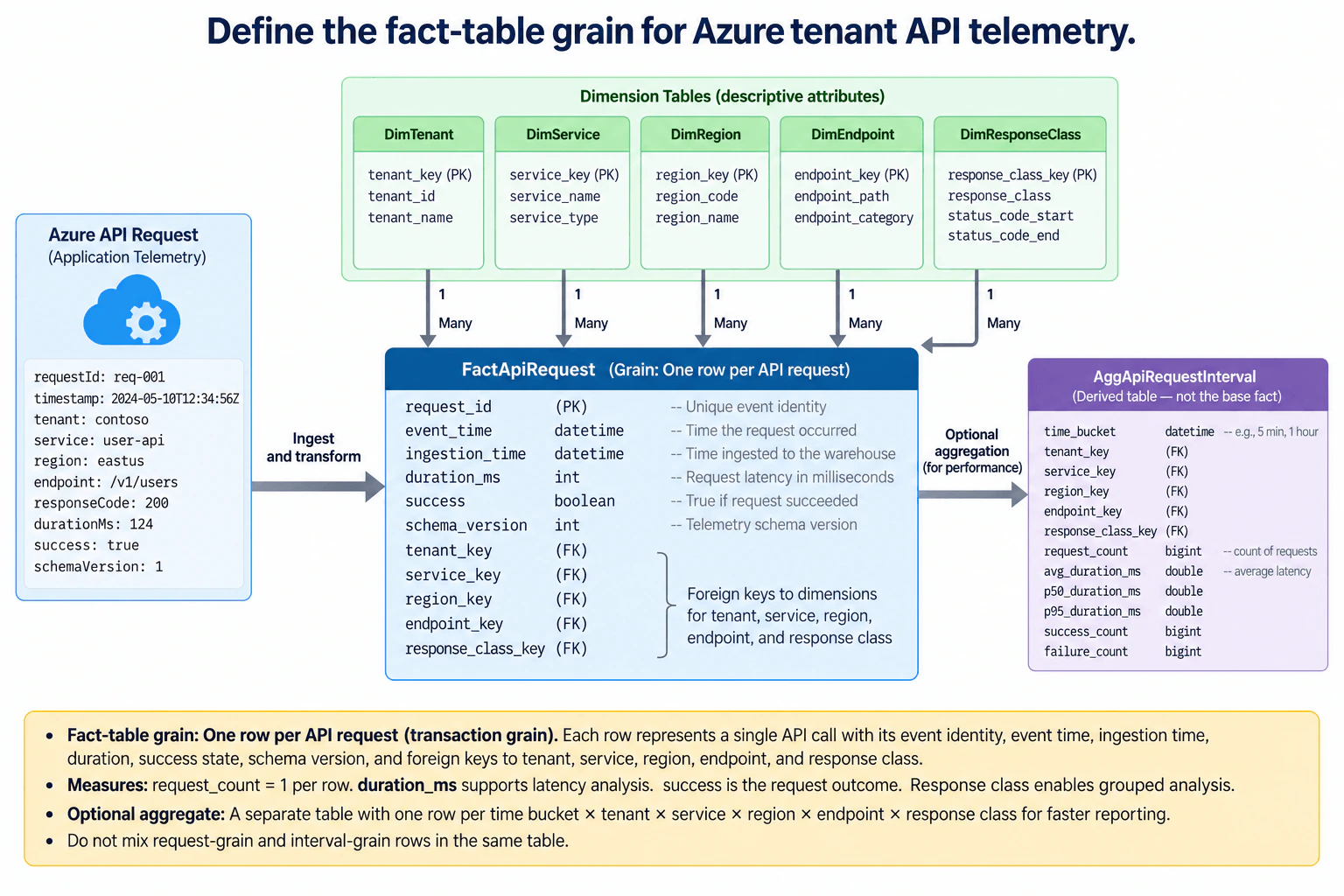
Define the fact-table grain for Azure tenant API telemetry. diagram
How to Explain It in an Interview

I would define FactApiRequest as a transaction fact with the grain: one row per API request. request_id is the unique event identity. The request row stores event_time, ingestion_time, duration_ms, success, and schema_version.

The fact also stores the foreign keys tenant_key, service_key, region_key, endpoint_key, and response_class_key. Those keys relate each request to DimTenant, DimService, DimRegion, DimEndpoint, and DimResponseClass. Each dimension row can relate to many request rows, so each relationship is one dimension row to many facts.

Descriptive attributes stay in the dimensions. DimTenant contains values such as tenant_id and tenant_name. DimService contains service_name and service_type. DimRegion contains region_code and region_name. DimEndpoint contains endpoint_path and endpoint_category. DimResponseClass contains response_class, status_code_start, and status_code_end.

At request grain, volume can be measured by counting rows; conceptually, each row contributes request_count = 1. Latency analysis uses duration_ms. The success value records the request outcome, and the response-class dimension supports grouped outcome analysis. event_time tells when the request occurred, while ingestion_time tells when the request reached the warehouse, so arrival delay can be distinguished from event occurrence.

For faster summary reporting, I can derive a separate AggApiRequestInterval fact table. Its grain is one row per time_bucket × tenant × service × region × endpoint × response class. It uses the same dimension keys and can store request_count, avg_duration_ms, p50_duration_ms, p95_duration_ms, success_count, and failure_count.

The aggregate is derived from FactApiRequest; it is not the base fact. I would not mix request-grain and interval-grain rows in one table. Mixing different grains would make counts and latency measures ambiguous and could cause incorrect aggregation. Keeping the detailed and aggregate facts separate preserves clear analytical meaning while still allowing a pre-aggregated table to speed up common reporting.

Technical Approach
  1. Identify the business process as recording Azure API calls.
  2. Declare FactApiRequest at exactly one row per API request.
  3. Use request_id as the unique event identity.
  4. Store event_time, ingestion_time, duration_ms, success, and schema_version at request grain.
  5. Add foreign keys for tenant, service, region, endpoint, and response class.
  6. Measure request volume by counting request rows and latency from duration_ms.
  7. If recurring summaries need faster reads, derive AggApiRequestInterval at time_bucket × tenant × service × region × endpoint × response class grain.
  8. Keep request-level and interval-level facts in separate tables.
Practical Insights

Storage for FactApiRequest grows with the number of API calls because every request produces one row. Detailed reports may need to scan many request rows. A separate interval aggregate adds storage and processing work because it must be calculated and maintained, but it can reduce the amount of data read for common summary reports. The main maintenance cost is keeping the aggregate dimensions, time buckets, and measures consistent with the request-level fact.

Why Interviewers Ask This

This question tests whether the candidate can define a precise fact-table grain before choosing measures and dimensions. It also evaluates whether they understand transaction facts, dimension relationships, latency and volume analysis, event time versus ingestion time, and why facts with different grains should be stored in separate tables.

Common interview mistakes

Common mistakes are using an aggregate interval as the base grain and losing individual-request detail; mixing request-level and interval-level rows in one fact table; omitting request_id, event_time, or ingestion_time; confusing event occurrence time with ingestion time; placing descriptive tenant, service, region, endpoint, or response-class attributes directly in the fact instead of dimensions; and counting rows without first confirming the table's grain.

Interview tip

Start by saying, "The base grain is one row per API request." Then name the request-level fields and dimension keys, explain that row count gives volume and duration_ms gives latency, and finish by saying that interval aggregates belong in a separate fact table.
Interviewer may ask next
Why not use the interval aggregate as the only fact table?

An interval-only fact loses individual-request detail. It can answer predefined summary questions, but it cannot preserve each request's unique identity, exact duration, success state, or arrival time. It also limits the ability to calculate new request-level statistics later. Keeping FactApiRequest at one-request grain preserves the detailed source of truth, while AggApiRequestInterval remains an optional derived table for faster summaries.

How should the aggregate fact be defined to avoid double counting?

Give it an explicit grain of one row per time_bucket × tenant × service × region × endpoint × response class. Derive each aggregate row only from request facts belonging to that exact combination. Store measures such as request_count, avg_duration_ms, p50_duration_ms, p95_duration_ms, success_count, and failure_count. A metric should be calculated from either the request fact or the aggregate fact at the appropriate grain, rather than combining both sets of rows.

2. Design a star schema for Microsoft Teams meeting analytics.Data ModelingEasyMicrosoft

Question Details

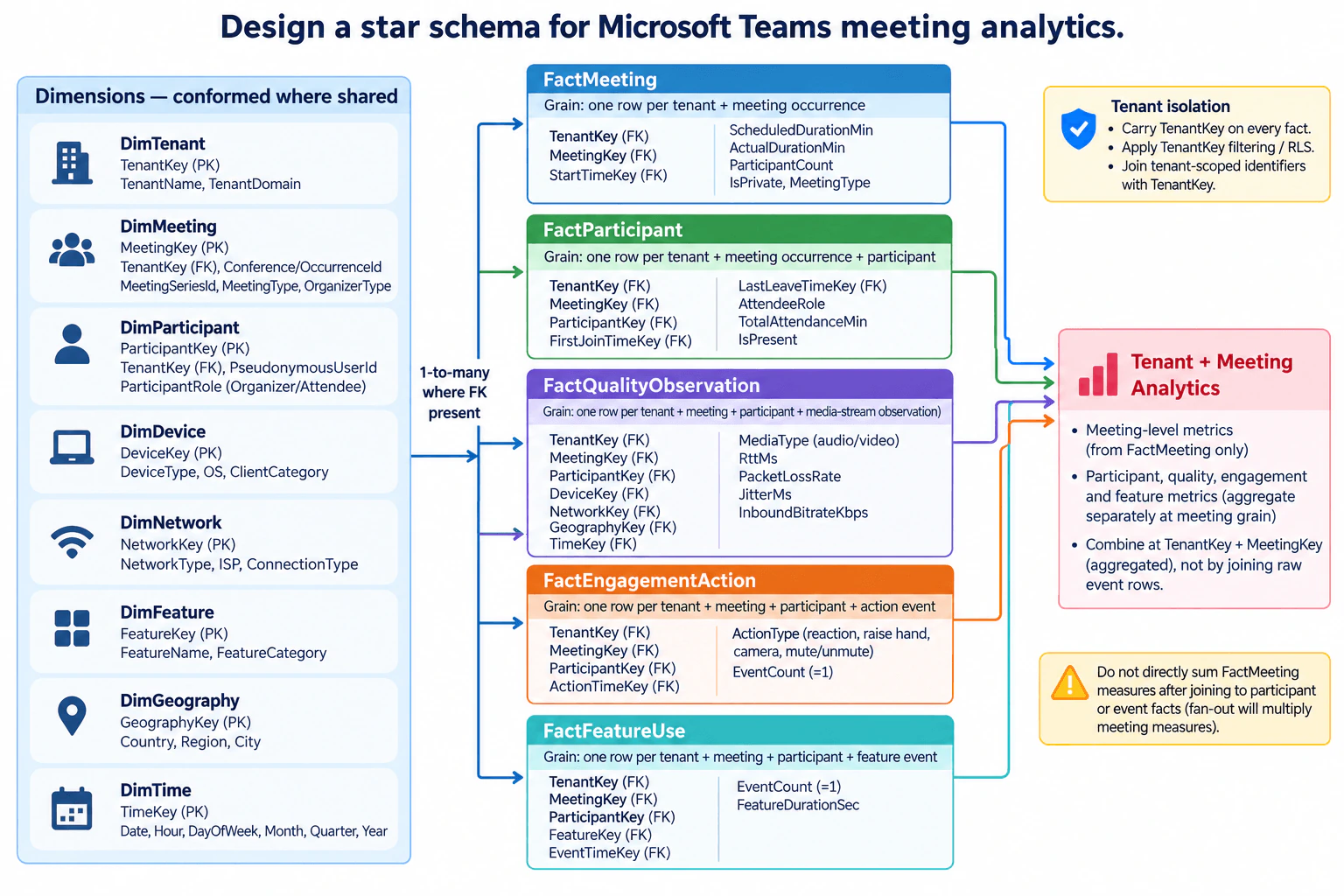
Declare the grain for meetings, participants, quality observations, engagement actions, and feature-use events. Identify tenant, meeting, user-safe participant, device, network, feature, geography, and time dimensions, and show how the model supports enterprise-tenant isolation without multiplying meeting-level measures by participant or event rows.

Short Interview Answer (30-60 seconds)

I would model five separate facts for meetings, participants, quality observations, engagement actions, and feature use. Shared dimensions are joined only where their keys exist. Every fact carries TenantKey, and detail facts are aggregated to TenantKey + MeetingKey before joining to FactMeeting so meeting measures are not duplicated.

Detailed Explanation

The goal is to keep different kinds of meeting information at the right level so reports stay correct. One record describes the meeting itself. Other records describe who attended, what connection quality they experienced, what actions they took, and which meeting features they used. Shared reference data describes the company, meeting, person, device, connection, feature, place, and time. Every record also carries the company identifier so data stays separated by company. Before combining detailed activity with meeting totals, summarize the detail first so the meeting totals are not repeated.

Useful Questions to Ask the Interviewer
  1. Should FactMeeting represent one meeting occurrence, including each occurrence of a recurring meeting?
  2. Should FactParticipant store one summarized row per participant per occurrence even when a participant leaves and rejoins?
  3. Which media-stream quality observations should be retained, and at what retention period?
  4. Should tenant isolation be enforced in the warehouse, the semantic layer, or both?
Design a star schema for Microsoft Teams meeting analytics. diagram
How to Explain It in an Interview

Start by declaring the grain of every fact table. Grain means exactly what one row represents. This is the most important decision because it controls joins and prevents double counting.

  1. FactMeeting — one row per tenant + meeting occurrence FactMeeting contains TenantKey, MeetingKey, and StartTimeKey as foreign keys. The diagram shows ScheduledDurationMin, ActualDurationMin, and ParticipantCount as meeting-level measures, plus IsPrivate and MeetingType as meeting-level attributes. Because these values belong to one meeting occurrence, they should be read and aggregated from FactMeeting at meeting grain.
  1. FactParticipant — one row per tenant + meeting occurrence + participant FactParticipant contains TenantKey, MeetingKey, ParticipantKey, FirstJoinTimeKey, and LastLeaveTimeKey. It stores AttendeeRole, TotalAttendanceMin, and IsPresent. A participant who leaves and rejoins can still be summarized into this one participant-level row for the meeting occurrence.
  1. FactQualityObservation — one row per tenant + meeting + participant + media-stream observation FactQualityObservation contains TenantKey, MeetingKey, ParticipantKey, DeviceKey, NetworkKey, GeographyKey, and TimeKey. The diagram includes MediaType, RttMs, PacketLossRate, JitterMs, and InboundBitrateKbps. This lets analysts slice quality by participant, device, network, geography, meeting, tenant, and observation time where those foreign keys are present.
  1. FactEngagementAction — one row per tenant + meeting + participant + action event FactEngagementAction contains TenantKey, MeetingKey, ParticipantKey, and ActionTimeKey. ActionType identifies the event, such as reaction, raise hand, camera, or mute/unmute. EventCount is 1 on each row, so counts are additive when grouped by meeting, participant, time, or action type.
  1. FactFeatureUse — one row per tenant + meeting + participant + feature event FactFeatureUse contains TenantKey, MeetingKey, ParticipantKey, FeatureKey, and EventTimeKey. EventCount is 1 per event, and FeatureDurationSec stores a duration when that feature-use event has a meaningful duration.

The dimensions are conformed where shared, not forced onto every fact. DimTenant contains TenantKey with TenantName and TenantDomain. DimMeeting uses MeetingKey and includes TenantKey, Conference/OccurrenceId, MeetingSeriesId, MeetingType, and OrganizerType. DimParticipant uses ParticipantKey with TenantKey, PseudonymousUserId, and ParticipantRole. DimDevice describes DeviceType, OS, and ClientCategory. DimNetwork describes NetworkType, ISP, and ConnectionType. DimFeature contains FeatureName and FeatureCategory. DimGeography contains Country, Region, and City. DimTime contains Date, Hour, DayOfWeek, Month, Quarter, and Year. Time is role-played through StartTimeKey, FirstJoinTimeKey, LastLeaveTimeKey, ActionTimeKey, EventTimeKey, and the quality-observation TimeKey.

The critical failure case is fan-out. FactMeeting has one row per meeting occurrence, but the other facts can have many rows for the same meeting. If FactMeeting is joined directly to raw participant or event rows and then ActualDurationMin or another meeting-level measure is summed, that meeting value is repeated once for every matching detail row. The safe pattern is to aggregate each lower-grain fact separately to TenantKey + MeetingKey and only then combine those meeting-grain results with FactMeeting.

Tenant isolation is part of the model. TenantKey is carried on every fact. Apply TenantKey filtering or row-level security in the semantic layer, and include TenantKey when joining tenant-scoped identifiers. This prevents identifiers from one tenant from accidentally matching rows from another tenant.

The tradeoff is more fact tables and more semantic-model logic than one wide table. In return, every business process keeps a clear grain, meeting-level measures stay correct, detailed analytics remain flexible, and tenant boundaries are explicit.

Technical Approach
  1. Declare the five fact grains before choosing columns.
  2. Create FactMeeting at one row per tenant + meeting occurrence.
  3. Create FactParticipant at one row per tenant + meeting occurrence + participant.
  4. Create FactQualityObservation at one row per tenant + meeting + participant + media-stream observation.
  5. Create FactEngagementAction and FactFeatureUse at one row per corresponding event.
  6. Add only the dimensions whose foreign keys are present in each fact.
  7. Carry TenantKey on every fact and use it in tenant filtering and tenant-scoped joins.
  8. Aggregate participant, quality, engagement, and feature facts to TenantKey + MeetingKey before combining them with meeting-level measures.
Practical Insights

This design uses more tables than a single wide table, so ETL, testing, documentation, and semantic-model maintenance take more work. Storage also grows because quality and event facts can contain many rows per meeting. The benefit is safer analytics: each process has a clear grain, meeting measures are not repeated, and reports can scan only the fact tables they need. Query cost is driven mainly by the volume of quality and event rows and by how much data must be filtered and aggregated before the meeting-level join.

Why Interviewers Ask This

This question tests whether the candidate can declare correct fact-table grains, choose reusable dimensions and keys, separate meeting-level measures from participant and event detail, enforce tenant isolation, and prevent fan-out when one meeting has many participants, quality observations, engagement actions, and feature-use events.

Common interview mistakes

Common mistakes are putting all meeting, participant, quality, and event data into one fact table; failing to declare grain; treating every dimension as if it joins to every fact; omitting TenantKey from detail facts; joining tenant-scoped identifiers without TenantKey; exposing a direct user identifier instead of a pseudonymous participant identifier; and joining FactMeeting to raw lower-grain facts before summing meeting-level measures, which causes fan-out and inflated totals.

Interview tip

Lead with the five grains. Then explain which dimensions are shared, how TenantKey protects tenant isolation, and why lower-grain facts must be aggregated to TenantKey + MeetingKey before they are combined with FactMeeting. That shows clear dimensional-modeling judgment and directly addresses the main failure mode.

Interviewer may ask next
How would you calculate total meeting duration and total engagement events without double counting the meeting duration?

Read meeting duration from FactMeeting at its native one-row-per-meeting-occurrence grain. Separately group FactEngagementAction by TenantKey and MeetingKey and sum EventCount. Then join that aggregated result to FactMeeting on TenantKey + MeetingKey. Do not join raw engagement-event rows to FactMeeting before summing ActualDurationMin, because the duration would repeat for every event.

How would you handle a participant who leaves and rejoins the same meeting occurrence?

Keep FactParticipant at one summarized row per tenant + meeting occurrence + participant, as shown in the diagram. FirstJoinTimeKey stores the first join, LastLeaveTimeKey stores the final leave, and TotalAttendanceMin represents the participant's total attendance across rejoin periods. If interval-level analysis becomes a requirement, add a separate lower-grain attendance-interval fact instead of changing the declared FactParticipant grain.

3. Design a customer 360 model across Microsoft Entra ID, Microsoft 365 usage, and Azure consumption.Data ModelingMediumMicrosoft

Question Details

Specify source identities, privacy-safe master entities, crosswalk confidence and validity, source-record lineage, and separate event or snapshot grains for directory state, product usage, and cloud consumption. The model must support both streaming updates and batch history without treating uncertain identity matches as definitive.

Short Interview Answer (30-60 seconds)

I would use a privacy-safe customer master, a confidence- and validity-aware identity crosswalk, and separate facts for Entra directory snapshots, Microsoft 365 usage, and Azure Cost Details. Only definitive matches receive customer_key; uncertain matches remain candidates, with complete lineage for streaming updates and batch history.

Detailed Explanation

The goal is to create one trustworthy customer view from three Microsoft data sources without pretending that every record belongs to a known customer. We need a safe way to recognize the same person or account, protect private information, remember where each record came from, and keep each kind of activity at its natural level of detail. The design must also handle quick directory changes and scheduled historical loads while keeping old information available. Most importantly, doubtful identity matches must stay doubtful instead of being treated as confirmed customers.

Useful Questions to Ask the Interviewer
  1. What source keys are approved as definitive identity matches across Microsoft Entra ID, Microsoft 365, and Azure?
  2. Should the customer master represent only users, or also accounts and organizations?
  3. Which Microsoft 365 usage reports and reporting periods must be modeled?
  4. How long must crosswalk history, directory snapshots, usage history, Azure Cost Details, and lineage metadata be retained?
  5. What privacy, residency, concealment, and retention rules apply to identity attributes?
Design a customer 360 model across Microsoft Entra ID, Microsoft 365 usage, and Azure consumption. diagram
How to Explain It in an Interview

I would separate identity resolution from analytical facts.

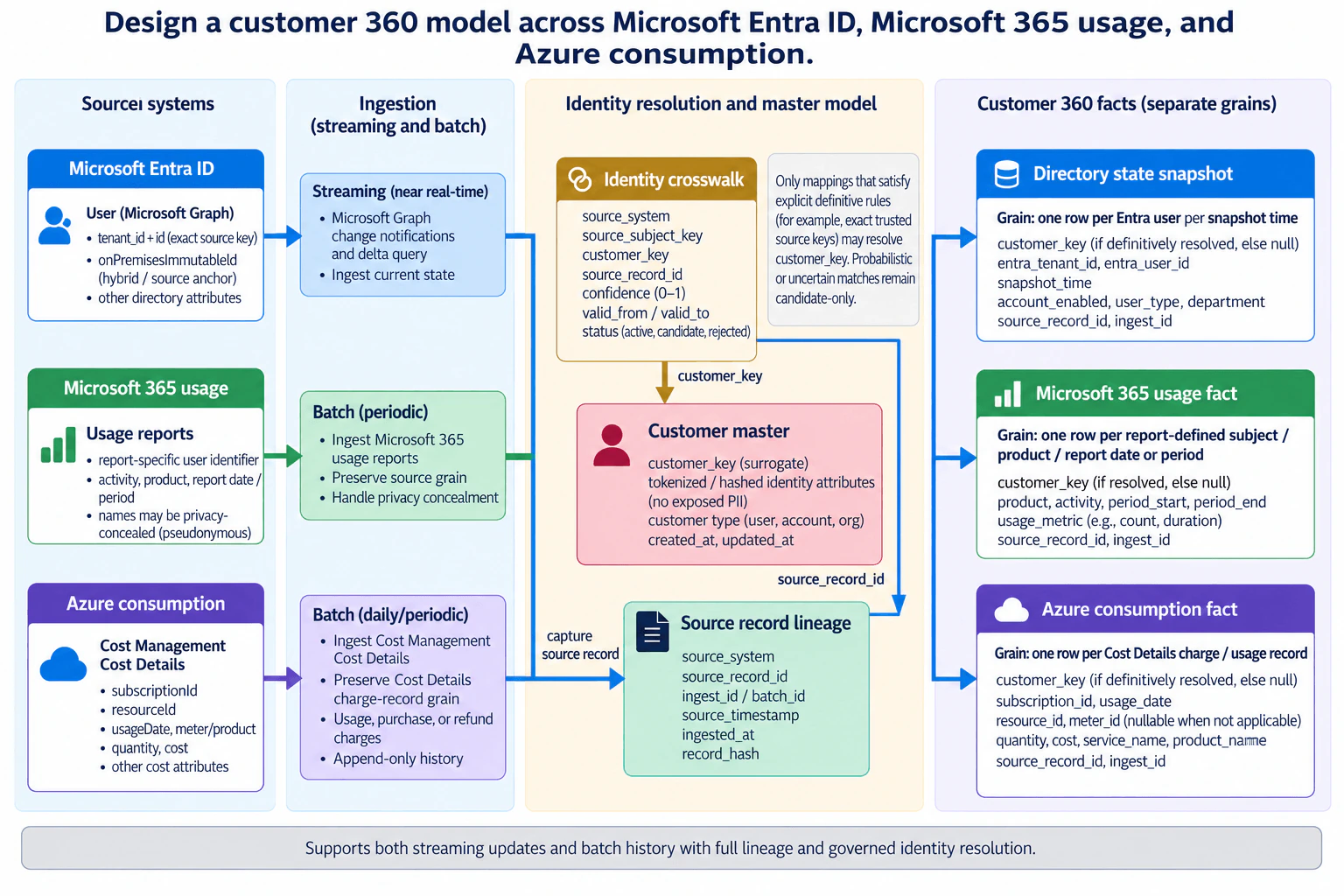
Start with the source identities. For Microsoft Entra ID, use the tenant plus Microsoft Graph user id as the exact source key, with onPremisesImmutableId available for hybrid identity scenarios. Microsoft 365 usage keeps the report-defined subject identifier, product, activity, and report date or period. Azure Cost Management keeps the identifiers supplied by Cost Details, such as subscription_id and, when applicable, resource_id or meter_id.

Next, create a privacy-safe Customer master. Its primary identifier is customer_key, a surrogate key generated inside the Customer 360 model instead of copied from a source system. Store only minimized identity attributes in tokenized or hashed form, without exposed personally identifiable information. The master can also carry customer_type, such as user, account, or organization, plus created_at and updated_at.

Then create the Identity crosswalk. Each row stores source_system, source_subject_key, customer_key, source_record_id, confidence from 0 to 1, valid_from, valid_to, and status such as active, candidate, or rejected. The validity range makes the mapping temporal, so a changed identity relationship creates history instead of overwriting the past.

The most important identity rule is that confidence alone does not make a match definitive. Only mappings that satisfy explicit definitive rules, for example exact trusted source keys, may resolve customer_key. Probabilistic or uncertain matches remain candidate-only. A fact row therefore keeps customer_key null when its source identity is not definitively resolved.

Keep the three business processes in separate fact tables because they have different grains.

The Directory state snapshot has one row per Microsoft Entra user per snapshot_time. It can contain customer_key when definitively resolved, otherwise null, plus entra_tenant_id, entra_user_id, snapshot_time, account_enabled, user_type, department, source_record_id, and ingest_id.

The Microsoft 365 usage fact has one row per report-defined subject, product, and report date or period. It stores customer_key if resolved, otherwise null, plus product, activity, period_start, period_end, usage_metric, source_record_id, and ingest_id. This preserves the reporting grain instead of forcing Microsoft 365 usage into the directory snapshot grain.

The Azure consumption fact has one row per Cost Details charge or usage record. It stores customer_key only when definitively resolved, otherwise null, plus subscription_id, usage_date, resource_id and meter_id when applicable, quantity, cost, service_name, product_name, source_record_id, and ingest_id. Resource and meter fields are nullable when a charge record does not have those concepts.

For ingestion, Microsoft Entra ID uses the near-real-time path shown in the diagram, using Microsoft Graph change notifications and delta query to ingest current state changes. Microsoft 365 usage is loaded periodically in batch while preserving its source report grain and privacy concealment behavior. Azure Cost Details is loaded daily or periodically in batch while preserving the charge-record grain for usage, purchase, or refund charges and retaining append-only history.

Capture source-record lineage before or during modeling. The lineage structure stores source_system, source_record_id, ingest_id or batch_id, source_timestamp, ingested_at, and record_hash. The Identity crosswalk references source_record_id, and the fact tables retain source_record_id plus ingest_id. That lets an analyst trace a modeled row back to its original source record and load.

The main tradeoff is that some fact rows will have a null customer_key. That lowers apparent identity coverage, but it avoids incorrect customer attribution. The second tradeoff is extra storage and maintenance for separate facts, temporal crosswalk history, snapshots, and lineage. That complexity is justified because the model stays auditable, privacy-safe, historically reproducible, and correct at each source grain.

Technical Approach
  1. Ingest Microsoft Entra ID changes through the near-real-time path, and ingest Microsoft 365 usage and Azure Cost Details through periodic batch paths.
  2. Preserve every source record and capture source_system, source_record_id, ingest_id or batch_id, source timestamp, ingestion time, and record hash for lineage.
  3. Normalize every source identity into source_system plus source_subject_key.
  4. Evaluate identity-resolution rules and write a temporal Identity crosswalk containing customer_key, source_record_id, confidence, valid_from, valid_to, and status.
  5. Populate customer_key only when the mapping satisfies an explicit definitive rule; keep uncertain matches candidate-only.
  6. Maintain the privacy-safe Customer master using the surrogate customer_key and tokenized or hashed minimized identity attributes.
  7. Write Entra directory state at one-user-per-snapshot-time grain.
  8. Write Microsoft 365 usage at report-defined subject/product/report-date-or-period grain.
  9. Write Azure Cost Details at one-charge-or-usage-record grain.
  10. Retain source_record_id and ingest_id in facts so every result can be traced and reproduced.
Practical Insights

The main cost is data volume and history rather than algorithmic complexity. Directory snapshots create another row for each user at each snapshot time. Microsoft 365 usage grows for every report period, subject, and product. Azure consumption can become the largest fact because individual Cost Details charge or usage records are retained. Crosswalk history also grows whenever mappings change. The model uses more storage and requires more maintenance than one flattened table, but it avoids fan-out, preserves correct aggregation grains, supports auditing, and allows each fact table to be processed and partitioned independently.

Why Interviewers Ask This

This question tests whether a candidate can unify identity, product-usage, and cloud-consumption data without collapsing different business grains or overstating identity certainty. A strong answer separates master data from facts, models confidence and validity in identity mappings, protects personal information, preserves source-record lineage, supports both streaming and batch ingestion, and explains how unresolved identities remain nullable instead of being forced into a customer.

Common interview mistakes

Common mistakes include joining Microsoft Entra ID, Microsoft 365 usage, and Azure consumption directly into one wide table; using email or display name as a permanent master key; treating a high confidence score as automatically definitive; overwriting crosswalk mappings instead of keeping valid_from and valid_to history; assigning customer_key to uncertain matches; mixing directory snapshot, usage-report, and Cost Details grains; assuming every Azure Cost Details row has resource_id or meter_id; storing exposed personal information in the customer master; dropping source_record_id during transformations; and supporting near-real-time current state without retaining batch history and lineage.

Interview tip

Lead with the identity rule: uncertain matches never become definitive customers. Then describe the privacy-safe master and temporal crosswalk, explicitly declare the grain of all three fact tables, and finish with lineage plus streaming-versus-batch behavior. Naming each grain clearly is the fastest way to demonstrate strong data-modeling judgment.

Interviewer may ask next
How would you handle an uncertain identity match that later becomes definitive?

Do not overwrite the old crosswalk record. Close its validity interval by setting valid_to and update its status as appropriate, then create a new active crosswalk version for the definitive mapping. New facts can resolve to the definitive customer_key. Historical analysis can use the crosswalk validity period to reproduce what was known at the relevant time. If older facts with null customer_key are later backfilled, that should be a governed and auditable process rather than an invisible overwrite.

Why keep directory state, Microsoft 365 usage, and Azure consumption in separate fact tables?

They represent different business processes and different grains. Directory state is one Entra user at a snapshot time. Microsoft 365 usage is defined by report subject, product, and reporting date or period. Azure consumption is one Cost Details charge or usage record. Putting them in one fact table would create fan-out, duplicated measures, many null columns, and ambiguous aggregation. Separate facts can still share the governed customer_key while preserving each measure at its natural grain.

4. Model an enterprise platform that stores trillions of evolving log records per day.NEWData ModelingHardMicrosoft

Question Details

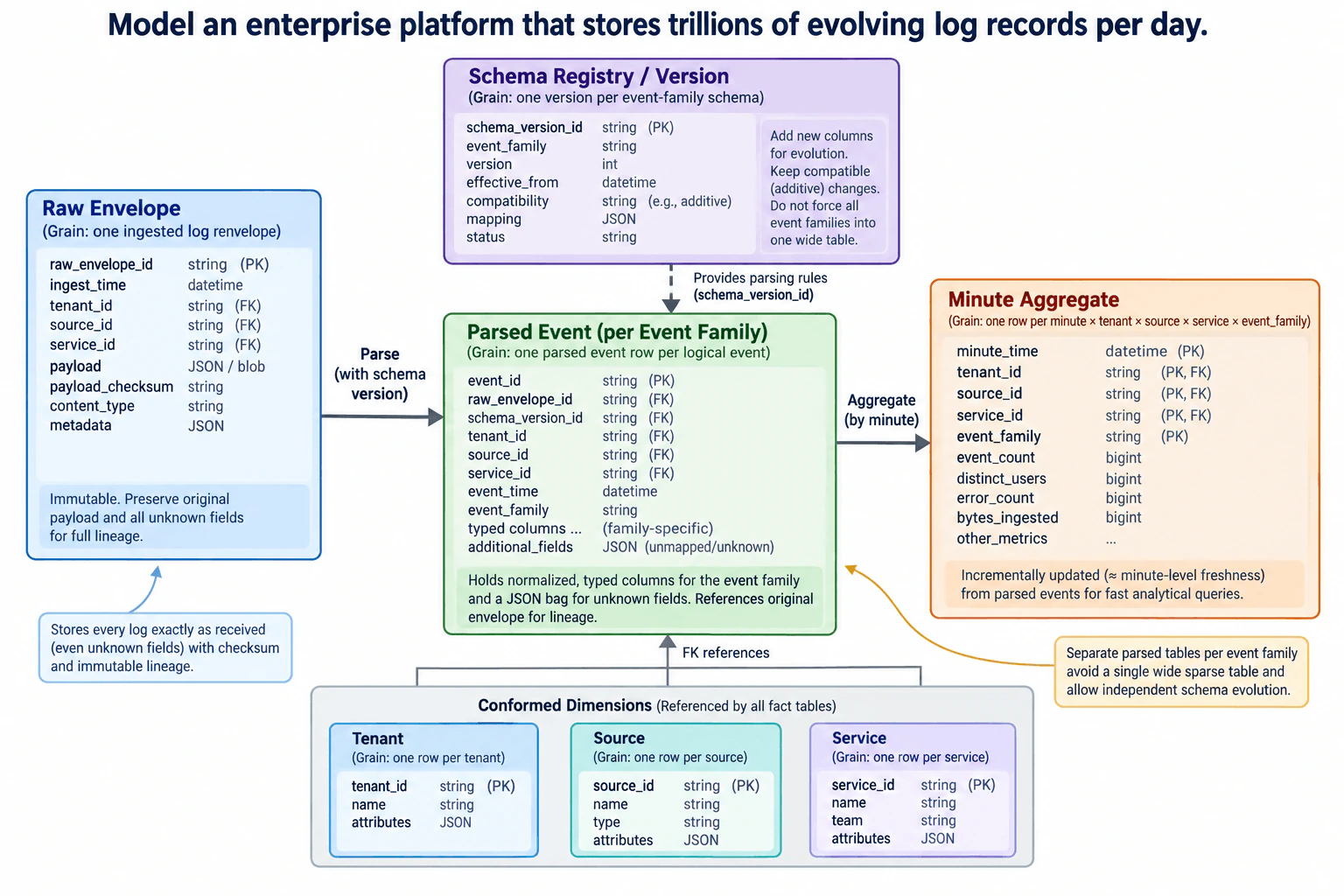
Define raw-envelope, parsed-event, schema-version, source, tenant, service, and aggregate grains for extremely high-volume logs. The model must preserve unknown fields and original payload lineage, permit compatible schema evolution, support minute-level analytical freshness, and avoid a single wide sparse table for every event family.

Short Interview Answer (30-60 seconds)

Store every incoming log unchanged in an immutable Raw Envelope. Parse it into a family-specific Parsed Event linked to both the raw record and schema version. Preserve unknown fields in JSON, reuse Tenant, Source, and Service dimensions, and incrementally build Minute Aggregate rows for fast analytics.

Detailed Explanation

The system must keep every incoming message exactly as it arrived while also making recent information easy to study. Different kinds of messages change at different times, so forcing them into one giant shape would create many empty fields and make future changes harder. A better design keeps the original message, creates a cleaner record for each kind of event, remembers which definition was used to read it, and builds small one-minute summaries. Shared customer, source, and service references keep meaning consistent without stopping each event type from changing independently.

Useful Questions to Ask the Interviewer
  1. Are schema changes expected to be mainly compatible additions, or must the platform also support breaking changes between event-family versions?
  2. Is minute-level freshness required for every event family or only for selected analytical aggregates?
  3. How long must immutable raw payloads be retained compared with parsed events and aggregates?
  4. Are tenant, source, and service identifiers stable, or is historical versioning of those dimensions also required?
Model an enterprise platform that stores trillions of evolving log records per day. diagram
How to Explain It in an Interview

Start by declaring the grain of every entity. That prevents accidental mixing of detailed events, reference data, and summaries.

  1. Raw Envelope — grain: one ingested log envelope

The Raw Envelope is the immutable source of truth. Its primary key is raw_envelope_id. It also carries ingest_time, tenant_id, source_id, service_id, the original payload, payload_checksum, content_type, and metadata.

Store the original payload without dropping fields. If the parser does not understand a field today, the raw copy still preserves it. The raw row also keeps the Tenant, Source, and Service foreign keys shown in the diagram. Keeping the immutable payload allows later reprocessing when parsing logic or schema definitions change.

  1. Schema Registry / Version — grain: one version per event-family schema

Each Schema Registry / Version row has schema_version_id as its primary key, with event_family, version, effective_from, compatibility, mapping, and status.

The mapping describes the parsing rules for that event-family version. A Parsed Event stores the schema_version_id that was used to interpret it. Compatible evolution can therefore add new fields or mappings without forcing unrelated event families into the same physical shape or silently changing the meaning of previously parsed rows.

  1. Parsed Event (per Event Family) — grain: one parsed event row per logical event

Do not create one enormous table containing every possible field from every event family. Use separate family-specific parsed structures instead.

Each Parsed Event contains event_id as its primary key; raw_envelope_id as a foreign key to the Raw Envelope; schema_version_id as a foreign key to Schema Registry / Version; and tenant_id, source_id, and service_id as foreign keys to the shared dimensions. It also carries event_time, event_family, family-specific typed columns, and additional_fields JSON for unmapped or unknown fields.

Typed columns make common fields easy to analyze. additional_fields prevents less-common or newly introduced fields from being lost. raw_envelope_id provides lineage back to the exact original payload, while schema_version_id records how that payload was interpreted.

  1. Conformed Dimensions — Tenant, Source, and Service

Tenant has grain one row per tenant and uses tenant_id as its primary key. Source has grain one row per source and uses source_id. Service has grain one row per service and uses service_id.

These are conformed dimensions: the same shared entities are referenced across the relevant fact-like structures instead of redefining tenant, source, or service separately for every event family.

The diagram keeps descriptive values such as names, source type, team, and flexible attributes in these dimensions instead of repeating them in every detailed event row.

  1. Minute Aggregate — grain: one row per minute × tenant × source × service × event family

The Minute Aggregate uses minute_time, tenant_id, source_id, service_id, and event_family as its composite grain. Measures shown in the diagram include event_count, distinct_users, error_count, bytes_ingested, and other metrics appropriate to the event family.

Parsed Events feed this structure through a by-minute aggregation. The aggregate is updated incrementally to support approximately minute-level analytical freshness. Dashboards and operational reports can read this much smaller summary instead of scanning trillions of detailed records for every request.

The Minute Aggregate is derived data, not the authoritative event history. Detailed investigation still uses Parsed Events, while replay and original-payload lineage use Raw Envelopes.

End-to-end flow

A log first lands in Raw Envelope. Schema Registry / Version provides the parsing rules identified by schema_version_id. Parsing writes a family-specific Parsed Event with typed fields plus additional_fields for unmapped values. The Parsed Event retains both raw_envelope_id and schema_version_id. Parsed Events are then aggregated by minute into Minute Aggregate rows. Tenant, Source, and Service remain shared references across the model.

Main decision and tradeoff

The important decision is to use multiple clear grains instead of one universal log table. Separate event-family Parsed Event structures require more schema-management work, but they prevent a huge sparse table filled with unrelated nullable columns. The immutable Raw Envelope protects original data and supports replay. Schema Registry / Version makes compatible evolution explicit. Minute Aggregate adds extra derived storage and processing, but it gives analytical consumers fresh results without repeatedly scanning the full event history.

Technical Approach
  1. Ingest each log into one immutable Raw Envelope with its original payload, checksum, ingest time, and Tenant, Source, and Service references.
  2. Identify the event family and the Schema Registry / Version record used to parse it.
  3. Write one logical Parsed Event into the appropriate family-specific structure with typed columns, additional_fields JSON, raw_envelope_id, schema_version_id, and the shared dimension keys.
  4. Incrementally group Parsed Events into the Minute Aggregate grain of minute × tenant × source × service × event family.
  5. Use Minute Aggregate for fast recent analytics, Parsed Event for detailed analysis, and Raw Envelope for replay and lineage.
Practical Insights

At trillions of records per day, storage volume and data movement dominate the cost. Raw Envelope is large because every original payload is retained. Parsed Event creates another detailed representation, which costs more storage but makes common fields easier to query. Minute Aggregate requires continuous incremental work, but each summary row represents many detailed events, greatly reducing data scanned by dashboards. Separate event-family structures also create more schemas to operate and evolve, but they avoid the maintenance and query problems of one huge sparse table. Retention, partitioning, and physical storage choices would be important implementation decisions, but they are outside the logical model shown in the diagram.

Why Interviewers Ask This

This question tests whether the candidate can define clear data grains at extreme scale while balancing original-payload lineage, compatible schema evolution, shared dimensions, minute-level analytical freshness, and maintainability. A strong answer separates immutable raw data from family-specific parsed data, explicitly versions parsing schemas, uses conformed Tenant, Source, and Service dimensions, and avoids a universal sparse event table.

Common interview mistakes

A major mistake is putting every event family into one universal table with hundreds or thousands of mostly nullable columns. Another is discarding the original payload after parsing, which breaks reliable replay and lineage. Do not overwrite the meaning of old parsed rows when a schema changes; retain the schema_version_id used for each event. Do not drop unknown fields simply because the current parser has no typed column for them. Do not use only raw JSON for every analytical field when stable, frequently queried values can be typed in the family-specific Parsed Event. Finally, do not treat Minute Aggregate as the authoritative event history because it is a derived summary.

Interview tip

Lead with the grains in order: Raw Envelope, Schema Registry / Version, Parsed Event per event family, shared Tenant/Source/Service dimensions, and Minute Aggregate. Then explain the lineage keys and finish with the tradeoff: extra modeling and schema-management work buys preserved raw truth, safe evolution, and fast analytics without a universal sparse table.

Interviewer may ask next
How would you handle a new field that appears in an existing event family?

Keep the original payload unchanged in Raw Envelope. Add or activate a compatible Schema Registry / Version definition for that event family. If the field becomes important for common analysis, add it to that family's typed parsed structure. Until then, retain it in additional_fields JSON. New Parsed Events reference the appropriate schema_version_id, while older rows keep the version under which they were parsed. This supports additive evolution without forcing every event family to change.

What happens if a parser bug is discovered after a large number of events have already been processed?

Use the immutable Raw Envelope as the replay source. Identify the affected parsing logic or schema version, correct it, and reprocess the affected raw records into corrected Parsed Events while retaining their raw_envelope_id lineage. Then recompute any Minute Aggregate ranges derived from incorrect Parsed Events. Because the original payload was preserved, the faulty parsed representation is not the only copy of the data.

5. Create a Microsoft Fabric Data Pipeline for a scheduled sales load.Data PipelinesEasyMicrosoft

Question Details

Define the source connection, Copy or notebook activities, staging destination in OneLake, transformation step, dependency order, parameters, schedule, and final publication. Include a run identifier and completion condition so a retry cannot expose both the original and retried result.

Short Interview Answer (30-60 seconds)

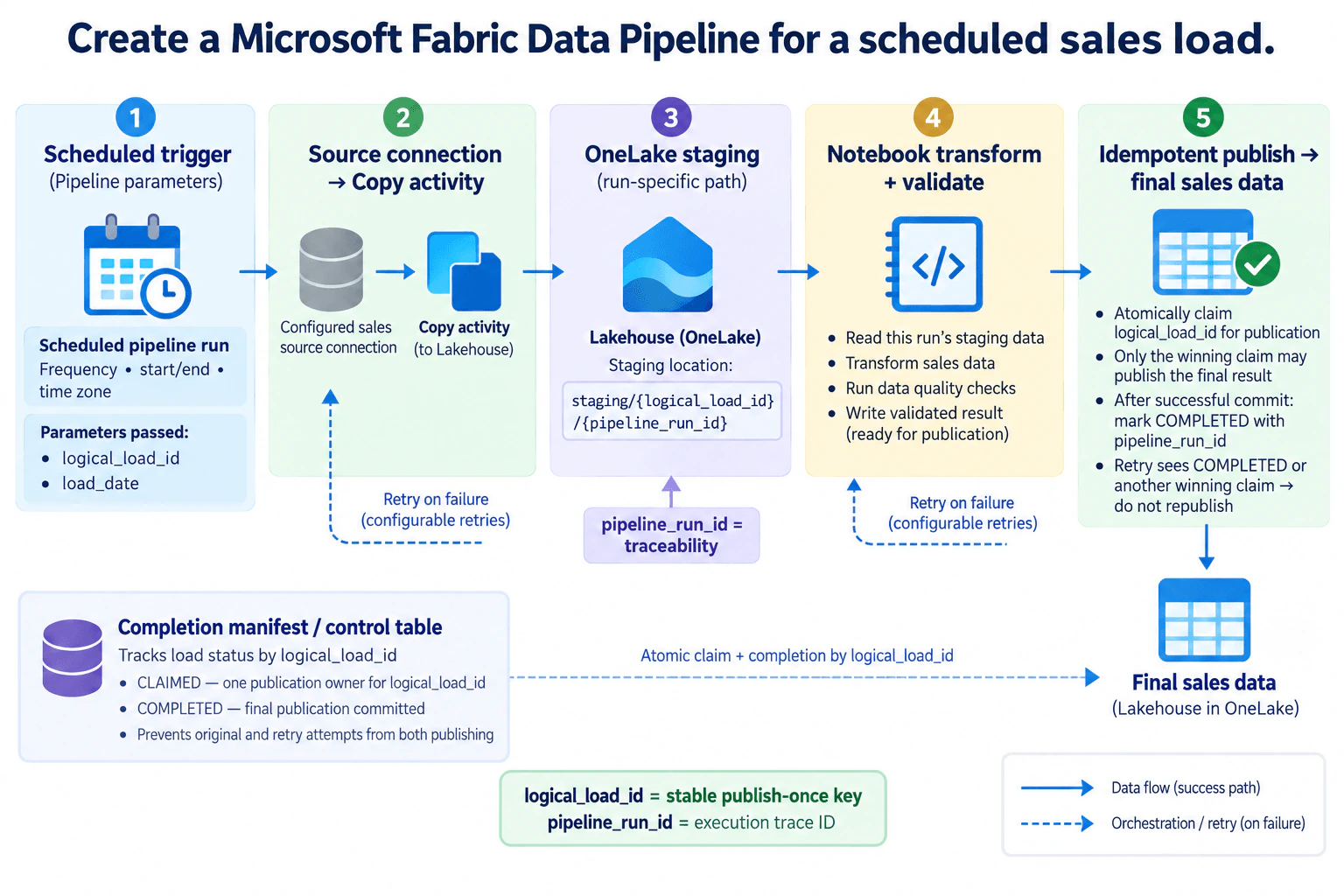
I would schedule a Microsoft Fabric pipeline that passes a logical load ID and load date, copies sales data from the configured source into a run-specific OneLake Lakehouse staging path, then runs a notebook to transform and validate it. Publication uses the logical load ID as a stable publish-once key. One attempt atomically claims that key, publishes the final result, and marks it COMPLETED with the pipeline run ID. The trade-off is extra control-state coordination in exchange for safe retries.

Detailed Explanation

The goal is to move sales information on a regular timetable and make the finished result available only once. Each scheduled load gets a stable identity, while each execution also has its own identifier. The information is first copied to a temporary location for that execution. It is then cleaned and checked before becoming final. If a failure causes work to be repeated, the design must prevent two attempts from creating separate visible final results. A small completion record decides which attempt may finish the load and records when publication has succeeded.

Useful Questions to Ask the Interviewer
  1. What schedule frequency, start and end settings, and time zone should the pipeline use?
  2. What is the configured sales source connection and expected source data contract?
  3. What business rule should define the stable logical_load_id for each scheduled sales load?
  4. Which data-quality checks must pass before the sales result can be published?
Create a Microsoft Fabric Data Pipeline for a scheduled sales load. diagram
How to Explain It in an Interview
1. Start the scheduled pipeline with stable parameters

I would start with the Microsoft Fabric scheduled trigger. The schedule passes pipeline parameters such as logical_load_id and load_date. The important distinction is that logical_load_id identifies the business load that should be published once, while pipeline_run_id identifies the specific pipeline execution for traceability. I would not use the execution ID itself as the publish-once key because another execution of the same logical load still represents the same business result.

2. Copy the configured sales source into OneLake staging

The next dependency is the Copy activity. It reads from the configured sales source connection and writes the sales data into the Lakehouse in OneLake. The diagram uses a run-specific staging location: staging/{logical_load_id}/{pipeline_run_id}. This separates temporary data for different pipeline executions. The staging area is not the consumer-visible result, so failure during ingestion does not expose a partially completed sales load as final data. The Copy activity can use its configured retry behavior for recoverable failures.

3. Transform and validate the staged data

After Copy succeeds, the Notebook activity reads that run's staging data. It transforms the sales data, applies the required data-quality checks, and writes a validated result that is ready for publication. Validation is a publication gate. A pipeline activity merely finishing is not enough if the required quality checks fail. Only validated output continues toward the final publication step. This keeps incorrect or incomplete staged data from being presented as the completed sales result.

4. Atomically claim the logical load before publication

The key reliability decision is the completion manifest or control table. Before publishing, an attempt must atomically claim the logical_load_id. The control state becomes CLAIMED, meaning one publication owner exists for that logical load. Only the winning claim may publish the final result. If another attempt sees that the same logical load already has a winning claim or is already completed, it must not publish another result. A simple separate read of the status followed by a later write would not provide the same protection because competing attempts could both observe the old state.

5. Publish and mark completion after the commit succeeds

The winning attempt publishes the validated result to the final sales data in the Lakehouse. Only after that publication successfully commits does the control record become COMPLETED, with the pipeline_run_id retained for execution traceability. The order is important: claim first, publish second, and mark COMPLETED after the successful publication commit. A retry that encounters a completed load does not republish it. This separates pipeline execution success from business-result correctness and gives one visible published result for each logical load.

6. Recover safely from activity failures

The diagram shows configurable retry behavior around the Copy and Notebook activities. Those activities can repeat failed work while their intermediate output remains outside the final sales-data boundary. The final publication gate is what prevents repeated processing from creating repeated visible business results. If publication ownership has already been established, another attempt does not bypass that ownership and publish independently. The trade-off is additional coordination through the control record, including handling publication state carefully during recovery, but that complexity is accepted because preventing duplicate final results is the stronger correctness requirement.

Technical Approach
  1. Configure the Microsoft Fabric scheduled trigger and pass logical_load_id and load_date.
  2. Use the current pipeline_run_id as the execution trace identifier.
  3. Run the Copy activity from the configured sales source connection into staging/{logical_load_id}/{pipeline_run_id} in the OneLake Lakehouse.
  4. Continue to the Notebook activity only after Copy succeeds.
  5. Transform the staged sales data and run the required data-quality checks.
  6. Allow validated output to proceed to publication only after those checks pass.
  7. Atomically claim logical_load_id in the completion manifest/control table.
  8. Allow only the winning claim to publish the final sales result.
  9. After the final publication successfully commits, mark the control record COMPLETED with pipeline_run_id.
  10. If another attempt encounters an existing winning claim or a COMPLETED logical load, do not republish.
Practical Insights

The benefit is that temporary work can be repeated without exposing two final sales results for the same logical load. Run-specific staging also makes different pipeline executions easier to trace and isolate. The downside is extra control state: the pipeline needs an atomic claim and a completion transition for each logical_load_id. That adds coordination and recovery complexity compared with a simple copy-and-publish pipeline. Validation may also delay publication because the result stays outside the final boundary until checks pass. We accept this because correctness is more important than publishing immediately after a retry. Storage and processing costs can temporarily increase when work is repeated, but the final publication gate keeps those attempts from independently becoming consumer-visible results.

Why Interviewers Ask This

This question tests whether I can turn a scheduled batch load into a reliable production pipeline instead of only connecting activities. The interviewer wants to see whether I understand dependency order, staging versus final data, parameters, validation, run identity, retries, and controlled publication. The most important judgment is recognizing that repeated execution must not create repeated business results. It also tests whether I can distinguish the stable identity of one logical sales load from the identifier of a particular pipeline execution.

Common interview mistakes

Common mistakes are using pipeline_run_id as the business idempotency key, publishing directly from staging before validation, treating activity success as proof that the data is correct, using a non-atomic status check followed by publication, or marking the load COMPLETED before the final publication commits. Another mistake is allowing a retry or overlapping attempt to ignore an existing publication owner. The stable logical_load_id, run-specific staging path, quality gate, atomic claim, and post-commit COMPLETED state address these problems.

Interview tip

Explain the pipeline from left to right, but spend the most time on logical_load_id versus pipeline_run_id. State the correctness rule clearly: one attempt atomically claims the logical load, only that owner may publish, and COMPLETED is recorded only after the final publication commit succeeds.

Interviewer may ask next
What would you do if the Notebook activity fails and the scheduled sales load must be retried?

I would keep the same architecture and repeat the failed processing without making unvalidated output visible as final sales data. The affected component is the Notebook activity, which reads the run-specific OneLake staging data for the current logical load and pipeline execution. Its transformation and required quality checks must succeed before anything can move to the publication step. The stable logical_load_id continues to identify the one business load, while pipeline_run_id remains the execution trace identifier. If processing succeeds after a retry, the attempt still has to go through the atomic publication claim. If that logical load is already COMPLETED or another attempt owns the winning claim, it must not independently publish again. The benefit is that a recoverable processing failure can be retried without producing duplicate final business results. The downside is repeated notebook compute and possibly additional temporary processing or storage cost. The Copy activity, OneLake staging boundary, validation rule, completion control, and final sales destination otherwise remain unchanged.

Why not simply check whether logical_load_id is COMPLETED and publish when it is not?

A separate read-then-publish check is not enough because two attempts could read the same old state at nearly the same time. Both could see that logical_load_id is not COMPLETED and then both could publish. The affected component is the completion manifest or control table. Instead, publication starts with an atomic claim of the logical load. Only one attempt becomes the publication owner. That winning attempt publishes the validated sales result and changes the control state to COMPLETED only after the final publication commit succeeds. Another attempt that encounters an existing winning claim or COMPLETED state does not republish. The source connection, Copy activity, OneLake staging path, Notebook transformation, and validation step remain unchanged. This keeps correctness and recovery centered on the publication boundary rather than assuming execution itself is exactly once. The benefit is protection from duplicate consumer-visible results. The downside is stronger coordination and more careful recovery handling than a simple status lookup.

6. Implement a watermark-based incremental load in Azure Data Factory.Data PipelinesEasyMicrosoft

Question Details

Use a control table holding the last committed timestamp or sequence. Define how the run captures a stable upper bound, reads rows above the prior watermark and at or below that bound, writes them idempotently, validates the target, and advances the watermark only after successful publication; identify how deletes differ from updates in this pattern.

Short Interview Answer (30-60 seconds)

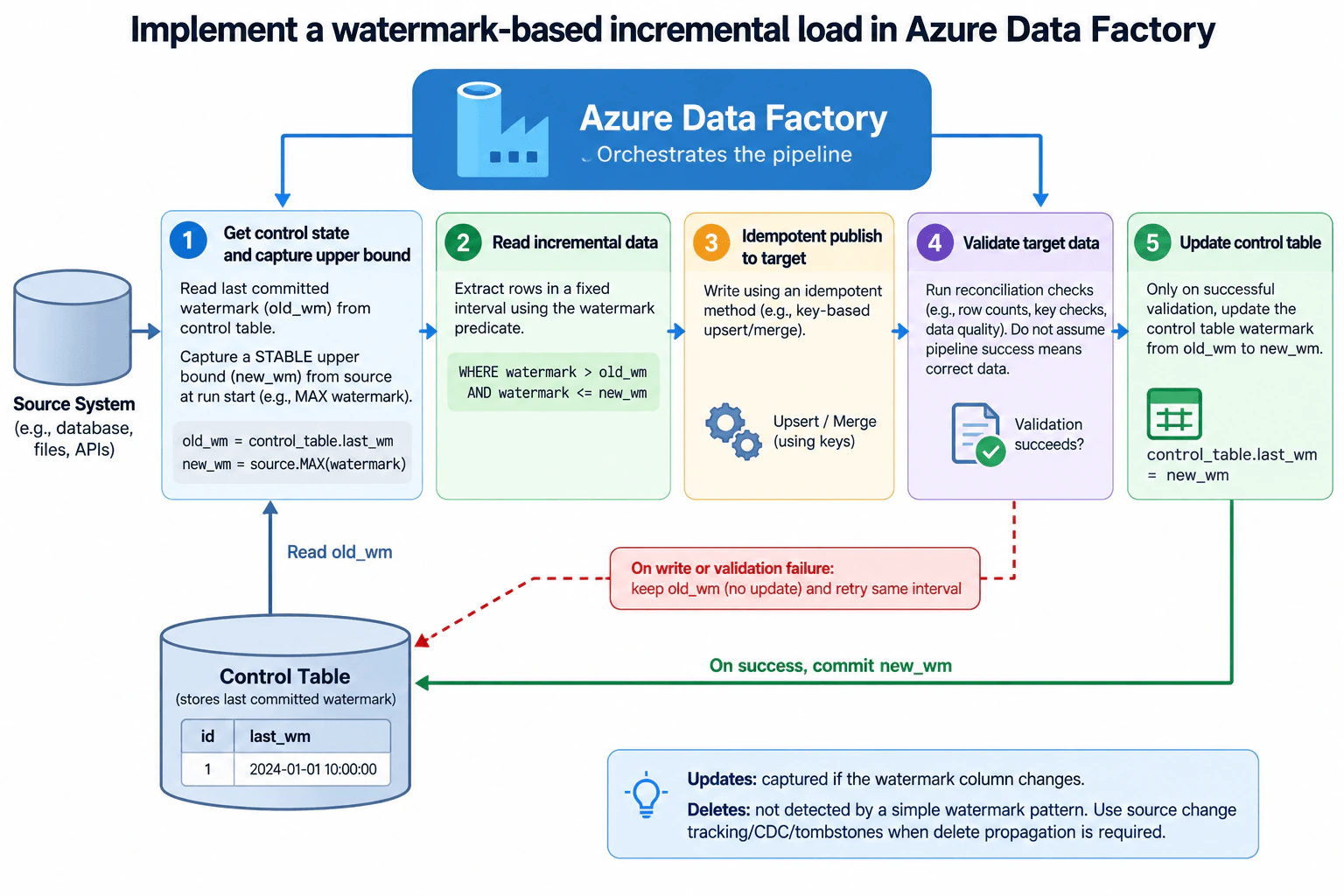
I would store the last successfully committed watermark in a control table. Each Azure Data Factory run reads that old value, captures one stable upper bound from the source, and loads only rows between those two values. The target write must be idempotent, such as a key-based upsert or merge. I validate the target before advancing the watermark. On failure, I keep the old watermark and retry the same interval. The trade-off is that a simple watermark does not detect physical deletes.

Detailed Explanation

The goal is to move only new or changed information instead of reading everything every time. Each run first remembers where the previous successful run stopped. It then chooses one fixed stopping point for the current run, copies everything between those two points, checks that the destination is correct, and only then saves the new stopping point. If anything goes wrong, the saved position does not move, so the same work can be tried again safely. Changed items can be found this way, but removed items need a different signal from the source.

Useful Questions to Ask the Interviewer
  1. Is the source watermark a timestamp or a monotonically increasing sequence?
  2. Does the destination support a key-based upsert or merge for idempotent writes?
  3. Must physical source deletes also be propagated to the target?
  4. What validation must pass before the new watermark is committed?
Implement a watermark-based incremental load in Azure Data Factory. diagram
How to Explain It in an Interview
1. Read the committed state and capture the upper bound

I would start each Azure Data Factory run by reading the Control Table. It stores the last successfully committed watermark, which I call old_wm. I then capture one stable new_wm from the committed source state, for example the current maximum watermark value, and keep that value fixed for the entire run. The source therefore needs a watermark column whose value changes when a row should be processed again. Capturing the upper bound once prevents the extraction boundary from moving while the run is executing.

2. Read only the fixed incremental interval

The Source System read uses the predicate watermark > old_wm AND watermark <= new_wm. That creates one deterministic interval for the run. Rows at or below old_wm belong to previously committed work, while rows above new_wm belong to a later run. Azure Data Factory orchestrates this step and moves the selected rows toward the target-writing step. This design assumes the chosen watermark provides a reliable ordering boundary for committed source changes.

3. Publish to the target idempotently

The selected rows are published to the target using an idempotent operation, such as a key-based upsert or merge. Idempotent means that repeating the same interval produces the same business result instead of creating duplicate rows. This matters because a target write can succeed for some or all rows before a later validation step fails. If the run is retried while old_wm is unchanged, the same rows can be presented again. The destination key used by the upsert or merge is therefore an important correctness boundary.

4. Validate the target before committing progress

After the target write, I run the reconciliation checks shown in the diagram, such as row-count checks, key checks, or appropriate data-quality checks. A successful pipeline activity by itself does not prove that the target data is correct. In this design, validation is the gate for advancing durable progress. The target write has already occurred, but the Control Table must not move forward until the resulting target state has passed validation.

5. Commit the new watermark only on success

When the target has been written successfully and validation passes, Azure Data Factory updates the Control Table from old_wm to new_wm. That commit records that the interval has been accepted. If either the write or validation fails, the Control Table remains unchanged. A retry therefore processes the same fixed interval again. Because the target operation is idempotent, repeating that interval should converge to the same target state rather than create duplicate business results.

6. Treat updates and deletes differently

Updates fit this pattern when an updated row receives a newer watermark value. The row falls into a later interval and the key-based upsert or merge updates its target state. Physical deletes are different because the deleted row no longer exists for the watermark query to find. If delete propagation is required, the source needs an explicit deletion signal such as change tracking, change data capture, or tombstone records. Those delete events can then be processed with the same controlled retry and validation principles.

Key Insight / Why This Solution Works
  1. Read control_table.last_wm into old_wm.
  2. Capture one stable new_wm from the committed source state at the beginning of the run.
  3. Extract source rows where watermark > old_wm and watermark <= new_wm.
  4. Publish those rows to the target with a key-based idempotent upsert or merge.
  5. Run target reconciliation and data-quality checks.
  6. If validation succeeds, update control_table.last_wm = new_wm.
  7. If writing or validation fails, leave old_wm unchanged and retry the same interval.
  8. Capture updates through watermark changes; use change tracking, CDC, or tombstones when physical deletes must be propagated.
Why Interviewers Ask This

Interviewers use this question to test whether a candidate understands incremental state, not just Azure Data Factory activities. A strong answer shows that the candidate can define a stable read boundary, avoid missing or duplicating business results during retries, separate target writes from durable progress, validate output before advancing the watermark, and explain an important limitation: a normal watermark query can capture changed rows but cannot discover rows after they have been physically deleted.

Common interview mistakes

Common mistakes are recalculating the upper bound during the run instead of keeping one stable new_wm, using an unsafe boundary predicate, advancing the Control Table immediately after extraction or target writing, treating Azure Data Factory task success as proof that the target is correct, using non-idempotent target writes when retries can repeat rows, and changing the watermark after failed validation. Another important mistake is claiming that a timestamp watermark detects physical deletes. It captures updates only when the row's watermark changes; deleted rows require an explicit source signal such as change tracking, CDC, or tombstones.

Interview tip

Explain the design as one durable progress protocol: read old_wm, capture a fixed new_wm, process exactly that interval, publish idempotently, validate the target, and only then commit new_wm. Emphasize the failure rule—keep old_wm unchanged—and finish by explaining why physical deletes require a different source signal.

Interviewer may ask next
What happens if the target write partially succeeds and the Azure Data Factory run fails before the watermark is updated?

I would keep old_wm unchanged and rerun the same old_wm-to-new_wm interval. The requirement that changes is recovery: the pipeline must tolerate the possibility that some target rows were already written before the failure. The affected component is the idempotent target publication step. A key-based upsert or merge makes repeated rows converge to the same business state instead of producing duplicates. The Control Table remains the durable progress point and must not move until validation succeeds. On retry, Azure Data Factory reads the same fixed source interval, republishes it, and runs the reconciliation checks again. If validation passes, only then does the Control Table advance to new_wm. The existing source and target access boundaries remain unchanged. The downside is extra target work because some rows may be written more than once physically. We accept that cost because repeated idempotent processing is safer than advancing the watermark and silently skipping data.

How would you change this design if source deletes also have to be reflected in the target?

I would keep the watermark pipeline but require an explicit source-provided delete signal, because a normal watermark query cannot discover a row after that row has been physically removed. The requirement that changes is the source change contract. Instead of processing only existing rows with newer watermark values, the source must expose deletions through change tracking, CDC, or tombstone records. Azure Data Factory can then process those delete events and apply the corresponding target delete or logical-delete action using the record key. The same correctness rule remains: perform the target operation idempotently, validate the resulting target state, and advance the Control Table only after success. On failure, keep old_wm and retry the same interval, including its delete events. The main downside is added source and target complexity because delete events need reliable keys, retention, and replay behavior. The rest of the pipeline design remains unchanged.

7. Choose an ETL or ELT pipeline for Microsoft tenant, telemetry, subscription, and support events.NEWData PipelinesMediumMicrosoft

Question Details

State privacy, bandwidth, source-system load, transformation complexity, latency, replay, and warehouse or Lakehouse compute assumptions. Trace where raw records land, which fields are transformed before or after loading, how incompatible sources are conformed, and how the design preserves a reprocessable source of truth.

Short Interview Answer (30-60 seconds)

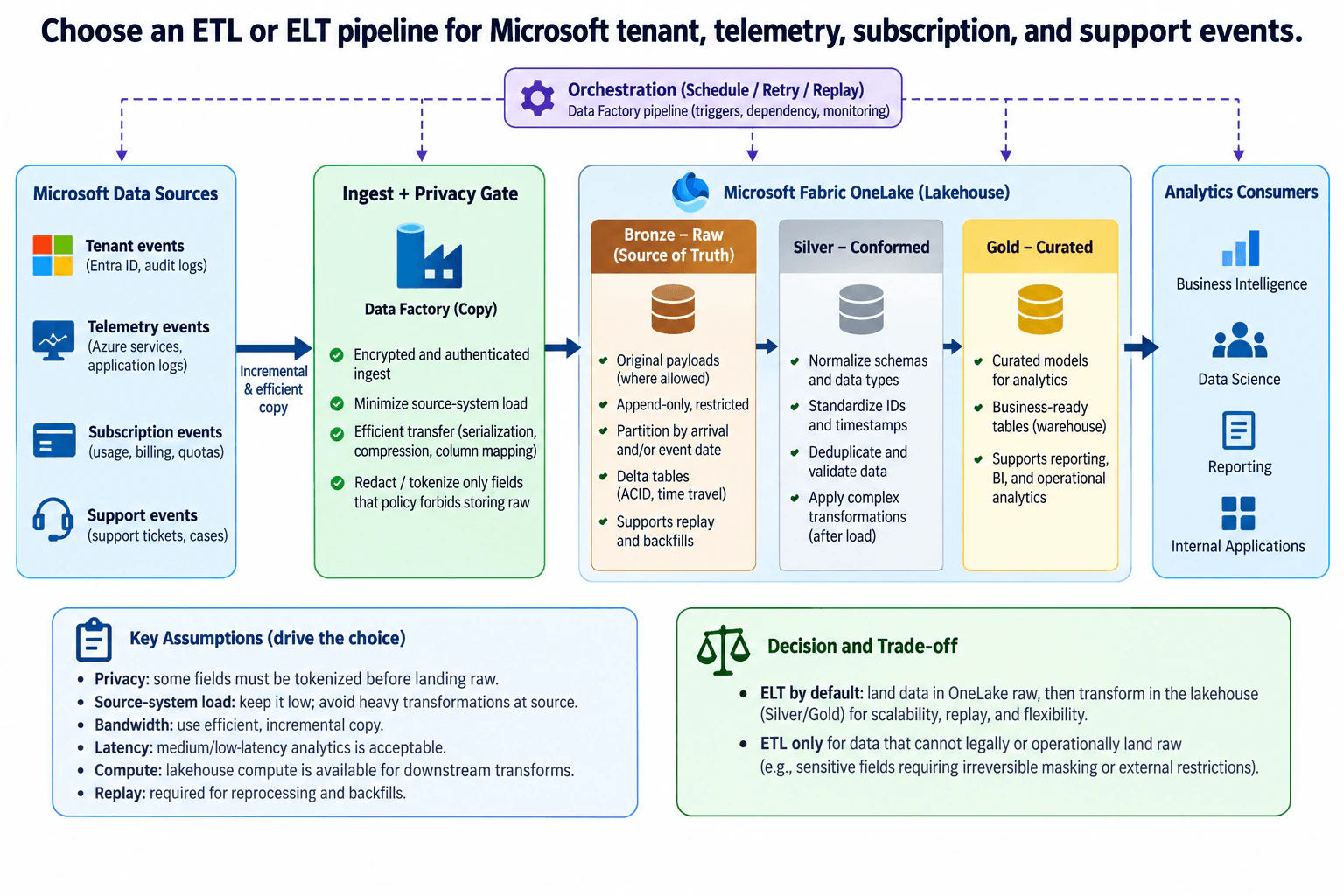
I would use ELT by default. Tenant, telemetry, subscription, and support events are copied incrementally through a privacy gate into a restricted Bronze layer in Microsoft Fabric OneLake. Fields that cannot legally or operationally land raw are redacted or tokenized first. Silver normalizes schemas, IDs, and timestamps, deduplicates and validates records, and performs complex transformations. Gold serves analytics. The trade-off is extra lakehouse storage and compute in exchange for flexible replay, backfills, and lower source-system load.

Detailed Explanation

The main choice is where we should do most of the work on the incoming information. We have four different sources, and they do not all look the same. We also need to protect private information, avoid putting too much pressure on the original systems, move data efficiently, and be able to repeat past work when something changes. My default choice is to keep an allowed original copy first, then clean and combine it later. Only information that cannot be stored in its original form should be changed before it is saved.

Useful Questions to Ask the Interviewer
  1. Which tenant, telemetry, subscription, or support fields are forbidden from being stored in raw form?
  2. What freshness is required, and is medium or low latency acceptable as assumed in the diagram?
  3. How much load can the source systems tolerate, and do they support incremental extraction?
  4. How far back must replay and backfill work, and what raw-data retention is required?
  5. Is Microsoft Fabric Lakehouse compute available for the heavier transformations after loading?
Choose an ETL or ELT pipeline for Microsoft tenant, telemetry, subscription, and support events. diagram
How to Explain It in an Interview
1. Start with the ETL-versus-ELT decision

I would say, "I prefer ELT for this design because replay and heterogeneous data make a retained raw layer valuable." Tenant events, telemetry events, subscription events, and support events are different in shape and meaning. Doing every complex transformation at the sources would increase source load and make future logic changes harder. The exception is privacy. If policy says a sensitive field cannot be stored raw, the Ingest + Privacy Gate must redact or tokenize that field before it reaches OneLake. That is the ETL part of an otherwise ELT-oriented design.

2. Ingest incrementally through the privacy gate

The four source groups flow into Data Factory Copy. The diagram assumes encrypted and authenticated ingestion, low allowed source-system load, and bandwidth-conscious transfer. I would therefore use incremental and efficient copy rather than repeatedly extracting complete datasets. Serialization, compression, and column mapping belong to this ingestion boundary. The important contract is that permitted source values stay unchanged for Bronze, while prohibited sensitive fields are transformed before landing. That keeps privacy enforcement close to ingestion without moving all business transformations upstream.

3. Preserve Bronze as the reprocessable source of truth

Data Factory Copy writes into the Bronze layer of the Microsoft Fabric OneLake Lakehouse. Bronze keeps original payloads when policy allows, with restricted access and append-only raw history. The diagram partitions raw data by arrival date and/or event date and uses Delta tables with ACID transactions and time travel. This layer makes replay and backfill practical because downstream logic can be rerun from retained Bronze data instead of repeatedly stressing the original systems. Event time means when the source event occurred; arrival or processing time means when the pipeline received or handled it. They should remain separate.

4. Conform incompatible sources in Silver

Silver is where most of the ELT work happens. I would normalize schemas and data types, standardize identifiers and timestamps, deduplicate records, validate the data, and apply the complex transformations needed to combine heterogeneous sources. Tenant, telemetry, subscription, and support records may use different identifiers or timestamp representations, so Silver creates consistent representations before analytics uses them. I would not claim a global ordering guarantee because the diagram does not define one. I also would not invent a deduplication key or schema-version strategy; those contracts must be agreed with the source owners.

5. Publish curated Gold data to consumers

Validated and conformed Silver data flows into Gold. Gold contains curated models and business-ready tables for analytics. The diagram then serves Business Intelligence, Data Science, Reporting, and Internal Applications. This separates reprocessable raw history from consumer-facing data. Consumers should not depend directly on source-specific schemas when the Silver and Gold layers provide a consistent analytical shape. Complex transformation compute is intentionally concentrated in the lakehouse because the design assumes that lakehouse compute is available for downstream transformations.

6. Orchestrate retries, replay, and recovery separately from data flow

The dashed orchestration path is control flow, not business data. The Data Factory pipeline manages triggers, dependencies, monitoring, retries, and replay coordination across the pipeline. A transient failed execution can be retried under orchestration control, while replay or backfill reads retained Bronze history and executes downstream processing again. The diagram does not specify retry count, delay, or whether a retry repeats one task or a complete workflow, so I would not invent those details. Silver validation checks data correctness before it moves toward curated Gold output. The main trade-off is more lakehouse storage and downstream compute in return for replayability, transformation flexibility, and lower pressure on source systems.

Technical Approach
  1. Classify the four source groups: tenant events, telemetry events, subscription events, and support events.
  2. Identify fields that policy forbids storing raw; redact or tokenize only those fields at the Ingest + Privacy Gate.
  3. Use Data Factory Copy for encrypted, authenticated, incremental, bandwidth-efficient ingestion while keeping source-system load low.
  4. Land permitted original payloads in the restricted Bronze layer in Microsoft Fabric OneLake and partition by arrival date and/or event date.
  5. Preserve append-only Bronze history so downstream logic can be replayed or backfilled without rereading every source.
  6. In Silver, normalize schemas and data types, standardize identifiers and timestamps, deduplicate, validate, and perform complex transformations.
  7. Publish curated business-ready models in Gold for Business Intelligence, Data Science, Reporting, and Internal Applications.
  8. Keep orchestration control separate from business data: the Data Factory pipeline manages triggers, dependencies, monitoring, retries, replay, and backfill coordination.
Practical Insights

The benefit is that most expensive transformation work runs in the Lakehouse instead of repeatedly loading the source systems. Keeping Bronze history also makes replay and backfill much easier because the pipeline can process retained raw data again. The downside is extra storage and Lakehouse compute, especially when history is long or a large backfill must be processed. Incremental copy reduces bandwidth and source load, but it also requires reliable incremental source boundaries. Privacy adds another trade-off: changing prohibited fields before landing protects sensitive data, but irreversible masking can remove information that later transformations might have used. We accept these costs because the design values low source pressure, flexible transformation logic, and a reprocessable source of truth.

Why Interviewers Ask This

This question tests whether a candidate can make a practical ETL-versus-ELT decision instead of choosing a pattern by habit. The interviewer wants to see how the candidate balances privacy, source-system load, bandwidth, latency, transformation complexity, compute cost, and replay needs. It also tests whether the candidate can trace data and orchestration separately, preserve a reprocessable source of truth, conform incompatible inputs, and explain recovery and validation without inventing guarantees.

Common interview mistakes

A common mistake is choosing ETL or ELT only because one pattern is fashionable. The decision should come from privacy, source load, bandwidth, latency, transformation complexity, available Lakehouse compute, and replay needs. Another mistake is calling Bronze raw while silently applying broad business transformations before landing; only policy-required redaction or tokenization belongs at the privacy gate in this design. Candidates may also overwrite raw history, which removes the replay advantage. Other mistakes are skipping schema and identifier conformance in Silver, treating orchestration control arrows as data movement, assuming task success proves data correctness, inventing exactly-once or ordering guarantees, or sending source-specific schemas directly to analytics consumers.

Interview tip

Lead with the decision: "ELT by default, ETL only for data that cannot legally or operationally land raw." Then trace one clean path from the four source groups through the privacy gate, Bronze, Silver, Gold, and consumers. Explicitly separate Data Factory orchestration from business data flow. Spend most of the explanation on why Bronze replayability and Silver conformance justify the choice, and call out the privacy exception early.

Interviewer may ask next
What would you change if the business suddenly required much fresher analytics while source-system load still had to stay low?

I would keep the same Bronze, Silver, and Gold architecture, but I would first revisit ingestion frequency and the incremental source contracts. The requirement that changes is freshness, not the need for privacy, replay, or a reprocessable source of truth. Data Factory Copy and the Ingest + Privacy Gate remain the ingestion boundary, but I would reduce the amount of data handled per run and run incremental copies more frequently where the sources can safely support that behavior. Privacy-restricted fields would still be redacted or tokenized before Bronze.

Bronze would continue to retain permitted original payloads, and Silver would still normalize schemas, standardize identifiers and timestamps, deduplicate, validate, and perform complex transformations. Gold would remain the consumer-facing layer. I would identify whether source extraction, transfer, Silver processing, or Gold preparation is the new freshness bottleneck before increasing frequency further. Replay would still come from Bronze. The downside is higher orchestration and Lakehouse compute activity, more frequent writes, and potentially greater source pressure, so the faster target must remain within the source-load and bandwidth assumptions.

What if a new privacy rule says some support-event fields may never be stored in their original form?

I would move the required transformation for those specific fields into the existing Ingest + Privacy Gate and keep the rest of the architecture unchanged. The changed requirement affects the source-to-Bronze contract: those support fields can no longer be part of the original payload retained in OneLake. Data Factory Copy would still ingest incrementally, but prohibited values would be redacted or tokenized before the Bronze write. Fields that policy still permits would continue to land in their original form.

Bronze remains the reprocessable source of truth for the data we are legally and operationally allowed to retain. Silver still performs schema normalization, identifier and timestamp standardization, deduplication, validation, and complex transformations. Gold still serves curated analytics. Replay and backfill continue from Bronze, but a replay cannot reconstruct information that was irreversibly removed at ingestion. That is the main downside: stronger privacy protection reduces future analytical flexibility for those fields. I would therefore apply the pre-load transformation only to fields covered by the new rule, not to the entire support dataset.

8. Design a real-time enterprise telemetry pipeline on Azure.Data PipelinesHardMicrosoft

Question Details

Start with application or device producers and define Event Hubs partitioning, schema validation, event-time processing, raw Delta landing in ADLS Gen2, curated transformations, low-latency serving, and ADF or Fabric orchestration. Cover burst absorption, hot tenants, duplicate delivery, late events, replay, checkpointed state, and a safe backfill path.

Short Interview Answer (30-60 seconds)

I would use Event Hubs to absorb telemetry bursts and partition the stream with a stable key that balances required ordering against hot-tenant risk. Structured Streaming validates the schema, processes by event time, applies a watermark, deduplicates by event_id within bounded state, and checkpoints progress. Validated events land in raw Delta on ADLS Gen2, then curated Delta is published to analytics and operational consumers. ADF or Fabric controls processing and backfill jobs. The main trade-off is stronger event-time correctness versus more state, latency, and operational cost.

Detailed Explanation

The goal is to continuously collect information from applications and devices, keep it safe when traffic suddenly increases, check that every record has the expected shape, handle records that arrive more than once or arrive late, and keep an original history before producing a cleaner version for reports and operational uses. The design also needs a safe way to restart after failures, replay recent information, and recalculate older periods without disturbing the live flow. The main challenge is keeping the result correct while still making fresh information available quickly.

Useful Questions to Ask the Interviewer
  1. Which telemetry events require ordering for the same tenant, device, or other business key?
  2. How late may an event arrive before it is outside the normal processing window?
  3. How long must Event Hubs retain data for replay, and how far back must historical backfills go?
  4. Which schema changes are considered compatible, and what should happen to records that fail validation?
  5. What freshness is required for Power BI, Synapse, real-time applications, and other downstream systems?
Design a real-time enterprise telemetry pipeline on Azure. diagram
How to Explain It in an Interview
1. Define the telemetry contract and ingestion boundary

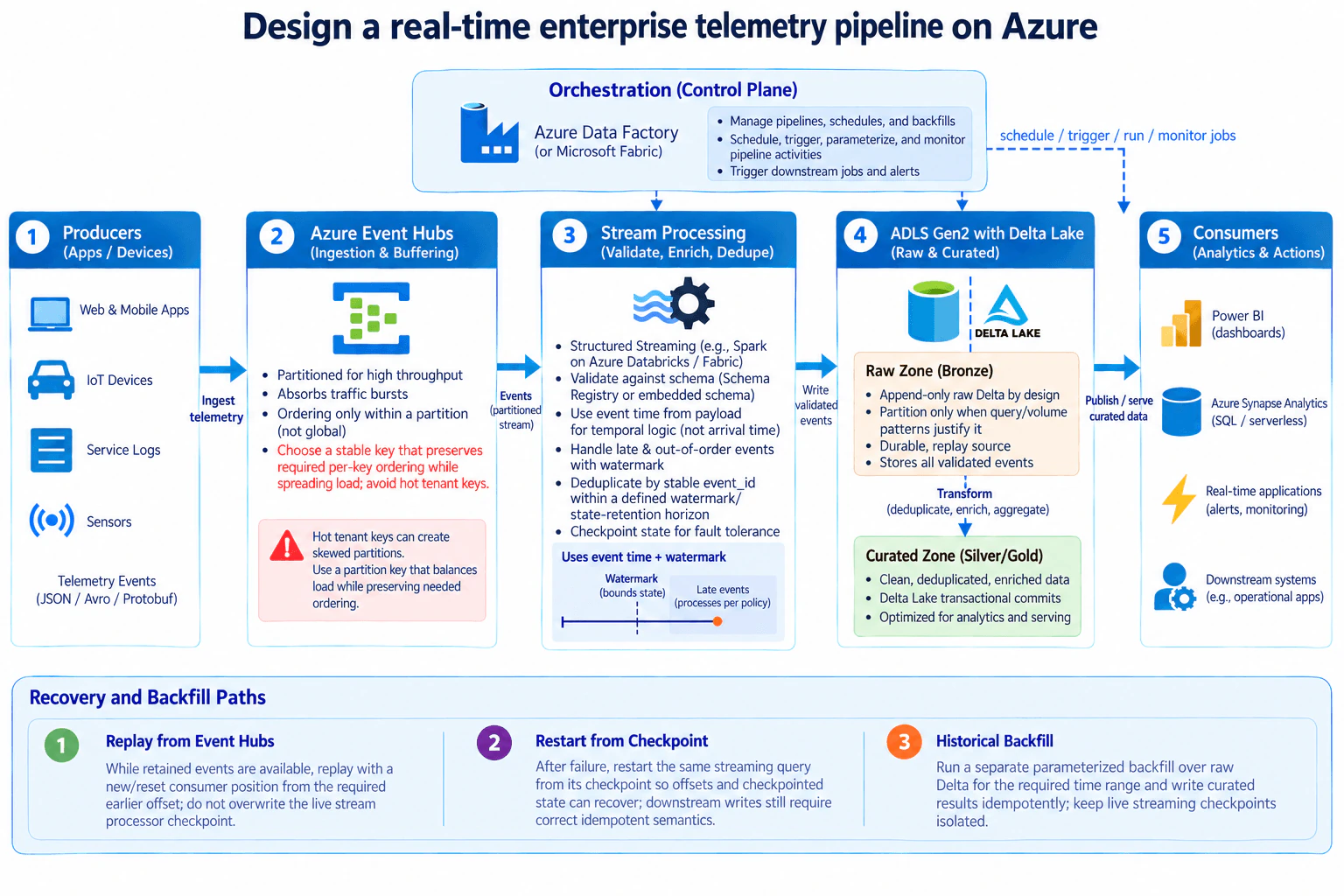
I would start with one telemetry event as the record grain. Application and device producers send telemetry events into Azure Event Hubs. The diagram allows JSON, Avro, or Protobuf serialization. The processing logic needs a source event timestamp such as event_time for event-time decisions and a stable event_id for duplicate detection. The solid arrow from Producers to Event Hubs is the business-data path. The orchestration control plane does not carry these telemetry records.

2. Use Event Hubs to absorb bursts and control partitioning

Event Hubs provides the ingestion buffer between producers and processing. Its partitions enable parallel consumption, but ordering exists only within one partition, not globally. I would choose a stable partition key only where per-key ordering is required, and I would spread keys well enough to avoid a large tenant creating a hot partition. That is the important scaling decision: adding processing workers cannot remove a bottleneck caused by one overloaded partition. More partitions increase parallelism, but they also add coordination overhead.

3. Validate, process by event time, and keep bounded state

Structured Streaming on Azure Databricks or Fabric reads the partitioned stream. It validates records against the expected schema before they enter the validated raw-data path. Temporal logic uses the source event time rather than arrival time. A watermark bounds retained streaming state and defines the normal lateness horizon. Events beyond that threshold require an explicit processing policy rather than an assumption that all late events behave identically.

The same processing stage deduplicates using stable event_id values within the defined watermark or state-retention horizon. This protects business results from repeated delivery without claiming unlimited historical deduplication. The streaming query also checkpoints offsets and state so the same query can recover after a processor failure.

4. Land raw Delta and produce curated Delta

Validated events are written to the Raw Zone in ADLS Gen2 using Delta Lake. The raw zone is append-only by design and acts as the durable source for replay and historical recomputation. I would partition the stored data only when real query and volume patterns justify it rather than assuming date partitioning is always correct.

A transformation step reads raw Delta and produces the Curated Silver/Gold Delta data. It cleans, deduplicates, enriches, and aggregates data for serving. Delta transactional commits provide the table commit boundary for those curated changes. The curated result is then published or served to Power BI, Azure Synapse Analytics, real-time applications, and downstream operational systems.

5. Keep orchestration control separate from business data

Azure Data Factory or Microsoft Fabric is the orchestration control plane. It manages pipelines, schedules, backfills, parameters, runs, monitoring, downstream jobs, and alerts. The dashed arrows represent control signals, while the solid arrows carry telemetry or curated data. The processing engine still performs the streaming transformations, and ADLS Gen2 with Delta Lake still stores the data. The control path reaching downstream jobs or alerts does not mean that ADF or Fabric carries the curated business records to consumers.

6. Recover, replay, and backfill safely

I would use three separate recovery mechanisms. After a streaming processor failure, restart the same query from its checkpoint so offsets and checkpointed state can recover. If recent source events must be reprocessed while they are still retained in Event Hubs, start from the required earlier consumer position without overwriting the live streaming checkpoint.

For older historical corrections, run a separate parameterized backfill over raw Delta for the required time range. The backfill writes curated results idempotently and keeps its run state isolated from the live streaming checkpoints. This prevents historical work from moving or corrupting the production stream's recovery position.

Technical Approach
  1. Define one telemetry event as the source grain and identify event_time, event_id, and the business key that needs partition-local ordering.
  2. Send application and device telemetry into Azure Event Hubs and choose a stable partition key that balances ordering requirements against hot-partition risk.
  3. Read the stream with Structured Streaming, validate the schema, process using event time, apply a watermark, deduplicate by event_id within bounded retained state, and checkpoint offsets and state.
  4. Write validated events into an append-only raw Delta zone in ADLS Gen2.
  5. Run curated transformations from raw Delta into Silver/Gold Delta using transactional commits.
  6. Publish or serve curated data to Power BI, Azure Synapse Analytics, real-time applications, and downstream operational systems.
  7. Use ADF or Fabric to schedule, trigger, parameterize, run, and monitor processing, curation, downstream jobs, alerts, and backfills.
  8. Recover using checkpoints for processor failures, Event Hubs replay for retained recent data, and isolated raw-Delta backfills for historical periods.
Practical Insights

The benefit is that Event Hubs separates producers from processors and absorbs short traffic bursts, while partitions allow parallel work. The downside is that ordering exists only inside each partition, so a poor key can create a hot tenant and limit throughput. The benefit of event-time processing and watermarks is better handling of late records. The downside is that a longer lateness window keeps more state and can delay final results. Deduplication also needs retained state, so a longer duplicate-detection horizon costs more memory and storage. Raw Delta gives strong replay and backfill flexibility, but retaining more history costs storage. We accept these costs because checkpoints, replayable raw data, and isolated backfills make recovery safer.

Why Interviewers Ask This

This question tests whether I can design streaming data systems around correctness rather than simply naming Azure services. The interviewer is checking whether I understand partitioning and skew, partition-local ordering, event time, late records, bounded duplicate handling, checkpoint recovery, replay, safe historical backfills, and the separation between business-data flow and orchestration control flow. It also tests whether I can explain reliability and scaling trade-offs without claiming global ordering or exactly-once business outcomes.

Common interview mistakes

Common mistakes are using tenant_id directly as a partition key when a few large tenants can create hot partitions; claiming Event Hubs provides global ordering; using arrival time when business logic requires event time; promising unlimited deduplication instead of defining a watermark or state-retention horizon; calling Delta data inherently immutable instead of making append-only raw storage an explicit design policy; overwriting the live streaming checkpoint during replay; running a historical backfill through the live checkpoint; and describing ADF or Fabric as if it carries telemetry or performs the streaming transformation itself.

Interview tip

Explain the design in two flows. First trace the solid business-data path from producers to Event Hubs, streaming, Delta, and consumers. Then explain the dashed orchestration control path for jobs, backfills, downstream triggers, and alerts. Spend most of the discussion on partitioning, event time, bounded deduplication, checkpoints, and why checkpoint restart, source replay, and historical backfill are different recovery mechanisms.

Interviewer may ask next
What would you change if one tenant suddenly produced most of the telemetry and created a hot Event Hubs partition?

I would keep the same architecture and change the partitioning decision first, because the bottleneck is at the Event Hubs partition boundary. The changed requirement is load distribution: one business key now produces enough traffic to dominate a partition.

I would check whether strict ordering is really required for every event from that tenant. If ordering only needs to be preserved for a narrower stable key, such as a device or another sub-key, I would partition on that finer-grained key so the tenant's traffic can spread across multiple partitions. If per-tenant ordering is mandatory, that requirement limits the amount of parallelism available, and I would state that trade-off instead of claiming that more processing workers alone will solve it.

The streaming stage still validates the schema, processes by event time, deduplicates by event_id, and checkpoints state. Raw and curated Delta paths remain unchanged. Recovery still uses the same checkpoint, replay, and backfill mechanisms. The downside of using a finer partition key is a narrower ordering scope and potentially more coordination, so the partition key must follow the real business-ordering requirement.

How would you backfill a corrected transformation for the previous month without disturbing the live stream?

I would run a separate parameterized backfill over the Raw Zone in Delta for that month and keep it isolated from the live streaming query. The changed requirement is historical recomputation, not live ingestion, so I would not reset Event Hubs or reuse the production streaming checkpoint.

Azure Data Factory or Microsoft Fabric can schedule, trigger, parameterize, run, and monitor the backfill. The backfill reads the required time range from raw Delta, applies the corrected transformation, and writes the affected curated results idempotently. The live Structured Streaming job continues reading Event Hubs from its existing checkpoint and keeps its own offsets and state untouched.

Correctness depends on making the historical write repeatable without creating repeated business results. Delta transactional commits provide the table commit boundary for the curated changes. I would verify that the expected historical range was recomputed before considering the backfill complete. The main downside is extra compute and storage-write load while live processing continues.

9. What is a Microsoft Fabric Lakehouse?Cloud Data PlatformsEasyMicrosoft

Question Details

Describe how files and Delta tables coexist in OneLake, how Spark and the SQL analytics endpoint access the same governed data, and which ingestion, transformation, machine-learning, and reporting workloads fit the item. Distinguish raw file storage from managed tables and business semantic models.

Short Interview Answer (30-60 seconds)

A Microsoft Fabric Lakehouse keeps file-oriented data and managed Delta tables together in OneLake. Spark provides read/write engineering and data-science access, while the SQL analytics endpoint gives read-only T-SQL access to eligible Delta tables. Power BI semantic models are separate business artifacts, which keeps storage and reporting concerns distinct.

Detailed Explanation

A Microsoft Fabric Lakehouse gives data engineers, data scientists, analysts, and reporting users one governed data foundation instead of requiring a separate storage copy for each workload. Operational databases, files, SaaS applications, streams, and other sources can feed the lakehouse through Fabric ingestion options. Inside OneLake, ordinary files remain file-oriented data while the Tables area contains managed Delta tables. Spark handles engineering and machine-learning work, the SQL analytics endpoint serves eligible Delta tables for read-only T-SQL queries, and separately created Power BI semantic models provide the business layer for reports and dashboards.

Useful Questions to Ask the Interviewer
  1. Will consumers mainly need raw file access, Spark-accessible Delta tables, T-SQL queries, or Power BI reporting?
  2. Which sources should be copied into OneLake and which should remain at their source through shortcuts?
  3. Do ingestion and transformations need Dataflows Gen2, data pipelines, Spark notebooks, or a combination of those Fabric workloads?
  4. Will data scientists train and score machine-learning models against the lakehouse data?
  5. What access-control, classification, lineage, and monitoring requirements must apply to the shared data?
  6. How should teams separate raw file storage, governed analytical tables, and business-facing semantic models?
What is a Microsoft Fabric Lakehouse? diagram
How to Explain It in an Interview
  1. Start with the OneLake storage boundary. The lakehouse stores its data in OneLake. Its Files area holds file-oriented data such as Parquet, CSV, JSON, and other formats. Those files remain files and are not automatically exposed as SQL tables. Its Tables area contains managed Delta tables. Delta adds table metadata and a transaction log, giving the table ACID transaction behavior and versioned table state. This distinction lets engineering teams retain raw data while publishing structured analytical tables separately.
  1. Explain ingestion as several supported paths, not one mandatory sequence. The diagram shows operational databases, files, SaaS applications, streaming data, and other sources entering Microsoft Fabric. Dataflows Gen2 can provide a no-code ingestion and transformation path. Data pipelines orchestrate data movement and processing. Shortcuts reference supported data in place rather than requiring another copy. Raw files can also land directly in the lakehouse. A team chooses the path that fits the source; these choices are alternatives and should not be described as stages that every dataset must pass through.
  1. Use Spark for read/write engineering and data-science workloads. Spark notebooks can read both files and Delta tables from the lakehouse. Data engineers can transform and enrich data and write updated Delta tables. Data-science workloads can train and score machine-learning models using the same governed data. Spark therefore owns the read/write processing path shown in the architecture. If a transformation fails, the processing workload should be corrected or rerun and its output validated before downstream consumers treat the table as current.
  1. Keep the SQL analytics endpoint boundary precise. The lakehouse SQL analytics endpoint exposes eligible Delta tables through a read-only T-SQL query surface. Analysts can use it for SQL analytics and exploration against the same underlying governed data. It does not provide the write path for lakehouse table data, so inserts, updates, and deletes to the underlying lakehouse data do not belong there. Raw files in the Files area are also not automatically exposed through this SQL interface. Data must be represented as an eligible Delta table in the Tables area before this path applies.
  1. Separate the Power BI semantic model from physical lakehouse storage. A Power BI semantic model is a separate business-facing artifact, not another lakehouse table and not the raw storage layer. It can add relationships, measures, and reporting security on top of lakehouse data. The diagram explicitly treats semantic-model creation as a separate step rather than an automatic lakehouse artifact. Direct Lake or another supported connectivity mode can then be chosen for the model, and Power BI reports and dashboards consume that semantic layer.
  1. Apply governance across the shared data boundary. The architecture applies Microsoft Entra ID, access control, data classification, lineage, and monitoring across OneLake and the lakehouse. Identity establishes who or what is accessing the platform, while authorization controls permitted access. Classification and lineage describe and trace the data, and monitoring provides operational evidence. These mechanisms are different responsibilities; classification or lineage alone does not grant or deny access.
  1. Keep platform and workload ownership separate. Fabric and OneLake provide the reusable shared foundation. Data-producing teams choose how their sources are ingested and own the correctness of their files and Delta-table outputs. Engineering and data-science workloads own transformations and model execution. Analysts use the SQL endpoint without becoming table writers, while reporting teams own the semantic model and reports. The diagram does not define a separate custom control-plane service, tenant-isolation model, region strategy, or manual provisioning workflow, so those should not be invented as part of this answer.
  1. Handle failures at the workload boundary. An ingestion failure affects the source-to-lakehouse path rather than automatically corrupting every consumer. A Spark failure affects the transformation or table update it owns. A SQL endpoint problem affects read access but does not become the mechanism for changing stored table data. A semantic-model or report problem affects the reporting layer. Recovery means correcting or rerunning the failed workload as appropriate and then validating the resulting files or Delta tables before downstream users rely on them. The diagram supplies no numeric retry policy, recovery-time objective, or disaster-recovery design, so I would not invent one.
  1. Close with the main trade-off. The lakehouse lets ingestion, Spark, machine learning, SQL analytics, semantic modeling, and reporting work from one governed OneLake foundation, reducing unnecessary data copies. The trade-off is that the boundaries must remain explicit: a file is not automatically a managed table, the SQL endpoint is not the table-write path, and a semantic model is not the physical data store. That separation introduces some modeling and governance work, but it creates clearer contracts between raw data, analytical tables, and business reporting.
Technical Approach
  1. Identify the producers and consumers: source databases, files, SaaS applications, streams, engineering workloads, data-science workloads, SQL users, and Power BI users.
  2. Select the appropriate ingestion path for each source: Dataflows Gen2, data pipelines, shortcuts, or direct file landing.
  3. Keep raw or file-oriented data in the Files area when it should remain file based.
  4. Publish managed Delta tables in the Tables area when structured analytical access is needed.
  5. Use Spark notebooks for read/write transformation across files and Delta tables and for data-science workloads such as model training and scoring.
  6. Serve eligible Delta tables through the read-only SQL analytics endpoint for T-SQL analytics and exploration.
  7. Create a separate Power BI semantic model when business relationships, measures, or reporting security are needed, then use it from reports and dashboards.
  8. Apply identity, access control, classification, lineage, and monitoring across the OneLake and lakehouse boundary.
  9. Keep failure ownership with the workload performing ingestion, transformation, querying, or reporting and validate outputs after recovery.
Practical Insights

There is no single Big-O complexity for this platform. Storage grows with the files and Delta-table data retained in OneLake. Spark time and cost depend on how much data transformations read, shuffle, and rewrite. SQL responsiveness depends on the eligible Delta tables and the queries being executed. Ingestion cost depends on source movement and orchestration, while shortcuts can avoid copying data when referencing it in place is appropriate. Power BI adds semantic-model and reporting work above the lakehouse. Practical bottlenecks can appear in ingestion, Spark processing, table layout, or analytical queries. No numeric volume, latency target, recovery objective, concurrency limit, region requirement, or cost target is supplied, so those values must be measured rather than invented.

Why Interviewers Ask This

Interviewers want to see whether you understand the boundaries between file storage, managed Delta tables, processing engines, SQL serving, and the Power BI business layer. A strong answer explains how multiple Fabric workloads use the same governed OneLake data without incorrectly treating raw files, Delta tables, the SQL analytics endpoint, and semantic models as the same thing.

Common interview mistakes

Common mistakes are saying every lakehouse file is automatically a Delta table; claiming raw Files-area data is automatically exposed through the SQL analytics endpoint; saying the SQL analytics endpoint can modify underlying lakehouse table data; treating Spark and the SQL endpoint as having identical read/write capabilities; treating a Power BI semantic model as if it were stored inside the lakehouse Tables area; assuming the semantic model is automatically created; describing shortcuts as if they always copy their target data; or presenting Dataflows Gen2, data pipelines, shortcuts, and file landing as mandatory sequential stages instead of separate ingestion choices.

Interview tip

Explain the lakehouse using three boundaries: OneLake stores files and managed Delta tables, Spark is the main read/write engineering path while the SQL analytics endpoint provides read-only T-SQL access to eligible Delta tables, and Power BI semantic models sit above the lakehouse as a separate business layer. Then mention shared governance across those paths.

Interviewer may ask next
Suppose analysts need T-SQL access to data that currently exists only as CSV and JSON files in the lakehouse. What would you change?

I would keep the source files in the Files area as the file-oriented representation, then use an appropriate Fabric transformation workload, such as Spark or another ingestion and transformation path shown in the architecture, to validate and publish the required data as managed Delta tables in the Tables area. The SQL analytics endpoint can then expose those eligible Delta tables for read-only T-SQL queries. I would not describe the original CSV or JSON files as automatically SQL-queryable. This adds a publication step but gives analysts a stable table contract while preserving the source files for engineering use.

What if Power BI users need business calculations and relationships that should not be embedded in the physical Delta tables?

I would keep the Delta tables focused on governed analytical data and create a separate Power BI semantic model for business-facing relationships, measures, and reporting security. Reports and dashboards would use that semantic model instead of forcing every reporting rule into the physical lakehouse tables. The model can use Direct Lake or another supported connectivity mode. This adds a separate artifact to operate, but it keeps the storage contract and the business reporting contract independent.

10. Compare ADLS Gen2 with Azure Blob Storage for a data lake.Cloud Data PlatformsMediumMicrosoft

Question Details

Explain how hierarchical namespace changes directory operations, analytics I/O, ACLs, and rename behavior while both use Azure object storage durability. Include RBAC, path-level authorization, supported connectors, migration implications, and a workload where the flat namespace remains sufficient.

Short Interview Answer (30-60 seconds)

I would use ADLS Gen2 when a data lake needs hierarchical directories, path-level ACLs, atomic directory operations, and analytics-friendly access. I would keep flat Azure Blob Storage for independent-object workloads. Both share Azure object storage, so the main trade-off is richer filesystem semantics versus simpler object storage.

Detailed Explanation

Producer teams may send application data, logs, database extracts, files, and media into the same Azure storage platform, while Spark, Hadoop, SQL analytics, data science, and reporting workloads read that data. The recurring design choice is whether those workloads need real directory semantics or only independent objects. A flat Blob namespace is simpler, but directory-style operations can touch many blobs and it does not provide filesystem ACLs. ADLS Gen2 adds a hierarchical namespace, which gives real directories, path-level ACLs, efficient directory operations, and atomic directory manipulation while keeping the same Azure object-storage foundation.

Useful Questions to Ask the Interviewer
  1. Will the lake run Spark, Hadoop-style, Synapse, or similar analytics workloads that frequently traverse and reorganize directories?
  2. Do teams need authorization at individual directory or file paths, or is Azure RBAC at broader resource scopes sufficient?
  3. Will workloads frequently rename, move, or delete whole directories as part of publication or processing?
  4. Are existing applications already using Blob APIs, SDKs, REST interfaces, or connectors that must continue working after migration?
  5. Is the current storage account already populated, and what compatibility or cutover constraints apply before enabling hierarchical namespace?
  6. Are some datasets simply independent blobs such as media, backups, archives, or application assets that do not require filesystem behavior?
Compare ADLS Gen2 with Azure Blob Storage for a data lake. diagram
How to Explain It in an Interview
  1. Shared Azure storage foundation and the main decision Both choices use the Azure object-storage foundation shown in the design. Producer applications, logs and events, databases, and files or media write through Blob or Data Lake APIs, REST interfaces, SDKs, or supported connectors. Analytics and consumer workloads read or write through Blob APIs or DFS/Data Lake APIs. The main design decision is therefore not a different underlying object-storage platform. It is whether the account should use a flat namespace or enable hierarchical namespace. If the workload treats objects independently, flat Blob Storage is often enough. If analytics workloads depend on filesystem-style paths and directory operations, ADLS Gen2 is the better fit.
  1. Azure Blob Storage with a flat namespace In the flat namespace, a container holds blobs whose names can contain slash characters such as "images/logo.png" or "data/file1.parquet". Those slashes look like folders to users, but they do not create real hierarchical directories. A directory-style operation therefore has to operate on the individual blobs represented by that prefix. This is acceptable for workloads that mostly create, read, or delete independent objects. Azure RBAC provides role-based authorization, but the flat namespace does not add the POSIX-like directory and file ACL model shown on the ADLS Gen2 side. This makes it a good fit for static media, application assets, backups, archives, and similar independent blobs.
  1. ADLS Gen2 with hierarchical namespace ADLS Gen2 enables hierarchical namespace on Azure Blob Storage. A container can then be treated as a file system with real directory and file relationships, such as "raw/2024/data.parquet" and "curated/sales/part-000.parquet". Directory operations no longer need to be simulated by enumerating every blob whose name begins with a prefix. Azure can manipulate the directory entry directly. This matters for analytics engines that organize data into directory trees, partitions, raw zones, and curated zones.
  1. Analytics I/O and rename behavior Spark and Hadoop-style workloads often perform many metadata and directory operations while scanning, staging, and publishing files. With hierarchical namespace, those workloads operate against real directories rather than only blob-name prefixes. Directory rename, move, and delete operations can be handled as atomic namespace metadata operations instead of processing all blobs under a logical folder. This is especially useful when analytics frameworks write temporary output and then rename the completed directory. I would not claim that HNS makes every query faster automatically; its advantage is efficient filesystem semantics and directory-oriented operations that analytics frameworks commonly use.
  1. Authorization and governance The governance path is separate from the production data path. Azure RBAC provides role-based authorization through Azure resource scopes and data-access roles. With ADLS Gen2 hierarchical namespace, POSIX-like ACLs add finer-grained authorization on directories and files. That allows path-level rules for structures such as raw and curated directories. Directory execute permission controls whether a principal can traverse each directory in a path. Platform and data teams own policy, role assignment, ACL design, auditing, and monitoring rather than routing production records through this control path. A namespace and ACL structure alone should not be treated as complete tenant isolation.
  1. Producer and consumer interfaces The producer side can ingest through Blob APIs or Data Lake APIs using REST, SDKs, and supported connectors. For an HNS-enabled account, multi-protocol access allows Blob APIs and Data Lake Storage APIs to operate on the same stored data. Capabilities unique to ADLS Gen2, such as directory operations and ACL management, should use the Data Lake Storage interfaces. Spark and Hadoop-style processing, SQL analytics such as Synapse workloads, data science workloads, and BI or reporting consumers can access the lake through the connectors appropriate to those engines. I would still validate each application, integration, and Blob feature before migration rather than assuming every dependency behaves identically after HNS is enabled.
  1. Normal data and control flows The normal data path runs from producers into the Azure storage account and from storage to analytics and consumer workloads. Producers write application data, logs, database extracts, files, or media. Consumers and processing engines read and write the stored objects through supported storage interfaces. Separately, the governance control path applies authorization, policy, auditing, and monitoring. Azure RBAC controls role-based access, while an HNS-enabled account can additionally enforce ACLs at directory and file paths. Keeping those flows separate avoids confusing governance decisions with movement of production records.
  1. Failure and operational behavior A key operational problem in a flat namespace is directory-operation amplification. A logical folder rename or move may require work across many individual blobs. If an application implements a multi-object copy-and-delete workflow and that workflow fails partway through, operators may need to reconcile the objects before consumers use the final location. With hierarchical namespace, atomic directory manipulation avoids that multi-object rename pattern. Access failures are investigated through the RBAC assignment and, for ADLS Gen2, the ACLs along the requested path. Operators verify denied requests, path traversal permissions, connector behavior, and application compatibility instead of treating every authorization failure as a storage failure.
  1. Migration implications Enabling hierarchical namespace on an existing supported storage account is an account upgrade and migration decision, not a cosmetic folder setting. I would first inventory applications, SDKs, connectors, Blob features, integrations, authorization rules, and operational assumptions. Then I would run the supported account validation and test the important dependencies before the upgrade. The completed HNS change cannot be reverted to a flat namespace, so compatibility testing is important before cutover. I would validate producer writes, consumer reads, Blob and DFS access, directory behavior, RBAC, ACLs, and analytics integrations before proceeding. If a dependency is incompatible, I would remediate it or use a separate storage account rather than assuming I can disable HNS after the migration.
  1. Cost and trade-offs The main trade-off is capability versus simplicity. Hierarchical namespace adds real directories, atomic directory manipulation, path-level ACLs, and filesystem behavior that suits analytics workloads, but it also introduces migration, compatibility, ACL administration, and operational considerations. Flat Blob Storage avoids filesystem semantics that an independent-object workload does not need. For media, application assets, backups, archives, and similar objects, that simpler model can be completely sufficient. I would therefore choose ADLS Gen2 because the workload requires its namespace capabilities, not merely because the system is called a data lake.
Technical Approach
  1. Identify the access pattern: independent object access versus analytics workloads that depend on directory trees and filesystem-style operations.
  2. Keep the Azure object-storage foundation constant and compare the behaviors introduced by hierarchical namespace.
  3. Check directory operations and rename requirements. Choose HNS when real directories and atomic directory manipulation are important.
  4. Check authorization needs. Use Azure RBAC for role-based access and ADLS Gen2 ACLs when file or directory path-level authorization is required.
  5. Check producer and consumer interfaces, including Blob APIs, DFS/Data Lake APIs, REST, SDKs, supported connectors, Spark, Hadoop-style engines, SQL analytics, data science, and reporting workloads.
  6. Inventory existing applications, Blob features, integrations, and permissions before enabling HNS on an existing account.
  7. Run compatibility validation and test critical dependencies because the completed HNS change cannot be reverted to a flat namespace.
  8. Keep flat Blob Storage when workloads mainly store and retrieve independent objects such as static media, application assets, backups, or archives.
  9. Verify producer writes, consumer reads, authorization, directory operations, and connector behavior before production cutover.
Practical Insights

Both choices store objects on Azure storage, so storage growth mainly depends on how much data the producers retain. The important scaling difference appears in directory operations. With a flat namespace, a logical directory operation can require work across many individual blobs, so its work grows with the number of blobs represented by that prefix. With ADLS Gen2, hierarchical namespace can turn directory manipulation into a metadata operation on a real directory. That is valuable for Spark and Hadoop-style workloads that frequently stage, traverse, rename, move, or delete directory trees. Network usage still depends on the amount of data applications and analytics engines transfer, not simply on the namespace choice. Operational complexity can increase with HNS because ACL administration, application compatibility, feature validation, and migration become part of the platform. Migration cost depends on the current workloads and integrations, so no fixed saving should be assumed.

Why Interviewers Ask This

Interviewers want to see whether you understand that ADLS Gen2 is built on Azure Blob Storage rather than being a completely separate durability layer. The important design decision is the namespace and the behavior it enables. A strong answer connects hierarchical namespace to real directories, atomic directory operations, analytics I/O, Azure RBAC plus path-level ACLs, multi-protocol access, migration impact, and cases where a flat object namespace remains sufficient.

Common interview mistakes

A common mistake is describing ADLS Gen2 as a completely separate storage durability system instead of recognizing that it builds hierarchical namespace capabilities on Azure Blob Storage. Another mistake is treating slash-separated Blob names as real directories. Candidates also often say HNS makes every analytics query faster; the more precise benefit is efficient filesystem and directory operations used by many analytics workloads. Another error is saying Azure RBAC and ACLs are interchangeable. RBAC provides role-based authorization, while ADLS Gen2 can additionally enforce POSIX-like ACLs at directory and file paths. It is also incorrect to describe a flat-namespace folder rename as the same atomic namespace operation available with HNS. Finally, do not recommend enabling HNS without checking existing applications, storage features, connectors, integrations, permissions, and migration compatibility, because the completed change cannot be reverted to a flat namespace.

Interview tip

Start with the shared Azure object-storage foundation, then make the namespace the decision point. Compare four concrete behaviors: directories, analytics I/O patterns, authorization, and rename semantics. Finish with migration irreversibility and one clear flat-namespace workload so the answer sounds like an engineering trade-off rather than a product ranking.

Interviewer may ask next
What would you change if different data teams need access to separate raw and curated directory trees in the same data lake?

I would favor ADLS Gen2 because hierarchical namespace gives me real directory boundaries and POSIX-like ACLs in addition to Azure RBAC. I would use RBAC for broader Azure resource and data-role authorization, then apply directory and file ACLs where teams need narrower path-level access. For example, a producer could receive access to its raw path while an analytics team receives access to selected curated paths. I would also validate execute permissions on parent directories because a principal must be allowed to traverse the path. The storage namespace helps enforce path access, but I would not treat it as complete tenant isolation by itself; identity, storage-account boundaries, governance, auditing, and monitoring remain platform responsibilities.

How would you migrate an existing flat Blob Storage data lake to ADLS Gen2 without creating an all-at-once cutover risk?

I would first inventory every producer, consumer, SDK, connector, Blob feature, authorization rule, and operational process that depends on the current account. I would then run the supported HNS migration validation and test the important behaviors before starting the account upgrade. I would validate Blob and DFS/Data Lake access, directory operations, Azure RBAC, ACLs, analytics engines, and affected integrations. Because a successfully enabled hierarchical namespace cannot be reverted to a flat namespace, the safe rollback boundary is before completing the upgrade; an incompatible workload may instead require remediation or a separate storage account. Before cutover, I would verify that producers can write, consumers can read, permissions resolve correctly, and directory operations behave as expected.

More questions load as you scroll

Disclaimer: This interview guide is for educational and informational purposes only. It is designed to help readers prepare, but it does not guarantee any interview result, hiring decision, offer, or outcome. Interview questions, hiring criteria, and preferred answers can vary by employer, interviewer, industry, location, and time. The examples and explanations reflect the authors' research and judgment, are provided without warranties of any kind, and should not be treated as the only correct approach. Diagrams are simplified illustrations intended to highlight the main components and their interactions; actual systems and implementations may be more complex. Alternative approaches may be equally valid or better suited to a particular question, context, or interviewer. To the fullest extent permitted by applicable law, the author, contributors, and publisher are not liable for decisions made, actions taken, or losses incurred based on this guide.

Company Notice: This guide is an independent educational resource and is not affiliated with, endorsed by, sponsored by, or approved by the company named in this guide. Company names are used only to identify interview experiences commonly reported by candidates. Interview practices can change without notice, and inclusion of company-specific content does not mean these questions are official, complete, or guaranteed to be asked. To the fullest extent permitted by law, the author, contributors, and publisher are not responsible for outcomes related to use of this material.

Content Accuracy and Verification: To the fullest extent permitted by applicable law, we do not represent or warrant that interview guides, questions, answers, examples, or diagrams are accurate, complete, current, error-free, or suitable for any particular purpose. You are responsible for independently reviewing and verifying the information before relying on it.