This interview guide is for educational and informational purposes only. It is designed to help readers prepare, but it does not guarantee any interview result, hiring decision, offer, or outcome. Interview questions, hiring criteria, and preferred answers can vary by employer, interviewer, industry, location, and time. All answers, examples, and explanations in this guide are suggested examples for interview preparation, not definitive answers or instructions for professional practice. They are based on research and judgment, are provided without warranties of any kind, and should be adapted to the question, role, and applicable laws and professional requirements. Diagrams are simplified illustrations intended to highlight the main concepts and their relationships; actual situations, systems, and practices may be more complex. Alternative approaches may be equally valid or better suited to a particular question, context, or interviewer. To the fullest extent permitted by applicable law, the contributors and publisher are not liable for decisions made, actions taken, or losses incurred based on this guide.
State Laws and Professional Responsibilities
Laws and requirements governing an occupation vary by state and jurisdiction. You are responsible for checking the current laws, licensing requirements, and scope-of-practice rules that apply to your location and role, and for ensuring that your answers and actions comply with them. Adapt examples in this guide to those requirements. This guide is not legal advice.
Identity, Image, and Privacy Notice
To respect individual privacy, some names, profile photographs, avatars, biographical details, and other identifying information displayed in this guide may be replaced with pseudonyms, licensed stock images, illustrative avatars, composite images, or representative descriptions. Unless a person is expressly identified as an actual contributor, a displayed name, image, or profile should not be understood as depicting or identifying a specific candidate, interviewer, employee, or other real individual. These representations are provided for editorial and illustrative purposes only and do not imply endorsement, employment, participation, or affiliation with this guide or any company mentioned in it. Any resemblance to an actual person is coincidental.
Company Notice
This guide is an independent educational resource and is not affiliated with, endorsed by, sponsored by, or approved by the company named in this guide. Company names identify reported interview experiences or the employer context of clearly labeled original practice exercises. Interview practices can change without notice, and inclusion of company-specific content does not mean these questions are official, complete, or guaranteed to be asked. To the fullest extent permitted by law, the author, contributors, and publisher are not responsible for outcomes related to use of this material.
Content Accuracy and Verification
To the fullest extent permitted by applicable law, we do not represent or warrant that interview guides, questions, answers, examples, or diagrams are accurate, complete, current, error-free, or suitable for any particular purpose. You are responsible for independently reviewing and verifying the information before relying on it.
Questions or comments?
Contact us for general questions, or share feedback, technical corrections, and comments with the community.
11. Determine whether one positive-integer point can reach another using coordinate-sum moves.CodingHardNvidia
i Question Details
Using Python 3.14, implement def can_reach(sx: str, sy: str, tx: str, ty: str) -> bool. Each argument is a decimal representation of an integer from 1 through 10**18. From (x,y), one move produces either (x+y,y) or (x,x+y). Return whether the start can reach the target, including equality, without enumerating an exponentially large forward search. Do not mutate caller-owned data and use only the standard library; malformed strings need not be handled. Examples: can_reach('1','1','3','5') returns True, while can_reach('1','1','2','2') returns False.
Short Interview Answer (30-60 seconds)
I would work backward from the target instead of exploring many forward paths. While both target coordinates are above their matching start coordinates, I reduce one coordinate with modulo. If tx is larger, I use tx %= ty. Otherwise, I use ty %= tx. When one coordinate reaches its start value, I check whether the remaining difference is divisible by that fixed coordinate. This works in O(log(max(tx, ty))) modulo iterations and uses O(1) auxiliary space.
We are given a start point and a target point. Each coordinate is a positive integer written as a decimal string. From the current point, one move adds one coordinate to the other. We must return whether the start can reach the target. A forward search can create too many possible points. The useful idea is to work backward from the target. Modulo lets us undo many repeated additions at once, so the target becomes smaller very quickly without building a large search tree.
Useful Questions to Ask the Interviewer
Does the start point count as reachable when it already equals the target? Here, yes.
Can I assume all four strings are valid decimal integers from 1 through 1018? Here, yes.
Should I avoid generating all possible forward states? Here, yes.
How to Explain It in an Interview
1. Understand the input and output
The function receives four strings: sx, sy, tx, and ty. They represent the start point (sx, sy) and target point (tx, ty). One legal forward move changes (x, y) into either (x + y, y) or (x, x + y). The function returns True if the target is reachable, including the case where start and target are already equal. Otherwise, it returns False.
2. Choose the reverse-modulo algorithm
A forward search is too expensive because each point can create two next points. Instead, I reverse the process. A forward move adds one coordinate to the other. Going backward means repeatedly subtracting the smaller coordinate from the larger one. Modulo performs many of those repeated subtractions in one operation.
The algorithm uses only a fixed number of integer variables. It does not need a list, map, set, queue, or other growing data structure.
3. Reduce the target
First, convert the four decimal strings into integers. Keep the start values fixed. While tx > sx and ty > sy, reduce one target coordinate. If tx > ty, set tx to tx % ty. Otherwise, set ty to ty % tx. The loop stops as soon as one target coordinate reaches or goes below its corresponding start boundary.
4. Walk through the verified example
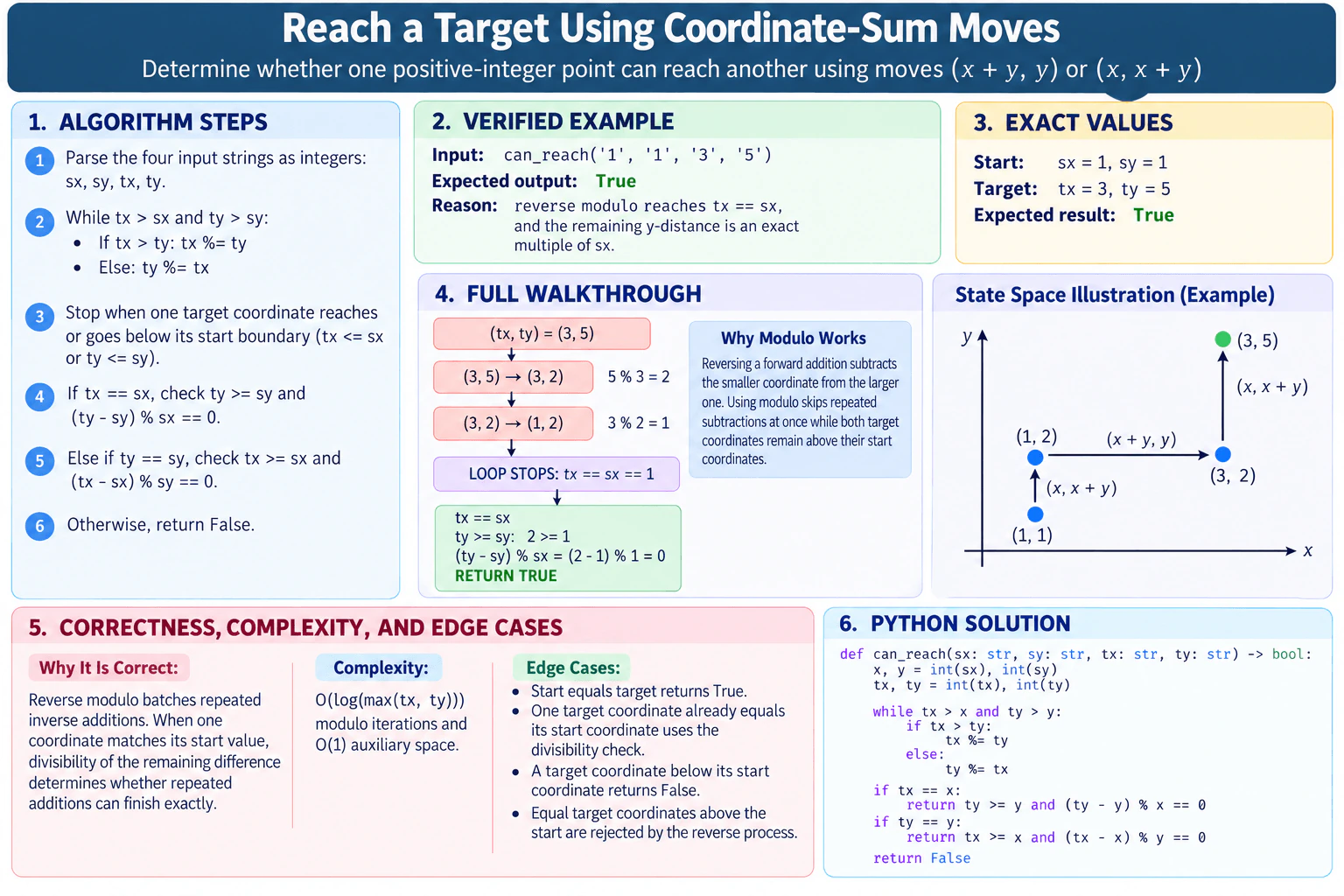
The diagram uses can_reach('1', '1', '3', '5'). The start is (1, 1), and the target is (3, 5).
Begin at (tx, ty) = (3, 5). Since ty is larger, calculate 5 % 3 = 2. The state becomes (3, 2).
Now tx is larger. Calculate 3 % 2 = 1. The state becomes (1, 2).
The loop stops because tx == sx == 1. There is no third modulo step.
Now check the remaining y distance. We have ty >= sy because 2 >= 1. Then calculate (ty - sy) % sx = (2 - 1) % 1 = 0. The difference is exactly divisible by sx, so repeated forward additions can finish the y coordinate. The function returns True.
The matching legal forward path is (1, 1) -> (1, 2) -> (3, 2) -> (3, 5).
5. Explain why it is correct
Each legal forward move keeps one coordinate fixed and adds it to the other coordinate. Therefore, in reverse, the larger coordinate can be reduced by repeated copies of the smaller coordinate. Modulo batches those repeated reverse subtractions into one calculation. Once one coordinate matches its start value, that coordinate must stay fixed. The remaining difference in the other coordinate must then be an exact multiple of the fixed start coordinate.
6. Explain the Python implementation
The code converts the strings into local integers. It repeatedly applies reverse modulo while both target coordinates are still greater than their matching start coordinates. After the loop, it checks the two possible alignments. If tx equals sx, it tests whether ty is at least sy and whether ty - sy is divisible by sx. If ty equals sy, it performs the symmetric check for x. If neither alignment works, it returns False.
7. Explain complexity and edge cases
The reverse reductions behave like the Euclidean algorithm, so there are O(log(max(tx, ty))) modulo iterations. The algorithm uses only a fixed number of integer variables, so auxiliary space is O(1).
Important edge cases are when the start already equals the target, when one target coordinate already equals its start coordinate, when a target coordinate falls below its matching start coordinate, and when equal target coordinates above the start reduce to an invalid state.
Key Insight / Why This Solution Works
The key idea is to reverse the coordinate-sum moves. A forward move keeps one coordinate fixed and adds it to the other. In reverse, this means repeatedly subtracting the smaller coordinate from the larger one. Modulo batches those repeated subtractions into one operation. The central invariant is that every reverse modulo update represents one or more valid inverse additions while both target coordinates remain above their corresponding start coordinates. When one coordinate matches its start value, the other coordinate is reachable only if its remaining difference is an exact multiple of that fixed coordinate. This avoids an exponentially large forward search.
Code
defcan_reach(sx: str, sy: str, tx: str, ty: str) -> bool:
# Convert the validated decimal strings into local integers.# The caller-owned string objects are never changed.
x, y = int(sx), int(sy)
tx, ty = int(tx), int(ty)
# Work backward while both target coordinates are still strictly# above their corresponding start coordinates.while tx > x and ty > y:
if tx > ty:
# Undo many repeated additions of ty into tx at once.
tx %= ty
else:
# Undo many repeated additions of tx into ty at once.
ty %= tx
if tx == x:
# x is aligned with the start. The remaining y-distance must be# a nonnegative multiple of x to be completed by forward additions.return ty >= y and (ty - y) % x == 0if ty == y:
# y is aligned with the start. The remaining x-distance must be# a nonnegative multiple of y to be completed by forward additions.return tx >= x and (tx - x) % y == 0# Neither coordinate aligned with the required start coordinate.returnFalse# Verified diagram example: (1, 1) -> (1, 2) -> (3, 2) -> (3, 5).assert can_reach("1", "1", "3", "5") isTrue
Time & Space Complexity
The reverse process uses O(log(max(tx, ty))) modulo iterations because the coordinates shrink in the same style as the Euclidean algorithm. The algorithm stores only the start values and the current target values. It does not create any growing data structure. Therefore, the auxiliary space is O(1). Auxiliary space means extra working memory used by the algorithm.
Where it is used
This reverse-and-reduce pattern is useful when a process repeatedly adds one positive quantity to another and a direct forward search would create too many states. Similar reasoning appears in number-theory problems and arithmetic reachability problems where repeated subtraction can be compressed with modulo.
Why Interviewers Ask This
This problem tests whether a candidate can avoid an explosive forward search and recognize a reversible arithmetic pattern. It checks whether the candidate can connect repeated subtraction with modulo, maintain the correct stopping condition, and reason about the final divisibility test. It also tests careful Python implementation, handling of very large integer inputs, edge-case reasoning, and the ability to explain why the solution uses logarithmic modulo iterations and constant auxiliary space.
Common interview mistakes
A common mistake is trying a forward BFS or recursive search. The number of possible states grows too quickly for coordinates as large as 1018. Another mistake is continuing the modulo loop after one coordinate has reached its start value. At that point, the algorithm must use the final divisibility check. Candidates may also reduce the wrong coordinate, forget to reject a target coordinate that has gone below its matching start coordinate, or claim the complexity is linear instead of logarithmic. Checking only whether the start and target have the same gcd is also not enough to prove reachability from a specific start point.
Interview tip
Explain modulo as compressed reverse subtraction. Say that a forward move adds one coordinate to the other, so reversing the move repeatedly subtracts the smaller coordinate from the larger one. Then show that modulo performs many of those subtractions at once. This makes the stopping rule and final divisibility check easy to justify.
Interviewer may ask next
Why is checking only gcd(start) == gcd(target) not enough?
Every allowed move preserves the gcd, so matching gcd values are necessary. They are not sufficient for reachability from a specific positive start point because forward moves can only increase coordinates. A target can have the same gcd but still fail to reverse back to the required start coordinates. The reverse-modulo algorithm keeps sx and sy as exact lower boundaries and checks the final divisibility condition. Its complexity remains O(log(max(tx, ty))) modulo iterations and O(1) auxiliary space.
How would you return one actual sequence of forward moves instead of only True or False?
During the reverse pass, I would record which coordinate was reduced and how many repeated subtractions the modulo operation compressed. If the point is reachable, I would replay those recorded operations in reverse order to reconstruct forward additions. Correctness is preserved because each recorded quotient expands into the same repeated additions that were compressed during the reverse pass. The reachability reduction still has O(log(max(tx, ty))) stages and O(log(max(tx, ty))) stored reduction records, but producing the full path also takes time and output space proportional to the number of moves returned.
12. Tell me about a project where ambiguous requirements forced you to define the problem scope yourself.BehavioralEasyNvidia
i Question Details
Use a real data-science project whose user, decision, metric, data contract, or delivery boundary was initially unclear. Explain the questions and evidence you used to identify the decision owner, define a smallest useful scope, and document assumptions and success criteria. Describe how you prevented ambiguity from becoming hidden rework, what changed after the first checkpoint, the delivered outcome, and one scoping choice you would make differently.
Interview tip:
Use STAR to structure your answer: briefly explain the Situation and Task, make Action the most detailed part, and finish with the Result. For example, describe a data science project where the user, decision, metric, data contract, or delivery boundary was unclear. Explain how you identified the decision owner, asked focused questions, used available evidence to define the smallest useful scope, documented assumptions and success criteria, checked the scope early with stakeholders, adjusted it after feedback, delivered a useful result, and identified one scoping choice you would improve next time.
Situation
During a previous project, I was asked to build an analysis that would help an operations team understand which cases needed attention. The request sounded simple, but the requirements were unclear. Different stakeholders described the goal differently. It was also unclear who would use the output, what decision they would make from it, which data fields could be trusted, and what a useful first delivery should contain.
Task
I took responsibility for defining a clear problem before doing a large amount of analysis. My goal was to identify the actual decision owner, agree on the smallest useful scope, make the assumptions visible, and define success in a way that the team could review before I invested time in a broader solution.
Action
I first met with the main stakeholders and asked specific questions about the decision they were trying to make. Instead of asking what analysis they wanted, I asked who would use the result, what action that person would take, how often the decision happened, and what information they already used. This helped me identify the operations lead as the main decision owner. I then reviewed the available data with the data engineering team to understand which fields were reliable and which had missing or inconsistent values. Based on those conversations, I proposed a smaller first scope. Rather than trying to explain every type of case, I focused on producing a ranked view of cases that needed review, using only data fields we understood well. I wrote down the user, decision, input data, assumptions, output, and success criteria in a short scope document. I also listed what was explicitly outside the first version so that new requests would not quietly expand the work. I shared this document with the decision owner and the engineering partner before building the analysis. At the first checkpoint, the operations lead explained that one of my proposed signals was difficult for the team to interpret during daily work. I changed the output to use simpler factors that could be traced back to source data, even though that reduced some analytical detail. I chose that tradeoff because an understandable result was more useful than a more complex result that the team might not trust or act on. I also kept a record of open questions so that unresolved assumptions were visible instead of becoming hidden rework later.
Result
The team received an analysis with a clear purpose, a defined user, documented assumptions, and an output they could use in their existing review process. The early checkpoint also prevented me from spending more time on a signal that would not have worked well for the user. I learned that ambiguous requests become much easier to manage when I define the decision before defining the model or analysis. If I did the project again, I would involve the final user even earlier and review a simple example of the expected output before completing the first analytical design.
Why Interviewers Ask This
Interviewers ask this question to see whether a candidate can create structure when a problem is poorly defined. A strong Data Scientist must identify the real decision, find the right stakeholder, separate essential requirements from optional ones, make assumptions visible, and choose a useful scope before investing heavily in analysis. A strong answer also shows ownership, communication, practical judgment, and the ability to reduce rework when requirements change.
Interviewer may ask next
How did you decide what to include in the first version and what to leave out?
I used the decision the operations lead needed to make as the main filter. I included only information that directly helped prioritize cases and came from data we understood well. I left out broader explanations and less reliable signals because they were not necessary for the first useful delivery. I also documented those exclusions so stakeholders understood that they were deliberate scope choices rather than forgotten requirements.
What would you do differently if you faced the same level of ambiguity today?
I would bring the final user into the process even earlier and show a simple example of the proposed output before designing the full analysis. In this project, the first checkpoint revealed that one signal was hard to interpret. A concrete example at the start would have exposed that issue sooner. I would still document the decision owner, assumptions, data boundaries, success criteria, and excluded scope because those steps were effective at preventing hidden rework.
13. Describe a time your initial analysis contradicted a product team’s intuition and you had to resolve the disagreement.BehavioralMediumNvidia
i Question Details
Use a real consequential product or infrastructure decision. Explain the team’s initial belief, your analysis, the assumptions and data-quality checks, and why either side could reasonably be wrong. Describe how you separated factual disputes from value trade-offs, proposed a replication, segment analysis, experiment, or decision threshold, and handled new evidence. State who owned the final decision, the outcome, and what the episode changed about your collaboration or analysis process.
Interview tip:
Use STAR to structure your answer: briefly explain the Situation and Task, make Action the most detailed part, and finish with the Result. For example, describe Use a real consequential product or infrastructure decision. Explain the team’s initial belief, your analysis, the assumptions and data-quality checks, and why either side could reasonably be wrong. Describe how you separated factual disputes from value trade-offs, proposed a replication, segment analysis, experiment, or decision threshold, and handled new evidence. State who owned the final decision, the outcome, and what the episode changed about your collaboration or analysis process.
Situation
In my last role, I supported a product team that was considering expanding a feature because the team believed early usage patterns showed strong user interest. When I analyzed the behavior more closely, I found that the apparent improvement was concentrated in a narrow group of highly active users. For the broader user population, the pattern was much less clear. This mattered because expanding the feature would require product and engineering effort, so the team needed confidence that the signal represented real user value rather than a measurement effect.
Task
My responsibility was to determine whether the data supported the proposed expansion and to explain the disagreement in a way that helped the product team make a decision. I also needed to recognize that my first analysis could be incomplete. The product team had useful context about user behavior that was not obvious in the data, while I had responsibility for checking whether the measured effect was reliable.
Action
I first reviewed my analysis before challenging the team's conclusion. I checked the event definitions, missing records, time windows, and whether the same users were being counted consistently across the comparison groups. I also tested whether recent product changes could have affected tracking. Those checks did not reveal a major data issue, so I then broke the results into user segments instead of relying on the overall average. That showed that highly active users were driving most of the positive signal, while newer and less active users behaved differently. I shared this with the product team and made a clear distinction between two questions. The factual question was whether the feature improved the measured behavior across the wider population. The value question was whether improving the experience for the most active users was still important enough to justify the investment. That distinction helped reduce the disagreement because we were no longer arguing about one combined conclusion. The product team then raised a reasonable concern that my historical comparison could still be affected by differences between users who chose to use the feature and those who did not. I agreed with that limitation. Instead of defending my original analysis, I proposed a controlled experiment with a clear decision threshold agreed on before looking at the results. We also planned to review the important user segments separately so a strong result in one group would not hide a weak result in another. When the experiment produced new evidence, I updated my recommendation rather than treating my first analysis as something I needed to prove correct. I summarized what the data supported, what remained uncertain, and the product tradeoffs that were outside my ownership. The product lead owned the final decision.
Result
The team used the experiment and segment results to make a more focused product decision rather than broadly expanding the feature based only on the original aggregate signal. More importantly, the disagreement became productive instead of personal because we created a shared way to test the competing explanations. I learned to present conflicting analysis as a set of testable assumptions, not as proof that another team's intuition is wrong. After that experience, I involved product partners earlier when defining success measures and decision thresholds, which made later analytical discussions clearer and more collaborative.
Why Interviewers Ask This
Interviewers ask this question to see how a Data Scientist handles disagreement when data conflicts with product intuition. They are evaluating analytical rigor, humility, communication, and decision judgment. A strong answer shows that the candidate checks the analysis carefully, understands why both sides may have reasonable assumptions, separates evidence from product values, proposes a fair way to reduce uncertainty, responds constructively to new evidence, and respects who owns the final decision.
Interviewer may ask next
Why did you propose an experiment instead of continuing to analyze the historical data?
The historical analysis was useful for finding the segment difference, but it could not fully separate the effect of the feature from differences between users who chose to use it and users who did not. The product team's concern about that limitation was valid. I proposed an experiment because it gave us a cleaner comparison and allowed us to agree on the decision threshold before seeing the result. That reduced the chance that either side would interpret the same evidence differently after the fact.
What would you do differently if you faced a similar disagreement now?
I would involve the product team earlier when defining the success metric, important user segments, and decision threshold. In this case, I completed the first analysis before we had fully aligned on those points. The disagreement was still resolved well, but earlier alignment would have made the assumptions visible sooner. I would also document the main competing explanations before analysis so everyone understands what evidence would support or weaken each one.
14. Tell me about a customer-facing situation where you handled difficult objections and influenced a technical decision.BehavioralHardNvidia
i Question Details
Use a real customer or internal-client decision. Identify the stakeholders, desired outcome, objections involving value, cost, lock-in, privacy, reliability, or implementation risk, and why those concerns were legitimate. Explain the discovery questions, benchmark, ROI or risk evidence, pilot and success gates, and alternatives you offered. Clarify what you influenced versus what the customer decided, the measurable outcome, relationship effect, and what you would do differently.
Interview tip:
Use STAR to structure your answer: briefly explain the Situation and Task, make Action the most detailed part, and finish with the Result. For example, describe Use a real customer or internal-client decision. Identify the stakeholders, desired outcome, objections involving value, cost, lock-in, privacy, reliability, or implementation risk, and why those concerns were legitimate. Explain the discovery questions, benchmark, ROI or risk evidence, pilot and success gates, and alternatives you offered. Clarify what you influenced versus what the customer decided, the measurable outcome, relationship effect, and what you would do differently.
Situation
In my last role, I worked with an internal client that was considering a new model scoring service for an important operational workflow. The main stakeholders included the client team, data science, engineering, and security. The client wanted faster and more consistent model decisions, but they had serious objections. They were concerned about sending sensitive data to a managed service, depending too much on one vendor, increasing operating cost, and creating a new reliability risk. I thought those concerns were legitimate because a technically strong model would still fail as a solution if the surrounding system created unacceptable business or operational risk.
Task
My responsibility was not to convince the client to accept our first design. I needed to understand what would make the solution valuable and safe for them, provide evidence for the main tradeoffs, and help the stakeholders compare realistic options. I owned the analytical evaluation and worked with engineering and security on the technical constraints. The final deployment decision remained with the client and the teams responsible for operating the service.
Action
I started with discovery questions instead of defending the proposal. I asked which data fields were sensitive, what failure behavior they could tolerate, how quickly a decision needed to return, what operating cost would be acceptable, and what would happen if the scoring service became unavailable. This helped separate general concern from specific requirements. I then created a benchmark using representative historical requests. I compared the existing process with several deployment choices on model quality, response time, operating effort, cost, privacy exposure, and recovery behavior. For cost, I showed the main drivers instead of presenting one total estimate, so the client could see how request volume and compute usage affected the decision. For privacy and lock in, I worked with security and engineering to identify which data could remain inside the existing environment and how the model interface could stay portable. I also presented alternatives instead of making the discussion a choice between accepting or rejecting one design. The options included keeping the current process, running the model inside the existing environment, and using a managed scoring service. We agreed to a limited pilot with representative data and clear success gates for model quality, response time, cost, privacy controls, fallback behavior, and operational support. During the pilot, I shared both positive and negative findings. When one deployment option introduced concerns about data handling and dependency on the provider, I did not minimize them. I showed how another option reduced those risks while keeping most of the expected value. My influence was in turning the objections into requirements, producing evidence, and making the tradeoffs visible. The client made the final choice.
Result
The pilot met the agreed technical and operational gates, and the client approved a phased deployment using the option that better matched its privacy and reliability requirements. The outcome was measurable through the success criteria we had defined before the pilot rather than through subjective preference. The process also improved the relationship because the client saw that I was trying to solve its problem rather than defend a particular technology. I learned that difficult objections are often useful design information. If I handled a similar situation again, I would bring privacy, portability, and failure behavior into the first design discussion even earlier so those concerns shape the evaluation from the beginning.
Why Interviewers Ask This
Interviewers ask this question to see whether a Data Scientist can influence an important technical decision without ignoring legitimate customer concerns. A strong answer shows careful discovery, evidence based judgment, clear communication of tradeoffs, respect for decision ownership, and the ability to turn objections about value and risk into testable requirements.
Interviewer may ask next
How did you respond when the client continued to resist the original deployment option?
I did not treat the resistance as something I needed to overcome. I asked which specific risks still blocked the decision and connected each concern to evidence from the benchmark or pilot. When privacy and provider dependency remained important, I showed the alternative deployment option that reduced those risks. That kept the discussion focused on requirements and tradeoffs instead of personal preference.
What would you do differently if you faced the same situation today?
I would discuss privacy, portability, failure behavior, and operating ownership before proposing a preferred architecture. In this case, those issues became clear during discovery and the pilot. Bringing them forward earlier would make the first set of options stronger and could reduce unnecessary debate while still leaving the final technical choice with the customer.
Disclaimer: This interview guide is for educational and informational purposes only. It is designed to help readers prepare, but it does not guarantee any interview result, hiring decision, offer, or outcome. Interview questions, hiring criteria, and preferred answers can vary by employer, interviewer, industry, location, and time. All answers, examples, and explanations in this guide are suggested examples for interview preparation, not definitive answers or instructions for professional practice. They are based on research and judgment, are provided without warranties of any kind, and should be adapted to the question, role, and applicable laws and professional requirements. Diagrams are simplified illustrations intended to highlight the main concepts and their relationships; actual situations, systems, and practices may be more complex. Alternative approaches may be equally valid or better suited to a particular question, context, or interviewer. To the fullest extent permitted by applicable law, the contributors and publisher are not liable for decisions made, actions taken, or losses incurred based on this guide.
State Laws and Professional Responsibilities: Laws and requirements governing an occupation vary by state and jurisdiction. You are responsible for checking the current laws, licensing requirements, and scope-of-practice rules that apply to your location and role, and for ensuring that your answers and actions comply with them. Adapt examples in this guide to those requirements. This guide is not legal advice.
Company Notice: This guide is an independent educational resource and is not affiliated with, endorsed by, sponsored by, or approved by the company named in this guide. Company names identify reported interview experiences or the employer context of clearly labeled original practice exercises. Interview practices can change without notice, and inclusion of company-specific content does not mean these questions are official, complete, or guaranteed to be asked. To the fullest extent permitted by law, the author, contributors, and publisher are not responsible for outcomes related to use of this material.
Content Accuracy and Verification: To the fullest extent permitted by applicable law, we do not represent or warrant that interview guides, questions, answers, examples, or diagrams are accurate, complete, current, error-free, or suitable for any particular purpose. You are responsible for independently reviewing and verifying the information before relying on it.