This interview guide is for educational and informational purposes only. It is designed to help readers prepare, but it does not guarantee any interview result, hiring decision, offer, or outcome. Interview questions, hiring criteria, and preferred answers can vary by employer, interviewer, industry, location, and time. All answers, examples, and explanations in this guide are suggested examples for interview preparation, not definitive answers or instructions for professional practice. They are based on research and judgment, are provided without warranties of any kind, and should be adapted to the question, role, and applicable laws and professional requirements. Diagrams are simplified illustrations intended to highlight the main concepts and their relationships; actual situations, systems, and practices may be more complex. Alternative approaches may be equally valid or better suited to a particular question, context, or interviewer. To the fullest extent permitted by applicable law, the contributors and publisher are not liable for decisions made, actions taken, or losses incurred based on this guide.
State Laws and Professional Responsibilities
Laws and requirements governing an occupation vary by state and jurisdiction. You are responsible for checking the current laws, licensing requirements, and scope-of-practice rules that apply to your location and role, and for ensuring that your answers and actions comply with them. Adapt examples in this guide to those requirements. This guide is not legal advice.
Identity, Image, and Privacy Notice
To respect individual privacy, some names, profile photographs, avatars, biographical details, and other identifying information displayed in this guide may be replaced with pseudonyms, licensed stock images, illustrative avatars, composite images, or representative descriptions. Unless a person is expressly identified as an actual contributor, a displayed name, image, or profile should not be understood as depicting or identifying a specific candidate, interviewer, employee, or other real individual. These representations are provided for editorial and illustrative purposes only and do not imply endorsement, employment, participation, or affiliation with this guide or any company mentioned in it. Any resemblance to an actual person is coincidental.
Company Notice
This guide is an independent educational resource and is not affiliated with, endorsed by, sponsored by, or approved by the company named in this guide. Company names identify reported interview experiences or the employer context of clearly labeled original practice exercises. Interview practices can change without notice, and inclusion of company-specific content does not mean these questions are official, complete, or guaranteed to be asked. To the fullest extent permitted by law, the author, contributors, and publisher are not responsible for outcomes related to use of this material.
Content Accuracy and Verification
To the fullest extent permitted by applicable law, we do not represent or warrant that interview guides, questions, answers, examples, or diagrams are accurate, complete, current, error-free, or suitable for any particular purpose. You are responsible for independently reviewing and verifying the information before relying on it.
Questions or comments?
Contact us for general questions, or share feedback, technical corrections, and comments with the community.
1. Explain COP of chillerThermodynamics And Energy BalancesMediumDaikin
Short Interview Answer (30-60 seconds)
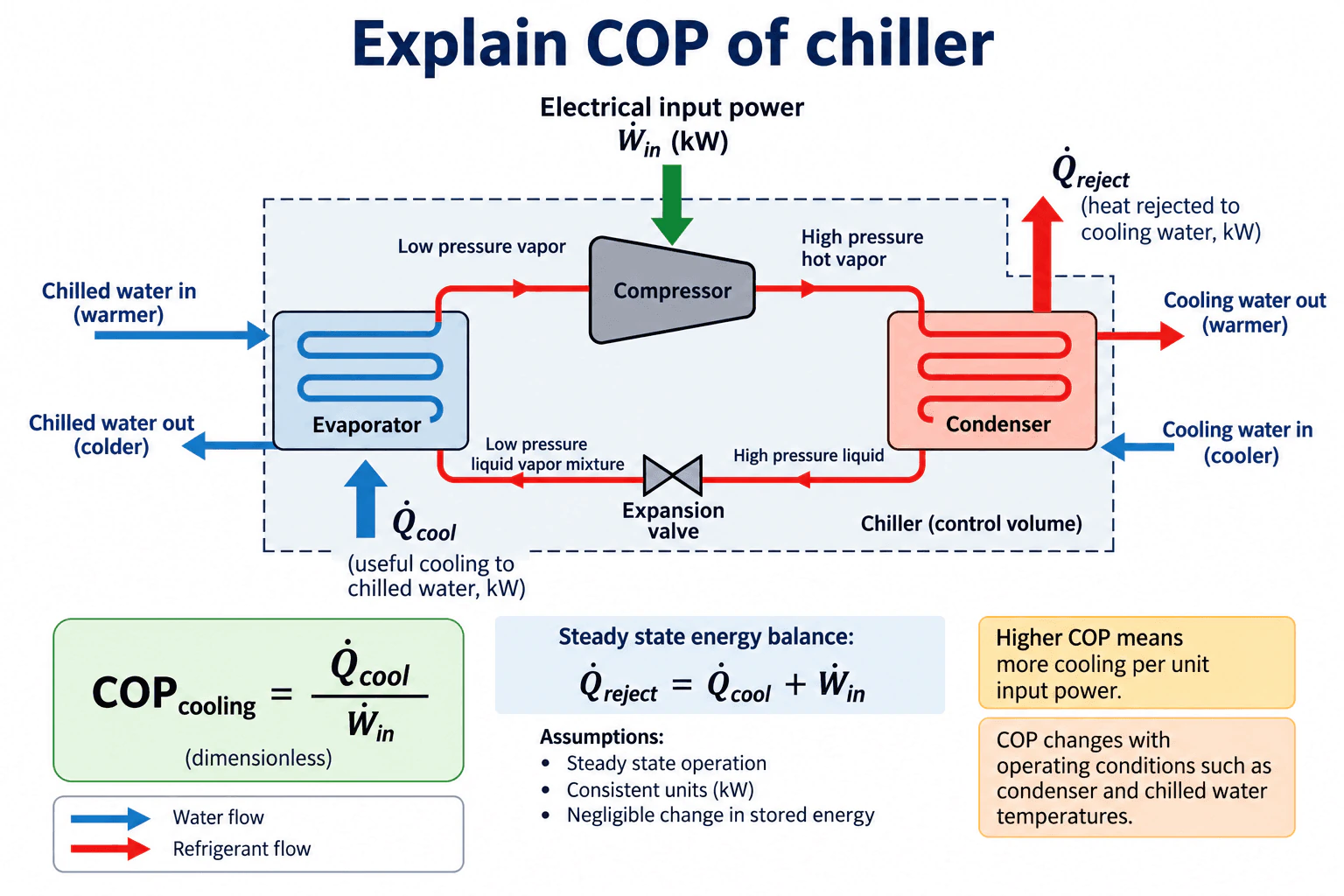
The cooling COP of a chiller is the useful cooling rate divided by the required input power. For the simplified chiller control volume shown, COP cooling equals Q cool divided by W in. Both quantities can be expressed in kW, so COP is dimensionless. At steady state, with negligible stored energy change, the energy balance is Q reject equals Q cool plus W in. A higher COP means the chiller provides more useful cooling for each unit of input power.
Detailed Explanation
COP describes how effectively a chiller uses input work to provide useful cooling. For a vapor compression chiller, refrigerant absorbs heat from the chilled water in the evaporator, the compressor supplies work, and the condenser rejects the absorbed heat plus compressor input to the cooling water.
Useful Questions to Ask the Interviewer
Should I explain COP using a simplified steady state chiller control volume?
Should W in represent the compressor electrical input for this conceptual explanation?
Do you want only the thermodynamic definition, or also how operating temperatures affect COP?
How to Explain It in an Interview
For the simplified control volume, I define Q cool as the useful cooling rate absorbed in the evaporator and W in as the electrical input to the compressor. The cooling coefficient of performance is
COP cooling = Q cool / W in
If Q cool and W in are both in kW, their units cancel, so COP is dimensionless. A COP greater than one is normal because COP is not a conventional efficiency percentage. The chiller transfers thermal energy while consuming work.
The refrigerant enters the compressor as low pressure vapor. Compression raises its pressure and temperature, producing high pressure hot vapor. In the condenser, the refrigerant rejects heat to the cooling water and becomes high pressure liquid. The expansion valve reduces its pressure, producing a low pressure liquid vapor mixture. In the evaporator, that refrigerant absorbs heat from the chilled water and returns toward the compressor as low pressure vapor.
For the whole chiller at steady state, assuming negligible change in stored energy, the first law gives
Q reject = Q cool + W in
This is an important independent check. Heat rejected at the condenser must equal the useful cooling absorbed at the evaporator plus the work supplied to the compressor under these assumptions.
The chilled water enters the evaporator warmer and leaves colder because Q cool is removed from it. The cooling water enters the condenser cooler and leaves warmer because it receives Q reject.
A higher COP means more cooling is produced per unit of input power. COP also changes with operating conditions. For example, increasing the required temperature lift generally increases compressor work and tends to reduce COP.
For a real test, I would verify the control volume, measured cooling rate, electrical input, steady operating condition, consistent units, and whether auxiliary power is included in the stated COP definition before comparing equipment.
Why Interviewers Ask This
The interviewer is checking whether I understand chiller performance from a thermodynamics and energy balance perspective. A strong answer should define COP correctly, identify useful cooling and required work, apply a control volume energy balance, and explain how operating conditions affect performance.
Common interview mistakes
Common mistakes are treating COP as a percentage efficiency, reversing Q cool and W in, forgetting that COP is dimensionless when consistent power units are used, omitting compressor work from the condenser energy balance, confusing refrigerant flow with heat flow, and comparing COP values without checking operating conditions or what electrical loads are included.
Interview tip
Start with the simple definition COP cooling equals Q cool divided by W in. Then connect it to the steady state balance Q reject equals Q cool plus W in. Explain what happens physically in the evaporator, compressor, condenser, and expansion valve, and finish by noting that COP depends on operating conditions and on the exact system boundary used for the power measurement.
Interviewer may ask next
What assumptions are required for Q reject equals Q cool plus W in?
For the simplified whole chiller control volume, I assume steady state operation, negligible change in stored energy, consistent units, and that the relevant energy transfers are the cooling absorbed at the evaporator, work entering the compressor, and heat rejected at the condenser. If stored energy changes during a transient condition, an accumulation term must be included.
What happens to chiller COP if the condenser temperature rises while the evaporator condition remains similar?
The compressor generally has to operate across a larger pressure and temperature lift. That usually increases the required compressor work for a given cooling effect, so COP tends to decrease. The exact change depends on the refrigerant, compressor behavior, heat exchanger conditions, and other operating details.
2. What is sub-cooling and how does it work?Phase Change And Two Phase FlowEasyDaikin
Short Interview Answer (30-60 seconds)
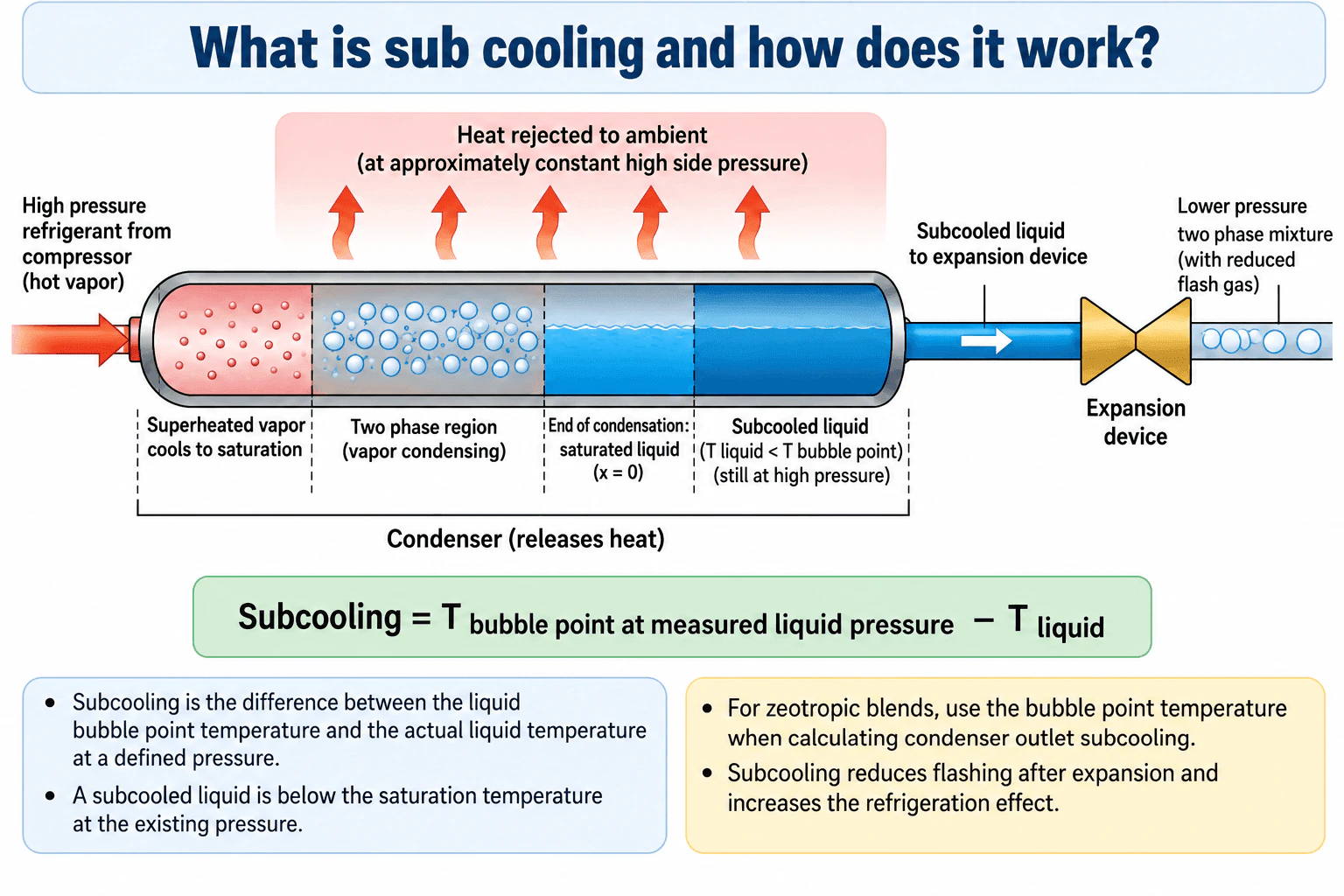
Subcooling means cooling a liquid refrigerant below its saturation temperature at the measured liquid pressure. In a condenser, high pressure superheated vapor first cools to saturation, then condenses through the two phase region. At the end of condensation the refrigerant is saturated liquid with vapor quality x = 0. If more heat is rejected while the refrigerant remains at approximately the same high side pressure, its temperature falls below the applicable saturation temperature and it becomes subcooled liquid. For a zeotropic blend, the liquid reference is the bubble point temperature. Subcooling reduces flash vapor formed during expansion and increases the available refrigeration effect.
Useful Questions to Ask the Interviewer
Are we discussing a pure refrigerant or a zeotropic blend where bubble point temperature should be used for liquid subcooling?
Should I explain only the condenser state change, or also the effect of subcooling on the expansion process?
Can I assume the condenser pressure is approximately constant while heat is rejected?
Detailed Explanation
How to Explain It in an Interview
Subcooling is the condition where a liquid refrigerant is colder than its saturation temperature at the same local pressure. For a zeotropic refrigerant blend, condenser outlet liquid subcooling is referenced to the bubble point temperature.
The working fluid is the refrigerant, but no specific refrigerant is given in the question. Consider its path through a condenser. High pressure superheated vapor enters from the compressor. As heat is rejected, the vapor first cools to the saturation condition. Continued heat rejection causes condensation in the two phase region. The vapor fraction falls until the refrigerant reaches saturated liquid, where vapor quality is x = 0.
If more sensible heat is removed after condensation is complete, the liquid temperature falls below the applicable saturation temperature while pressure remains approximately at the high side value. The refrigerant is then subcooled. The operating region for subcooling is therefore the single phase liquid region below the saturation or bubble point temperature at the local pressure. Physical orientation does not change this thermodynamic definition.
A useful expression is:
Subcooling = T bubble point at measured liquid pressure − T liquid
For a pure refrigerant, use the saturation temperature at the measured liquid pressure. For example, if the applicable saturation temperature is 40 °C and the measured liquid temperature is 35 °C, the subcooling is 5 °C, which is also a temperature difference of 5 K.
The subcooled liquid then reaches the expansion device. Because its specific enthalpy is lower than that of saturated liquid at the same high side pressure, the expansion process produces less flash vapor than it would with saturated liquid entering at that pressure. The outlet is still normally a lower pressure two phase mixture.
For validation, I would measure liquid pressure and temperature at representative nearby locations, use refrigerant property data for the actual working fluid, select the correct saturation reference, and account for meaningful pressure drop between measurement points. The approximately constant pressure condenser description is an engineering approximation, not a statement that real systems have zero pressure loss.
Why Interviewers Ask This
Interviewers want to see whether the candidate understands the relationship between pressure, saturation temperature, condensation, and the liquid state in a refrigeration system. A strong answer should distinguish saturated liquid from subcooled liquid and explain why additional heat rejection after condensation changes the refrigerant state before expansion.
Common interview mistakes
Common mistakes include calling refrigerant subcooled while it is still in the two phase region, confusing subcooling with superheat, using the wrong saturation reference for a zeotropic blend, treating saturated liquid at x = 0 as already subcooled, ignoring pressure drop between pressure and temperature measurement locations, and assuming the expansion outlet becomes entirely liquid. Condensation must be complete before the liquid can be cooled below its saturation temperature at that pressure.
Interview tip
Explain the state sequence in order: superheated vapor, saturation, two phase condensation, saturated liquid at x = 0, then subcooled liquid. Then give the temperature difference definition and connect it to reduced flash vapor after expansion. This shows both the physical mechanism and the practical refrigeration effect.
Interviewer may ask next
How would you verify a measured subcooling value in a real system?
Measure the liquid line pressure and temperature at appropriate nearby locations, convert the measured pressure to the correct saturation reference for the actual refrigerant, and calculate the temperature difference. For a zeotropic blend, use the bubble point temperature for liquid subcooling. Also check sensor accuracy, pressure units, whether the property source expects absolute or gauge pressure, and whether pressure drop between measurement locations is large enough to affect the result.
What happens if condenser outlet subcooling increases while the expansion device inlet pressure stays approximately constant?
The liquid enters the expansion device at a lower temperature and lower specific enthalpy. After the pressure reduction, less refrigerant must flash into vapor to reach the lower pressure equilibrium state. This generally increases the available refrigeration effect per unit mass, although the overall system effect depends on how the additional subcooling is produced and on the remaining operating conditions.
3. 3 words that best describe yourself, elaborateBehavioralHardDaikin
Interview tip:
Use STAR to structure your answer: briefly explain the Situation and Task, make Action the most detailed part, and finish with the Result. For example, describe a thermal engineering project that shows three qualities such as analytical, dependable, and collaborative, explain how those qualities guided your technical decisions and communication, and connect them to a successful project outcome.
Situation
Three words that best describe me are analytical, dependable, and collaborative. On one of my previous projects, our team was reviewing a thermal system that was not meeting the expected temperature performance during testing. The issue required both careful technical analysis and close coordination with other engineers.
Task
I was responsible for identifying the likely thermal cause, recommending practical changes, and helping the team reach a solution without creating new reliability or integration problems.
Action
I showed my analytical side by first reviewing the temperature data, heat loads, airflow conditions, material properties, and boundary conditions instead of assuming the first suspected cause was correct. I compared the test behavior with our thermal calculations and looked for where the actual system differed from the expected model. I then identified the most likely heat transfer bottlenecks and explained the evidence to the team in simple terms. I showed that I am dependable by following each issue through to closure. I documented my assumptions, checked the proposed changes against operating limits, and made sure the updated design was reviewed before another test. I also showed that I am collaborative. I worked closely with the mechanical and test engineers, listened to their observations, and adjusted my analysis when new test information became available. Rather than treating the thermal analysis as a separate activity, I made sure our decisions considered manufacturability, testing, and overall system performance.
Result
The team was able to correct the main thermal issue and achieve stable performance during the next round of testing. The experience reinforced why analytical, dependable, and collaborative are good descriptions of how I work. I like to understand the technical problem carefully, take ownership of my part, and work with others until we reach a practical solution.
Why Interviewers Ask This
Interviewers ask this question to understand how a candidate sees their own working style and whether they can support those qualities with real behavior. A strong answer shows self awareness, gives clear examples, and connects personal qualities to the judgment, ownership, communication, and teamwork required in thermal engineering.
Interviewer may ask next
Why did you choose analytical, dependable, and collaborative as your three words?
I chose them because they describe the way I approached the thermal problem in that project. I used data and engineering reasoning to understand the issue, I stayed responsible for my analysis through testing and review, and I worked closely with other engineers so the final solution considered the complete system rather than only the thermal calculation.
Which of those three qualities is most important when solving a difficult thermal problem?
I think all three need to work together. Being analytical helps me find the real cause, being dependable helps me follow the problem through verification, and being collaborative helps me include information from design and test teams. In that project, the solution was stronger because I used all three qualities together.
4. Why you think your qualification and experience are suit to the job title?BehavioralMediumDaikin
Interview tip:
Use STAR to structure your answer: briefly explain the Situation and Task, make Action the most detailed part, and finish with the Result. For example, describe a previous thermal engineering project where your education gave you the technical foundation, your practical experience helped you solve a real heat transfer problem, you worked with other engineers to validate the solution, and the outcome showed that your skills match the responsibilities of a Thermal Engineer.
Situation
In my last role, I worked on a project where a mechanical system was experiencing higher than expected operating temperatures. My education in thermodynamics, heat transfer, and fluid flow gave me the foundation to understand the problem, and my previous engineering experience helped me approach it in a practical way.
Task
I was responsible for helping identify the main cause of the thermal issue and recommending a solution that could improve temperature control without creating new reliability or integration problems.
Action
I first reviewed the system requirements, operating conditions, temperature measurements, and available design information. I compared the expected heat load with the actual operating behavior so I could understand where the largest thermal resistance might be occurring. I then checked the heat transfer path, airflow conditions, material interfaces, and cooling arrangement. I used basic thermal calculations to test my assumptions before discussing them with the wider engineering team. When I found that the cooling path could be improved, I explained the technical reason in simple terms and worked with the team to evaluate practical design changes. I also considered manufacturability, reliability, available space, and how the change could affect other parts of the system. After the preferred option was selected, I supported the validation work and compared the new temperature behavior with the original condition. This experience showed me how to combine engineering theory, practical analysis, communication, and teamwork instead of looking at the thermal problem in isolation.
Result
The team achieved a more stable thermal condition and had a clearer understanding of the factors controlling system temperature. I also strengthened my ability to move from thermal theory to a practical engineering decision. That combination of thermal engineering knowledge, hands on problem solving, validation, and cross functional communication is why I believe my qualifications and experience are well suited to a Thermal Engineer role.
Why Interviewers Ask This
Interviewers ask this question to understand whether the candidate can connect their education and previous experience directly to the responsibilities of a Thermal Engineer. A strong answer shows relevant technical knowledge, practical problem solving, sound engineering judgment, collaboration, and a clear understanding of how those skills apply to the role.
Interviewer may ask next
Which part of your previous experience is most relevant to this Thermal Engineer role?
The most relevant part is my experience taking a real temperature problem from initial data review through analysis, design discussion, and validation. It required me to use thermodynamics and heat transfer knowledge, but it also required practical judgment about airflow, materials, reliability, space, and integration with the rest of the system.
How did you make sure your proposed thermal solution was technically sound?
I checked the operating data first, used thermal calculations to test the likely causes, reviewed the heat transfer path and cooling conditions, and discussed the findings with the engineering team. After the design change was selected, I supported validation and compared the new temperature behavior with the original condition before treating the solution as successful.
5. Rank in order of importance. Location, recognition, money, working environment, work challenge.BehavioralHardDaikin
Interview tip:
Use STAR to structure your answer: briefly explain the Situation and Task, make Action the most detailed part, and finish with the Result. For example, describe a time when you evaluated a work opportunity by considering work challenge, working environment, recognition, money, and location, explain why you ranked those factors in that order, and show how your priorities supported both professional growth and effective thermal engineering work.
Situation
During a previous project, I had an opportunity to think carefully about what matters most to me in a role. The work involved solving thermal performance problems, working with other engineers, and making design decisions based on test results and engineering analysis.
Task
I wanted to identify the conditions that would help me do my best work and continue growing as a Thermal Engineer. I considered the five factors in the question and ranked them based on how much each one affects my ability to contribute over the long term.
Action
My first priority is work challenge because I want problems that require me to think, learn, and apply thermal engineering principles. Challenging work helps me improve my judgment and gives me the chance to create useful solutions. My second priority is the working environment. Even an interesting technical problem becomes difficult to solve well if people do not communicate, share information, or support careful engineering decisions. I value a team where engineers can discuss test results, question assumptions, and work together respectfully. My third priority is recognition. I do not need constant praise, but I value clear feedback and knowing that good work is noticed because that helps me understand where I am contributing and where I should improve. My fourth priority is money. Fair compensation is important, but once it is reasonable for the role and responsibilities, I place more value on meaningful technical work and a healthy environment. My fifth priority is location. Location matters for practical reasons, but I am generally flexible when the role provides strong technical challenges, a good team, and opportunities to grow.
Result
Thinking through these priorities helped me make career decisions based on long term professional growth instead of one short term factor. My ranking is work challenge first, working environment second, recognition third, money fourth, and location fifth. I have learned that when the technical work is meaningful and the team works well together, I am more engaged and able to contribute more effectively.
Why Interviewers Ask This
Interviewers ask this question to understand what motivates a candidate and whether those priorities are likely to fit the role and workplace. A strong answer shows clear judgment, realistic career priorities, flexibility, and an understanding that meaningful technical work depends on both challenging problems and a supportive working environment.
Interviewer may ask next
Why do you rank work challenge above money?
I want fair compensation, but challenging work has a stronger effect on my long term development. In thermal engineering, difficult problems give me opportunities to improve my analysis, testing, and design judgment. If compensation is reasonable, I would rather choose work that keeps me learning and allows me to make a meaningful technical contribution.
Would your ranking change if the location created a major personal difficulty?
Yes, I would consider the practical impact of the location before making a final decision. My ranking shows my general priorities, not a rule that ignores personal circumstances. I would still value work challenge and the working environment highly, but I would look for a balanced decision that I could sustain over the long term.
6. Rank in order of importance. Quality, productivity, safetyBehavioralHardDaikin
Interview tip:
Use STAR to structure your answer: briefly explain the Situation and Task, make Action the most detailed part, and finish with the Result. For example, describe a thermal engineering task where you placed safety first, protected quality before increasing output, explained those priorities to the team, and found a practical way to improve productivity without creating safety or quality risks.
Situation
I rank safety first, quality second, and productivity third. During a previous thermal engineering project, we were preparing equipment for testing while also trying to keep the schedule moving. The team wanted to complete several test runs quickly, but I noticed that some setup checks still needed careful review.
Task
My responsibility was to help complete the testing efficiently while making sure the equipment was safe to operate and the test results would be reliable. I needed to balance those priorities without treating the schedule as unimportant.
Action
I first made sure the safety checks were complete because no schedule benefit is worth exposing people or equipment to an avoidable hazard. I verified that the thermal limits, pressure conditions, connections, sensors, and shutdown protections were appropriate before testing continued. Next, I focused on quality. I checked that the instrumentation was positioned correctly and that the test procedure would give repeatable data. Only after those two areas were under control did I focus on productivity. I organized the remaining checks in a logical order, prepared the next test conditions while safe activities were already in progress, and communicated clearly with the team so we did not repeat work. This allowed us to move efficiently without skipping an important verification step.
Result
We completed the testing with a controlled process and obtained data that the team could use with confidence. The experience reinforced my view that safety comes first, quality comes next, and productivity follows. Productivity is still important, but the best productivity improvements come from better planning and execution rather than taking shortcuts with safety or quality.
Why Interviewers Ask This
Interviewers ask this question to understand how a candidate makes decisions when safety, product quality, and schedule pressure compete. A strong answer shows that the candidate protects people and equipment first, maintains reliable engineering work, and then improves productivity through planning rather than shortcuts.
Interviewer may ask next
What would you do if a manager asked you to continue testing before all safety checks were complete?
I would clearly explain the specific safety concern and why continuing could create an unacceptable risk. I would identify what still needed to be verified and suggest the fastest safe path to complete those checks. I would stay focused on the technical facts and the shared goal of completing the work without creating a preventable incident.
How did you improve productivity without reducing quality in that situation?
I improved productivity by organizing the work rather than removing checks. I put the verification steps in a logical sequence, prepared upcoming test conditions while other safe activities were happening, and kept communication clear so the team did not repeat work. That helped us move faster while preserving the safety and data quality requirements.
Thermal Engineer Resume Examples
Explore the resume examples below to find the one that best matches your target Thermal Engineer role.
Disclaimer: This interview guide is for educational and informational purposes only. It is designed to help readers prepare, but it does not guarantee any interview result, hiring decision, offer, or outcome. Interview questions, hiring criteria, and preferred answers can vary by employer, interviewer, industry, location, and time. All answers, examples, and explanations in this guide are suggested examples for interview preparation, not definitive answers or instructions for professional practice. They are based on research and judgment, are provided without warranties of any kind, and should be adapted to the question, role, and applicable laws and professional requirements. Diagrams are simplified illustrations intended to highlight the main concepts and their relationships; actual situations, systems, and practices may be more complex. Alternative approaches may be equally valid or better suited to a particular question, context, or interviewer. To the fullest extent permitted by applicable law, the contributors and publisher are not liable for decisions made, actions taken, or losses incurred based on this guide.
State Laws and Professional Responsibilities: Laws and requirements governing an occupation vary by state and jurisdiction. You are responsible for checking the current laws, licensing requirements, and scope-of-practice rules that apply to your location and role, and for ensuring that your answers and actions comply with them. Adapt examples in this guide to those requirements. This guide is not legal advice.
Company Notice: This guide is an independent educational resource and is not affiliated with, endorsed by, sponsored by, or approved by the company named in this guide. Company names identify reported interview experiences or the employer context of clearly labeled original practice exercises. Interview practices can change without notice, and inclusion of company-specific content does not mean these questions are official, complete, or guaranteed to be asked. To the fullest extent permitted by law, the author, contributors, and publisher are not responsible for outcomes related to use of this material.
Content Accuracy and Verification: To the fullest extent permitted by applicable law, we do not represent or warrant that interview guides, questions, answers, examples, or diagrams are accurate, complete, current, error-free, or suitable for any particular purpose. You are responsible for independently reviewing and verifying the information before relying on it.