This interview guide is for educational and informational purposes only. It is designed to help readers prepare, but it does not guarantee any interview result, hiring decision, offer, or outcome. Interview questions, hiring criteria, and preferred answers can vary by employer, interviewer, industry, location, and time. All answers, examples, and explanations in this guide are suggested examples for interview preparation, not definitive answers or instructions for professional practice. They are based on research and judgment, are provided without warranties of any kind, and should be adapted to the question, role, and applicable laws and professional requirements. Diagrams are simplified illustrations intended to highlight the main concepts and their relationships; actual situations, systems, and practices may be more complex. Alternative approaches may be equally valid or better suited to a particular question, context, or interviewer. To the fullest extent permitted by applicable law, the contributors and publisher are not liable for decisions made, actions taken, or losses incurred based on this guide.
State Laws and Professional Responsibilities
Laws and requirements governing an occupation vary by state and jurisdiction. You are responsible for checking the current laws, licensing requirements, and scope-of-practice rules that apply to your location and role, and for ensuring that your answers and actions comply with them. Adapt examples in this guide to those requirements. This guide is not legal advice.
Identity, Image, and Privacy Notice
To respect individual privacy, some names, profile photographs, avatars, biographical details, and other identifying information displayed in this guide may be replaced with pseudonyms, licensed stock images, illustrative avatars, composite images, or representative descriptions. Unless a person is expressly identified as an actual contributor, a displayed name, image, or profile should not be understood as depicting or identifying a specific candidate, interviewer, employee, or other real individual. These representations are provided for editorial and illustrative purposes only and do not imply endorsement, employment, participation, or affiliation with this guide or any company mentioned in it. Any resemblance to an actual person is coincidental.
Company Notice
This guide is an independent educational resource and is not affiliated with, endorsed by, sponsored by, or approved by the company named in this guide. Company names identify reported interview experiences or the employer context of clearly labeled original practice exercises. Interview practices can change without notice, and inclusion of company-specific content does not mean these questions are official, complete, or guaranteed to be asked. To the fullest extent permitted by law, the author, contributors, and publisher are not responsible for outcomes related to use of this material.
Content Accuracy and Verification
To the fullest extent permitted by applicable law, we do not represent or warrant that interview guides, questions, answers, examples, or diagrams are accurate, complete, current, error-free, or suitable for any particular purpose. You are responsible for independently reviewing and verifying the information before relying on it.
Questions or comments?
Contact us for general questions, or share feedback, technical corrections, and comments with the community.
1. Describe the Brayton CycleThermodynamics And Energy BalancesEasyHoneywell
Short Interview Answer (30-60 seconds)
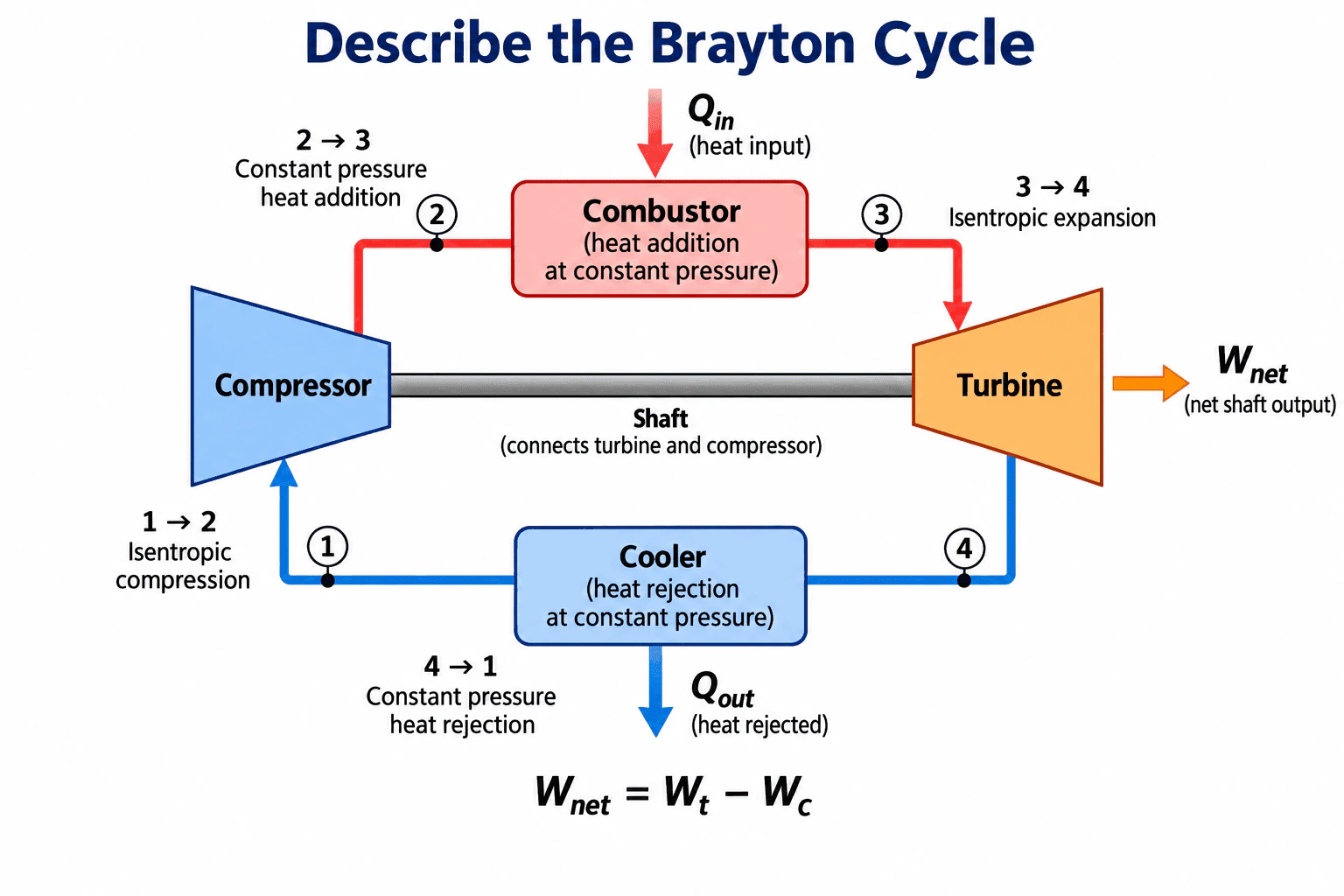
The ideal Brayton Cycle has four processes. From state 1 to 2, the gas undergoes isentropic compression in the compressor. From 2 to 3, heat is added at constant pressure. From 3 to 4, the gas expands isentropically through the turbine and produces shaft work. From 4 back to 1, heat is rejected at constant pressure. The turbine drives the compressor through the shaft, and the remaining shaft work is the net output, so Wnet = Wt − Wc.
Detailed Explanation
The Brayton Cycle is the ideal thermodynamic cycle used to describe gas turbine operation. In the closed idealized representation shown in the diagram, the working fluid passes through a compressor, a constant pressure heat addition device, a turbine, and a constant pressure heat rejection device before returning to its initial state.
Useful Questions to Ask the Interviewer
Should I describe only the ideal Brayton Cycle, or also mention real compressor and turbine losses?
Should I use the closed idealized cycle shown here, or relate it to an open gas turbine system?
Would you like me to include the effect of pressure ratio on efficiency?
How to Explain It in an Interview
Start by defining the system. Treat each component as a steady flow control volume and neglect kinetic and potential energy changes for the ideal analysis. Heat added to the working fluid is positive, heat rejected leaves the working fluid, turbine work is produced by the gas, and compressor work is required by the gas.
State 1 to 2 is isentropic compression. The compressor raises the pressure and temperature of the working fluid. In the ideal model, entropy remains constant during this process.
State 2 to 3 is constant pressure heat addition. Energy enters as Qin, increasing the fluid temperature and enthalpy while pressure remains constant in the ideal cycle.
State 3 to 4 is isentropic expansion through the turbine. The pressure and temperature decrease as the working fluid produces turbine shaft work Wt.
State 4 to 1 is constant pressure heat rejection. Energy leaves as Qout, reducing the fluid temperature and returning it toward the compressor inlet state.
The turbine and compressor are connected by a shaft. Part of the turbine work drives the compressor, so the useful net shaft output is Wnet = Wt − Wc.
For a steady flow component with negligible kinetic and potential energy changes, the first law relates heat transfer, shaft work, and enthalpy change. For example, ideal compressor work is associated with h2 − h1, turbine work with h3 − h4, heat addition with h3 − h2, and heat rejection with h4 − h1 when each quantity is expressed consistently per unit mass.
The second law provides the ideal isentropic reference for the compressor and turbine. Real components generate entropy, so a real compressor normally requires more work than the ideal compressor and a real turbine normally produces less work than the ideal turbine for comparable inlet and outlet pressure conditions.
A good validation check is to confirm mass conservation, close the energy balance around each component, and compare measured pressures, temperatures, heat input, and shaft power with the ideal assumptions. The ideal Brayton Cycle is a reference model rather than an exact prediction of a real engine.
Why Interviewers Ask This
Interviewers want to see whether the candidate understands the four ideal Brayton Cycle processes, can identify where heat and shaft work cross the system boundary, and can connect the compressor, heat addition process, turbine, and heat rejection process using thermodynamic energy balances.
Common interview mistakes
Common mistakes include reversing the order of the four processes, calling heat addition or heat rejection constant temperature processes, forgetting that the compressor consumes shaft work, treating turbine work as the full net output, and assuming real compressors and turbines are actually isentropic. Another mistake is mixing an open gas turbine flow path with the closed idealized cycle without stating the chosen system boundary.
Interview tip
Describe the four states in order and connect each process to its physical component. Then state Wnet = Wt − Wc and explain that the ideal isentropic compressor and turbine provide reference states for evaluating real component losses.
Interviewer may ask next
What assumptions define the ideal Brayton Cycle, and how would you check them against a real system?
The ideal model assumes steady flow, negligible kinetic and potential energy changes, isentropic compression and expansion, and constant pressure heat addition and rejection. For a real system, I would measure mass flow, pressures, temperatures, heat input, and shaft power across the components. I would determine enthalpy and entropy changes from appropriate fluid properties, check mass and energy conservation, and compare the measured compressor and turbine behavior with the ideal isentropic reference.
How does increasing compressor pressure ratio affect Brayton Cycle performance?
For an ideal Brayton Cycle with constant specific heats and a fixed specific heat ratio, increasing pressure ratio increases ideal thermal efficiency. If compressor inlet temperature and maximum turbine inlet temperature are constrained, compressor work also rises, so net work does not increase indefinitely. Practical systems therefore balance pressure ratio, net work, component efficiencies, pressure losses, temperature limits, and required output.
2. What is Mach Number and how is it significantConvection And Fluid FlowEasyHoneywell
Short Interview Answer (30-60 seconds)
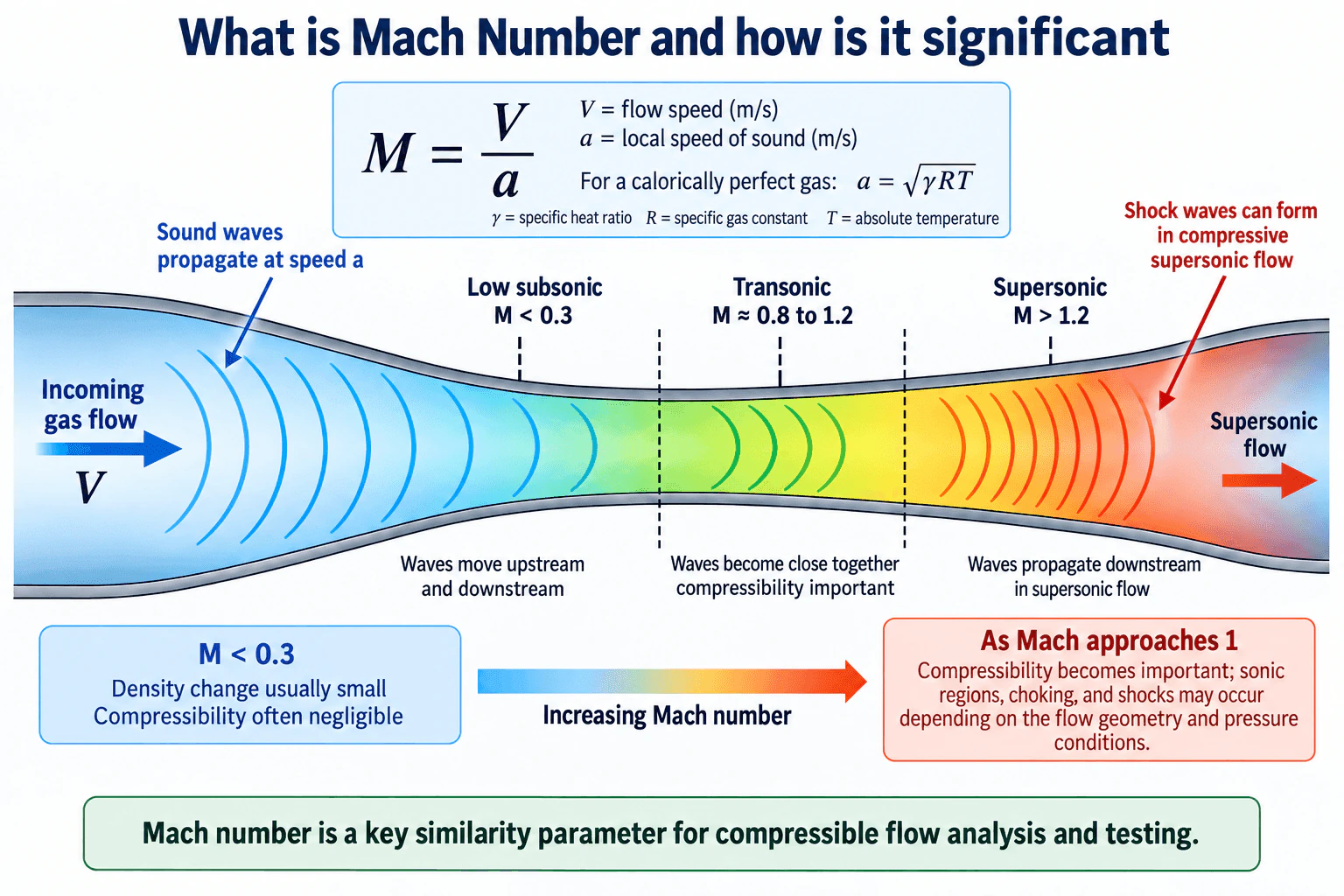
Mach number is the ratio of the local flow velocity to the local speed of sound, M = V/a. It tells us how fast the fluid is moving relative to pressure disturbances traveling through that fluid. At low subsonic Mach numbers, especially below about 0.3, density changes are often small enough that compressibility can be neglected. As Mach approaches 1, compressibility becomes important and sonic conditions can occur. In supersonic flow, disturbances cannot propagate upstream through the undisturbed flow, and compressive processes can form shock waves. Mach number is therefore a key similarity parameter for compressible flow analysis and testing.
Detailed Explanation
Mach number compares the local fluid velocity with the local speed at which small pressure disturbances travel through the fluid. It is defined as M = V/a, where V is the flow velocity in m/s and a is the local speed of sound in m/s. For a calorically perfect gas, a = √(γRT), where γ is the specific heat ratio, R is the specific gas constant, and T is absolute temperature.
Useful Questions to Ask the Interviewer
Should I focus mainly on why Mach number indicates compressibility, or also discuss the different flow regimes?
Are we assuming a calorically perfect gas for the speed of sound relation?
Would you like me to relate Mach number to internal flow, external flow, or both?
How to Explain It in an Interview
Start with the physical meaning. Mach number compares fluid velocity with the speed at which small pressure disturbances propagate through that fluid.
For low subsonic flow, particularly M < 0.3, density changes are usually small, so an incompressible approximation is often reasonable. This value is an engineering guideline for small compressibility effects, not the definition of all subsonic flow.
As Mach approaches 1, pressure, density, temperature, and velocity become strongly coupled. A commonly used transonic range is approximately M = 0.8 to 1.2. Local sonic regions can occur, and depending on geometry and pressure conditions, choking and shock formation may become important.
For flow clearly beyond the transonic regime, such as M > 1.2, the flow is supersonic. Small disturbances are carried downstream relative to the undisturbed flow, so there is no upstream propagation of those disturbances through the supersonic region. Compressive waves can combine into shock waves. Across a shock, pressure, temperature, and density increase while velocity decreases, so incompressible equations are not appropriate.
The local speed of sound also matters. For a calorically perfect gas, a = √(γRT), so Mach number depends on both velocity and local thermodynamic conditions.
In practice, I would determine the local Mach number, check whether the gas model is appropriate, identify the applicable flow regime, and then select governing equations or correlations that include compressibility when required. Mach number is also important when matching dynamically similar conditions in compressible flow testing.
Why Interviewers Ask This
Interviewers want to see whether the candidate understands the physical meaning of Mach number and can use it to judge when gas compressibility, pressure wave propagation, sonic conditions, choking, and shock waves become important in fluid flow analysis.
Common interview mistakes
Common mistakes include treating Mach number as velocity alone, using a fixed speed of sound without considering local temperature and gas properties, treating M < 0.3 as the definition of all subsonic flow, assuming compressibility matters only after Mach 1, and using incompressible flow equations in regimes where density changes or shock waves are important.
Interview tip
Define M = V/a first, explain what the ratio means physically, then connect low subsonic, transonic, and supersonic behavior to compressibility and pressure disturbance propagation. Mention that M < 0.3 is a common guideline for neglecting compressibility rather than a universal subsonic boundary.
Interviewer may ask next
Why is M < 0.3 commonly used as a guideline for neglecting compressibility?
At sufficiently low Mach number, the density changes caused by the flow are usually small enough that treating density as approximately constant gives a useful engineering approximation. Around M < 0.3 this is often acceptable for gases, but the assumption should still be checked against the required accuracy, temperature changes, geometry, and operating conditions.
If the flow velocity stays constant but the gas temperature increases, what happens to Mach number?
For a calorically perfect gas, the local speed of sound is a = √(γRT). If temperature increases while velocity and gas properties remain otherwise unchanged, the speed of sound increases. Since M = V/a, the Mach number decreases. This shows why Mach number depends on the local thermodynamic state as well as velocity.
3. Explain how raising/lowering heat transfer coefficient affects the materialConvection And Fluid FlowMediumHoneywell
Short Interview Answer (30-60 seconds)
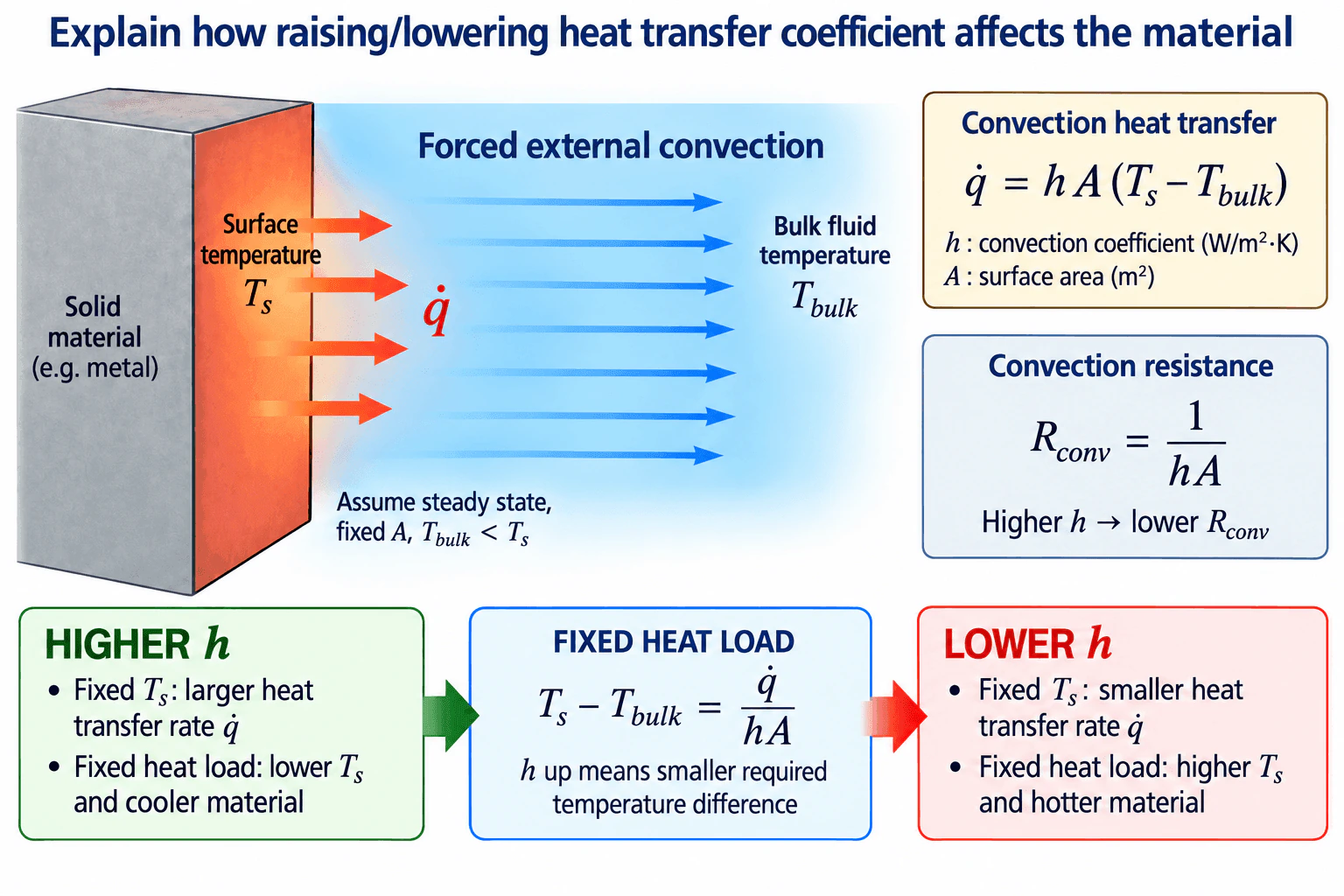
Using q̇ = hA(T_s - T_bulk), the effect depends on what is fixed. If T_s and T_bulk are fixed, increasing h increases the heat transfer rate and decreasing h reduces it. If the heat load is fixed, then T_s - T_bulk = q̇/(hA), so increasing h lowers the required surface temperature and decreasing h raises it. In resistance form, R_conv = 1/(hA), so higher h means lower convection resistance and better heat removal.
Detailed Explanation
The key idea is that h controls the thermal resistance between the solid surface and the moving fluid. For the diagram conditions, treat the problem as steady forced convection from a hot solid surface to a cooler bulk fluid, with fixed surface area A and T_bulk < T_s.
The convection equation is q̇ = hA(T_s - T_bulk), where q̇ is heat transfer rate in W, h is the convection heat transfer coefficient in W/(m²·K), A is surface area in m², T_s is surface temperature, and T_bulk is bulk fluid temperature. The equivalent convection resistance is R_conv = 1/(hA), with units of K/W.
There are two different operating cases.
If T_s, T_bulk, and A are fixed, increasing h increases q̇. The fluid removes heat more strongly from the surface. Decreasing h reduces q̇.
If q̇ is fixed, rearrange the equation to T_s - T_bulk = q̇/(hA). Increasing h reduces the temperature difference required to reject the same heat, so T_s decreases. Decreasing h requires a larger temperature difference, so T_s increases.
For a real component, h is not chosen independently of the flow. It is influenced by fluid properties, velocity, geometry, and whether convection is forced or natural. A change intended to increase h can also increase pressure drop and fan or pump power, so the thermal benefit must be considered together with the fluid flow penalty.
Useful Questions to Ask the Interviewer
Should I assume the surface temperature is fixed, or is the heat load fixed?
Should I treat the case as forced external convection with a fixed bulk fluid temperature?
Do you want only the thermal effect of changing h, or also the pressure drop and flow power tradeoff?
How to Explain It in an Interview
Start with q̇ = hA(T_s - T_bulk).
For fixed T_s, T_bulk, and A, increasing h directly increases q̇. More heat leaves the surface. Decreasing h does the opposite.
For fixed heat load, rearrange the same equation to T_s - T_bulk = q̇/(hA). Now a higher h means the same heat can be rejected with a smaller temperature difference, so the material surface can run cooler. A lower h requires a larger temperature difference, so the surface becomes hotter.
The same result appears from the resistance form R_conv = 1/(hA). Higher h means lower convection resistance, while lower h means higher convection resistance.
I would then state the assumptions: steady conditions, fixed area, a hotter surface than the bulk fluid, and a convection coefficient appropriate to the actual fluid, geometry, and flow regime. I would validate h using an applicable convection correlation or test data and check whether increasing flow to raise h also causes an unacceptable pressure drop or fan or pump power requirement.
Why Interviewers Ask This
Interviewers want to see whether you understand the physical meaning of the convection coefficient and can distinguish between a fixed surface temperature case and a fixed heat load case. They are also checking whether you recognize that h depends on the fluid, flow regime, velocity, geometry, and boundary conditions rather than being a material property of the solid.
Common interview mistakes
Common mistakes are saying that a higher h always changes material temperature without stating what is held fixed, treating h as a property of the solid material, ignoring the distinction between surface temperature and bulk fluid temperature, and assuming that increasing flow to raise h has no pressure drop or power penalty.
Interview tip
State the convection equation first, then explain the fixed surface temperature case and the fixed heat load case separately. That makes the direction of each effect clear and prevents mixing heat transfer rate with material temperature.
Interviewer may ask next
What assumptions or measurements would you validate before using a value of h in a real design?
I would confirm whether the flow is forced or natural, whether it is internal or external, the fluid properties, velocity, geometry, characteristic length, surface and bulk temperatures, and the applicable flow regime. I would then select a convection correlation that matches those conditions or use measured data. I would also check whether properties change enough with temperature to require evaluation at an appropriate reference temperature and whether radiation or internal conduction materially affects the result.
What tradeoff appears if you increase h by increasing fluid velocity?
Higher velocity can increase h and reduce the required surface temperature for a fixed heat load, but it usually also increases pressure drop. That can require more fan or pump power and can introduce noise, vibration, or equipment constraints. The engineering choice is therefore to achieve enough h to meet the temperature requirement without creating an unacceptable fluid flow penalty.
4. What were your favorite and least favorite classes?BehavioralEasyHoneywell
Interview tip:
Use STAR to structure your answer: briefly explain the Situation and Task, make Action the most detailed part, and finish with the Result. For example, describe which classes you enjoyed most and least, why their teaching style or subject matter affected your interest, how you adapted your approach to succeed in both, and what the experience taught you about how you learn and solve engineering problems.
Situation
During my engineering studies, my favorite classes were heat transfer and fluid mechanics because I could connect the equations to physical systems such as conduction through materials, convection, pressure loss, and thermal performance. My least favorite class was a required course that relied much more on memorization and offered fewer opportunities to apply the ideas to practical problems.
Task
My goal was to do well in every class, not only the subjects that naturally interested me. I also wanted to understand why I learned some material more easily so I could improve my approach to subjects that were less engaging.
Action
In heat transfer and fluid mechanics, I tried to understand the physical behavior before using an equation. I would sketch the system, identify the heat or fluid flow path, list the important assumptions, and then solve the problem. Labs and practical examples made these classes especially interesting because I could compare calculations with real behavior. For the class I enjoyed less, I changed my study method instead of treating my lack of interest as an excuse. I organized the material into smaller topics, wrote short explanations in my own words, and connected abstract ideas to examples whenever possible. I also reviewed difficult material regularly rather than waiting until an exam. That approach helped me stay disciplined even when the subject did not naturally hold my attention.
Result
I learned that I am most engaged when I can connect theory to a real engineering problem, which is one reason thermal engineering appealed to me. I also learned that I can adapt my learning approach when a subject is less interesting. That experience made me more patient and systematic when I need to understand unfamiliar material.
Why Interviewers Ask This
Interviewers ask this question to understand what naturally motivates the candidate, how the candidate approaches subjects that are less interesting, and whether academic preferences connect logically to the role. A strong answer shows genuine interest in relevant engineering topics while also demonstrating discipline, adaptability, and respect for subjects that were less enjoyable.
Interviewer may ask next
What did you enjoy most about heat transfer and fluid mechanics?
I enjoyed seeing how the theory described real physical behavior. For example, I liked starting with a thermal or fluid system, identifying the important heat or flow paths, making reasonable assumptions, and then using the equations to predict what should happen. That connection between physical intuition and analysis is what made those classes especially interesting to me.
How did you stay motivated in the class you liked least?
I focused on the responsibility to learn the material even if it was not naturally interesting to me. I broke the content into smaller topics, explained each idea in simple words, and connected it to practical examples when I could. That made the material easier to manage and taught me how to adjust my learning method instead of depending only on personal interest.
5. Walk me thru your daily job?BehavioralMediumHoneywell
Interview tip:
Use STAR to structure your answer: briefly explain the Situation and Task, make Action the most detailed part, and finish with the Result. For example, describe a typical day in your thermal engineering role, how you review priorities and test or simulation data, perform thermal analysis, work with design and test teams, communicate risks, make engineering decisions, and confirm that thermal requirements are being met.
Situation
In my last role, my daily work focused on making sure a product or system could operate within its thermal limits. I usually had several activities moving at the same time, such as reviewing analysis results, supporting testing, investigating temperature concerns, and coordinating with other engineers.
Task
My responsibility was to understand the current thermal priorities, complete the required analysis, identify risks early, and give the design team clear information they could use. I also needed to make sure that simulation, test data, and design assumptions stayed consistent as the design changed.
Action
I normally started by reviewing the most important open items and any new test or simulation results. If I was working on a thermal model, I checked the geometry, material properties, heat loads, boundary conditions, and assumptions before reviewing temperatures and heat flow. I compared the results with the thermal requirements and looked closely at areas with limited margin. If something looked unusual, I first checked whether the issue came from the model, the input data, or the physical design instead of immediately recommending a design change. I also reviewed available test data because it helped me confirm whether the model was representing the real system correctly. During the day, I worked with mechanical, electrical, test, and other engineering teams to understand design changes and explain their thermal impact. When I found a concern, I communicated it early, explained the cause in simple terms, and discussed practical options such as improving the heat path, changing airflow, adjusting material choices, or reducing unnecessary heat exposure. I documented important assumptions and decisions so the team could understand why a recommendation was made and update the analysis correctly when the design changed.
Result
This daily approach helped me keep thermal work connected to the actual design instead of treating analysis as a separate activity. It allowed the team to identify concerns earlier, make better informed design decisions, and move into testing with a clearer understanding of the expected thermal behavior. It also taught me that good thermal engineering depends on both accurate analysis and clear communication with the people making and testing the design.
Why Interviewers Ask This
Interviewers ask this question to understand what the candidate actually does in a normal thermal engineering role. They want to see how the candidate organizes technical work, uses analysis and test data, communicates with other engineering teams, handles changing priorities, and takes ownership of thermal risks from analysis through validation.
Interviewer may ask next
How do you decide which thermal issue to work on first when several items need attention?
I first look at the potential impact on safety, thermal requirements, testing, and the overall design schedule. I give higher priority to an issue that could exceed a temperature limit, block an upcoming test, or force a major design change if it is discovered late. I also speak with the affected engineers so I understand what information they need and when they need it. That helps me focus my analysis on the work that will reduce the most important risk first.
What do you do when your thermal simulation does not agree with test data?
I do not immediately assume that either the model or the test is wrong. I review the model assumptions, heat loads, material properties, contacts, airflow conditions, and boundary conditions. I also check how the temperature was measured and whether the test conditions match the model conditions. Then I compare the difference by location and operating condition to look for a pattern. Once I understand the likely cause, I update the model only when there is a physical reason for the change and document what I learned from the comparison.
6. how would you perform in a team?BehavioralMediumHoneywell
Interview tip:
Use STAR to structure your answer: briefly explain the Situation and Task, make Action the most detailed part, and finish with the Result. For example, describe a thermal engineering project where you worked closely with design, test, and analysis engineers, shared technical information clearly, listened to different views, helped the team solve a thermal issue, and supported a practical decision that everyone could execute.
Situation
During a previous project, I worked with a team that was evaluating a thermal issue found during hardware testing. The measured temperature was higher than our analysis had predicted, so the team needed to understand whether the cause was the model, the test setup, or the hardware itself.
Task
My responsibility was to review the thermal analysis and work with the design and test engineers to identify the cause. I also needed to make sure my analysis was easy for the rest of the team to understand so we could make a decision together.
Action
I first reviewed my thermal model and listed the assumptions that could affect the temperature prediction, such as heat input, material properties, contact resistance, and boundary conditions. I shared those assumptions with the team instead of only presenting the final temperature result. I then worked with the test engineer to compare sensor locations and test conditions with the model. When the design engineer suggested that an interface might not have the expected thermal contact, I included that possibility in the analysis and checked how sensitive the temperature was to contact resistance. I listened to the test and design teams because they had information that was not visible in the model. I also explained my findings in simple terms so everyone understood which assumptions had the largest effect. We agreed on the most useful checks to perform next and divided the work based on each person's area of expertise. I kept the team updated as I refined the model and raised uncertainties early instead of waiting until the analysis was complete.
Result
The team was able to narrow the issue to the most important thermal factors and agree on a practical path for further testing and design review. The experience reinforced that I perform best in a team when I communicate assumptions clearly, listen to other disciplines, take ownership of my part, and focus on solving the shared problem rather than defending my original analysis.
Why Interviewers Ask This
Interviewers ask this question to understand how you collaborate with people from different technical areas, communicate your work, handle different viewpoints, and contribute to a shared engineering goal. A strong answer shows that you can take ownership of your responsibilities while still using the knowledge and experience of the wider team.
Interviewer may ask next
How did you handle it when another team member had a different view of the thermal issue?
I treated the different view as another technical possibility to test. I asked the person to explain the evidence behind the idea, then compared that explanation with the model and test data. This helped us discuss the issue based on engineering evidence instead of personal preference.
What did you learn about working with a team from that experience?
I learned that a thermal model is only one part of the full engineering picture. Test engineers understand the measurement conditions, and design engineers understand physical interfaces and manufacturing details. I can contribute more effectively when I explain my analysis clearly, ask for their input early, and combine those perspectives before making a recommendation.
7. What's a time you had to deal with an issue within a group.BehavioralEasyHoneywell
Interview tip:
Use STAR to structure your answer: briefly explain the Situation and Task, make Action the most detailed part, and finish with the Result. For example, describe a project where team members disagreed about the cause of a thermal performance issue, explain your responsibility, show how you listened to each view, used test data to guide the discussion, helped the group agree on the next steps, and reached a practical result.
Situation
During a previous thermal testing project, our group found that a component was running hotter than expected. The team disagreed about the cause. One view was that the cooling airflow was too low, while another view was that the thermal interface between two parts was creating too much resistance. The discussion became unproductive because each person was focused on defending a different explanation.
Task
I was responsible for supporting the thermal analysis and helping the group identify the real cause so we could decide what to change. I also wanted to keep the discussion focused on evidence instead of personal opinions.
Action
I first listened to each person and summarized the two main explanations so everyone could confirm that I understood them correctly. I then suggested that we separate what we knew from what we were assuming. I reviewed the temperature measurements, airflow information, and the thermal model with the group. I pointed out which observations supported each explanation and where we still lacked evidence. Instead of asking the team to choose one theory immediately, I proposed a simple test sequence that could help isolate the cause. We first checked the airflow path and confirmed that the measured flow was close to the expected condition. We then inspected the thermal interface and found signs that the contact between the parts was not consistent. I worked with the team to update the interface condition and repeat the test. Throughout the process, I kept the conversation focused on the shared goal of solving the thermal problem rather than proving one person right or wrong.
Result
The repeated test showed better thermal behavior after the interface issue was corrected. More importantly, the group moved from disagreement to a clear decision based on evidence. I learned that when a technical group has conflicting opinions, it helps to define the competing ideas clearly, identify what data can test them, and keep the discussion focused on the problem instead of the people.
Why Interviewers Ask This
Interviewers ask this question to understand how you handle disagreement, communication, and teamwork when a group faces a problem. A strong answer shows that you can listen to different viewpoints, stay professional, use evidence to guide decisions, take ownership of your part, and help the team move toward a practical solution.
Interviewer may ask next
How did you handle the team members who strongly disagreed with each other?
I made sure both views were heard before suggesting a decision. I restated each explanation in neutral terms and asked the group to agree on what evidence would support or reject each one. That changed the discussion from defending opinions to testing ideas, which made it easier for the group to work together.
What would you do differently if you faced a similar group issue again?
I would define the competing explanations and the available evidence earlier in the discussion. That would help prevent the conversation from becoming personal or repetitive. I would also agree on a simple test plan sooner so the team could move quickly from debate to evidence.
8. What was a challenging problem you faced in one of your projects and how did you solve it?BehavioralMediumHoneywell
Interview tip:
Use STAR to structure your answer: briefly explain the Situation and Task, make Action the most detailed part, and finish with the Result. For example, describe a thermal engineering project where an unexpected temperature problem appeared during testing, explain your responsibility for finding the cause, show how you reviewed the data, isolated possible causes, worked with the team, tested the most likely solution, and confirmed that the final design performed reliably.
Situation
During a previous thermal design project, our team found that one part of the system was running hotter than expected during validation testing. The temperature was still controllable, but the result reduced our thermal margin and created a risk that the design would not perform reliably under more demanding operating conditions.
Task
I was responsible for understanding why the temperature was higher than our prediction and recommending a practical solution. I needed to determine whether the problem came from the thermal model, the test setup, the airflow path, the interface between parts, or the physical design itself.
Action
I first reviewed the test data and compared the measured temperatures with the values from our thermal model. I checked the sensor locations and test conditions so I could confirm that the comparison was valid. I then broke the thermal path into smaller parts and looked at each source of thermal resistance, which means anything that makes it harder for heat to move from the hot component to the surrounding environment. I noticed that the measured temperature pattern suggested weaker heat transfer near one mechanical interface. I inspected that area with the mechanical team and found that the actual contact condition was less effective than the assumption used in the model. I updated the model to represent the interface more realistically and used it to compare several possible changes. Instead of immediately changing the full design, I recommended a focused change that improved thermal contact while keeping the existing packaging approach. I explained the reasoning to the team, including what the data showed, what assumptions had changed, and why I believed this option addressed the main cause. We then repeated the relevant test conditions and compared the new measurements with the updated model.
Result
The revised configuration reduced the unexpected temperature rise and brought the test behavior much closer to the updated thermal prediction. The team was able to continue with a design that had better thermal confidence without making a much larger change. I learned that when test results do not match a model, I should not immediately assume that either one is wrong. I should first verify the conditions, examine the physical heat path carefully, and use both test evidence and modeling to isolate the real cause.
Why Interviewers Ask This
Interviewers ask this question to understand how a candidate approaches a difficult engineering problem when the answer is not obvious. They want to see structured problem solving, ownership, technical judgment, communication, and the ability to use evidence to move from a problem to a reliable solution. A strong answer also shows that the candidate can learn from the experience instead of only describing the final result.
Interviewer may ask next
How did you decide that the thermal interface was the main cause of the problem?
I compared the measured temperature pattern with the predicted heat path and looked for where the largest difference appeared. The hotter region was concentrated near the interface rather than across the full system. I also checked the test conditions and sensor placement before changing the model. Once those checks were complete, I changed the interface assumption in the model and saw that the predicted behavior moved much closer to the measured result. That gave me stronger evidence that the interface was the main issue.
What would you do differently if you faced a similar problem again?
I would review the physical interface assumptions earlier in the design process, especially for areas where contact pressure, surface condition, or assembly variation can affect heat transfer. I would also identify the most sensitive thermal assumptions before testing so the team already knows which areas to inspect if the measurements differ from the model. That would make the investigation faster while still keeping it evidence based.
Thermal Engineer Resume Examples
Explore the resume examples below to find the one that best matches your target Thermal Engineer role.
Disclaimer: This interview guide is for educational and informational purposes only. It is designed to help readers prepare, but it does not guarantee any interview result, hiring decision, offer, or outcome. Interview questions, hiring criteria, and preferred answers can vary by employer, interviewer, industry, location, and time. All answers, examples, and explanations in this guide are suggested examples for interview preparation, not definitive answers or instructions for professional practice. They are based on research and judgment, are provided without warranties of any kind, and should be adapted to the question, role, and applicable laws and professional requirements. Diagrams are simplified illustrations intended to highlight the main concepts and their relationships; actual situations, systems, and practices may be more complex. Alternative approaches may be equally valid or better suited to a particular question, context, or interviewer. To the fullest extent permitted by applicable law, the contributors and publisher are not liable for decisions made, actions taken, or losses incurred based on this guide.
State Laws and Professional Responsibilities: Laws and requirements governing an occupation vary by state and jurisdiction. You are responsible for checking the current laws, licensing requirements, and scope-of-practice rules that apply to your location and role, and for ensuring that your answers and actions comply with them. Adapt examples in this guide to those requirements. This guide is not legal advice.
Company Notice: This guide is an independent educational resource and is not affiliated with, endorsed by, sponsored by, or approved by the company named in this guide. Company names identify reported interview experiences or the employer context of clearly labeled original practice exercises. Interview practices can change without notice, and inclusion of company-specific content does not mean these questions are official, complete, or guaranteed to be asked. To the fullest extent permitted by law, the author, contributors, and publisher are not responsible for outcomes related to use of this material.
Content Accuracy and Verification: To the fullest extent permitted by applicable law, we do not represent or warrant that interview guides, questions, answers, examples, or diagrams are accurate, complete, current, error-free, or suitable for any particular purpose. You are responsible for independently reviewing and verifying the information before relying on it.