This interview guide is for educational and informational purposes only. It is designed to help readers prepare, but it does not guarantee any interview result, hiring decision, offer, or outcome. Interview questions, hiring criteria, and preferred answers can vary by employer, interviewer, industry, location, and time. All answers, examples, and explanations in this guide are suggested examples for interview preparation, not definitive answers or instructions for professional practice. They are based on research and judgment, are provided without warranties of any kind, and should be adapted to the question, role, and applicable laws and professional requirements. Diagrams are simplified illustrations intended to highlight the main concepts and their relationships; actual situations, systems, and practices may be more complex. Alternative approaches may be equally valid or better suited to a particular question, context, or interviewer. To the fullest extent permitted by applicable law, the contributors and publisher are not liable for decisions made, actions taken, or losses incurred based on this guide.
State Laws and Professional Responsibilities
Laws and requirements governing an occupation vary by state and jurisdiction. You are responsible for checking the current laws, licensing requirements, and scope-of-practice rules that apply to your location and role, and for ensuring that your answers and actions comply with them. Adapt examples in this guide to those requirements. This guide is not legal advice.
Identity, Image, and Privacy Notice
To respect individual privacy, some names, profile photographs, avatars, biographical details, and other identifying information displayed in this guide may be replaced with pseudonyms, licensed stock images, illustrative avatars, composite images, or representative descriptions. Unless a person is expressly identified as an actual contributor, a displayed name, image, or profile should not be understood as depicting or identifying a specific candidate, interviewer, employee, or other real individual. These representations are provided for editorial and illustrative purposes only and do not imply endorsement, employment, participation, or affiliation with this guide or any company mentioned in it. Any resemblance to an actual person is coincidental.
Company Notice
This guide is an independent educational resource and is not affiliated with, endorsed by, sponsored by, or approved by the company named in this guide. Company names identify reported interview experiences or the employer context of clearly labeled original practice exercises. Interview practices can change without notice, and inclusion of company-specific content does not mean these questions are official, complete, or guaranteed to be asked. To the fullest extent permitted by law, the author, contributors, and publisher are not responsible for outcomes related to use of this material.
Content Accuracy and Verification
To the fullest extent permitted by applicable law, we do not represent or warrant that interview guides, questions, answers, examples, or diagrams are accurate, complete, current, error-free, or suitable for any particular purpose. You are responsible for independently reviewing and verifying the information before relying on it.
Questions or comments?
Contact us for general questions, or share feedback, technical corrections, and comments with the community.
1. Describe a time in which you constructed a thermal resistor network model that included nonlinearities and controlled it. How many nodes were in your network?Conduction And Thermal ResistanceHardTesla
Short Interview Answer (30-60 seconds)
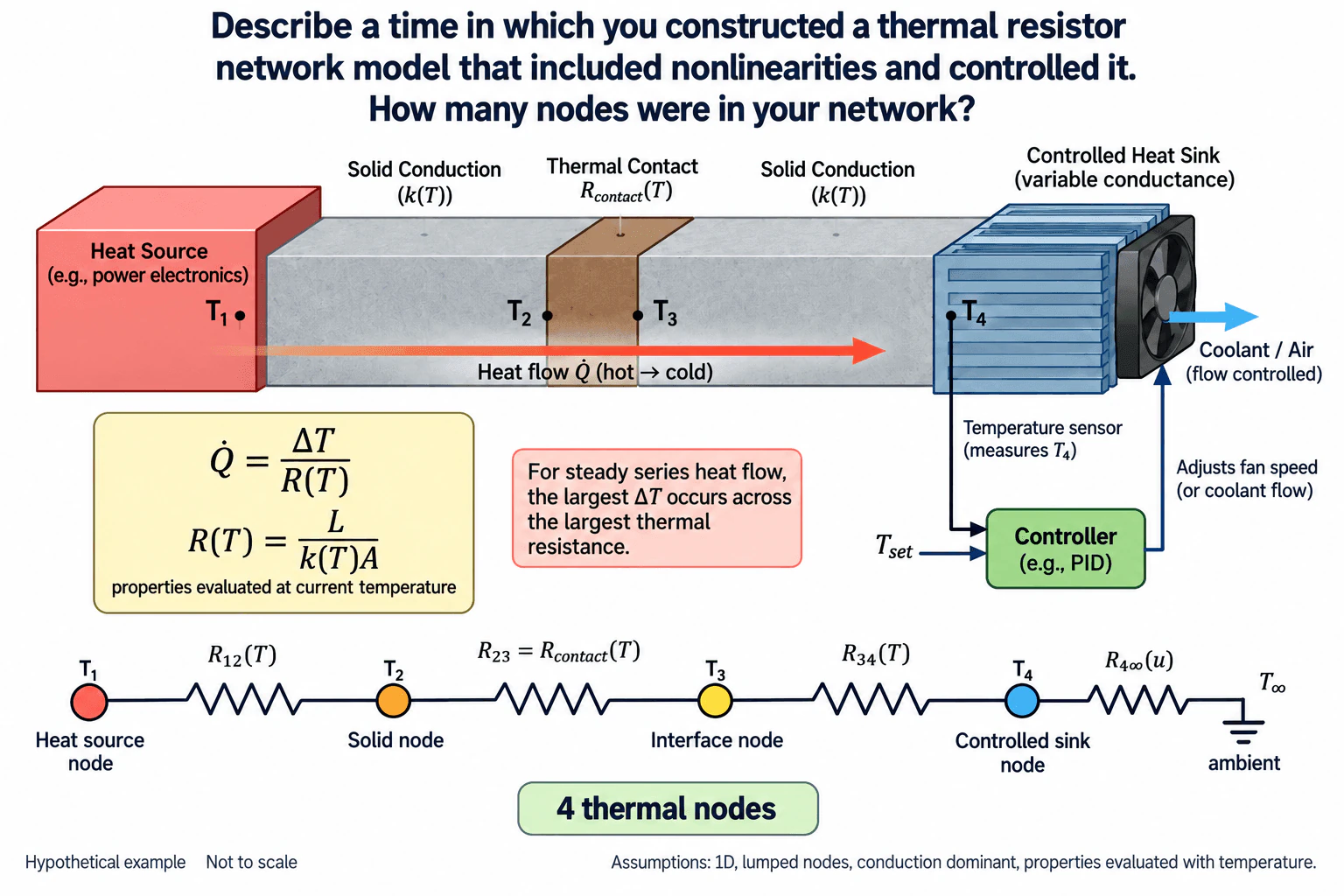
In a representative hypothetical example, I would use four thermal nodes. T1 represents the heat source, T2 a solid conduction node, T3 the thermal interface, and T4 the controlled sink. The series path contains R₁₂(T), R₂₃ = Rcontact(T), and R₃₄(T), followed by the controlled sink to ambient resistance R₄∞(u). A sensor measures T4, a PID controller compares it with Tset, and the controller adjusts fan speed or coolant flow through command u. I would validate the model with energy balance checks, measured node temperatures across multiple operating conditions, and sensitivity studies on the temperature dependent properties and sink conductance.
Detailed Explanation
I would model the dominant heat path as four thermal nodes connected by physically meaningful resistances. Heat leaves the source at T1, passes through a solid region to T2, crosses a thermal contact to T3, passes through another solid region to T4, and then rejects heat to ambient T∞ through a controlled resistance. T∞ is a boundary condition, not a fifth thermal node.
Useful Questions to Ask the Interviewer
Is the expected model steady state only, or should it also include transient thermal capacitance?
Which nonlinear effects are most important, such as k(T), contact resistance, or the flow dependent sink resistance?
Is the control objective to regulate T4, limit T1, or satisfy both?
How to Explain It in an Interview
I would say that the network has four thermal nodes because each node represents a temperature that matters to either the heat path or the control system.
For each solid conduction element, I would start from Fourier conduction. In a lumped resistance model, R(T) = L divided by [k(T)A], where L is conduction length, A is cross sectional area, and k(T) is an effective conductivity evaluated at the current operating point. The corresponding heat rate is Q̇ = ΔT divided by R(T). Because k changes with temperature, R₁₂(T) and R₃₄(T) change as the solution changes, so I would solve the network iteratively. If the temperature dependence were too strong for an effective conductivity approximation, I would use the integrated Fourier relation instead.
The interface is modeled as R₂₃ = Rcontact(T). Under steady series heat flow, the same heat rate passes through each series resistance, so the largest temperature drop occurs across the largest instantaneous thermal resistance.
At T4, heat is rejected to ambient T∞ through R₄∞(u). The command u represents fan speed or coolant flow. A sensor measures T4, the PID controller compares T4 with Tset, and the controller adjusts u, changing the effective sink conductance.
For validation, I would check dimensional consistency and conservation of energy, then compare predicted T1 through T4 temperatures with independent measurements at several heat loads and control commands. I would vary k(T), contact resistance, heat input, and R₄∞(u) to understand sensitivity. I would also check actuator saturation and sensor bias because either can prevent the controller from holding T4 near its setpoint.
If transient response matters, I would add thermal capacitance at appropriate nodes. I would use Biot number reasoning to judge whether each lumped node can reasonably represent a nearly uniform temperature and Fourier number reasoning to interpret transient diffusion time. If internal gradients remain important, I would increase model fidelity rather than adding arbitrary tuning factors.
Why Interviewers Ask This
The interviewer is testing whether I can reduce a physical thermal system to an appropriate resistance network, choose meaningful thermal nodes and boundary conditions, identify important nonlinear behavior, connect the thermal model to a control loop, and explain how I would validate the model before relying on it.
Common interview mistakes
Common mistakes are using too many nodes without physical justification, treating conductivity as constant when temperature dependence matters, omitting contact resistance, confusing conductivity with conductance or thermal resistance, counting the ambient boundary as another thermal node, controlling a temperature without defining the measured node and setpoint, ignoring actuator limits, and validating the network at only one operating condition.
Interview tip
State the four node count immediately, then explain what T1, T2, T3, and T4 physically represent. Next, identify R₁₂(T), R₂₃ = Rcontact(T), R₃₄(T), and R₄∞(u), then explain the T4 sensor, Tset comparison, PID controller, and command u as one closed control loop. Finish with validation and the conditions that would require a higher fidelity conduction model.
Interviewer may ask next
How would you determine whether four lumped nodes are sufficient?
I would examine the expected internal temperature gradients and compare the internal conduction resistance with the relevant boundary resistance. Biot number reasoning helps determine whether a region can reasonably be treated as nearly uniform in temperature. I would also compare predicted temperatures with measurements at several locations and operating conditions. If one node represents a region with a significant unresolved gradient, I would divide that region into additional nodes or move to a higher fidelity conduction model.
What would change if the fan or coolant system had a strongly nonlinear response to the controller command?
I would represent R₄∞(u) with a measured or physically based nonlinear relationship instead of assuming a constant gain between controller command and sink conductance. I would evaluate the closed loop response across low, nominal, and high heat loads, include actuator limits, and verify that the controller remains stable while meeting the temperature objective.
2. What is the pressure's impact on the convection heat transfer coefficient?Convection And Fluid FlowMediumTesla
Short Interview Answer (30-60 seconds)
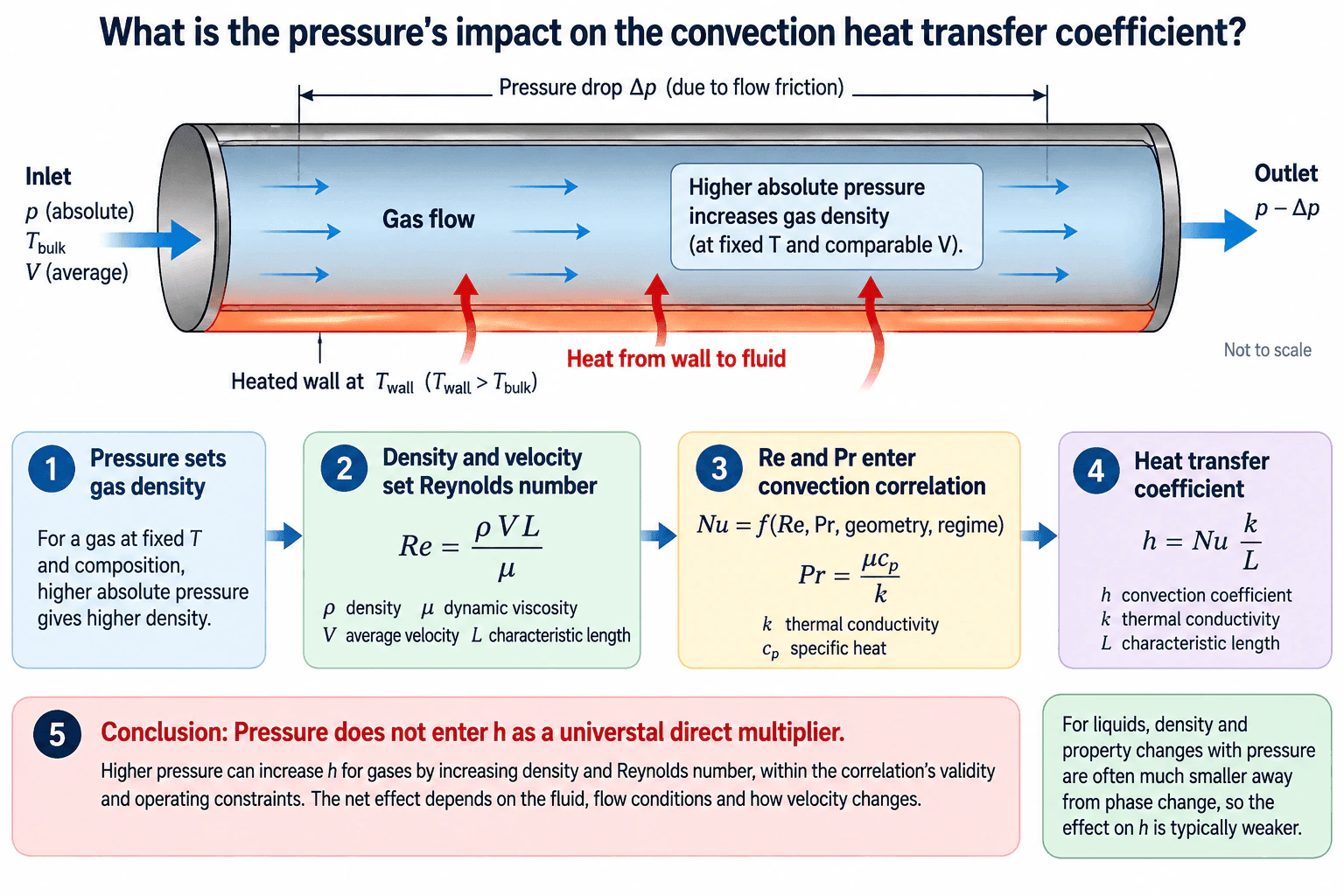
Pressure usually affects the convection heat transfer coefficient indirectly. For forced convection, h is commonly obtained from h = Nu k divided by L, where Nu depends on Reynolds number, Prandtl number, geometry, and flow regime. For a gas at fixed temperature and composition, higher absolute pressure generally increases density. If velocity remains comparable, Re = ρVL divided by μ increases, which can raise Nu and h. For liquids away from phase change, pressure usually changes density and properties much less, so the effect on h is typically weaker.
Detailed Explanation
Pressure by itself does not determine the convection heat transfer coefficient. I would first define the physical problem as internal or external flow, natural or forced convection, the fluid, geometry, wall condition, and operating temperature. For the internal forced gas flow shown in the approved diagram, heat moves from a hotter wall into the flowing gas while the gas experiences a frictional pressure drop from inlet to outlet.
Useful Questions to Ask the Interviewer
Are we discussing a gas or a liquid, and is the stated pressure absolute pressure or pressure drop?
Is the flow internal or external, and is velocity, mass flow rate, or fan or pump operation held fixed as pressure changes?
What geometry, temperature range, and flow regime should I use for the convection correlation?
How to Explain It in an Interview
For forced convection, I would start with
Re = ρVL divided by μ
Pr = μcp divided by k
Nu = f(Re, Pr, geometry, flow regime)
h = Nu k divided by L
Here ρ is density in kg per m³, V is average velocity in m per s, L is the characteristic length in m, μ is dynamic viscosity in Pa s, cp is specific heat in J per kg K, k is thermal conductivity in W per m K, Nu is the Nusselt number, and h is the convection coefficient in W per m² K.
For a gas at fixed temperature and composition, increasing absolute pressure generally increases density. If V, L, and μ remain comparable, Reynolds number increases. A suitable correlation may then predict a higher Nusselt number, so h increases. Pressure therefore influences h through the state and motion of the fluid rather than appearing as a universal direct multiplier.
The constraint held fixed matters. If mass flow rate is fixed, increasing density reduces average velocity because mass flow rate equals ρVA. The product ρV can therefore remain nearly unchanged. Since Re = ρVL divided by μ, Reynolds number may also change little if viscosity remains nearly unchanged. A fan or pump operating point can change as pressure losses change, so velocity should not automatically be assumed constant.
For liquids away from phase change, density and many thermophysical properties vary relatively little with pressure, so pressure commonly has a weaker effect on h. Near phase change, or when properties vary strongly, this simple conclusion may no longer apply.
I would evaluate properties at the temperature required by the chosen correlation, check whether the flow is developing or fully developed, confirm the correlation geometry and Reynolds and Prandtl ranges, and compare the predicted trend with measured data or another applicable correlation. I would also keep absolute pressure separate from the frictional pressure drop along the passage.
Why Interviewers Ask This
This question tests whether the candidate understands that convection depends on the coupled fluid mechanics and heat transfer problem rather than treating pressure as an isolated input. A strong answer should distinguish absolute pressure from pressure drop, connect pressure to density and Reynolds number, select an appropriate Nusselt correlation for the actual flow regime, and recognize that changing pressure can also change velocity, properties, and the fan or pump operating point.
Common interview mistakes
Common mistakes are saying that higher pressure always increases h, confusing absolute pressure with pressure drop, assuming velocity stays constant without stating that condition, using Re alone without checking Pr and the applicable Nu correlation, treating gas and liquid pressure sensitivity as identical, and applying a correlation outside its geometry or flow regime.
Interview tip
State the conclusion first: pressure affects h mainly through density, velocity, properties, and the resulting Reynolds and Nusselt numbers. Then explicitly say what is being held fixed. That qualification is often the most important part of the answer because constant velocity and constant mass flow rate can produce different pressure trends.
Interviewer may ask next
What changes if mass flow rate is held constant while gas pressure increases?
For a fixed passage area, mass flow rate equals ρVA. If pressure increases gas density while mass flow rate remains fixed, average velocity decreases approximately in inverse proportion to density. The product ρV can therefore remain nearly unchanged. Since Re = ρVL divided by μ, Reynolds number may change little if viscosity is also nearly unchanged. In that case, increasing pressure does not necessarily produce the same increase in h that would occur if velocity were held constant. The selected correlation and pressure dependent properties still need to be checked.
How would your answer change for a liquid instead of a gas?
For a single phase liquid away from phase change, density is usually much less sensitive to pressure than it is for a gas. Pressure therefore often has only a modest indirect effect on Reynolds number and the convection coefficient, unless pressure significantly changes properties or the pump operating point. I would still calculate properties at the appropriate temperature and pressure, determine Re and Pr, use a correlation valid for the geometry and flow regime, and verify whether the pressure change is large enough to matter.
3. How long does it take to cool down a cup of coffee from 60 C to 40 C without any other specific conditions?Convection And Fluid FlowHardTesla
i Question Details
State the assumptions and additional physical information needed before estimating the cooling time.
Short Interview Answer (30-60 seconds)
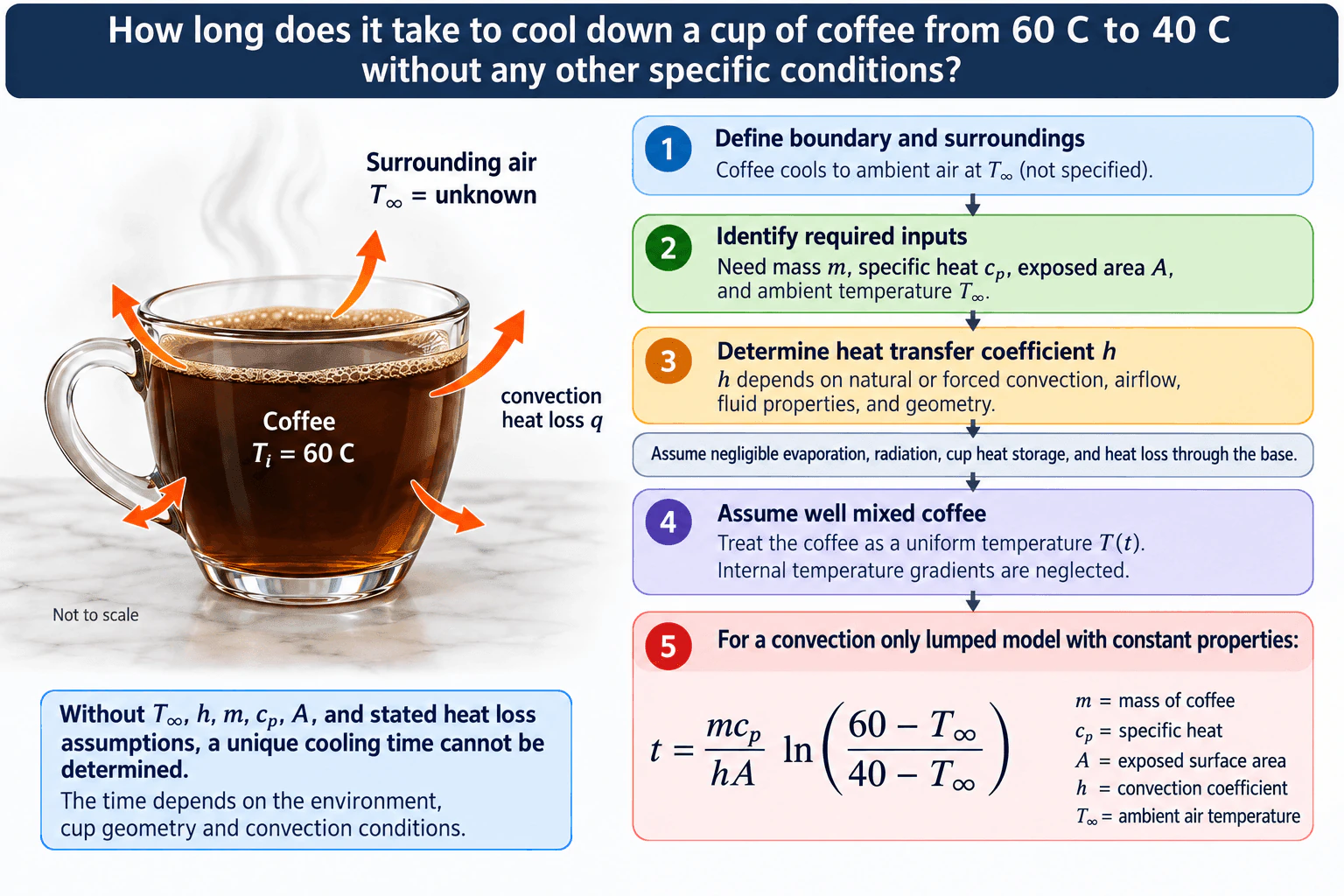
There is not enough information to give one cooling time. I need at least ambient temperature T∞, coffee mass m, specific heat c_p, exposed convection area A, and a convection coefficient h based on whether the surrounding air motion is natural or forced. If I assume the coffee is well mixed, properties are constant, and evaporation, radiation, cup heat storage, and base heat loss are negligible, then t = mc_p/(hA) ln[(60 − T∞)/(40 − T∞)]. I would determine h from a convection correlation appropriate to the actual geometry, fluid properties, and airflow conditions, then verify that the simplified assumptions are reasonable.
Detailed Explanation
The temperatures 60 C and 40 C define the requested temperature change, but they do not determine the cooling rate. The rate depends on how much thermal energy the coffee stores and how effectively heat is transferred to the surroundings.
Useful Questions to Ask the Interviewer
What is the ambient air temperature, and is the surrounding air still or moving?
What are the coffee mass, cup geometry, and exposed surface area?
Should I use the simplified convection only model shown here, or should evaporation, radiation, and cup thermal effects be included?
How to Explain It in an Interview
I would first define the physical boundary. The coffee starts at 60 C, the target is 40 C, and the surrounding air is at an unknown ambient temperature T∞.
For the simplified model, I would assume the coffee is well mixed, so it has a uniform temperature T(t). I would use constant properties and neglect evaporation, radiation, cup heat storage, and heat loss through the base. These assumptions reduce the problem to transient convection.
The required inputs are coffee mass m in kg, specific heat c_p in J/(kg K), exposed area A in m², ambient temperature T∞, and convection coefficient h in W/(m² K).
The energy balance is mc_p dT/dt = −hA(T − T∞).
Integrating from 60 C to 40 C gives
t = mc_p/(hA) ln[(60 − T∞)/(40 − T∞)].
A numerical cooling time cannot be calculated until m, c_p, A, h, and T∞ are known. For this passive cooling model, T∞ must be below 40 C for the coffee to reach 40 C in finite time.
The value of h depends on whether convection is natural or forced, together with airflow, fluid properties, and geometry. For still air, I would select a natural convection correlation appropriate to the geometry and applicable Rayleigh and Prandtl number range. For imposed airflow, I would select a forced convection correlation appropriate to the Reynolds and Prandtl number range. I would evaluate properties at the temperature specified by that correlation.
Finally, I would check the result against physical expectations and the model assumptions. If evaporation, radiation, cup thermal effects, or other heat paths are important, this convection only equation is insufficient and the energy balance must be expanded.
Why Interviewers Ask This
This tests whether the candidate recognizes that a transient thermal problem is under specified, defines the physical boundary and missing operating conditions before calculating, selects an appropriate convection model, states simplifying assumptions, and checks whether the resulting estimate is physically meaningful.
Common interview mistakes
Common mistakes are giving a numerical cooling time without enough inputs, assuming an arbitrary ambient temperature or convection coefficient, failing to distinguish natural from forced convection, using an exposed area that does not match the modeled heat transfer path, applying a convection correlation outside its documented geometry or flow regime, and presenting the convection only result as a complete model while silently ignoring evaporation, radiation, or cup thermal effects.
Interview tip
Start by saying that the problem is under specified rather than guessing a time. Then define the boundary, identify the missing physical inputs, state the simplifying assumptions, write the transient energy balance, and explain how h would be determined. This demonstrates thermal judgment before calculation.
Interviewer may ask next
How would you validate the convection only estimate?
I would measure coffee temperature versus time under controlled ambient temperature and airflow and compare the measured cooling curve with the predicted exponential response. I would also check whether the coffee remains reasonably well mixed and whether the chosen convection correlation applies to the actual geometry and flow regime. Consistent disagreement would indicate that neglected effects such as evaporation, radiation, or cup thermal behavior need to be included.
What changes if a fan blows across the cup?
The external air motion becomes forced convection rather than primarily natural convection. I would characterize the air velocity and geometry, determine the relevant Reynolds and Prandtl numbers, select an applicable Nusselt correlation, and calculate a new h. A larger h reduces the thermal time constant mc_p/(hA), so the coffee generally reaches 40 C sooner if the remaining assumptions stay valid.
4. Explain why the new battery cooling system is superior compared with the older battery cooling system.Thermal DesignHardTesla
Short Interview Answer (30-60 seconds)
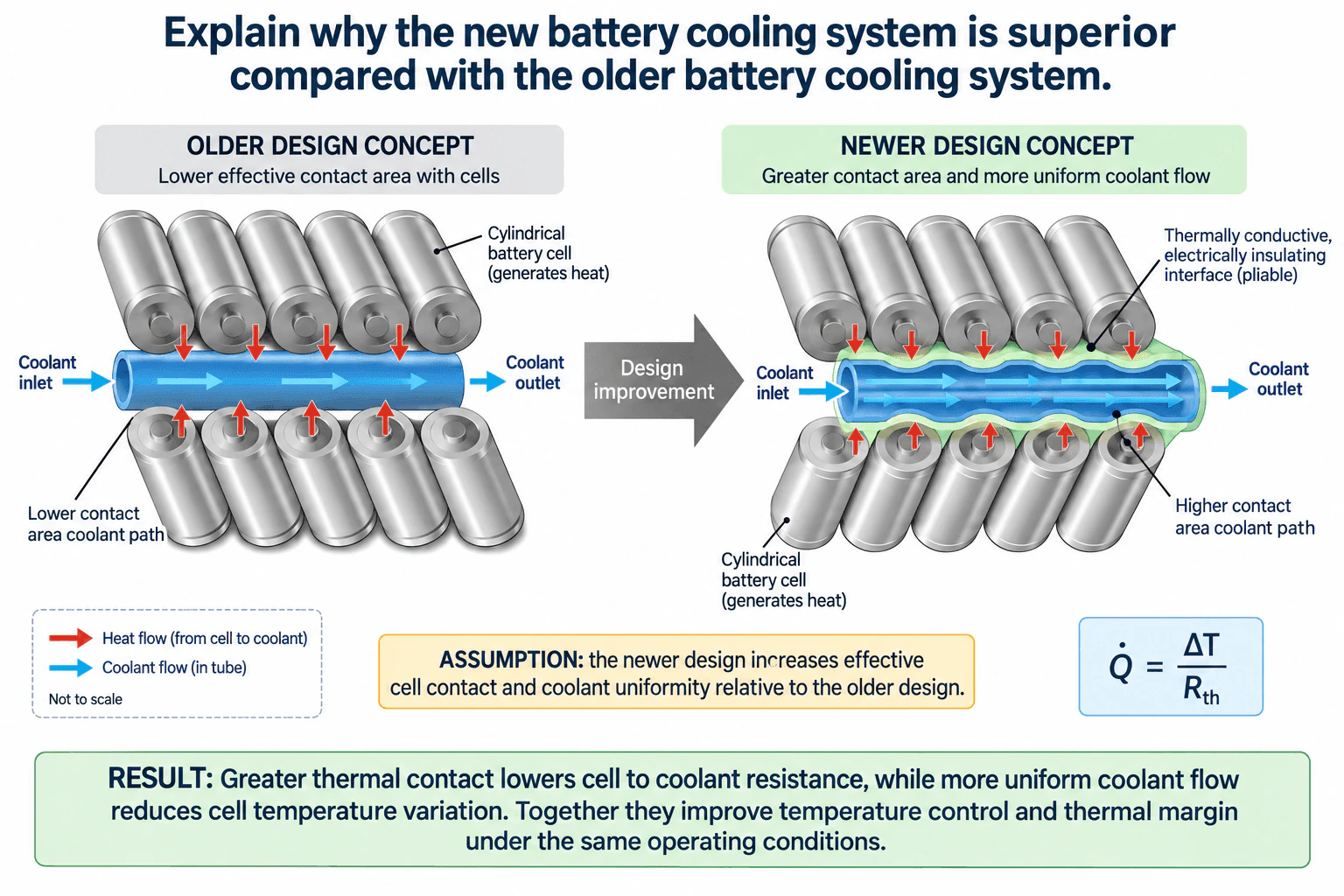
The newer system is better because it improves both thermal contact and coolant uniformity. It gives the cells more effective contact area with the cooling path and uses a pliable thermally conductive and electrically insulating interface. That lowers cell to coolant thermal resistance, so for the same ΔT more heat can be removed. More uniform coolant flow also reduces temperature differences between cells. The result is better temperature control and more thermal margin under the same operating conditions.
Detailed Explanation
The key improvement is a lower resistance and more uniform path from each cylindrical cell to the coolant. In the older design concept, the coolant path has lower effective contact area with the cells. In the newer concept, greater contact area and a pliable thermally conductive and electrically insulating interface improve thermal coupling. The newer coolant path also promotes more uniform coolant conditions along the cells. These two mechanisms address both peak temperature and cell temperature spread.
Useful Questions to Ask the Interviewer
Should I compare both designs at the same cell heat load, coolant properties, flow rate, inlet temperature, and ambient condition?
Is the primary objective lower peak cell temperature, lower temperature variation between cells, lower pumping power, or a combination of these?
Should the comparison remain conceptual, or should I also discuss pressure drop, mass, cost, manufacturing tolerance, and reliability?
How to Explain It in an Interview
I would start by defining a fair comparison boundary. I would assume the same cells, heat generation, duty cycle, coolant, inlet condition, and environment unless the interviewer specifies otherwise.
First, compare the thermal path. The older concept has lower effective contact area between the cylindrical cells and the coolant path. The newer concept has greater contact area and a pliable thermally conductive and electrically insulating interface. That interface can maintain contact despite small cell position or dimensional variations, which reduces the resistance between the cells and the coolant.
The governing idea can be expressed as Q̇ = ΔT / R_th, where Q̇ is heat transfer rate, ΔT is the temperature difference driving heat transfer, and R_th is thermal resistance. If R_th decreases, the system can transfer more heat for the same ΔT, or achieve the same heat removal with a smaller temperature difference.
Second, compare coolant uniformity. If coolant conditions are more uniform along the cells, the local heat sink temperature varies less. That helps reduce cell temperature variation, so the hottest cells are less likely to become the limiting locations in the pack.
I would not declare the design superior from geometry alone. I would check peak cell temperature, cell temperature spread, coolant temperature rise, pressure drop, pump power, interface durability, manufacturing tolerances, and degraded coolant flow. The newer architecture is superior when its thermal benefits remain significant without unacceptable penalties in power, mass, cost, reliability, or serviceability.
I would validate the conclusion with a traceable heat budget and instrumented testing under representative steady and transient loads, including hot conditions and reduced flow. The decision should include uncertainty and thermal margin rather than relying on a single nominal result.
Why Interviewers Ask This
They want to see whether you can compare two thermal architectures from first principles, identify the mechanisms that control heat removal and temperature uniformity, state assumptions, recognize tradeoffs, and explain how you would validate the conclusion.
Interviewer may ask next
What assumptions would you verify before accepting that the newer cooling system is better?
I would verify that both systems are compared with the same cell heat generation, duty cycle, coolant properties, coolant inlet temperature, flow conditions, ambient environment, and cell arrangement. I would then compare measured peak cell temperature, temperature variation between cells, coolant temperature rise, pressure drop, and pump power. I would also inspect the thermal interface because its contact quality and manufacturing tolerance directly affect the expected reduction in thermal resistance.
What if the newer design gives better temperatures but requires much more pump power?
Then it becomes an architecture tradeoff rather than an automatic improvement. I would compare the reduction in peak temperature and cell temperature variation against the increase in pressure drop and pump power, while also considering mass, cost, reliability, and available power budget. If the thermal requirement can be met with a simpler flow path, I would consider reducing channel complexity or flow rate while retaining the improved contact interface. The preferred design is the one that satisfies the temperature limits and thermal margin with acceptable system penalties.
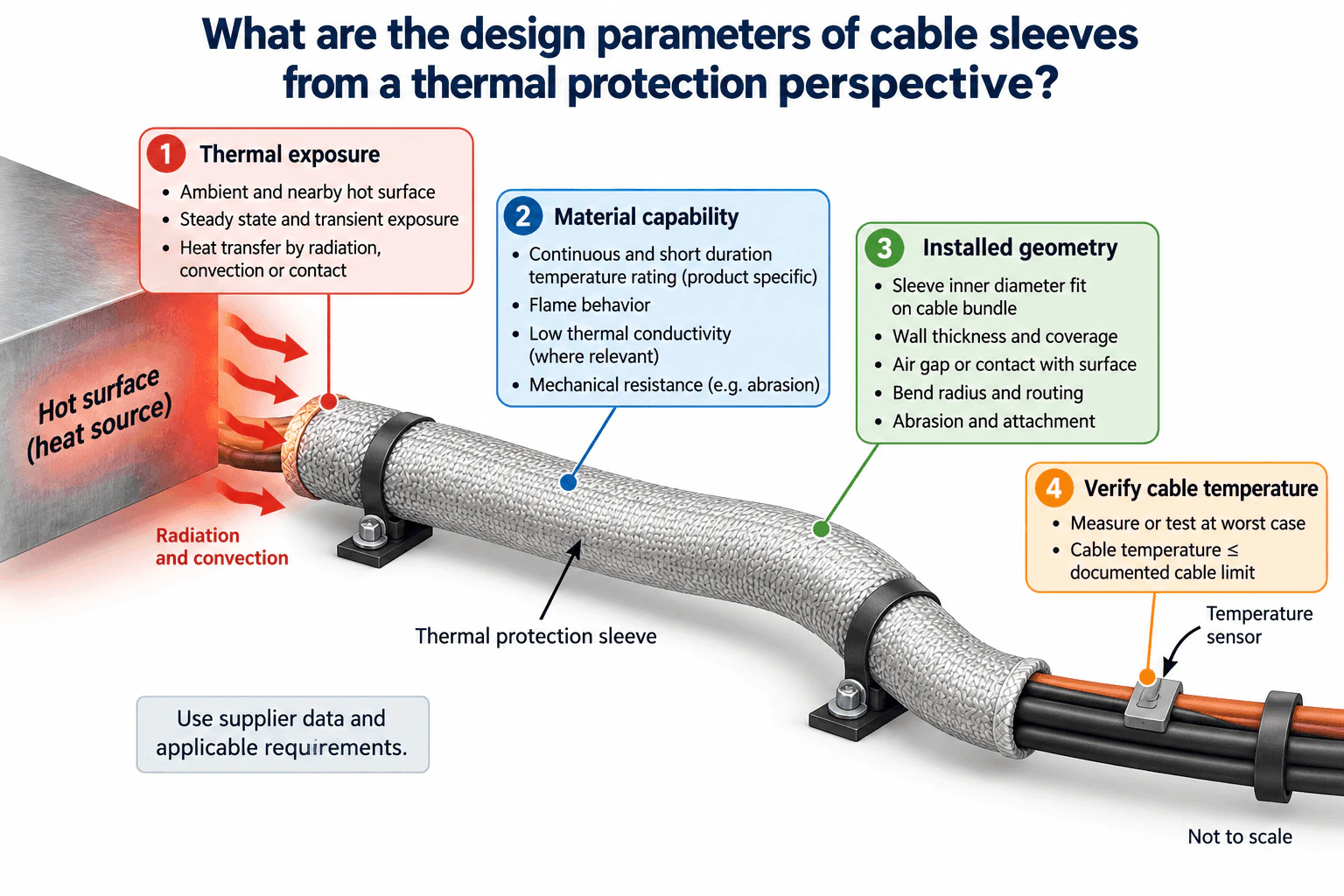
5. What are the design parameters of cable sleeves from a thermal protection perspective?Reliability Safety And Failure AnalysisMediumTesla
Short Interview Answer (30-60 seconds)
From a thermal protection perspective, I would evaluate four areas. First, define the thermal exposure, including ambient temperature, nearby hot surfaces, steady and transient conditions, and whether heat reaches the cable by radiation, convection, or contact. Second, check sleeve material capability, including continuous and short duration temperature ratings, flame behavior, thermal conductivity where relevant, and mechanical resistance. Third, check installed geometry, including sleeve fit, wall thickness, coverage, air gap or hot surface contact, bend radius, routing, abrasion, and attachment. Finally, measure or test the cable under the worst credible thermal condition and confirm its temperature remains below the documented cable limit.
Detailed Explanation
A cable sleeve should be selected from the thermal environment seen by the cable, not from sleeve temperature rating alone. The design objective is to reduce heat transfer enough that the cable remains within its documented allowable temperature while the sleeve also survives the mechanical and installation environment.
Useful Questions to Ask the Interviewer
What are the maximum ambient and nearby hot surface temperatures, including transient exposure?
Is the dominant heat transfer path radiation, convection, direct contact, or a combination?
What documented cable temperature limit and sleeve supplier requirements define acceptance?
How to Explain It in an Interview
I would use four checks.
First, define the thermal exposure. I would identify ambient temperature, nearby hot surface temperature, exposure duration, transient events, and the heat transfer paths. Radiation can dominate when the cable is close to a hot surface without contact. Convection depends on the surrounding fluid and flow conditions. Direct contact creates a conductive heat path.
Second, check material capability. I would compare the expected exposure with supplier data for continuous and short duration temperature capability, flame behavior, thermal conductivity where relevant, and resistance to abrasion or other mechanical damage. I would not assume a universal temperature limit because sleeve and cable ratings are product specific.
Third, check installed geometry. Sleeve inner diameter must fit the cable bundle without excessive compression. Wall thickness and coverage influence protection. An air gap can reduce direct conductive heating, while contact with a hot surface can increase it. Bend radius, routing, clamps, and attachment must also avoid sleeve damage, movement, or loss of coverage.
Fourth, verify cable temperature. I would measure or test the installed configuration at the most thermally stressed location under the worst credible operating condition. Acceptance requires the cable temperature to remain below its documented limit using the applicable supplier data and requirements.
For reliability, I would also consider thermal cycling, abrasion, attachment damage, and sleeve displacement as possible failure mechanisms. If validation shows insufficient margin, corrective action could include increasing separation from the heat source, revising routing, changing the sleeve construction, increasing coverage, or adding another approved thermal barrier. The revised configuration must then be verified again, with any remaining residual risk documented.
Why Interviewers Ask This
The interviewer is evaluating whether the candidate can translate a thermal hazard into practical cable sleeve requirements, account for real installation conditions, and verify that the protected cable remains within its documented temperature limit rather than selecting a sleeve from temperature rating alone.
Common interview mistakes
Common mistakes are selecting a sleeve only from its maximum advertised temperature, ignoring transient exposure, overlooking radiation from nearby hot surfaces, allowing direct contact that creates a conductive heat path, choosing an incorrect sleeve fit, ignoring wall thickness or coverage, exceeding routing or bend constraints, overlooking abrasion or attachment damage, and accepting the design without measuring the actual cable temperature at the worst credible location.
Interview tip
Structure the answer as thermal exposure, material capability, installed geometry, and verification. Emphasize that the final acceptance criterion is the protected cable temperature relative to its documented limit, supported by supplier data and applicable requirements.
Interviewer may ask next
How would you validate that the cable sleeve provides enough thermal protection?
I would test the installed configuration under the worst credible thermal condition and measure cable temperature at the most stressed location with calibrated instrumentation. I would compare that result with the documented cable limit and inspect the sleeve, routing, clamps, and attachments for thermal damage, abrasion, movement, or loss of coverage. Passing temperature alone would not justify acceptance if the installation shows degradation that could reduce protection over time.
What would you change if the protected cable temperature is still too high?
I would first identify the dominant heat transfer path. For radiation, I could increase separation from the hot surface, revise shielding, or select a sleeve construction with more suitable documented thermal performance. For direct contact, I would remove the contact or introduce an approved insulating barrier. I could also revise routing, increase coverage, or change sleeve construction. The modified configuration would then be tested again under the same worst credible condition.
6. Why Tesla? Why are you interested in joining this team specifically?BehavioralEasyTesla
Interview tip:
Use STAR to structure your answer: briefly explain the Situation and Task, make Action the most detailed part, and finish with the Result. For example, describe a previous thermal engineering project that showed you how much you enjoy solving difficult heat transfer and cooling problems, explain the responsibilities you owned, connect the engineering decisions you made to safety and reliability, and show why that experience makes the thermal engineering work at Tesla especially interesting to you.
Situation
During a previous project, I worked on a thermal system where temperature control was important for performance, reliability, and safe operation. The work required more than simply meeting a temperature target. I had to understand how heat moved through the system and how different operating conditions affected the design.
Task
My responsibility was to evaluate the thermal behavior, identify the main risks, and help the team choose a practical design that could control temperature without adding unnecessary complexity. That experience made me realize that I am most motivated by thermal problems where engineering decisions have a direct effect on the overall product.
Action
I started by breaking the problem into the main heat sources, heat transfer paths, cooling limits, and operating conditions. I used thermal calculations and test information to understand where the largest temperature risks were coming from. I then compared design options based on thermal performance, reliability, packaging, energy use, and ease of validation. When the analysis showed uncertainty, I worked with other engineers to define useful tests instead of making assumptions. I also made sure that I could explain the thermal tradeoffs clearly so the broader team understood why one option was safer or more practical than another. That type of work is why Tesla interests me. I want to work on products where thermal engineering is closely connected to safety, efficiency, reliability, and product performance. I am especially interested in this thermal engineering team because the role would let me use heat transfer, fluid flow, testing, and engineering judgment together rather than treating thermal analysis as an isolated task.
Result
The project gave the team a clearer understanding of the important thermal risks and helped us move forward with a design that could be validated with confidence. It also confirmed the type of work I want to continue doing. I enjoy taking a difficult thermal problem, understanding the physics, working across teams, and turning the analysis into a practical engineering decision. That is the main reason I am interested in joining Tesla and this team specifically.
Why Interviewers Ask This
Interviewers ask this question to understand whether the candidate has a clear reason for choosing Tesla and the specific thermal engineering team rather than applying only because of the company name. A strong answer shows that the candidate understands how thermal engineering connects to product performance, safety, reliability, and efficiency, and that the candidate's interests and working style fit the responsibilities of the role.
Interviewer may ask next
What part of thermal engineering work at Tesla interests you the most?
I am most interested in problems where thermal design affects several product goals at the same time, such as temperature control, efficiency, reliability, safety, and packaging. In my previous project, I enjoyed looking beyond a single temperature result and understanding how each thermal decision affected the complete system. I would like to continue doing that type of system focused thermal work.
How did your previous project influence what you are looking for in your next role?
It showed me that I do my best work when I can combine analysis, testing, and collaboration. I enjoyed identifying the important thermal risks, checking assumptions with data, comparing practical design options, and explaining tradeoffs to other engineers. In my next role, I want those activities to be a central part of my responsibilities, which is why this thermal engineering team is attractive to me.
7. Tell me about something you built end to end without relying on others.BehavioralMediumTesla
Interview tip:
Use STAR to structure your answer: briefly explain the Situation and Task, make Action the most detailed part, and finish with the Result. For example, describe a thermal test setup you owned from the initial requirement through design, assembly, instrumentation, testing, data analysis, and documentation, while explaining the decisions you made independently and how you verified that the final system produced reliable results.
Situation
During a previous project, I needed a reliable way to evaluate the thermal performance of a small liquid cooled component under different heat loads and coolant conditions. There was no existing test setup that matched the operating conditions we needed, so I decided to build the complete thermal test system myself.
Task
I was responsible for taking the setup from an initial test need to a working and documented system. I needed to define the test method, select the hardware and sensors, assemble the system, create the data collection process, run the tests, and confirm that the results were trustworthy without depending on another engineer to complete any part of the build.
Action
I started by defining exactly what I needed to measure, including inlet and outlet coolant temperature, component temperature, coolant flow, pressure, and electrical heat input. I then created a simple thermal energy balance so I could compare the electrical power entering the component with the heat carried away by the coolant. This gave me an independent way to check whether the measurements made physical sense. I selected temperature sensors with suitable accuracy and response time, chose a flow sensor that covered the expected operating range, and selected tubing, fittings, a pump, and a small heat exchanger that could safely handle the required flow and temperature. I planned the sensor locations carefully because poor placement can create misleading temperature readings. I assembled the coolant loop, checked every connection for leaks, wired the sensors, and created the data collection procedure. Before testing the component, I checked each measurement channel and ran the loop at steady conditions to confirm that the readings were stable. I then increased the heat input gradually instead of applying the maximum load immediately. At each condition, I waited for temperatures to stabilize, recorded the data, and compared the coolant heat removal with the electrical heat input. When the energy balance did not agree as closely as expected, I traced the issue to heat loss from exposed tubing and improved the insulation around the test section. I repeated the checks until the measurements behaved consistently. Finally, I documented the setup, operating sequence, sensor locations, assumptions, and data analysis steps so the test could be repeated later.
Result
I delivered a complete working thermal test setup that could produce consistent data across different operating conditions. More importantly, I understood every part of the system because I had designed, assembled, checked, tested, and documented it myself. The experience reinforced that building something end to end is not only about making it work. It also means creating clear verification steps so you know why you can trust the result.
Why Interviewers Ask This
Interviewers ask this question to understand whether a candidate can take full ownership of an open problem and turn it into a finished result. A strong answer shows independent judgment, practical execution, attention to verification, and the discipline to complete both the technical work and the supporting documentation.
Interviewer may ask next
How did you know the test setup was producing reliable data?
I used several checks instead of trusting one measurement. The main check was the thermal energy balance. I compared the electrical heat input with the heat removed by the coolant using the measured flow rate and temperature change. I also checked whether sensor readings became stable at steady conditions and whether repeated tests showed the same general behavior. When the energy balance exposed an unexpected difference, I investigated the physical setup instead of adjusting the data, which led me to improve the insulation around the test section.
What would you do differently if you built the same system again?
I would plan the heat loss control earlier in the design. In the first version, I focused mainly on the coolant loop, sensors, and data collection. The energy balance later showed that exposed tubing was allowing more heat loss than I wanted. If I built the system again, I would include insulation and heat loss checks in the initial design so the first validation runs would start with a better controlled thermal boundary.
8. Tell me about a time when you raised the bar.BehavioralMediumTesla
Interview tip:
Use STAR to structure your answer: briefly explain the Situation and Task, make Action the most detailed part, and finish with the Result. For example, describe a thermal engineering project where you saw that the existing validation approach could miss important issues, took ownership of improving the review standard, introduced stronger checks, helped the team adopt them, and produced a more reliable engineering process.
Situation
During a previous thermal design project, my team was comparing simulation results with test data before making a design decision. The results looked reasonable, but I noticed that different analyses were using slightly different boundary conditions and assumptions. Each analysis could still pass review, so I felt our existing process was not strong enough to give us consistent confidence in the final decision.
Task
I was responsible for my thermal analysis, but I also wanted to improve the quality standard for the broader review. My goal was to make sure we were not only getting plausible temperatures, but also proving that the results were based on consistent inputs, realistic operating conditions, and clear validation against available test data.
Action
I first reviewed the main thermal models and listed the assumptions that had the largest effect on the results, such as heat generation, coolant conditions, contact resistance, and environmental conditions. I then created a simple review checklist that required those assumptions to be stated clearly before results were accepted. I also added a comparison step so simulation trends were checked against test behavior instead of looking only at a final temperature value. When there was a mismatch, I traced it back to the model input or physical assumption before changing the design. I shared the approach with the other engineers and explained why each check mattered. I did not want the checklist to become extra paperwork, so I kept it focused on the few items that could materially change the engineering conclusion. I also asked teammates to challenge my own analysis using the same standard. That made the process feel like a shared quality improvement rather than a rule I was placing on others.
Result
The team began using a more consistent review process, and our thermal discussions became clearer because assumptions and validation evidence were visible before decisions were made. We found issues earlier and had more confidence that design changes were based on physical behavior rather than differences between models. I learned that raising the bar is not about making a process more complicated. It is about identifying where quality can fail, setting a practical standard, and helping the team apply it consistently.
Why Interviewers Ask This
Interviewers ask this question to understand whether a candidate accepts the current standard or actively looks for practical ways to improve quality. A strong answer shows ownership, sound judgment, attention to engineering risk, willingness to challenge existing practices constructively, and the ability to bring other people along when introducing a higher standard.
Interviewer may ask next
How did you get the rest of the team to adopt the higher review standard?
I focused on the engineering reason behind the change rather than presenting it as a new rule. I showed how inconsistent assumptions could produce different conclusions even when each individual analysis looked reasonable. I also kept the checklist short and asked teammates to improve it. That gave the team ownership of the process and made adoption much easier.
What would you do differently if you were improving that process again?
I would involve the test and design engineers earlier when defining the review checks. My approach worked, but earlier input from those groups could make the validation criteria even more useful because they often see physical behavior and design constraints that may not be obvious from the thermal model alone.
9. What would you do if you had to deliver a product or feature in half of the initial timeline?BehavioralHardTesla
Interview tip:
Use STAR to structure your answer: briefly explain the Situation and Task, make Action the most detailed part, and finish with the Result. For example, describe a thermal engineering project where the schedule was suddenly shortened, how you identified the work that was essential for safety and performance, simplified lower priority scope, communicated risks early, coordinated closely with other teams, and used focused analysis and testing to deliver a reliable result.
Situation
During a previous thermal engineering project, our team was developing a cooling solution for a product that had to meet temperature and reliability requirements. Partway through the project, the delivery date was moved much earlier because another part of the product depended on our design.
Task
I was responsible for the thermal analysis and validation work. My goal was to support the shorter schedule without skipping the work needed to show that the design was safe and could control temperatures under the important operating conditions.
Action
I first separated the work into what was essential for release and what could be completed later. I kept the thermal limits, worst case operating conditions, critical interfaces, and validation checks in the first group. I reviewed the plan with the mechanical, electrical, and test teams so everyone understood the new priorities and the risks. I then simplified the analysis plan by using proven models and existing test data where they were appropriate instead of repeating work that would not change the design decision. For areas with higher uncertainty, I focused testing on the conditions most likely to expose a thermal problem. I also reviewed results as soon as they became available instead of waiting for all testing to finish. This allowed me to identify issues early and work with the design team on changes while other validation work continued. I gave the team frequent updates on what was complete, what still had uncertainty, and what decisions were needed. I would not hide a thermal risk just to protect the schedule. If a safety or reliability requirement could not be supported, I would raise it immediately and recommend changing the scope or delivery plan.
Result
We were able to complete the critical thermal work within the shortened schedule and provide the team with clear evidence for the design decisions. Lower priority work was documented for later completion instead of being silently removed. I learned that when a timeline becomes very aggressive, the best approach is not simply to work faster. It is to protect the critical requirements, reduce unnecessary work, communicate risk clearly, and make decisions earlier.
Why Interviewers Ask This
Interviewers ask this question to understand how a candidate responds to strong schedule pressure. They want to see whether the candidate can prioritize intelligently, protect safety and quality, communicate tradeoffs, coordinate with other teams, and take ownership instead of either accepting unrealistic risk or refusing to adapt.
Interviewer may ask next
How did you decide which thermal work could be delayed?
I looked at whether each activity could affect a release decision, a thermal limit, safety, reliability, or a major design interface. Work connected to those areas stayed in the critical path. Work that added useful knowledge but was unlikely to change the immediate design decision could be moved later. I also reviewed those choices with the relevant teams so the reduced scope was visible and agreed upon.
What would you do if the shortened schedule required skipping a validation step that you believed was critical?
I would explain the specific risk and why that validation step matters. I would look for a faster way to obtain enough evidence, such as a focused test or an existing validated model, but I would not present an unverified design as safe. If the risk could not be reduced enough, I would recommend changing the scope or delivery plan and make sure the decision was clearly communicated.
Thermal Engineer Resume Examples
Explore the resume examples below to find the one that best matches your target Thermal Engineer role.
Disclaimer: This interview guide is for educational and informational purposes only. It is designed to help readers prepare, but it does not guarantee any interview result, hiring decision, offer, or outcome. Interview questions, hiring criteria, and preferred answers can vary by employer, interviewer, industry, location, and time. All answers, examples, and explanations in this guide are suggested examples for interview preparation, not definitive answers or instructions for professional practice. They are based on research and judgment, are provided without warranties of any kind, and should be adapted to the question, role, and applicable laws and professional requirements. Diagrams are simplified illustrations intended to highlight the main concepts and their relationships; actual situations, systems, and practices may be more complex. Alternative approaches may be equally valid or better suited to a particular question, context, or interviewer. To the fullest extent permitted by applicable law, the contributors and publisher are not liable for decisions made, actions taken, or losses incurred based on this guide.
State Laws and Professional Responsibilities: Laws and requirements governing an occupation vary by state and jurisdiction. You are responsible for checking the current laws, licensing requirements, and scope-of-practice rules that apply to your location and role, and for ensuring that your answers and actions comply with them. Adapt examples in this guide to those requirements. This guide is not legal advice.
Company Notice: This guide is an independent educational resource and is not affiliated with, endorsed by, sponsored by, or approved by the company named in this guide. Company names identify reported interview experiences or the employer context of clearly labeled original practice exercises. Interview practices can change without notice, and inclusion of company-specific content does not mean these questions are official, complete, or guaranteed to be asked. To the fullest extent permitted by law, the author, contributors, and publisher are not responsible for outcomes related to use of this material.
Content Accuracy and Verification: To the fullest extent permitted by applicable law, we do not represent or warrant that interview guides, questions, answers, examples, or diagrams are accurate, complete, current, error-free, or suitable for any particular purpose. You are responsible for independently reviewing and verifying the information before relying on it.