This interview guide is for educational and informational purposes only. It is designed to help readers prepare, but it does not guarantee any interview result, hiring decision, offer, or outcome. Interview questions, hiring criteria, and preferred answers can vary by employer, interviewer, industry, location, and time. All answers, examples, and explanations in this guide are suggested examples for interview preparation, not definitive answers or instructions for professional practice. They are based on research and judgment, are provided without warranties of any kind, and should be adapted to the question, role, and applicable laws and professional requirements. Diagrams are simplified illustrations intended to highlight the main concepts and their relationships; actual situations, systems, and practices may be more complex. Alternative approaches may be equally valid or better suited to a particular question, context, or interviewer. To the fullest extent permitted by applicable law, the contributors and publisher are not liable for decisions made, actions taken, or losses incurred based on this guide.
State Laws and Professional Responsibilities
Laws and requirements governing an occupation vary by state and jurisdiction. You are responsible for checking the current laws, licensing requirements, and scope-of-practice rules that apply to your location and role, and for ensuring that your answers and actions comply with them. Adapt examples in this guide to those requirements. This guide is not legal advice.
Identity, Image, and Privacy Notice
To respect individual privacy, some names, profile photographs, avatars, biographical details, and other identifying information displayed in this guide may be replaced with pseudonyms, licensed stock images, illustrative avatars, composite images, or representative descriptions. Unless a person is expressly identified as an actual contributor, a displayed name, image, or profile should not be understood as depicting or identifying a specific candidate, interviewer, employee, or other real individual. These representations are provided for editorial and illustrative purposes only and do not imply endorsement, employment, participation, or affiliation with this guide or any company mentioned in it. Any resemblance to an actual person is coincidental.
Company Notice
This guide is an independent educational resource and is not affiliated with, endorsed by, sponsored by, or approved by the company named in this guide. Company names identify reported interview experiences or the employer context of clearly labeled original practice exercises. Interview practices can change without notice, and inclusion of company-specific content does not mean these questions are official, complete, or guaranteed to be asked. To the fullest extent permitted by law, the author, contributors, and publisher are not responsible for outcomes related to use of this material.
Content Accuracy and Verification
To the fullest extent permitted by applicable law, we do not represent or warrant that interview guides, questions, answers, examples, or diagrams are accurate, complete, current, error-free, or suitable for any particular purpose. You are responsible for independently reviewing and verifying the information before relying on it.
Questions or comments?
Contact us for general questions, or share feedback, technical corrections, and comments with the community.
1. What is the purpose of turbine?Thermodynamics And Energy BalancesEasyGe Aerospace
Short Interview Answer (30-60 seconds)
The purpose of a turbine is to extract useful mechanical work from a flowing fluid. The fluid enters with relatively high energy and expands through the turbine, transferring part of its energy to a rotating shaft. For a steady and approximately adiabatic turbine with negligible changes in kinetic and potential energy, the specific shaft work is approximately w = h1 − h2. The shaft power can then drive equipment such as a compressor, generator, pump, or other rotating machinery.
Detailed Explanation
A turbine converts energy carried by a flowing fluid into mechanical shaft work. The working fluid can be a gas, steam, or another fluid. As the fluid passes through the turbine, it usually expands from a higher pressure and higher energy state to a lower pressure and lower energy state. Part of that energy decrease is transferred to the rotating shaft.
For thermodynamic analysis, I would draw a control volume around the turbine. I would define heat transfer into the control volume as positive and shaft work leaving the control volume as positive useful turbine work. For steady flow, an energy balance can be written as:
Here, Q̇ is the heat transfer rate into the control volume, Ẇ is the shaft power leaving the control volume, ṁ is the mass flow rate, h is specific enthalpy, V is velocity, g is gravitational acceleration, and z is elevation.
For a common simplified turbine analysis, heat transfer is small and changes in kinetic and potential energy are negligible. The balance then becomes:
Ẇ ≈ ṁ(h1 − h2)
This relation shows the basic purpose of the turbine. The fluid loses enthalpy as useful shaft work is extracted. The result should be checked with consistent units and with measured or specified inlet and outlet states when actual values are available.
A real turbine also has irreversibilities such as friction, turbulence, and leakage. Therefore, its actual work output is lower than the work associated with an ideal isentropic expansion between comparable inlet and outlet pressure conditions. Isentropic efficiency is commonly used to compare actual and ideal turbine performance.
Useful Questions to Ask the Interviewer
Should I assume the turbine operates at steady state?
Can heat transfer and changes in kinetic and potential energy be neglected?
Would you like me to discuss only the turbine purpose or also its isentropic efficiency?
How to Explain It in an Interview
I would start with the physical purpose: a turbine extracts useful mechanical work from a flowing fluid.
I would then define a control volume around the turbine. The fluid enters carrying energy, especially enthalpy, and may also carry kinetic and potential energy. As the fluid expands through the turbine, part of its energy is transferred to the rotating shaft.
Using the steady flow first law, shaft power depends on heat transfer and the differences between the inlet and outlet enthalpy, kinetic energy, and potential energy. If the turbine is approximately adiabatic and velocity and elevation changes are small, the equation simplifies to Ẇ ≈ ṁ(h1 − h2).
That means the turbine produces shaft power because the fluid leaves with lower specific enthalpy than it had at the inlet. The units should remain consistent, with ṁ in kg/s and h in J/kg or kJ/kg so that shaft power is obtained in W or kW.
For a real turbine, friction, turbulence, leakage, and other irreversibilities reduce the work compared with an ideal isentropic expansion. I would finish by stating that turbines are used whenever energy in an expanding fluid needs to be converted into useful shaft power.
Why Interviewers Ask This
Interviewers want to confirm that the candidate understands the fundamental thermodynamic purpose of a turbine, recognizes the conversion of fluid energy into shaft work, and can connect that physical process to the first law for a control volume.
Common interview mistakes
Common mistakes include saying that a turbine creates energy instead of converting energy, confusing a turbine with a compressor, ignoring the control volume energy balance, assuming every turbine is perfectly adiabatic, or treating pressure drop alone as the direct measure of turbine work without considering the complete thermodynamic state and enthalpy change.
Interview tip
State the purpose first, then connect it to the first law. A clear answer is that a turbine extracts shaft work from an expanding fluid and, under common steady and approximately adiabatic assumptions, that work is closely related to the fluid enthalpy decrease.
Interviewer may ask next
How would you verify whether the simplified turbine energy balance is appropriate?
I would first confirm that operation is close to steady state. I would then estimate whether heat transfer is small relative to shaft power and whether inlet and outlet velocity or elevation changes contribute significantly to the energy balance. If any of those terms are important, I would retain them in the full steady flow energy equation. I would also obtain fluid properties from appropriate property data using the measured or specified inlet and outlet states.
What changes if the turbine has significant heat loss to the surroundings?
If heat loss is significant, the adiabatic assumption is not valid and the heat transfer term must remain in the energy balance. With the stated sign convention, heat loss means Q̇ is negative. Therefore, the shaft power must be determined from the complete energy balance rather than only from Ẇ ≈ ṁ(h1 − h2).
2. What is the significance of the stagnation point?Convection And Fluid FlowEasyGe Aerospace
Short Interview Answer (30-60 seconds)
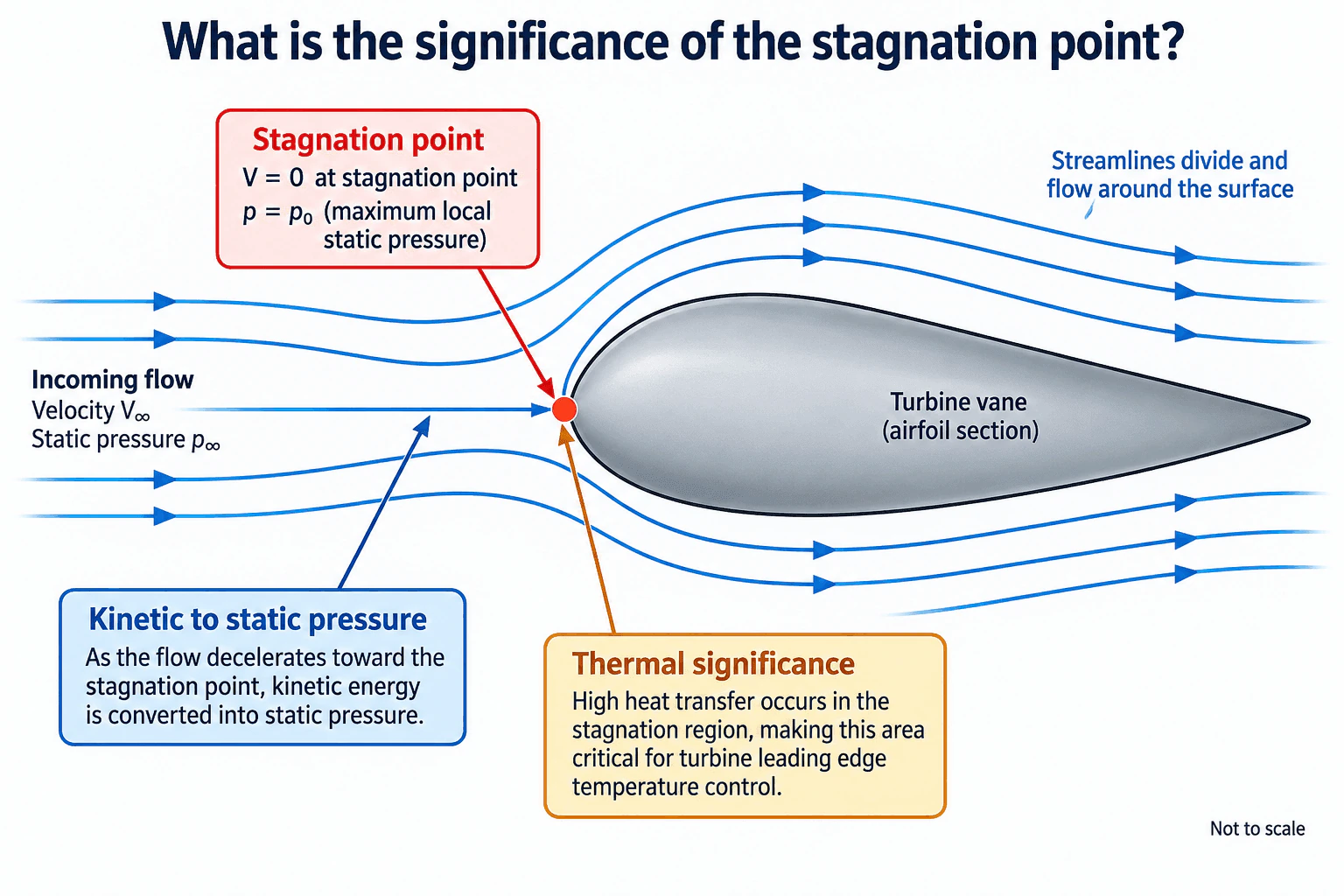
A stagnation point is a location in the outer flow where the local flow velocity becomes zero and the incoming stagnation streamline divides around the body. As the flow decelerates toward that point, the dynamic pressure contribution decreases while static pressure rises. For an ideal incompressible streamline, the stagnation point has the maximum local static pressure and p₀ = p∞ + 1/2 ρV∞². On a turbine vane, the stagnation region is also thermally important because its convective heat transfer can be high, making leading edge temperature control important.
Detailed Explanation
A stagnation point is a location in the outer flow where the local velocity becomes zero. In the turbine vane example, the incoming forced external flow approaches the leading edge, decelerates, reaches the stagnation point, and then divides into streamlines that pass around the two sides of the vane.
For a steady incompressible inviscid streamline, Bernoulli's equation can be written as p + 1/2 ρV² = constant. Far upstream, the flow has velocity V∞ and static pressure p∞. At the stagnation point, V = 0, so the ideal relation becomes p₀ = p∞ + 1/2 ρV∞². This shows why static pressure rises as the flow decelerates and reaches the stagnation pressure at that point.
The thermal significance is also important. Near a turbine vane leading edge, stagnation region convection can be strong because the approaching flow is brought directly toward the surface and the thermal boundary layer begins developing there. The resulting heat transfer can make the leading edge an important location for surface heat flux prediction and temperature control.
In real flow, the simple pressure relation has limits. Viscous dissipation, shocks, and other irreversible effects can reduce stagnation pressure along a flow path. Compressible flow also requires compressible stagnation relations rather than the incompressible Bernoulli form.
Useful Questions to Ask the Interviewer
Should I treat the incoming flow as incompressible or compressible?
Are we considering an external flow over a turbine vane or another geometry?
Should I discuss only the fluid mechanics significance or also the heat transfer significance?
How to Explain It in an Interview
Start with the definition. A stagnation point is where the outer flow velocity becomes zero.
Then describe the flow path. For external forced flow over a turbine vane, the incoming stagnation streamline approaches the leading edge and decelerates. At the stagnation point, V = 0, and the surrounding streamlines turn and pass around the vane surface.
Next connect velocity to pressure. For a steady incompressible inviscid streamline, p + 1/2 ρV² is constant. As V decreases, the dynamic pressure term decreases and static pressure rises. At V = 0, the local static pressure equals the stagnation pressure for that ideal streamline. If the upstream conditions are p∞ and V∞, then p₀ = p∞ + 1/2 ρV∞².
For a Thermal Engineer, the stagnation region also matters because convective heat transfer near a turbine leading edge can be high. This makes the region important for estimating surface heat flux and controlling leading edge temperature.
I would also state the assumptions. The simple Bernoulli relation applies to an appropriate incompressible inviscid streamline model. Compressible flow requires stagnation relations using Mach number and thermodynamic properties, while real viscous losses can reduce stagnation pressure.
A useful physical check is that the velocity approaches zero at the stagnation point, static pressure rises as the flow decelerates, and the streamlines turn around the body instead of passing through it.
Why Interviewers Ask This
Interviewers want to see whether the candidate can connect the physical definition of a stagnation point with velocity, static pressure, streamline behavior, and thermal loading at a turbine vane leading edge.
Common interview mistakes
Common mistakes include saying that the entire flow stops, confusing stagnation pressure with static pressure everywhere in the flow, applying incompressible Bernoulli reasoning to strongly compressible conditions without checking assumptions, and ignoring the thermal importance of the turbine leading edge stagnation region.
Interview tip
State the physical definition first, then connect flow deceleration to increasing static pressure and explain how the stagnation streamline divides around the surface. Add the thermal significance after the fluid mechanics is clear, and state the assumptions behind any stagnation pressure equation.
Interviewer may ask next
Does static pressure always equal stagnation pressure at a stagnation point?
At the stagnation point, the local velocity is zero, so the local static pressure is the stagnation pressure associated with that local state. However, stagnation pressure can decrease along a real flow path because of irreversible effects such as viscous dissipation or shocks. Therefore, the same stagnation pressure should not be assumed everywhere in a real flow field.
How does the interpretation change for compressible flow?
The physical meaning remains the same: the stagnation point is where the local outer flow velocity becomes zero. The pressure and temperature analysis changes because density is no longer constant. Compressible stagnation relations based on Mach number and thermodynamic properties are required, and shock losses or other irreversible effects must be included when present.
3. Explain the nature of the boundary layer over an airfoil.Convection And Fluid FlowMediumGe Aerospace
Short Interview Answer (30-60 seconds)
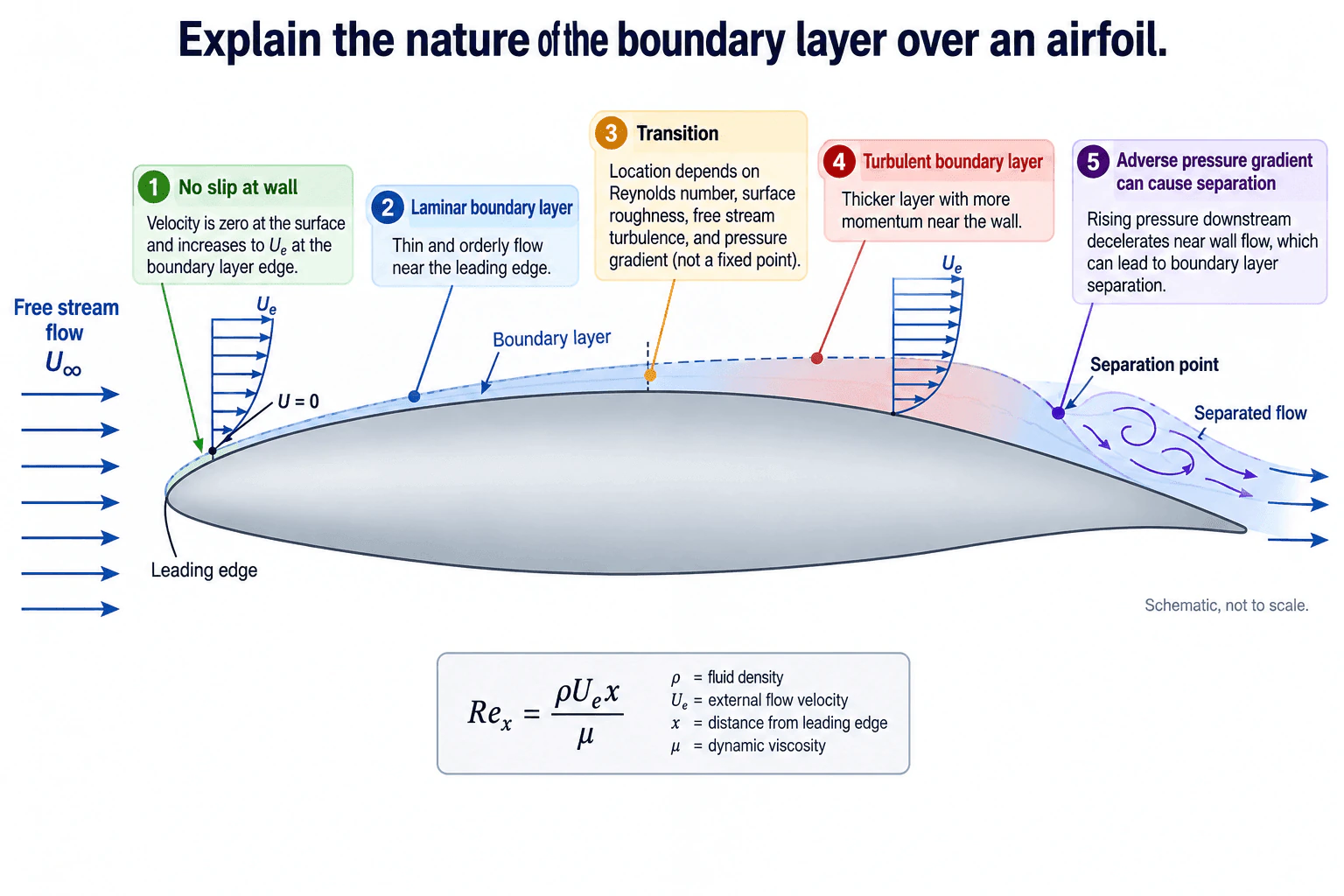
The boundary layer is the thin viscous region next to an airfoil surface. Because of the no slip condition, the air velocity is zero at the wall and increases toward the external flow velocity at the boundary layer edge. Near the leading edge the layer may be laminar, then transition to turbulent depending on Reynolds number, surface roughness, free stream turbulence, and pressure gradient. A turbulent layer generally has stronger mixing and more momentum near the wall. Under a sufficiently strong adverse pressure gradient, the near wall flow can decelerate and separate from the surface.
Detailed Explanation
For an airfoil, this is external forced flow. A boundary layer forms because viscosity makes the air satisfy the no slip condition at the solid surface while the flow outside the thin viscous region moves at approximately the external velocity. The layer begins near the leading edge and grows as the flow moves downstream over the airfoil.
Useful Questions to Ask the Interviewer
Should I describe both laminar and turbulent boundary layers?
Should I include transition and separation under an adverse pressure gradient?
May I assume steady external flow of a Newtonian fluid over a smooth airfoil surface?
How to Explain It in an Interview
Start at the leading edge. Let x be distance measured along the surface, ρ the fluid density, μ the dynamic viscosity, and Ue the external velocity just outside the boundary layer. A useful local Reynolds number is Re_x = ρUe x/μ. It compares inertial effects with viscous effects and helps describe boundary layer development, although pressure gradient and disturbances also matter on an airfoil.
At the wall, velocity is zero because of the no slip condition. Moving away from the surface, velocity rises until it approaches Ue at the boundary layer edge. The resulting velocity gradient produces wall shear stress.
Near the leading edge, the boundary layer can be laminar, with relatively orderly motion. Transition may occur farther downstream. Its location is not fixed because it depends on Reynolds number, surface roughness, free stream turbulence, pressure gradient, and other disturbances.
After transition, turbulent mixing transfers momentum more effectively toward the wall. Under comparable conditions, the turbulent boundary layer is usually thicker and has a fuller velocity profile, leaving more streamwise momentum near the surface. This makes it generally more resistant to separation than a comparable laminar layer, although it also usually produces greater skin friction.
An adverse pressure gradient means pressure increases in the downstream direction. The low momentum fluid near the wall decelerates first. If the wall shear stress decreases to zero and then the near wall flow reverses, the boundary layer separates. The separated region changes the outer flow and can substantially increase aerodynamic losses.
For a real airfoil, I would check the boundary conditions, Reynolds number range, surface condition, external pressure distribution, transition behavior, and evidence of separation. Exact transition and separation locations normally require applicable experimental data, validated correlations, or validated computational analysis rather than one universal criterion.
Why Interviewers Ask This
This question tests whether the candidate understands how viscosity creates a boundary layer on an airfoil, how the velocity profile develops from the no slip wall condition, how laminar flow can transition to turbulent flow, how Reynolds number and pressure gradient affect the layer, and why boundary layer separation matters.
Common interview mistakes
Common mistakes include saying the boundary layer has zero velocity everywhere, treating its outer edge as a solid boundary, assuming transition always occurs at one fixed Reynolds number, confusing turbulent flow with separated flow, and assuming an adverse pressure gradient causes immediate separation. Another mistake is ignoring the no slip condition and the wall velocity gradient that produces shear stress.
Interview tip
Explain the physics in the same order as the flow over the airfoil: no slip at the wall, velocity recovery toward the external flow, laminar development, possible transition to turbulence, then adverse pressure gradient and possible separation. Use Reynolds number as an important governing parameter, but do not present one universal transition value.
Interviewer may ask next
How would you determine whether the boundary layer is likely to remain laminar or transition to turbulence?
I would first evaluate an appropriate local Reynolds number using the external velocity, distance from the leading edge, density, and viscosity. I would then consider surface roughness, free stream turbulence, pressure gradient, geometry, and other disturbances because transition depends on more than Reynolds number alone. For a real airfoil, I would compare the operating condition with applicable experimental data, validated transition methods, or validated computational results.
What changes when the boundary layer encounters a strong adverse pressure gradient?
An adverse pressure gradient means pressure increases downstream. The low momentum fluid near the wall decelerates first, so wall shear stress decreases. At the separation point, wall shear stress reaches zero, and farther downstream near wall reverse flow can develop. A turbulent boundary layer often resists separation better than a comparable laminar layer because turbulent mixing brings more momentum toward the wall, although turbulent flow generally produces greater skin friction.
4. For heat transfer over an isothermal airfoil, how can we calculate the temperature at any point in the wake?Convection And Fluid FlowHardGe Aerospace
Short Interview Answer (30-60 seconds)
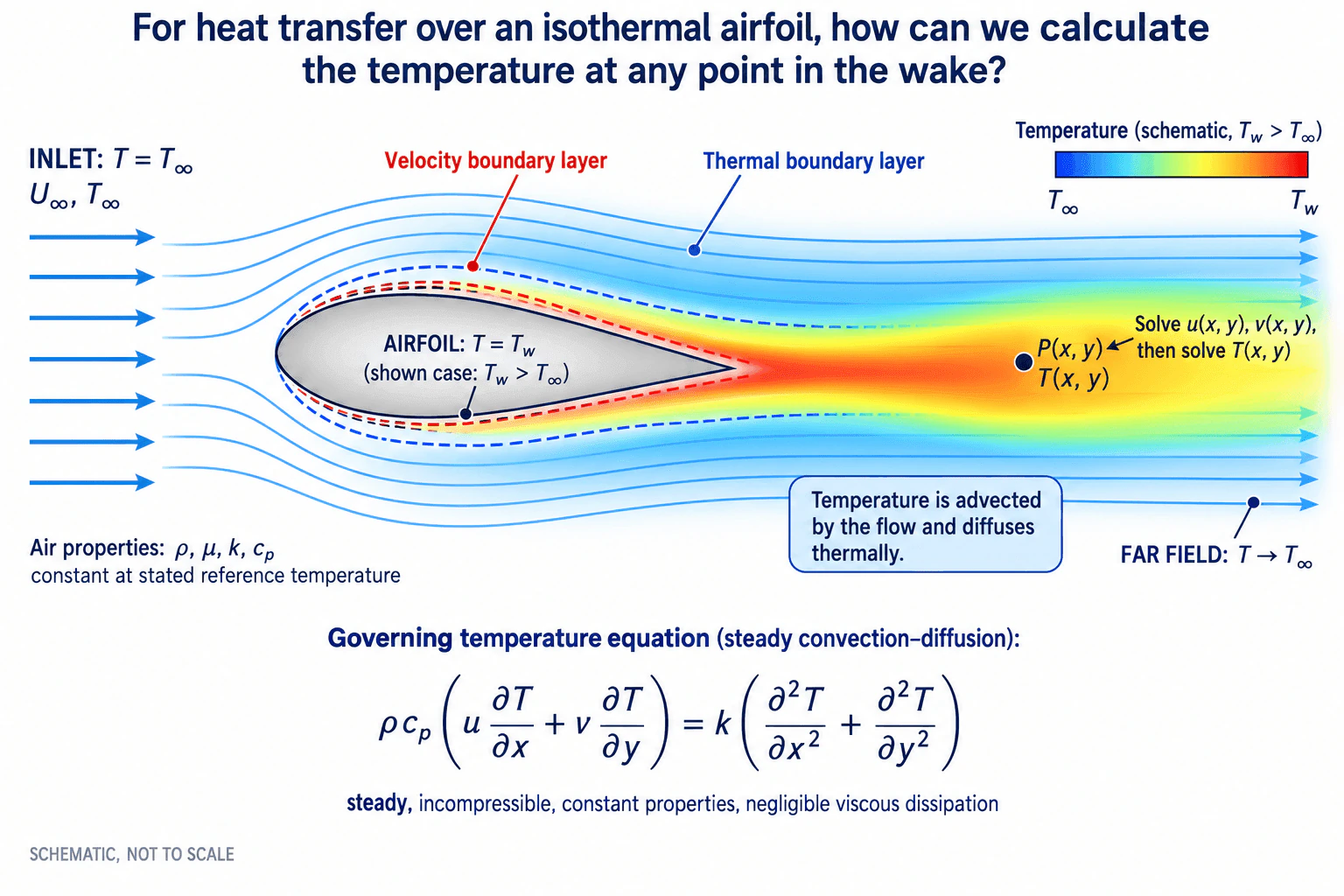
Treat the problem as external forced convection. First determine the velocity field around the airfoil, giving u(x,y) and v(x,y). Then solve the steady energy equation for T(x,y) using T = T∞ at the inlet, T = Tw on the isothermal airfoil, and T approaching T∞ in the far field. For steady, two dimensional, incompressible flow with constant properties and negligible viscous dissipation, ρcp(u ∂T/∂x + v ∂T/∂y) = k(∂²T/∂x² + ∂²T/∂y²). The temperature at any requested wake location is the computed value of T(x,y) at that point.
Detailed Explanation
The wake temperature is a field quantity. Heat from the isothermal airfoil is transported downstream by the moving air and spread by thermal diffusion. Therefore, a surface heat transfer coefficient alone is not enough to give the temperature at an arbitrary wake point.
Useful Questions to Ask the Interviewer
Can I assume steady, two dimensional, incompressible forced convection with constant air properties?
Are Tw, T∞, and U∞ specified and uniform?
Do you want the governing method only, or a numerical solution for a specific airfoil and operating condition?
How to Explain It in an Interview
Start by defining the physical problem as external forced convection over an isothermal airfoil. Let x be the streamwise coordinate and y the transverse coordinate. The incoming air has velocity U∞ and temperature T∞, while the airfoil surface is maintained at the constant temperature Tw. For the hotter wall case shown in the diagram, Tw > T∞.
Under the simplified model, assume steady flow, two dimensional behavior, incompressible air, constant ρ, cp, k, and μ evaluated at a stated reference temperature, forced convection dominant over buoyancy, and negligible viscous dissipation.
First solve the flow field using continuity and momentum to obtain u(x,y) and v(x,y). The velocity boundary layer develops along the airfoil. Reynolds number helps determine whether a laminar or turbulent flow model is appropriate, while Prandtl number indicates the relative rates of momentum and thermal diffusion.
Then solve the temperature field from the steady convection and diffusion equation:
ρcp(u ∂T/∂x + v ∂T/∂y) = k(∂²T/∂x² + ∂²T/∂y²).
Apply the thermal boundary conditions T = T∞ at the inlet, T = Tw on the airfoil surface, and T approaching T∞ sufficiently far from the body and thermal wake. The thermal boundary layer formed at the airfoil continues downstream as a thermal wake.
Once the equation is solved, the requested temperature is simply T(x,y) evaluated at the desired wake coordinates. For a realistic airfoil, this normally requires a numerical solution. I would validate the result by checking conservation, domain size, mesh convergence, boundary placement, property assumptions, and the limiting behavior that T approaches T∞ away from the wake.
Why Interviewers Ask This
This tests whether the candidate can convert an external forced convection problem into the correct flow and thermal field calculation, define physically appropriate boundary conditions, state simplifying assumptions, and distinguish a local surface heat transfer correlation from the full temperature field required to obtain a wake temperature.
Common interview mistakes
Common mistakes include using only a Nusselt number or heat transfer coefficient and treating it as the wake temperature, solving the energy equation without first obtaining the velocity field, omitting the airfoil wall or far field thermal boundary conditions, confusing temperature with temperature difference, using fluid properties without stating the reference temperature, and applying the simplified incompressible constant property equation when compressibility or strong property variation is important.
Interview tip
Lead with the key distinction that the requested wake temperature comes from the full temperature field, not from a surface heat transfer coefficient alone. State the assumptions and boundary conditions first, explain that u(x,y) and v(x,y) are obtained from the flow solution, then solve the convection and diffusion equation for T(x,y) and evaluate it at the requested point.
Interviewer may ask next
How would you validate the calculated wake temperature field?
I would check mass and energy consistency, verify that T approaches T∞ far from the thermal wake, and perform mesh and domain size sensitivity studies. I would also confirm that the velocity and thermal boundary layers are adequately resolved. Where an appropriate external flow correlation is applicable, the predicted surface heat flux or heat transfer coefficient can provide an independent comparison. Experimental temperature measurements at selected wake locations could provide additional validation with measurement uncertainty included.
What changes if air properties vary strongly with temperature or the flow becomes compressible?
The constant property incompressible equation is no longer sufficient. Density, viscosity, thermal conductivity, and heat capacity may need to vary with the local thermodynamic state, and the velocity and temperature fields become more strongly coupled. For compressible flow, the appropriate full energy equation and thermodynamic relationships must be solved together with the flow equations. The same physical boundary conditions remain important, but the governing model becomes more complete.
5. Please tell me about yourself.BehavioralEasyGe Aerospace
Interview tip:
Use STAR to structure your answer: briefly explain the Situation and Task, make Action the most detailed part, and finish with the Result. For example, describe how your thermal engineering background developed through practical work, what responsibilities you have taken on, how you approach thermal problems and collaborate with others, and what those experiences have taught you about the type of engineering work you want to continue doing.
Situation
I am a Thermal Engineer with a strong interest in understanding how heat moves through real systems and how thermal decisions affect performance, reliability, and safety. During a previous project, I worked on a thermal problem where the team needed to understand why a component was operating hotter than expected.
Task
My responsibility was to help identify the main heat transfer paths, understand the operating conditions that were driving the temperature, and support a practical solution that the wider engineering team could use with confidence.
Action
I started by reviewing the available test data, operating conditions, geometry, and material information. I broke the problem into conduction, convection, and heat generation so I could understand which effects mattered most. I checked the assumptions behind the thermal model instead of treating the first result as correct. I then compared the model behavior with the available test observations and investigated the areas where they did not agree. I discussed those differences with engineers from other disciplines because changes to airflow, materials, packaging, or operating limits could affect more than the thermal design. I focused on explaining the thermal behavior in simple terms so the team could understand both the technical finding and the reason behind the recommended changes. That experience reflects how I normally work. I like to combine analysis with practical engineering judgment, verify assumptions with data, and communicate clearly with the people who depend on the result.
Result
The team gained a clearer understanding of the thermal issue and was able to move forward with a better supported design decision. I also learned that good thermal engineering is not only about producing an accurate calculation. It is about understanding the physical system, questioning assumptions, working well with other disciplines, and turning analysis into a useful engineering decision. That is the type of work I want to keep developing in my career.
Why Interviewers Ask This
Interviewers ask this question to understand how clearly you can summarize your professional background, connect your experience to the Thermal Engineer role, and explain what kind of engineer you are. A strong answer shows relevant technical experience, practical judgment, communication skills, and a clear sense of professional direction.
Interviewer may ask next
What part of that thermal investigation did you personally find most challenging?
The most challenging part was understanding why the model and the observed thermal behavior did not fully agree. I had to avoid assuming that either one was automatically correct. I reviewed the boundary conditions, material properties, heat inputs, and heat transfer assumptions one at a time. That taught me to treat thermal models as engineering tools that need validation rather than as final answers by themselves.
What did that experience teach you about working with other engineering disciplines?
It taught me that a thermal recommendation can affect many other parts of a design. A change that improves cooling may affect packaging, structural needs, manufacturing, or system performance. I learned to involve the relevant engineers early, explain the thermal reasoning clearly, and understand their constraints before recommending a change. That makes the final decision more practical and easier for the team to support.
6. What is GE Aerospace most known for? What interests you about GE Aerospace?BehavioralMediumGe Aerospace
Interview tip:
Use STAR to structure your answer: briefly explain the Situation and Task, make Action the most detailed part, and finish with the Result. For example, describe how you researched GE Aerospace, connected its work in aircraft engines and propulsion to your thermal engineering background, identified the technical problems that interest you, and explained why you want to contribute to reliable and efficient aviation systems.
Situation
As I prepared for this Thermal Engineer opportunity, I wanted to understand what GE Aerospace is known for and whether its engineering work matched the type of problems I enjoy solving. I learned that the company is strongly associated with aircraft engines, propulsion systems, and technologies that support commercial and military aviation.
Task
My goal was to understand where thermal engineering fits into that work and identify specific reasons why I would be interested in contributing as a Thermal Engineer.
Action
I focused on the thermal challenges that are central to aircraft engine performance and reliability. Gas turbine components operate in very demanding temperature environments, so engineers need to understand heat transfer, cooling, material temperature limits, and how thermal behavior affects efficiency and durability. That interests me because I enjoy turning heat transfer fundamentals into practical engineering decisions. I also like work where thermal analysis is connected to real hardware, testing, and collaboration with other engineering groups. GE Aerospace interests me because those thermal decisions can directly affect engine performance, component life, reliability, and safe operation. I would be especially motivated by opportunities to analyze temperature distributions, understand cooling performance, compare analytical or simulation results with test data, and help teams make sound design decisions.
Result
That research confirmed that the role is closely aligned with the kind of thermal engineering work I want to continue developing. I am interested in GE Aerospace because it combines challenging thermal problems with complex aerospace hardware where careful engineering decisions have a clear purpose. It would give me an opportunity to apply my thermal fundamentals while continuing to learn from experienced engineers working on demanding aviation systems.
Why Interviewers Ask This
Interviewers ask this question to see whether the candidate understands the company and has a clear reason for wanting the role. A strong answer shows that the candidate has researched GE Aerospace, understands how thermal engineering supports aircraft engine performance and reliability, and can connect that work to genuine professional interests rather than giving a generic reason for applying.
Interviewer may ask next
Which part of GE Aerospace's thermal engineering work interests you the most?
I am most interested in heat transfer and cooling problems around high temperature engine components. I like understanding where heat enters a component, how it moves through the material, how cooling removes it, and whether the resulting temperatures stay within acceptable limits. I also enjoy comparing analysis with test data because that helps confirm whether the model represents the real hardware well enough to support design decisions.
Why are aircraft engine thermal problems especially interesting to you?
They combine fundamental heat transfer with practical design limits. A thermal decision can affect efficiency, durability, cooling requirements, and reliability at the same time. I find that combination interesting because it requires more than producing a temperature result. I need to understand what is causing the thermal behavior, communicate the important tradeoffs, and help the broader team choose a design that performs reliably in the intended operating environment.
7. Why does your experience position you well for this role?BehavioralMediumGe Aerospace
Interview tip:
Use STAR to structure your answer: briefly explain the Situation and Task, make Action the most detailed part, and finish with the Result. For example, describe a thermal engineering project where you combined heat transfer analysis, simulation, test data, practical design decisions, and clear communication to solve a thermal problem and support a reliable design.
Situation
In my last role, I worked on a system where several components operated close to their allowable temperature limits. The design had to perform across different operating conditions, so thermal performance and reliability were both important.
Task
I was responsible for understanding the main heat sources and heat transfer paths, identifying the areas with the highest thermal risk, and helping the team develop a design that could meet the temperature requirements without creating unnecessary complexity.
Action
I started by building a clear thermal picture of the system. I reviewed the expected heat loads, material properties, airflow conditions, interfaces, and boundary conditions. I then used hand calculations to estimate the important heat transfer paths before using thermal simulation for more detailed analysis. This helped me check whether the simulation results were physically reasonable. I focused on the hottest regions and studied how conduction, convection, and contact resistance affected their temperatures. When I found areas with limited thermal margin, I worked with the mechanical and test teams to evaluate practical changes such as improving the heat path, adjusting airflow, and reducing unnecessary thermal resistance. I also compared the analysis with available test data. When the model and test results did not fully agree, I reviewed assumptions instead of simply changing the model until the numbers matched. I explained the main sensitivities and uncertainties to the team so that design decisions were based on both the predicted temperatures and our confidence in those predictions.
Result
The team reached a design that addressed the main thermal risks and was supported by both analysis and testing. The experience strengthened my ability to connect thermal fundamentals with simulation, test evidence, design tradeoffs, and communication. Those are the same skills I would bring to this Thermal Engineer role.
Why Interviewers Ask This
Interviewers ask this question to understand whether the candidate's past experience matches the technical and professional demands of the role. A strong answer shows relevant thermal engineering knowledge, sound judgment, practical problem solving, collaboration, and the ability to connect analysis with real design decisions.
Interviewer may ask next
How did you decide which thermal risks to investigate first?
I prioritized the areas that were closest to their temperature limits and the assumptions that had the largest effect on predicted temperature. I also considered how difficult a problem would be to correct later in the design process. That helped me focus effort on the risks that could have the greatest impact on performance and reliability.
What did you do when the thermal model and test results did not agree?
I compared the model assumptions with the actual test conditions. I checked heat loads, boundary conditions, airflow, material properties, contact resistance, and sensor locations. I used the difference as information about where the model might be incomplete. I then updated assumptions only when there was a physical reason or test evidence to support the change.
8. Tell me about a time when you showed leadership.BehavioralMediumGe Aerospace
Interview tip:
Use STAR to structure your answer: briefly explain the Situation and Task, make Action the most detailed part, and finish with the Result. For example, describe a thermal engineering project where the team faced conflicting priorities or an unclear technical path, you helped organize the work, guided the technical discussion, communicated responsibilities clearly, and helped the team reach a sound result.
Situation
During a previous thermal design project, my team was reviewing a cooling concept for a component that was showing higher temperatures than expected during analysis. Several engineers had different ideas about the cause, and the discussion was starting to move in several directions without a clear plan.
Task
I was responsible for part of the thermal analysis, but I saw that the team also needed someone to organize the investigation. My goal was to help the group identify the most likely causes, assign clear next steps, and keep the work moving without taking ownership away from the other engineers.
Action
I first summarized what we already knew from the thermal model and the available test data. I separated confirmed facts from assumptions so that we would not spend time debating points that had already been established. I then suggested that we group the possible causes into a few areas, including heat input, thermal resistance, airflow, and boundary conditions. I asked each engineer to take the area closest to their expertise and explain what evidence would support or reject that cause. I took responsibility for reviewing the thermal model inputs and checking the heat transfer assumptions. I also kept a simple list of open questions and decisions so everyone could see what had been resolved and what still needed work. When two possible explanations remained, I guided the team toward the check that could give us the clearest answer with the least additional effort. Throughout the process, I made sure quieter team members had a chance to contribute, and I kept the discussion focused on evidence rather than personal preference.
Result
The team reached a clear understanding of the main issue and agreed on the design and analysis changes needed to address it. The investigation became more organized, and we avoided repeating the same checks. I learned that leadership in engineering is not always about having formal authority. It can also mean creating structure, helping people use their strengths, and keeping the team focused on evidence and the shared goal.
Why Interviewers Ask This
Interviewers ask this question to understand how a candidate takes initiative, guides others, makes decisions, and creates progress when a team needs direction. A strong answer shows that the candidate can lead through communication, sound judgment, ownership, and respect for the contributions of other team members.
Interviewer may ask next
How did you make sure the team accepted your leadership even though you were not the formal team lead?
I focused on making the work easier for the team rather than trying to control the team. I organized the facts, asked people to contribute in their areas of expertise, and explained why each next step would help us reduce uncertainty. Because the approach was based on evidence and included everyone, the team was comfortable moving forward with it.
What would you do differently if you faced a similar situation again?
I would create the list of assumptions, open questions, and owners even earlier. That structure helped us make progress once we started using it. In a similar situation now, I would introduce that approach at the beginning so the team could identify gaps faster and avoid spending time on discussions that do not change the technical decision.
9. You have a deadline approaching and know you wont be able to complete the task on time. What do you do?BehavioralHardGe Aerospace
Interview tip:
Use STAR to structure your answer: briefly explain the Situation and Task, make Action the most detailed part, and finish with the Result. For example, describe a thermal engineering task where you realized the remaining analysis could not be completed by the agreed deadline, identified the highest priority work, communicated the risk early, proposed a realistic recovery plan, and protected the quality of the final result.
Situation
During a previous thermal engineering project, I was completing a thermal analysis that supported a design review. As I worked through the remaining cases, I found that some results needed additional checking before I could confidently release them. I could see that completing every planned analysis step by the original deadline was no longer realistic.
Task
I was responsible for making sure the team received useful thermal results for the review while also protecting the accuracy of the analysis. I needed to raise the schedule risk early, explain what work was still required, and help the team decide what could be completed first.
Action
I first reviewed the remaining work and separated the items that were essential for the upcoming decision from the items that could wait. I checked which thermal cases had the greatest effect on the design and which results still needed verification. I then told my lead as soon as I was confident the deadline was at risk. I explained what had been completed, what remained, why the remaining checks were important, and what I believed could realistically be finished before the review. I did not wait until the deadline to report the problem. I proposed completing the most important verified results first and clearly identifying any open items. I also asked whether another team member could help with independent result checks while I finished the highest priority analysis. As the work progressed, I gave short updates so there were no surprises. I avoided rushing through the remaining calculations because an incorrect thermal result could lead the team to make the wrong design decision.
Result
The team had the verified information needed for the immediate review and understood which lower priority items were still open. The remaining analysis was completed afterward with the required checks instead of being rushed. I learned that when a deadline is at risk, early communication and clear prioritization are much better than quietly trying to recover at the last minute.
Why Interviewers Ask This
Interviewers ask this question to understand how a candidate responds when a commitment is at risk. They want to see whether the candidate communicates early, takes ownership, prioritizes important work, protects technical quality, and proposes practical options instead of hiding the problem or simply missing the deadline.
Interviewer may ask next
Why did you choose to communicate the delay before you had finished all of the analysis?
I wanted the team to have enough time to adjust the plan instead of discovering the problem at the deadline. Once I had confirmed that the remaining verification work made the original schedule unrealistic, I had enough information to explain the risk clearly. Communicating early also allowed us to agree on which thermal results were most important for the review.
What would you do differently if you faced a similar deadline risk again?
I would add earlier checkpoints for the analysis so I could compare progress with the planned schedule before the final stages of the work. I would also identify the most important thermal cases at the start of the task. That would make it easier to protect the critical work if unexpected analysis or verification issues appeared later.
Thermal Engineer Resume Examples
Explore the resume examples below to find the one that best matches your target Thermal Engineer role.
Disclaimer: This interview guide is for educational and informational purposes only. It is designed to help readers prepare, but it does not guarantee any interview result, hiring decision, offer, or outcome. Interview questions, hiring criteria, and preferred answers can vary by employer, interviewer, industry, location, and time. All answers, examples, and explanations in this guide are suggested examples for interview preparation, not definitive answers or instructions for professional practice. They are based on research and judgment, are provided without warranties of any kind, and should be adapted to the question, role, and applicable laws and professional requirements. Diagrams are simplified illustrations intended to highlight the main concepts and their relationships; actual situations, systems, and practices may be more complex. Alternative approaches may be equally valid or better suited to a particular question, context, or interviewer. To the fullest extent permitted by applicable law, the contributors and publisher are not liable for decisions made, actions taken, or losses incurred based on this guide.
State Laws and Professional Responsibilities: Laws and requirements governing an occupation vary by state and jurisdiction. You are responsible for checking the current laws, licensing requirements, and scope-of-practice rules that apply to your location and role, and for ensuring that your answers and actions comply with them. Adapt examples in this guide to those requirements. This guide is not legal advice.
Company Notice: This guide is an independent educational resource and is not affiliated with, endorsed by, sponsored by, or approved by the company named in this guide. Company names identify reported interview experiences or the employer context of clearly labeled original practice exercises. Interview practices can change without notice, and inclusion of company-specific content does not mean these questions are official, complete, or guaranteed to be asked. To the fullest extent permitted by law, the author, contributors, and publisher are not responsible for outcomes related to use of this material.
Content Accuracy and Verification: To the fullest extent permitted by applicable law, we do not represent or warrant that interview guides, questions, answers, examples, or diagrams are accurate, complete, current, error-free, or suitable for any particular purpose. You are responsible for independently reviewing and verifying the information before relying on it.