This interview guide is for educational and informational purposes only. It is designed to help readers prepare, but it does not guarantee any interview result, hiring decision, offer, or outcome. Interview questions, hiring criteria, and preferred answers can vary by employer, interviewer, industry, location, and time. All answers, examples, and explanations in this guide are suggested examples for interview preparation, not definitive answers or instructions for professional practice. They are based on research and judgment, are provided without warranties of any kind, and should be adapted to the question, role, and applicable laws and professional requirements. Diagrams are simplified illustrations intended to highlight the main concepts and their relationships; actual situations, systems, and practices may be more complex. Alternative approaches may be equally valid or better suited to a particular question, context, or interviewer. To the fullest extent permitted by applicable law, the contributors and publisher are not liable for decisions made, actions taken, or losses incurred based on this guide.
State Laws and Professional Responsibilities
Laws and requirements governing an occupation vary by state and jurisdiction. You are responsible for checking the current laws, licensing requirements, and scope-of-practice rules that apply to your location and role, and for ensuring that your answers and actions comply with them. Adapt examples in this guide to those requirements. This guide is not legal advice.
Identity, Image, and Privacy Notice
To respect individual privacy, some names, profile photographs, avatars, biographical details, and other identifying information displayed in this guide may be replaced with pseudonyms, licensed stock images, illustrative avatars, composite images, or representative descriptions. Unless a person is expressly identified as an actual contributor, a displayed name, image, or profile should not be understood as depicting or identifying a specific candidate, interviewer, employee, or other real individual. These representations are provided for editorial and illustrative purposes only and do not imply endorsement, employment, participation, or affiliation with this guide or any company mentioned in it. Any resemblance to an actual person is coincidental.
Company Notice
This guide is an independent educational resource and is not affiliated with, endorsed by, sponsored by, or approved by the company named in this guide. Company names identify reported interview experiences or the employer context of clearly labeled original practice exercises. Interview practices can change without notice, and inclusion of company-specific content does not mean these questions are official, complete, or guaranteed to be asked. To the fullest extent permitted by law, the author, contributors, and publisher are not responsible for outcomes related to use of this material.
Content Accuracy and Verification
To the fullest extent permitted by applicable law, we do not represent or warrant that interview guides, questions, answers, examples, or diagrams are accurate, complete, current, error-free, or suitable for any particular purpose. You are responsible for independently reviewing and verifying the information before relying on it.
Questions or comments?
Contact us for general questions, or share feedback, technical corrections, and comments with the community.
1. Give an estimate for the thermal conductivity of salmon.Conduction And Thermal ResistanceEasySpacex
Short Interview Answer (30-60 seconds)
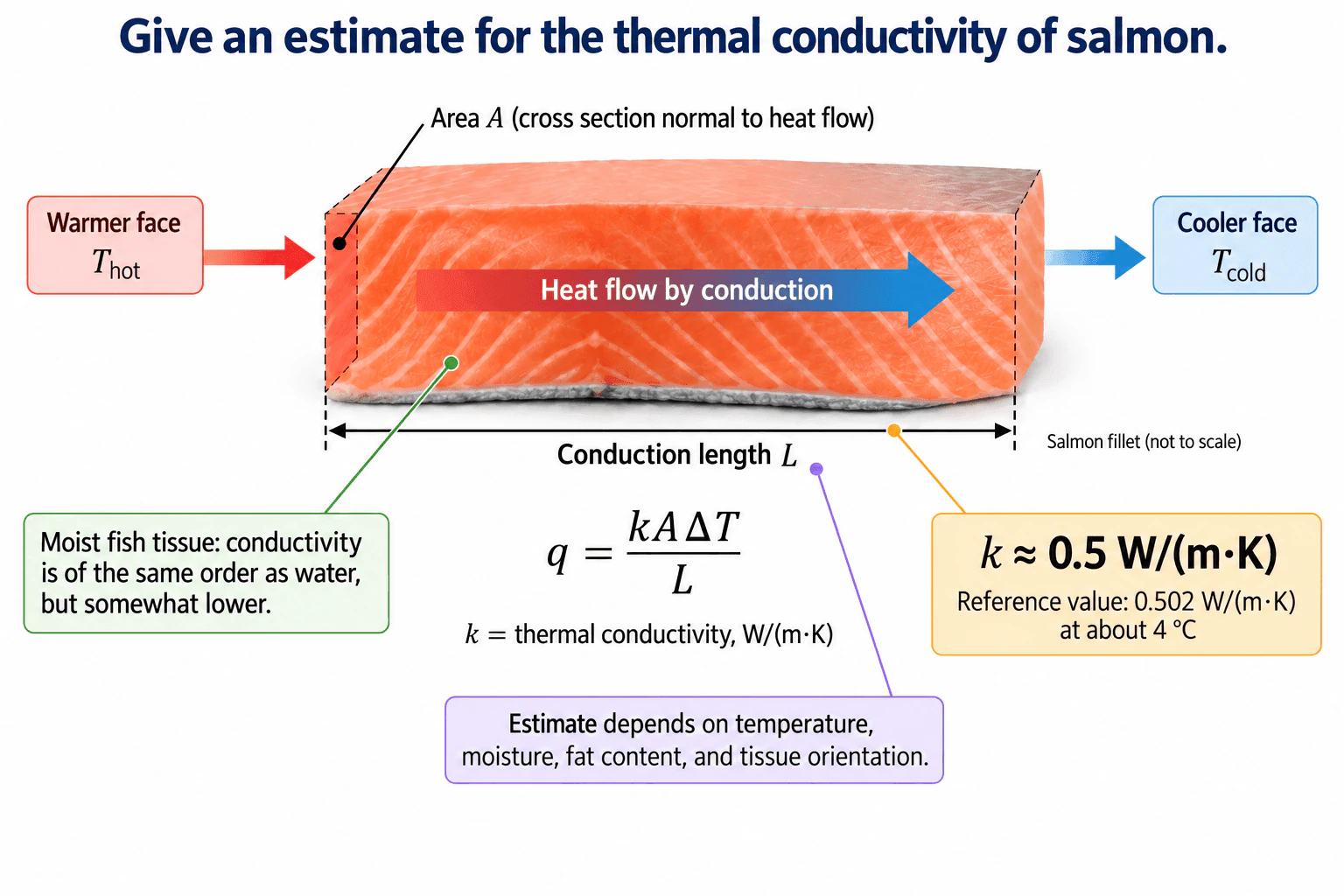
I would estimate the thermal conductivity of salmon as roughly 0.5 W/(m·K). Salmon is moist biological tissue, so its conductivity should be of the same order as water but somewhat lower because it also contains fat, protein, and structured tissue. A representative value is about 0.502 W/(m·K) at roughly 4 °C. I would also state that temperature, moisture content, fat content, and tissue orientation can shift the actual value.
Detailed Explanation
Salmon can be treated as a moist biological material. For a first engineering estimate, I would expect its thermal conductivity to be of the same order as water but somewhat lower because salmon also contains fat, protein, and structured tissue. That gives an estimate near 0.5 W/(m·K), consistent with the representative value of 0.502 W/(m·K) at about 4 °C shown in the approved diagram.
Useful Questions to Ask the Interviewer
Should I assume chilled, unfrozen salmon near 4 °C?
Do you want an order of magnitude estimate or a property value for a thermal calculation?
Should I consider heat flow along a specific tissue orientation?
How to Explain It in an Interview
Start with the physical model. Treat the salmon as a slab with heat flowing from a warmer face to a cooler face. Let A be the cross sectional area normal to the heat flow direction, and let L be the conduction length measured in the same direction as the heat flow.
For steady one dimensional conduction, Fourier law gives q = kAΔT/L, where q is the heat transfer rate, k is thermal conductivity, A is the cross sectional area normal to heat flow, ΔT is the temperature difference between the warmer and cooler faces, and L is the conduction length.
The quantity being estimated is k. Thermal conductivity is a material property with units of W/(m·K). It is different from thermal conductance and thermal resistance. For the same simple slab, thermal resistance is R = L/(kA), so changing A or L changes resistance but not the intrinsic conductivity of the material.
For salmon, I would use k ≈ 0.5 W/(m·K) as a practical initial estimate. The approved diagram gives 0.502 W/(m·K) at about 4 °C as a representative reference value. I would not treat that number as universal because the actual value depends on temperature, moisture content, fat content, and tissue orientation.
The estimate is most appropriate for a simple chilled, unfrozen conduction problem. If the temperature changes significantly with time, I would consider transient conduction. Biot and Fourier numbers can then help determine whether a lumped approximation is appropriate or whether spatial temperature gradients must be resolved.
My conclusion is to use about 0.5 W/(m·K) for an initial estimate, then replace it with condition specific measured data when greater accuracy is required.
Why Interviewers Ask This
This question tests whether the candidate can estimate an unfamiliar thermal property from physical reasoning, use correct units, connect conductivity to Fourier conduction, and communicate the assumptions and uncertainty behind the estimate.
Common interview mistakes
Common mistakes are confusing thermal conductivity with thermal conductance or thermal resistance, omitting the units, treating 0.5 W/(m·K) as exact for every condition, measuring L perpendicular to the heat flow direction, or defining A as a surface parallel to heat flow instead of the cross section normal to it.
Interview tip
Give the estimate first, then justify it physically. Say about 0.5 W/(m·K), explain that salmon is moist biological tissue with conductivity somewhat below water, and state the main assumptions and sources of uncertainty.
Interviewer may ask next
How would you validate the estimate if you needed a more accurate value?
I would first define the actual temperature, moisture content, fat content, frozen state, and tissue orientation. Then I would obtain condition specific measured conductivity data or perform an appropriate thermal property measurement. I would compare the result with the 0.5 W/(m·K) estimate and update the thermal model using the measured value and its uncertainty.
What changes if the salmon is frozen instead of chilled and unfrozen?
I would not reuse the chilled value without checking. Freezing changes the material phases and therefore the thermal properties. I would use conductivity data appropriate to the frozen temperature and composition. For a transient freezing problem, I would also account for temperature dependent properties and phase change rather than relying only on a constant property steady conduction model.
2. Draw the thermal resistance circuit for a Starlink dish.Conduction And Thermal ResistanceMediumSpacex
Short Interview Answer (30-60 seconds)
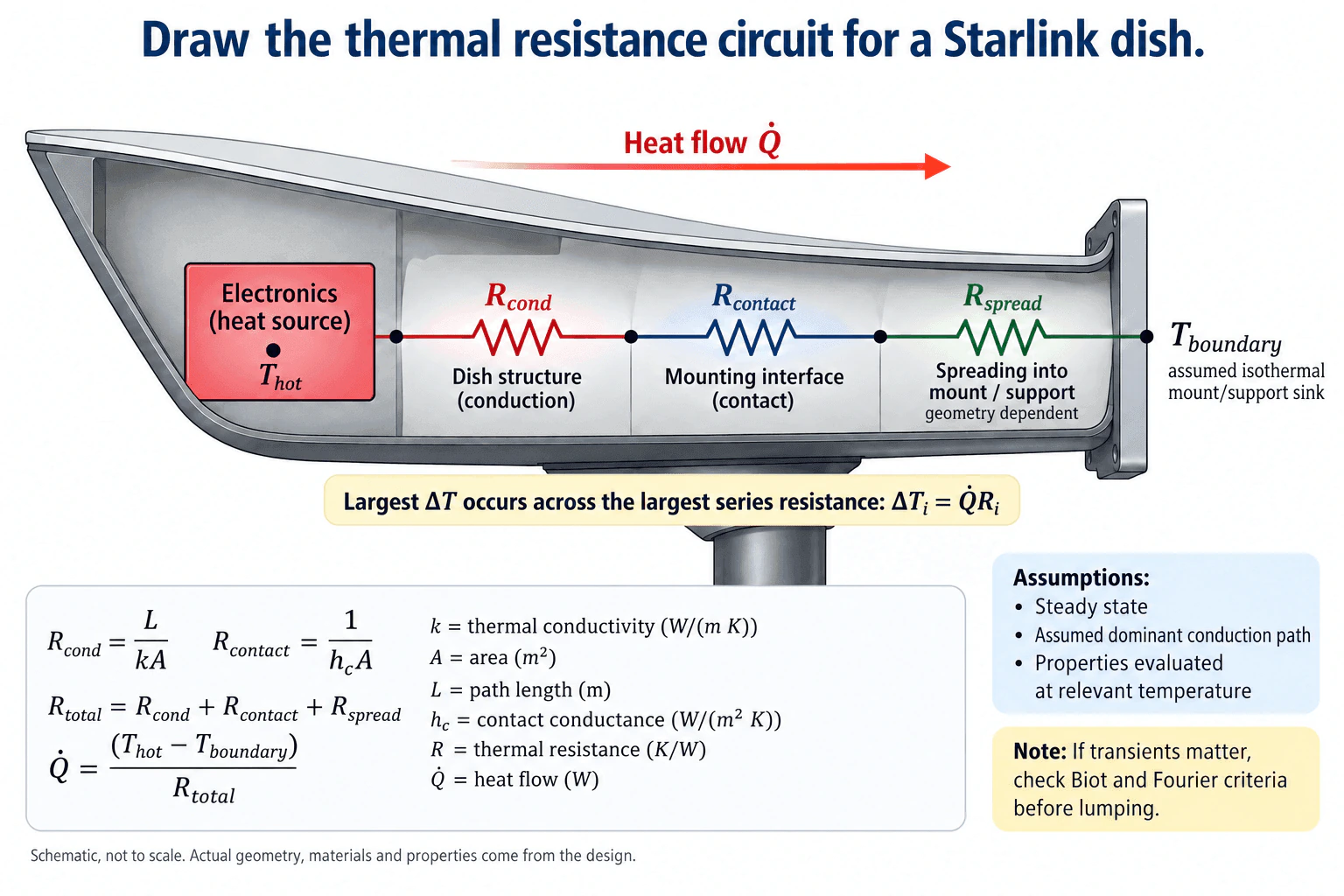
I would model the dominant assumed heat path from the dish electronics to an isothermal mount or support boundary as three series resistances. Starting at T_hot, heat Q̇ passes through conduction resistance R_cond in the dish structure, contact resistance R_contact at the mounting interface, and geometry dependent spreading resistance R_spread into the mount or support, ending at T_boundary. For steady state heat flow, R_total = R_cond + R_contact + R_spread and Q̇ = (T_hot − T_boundary) / R_total. Because the same heat rate passes through each series resistance, ΔT_i = Q̇R_i, so the largest resistance produces the largest temperature drop.
Detailed Explanation
A useful first model is a single dominant heat path from the electronics heat source to an assumed isothermal mount or support sink. This is a conceptual thermal resistance circuit, not a claim about the exact internal construction of a Starlink dish.
Useful Questions to Ask the Interviewer
Should I assume steady state operation and one dominant conduction path?
Should the mount or support be treated as an isothermal temperature boundary?
Do you want only the steady state resistance circuit, or should I also discuss transient checks using Biot and Fourier numbers?
How to Explain It in an Interview
Start with the heat source at T_hot and define positive heat flow Q̇ toward the support boundary at T_boundary.
Model the dominant path with three series resistances.
R_cond represents conduction through the dish structure. For a simple slab approximation, R_cond = L/(kA), where L is the conduction path length in m, k is thermal conductivity in W/(m K), and A is cross sectional area in m². Conductivity k is a material property, while thermal resistance depends on both the material and geometry.
R_contact represents the mounting interface. If h_c is the thermal contact conductance in W/(m² K), then R_contact = 1/(h_cA). Contact conductance describes how readily heat crosses the interface, while contact resistance is its resistance representation for the selected area.
R_spread represents heat spreading into the mount or support. It depends on geometry and material properties, so I would not assign a numerical value without the actual design geometry.
For the series path: R_total = R_cond + R_contact + R_spread
The steady state heat rate is: Q̇ = (T_hot − T_boundary)/R_total
The temperature drop across each element is: ΔT_i = Q̇R_i
Therefore, the largest series resistance produces the largest temperature drop.
The model assumes steady state behavior, one dominant conduction path, and properties evaluated at a relevant temperature. I would check actual geometry, conductivity, contact conductance, the support boundary condition, temperature dependence, anisotropy, and possible parallel heat paths. If transient behavior matters, I would use the Biot number to judge whether a lumped temperature approximation is reasonable and the Fourier number to characterize transient diffusion through the solid. Radiation or convection would require additional paths if they are significant.
Why Interviewers Ask This
This question tests whether the candidate can translate a physical thermal path into a defensible resistance network, define the heat source and boundary condition, distinguish conduction, contact, and spreading resistance, and state the assumptions that make the simplified model valid.
Common interview mistakes
Common mistakes are replacing the entire assembly with one resistance, omitting contact or spreading resistance, inventing a numerical spreading resistance without geometry, confusing thermal conductivity with thermal conductance or resistance, drawing heat flow in the wrong direction, or using a boundary temperature without stating the boundary assumption. Another mistake is applying a steady state or lumped approximation to an important transient case without checking whether that approximation is justified.
Interview tip
Draw the heat source and thermal boundary first, then place each resistance along the dominant heat path. Label R_cond, R_contact, and R_spread, state that the path is an assumed conceptual model, and finish with R_total, Q̇, and ΔT_i = Q̇R_i. This shows both the circuit and the physical reasoning without inventing internal construction details.
Interviewer may ask next
How would you validate that the simple series resistance network is a reasonable approximation?
I would compare the assumed path with the real geometry and identify any significant parallel heat paths. I would verify dimensions, thermal conductivity, contact conductance, and the thermal boundary condition, then compare predicted temperatures with independent analysis or test data when available. If transient response matters, I would also check the Biot and Fourier numbers before relying on a lumped approximation.
What changes if the mounting interface has a much larger resistance than the dish structure?
The mounting interface would create the largest temperature drop because the same steady state heat rate passes through every series element and ΔT_i = Q̇R_i. If R_contact dominates, reducing that resistance would have the greatest effect on lowering T_hot for the same heat load and boundary temperature. The physical change could involve greater effective contact conductance or contact area, but the appropriate choice depends on the actual geometry and interface requirements.
3. What is Reynolds number a measure of?Convection And Fluid FlowEasySpacex
Short Interview Answer (30-60 seconds)
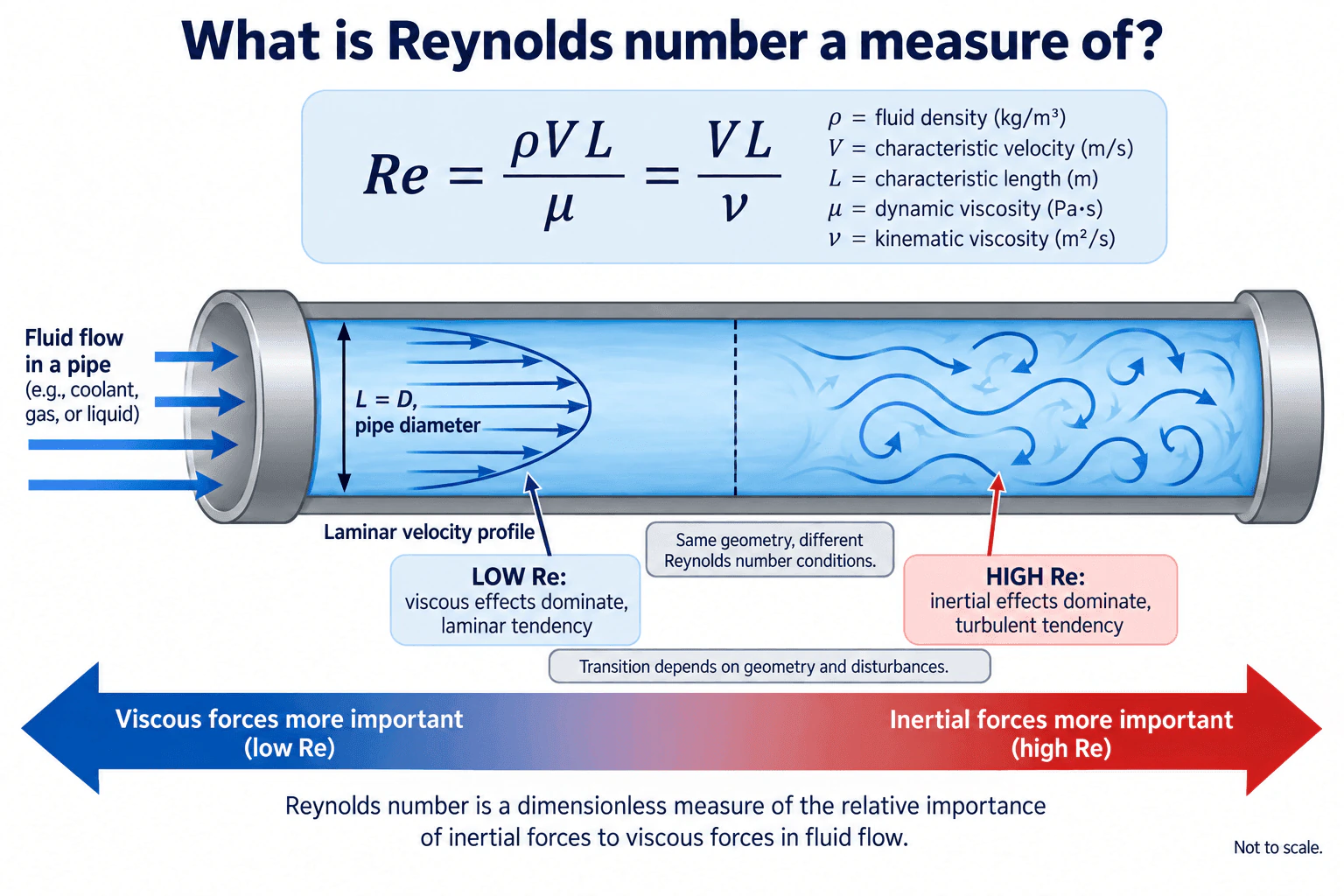
Reynolds number is a dimensionless measure of the relative importance of inertial effects compared with viscous effects in a fluid flow. It is commonly written as Re = ρVL/μ = VL/ν. Low Reynolds number means viscous effects are relatively more important and laminar behavior is more likely. High Reynolds number means inertial effects are relatively more important and turbulent behavior is more likely. The characteristic length depends on the geometry, such as pipe diameter for flow through a circular pipe.
Detailed Explanation
Reynolds number compares the relative importance of fluid inertia with viscous resistance. It is dimensionless, so it is useful for comparing flows with different sizes, speeds, fluids, and operating conditions.
For characteristic velocity V and characteristic length L,
Re = ρVL/μ = VL/ν
where ρ is fluid density in kg/m³, V is characteristic velocity in m/s, L is characteristic length in m, μ is dynamic viscosity in Pa·s, and ν is kinematic viscosity in m²/s.
For internal flow through a circular pipe, the characteristic length is the pipe diameter D, so Re = ρVD/μ.
Useful Questions to Ask the Interviewer
Are we considering internal pipe flow or an external flow geometry?
What characteristic velocity and length should I use for this geometry?
Should the fluid properties be evaluated at a specified operating temperature?
How to Explain It in an Interview
Start with the physical meaning: Reynolds number tells me whether inertial effects or viscous effects are more influential in the flow.
At low Re, viscous effects dominate. Disturbances are more strongly damped, so laminar behavior is more likely. For fully developed Newtonian flow in a circular pipe, the laminar velocity profile is parabolic.
At high Re, inertial effects are relatively stronger. Disturbances can persist more readily, so turbulent behavior is more likely.
I would not treat Reynolds number as a universal transition switch. The actual transition depends on geometry, disturbances, surface condition, inlet conditions, and other boundary conditions. That is why two cases with the same geometry can show different flow behavior when their Reynolds numbers differ.
For circular internal pipe flow, I would use the pipe diameter as the characteristic length. If velocity increases while density, viscosity, and diameter remain unchanged, Reynolds number increases. If viscosity increases while the other terms remain unchanged, Reynolds number decreases.
The engineering use is to characterize the likely flow regime and choose models or correlations that apply to that regime and geometry. Before using a friction factor relation, pressure drop model, or convection correlation, I would check that the Reynolds number and geometry fall within the documented applicability range and consider entrance effects where relevant.
So the key conclusion is that Reynolds number measures the relative importance of inertial effects to viscous effects in fluid flow.
Why Interviewers Ask This
Interviewers want to see whether the candidate understands the physical competition between inertia and viscosity in fluid flow and can use Reynolds number to reason about likely flow behavior and the applicability of fluid flow correlations.
Common interview mistakes
Common mistakes include saying Reynolds number directly measures turbulence, using the wrong characteristic length, ignoring how operating conditions affect fluid properties, assuming one transition value applies to every geometry, or using a heat transfer or pressure drop correlation outside its documented Reynolds number range.
Interview tip
Lead with the physical meaning before giving the equation: Reynolds number compares inertial effects with viscous effects. Then define the symbols and give one simple geometry example, such as using pipe diameter for circular internal flow. Mention that transition depends on geometry and disturbances rather than presenting Reynolds number as an absolute turbulence switch.
Interviewer may ask next
Does a specific Reynolds number always guarantee that the flow is laminar or turbulent?
No. Reynolds number is a strong indicator of flow regime, but the actual transition also depends on geometry, disturbances, surface condition, inlet conditions, and other boundary conditions. I would use transition ranges documented for the specific geometry and application rather than assuming one universal threshold.
What happens to Reynolds number if the velocity doubles while density, viscosity, and characteristic length remain constant?
Reynolds number doubles because Re = ρVL/μ and velocity appears linearly in the numerator. The higher Reynolds number means inertial effects have become more important relative to viscous effects, which can move the flow toward conditions where turbulent behavior is more likely.
4. Explain the Stefan Boltzmann law for radiation.Radiation Heat TransferMediumSpacex
Short Interview Answer (30-60 seconds)
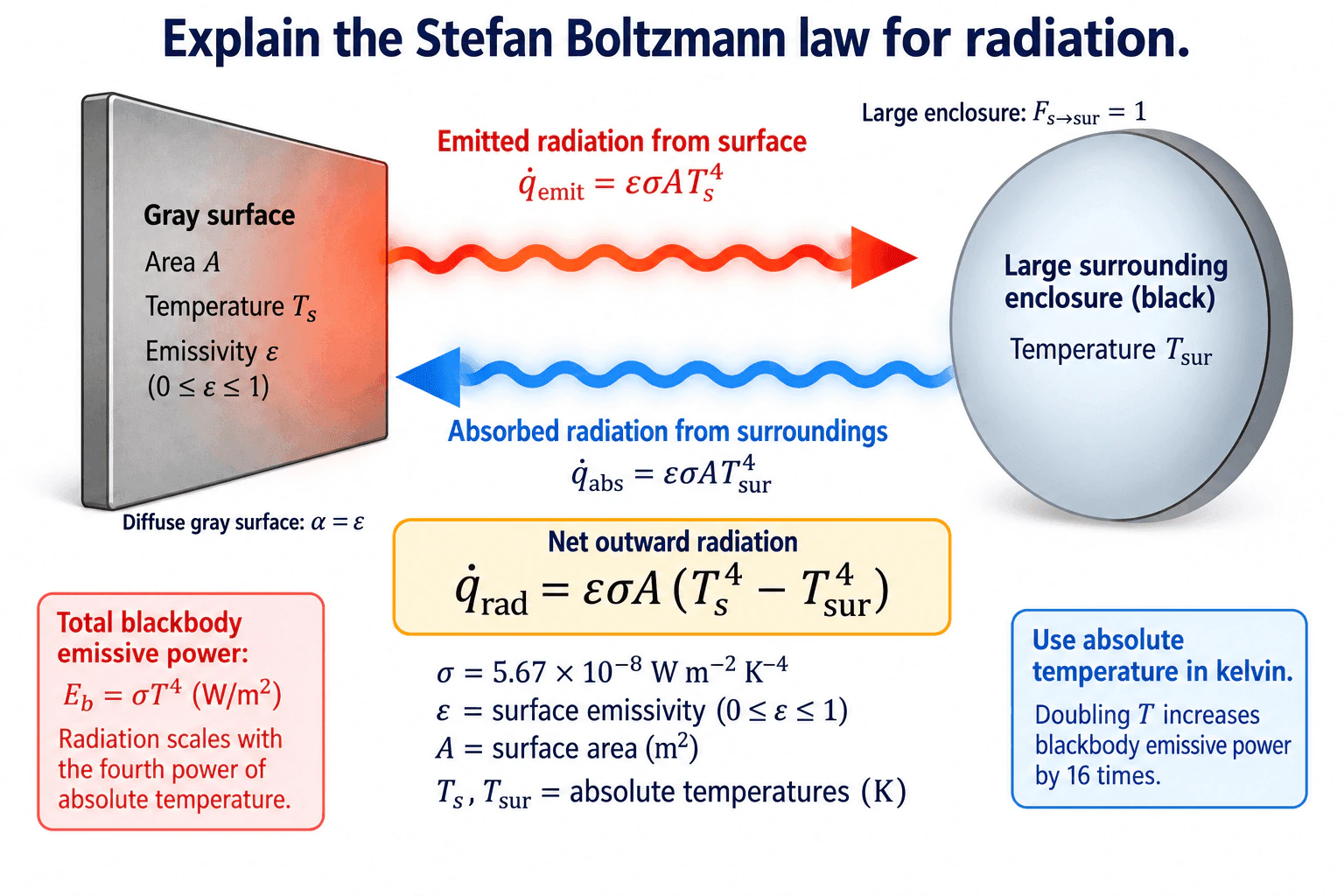
The Stefan Boltzmann law states that the total emissive power of a blackbody is Eb = σT^4, where T is absolute temperature in kelvin and σ is the Stefan Boltzmann constant, approximately 5.67 × 10^−8 W m^−2 K^−4. A real gray surface emits εσT^4 per unit area, where ε is emissivity. For a diffuse gray surface completely surrounded by a large black enclosure, with α = ε and Fs→sur = 1, the net outward radiation rate is q̇rad = εσA(Ts^4 − Tsur^4). The fourth power dependence makes thermal radiation very sensitive to absolute temperature.
Detailed Explanation
A simple way to explain the Stefan Boltzmann law is to start with an ideal blackbody, then extend it to a real surface and finally to net radiation exchange with the surroundings.
Useful Questions to Ask the Interviewer
Should I explain only surface emission, or also net radiation exchange with the surroundings?
May I assume a diffuse gray surface inside a large black enclosure?
Should I discuss spectral effects, or use total hemispherical properties?
How to Explain It in an Interview
For an ideal blackbody, the Stefan Boltzmann law gives the total emissive power as Eb = σT^4. Here Eb is in W/m², T is the absolute temperature in kelvin, and σ ≈ 5.67 × 10^−8 W m^−2 K^−4.
For a real gray surface, emission is reduced by emissivity ε, so a surface of area A at temperature Ts emits q̇emit = εσATs^4. Emissivity is dimensionless and lies between 0 and 1.
For the diagrammed case, the surface is diffuse and gray and is completely surrounded by a large black enclosure at temperature Tsur. The geometric assumption is Fs→sur = 1. Under the gray surface assumption, absorptivity equals emissivity for the corresponding thermal radiation conditions, so α = ε. The absorbed radiation from the enclosure is therefore q̇abs = εσATsur^4.
The net outward radiation rate is the emitted rate minus the absorbed rate:
q̇rad = εσA(Ts^4 − Tsur^4).
This sign convention is useful. If Ts > Tsur, the surface loses heat by radiation. If Ts = Tsur, the net exchange is zero even though both bodies continue to emit and absorb radiation. If Ts < Tsur, q̇rad is negative, so the surface has a net radiative heat gain.
The most important physical point is the fourth power dependence. Doubling the absolute temperature increases blackbody emissive power by a factor of 16. Temperature must therefore be used in kelvin.
Emissivity, absorptivity, and reflectivity should not be treated as interchangeable constants in general. For an opaque surface, α + ρ = 1 at a given wavelength and direction. For nongray surfaces, wavelength dependent properties may be needed.
For more general geometries, I would use view factors and check enclosure relationships such as summation and reciprocity. Radiation is also distinct from convection because it does not require a material medium and can occur across vacuum.
Why Interviewers Ask This
This question tests whether the candidate understands the fundamental relationship between absolute temperature and thermal radiation, can distinguish blackbody emission from real surface emission, and can correctly apply emissivity, absorptivity, surroundings temperature, and geometric visibility when evaluating radiation exchange.
Common interview mistakes
Common mistakes include using degrees Celsius instead of kelvin, forgetting the fourth power on temperature, applying εσAT^4 as a net heat transfer equation without accounting for radiation received from the surroundings, confusing emissivity with absorptivity or reflectivity when their relationship is not justified, ignoring view factors when surfaces do not completely see each other, and applying one constant emissivity when spectral variation is important.
Interview tip
State the blackbody law first, then extend it to a real gray surface and finally to net exchange with the surroundings. Define every symbol, state that temperature must be absolute, explain the sign of Ts^4 − Tsur^4, and identify the assumptions Fs→sur = 1 and α = ε that make the simplified enclosure equation valid.
Interviewer may ask next
When would q̇rad = εσA(Ts^4 − Tsur^4) not be valid?
The simplified expression is not generally valid when the surface does not view a large isothermal black enclosure, when the relevant view factor is less than 1, when several surfaces exchange radiation, or when surface properties vary strongly with wavelength, temperature, direction, or position. In those cases I would use a radiation network with appropriate view factors and surface properties. For an enclosure, I would also check view factor summation and reciprocity.
What changes if the surrounding enclosure temperature is higher than the surface temperature?
The term Ts^4 − Tsur^4 becomes negative. With outward heat transfer defined as positive, q̇rad is then negative, which means the surface has a net radiative heat gain from the surroundings. Both bodies still emit radiation continuously. The direction of net exchange is determined by the difference between their absolute temperatures raised to the fourth power.
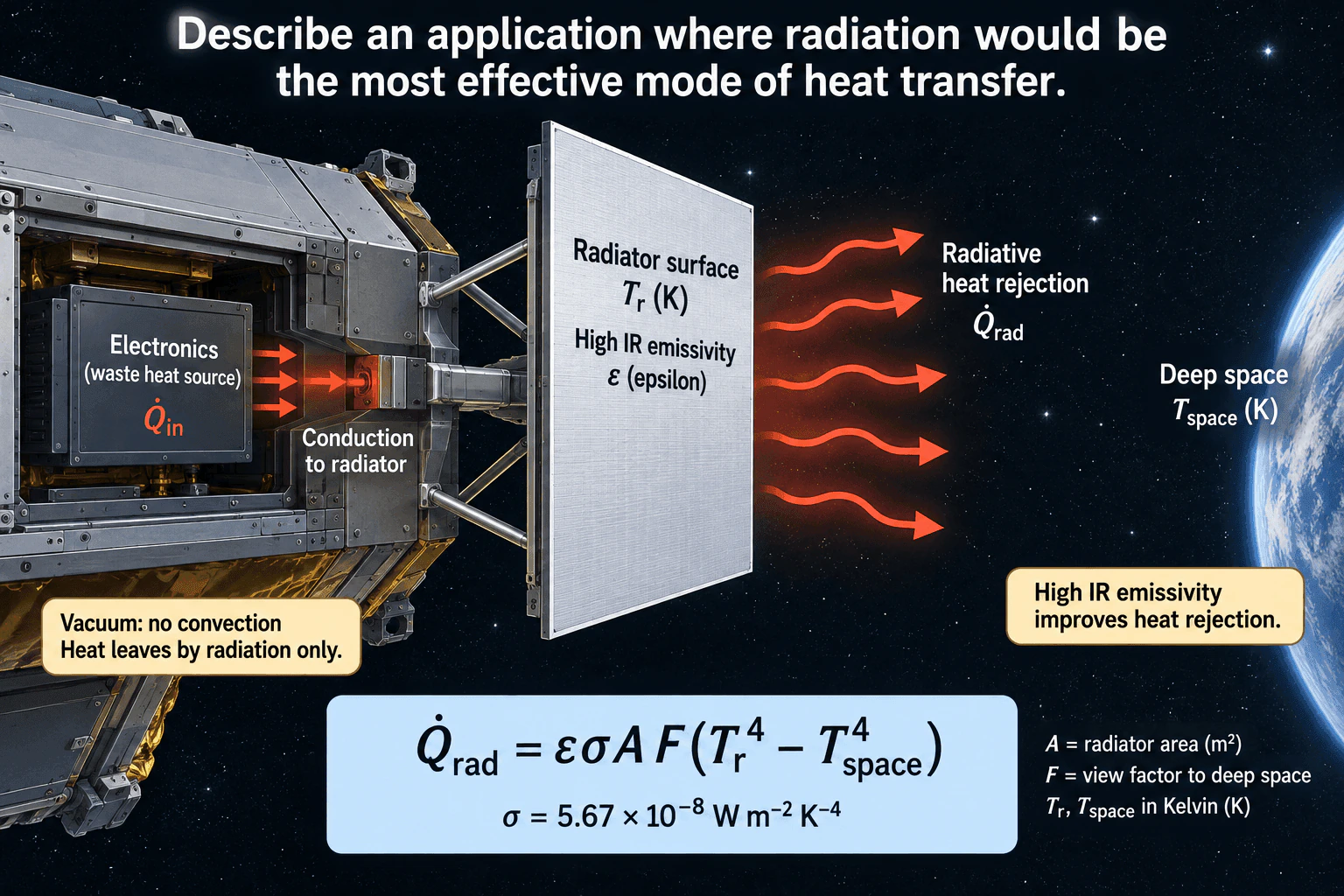
5. Describe an application where radiation would be the most effective mode of heat transfer.Radiation Heat TransferEasySpacex
Short Interview Answer (30-60 seconds)
A spacecraft radiator operating in vacuum is a strong example. Electronics generate waste heat, Q̇in, which is conducted through the spacecraft thermal path to an external radiator. Because vacuum provides essentially no convective heat transfer, the radiator rejects that energy primarily by thermal radiation to its surroundings. For a simplified radiator with a clear view of deep space, Q̇rad = εσAF(Tr⁴ − Tspace⁴), where ε is infrared emissivity, A is radiator area, F is the view factor to deep space, and both temperatures are absolute temperatures in Kelvin.
Useful Questions to Ask the Interviewer
Should I assume the radiator has a clear view of deep space?
Should solar and planetary radiation be neglected for this example?
Can I treat the radiator as a diffuse gray surface?
Detailed Explanation
How to Explain It in an Interview
A good application is an external spacecraft radiator operating in vacuum. Electronics inside the spacecraft generate waste heat, Q̇in. That heat can still move through solid structures by conduction, so it is conducted to the radiator surface. At the external radiator, convection is essentially unavailable because there is no surrounding fluid. The radiator therefore rejects heat primarily through thermal radiation.
For the simplified case shown, define the radiator surface temperature as Tr and the effective deep space temperature as Tspace, both in Kelvin. Let ε be the radiator infrared emissivity, A the radiating area, F the view factor to deep space, and σ the Stefan Boltzmann constant, approximately 5.67 × 10⁻⁸ W m⁻² K⁻⁴. The net radiative heat rejection can then be represented as
Q̇rad = εσAF(Tr⁴ − Tspace⁴).
This relation shows why absolute temperature matters. Radiative emission varies with the fourth power of temperature, so a hotter radiator can reject substantially more heat for the same area and emissivity. A high infrared emissivity also increases thermal emission and therefore improves heat rejection for the same geometry and temperature.
The view factor F represents geometric visibility between the radiator and deep space. The simplified expression is appropriate when the radiator has a clear view of that radiative sink and other incident radiation is neglected. If the radiator also sees a warm planet or another spacecraft surface, those surfaces must be included separately with their own temperatures and view factors.
Surface properties should also be interpreted carefully. Emissivity describes thermal emission, absorptivity describes absorption of incident radiation, and reflectivity describes the reflected fraction. They should not automatically be treated as interchangeable constants across different wavelength ranges. Solar radiation and infrared thermal radiation can therefore require different surface property values.
As a check, I would verify that temperatures are in Kelvin, confirm the radiator energy balance between incoming conducted heat and outgoing net radiation, and check that the relevant view factors represent the actual geometry. The key conclusion is that conduction transports the electronics heat to the radiator, while radiation is the external heat rejection mechanism to space.
Why Interviewers Ask This
This question tests whether the candidate can recognize when radiation is the appropriate external heat rejection mechanism and explain how emissivity, absolute temperature, area, and geometric visibility control radiative exchange.
Common interview mistakes
Common mistakes include saying that conduction cannot occur in vacuum, even though heat can still conduct through solid spacecraft structures, using Celsius instead of Kelvin in the Stefan Boltzmann relation, ignoring the radiator view factor, assuming every radiator sees only deep space, and treating emissivity, absorptivity, and reflectivity as interchangeable surface properties.
Interview tip
Start with the physical environment. State that the spacecraft is in vacuum, so external convection is essentially absent. Then trace the same heat path shown in the diagram: electronics generate Q̇in, conduction moves that heat to the radiator, and the radiator rejects Q̇rad by thermal radiation to deep space. Finish by mentioning high infrared emissivity, absolute temperature, radiator area, and view factor.
Interviewer may ask next
How would you check whether the simple deep space radiation equation is a reasonable approximation?
I would identify everything visible to the radiator and determine whether most of its radiative view is effectively toward deep space. I would confirm that solar radiation, planetary radiation, and exchange with nearby warm surfaces can reasonably be neglected for the stated case. I would also verify that all temperatures are in Kelvin, that the assumed emissivity is appropriate for the thermal infrared wavelength range, and that the radiator energy balance is consistent with the heat conducted into it.
What changes if part of the radiator sees a warm planet instead of deep space?
The planet becomes an additional radiative surface. I would divide the radiator view among deep space, the planet, and any other visible surfaces using appropriate view factors. The radiator emits toward the planet but also receives radiation from it. Because a warm planet provides a less effective radiative sink than deep space, the net heat rejection capability of that portion of the radiator generally decreases.
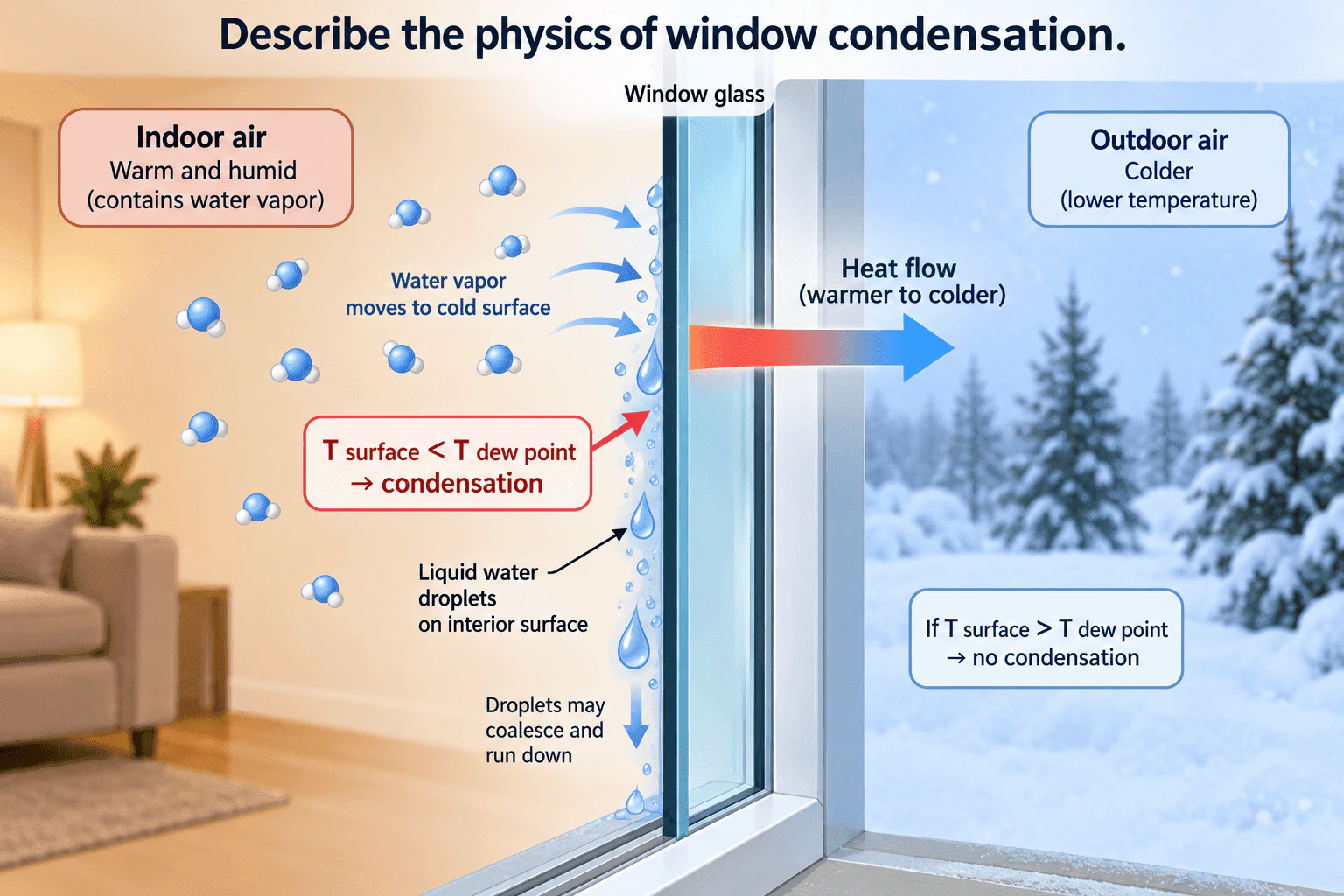
6. Describe the physics of window condensation.Phase Change And Two Phase FlowMediumSpacex
Short Interview Answer (30-60 seconds)
Window condensation occurs when humid indoor air contacts glass whose interior surface temperature is below the indoor air dew point. Heat flows from the warmer room toward the colder exterior, cooling the glass and the adjacent air. When that local air reaches saturation, water vapor changes phase into liquid on the glass and releases latent heat. The droplets can grow, merge, and run downward. If the surface remains above the dew point, condensation does not occur.
Detailed Explanation
Window condensation is a surface phase change problem. The working fluid is water contained as vapor in indoor air. In the winter condition shown, the indoor air is warmer and more humid than the outdoor air, while heat flows through the window toward the colder exterior. This lowers the temperature of the interior glass surface. Condensation begins when the local surface temperature, T surface, falls below the indoor air dew point temperature, T dew point. Air immediately next to the surface then reaches saturation, and water vapor changes into liquid droplets on the glass. The droplets can grow, coalesce, and move downward under gravity. If T surface remains above T dew point, the surface does not reach the condition required for condensation.
Useful Questions to Ask the Interviewer
Should I assume a winter case with warm humid indoor air and colder outdoor air?
Do you want only the condensation mechanism, or should I also discuss how humidity and window thermal resistance affect it?
Should I treat the indoor pressure as approximately atmospheric and focus on the local surface condition?
How to Explain It in an Interview
Physical Method
I would define the physical boundary as the indoor air next to the interior glass surface. Water vapor is the condensing species. For an ordinary building window, I would assume pressure is approximately constant and near atmospheric pressure unless another condition is specified.
The controlling comparison is the surface temperature against the dew point temperature. If T surface is below T dew point, condensation can occur. If T surface is above T dew point, condensation does not occur on that surface.
Heat transfer from the warm room toward the colder exterior lowers the interior glass temperature. The thin layer of indoor air next to the glass is cooled by contact with that surface. As this local air cools at approximately constant pressure, its relative humidity rises. At the dew point, the water vapor partial pressure equals the saturation pressure of water at that temperature. Additional cooling causes some water vapor to leave the gas phase and become liquid.
Engineering Reasoning
The phase distribution is therefore humid air in the room and liquid water droplets on the cold interior glass after saturation is reached. During condensation, water releases latent heat. Water can initially appear as small droplets, which grow with continued condensation, coalesce with neighboring droplets, and eventually run downward when gravity overcomes surface retention forces.
The amount and likelihood of condensation depend strongly on indoor moisture content and glass surface temperature. Higher indoor humidity raises the dew point, so condensation can begin at a warmer glass temperature. A window with greater thermal resistance can keep the interior glass surface warmer under the same indoor and outdoor conditions, reducing the chance that the surface falls below the dew point.
Assumptions And Checks
I would check the indoor air temperature and relative humidity to determine the dew point, then compare that value with the measured interior glass surface temperature. I would also confirm that the observed droplets are on the interior face because condensation on another face represents a different local temperature and moisture condition. This is ordinary surface condensation, so boiling, critical heat flux, dryout, heat pipes, and vapor chambers are not applicable to this specific question.
Why Interviewers Ask This
This question tests whether the candidate can connect heat transfer, humidity, phase equilibrium, and latent heat to a familiar physical observation. A strong answer should identify the controlling comparison between the window surface temperature and the indoor air dew point rather than simply saying that cold glass creates water.
Common interview mistakes
Common mistakes are saying that cold air itself creates water, ignoring the dew point, assuming condensation starts whenever the glass feels cold, confusing relative humidity with the actual amount of water vapor, or forgetting that condensation occurs on the surface whose temperature falls below the local dew point.
Interview tip
Lead with the dew point criterion first. Then connect it to heat flowing from the warm interior toward the colder exterior, explain saturation and the vapor to liquid phase change, and finish by stating that the droplets can grow, coalesce, and run down the glass.
Interviewer may ask next
How would you verify whether condensation should occur on a particular window?
Measure the indoor air temperature and relative humidity, use them to determine the indoor dew point, and measure the interior glass surface temperature. If the measured glass temperature is below the dew point, the local air adjacent to the surface can become saturated and condensation is expected. I would also verify that the temperature and humidity measurements represent the air close to the window and that the surface temperature measurement is taken at the location where droplets appear.
What happens if the indoor humidity increases while the window temperature stays the same?
Increasing indoor humidity raises the dew point. That reduces the temperature difference between the glass surface and the dew point, so a window that previously stayed dry can begin to condense even though its temperature has not changed. If the surface is already below the dew point, the greater moisture content can also support more condensation.
7. Why SpaceX?BehavioralEasySpacex
Interview tip:
Use STAR to structure your answer: briefly explain the Situation and Task, make Action the most detailed part, and finish with the Result. For example, describe how your previous thermal engineering work shaped what you want in your next role, why technically demanding hardware motivates you, what attracts you to SpaceX specifically, and how your approach to analysis, testing, ownership, and learning would help you contribute.
Situation
During previous thermal engineering work, I found that I was most engaged when the problem involved real hardware, difficult thermal limits, and decisions that had to be supported by both analysis and testing. Those projects made me think carefully about the type of engineering environment where I want to continue growing.
Task
My goal now is to find a role where thermal engineering is closely connected to hardware performance and where I can take ownership of problems from understanding the heat sources through analysis, design, testing, and improvement. I also want to work in an environment where learning quickly and making sound engineering decisions matter every day.
Action
That is why I am interested in SpaceX. The work gives thermal engineers the chance to solve challenging hardware problems where temperature, heat transfer, materials, operating conditions, and reliability all have to be considered together. That matches how I like to work. I enjoy starting with the physics, identifying the dominant heat paths, building a useful model, and then checking the assumptions against test data. If the data does not match the model, I want to understand why rather than simply adjust the model until it fits. I also like working closely with mechanical, fluids, structures, test, and manufacturing engineers because thermal decisions often affect the rest of the system. What attracts me most is the opportunity to combine careful engineering with strong ownership and fast learning while contributing to hardware that has demanding thermal requirements.
Result
My previous experience helped me understand that this combination of technical depth, hands on hardware work, collaboration, and responsibility is what motivates me most. That is why SpaceX is especially interesting to me. I believe the role would let me apply the thermal engineering skills I already have while continuing to become a stronger engineer through difficult real world problems.
Why Interviewers Ask This
Interviewers ask this question to understand whether the candidate has a clear and genuine reason for choosing SpaceX and whether that reason connects to the Thermal Engineer role. A strong answer shows that the candidate understands what type of engineering work motivates them, can connect their experience to the role, and is interested in contributing through technical ownership, collaboration, and continuous learning.
Interviewer may ask next
What part of thermal engineering work at SpaceX interests you most?
I am most interested in work where analysis is directly connected to hardware and testing. I like understanding the dominant heat transfer paths, making design decisions from the physics, and then using test data to confirm or challenge those decisions. That full loop from analysis to hardware to validation is the type of work I find most rewarding.
How would your previous thermal engineering experience help you contribute here?
My previous work taught me to approach thermal problems in a structured way. I start by understanding the operating conditions and heat sources, identify the important thermal paths, build the simplest model that can answer the engineering question, and then compare the prediction with test data. I also communicate assumptions and risks early so other engineers can make informed decisions. I would bring that same approach to the thermal problems I work on at SpaceX.
8. Give an example of a time you showed extreme effort.BehavioralMediumSpacex
Interview tip:
Use STAR to structure your answer: briefly explain the Situation and Task, make Action the most detailed part, and finish with the Result. For example, describe a critical thermal validation problem with a tight schedule where you took personal ownership, put in sustained extra effort, investigated the issue carefully, coordinated with the team, protected test quality and safety, and helped move the project forward.
Situation
During a previous project, we were close to an important design review when thermal testing showed an unexpected hot spot near a mechanical interface. The temperature behavior did not match our model, and we needed to understand the cause before the team could confidently continue with the design.
Task
I was responsible for the thermal analysis and for supporting the validation work. My goal was to determine whether the problem came from the design, the thermal interface, the instrumentation, or an incorrect model assumption. The schedule was tight, so I knew I needed to give the problem much more time and attention than a normal test cycle while still protecting safety and data quality.
Action
I took personal ownership of the investigation and reorganized my work around the issue. I reviewed the test data point by point and compared the measured temperatures with the expected heat flow through the assembly. I checked sensor placement and attachment because a poor measurement can look like a real thermal problem. I then repeated the key calculations by hand so I was not relying only on the simulation. That comparison suggested that the effective contact resistance at the interface could be higher than we had assumed. I worked with the test and mechanical engineers to inspect the interface, review the assembly condition, and prepare another controlled test. I stayed closely involved through the setup, test execution, and data review instead of handing the problem to another group. When new results came in, I updated the thermal model immediately and compared it with the measurements. I also kept the wider team informed about what we knew, what was still uncertain, and what evidence we needed next. I put in extra time over several test cycles because I wanted the team to have a technically sound answer, not a quick explanation that only appeared to fit the data.
Result
The investigation showed that the interface condition was the main reason for the unexpected temperature behavior. After the interface was corrected and the model was updated to represent it more realistically, the test and analysis were consistent enough for the team to make the next design decision with confidence. The experience taught me that extreme effort is most useful when it stays focused and disciplined. Working longer only helped because I used that time to remove uncertainty, communicate clearly, and protect the quality of the engineering decision.
Why Interviewers Ask This
Interviewers ask this question to understand how a candidate responds when an important engineering problem requires unusual persistence and ownership. A strong answer shows that the candidate can put in sustained effort without abandoning judgment, communication, safety, or technical quality.
Interviewer may ask next
How did you make sure the extra effort was focused on the right problem?
I kept the investigation evidence based. I separated the possible causes into instrumentation, model assumptions, interface behavior, and the physical design. I tested those possibilities one at a time and used the measurements to decide what to investigate next. That prevented me from spending extra time on work that would not reduce the main uncertainty.
What would you do differently if you faced the same situation again?
I would review the interface assumptions and assembly conditions earlier in the validation plan. In this case, the model treated the interface more ideally than the real hardware behaved. I would also define the checks for sensor installation and contact conditions before the first test so the team could identify this type of difference sooner.
Thermal Engineer Resume Examples
Explore the resume examples below to find the one that best matches your target Thermal Engineer role.
Disclaimer: This interview guide is for educational and informational purposes only. It is designed to help readers prepare, but it does not guarantee any interview result, hiring decision, offer, or outcome. Interview questions, hiring criteria, and preferred answers can vary by employer, interviewer, industry, location, and time. All answers, examples, and explanations in this guide are suggested examples for interview preparation, not definitive answers or instructions for professional practice. They are based on research and judgment, are provided without warranties of any kind, and should be adapted to the question, role, and applicable laws and professional requirements. Diagrams are simplified illustrations intended to highlight the main concepts and their relationships; actual situations, systems, and practices may be more complex. Alternative approaches may be equally valid or better suited to a particular question, context, or interviewer. To the fullest extent permitted by applicable law, the contributors and publisher are not liable for decisions made, actions taken, or losses incurred based on this guide.
State Laws and Professional Responsibilities: Laws and requirements governing an occupation vary by state and jurisdiction. You are responsible for checking the current laws, licensing requirements, and scope-of-practice rules that apply to your location and role, and for ensuring that your answers and actions comply with them. Adapt examples in this guide to those requirements. This guide is not legal advice.
Company Notice: This guide is an independent educational resource and is not affiliated with, endorsed by, sponsored by, or approved by the company named in this guide. Company names identify reported interview experiences or the employer context of clearly labeled original practice exercises. Interview practices can change without notice, and inclusion of company-specific content does not mean these questions are official, complete, or guaranteed to be asked. To the fullest extent permitted by law, the author, contributors, and publisher are not responsible for outcomes related to use of this material.
Content Accuracy and Verification: To the fullest extent permitted by applicable law, we do not represent or warrant that interview guides, questions, answers, examples, or diagrams are accurate, complete, current, error-free, or suitable for any particular purpose. You are responsible for independently reviewing and verifying the information before relying on it.