This interview guide is for educational and informational purposes only. It is designed to help readers prepare, but it does not guarantee any interview result, hiring decision, offer, or outcome. Interview questions, hiring criteria, and preferred answers can vary by employer, interviewer, industry, location, and time. All answers, examples, and explanations in this guide are suggested examples for interview preparation, not definitive answers or instructions for professional practice. They are based on research and judgment, are provided without warranties of any kind, and should be adapted to the question, role, and applicable laws and professional requirements. Diagrams are simplified illustrations intended to highlight the main concepts and their relationships; actual situations, systems, and practices may be more complex. Alternative approaches may be equally valid or better suited to a particular question, context, or interviewer. To the fullest extent permitted by applicable law, the contributors and publisher are not liable for decisions made, actions taken, or losses incurred based on this guide.
State Laws and Professional Responsibilities
Laws and requirements governing an occupation vary by state and jurisdiction. You are responsible for checking the current laws, licensing requirements, and scope-of-practice rules that apply to your location and role, and for ensuring that your answers and actions comply with them. Adapt examples in this guide to those requirements. This guide is not legal advice.
Identity, Image, and Privacy Notice
To respect individual privacy, some names, profile photographs, avatars, biographical details, and other identifying information displayed in this guide may be replaced with pseudonyms, licensed stock images, illustrative avatars, composite images, or representative descriptions. Unless a person is expressly identified as an actual contributor, a displayed name, image, or profile should not be understood as depicting or identifying a specific candidate, interviewer, employee, or other real individual. These representations are provided for editorial and illustrative purposes only and do not imply endorsement, employment, participation, or affiliation with this guide or any company mentioned in it. Any resemblance to an actual person is coincidental.
Company Notice
This guide is an independent educational resource and is not affiliated with, endorsed by, sponsored by, or approved by the company named in this guide. Company names identify reported interview experiences or the employer context of clearly labeled original practice exercises. Interview practices can change without notice, and inclusion of company-specific content does not mean these questions are official, complete, or guaranteed to be asked. To the fullest extent permitted by law, the author, contributors, and publisher are not responsible for outcomes related to use of this material.
Content Accuracy and Verification
To the fullest extent permitted by applicable law, we do not represent or warrant that interview guides, questions, answers, examples, or diagrams are accurate, complete, current, error-free, or suitable for any particular purpose. You are responsible for independently reviewing and verifying the information before relying on it.
Questions or comments?
Contact us for general questions, or share feedback, technical corrections, and comments with the community.
1. Explain the different heat-transfer mechanisms operating in a mobile phone.Thermodynamics And Energy BalancesMediumNvidia
Short Interview Answer (30-60 seconds)
A mobile phone transfers heat mainly by conduction, natural convection, and thermal radiation. Heat generated by the processor, battery, and other electronics conducts through solids such as the package, printed circuit board, heat spreader, and enclosure. Once that energy reaches the outer surface, part is transferred to nearby air by natural convection and part is exchanged with the surroundings by thermal radiation. During warm up, some energy is stored internally, so the phone is transient. At steady state, average stored energy no longer changes and generated thermal power must balance the heat rejected to the surroundings.
Detailed Explanation
Treat the complete phone as the system boundary. For a simple operating case in still air, assume negligible mass crosses that boundary. Take electrical power entering the phone as positive work input and heat leaving the phone as positive heat rejection. During a transient, the first law can be stated conceptually as electrical power dissipated as heat equals heat rejected to the surroundings plus the rate of increase of stored internal energy. At steady state, the stored energy rate is zero.
Heat is energy transferred because of a temperature difference. Temperature describes thermal state. Internal energy is microscopic energy stored in the materials. Stored energy increases when the phone warms. Enthalpy is most useful when energy is carried with flowing mass, so it is not usually the main quantity for a sealed phone with negligible mass flow. Entropy describes energy dispersal and irreversibility and helps determine the natural direction of heat transfer. Thermal power is the rate of thermal energy transfer and is measured in watts.
Useful Questions to Ask the Interviewer
Should I assume the phone is operating in still air or under forced airflow?
Should I discuss steady operation, transient warm up, or both?
Should I focus on the complete phone boundary or also trace the internal heat path from the processor?
How to Explain It in an Interview
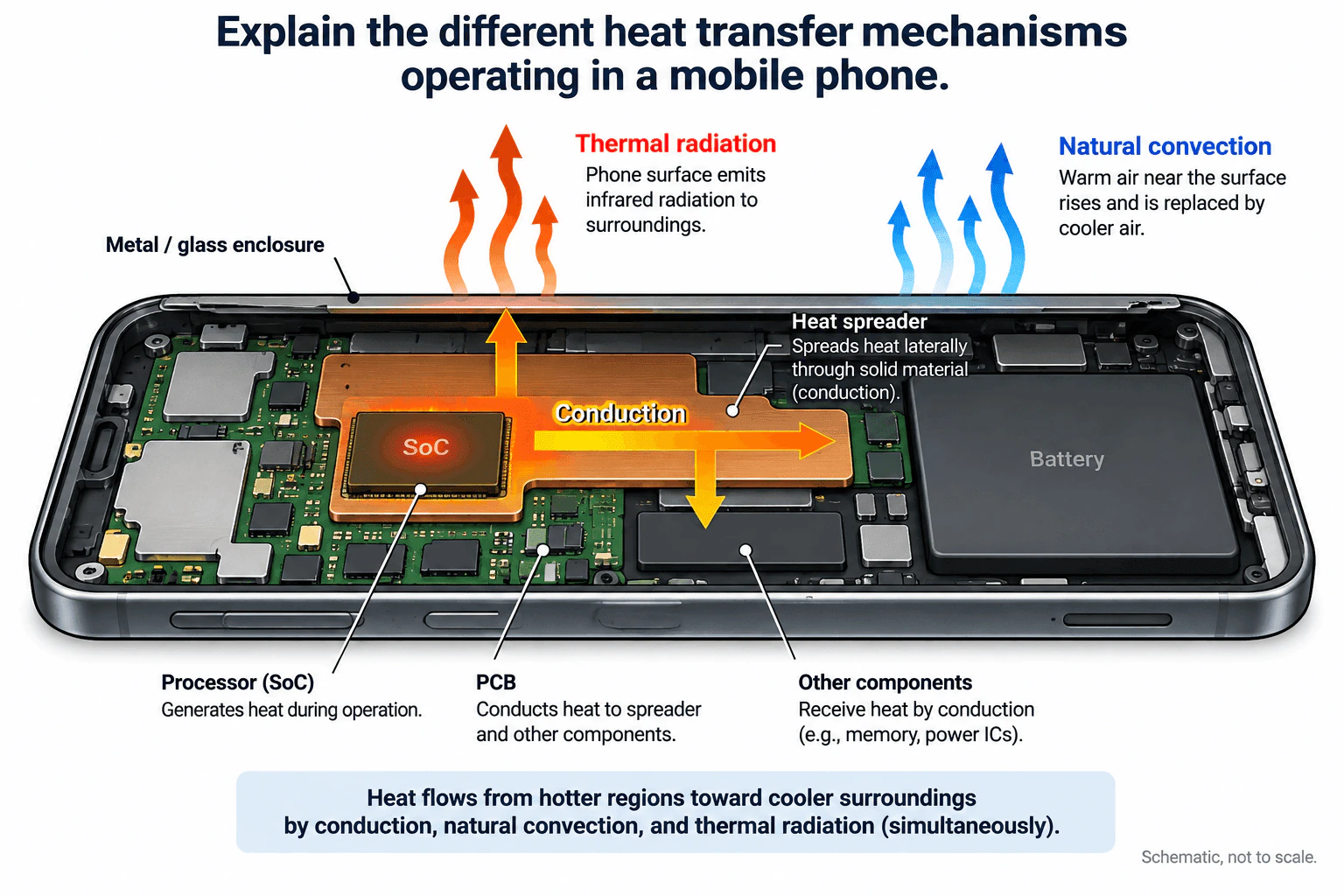
Start at the heat sources. The processor, battery, memory, power electronics, and other components generate thermal energy during operation. In the diagram, the processor is the representative source.
The first mechanism is conduction. Heat moves through solid materials when a temperature difference exists. From the processor, energy conducts through the package and connected structures into the printed circuit board and heat spreader. The heat spreader distributes energy laterally, while conduction also carries energy toward the enclosure and nearby components. The battery and other components can both generate heat and receive heat conducted through the structure.
The second mechanism is natural convection. After heat reaches the metal or glass enclosure, the external surface warms the adjacent air. The warmer air becomes less dense and rises while cooler air replaces it. This transfers energy from the phone surface to the surrounding air without a fan.
The third mechanism is thermal radiation. A warm phone surface emits electromagnetic radiation, primarily in the infrared range at ordinary device temperatures, and simultaneously receives radiation from its surroundings. Net radiative heat transfer depends on the surface temperature, surrounding temperature, surface emissivity, and absolute temperature.
These mechanisms occur simultaneously. Internal conduction moves heat from components such as the processor through the printed circuit board, heat spreader, and enclosure. At the external surface, natural convection and thermal radiation reject energy to cooler surroundings.
During warm up, part of the generated thermal energy increases stored internal energy, so component and enclosure temperatures rise. At steady state, the average stored energy no longer changes, so generated thermal power balances the heat rejected to the environment.
I would validate the model by checking energy conservation and confirming that measured component and surface temperatures follow the expected direction of heat flow. I would also state that the diagram is schematic and does not specify material properties, contact resistances, convection coefficients, emissivities, dimensions, or heat loads.
Why Interviewers Ask This
This question tests whether the candidate can identify how thermal energy moves from heat generating components through a compact mobile device and then reaches the surroundings. It also tests whether the candidate can distinguish heat from temperature, define a system boundary and sign convention, recognize transient energy storage, and apply energy conservation without relying on detailed heat transfer correlations.
Common interview mistakes
Common mistakes include calling temperature a form of heat, treating conduction, convection, and radiation as mutually exclusive, describing natural convection as heat transfer through the solid enclosure, forgetting that conduction mainly moves energy internally toward the surface, ignoring thermal radiation from the enclosure, and using a steady state balance during warm up when stored energy is still changing.
Interview tip
Organize the answer from the heat source to the surroundings. Explain conduction from the processor through the printed circuit board, heat spreader, and enclosure first. Then explain natural convection and thermal radiation from the external surface. Finish by distinguishing transient energy storage from the steady state energy balance.
Interviewer may ask next
How would the energy balance change while the phone is warming up?
During warm up, the phone is transient, so generated thermal power does not immediately equal heat rejected to the surroundings. Part of the generated energy increases stored internal energy in the processor, printed circuit board, battery, heat spreader, enclosure, and other components. As temperatures rise, convection and radiation losses generally increase. When the average temperature field stops changing with time, the stored energy rate approaches zero and the phone reaches steady state.
What changes if a fan blows air across the phone?
The external air heat transfer changes from primarily natural convection to forced convection. The moving air alters the boundary layer and can increase convective heat transfer for the same surface and ambient temperatures. Internal conduction through the processor, printed circuit board, heat spreader, and enclosure still occurs, and thermal radiation still occurs simultaneously. The final temperature field depends on the complete energy balance rather than on convection alone.
2. What is your experience with heat pipes?Heat Exchangers And Cooling SystemsMediumNvidia
Short Interview Answer (30-60 seconds)
My experience with heat pipes is centered on evaluating them as passive two phase heat transport devices within a complete source to sink thermal path. I start with the heat load, source temperature limit, sink condition, orientation, transport distance, and available envelope. I then check whether the selected heat pipe can carry the required heat without approaching capillary, sonic, boiling, entrainment, or condenser limits. I also evaluate evaporator and condenser interface resistance because poor contact can dominate system performance. I would validate the integrated assembly using controlled power input and temperature measurements across the required operating conditions.
Detailed Explanation
A heat pipe moves heat by evaporating a working fluid near the heat source, transporting vapor toward a cooler region, condensing the vapor, and returning liquid through a wick structure. I treat it as one element in the complete thermal resistance path rather than judging it only by a published maximum heat transport value.
Useful Questions to Ask the Interviewer
What heat load and maximum source temperature must the heat pipe support?
What orientation, transport distance, and operating temperature range are required?
What mechanical envelope and condenser cooling method are available?
How to Explain It in an Interview
I would first define the physical boundary. The evaporator receives heat from the source, the heat pipe transports that energy, and the condenser rejects it to a heat sink, cold plate, chassis, or air cooled surface.
The primary requirement is heat duty, Q, in watts. I would establish the expected steady load, relevant transient load, source temperature limit, sink temperature, effective transport length, orientation, and available space. Orientation matters because gravity can assist or oppose liquid return.
Next, I would select a geometry, working fluid, and wick suitable for the operating temperature range. I would compare the required heat transport with manufacturer data or validated test data for the actual orientation and effective length. I would not assume that one maximum wattage value applies to every condition.
I would then check the important transport limits. The capillary limit occurs when the wick cannot create enough pressure to return liquid to the evaporator. The sonic limit can restrict vapor flow, particularly during startup or at low temperature. Boiling within the wick can disrupt liquid supply. Entrainment can cause vapor flow to interfere with returning liquid. Condenser performance can also become limiting if heat cannot be rejected fast enough.
For integration, I would evaluate the complete source to sink resistance. Contact resistance at the evaporator and condenser can become significant if surface flatness, clamping pressure, or interface material is poor. I would also check spreading resistance and whether multiple heat pipes share the thermal load reasonably.
For validation, I would apply controlled heat input and measure temperatures at the source, evaporator, condenser, and sink. I would test the relevant orientations and operating temperatures, compare measured temperature rise with the expected behavior, and investigate unexpected gradients, dryout symptoms, or poor heat sharing before accepting the design.
Why Interviewers Ask This
The interviewer is evaluating whether I understand heat pipe operating physics, selection limits, integration into a cooling system, interface resistance, orientation effects, and the validation needed to confirm performance across the required operating envelope.
Common interview mistakes
Common mistakes include using a published maximum heat transport value without checking its test conditions, ignoring orientation, overlooking contact resistance, failing to consider transport limits, assuming parallel heat pipes share heat equally, and validating only one operating point instead of the required operating envelope.
Interview tip
Answer in a source to sink sequence. Start with the required heat load and temperature limits, explain the two phase transport mechanism, identify the physical limits that can reduce performance, describe interface and integration checks, and finish with how you would validate the assembly using controlled heat input and measured temperatures.
Interviewer may ask next
How would you verify that a selected heat pipe has enough transport margin?
I would compare the required heat load with validated capacity data for the specific geometry, working fluid, wick structure, effective length, orientation, and operating temperature. I would also identify which physical transport limit is most restrictive under the expected condition rather than relying on one nominal capacity number. For the integrated assembly, I would apply controlled heat input and measure temperatures at the evaporator, condenser, and sink across the required operating range. A sharp increase in evaporator temperature or an unexpectedly large evaporator to condenser temperature difference would require investigation before accepting the design.
What would change if the heat pipe had to operate against gravity?
Liquid return would become more difficult because the wick must overcome both internal flow losses and the gravitational pressure difference. I would therefore recheck the capillary limit using data for the required adverse orientation. The allowable heat transport could decrease, so possible responses include using a different wick structure, increasing heat pipe size, shortening the transport distance, adding heat pipes, or selecting another cooling method. I would validate the final configuration in the worst required orientation rather than assuming horizontal performance applies.
3. How would you approach the design of a heat sink?Thermal DesignHardNvidia
Short Interview Answer (30-60 seconds)
I would start by defining the maximum allowable junction temperature, worst case ambient temperature, dissipated power, duty cycle, available volume, airflow, mass, and fan power limits. I would then model the dominant heat path from the die through the package, thermal interface material, heat sink base, fins, and ambient air. Using the simplified thermal resistance model, I would calculate the maximum allowable sink to ambient resistance, choose a passive or forced airflow heat sink that can meet that target within the mechanical constraints, and then verify worst case steady operation, transients, degraded airflow, tolerances, and thermal margin.
Detailed Explanation
A heat sink should be designed from the thermal requirement backward rather than by choosing fin geometry first. The goal is to keep the device junction temperature below its allowable limit for the required operating conditions while respecting space, mass, airflow, power, manufacturing, and reliability constraints.
Useful Questions to Ask the Interviewer
What are the maximum junction temperature, worst case ambient temperature, and maximum or time varying heat load?
What volume, mass, orientation, airflow, noise, and fan power constraints apply?
What package thermal data, interface requirements, duty cycle, reliability targets, and degraded operating conditions should I assume?
How to Explain It in an Interview
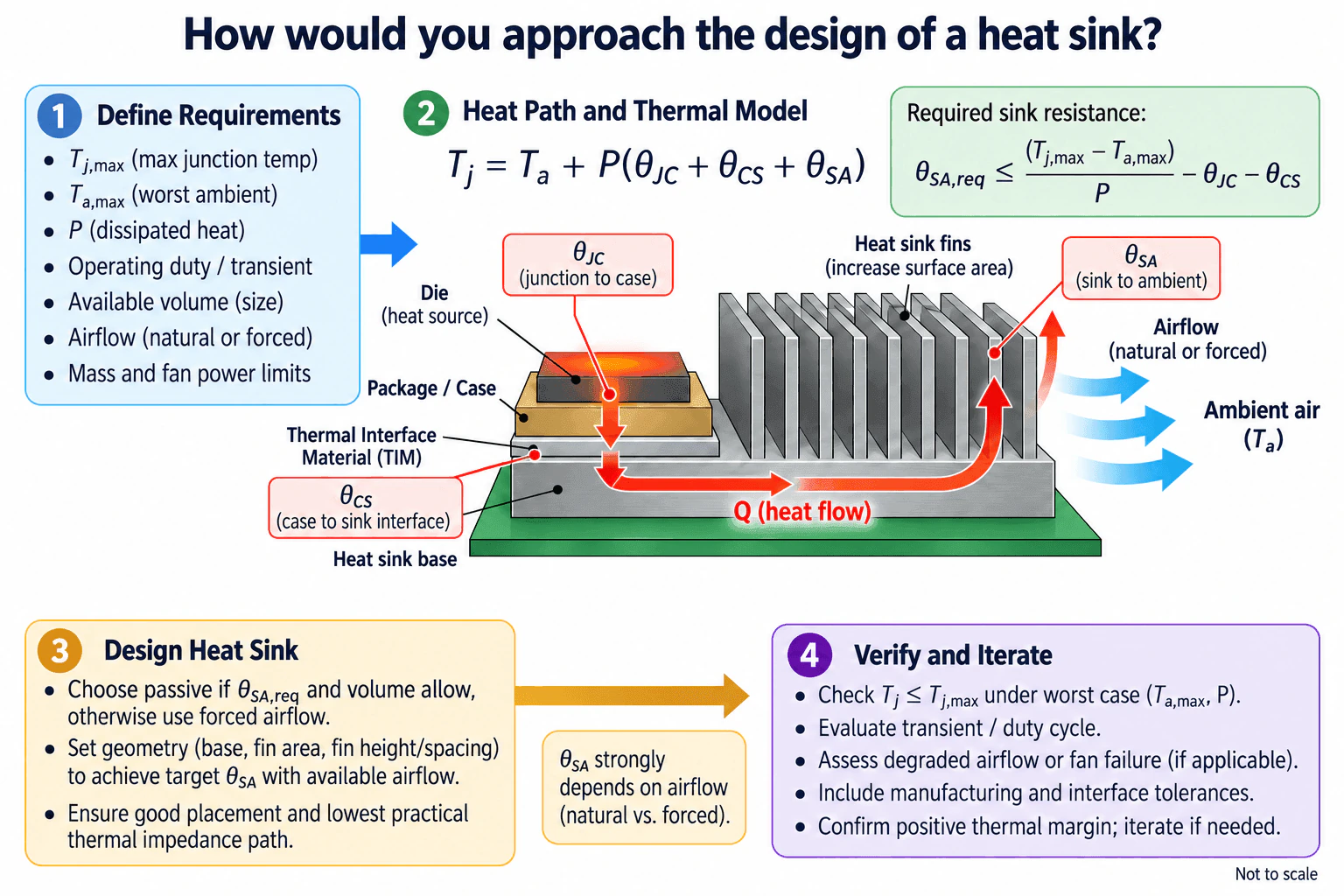
I would first define the physical boundary and requirements. My main inputs are maximum junction temperature Tj,max, maximum ambient temperature Ta,max, dissipated power P, duty cycle, available volume, airflow condition, mass budget, fan power budget, and package and interface constraints.
For a first order design, I would represent the dominant heat path as junction to case, case through the thermal interface material to the sink, and sink to ambient. The corresponding resistances are θJC, θCS, and θSA. Under the simplified steady state assumption that the dominant dissipated power follows this series path:
Tj = Ta + P(θJC + θCS + θSA)
Solving for the required heat sink performance gives:
θSA,req ≤ (Tj,max − Ta,max) / P − θJC − θCS
This gives the largest acceptable sink to ambient thermal resistance. I would use package thermal data and interface resistance values that are applicable to the intended heat path and operating conditions rather than inventing values.
Next I would select the cooling approach. If the required θSA can be achieved with natural convection inside the available volume, I would prefer a passive sink because it avoids fan power and fan failure. If not, I would use forced airflow. I would then adjust base spreading, fin area, fin height, fin spacing, orientation, and airflow so the sink can meet the target resistance without violating mechanical or power constraints. The package, thermal interface material, and heat sink base must provide a practical low resistance path into the fins.
Finally, I would verify the design against the original requirements. I would check the worst hot condition using maximum ambient temperature and heat load, then assess duty cycle and transient behavior if the load is not steady. For an active design I would also examine reduced airflow or fan failure. Manufacturing tolerances, interface variation, installation variation, contamination, and model uncertainty should be included when establishing margin. I would accept the design only when predicted junction temperature remains below its limit with positive thermal margin under the required cases. The simplified resistance network is useful for initial architecture and sizing, but detailed geometry and strongly coupled airflow may require higher fidelity analysis and physical validation.
Why Interviewers Ask This
Interviewers want to see whether I can translate temperature, power, environment, packaging, airflow, size, mass, and reliability constraints into a traceable thermal design. They are also evaluating whether I understand the complete heat path, can choose between passive and forced airflow approaches, can reason about uncertainty and degraded operation, and can verify that the final design retains positive thermal margin.
Interviewer may ask next
How would you validate that the heat sink actually meets the thermal requirement?
I would define acceptance conditions directly from the requirements, including heat load, ambient temperature, airflow, orientation, duty cycle, and interface assembly. I would compare predicted and measured temperatures at appropriate accessible locations, use the device manufacturer method for estimating or measuring junction temperature when applicable, and check whether uncertainty could consume the available thermal margin. I would also test important worst case and degraded conditions rather than validating only a nominal operating point. If measurements disagree materially with the model, I would update the thermal resistances, boundary conditions, or contact assumptions before approving the design.
What would you change if natural convection cannot meet the required θSA within the available volume?
I would first determine how far the passive design misses the required θSA and identify the dominant constraint. I could increase effective fin area, improve base spreading, reduce interface resistance, change fin spacing or orientation, or use a more conductive heat spreading structure if those changes fit the mechanical limits. If passive cooling still cannot satisfy the requirement, I would move to forced airflow and size the sink and airflow together. That introduces fan power, acoustic limits, pressure drop, reliability, serviceability, and degraded airflow considerations, so I would verify both normal operation and reduced airflow or fan failure before selecting the final design.
4. Explain the choices in a thermal-engineering project you completed, including improvements and alternative approaches you considered.Thermal DesignHardNvidia
Short Interview Answer (30-60 seconds)
I would explain the project by starting with the actual thermal requirements and tracing each major design choice back to them. I would define the thermal boundary, heat loads, duty cycles, temperature limits, environment, interfaces, and available mass, volume, and power. Then I would explain the architectures I considered, such as passive conduction, forced airflow, or liquid cooling where appropriate, and why the selected approach provided the best balance of thermal margin, integration risk, reliability, and serviceability. I would also describe the improvements made during development, the evidence behind those changes, the alternatives I rejected, and what new evidence would cause me to reconsider the final architecture. Because no project data is supplied here, I would not invent temperatures, dimensions, heat loads, margins, or test results.
Detailed Explanation
A strong answer should connect every important thermal choice to a real requirement rather than presenting the final design as an isolated result. Because the project details are not supplied, the explanation should preserve that decision structure without inventing project specific temperatures, heat loads, dimensions, margins, or validation results.
Useful Questions to Ask the Interviewer
Would you like me to focus more on the thermal architecture decision or on how the design changed during development?
Should I include alternatives that were rejected because of mass, volume, power, reliability, manufacturing, or serviceability constraints?
Would you like me to emphasize analytical validation, simulation evidence, physical testing, or the complete decision process?
How to Explain It in an Interview
Physical Method
I would begin by defining the physical boundary and operating conditions. I would state the heat sources, duty cycles, allowable component temperatures, ambient conditions, available interfaces, mass budget, volume budget, power budget, and reliability expectations. I would clearly separate measured project facts, assumptions, unknowns, and derived results.
Next, I would build a traceable heat budget showing where heat was generated and where it needed to go. I would compare realistic architectures such as passive conduction to a chassis or spreader, passive convection where appropriate, forced airflow, or a liquid cooling path if the requirements justified the added complexity.
I would explain the selected architecture by tracing it directly to the requirements. If passive cooling could not provide adequate margin within the available volume, active cooling might be justified. If active cooling required too much power or introduced unacceptable reliability concerns, that would affect the decision.
Engineering Reasoning
I would describe improvements as changes driven by evidence. Examples could include reducing interface resistance, improving heat spreading, shortening the thermal path, reducing airflow bypass, improving airflow distribution, adjusting sensor placement, or changing control logic. I would only claim improvements supported by the actual project data.
For each alternative, I would explain both its benefit and its penalty. A larger heat sink could improve thermal margin but consume additional mass and volume. Higher airflow could improve cooling but increase power, acoustic impact, contamination sensitivity, and dependence on a fan. Liquid cooling could improve heat transport but add pumps, seals, service requirements, and leak risk.
Assumptions And Checks
I would check the selected design against the hottest credible operating case, cold conditions where relevant, startup, transient loads, manufacturing variation, degraded cooling, and sensor or actuator failures. I would preserve thermal margin for uncertainty rather than treating a nominal prediction as sufficient.
Finally, I would validate the integrated design with independent evidence appropriate to the project, such as analytical estimates, simulation, and measured temperatures or heat flows. I would investigate meaningful disagreement between methods, update uncertain assumptions, and state what new evidence would cause me to reconsider the architecture.
Why Interviewers Ask This
Interviewers want to understand how you convert thermal requirements into an integrated design, compare alternatives against measurable constraints, manage uncertainty, and improve a design based on evidence. They are also evaluating whether you can explain why a particular thermal architecture was selected instead of simply describing the final hardware.
Interviewer may ask next
How would you prove that your selected thermal architecture still works when important assumptions are uncertain?
I would identify the assumptions that most strongly affect temperature, such as heat load, ambient temperature, interface resistance, airflow, material properties, contact quality, and manufacturing variation. I would vary those inputs across credible ranges and evaluate the resulting thermal margin. I would also compare predictions with independent evidence such as analytical estimates, simulation, and physical measurements. If the methods disagree materially, I would investigate the assumptions and model boundaries rather than averaging the results. I would accept the design only when the required temperature limits are satisfied with appropriate margin across the credible operating envelope.
What would you change if the available cooling power were significantly reduced?
I would first rebuild the power and heat budgets using the new constraint. I would then look for ways to reduce thermal resistance without depending on additional electrical power, such as improving conduction paths, spreading heat over more area, reducing interface resistance, increasing effective passive surface area, or relocating heat sources relative to the available sink. I would also evaluate workload or control changes that reduce peak heat generation if the product requirements allow them. If those changes still could not satisfy the temperature limits, I would quantify the remaining gap and explain which requirement, architecture choice, or operating condition would need to change.
5. What were the difficulties when you used a high speed camera?Thermal Testing And ValidationMediumNvidia
Short Interview Answer (30-60 seconds)
The main difficulties with a high speed camera are the tradeoff between frame rate, exposure time, lighting, and image quality, plus synchronization with the rest of the test equipment. Increasing frame rate reduces the available exposure time, so stronger lighting may be required, but that lighting can add heat and disturb a thermal experiment. I would also pay close attention to focus, depth of field, vibration, trigger timing, storage capacity, and spatial calibration. Before trusting the results, I would verify timing against an independent signal and confirm that the camera and lighting did not materially change the thermal boundary conditions.
Detailed Explanation
A high speed camera is useful when a thermal or fluid event changes too quickly for normal video, but obtaining a clear image is only part of the measurement problem. The camera has to capture the event with sufficient temporal and spatial resolution without changing the physical behavior being measured.
Useful Questions to Ask the Interviewer
What transient event are we trying to observe, and what characteristic time scale needs to be resolved?
Does the camera need to be synchronized with thermocouples, RTDs, pressure, flow, power, or another measurement system?
Are there restrictions on optical access, lighting intensity, or added heat near the test article?
How to Explain It in an Interview
I would start by defining the event I need to resolve and choosing a frame rate that provides enough samples over that event. One major difficulty is that increasing frame rate usually reduces the available exposure time. Short exposure helps reduce motion blur, but it also reduces the light reaching the sensor, so stronger illumination or a larger lens aperture may be needed.
For a thermal test, illumination needs special attention because a strong lamp can add radiative heat to the test article. I would define the thermal boundary and operating conditions before the test, then check whether adding the camera lighting changes measured temperatures or the observed behavior. If it does, I would change the lighting geometry, reduce illumination, improve optical efficiency, or quantify the disturbance as part of the measurement uncertainty.
Focus and depth of field are another challenge. A larger aperture improves light collection but reduces depth of field. I would confirm that the complete region of interest remains in focus throughout the event. I would also control vibration and camera mounting because movement can corrupt displacement, size, or velocity measurements.
Synchronization is critical when comparing images with temperature, pressure, flow, power, or other sensor data. I would use a common trigger where practical and verify timing with an independently observable event. I would not assume that two acquisition systems started at exactly the same instant simply because they received similar commands.
I would calibrate image scale using a known dimension in the measurement plane and consider perspective distortion if the camera is not normal to that plane. I would document frame rate, exposure time, resolution, lens settings, lighting, trigger method, calibration, and relevant uncertainty.
Finally, high frame rates can create very large data sets. I would confirm recording duration, memory capacity, transfer capability, and the required time window before an important test. I would repeat representative runs and compare the optical observation with independent sensor evidence before drawing a thermal conclusion.
Why Interviewers Ask This
The interviewer is evaluating whether I understand the practical limitations of high speed optical measurements and whether I can protect measurement quality while integrating the camera with a thermal test. They want to see judgment around lighting, exposure, synchronization, calibration, data handling, uncertainty, and the possibility that the measurement setup itself can disturb the thermal behavior.
Common interview mistakes
Common mistakes include selecting frame rate without considering the event time scale, using excessive lighting without checking its thermal effect, accepting blurred images because exposure time is too long, losing depth of field by opening the lens too far, assuming trigger synchronization is exact without verification, measuring dimensions without spatial calibration, ignoring perspective distortion, and collecting large amounts of video without first defining the useful recording window.
Interview tip
Connect the camera problem back to measurement validity. Explain not only how to obtain a sharp video, but also how you would prove that the lighting, mounting, triggering, calibration, and optical setup did not invalidate the thermal test. That demonstrates stronger thermal testing and validation judgment than discussing camera settings alone.
Interviewer may ask next
How would you validate that the high speed camera setup was not disturbing the thermal test?
I would compare the thermal response with and without the camera illumination under otherwise equivalent operating conditions. I would keep the same physical boundary, power input, flow conditions, ambient conditions, sensor locations, and dwell criteria. I would compare temperatures and other independent measurements within their uncertainty and repeatability limits. If the illumination causes a measurable change, I would modify the lighting geometry or intensity, improve optical collection efficiency, or include the additional heat input in the test interpretation. I would document the remaining uncertainty and applicability limits rather than assuming the optical setup is nonintrusive.
What would you do if you needed twice the frame rate but the images became too dark?
I would first determine whether twice the frame rate is actually required by the physical time scale. If it is, I would reduce exposure time as needed and improve light collection without unnecessarily disturbing the test. Options include increasing illumination within the acceptable thermal disturbance limit, using a larger lens aperture while checking depth of field, reducing the region of interest when the camera supports it, improving lens transmission, or using a more sensitive imaging configuration. After changing the setup, I would repeat spatial calibration and timing checks and verify that the added illumination has not changed the thermal boundary conditions.
6. How do you know about NVIDIA's products?BehavioralEasyNvidia
Interview tip:
Use STAR to structure your answer: briefly explain the Situation and Task, make Action the most detailed part, and finish with the Result. For example, describe how you learned about NVIDIA's major product areas, connected those products to thermal engineering challenges, studied the cooling needs of high power computing hardware, and used that research to understand how a Thermal Engineer can support reliable product performance.
Situation
As I prepared for this Thermal Engineer interview, I wanted to understand NVIDIA's products from a thermal engineering point of view instead of only knowing the company as a GPU manufacturer.
Task
My goal was to understand the main product areas, where thermal limits matter, and how cooling decisions can affect performance, reliability, acoustics, size, and power use.
Action
I reviewed NVIDIA's public product information and focused on the areas most relevant to thermal engineering. I looked at GPUs used for gaming, professional computing, and data center workloads, as well as accelerated computing systems, networking products, and automotive platforms. I paid particular attention to products that operate at high power because they create difficult heat removal problems. I thought about the complete thermal path from the silicon through the package, thermal interface material, heat spreader, heat sink, cold plate, or other cooling hardware, and then to the surrounding air or liquid loop. I also considered how a thermal engineer has to balance junction temperature, cooling capacity, pressure drop, fan power, acoustic limits, mechanical constraints, and reliability. That helped me connect the product portfolio to the type of engineering work I would be doing instead of simply memorizing product names.
Result
I now have a practical understanding of NVIDIA's products and why thermal design is important to them. I can discuss the products in terms of the engineering problems they create, especially removing heat from high power computing hardware while protecting performance and reliability. That is also one of the reasons I am interested in this Thermal Engineer role.
Why Interviewers Ask This
Interviewers ask this question to see whether the candidate has taken the time to understand NVIDIA's business and products and can connect that knowledge to the Thermal Engineer role. A strong answer shows genuine preparation, technical curiosity, and an understanding of why thermal performance matters in high power computing products.
Interviewer may ask next
Which NVIDIA products are most interesting to you from a thermal engineering perspective?
I am especially interested in high power data center GPUs and accelerated computing systems because they create demanding heat removal problems. They require careful work across the complete thermal path, including the package interface, heat spreading, cooling hardware, airflow or liquid flow, and system level operating limits.
How would your product research help you if you joined the thermal engineering team?
It gives me useful context before I start solving a thermal problem. I would know that the cooling solution has to support more than temperature alone. I would consider performance, reliability, power, pressure drop, acoustics, mechanical space, and manufacturability together, then work with the wider engineering team to find a practical solution.
Thermal Engineer Resume Examples
Explore the resume examples below to find the one that best matches your target Thermal Engineer role.
Disclaimer: This interview guide is for educational and informational purposes only. It is designed to help readers prepare, but it does not guarantee any interview result, hiring decision, offer, or outcome. Interview questions, hiring criteria, and preferred answers can vary by employer, interviewer, industry, location, and time. All answers, examples, and explanations in this guide are suggested examples for interview preparation, not definitive answers or instructions for professional practice. They are based on research and judgment, are provided without warranties of any kind, and should be adapted to the question, role, and applicable laws and professional requirements. Diagrams are simplified illustrations intended to highlight the main concepts and their relationships; actual situations, systems, and practices may be more complex. Alternative approaches may be equally valid or better suited to a particular question, context, or interviewer. To the fullest extent permitted by applicable law, the contributors and publisher are not liable for decisions made, actions taken, or losses incurred based on this guide.
State Laws and Professional Responsibilities: Laws and requirements governing an occupation vary by state and jurisdiction. You are responsible for checking the current laws, licensing requirements, and scope-of-practice rules that apply to your location and role, and for ensuring that your answers and actions comply with them. Adapt examples in this guide to those requirements. This guide is not legal advice.
Company Notice: This guide is an independent educational resource and is not affiliated with, endorsed by, sponsored by, or approved by the company named in this guide. Company names identify reported interview experiences or the employer context of clearly labeled original practice exercises. Interview practices can change without notice, and inclusion of company-specific content does not mean these questions are official, complete, or guaranteed to be asked. To the fullest extent permitted by law, the author, contributors, and publisher are not responsible for outcomes related to use of this material.
Content Accuracy and Verification: To the fullest extent permitted by applicable law, we do not represent or warrant that interview guides, questions, answers, examples, or diagrams are accurate, complete, current, error-free, or suitable for any particular purpose. You are responsible for independently reviewing and verifying the information before relying on it.