
1. what is airflow, explain chiller, what is air flow rate
Airflow is the movement of air caused by a pressure difference. In this HVAC system, a supply fan moves air through the cooling coil, supply duct, and conditioned space. A chiller is a refrigeration system that removes heat from chilled water. Cold water goes to the cooling coil, absorbs heat from the air, and returns warmer to the chiller. Air flow rate describes how much air volume passes through a section per unit time. For average velocity normal to a duct cross section, Q = vA, where Q is volumetric air flow rate in m³/s, v is average air velocity in m/s, and A is duct area in m². cfm, meaning cubic feet per minute, is another common volumetric air flow rate unit.
Airflow means the movement of air from one location to another because of a pressure difference. In the shown HVAC path, warm return air passes through a cooling coil. Chilled water inside the coil absorbs heat from that air. A supply fan then moves the cooled air through the supply duct and into the conditioned space.
A chiller provides the cold water used by the cooling coil. Inside the refrigeration cycle, the evaporator absorbs heat from the chilled water. The compressor raises the refrigerant pressure and temperature. The condenser rejects the absorbed heat outdoors. The expansion device lowers the refrigerant pressure before the refrigerant returns to the evaporator. The chilled water leaving the chiller travels to the cooling coil, absorbs heat, and returns warmer to the chiller.
Air flow rate is the volume of air passing through a cross section per unit time. For a duct where v represents the average velocity normal to the area, Q = vA. Here, Q is volumetric air flow rate in m³/s, v is average air velocity in m/s, and A is duct cross sectional area in m². In this equation, Q represents volumetric flow, not heat transfer rate. cfm, or cubic feet per minute, is also commonly used.
- Are you asking about volumetric air flow rate or mass flow rate?
- Should I assume steady airflow through a known duct area?
- Do you want the chiller explained only at the system level or through its refrigeration cycle?
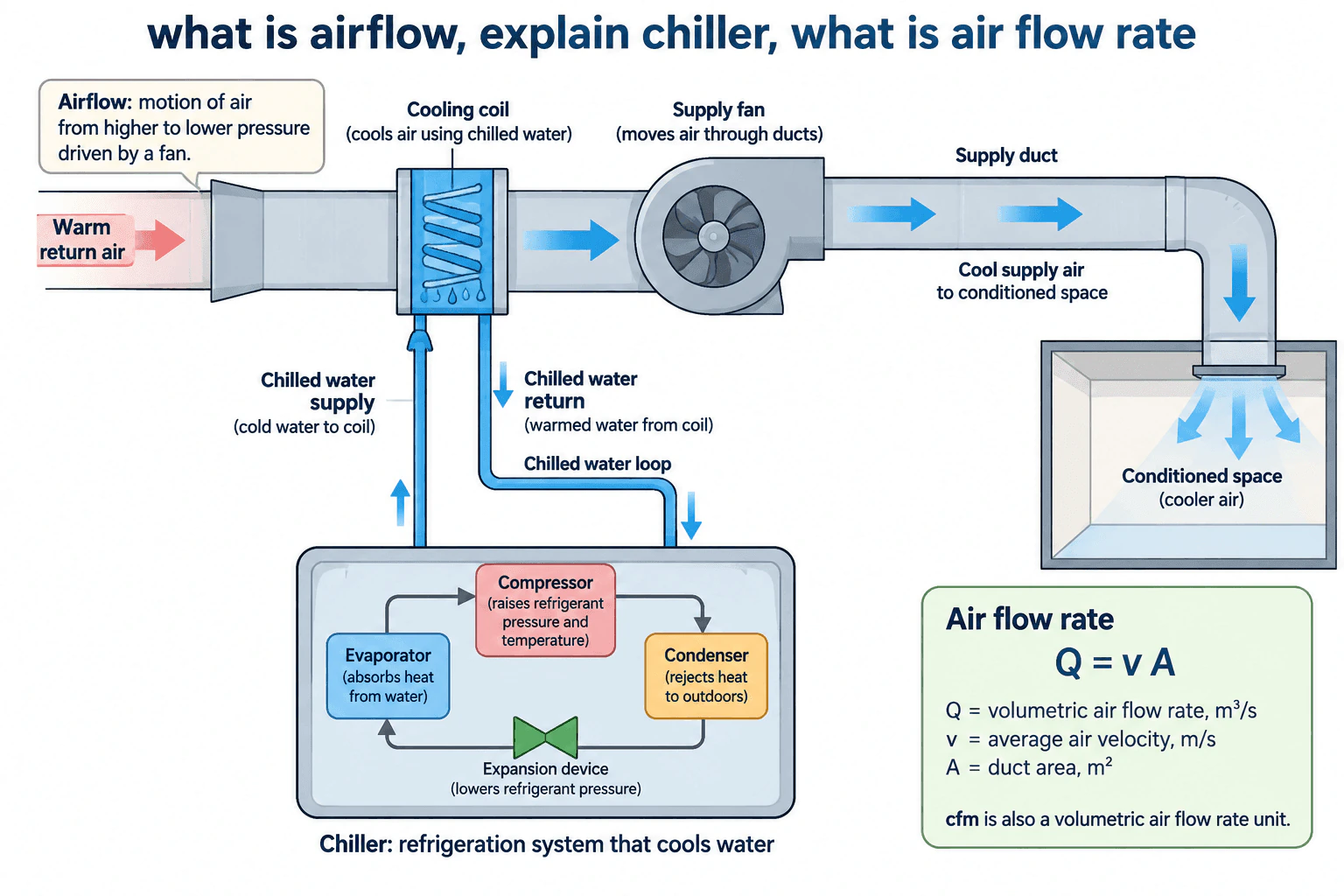
Start with the airflow path. Warm return air enters the cooling section, passes over the chilled water coil, and leaves as cooler supply air. The fan adds mechanical energy and provides the pressure rise needed to move air through the coil and duct system.
Then explain the chilled water loop. Cold water from the chiller enters the coil and gains heat from the air. The warmer return water goes back to the chiller. In the chiller, the evaporator transfers heat from the water to the refrigerant. The compressor raises refrigerant pressure and temperature, the condenser rejects heat outdoors, and the expansion device reduces refrigerant pressure before the cycle repeats.
For air flow rate, define the physical boundary at a duct cross section. If the average air velocity normal to the area is v and the duct area is A, then Q = vA. For example, doubling the average velocity at the same area doubles the volumetric flow rate.
For Q = vA, use the average velocity across the section rather than a single local velocity unless the velocity profile is uniform. Keep units consistent. Multiplying m/s by m² gives m³/s. If measurements are taken in cfm, convert units consistently before combining them with SI values.
Actual airflow also depends on system pressure loss and the fan operating point. The cooling coil, filters, fittings, and ductwork add resistance. A measured velocity profile or calibrated airflow measurement can be used to validate the calculated flow rate.
The air path and chilled water loop are connected by heat transfer at the cooling coil. Air loses heat while chilled water gains heat. The chiller then removes that heat from the returning water so the water can be supplied cold to the coil again. The fan produces the airflow, the cooling coil transfers heat from the air to the water, and the chiller restores the chilled water to a lower temperature for continued cooling.
This question tests whether the candidate can explain basic HVAC airflow, chilled water cooling, and volumetric air flow rate clearly while connecting air movement, heat removal, and equipment operation.
Common mistakes include confusing air velocity with air flow rate, using Q = vA with a single local velocity instead of an appropriate section average, mixing cfm and SI units without conversion, describing the fan as the device that cools the air, or saying the chiller directly supplies cold air. The fan moves the air, the cooling coil cools the air, and the chiller cools the water supplied to the coil.
Answer in three parts. First define airflow, then explain the chilled water and refrigeration path through the chiller, and finally define air flow rate with Q = vA and units. Connecting all three through the cooling coil makes the explanation easy to follow.


