This interview guide is for educational and informational purposes only. It is designed to help readers prepare, but it does not guarantee any interview result, hiring decision, offer, or outcome. Interview questions, hiring criteria, and preferred answers can vary by employer, interviewer, industry, location, and time. All answers, examples, and explanations in this guide are suggested examples for interview preparation, not definitive answers or instructions for professional practice. They are based on research and judgment, are provided without warranties of any kind, and should be adapted to the question, role, and applicable laws and professional requirements. Diagrams are simplified illustrations intended to highlight the main concepts and their relationships; actual situations, systems, and practices may be more complex. Alternative approaches may be equally valid or better suited to a particular question, context, or interviewer. To the fullest extent permitted by applicable law, the contributors and publisher are not liable for decisions made, actions taken, or losses incurred based on this guide.
State Laws and Professional Responsibilities
Laws and requirements governing an occupation vary by state and jurisdiction. You are responsible for checking the current laws, licensing requirements, and scope-of-practice rules that apply to your location and role, and for ensuring that your answers and actions comply with them. Adapt examples in this guide to those requirements. This guide is not legal advice.
Identity, Image, and Privacy Notice
To respect individual privacy, some names, profile photographs, avatars, biographical details, and other identifying information displayed in this guide may be replaced with pseudonyms, licensed stock images, illustrative avatars, composite images, or representative descriptions. Unless a person is expressly identified as an actual contributor, a displayed name, image, or profile should not be understood as depicting or identifying a specific candidate, interviewer, employee, or other real individual. These representations are provided for editorial and illustrative purposes only and do not imply endorsement, employment, participation, or affiliation with this guide or any company mentioned in it. Any resemblance to an actual person is coincidental.
Company Notice
This guide is an independent educational resource and is not affiliated with, endorsed by, sponsored by, or approved by the company named in this guide. Company names identify reported interview experiences or the employer context of clearly labeled original practice exercises. Interview practices can change without notice, and inclusion of company-specific content does not mean these questions are official, complete, or guaranteed to be asked. To the fullest extent permitted by law, the author, contributors, and publisher are not responsible for outcomes related to use of this material.
Content Accuracy and Verification
To the fullest extent permitted by applicable law, we do not represent or warrant that interview guides, questions, answers, examples, or diagrams are accurate, complete, current, error-free, or suitable for any particular purpose. You are responsible for independently reviewing and verifying the information before relying on it.
Questions or comments?
Contact us for general questions, or share feedback, technical corrections, and comments with the community.
1. How would you reassess a patient whose discomfort persists despite an initial care plan?Clinical KnowledgeEasyCedars Sinai
i Question Details
Original practice question for this employer context, not a reported employer interview question. Explain the relevant ED nursing judgment and identify information or authority you would need. Do not assume an internal employer protocol.
Short Interview Answer (30-60 seconds)
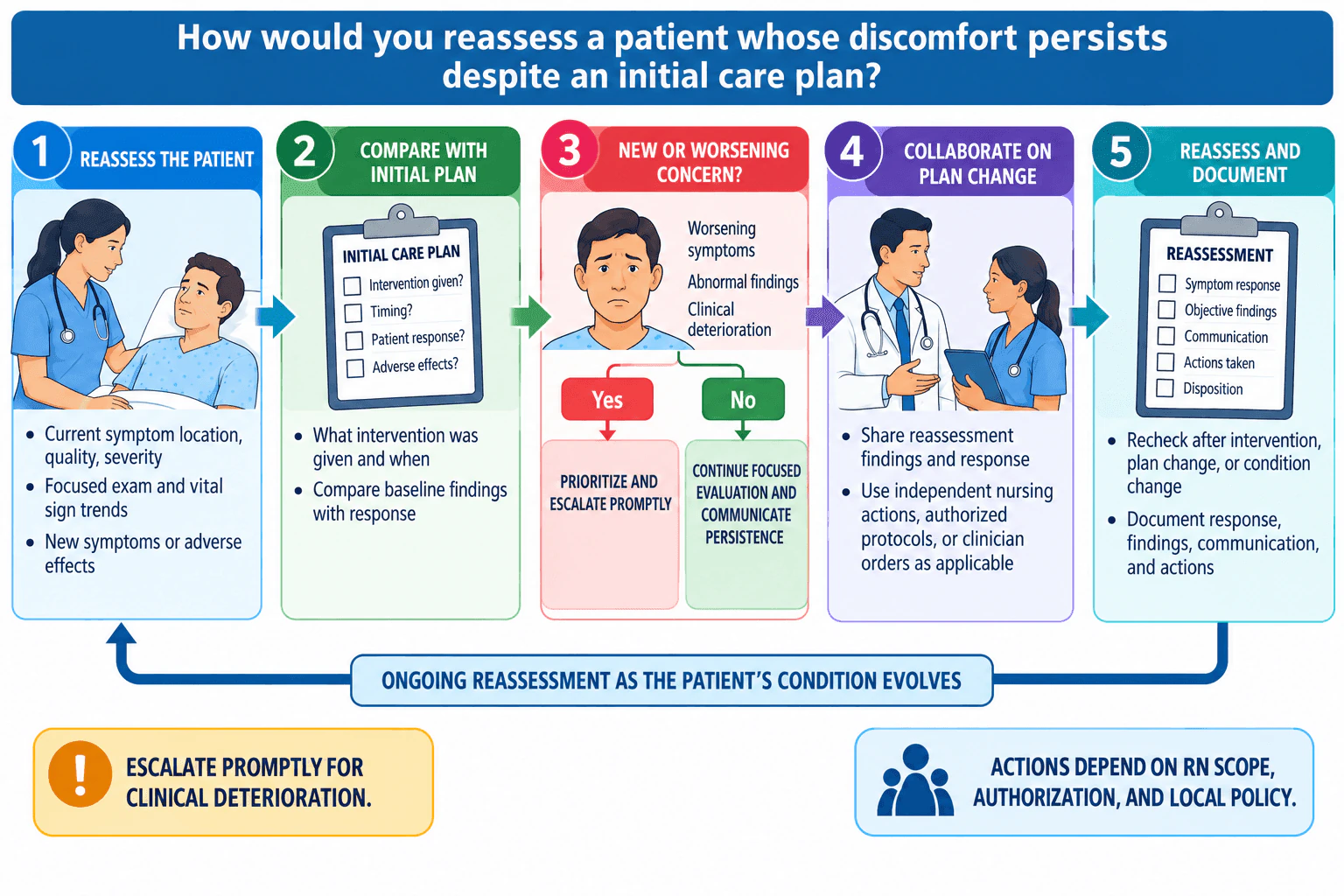
I would first reassess the patient by clarifying the current discomfort, performing a focused exam, reviewing vital sign trends, and checking for new symptoms or adverse effects. Then I would compare the current findings with the baseline assessment, the intervention already given, its timing, and the patient's response. New or worsening concerns would prompt timely escalation. If the patient is stable but symptoms persist, I would communicate the findings and collaborate on the next plan within RN scope, authorized protocols, and applicable orders. After any intervention or plan change, I would reassess and document the patient's response, objective findings, communication, and actions.
Detailed Explanation
Persistent discomfort means I should reassess the patient and determine whether the initial plan has been ineffective or whether the patient's condition has changed. I would not assume that persistent discomfort alone establishes a diagnosis or automatically calls for another treatment.
Useful Questions to Ask the Interviewer
What were the patient's baseline findings, and what has changed since the initial intervention?
What intervention was given, when was it given, and what response or adverse effects were observed?
What orders, authorized protocols, and escalation resources are available in this setting?
How to Explain It in an Interview
Reassess the Patient
I would clarify the current symptom location, quality, severity, associated symptoms, and any change from baseline. I would perform a focused assessment and review current vital signs and trends. I would also look for new symptoms, adverse effects, or other findings that suggest the patient's condition is worsening. When discomfort represents pain, current hospital standards support using defined criteria to assess and reassess the patient's pain. jointcommission.org
Compare With the Initial Plan
I would confirm what intervention was given and when, then compare the current findings with the original assessment and the patient's response. This helps distinguish persistent symptoms with otherwise stable findings from a meaningful clinical change.
Respond to New or Worsening Concerns
If reassessment shows deterioration or a significant new concern, I would prioritize prompt escalation through the appropriate clinical pathway. If the patient remains stable but the symptom persists, I would continue focused evaluation, clearly communicate the persistence and reassessment findings, and collaborate on modification of the plan.
Stay Within RN Scope
I would distinguish independent nursing actions from actions performed through an authorized protocol or standardized procedure and from treatments requiring an appropriate clinician order. Scope decisions depend on licensure, competence, applicable law, and the practice setting. California RN guidance recognizes observation of signs and symptoms, recognition of abnormal characteristics, and appropriate reporting, referral, standardized procedures, or emergency procedures within applicable scope. rn.ca.gov
Reassess and Document
After an intervention, plan change, or meaningful change in condition, I would reassess again. I would document the patient's response, objective findings, communication, and actions taken. Reassessment continues as the patient's condition evolves.
Why Interviewers Ask This
This question evaluates whether the nurse responds to persistent symptoms with structured clinical reassessment rather than automatically repeating an intervention. It tests focused assessment, comparison with baseline findings, recognition of deterioration, appropriate escalation, communication, collaboration, scope awareness, reassessment, and documentation.
Common interview mistakes
Common mistakes include repeating the initial intervention without reassessing, focusing only on the patient's symptom rating while ignoring objective findings and trends, failing to compare current findings with baseline, inventing missing findings, delaying escalation when the patient is deteriorating, implying authority to change treatment outside RN scope, or failing to document the patient's response and subsequent reassessment.
Interview tip
Present the answer as a continuous clinical loop: reassess the patient, compare current findings with the initial plan and response, identify new or worsening concerns, escalate when necessary, collaborate on the next plan within scope, then reassess and document. This closely demonstrates the clinical judgment the question is testing.
Interviewer may ask next
How would you verify whether you are authorized to perform the next intervention?
I would determine whether the action is an independent nursing function, an action covered by an authorized protocol or standardized procedure, or an intervention requiring an appropriate clinician order. I would confirm the applicable order, protocol, policy, my competence, and the legal scope for the practice setting before proceeding. Scope decisions should reflect licensure, competence, and state or jurisdictional requirements. ncsbn.org
What would change if the patient developed a new abnormal finding or clear clinical deterioration during reassessment?
The priority would shift from evaluating persistent discomfort to addressing the clinical change. I would promptly characterize the new finding with the appropriate focused assessment, obtain and trend relevant vital signs, communicate the change, and escalate through the appropriate emergency or clinician pathway. I would not delay escalation simply because the original complaint was discomfort, and I would continue reassessment and documentation as the condition evolves.
2. How would you avoid treating a familiar symptom cluster as a confirmed diagnosis?Clinical KnowledgeEasyCedars Sinai
i Question Details
Original practice question for this employer context, not a reported employer interview question. Explain the relevant ED nursing judgment and identify information or authority you would need. Do not assume an internal employer protocol.
Short Interview Answer (30-60 seconds)
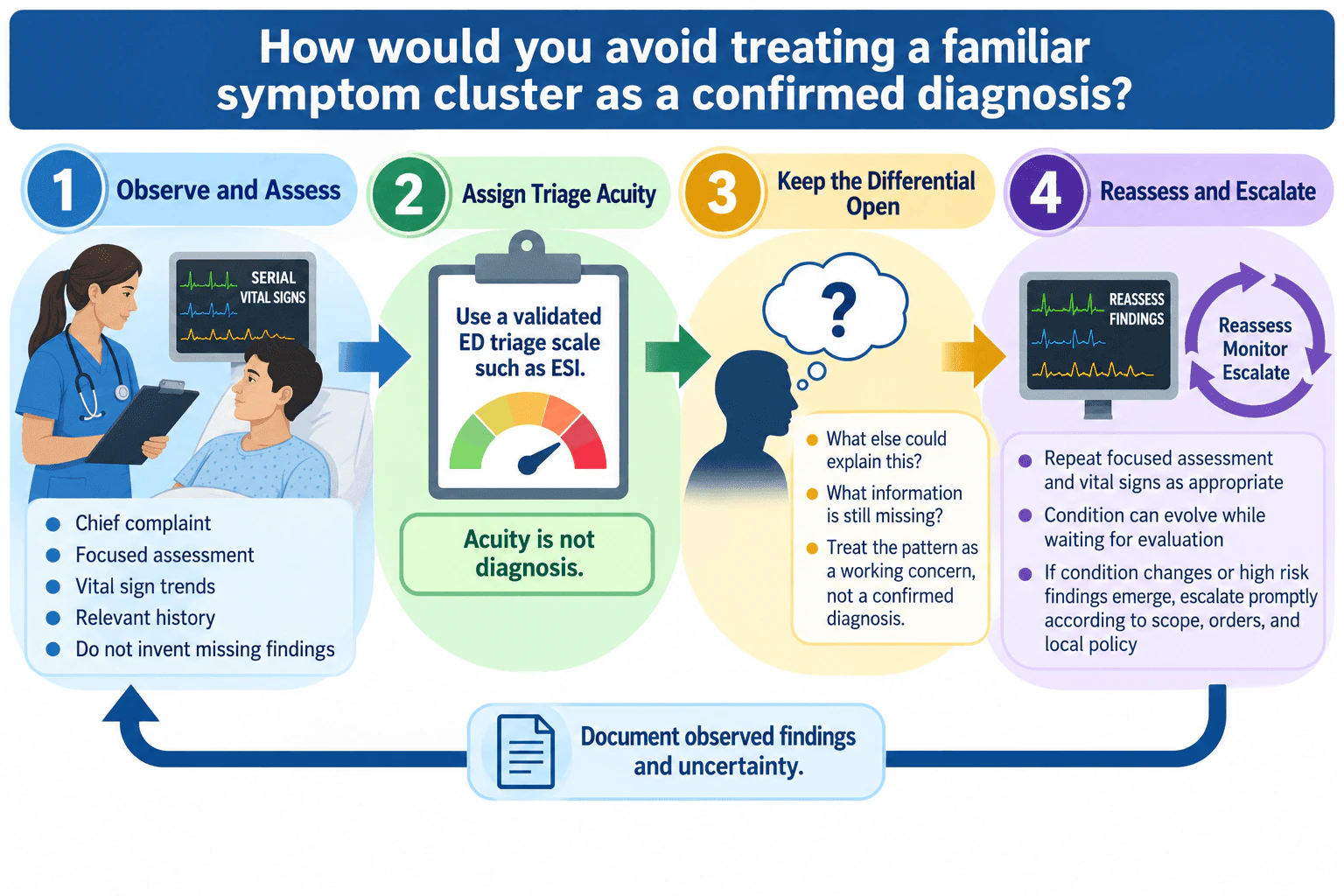
I would separate what I observe from what I think might explain it. I would assess the chief complaint, focused findings, serial vital signs, and relevant history, then assign triage acuity using the validated method used by the department. ESI can help prioritize urgency, but acuity is not diagnosis. ena.org I would keep the differential open by asking what else could explain the presentation and what information is still missing. I would reassess for change, escalate concerning findings, and document the observed findings and uncertainty rather than labeling the symptom pattern as a confirmed diagnosis.
Detailed Explanation
A familiar symptom cluster can guide initial thinking, but it should not automatically become a confirmed diagnosis. My role as an emergency department nurse is to identify what is actually present, determine urgency, recognize uncertainty, reassess for change, and communicate findings so the diagnostic process can continue safely. AHRQ emphasizes that diagnostic reasoning changes as history, examination findings, and test information become available. ahrq.gov
Useful Questions to Ask the Interviewer
Which validated triage method does this emergency department use for routine arrivals?
Which standing protocols may an RN initiate when specified high risk findings are present?
What escalation process should nurses follow when a patient's condition changes while waiting?
How to Explain It in an Interview
Observe and Assess
I would begin with the chief complaint, focused assessment, serial vital signs, and relevant history. I would document what I actually observe and avoid adding findings that have not been assessed.
Assign Triage Acuity
I would use the validated triage method used by the department to determine urgency. The joint ACEP and ENA triage policy describes triage as a rapid evaluation of acuity used to establish priority for clinical assessment and supports validated scales such as ESI. ena.org ESI is a five level triage acuity scale that considers physiologic stability, risk for deterioration, and expected resource needs. enau.ena.org Acuity therefore guides prioritization. It does not confirm a diagnosis.
Keep the Differential Open
I would ask, "What else could explain this?" and "What information is still missing?" AHRQ identifies premature closure as failing to continue considering reasonable alternatives after an initial impression forms. psnet.ahrq.gov I would communicate findings that support the working concern as well as findings that do not fit it.
Reassess and Escalate
The clinical picture can change while evaluation continues. I would repeat relevant focused assessments and vital signs according to the patient's condition and department process. If meaningful deterioration or high risk findings emerged, I would escalate promptly to the appropriate clinician and follow authorized protocols, orders, and local policy.
Document Uncertainty
I would document observed findings, reassessment findings, communication, actions taken, and unresolved uncertainty. That keeps the record aligned with what is actually known and reduces the risk of treating pattern recognition as diagnostic certainty.
Why Interviewers Ask This
Interviewers are evaluating whether I can avoid anchoring and premature closure while still recognizing urgency and protecting patient safety. AHRQ describes premature closure as stopping consideration of alternative diagnoses after an initial impression forms and emphasizes revising diagnostic thinking when new information appears. psnet.ahrq.gov A strong emergency nursing answer distinguishes observed findings from diagnostic certainty, uses triage for prioritization, reassesses the patient, communicates change, and stays within nursing scope.
Common interview mistakes
Common mistakes include treating pattern recognition as proof of a diagnosis, confusing triage acuity with diagnosis, assuming arrival order determines priority, inventing findings that were not assessed, seeking only information that supports the first impression, failing to reassess a waiting patient, overlooking meaningful change, documenting unsupported certainty, or acting beyond nursing scope and local authorization.
Interview tip
Organize the answer around five linked ideas: observe and assess, assign triage acuity, keep the differential open, reassess and escalate, and document observed findings and uncertainty. A concise interview phrase is, "I would treat the pattern as a working concern, not a confirmed diagnosis."
Interviewer may ask next
How would you verify whether your working concern is becoming more or less likely?
I would compare new information with the original assessment instead of looking only for confirming evidence. I would repeat relevant nursing assessments and vital signs, review available history and results, identify findings that support or conflict with the working concern, and communicate those findings to the responsible clinician. AHRQ describes diagnostic reasoning as an evolving process in which probabilities should be updated as new history, examination findings, and test results become available. ahrq.gov Additional testing, consultation, or treatment would occur according to applicable orders, protocols, nursing scope, and local policy.
What would you do if the patient's condition changed while waiting for evaluation?
I would promptly reassess the patient, compare the new findings with the prior focused assessment and vital sign trend, reconsider the patient's urgency through the department's validated triage process, and escalate concerning changes to the appropriate clinician. I would document the change, reassessment, communication, and actions taken. The new information would also prompt me to reconsider the working concern rather than remain anchored to the original pattern.
3. what dx do I think a pt has if they’re shaky, confused, sweaty and weak?Clinical KnowledgeMediumCedars Sinai
i Question Details
Use only the listed findings. Explain the focused emergency nursing assessment, the most important competing causes to consider, the information needed to narrow them, and when escalation is required.
Short Interview Answer (30-60 seconds)
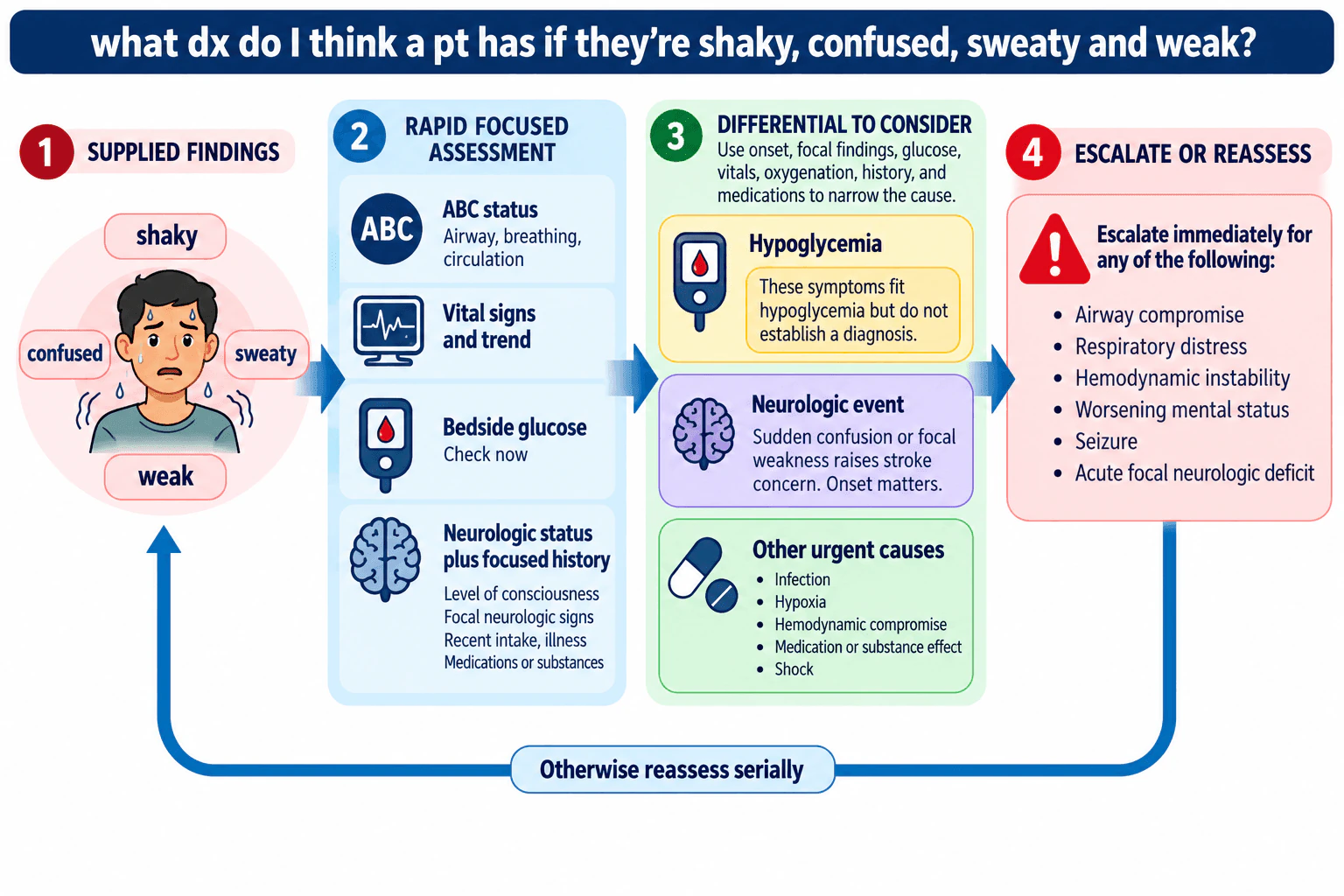
Hypoglycemia would be high on my differential because shaky, confused, sweaty, and weak can occur with low blood glucose, but I would not diagnose it from symptoms alone. niddk.nih.gov I would assess ABC status, obtain and trend vital signs, check bedside glucose promptly, assess neurologic status, and get a focused history. I would also consider a neurologic event, hypoxia, infection, shock, and medication or substance effects. Sudden focal weakness or sudden confusion raises concern for stroke. cdc.gov Any airway, breathing, circulation, neurologic, or mental status deterioration would prompt immediate escalation and serial reassessment.
Detailed Explanation
The symptoms make hypoglycemia an important possibility, but they are not specific enough to establish a diagnosis. NIDDK materials identify shakiness, confusion, sweating, and weakness as possible manifestations of low blood glucose. niddk.nih.gov The emergency nursing priority is to identify immediate threats, obtain objective information quickly, and keep competing dangerous causes in mind.
Useful Questions to Ask the Interviewer
Are any vital signs or bedside glucose results available?
When did the symptoms begin, and were they sudden or progressive?
Are there focal neurologic findings, recent illness, diabetes treatment, reduced intake, or medication or substance exposures?
How to Explain It in an Interview
I would say that hypoglycemia is an important possibility, but I would not label the patient with a diagnosis from these four symptoms alone.
My first priority is a rapid focused assessment of airway, breathing, and circulation. I would obtain and trend vital signs, assess the patient's level of consciousness, and check bedside glucose promptly under the applicable emergency department protocol or order. The symptom pattern is compatible with hypoglycemia, and an objective glucose result helps support or weaken that possibility. Emergency medicine guidance for altered mental status also prioritizes ABC assessment and point of care glucose testing. saem.org
I would then perform a focused neurologic assessment and clarify symptom onset. Sudden confusion or focal weakness raises concern for stroke, so onset time and focal findings matter. CDC identifies sudden confusion and sudden weakness, especially on one side, as stroke warning signs. cdc.gov
The focused history would include diabetes or glucose lowering medicines, recent intake, recent illness, other medications, and substance exposure. I would also consider hypoxia, infection, hemodynamic compromise or shock, and medication or substance effects as competing urgent causes of altered mental status. saem.org
I would escalate immediately for airway compromise, respiratory distress, hemodynamic instability, worsening mental status, seizure, or an acute focal neurologic deficit. If those findings are absent and the patient remains stable, I would continue serial reassessment while additional information is obtained and the cause is clarified.
Why Interviewers Ask This
This question tests whether the nurse recognizes hypoglycemia as an important possibility without anchoring on a diagnosis, performs a focused emergency assessment, considers dangerous competing causes, gathers the information needed to narrow the differential, and escalates when time critical findings appear.
Common interview mistakes
Common mistakes include assuming the symptoms prove hypoglycemia, delaying an objective bedside glucose check, overlooking ABC threats, failing to assess for focal neurologic findings, ignoring symptom onset, inventing findings that were not provided, and failing to reassess after the initial evaluation.
Interview tip
State hypoglycemia as an important possibility, then show how you would verify it without anchoring. A strong sequence is ABC status, vital sign trends, bedside glucose, focused neurologic assessment and history, competing urgent causes, escalation for deterioration, and serial reassessment.
Interviewer may ask next
How would you verify whether hypoglycemia is actually causing the symptoms?
I would obtain an objective bedside glucose measurement promptly under the applicable emergency department protocol or order and interpret it together with the symptoms and clinical context rather than relying on symptoms alone. I would also review relevant history such as diabetes, glucose lowering medicines, recent intake, illness, and medication or substance exposure. I would continue the broader assessment because another urgent condition can coexist with an abnormal glucose result.
What would change if the patient suddenly developed one sided weakness or speech difficulty?
That change would substantially increase concern for an acute stroke or another neurologic emergency. CDC identifies sudden one sided weakness, sudden confusion, and speech difficulty as stroke warning signs. cdc.gov I would immediately escalate according to the applicable emergency department stroke pathway, establish symptom onset or last known well information, continue ABC assessment, and avoid assuming that the original symptoms were explained only by hypoglycemia.
4. How would you explain the next assessment step to a confused patient without overwhelming them?Communication And DelegationMediumCedars Sinai
i Question Details
Original practice question for this employer context, not a reported employer interview question. Explain the relevant ED nursing judgment and identify information or authority you would need. Do not assume an internal employer protocol.
Short Interview Answer (30-60 seconds)
I would give the patient one simple piece of information at a time and focus only on the next assessment step. I might say, "I am going to ask you a few questions and check how you are feeling. We will go one step at a time, and I will tell you what I am doing before I do it." I would speak slowly, avoid unnecessary clinical terms, allow time for a response, and use teach back to confirm what the patient understood. I would also check for language, hearing, vision, cognitive, or other communication barriers. If the confusion were new or worsening, I would continue the appropriate nursing assessment and escalate the change promptly.
Detailed Explanation
A confused patient usually benefits from small amounts of clear information at a time. For a bedside emergency department RN in California, my goal would be to make the immediate next step understandable while also determining whether the confusion represents a communication barrier, a change in clinical condition, or both.
Useful Questions to Ask the Interviewer
Is the patient's confusion new, or is it consistent with the patient's known baseline?
Are there known language, hearing, vision, cognitive, or other communication needs?
Is a support person or legally appropriate surrogate available if additional decision support becomes necessary?
How to Explain It in an Interview
Nursing Priorities
I would approach calmly, introduce myself, reduce unnecessary distractions when possible, and explain only the immediate assessment step. I would use short sentences and familiar words. For example, I could say, "I am going to check how you are feeling and ask you a few simple questions. We will do one thing at a time."
I would not assume that confusion automatically means the patient cannot understand or participate. I would assess the patient's responses and orientation within registered nursing scope and look for any concerning change from baseline. I would personally perform and interpret the nursing assessment rather than delegate nursing assessment judgment to assistive personnel. If the confusion appeared new or worsening, I would promptly communicate the change and escalate according to the clinical situation.
Patient Context
I would look for factors that could interfere with communication, including limited English proficiency, hearing or vision difficulty, distress, pain, or cognitive impairment. If language assistance is needed for important clinical communication, I would use qualified interpretation. I would speak directly to the patient and include family or another support person when appropriate while respecting the patient's preferences and applicable consent requirements.
Confirming Understanding
I would use teach back rather than asking only, "Do you understand?" I might say, "I want to make sure I explained it clearly. Can you tell me what we are going to do next?" If the patient's response showed misunderstanding, I would explain it again using simpler wording and check understanding again.
Clinical Rationale
This approach limits information overload while supporting autonomy, safety, and patient advocacy. Agreement alone does not prove understanding. If a decision requiring consent arises and the patient's ability to understand the information is uncertain, I would communicate that concern to the responsible clinician and follow applicable consent and surrogate processes rather than independently deciding that confusion means the patient lacks decision making ability.
Why Interviewers Ask This
Interviewers are evaluating whether the nurse can communicate calmly with a confused patient while preserving dignity, identifying communication barriers, verifying actual understanding, recognizing clinically important changes, and advocating for safe participation in care. They also want to see whether the nurse adapts the explanation to the patient instead of simply repeating more information.
Common interview mistakes
Common mistakes include giving several instructions at once, speaking rapidly, using unexplained clinical terminology, assuming that a patient who agrees actually understands, treating confusion as automatic proof that the patient cannot participate in decisions, overlooking language or sensory barriers, using an unqualified person for important interpretation, delegating nursing assessment judgment to assistive personnel, or continuing a routine explanation when new or worsening confusion requires clinical reassessment and escalation.
Interview tip
Give one brief example of the words you would actually use with the patient, then explain how you would verify understanding. This shows compassionate communication and clinical judgment. Make clear that teach back checks whether your explanation was understandable rather than testing the patient.
Interviewer may ask next
How would you verify that the patient actually understood your explanation?
I would use teach back and ask the patient to describe the next step in the patient's own words. For example, I could say, "I want to make sure I explained that clearly. Can you tell me what we are going to do next?" I would evaluate whether the response reflects the plan rather than relying on a simple yes answer. If the patient could not explain it, I would simplify or restate the information, address any communication barrier, and check again. Persistent difficulty would prompt further assessment and appropriate escalation.
What would change if the confused patient also had limited English proficiency?
I would use qualified interpretation for important clinical communication and continue using short, plain language statements through the interpreter. I would speak directly to the patient, present one concept at a time, and use teach back through the interpreter to confirm understanding. I would not assume that apparent confusion is cognitive when a language barrier may be contributing. If concerning confusion remained after effective communication was established, I would continue the appropriate nursing assessment and escalate any new or worsening clinical concern.
5. How would you clarify the intended monitoring before administering an unfamiliar medication?Medication And ProceduresMediumCedars Sinai
i Question Details
Original practice question for this employer context, not a reported employer interview question. Explain the relevant ED nursing judgment and identify information or authority you would need. Do not assume an internal employer protocol.
Short Interview Answer (30-60 seconds)
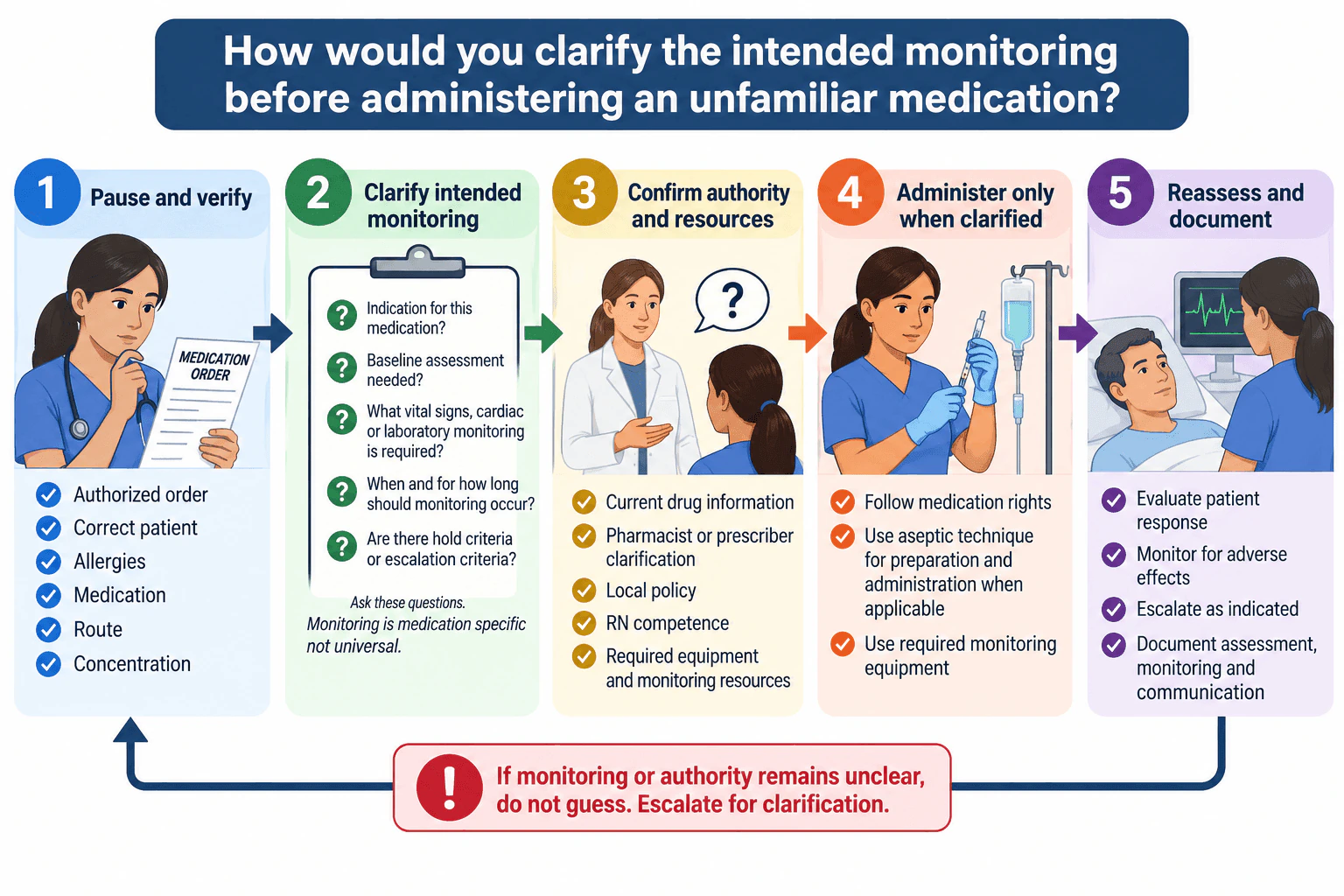
I would pause before giving the unfamiliar medication and first verify the authorized order, patient, allergies, medication, route, concentration, and indication. Then I would clarify the required baseline assessment, medication specific vital sign, cardiac, laboratory, or focused clinical monitoring, when monitoring should occur, how long it should continue, and any supported hold or escalation criteria. I would confirm the information through current drug information and, when needed, the pharmacist or authorized prescriber. I would also confirm my scope and competence and that the required monitoring resources are available. If anything material remains unclear, I would not guess or administer until it is clarified. Once the medication is given, I would monitor as required, reassess the response and adverse effects, escalate concerns, and document the care.
Detailed Explanation
The safest approach is to treat unfamiliarity as a reason to pause and verify rather than rely on memory. The goal is to understand what must be assessed before administration, what must be monitored during and after administration, what findings require action, and whether I have the authority, competence, and resources to carry out the plan safely. Monitoring is medication specific rather than universal.
Useful Questions to Ask the Interviewer
What current drug information or policy is available to identify the required monitoring for this medication?
When the order does not provide enough information, should I clarify the monitoring plan with the pharmacist, authorized prescriber, or both?
Are specific competencies or monitoring resources required before this medication can be administered in this setting?
How to Explain It in an Interview
Pause And Verify
For a bedside emergency department RN in California, I would first verify the authorized order, correct patient, allergies, medication, route, concentration, and indication. Medication administration generally implements an authorized treatment regimen, while nursing responsibilities include observing the patient's response and acting on abnormal findings. rn.ca.gov
Clarify Intended Monitoring
Before administration, I would identify the required baseline assessment and determine the medication specific monitoring. Depending on the medication and verified instructions, that could involve vital signs, cardiac monitoring, laboratory testing, or a focused clinical assessment. I would clarify when monitoring starts, how long it continues, and any supported hold or escalation criteria rather than inventing thresholds.
Confirm Authority And Resources
I would use current drug information and seek clarification from the pharmacist or authorized prescriber when needed. I would confirm that the activity is permitted within my nursing scope, supported by applicable practice setting policy, consistent with my education and competence, and supported by the resources required to perform it safely. These considerations are reflected in the NCSBN scope decision framework. ncsbn.org
Administer Only When Clarified
Once the medication and monitoring plan are clear, I would follow medication safety checks and use the required monitoring equipment. If the medication is injectable, I would use aseptic technique during preparation and administration. cdc.gov
Reassess And Document
After administration, I would evaluate the patient's response, monitor for adverse effects, escalate concerning findings as indicated, and document the relevant assessment, monitoring, response, and communication. If the monitoring plan or my authority remains unclear at any point, I would stop and obtain clarification rather than guess.
Why Interviewers Ask This
This question evaluates whether the nurse recognizes uncertainty as a medication safety issue and responds with verification rather than assumption. It tests clinical judgment, appropriate use of pharmacists and authorized prescribers, understanding of nursing scope and competence, medication specific monitoring, reassessment, escalation, and documentation.
Common interview mistakes
Common mistakes include administering an unfamiliar medication before understanding its monitoring requirements, relying only on memory, assuming all medications in the same class require identical monitoring, inventing hold parameters or thresholds, overlooking allergies or concentration, failing to confirm scope or competence, proceeding without required monitoring resources, and failing to reassess or document the patient's response.
Interview tip
Use the same sequence shown in the clinical workflow: pause and verify, clarify the intended monitoring, confirm the information and your authority, administer only when the plan is clear, then reassess and document. Emphasize that you would obtain pharmacist or authorized prescriber clarification when needed and would never invent monitoring thresholds or proceed while a material safety question remains unresolved.
Interviewer may ask next
What would you verify before administering the unfamiliar medication?
I would verify the authorized order, correct patient, allergies, medication, route, concentration, and clinical indication. I would then verify the required baseline assessment, medication specific monitoring, timing and duration of monitoring, and any supported hold or escalation criteria. I would use current drug information and obtain pharmacist or authorized prescriber clarification when necessary. I would also confirm that the activity is within my nursing scope and competence and that the required monitoring resources are available.
What would you do if the patient's condition changed after the medication was administered?
I would promptly reassess the patient using the monitoring appropriate to that medication and the patient's current condition, identify any concerning change or possible adverse effect, and escalate to the appropriate clinician according to the urgency and applicable protocol. I would continue required monitoring and nursing actions within my scope, communicate the relevant findings and medication timing clearly, and document the change, reassessment, communication, and response.
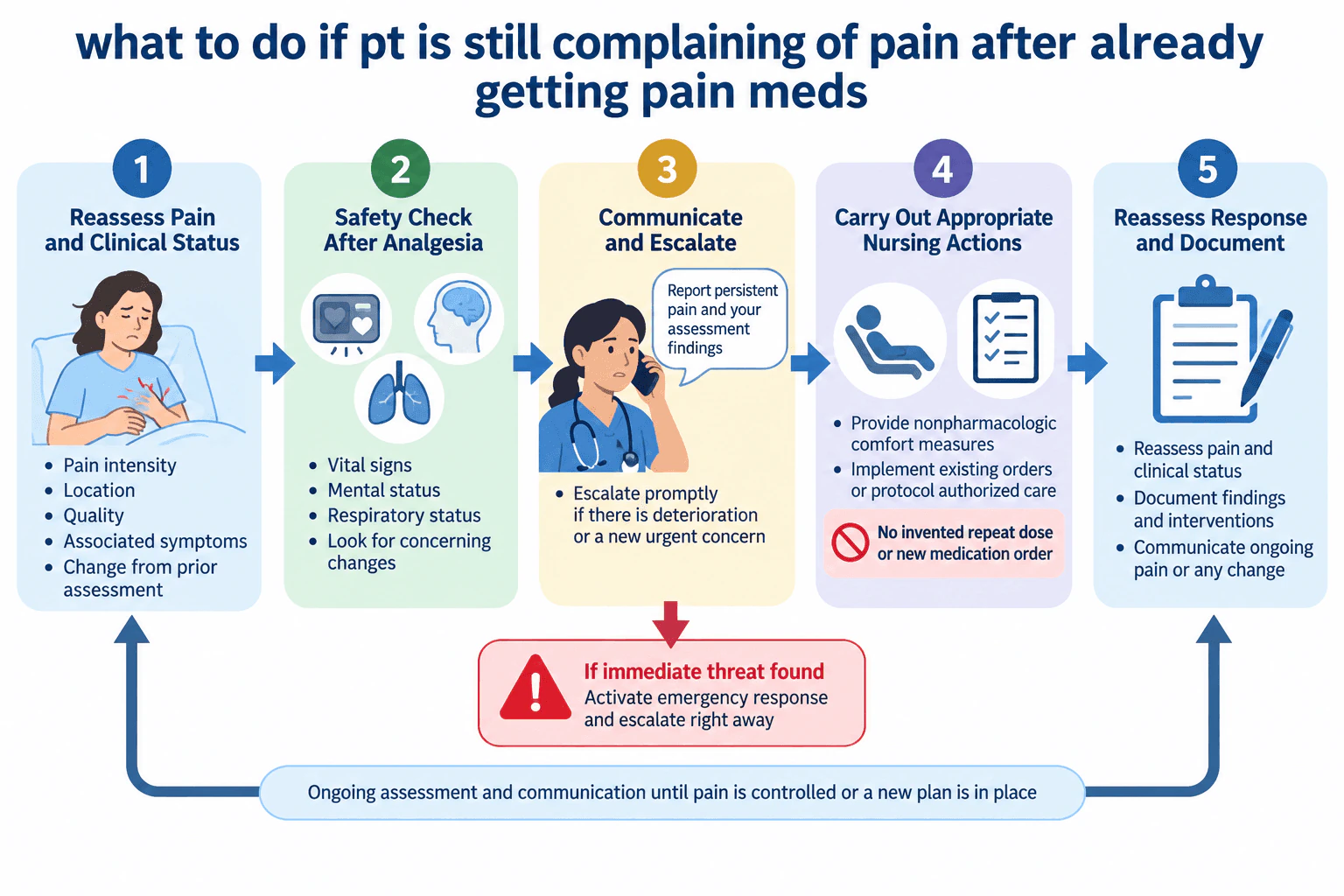
6. what to do if pt is still complaining of pain after already getting pain medsNEWScenario BasedMediumCedars Sinai
i Question Details
Use only the facts in the reported scenario. Explain immediate reassessment, safety checks, communication with the appropriate clinician, authorized nursing actions, and reassessment of response without inventing another medication order or dose.
Short Interview Answer (30-60 seconds)
I would reassess before taking any further medication action. I would reassess the pain intensity, location, quality, associated symptoms, and change from the prior assessment, then check vital signs, mental status, respiratory status, and the overall clinical picture. If there is deterioration or an immediate threat, I would escalate emergency care promptly. If the patient is stable but still has pain, I would report the persistent pain and my assessment findings to the appropriate clinician, provide appropriate nonpharmacologic comfort measures, and carry out only care already authorized by valid orders or applicable nursing protocols. I would not invent another medication dose or order. Then I would reassess the response, document the findings and interventions, and continue communicating any persistent pain or clinical change.
Detailed Explanation
Persistent pain after medication is a reason to reassess the patient, not simply repeat medication. The immediate goal is to determine whether the pain is unchanged, worsening, different in character, associated with a new clinical problem, or accompanied by a treatment related safety concern. Pain assessment commonly includes intensity, location, quality, and associated symptoms, and reassessment should reflect the patient's condition and response to treatment. jointcommission.org
Useful Questions to Ask the Interviewer
Is the patient currently stable, or are there any new abnormal vital signs, mental status changes, respiratory changes, or other concerning symptoms?
What pain medication was already given, and what valid medication orders or other authorized nursing interventions are currently available?
Has the pain changed in intensity, location, quality, or associated symptoms since the previous assessment?
How to Explain It in an Interview
Immediate Reassessment
I would first reassess the pain intensity, location, quality, associated symptoms, and change from the previous assessment. I would also check vital signs, mental status, respiratory status, and the overall clinical picture. This helps distinguish persistent pain from deterioration, a new urgent problem, or a possible adverse effect of treatment.
Safety Checks and Escalation
If I identify an immediate threat or significant deterioration, I would activate the appropriate emergency response and escalate promptly rather than continue a routine pain reassessment sequence. If the patient is stable, I would continue the focused assessment and communicate the persistent pain and relevant findings to the appropriate clinician.
Authorized Nursing Actions
I would provide appropriate nonpharmacologic comfort measures and perform care that is already authorized and within my nursing scope. Medication administration requires a valid treatment order. Other medical functions performed by an RN may require an applicable standardized procedure depending on the function and setting. rn.ca.gov I would not independently create another medication order or dose.
Reassessment and Documentation
After any intervention, I would reassess the patient's pain and clinical status, document the assessment, intervention, and response, and communicate persistent pain or any new change. Joint Commission hospital requirements call for reassessment and documentation of response to pain interventions, progress toward goals, treatment side effects, and risk factors for adverse events. digitalassets.jointcommission.org
Why Interviewers Ask This
This scenario tests whether the nurse responds to persistent pain with reassessment and clinical judgment instead of automatically giving more medication. Interviewers are evaluating whether the nurse recognizes deterioration or treatment related harm, communicates with the appropriate clinician, stays within nursing scope and existing orders, uses appropriate comfort measures, and closes the loop with reassessment and documentation. Joint Commission hospital requirements specifically include assessment, reassessment, treatment response, side effects, risks, and both pharmacologic and nonpharmacologic treatment strategies. jointcommission.org
Common interview mistakes
Common mistakes include assuming persistent pain automatically means another medication dose is needed, failing to reassess the character of the pain and overall clinical status, overlooking respiratory or mental status changes after analgesia, delaying escalation when the patient is deteriorating, administering medication without a valid order, acting outside authorized nursing scope, and failing to reassess and document the patient's response.
Interview tip
Organize the response as the same reassessment loop shown in the clinical workflow: reassess the pain and clinical status, perform safety checks, communicate and escalate when needed, carry out only appropriate authorized nursing actions, then reassess and document. Explicitly stating that you would not invent another medication dose or order demonstrates both clinical judgment and respect for nursing scope.
Interviewer may ask next
How would you verify whether the pain medication actually helped?
I would compare the current assessment with the previous assessment and evaluate both benefit and safety. I would reassess pain intensity, location, quality, associated symptoms, functional response when relevant, vital signs, mental status, respiratory status, treatment side effects, and any new clinical changes. I would document the response and communicate persistent or worsening pain or any concerning change. Joint Commission hospital requirements specifically include reassessment and documentation of response to pain interventions, functional progress, side effects, and risks. digitalassets.jointcommission.org
What would change if the patient became difficult to arouse or developed respiratory deterioration after the pain medication?
That would change the priority from routine persistent pain management to an immediate safety problem. I would rapidly assess the patient's responsiveness, airway, breathing, circulation, vital signs, and overall condition while activating the appropriate emergency response and obtaining additional help according to the clinical situation. A routine pain reassessment sequence must not delay urgent lifesaving care. I would then carry out authorized emergency interventions within my scope, existing orders, and applicable emergency procedures, followed by continued reassessment, communication, and documentation. California RN guidance specifically recognizes observation of treatment reactions, reporting or referral, and initiation of emergency procedures when abnormal findings are identified. rn.ca.gov
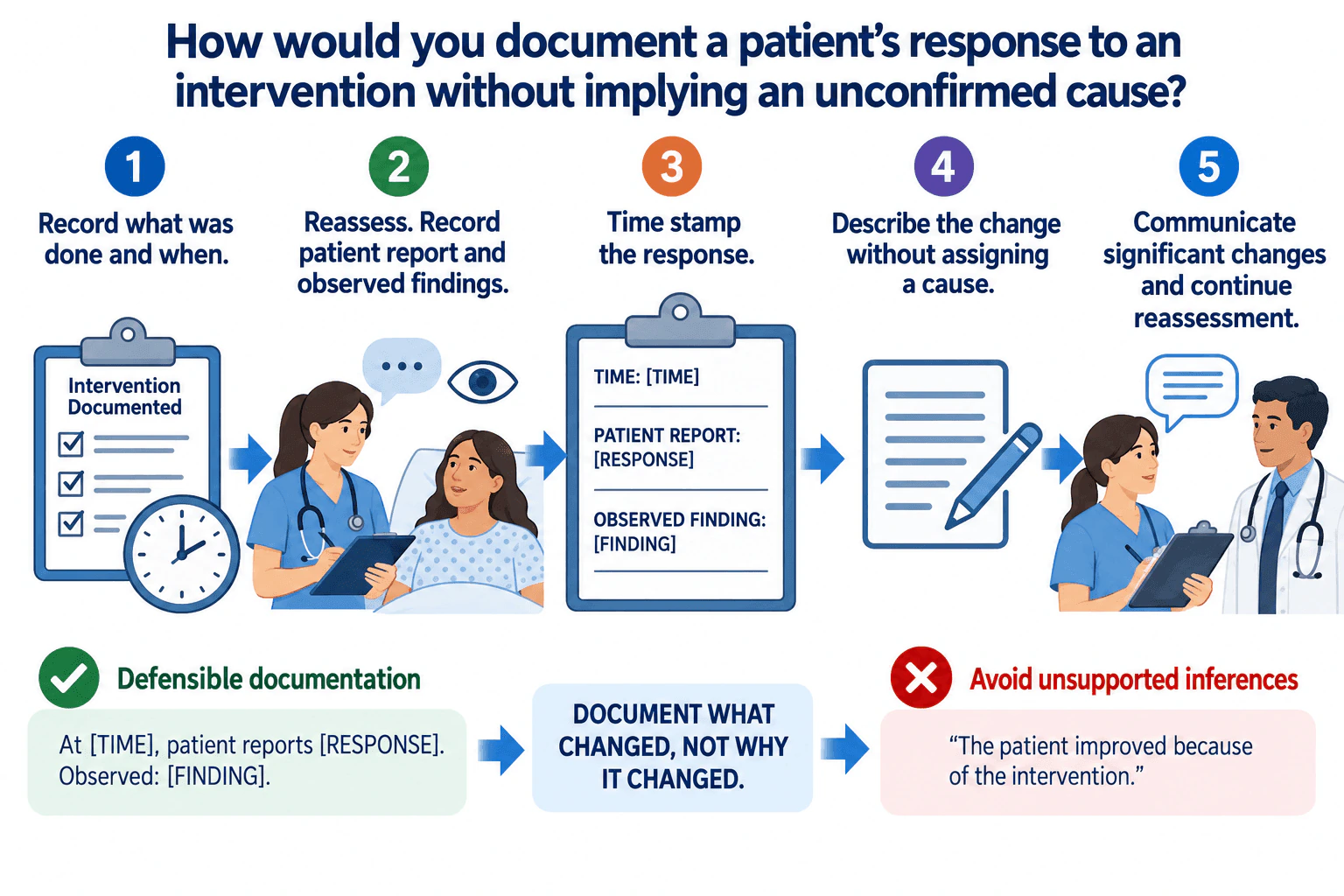
7. How would you document a patient's response to an intervention without implying an unconfirmed cause?NEWDocumentation ComplianceHardCedars Sinai
i Question Details
Original practice question for this employer context, not a reported employer interview question. Explain the relevant ED nursing judgment and identify information or authority you would need. Do not assume an internal employer protocol.
Short Interview Answer (30-60 seconds)
I would chart what was done, when it was done, and what changed on reassessment without claiming why the change occurred. I would separate the patient's report from my observed or measured findings and include the relevant time. A defensible pattern is, "At [TIME], patient reports [RESPONSE]. Observed: [FINDING]." I would not write that the intervention caused improvement unless that conclusion was established. If the response were clinically significant, I would promptly communicate it to the appropriate care team member and continue reassessment.
Detailed Explanation
The key principle is to document what happened and what changed, not to assign an unconfirmed cause. The medical record should accurately reflect care that was actually provided, the patient's response, and the timing of relevant entries. In an emergency department record, I would separate the intervention, reassessment, and patient response so another clinician can reconstruct the sequence without having to infer what occurred.
Useful Questions to Ask the Interviewer
What documentation standards or approved terminology does the organization use for reassessment after an intervention?
How are significant changes and required notifications documented in the local workflow?
Are there specific documentation expectations for pending follow up or transfer of responsibility during handoff?
How to Explain It in an Interview
Observed Findings And Timeline
I would first document only care that was actually performed and record the relevant time. Then I would reassess the patient and separate subjective information from objective findings. Subjective information is what the patient reports. Objective information is what I directly observe, assess, or measure.
A neutral documentation pattern would be: "At [TIME], patient reports [RESPONSE]. Observed: [FINDING]." The exact findings would come from the actual patient assessment rather than assumptions or a template.
Avoiding Unsupported Causation
I would describe the change without automatically attributing it to the intervention. A change occurring after an intervention does not by itself establish that the intervention caused the change. I can document the actual response and timing, but I should not state that the intervention caused the response unless that conclusion has been established and is appropriate to include in the record.
Communication And Reassessment
If the response represents a clinically significant change, I would promptly communicate it through the appropriate care pathway, document the relevant notification according to applicable policy, and continue reassessment. I would document who received important information and any resulting actions that actually occurred rather than recording anticipated care as completed.
Privacy And Scope
I would use only information needed for the clinical record and authorized communication and avoid unnecessary identifying details outside appropriate clinical systems. I would follow applicable law, professional standards, and hospital policy for documentation, communication, and scope. I would not invent patient findings, document unperformed care, or assume authority that belongs to another designated professional.
The goal is a record that clearly shows what was done, what the patient reported, what was observed, when it occurred, and what follow up actually happened.
Why Interviewers Ask This
This question tests whether the nurse can create an accurate clinical record while separating observation from interpretation. The interviewer is looking for disciplined reassessment, accurate timing, distinction between patient reported and observed findings, avoidance of unsupported causal claims, appropriate communication of significant changes, and awareness that documentation must reflect care that was actually provided.
Common interview mistakes
Common mistakes include documenting an intervention that was not actually performed, using vague language such as "better" without supporting findings, blending the patient's report with the nurse's observation, omitting relevant timing, assuming that a change occurring after an intervention proves the intervention caused it, recording anticipated actions as completed, disclosing unnecessary identifying information, or failing to document clinically important communication and reassessment.
Interview tip
Use a simple sequence in your answer: intervention actually performed, time, patient report, observed findings, neutral description of change, communication if significant, and reassessment. A strong phrase to remember is, "Document what changed, not why it changed unless the cause is established."
Interviewer may ask next
What would you verify before finalizing this documentation?
I would verify that the intervention was actually performed, the time is accurate, the patient report is represented as the patient's report, observed or measured findings match the assessment, and any communication or follow up documented actually occurred. I would also check applicable law, professional standards, and hospital policy when the documentation workflow or responsibility is unclear.
How would your documentation change if the patient deteriorated after the intervention?
I would still avoid assuming that the intervention caused the deterioration. I would document the actual change, the time, the patient's report when available, and my observed or measured findings. I would promptly communicate the deterioration through the appropriate clinical pathway, document the relevant notification and actions that actually occurred, and continue reassessment. Any orders, treatments, transfer decisions, or escalation steps would be documented only if they were actually received, performed, or initiated within the nurse's authorized role.
8. How do you stand out from other applicants?NEWBehavioralMediumCedars Sinai
i Question Details
Answer with truthful strengths and examples from your own nursing experience, education, or clinical training. Connect those examples to emergency nursing judgment, communication, accountability, teamwork, and continued learning without inventing qualifications or outcomes.
Interview tip:
Use STAR to structure your answer: briefly explain the Situation and Task, make Action the most detailed part, and finish with the Result. For example, describe a demanding emergency care experience where you stayed organized, communicated clearly, supported the team, took responsibility for your work, and showed that you were willing to keep learning.
Situation
During a nursing education team exercise, we had to work through a fast changing patient care scenario while several priorities competed for attention. I saw that staying calm and communicating clearly were just as important as completing individual tasks.
Task
My responsibility was to stay focused on the priorities assigned to me, recognize when information changed, communicate important observations, and support the team without losing attention to safety or patient concerns.
Action
I stayed organized by reviewing the most important needs first and keeping track of what still required follow up. I paid close attention when new information was introduced and made sure important changes were communicated promptly to the appropriate team member. I also explained my reasoning in simple language so the group understood what I was prioritizing and why. When I was unsure about something, I asked instead of guessing. I accepted feedback, applied it to the next task, and looked for ways to help the team when my immediate responsibilities were under control. What I believe makes me stand out is that I combine urgency with careful communication. I want to move efficiently, but I do not want speed to replace listening, accountability, or teamwork.
Result
The team stayed organized, communication remained clear, and we were able to work through the scenario together. I learned that being dependable in a fast changing environment means keeping priorities clear, communicating early, accepting feedback, and supporting the team. I bring a calm approach, strong attention to priorities, respect for the team, and a genuine willingness to keep learning. Those are the qualities I would bring to an Emergency Department Nurse role.
Why Interviewers Ask This
Interviewers ask this question to understand what the candidate believes they can contribute beyond basic qualifications. A strong answer shows self awareness and supports the candidate's strengths with a realistic example of judgment, communication, accountability, teamwork, and continued learning.
Interviewer may ask next
Which of those strengths do you think matters most in a busy emergency department?
I would choose staying calm while keeping priorities clear. That approach would help me organize my responsibilities, notice important changes, communicate them promptly, and still make time to explain what was happening to patients. Staying calm would help me make better decisions instead of simply reacting to the pace around me.
What would you apply from the approach you described in this role?
I learned from that exercise that being dependable means more than completing my own tasks. It also means communicating early, asking questions when something is unclear, following through on concerns, and supporting the team when priorities change. I would continue using that approach while remaining open to feedback and learning from more experienced colleagues.
9. Have you experienced a code blue?NEWBehavioralHardCedars Sinai
i Question Details
Answer truthfully about whether you have participated in or observed a code blue. If you have, explain your role, communication, teamwork, accountability, and learning. If you have not, say so and discuss relevant preparation or supervised training without inventing experience.
Interview tip:
Use STAR to structure your answer: briefly explain the Situation and Task, make Action the most detailed part, and finish with the Result. For example, describe whether you have participated in a real code blue or a supervised simulation, what responsibility you had, how you communicated with the team, how you supported safe resuscitation, and what you learned from the experience.
Situation
I have not personally participated in a real code blue, so I would not claim that experience. I have prepared for cardiac arrest response through my nursing education and supervised clinical training so I can understand my role and remain effective during a real emergency.
Task
My responsibility is to recognize the emergency, respond within my assigned nursing role, communicate clearly with the team, and support organized resuscitation without acting beyond my training or assigned responsibilities.
Action
I would focus first on recognizing that the patient is unresponsive and that immediate help is needed. I would activate the emergency response and begin the actions assigned to me. If I were responsible for compressions, I would concentrate on providing high quality CPR and limiting interruptions. I would listen closely to the team leader and use closed loop communication by repeating instructions back and confirming when a task was completed. I would also make sure I clearly stated what I had done so the team had the same information. When another team member took over compressions, I would move out of the way quickly and remain ready for my next assigned task. I would not try to direct treatments or medications that were outside my role. After the event, I would participate in the debrief and review where communication, role clarity, and preparation could improve the response.
Result
My preparation has shown me how important calm communication, clear roles, immediate CPR, and teamwork are during cardiac arrest. It has also taught me that accountability means knowing my responsibility, speaking up when information is important, and staying within my scope while supporting the team. I would bring that same disciplined approach to a real code blue and continue learning from each supervised experience.
Why Interviewers Ask This
Interviewers ask this question to understand whether a nurse can be truthful about clinical experience while also showing readiness for a high acuity emergency. A strong answer demonstrates calm prioritization, teamwork, clear communication, accountability, respect for scope, and an understanding that effective resuscitation depends on coordinated action.
Interviewer may ask next
What have you learned from preparing for a code blue that would help you during a real event?
My preparation has taught me that knowing the clinical steps is only part of an effective response. I also need to listen carefully, understand my assigned role, communicate clearly, and confirm completed tasks. In a real event, I would focus on those basics so I could contribute safely instead of becoming distracted by everything happening around me.
How would you approach a future code blue or supervised simulation?
If I participated in a simulation, I would prepare myself to anticipate the next likely team need while still staying focused on my current assignment. I understand how quickly small communication delays can create confusion. I would be deliberate about concise closed loop communication and immediately reporting when my assigned task was complete.
Emergency Department Nurse Resume Examples
Explore the resume examples below to find the one that best matches your target Emergency Department Nurse role.
New Graduate Emergency Department Nurse0-1 years; supervised transition to emergency nursing
Disclaimer: This interview guide is for educational and informational purposes only. It is designed to help readers prepare, but it does not guarantee any interview result, hiring decision, offer, or outcome. Interview questions, hiring criteria, and preferred answers can vary by employer, interviewer, industry, location, and time. All answers, examples, and explanations in this guide are suggested examples for interview preparation, not definitive answers or instructions for professional practice. They are based on research and judgment, are provided without warranties of any kind, and should be adapted to the question, role, and applicable laws and professional requirements. Diagrams are simplified illustrations intended to highlight the main concepts and their relationships; actual situations, systems, and practices may be more complex. Alternative approaches may be equally valid or better suited to a particular question, context, or interviewer. To the fullest extent permitted by applicable law, the contributors and publisher are not liable for decisions made, actions taken, or losses incurred based on this guide.
State Laws and Professional Responsibilities: Laws and requirements governing an occupation vary by state and jurisdiction. You are responsible for checking the current laws, licensing requirements, and scope-of-practice rules that apply to your location and role, and for ensuring that your answers and actions comply with them. Adapt examples in this guide to those requirements. This guide is not legal advice.
Company Notice: This guide is an independent educational resource and is not affiliated with, endorsed by, sponsored by, or approved by the company named in this guide. Company names identify reported interview experiences or the employer context of clearly labeled original practice exercises. Interview practices can change without notice, and inclusion of company-specific content does not mean these questions are official, complete, or guaranteed to be asked. To the fullest extent permitted by law, the author, contributors, and publisher are not responsible for outcomes related to use of this material.
Content Accuracy and Verification: To the fullest extent permitted by applicable law, we do not represent or warrant that interview guides, questions, answers, examples, or diagrams are accurate, complete, current, error-free, or suitable for any particular purpose. You are responsible for independently reviewing and verifying the information before relying on it.