This interview guide is for educational and informational purposes only. It is designed to help readers prepare, but it does not guarantee any interview result, hiring decision, offer, or outcome. Interview questions, hiring criteria, and preferred answers can vary by employer, interviewer, industry, location, and time. All answers, examples, and explanations in this guide are suggested examples for interview preparation, not definitive answers or instructions for professional practice. They are based on research and judgment, are provided without warranties of any kind, and should be adapted to the question, role, and applicable laws and professional requirements. Diagrams are simplified illustrations intended to highlight the main concepts and their relationships; actual situations, systems, and practices may be more complex. Alternative approaches may be equally valid or better suited to a particular question, context, or interviewer. To the fullest extent permitted by applicable law, the contributors and publisher are not liable for decisions made, actions taken, or losses incurred based on this guide.
State Laws and Professional Responsibilities
Laws and requirements governing an occupation vary by state and jurisdiction. You are responsible for checking the current laws, licensing requirements, and scope-of-practice rules that apply to your location and role, and for ensuring that your answers and actions comply with them. Adapt examples in this guide to those requirements. This guide is not legal advice.
Identity, Image, and Privacy Notice
To respect individual privacy, some names, profile photographs, avatars, biographical details, and other identifying information displayed in this guide may be replaced with pseudonyms, licensed stock images, illustrative avatars, composite images, or representative descriptions. Unless a person is expressly identified as an actual contributor, a displayed name, image, or profile should not be understood as depicting or identifying a specific candidate, interviewer, employee, or other real individual. These representations are provided for editorial and illustrative purposes only and do not imply endorsement, employment, participation, or affiliation with this guide or any company mentioned in it. Any resemblance to an actual person is coincidental.
Company Notice
This guide is an independent educational resource and is not affiliated with, endorsed by, sponsored by, or approved by the company named in this guide. Company names identify reported interview experiences or the employer context of clearly labeled original practice exercises. Interview practices can change without notice, and inclusion of company-specific content does not mean these questions are official, complete, or guaranteed to be asked. To the fullest extent permitted by law, the author, contributors, and publisher are not responsible for outcomes related to use of this material.
Content Accuracy and Verification
To the fullest extent permitted by applicable law, we do not represent or warrant that interview guides, questions, answers, examples, or diagrams are accurate, complete, current, error-free, or suitable for any particular purpose. You are responsible for independently reviewing and verifying the information before relying on it.
Questions or comments?
Contact us for general questions, or share feedback, technical corrections, and comments with the community.
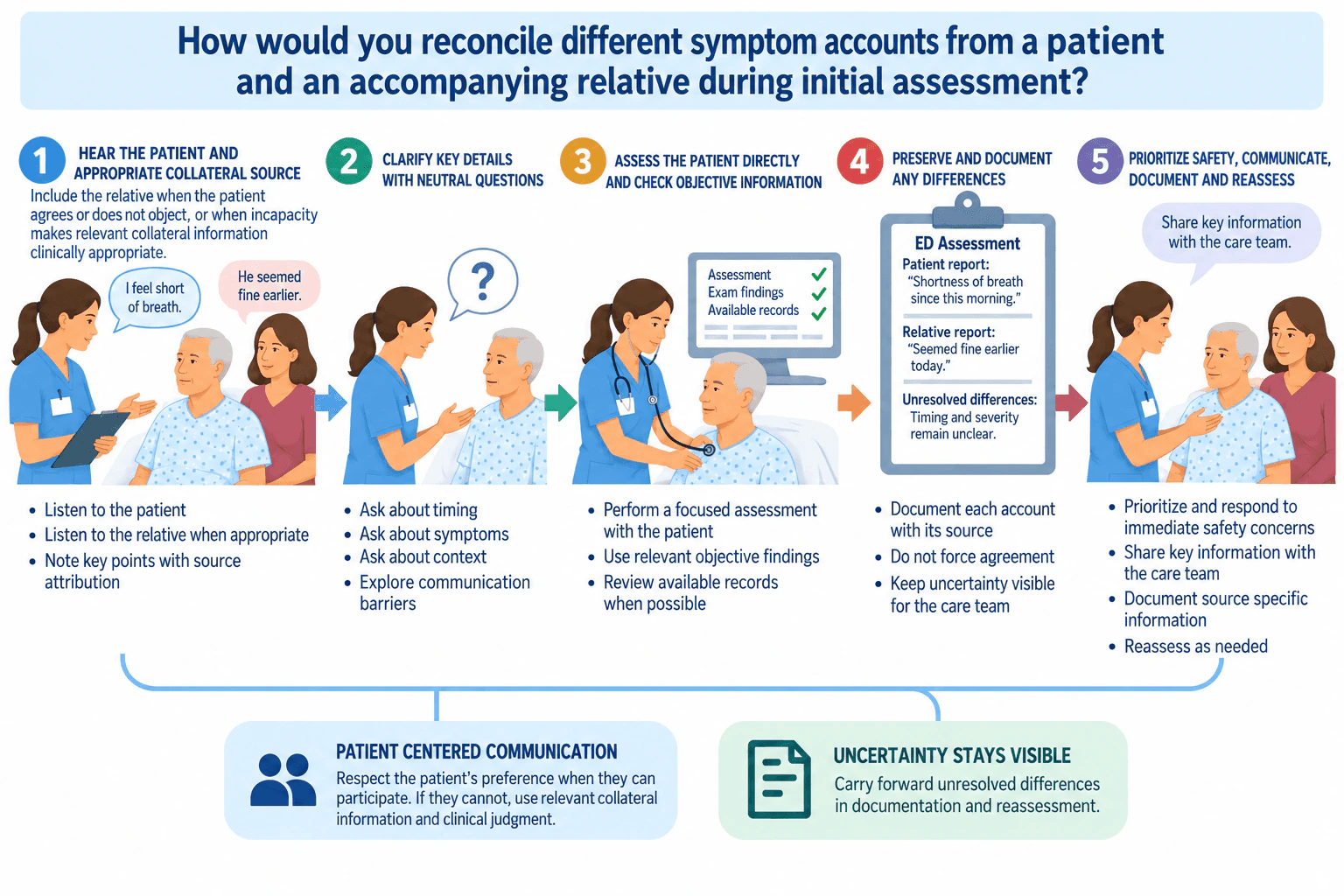
1. How would you reconcile different symptom accounts from a patient and an accompanying relative during initial assessment?Clinical KnowledgeEasyMayo Clinic
i Question Details
Original practice question for this employer context, not a reported employer interview question. Explain the relevant ED nursing judgment and identify information or authority you would need. Do not assume an internal employer protocol.
Short Interview Answer (30-60 seconds)
I would hear the patient first and use the relative as an appropriate collateral source rather than deciding immediately that one account is correct. I would clarify differences with neutral questions, assess the patient directly, compare both accounts with relevant objective findings and available records, and document who reported each detail. I would not force agreement when uncertainty remains. I would prioritize any immediate safety concern, communicate meaningful discrepancies to the care team, and reassess as new information becomes available.
Detailed Explanation
The goal is not to decide which person is right. The goal is to establish what each person is reporting, assess the patient directly, identify any immediate clinical risk, and keep unresolved uncertainty visible rather than blending two different histories into one.
Useful Questions to Ask the Interviewer
Is the patient able to communicate clearly and participate in the assessment?
Has the patient indicated whether the accompanying relative may participate in the discussion?
What objective information or prior records are available to help clarify the timeline or symptoms?
How to Explain It in an Interview
Start with the patient
I would begin with the patient whenever the patient can participate. I would listen without interruption and establish the patient's description of symptoms, timing, severity, and relevant context. I would then hear the relative's account when appropriate and keep the two sources clearly attributed rather than combining them prematurely.
Clarify the difference
I would use neutral questions about when the change was first noticed, what exactly was observed, and whether each person is describing a different point in time. A relative saying the patient seemed fine earlier does not invalidate a patient's current report. It may simply describe an earlier time.
Assess the patient directly
I would perform the focused nursing assessment appropriate to the presenting concern and compare both histories with current findings and relevant available records. I would not invent missing findings or assume that a disagreement establishes a diagnosis. Current instability or another immediate safety concern takes priority over resolving the history perfectly.
Preserve uncertainty and attribution
If the accounts remain different, I would document each account with its source and record relevant objective findings separately. I would not force agreement or chart uncertain information as established fact. This keeps the clinical reasoning transparent for the care team.
Respect patient preference and privacy
In the United States, when a patient is present and has decision making capacity, relevant information may be discussed with a family member or other involved person when the patient agrees, does not object after an opportunity to do so, or professional judgment reasonably supports an inference that the patient does not object. If incapacity or an emergency circumstance prevents the patient from participating, professional judgment and the patient's best interests guide disclosure, and only information directly relevant to the person's involvement should be shared. hhs.gov
Communicate and reassess
I would communicate clinically important discrepancies and safety concerns to the appropriate care team members, continue reassessing the patient, and update the documented picture as new information becomes available.
Why Interviewers Ask This
This question evaluates whether the nurse can remain patient centered while handling conflicting information without dismissing either source, making unsupported assumptions, or allowing disagreement to delay recognition of an urgent problem. It also tests focused assessment, neutral communication, source attribution, privacy awareness, documentation, escalation, teamwork, and reassessment.
Common interview mistakes
Common mistakes include automatically believing one account over the other, treating the relative's report as a replacement for the patient's own account, asking leading questions, merging conflicting histories into one undocumented version, inventing clinical findings to resolve the discrepancy, delaying attention to an immediate safety concern while trying to settle the history, sharing information with a relative without considering the patient's preference or capacity, and failing to document which source provided each statement.
Interview tip
Frame the answer around three ideas: keep the patient central, preserve source attribution and uncertainty, and let direct assessment plus relevant objective information guide urgency. Avoid claiming that your task is to prove which person is correct. Show that you can manage disagreement while protecting safety, privacy, communication, and reassessment.
Interviewer may ask next
How would you verify which account is more clinically useful when the stories conflict?
I would clarify timing and exact observations with each source, perform a focused assessment of the patient, review relevant available records, and compare the information without assuming that one source must be completely correct. I would document each account with its source and distinguish reported information from objective findings. If the difference could affect immediate safety or care, I would communicate it to the appropriate clinician and continue reassessment.
What would change if the patient could not reliably participate in the assessment?
I would rely more heavily on relevant collateral history, direct nursing assessment, objective findings, and available records while clearly documenting the limits of the history. In a United States setting, if incapacity or an emergency circumstance prevents the patient from agreeing or objecting, relevant information may be shared with a person involved in care when professional judgment determines that doing so is in the patient's best interests. Only information directly relevant to that person's involvement should be disclosed. hhs.gov I would still avoid presenting uncertain collateral information as established fact and would reassess as the patient's ability to participate changes.
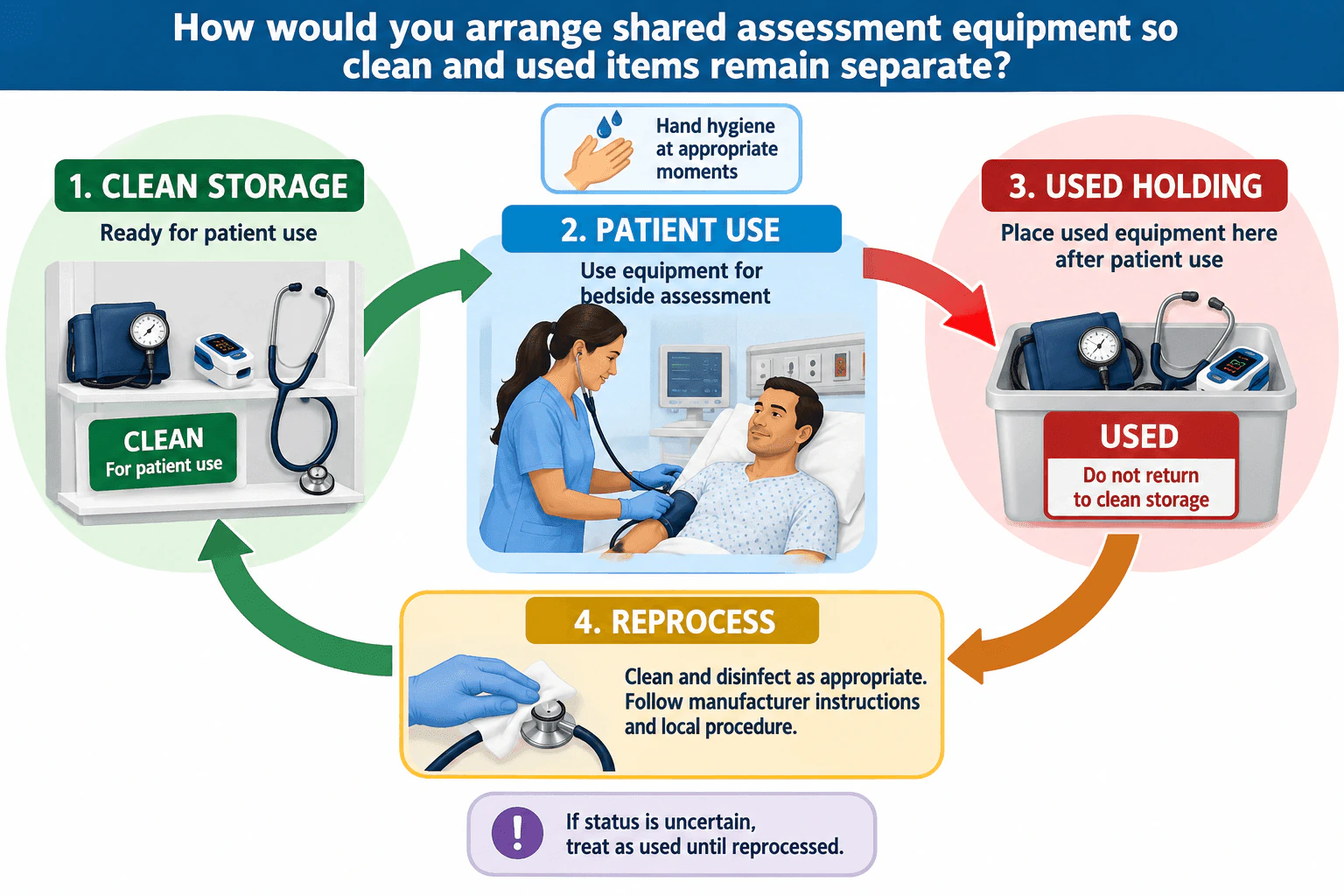
2. How would you arrange shared assessment equipment so clean and used items remain separate?Patient SafetyEasyMayo Clinic
i Question Details
Original practice question for this employer context, not a reported employer interview question. Explain the relevant ED nursing judgment and identify information or authority you would need. Do not assume an internal employer protocol.
Short Interview Answer (30-60 seconds)
I would arrange the equipment as a one direction workflow: clean equipment in a clearly designated storage area, equipment taken from there for patient use, and used equipment placed immediately in a separate designated holding area. Reusable equipment would then be cleaned and disinfected as appropriate according to manufacturer instructions and local procedures before returning to clean storage. I would also perform hand hygiene at appropriate moments and, if I could not verify whether an item was clean, I would treat it as used until its status was verified and required reprocessing was complete.
Detailed Explanation
The main principle is to prevent used equipment from crossing back into the clean supply path before it has been appropriately reprocessed. I would organize the physical space so equipment moves in one clear direction: clean storage, patient use, used holding, reprocessing, then back to clean storage. Current CDC core infection prevention guidance states that reusable medical equipment should be cleaned and reprocessed before use on another patient and that clean and soiled equipment should remain separated to prevent cross contamination. cdc.gov
Useful Questions to Ask the Interviewer
Where is the designated clean storage area and the designated location for used equipment on this unit?
Which staff role is responsible for reprocessing each type of shared assessment equipment?
Where are the manufacturer instructions and facility procedures for cleaning and disinfection located?
How to Explain It in an Interview
I would start by creating an obvious physical boundary between equipment that is ready for patient use and equipment that has already been used. Clean items such as reusable blood pressure cuffs, pulse oximeter probes, or stethoscopes would stay only in the designated clean area. CDC guidance specifically calls for separation between clean and soiled equipment to prevent cross contamination. cdc.gov
When I take an item for bedside assessment, it leaves the clean area. After patient use, I would place it directly in the designated used holding area rather than putting it back with clean supplies. That creates a simple visible workflow and reduces the chance that another clinician accidentally selects an item that has not been reprocessed.
Before the item returns to clean storage, it must be cleaned and disinfected or otherwise reprocessed as appropriate for that device. I would follow the manufacturer instructions and the applicable local procedure. CDC guidance directs healthcare facilities to consult and adhere to manufacturer instructions when reprocessing reusable medical equipment. cdc.gov
I would perform hand hygiene at appropriate moments and avoid moving potentially contaminated equipment back into the clean area. If I found equipment whose status was unclear, I would not assume it was clean. I would keep it in the used pathway until its status was verified and any required reprocessing was completed.
For a patient requiring Contact Precautions, I would follow the applicable precautions and local process. When feasible, disposable or patient dedicated noncritical equipment can reduce sharing. If common equipment must be shared, CDC guidance calls for cleaning and disinfection before use on another patient. cdc.gov
Why Interviewers Ask This
This evaluates whether the nurse can translate infection prevention principles into a simple physical workflow that reduces cross contamination. The interviewer is looking for clear separation of clean and used equipment, appropriate reprocessing before reuse, recognition of manufacturer instructions and local procedures, and safe judgment when an item's status is uncertain.
Common interview mistakes
Common mistakes include storing used equipment beside clean equipment, returning an item to clean storage before required reprocessing is complete, assuming an unlabeled or uncertain item is clean, using a cleaning product or process without checking the device manufacturer instructions, and failing to clarify who is responsible for reprocessing shared equipment.
Interview tip
Describe the arrangement as one visible flow: clean storage, patient use, used holding, reprocessing, then return to clean storage. Emphasize that the physical separation prevents accidental reuse and that manufacturer instructions and local procedures determine the correct reprocessing method.
Interviewer may ask next
How would you verify that a shared item is safe to return to clean storage?
I would verify that the required cleaning, disinfection, or other reprocessing has been completed using the manufacturer instructions and the applicable facility procedure. I would also confirm that the item's status is clearly identifiable according to the local process. If I could not verify its status, I would keep it out of clean storage until verification and any required reprocessing were complete.
What would change if the patient were on Contact Precautions?
I would follow the applicable Contact Precautions and local procedure. When feasible, I would use disposable or patient dedicated noncritical equipment. If common equipment had to be shared, it would remain in the used pathway after patient contact and would be cleaned and disinfected before use with another patient. CDC guidance supports disposable or patient dedicated equipment for Contact Precautions when possible and cleaning and disinfection before reuse when sharing is unavoidable. cdc.gov
3. How would you explain why another patient is being seen first without disclosing that patient's information?Communication And DelegationMediumMayo Clinic
i Question Details
Original practice question for this employer context, not a reported employer interview question. Explain the relevant ED nursing judgment and identify information or authority you would need. Do not assume an internal employer protocol.
Short Interview Answer (30-60 seconds)
I would first acknowledge the patient's frustration. Then I would explain that emergency department patients are prioritized according to clinical urgency, so they may not always be seen in arrival order. I would not disclose anything about the other patient's condition. I would say, "I cannot discuss another patient's medical information, but I can focus on your care and make sure we know if your symptoms have changed." I would reassess new concerns as appropriate, escalate any concerning change, and confirm understanding when needed.
Detailed Explanation
The safest approach is to explain the triage principle without using another patient's medical information as the explanation. In the United States, a January 2025 joint policy statement from the American College of Emergency Physicians and the Emergency Nurses Association describes emergency department triage as a rapid evaluation of patient acuity used to establish the order or location in which a patient should be seen. HHS privacy guidance also supports limiting unnecessary disclosure of protected health information. The exact interview focus is confidential, empathetic communication while maintaining appropriate nursing judgment.
Useful Questions to Ask the Interviewer
What interpreter resources are available when a patient needs qualified language assistance?
What is the expected escalation pathway when a waiting patient's condition changes?
How to Explain It in an Interview
Nursing Priorities
I would start by acknowledging the patient's concern without becoming defensive. I would explain that emergency departments prioritize patients according to how urgently they need medical care, so the order may change. I would not reveal why a specific other patient was prioritized or disclose that person's symptoms, diagnosis, treatment, or acuity.
I might say, "I understand that waiting is frustrating. We assess patients according to how urgently they need care, so patients are not always seen in arrival order. I cannot discuss another patient's medical situation, but I can focus on your care and make sure we know if anything has changed."
Patient Context
I would then return attention to the patient in front of me. If the patient reported new or worsening symptoms, I would perform the appropriate nursing reassessment within my role and communicate concerning findings to the appropriate clinical team member. I would follow applicable state law, nurse practice rules, and local policy when assigning or delegating tasks. Nursing judgment and critical decision making are not delegated to assistive personnel.
If a language barrier affected communication, I would use a qualified medical interpreter through available clinical resources rather than relying on an unqualified person for important clinical communication.
Clinical Rationale
The goal is to protect privacy while maintaining trust and patient safety. I would give enough information for the patient to understand the general process without using another person's health information to justify it.
When understanding needs confirmation, I can use teach back by asking the patient to explain the process in their own words. This checks whether I communicated clearly rather than testing the patient.
If competing assignments prevented timely reassessment or communication, I would alert the appropriate nurse or leader and use closed loop communication to confirm who is assuming responsibility for the needed follow up.
Why Interviewers Ask This
This question evaluates whether the nurse can combine empathy, confidentiality, emergency department prioritization, reassessment, and clear communication. It also tests whether the nurse can explain why care order may change without revealing another patient's symptoms, diagnosis, acuity, treatment, or other protected information.
Common interview mistakes
Common mistakes include revealing another patient's symptoms or severity to justify the delay, saying that another patient is more important, promising an exact wait time without reliable information, becoming defensive, ignoring new symptoms because the conversation began as a complaint about waiting, or assuming that agreement means understanding. Another mistake is assigning nursing assessment, clinical reasoning, nursing judgment, or critical decision making to assistive personnel. Delegation must account for applicable state law, the delegatee's competence, appropriate supervision, and the nurse's continuing accountability for nursing judgment.
Interview tip
Use the actual words you would say to the patient. A strong response combines empathy, a simple explanation of acuity based prioritization, a firm privacy boundary, and a return to the patient's current safety. Then explain how you would respond to changed symptoms and how you would verify understanding when necessary.
Interviewer may ask next
How would you verify that the patient understood your explanation?
I would not rely only on a yes response to a question such as whether everything makes sense. If understanding needs confirmation, I would use teach back in a respectful way. For example, I might say, "Just so I know I explained this clearly, can you tell me how the emergency department decides who needs to be seen first?" If the response showed misunderstanding, I would explain the process again in simpler language and check understanding again. AHRQ describes teach back as asking patients or family caregivers to explain information in their own words so the clinician can confirm that the explanation was clear.
What would you do if the waiting patient suddenly reported worsening symptoms during this conversation?
The priority would immediately shift from explaining the wait to evaluating the patient's current condition. I would perform the appropriate nursing reassessment within my role, communicate concerning findings promptly to the appropriate clinical team member, and follow the applicable process for reprioritization. I would not assume that the original triage priority still reflected the patient's condition. I also would not delegate nursing judgment or critical decision making to assistive personnel. If another team member assumed a permitted task, I would communicate the responsibility clearly and confirm the handoff using closed loop communication.
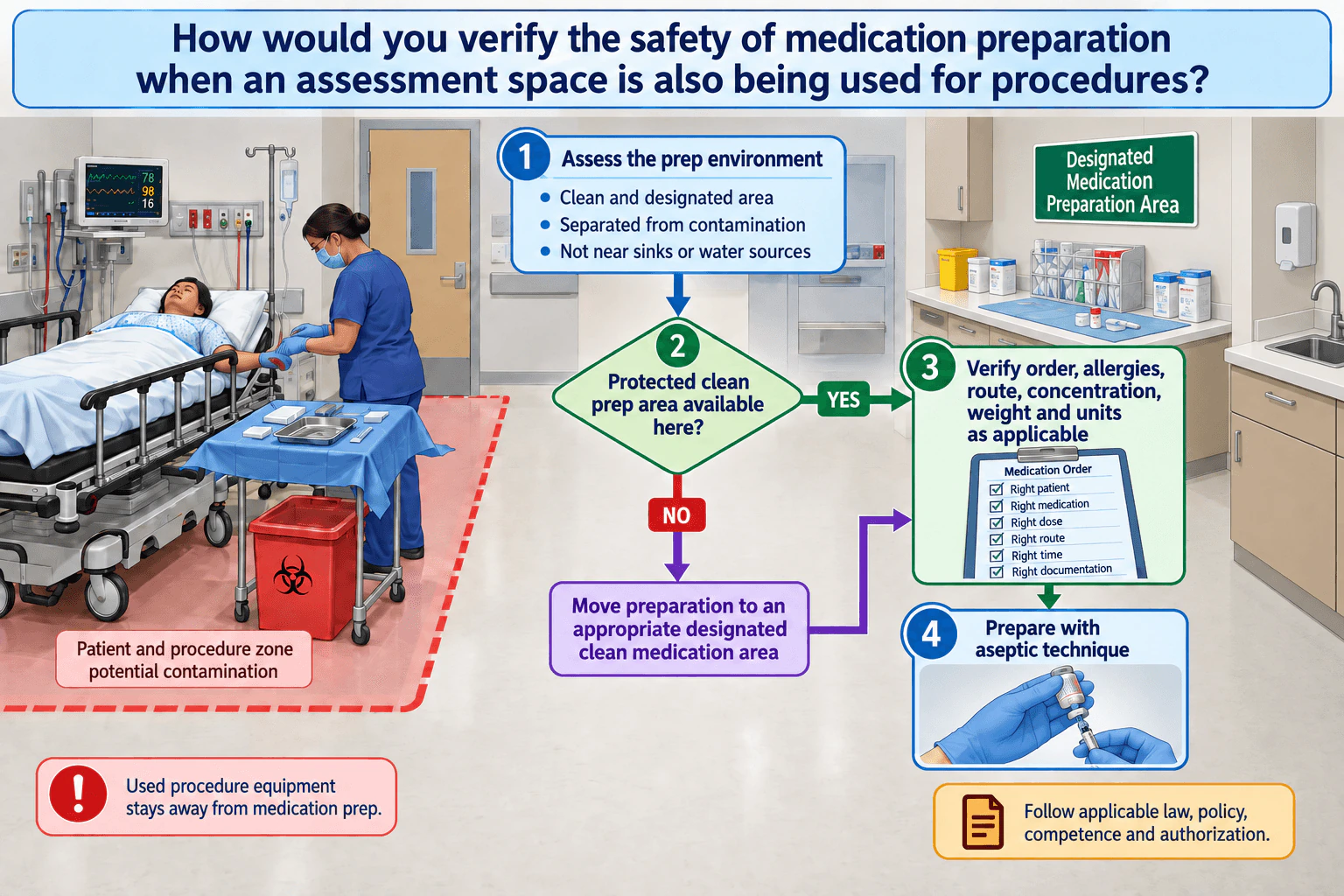
4. How would you verify the safety of medication preparation when an assessment space is also being used for procedures?Medication And ProceduresMediumMayo Clinic
i Question Details
Original practice question for this employer context, not a reported employer interview question. Explain the relevant ED nursing judgment and identify information or authority you would need. Do not assume an internal employer protocol.
Short Interview Answer (30-60 seconds)
I would first confirm that medication preparation can occur in a designated clean area separated from the procedure, used equipment, sinks, and other contamination sources. If that protected area is not available, I would move preparation to an appropriate designated clean medication area. I would verify the authorized order, correct patient, allergies, medication, route, concentration, supplied weight, and units as applicable, then prepare using aseptic technique. I would also follow applicable law, nursing scope, competency, authorization, and local policy rather than assuming the shared room is automatically safe.
Detailed Explanation
The key decision is whether medication preparation can remain protected from contamination while procedures are occurring in the same assessment space. I would not treat the room itself as either safe or unsafe without assessing where medication preparation occurs and what contamination risks are present.
Useful Questions to Ask the Interviewer
Is there a designated clean medication preparation area that is physically separated from procedure activity and used equipment?
What local policy defines where medications may be prepared when the assessment space is also being used for procedures?
What authorization or competency requirements apply to the medication or procedure involved?
How to Explain It in an Interview
Assess The Preparation Environment
I would first look for a designated clean medication preparation area. It should be separated from procedure activity, used equipment, and potential environmental contamination such as sinks or other water sources. Used procedure equipment should remain outside the medication preparation area.
Decide Whether Preparation Can Occur There
If a protected clean preparation area is available and meets applicable policy, I can continue the safety verification process there. If it is not available, I would move medication preparation to an appropriate designated clean medication area rather than trying to create a temporary preparation surface beside the procedure.
Verify The Medication Before Preparation
Before preparing the medication, I would verify the authorized order and the relevant patient and medication information. Depending on the medication, that includes confirming the correct patient, allergies, medication, route, concentration, supplied weight, and units. I would not invent a dose or calculation when the required inputs are missing.
Prepare Using Aseptic Technique
Once the medication and patient information are verified, I would prepare the medication using aseptic technique in the protected clean area. I would keep contaminated or used procedure items away from that workspace.
Apply Scope And Local Authority
I would follow applicable law, nursing scope, competency, authorization, and local policy. If there were uncertainty about whether the space or activity was permitted, I would clarify the requirement before proceeding rather than assuming a universal rule.
Why Interviewers Ask This
This question evaluates whether the nurse can recognize contamination risk in a shared clinical space, protect medication preparation from procedure related contamination, verify patient specific medication information before preparation, and distinguish safe nursing judgment from assumptions about local policy or authority.
Common interview mistakes
Common mistakes include preparing medication beside used procedure equipment, treating any open counter as a clean preparation area, preparing near a sink or other contamination source, verifying medication details only after preparation, assuming local policy without checking it, or proceeding when the order, concentration, weight, units, competency, or authorization needed for safe preparation is unclear.
Interview tip
Describe the decision in the same order you would act: assess whether a protected clean preparation area exists, relocate preparation if it does not, verify the medication and patient specific information, then use aseptic technique. Make clear that you would follow applicable scope and local policy rather than claim that every shared assessment room is managed the same way.
Interviewer may ask next
What medication information would you verify before preparation?
I would verify the authorized order and the relevant patient and medication information, including the correct patient, allergies, medication, route, concentration, supplied weight, and units as applicable. If a calculation were required, I would confirm all necessary inputs and independently check the arithmetic before preparation rather than inventing missing values.
What would you do if the procedure had already placed used equipment near the medication preparation surface?
I would treat that location as unsuitable for medication preparation and move preparation to an appropriate designated clean medication area. I would keep used procedure equipment outside that area, use aseptic technique, and follow applicable local infection prevention and medication safety policy before proceeding.
5. How would you adjust your approach when a caregiver answers every question directed to an adolescent?Trauma And Special PopulationsMediumMayo Clinic
i Question Details
Original practice question for this employer context, not a reported employer interview question. Explain the relevant ED nursing judgment and identify information or authority you would need. Do not assume an internal employer protocol.
Short Interview Answer (30-60 seconds)
I would respectfully redirect the conversation to the adolescent rather than confront or exclude the caregiver. I would acknowledge the caregiver's input, ask the adolescent the question directly, and assess whether there is a clinical, developmental, language, or communication reason they are not answering independently. When appropriate, I would create an opportunity for private conversation, explain confidentiality and its limits, and follow applicable law and local policy. I would continue to involve the caregiver appropriately while making sure the adolescent's own symptoms, concerns, preferences, and safety information are heard.
Detailed Explanation
The goal is to hear directly from the adolescent while preserving a respectful relationship with the caregiver. A caregiver answering repeatedly can have many explanations, so I would not assume coercion, abuse, or impaired decision making from that behavior alone.
Useful Questions to Ask the Interviewer
Is there a known communication, developmental, cognitive, language, or clinical reason the adolescent cannot answer independently?
What is the caregiver's legal relationship to the adolescent, and are there known consent or custody considerations?
Are there immediate safety concerns that affect how privacy or caregiver involvement should be handled?
How to Explain It in an Interview
Patient Context
I would address the adolescent directly and give them a clear opportunity to answer. I might tell the caregiver, "Thank you. I want to hear from both of you, and I would like to let them answer this question first." This keeps the interaction respectful while making the adolescent an active participant.
I would assess why the caregiver is answering. The adolescent may be frightened, acutely ill, injured, in pain, have developmental or communication needs, require an interpreter, or prefer caregiver assistance. I would respond to the actual need rather than assume family dysfunction.
Nursing Priorities
When clinically appropriate, I would normalize some private conversation as part of adolescent care rather than present it as a response to suspicion. American Academy of Pediatrics guidance describes consistent opportunities for adolescents to speak privately with health professionals as developmentally appropriate. publications.aap.org
During private conversation, I would assess relevant symptoms, concerns, safety issues, and information the adolescent may be uncomfortable discussing with the caregiver present. I would explain that confidentiality has limits and may need to be broken when required by law or necessary to address serious safety concerns. publications.aap.org
Clinical Rationale
Within bedside emergency nursing scope, I can redirect communication, assess the patient's ability to participate, use appropriate communication resources, observe interactions, document objectively, and escalate concerns. Decisions involving minor consent, disclosure of protected information, reporting requirements, or treatment authority must follow applicable law, professional responsibilities, and local policy. Under the HIPAA Privacy Rule, a parent or guardian is generally the personal representative of an unemancipated minor, but specified exceptions exist, including circumstances in which applicable law allows the minor to consent to particular care. hhs.gov
If the interaction raised a safety concern, I would assess further and escalate through the appropriate clinical and safeguarding pathway without assigning motives that the evidence does not support.
Why Interviewers Ask This
This question evaluates whether the nurse can obtain the adolescent's own history while maintaining a respectful caregiver relationship, recognizing developmental autonomy, identifying communication or safety barriers, and remaining within nursing scope. It also tests whether the nurse understands that adolescent confidentiality is important but not absolute and that applicable law affects consent and access to information. American Academy of Pediatrics guidance recommends developmentally appropriate opportunities for adolescents to speak privately with health professionals and recognizes circumstances in which confidentiality may need to be limited for safety or legal requirements. publications.aap.org
Common interview mistakes
Common mistakes include directing the entire assessment to the caregiver, abruptly excluding the caregiver, assuming the caregiver's behavior proves abuse or coercion, promising absolute confidentiality, assuming every minor has the same consent rights, failing to assess communication barriers, and documenting conclusions instead of objective observations and patient statements.
Interview tip
Show that you can balance three responsibilities at once: obtain the adolescent's own history, preserve a constructive caregiver relationship, and protect safety and confidentiality within applicable law and nursing scope. Explain what you would actually say to redirect the conversation and avoid assuming either that the caregiver should control the interview or that the caregiver has no legitimate role.
Interviewer may ask next
How would you verify what confidentiality rules apply before discussing sensitive information with the adolescent?
I would verify the adolescent's age, the caregiver's legal relationship, the type of care involved, and any relevant consent information already available. I would then follow applicable state law, federal privacy requirements, and the organization's approved policy, and I would seek guidance from the appropriate clinician, supervisor, privacy resource, or other designated resource when authority is unclear. I would not make my own legal assumption. Federal HIPAA guidance states that a parent is generally the personal representative of an unemancipated minor, but specified exceptions apply when state or other law gives the minor authority to consent to particular care or when another legally authorized decision maker controls that care. hhs.gov
What would change if the adolescent became visibly distressed whenever the caregiver answered for them?
I would treat the distress as an important observation without assuming its cause. I would maintain immediate clinical priorities, provide a safe opportunity for the adolescent to communicate privately when clinically and legally appropriate, and assess relevant safety concerns using age appropriate communication. If the assessment suggested abuse, neglect, exploitation, imminent danger, or another reportable concern, I would escalate through the appropriate clinical and safeguarding process and follow applicable reporting requirements. I would document observable behavior and the adolescent's own statements accurately rather than assigning a motive to the caregiver.
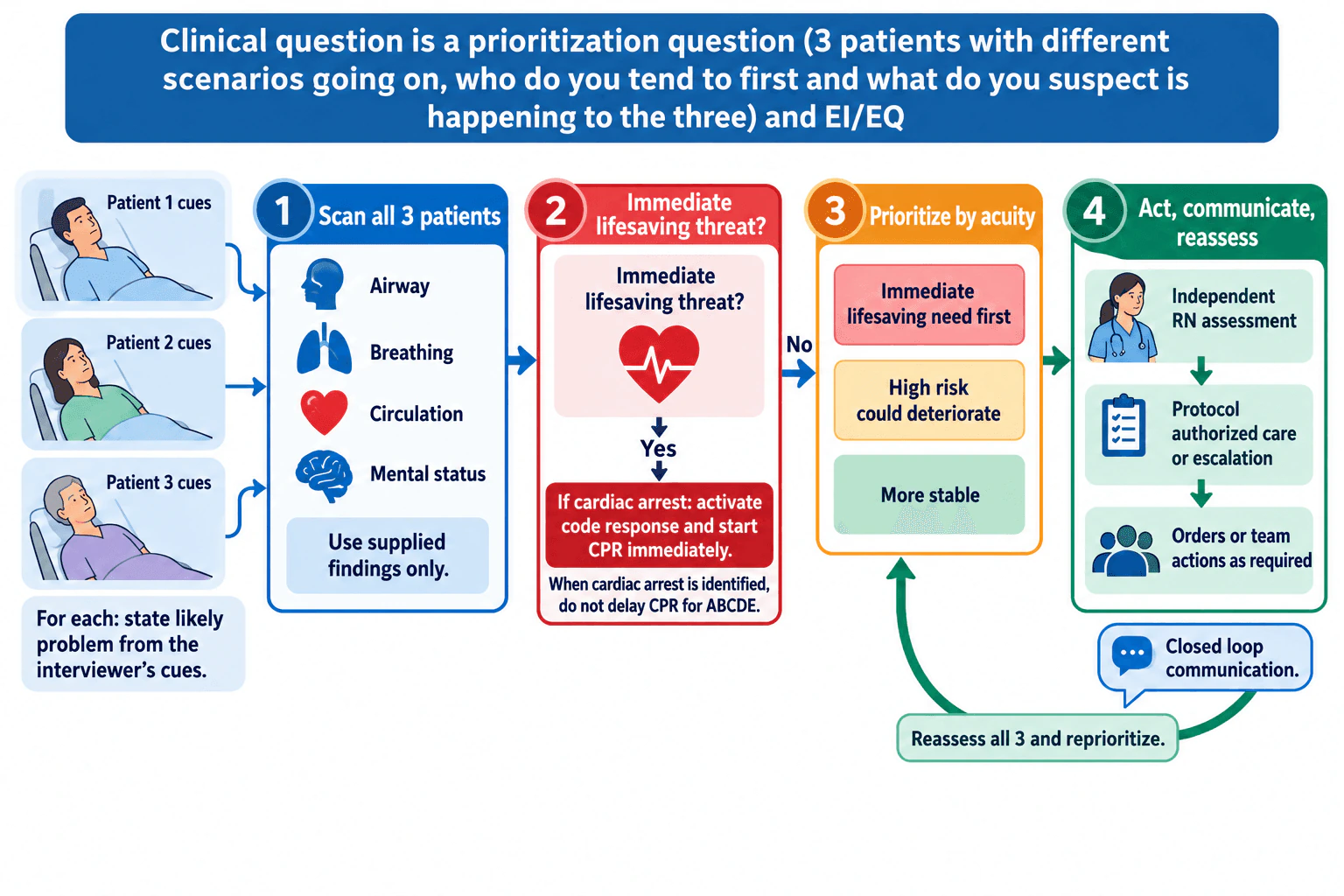
6. Clinical question is a prioritization question (3 patients with different scenarios going on, who do you tend to first and what do you suspect is happening to the three) and EI/EQScenario BasedEasyMayo Clinic
i Question Details
Use the patient scenarios supplied by the interviewer. Identify which patient you would assess first, explain what you suspect is occurring with each patient, justify the priority, and describe the assessment, escalation, reassessment, and team communication that support safe emergency nursing care.
Short Interview Answer (30-60 seconds)
I would first scan all three patients for an immediate lifesaving threat and go to the patient with the greatest current acuity. I would use the supplied cues to assess airway, breathing, circulation, and mental status and explain what I suspect for each patient without inventing missing findings. If the cues establish cardiac arrest, I would activate the emergency response and begin population appropriate resuscitation immediately rather than delaying for a full sequential assessment. For an adult with no normal breathing or only gasping and no definite pulse within 10 seconds, current 2025 AHA guidance directs starting CPR and using an AED or defibrillator as soon as available. cpr.heart.org I would then prioritize the remaining patients by risk of deterioration, communicate with the team using closed loop communication, carry out independent, protocol authorized, and ordered actions within the appropriate scope, and reassess all three patients because the priority can change.
Detailed Explanation
The safest way to answer this question is to show that priority comes from the patients' current clinical threats, not from room number, arrival order, or a diagnosis guessed from incomplete information. Because the three patient scenarios are not supplied here, I would not assign a fixed first patient or invent diagnoses. I would explain how I would compare the actual cues the interviewer gives me.
Useful Questions to Ask the Interviewer
What are the current symptoms, vital signs, mental status, and major changes for each patient?
Is any patient unresponsive, having abnormal or absent breathing, showing severe respiratory distress, active major bleeding, or another immediate threat to life?
What care has already been started, and are any protocol authorized actions or current orders already in place?
How to Explain It in an Interview
I would begin with a rapid scan of all three patients and identify whether anyone has an immediate lifesaving threat. Emergency triage is intended to identify patients who cannot safely wait. Patients requiring immediate lifesaving intervention take priority over patients who are high risk but do not currently require that level of intervention. psnet.ahrq.gov
Immediate Actions
I would quickly assess the supplied findings for airway, breathing, circulation, and mental status. If the scenario establishes cardiac arrest, I would activate the emergency response and start indicated resuscitation immediately rather than delaying to complete a routine sequential ABCDE assessment. For an adult scenario, current 2025 AHA guidance directs CPR when there is no normal breathing or only gasping and no definite pulse is felt within 10 seconds. cpr.heart.org
If there is another immediate lifesaving threat, I would respond to that threat within my nursing scope and applicable emergency protocols rather than treating cardiac arrest as the only emergency that can come first. If no patient has an immediate lifesaving need, I would next prioritize the patient at greatest risk of rapid deterioration, then the more stable patient. I would state what I suspect is happening with each person only from the interviewer supplied cues and identify missing information rather than filling it in.
Risk Signals
I would focus on evidence of airway compromise, respiratory failure, poor perfusion or shock, major neurologic change, severe deterioration, or another time sensitive threat. High risk patients may require urgent attention even when they do not yet need an immediate lifesaving intervention. psnet.ahrq.gov
Decision Rationale
I would explain which actions I can perform independently as the bedside RN, which actions are available under an applicable emergency protocol, and which require an order or another professional. I would call for appropriate help early, communicate the clinical concern and priority clearly, use closed loop communication, and continue monitoring the other assigned patients rather than treating prioritization as a one time decision.
Reassessment
After the first intervention or escalation, I would reassess that patient's response and rescan all three patients. If another patient worsens, I would reprioritize immediately. That demonstrates that emergency nursing priority follows current acuity and response to care rather than a fixed ranking established at the beginning.
Why Interviewers Ask This
This question tests whether the nurse can recognize which patient cannot safely wait, reason from incomplete clinical information without inventing findings, separate immediate nursing actions from protocol authorized or ordered care, communicate priorities clearly, and continually reprioritize a multiple patient assignment. It also evaluates emotional intelligence through calm communication, teamwork, situational awareness, and the ability to explain decisions while continuing to account for the needs of the other patients.
Common interview mistakes
Common mistakes include choosing a patient only because of arrival order, assuming a diagnosis that was not supported by the supplied scenario, completing a routine assessment before responding to an identified need for immediate resuscitation, treating cardiac arrest as the only possible immediate lifesaving threat, failing to distinguish independent nursing actions from protocol authorized or ordered care, focusing on one patient without accounting for the others, and failing to reassess and reprioritize after the situation changes.
Interview tip
State your priority rule before naming a patient: immediate lifesaving threat first, then highest current acuity and risk of deterioration. Next, tie every suspected condition and action to a specific cue supplied by the interviewer. Finish by describing escalation, closed loop team communication, and reassessment of all three patients. This makes both your clinical reasoning and your EI/EQ visible without inventing facts.
Interviewer may ask next
How would you verify that your initial prioritization was correct?
I would verify it by reassessing the patient's airway, breathing, circulation, mental status, symptoms, available vital signs, and response to the first actions while obtaining updates on the other two patients. I would compare new findings with the original cues, confirm that the highest acuity threat is receiving appropriate attention, communicate any change to the team, and reprioritize immediately if another patient deteriorates. Reassessment is essential because emergency department acuity can change quickly.
What would change if one of the three patients suddenly became unresponsive with no normal breathing?
That new finding would immediately change the priority. I would assess responsiveness, breathing, and pulse according to the patient's population and activate emergency help. For an adult with no normal breathing or only gasping and no definite pulse within 10 seconds, current 2025 AHA guidance directs starting CPR and using an AED or defibrillator as soon as available. cpr.heart.org I would coordinate the response with closed loop communication while making sure the other assigned patients remain covered, then reassess and reprioritize the full assignment after the immediate threat is addressed.
7. What are your experiences with conflict?NEWBehavioralMediumMayo Clinic
i Question Details
Describe a real nursing or clinical experience involving conflict. Explain the situation, your judgment, how you communicated with the other person, what actions you took, the outcome, and what you learned.
Interview tip:
Use STAR to structure your answer: briefly explain the Situation and Task, make Action the most detailed part, and finish with the Result. For example, describe a clinical disagreement where you stayed calm, focused the discussion on patient safety, shared your assessment clearly, listened to the other person's concerns, used the appropriate escalation path when needed, and helped the team reach a safe plan.
Situation
In a realistic emergency department example, I could face a disagreement with another team member about how urgently a patient needs further evaluation. The department is busy, and we have different views of the patient's current risk.
Task
My responsibility would be to protect the patient while keeping the discussion professional. I would need to explain what I am seeing, understand the other person's reasoning, and make sure the concern receives appropriate attention.
Action
I would first reassess the patient so I could speak from current information rather than emotion. I would then approach the team member privately and explain the specific changes that concern me. I would keep the conversation focused on the patient instead of making it personal. I would also ask the other person to explain their view because I would want to understand whether I am missing important information. If we still did not fully agree, I would clearly state why I remain concerned and use the appropriate clinical escalation path by involving the charge nurse and communicating the updated assessment to the responsible clinician. I would continue to monitor the patient and share relevant changes with the team. Throughout the situation, I would stay respectful because conflict is easier to resolve when everyone can focus on the same goal, which is safe patient care.
Result
The goal would be for the patient to receive further evaluation and for the team to reach a shared plan without the disagreement becoming personal. The lesson I would take from the situation is that conflict in emergency nursing does not always mean someone is being difficult. Sometimes people are working from different information or priorities. I would address disagreements early, use specific observations, listen carefully, and escalate concerns appropriately when patient safety may be affected.
Why Interviewers Ask This
Interviewers ask this question to understand how a nurse responds when professional opinions differ in a stressful clinical environment. A strong answer shows respectful communication, sound judgment, emotional control, willingness to listen, appropriate escalation, and the ability to keep patient safety at the center of the discussion.
Interviewer may ask next
Why would you involve the charge nurse instead of continuing to resolve the disagreement directly?
I would first discuss the concern directly and listen to the other person's reasoning, but if I still believed the patient needed additional attention, involving the charge nurse would help move the concern through an appropriate clinical escalation path while keeping the discussion focused on patient safety rather than on who was right.
What would you do differently if a similar conflict happened?
I would use the same basic approach, but I would try to clarify our different concerns even earlier. I would summarize the current assessment, ask the other person to explain their reasoning, identify exactly where our views differ, and agree on what information would require escalation. That can reduce misunderstanding while still allowing me to speak up promptly if I remain concerned about the patient.
8. Tell me about a time you provided good customer service?BehavioralHardMayo Clinic
i Question Details
Use a truthful patient care or clinical service example. Describe the need you recognized, what you did, how you communicated, how you remained accountable to safe patient centered care, the outcome, and what you learned.
Interview tip:
Use STAR to structure your answer: briefly explain the Situation and Task, make Action the most detailed part, and finish with the Result. For example, describe a time when you recognized that an emergency department patient or family needed clearer communication and support, took ownership of their concerns while keeping care safe, explained what you could do, followed through on updates, and helped create a better patient experience.
Situation
In a previous emergency department role in the United States, I cared for a patient who was anxious and frustrated because they had been waiting while the department was very busy. The patient felt that no one was keeping them informed, and I could see that the lack of communication was making the experience more stressful.
Task
My responsibility was to continue providing safe nursing care while also making sure the patient felt heard, respected, and informed. I wanted to address the concern without making promises about timing that I could not control.
Action
I first listened without interrupting and acknowledged the patient's frustration. I then explained in simple terms that patients were being cared for based on clinical need and that I would keep them updated as their care progressed. I checked that the patient understood the next steps and asked whether there was anything I could safely address while they were waiting. I continued my nursing assessment and remained alert for any change in the patient's condition. I also followed up when I had new information instead of waiting for the patient to ask again. When part of the plan depended on another member of the care team, I communicated the patient's concern and made sure I did not promise something outside my role or control. Before leaving the room, I told the patient what I knew, what I was still waiting to learn, and that I would return with an update. I documented relevant care and communication as appropriate.
Result
The patient became calmer and said they appreciated knowing what was happening. The clinical situation did not require a change in priority, but the patient had a clearer understanding of the process and felt that someone was paying attention to their concerns. I learned that good customer service in emergency nursing is not about promising faster care. It is about listening, communicating clearly, following through, and making the patient feel respected while keeping safety first.
Why Interviewers Ask This
Interviewers ask this question to understand how a nurse responds when a patient or family member is worried, frustrated, or needs extra support. A strong answer shows respectful communication, ownership, patient centered care, sound boundaries, and the ability to provide a positive experience without compromising clinical priorities or safety.
Interviewer may ask next
Why did you avoid giving the patient a specific estimate for how long they would wait?
I did not want to give information that might become inaccurate because emergency department priorities can change as patients are assessed and conditions change. I felt it was better to be transparent about what I knew, explain the next step, and follow through with updates rather than make a promise I could not keep.
What did you learn from that experience that you use with other patients?
I learned that patients often become more anxious when they do not understand what is happening. Now I try to communicate early, listen for the main concern, explain what I can clearly, and return with updates when I say I will. That helps build trust while I continue to focus on safe care.
9. Describe a time you coordinated with another discipline to close a gap in patient care.NEWBehavioralHardMayo Clinic
i Question Details
Original practice question for this employer context, not a reported employer interview question. Explain the relevant ED nursing judgment and identify information or authority you would need. Do not assume an internal employer protocol.
Interview tip:
Use STAR to structure your answer: briefly explain the Situation and Task, make Action the most detailed part, and finish with the Result. For example, describe a situation where you identified a gap that could affect safe patient care, coordinated with another discipline to verify the missing information, communicated the concern clearly, and made sure the care plan was updated before the patient moved to the next stage of care.
Situation
During a previous emergency department shift, I was caring for a patient who was preparing for discharge. While reviewing the discharge information with the patient, I noticed that the home medication information in the record did not fully match what the patient described taking. That created a gap because the patient needed clear and accurate information before leaving the department.
Task
My responsibility was to identify what information was uncertain, communicate the concern to the appropriate team members, and help make sure the patient received a clear plan. I also needed to stay within my nursing role rather than independently changing a medication plan.
Action
I first reviewed the available medication information with the patient and clarified which parts were uncertain. I documented the discrepancy and explained to the patient that I wanted the team to verify the information before discharge. I then contacted the pharmacist and gave a focused summary of what the record showed, what the patient reported, and where the information did not agree. The pharmacist reviewed the medication information and helped clarify the discrepancy. I communicated the clarified information to the emergency department provider because any change to the treatment or discharge plan required the appropriate clinical decision and order. After the provider finalized the plan, I reviewed the updated instructions with the patient in plain language. I asked the patient to explain the plan back to me so I could identify any remaining confusion. I also made sure the final information and communication were documented so the next clinician would have the same understanding of what had been resolved.
Result
The care gap was closed before discharge, and the patient left with a clearer medication plan that reflected the team's review. The experience reinforced that interdisciplinary coordination works best when I identify the exact uncertainty, communicate it clearly to the right discipline, and then confirm that the resolution actually reaches the patient.
Why Interviewers Ask This
Interviewers ask this question to understand whether a nurse can recognize a care gap, take ownership of the concern, work effectively with another discipline, respect professional scope, and follow the issue through to a safe resolution. A strong answer shows clear communication, practical judgment, teamwork, and accountability for continuity of patient care.
Interviewer may ask next
Why did you involve the pharmacist instead of trying to resolve the medication discrepancy yourself?
I could gather information, identify the discrepancy, and communicate what I found, but I did not want to make an independent medication decision that was outside my role. The pharmacist had the medication expertise to help reconcile the information, and the provider was responsible for any change to the treatment or discharge plan. My role was to connect the information, escalate the concern, and make sure the final plan was clear to the patient.
How did you know the gap had actually been closed?
I did not consider it resolved just because I had contacted another discipline. I confirmed that the pharmacist's clarification reached the provider, that the final discharge information reflected the clinical decision, and that the patient could explain the plan back in their own words. I also documented the resolved discrepancy and the communication so the final plan was clear across the care team.
Emergency Department Nurse Resume Examples
Explore the resume examples below to find the one that best matches your target Emergency Department Nurse role.
New Graduate Emergency Department Nurse0-1 years; supervised transition to emergency nursing
Disclaimer: This interview guide is for educational and informational purposes only. It is designed to help readers prepare, but it does not guarantee any interview result, hiring decision, offer, or outcome. Interview questions, hiring criteria, and preferred answers can vary by employer, interviewer, industry, location, and time. All answers, examples, and explanations in this guide are suggested examples for interview preparation, not definitive answers or instructions for professional practice. They are based on research and judgment, are provided without warranties of any kind, and should be adapted to the question, role, and applicable laws and professional requirements. Diagrams are simplified illustrations intended to highlight the main concepts and their relationships; actual situations, systems, and practices may be more complex. Alternative approaches may be equally valid or better suited to a particular question, context, or interviewer. To the fullest extent permitted by applicable law, the contributors and publisher are not liable for decisions made, actions taken, or losses incurred based on this guide.
State Laws and Professional Responsibilities: Laws and requirements governing an occupation vary by state and jurisdiction. You are responsible for checking the current laws, licensing requirements, and scope-of-practice rules that apply to your location and role, and for ensuring that your answers and actions comply with them. Adapt examples in this guide to those requirements. This guide is not legal advice.
Company Notice: This guide is an independent educational resource and is not affiliated with, endorsed by, sponsored by, or approved by the company named in this guide. Company names identify reported interview experiences or the employer context of clearly labeled original practice exercises. Interview practices can change without notice, and inclusion of company-specific content does not mean these questions are official, complete, or guaranteed to be asked. To the fullest extent permitted by law, the author, contributors, and publisher are not responsible for outcomes related to use of this material.
Content Accuracy and Verification: To the fullest extent permitted by applicable law, we do not represent or warrant that interview guides, questions, answers, examples, or diagrams are accurate, complete, current, error-free, or suitable for any particular purpose. You are responsible for independently reviewing and verifying the information before relying on it.