This interview guide is for educational and informational purposes only. It is designed to help readers prepare, but it does not guarantee any interview result, hiring decision, offer, or outcome. Interview questions, hiring criteria, and preferred answers can vary by employer, interviewer, industry, location, and time. All answers, examples, and explanations in this guide are suggested examples for interview preparation, not definitive answers or instructions for professional practice. They are based on research and judgment, are provided without warranties of any kind, and should be adapted to the question, role, and applicable laws and professional requirements. Diagrams are simplified illustrations intended to highlight the main concepts and their relationships; actual situations, systems, and practices may be more complex. Alternative approaches may be equally valid or better suited to a particular question, context, or interviewer. To the fullest extent permitted by applicable law, the contributors and publisher are not liable for decisions made, actions taken, or losses incurred based on this guide.
State Laws and Professional Responsibilities
Laws and requirements governing an occupation vary by state and jurisdiction. You are responsible for checking the current laws, licensing requirements, and scope-of-practice rules that apply to your location and role, and for ensuring that your answers and actions comply with them. Adapt examples in this guide to those requirements. This guide is not legal advice.
Identity, Image, and Privacy Notice
To respect individual privacy, some names, profile photographs, avatars, biographical details, and other identifying information displayed in this guide may be replaced with pseudonyms, licensed stock images, illustrative avatars, composite images, or representative descriptions. Unless a person is expressly identified as an actual contributor, a displayed name, image, or profile should not be understood as depicting or identifying a specific candidate, interviewer, employee, or other real individual. These representations are provided for editorial and illustrative purposes only and do not imply endorsement, employment, participation, or affiliation with this guide or any company mentioned in it. Any resemblance to an actual person is coincidental.
Company Notice
This guide is an independent educational resource and is not affiliated with, endorsed by, sponsored by, or approved by the company named in this guide. Company names identify reported interview experiences or the employer context of clearly labeled original practice exercises. Interview practices can change without notice, and inclusion of company-specific content does not mean these questions are official, complete, or guaranteed to be asked. To the fullest extent permitted by law, the author, contributors, and publisher are not responsible for outcomes related to use of this material.
Content Accuracy and Verification
To the fullest extent permitted by applicable law, we do not represent or warrant that interview guides, questions, answers, examples, or diagrams are accurate, complete, current, error-free, or suitable for any particular purpose. You are responsible for independently reviewing and verifying the information before relying on it.
Questions or comments?
Contact us for general questions, or share feedback, technical corrections, and comments with the community.
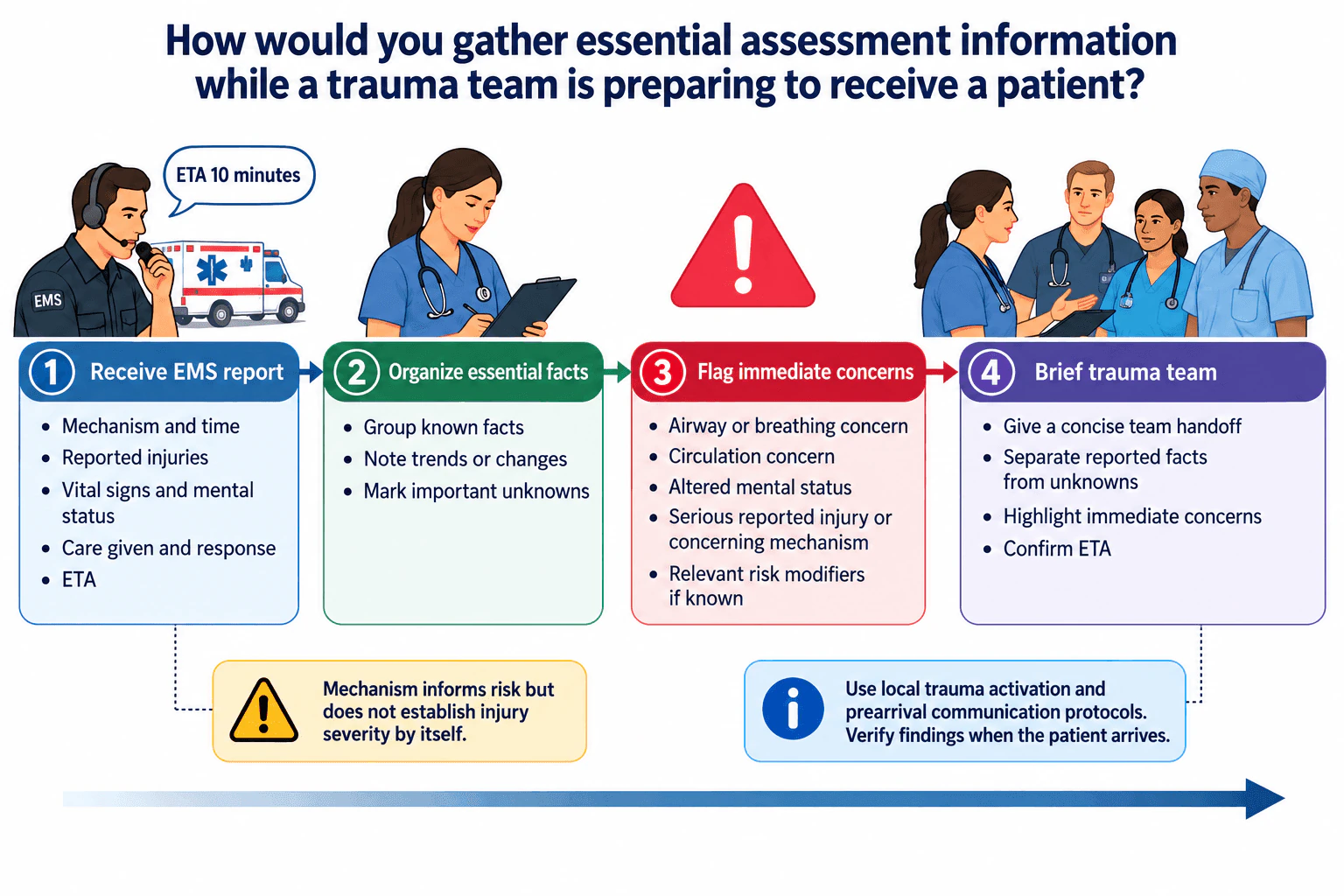
1. How would you gather essential assessment information while a trauma team is preparing to receive a patient?NEWClinical KnowledgeEasyNorthwestern Medicine
i Question Details
Original practice question for this employer context, not a reported employer interview question. Explain the relevant ED nursing judgment and identify information or authority you would need. Do not assume an internal employer protocol.
Short Interview Answer (30-60 seconds)
I would obtain the EMS report, capture the mechanism and time, reported injuries, vital signs and mental status, care already given and the response, and the ETA. I would organize the known facts, note trends and important unknowns, flag any reported airway, breathing, circulation, or mental status concerns, and give the trauma team a concise handoff. I would use the local trauma activation and prearrival communication protocol, keep reported information separate from confirmed findings, and verify everything when the patient arrives.
Detailed Explanation
The key is to turn an incomplete prehospital report into a clear preparation brief without treating reported information as confirmed findings. In a United States emergency department setting, I would collect the essential EMS information, identify what could change immediate preparation, communicate what is known and unknown, and use local trauma activation and prearrival communication protocols rather than assume a specific employer process.
Useful Questions to Ask the Interviewer
What trauma activation and prearrival communication protocol does this emergency department use?
Which team member usually receives and distributes the EMS report before arrival?
What information does the team expect to be repeated or verified at bedside handoff?
How to Explain It in an Interview
Receive the EMS report
I would first collect the mechanism and time, reported injuries, current vital signs and mental status, care already given and the response, and the estimated arrival time. These are reported prehospital facts, not my own confirmed assessment findings.
Organize what is known
I would group the information into known facts, trends or changes, and important unknowns. That keeps the team from filling gaps with assumptions and makes it easier to identify what still needs confirmation when the patient arrives.
Flag immediate concerns
I would highlight any reported airway or breathing concern, circulation concern, altered mental status, serious reported injury, concerning mechanism, or relevant risk modifier if known. Mechanism informs risk, but it does not establish injury severity by itself.
Brief the trauma team
I would give a concise team handoff, separate reported facts from unknowns, highlight the immediate concerns, and confirm the ETA. I would follow the local trauma activation and prearrival communication protocol for any activation or escalation step. Any action to mobilize additional resources would follow the nurse's authorized role and local protocol.
Verify on arrival
Prearrival information is provisional. Once the patient arrives, the receiving team performs the direct assessment and updates the plan using the actual findings. If the bedside findings differ from the EMS report, I would promptly communicate the discrepancy while retaining the prehospital information as relevant clinical context.
Why Interviewers Ask This
This tests whether the nurse can collect incomplete prehospital information, recognize what may be time critical, communicate uncertainty clearly, and help the trauma team prepare without inventing findings or assuming a facility policy.
Common interview mistakes
Common mistakes are treating mechanism as proof of injury severity, presenting reported EMS information as personally confirmed findings, omitting trends or important unknowns, burying urgent concerns inside a long handoff, assuming a specific employer activation policy, or failing to verify the information after arrival.
Interview tip
Use a simple sequence: receive the EMS report, organize known facts, flag immediate concerns, and brief the trauma team. Say explicitly what is reported versus unknown, mention the local trauma activation and prearrival communication protocol, and close by stating that findings are verified when the patient arrives.
Interviewer may ask next
How would you verify the prearrival information once the patient arrives?
I would compare the EMS handoff with the receiving team's direct assessment, current vital signs, mental status, reported injuries, and response to care. I would identify any differences, update the team promptly, and document according to local policy. Reported prehospital information remains useful context, but current direct findings guide immediate decisions.
What would change if EMS reported a new airway or circulation concern while the patient was still en route?
I would immediately update the trauma team with the new reported concern, the change from the prior report, and the revised ETA if available. I would follow the local trauma activation and prearrival communication protocol for any additional escalation or resource preparation. I would still label the information as reported until the patient is directly assessed on arrival.
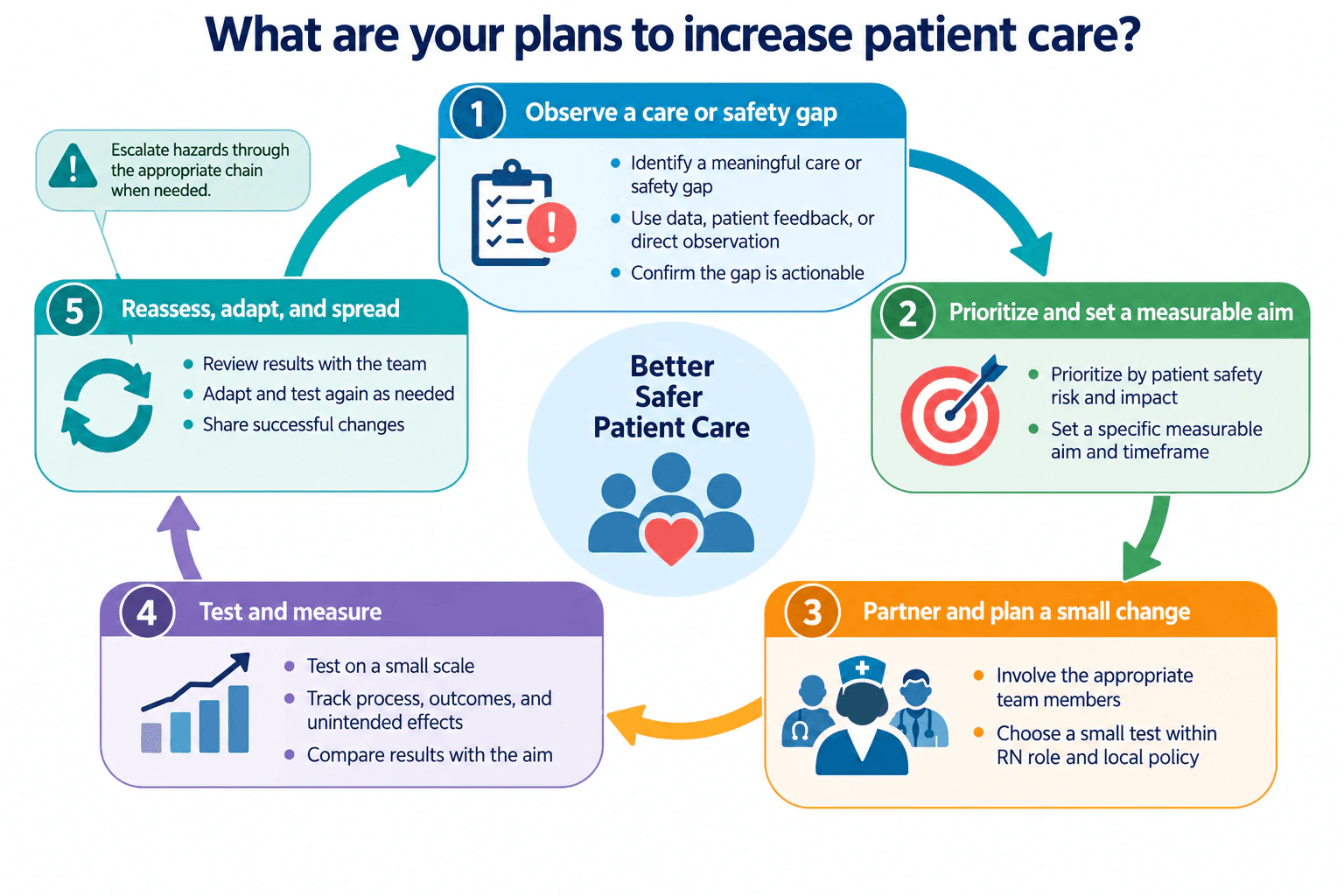
2. What are your plans to increase patient care?NEWPatient SafetyEasyNorthwestern Medicine
i Question Details
Explain how you would identify opportunities to improve safe emergency nursing care, prioritize risks, involve the appropriate team members, measure whether the change improves care, and stay within your role and local policy.
Short Interview Answer (30-60 seconds)
My plan would be to identify a meaningful care or safety gap, prioritize it by patient risk and impact, and set a specific measurable aim with the appropriate team. I would test a small change within my RN role and local policy, track the process, patient outcomes, and unintended effects, and compare the results with the aim. Then I would review the findings with the team and either adapt and test again or move a successful change toward implementation and appropriate spread. Any immediate safety hazard would be addressed and escalated promptly.
Detailed Explanation
I would approach increasing patient care as a continuous improvement cycle. I would identify a meaningful and actionable care or safety gap, prioritize it according to patient risk and impact, define a measurable aim with the appropriate team, test a small change, measure what happens, and use the results to decide what to do next. This is consistent with current health care improvement guidance, which emphasizes measurable aims, team involvement, measurement, and small scale testing before implementation. ihi.org
Useful Questions to Ask the Interviewer
What patient safety or care improvement priorities are most important for nurses in this emergency department?
How are bedside nurses involved in quality improvement work and reviewing results?
What process should nurses use to escalate immediate safety concerns or propose a change in practice?
How to Explain It in an Interview
Identify the opportunity
I would begin with a specific care or safety gap rather than a broad goal. The signal could come from direct observation, patient feedback, near misses, safety reports, workflow concerns, or quality data. Depending on the problem, examples might involve patient identification, infection prevention, fall prevention, suicide or violence risk, communication, or safe care during crowding. I would first confirm that the gap is meaningful and actionable. If it represents an immediate patient hazard, I would address and escalate the hazard through the appropriate chain rather than waiting for a quality improvement project.
Prioritize and set the aim
I would consider the potential severity of harm, frequency, number of patients affected, and practical ability to improve the process. I would then work with the appropriate team to define a specific measurable aim and timeframe. Current improvement guidance describes effective aims as measurable and time bound, with a defined population and setting. ihi.org
Partner and test a small change
Improvement work is team based. Depending on the issue, the appropriate team might include bedside nurses, physicians, pharmacists, case management, quality staff, infection prevention staff, or other people familiar with the affected process. I would choose a practical change that fits my RN role and local policy, then test it on a small scale before broader implementation. Current guidance supports including people who understand the process and using small scale tests to learn how a change works in the local setting. ihi.org
Measure the result
Before testing, I would decide how we will know whether the change helped. I would track whether the process occurred as intended, whether patient outcomes moved toward the aim, and whether unintended effects appeared. Process, outcome, and balancing measures are established approaches for evaluating improvement. ihi.org
Reassess, adapt, and spread
I would review the results with the team and compare them with the original aim. If the change did not work as expected, I would use what we learned to modify or stop it and plan another test. If repeated testing supports the change, the team can move toward implementation. Wider spread should follow successful implementation and further adaptation to the setting where the change will be used. ihi.org
Why Interviewers Ask This
Interviewers are evaluating whether I can recognize opportunities to make emergency care safer, prioritize risk, involve the appropriate team, use measurement instead of assumptions, and stay within nursing scope and local policy. They also want to see that I understand improvement as an iterative process in which changes are tested, evaluated, adapted, and expanded only when the results support doing so.
Common interview mistakes
Common mistakes include proposing a broad change without identifying a specific care gap, failing to prioritize patient risk, assuming a change worked without measuring results, ignoring unintended effects, attempting a broad implementation before learning from a small test, working without the appropriate team, exceeding nursing scope, or delaying escalation of an immediate safety hazard because it is being treated only as an improvement project.
Interview tip
Describe one clear cycle that matches your nursing role: identify the gap, prioritize the risk, set a measurable aim, involve the appropriate team, test a small change, measure the results, and adapt or spread based on what the findings show. Also state that immediate hazards are addressed and escalated promptly and that every proposed change remains within RN scope and local policy.
Interviewer may ask next
How would you verify that your change actually improved patient care?
I would define the measures before the test. I would track whether the process occurred as intended, whether the patient outcome moved toward the stated aim, and whether the change caused unintended effects elsewhere. I would compare the findings with the original aim and review them with the team. If the evidence did not demonstrate improvement, I would not label the change successful. I would use what we learned to modify, retest, or stop the change as appropriate. Current improvement guidance supports using process, outcome, and balancing measures to determine whether a change represents improvement. ihi.org
What would you do if the change worked during a normal shift but not during a crowded emergency department shift?
I would treat that as important information about the clinical context rather than assuming the original result applies under all conditions. I would review what changed during crowding, such as workflow, competing safety priorities, patient volume, staffing demands, or resource availability. The team could adapt the change and test it again under those conditions while continuing to monitor outcomes and unintended effects. Improvement guidance recommends testing changes under varying conditions before making them permanent and adapting successful changes when they are spread to a new context. ihi.org
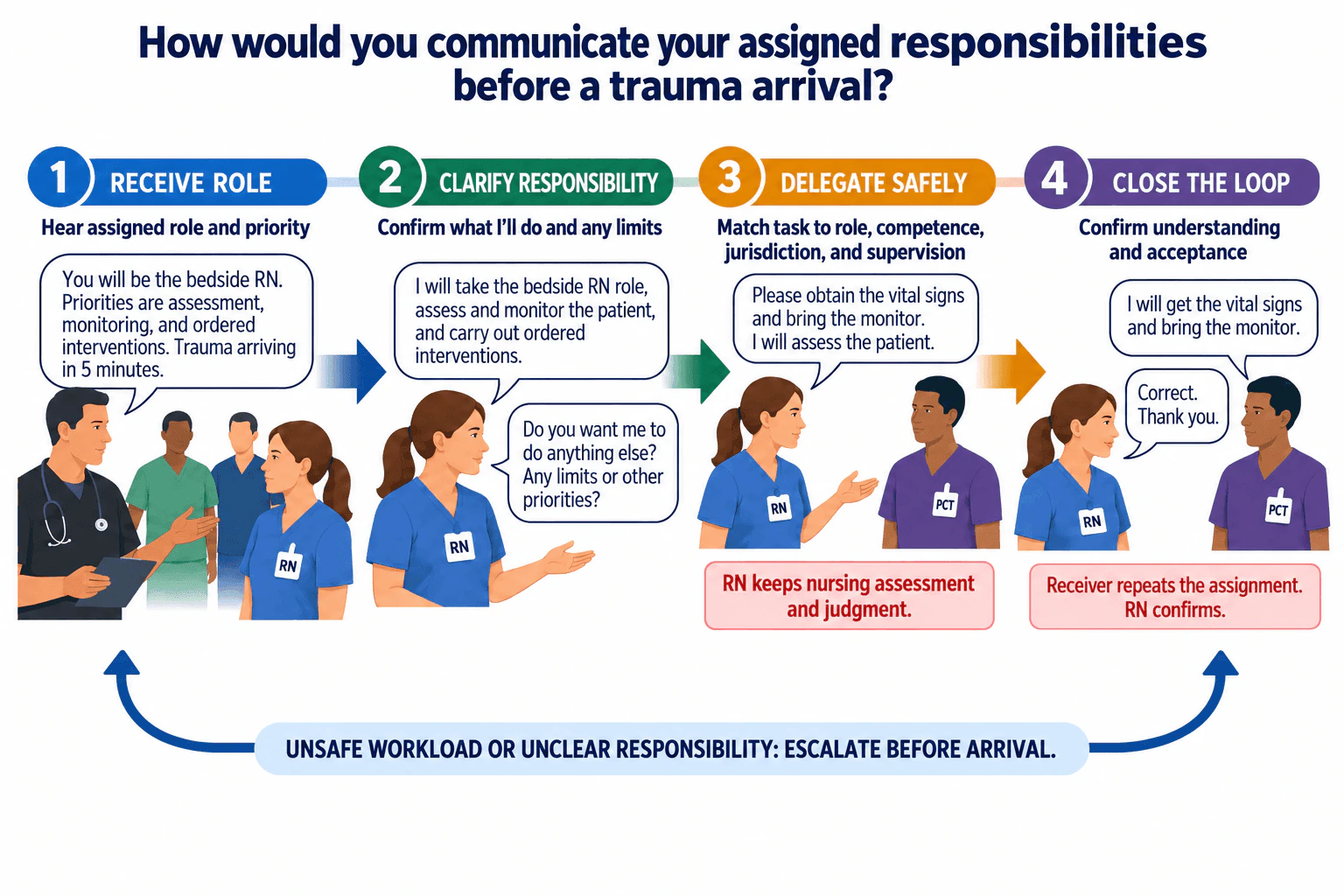
3. How would you communicate your assigned responsibilities before a trauma arrival?NEWCommunication And DelegationMediumNorthwestern Medicine
i Question Details
Original practice question for this employer context, not a reported employer interview question. Explain the relevant ED nursing judgment and identify information or authority you would need. Do not assume an internal employer protocol.
Short Interview Answer (30-60 seconds)
Before the trauma arrives, I would confirm my role and priorities, repeat back what I understand I own, and clarify any limits or competing assignments. If I delegate, I would match the task to the person's role and competence, applicable jurisdiction requirements, facility policy, and available supervision while keeping nursing assessment and judgment with the RN. I would close the loop by having the receiver repeat the assignment and confirming it. If workload or responsibility is unsafe or unclear, I would escalate before arrival.
Detailed Explanation
I would use the prearrival briefing to make responsibility explicit before the team is under greater time pressure. I would listen to the assigned role, state back what I understand I own, clarify uncertainty, and confirm who is responsible for each essential task. I would not assume that agreement alone means everyone has the same understanding.
Useful Questions to Ask the Interviewer
How are trauma roles normally assigned and confirmed in this emergency department?
What responsibilities may be assigned to patient care technicians or other assistive personnel in this setting?
Who should an RN contact if workload, scope, or role ownership is unclear before the patient arrives?
How to Explain It in an Interview
Clarify the Assignment
I would first confirm my role, priorities, timing, and limits. If I am assigned as the bedside RN, I would state that I understand I am responsible for nursing assessment, monitoring, and carrying out appropriate ordered or protocol authorized interventions within my scope. If another assignment could interfere with those responsibilities, I would raise that before the trauma arrives.
Delegate Within Scope
If another team member can appropriately perform a task, I would consider the patient's condition, potential for harm, task complexity, expected outcome, the person's competence, applicable law, facility policy, and available supervision before delegating. Illinois law specifically prohibits an RN from delegating nursing judgment or the comprehensive patient assessment. ilga.gov A routine task such as obtaining vital signs may be assigned to trained assistive personnel when appropriate and permitted, while the RN retains assessment and clinical judgment.
Close the Communication Loop
I would give a specific assignment and have the receiver repeat it back. I would then confirm or correct the repeated message. This matches closed loop communication, in which the sender gives the message, the receiver confirms what was received, and the sender verifies the understanding. ahrq.gov
Escalate Unsafe or Unclear Responsibility
If workload is unsafe, ownership is unclear, or an assignment exceeds someone's scope or competence, I would escalate before arrival and confirm the revised responsibility. The goal is a shared and explicit understanding of who is doing what when the patient arrives.
Why Interviewers Ask This
This question evaluates whether the nurse can establish clear role ownership before a high acuity arrival, communicate safely under time pressure, delegate within nursing scope, confirm that messages were actually understood, and escalate an unsafe or ambiguous assignment rather than allowing responsibility to remain unclear.
Common interview mistakes
Common mistakes include accepting an unclear assignment without confirming ownership, assuming that agreement proves understanding, delegating nursing assessment or judgment to assistive personnel, assigning a task without considering patient condition and staff competence, failing to confirm that responsibility was accepted, and waiting until the patient arrives to raise an unsafe workload or unclear responsibility.
Interview tip
Describe the communication as a short sequence: receive the role, state back what you own, clarify limits, delegate only appropriate tasks, close the loop, and escalate unsafe or unclear responsibility before arrival. Make it clear that delegation does not transfer the RN's responsibility for nursing assessment and judgment.
Interviewer may ask next
How would you verify that another team member understood the responsibility you assigned?
I would use closed loop communication. I would state the task clearly, have the receiver repeat the assignment, and then confirm or correct what they repeat. AHRQ describes this check back process as the sender initiating the message, the receiver providing confirmation, and the sender verifying that the message was understood correctly. ahrq.gov
What would you do if you learned just before arrival that your current patient assignment made the trauma responsibility unsafe?
I would immediately tell the team leader that I have a competing assignment that may prevent me from safely carrying out the trauma role. I would describe the conflict clearly and request reassignment or additional support according to local policy. I would confirm the revised ownership before arrival rather than assuming another team member will cover the responsibility.
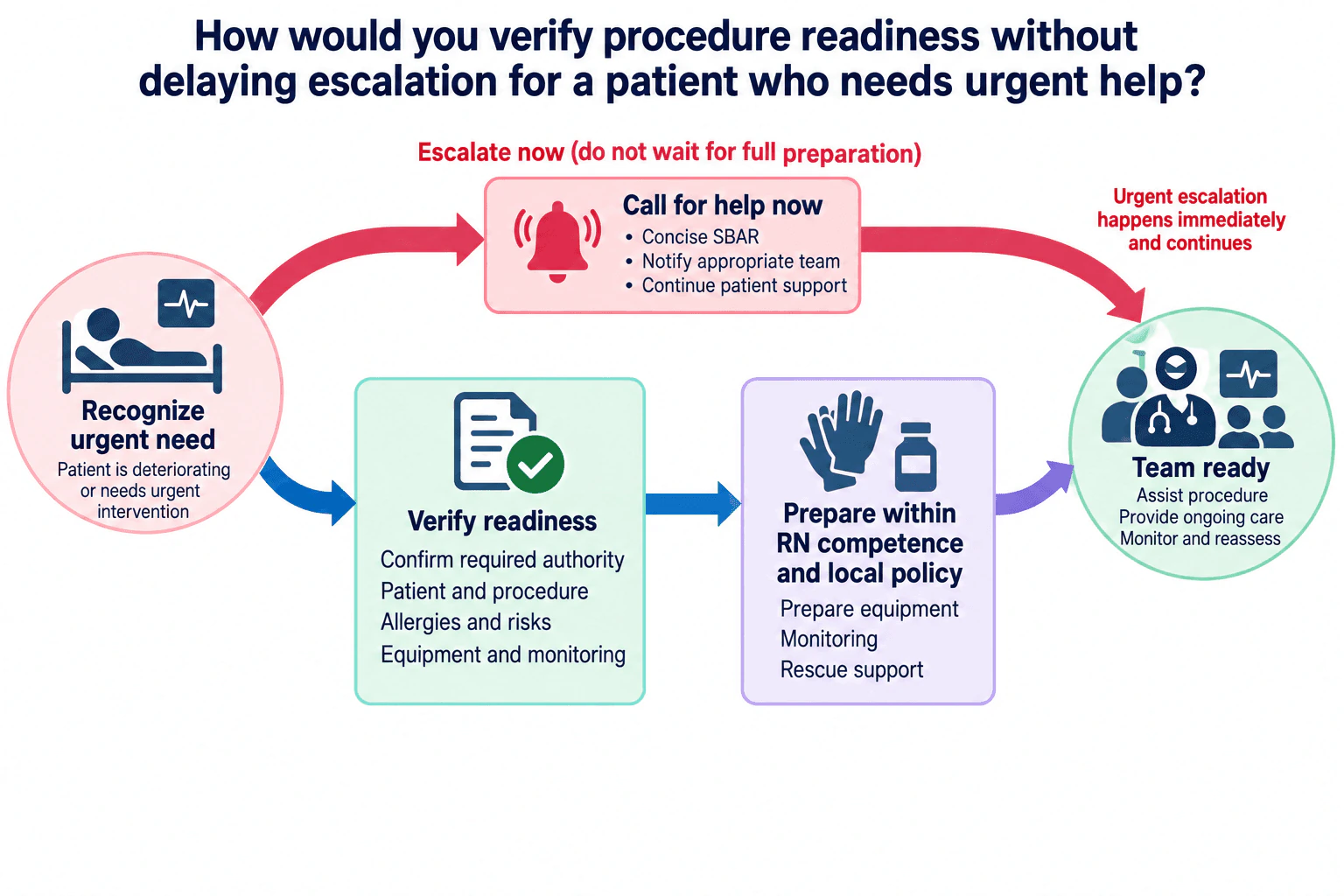
4. How would you verify procedure readiness without delaying escalation for a patient who needs urgent help?NEWMedication And ProceduresMediumNorthwestern Medicine
i Question Details
Original practice question for this employer context, not a reported employer interview question. Explain the relevant ED nursing judgment and identify information or authority you would need. Do not assume an internal employer protocol.
Short Interview Answer (30-60 seconds)
If a patient needs urgent help, I would escalate immediately rather than waiting for every preparation task to be complete. I would call the appropriate team, communicate concisely using SBAR when appropriate, and continue supporting the patient. In parallel, I would verify the required authority, correct patient and procedure, relevant allergies and risks, equipment, monitoring, and rescue support. I would prepare only within my RN competence and local policy. Once the team is ready, I would assist as authorized, continue monitoring, and reassess the patient.
Detailed Explanation
The central judgment is to avoid making procedure preparation a reason to delay urgent help. If the patient is deteriorating, I would escalate immediately and continue patient support while the essential readiness checks happen in parallel. SBAR can provide a concise structure for communicating a rapidly changing patient condition, and nursing scope decisions depend on licensure, competence, applicable law, and the practice setting.
Useful Questions to Ask the Interviewer
What escalation resources are available to the bedside nurse when a patient deteriorates?
Which procedures require specific authorization or additional competency validation for an RN in this setting?
What monitoring and rescue resources are expected to be available for urgent procedures?
How to Explain It in an Interview
I would start by recognizing that the patient needs urgent help. I would call the appropriate team immediately, communicate the situation concisely using SBAR when appropriate, and continue supporting the patient. I would not wait for every preparation step to be finished before escalating.
While help is being mobilized, I would verify procedure readiness in parallel. I would confirm the required authority for the procedure, the correct patient and intended procedure, relevant allergies and risks, and whether the necessary equipment and monitoring are available. These checks support correct patient and correct procedure safety without implying that every procedure has the same authorization requirements.
Next, I would prepare within my RN competence, applicable nursing scope, and local policy. That includes preparing the needed equipment, confirming monitoring, and making sure appropriate rescue support is available for the planned procedure. I would not assume prescribing authority, perform a procedure outside my competence, or invent a treatment threshold or device setting.
When the team is ready, I would assist with the procedure within my authorized role. I would continue patient support, monitor the response, communicate any change promptly, and reassess throughout the event. If the patient worsened at any point, the worsening condition would take priority and I would intensify escalation while other team members continued readiness work that could safely occur in parallel.
The key interview point is that safety verification still matters, but it should support the urgent response rather than become a barrier to getting help.
Why Interviewers Ask This
This question evaluates whether the nurse can recognize deterioration, escalate promptly, complete essential procedure readiness checks without creating an avoidable delay, communicate effectively with the team, and stay within nursing scope and local policy. It also tests whether the candidate understands that urgent escalation and preparation can occur at the same time rather than as a rigid sequence.
Common interview mistakes
Waiting until every preparation task is complete before calling for help; assuming every procedure has the same authorization requirements; failing to confirm the correct patient and intended procedure; overlooking relevant allergies, risks, equipment, monitoring, or rescue support; performing tasks outside RN competence or local policy; and failing to continue monitoring and reassessment after the team arrives.
Interview tip
Organize the answer around two actions happening at the same time: escalate immediately and verify readiness in parallel. Then name the specific readiness checks, explain that preparation stays within RN competence and local policy, and close with ongoing monitoring and reassessment.
Interviewer may ask next
What would you verify before telling the team that the procedure is ready to proceed?
I would verify the required authority, correct patient and intended procedure, relevant allergies and risks, required equipment, monitoring, and appropriate rescue support. I would also confirm that my own role is within RN competence and applicable policy. Any unresolved discrepancy that affects procedural safety would be communicated to the team while urgent patient support and escalation continue.
What would you do if the patient's condition worsened while you were still completing readiness checks?
I would prioritize the worsening clinical condition, intensify escalation, communicate the change to the appropriate team, and continue patient support and monitoring. Readiness work that can safely continue would proceed in parallel through available team members. I would not delay the urgent response simply to finish preparation tasks, and I would continue reassessing as the situation evolves.
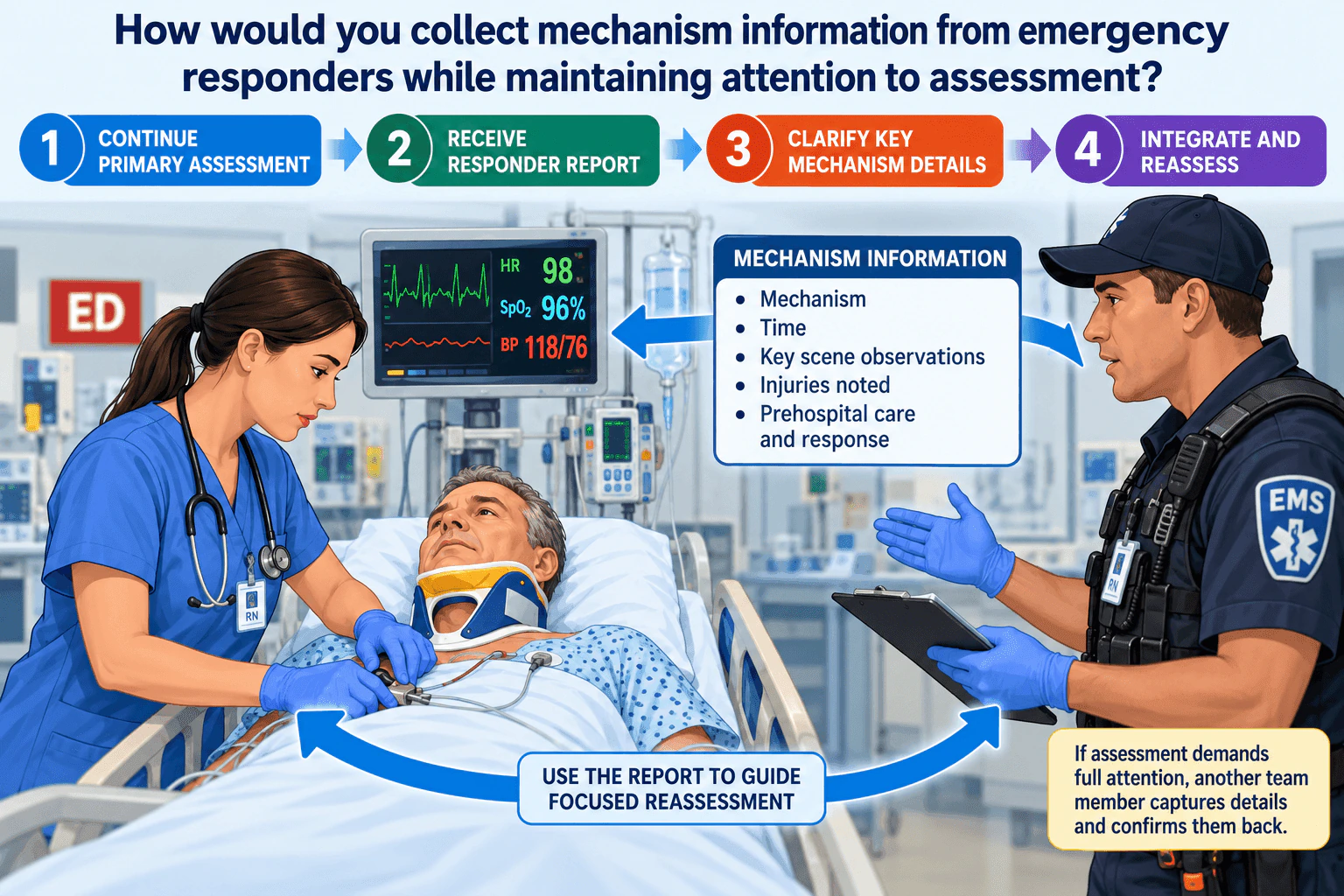
5. How would you collect mechanism information from emergency responders while maintaining attention to assessment?NEWTrauma And Special PopulationsMediumNorthwestern Medicine
i Question Details
Original practice question for this employer context, not a reported employer interview question. Explain the relevant ED nursing judgment and identify information or authority you would need. Do not assume an internal employer protocol.
Short Interview Answer (30-60 seconds)
I would continue the primary assessment while receiving a focused responder report rather than stopping bedside assessment for a complete history. I would capture the mechanism, time, key scene observations, injuries noted, prehospital care, and response to that care. I would clarify information that could change priorities, integrate it into focused reassessment, and confirm important details. If the patient's condition requires my full attention, another team member can capture the report and confirm the key information back to me.
Detailed Explanation
The central idea is to obtain mechanism information in parallel with assessment, not instead of assessment. The nurse continues observing and assessing the patient while collecting only the responder information that helps explain current findings, identify possible hidden injury, or guide focused reassessment.
Useful Questions to Ask the Interviewer
What structured process does the emergency department use for receiving emergency responder handoff?
When the bedside nurse must give the patient full attention, who typically captures and relays the responder report?
How is prehospital information documented and made available to the receiving team?
How to Explain It in an Interview
Nursing Priorities
I would keep the primary assessment moving while the responder gives a concise report. My attention stays on the patient's immediate condition and any change in findings. I would not pause essential assessment simply to obtain a complete narrative.
Patient Context
I would listen specifically for the mechanism, time of the event, key scene observations, injuries noted, prehospital care, and the patient's response. I would clarify details that could change my assessment priorities or direct a focused reassessment. I would not treat the responder report as a substitute for my own assessment.
Clinical Rationale
Structured handoff guidance emphasizes clear information transfer, acknowledgment, opportunities to ask questions, and clarification of uncertainty. A check back adds closed loop verification by having the receiver restate key information and the sender confirm that it was understood correctly. ahrq.gov
Team Support and Reassessment
If the patient requires my full attention, I would ask another team member to capture the responder report and confirm the important points back to me. I would then combine that information with my bedside findings and use it to guide focused reassessment. Any treatment or procedure beyond independent nursing assessment and communication would follow applicable orders, protocols, professional scope, and local policy.
Why Interviewers Ask This
This question evaluates whether the nurse can maintain patient focus during a high information transition, identify which prehospital details may change trauma assessment, communicate efficiently with emergency responders, verify important information, and use teamwork when simultaneous assessment and information collection exceed one person's attention.
Common interview mistakes
Common mistakes include stopping assessment to obtain an exhaustive responder history, accepting the responder report as a substitute for direct patient assessment, failing to clarify information that could change priorities, overlooking the patient's response to prehospital care, or trying to capture every detail personally when the patient requires full attention.
Interview tip
Describe the work as two activities occurring together: direct patient assessment remains primary while concise responder information is received and integrated. Name the specific information you want, explain what would trigger clarification, and state that another team member can capture details when the patient's condition requires your full attention.
Interviewer may ask next
How would you verify important information from the responder report?
I would clarify any ambiguous or clinically important point before the responder leaves when possible, restate key details to confirm my understanding, compare the report with the patient's current findings, and review available prehospital documentation according to local workflow. Check back communication is specifically intended to verify that exchanged information was received and understood correctly. ahrq.gov
What would change if the patient were a child, pregnant, or otherwise required population specific assessment?
I would collect the same core mechanism information while also identifying the population specific facts needed for safe assessment, such as age, weight when clinically relevant, pregnancy status when applicable, mechanism, responder observations, prehospital care, and response. I would use age and population appropriate assessment and escalation guidance rather than scaling adult pathways to a child or assuming that visible injuries represent the full extent of trauma.
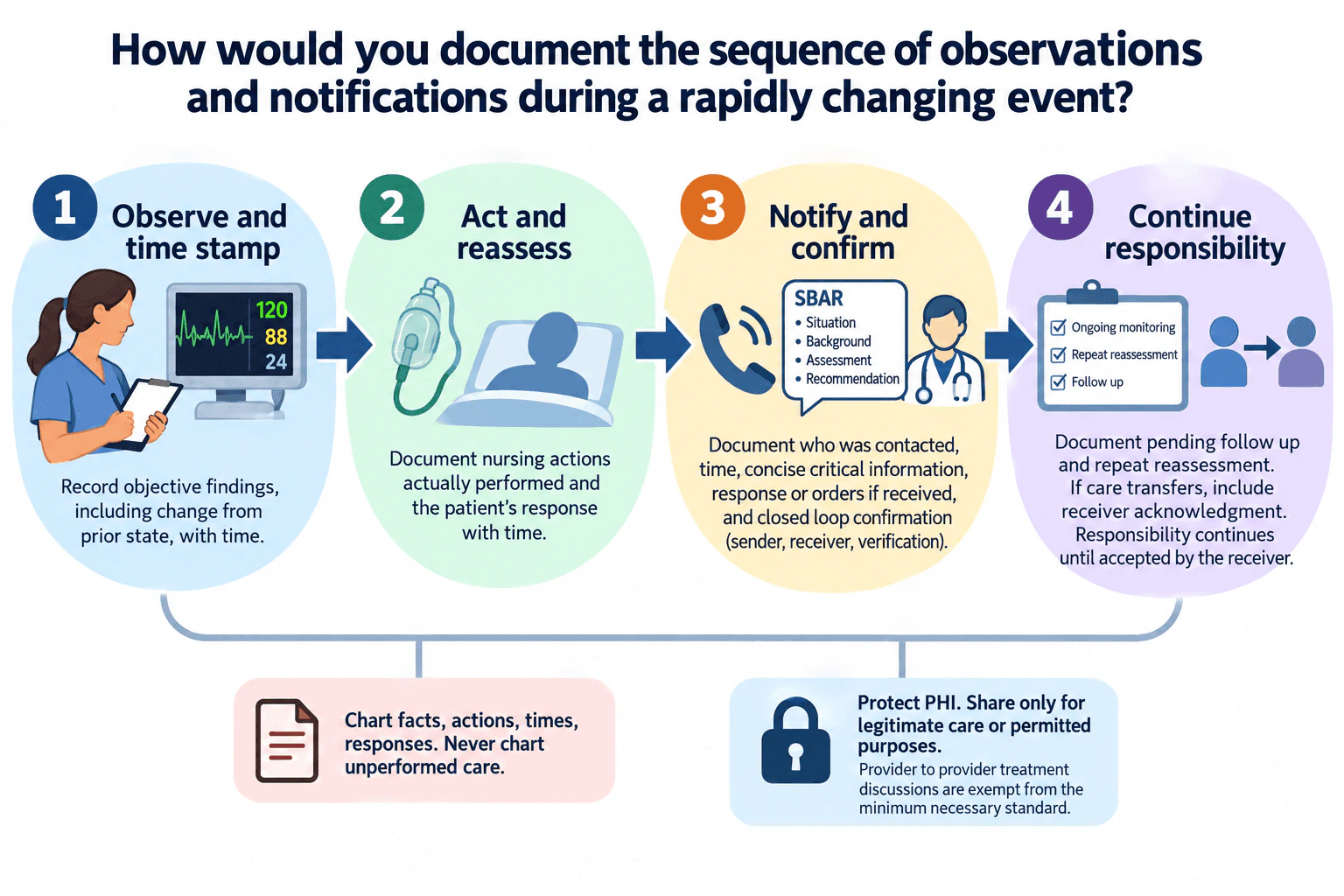
6. How would you document the sequence of observations and notifications during a rapidly changing event?NEWDocumentation ComplianceHardNorthwestern Medicine
i Question Details
Original practice question for this employer context, not a reported employer interview question. Explain the relevant ED nursing judgment and identify information or authority you would need. Do not assume an internal employer protocol.
Short Interview Answer (30-60 seconds)
I would document the event in chronological order: objective findings and the time they occurred, nursing actions actually performed, reassessment and patient response, who I notified and when, the critical information communicated, and any response or orders received. I would use concise communication such as SBAR and document closed loop confirmation when appropriate. If care is handed off, I would identify pending follow up and document acknowledgment that the receiving clinician understands and accepts responsibility. I would protect protected health information and never chart care that was not performed.
Detailed Explanation
A rapidly changing event needs a record that lets another clinician reconstruct what happened, when it happened, what was done, how the patient responded, and who knew about it.
Useful Questions to Ask the Interviewer
What documentation and escalation standards does this emergency department use for significant changes in condition and critical results?
How are pending tests, reassessments, and responsibility documented during handoff or transfer?
Which clinicians are designated by hospital policy and applicable law to perform the EMTALA medical screening examination?
How to Explain It in an Interview
Observed Findings And Timeline
I would begin with objective findings and accurate time stamps. I would describe the meaningful change from the patient's prior condition rather than using vague wording. I would document what I directly observed or measured and avoid assumptions about cause unless it has been clinically established.
Actions And Reassessment
Next, I would record nursing actions that were actually performed and the patient's response. I would include reassessment after relevant interventions so the record shows whether the condition improved, persisted, or changed further. I would never document an assessment, medication, procedure, education, or other care that did not occur.
Notifications And Handover
When escalation is needed, I would communicate concise critical information, for example with SBAR, meaning Situation, Background, Assessment, and Recommendation or Request. I would document who was contacted, the time, the important information communicated, the response or orders received when applicable, and closed loop confirmation of critical information. A handoff transfers information together with authority and responsibility. I would identify pending follow up and document acknowledgment that the receiving clinician understands and accepts the transfer before treating the handoff as complete.
Privacy And Scope
I would protect protected health information and share it only for treatment or other permitted purposes using appropriate safeguards. Under HIPAA, the minimum necessary standard does not apply to disclosures to or requests by a health care provider for treatment purposes, although organizational access controls and other privacy safeguards still apply. I would also distinguish triage from the EMTALA medical screening examination. Triage prioritizes patients but is not, by itself, the medical screening examination. The examination must be performed by qualified medical personnel designated under applicable hospital requirements and acting within their permitted scope.
Disposition Documentation
If the event ends in transfer or discharge, I would document the handoff or transfer information, relevant current findings, treatments and responses, pending follow up, and receiver acknowledgment when responsibility transfers. For discharge, I would document applicable medication reconciliation, patient education, discharge instructions, return precautions, and confirmation of understanding using an appropriate method such as teach back when indicated.
Why Interviewers Ask This
This evaluates whether the nurse can maintain an accurate clinical timeline while patient conditions and priorities are changing quickly. Interviewers are looking for objective documentation, timely escalation, reassessment, closed loop communication, privacy awareness, continuity of responsibility, and an understanding that documentation supports patient safety rather than replacing bedside care.
Common interview mistakes
Common mistakes include using vague retrospective language instead of objective time stamped observations, charting care before it occurs, omitting the patient's response to an intervention, recording that a provider was notified without documenting the time or response, failing to confirm receipt of critical information, assuming an electronic message alone completes a handoff, leaving responsibility for pending follow up unclear, including unnecessary identifying information, confusing triage with the EMTALA medical screening examination, or documenting discharge education without the actual instructions and return precautions provided.
Interview tip
Describe the documentation as one continuous timeline: observe and time stamp, act and reassess, notify and confirm, then continue responsibility until the receiving clinician acknowledges and accepts the handoff. Emphasize objective facts, actual care performed, patient response, closed loop communication, privacy, and clear ownership of pending follow up.
Interviewer may ask next
How would you verify that a critical notification was successfully communicated?
I would verify that the intended clinician actually received and understood the critical information rather than relying only on the fact that I placed a call or sent a message. When appropriate, I would use closed loop communication in which the receiver confirms the information and the sender verifies that confirmation. I would document who was contacted, the time, the essential information communicated, the response or orders received when applicable, and any required follow up.
How would your documentation change if the patient were transferred or discharged after the event?
For a transfer, I would add the receiving destination and clinician or team as applicable, relevant current findings, recent changes, treatments and responses, pending tests or tasks, and acknowledgment that the receiving clinician understands and accepts responsibility through the appropriate handoff process. For discharge, I would document the patient's condition at disposition, relevant medication reconciliation, education provided, discharge instructions, return precautions, and confirmation that the patient or appropriate caregiver understood the information. I would follow applicable orders, policy, and scope rather than assuming every disposition process is identical.
7. a time where you faced a change and adapted to itNEWBehavioralEasyNorthwestern Medicine
i Question Details
Describe a real nursing, clinical training, academic, or work example in which circumstances changed. Explain what changed, how you adjusted your approach, how you communicated with others, the result, and what you learned.
Interview tip:
Use STAR to structure your answer: briefly explain the Situation and Task, make Action the most detailed part, and finish with the Result. For example, describe a time when patient volume, acuity, or your assignment changed unexpectedly, how you adjusted your priorities, communicated with the team, protected continuity of care, and what you learned from the experience.
Situation
In a previous emergency department role, I was caring for a stable patient assignment when patient volume and acuity changed quickly. The charge nurse needed to reorganize assignments so the team could respond to patients with more urgent needs.
Task
I needed to transition my current patients safely to another nurse, take responsibility for a different assignment, and adjust my priorities without losing important information or delaying communication.
Action
I first reviewed each of my current patients so I could give the receiving nurse a clear handoff. I explained the reason for each visit, the current condition, important assessments, pending tests, and any concerns that still needed attention. I also made sure that urgent needs were addressed before the transfer of responsibility. When I moved to the new assignment, I quickly reviewed the available information and assessed which patients needed my attention first. I focused on immediate safety needs and reassessed patients as their conditions or priorities changed. I kept the charge nurse and appropriate members of the care team informed when I identified concerns or needed additional support. I also communicated with patients about changes in the department and what they could expect. This helped me stay organized while making sure the change in assignment did not create gaps in communication or care.
Result
The transition was completed smoothly, and the team was able to adjust to the changing needs in the department while maintaining continuity of care. The experience taught me that adapting in the emergency department is not only about working faster. It is about reassessing priorities, communicating early, and making sure important information follows the patient when responsibilities change.
Why Interviewers Ask This
Interviewers ask this question to understand how a nurse responds when circumstances change unexpectedly. A strong answer shows flexibility, sound prioritization, clear communication, ownership, and the ability to maintain patient safety while adjusting to a new situation.
Interviewer may ask next
How did you make sure important information was not lost when your assignment changed?
I paused long enough to organize the key information for each patient before transferring responsibility. I gave the receiving nurse a focused handoff that covered the reason for the visit, current condition, important assessments, pending work, and any concerns that still required attention. I also made sure urgent needs were addressed before the transition.
What would you do if a similar change happened again?
I would use the same approach of reassessing priorities first and communicating early. I would quickly identify what must be completed before the transition, give a clear handoff, and then review the new assignment based on patient needs. I would also ask for support early if the change created a safety concern or workload that required additional help.
8. Tell me 3 words your current boss would use to describe you?NEWBehavioralEasyNorthwestern Medicine
i Question Details
Choose three accurate professional qualities that a current or recent supervisor could reasonably use to describe you. Support each quality with a brief truthful example from nursing, clinical training, school, or work.
Interview tip:
Use STAR to structure your answer: briefly explain the Situation and Task, make Action the most detailed part, and finish with the Result. For example, describe one situation that shows why your supervisor would call you calm, dependable, and collaborative, including how you organized your responsibilities, communicated changes, supported the team, and maintained safe patient care.
Situation
Three words my current boss would use to describe me are calm, dependable, and collaborative. One situation that reflects those qualities was a busy emergency department shift when several patients needed attention at about the same time and the team had to keep priorities clear.
Task
My responsibility was to stay organized with my assigned patients, recognize and communicate important changes, and support the rest of the team without losing focus on my own responsibilities.
Action
I first reviewed what needed attention most urgently and made sure my immediate responsibilities were organized. I reassessed my assigned patients as appropriate and communicated relevant changes clearly to the team so information was not lost during a busy period. I stayed calm in my communication because that helped me think clearly and made it easier for others to understand what I needed. When my own immediate responsibilities were under control, I checked whether a teammate needed help and assisted with appropriate nursing tasks. I also made sure that important information was communicated during transitions in care instead of assuming someone else already knew it. I think those actions show dependability because I followed through on my responsibilities, calmness because I did not let the pace change how I communicated, and collaboration because I stayed aware of what the team needed as well as what I needed to complete.
Result
The shift remained organized, important information was communicated, and the team was able to continue working together effectively. It reinforced for me that being calm, dependable, and collaborative is not only about personality. It is shown through consistent actions, especially when the emergency department becomes busy.
Why Interviewers Ask This
Interviewers ask this question to understand how the candidate believes a supervisor experiences working with them. A strong answer names clear professional qualities and supports those qualities with behavior that shows reliability, self awareness, communication, teamwork, and sound judgment in a demanding care environment.
Interviewer may ask next
Why did you choose calm, dependable, and collaborative as the three words?
I chose them because they describe behaviors I try to show consistently. In that busy situation, I stayed calm so I could communicate clearly, I remained accountable for my own patient responsibilities, and I helped the team when I was able to do so safely. Those qualities work together and are especially important in an emergency department.
Which of those three qualities is most important to you during a busy shift?
Dependable is especially important to me because the team needs to know that I will follow through on my responsibilities and communicate when something changes. In that situation, staying dependable also required me to remain calm and collaborate with others, so I see the three qualities as closely connected.
9. Name two of your favorite clinical rotations as a nursing student and why?NEWBehavioralMediumNorthwestern Medicine
i Question Details
Choose two real clinical rotations from your nursing education. Explain what you learned in each setting, why the experiences were meaningful to you, how they shaped your professional interests, and what skills or judgment you developed.
Interview tip:
Use STAR to structure your answer: briefly explain the Situation and Task, make Action the most detailed part, and finish with the Result. For example, describe two clinical rotations that were especially meaningful to you, what responsibilities you had as a student, what you learned from observing and supporting patient care, how you communicated with nurses and patients, and how those experiences shaped your interest in emergency nursing.
Situation
Two of my favorite clinical rotations were my emergency department rotation and my medical surgical rotation. I liked the emergency department because every patient presented a different problem and I had to pay close attention to priorities. I liked the medical surgical rotation because it gave me more time to follow patients, understand their overall condition, and see how nursing care changed throughout a shift.
Task
As a nursing student, my responsibility was to learn safely within my student role, complete focused assessments, communicate important observations to my supervising nurse, and understand the reason behind each part of the care plan. I also wanted to learn how nurses organize several patient needs while still making each patient feel heard.
Action
In the emergency department rotation, I focused on developing strong assessment and communication habits. I watched how the nurses gathered important information quickly, recognized which concerns needed immediate attention, and continued reassessing patients as their condition or needs changed. When I participated in care, I stayed within my student responsibilities, reported my findings to my supervising nurse, and asked questions about why one patient needed attention before another. I also learned that calm communication matters when patients or family members are anxious. In my medical surgical rotation, I practiced looking at the whole patient instead of only the immediate complaint. I reviewed the available history and care plan with my supervising nurse, completed assigned assessments, watched for changes, and communicated anything concerning. I also spent more time explaining routine care to patients and listening to their questions. Seeing both settings helped me understand the connection between rapid prioritization and careful ongoing care.
Result
Those rotations shaped my professional interests because they showed me that I enjoy both quick clinical thinking and meaningful patient communication. The emergency department especially interested me because I liked the need to assess, prioritize, communicate, and adapt as new information became available. The medical surgical rotation gave me a stronger foundation in organized assessment and continued patient care. Together, they helped me see why emergency nursing is a good fit for the way I like to learn, work with a team, and care for patients.
Why Interviewers Ask This
Interviewers ask this question to understand which clinical environments motivated the candidate and what the candidate learned from those experiences. A strong answer shows self awareness, thoughtful reflection, realistic understanding of nursing responsibilities, and a clear connection between nursing school experiences and interest in emergency care.
Interviewer may ask next
What did your emergency department rotation teach you about prioritizing patient needs?
It taught me to start with a focused assessment, recognize which concerns may need faster attention, and communicate important findings promptly to the supervising nurse. I also learned that priorities can change, so reassessment and clear communication are important throughout the patient's care.
How did your medical surgical rotation help prepare you for an emergency nursing role?
It strengthened my basic assessment, organization, patient communication, and follow through. I learned to look at the whole clinical picture, notice changes over time, and communicate concerns clearly. Those habits are useful in the emergency department because rapid decisions still depend on careful assessment and good teamwork.
10. Discuss a time when you had to give someone advice and what happenedNEWBehavioralHardNorthwestern Medicine
i Question Details
Use a truthful example in which you needed to give someone advice. Explain the situation, how you understood the other person's needs, how you communicated your advice respectfully, what happened afterward, and what you learned about professional communication and judgment.
Interview tip:
Use STAR to structure your answer: briefly explain the Situation and Task, make Action the most detailed part, and finish with the Result. For example, describe a time when a colleague asked for advice about a difficult communication issue, how you understood the concern before responding, how you gave respectful and practical guidance, what happened after the advice was used, and what you learned about giving advice without taking over the decision.
Situation
During a previous emergency department shift, a newer nurse came to me after an unclear handoff with another member of the care team. The nurse was frustrated and was unsure how to raise the concern without making the conversation feel confrontational.
Task
I wanted to help the nurse address the communication problem in a professional way while keeping the focus on clear patient information. My responsibility was to give useful advice without speaking for the nurse or assuming I knew everything that had happened.
Action
I first asked the nurse to explain what information seemed unclear and what had already been discussed. I listened before offering advice because I wanted to understand the actual concern instead of reacting to the frustration. I suggested separating the facts from personal feelings and starting the conversation with a specific question about the information that needed clarification. I also advised the nurse to speak privately and respectfully with the other team member rather than discussing the issue in front of others. I explained that focusing on the patient information and the next care need could make the conversation less personal and more productive. I encouraged the nurse to listen to the response because there might have been information or context that was missing. I also said that if an important concern remained unclear after that conversation, the nurse should use the appropriate clinical leadership or escalation path rather than allowing uncertainty to continue. I stayed available for support, but I let the nurse handle the conversation directly so the nurse could build confidence in managing similar situations.
Result
The nurse later told me that the conversation went well and that the missing information was clarified without creating additional conflict. The nurse also felt more comfortable addressing similar communication concerns directly. I learned that good advice starts with listening. I also learned that advice is most useful when it gives someone a clear approach while still allowing that person to use professional judgment and take ownership of the conversation.
Why Interviewers Ask This
Interviewers ask this question to understand how a candidate uses judgment when another person seeks guidance. They are looking for someone who listens before responding, communicates advice respectfully, considers the other person's needs, protects professional relationships, and knows when a concern may require further escalation.
Interviewer may ask next
Why did you encourage the nurse to handle the conversation directly instead of stepping in yourself?
I wanted to support the nurse without taking away the opportunity to build confidence. The concern could be addressed through a respectful conversation, so I gave the nurse a practical way to approach it and stayed available if more support was needed. That allowed the nurse to take ownership while still knowing help was available.
What would you have done if the communication problem had not been resolved?
If important information was still unclear, I would have encouraged the nurse to use the appropriate clinical leadership or escalation path so the concern did not remain unresolved. I would continue to focus on the facts, the information that was still needed, and clear communication rather than turning the issue into a personal disagreement.
Emergency Department Nurse Resume Examples
Explore the resume examples below to find the one that best matches your target Emergency Department Nurse role.
New Graduate Emergency Department Nurse0-1 years; supervised transition to emergency nursing
Disclaimer: This interview guide is for educational and informational purposes only. It is designed to help readers prepare, but it does not guarantee any interview result, hiring decision, offer, or outcome. Interview questions, hiring criteria, and preferred answers can vary by employer, interviewer, industry, location, and time. All answers, examples, and explanations in this guide are suggested examples for interview preparation, not definitive answers or instructions for professional practice. They are based on research and judgment, are provided without warranties of any kind, and should be adapted to the question, role, and applicable laws and professional requirements. Diagrams are simplified illustrations intended to highlight the main concepts and their relationships; actual situations, systems, and practices may be more complex. Alternative approaches may be equally valid or better suited to a particular question, context, or interviewer. To the fullest extent permitted by applicable law, the contributors and publisher are not liable for decisions made, actions taken, or losses incurred based on this guide.
State Laws and Professional Responsibilities: Laws and requirements governing an occupation vary by state and jurisdiction. You are responsible for checking the current laws, licensing requirements, and scope-of-practice rules that apply to your location and role, and for ensuring that your answers and actions comply with them. Adapt examples in this guide to those requirements. This guide is not legal advice.
Company Notice: This guide is an independent educational resource and is not affiliated with, endorsed by, sponsored by, or approved by the company named in this guide. Company names identify reported interview experiences or the employer context of clearly labeled original practice exercises. Interview practices can change without notice, and inclusion of company-specific content does not mean these questions are official, complete, or guaranteed to be asked. To the fullest extent permitted by law, the author, contributors, and publisher are not responsible for outcomes related to use of this material.
Content Accuracy and Verification: To the fullest extent permitted by applicable law, we do not represent or warrant that interview guides, questions, answers, examples, or diagrams are accurate, complete, current, error-free, or suitable for any particular purpose. You are responsible for independently reviewing and verifying the information before relying on it.