This interview guide is for educational and informational purposes only. It is designed to help readers prepare, but it does not guarantee any interview result, hiring decision, offer, or outcome. Interview questions, hiring criteria, and preferred answers can vary by employer, interviewer, industry, location, and time. All answers, examples, and explanations in this guide are suggested examples for interview preparation, not definitive answers or instructions for professional practice. They are based on research and judgment, are provided without warranties of any kind, and should be adapted to the question, role, and applicable laws and professional requirements. Diagrams are simplified illustrations intended to highlight the main concepts and their relationships; actual situations, systems, and practices may be more complex. Alternative approaches may be equally valid or better suited to a particular question, context, or interviewer. To the fullest extent permitted by applicable law, the contributors and publisher are not liable for decisions made, actions taken, or losses incurred based on this guide.
State Laws and Professional Responsibilities
Laws and requirements governing an occupation vary by state and jurisdiction. You are responsible for checking the current laws, licensing requirements, and scope-of-practice rules that apply to your location and role, and for ensuring that your answers and actions comply with them. Adapt examples in this guide to those requirements. This guide is not legal advice.
Identity, Image, and Privacy Notice
To respect individual privacy, some names, profile photographs, avatars, biographical details, and other identifying information displayed in this guide may be replaced with pseudonyms, licensed stock images, illustrative avatars, composite images, or representative descriptions. Unless a person is expressly identified as an actual contributor, a displayed name, image, or profile should not be understood as depicting or identifying a specific candidate, interviewer, employee, or other real individual. These representations are provided for editorial and illustrative purposes only and do not imply endorsement, employment, participation, or affiliation with this guide or any company mentioned in it. Any resemblance to an actual person is coincidental.
Company Notice
This guide is an independent educational resource and is not affiliated with, endorsed by, sponsored by, or approved by the company named in this guide. Company names identify reported interview experiences or the employer context of clearly labeled original practice exercises. Interview practices can change without notice, and inclusion of company-specific content does not mean these questions are official, complete, or guaranteed to be asked. To the fullest extent permitted by law, the author, contributors, and publisher are not responsible for outcomes related to use of this material.
Content Accuracy and Verification
To the fullest extent permitted by applicable law, we do not represent or warrant that interview guides, questions, answers, examples, or diagrams are accurate, complete, current, error-free, or suitable for any particular purpose. You are responsible for independently reviewing and verifying the information before relying on it.
Questions or comments?
Contact us for general questions, or share feedback, technical corrections, and comments with the community.
1. How would you compare the current assessment with information sent from another hospital?NEWClinical KnowledgeEasyUpmc
i Question Details
Original practice question for this employer context, not a reported employer interview question. Explain the relevant ED nursing judgment and identify information or authority you would need. Do not assume an internal employer protocol.
Short Interview Answer (30-60 seconds)
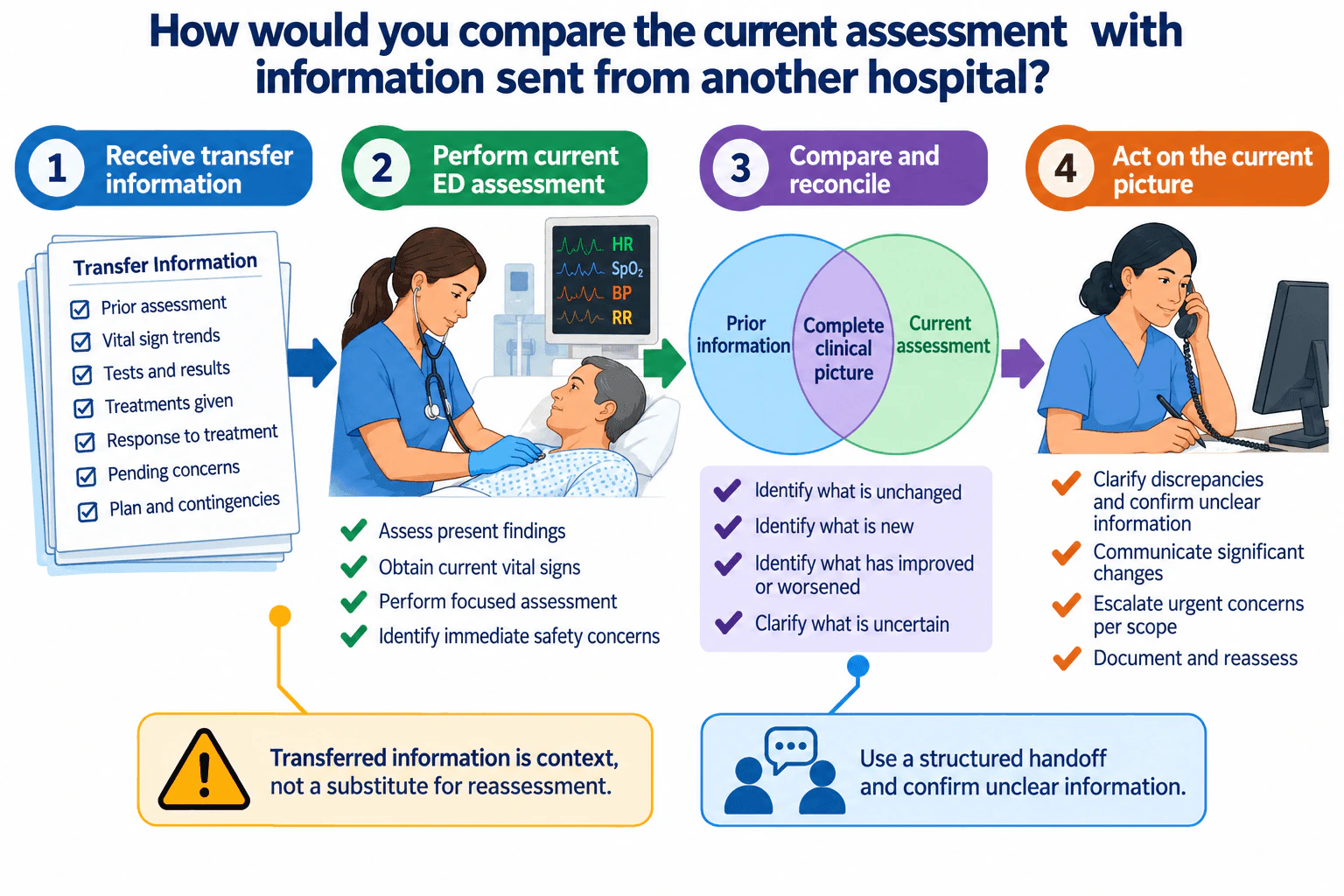
I would use the other hospital's information as a baseline, but I would still perform a current ED assessment. I would compare the present findings with the prior assessment, vital sign trends, test results, treatments, response to treatment, pending concerns, and plans. I would identify what is unchanged, new, improved, worsened, or uncertain. If I found a meaningful discrepancy, I would clarify it through the appropriate structured handoff, communicate significant changes, escalate urgent concerns within my scope, document the current findings, and continue reassessment.
Detailed Explanation
The key idea is that transferred information provides clinical context, but it does not replace a current bedside assessment. The receiving nurse needs to establish the patient's present condition and reconcile it with what was previously reported. AHRQ describes effective handoffs as communicating uncertainty, response to treatment, recent changes, plans, and contingencies, with an opportunity for the receiver to review the information and ask questions. ahrq.gov
Useful Questions to Ask the Interviewer
What structured handoff method does the ED use for patients transferred from another facility?
How should nurses document and communicate discrepancies between transferred information and the current assessment?
What is the expected escalation pathway when the current assessment suggests a more urgent condition than the transfer information indicates?
How to Explain It in an Interview
Review the transferred information
I would first review the information sent with the patient, including the prior assessment, vital sign trends, test results, treatments given, response to treatment, pending concerns, and plans or contingencies. I would note when those findings were obtained because they describe an earlier clinical picture.
Perform a current assessment
I would then perform an appropriate current ED nursing assessment, obtain current vital signs, complete the focused assessment relevant to the presentation, and identify any immediate safety concern. I would base urgency on what I observe now rather than assuming the transferred information is still current.
Compare and reconcile
I would compare the prior and current information and identify what is unchanged, what is new, and what has improved or worsened. I would also identify anything incomplete, inconsistent, or uncertain. If a difference could affect safety or urgency, I would verify the relevant current finding and clarify the discrepancy with the appropriate clinician or source through the established handoff process. AHRQ handoff guidance specifically supports review, questions, clarification of uncertainty, and communication of recent changes and treatment response. ahrq.gov
Act on the current clinical picture
I would communicate significant changes and escalate urgent concerns within RN scope. Independent nursing assessment and reassessment remain nursing responsibilities. Protocol authorized actions would depend on applicable local protocols, and interventions requiring an order would be obtained through the appropriate clinician. I would document the current assessment, important discrepancies, clarification obtained, communication performed, and resulting actions, then continue reassessment. The goal is a current, reconciled clinical picture rather than reliance on an earlier report.
Why Interviewers Ask This
This question tests whether the nurse can use transferred information without treating it as a substitute for a fresh assessment. It evaluates recognition of clinical change, reconciliation of prior and current findings, clarification of uncertainty, communication, escalation, documentation, and reassessment during a transition of care. Structured handoff guidance emphasizes accurate information exchange, acknowledgment by the receiver, review, questions, and clarification when information is uncertain. ahrq.gov
Common interview mistakes
Common mistakes include accepting transferred information as current without reassessing the patient, overlooking vital sign trends or treatment response, failing to distinguish prior findings from present findings, ignoring incomplete or conflicting information, failing to clarify a meaningful discrepancy, delaying escalation of an urgent change, or assuming an employer specific procedure that has not been provided.
Interview tip
Structure the response around four connected actions: review the transferred information, perform a fresh assessment, compare and reconcile the two clinical pictures, then communicate, escalate, document, and reassess. Emphasize that transferred information provides context but does not replace direct assessment.
Interviewer may ask next
How would you verify a discrepancy between the transfer information and your current assessment?
I would first repeat or validate the relevant current assessment finding using the appropriate nursing assessment method. I would confirm that I am comparing the same type of measurement or observation and review when the earlier finding was obtained. I would then check the available transfer documentation and clarify any unresolved difference with the appropriate clinician or source through the structured handoff process. If the discrepancy changes urgency or creates a safety concern, I would communicate and escalate it promptly within my scope and document the current finding and clarification. AHRQ guidance supports receiver review, questions, clarification of uncertainty, and confirmation of handoff information. ahrq.gov
What would you do if the patient's current condition is worse than the information sent by the other hospital?
I would act on the patient's current clinical picture. I would reassess the relevant findings, identify immediate safety concerns, communicate the significant change promptly, and escalate according to nursing scope, applicable protocols, provider involvement, and local policy. I would document how the present assessment differs from the earlier information and continue reassessment. The earlier report remains useful as context because it helps establish that the patient's condition has changed.
2. How would you confirm infection precautions when a transfer report is incomplete?NEWPatient SafetyEasyUpmc
i Question Details
Original practice question for this employer context, not a reported employer interview question. Explain the relevant ED nursing judgment and identify information or authority you would need. Do not assume an internal employer protocol.
Short Interview Answer (30-60 seconds)
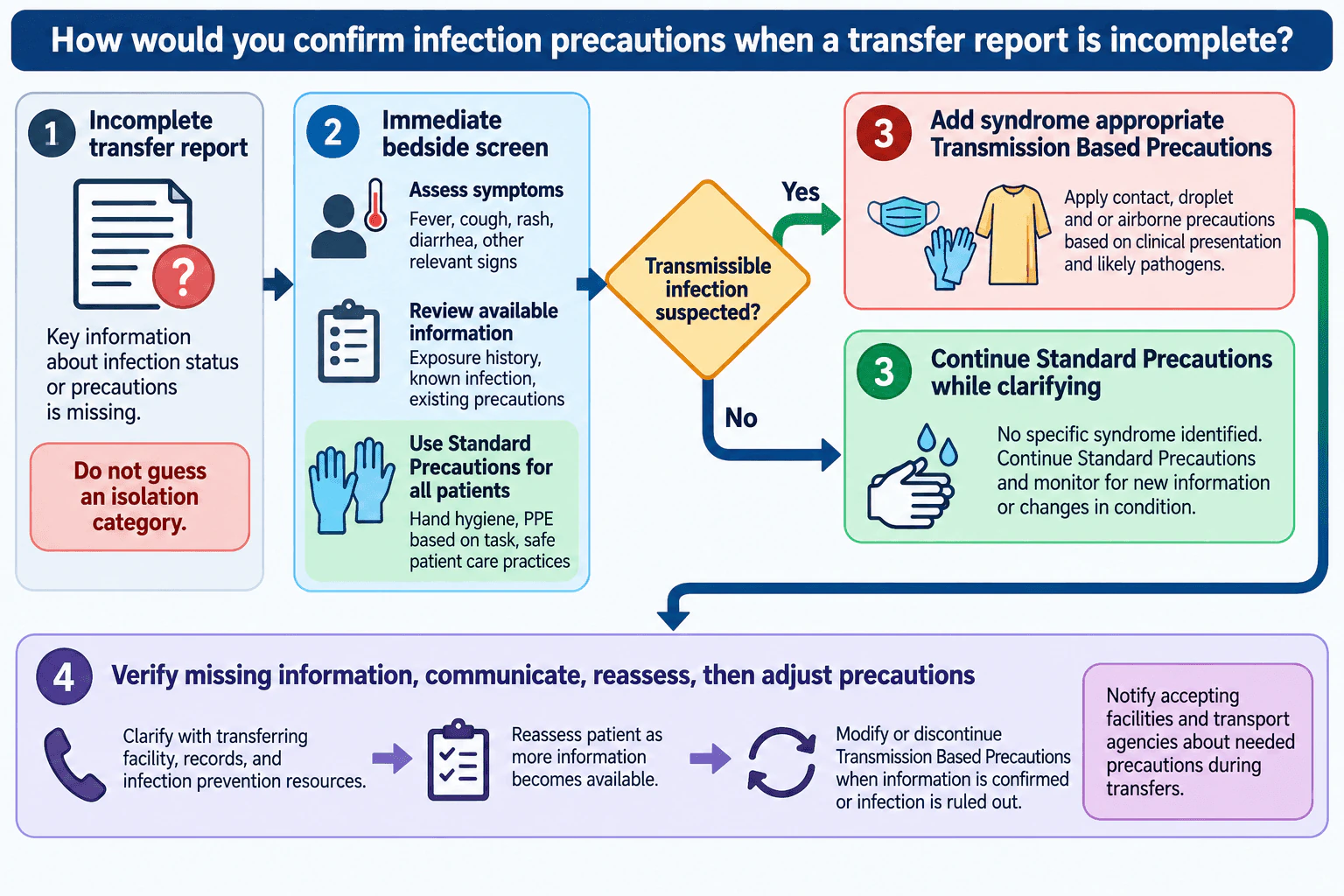
I would not guess the isolation category. I would assess the patient for relevant symptoms and exposure history, review available records and existing precautions, and continue Standard Precautions for all care. If the presentation suggests a transmissible infection, I would add the appropriate Transmission Based Precautions based on the clinical presentation and likely pathogens while I verify the missing information. I would clarify with the transferring facility, available records, and infection prevention resources as needed, then reassess and adjust precautions when more information becomes available.
Detailed Explanation
When a transfer report is incomplete, the safest approach is to protect the patient, staff, and others while actively resolving the information gap. Standard Precautions apply to all patient care. Additional Transmission Based Precautions are added when the clinical presentation and likely infection indicate that extra measures are needed.
Useful Questions to Ask the Interviewer
What clinical information and records are available from the transferring facility?
What infection prevention resources are available when the appropriate precautions are uncertain?
What local process is used to communicate precautions during transfers?
How to Explain It in an Interview
Immediate assessment
I would first recognize that the transfer information is incomplete and avoid guessing an isolation category. I would assess the patient for relevant symptoms, such as fever, cough, rash, diarrhea, or other findings that could suggest a transmissible infection. I would also review available exposure history, known infection information, and any documented existing precautions.
Maintain protection while clarifying
I would use Standard Precautions for all patient care, including hand hygiene and personal protective equipment based on the anticipated task and exposure. If the clinical presentation suggests a transmissible infection, I would add the appropriate Transmission Based Precautions based on the presentation and likely pathogens while the missing information is being clarified.
Verify missing information
I would contact the transferring facility, review available records, and use infection prevention resources when needed. I would clearly communicate what information remains uncertain rather than treating an assumption as confirmed fact.
Reassess and communicate
As more information becomes available, I would reassess the patient and modify or discontinue additional precautions when appropriate. If the patient is transferred again, I would communicate the required precautions to the accepting facility and transport team so appropriate protection continues during the transfer.
Why Interviewers Ask This
Interviewers are assessing whether the nurse can protect patients and staff when transfer information is incomplete without making unsupported assumptions. A strong answer demonstrates immediate assessment, appropriate use of Standard Precautions, recognition of when additional precautions may be needed, verification of missing information, communication, and reassessment as the clinical picture changes.
Common interview mistakes
Common mistakes include guessing an isolation category from incomplete information, failing to use Standard Precautions while clarification is underway, assuming that the absence of a confirmed diagnosis means no additional precautions are needed, failing to reassess when new information becomes available, and failing to communicate required precautions during another transfer.
Interview tip
Structure the answer around four actions: assess immediately, use Standard Precautions and add Transmission Based Precautions when indicated, verify the missing information, and reassess and communicate any change in precautions. Avoid presenting one isolation category or one local process as universally required.
Interviewer may ask next
How would you verify the correct precautions if the transferring nurse cannot be reached?
I would continue Standard Precautions, assess the patient for symptoms and relevant exposure history, and review available records, known infection information, and any existing precaution documentation. If the clinical presentation suggests a transmissible infection, I would use the appropriate Transmission Based Precautions based on the presentation and likely pathogens while seeking clarification through available infection prevention or clinical resources. I would reassess as new information becomes available.
What would you do if the patient developed new symptoms after arrival?
I would reassess the patient promptly because the new symptoms could change the infection risk assessment. If the changed presentation suggests a transmissible infection, I would add the appropriate Transmission Based Precautions based on the clinical presentation and likely pathogens while further information is obtained. I would communicate the change to the care team, continue Standard Precautions, and modify or discontinue additional precautions as more information becomes available.
3. How would you explain a regional transfer plan to a family unfamiliar with the receiving hospital?NEWCommunication And DelegationMediumUpmc
i Question Details
Original practice question for this employer context, not a reported employer interview question. Explain the relevant ED nursing judgment and identify information or authority you would need. Do not assume an internal employer protocol.
Short Interview Answer (30-60 seconds)
I would start by asking what the patient and family already know and what concerns them about the transfer. Then I would explain the reason for transfer, the receiving hospital's role, the transport plan, and what will happen next using plain language. I would distinguish confirmed information from anything I still need to verify and involve the responsible clinician for medical decision questions outside my nursing authority. If language assistance is needed, I would use a qualified interpreter. I would finish with teach back so the patient or family explains the plan in their own words, correct any misunderstanding, and confirm through closed loop communication that the appropriate teams have completed the clinical handoff.
Detailed Explanation
A regional transfer can feel confusing because the patient and family are being asked to trust an unfamiliar hospital during an already stressful situation. My role as the emergency department nurse is to explain what is known clearly, identify what still needs confirmation, verify understanding, advocate for unresolved concerns, and support a safe transition without exceeding my authority.
Useful Questions to Ask the Interviewer
What information about the receiving hospital and transport plan is normally available to the bedside nurse before speaking with the family?
How is acceptance of the patient and transfer of clinical responsibility confirmed during an interfacility transfer?
What qualified interpreter resources are available for patients and families who need language assistance?
How to Explain It in an Interview
Communication Needs
I would first ask what the patient and family already understand and what worries them most. I would explain the plan in small parts: why transfer is being recommended, where the patient is going, what type of care the receiving hospital is expected to provide, how transport is expected to occur, and what the family should expect next. I would avoid unexplained medical terms and clearly say when a detail still needs verification.
If the patient or family needs language assistance, I would use a qualified interpreter or other qualified language service rather than relying on an unqualified person. I would speak directly to the patient and family and give information in manageable sections.
Confirming Understanding
I would not assume that a nod or a yes means the plan is understood. I would use teach back by asking the patient or family to explain in their own words why the transfer is happening and what they expect next. If I hear a misunderstanding, I would explain the point another way and check again.
Consent And Advocacy
I can explain the nursing aspects of the transfer and reinforce information that has been appropriately provided. Questions about medical risks, alternatives, or decisions requiring another professional's authority should go to the responsible clinician. If the patient or family remains uncertain or raises a safety concern, I would advocate for that concern to be addressed before transfer whenever the clinical situation permits.
Competing Assignments And Delegation
In Pennsylvania, the registered nurse remains responsible for nursing assessment, planning, implementation, and evaluation. I would not delegate nursing assessment or other nursing functions requiring registered nurse judgment to unlicensed assistive personnel. Supportive non nursing tasks may be assigned only when they are appropriate to the worker's role, competence, supervision requirements, and facility policy. Tasks given to licensed team members must also remain within their legal scope and demonstrated competence.
If another urgent patient requires my attention, I would communicate the priority, obtain appropriate team support, and explicitly confirm who has assumed each responsibility rather than assuming someone else has taken over.
Safe Transfer Of Responsibility
Before departure, I would confirm that required communication with the appropriate sending, transport, and receiving personnel has occurred through the established process. Closed loop communication means the message is sent, acknowledged, and confirmed so important information or responsibility is not lost during the transition.
Why Interviewers Ask This
The interviewer is evaluating whether the nurse can explain a complex transition clearly, verify understanding, support meaningful patient and family participation, use qualified interpretation when needed, stay within nursing scope, advocate when concerns remain unresolved, and maintain safe communication when several teams and competing assignments are involved.
Common interview mistakes
Common mistakes include giving too much information at once, using unexplained clinical terminology, assuming agreement means understanding, relying on an unqualified interpreter when qualified language assistance is needed, presenting uncertain details as confirmed, answering medical decision questions outside nursing authority, failing to escalate unresolved concerns, failing to confirm who has assumed responsibility, or delegating nursing assessment to unlicensed assistive personnel.
Interview tip
Structure the answer around four actions: explain the transfer clearly, verify understanding with teach back, escalate questions or concerns to the appropriate professional, and confirm the clinical handoff through closed loop communication. Mention qualified interpretation when needed and make clear that nursing assessment and judgment remain with the registered nurse.
Interviewer may ask next
How would you verify that the patient and family actually understand the transfer plan?
I would use teach back instead of asking only whether they understand. I would ask them to explain in their own words why the transfer is happening, where the patient is going, and what they expect to happen next. If their response shows a misunderstanding, I would clarify that specific point using simpler language and ask them to explain it again. This checks how clearly I communicated rather than testing the patient or family.
What would change if the patient had limited English proficiency and the family became upset about the transfer?
I would slow the conversation, acknowledge the concern, and obtain a qualified interpreter or qualified language service so the patient can participate meaningfully. I would speak directly to the patient and family, explain confirmed information in small sections, invite questions, and use teach back through the interpreter. If they raised questions about medical risks, alternatives, consent, or another decision outside my nursing authority, I would involve the responsible clinician while continuing to advocate for clear communication and a safe transition.
4. How would you reconcile medications administered before arrival with the next planned intervention?NEWMedication And ProceduresMediumUpmc
i Question Details
Original practice question for this employer context, not a reported employer interview question. Explain the relevant ED nursing judgment and identify information or authority you would need. Do not assume an internal employer protocol.
Short Interview Answer (30-60 seconds)
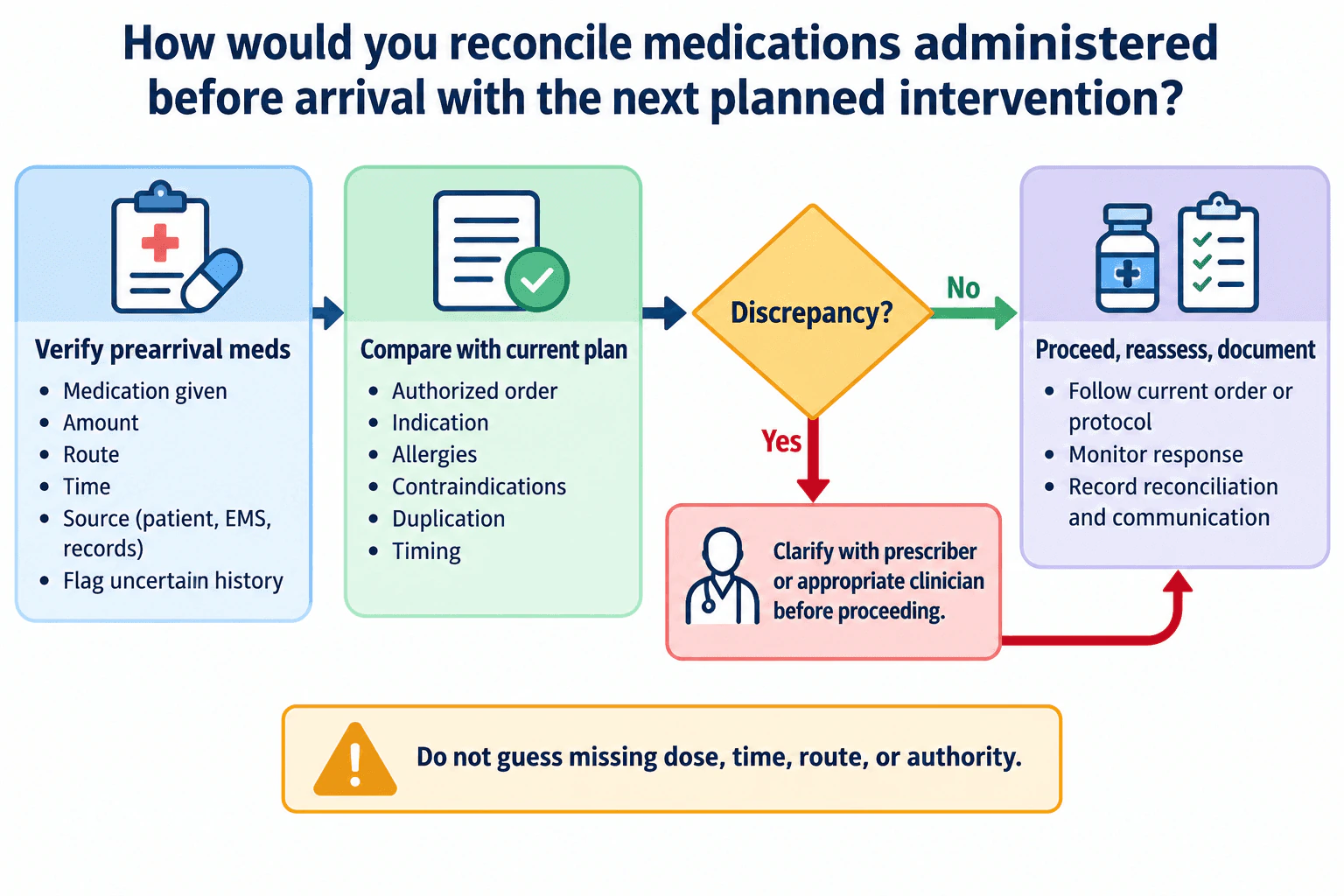
I would verify what the patient received before arrival, including the medication, amount, route, time, indication, and source of the information. Then I would compare that information with the current authorized order and planned intervention, checking allergies, possible duplication, contraindications, timing, and the patient's current response. If there is a discrepancy or missing information, I would not guess. I would clarify it with the prescriber or appropriate clinician before proceeding. After the plan is confirmed, I would carry it out within my scope, reassess the patient, and document the reconciliation and communication.
Detailed Explanation
Medication reconciliation means verifying what medication was given before arrival, comparing that information with the current authorized treatment plan, identifying discrepancies that could affect the next intervention, and resolving uncertainty before proceeding. The central safety principle is not to guess missing medication details or authority.
Useful Questions to Ask the Interviewer
What medication information is available from emergency medical services, the patient, caregivers, transfer records, or the electronic record?
Has the next medication or intervention already been ordered, and who should be contacted when a discrepancy needs clarification?
Are there applicable protocols that authorize specific nursing actions in this situation?
How to Explain It in an Interview
Verify What Was Given
I would establish the medication name, amount, route, time, indication, and source. I would determine whether the history is complete and reliable. If the source is uncertain or a clinically important detail is missing, I would flag that uncertainty rather than filling in the missing information myself.
Compare With the Current Plan
I would compare the prearrival medication information with the current authorized order and planned intervention. I would check allergies, indication, possible duplication, contraindications, timing, and the patient's current condition and response. This helps determine whether the planned intervention remains consistent with what has already been administered and with the patient's present clinical status.
Resolve A Discrepancy
If the information and current plan agree, I would proceed according to the authorized order or applicable protocol within my competence. If there is a discrepancy, such as uncertain timing, possible duplication, a conflicting route, or another safety concern, I would pause before administration and communicate the specific discrepancy to the prescriber or other appropriate clinician. I would not independently change a prescribed treatment plan unless that action is authorized by applicable scope, order, or protocol.
Reassess And Document
After clarification and the authorized intervention, I would monitor the patient's response and reassess for expected effects or adverse changes. I would document the verified medication information, any discrepancy, the clarification obtained, the resulting plan, the intervention performed, and the patient's response. This creates a clear transition of care record and reduces the chance that uncertain medication information is carried forward.
Why Interviewers Ask This
This question evaluates whether the nurse can prevent medication errors during a transition of care. The interviewer is looking for a structured approach to gathering reliable medication information, comparing it with the current plan, recognizing discrepancies, staying within nursing scope, escalating uncertainty appropriately, reassessing the patient, and documenting communication rather than making assumptions.
Common interview mistakes
Common mistakes include relying on an unverified medication history, recording only the medication name when the amount, route, or time is clinically important, overlooking allergies or possible duplication, assuming a prearrival treatment automatically remains appropriate, guessing missing information, proceeding despite an unresolved discrepancy, changing a prescribed plan without appropriate authority, and failing to document the clarification and patient response.
Interview tip
Present the answer as the same safety sequence shown in the clinical workflow: verify what was given, compare it with the current authorized plan, identify whether a discrepancy exists, clarify any discrepancy before proceeding, then reassess and document. Make it explicit that you would not guess a missing amount, time, route, or authority.
Interviewer may ask next
How would you verify a medication history if the patient could not provide reliable information?
I would use available reliable sources such as emergency medical services documentation, transfer records, medication administration records, the electronic record, pharmacy information when accessible, or information from an appropriate caregiver. I would compare available sources rather than assuming one is complete. Any unresolved uncertainty that could affect the next intervention would be communicated to the prescriber or appropriate clinician before administration, and I would document both the verified information and what remained uncertain.
What would you do if the patient's clinical condition changed after the next intervention had been planned?
I would reassess the patient and determine whether the clinical change creates a safety concern with the planned intervention. I would review the current authorized order and relevant prearrival medication information. If the change creates an unresolved concern, I would pause before administration and promptly communicate the change to the prescriber or appropriate clinician. I would then follow the confirmed authorized plan, continue appropriate monitoring, and document the change in condition, communication, intervention, and response.
5. How would you adapt a transfer handoff for an injured child accompanied by an anxious caregiver?NEWTrauma And Special PopulationsMediumUpmc
i Question Details
Original practice question for this employer context, not a reported employer interview question. Explain the relevant ED nursing judgment and identify information or authority you would need. Do not assume an internal employer protocol.
Short Interview Answer (30-60 seconds)
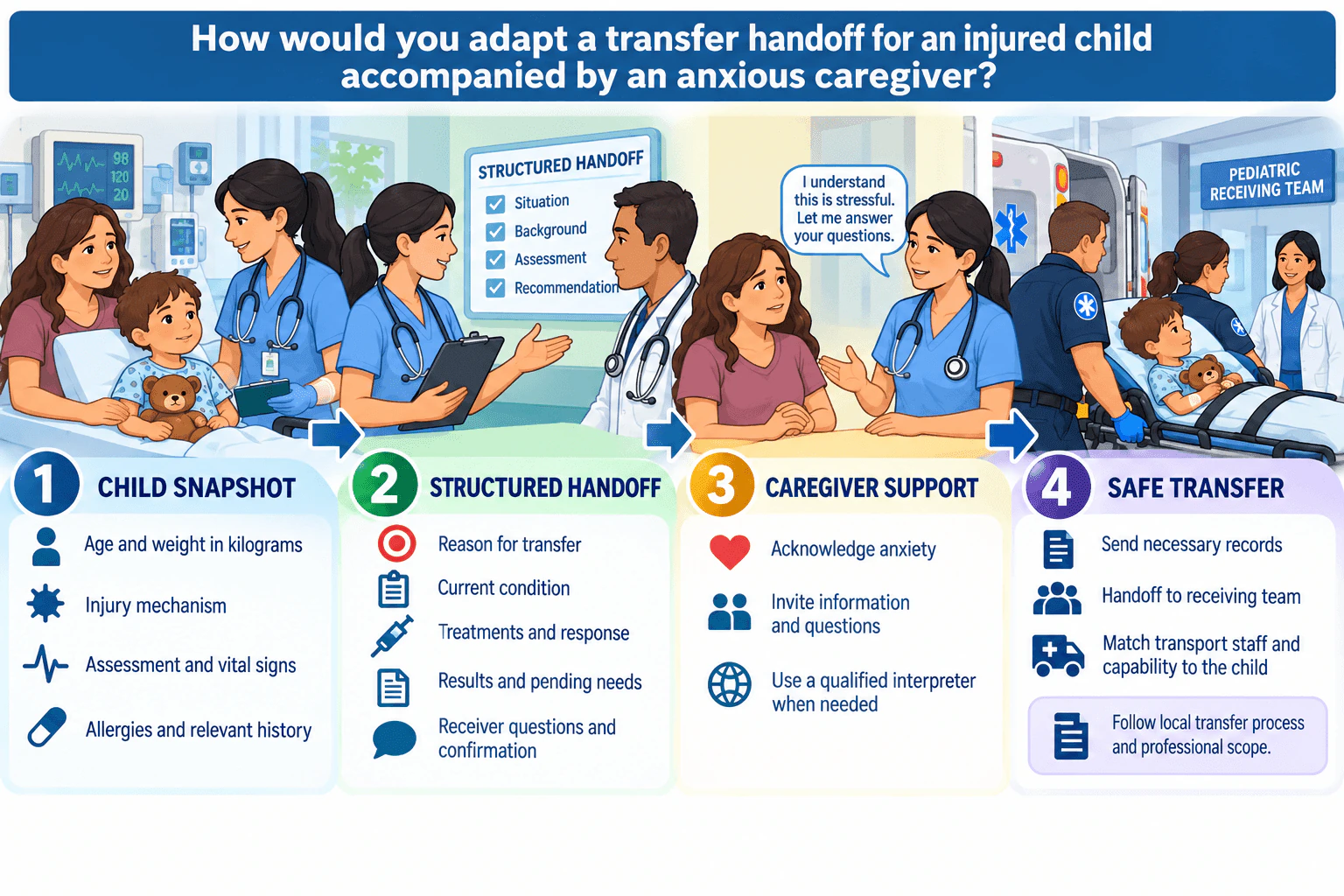
I would start with a child specific snapshot: age, weight in kilograms, injury mechanism, current assessment and vital signs, allergies, and relevant history. I would then give the receiving team a structured handoff with the reason for transfer, current condition, treatments and response, results and pending needs, and allow questions and confirmation. I would support the anxious caregiver with calm explanations, invite relevant information and questions, and use a qualified interpreter when needed. Before transfer, I would verify that necessary records are going with the child and that the transport staff and capability match the child's needs, following the responsible clinician, applicable transfer requirements, and local process.
Detailed Explanation
A strong handoff for an injured child has two goals: transfer the clinical information accurately and support the child and caregiver through a stressful transition. I would keep the handoff pediatric specific and would not treat the child as a smaller adult.
Useful Questions to Ask the Interviewer
What structured handoff method does this emergency department use for pediatric transfers?
What local process defines who confirms receiving facility acceptance and selects the transport level?
What pediatric transport and interpreter resources are available here?
How to Explain It in an Interview
I would begin with the child snapshot. I would confirm the child's age, current weight in kilograms, injury mechanism, assessment and vital signs, allergies, and relevant history. I would avoid inventing findings that were not provided and would communicate any important change before departure.
For the clinical handoff, I would clearly state the reason for transfer, the child's current condition, treatments already provided and the response, pertinent results and pending needs, and any concerns requiring attention during transport or on arrival. I would give the receiving clinician an opportunity to ask questions and confirm critical information. A standardized handoff with active exchange between sender and receiver supports safer transitions. manual.jointcommission.org
I would also address the caregiver directly. I would acknowledge the anxiety, explain the transfer in calm plain language, invite relevant observations and questions, and use a qualified interpreter when needed for effective communication. The caregiver can provide valuable context, but I would not rely on the caregiver to carry essential clinical information between teams.
For the safe transition, I would verify that necessary records and available results accompany the child and that the transport staff, equipment, and capability are appropriate for the child's current needs. Pediatric interfacility transfer guidance specifically addresses appropriate transport capability, handoff among clinicians and transport personnel, medical records, caregiver information, and family considerations. media.emscimprovement.center When EMTALA applies, an appropriate transfer also includes sending pertinent available records and using qualified personnel and appropriate transportation equipment. cms.gov I would follow the responsible clinician's decisions, applicable law, and local transfer process rather than assume authority or an employer specific protocol.
Why Interviewers Ask This
This question tests whether the nurse can combine pediatric assessment, clear clinical handoff, caregiver support, and safe transition planning while recognizing the limits of the bedside RN role. It also tests whether the nurse identifies information and authority that must be verified instead of inventing an employer specific transfer process.
Common interview mistakes
Common mistakes include giving an adult style handoff without emphasizing the child's age and weight, omitting the injury mechanism or response to treatment, failing to communicate pending needs, relying on the caregiver to relay essential clinical information, ignoring caregiver anxiety, skipping receiver questions and confirmation, assuming any transport crew is suitable, or describing an employer specific process that was never provided.
Interview tip
Present the answer as one continuous transfer story: child snapshot, structured clinical handoff, caregiver support, then safe transfer. Be clear about what you would assess, communicate, and verify as the bedside nurse, and identify receiving acceptance, transport selection, and other authorization decisions as matters for the responsible clinician and applicable local process.
Interviewer may ask next
What would you verify immediately before the child leaves the sending emergency department?
I would verify the child's current assessment and condition, confirm that the receiving and transport teams have the necessary handoff information, make sure pertinent available records and results accompany the transfer, communicate pending needs, and confirm that the transport staff, equipment, and capability are appropriate for the child's current needs. Pediatric transfer guidance includes these elements in safe transfer planning. media.emscimprovement.center When EMTALA applies, pertinent available records must be sent and the transfer must use qualified personnel and appropriate transportation equipment. cms.gov
How would your approach change if the child deteriorated just before transport?
I would treat the deterioration as new clinical information that could change transfer risk and transport requirements. I would immediately reassess the child, escalate the change to the responsible emergency clinician, update the receiving and transport teams, and revise the handoff and documentation. I would not assume the original transport plan remains appropriate. Any stabilization actions or change in transport capability would follow the responsible clinician, available emergency protocols, and local policy.
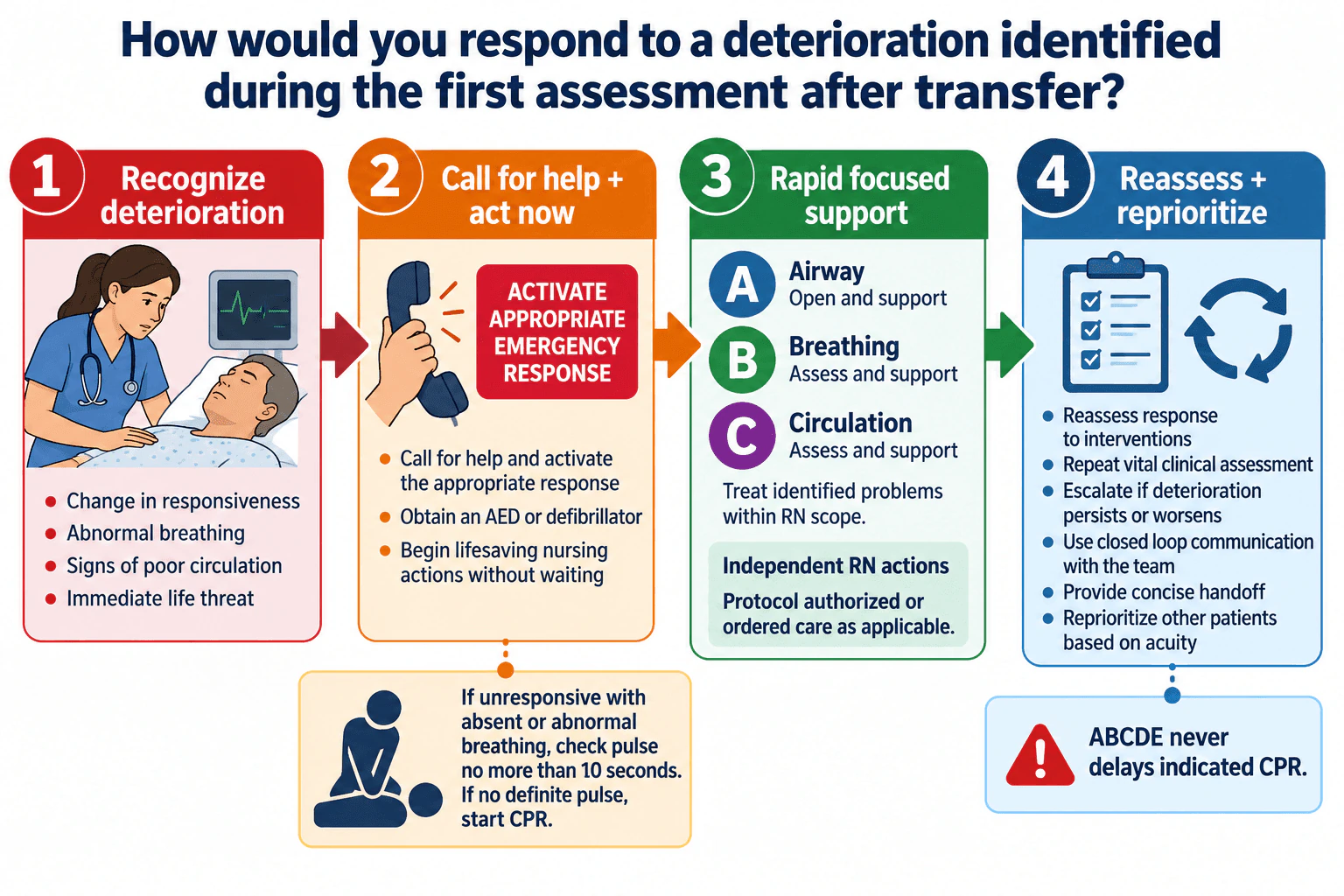
6. How would you respond to a deterioration identified during the first assessment after transfer?NEWScenario BasedMediumUpmc
i Question Details
Original practice question for this employer context, not a reported employer interview question. Explain the relevant ED nursing judgment and identify information or authority you would need. Do not assume an internal employer protocol.
Short Interview Answer (30-60 seconds)
I would immediately recognize the deterioration, identify the most urgent threat, call for the appropriate emergency response, and start lifesaving nursing actions within my scope. I would rapidly assess and support airway, breathing, and circulation without allowing a routine ABCDE assessment to delay indicated CPR. If an adult patient were unresponsive with absent or abnormal breathing, I would check for a pulse for no more than 10 seconds and start CPR if no definite pulse were present while obtaining an AED or defibrillator. I would then reassess the patient, escalate persistent or worsening deterioration, communicate clearly with the team, and reprioritize my other patients based on current acuity.
Detailed Explanation
A deterioration identified during the first assessment after transfer changes the priority immediately. I would stop treating the transfer assessment as routine, identify the immediate life threat, activate the appropriate emergency response, and begin actions that should not wait for completion of a full history or examination.
Useful Questions to Ask the Interviewer
What patient findings are available when the deterioration is recognized, including responsiveness, breathing, circulation, vital signs, and recent changes?
What emergency resources and team members are immediately available in this setting?
Which interventions are covered by standing protocols, and which require a specific order or another clinician?
How to Explain It in an Interview
Immediate Actions
I would first recognize the deterioration and rapidly assess responsiveness and immediate threats to airway, breathing, and circulation. I would call for help and activate the appropriate emergency response while beginning independent nursing actions within my scope. I would not delay lifesaving care to finish a routine transfer assessment.
If an adult patient were unresponsive with absent or abnormal breathing, I would check for a pulse for no more than 10 seconds. If no definite pulse were felt, I would start CPR, activate the emergency response, and have an AED or defibrillator obtained promptly. A complete ABCDE assessment would not delay indicated CPR.
If the patient had a pulse, I would continue rapid focused assessment and support airway, breathing, and circulation according to the findings. I would treat identified problems within nursing scope and use protocol authorized or ordered care when applicable rather than assuming authority that has not been established.
Risk Signals
I would pay particular attention to a change in responsiveness, abnormal breathing, signs of poor circulation, unstable vital signs, or other findings suggesting an immediate life threat. I would use the actual assessment findings rather than assume a diagnosis before the patient is evaluated.
Reassessment
After each intervention, I would reassess the patient's response and repeat the relevant clinical assessment. Persistent or worsening deterioration would trigger further escalation. I would use closed loop communication so requests are acknowledged and completed and provide a concise handoff describing the change, actions taken, response, and remaining concerns.
I would then reprioritize the rest of my patient assignment according to current acuity and arrange appropriate coverage when needed. The key is to recognize the unstable patient, act on immediate threats, reassess continuously, and adjust priorities as the clinical picture changes.
Why Interviewers Ask This
This question evaluates whether the nurse can recognize rapid deterioration, identify the immediate life threat, activate help without delaying lifesaving care, distinguish independent nursing actions from protocol authorized or ordered care, communicate effectively during an emergency, reassess the patient's response, and reprioritize competing patient needs according to acuity.
Common interview mistakes
Common mistakes include finishing a routine transfer assessment before responding to an obvious life threat, delaying indicated CPR while completing ABCDE, failing to activate help early, assuming a diagnosis before assessing the actual findings, performing protocol dependent or ordered interventions without appropriate authority, failing to reassess after interventions, using unclear team communication, and forgetting to reprioritize other assigned patients after the emergency begins.
Interview tip
Explain the response in the same priority order you would use clinically: recognize the deterioration, identify the immediate threat, call for appropriate help, begin lifesaving actions within nursing scope, rapidly support airway, breathing, and circulation, reassess the response, escalate persistent deterioration, communicate clearly, and reprioritize the rest of the assignment according to acuity.
Interviewer may ask next
What would you verify before carrying out additional treatment after the initial lifesaving response?
I would verify the patient's current assessment findings, allergies, relevant history, medication information, recent treatments, available transfer documentation, and the authority for the proposed intervention. I would distinguish independent nursing actions from actions permitted by an applicable protocol and actions requiring an order or another professional. I would also reassess the patient before proceeding because the clinical condition may have changed.
How would your response change if the transferred adult patient became unresponsive and had absent or abnormal breathing?
I would treat that as possible cardiac arrest. I would activate the emergency response, check for a pulse for no more than 10 seconds, and start CPR if no definite pulse were felt. I would have an AED or defibrillator obtained promptly while resuscitation continues according to current adult guidance. A routine ABCDE assessment would not delay CPR.
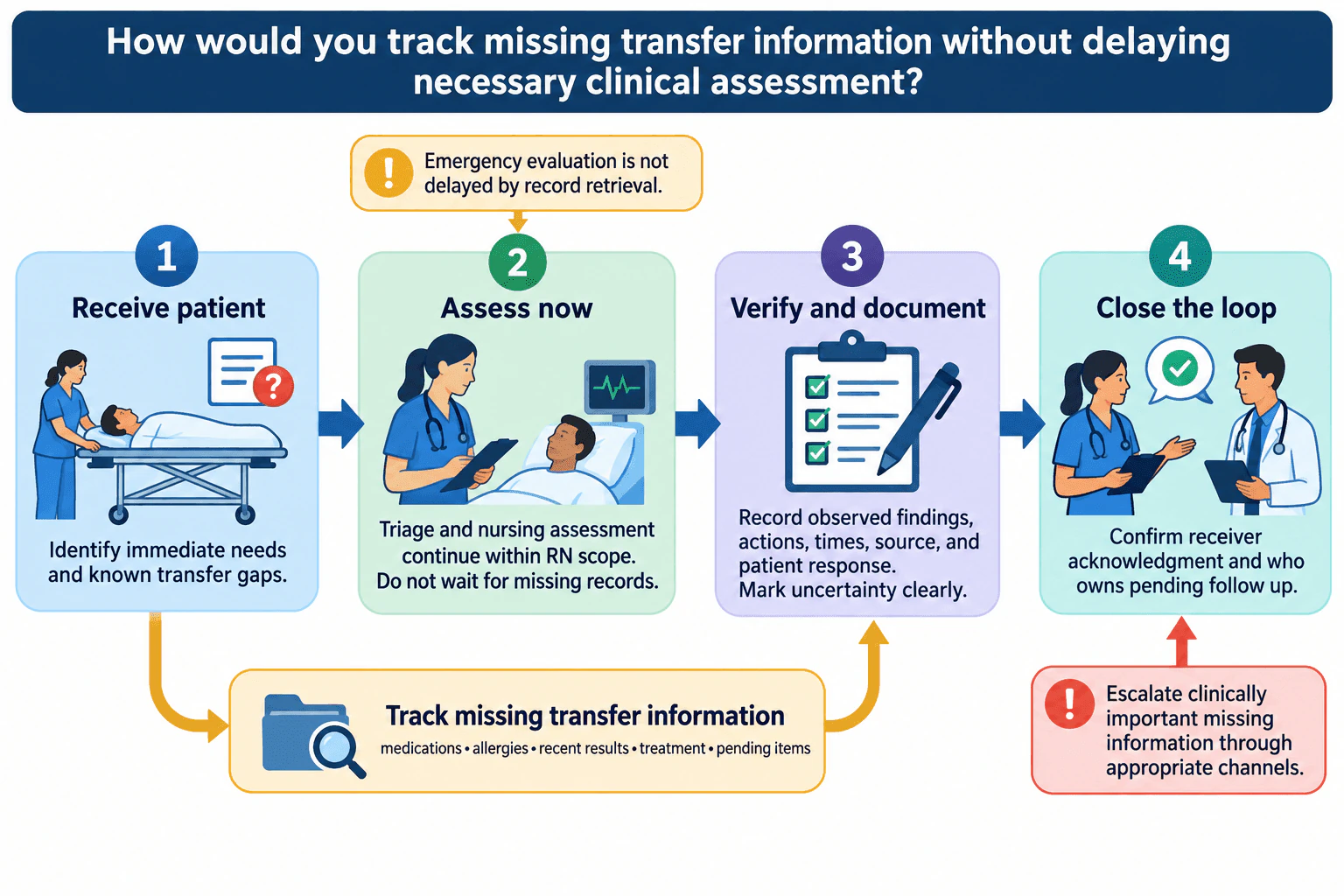
7. How would you track missing transfer information without delaying necessary clinical assessment?NEWDocumentation ComplianceHardUpmc
i Question Details
Original practice question for this employer context, not a reported employer interview question. Explain the relevant ED nursing judgment and identify information or authority you would need. Do not assume an internal employer protocol.
Short Interview Answer (30-60 seconds)
I would assess the patient first and track missing transfer information in parallel. I would document what is known, what is missing, the source and time of information, my observed findings and actions, and the patient's response. I would actively pursue important gaps such as medications, allergies, recent results, prior treatment, and pending items without delaying necessary assessment. If missing information could change immediate care, I would escalate it promptly. I would then confirm that the receiving clinician acknowledges critical information and that ownership of any pending follow up is clear.
Detailed Explanation
The key is to treat clinical assessment and information retrieval as parallel responsibilities. Missing paperwork or delayed records should not cause necessary emergency assessment to wait. At the same time, I should make the information gap visible, actively pursue it, and document what remains uncertain.
Useful Questions to Ask the Interviewer
Which roles are designated and authorized to perform the medical screening examination in this setting?
What communication channels are used for urgent transfer information and critical results?
How is responsibility for pending results or missing records assigned during handoff?
How to Explain It in an Interview
I would begin with the patient, not the paperwork. I would identify immediate clinical needs, complete triage and nursing assessment within my scope, and document the findings and time. I would not represent the medical screening examination as an independent RN function unless the nurse is designated as qualified by the hospital and is acting within applicable scope requirements. CMS states that an EMTALA medical screening examination must be performed by personnel designated as qualified under the hospital's bylaws or rules and regulations. cms.gov
At the same time, I would create a clear record of the missing transfer information. I would identify specific gaps that could affect care, such as medication history, allergies, recent diagnostic results, treatment already provided, and pending tests or consultations. I would note the source of information and distinguish confirmed facts from information that remains uncertain.
I would continue appropriate nursing assessment and reassessment while retrieving records through appropriate clinical communication channels. For an EMTALA governed interfacility transfer, the transferring hospital must send available medical records related to the emergency condition at the time of transfer, and records that are not yet available must be sent as soon as practicable afterward. qcor.cms.gov
If a missing item could materially affect current decisions, I would escalate the gap to the appropriate clinician rather than silently waiting. For example, an uncertain allergy history, an unknown medication given before arrival, or a pending critical result could require prompt clarification.
My documentation would remain objective. I would chart what I observed, what I did, when I did it, the information source, the patient's response, who was notified, and what information remained outstanding. I would never chart care that was not performed.
Finally, I would close the loop. I would confirm that the receiving clinician has acknowledged important information and clarify who owns any pending follow up. AHRQ describes effective handoff as transferring information together with responsibility and accountability, including acknowledgment by the receiver and clarity about responsibility. ahrq.gov That keeps the patient moving through necessary assessment while reducing the risk that missing information disappears during the transition.
Why Interviewers Ask This
This question evaluates whether the nurse can protect patient safety while managing incomplete information during a transition of care. The interviewer is looking for prioritization, objective documentation, awareness of nursing scope, appropriate escalation, and closed loop communication without allowing record retrieval to delay necessary emergency assessment.
Common interview mistakes
Waiting for complete transfer records before beginning necessary assessment, documenting unverified information as fact, failing to identify the source or time of received information, charting care that was not performed, allowing a clinically important missing item to remain unreported, assuming every RN independently performs the medical screening examination, or ending a handoff without confirming who is responsible for pending follow up.
Interview tip
Emphasize the parallel workflow shown in the diagram: identify immediate needs, assess now, track missing information at the same time, document verified findings and uncertainty, escalate clinically important gaps, and close the loop on responsibility. Avoid claiming a specific employer process or authority that depends on local designation.
Interviewer may ask next
How would you verify information that arrives after the initial transfer handoff?
I would verify the source, compare the new information with the existing record, document when and from whom it was received, and distinguish confirmed information from unresolved discrepancies. If the new information could change current care, I would communicate it promptly to the responsible clinician and confirm receipt. I would also document any resulting reassessment or patient response within my nursing scope.
What would you do if the patient's condition worsened while you were still waiting for missing transfer information?
The change in clinical condition would take priority. I would reassess the patient, initiate nursing actions that are within my scope and any applicable authorized protocols, notify the appropriate clinician, and escalate according to the urgency of the findings. I would continue pursuing the missing information in parallel, but I would not delay clinically necessary assessment or escalation while waiting for records.
8. Why do you want to work the ED What are your goalsNEWBehavioralEasyUpmc
i Question Details
Explain your genuine reasons for choosing emergency nursing and describe realistic professional goals that fit your actual experience, education, and development plans.
Interview tip:
Use STAR to structure your answer: briefly explain the Situation and Task, make Action the most detailed part, and finish with the Result. For example, describe what drew you to emergency nursing, how your interest developed through patient care experience, what strengths you want to build in the ED, how you plan to keep learning, and how those goals support safe and compassionate care.
Situation
I am drawn to emergency nursing because patients often need careful assessment, clear communication, and calm support during uncertain situations. That is what attracts me to emergency nursing. I like that the ED requires nurses to care for people with many different needs while staying focused on safety and priorities.
Task
My goal is to build a strong foundation as an emergency nurse. I want to become more confident in recognizing changes in a patient condition, organizing care when several needs compete for attention, communicating concerns early, and helping patients and families understand what is happening during a stressful visit.
Action
I would approach that goal by learning from experienced emergency nurses, asking questions when I am unsure, and using feedback to improve my practice. I would focus first on becoming consistent with assessment, prioritization, reassessment, communication, documentation, and safe transitions of care. I also want to improve how I stay organized when the department becomes busy because good emergency nursing is not only about moving quickly. It is about knowing what needs attention first and recognizing when a patient's condition may be changing. I would continue building my clinical knowledge through education and practice while staying within my role, competence, and the standards that guide registered nursing practice. I would also work closely with the rest of the care team because emergency care depends on clear communication and shared awareness of patient needs.
Result
My long term goal is to become a dependable emergency nurse who can manage increasing responsibility while still giving patients safe and compassionate care. I want to keep developing my judgment, communication, and emergency nursing skills over time. That combination of constant learning, teamwork, and meaningful patient care is why I want to work in the ED.
Why Interviewers Ask This
Interviewers ask this question to understand whether the candidate has a realistic reason for choosing emergency nursing and whether their professional goals match the demands of the ED. A strong answer shows motivation, self awareness, commitment to learning, sound priorities, and an understanding that emergency nursing requires assessment, communication, teamwork, adaptability, and continued skill development.
Interviewer may ask next
What part of emergency nursing do you most want to develop first?
I would first focus on strengthening assessment and prioritization. I want to become very consistent at gathering the important information, recognizing changes in a patient's condition, deciding what needs attention first, and communicating concerns clearly to the appropriate team member. I see those skills as a foundation for safe emergency nursing.
Where would you like to be professionally after gaining more ED experience?
I would like to become a dependable and experienced emergency nurse who can handle a wider range of patient situations with good judgment and calm communication. I also want to keep learning through education, feedback, and practice so I can contribute more effectively to the team while continuing to provide safe and compassionate care.
9. Past experience with conflict resolutionNEWBehavioralMediumUpmc
i Question Details
Describe a real nursing, clinical training, academic, or work example involving conflict. Explain the situation, your role, how you communicated, the actions you took, the outcome, and what you learned.
Interview tip:
Use STAR to structure your answer: briefly explain the Situation and Task, make Action the most detailed part, and finish with the Result. For example, describe a conflict with another member of the care team, your responsibility to keep communication respectful and patient focused, how you listened to the other person, explained your concern clearly, worked toward an agreed plan, and what the experience taught you about resolving disagreements.
Situation
During a busy emergency department shift, another nurse and I disagreed about which patient needed our immediate attention. I was concerned about a patient whose condition had changed, while my colleague was focused on another urgent task. The disagreement became tense because we were both trying to protect our patients and manage several demands at once.
Task
My responsibility was to address my concern without allowing the disagreement to interfere with patient care or teamwork. I needed to explain what I was seeing, understand my colleague's concern, and help us agree on a safe next step.
Action
I kept my voice calm and focused the conversation on the patient rather than on who was right. I briefly explained the change I had observed and why I believed the patient needed prompt reassessment. I then asked my colleague to explain what was driving her concern so I could understand the full situation. Once we both had the same information, I suggested that we divide the immediate work so the changing patient could be reassessed while the other urgent responsibility was still covered. I also made sure the appropriate clinical team member was informed of the change in the patient's condition. When the immediate issue was settled, I spoke with my colleague privately. I acknowledged that the shift had been stressful, listened to her perspective, and explained how I had experienced the disagreement. We agreed that in future situations we would state the clinical concern clearly, confirm priorities, and involve additional support early when competing needs could not be managed safely by the two of us.
Result
We resolved the disagreement without letting it continue at the bedside, and the team was able to stay focused on the patients who needed attention. The conversation afterward also improved how we communicated during later busy periods. I learned that conflict is easier to resolve when I stay calm, listen first, use specific clinical information, and keep the discussion centered on patient safety instead of making it personal.
Why Interviewers Ask This
Interviewers ask this question to understand how a nurse responds when another team member disagrees with them, especially in a fast moving clinical environment. A strong answer demonstrates respectful communication, active listening, sound judgment, patient focused decision making, accountability, and the ability to resolve tension without damaging teamwork.
Interviewer may ask next
Why did you choose to speak with your colleague privately after the immediate issue was resolved?
I wanted to keep the urgent discussion focused on patient care and avoid turning the disagreement into a personal argument in front of others. Once the immediate needs were addressed, a private conversation gave both of us space to explain our perspectives calmly. It also helped us agree on a better way to communicate when priorities compete in the future.
What would you do if a similar disagreement happened again and you still could not reach agreement?
I would again state my concern clearly, listen to the other person's reasoning, and focus on the patient facts. If we still could not agree and I remained concerned about patient safety, I would involve the appropriate charge nurse or other responsible clinical team member for additional assessment and direction. I would keep the discussion respectful and continue supporting the agreed care plan.
10. Describe a time you worked across team boundaries to clarify responsibility.NEWBehavioralHardUpmc
i Question Details
Original practice question for this employer context, not a reported employer interview question. Explain the relevant ED nursing judgment and identify information or authority you would need. Do not assume an internal employer protocol.
Interview tip:
Use STAR to structure your answer: briefly explain the Situation and Task, make Action the most detailed part, and finish with the Result. For example, describe a realistic emergency department situation where responsibility became unclear during a transition of care, explain how you kept the patient safe while confirming who owned each task, show how you communicated with the other team and appropriate clinical leaders, and explain how clear responsibility improved the handoff.
Situation
In my last role in Pennsylvania, I was caring for a patient in the emergency department who had been accepted for admission. While the transfer was being arranged, the patient's condition changed. The receiving team and the emergency department team were both involved, but it was not immediately clear who was responsible for several next steps while the patient was still physically in the emergency department.
Task
My responsibility was to keep the patient safe, avoid assumptions about ownership, and make sure there was a clear plan before the transfer continued. I also needed to communicate in a way that respected both teams and did not delay necessary assessment or escalation.
Action
I first reassessed the patient and continued the nursing monitoring that was within my responsibility while the patient remained under my immediate care. I notified the appropriate emergency department provider about the change and explained that responsibility during the transition needed to be clarified. I then spoke directly with the receiving nurse and described the patient's current condition, what had changed, what had already been completed, and what still needed attention. Instead of saying that a task belonged to one team or the other, I asked us to confirm responsibility for each immediate item based on the patient's location, the current plan of care, and our local policies. When there was still uncertainty, I involved the appropriate charge nurse so we could resolve it through the correct clinical leadership rather than make an assumption. Before the patient moved, I repeated the agreed plan with the receiving nurse so we both understood who was responsible for the remaining assessment, communication, and follow through. I also documented the relevant patient assessment and communication according to the requirements of my role.
Result
The teams reached a clear understanding of responsibility before the transition continued. The patient remained under active assessment during the handoff, and the receiving nurse had a clear picture of the current concerns and remaining work. I learned that when responsibility crosses team boundaries, the safest approach is to address the uncertainty early, state the facts clearly, involve the right clinical leader when needed, and confirm ownership instead of relying on assumptions.
Why Interviewers Ask This
Interviewers ask this question to understand how a nurse handles unclear responsibility when several teams are involved in patient care. A strong answer shows patient safety awareness, respectful communication, personal ownership, appropriate escalation, and the ability to create a clear transition plan without assuming another person's scope or responsibilities.
Interviewer may ask next
Why did you involve the charge nurse instead of resolving the disagreement yourself?
I involved the charge nurse because the remaining uncertainty affected responsibility across two care teams. I could explain the patient's condition and continue the nursing actions within my responsibility, but I did not want to invent a rule or assume authority over the receiving team's responsibilities. Using the appropriate clinical leader helped us clarify the plan safely and consistently.
What would you do if the receiving team still disagreed about who was responsible?
I would keep the focus on patient safety and continue the assessment and escalation that were within my responsibility while the patient remained in my care. I would clearly state which responsibilities were still unresolved and continue escalating through the appropriate clinical leadership until ownership was confirmed. I would not allow uncertainty between teams to become a reason for an important patient need to be ignored.
Emergency Department Nurse Resume Examples
Explore the resume examples below to find the one that best matches your target Emergency Department Nurse role.
New Graduate Emergency Department Nurse0-1 years; supervised transition to emergency nursing
Disclaimer: This interview guide is for educational and informational purposes only. It is designed to help readers prepare, but it does not guarantee any interview result, hiring decision, offer, or outcome. Interview questions, hiring criteria, and preferred answers can vary by employer, interviewer, industry, location, and time. All answers, examples, and explanations in this guide are suggested examples for interview preparation, not definitive answers or instructions for professional practice. They are based on research and judgment, are provided without warranties of any kind, and should be adapted to the question, role, and applicable laws and professional requirements. Diagrams are simplified illustrations intended to highlight the main concepts and their relationships; actual situations, systems, and practices may be more complex. Alternative approaches may be equally valid or better suited to a particular question, context, or interviewer. To the fullest extent permitted by applicable law, the contributors and publisher are not liable for decisions made, actions taken, or losses incurred based on this guide.
State Laws and Professional Responsibilities: Laws and requirements governing an occupation vary by state and jurisdiction. You are responsible for checking the current laws, licensing requirements, and scope-of-practice rules that apply to your location and role, and for ensuring that your answers and actions comply with them. Adapt examples in this guide to those requirements. This guide is not legal advice.
Company Notice: This guide is an independent educational resource and is not affiliated with, endorsed by, sponsored by, or approved by the company named in this guide. Company names identify reported interview experiences or the employer context of clearly labeled original practice exercises. Interview practices can change without notice, and inclusion of company-specific content does not mean these questions are official, complete, or guaranteed to be asked. To the fullest extent permitted by law, the author, contributors, and publisher are not responsible for outcomes related to use of this material.
Content Accuracy and Verification: To the fullest extent permitted by applicable law, we do not represent or warrant that interview guides, questions, answers, examples, or diagrams are accurate, complete, current, error-free, or suitable for any particular purpose. You are responsible for independently reviewing and verifying the information before relying on it.