This interview guide is for educational and informational purposes only. It is designed to help readers prepare, but it does not guarantee any interview result, hiring decision, offer, or outcome. Interview questions, hiring criteria, and preferred answers can vary by employer, interviewer, industry, location, and time. All answers, examples, and explanations in this guide are suggested examples for interview preparation, not definitive answers or instructions for professional practice. They are based on research and judgment, are provided without warranties of any kind, and should be adapted to the question, role, and applicable laws and professional requirements. Diagrams are simplified illustrations intended to highlight the main concepts and their relationships; actual situations, systems, and practices may be more complex. Alternative approaches may be equally valid or better suited to a particular question, context, or interviewer. To the fullest extent permitted by applicable law, the contributors and publisher are not liable for decisions made, actions taken, or losses incurred based on this guide.
State Laws and Professional Responsibilities
Laws and requirements governing an occupation vary by state and jurisdiction. You are responsible for checking the current laws, licensing requirements, and scope-of-practice rules that apply to your location and role, and for ensuring that your answers and actions comply with them. Adapt examples in this guide to those requirements. This guide is not legal advice.
Identity, Image, and Privacy Notice
To respect individual privacy, some names, profile photographs, avatars, biographical details, and other identifying information displayed in this guide may be replaced with pseudonyms, licensed stock images, illustrative avatars, composite images, or representative descriptions. Unless a person is expressly identified as an actual contributor, a displayed name, image, or profile should not be understood as depicting or identifying a specific candidate, interviewer, employee, or other real individual. These representations are provided for editorial and illustrative purposes only and do not imply endorsement, employment, participation, or affiliation with this guide or any company mentioned in it. Any resemblance to an actual person is coincidental.
Company Notice
This guide is an independent educational resource and is not affiliated with, endorsed by, sponsored by, or approved by the company named in this guide. Company names identify reported interview experiences or the employer context of clearly labeled original practice exercises. Interview practices can change without notice, and inclusion of company-specific content does not mean these questions are official, complete, or guaranteed to be asked. To the fullest extent permitted by law, the author, contributors, and publisher are not responsible for outcomes related to use of this material.
Content Accuracy and Verification
To the fullest extent permitted by applicable law, we do not represent or warrant that interview guides, questions, answers, examples, or diagrams are accurate, complete, current, error-free, or suitable for any particular purpose. You are responsible for independently reviewing and verifying the information before relying on it.
Questions or comments?
Contact us for general questions, or share feedback, technical corrections, and comments with the community.
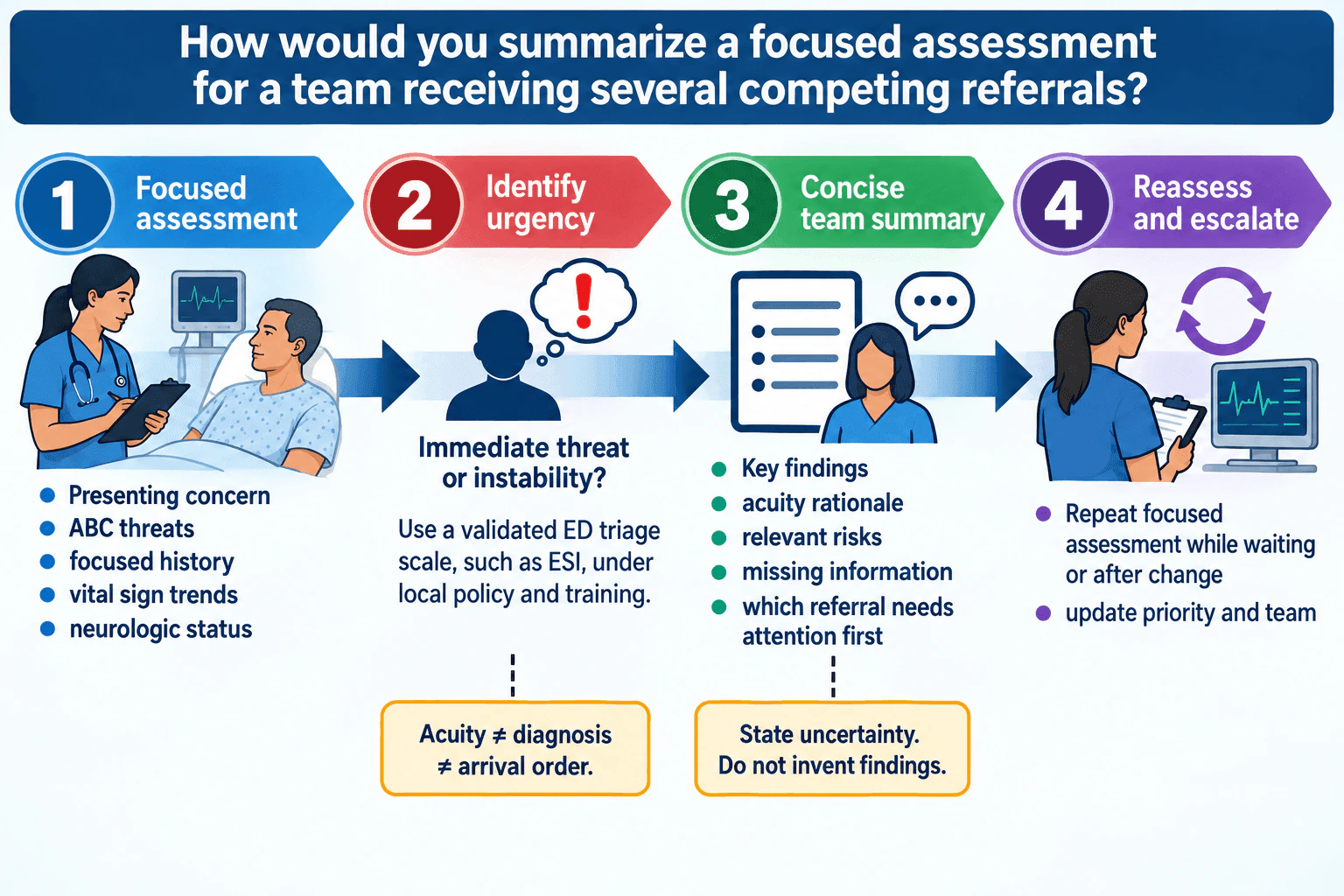
1. How would you summarize a focused assessment for a team receiving several competing referrals?Clinical KnowledgeEasyJohns Hopkins Medicine
i Question Details
Original practice question for this employer context, not a reported employer interview question. Explain the relevant ED nursing judgment and identify information or authority you would need. Do not assume an internal employer protocol.
Short Interview Answer (30-60 seconds)
I would use the same focused structure for every referral: presenting concern, immediate airway, breathing, or circulation threats, neurologic status, focused history, key assessment findings, available vital sign trends, and relevant risks. I would state what is known, what is still missing, and why one referral is more urgent than another. If the department uses a validated triage scale such as ESI, I would apply it within local policy and training. I would not treat acuity as a diagnosis or simply prioritize by arrival time, and I would reassess anyone waiting because priority can change. ena.org
Detailed Explanation
A focused assessment for competing referrals should make the reason for priority visible. I would not try to give the team every available detail. I would give the findings that affect urgency, clearly separate known information from missing information, and identify which referral needs attention first. Emergency department triage is a rapid evaluation of patient acuity used to establish the order or location in which patients should be seen. ena.org
Useful Questions to Ask the Interviewer
Which validated triage framework does this department use for routine emergency department prioritization?
What information is normally available to the receiving nurse when several referrals arrive at the same time?
What is the expected escalation pathway when a waiting patient develops new instability?
How to Explain It in an Interview
Clinical Priorities
I would start with the presenting concern and immediately identify findings that suggest an airway, breathing, or circulation threat, significant neurologic change, or other instability. I would then add the most relevant focused history, assessment findings, available vital sign trends, and risks. I would avoid inventing findings that were not provided.
Assessment Factors
For each referral, I would summarize four things: key findings, the reason for the acuity judgment, relevant risks, and important missing information. If a validated emergency department triage scale such as ESI is used locally, I would apply it within my training and the department's policy. ESI is an emergency department triage acuity tool, not a diagnosis or a disaster triage system. Current ACEP and ENA guidance supports use of a scientifically validated emergency department triage scale such as ESI. ena.org
I would also remember that triage priority is not simply arrival order. The purpose is to determine urgency so patients needing earlier clinical assessment are prioritized appropriately. ena.org
Care Rationale
My team summary would communicate the presenting problem, the findings that affect urgency, important information that is still missing, and which referral needs attention first. That keeps the communication clinically useful without overstating certainty.
If a patient remains in the waiting process, I would repeat the focused assessment according to local policy and reassess when the condition changes. New instability, worsening symptoms, or concerning changes in vital signs would prompt me to update the priority and communicate the change to the appropriate clinician or team. Reassessment of waiting patients is an important safety function because clinical conditions can evolve after the initial triage assessment. psnet.ahrq.gov
Why Interviewers Ask This
This question evaluates whether the nurse can turn several competing clinical presentations into a concise, safety focused priority summary. The interviewer is looking for recognition of instability, disciplined use of available findings, appropriate triage reasoning, clear communication of uncertainty, and reassessment when the clinical picture changes.
Common interview mistakes
Common mistakes are giving a long unfocused report, prioritizing by arrival time alone, treating ESI as a diagnosis, stating an acuity judgment without explaining the findings behind it, inventing missing findings, overlooking changes in vital signs or neurologic status, and failing to reassess a patient whose condition may change while waiting.
Interview tip
Use a consistent sequence so the interviewer can hear your judgment clearly: focused assessment, immediate threats, acuity rationale, concise team summary, then reassessment and escalation if the condition changes. State uncertainty directly rather than filling gaps with assumptions.
Interviewer may ask next
How would you verify your prioritization before acting on it?
I would confirm the available referral information, obtain or repeat focused assessment findings and vital signs that are within my nursing role, clarify conflicting or missing information, and apply the department's validated triage method according to policy and training. I would communicate significant uncertainty or concerning findings to the appropriate clinician rather than presenting an unsupported conclusion.
What would change if a patient who was initially lower priority developed new respiratory distress while waiting?
I would promptly reassess that patient, update the urgency based on the new findings, escalate through the appropriate emergency care pathway, and communicate that the patient's condition and priority have changed. The current clinical condition should guide the updated triage priority rather than relying on the earlier assessment. psnet.ahrq.gov
2. Walk me through a specific patient you cared for, including their admitting diagnosis, your plan of care, and the nursing interventions you implemented.Clinical KnowledgeMediumJohns Hopkins Medicine
i Question Details
Describe one real patient care example. Explain the admitting diagnosis, the focused nursing assessment, how the findings shaped the plan of care, the nursing interventions you performed within your role, how you monitored the patient response, and when you communicated or escalated changes.
Short Interview Answer (30-60 seconds)
I would choose a deidentified patient from my own practice and explain the case in the order the care occurred. For example, with an adult admitted with acute ischemic stroke, I would describe the initial airway, breathing, circulation, and neurologic assessment, the last known well information, serial vital signs, glucose assessment when authorized by protocol, rapid stroke team escalation, preparation for urgent imaging, ordered monitoring and treatment, and repeated neurologic reassessment. I would finish with what changed, what I communicated, and how the patient responded.
Detailed Explanation
A strong answer tells one complete clinical story. The admitting diagnosis gives the context, but the main point is to show how your assessment shaped the nursing plan, how you acted within your role, and how you reassessed the patient.
Useful Questions to Ask the Interviewer
Would you like an emergency department example that continued through admission or handoff?
Would you prefer that I focus more on assessment and prioritization or on interventions and reassessment?
Is there a particular patient population that would be most relevant to this role?
How to Explain It in an Interview
Model Case
Use your own real experience in an interview. As a fictional model, consider an adult who arrived at a United States emergency department with sudden unilateral weakness and difficulty speaking and was ultimately admitted with acute ischemic stroke.
Assessment Findings
I would explain that I began with a rapid airway, breathing, circulation, and focused neurologic assessment. I would establish when the patient was last known well, obtain and trend vital signs, assess neurologic findings using the facility stroke process, check glucose when authorized by protocol, and promptly communicate findings concerning for acute stroke. Sudden one sided weakness and difficulty speaking are recognized stroke warning signs, and rapid evaluation matters because treatment options depend on timing and clinical findings. cdc.gov
Plan of Care
My priorities would be rapid stroke evaluation, prevention of avoidable complications, timely diagnostic testing, close neurologic and physiologic monitoring, and preparation for treatment decisions by the stroke and medical teams. The 2026 American Heart Association and American Stroke Association guideline emphasizes rapid evaluation and time sensitive reperfusion decisions for eligible patients. professional.heart.org
Nursing Interventions
I would separate what I did independently from what required a protocol, order, or another clinician. Independent nursing actions included repeated focused neurologic assessments, monitoring airway and breathing, trending vital signs, maintaining safety, recognizing deterioration, and escalating changes. Protocol authorized or ordered actions could include obtaining intravenous access, collecting ordered laboratory specimens, preparing the patient for urgent brain imaging, cardiac monitoring, glucose testing, and carrying out ordered treatment. I would not present thrombolytic selection or prescribing as an independent nursing decision. Current 2026 guidance supports either alteplase or tenecteplase for eligible patients within the standard 4.5 hour thrombolytic treatment window. professional.heart.org
Reassessment and Communication
I would finish by describing serial neurologic assessments, vital sign trends, response to ordered treatment, and immediate communication of any worsening consciousness, weakness, speech, airway, breathing, or hemodynamic status. I would document the assessment, interventions, reassessments, communications, and handoff clearly. This shows that the plan of care remained responsive to the patient's condition rather than ending after the first intervention.
Why Interviewers Ask This
Interviewers are evaluating whether you can connect a diagnosis to bedside nursing priorities, recognize findings that require urgent escalation, work within the registered nurse role, reassess after interventions, and communicate meaningful changes to the interdisciplinary team. They also want to hear a coherent patient story rather than a list of unrelated tasks.
Common interview mistakes
Common mistakes include giving a task list without explaining why the interventions were chosen, claiming that triage acuity established the diagnosis, omitting reassessment, failing to distinguish independent nursing actions from protocol authorized or ordered care, inventing patient findings or outcomes, including identifying information, and describing medication selection as an independent registered nurse decision.
Interview tip
Choose one real deidentified case that you remember clearly. Organize the answer in the same order the care unfolded: diagnosis and presentation, focused assessment, nursing priorities, interventions, reassessment, escalation, and outcome. Be precise about what you personally observed and did, and clearly identify actions that required a protocol, order, or another clinician's decision.
Interviewer may ask next
How would you verify that your plan of care was appropriate for the patient's diagnosis?
I would compare the patient's current assessment and trends with the working diagnosis, verify orders and protocol requirements, review relevant allergies and contraindication information available in the record, confirm that required monitoring and diagnostic steps were progressing, and clarify anything inconsistent with the patient's condition. For acute ischemic stroke, I would use the current facility stroke pathway together with applicable evidence based guidance and promptly communicate discrepancies or new findings to the stroke or medical team. The current United States guideline is the 2026 American Heart Association and American Stroke Association guideline for early management of acute ischemic stroke. professional.heart.org
How would your nursing priorities change if the same patient became less responsive and developed difficulty protecting the airway?
The immediate priority would shift to airway, breathing, circulation, rapid reassessment, and urgent escalation. I would assess airway patency, respiratory effort, oxygenation, circulation, and neurologic status, call for immediate clinical assistance, prepare for advanced airway management by an appropriately qualified clinician, and continue close monitoring while carrying out authorized emergency interventions. I would also communicate the exact change from the previous assessment and the timing of deterioration because a worsening level of consciousness can materially change the urgency and treatment plan.
3. Tell me about a situation where you made a mistake. How did deal with it and how did you learn from your mistake?Patient SafetyMediumJohns Hopkins Medicine
i Question Details
Use a truthful nursing example. Explain the safety concern, the immediate steps you took within your role, how you communicated the issue, what follow up was needed, what you learned, and how the experience changed your practice.
Short Interview Answer (30-60 seconds)
I would answer with a real mistake from my own practice and take responsibility for it directly. I would briefly explain what happened, what safety risk I recognized, and what I did immediately to protect the patient. I would then describe who I notified when appropriate, any follow up required by local policy, and the specific habit or process I changed afterward. The key lesson I would emphasize is that in a busy emergency department, I cannot let urgency replace deliberate safety checks, and I need to speak up as soon as I recognize a concern.
Detailed Explanation
A strong response should be truthful and specific. Do not invent a patient, outcome, or clinical experience. Choose a real mistake or near miss that allows you to explain the safety concern, your immediate response, your communication, and what changed in your practice.
Useful Questions to Ask the Interviewer
How does the emergency department support staff learning from mistakes and near misses?
What resources are available when a nurse identifies a patient safety concern that needs escalation?
How are patient safety lessons shared across the emergency department team?
How to Explain It in an Interview
Patient Context
Briefly describe your real situation without identifiable patient information. State what you were responsible for and what mistake or near miss occurred. If your true experience involved patient identification or specimen collection, explain the discrepancy clearly without inventing findings or consequences.
Immediate Safety Actions
Explain what you did as soon as you recognized the problem. Stop any unsafe process that is still occurring, assess whether the patient has been affected, and apply the appropriate safety checks within your nursing role. For an identification concern, the 2026 Joint Commission National Performance Goal NPG.01.01.01 requires hospitals to have a process that includes at least two patient identifiers and states that room number or physical location is not an identifier. It also requires blood and other specimen containers to be labeled in the presence of the patient.
If a specimen is affected by an identification discrepancy, do not guess which patient it belongs to or simply change the label. Follow the organization's process for handling the specimen, including recollection or other action when required.
Accountability And Communication
State your contribution directly. Explain contributing circumstances only to provide context, not to transfer responsibility. Describe who you informed when appropriate, such as the charge nurse, treating clinician, laboratory, or another responsible team member, based on the actual event and local process. Escalate unresolved safety concerns through the appropriate chain of command.
Learning And Practice Change
Describe one specific change you made. Examples include completing identification for one patient before moving to another task, avoiding assumptions based on room location, or deliberately verifying identifiers before specimen labeling. The lesson should be more specific than saying you became more careful.
Prevention Rationale
Conclude by explaining how the experience changed your practice. A strong answer shows that you recognized the risk, acted to protect the patient, communicated openly, and converted the mistake into a reliable safety habit that you continue to use.
Why Interviewers Ask This
Interviewers are assessing honesty, accountability, patient safety judgment, communication, and your ability to learn from an error. They want to know whether you recognize risk promptly, protect the patient, communicate concerns appropriately, and make a concrete practice change that reduces the chance of recurrence.
Common interview mistakes
Do not say that you have never made a mistake. Do not invent an experience, patient outcome, facility policy, disciplinary response, or reporting requirement. Avoid minimizing the safety concern, blaming another person, or spending most of the answer explaining why the mistake happened. Do not describe changing a questionable specimen label without following the organization's process. The answer should focus on recognition, immediate safety actions, communication, accountability, learning, and a specific change in practice.
Interview tip
Choose a real event you can discuss without identifiable patient information. Keep the description of the mistake brief and spend more time explaining your response and what you learned. Name one concrete practice change that resulted from the event. A near miss is appropriate when you clearly explain the potential safety consequence and how the experience changed your behavior.
Interviewer may ask next
How would you verify patient identity if the mistake involved a specimen identification concern?
I would stop the process and use the hospital's patient identification process, including at least two patient identifiers. I would not use room number or physical location as an identifier. For blood or another specimen, I would ensure the container is labeled in the patient's presence as required by the 2026 Joint Commission National Performance Goal NPG.01.01.01. If a discrepancy already existed, I would not guess or simply alter the label. I would follow the organization's process for the affected specimen and communicate with the appropriate team member or laboratory when needed.
What would you do differently if you discovered the mistake after the specimen had already been sent for testing?
I would promptly communicate the concern through the appropriate clinical and laboratory channels so that a potentially mismatched result was not acted on without review. I would provide the known facts without guessing about specimen identity, follow the organization's process for the affected specimen and any required recollection, assess whether patient care had already been affected, escalate unresolved safety concerns, and complete documentation or safety reporting when required by local policy.
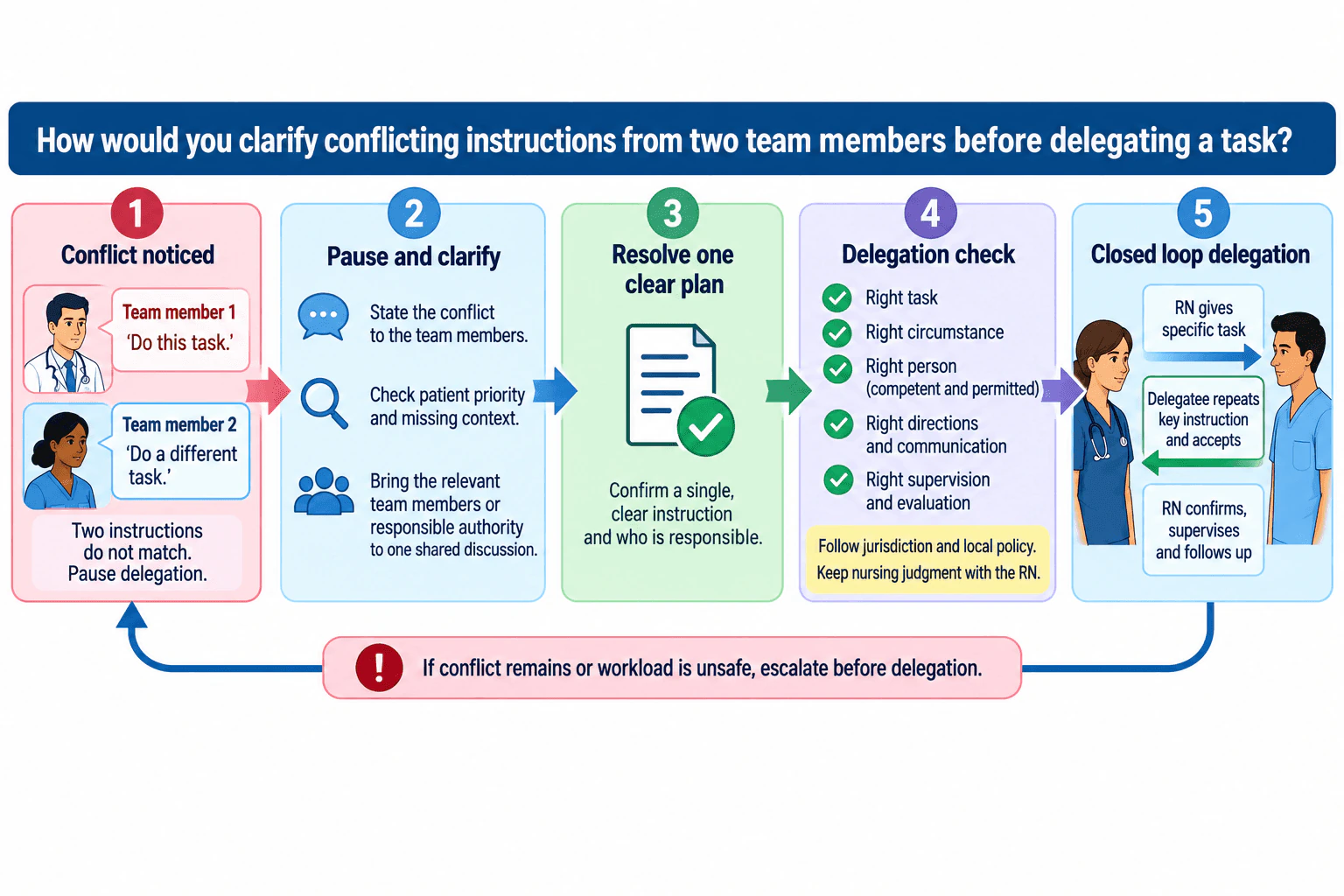
4. How would you clarify conflicting instructions from two team members before delegating a task?Communication And DelegationMediumJohns Hopkins Medicine
i Question Details
Original practice question for this employer context, not a reported employer interview question. Explain the relevant ED nursing judgment and identify information or authority you would need. Do not assume an internal employer protocol.
Short Interview Answer (30-60 seconds)
I would pause before delegating because the team should not act on conflicting instructions. I would state the conflict, check the patient's priority and any missing context, and bring the relevant team members or appropriate responsible authority into one discussion so we agree on one clear plan. I would then confirm that the task, circumstances, delegatee competence, directions, and supervision make delegation appropriate. I would use closed loop communication by giving specific instructions, asking the delegatee to repeat the key information, confirming understanding, and following up. If the conflict or an unsafe workload remains unresolved, I would escalate before delegating.
Detailed Explanation
The safest approach is to resolve the contradiction before transferring responsibility. A nurse should not choose between competing instructions by guessing or send a delegatee into an unclear situation.
Useful Questions to Ask the Interviewer
What roles do the two team members hold, and who has responsibility for the decision involved?
Has the patient's condition, priority, or assignment changed since either instruction was given?
What delegation rules, staff competencies, and escalation resources apply in this practice setting?
How to Explain It in an Interview
Clarify Before Delegating
I would first pause the delegation and state the conflict plainly. I would compare the two instructions with the patient's current needs, the urgency of the situation, and any information that may have changed. I would bring the relevant team members together, or contact the appropriate responsible authority, so the team reaches one clear instruction and understands who is responsible for the decision.
Check Delegation Boundaries
Once the plan is resolved, I would decide whether the task can safely be delegated. I would consider the right task, right circumstances, right person, right directions and communication, and right supervision and evaluation. I would verify that the delegatee has the required competence and that the task is permitted by the applicable jurisdiction and practice setting. Nursing assessment, clinical reasoning, and decisions requiring nursing judgment remain with the licensed nurse rather than being transferred to assistive personnel. These delegation principles align with current NCSBN guidance on jurisdiction, delegatee competence, communication, supervision, and retained nursing judgment. ncsbn.org
Use Closed Loop Communication
I would give one specific instruction that includes what needs to be done, relevant patient information, priorities, what findings should be reported, and when I need the information back. I would ask the delegatee to repeat the key instruction in their own words. I would then confirm that the message was understood correctly rather than treating simple agreement as proof of understanding. AHRQ describes check back as a closed loop strategy in which the receiver confirms the message and the sender verifies that it was received correctly. ahrq.gov
Supervise And Escalate
Delegation does not end when the task is assigned. I would remain available for questions, supervise at the level required by the situation, receive the report back, and evaluate the outcome. If the original conflict cannot be resolved, responsibility remains unclear, or competing assignments create an unsafe workload, I would escalate the concern through the appropriate clinical leadership path before delegating. That protects the patient and prevents a delegatee from being placed between contradictory directions.
Why Interviewers Ask This
This question tests whether the nurse protects patient safety when communication and competing assignments create uncertainty. The interviewer is looking for the ability to pause before acting, clarify priorities, recognize nursing scope and delegation boundaries, identify the appropriate source of authority, communicate a single plan, verify understanding, supervise delegated care, and escalate unresolved safety concerns.
Common interview mistakes
Common mistakes include choosing one instruction without clarifying the conflict, delegating before identifying the patient's current priority, assuming job title alone proves competence, transferring a task that requires nursing assessment or clinical judgment, giving vague directions, accepting a simple yes as proof of understanding, failing to identify who is responsible for the final plan, and failing to escalate when unresolved conflict or workload makes delegation unsafe.
Interview tip
Organize the answer around the safety sequence shown in the scenario: pause when the conflict is recognized, clarify the patient priority and responsible authority, establish one clear plan, check whether delegation is appropriate, use closed loop communication, and supervise the result. Explicitly say that unresolved conflict or unsafe workload is escalated before delegation.
Interviewer may ask next
How would you verify that the delegatee understood the final instruction?
I would use closed loop communication. I would give the instruction clearly, ask the delegatee to repeat the key task, priority, reporting expectations, and any important limits, then confirm or correct what was repeated. I would also remain available for questions and follow up after the task so verification includes both understanding and completion.
What would you do if the patient's condition changed after you had delegated the task?
I would reassess the situation and determine whether the original delegation is still appropriate. A change in condition can alter the circumstances, urgency, required nursing judgment, or level of supervision. I would give the delegatee updated instructions or stop the delegated activity if necessary, personally perform or coordinate care that requires nursing judgment, communicate the change to the appropriate team members, and escalate promptly if the patient's needs exceed the current plan or available resources.
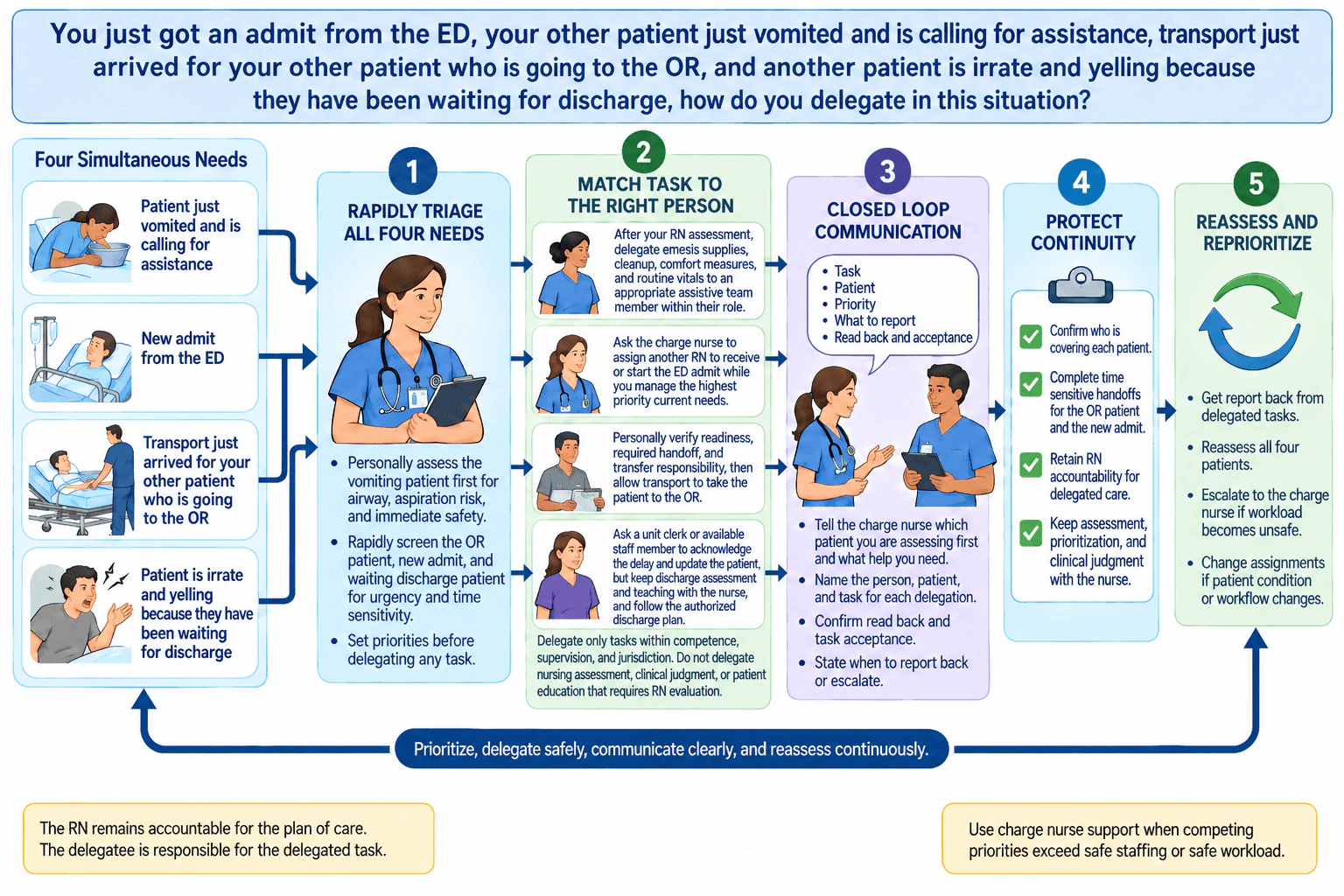
5. You just got an admit from the ED, your other patient just vomited and is calling for assistance, transport just arrived for your other patient who is going to the OR, and another patient is irrate and yelling because they have been waiting for discharge, how do you delegate in this situation?NEWCommunication And DelegationHardJohns Hopkins Medicine
i Question Details
Use only the competing assignments stated in the reported scenario. Explain which needs require immediate nursing assessment, which tasks may be delegated to appropriate team members, what information you would communicate to the charge nurse and team, how you would protect continuity of care, and how you would reassess priorities as the situation changes.
Short Interview Answer (30-60 seconds)
I would first assess the patient who just vomited because that is a new clinical change, while rapidly screening the other three patients for urgency and time sensitivity. Then I would delegate only appropriate tasks to qualified team members. After my assessment, assistive staff could help with routine supportive care that is within their role. I would ask the charge nurse to help assign another RN to the new admit if available, personally confirm readiness and handoff before the OR patient leaves, and have available staff acknowledge the discharge delay while I keep nursing assessment and teaching with the nurse. I would use closed loop communication, confirm who is covering each patient, get reports back, reassess all four patients, and escalate to the charge nurse if the workload becomes unsafe.
Detailed Explanation
The central principle is to prioritize first, delegate only appropriate tasks, communicate responsibility clearly, and then reassess. I would not assume that arrival order or the loudest patient determines priority, and I would not delegate nursing assessment or clinical judgment.
Useful Questions to Ask the Interviewer
What team members are normally available to support routine patient care and communication?
How does the charge nurse typically redistribute assignments when several time sensitive needs occur at once?
What handoff process is expected when responsibility transfers to another nurse or when a patient leaves for the OR?
How to Explain It in an Interview
Nursing Priorities
I would rapidly screen all four situations and personally assess the patient who just vomited first because this is the only newly stated clinical change. I would assess airway concerns, aspiration risk, immediate safety, and whether the patient is deteriorating. At the same time, I would quickly determine whether anything about the OR patient, new admit, or waiting discharge patient makes that patient more urgent. I would not invent stability that has not been established.
Match Tasks to the Right Person
After my assessment, I could delegate appropriate supportive tasks such as providing emesis supplies, cleanup, comfort measures, or routine vital signs to an assistive team member when the task is within that person's role, competence, jurisdiction, supervision structure, and appropriate for the patient's condition. Nursing judgment and critical decision making remain with the nurse.
I would ask the charge nurse to help assign another RN to receive or begin the new admit if staffing allows. For the OR patient, I would personally verify readiness, required handoff, and transfer of responsibility before transport proceeds. For the waiting discharge patient, a unit clerk or available staff member could acknowledge the delay and provide an update, while discharge assessment and teaching remain with the nurse and the authorized discharge plan is followed.
Closed Loop Communication
For every delegated or reassigned task, I would identify the person, patient, task, priority, what needs to be reported, and when I need a report back. I would confirm that the team member accepts and understands the responsibility rather than assuming agreement means understanding.
Protect Continuity
I would confirm who is covering each patient and complete time sensitive handoffs for the OR patient and new admit. I remain accountable for the nursing plan and for evaluating delegated care until responsibility has been appropriately transferred.
Reassess And Reprioritize
I would obtain reports from delegated tasks, reassess all four patients, and change assignments if patient condition or workflow changes. If competing needs exceed what can be managed safely, I would escalate to the charge nurse for additional support or redistribution of the workload.
Why Interviewers Ask This
This question evaluates whether the nurse can manage several competing demands without giving away nursing assessment, clinical judgment, accountability, or continuity of care. It tests prioritization, safe delegation, communication with the charge nurse and team, recognition of scope boundaries, confirmation that responsibility has actually been transferred, and willingness to reassess priorities when patient condition or workload changes.
Common interview mistakes
Common mistakes include responding only to the loudest patient, assuming the other patients are stable without a rapid screen, delegating nursing assessment or clinical judgment, assigning work without considering competence or patient condition, sending the OR patient before the required handoff and transfer of responsibility are clear, giving vague instructions without confirming acceptance, failing to obtain a report back, and waiting too long to involve the charge nurse when the workload becomes unsafe.
Interview tip
Give the interviewer a clear sequence: assess urgency, identify what must stay with the nurse, match appropriate tasks to qualified people, communicate each assignment using a closed loop, protect continuity during handoffs, and reassess. State specifically what you would personally do and what you would delegate rather than simply saying that you would ask the team for help.
Interviewer may ask next
How would you verify that delegated tasks were completed safely?
I would identify the patient and exact task, explain the priority and what findings must be reported, confirm that the team member accepts and understands the responsibility, remain available for questions, and specify when I need a report back. I would then review the report and reassess the patient or outcome when appropriate. I would not assume that silence means the task was completed or that the patient's condition remained unchanged.
What would change if the vomiting patient suddenly became less responsive?
That new finding would immediately increase the patient's priority. I would personally reassess the patient, address immediate airway and safety concerns within my nursing scope, call for appropriate clinical assistance, and notify the charge nurse so the other assignments could be covered or redistributed. Once responsibility for the other patients was clear, I would continue reassessing priorities as the situation evolved.
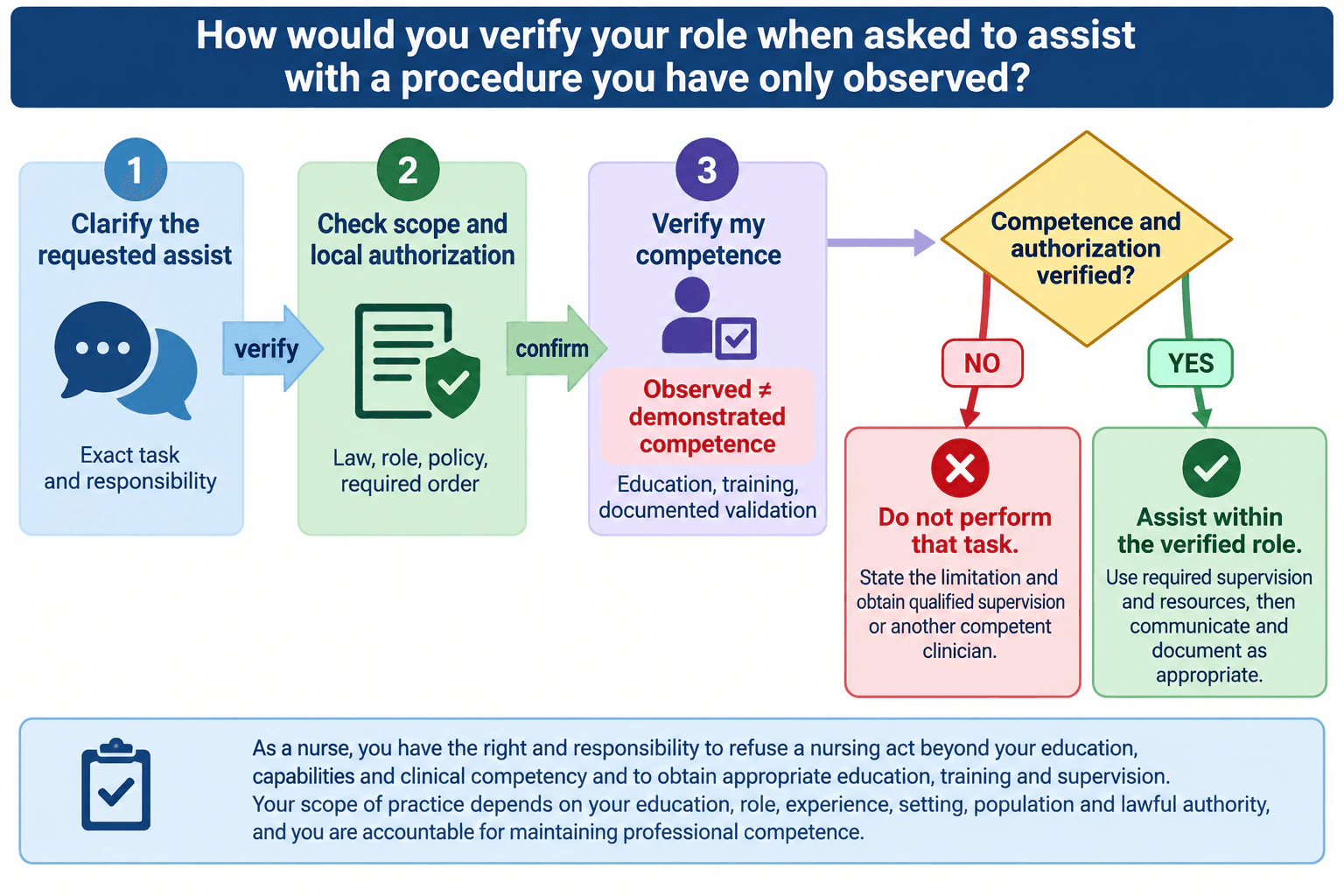
6. How would you verify your role when asked to assist with a procedure you have only observed?Medication And ProceduresMediumJohns Hopkins Medicine
i Question Details
Original practice question for this employer context, not a reported employer interview question. Explain the relevant ED nursing judgment and identify information or authority you would need. Do not assume an internal employer protocol.
Short Interview Answer (30-60 seconds)
I would clarify the exact task first, then verify my legal scope, practice setting authorization, any required order, and my own education and documented competence. Having only observed the procedure would not establish competence. If competence or authorization could not be verified, I would state that limitation and obtain qualified supervision or another competent clinician rather than perform the task. If both were verified, I would assist only within that defined role using the required supervision and resources, then communicate and document appropriately.
Useful Questions to Ask the Interviewer
What exact part of the procedure would the nurse be expected to perform or assist with?
What education, competency validation, or supervision is required for that role?
Does the activity require a specific order, authorization, or practice setting procedure?
Detailed Explanation
How to Explain It in an Interview
The key distinction is between having observed a procedure and having verified competence and authority to assist with it.
Clarify The Requested Role
I would first identify the exact task and responsibility being requested. Assisting could mean preparing equipment, monitoring the patient, administering an authorized treatment, performing a technical step, or documenting. I would not assume those activities carry the same requirements.
Check Scope And Authorization
I would confirm that the activity is permitted by applicable nursing law and regulation and supported by the practice setting. I would also determine whether a specific order, authorization, or defined supervision is required. The NCSBN Scope of Nursing Practice Decision Making Framework directs nurses to clarify the activity, consider applicable law and practice setting policies, verify education and documented current competence, confirm appropriate resources, and accept accountability before performing an activity. ncsbn.org
If this interview role is in Maryland, Maryland Board of Nursing guidance also emphasizes assessing personal knowledge, skills, and abilities before accepting an assignment, seeking assistance or additional training when gaps exist, and refusing nursing acts beyond the Nurse Practice Act or the nurse's education, capabilities, and experience. health.maryland.gov
Verify My Competence
I would compare the requested task with my completed education, training, current competency validation, and experience. Observation alone would not demonstrate that I can safely perform the task. I would also verify that appropriate human and material resources and any required qualified supervision are available.
Decide And Communicate
If competence and authorization are verified, I would assist only within that confirmed role and use the required supervision and resources. If either is not verified, I would not perform that task. I would state the limitation clearly and obtain qualified supervision or another competent clinician so patient care can continue safely. I would communicate the plan to the team and document as appropriate.
Why Interviewers Ask This
This question evaluates whether the nurse can distinguish familiarity with a procedure from verified competence and authorization. It tests judgment about patient safety, legal scope, practice setting requirements, accountability, communication, supervision, and appropriate escalation when the nurse has not demonstrated competence for a requested task.
Common interview mistakes
Common mistakes include assuming that observing a procedure establishes competence, accepting an unclear request without defining the exact task, failing to verify legal scope or practice setting authorization, assuming that an order alone establishes competence, proceeding without required supervision or resources, or declining the task without clearly communicating the limitation and helping obtain a qualified clinician.
Interview tip
Use the same decision path shown in the diagram: clarify the requested assist, check scope and local authorization, verify your competence, then decide. If competence and authorization are not verified, do not perform that task and obtain qualified supervision or another competent clinician. If they are verified, assist only within that confirmed role.
Interviewer may ask next
What would you verify before deciding that you can assist?
I would verify the exact task, applicable RN scope, practice setting requirements, any required order or authorization, my completed education and training, documented current competence, and the availability of appropriate resources and supervision. I would also confirm which responsibilities remain with another licensed professional. This is consistent with the NCSBN scope decision framework, which considers law, practice setting support, education, competence, resources, and accountability before an activity is performed. ncsbn.org
What would you do if the clinical situation became urgent while your competence for the requested procedure was still unverified?
I would immediately communicate that my competence for that specific task has not been verified and obtain a clinician who is qualified to perform it. I would continue nursing actions that are within my verified scope and competence and support the team within that role. Urgency would not make observation equivalent to demonstrated competence or create authority that has not otherwise been established. Maryland Board of Nursing guidance supports seeking assistance or additional training when gaps in knowledge, skills, or abilities are identified and communicating the need for alternate care when patient needs exceed the nurse's abilities or available resources. health.maryland.gov
7. How would you organize a trauma handoff when different team members assessed different injuries?Trauma And Special PopulationsMediumJohns Hopkins Medicine
i Question Details
Original practice question for this employer context, not a reported employer interview question. Explain the relevant ED nursing judgment and identify information or authority you would need. Do not assume an internal employer protocol.
Short Interview Answer (30-60 seconds)
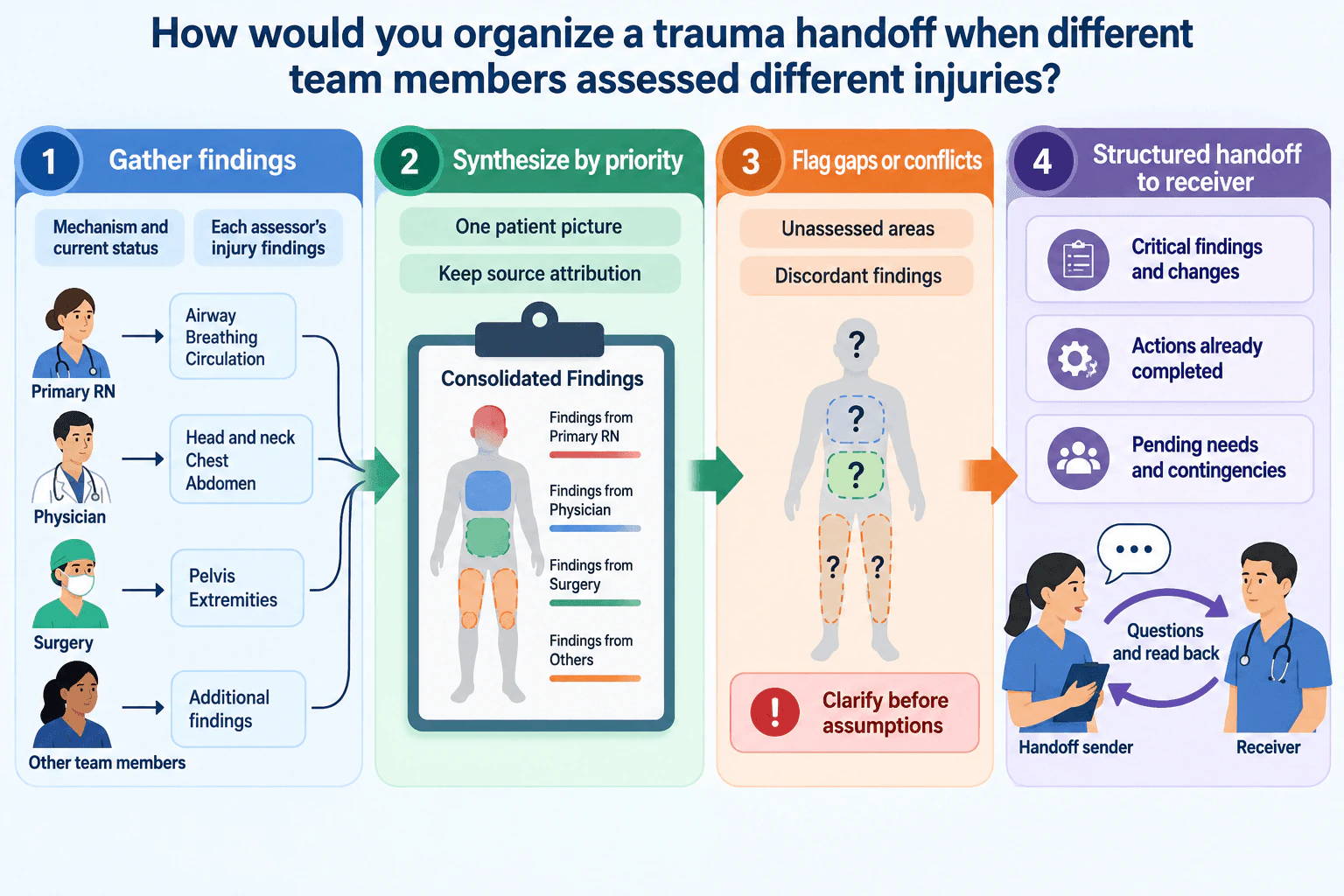
I would gather the mechanism, current status, and each assessor's findings, then synthesize them by clinical priority into one patient picture while keeping the source of important findings clear. I would flag unassessed areas or conflicting observations and clarify them rather than assume. My handoff would lead with critical findings and changes, then cover completed actions, pending needs, and contingencies. I would finish with questions and read back of important requests so the receiver can confirm the plan.
Detailed Explanation
The goal is to turn several partial trauma assessments into one organized patient picture without hiding who observed what or treating missing information as normal. ENA describes trauma nursing care as using a systematic assessment and standardized approach with rapid identification of life threatening injuries. ena.org
Useful Questions to Ask the Interviewer
What standardized handoff structure does this emergency department use for trauma transitions?
Who normally leads the handoff when several disciplines contributed separate assessments?
How are unresolved discrepancies documented or escalated before responsibility transfers?
How to Explain It in an Interview
Nursing Priorities
I would begin with the mechanism and current status, then gather each team member's actual findings. For example, if the primary nurse assessed airway, breathing, and circulation, another clinician assessed the head, neck, chest, and abdomen, and another team member assessed the pelvis or extremities, I would preserve those findings and who reported them. I would not assume those role assignments are universal.
I would then synthesize the findings by clinical priority into one patient picture instead of repeating separate reports in the order I received them. Source attribution still matters when it helps the receiver understand who directly assessed an injury or where clarification is needed.
Safety Checks
I would actively identify unassessed areas and discordant findings. If an area was not assessed, I would state that clearly. If two findings conflict, I would name the discrepancy and seek clarification from the appropriate clinician or available documentation rather than choose one version myself.
Patient Context
I would preserve relevant supplied facts such as mechanism, age, weight when clinically relevant, pregnancy status when applicable, and current observations. I would not infer that an injury is absent simply because nobody reported it.
Clinical Rationale
The structured handoff would lead with critical findings and important changes, then cover actions already completed, pending needs, and contingencies. AHRQ guidance states that handoffs should communicate uncertainty, recent changes, the plan, and contingencies, and should allow the receiver to ask questions and acknowledge the transfer. ahrq.gov
I would finish with questions and confirmation of important recommendations or requests. AHRQ's SBAR guidance includes repeat back of recommendations and requests to confirm accuracy. ahrq.gov
Why Interviewers Ask This
This question tests whether the nurse can combine several partial assessments into one coherent trauma picture without losing priorities, source attribution, uncertainty, or accountability. AHRQ describes handoff as the transfer of information together with authority and responsibility, including uncertainty, recent changes, response to treatment, and the plan with contingencies. ahrq.gov
Common interview mistakes
Common mistakes include presenting each clinician's findings as disconnected lists, burying critical changes beneath less urgent details, losing source attribution, treating an unassessed area as normal, ignoring discordant findings, omitting pending needs or contingencies, and ending the handoff without giving the receiver an opportunity to ask questions or confirm important actions.
Interview tip
Describe the handoff as synthesis rather than transcription. Show that you can gather each assessor's findings, prioritize them into one patient picture, preserve meaningful source attribution, identify gaps or conflicts, communicate completed and pending care, and confirm that the receiver understands the critical plan.
Interviewer may ask next
How would you verify information if two team members reported different findings?
I would state the discrepancy explicitly, identify who made each observation, and verify it with the appropriate clinicians or available documented assessment rather than choosing one version myself. If the difference could affect immediate safety or priorities, I would escalate it promptly to the responsible clinician and tell the receiver that the issue remains unresolved until clarified. AHRQ handoff guidance specifically includes communicating uncertainty and allowing questions and review. ahrq.gov
What would change if the trauma patient were a child or were pregnant?
The same handoff organization would still apply, but I would preserve the population specific context that changes assessment and care. For a child, I would communicate age, weight when relevant, and age appropriate findings rather than simply scale an adult pathway. For a pregnant patient, I would communicate pregnancy status and relevant observations and involve the appropriate trauma and obstetric clinicians according to local policy and available resources. I would not invent treatment steps, medication doses, or findings that were not supplied.
8. Your patient comes in for asthma exacerbation, what is the first thing you do? What do you do next?Scenario BasedMediumJohns Hopkins Medicine
i Question Details
Preserve the reported asthma presentation without adding patient findings that were not supplied. Explain the immediate emergency nursing assessment, how you would identify respiratory compromise, which nursing actions may occur under authorized protocols, when provider or rapid escalation is required, and how you would reassess response.
Short Interview Answer (30-60 seconds)
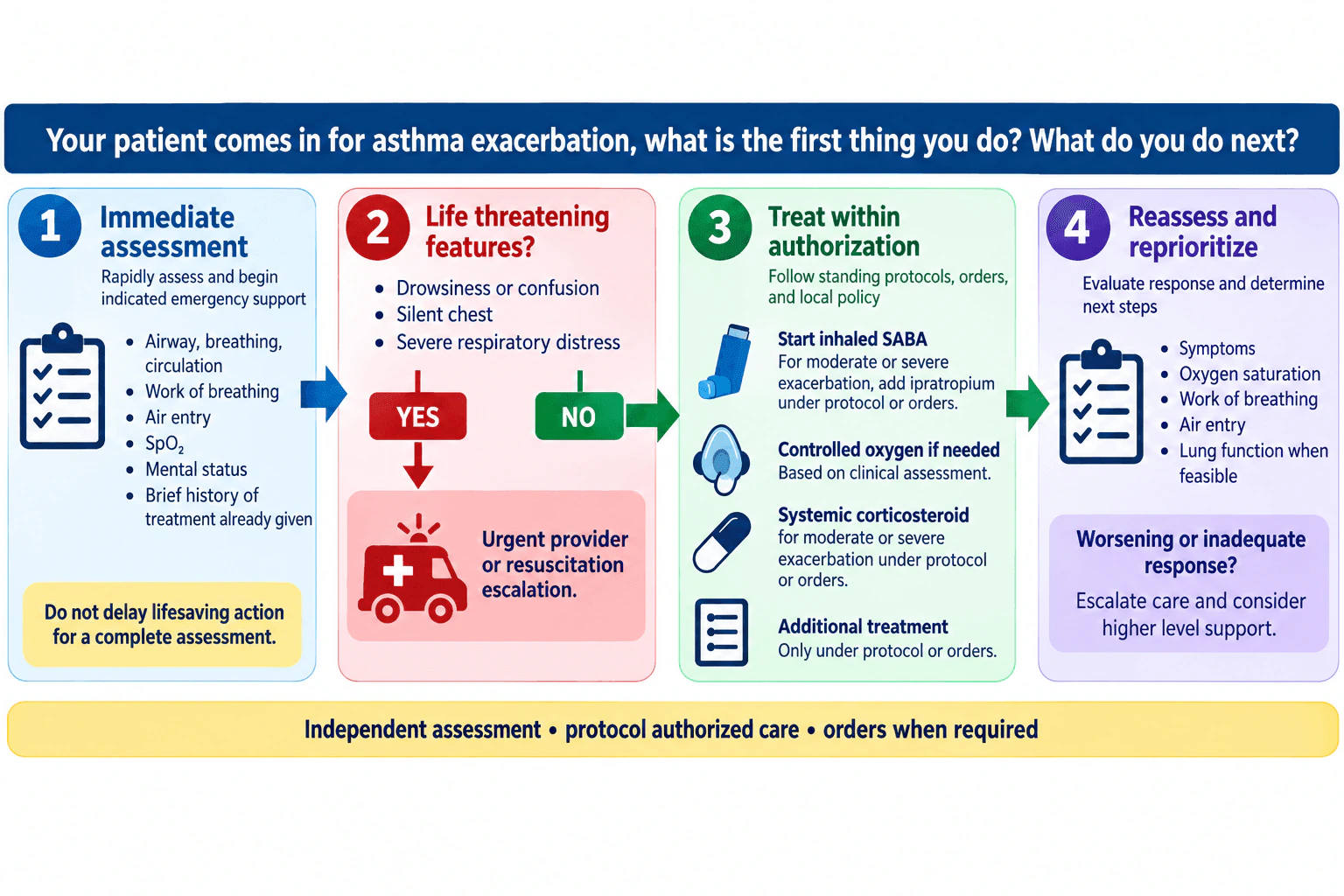
First, I rapidly assess airway, breathing, and circulation while starting any immediately indicated support. I check work of breathing, air entry, oxygen saturation, mental status, and treatment already given. If I see drowsiness, confusion, a silent chest, or severe respiratory distress, I escalate immediately. Otherwise, I begin acute bronchodilator treatment under the applicable protocol or orders. In the pathway shown, that is inhaled short acting beta2 agonist therapy. For a moderate or severe exacerbation, I add ipratropium and systemic corticosteroid therapy under protocol or orders and give controlled oxygen if needed. Then I reassess symptoms, oxygen saturation, breathing effort, air entry, and lung function when feasible and escalate if the patient worsens or does not respond.
Detailed Explanation
An asthma exacerbation is a respiratory emergency in which assessment and treatment occur together. The first priority is to determine whether the patient has life threatening respiratory compromise while beginning appropriate support. No age, pregnancy status, vital signs, oxygen saturation, or prior treatment details were supplied, so I would not invent them and would select population specific details once those facts are known.
Useful Questions to Ask the Interviewer
Should I assume an adult patient, or would you like a pediatric scenario?
May I assume the department has standing respiratory emergency protocols?
Would you like me to focus on the first several minutes or continue through disposition?
How to Explain It in an Interview
Immediate assessment
I would begin with a rapid airway, breathing, and circulation assessment while starting any immediately indicated support. I would assess work of breathing, air entry, oxygen saturation, mental status, and what asthma treatment has already been given. I would not delay lifesaving action to complete a lengthy history or full assessment.
Risk signals
I would immediately look for findings suggesting life threatening deterioration. Drowsiness, confusion, a silent chest, or severe respiratory distress would prompt urgent provider or resuscitation escalation and higher level respiratory support as appropriate. Current GINA 2026 acute care guidance identifies drowsiness, confusion, cyanosis, and a quiet or silent chest as life threatening features requiring immediate treatment and help. ginasthma.org
Treatment within authorization
If the patient is not already in the life threatening pathway, I would begin acute bronchodilator treatment according to the applicable protocol or orders. The diagram depicts inhaled short acting beta2 agonist treatment. Current GINA 2026 guidance also permits budesonide formoterol as an option for some mild acute presentations, so I would follow the population appropriate protocol rather than assume one reliever pathway for every patient. For moderate or severe exacerbations, GINA supports adding ipratropium and systemic corticosteroids. I would provide controlled oxygen when clinically needed. I would distinguish nursing assessment and supportive actions from treatments that depend on standing protocols, provider orders, or another professional's authority. ginasthma.org
Reassessment
After initial treatment, I would reassess symptoms, oxygen saturation, work of breathing, air entry, and lung function when feasible. Current GINA 2026 acute care guidance calls for review after initial treatment, including oxygen saturation, respiratory status, air entry, and lung function. If the patient worsens or has an inadequate response, I would escalate care and continue additional authorized treatment. ginasthma.org
The key interview point is that I would assess, treat, and reassess continuously rather than complete each step in isolation.
Why Interviewers Ask This
This question tests whether the nurse can identify the immediate respiratory threat, act without delaying lifesaving care, distinguish independent nursing assessment from protocol authorized treatment and ordered therapy, recognize when urgent escalation is required, and reassess whether treatment is working.
Common interview mistakes
Common mistakes include taking a long history before assessing immediate respiratory compromise, assuming every asthma exacerbation has the same severity or treatment pathway, failing to recognize drowsiness, confusion, a silent chest, or severe respiratory distress as urgent danger signals, giving protocol dependent treatment without clarifying authorization, and failing to reassess the patient's response after initial treatment.
Interview tip
Organize the response around four decisions: assess immediately, identify life threatening features, treat within nursing scope and authorization, then reassess and escalate according to response. Make it clear that assessment and lifesaving treatment can occur at the same time.
Interviewer may ask next
How would you verify that your initial interventions are working?
I would repeat the focused respiratory assessment and compare symptoms, oxygen saturation, work of breathing, air entry, mental status, and lung function when feasible with the initial findings. Current GINA 2026 guidance specifically calls for reassessment of oxygen saturation, respiratory status, air entry, and lung function after initial treatment. Worsening or inadequate response would trigger renewed escalation and additional authorized treatment. ginasthma.org
How would your approach change if this were a child rather than an adult?
The same priorities remain rapid assessment, recognition of life threatening deterioration, authorized treatment, and frequent reassessment, but I would use age appropriate pediatric severity assessment and current pediatric asthma guidance. Medication choice, delivery, dosing, oxygen goals, clinical scoring, and escalation criteria depend on the child's age, clinical severity, and applicable protocol, so I would not automatically apply adult treatment details. Current GINA 2026 guidance distinguishes pediatric assessment and treatment pathways from adult care. ginasthma.org
9. How would you document which clinician was notified when more than one service is involved?Documentation ComplianceHardJohns Hopkins Medicine
i Question Details
Original practice question for this employer context, not a reported employer interview question. Explain the relevant ED nursing judgment and identify information or authority you would need. Do not assume an internal employer protocol.
Short Interview Answer (30-60 seconds)
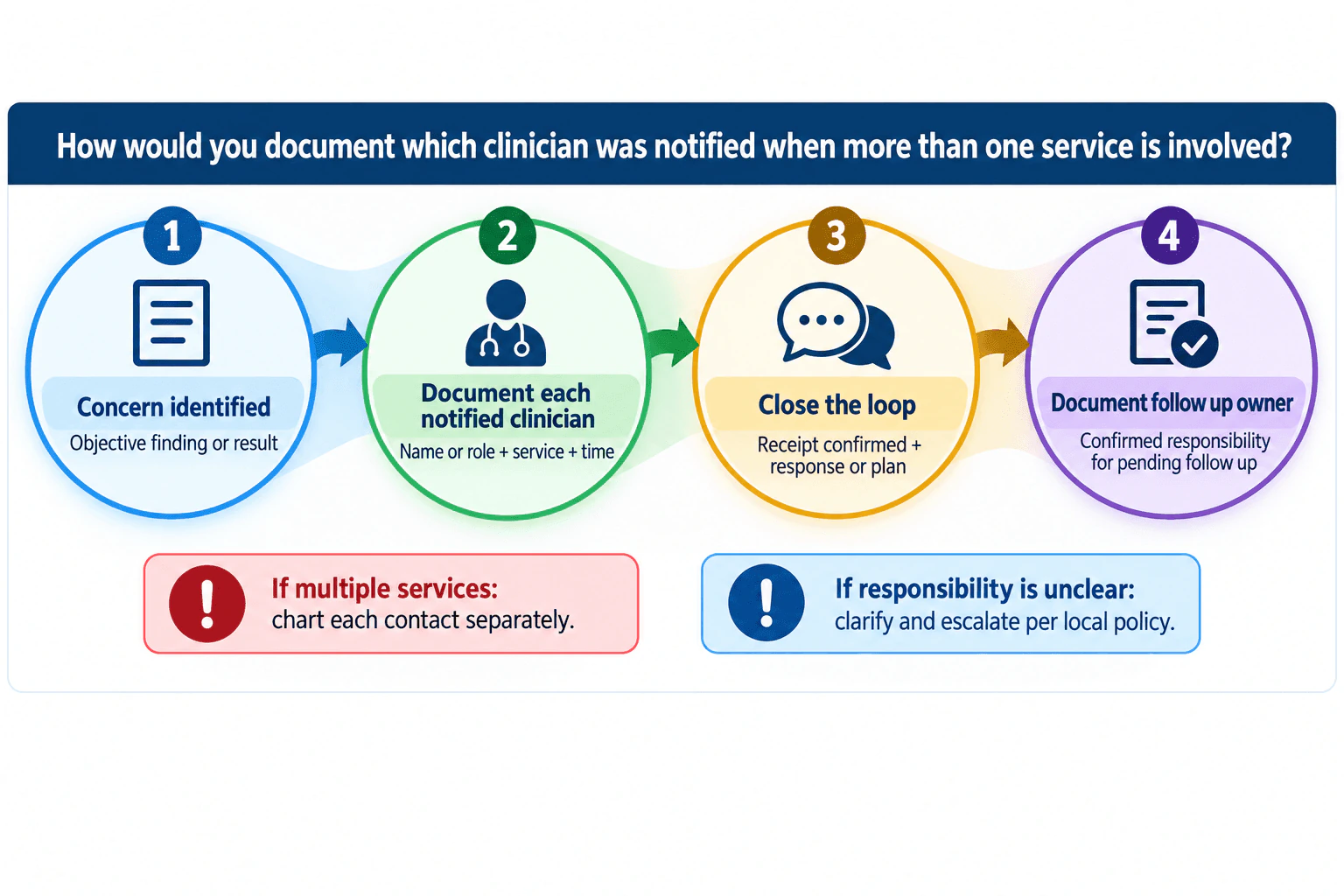
I would chart each clinician or service contact separately. For each notification, I would record the objective concern or result, the clinician name or role, the service, the time, confirmation that the information was received, and the response or plan. If something remains pending, I would document who accepted responsibility for follow up. If ownership is unclear, I would clarify it and escalate through the applicable local process rather than guessing.
Detailed Explanation
The central idea is to make the record show exactly what concern was identified, who was contacted, when the contact occurred, whether the information was received, what response or plan followed, and who accepted responsibility for anything still pending. AHRQ handoff guidance emphasizes that responsibility and accountability should be explicit and that ambiguity about responsibility should be resolved before transfer is considered complete. ahrq.gov
Useful Questions to Ask the Interviewer
What documentation workflow does this emergency department use when more than one service is notified?
How is responsibility for pending results or follow up identified during handoff or disposition?
What escalation process is used when responsibility between services is unclear?
How to Explain It in an Interview
I would begin with the objective concern or result and its relevant time. Then I would document each clinician or service contact separately so the record clearly shows who received which information.
For each contact, I would record the clinician name or role, the service, the time of notification, the information communicated, confirmation that it was received, and the response or plan. This follows the same sequence shown in the documentation workflow: identify the concern, document each notified clinician, close the communication loop, and identify the follow up owner.
If a result, reassessment, consultation, or other action remains pending, I would clarify who accepted responsibility and document that confirmed ownership. AHRQ guidance specifically notes that responsibility remains with the current caregiver until the receiving person is aware of and accepts the transfer, and that ambiguity about responsibility should be resolved. ahrq.gov
If several services are involved, I would not combine the contacts into a vague statement such as provider notified. I would chart each contact separately. If responsibility remains unclear, I would clarify and escalate according to the local chain rather than assume that someone else owns the next step.
I would document only findings, actions, communications, responses, and care that actually occurred. I would also protect patient information by using appropriate clinical communication and documentation channels. HIPAA permits treatment related information sharing between covered health care providers while requiring reasonable safeguards for protected health information. hhs.gov
Why Interviewers Ask This
This question evaluates whether an emergency nurse can maintain a clear communication record when several clinicians or services are involved. The key judgment is distinguishing notification from confirmed receipt and from acceptance of responsibility for pending follow up. Clear documentation supports continuity of care and reduces ambiguity about who received information and who owns the next action.
Common interview mistakes
Common mistakes include writing only that a provider was notified without identifying the clinician or service, omitting the notification time, combining several contacts into one ambiguous entry, failing to document whether the information was received, assuming that notification automatically transfers responsibility, leaving pending follow up without a confirmed owner, documenting a response that was never received, or charting care that was not performed.
Interview tip
Describe the documentation in the same sequence as the clinical communication: identify the objective concern, document each clinician or service and time separately, confirm receipt and the response or plan, then document who accepted responsibility for pending follow up. If ownership is unclear, state that you would clarify and escalate according to the applicable local process rather than assume responsibility transferred.
Interviewer may ask next
How would you verify that responsibility for a pending result was actually accepted?
I would use closed loop communication. I would identify the pending item, communicate it to the appropriate clinician, obtain confirmation that the information was received, clarify who accepts responsibility for the next action, and document that confirmed responsibility and the time. I would not treat an unanswered message or unconfirmed electronic notification as proof that responsibility transferred. AHRQ states that responsibility should not be relinquished until the receiving person is aware of and accepts the handoff. ahrq.gov
What would change if the patient were being transferred to another facility?
The same documentation principles would apply, but the transition would make explicit handoff responsibility especially important. I would document the relevant clinical information communicated, the receiving clinician or team when known, the time of communication, confirmation of receipt, the transfer plan, and responsibility for any known pending follow up according to the applicable transfer process. I would not assume that sending records alone means the receiving team has accepted responsibility.
Emergency Department Nurse Resume Examples
Explore the resume examples below to find the one that best matches your target Emergency Department Nurse role.
New Graduate Emergency Department Nurse0-1 years; supervised transition to emergency nursing
Disclaimer: This interview guide is for educational and informational purposes only. It is designed to help readers prepare, but it does not guarantee any interview result, hiring decision, offer, or outcome. Interview questions, hiring criteria, and preferred answers can vary by employer, interviewer, industry, location, and time. All answers, examples, and explanations in this guide are suggested examples for interview preparation, not definitive answers or instructions for professional practice. They are based on research and judgment, are provided without warranties of any kind, and should be adapted to the question, role, and applicable laws and professional requirements. Diagrams are simplified illustrations intended to highlight the main concepts and their relationships; actual situations, systems, and practices may be more complex. Alternative approaches may be equally valid or better suited to a particular question, context, or interviewer. To the fullest extent permitted by applicable law, the contributors and publisher are not liable for decisions made, actions taken, or losses incurred based on this guide.
State Laws and Professional Responsibilities: Laws and requirements governing an occupation vary by state and jurisdiction. You are responsible for checking the current laws, licensing requirements, and scope-of-practice rules that apply to your location and role, and for ensuring that your answers and actions comply with them. Adapt examples in this guide to those requirements. This guide is not legal advice.
Company Notice: This guide is an independent educational resource and is not affiliated with, endorsed by, sponsored by, or approved by the company named in this guide. Company names identify reported interview experiences or the employer context of clearly labeled original practice exercises. Interview practices can change without notice, and inclusion of company-specific content does not mean these questions are official, complete, or guaranteed to be asked. To the fullest extent permitted by law, the author, contributors, and publisher are not responsible for outcomes related to use of this material.
Content Accuracy and Verification: To the fullest extent permitted by applicable law, we do not represent or warrant that interview guides, questions, answers, examples, or diagrams are accurate, complete, current, error-free, or suitable for any particular purpose. You are responsible for independently reviewing and verifying the information before relying on it.