This interview guide is for educational and informational purposes only. It is designed to help readers prepare, but it does not guarantee any interview result, hiring decision, offer, or outcome. Interview questions, hiring criteria, and preferred answers can vary by employer, interviewer, industry, location, and time. All answers, examples, and explanations in this guide are suggested examples for interview preparation, not definitive answers or instructions for professional practice. They are based on research and judgment, are provided without warranties of any kind, and should be adapted to the question, role, and applicable laws and professional requirements. Diagrams are simplified illustrations intended to highlight the main concepts and their relationships; actual situations, systems, and practices may be more complex. Alternative approaches may be equally valid or better suited to a particular question, context, or interviewer. To the fullest extent permitted by applicable law, the contributors and publisher are not liable for decisions made, actions taken, or losses incurred based on this guide.
State Laws and Professional Responsibilities
Laws and requirements governing an occupation vary by state and jurisdiction. You are responsible for checking the current laws, licensing requirements, and scope-of-practice rules that apply to your location and role, and for ensuring that your answers and actions comply with them. Adapt examples in this guide to those requirements. This guide is not legal advice.
Identity, Image, and Privacy Notice
To respect individual privacy, some names, profile photographs, avatars, biographical details, and other identifying information displayed in this guide may be replaced with pseudonyms, licensed stock images, illustrative avatars, composite images, or representative descriptions. Unless a person is expressly identified as an actual contributor, a displayed name, image, or profile should not be understood as depicting or identifying a specific candidate, interviewer, employee, or other real individual. These representations are provided for editorial and illustrative purposes only and do not imply endorsement, employment, participation, or affiliation with this guide or any company mentioned in it. Any resemblance to an actual person is coincidental.
Company Notice
This guide is an independent educational resource and is not affiliated with, endorsed by, sponsored by, or approved by the company named in this guide. Company names identify reported interview experiences or the employer context of clearly labeled original practice exercises. Interview practices can change without notice, and inclusion of company-specific content does not mean these questions are official, complete, or guaranteed to be asked. To the fullest extent permitted by law, the author, contributors, and publisher are not responsible for outcomes related to use of this material.
Content Accuracy and Verification
To the fullest extent permitted by applicable law, we do not represent or warrant that interview guides, questions, answers, examples, or diagrams are accurate, complete, current, error-free, or suitable for any particular purpose. You are responsible for independently reviewing and verifying the information before relying on it.
Questions or comments?
Contact us for general questions, or share feedback, technical corrections, and comments with the community.
1. How would you choose an assessment approach when adults and children arrive during the same busy period?NEWClinical KnowledgeEasyNyu Langone Health
i Question Details
Original practice question for this employer context, not a reported employer interview question. Explain the relevant ED nursing judgment and identify information or authority you would need. Do not assume an internal employer protocol.
Short Interview Answer (30-60 seconds)
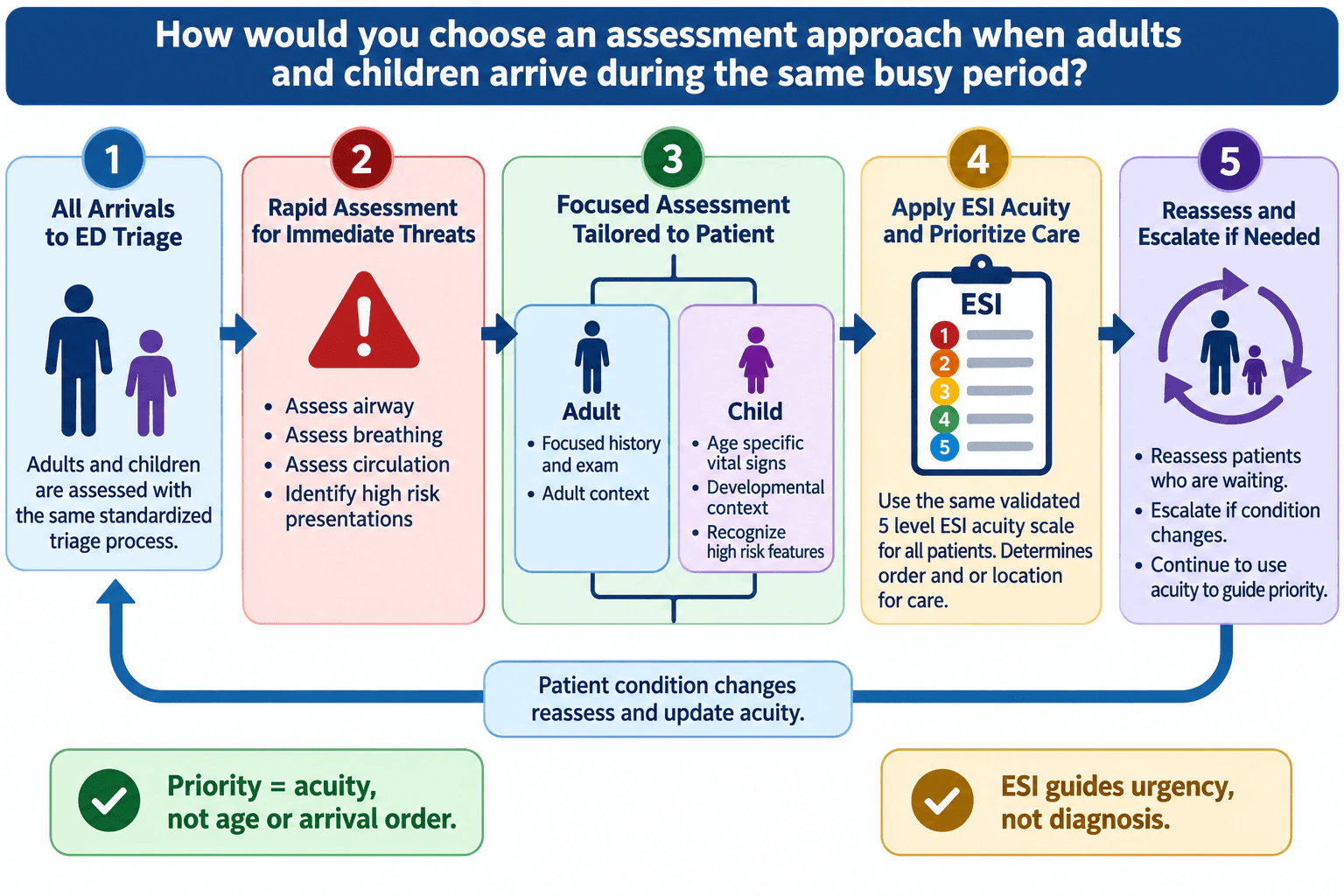
I would start every patient with the same standardized triage process and rapidly identify immediate threats to airway, breathing, circulation, or other high risk presentations. I would then tailor the focused assessment to the patient. Adults need an adult focused history, examination, vital signs, and clinical context, while children require age appropriate vital signs, developmental context, appearance, and pediatric high risk features. I would apply the validated triage scale used by the ED, such as ESI, and prioritize by acuity rather than age or arrival order. Anyone waiting would be reassessed, and a change in condition would trigger escalation and an updated acuity assessment.
Detailed Explanation
The key is to use one standardized triage process while tailoring the focused assessment to the patient. Adults and children should not be placed into separate priority systems simply because of age. The nurse first identifies immediate threats and high risk presentations, then performs a focused assessment appropriate to the patient's age and condition. A validated five level triage scale such as the Emergency Severity Index can then support an acuity decision. ESI evaluates physiologic stability and risk for deterioration and, for stable patients, uses anticipated resource needs to further differentiate acuity. It is not a diagnosis and it is not a mass casualty triage system.
Useful Questions to Ask the Interviewer
Which validated triage scale does the emergency department use?
What pediatric assessment and reassessment standards are included in local policy or protocol?
What is the expected escalation process when a waiting patient's condition changes?
How to Explain It in an Interview
Start with immediate threats
I would begin with the same rapid safety screen for every arrival. I would look for airway compromise, respiratory distress, circulatory instability, or another high risk presentation that requires immediate escalation. The purpose is to identify urgency before completing a more detailed assessment.
Tailor the focused assessment
After immediate threats are addressed, I would adapt the focused assessment to the patient. For an adult, that includes the presenting complaint, focused history, relevant examination, vital signs, and clinical context. For a child, I would also interpret age appropriate vital signs, developmental context, appearance, and pediatric high risk features. I would avoid applying adult expectations to pediatric findings.
Assign acuity consistently
I would use the validated triage method required by the department. ESI is a five level ED triage acuity scale used for both adult and pediatric patients. It evaluates physiologic stability and risk for deterioration and, for stable patients, anticipated resource needs. The acuity decision establishes priority for clinical assessment and can help determine where the patient should be seen. It should not be based on who arrived first or on age alone.
Reassess and escalate
Triage is a dynamic process rather than a single final decision. Patients who remain waiting need reassessment according to their condition and local policy. If symptoms, vital signs, appearance, mental status, or other findings worsen, I would promptly escalate the change and update the acuity assessment as appropriate.
The overall approach is therefore consistent triage, patient specific assessment, acuity based prioritization, and repeated reassessment.
Why Interviewers Ask This
This question evaluates whether the nurse can prioritize multiple patients safely without assuming that age or arrival order determines who is seen first. It also tests recognition of immediate threats, appropriate differences between adult and pediatric assessment, correct use of a validated triage scale, and the need for continued reassessment and escalation.
Common interview mistakes
Common mistakes include prioritizing by arrival order, assuming children or adults automatically receive higher priority because of age, applying adult vital sign expectations to children, treating ESI as a diagnosis, failing to recognize a high risk presentation before completing a longer assessment, and failing to reassess a patient whose condition may change while waiting.
Interview tip
Explain the decision in the same sequence shown in the clinical workflow: identify immediate threats, tailor the focused assessment to the adult or child, assign acuity with the validated method used by the department, and reassess anyone who continues to wait. State clearly that acuity rather than age or arrival order determines priority.
Interviewer may ask next
What would you verify before applying this approach in a specific emergency department?
I would verify which validated triage scale the department uses, the current local triage and reassessment policy, pediatric assessment standards, required documentation, and the escalation pathway for a patient's changing condition. I would not assume an employer specific process that had not been provided.
How would your approach change if a child who initially appeared stable became lethargic while waiting?
I would reassess the child promptly rather than relying on the original triage decision. I would repeat the focused assessment and relevant vital signs, evaluate the new neurologic and overall appearance findings in an age appropriate context, escalate the change to the appropriate clinical team, and update the acuity assessment according to the validated triage method and local policy.
2. How would you reassess a patient returning soon after a previous ED visit without assuming the problem is unchanged?Clinical KnowledgeEasyNyu Langone Health
i Question Details
Original practice question for this employer context, not a reported employer interview question. Explain the relevant ED nursing judgment and identify information or authority you would need. Do not assume an internal employer protocol.
Short Interview Answer (30-60 seconds)
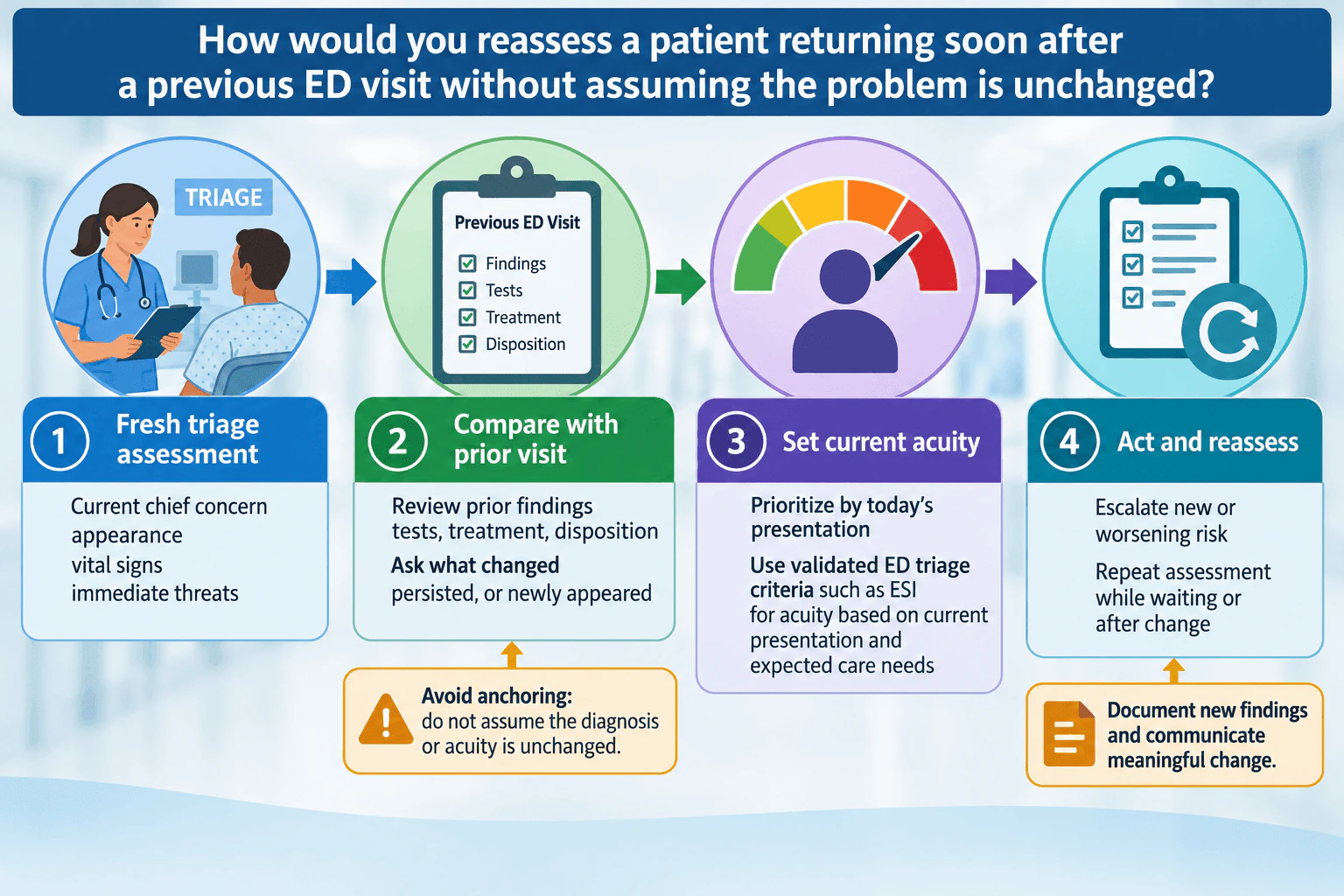
I would approach the return visit as a fresh presentation. First I would reassess the current chief concern, appearance, vital signs, symptoms, and immediate threats. Then I would compare the findings with the previous visit and ask what is new, persistent, or worse. I would determine current acuity using the department's validated triage process rather than assuming the earlier diagnosis or acuity still applies. If I identify new or worsening risk, I would escalate appropriately, continue reassessment, and document and communicate meaningful changes.
Detailed Explanation
A recent emergency department visit gives useful context, but it does not establish the patient's condition now. The safest approach is to perform a fresh assessment first, compare current findings with the prior visit, determine current acuity, and then act and reassess.
Useful Questions to Ask the Interviewer
Which validated triage system does this emergency department use for routine patient prioritization?
What local process should the nurse follow when a waiting patient's condition changes or requires escalation?
What documentation and communication process is expected when reassessment identifies a meaningful change?
How to Explain It in an Interview
Fresh triage assessment
I would begin with the patient's current presentation rather than the previous diagnosis. I would assess the current chief concern, general appearance, vital signs, symptoms, and any immediate threats. Triage is intended to assess present acuity and establish priority for evaluation, not to make a diagnosis. ACEP and ENA support use of a scientifically validated emergency department triage scale such as ESI. acep.org
Compare with the prior visit
Once immediate concerns are addressed, I would review the previous visit for documented findings, tests, treatment, response, and disposition. I would ask what has changed, what has persisted, and what has newly appeared. That comparison can reveal an important change, but it should not replace a fresh assessment.
Set current acuity
I would assign priority based on today's presentation using the validated triage method adopted by the facility. ESI is a five level emergency department triage framework, and current ENA resources emphasize accurate application of the algorithm for patient assessment and prioritization. ena.org I would not treat ESI as a diagnosis or assume the previous acuity still applies.
Act and reassess
If current findings indicate new or worsening risk, I would communicate the change promptly and escalate according to my nursing responsibilities, applicable standing protocols, provider involvement when required, and local policy. If the patient remains waiting or the condition changes, I would repeat the relevant assessment and vital signs rather than relying on the original triage snapshot.
Document meaningful change
I would clearly document the current findings, important differences from the previous visit, reassessment, and communication. The central principle is to avoid anchoring: the previous visit informs the assessment, but the patient's current presentation determines current urgency.
Why Interviewers Ask This
This question evaluates whether the nurse can avoid anchoring on a previous diagnosis, reassess the patient based on the current presentation, use prior information as context rather than as a conclusion, recognize new or worsening risk, determine current urgency, and communicate and reassess appropriately.
Common interview mistakes
Common mistakes include anchoring on the previous diagnosis, assuming the previous acuity still applies, reviewing the old record before assessing the patient now, treating ESI as a diagnosis, overlooking new or worsening findings, failing to reassess a patient who remains waiting, and failing to document or communicate a meaningful change in condition.
Interview tip
Organize the answer around the same four clinical steps shown in the diagram: fresh triage assessment, comparison with the prior visit, determination of current acuity, then action and reassessment. State explicitly that prior information is context rather than a conclusion.
Interviewer may ask next
What information would you verify from the previous emergency department visit?
I would verify the documented presenting concern, assessment findings, relevant vital sign trends, available test results, treatments provided, response to treatment, disposition, and follow up instructions. I would confirm that I am reviewing the correct encounter and use those facts as a comparison point for the current assessment rather than assuming the same diagnosis or acuity still applies.
What would you do if the returning patient now had a new or worsening clinical finding?
I would reassess the finding in the context of the patient's current presentation, determine whether the current triage priority needs to change under the department's validated process, and promptly communicate and escalate the change according to nursing responsibilities and local policy. I would initiate only actions authorized within my role or applicable protocols, obtain provider involvement when an order or medical decision is required, continue relevant reassessment, and document the change and communication.
3. How would you prevent exposure when a child with respiratory symptoms is accompanied by several relatives?Patient SafetyEasyNyu Langone Health
i Question Details
Original practice question for this employer context, not a reported employer interview question. Explain the relevant ED nursing judgment and identify information or authority you would need. Do not assume an internal employer protocol.
Short Interview Answer (30-60 seconds)
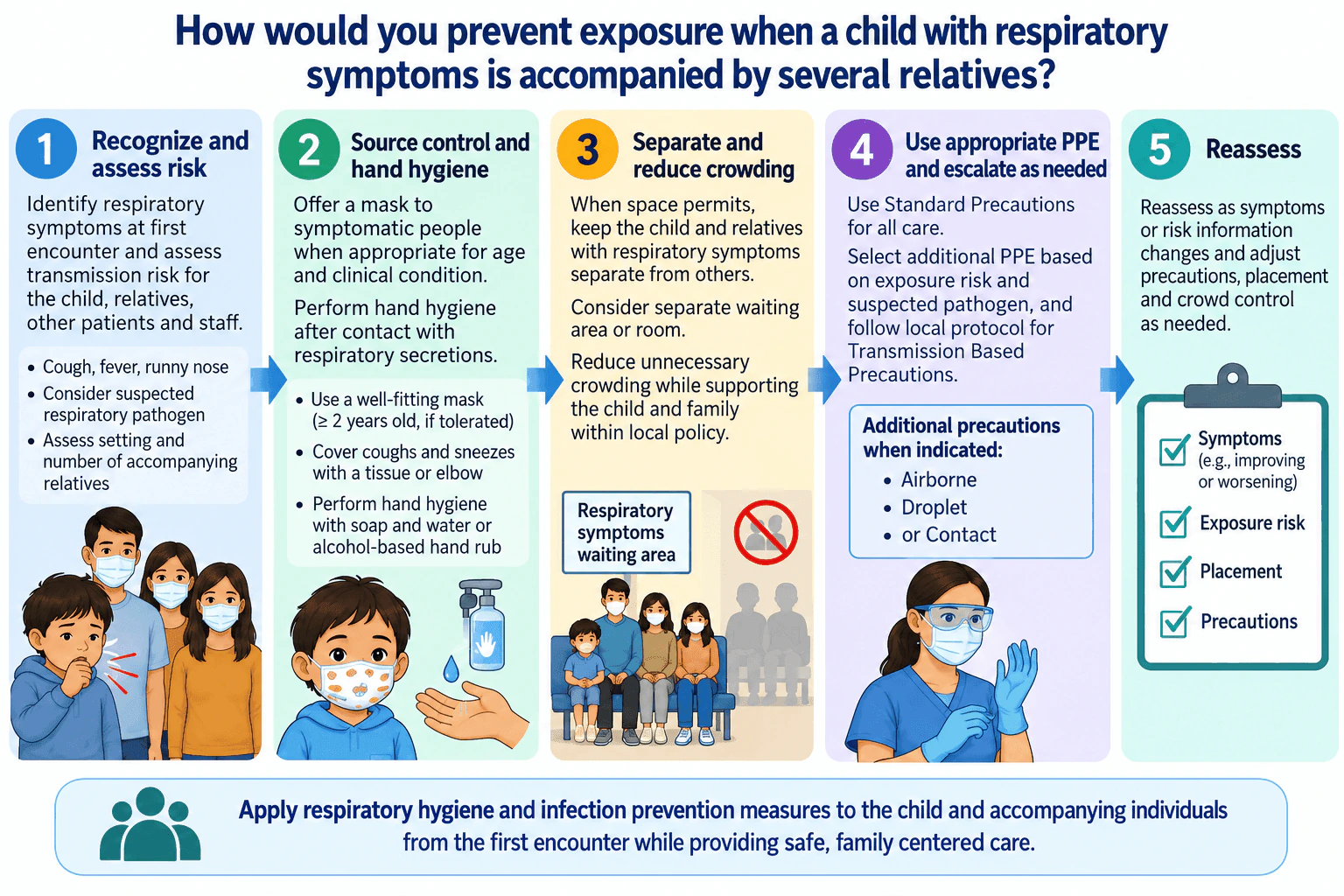
I would identify the respiratory risk at triage, use Standard Precautions, and begin respiratory hygiene immediately. I would offer a mask when appropriate for age and clinical condition, encourage cough etiquette and hand hygiene, and separate the child and any symptomatic relatives from other patients when feasible. I would reduce unnecessary crowding while maintaining appropriate family support. Then I would use pathogen appropriate Contact, Droplet, Airborne, or combined Transmission Based Precautions when indicated and reassess symptoms, exposure risk, placement, and precautions as new information becomes available. cdc.gov
Detailed Explanation
The main goal is to reduce respiratory exposure from the first encounter without assuming that every child with respiratory symptoms needs the same isolation response. I would assess the child's symptoms, such as cough, fever, or runny nose, relevant exposure information, whether accompanying relatives are symptomatic, the number of accompanying people, and the available waiting or treatment space. Standard Precautions apply to every patient, while additional precautions depend on the clinical presentation and suspected infection. cdc.gov
Useful Questions to Ask the Interviewer
What respiratory symptoms, exposure history, and clinical findings are present?
Are any accompanying relatives also symptomatic or particularly vulnerable to exposure?
What patient placement and infection prevention resources are available in this emergency department?
How to Explain It in an Interview
I would start respiratory hygiene at the first encounter. I would offer a mask to a symptomatic person when appropriate for age and clinical condition, encourage covering coughs and sneezes, and provide hand hygiene after contact with respiratory secretions. CDC guidance advises providing masks to symptomatic people and advising those older than 2 years to wear one unless medically contraindicated. Alcohol based hand sanitizer should be readily available, with soap and water supplies where sinks are available. cdc.gov
Next, I would reduce shared exposure. When space permits, I would have the child and any symptomatic accompanying relatives sit away from other patients or use a separate waiting area or room. I would reduce unnecessary crowding while still supporting the child's need for family presence and following local policy. I would not assume a universal visitor restriction. CDC guidance supports limiting crowding and separating people with respiratory symptoms from others when possible. cdc.gov
For direct care, I would use Standard Precautions and choose personal protective equipment based on the anticipated exposure. If the clinical syndrome suggests an infection requiring additional precautions, I would apply the indicated Contact, Droplet, Airborne, or combined Transmission Based Precautions according to the suspected pathogen and local infection prevention process. Transmission Based Precautions are used in addition to Standard Precautions. cdc.gov
Finally, I would reassess whether symptoms are improving or worsening, whether exposure information has changed, and whether placement or precautions should change. If the risk increases or suitable placement cannot be achieved, I would escalate through the available clinical and infection prevention process. CDC guidance supports starting precautions from the clinical presentation and adjusting them when more information becomes available. cdc.gov
Why Interviewers Ask This
This question evaluates whether the nurse can recognize respiratory transmission risk early, protect patients, visitors, and staff, use Standard Precautions and respiratory hygiene appropriately, reduce crowding without inventing a universal visitor rule, select additional precautions according to the suspected infection, and reassess the plan when clinical information changes.
Common interview mistakes
Common mistakes include waiting until the child reaches an examination room before starting respiratory hygiene, assuming all accompanying relatives are symptomatic, using the same additional precaution category for every respiratory illness, forgetting that symptomatic accompanying individuals can contribute to exposure, allowing avoidable crowding, treating Standard Precautions as unnecessary once additional precautions begin, imposing an unsupported universal visitor restriction, or failing to reassess placement and precautions when symptoms or exposure information change.
Interview tip
Organize the response in the same five step sequence used at the bedside: recognize and assess risk, begin source control and hand hygiene, separate and reduce crowding, use appropriate personal protective equipment and additional precautions when indicated, then reassess. Make clear that exact placement, visitor limits, and Transmission Based Precautions depend on the clinical presentation, available resources, and local policy.
Interviewer may ask next
What would you verify before deciding which additional precautions are needed?
I would verify the child's symptoms and clinical syndrome, relevant exposure history, suspected or confirmed diagnosis if available, likely transmission route, current infection prevention guidance, and available placement resources. Standard Precautions continue for all care, while Contact, Droplet, Airborne, or combined Transmission Based Precautions are selected according to the suspected infection and transmission risk. cdc.gov
What would change if one of the relatives developed respiratory symptoms while waiting?
I would treat that as a change in exposure risk. I would offer the symptomatic relative a mask when appropriate, reinforce cough etiquette and hand hygiene, reduce close contact with other patients, and reassess whether the family's placement should change. I would communicate the new information to the clinical team and follow the local infection prevention process for any additional precautions or placement decisions. cdc.gov
4. How would you check a caregiver's understanding of a child's discharge plan?Communication And DelegationMediumNyu Langone Health
i Question Details
Original practice question for this employer context, not a reported employer interview question. Explain the relevant ED nursing judgment and identify information or authority you would need. Do not assume an internal employer protocol.
Short Interview Answer (30-60 seconds)
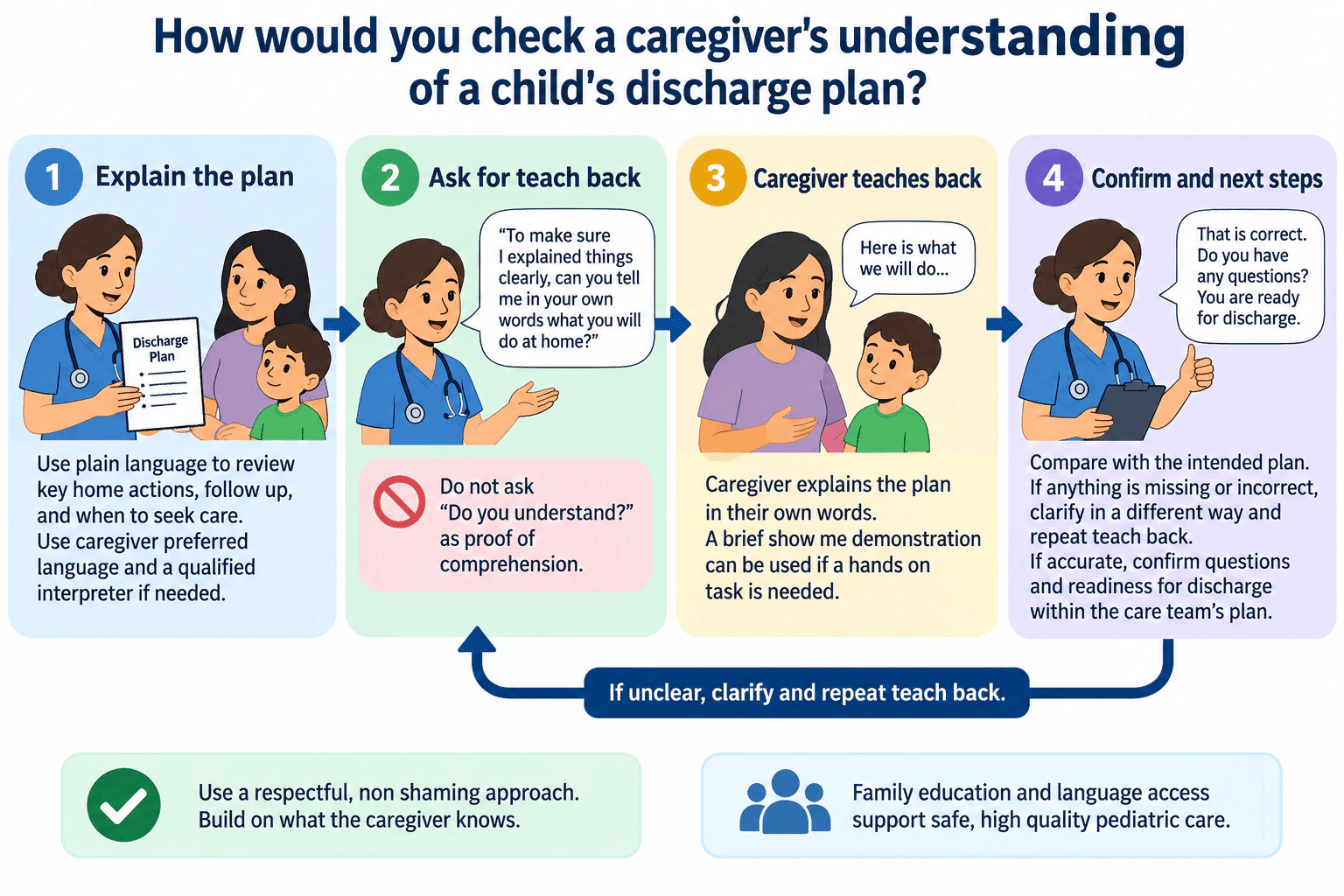
I would explain the child's discharge plan in plain language, then use teach back by asking the caregiver to tell me in their own words what they will do at home. I would check key home actions, follow up, and when to seek care. If a practical skill is involved, I would ask for a brief demonstration. If anything is missing or incorrect, I would clarify it differently and repeat teach back. I would also use qualified interpretation when needed and would not treat a simple yes as proof of understanding.
Detailed Explanation
Teach back is a respectful way to check whether my explanation was clear. I would first review the essential parts of the child's discharge plan in plain language, including what the caregiver needs to do at home, follow up, and when to seek further care. I would communicate in the caregiver's preferred language and use qualified interpretation when needed.
I would then ask the caregiver to explain the plan in their own words. I would avoid using a question such as "Do you understand?" as proof of comprehension because agreement does not show that the caregiver can carry out the plan. If the plan includes a hands on task, I would ask the caregiver to show me how they would do it.
I would compare what the caregiver says or demonstrates with the intended plan. If something is missing or incorrect, I would clarify it using a different explanation and repeat teach back. Once the caregiver can explain the plan accurately, I would invite questions and confirm readiness within the care team's discharge process.
Useful Questions to Ask the Interviewer
What qualified interpretation resources are available when a caregiver prefers another language?
How are pediatric discharge teaching responsibilities coordinated among members of the care team?
What resources are available when a caregiver needs additional teaching before discharge?
How to Explain It in an Interview
Confirming Understanding
I would start by reviewing the most important home care instructions in plain language. Then I would say something like, "To make sure I explained this clearly, can you tell me in your own words what you will do at home?" That keeps the focus on the clarity of my teaching rather than making the caregiver feel tested.
I would listen for the caregiver's understanding of the key actions, follow up, and when to seek further care. If a practical skill is required, I would ask for a brief show me demonstration.
Clarifying Misunderstanding
If any part of the response is missing or incorrect, I would explain it in a different way and repeat teach back. I would continue the feedback loop until the caregiver can accurately explain or demonstrate the important parts of the plan.
Communication Needs
I would use a respectful, non shaming approach and build on what the caregiver already knows. If language assistance is needed, I would use qualified interpretation and continue the teach back process through that communication support rather than assuming that interpretation alone proves understanding.
Safe Discharge Communication
After accurate teach back, I would invite remaining questions and confirm that the caregiver appears prepared for the home care responsibilities within the care team's discharge process. I would not independently change the medical discharge plan or assume authority beyond the registered nurse role.
Why Interviewers Ask This
This question evaluates whether the nurse can distinguish apparent agreement from demonstrated understanding. It also tests clear family communication, use of teach back, recognition of language needs, respectful correction of misunderstandings, and the ability to support a safe pediatric discharge without assuming that simply giving instructions is enough.
Common interview mistakes
Common mistakes include asking only "Do you understand?", treating a nod or yes as proof of comprehension, giving too much information without checking understanding, asking the caregiver to repeat words without explaining the meaning, failing to clarify and repeat teach back after an error, overlooking the need for qualified interpretation, or assuming written instructions alone demonstrate readiness.
Interview tip
Describe teach back as a feedback loop: explain the plan clearly, ask the caregiver to explain it in their own words, compare the response with the intended plan, clarify anything missing or incorrect, repeat the check, then invite questions and confirm readiness within the care team's discharge process.
Interviewer may ask next
How would you verify understanding if the caregiver says they understand everything?
I would not rely on the statement alone. I would ask the caregiver to explain the important home care actions, follow up, and when to seek further care in their own words. If a practical skill is involved, I would ask for a brief demonstration. I would compare the response with the intended plan, clarify any misunderstanding, and repeat teach back until the caregiver can explain the important steps accurately.
What would you change if the caregiver had limited English proficiency?
I would use qualified language assistance available through the care setting and continue to address the caregiver directly. I would still use teach back because interpretation supports communication but does not by itself demonstrate understanding. I would ask the caregiver to explain the plan in their own words through the interpreter, clarify anything missing or incorrect, and repeat the check as needed.
5. How would you explain a delay to a distressed family while maintaining attention to changing symptoms?Communication And DelegationMediumNyu Langone Health
i Question Details
Original practice question for this employer context, not a reported employer interview question. Explain the relevant ED nursing judgment and identify information or authority you would need. Do not assume an internal employer protocol.
Short Interview Answer (30-60 seconds)
I would first acknowledge the family's concern and give a clear explanation of what I know without promising an exact waiting time that I cannot verify. I would continue assessing the patient and explain which new or worsening symptoms should be reported immediately. If symptoms changed, reassessment and escalation would take priority over the conversation. If language assistance were needed, I would use a qualified interpreter for important clinical communication. With competing assignments, I would communicate priorities, advocate for help if the workload became unsafe, and assign only appropriate tasks to team members who are competent and legally authorized to perform them. I would retain nursing assessment and judgment and use closed loop communication to confirm responsibility and follow up.
Detailed Explanation
The key is to communicate honestly with the family while continuing to protect the patient's clinical priority. A distressed family deserves acknowledgment and clear information, but reassurance should never replace nursing assessment or delay a response to changing symptoms.
Useful Questions to Ask the Interviewer
What team resources are available when several emergency department patients need attention at the same time?
How is qualified language assistance accessed for urgent patient and family communication?
What support roles are typically available for tasks that do not require registered nurse assessment or judgment?
How to Explain It in an Interview
Nursing Priorities
I would acknowledge the family's concern and explain the delay in plain language using only information I can verify. I would not give an exact waiting time unless it was reliable. I would tell them that I am continuing to monitor the patient and that new or worsening symptoms should be reported immediately.
My own assessment and reassessment would continue. Family observations can provide important information, but they do not replace professional nursing assessment. If the patient's symptoms changed, I would pause the discussion, reassess the patient, reprioritize care, and escalate to the appropriate clinician or emergency response resource according to the clinical situation.
Patient Context
I would consider the patient's communication ability, preferences, decision making capacity, privacy, consent for family involvement when applicable, emotional distress, and language needs. I would advocate for the patient if communication barriers or competing demands were interfering with safe care.
For a patient with limited English proficiency who needs language assistance for important clinical communication, I would use a qualified interpreter rather than assuming that an accompanying family member should interpret. Current HHS guidance states that covered entities must provide accurate and timely language assistance and describes the use of qualified interpreters. hhs.gov
I would check understanding with teach back when appropriate. I might ask the patient or family to explain in their own words which changes they should report. AHRQ describes teach back as checking whether information was explained in a way the patient understands and recommends clarifying and checking again when misunderstanding is found. ahrq.gov
Clinical Rationale
If competing assignments were affecting safety, I would communicate the concern and request assistance. In New York, I would assign only tasks that the receiving team member is legally authorized and competent to perform. I would not transfer registered nurse assessment or professional nursing judgment to unlicensed assistive personnel. New York State guidance emphasizes professional competence and restricts tasks requiring professional assessment and judgment to appropriately licensed personnel. op.nysed.gov
For any appropriate delegated or assigned task, I would clearly state what is needed, confirm that the person accepted the responsibility, identify what findings require immediate reporting, and follow up. NCSBN guidance also emphasizes that delegation depends on jurisdiction, competence, communication, supervision, and the patient's circumstances. ncsbn.org
Why Interviewers Ask This
This question evaluates whether the nurse can communicate with empathy without losing clinical vigilance. It tests prioritization, reassessment, advocacy, recognition of deterioration, safe use of team resources, qualified interpretation, confirmation of understanding, and appropriate delegation boundaries when several demands compete for attention.
Common interview mistakes
Common mistakes include spending so much time reassuring the family that reassessment is delayed, giving a waiting time that has not been confirmed, treating agreement as proof of understanding, failing to respond promptly to new symptoms, using an unqualified person for important interpretation when qualified language assistance is required, discussing information with family without considering the patient's wishes or privacy, transferring nursing assessment or judgment to unlicensed assistive personnel, assigning a task without checking legal authority and competence, and assuming responsibility has transferred without clear acceptance and follow up.
Interview tip
Organize the response around two responsibilities occurring at the same time: communicate respectfully with the family and continue protecting the patient. Explain what you would say, how you would recognize and respond to a clinical change, how you would verify understanding, and how you would obtain team help without transferring nursing judgment.
Interviewer may ask next
How would you verify that the patient or family actually understood your explanation?
I would use teach back when appropriate rather than relying on a yes response. I could ask the patient or family to explain in their own words what they understand about the delay and which changes they should report immediately. If their response revealed a misunderstanding, I would explain the information differently and check again. AHRQ recommends this approach because teach back evaluates how clearly the information was communicated rather than testing the patient. ahrq.gov If language assistance were needed for important clinical communication, I would use a qualified interpreter as required by applicable language access standards. hhs.gov
What would change if the patient developed a new or worsening symptom while you were speaking with the family?
The clinical change would become the immediate priority. I would pause the conversation, assess and reassess the patient within my registered nurse scope, reprioritize care, and notify or escalate to the appropriate clinician or emergency response resource based on the patient's condition. I would briefly tell the family that I need to respond to the change. If team assistance were needed, I would assign only tasks that the receiving person was legally authorized and competent to perform, give clear directions, identify what must be reported back, and follow up. I would retain responsibility for professional nursing assessment and judgment. New York State guidance supports keeping professional assessment and judgment with appropriately licensed personnel. op.nysed.gov
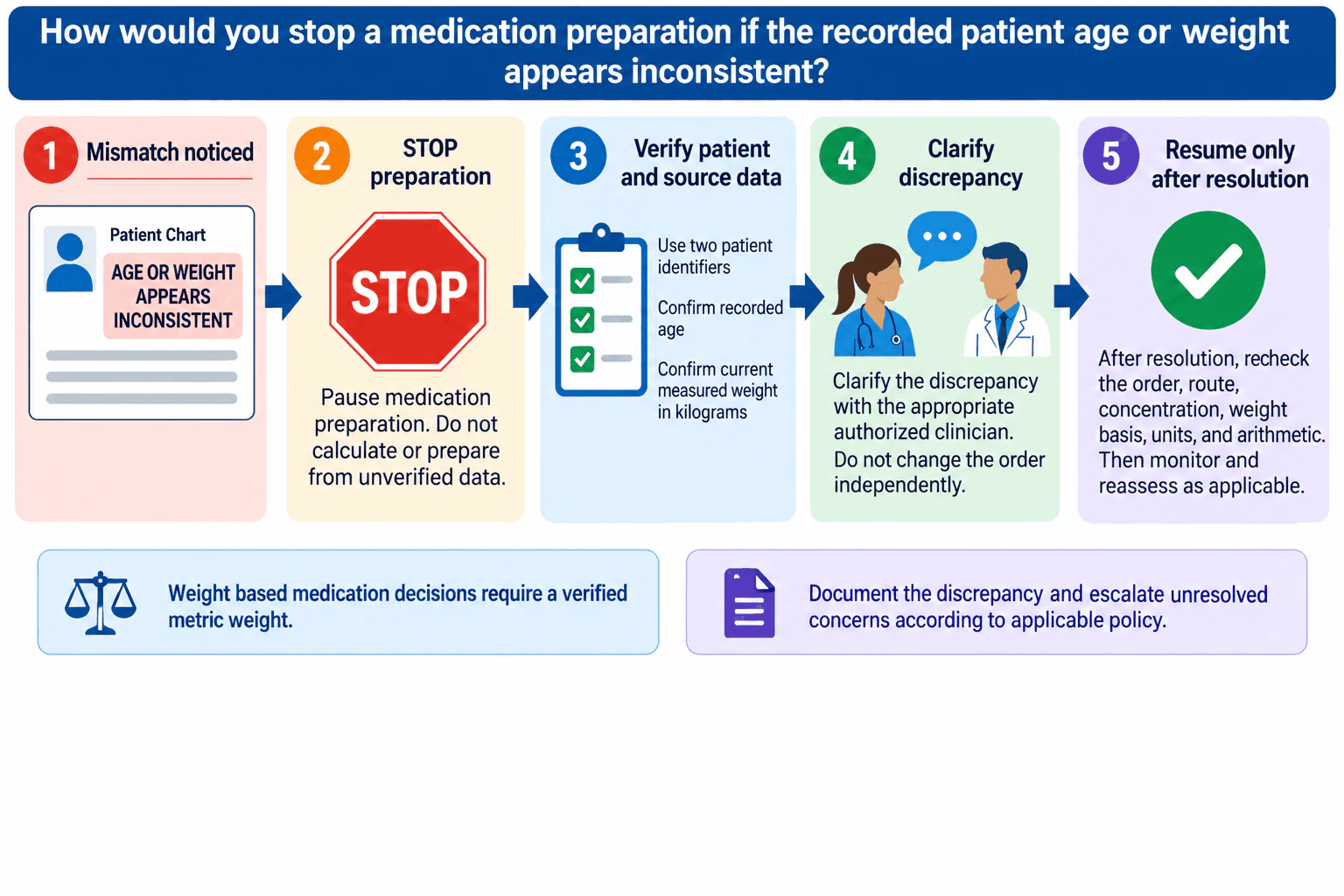
6. How would you stop a medication preparation if the recorded patient age or weight appears inconsistent?Medication And ProceduresMediumNyu Langone Health
i Question Details
Original practice question for this employer context, not a reported employer interview question. Explain the relevant ED nursing judgment and identify information or authority you would need. Do not assume an internal employer protocol.
Short Interview Answer (30-60 seconds)
I would stop the preparation immediately and would not calculate or prepare medication from questionable age or weight data. I would verify the patient with two identifiers, confirm the recorded age, and confirm a current measured weight in kilograms when weight is relevant to dosing. I would clarify any unresolved discrepancy with the appropriate authorized clinician and would not independently change the order. Once the discrepancy was resolved, I would recheck the order, route, concentration, weight basis, units, and arithmetic before proceeding, then monitor and reassess as appropriate.
Detailed Explanation
The key decision is to treat an inconsistent age or weight as a medication safety concern before preparation continues. The nurse should pause, verify the patient and source data, communicate the discrepancy, and resume only after it has been resolved. No patient value should be invented or assumed simply to make a calculation possible.
Useful Questions to Ask the Interviewer
What process is used to document and escalate discrepancies in patient demographic or weight information?
What resources are available for independent medication calculation verification when required?
When an urgent medication is affected by an unresolved discrepancy, what escalation pathway is expected?
How to Explain It in an Interview
Stop Before the Error Progresses
If the recorded age or weight appears inconsistent, I would pause medication preparation. I would not continue a weight based calculation or prepare medication from data that I believe may be incorrect.
Verify the Patient and Source Data
I would confirm the correct patient using two identifiers. I would verify the recorded age and determine whether the weight is current and measured. When weight affects dosing, I would confirm the measured weight in kilograms and verify the intended weight basis and units. I would not substitute an invented value or an unverified conversion.
Clarify the Discrepancy
If the information still does not reconcile, I would communicate the discrepancy to the appropriate authorized clinician and explain exactly what is inconsistent. In New York, an RN may execute medical regimens prescribed by an authorized practitioner, but the RN does not independently prescribe a new medical regimen. I therefore would not change the order independently to compensate for questionable data.
Resume Only After Resolution
After the discrepancy is resolved, I would restart the medication safety check. I would verify the order, route, concentration, weight basis, units, and arithmetic before preparation. If an independent calculation check is required for that medication or applicable process, I would complete it using the verified information.
Monitor, Reassess, and Document
After safe administration under the applicable order or protocol, I would perform the medication specific monitoring and reassessment that are appropriate. I would document the verified information and discrepancy resolution and escalate unresolved concerns rather than proceeding with uncertain patient data.
Why Interviewers Ask This
This question evaluates whether the nurse recognizes an unsafe medication input before it becomes a preparation or administration error. It also tests patient identification, verification of weight based dosing information, communication, escalation, calculation discipline, and understanding of RN scope. A strong answer shows that the nurse will interrupt an unsafe process, verify the source information, involve the appropriate authorized clinician, and resume only after the discrepancy is resolved.
Common interview mistakes
Common mistakes include continuing preparation because an order is already entered, assuming unusual information must be correct because it appears in the health record, calculating before confirming the correct patient, using an unverified weight or unit, independently changing the medication order, and resuming without rechecking the order, route, concentration, weight basis, units, and arithmetic. Another mistake is allowing urgency to turn an unresolved discrepancy into an assumed patient value rather than escalating it.
Interview tip
Present the response as a clear safety sequence: pause, identify, verify, clarify, then resume only after resolution. State explicitly that you would not invent a weight, calculate from questionable data, or independently change the medication order. This demonstrates medication safety judgment, communication, escalation, and appropriate RN scope.
Interviewer may ask next
What would you verify before restarting the medication preparation?
I would verify the correct patient with two identifiers, confirm the recorded age, confirm a current measured weight in kilograms when weight is relevant, and make sure the discrepancy has been resolved. I would then recheck the authorized order, route, concentration, weight basis, units, and arithmetic before preparing the medication again. I would also confirm any medication specific monitoring requirements that apply.
What would you do if the medication were urgently needed but the age or weight discrepancy had not yet been resolved?
I would not invent a value or knowingly prepare a weight based medication from questionable information. I would escalate the discrepancy promptly to the appropriate authorized clinician while continuing nursing assessment, monitoring, and other supportive actions within my scope. If an applicable emergency order or protocol authorizes a specific action, I would follow it within my competence. Otherwise, I would wait for the necessary verified information and authorized treatment decision before proceeding with the affected medication.
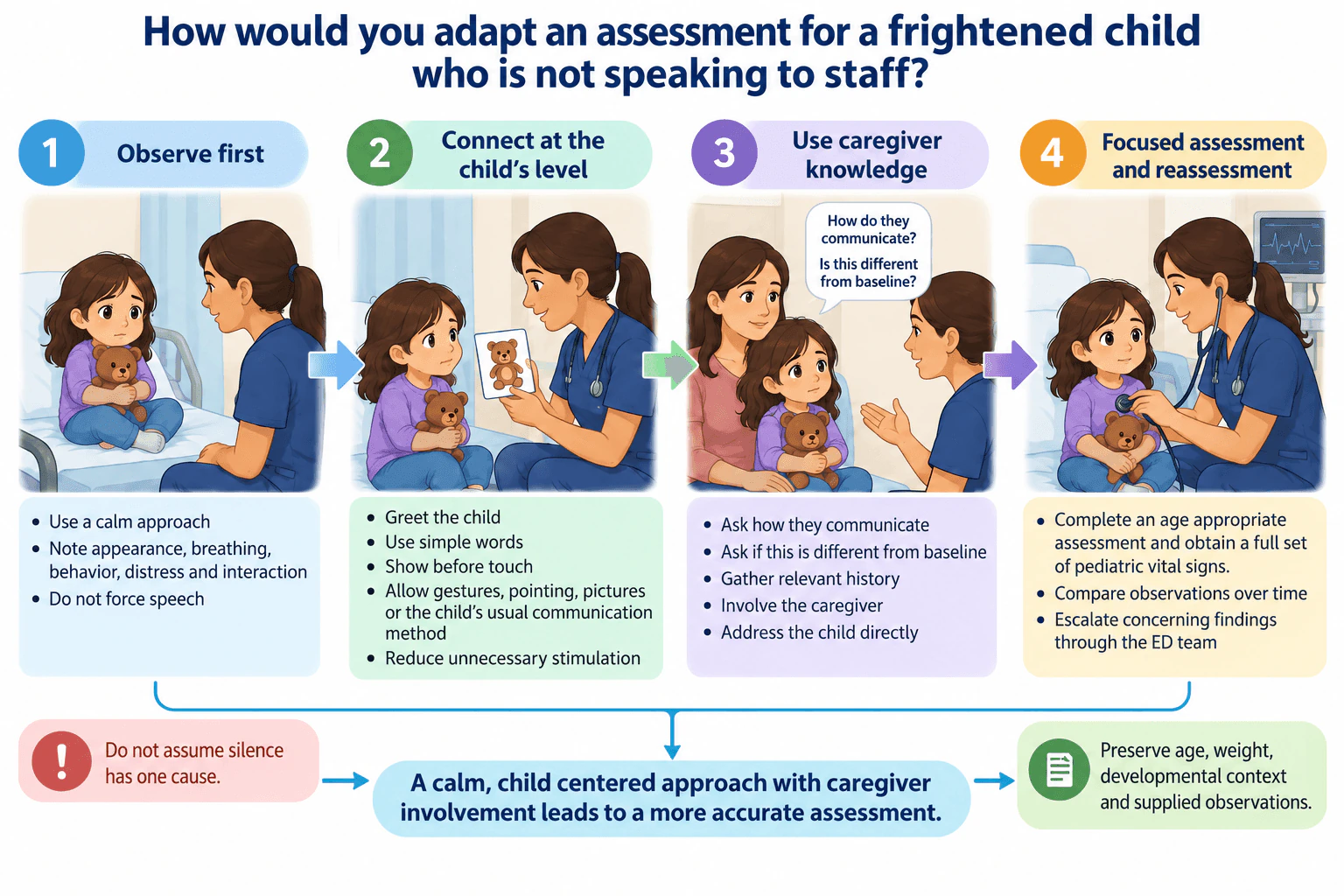
7. How would you adapt an assessment for a frightened child who is not speaking to staff?Trauma And Special PopulationsMediumNyu Langone Health
i Question Details
Original practice question for this employer context, not a reported employer interview question. Explain the relevant ED nursing judgment and identify information or authority you would need. Do not assume an internal employer protocol.
Short Interview Answer (30-60 seconds)
I would start by observing first and using a calm approach rather than forcing the child to talk. I would assess appearance, breathing, behavior, distress, and interaction, then connect at the child’s level with simple words, showing before touch, and allowing gestures, pictures, or the child’s usual communication method. I would use caregiver knowledge to learn how the child normally communicates and whether this is different from baseline, while still addressing the child directly. Then I would complete an age appropriate assessment, obtain a full set of pediatric vital signs, compare observations over time, and escalate concerning findings through the emergency department team.
Detailed Explanation
A frightened child who is not speaking can still tell you a lot through appearance, breathing, behavior, distress, and interaction. My goal is to reduce fear, gather reliable information, and still complete a safe pediatric assessment.
Useful Questions to Ask the Interviewer
What is the child’s age and developmental level?
Is the caregiver present, and what is the child’s usual communication method and baseline behavior?
Are there any supplied observations, symptoms, mechanism of injury, or communication needs I should account for?
How to Explain It in an Interview
Nursing Priorities
I would observe first. Before asking many questions, I would note appearance, breathing, behavior, distress, and interaction. I would use a calm approach and I would not force speech.
Next, I would connect at the child’s level. I would greet the child, use simple words, show before touch, and allow gestures, pointing, pictures, or the child’s usual communication method. I would also reduce unnecessary stimulation when possible.
Patient Context
I would use caregiver knowledge to ask how the child normally communicates, whether this behavior is different from baseline, and to gather relevant history. I would involve the caregiver, but I would still address the child directly.
I would also preserve age, weight, developmental context, and supplied observations. That matters because silence does not have one cause. Fear is common, but pain, illness, injury, developmental difference, language difference, or a change in mental status can also affect communication.
Safety Checks
After building rapport, I would complete an age appropriate assessment and obtain a full set of pediatric vital signs. I would compare observations over time rather than relying on one impression.
Reassessment
If the child becomes less interactive, shows worsening distress, abnormal breathing, abnormal vital signs, or any other concerning finding, I would escalate through the emergency department team. I would also follow the local pediatric assessment and escalation process within nursing scope. The key idea is to adapt communication, not lower the standard of assessment.
Why Interviewers Ask This
Interviewers ask this to see whether you can balance patient experience with pediatric safety. They want to know if you can gather reliable information from a frightened child, adapt communication to developmental level, use caregiver input well, avoid assuming that silence has one cause, and still complete a safe assessment with reassessment and escalation when needed.
Common interview mistakes
Common mistakes include forcing the child to speak, assuming silence means only fear, speaking only to the caregiver, skipping direct observation, not asking what is normal for that child, forgetting developmental context, failing to obtain pediatric vital signs, not comparing observations over time, and delaying escalation when findings are concerning.
Interview tip
A strong answer mirrors the flow of the final diagram. Say that you observe first, connect at the child’s level, use caregiver knowledge, then complete an age appropriate assessment with full pediatric vital signs, reassessment, and escalation when needed.
Interviewer may ask next
What information would you verify before deciding the child is simply frightened?
I would verify the child’s age, weight, developmental level, usual communication method, baseline behavior, supplied observations, symptoms, and any relevant history from the caregiver. I would also verify appearance, breathing, behavior, distress, interaction, and a full set of pediatric vital signs before deciding that fear is the main reason for the silence.
How would your approach change if the child became less responsive or showed worsening breathing during the assessment?
My priority would shift from rapport building to urgent pediatric assessment and escalation. I would reassess appearance and breathing immediately, obtain or repeat vital signs, call for help through the emergency department team, and follow local pediatric escalation processes within nursing scope. I would continue to use the caregiver for information and calming support, but urgent safety needs would come first.
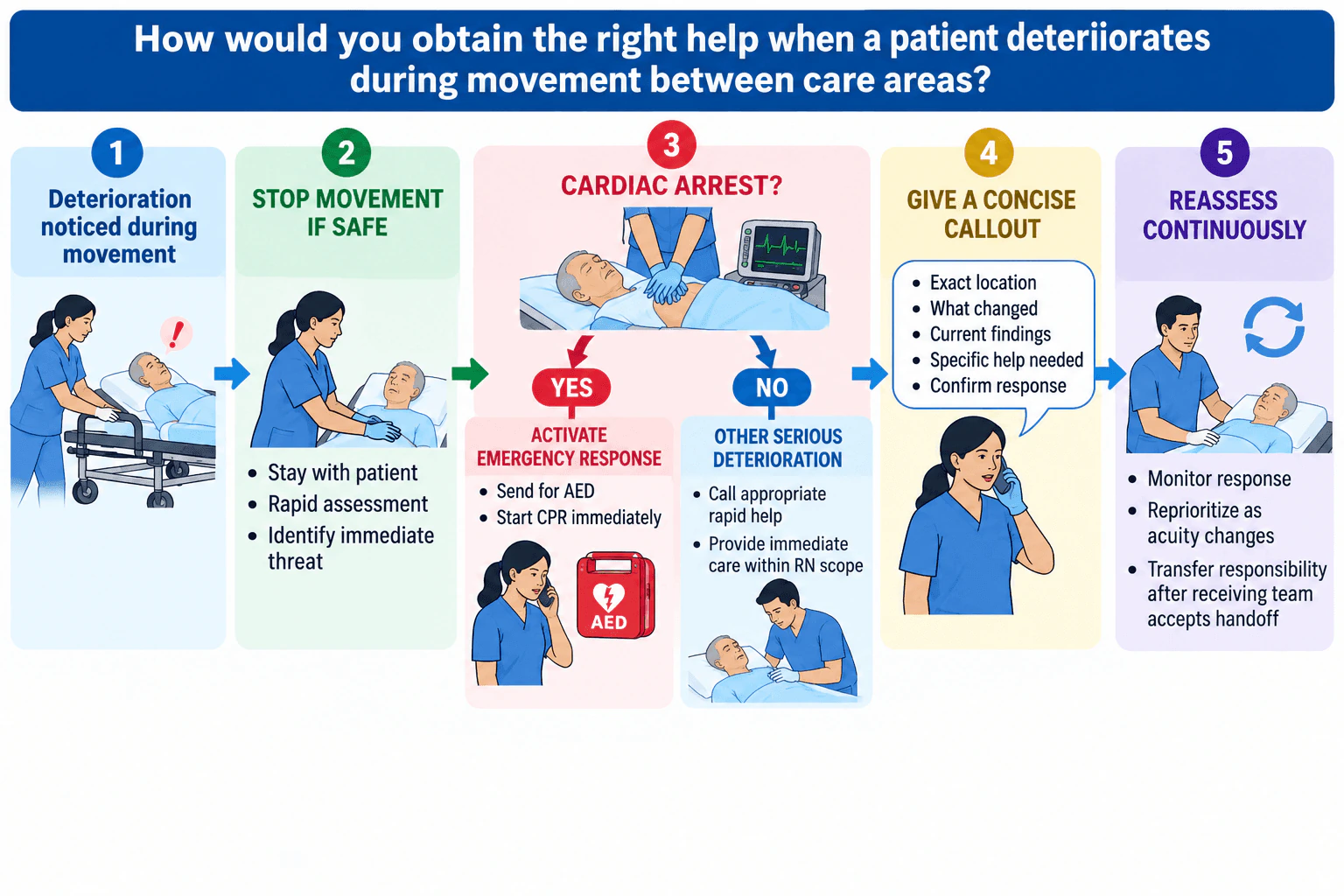
8. How would you obtain the right help when a patient deteriorates during movement between care areas?Scenario BasedMediumNyu Langone Health
i Question Details
Original practice question for this employer context, not a reported employer interview question. Explain the relevant ED nursing judgment and identify information or authority you would need. Do not assume an internal employer protocol.
Short Interview Answer (30-60 seconds)
I would stop the movement if it is safe, stay with the patient, rapidly assess the immediate threat, and activate the appropriate help. If cardiac arrest is recognized, I would activate the emergency response system, send for an automated external defibrillator, and start CPR immediately. For other serious deterioration, I would call the appropriate rapid help and provide immediate care within RN scope and local authorization. I would communicate the exact location, what changed, current findings, and the help needed, confirm the response, reassess continuously, and transfer responsibility only after the receiving team accepts the handoff.
Detailed Explanation
The central judgment is that the patient's current acuity takes priority over the planned destination. If deterioration occurs during movement between care areas, I would stop the movement if it is safe, stay with the patient, rapidly identify the immediate threat, activate the appropriate help, and continue reassessment until responsibility is safely transferred.
Useful Questions to Ask the Interviewer
What emergency escalation resources are available when a patient deteriorates between care areas?
How should staff communicate the exact location when activating urgent help outside a usual treatment space?
Which immediate interventions are authorized by standing protocols, and which require an order or another clinician?
How to Explain It in an Interview
Immediate Actions
I would stop movement if it is safe, stay with the patient, and perform a rapid assessment focused on the immediate threat. If an adult is unresponsive, has absent or abnormal breathing such as gasping, and no definite pulse is felt within 10 seconds, I would treat that as cardiac arrest. I would activate the emergency response system, send someone for an automated external defibrillator, and start CPR immediately. A broader assessment must not delay indicated CPR.
If the patient is not in cardiac arrest but has another serious deterioration, I would call the appropriate rapid help and provide immediate nursing care within my scope, competence, standing protocols, and local authorization. I would not assume a specific employer pathway or perform an intervention that requires authority I do not have.
Communication
Because the patient is between care areas, the exact location is essential. I would give a concise callout stating where we are, what changed, the most important current findings, and the specific help needed. I would confirm the response so I know the request was heard and understood.
Reassessment and Handoff
I would continuously monitor the patient's response and reprioritize as acuity changes. The original destination may no longer be appropriate after deterioration. When the receiving team arrives, I would communicate the change in condition, current assessment, actions already taken, response to those actions, and ongoing concerns. I would not relinquish responsibility until the receiving team has acknowledged and accepted the handoff.
The exact escalation pathway and protocol authorized interventions depend on the patient population, clinical findings, local policy, standing protocols, and available resources.
Why Interviewers Ask This
This question evaluates whether an emergency nurse can recognize deterioration during a vulnerable transition, stop an unsafe movement, identify the immediate threat, obtain the correct level of help without delaying lifesaving care, communicate clearly enough for responders to locate the patient and understand the need, remain within RN scope and local authority, reassess continuously, and complete a safe transfer of responsibility.
Common interview mistakes
Continuing movement simply because the destination is close, leaving the deteriorating patient alone to find help, delaying indicated CPR while completing a broader assessment, treating every deterioration as cardiac arrest, calling for help without giving the exact location or specific need, performing interventions outside RN scope or local authorization, failing to confirm that the request was received, neglecting reassessment after escalation, or assuming responsibility has transferred before the receiving team accepts the handoff.
Interview tip
Organize the response around five actions that match the clinical flow: recognize deterioration, stop movement if safe and assess the immediate threat, activate the appropriate help, give a concise callout with the exact location and need, then reassess continuously until the receiving team accepts responsibility. Make clear that cardiac arrest requires immediate resuscitation, while other serious deterioration requires rapid escalation and care within RN scope and local authority.
Interviewer may ask next
How would you verify that the right help is actually coming?
I would use closed loop communication. I would state the exact location, what changed, current findings, and the specific help needed, then obtain confirmation that the receiver understood the request and that the appropriate response was activated. If I did not receive confirmation or the patient's condition worsened, I would escalate again through the available emergency pathway while continuing immediate care and reassessment.
What would change if the deteriorating patient were a child rather than an adult?
The priorities of stopping movement if safe, staying with the patient, obtaining help, communicating the location and findings, and reassessing would remain, but assessment and resuscitation would follow current pediatric guidance rather than adult guidance. I would use the child's age, size, clinical findings, appropriate pediatric equipment, local protocols, and my authorized scope to guide care rather than applying adult resuscitation assumptions.
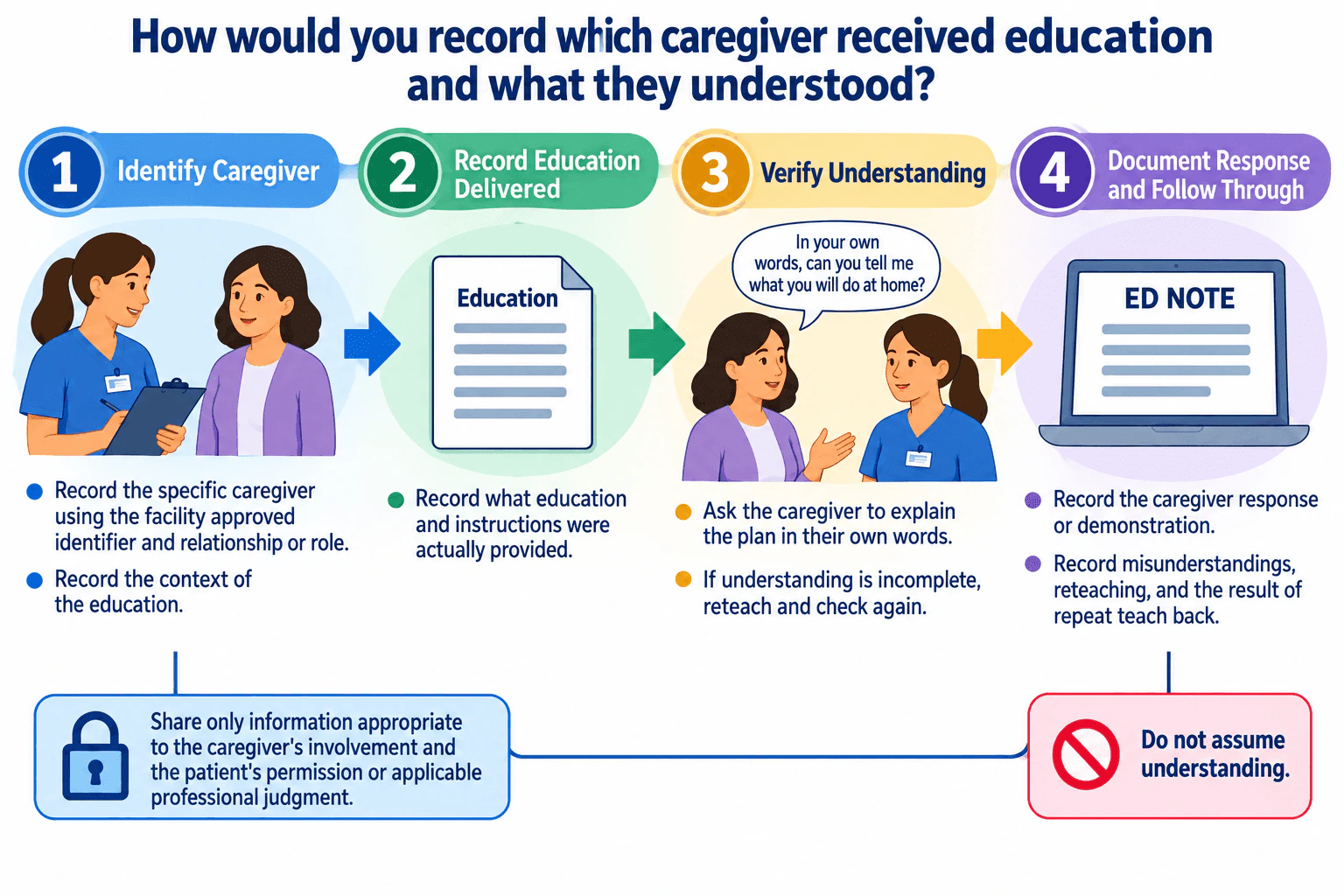
9. How would you record which caregiver received education and what they understood?Documentation ComplianceHardNyu Langone Health
i Question Details
Original practice question for this employer context, not a reported employer interview question. Explain the relevant ED nursing judgment and identify information or authority you would need. Do not assume an internal employer protocol.
Short Interview Answer (30-60 seconds)
I would record the specific caregiver, their relationship or role, the context of the education, and exactly what was taught. I would then ask the caregiver to explain the plan in their own words or demonstrate the skill when appropriate. If the response showed incomplete understanding, I would reteach and check again. Finally, I would document the caregiver's response or demonstration, any misunderstanding, the reteaching provided, and the result of the repeat check. I would not assume that a yes response means understanding, and I would share only information appropriate to the caregiver's involvement and the patient's permission or applicable professional judgment.
Detailed Explanation
The key is to document three things clearly: which caregiver received the education, what education was actually provided, and what that caregiver demonstrated they understood. The record should describe observable communication and responses rather than relying on a vague statement that understanding was confirmed.
Useful Questions to Ask the Interviewer
What record field or identifier does the organization use to document which caregiver received education?
Where should teach back results, misunderstandings, and reteaching be documented?
What local policy should I follow when caregiver involvement is needed but the patient's permission or decision making capacity is unclear?
How to Explain It in an Interview
Identify The Caregiver And Context
I would document the specific caregiver using the identifier required in the clinical record and note the caregiver's relationship or role. I would also document the context of the education, such as discharge preparation, without adding unnecessary identifying information.
Record What Was Actually Taught
I would record the education and instructions that were actually provided. I would not chart teaching that did not occur.
Verify Understanding
I would ask the caregiver to explain the plan in their own words. If the instruction involves a practical skill, I would use an appropriate demonstration when relevant. AHRQ describes teach back as checking understanding by asking the recipient to state in their own words what they need to know or do. ahrq.gov
If the response showed incomplete understanding, I would clarify or reteach the information and ask the caregiver to explain or demonstrate it again. AHRQ recommends clarifying and checking again when teach back identifies a misunderstanding. ahrq.gov
Document The Response
I would record the caregiver's response or demonstration, the specific misunderstanding if present, what I retaught, and the result of the repeat teach back. That documents both the education delivered and the observable evidence of understanding.
Protect Privacy
Before sharing protected information, I would confirm that caregiver involvement is appropriate. When the patient is present and capable, HIPAA permits relevant communication when the patient agrees, does not object, or the clinician can reasonably infer no objection using professional judgment. When the patient is unavailable or incapacitated, relevant information may be shared when professional judgment supports that it is in the patient's best interest. In either situation, information should be limited to what is directly relevant to that caregiver's involvement. hhs.gov
Why Interviewers Ask This
This question evaluates whether the nurse can create an objective record showing who received education, what was actually taught, and how understanding was verified. It also tests whether the nurse recognizes incomplete understanding, reteaches when needed, documents the result, protects privacy, and avoids assuming an employer specific workflow.
Common interview mistakes
Common mistakes are failing to identify which caregiver received the education, documenting only that the caregiver understood without describing how understanding was verified, charting education that was not actually provided, omitting misunderstandings or reteaching, treating a yes response as proof of comprehension, or sharing information without considering the patient's wishes and the caregiver's role. AHRQ specifically advises against relying on yes or no questions such as asking whether the person understands because that is not teach back. ahrq.gov
Interview tip
Explain the sequence clearly: identify the caregiver, record what was taught, verify understanding with teach back or an appropriate demonstration, reteach when needed, and document the observed response and repeat check. Then mention the privacy boundary. Do not claim that a specific employer uses a particular field, template, or workflow unless that information is provided.
Interviewer may ask next
How would you verify that the caregiver truly understood the instructions?
I would ask the caregiver to explain the plan in their own words or demonstrate the relevant skill when appropriate. I would compare that response with the intended instructions. If an important part were incorrect or missing, I would clarify or reteach that part and ask the caregiver to explain or demonstrate it again. I would then document the response, the misunderstanding identified, the reteaching provided, and the result of the repeat check. AHRQ recommends repeating the clarify and check process when teach back reveals misunderstanding. ahrq.gov
What would change if the patient lacked decision making capacity and a caregiver needed the education?
I would first determine the caregiver's role and follow applicable law, local policy, and the care team's determination of who may appropriately receive information. Under HIPAA, when a patient is unavailable or incapacitated, relevant information may be shared with a family member, friend, or another person involved in care when professional judgment supports that doing so is in the patient's best interest. The information should be limited to what is directly relevant to that person's involvement. I would then provide the needed education, verify understanding, and document the caregiver, the education provided, the response or demonstration, and any reteaching. hhs.gov
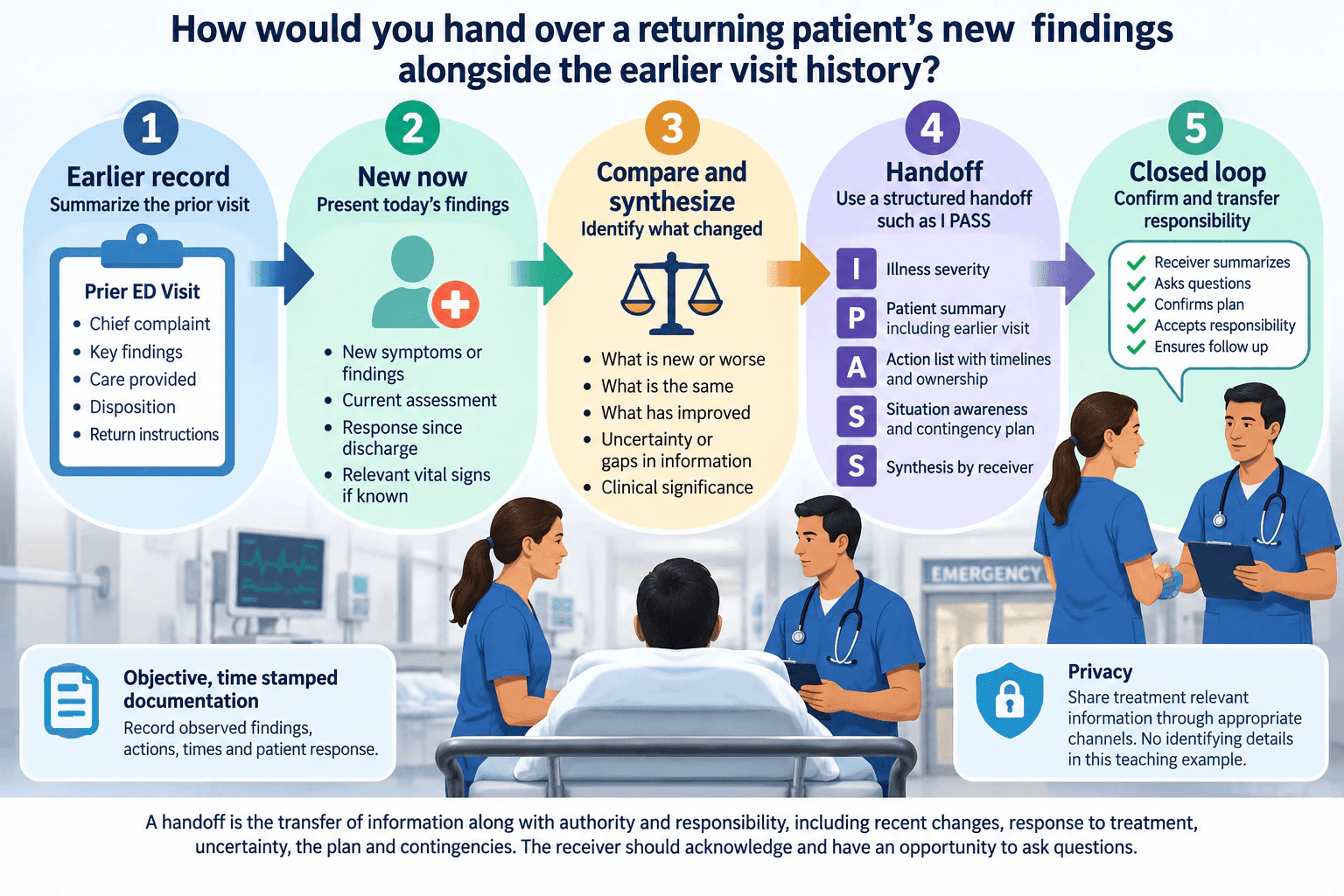
10. How would you hand over a returning patient's new findings alongside the earlier visit history?Documentation ComplianceHardNyu Langone Health
i Question Details
Original practice question for this employer context, not a reported employer interview question. Explain the relevant ED nursing judgment and identify information or authority you would need. Do not assume an internal employer protocol.
Short Interview Answer (30-60 seconds)
I would briefly summarize the earlier emergency visit, then focus on what is different now. I would report the current assessment, new or worsening findings, response since discharge, and anything important that is unchanged or improved. I would use a structured handoff such as I PASS, clearly state pending actions, timelines, ownership, and contingencies, and ask the receiver to summarize the plan and accept responsibility. I would document objective findings, actions, times, notifications, and patient response while protecting privacy and verifying who is authorized for tasks such as the medical screening examination.
Detailed Explanation
A safe return visit handoff should connect the earlier encounter to the patient's condition now. The goal is not to recite two separate histories. The goal is to show what changed, what stayed the same, what remains uncertain, what still needs action, and who is responsible next.
Useful Questions to Ask the Interviewer
What structured handoff method does this emergency department use for return visits and transfers of responsibility?
How are pending results and follow up responsibilities assigned and confirmed during handoff?
Which personnel are designated to perform the EMTALA medical screening examination under applicable requirements and hospital policy?
How to Explain It in an Interview
Earlier Record And Current Findings
I would start with a concise summary of the earlier emergency visit, including the chief complaint, key findings, care provided, disposition, and return instructions. Then I would present today's assessment separately, emphasizing new symptoms or findings, current assessment findings, relevant vital signs if known, and the patient's response since discharge.
Compare And Synthesize
I would clearly identify what is new or worse, what is unchanged, what has improved, and any important gaps or uncertainty. I would explain the clinical significance of those changes rather than simply listing facts. If the patient's condition has deteriorated, I would escalate through the appropriate clinical pathway while continuing assessment, reassessment, and documentation.
Structured Handoff And Closed Loop Communication
I would use the department's approved handoff method. I PASS is one established structured approach. It includes illness severity, patient summary, an action list, situation awareness and contingency planning, and synthesis by the receiver. The receiver should have an opportunity to ask questions and confirm the plan. psnet.ahrq.gov I would state pending actions, expected timelines, and ownership, then confirm that responsibility has actually transferred.
Objective Documentation And Privacy
I would document only observed findings, actions performed, relevant times, notifications, and the patient's response. I would not chart care that was not performed. Treatment related information can be shared with appropriate health care providers for treatment, while reasonable privacy safeguards still apply. hhs.gov I would also keep nursing triage and assessment distinct from the EMTALA medical screening examination and verify the designated personnel and local requirements rather than assuming every registered nurse independently performs that examination.
Why Interviewers Ask This
This question tests whether the nurse can connect two emergency encounters without simply repeating the earlier chart. The interviewer is evaluating whether the nurse can identify clinically meaningful change, communicate uncertainty, assign responsibility for pending work, use closed loop communication, document objectively, protect privacy, and recognize when authority or local policy must be verified.
Common interview mistakes
Common mistakes include repeating the earlier visit without explaining what changed, mixing old and current findings together, omitting uncertainty or pending work, failing to identify ownership, assuming the receiver has already reviewed the record, failing to confirm transfer of responsibility, charting care that was not performed, sharing unnecessary identifying information, or assuming every registered nurse is independently authorized to perform the medical screening examination.
Interview tip
Organize the answer in the same sequence as the handoff: earlier record, new findings now, comparison and synthesis, structured handoff, then closed loop confirmation. Make it clear that the central nursing judgment is identifying what changed and confirming who owns the next action.
Interviewer may ask next
How would you verify that the handoff was understood?
I would ask the receiver to summarize the key findings, pending actions, timelines, and contingency plan in their own words. I would answer questions, correct any misunderstanding, and explicitly confirm that the receiver has accepted responsibility. This matches the synthesis by receiver element of I PASS and supports closed loop communication. psnet.ahrq.gov
What would change if the returning patient's condition had significantly worsened?
I would still connect the current presentation to the earlier visit, but immediate assessment, prioritization, and escalation would take precedence over a routine handoff. I would communicate the deterioration first, identify the specific changes from the earlier condition, state actions already taken within nursing scope or authorized protocols, notify the appropriate clinician or response team, continue reassessment, and document the timeline and patient response objectively.
Emergency Department Nurse Resume Examples
Explore the resume examples below to find the one that best matches your target Emergency Department Nurse role.
New Graduate Emergency Department Nurse0-1 years; supervised transition to emergency nursing
Disclaimer: This interview guide is for educational and informational purposes only. It is designed to help readers prepare, but it does not guarantee any interview result, hiring decision, offer, or outcome. Interview questions, hiring criteria, and preferred answers can vary by employer, interviewer, industry, location, and time. All answers, examples, and explanations in this guide are suggested examples for interview preparation, not definitive answers or instructions for professional practice. They are based on research and judgment, are provided without warranties of any kind, and should be adapted to the question, role, and applicable laws and professional requirements. Diagrams are simplified illustrations intended to highlight the main concepts and their relationships; actual situations, systems, and practices may be more complex. Alternative approaches may be equally valid or better suited to a particular question, context, or interviewer. To the fullest extent permitted by applicable law, the contributors and publisher are not liable for decisions made, actions taken, or losses incurred based on this guide.
State Laws and Professional Responsibilities: Laws and requirements governing an occupation vary by state and jurisdiction. You are responsible for checking the current laws, licensing requirements, and scope-of-practice rules that apply to your location and role, and for ensuring that your answers and actions comply with them. Adapt examples in this guide to those requirements. This guide is not legal advice.
Company Notice: This guide is an independent educational resource and is not affiliated with, endorsed by, sponsored by, or approved by the company named in this guide. Company names identify reported interview experiences or the employer context of clearly labeled original practice exercises. Interview practices can change without notice, and inclusion of company-specific content does not mean these questions are official, complete, or guaranteed to be asked. To the fullest extent permitted by law, the author, contributors, and publisher are not responsible for outcomes related to use of this material.
Content Accuracy and Verification: To the fullest extent permitted by applicable law, we do not represent or warrant that interview guides, questions, answers, examples, or diagrams are accurate, complete, current, error-free, or suitable for any particular purpose. You are responsible for independently reviewing and verifying the information before relying on it.