This interview guide is for educational and informational purposes only. It is designed to help readers prepare, but it does not guarantee any interview result, hiring decision, offer, or outcome. Interview questions, hiring criteria, and preferred answers can vary by employer, interviewer, industry, location, and time. All answers, examples, and explanations in this guide are suggested examples for interview preparation, not definitive answers or instructions for professional practice. They are based on research and judgment, are provided without warranties of any kind, and should be adapted to the question, role, and applicable laws and professional requirements. Diagrams are simplified illustrations intended to highlight the main concepts and their relationships; actual situations, systems, and practices may be more complex. Alternative approaches may be equally valid or better suited to a particular question, context, or interviewer. To the fullest extent permitted by applicable law, the contributors and publisher are not liable for decisions made, actions taken, or losses incurred based on this guide.
State Laws and Professional Responsibilities
Laws and requirements governing an occupation vary by state and jurisdiction. You are responsible for checking the current laws, licensing requirements, and scope-of-practice rules that apply to your location and role, and for ensuring that your answers and actions comply with them. Adapt examples in this guide to those requirements. This guide is not legal advice.
Identity, Image, and Privacy Notice
To respect individual privacy, some names, profile photographs, avatars, biographical details, and other identifying information displayed in this guide may be replaced with pseudonyms, licensed stock images, illustrative avatars, composite images, or representative descriptions. Unless a person is expressly identified as an actual contributor, a displayed name, image, or profile should not be understood as depicting or identifying a specific candidate, interviewer, employee, or other real individual. These representations are provided for editorial and illustrative purposes only and do not imply endorsement, employment, participation, or affiliation with this guide or any company mentioned in it. Any resemblance to an actual person is coincidental.
Company Notice
This guide is an independent educational resource and is not affiliated with, endorsed by, sponsored by, or approved by the company named in this guide. Company names identify reported interview experiences or the employer context of clearly labeled original practice exercises. Interview practices can change without notice, and inclusion of company-specific content does not mean these questions are official, complete, or guaranteed to be asked. To the fullest extent permitted by law, the author, contributors, and publisher are not responsible for outcomes related to use of this material.
Content Accuracy and Verification
To the fullest extent permitted by applicable law, we do not represent or warrant that interview guides, questions, answers, examples, or diagrams are accurate, complete, current, error-free, or suitable for any particular purpose. You are responsible for independently reviewing and verifying the information before relying on it.
Questions or comments?
Contact us for general questions, or share feedback, technical corrections, and comments with the community.
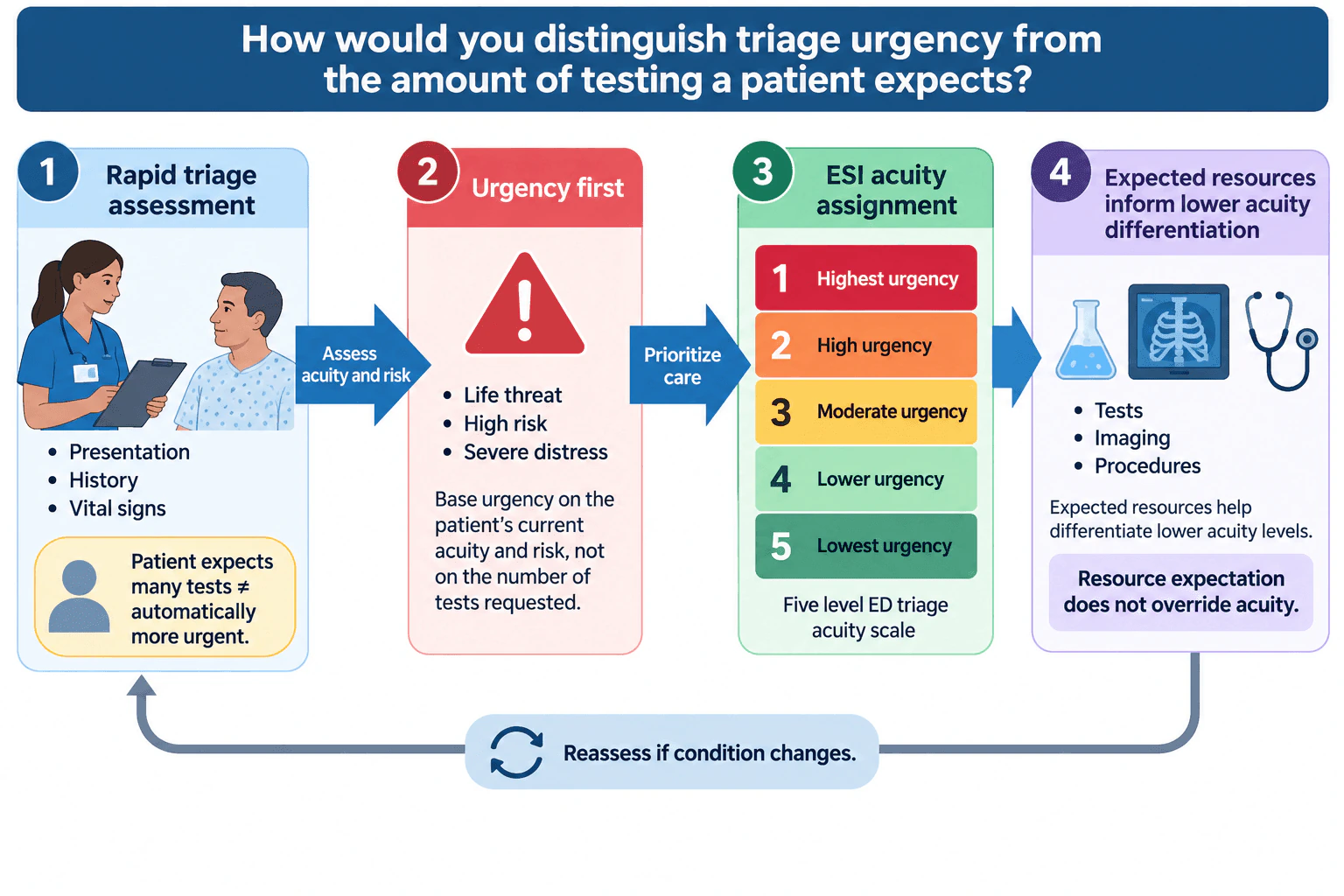
1. How would you distinguish triage urgency from the amount of testing a patient expects?Clinical KnowledgeEasyCleveland Clinic
i Question Details
Original practice question for this employer context, not a reported employer interview question. Explain the relevant ED nursing judgment and identify information or authority you would need. Do not assume an internal employer protocol.
Short Interview Answer (30-60 seconds)
I would determine urgency from the patient's current clinical condition, not from how many tests the patient expects. I would rapidly assess the presentation, focused history, vital signs, and signs of instability, high risk illness, or severe distress. With the Emergency Severity Index, immediate life saving needs and high risk findings are considered first. Expected resources then help differentiate lower acuity patients. Patient expectations do not override acuity, and I would reassess if the patient's condition changes.
Detailed Explanation
Triage urgency answers a different question from testing expectations. Urgency asks how quickly the patient needs evaluation and care based on current clinical risk. The amount of testing a patient expects does not establish that risk. In the Emergency Severity Index, acuity is considered first, while predicted resource needs help further differentiate stable patients who do not meet the highest acuity criteria.
Useful Questions to Ask the Interviewer
Which triage framework and version does this emergency department currently use?
What local policy defines reassessment and escalation for patients who remain in the waiting area?
Are there department specific protocols that affect nurse initiated testing or other actions at triage?
How to Explain It in an Interview
Core Concept
I would begin with a rapid triage assessment of the patient's presentation, focused history, vital signs, general appearance, and signs of immediate instability or high risk illness. The purpose is to determine acuity, not to estimate how much care the patient believes should be ordered.
Triage Meaning
Using the Emergency Severity Index as an example, ESI 1 identifies patients who require immediate life saving intervention. ESI 2 identifies patients with high risk presentations or other findings that indicate they should not wait for routine evaluation. These decisions are driven primarily by acuity and clinical risk.
For patients who do not meet those highest acuity criteria, predicted resource needs help distinguish the lower acuity levels. Tests, imaging, and procedures may contribute to that resource prediction, but the prediction is based on the care likely to be needed for evaluation and disposition, not simply the number of tests a patient requests or expects. Vital signs and clinical judgment remain important to the final triage decision.
Assessment Findings
A patient who expects extensive laboratory testing and imaging may still be clinically stable and lower acuity. Conversely, a patient who expects very little testing may have findings that indicate a high risk condition and require rapid evaluation. I would therefore prioritize current risk over expectations about testing.
Reassessment and Communication
If the patient remains waiting, I would reassess for changes in condition according to local policy and respond to new abnormal findings or increasing concern. I would explain respectfully that triage prioritizes clinical urgency and that decisions about testing depend on the assessment and the appropriate clinician's evaluation.
Limitations
I would not assume a Cleveland Clinic specific triage workflow. I would verify the department's approved triage framework, current ESI education, nurse initiated protocols, reassessment expectations, and escalation process.
Why Interviewers Ask This
This evaluates whether the nurse can separate acuity from resource demand, recognize patients who need rapid attention, use a validated triage framework appropriately, communicate with patients whose expectations may differ from clinical priorities, and recognize when local policy or additional clinical information is needed.
Common interview mistakes
Common mistakes include treating the number of requested tests as a measure of urgency, assuming that many predicted resources automatically mean high acuity, assigning ESI as though it were a diagnosis, ignoring changes in condition while a patient waits, or assuming a local triage or nurse initiated testing policy without verifying it.
Interview tip
State the distinction early: acuity comes first. Then explain that ESI uses expected resource needs to help distinguish lower acuity patients after immediate life saving needs and high risk presentations have been considered. Finish by mentioning reassessment, patient communication, and verification of the department's local triage policy.
Interviewer may ask next
What would you verify before applying this approach in a specific emergency department?
I would verify the triage framework and version in use, the department's triage education and competency requirements, its reassessment and escalation policy, and any approved nurse initiated protocols. That avoids assuming that one facility's workflow applies everywhere.
What changes if a patient who initially appeared stable develops new concerning findings while waiting?
I would reassess the patient promptly, repeat relevant observations and vital signs, update the acuity judgment, and escalate according to the new clinical findings and local policy. The original triage level should not prevent recognition of deterioration.
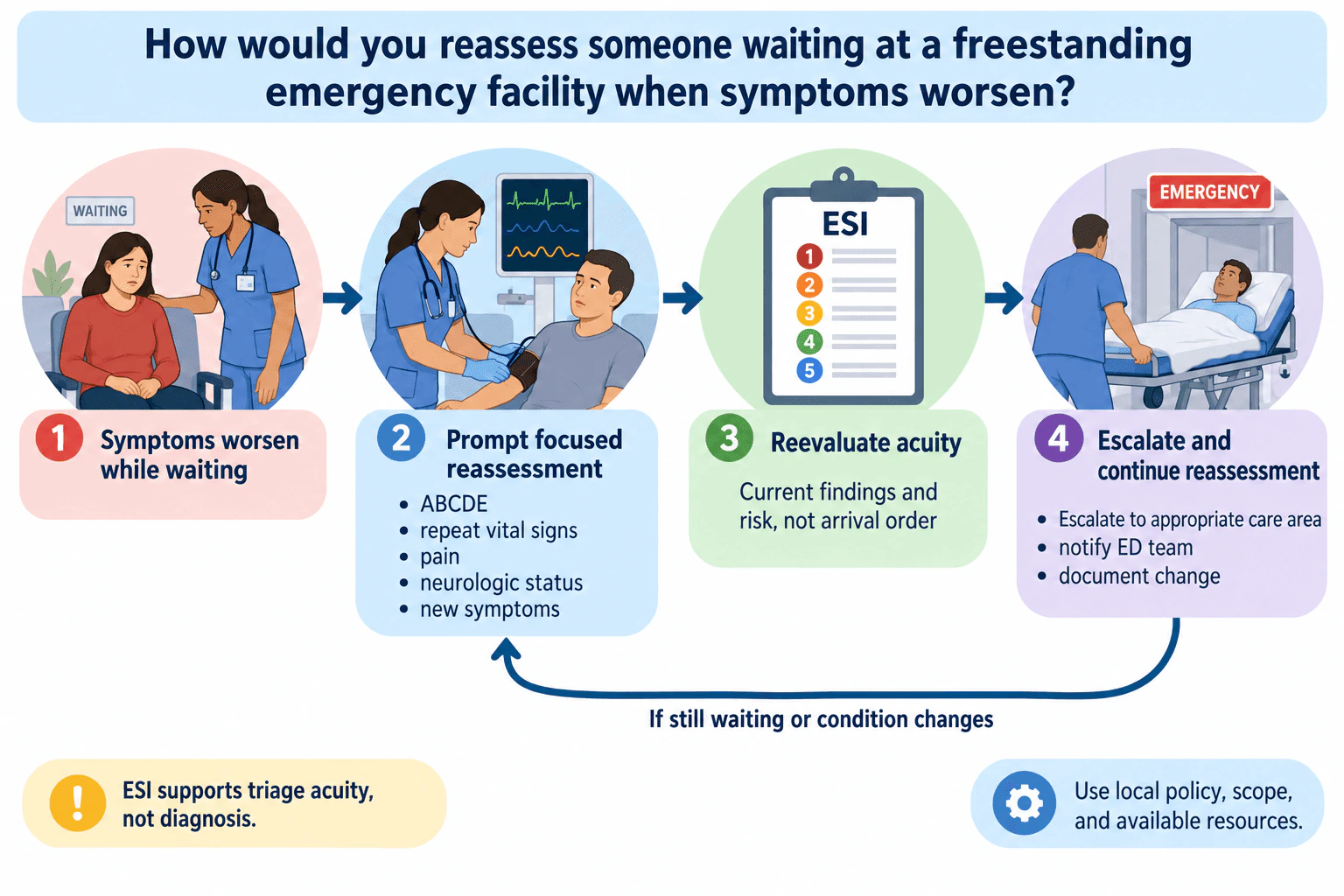
2. How would you reassess someone waiting at a freestanding emergency facility when symptoms worsen?Clinical KnowledgeEasyCleveland Clinic
i Question Details
Original practice question for this employer context, not a reported employer interview question. Explain the relevant ED nursing judgment and identify information or authority you would need. Do not assume an internal employer protocol.
Short Interview Answer (30-60 seconds)
If symptoms worsen while the patient is waiting, I would promptly reassess rather than rely on the original triage assessment. I would repeat a focused ABCDE assessment, vital signs, pain assessment, and neurologic assessment when relevant, and clarify what has changed. I would reevaluate acuity using the facility's validated triage process, recognizing that ESI supports acuity rather than diagnosis. If risk has increased, I would escalate to the appropriate care area, notify the emergency team, document the change, and continue reassessment if the patient remains waiting. Additional actions would depend on RN scope, local policy, applicable protocols, available resources, and provider orders when required.
Detailed Explanation
Worsening symptoms mean the original triage assessment may no longer represent the patient's current level of risk. The priority is prompt focused reassessment, followed by reevaluation of acuity and escalation based on the current findings. Triage should reflect current acuity rather than simply the order in which patients arrived.
Useful Questions to Ask the Interviewer
Which validated triage method does this facility use, and how is reassessment documented when a waiting patient's condition changes?
Which actions may an RN initiate independently, which require an approved nursing protocol, and which require a provider order?
What escalation pathway and resources are available when a waiting patient's acuity increases?
How to Explain It in an Interview
Clinical Priorities
I would respond to reported or observed worsening symptoms with prompt reassessment. I would repeat a focused ABCDE assessment, obtain repeat vital signs, reassess pain, evaluate neurologic status when relevant, and ask specifically what symptoms are new or different. I would compare the new information with the earlier assessment rather than assuming the original triage level is still appropriate.
Assessment Factors
I would then reevaluate acuity using the validated triage method used by the facility. If the Emergency Severity Index is applicable, I would use it to support an acuity decision based on the patient's current presentation and risk. ESI is a triage acuity tool, not a diagnosis, and the patient should not remain prioritized simply by arrival order. I would not invent findings that have not been observed or reported.
If reassessment shows increased risk or instability, I would escalate to the appropriate care area and notify the emergency team promptly. Independent nursing actions would remain within RN scope and local policy. Protocol authorized actions would require an applicable approved protocol. Actions requiring a provider order would follow that authorization.
Care Rationale
The key point is that triage is dynamic. A patient's condition can change while waiting, so reassessment prevents continued prioritization based on outdated information. I would communicate and document the change in symptoms, reassessment findings, updated acuity, escalation, and actions taken. If the patient remains in the waiting area, I would continue reassessment according to the patient's condition and local process, with earlier reassessment whenever another change occurs.
Because this is a freestanding emergency facility, I would confirm the available resources, escalation options, nursing protocols, and transfer process rather than assuming a specific internal policy.
Why Interviewers Ask This
This question evaluates whether the nurse recognizes that triage is dynamic. A strong answer shows prompt reassessment when symptoms change, prioritization according to current acuity rather than arrival order, appropriate use and limitations of a validated triage tool, escalation and communication when risk increases, continued reassessment, documentation, and awareness of nursing scope, local protocols, and available resources.
Common interview mistakes
Common mistakes include assuming the original triage level remains valid despite worsening symptoms, prioritizing strictly by arrival order, treating ESI as a diagnosis, focusing on one symptom without repeating a focused assessment, inventing patient findings or treatment thresholds, failing to communicate and document a change in condition, or implying that an RN may independently perform actions that actually require an approved protocol or provider order.
Interview tip
Make the sequence explicit: recognize the change, promptly reassess, compare with the previous assessment, reevaluate acuity, escalate according to current risk, communicate and document, then continue reassessment if the patient remains waiting. Mention that ESI supports triage acuity rather than diagnosis and that local scope, policy, protocols, and available resources determine which additional actions an RN may initiate.
Interviewer may ask next
How would you verify that your reassessment and escalation were appropriate?
I would verify that the reassessment reflects the patient's current symptoms and objective findings, compare those findings with the previous assessment, and confirm that the acuity decision follows the validated triage method used by the facility. I would also confirm that the appropriate emergency team member was notified, that the change and response were documented, and that each nursing action was within RN scope, an applicable approved protocol, or a provider order when required. If the patient remained waiting, I would continue reassessment and escalate again if the condition changed.
What would change if the patient became visibly unstable during reassessment?
The priority would shift to immediate escalation rather than routine waiting area reassessment. I would address immediate ABCDE concerns within RN scope, summon the appropriate emergency team, and escalate the patient to the appropriate care area without allowing completion of a routine triage process to delay urgent care. Additional testing or treatment would follow applicable emergency protocols, available resources, and provider orders when required. I would continue monitoring, communication, reassessment, and documentation during the escalation.
3. How would you explain the need for transfer from one emergency location to another?NEWCommunication And DelegationMediumCleveland Clinic
i Question Details
Original practice question for this employer context, not a reported employer interview question. Explain the relevant ED nursing judgment and identify information or authority you would need. Do not assume an internal employer protocol.
Short Interview Answer (30-60 seconds)
I would first clarify why the patient needs to move and whether the transfer is within the same organization or to another facility. Then I would explain the confirmed reason in plain language, focusing on the service, specialist, monitoring, or level of care the patient needs. I would explain what the patient should expect next, invite questions, use qualified interpretation when needed, and use teach back to confirm understanding. I would continue assessment and reassessment, escalate any change in condition or unresolved concern, and make sure responsibility is clearly communicated to the next team. If other assignments compete for attention, I would delegate only appropriate tasks within staff competence and permitted scope while retaining nursing assessment and judgment.
Detailed Explanation
A good transfer explanation connects the move to the patient's care needs without inventing details that have not been confirmed. Because the question does not specify whether the move is within one hospital system or between separate facilities, I would first clarify the type of transfer, the reason for it, the patient's current condition, and which team has authority for the transfer decision. For an interfacility transfer involving an emergency medical condition, federal EMTALA requirements may apply. CMS states that when an emergency medical condition cannot be stabilized with the staff and facilities available, an appropriate transfer may be necessary, with applicable transfer protections including communication of risks and benefits.
Useful Questions to Ask the Interviewer
What clinical need or capability is driving the transfer?
Is this an internal movement or an interfacility transfer, and has the receiving team accepted responsibility when acceptance is required?
What monitoring, transport, interpretation, or other communication support does this patient currently need?
How to Explain It in an Interview
Nursing Priorities
I would explain the reason for transfer in simple language. I might say that the patient needs a service, specialist, monitoring capability, or level of care that the next location can provide. I would distinguish confirmed facts from information that still needs clarification and avoid promising an outcome.
I would continue assessment and reassessment while the transfer is being arranged. If the patient's condition changed, I would address immediate nursing priorities within my scope and promptly notify the responsible clinician and transfer team. A change in condition could affect the transport plan, destination, monitoring needs, or readiness for transfer, so I would not assume that the original plan remains appropriate.
Patient Context
I would invite questions and identify communication needs. If the patient has limited English proficiency, I would use qualified language assistance consistent with applicable requirements rather than relying on an unqualified person when qualified interpretation is needed. I would include the family or support person when appropriate and with the patient's permission or other applicable authority.
I would use teach back to check understanding. Instead of asking only whether the patient understands, I would ask the patient to explain in their own words why the transfer is occurring and what they expect next. AHRQ describes teach back as a way to confirm that information was explained clearly.
Clinical Rationale
I would use closed loop communication during handoff so important information is received and acknowledged. For an applicable interfacility transfer of an unstabilized emergency medical condition, CMS requirements include treatment within the sending hospital's capacity to minimize transfer risk, acceptance by a receiving facility with appropriate capability and capacity, transfer of relevant records, and appropriate personnel and transportation.
If workload requires delegation, I would assign only tasks appropriate to the other person's competence and legal role and provide required supervision. Under Ohio nursing delegation rules, tasks delegated to an unlicensed person must not require nursing judgment, complex observations, critical decisions, or repeated nursing assessments. I would therefore retain nursing assessment and clinical judgment while delegating only suitable tasks.
Why Interviewers Ask This
This question evaluates whether the nurse can explain a care transition clearly while protecting patient understanding, autonomy, and safety. It also tests communication with patients and families, recognition of interpretation needs, advocacy when concerns arise, coordination with the sending and receiving teams, and appropriate delegation when several patients require attention.
Common interview mistakes
Common mistakes include giving a vague reason for the transfer, presenting an unconfirmed service or outcome as certain, failing to distinguish an internal movement from an interfacility transfer, using an unqualified person when qualified interpretation is needed, mistaking agreement for understanding, failing to reassess when the patient's condition changes, assuming the receiving team has accepted responsibility without confirmation when acceptance is required, or delegating nursing assessment and judgment to unlicensed assistive personnel.
Interview tip
Organize the response around the patient first. Explain why the move is needed, confirm understanding with teach back, address language and consent concerns, maintain assessment and reassessment until responsibility changes, and communicate clearly with the next team. Then briefly explain that competing assignments may be delegated only when the task is appropriate to the other person's competence and permitted role, while nursing assessment and judgment remain with the licensed nurse.
Interviewer may ask next
How would you verify that the patient actually understands the reason for transfer?
I would use teach back rather than relying on a yes or no response. After explaining the transfer in plain language, I would ask the patient to describe in their own words why the move is recommended and what they expect to happen next. If their response shows a misunderstanding, I would clarify the information and check again. I would use qualified interpretation or other appropriate communication support when needed and escalate unanswered clinical questions to the responsible clinician.
What would you do if the patient's condition changed while the transfer was being arranged?
I would reassess the patient, address immediate nursing priorities within my scope, and promptly communicate the change to the responsible clinician and transfer team. I would not assume that a previously appropriate transport or destination remains appropriate after a meaningful clinical change. Decisions about revised treatment, destination, monitoring, or transport that require an order or another professional's authority would be escalated accordingly. I would continue appropriate monitoring and make sure the updated condition is communicated before responsibility transfers.
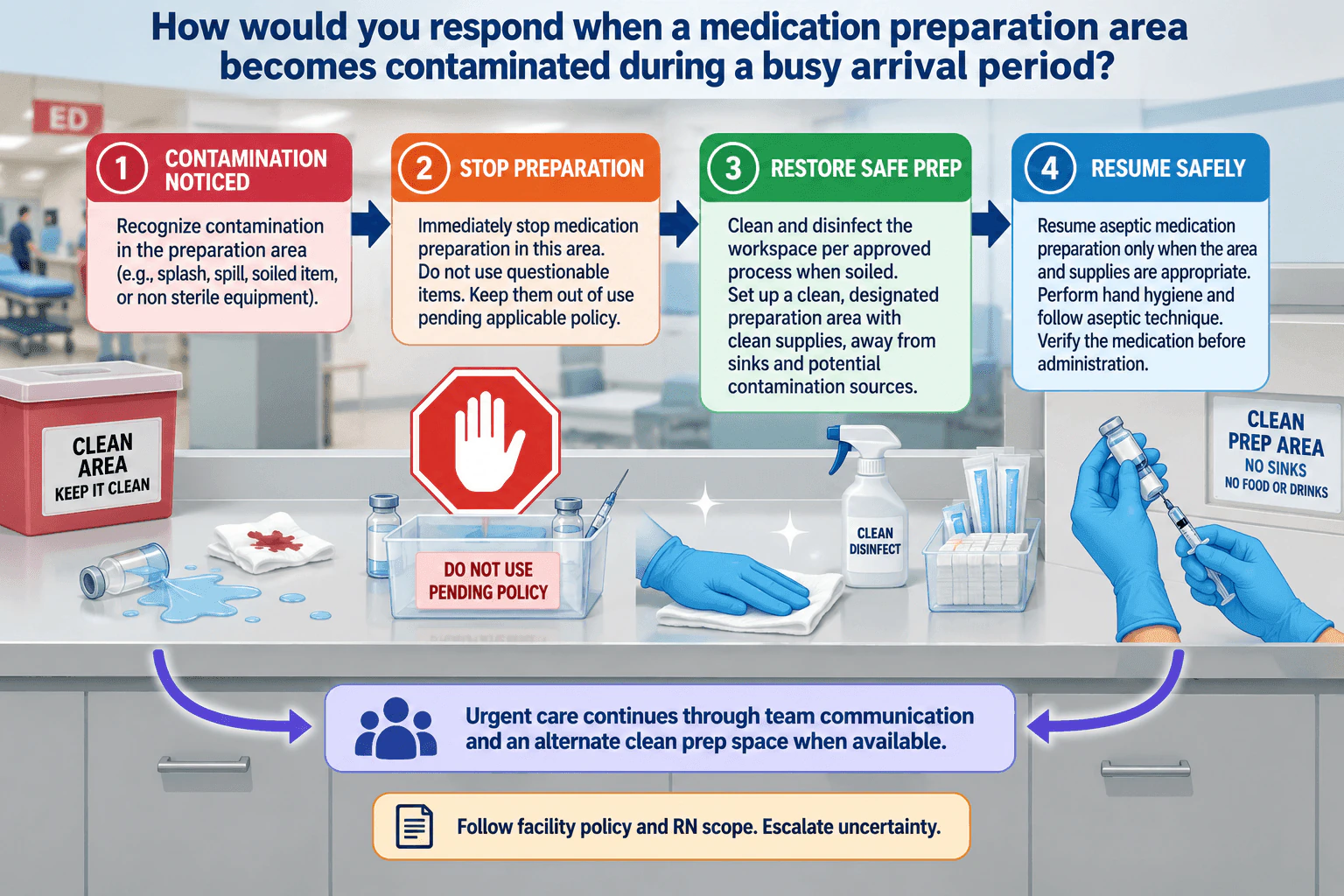
4. How would you respond when a medication preparation area becomes contaminated during a busy arrival period?Medication And ProceduresMediumCleveland Clinic
i Question Details
Original practice question for this employer context, not a reported employer interview question. Explain the relevant ED nursing judgment and identify information or authority you would need. Do not assume an internal employer protocol.
Short Interview Answer (30-60 seconds)
I would stop medication preparation in the contaminated area and keep questionable items out of use pending the applicable policy. I would communicate with the team so urgent care continues and move preparation to an approved alternate clean area when available. I would have the affected workspace cleaned and disinfected according to the approved process, restore clean supplies away from sinks and other contamination sources, then perform hand hygiene, use aseptic technique, and verify the medication before administration. If anything remained uncertain, I would follow facility policy and RN scope and escalate rather than guess.
Detailed Explanation
The central decision is to stop using an unsafe medication preparation area without allowing a busy arrival period to lower the safety standard. Current CDC guidance supports preparing medications in a designated clean area separated from potential contamination sources, including sinks or other water sources, using aseptic technique, and cleaning and disinfecting medication preparation areas when there is evidence of soiling.
Useful Questions to Ask the Interviewer
What approved process does this organization use to clean and restore a contaminated medication preparation area?
Where is the approved alternate medication preparation area when the usual space cannot be used?
Who should the nurse contact when the usability of exposed medication or supplies is uncertain?
How to Explain It in an Interview
Stop preparation
I would immediately stop preparing medication in the contaminated area. Any questionable medication or supplies would remain out of use until their status was determined through applicable policy, manufacturer guidance, or another authorized source. I would not assume an item was safe simply because contamination was not obvious.
Keep urgent care moving safely
Because patients are arriving, I would communicate the problem to the team and use an approved alternate clean medication preparation area when available. This allows urgent care to continue without preparing medication in an unsuitable space.
Restore a safe preparation area
The affected workspace would be cleaned and disinfected according to the approved process. Medication preparation should occur in a designated clean area with clean supplies separated from potential contamination sources such as sinks, water, blood, body fluids, or contaminated equipment.
Resume with medication safety checks
Once an appropriate clean area and appropriate supplies are available, I would perform hand hygiene and use aseptic technique. I would then complete the relevant medication verification before administration, including the authorized order, correct patient, allergies, medication, route, concentration, and any other medication specific checks required for that situation.
Escalate uncertainty
I would not invent a cleaning method, discard rule, or local procedure. Nursing practice depends on applicable law, facility policy, competence, available resources, and accountability. If the safety of an item, workspace, or alternate preparation location remained uncertain, I would keep it out of use and escalate to the appropriate clinical resource rather than improvise.
Why Interviewers Ask This
This question evaluates whether the nurse protects medication safety when workload pressure could encourage shortcuts. It tests recognition of contamination, willingness to stop an unsafe preparation process, communication during competing emergency department demands, restoration of a clean preparation environment, use of aseptic technique, and appropriate use of facility policy, nursing scope, and escalation when the correct disposition of an item or workspace is uncertain.
Common interview mistakes
Continuing medication preparation because the department is busy, using questionable medication or supplies before their status is resolved, moving contaminated equipment into another preparation area, resuming before an appropriate clean space is available, skipping hand hygiene or aseptic technique, and inventing a universal cleaning or discard rule instead of following applicable policy and authorized guidance.
Interview tip
Present the response as a safety decision under pressure: stop preparation in the contaminated area, keep questionable items out of use, communicate so urgent care continues, use an approved alternate clean preparation area when available, restore the affected workspace through the approved process, resume with hand hygiene, aseptic technique, and medication verification, and escalate uncertainty rather than improvise.
Interviewer may ask next
What would you verify before resuming medication preparation?
I would verify that an appropriate clean medication preparation area is available, that the affected workspace has been cleaned and disinfected according to the approved process if it will be reused, and that clean supplies are separated from potential contamination sources. I would perform hand hygiene, use aseptic technique, and complete the applicable medication checks before administration. If the status of any exposed medication or supply remained uncertain, I would keep it out of use until the appropriate policy or authorized clinical resource resolved the question.
What would you do if several urgent patients arrived while the usual medication preparation area was still unavailable?
I would not lower the medication safety standard because of workload. I would communicate the situation to the team, prioritize urgent clinical needs, and use an approved alternate clean medication preparation area when available. If there were no clearly approved alternate location, I would escalate to the appropriate clinical leader or resource and follow applicable policy rather than improvise a preparation space or use questionable supplies.
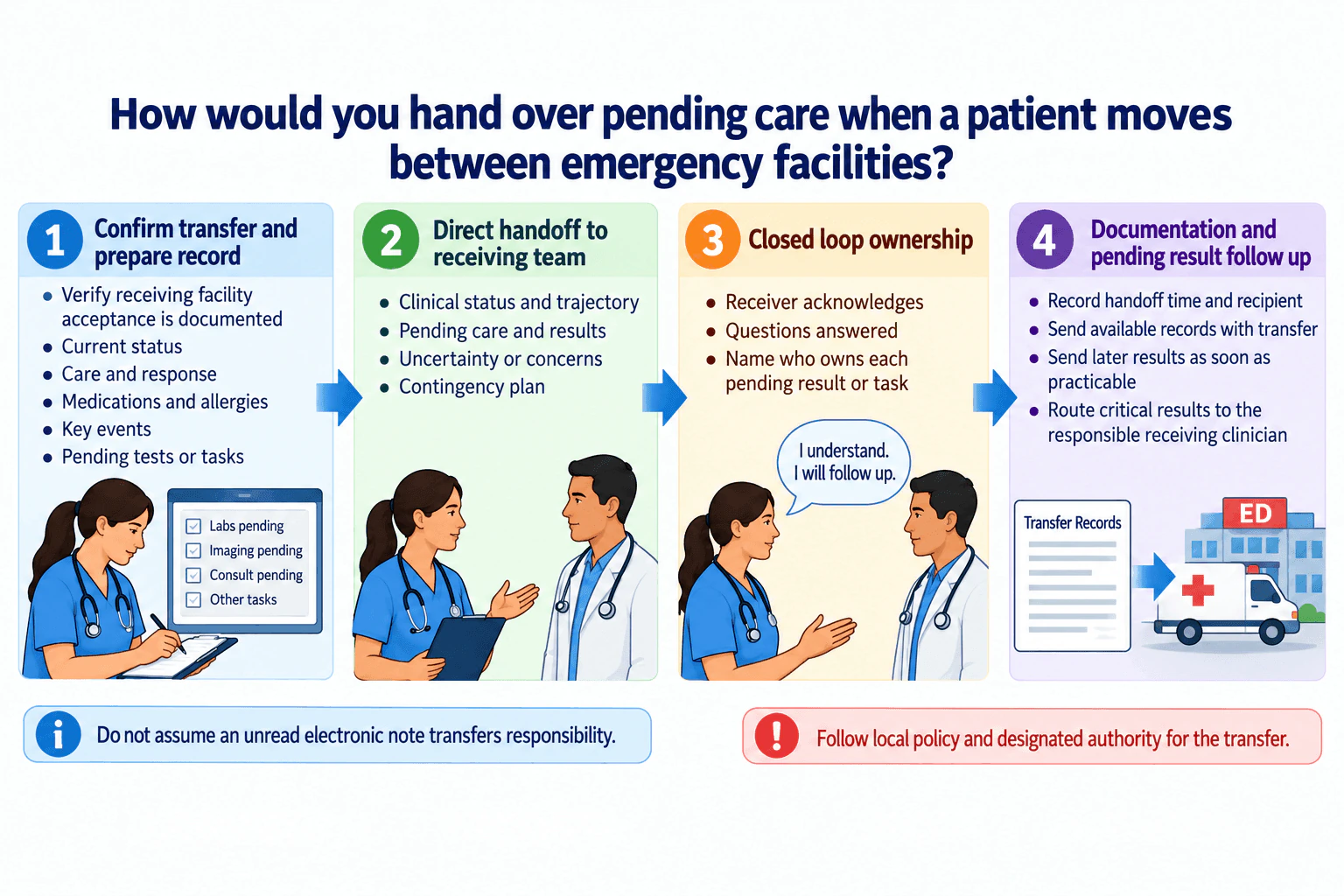
5. How would you hand over pending care when a patient moves between emergency facilities?Documentation ComplianceHardCleveland Clinic
i Question Details
Original practice question for this employer context, not a reported employer interview question. Explain the relevant ED nursing judgment and identify information or authority you would need. Do not assume an internal employer protocol.
Short Interview Answer (30-60 seconds)
I would first verify that receiving facility acceptance is documented through the appropriate transfer process and prepare an accurate summary of the patient's current status, care and response, medications and allergies, key events, and pending tests or tasks. I would give a direct handoff to the receiving team, confirm acknowledgment, answer questions, and explicitly identify who owns each pending result or action. I would document the handoff time and recipient, send available records with the transfer, communicate later and critical results through the proper clinical pathway, and follow local policy and designated authority throughout.
Detailed Explanation
A safe interfacility handoff is a transfer of both information and responsibility. My goal is to make the patient's current condition, unfinished care, and ownership of follow up unmistakable.
Useful Questions to Ask the Interviewer
What process identifies the receiving clinician or team responsible for pending results after transfer?
Which role is authorized to complete or approve the transfer requirements in this jurisdiction and facility?
How are results that become available after the patient leaves routed to the receiving team?
How to Explain It in an Interview
Confirm Transfer And Prepare The Record
I would first verify that receiving facility acceptance is documented through the appropriate process. I would not assume that an emergency department nurse independently authorizes an Emergency Medical Treatment and Labor Act transfer. I would confirm the responsible personnel and applicable policy. I would prepare an objective transfer record with the patient's current status, care already provided and response, medications and allergies, important events, and every known pending test, consultation, or task.
Give A Direct Clinical Handoff
I would communicate directly with the receiving team and summarize the clinical status and trajectory, pending care and results, important uncertainty or concerns, and any relevant contingency plan. I would share information needed to support treatment and continuity of care while using reasonable privacy safeguards.
Establish Closed Loop Ownership
I would confirm that the receiver acknowledges the handoff and has an opportunity to ask questions. Most importantly, I would state who is responsible for each pending result or task rather than assuming that an electronic note has been seen. If responsibility is unclear, I would escalate through the appropriate clinical pathway until ownership is identified.
Document And Route Updates
I would document the handoff time, recipient, information communicated, and any confirmed follow up responsibility. Available records relevant to the emergency condition should accompany an appropriate transfer. If relevant records or test results are not available when the patient leaves, they should be sent to the receiving facility as soon as practicable. A critical result that becomes available after transfer should be communicated promptly to the responsible receiving clinician according to the approved process, with the notification documented accurately.
Throughout the transfer, I would chart only what I observed, performed, communicated, and confirmed. I would not document unperformed care or assume that sending information alone completes the handoff.
Why Interviewers Ask This
This question tests whether the nurse can protect continuity of care when responsibility moves between facilities. The key judgment is recognizing that safe transfer requires more than sending records. The nurse must communicate the current clinical picture, identify unfinished work, establish who is responsible for follow up, document the exchange objectively, protect patient information, and work within the authority defined by applicable law and local policy.
Common interview mistakes
Common mistakes include treating record transmission as the entire handoff, failing to identify pending tests or tasks, assuming the receiving team has read an electronic note, failing to confirm who owns follow up, omitting the handoff recipient or time from documentation, sending inaccurate or incomplete information, charting care that was not performed, disclosing information outside an appropriate treatment or legally permitted purpose, and assuming the bedside nurse independently has authority to complete every legal element of an interfacility transfer.
Interview tip
Organize the answer around four actions: confirm the transfer process and prepare the record, give a direct clinical handoff, establish closed loop ownership of pending work, then document and route later results. Emphasize that responsibility must be explicit and that local policy and designated authority determine the nurse's role in the transfer process.
Interviewer may ask next
How would you verify that responsibility for a pending result was actually transferred?
I would identify the receiving clinician or team responsible for the result, communicate the pending item directly, obtain acknowledgment, answer questions, and document the handoff recipient, time, and agreed responsibility. If I could not establish ownership, I would escalate through the appropriate clinical chain rather than assume that an electronic record entry was sufficient.
What would you do if a critical result became available after the patient had already left for the receiving facility?
I would follow the approved critical result process promptly, route the result to the responsible receiving clinician or team, use closed loop communication to confirm receipt when required, and document the notification accurately. I would also make sure the result is transmitted to the receiving facility through the appropriate records process. I would not independently prescribe treatment or assume authority outside my nursing scope.
6. How did you become interested in nursing?BehavioralMediumCleveland Clinic
i Question Details
Describe the real experiences, influences, or training that led you toward nursing and explain what continues to motivate your professional development.
Interview tip:
Use STAR to structure your answer: briefly explain the Situation and Task, make Action the most detailed part, and finish with the Result. For example, describe an experience that first showed you the value of nursing, how you explored the profession through education and patient care experiences, what you learned from communicating with patients and the care team, and why those experiences continue to motivate you to grow as an emergency nurse.
Situation
My interest in nursing started when I saw how much difference a nurse could make during a stressful health situation involving someone close to me. What stayed with me was not only the clinical care. It was also the way the nurse explained what was happening, listened carefully, and helped the patient and family feel less overwhelmed.
Task
That experience made me want to understand whether nursing was the right career for me. I wanted a role where I could combine practical knowledge, careful observation, communication, and direct service to people during difficult moments.
Action
I began learning more about nursing and paid close attention to what the work required beyond simply being caring. Through my education and patient care experiences, I saw that nurses must notice changes, organize priorities, communicate clearly with the care team, and help patients understand what is happening. I became especially interested in emergency nursing because patients often arrive frightened, uncomfortable, or unsure of what will happen next. I found that I was drawn to the responsibility of staying calm, listening carefully, gathering important information, and helping the team provide safe and organized care. I also learned that good nursing requires continuous development. I try to understand the reason behind each assessment, ask questions when something is unclear, learn from experienced colleagues, and reflect on how I can communicate more effectively with patients and families.
Result
Those experiences confirmed that nursing fits both my strengths and the kind of work I find meaningful. I am motivated by being able to combine clinical judgment with compassion and clear communication. I am especially interested in continuing to grow in emergency nursing, where teamwork, patient safety, and a calm presence can make an important difference during a difficult moment.
Why Interviewers Ask This
Interviewers ask this question to understand whether the candidate has a thoughtful and lasting reason for choosing nursing. A strong answer shows self awareness, realistic understanding of the profession, commitment to patient care, and motivation to continue learning rather than giving only a general statement about wanting to help people.
Interviewer may ask next
What specifically attracted you to emergency nursing?
I was drawn to emergency nursing because it requires calm communication, careful assessment, teamwork, and the ability to adjust priorities as patient needs change. I also value being able to support patients and families during moments when they may feel anxious or uncertain. That combination of clinical responsibility and human connection is what makes the emergency setting meaningful to me.
How do you continue developing the qualities that first attracted you to nursing?
I continue developing them by asking questions, learning the reason behind clinical decisions, listening to feedback, and reflecting on how I communicate with patients and the care team. I also try to stay aware of areas where I need more knowledge or practice. That helps me keep improving while maintaining the compassion and curiosity that originally drew me to nursing.
7. What do you think will be difficult for you in this environment?BehavioralMediumCleveland Clinic
i Question Details
Identify a genuine challenge you expect in the clinical environment, explain why it may be demanding, and describe how you would prepare, seek support, learn, and remain accountable.
Interview tip:
Use STAR to structure your answer: briefly explain the Situation and Task, make Action the most detailed part, and finish with the Result. For example, describe the challenge you expect when managing several patients with changing priorities, how you would stay organized, communicate concerns early, ask experienced team members for support when needed, and remain accountable for safe patient care.
Situation
I think one of the most difficult parts of working in a busy emergency department will be managing several competing priorities when patient conditions can change quickly. I know there may be times when I need to shift my attention rapidly while still making sure each patient receives careful and respectful care.
Task
My responsibility would be to recognize which needs are most urgent, keep track of the patients assigned to me, communicate important changes promptly, and know when I need support. I would also need to keep learning the department workflow without allowing the pressure of the environment to affect my attention to safety or communication.
Action
I would prepare by learning the department routines, common emergency workflows, and available resources during orientation. At the bedside, I would use frequent assessment and reassessment to notice changes in a patient's condition. I would organize my work around the most urgent patient needs and update my priorities as new information becomes available. If I noticed a concerning change, I would communicate it promptly to the appropriate team member and clearly explain what I observed. I would not stay silent or guess when I was unsure. I would ask an experienced nurse or another appropriate team member for help, especially when a situation was unfamiliar or several urgent needs occurred at the same time. I would also communicate with patients and families so they understood what I could explain within my role, even when the department was busy. After difficult situations, I would review what went well, identify what I needed to improve, and use feedback from the team to strengthen my judgment and organization.
Result
I expect the pace and changing priorities to be challenging at first, but I would approach that challenge with preparation, communication, and accountability. My goal would be to become more efficient without becoming careless, to ask for help before a concern becomes a safety issue, and to keep developing the judgment needed to provide dependable care in the emergency department.
Why Interviewers Ask This
Interviewers ask this question to see whether the candidate has a realistic understanding of the demands of emergency nursing and enough self awareness to identify a genuine challenge. A strong answer shows that the candidate does not minimize the difficulty, has a practical plan for learning and seeking support, communicates concerns early, and remains accountable for patient safety while adapting to a fast paced environment.
Interviewer may ask next
How would you handle a situation where several patients needed your attention at the same time?
I would reassess the situation, identify which patient had the most urgent need, and address that priority first. I would communicate clearly with the team so they knew what I was managing and ask for appropriate help when the workload could not be handled safely by one person. I would continue reassessing because priorities can change quickly in the emergency department.
What would you do if you were unsure how to handle an unfamiliar situation?
I would first gather the information I could safely obtain within my role and identify what I did not know. I would then ask an experienced nurse or the appropriate team member for guidance rather than guessing. After the situation was addressed, I would review what I learned so I would be better prepared the next time I encountered something similar.
8. Why did you choose the Cleveland Clinic?BehavioralMediumCleveland Clinic
i Question Details
Explain your genuine reasons for applying, linking your professional goals and nursing interests to publicly documented features of Cleveland Clinic without inventing personal experiences with the organization.
Interview tip:
Use STAR to structure your answer: briefly explain the Situation and Task, make Action the most detailed part, and finish with the Result. For example, describe how you evaluated Cleveland Clinic against your goals in emergency nursing, researched its public focus on patient centered care, teamwork, quality, safety, and nursing development, and decided those priorities matched the kind of nurse you want to become.
Situation
As I considered my next step in emergency nursing, I wanted to choose an organization where strong clinical care and the patient experience are both treated as important. I also wanted an environment where nurses work closely with the wider care team and continue developing their practice.
Task
My goal was to look beyond the name of the organization and understand whether Cleveland Clinic's publicly stated approach to emergency care and nursing matched the way I want to practice. I wanted a setting where I could contribute to safe, compassionate care while continuing to grow as an emergency nurse.
Action
I reviewed Cleveland Clinic's public information about its emergency departments, nursing practice, and patient care priorities. What stood out to me was the focus on putting patients first, including making the emergency department experience as supportive as possible during what can be a stressful time. I also saw a strong emphasis on quality and safety, communication across multidisciplinary teams, and nurses having an active role in professional practice. Those points matter to me because emergency nursing requires more than completing clinical tasks. A nurse has to assess changing needs, communicate clearly, help patients and families understand what is happening, and work closely with the rest of the care team. I was also interested in the opportunities Cleveland Clinic describes for nursing education and professional development. I want to keep strengthening my emergency assessment, communication, and clinical judgment rather than becoming comfortable with what I already know.
Result
That research gave me a clear reason to choose Cleveland Clinic. Its public priorities around patient centered care, teamwork, quality, safety, and continued nursing development match the kind of emergency nurse I want to be. I am applying because I believe this is an environment where I could contribute to patients and the team while continuing to grow professionally.
Why Interviewers Ask This
Interviewers ask this question to understand whether the candidate has made a thoughtful choice and understands what is important about Cleveland Clinic rather than applying only because of its name. A strong answer connects documented features of the organization with the candidate's genuine goals in emergency nursing and shows a realistic interest in patient care, teamwork, quality, safety, and professional growth.
Interviewer may ask next
Which part of Cleveland Clinic's approach is most important to you as an Emergency Department Nurse?
The focus on patient centered care is especially important to me because emergency visits can be frightening and uncertain for patients and families. I want to provide strong clinical care while also communicating clearly, helping people understand what is happening, and treating them with compassion. I also value that this is connected with teamwork and safety rather than treated as a separate goal.
How would you contribute to the kind of team environment you described?
I would contribute by communicating changes in a patient's condition clearly, sharing important information promptly, listening to concerns from other caregivers, and speaking up when I see a possible safety issue. I would also ask questions when I need help and be willing to support teammates during busy periods. My goal would be to be dependable, respectful, and focused on what the patient needs.
9. What kind of a nurse do you want to be?BehavioralMediumCleveland Clinic
i Question Details
Describe the professional qualities, clinical judgment, communication habits, accountability, and learning goals you want to demonstrate in nursing practice.
Interview tip:
Use STAR to structure your answer: briefly explain the Situation and Task, make Action the most detailed part, and finish with the Result. For example, describe a patient care experience that showed you the kind of nurse you want to become, including how you stayed attentive to safety, communicated clearly with the patient and team, took responsibility for your nursing care, and used the experience to identify areas where you want to keep learning.
Situation
In a busy emergency department setting, I could be caring for a patient who is anxious and unsure about what is happening while the care team is evaluating the patient. That kind of situation reflects why I believe emergency nursing is not only about responding quickly. It is also about helping patients feel heard and safe during a stressful time.
Task
My responsibility would be to provide safe nursing care within my role, keep the patient informed, communicate important changes to the appropriate team members, and make sure I did not let the pace of the department reduce the quality of my communication.
Action
I would focus on being the kind of nurse I want to become. I would stay attentive, communicate clearly, and share relevant concerns with the appropriate team members. I would explain what I could in simple language and avoid making promises about decisions that were outside my role. When I did not have an answer, I would tell the patient that I would find the right person or clarify the plan rather than guessing. I would also return to the patient when possible to provide updates because uncertainty can make an emergency department visit more stressful. At the same time, I would stay accountable for my own work. I would check that my responsibilities were completed, communicate clearly during team interactions, and ask questions when I needed clarification. I want to continue developing strong judgment, so I also reflect on situations like this and identify what I can learn from more experienced nurses and continued learning.
Result
My goal would be for the patient to remain informed and involved while the team continued the evaluation, and for the experience to reinforce the kind of nurse I want to be. I want to be calm, dependable, compassionate, and accountable. I want patients and coworkers to know that I will communicate clearly, protect safety, recognize when I need help, and keep learning so that my judgment becomes stronger over time.
Why Interviewers Ask This
Interviewers ask this question to understand the professional values that will guide your nursing practice. They are looking for evidence that your goals include safe and person centered care, accountability, communication, sound judgment, teamwork, and continued professional growth.
Interviewer may ask next
Why is clear communication so important to the kind of nurse you want to be?
I want to communicate clearly because it helps people understand what is happening and supports effective teamwork. In a situation like this, I would explain what I knew, avoid guessing when something was outside my role, and make sure the appropriate team members received relevant concerns.
How will you continue developing the clinical judgment you described?
I will keep learning from patient care experiences, feedback, and experienced team members. When I am uncertain, I want to ask questions and understand the reason behind a decision instead of simply copying what someone else does. That approach helps me build stronger judgment while remaining accountable for practicing within my role.
10. Describe a time you recognized a system barrier and raised it through an appropriate channel.BehavioralHardCleveland Clinic
i Question Details
Original practice question for this employer context, not a reported employer interview question. Explain the relevant ED nursing judgment and identify information or authority you would need. Do not assume an internal employer protocol.
Interview tip:
Use STAR to structure your answer: briefly explain the Situation and Task, make Action the most detailed part, and finish with the Result. For example, describe a recurring barrier that affected safe or efficient emergency care, how you confirmed that it was a system issue rather than a single mistake, how you addressed the immediate concern, and how you raised the pattern through the appropriate nursing leadership or quality channel.
Situation
In a previous United States emergency department role, I noticed that an important supply was repeatedly unavailable when nurses prepared rooms for incoming patients. Each shortage could be handled in the moment, but after seeing the same problem more than once, I became concerned that the real issue was the restocking process rather than an isolated mistake.
Task
My responsibility was to make sure the immediate care area was ready and to raise the recurring problem without making assumptions about why it was happening. I also wanted to use the proper channel so the issue could be reviewed by people who had authority over the larger process.
Action
First, I addressed each immediate shortage so the care team knew what was unavailable and could obtain the needed supply before relying on it. I then paid attention to when and where the problem occurred so I could describe a clear pattern instead of reporting a vague concern. I discussed what I had observed with the charge nurse and explained why I believed the repeated shortage could affect readiness and create avoidable delays. I focused on the process rather than blaming an individual. I asked what formal route was appropriate for reporting a recurring operational and safety concern in that setting. Using that route, I shared the specific pattern I had observed and the effect it was having on room preparation. When the issue was reviewed, I stayed available to explain what I had seen and to provide practical nursing input about when the supply was normally needed. I continued to watch the area afterward and raised any remaining concerns through the same leadership channel rather than creating my own workaround outside the established process.
Result
The concern received attention as a process issue instead of being treated as a series of unrelated shortages, and room preparation became more consistent. The experience taught me that good nursing judgment includes recognizing patterns, protecting patients from the immediate risk, and knowing when a problem needs to move beyond an individual fix to the people who can address the system.
Why Interviewers Ask This
Interviewers ask this question to understand whether a nurse can recognize a recurring system problem, manage the immediate patient safety concern, communicate facts without assigning blame, and escalate the issue through an appropriate channel. A strong answer shows judgment, ownership, professional communication, and respect for the limits of the nurse's individual authority.
Interviewer may ask next
How did you decide that this was a system problem rather than a one time mistake?
I did not make that conclusion after the first shortage. I addressed the immediate problem and then noticed the same type of issue happening again during room preparation. Once I could describe a repeated pattern, I brought the observations to the charge nurse so leadership could determine the cause rather than assuming I already knew it.
What would you do if the problem continued after you raised it?
I would continue to address any immediate safety concern within my nursing responsibilities, document or report relevant facts through the approved process, and escalate the recurring issue through the next appropriate leadership or quality channel available in that organization. I would avoid creating an unofficial process on my own because a lasting system change needs review by the people with the authority to make it.
Emergency Department Nurse Resume Examples
Explore the resume examples below to find the one that best matches your target Emergency Department Nurse role.
New Graduate Emergency Department Nurse0-1 years; supervised transition to emergency nursing
Disclaimer: This interview guide is for educational and informational purposes only. It is designed to help readers prepare, but it does not guarantee any interview result, hiring decision, offer, or outcome. Interview questions, hiring criteria, and preferred answers can vary by employer, interviewer, industry, location, and time. All answers, examples, and explanations in this guide are suggested examples for interview preparation, not definitive answers or instructions for professional practice. They are based on research and judgment, are provided without warranties of any kind, and should be adapted to the question, role, and applicable laws and professional requirements. Diagrams are simplified illustrations intended to highlight the main concepts and their relationships; actual situations, systems, and practices may be more complex. Alternative approaches may be equally valid or better suited to a particular question, context, or interviewer. To the fullest extent permitted by applicable law, the contributors and publisher are not liable for decisions made, actions taken, or losses incurred based on this guide.
State Laws and Professional Responsibilities: Laws and requirements governing an occupation vary by state and jurisdiction. You are responsible for checking the current laws, licensing requirements, and scope-of-practice rules that apply to your location and role, and for ensuring that your answers and actions comply with them. Adapt examples in this guide to those requirements. This guide is not legal advice.
Company Notice: This guide is an independent educational resource and is not affiliated with, endorsed by, sponsored by, or approved by the company named in this guide. Company names identify reported interview experiences or the employer context of clearly labeled original practice exercises. Interview practices can change without notice, and inclusion of company-specific content does not mean these questions are official, complete, or guaranteed to be asked. To the fullest extent permitted by law, the author, contributors, and publisher are not responsible for outcomes related to use of this material.
Content Accuracy and Verification: To the fullest extent permitted by applicable law, we do not represent or warrant that interview guides, questions, answers, examples, or diagrams are accurate, complete, current, error-free, or suitable for any particular purpose. You are responsible for independently reviewing and verifying the information before relying on it.