This interview guide is for educational and informational purposes only. It is designed to help readers prepare, but it does not guarantee any interview result, hiring decision, offer, or outcome. Interview questions, hiring criteria, and preferred answers can vary by employer, interviewer, industry, location, and time. All answers, examples, and explanations in this guide are suggested examples for interview preparation, not definitive answers or instructions for professional practice. They are based on research and judgment, are provided without warranties of any kind, and should be adapted to the question, role, and applicable laws and professional requirements. Diagrams are simplified illustrations intended to highlight the main concepts and their relationships; actual situations, systems, and practices may be more complex. Alternative approaches may be equally valid or better suited to a particular question, context, or interviewer. To the fullest extent permitted by applicable law, the contributors and publisher are not liable for decisions made, actions taken, or losses incurred based on this guide.
State Laws and Professional Responsibilities
Laws and requirements governing an occupation vary by state and jurisdiction. You are responsible for checking the current laws, licensing requirements, and scope-of-practice rules that apply to your location and role, and for ensuring that your answers and actions comply with them. Adapt examples in this guide to those requirements. This guide is not legal advice.
Identity, Image, and Privacy Notice
To respect individual privacy, some names, profile photographs, avatars, biographical details, and other identifying information displayed in this guide may be replaced with pseudonyms, licensed stock images, illustrative avatars, composite images, or representative descriptions. Unless a person is expressly identified as an actual contributor, a displayed name, image, or profile should not be understood as depicting or identifying a specific candidate, interviewer, employee, or other real individual. These representations are provided for editorial and illustrative purposes only and do not imply endorsement, employment, participation, or affiliation with this guide or any company mentioned in it. Any resemblance to an actual person is coincidental.
Company Notice
This guide is an independent educational resource and is not affiliated with, endorsed by, sponsored by, or approved by the company named in this guide. Company names identify reported interview experiences or the employer context of clearly labeled original practice exercises. Interview practices can change without notice, and inclusion of company-specific content does not mean these questions are official, complete, or guaranteed to be asked. To the fullest extent permitted by law, the author, contributors, and publisher are not responsible for outcomes related to use of this material.
Content Accuracy and Verification
To the fullest extent permitted by applicable law, we do not represent or warrant that interview guides, questions, answers, examples, or diagrams are accurate, complete, current, error-free, or suitable for any particular purpose. You are responsible for independently reviewing and verifying the information before relying on it.
Questions or comments?
Contact us for general questions, or share feedback, technical corrections, and comments with the community.
1. How would you assess urgency when a patient arrives at a freestanding ER expecting routine urgent care?Clinical KnowledgeEasyHca Healthcare
i Question Details
Original practice question for this employer context, not a reported employer interview question. Explain the relevant ED nursing judgment and identify information or authority you would need. Do not assume an internal employer protocol.
Short Interview Answer (30-60 seconds)
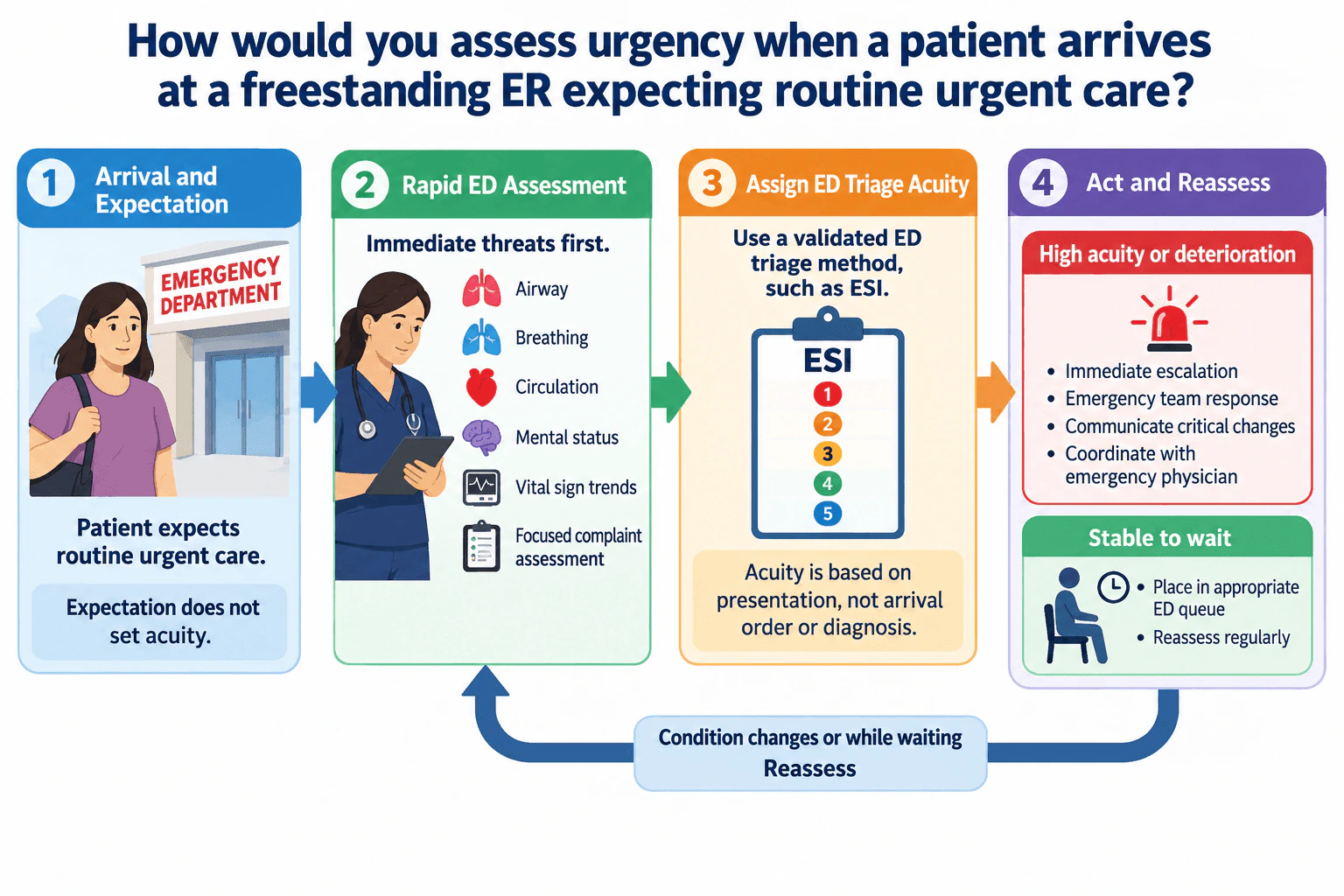
I would not let the patient’s expectation of routine urgent care determine priority. I would rapidly assess airway, breathing, circulation, mental status, vital sign trends, and the focused complaint, then apply the emergency department’s validated triage method, such as the Emergency Severity Index. High acuity findings or deterioration would trigger immediate escalation. A stable patient could enter the appropriate emergency department queue, but I would continue reassessment while the patient waits. I would follow the facility’s policies for triage, reassessment, escalation, and medical screening responsibilities.
Detailed Explanation
A patient arriving at a freestanding emergency department should be prioritized according to the clinical presentation, not according to what the patient expected the visit to involve. Triage is a rapid evaluation of acuity used to establish priority and where the patient should be evaluated. It does not establish the final diagnosis, and arrival order alone does not determine who should be seen first.
Useful Questions to Ask the Interviewer
Which validated triage framework does this emergency department use, such as the Emergency Severity Index?
What is the facility process for reassessing patients who remain in the waiting area?
Which professionals are designated by facility policy to perform the medical screening examination and what escalation pathway should the nurse use when acuity increases?
How to Explain It in an Interview
Clinical Priorities
I would begin with a rapid assessment for immediate threats. I would assess airway, breathing, circulation, mental status, vital signs and their trends, and the patient’s focused presenting complaint. The fact that the patient expected routine urgent care would not lower the priority if the actual presentation suggested greater urgency.
Assessment Factors
I would use the validated emergency department triage method adopted by the facility. If the facility uses the Emergency Severity Index, I would use that five level framework to assign acuity according to the patient’s presentation and the framework criteria. I would not use the Emergency Severity Index as a diagnosis or as a disaster triage system.
I would avoid inventing findings that have not been assessed. I would connect the urgency decision to observed findings, vital sign trends, mental status, symptoms, and other information actually available.
Care Rationale
If the assessment shows high acuity or the patient deteriorates, I would escalate immediately, use the appropriate emergency response according to local policy, communicate critical changes, and coordinate with the emergency physician and team. If the patient is stable to wait, I would place the patient in the appropriate emergency department queue and reassess regularly. Any condition change while waiting would trigger reassessment and could change the patient’s priority.
In the United States, triage should also be distinguished from the medical screening examination required when applicable under federal emergency care requirements. A qualified professional must provide an appropriate medical screening examination to determine whether an emergency medical condition exists, with the professionals authorized to perform that examination defined by applicable hospital rules and scope requirements. I would therefore follow the facility’s defined authority for triage, medical screening, reassessment, and escalation rather than assuming an employer specific protocol.
Why Interviewers Ask This
This question tests whether the nurse separates a patient’s expectation from clinical urgency, recognizes time critical findings, applies a validated emergency department triage process appropriately, reassesses patients whose condition may change, and understands that triage acuity is not the same as a diagnosis or a complete medical screening examination.
Common interview mistakes
Common mistakes include letting the patient’s expectation of routine care determine urgency, prioritizing strictly by arrival order, treating the Emergency Severity Index as a diagnosis, assigning acuity without a focused assessment, inventing unobserved findings, failing to recognize deterioration, and assuming that triage replaces the medical screening examination or the facility specific escalation process.
Interview tip
Explain the sequence clearly: assess immediate threats, review vital sign trends and the focused complaint, assign acuity with the facility’s validated triage method, act on high acuity findings, and reassess patients who are waiting. Explicitly state that urgency follows the clinical presentation rather than the patient’s expectation or arrival order.
Interviewer may ask next
What information or authority would you verify before applying this approach in a specific freestanding emergency department?
I would verify the facility’s approved triage framework, who is authorized to perform triage and the medical screening examination, the required reassessment process for waiting patients, escalation criteria, documentation expectations, and the communication pathway for a patient whose condition worsens. I would not assume that an internal employer procedure is universal.
What would change if a patient initially appeared stable but developed respiratory distress while waiting?
I would immediately reassess the patient, treat the new respiratory distress as a change in acuity, and escalate according to the emergency department’s response process rather than leaving the patient at the original priority. I would communicate the change promptly to the emergency team and physician, continue appropriate monitoring within nursing scope and local policy, and document the reassessment and escalation.
2. How would you establish a reassessment plan while a patient waits for a transfer decision?Clinical KnowledgeEasyHca Healthcare
i Question Details
Original practice question for this employer context, not a reported employer interview question. Explain the relevant ED nursing judgment and identify information or authority you would need. Do not assume an internal employer protocol.
Short Interview Answer (30-60 seconds)
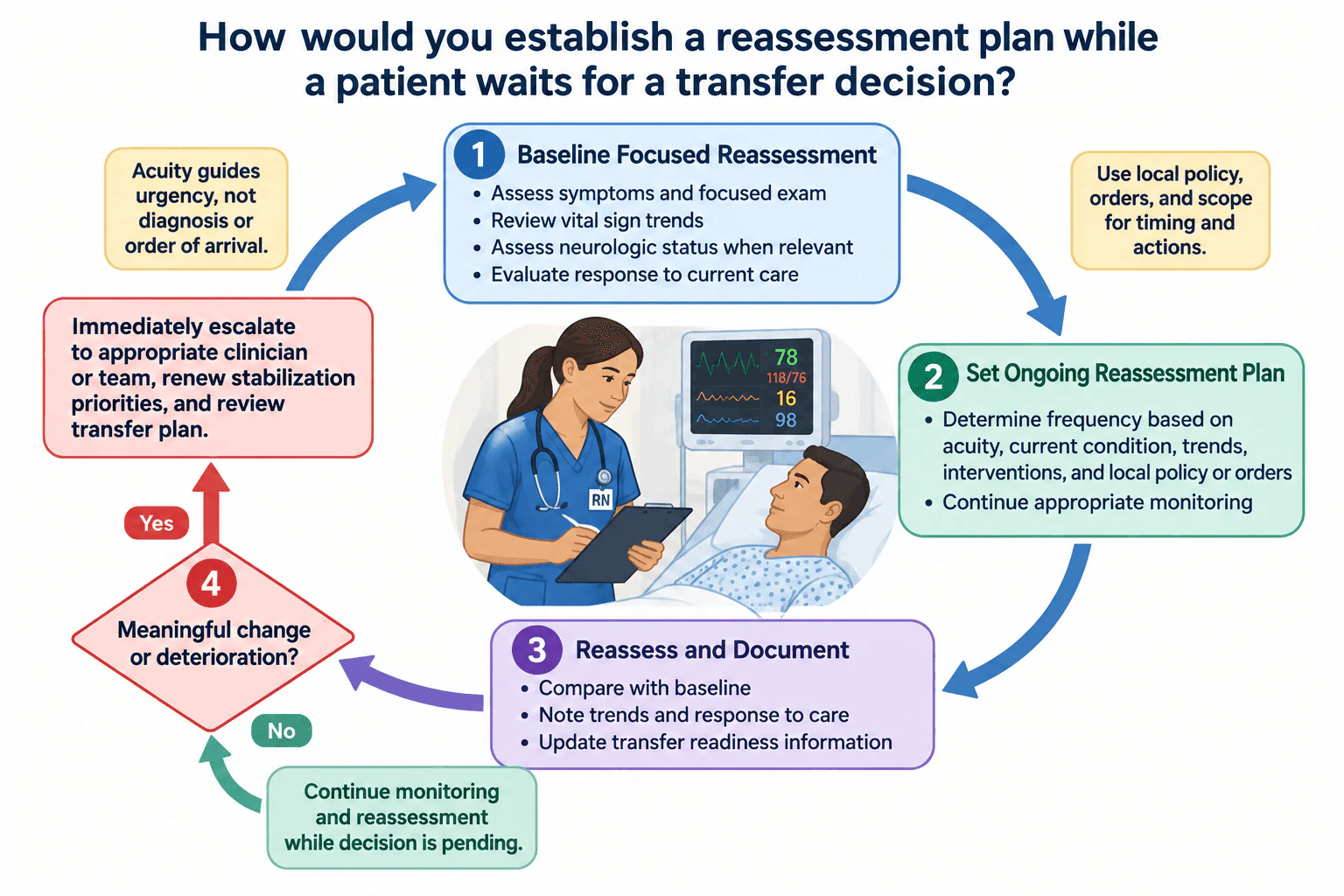
I would begin with a focused baseline assessment that includes current symptoms, relevant examination findings, vital sign trends, neurologic status when indicated, and response to care already provided. I would then set the reassessment frequency according to acuity, current condition, trends, recent interventions, and local policy or orders. At each reassessment I would compare the patient with baseline, document changes and response to care, and update information relevant to transfer readiness. If there were meaningful deterioration or a new concerning finding, I would escalate immediately, return attention to stabilization priorities, and have the transfer plan reviewed. If the patient remained stable, I would continue the monitoring and reassessment loop while the transfer decision was pending.
Detailed Explanation
A patient waiting for a transfer decision still requires active nursing surveillance. I would build the reassessment plan around the patient's current clinical risk and response to care rather than around the amount of time already spent waiting.
Useful Questions to Ask the Interviewer
What local policy or unit standard defines reassessment expectations while a patient is awaiting disposition or transfer?
What monitoring or reassessment orders are already in place for this patient?
Who should be notified if the patient's condition changes while the transfer decision is pending?
How to Explain It in an Interview
Establish a focused baseline
I would first establish the patient's current clinical status so later findings have a clear comparison point. That includes current symptoms, a focused examination, serial vital sign trends, relevant neurologic assessment when indicated, and the response to care already provided. I would also confirm current monitoring, treatment, and reassessment instructions.
Set the ongoing reassessment plan
I would choose the reassessment frequency according to acuity, current condition, trends, recent interventions, and local policy or orders. Acuity helps determine urgency, but it is not a diagnosis or simply the order in which patients arrived. Emergency Severity Index supports triage acuity decisions, but it does not supply a universal reassessment interval.
Reassess and document
At each reassessment I would compare findings with the baseline rather than treating each set of observations as isolated data. I would look for symptom progression, vital sign trends, changes in mental or neurologic status when relevant, and response to current care. I would document the findings, trends, and response to care and update information relevant to transfer readiness.
Respond to meaningful change
If the patient developed a meaningful change or deterioration, I would immediately escalate to the appropriate clinician or team. I would return attention to stabilization priorities within my nursing scope and applicable orders or authorized protocols, continue appropriate monitoring, and communicate that the change may require review of the transfer plan.
If the patient remained stable, I would continue monitoring and reassessment while the decision was pending. The key is that waiting for disposition does not mean stopping clinical surveillance.
Why Interviewers Ask This
This evaluates whether the nurse can maintain patient safety during an uncertain waiting period rather than treating a pending transfer decision as an administrative pause. The interviewer is looking for focused assessment, recognition of trends, individualized reassessment, documentation, communication, appropriate escalation, and awareness that reassessment timing depends on clinical need, nursing scope, current orders, and local policy rather than a universal Emergency Severity Index schedule.
Common interview mistakes
Common mistakes include selecting a fixed reassessment interval solely from an Emergency Severity Index level, treating a pending transfer decision as a passive waiting period, recording repeat vital signs without comparing trends, failing to reassess response to care, overlooking changes in symptoms or neurologic status when relevant, delaying escalation when the patient's condition worsens, or assuming a facility specific protocol that has not been provided.
Interview tip
Describe reassessment as a repeating safety loop: establish the baseline, set monitoring according to risk and local authority, compare each reassessment with baseline, document and communicate changes, and escalate immediately when deterioration could change stabilization priorities or transfer readiness.
Interviewer may ask next
How would you verify the appropriate reassessment frequency for this patient?
I would verify the patient's current acuity and condition, review existing monitoring and reassessment orders, and check the applicable emergency department policy or authorized protocol. I would clarify expectations with the responsible clinician or charge nurse when needed. I would not assume that the Emergency Severity Index level itself provides a universal reassessment interval.
What would you do if the patient's condition worsened while the transfer decision was still pending?
I would immediately reassess the patient, identify the meaningful change from baseline, and escalate to the appropriate clinician or emergency team. I would return attention to urgent stabilization priorities within my nursing scope and applicable orders or authorized protocols, continue appropriate monitoring, document the change and actions taken, and communicate that the patient's changed condition may affect transfer readiness, destination, or level of care.
3. How would you maintain infection precautions when isolation space is limited?Patient SafetyEasyHca Healthcare
i Question Details
Original practice question for this employer context, not a reported employer interview question. Explain the relevant ED nursing judgment and identify information or authority you would need. Do not assume an internal employer protocol.
Short Interview Answer (30-60 seconds)
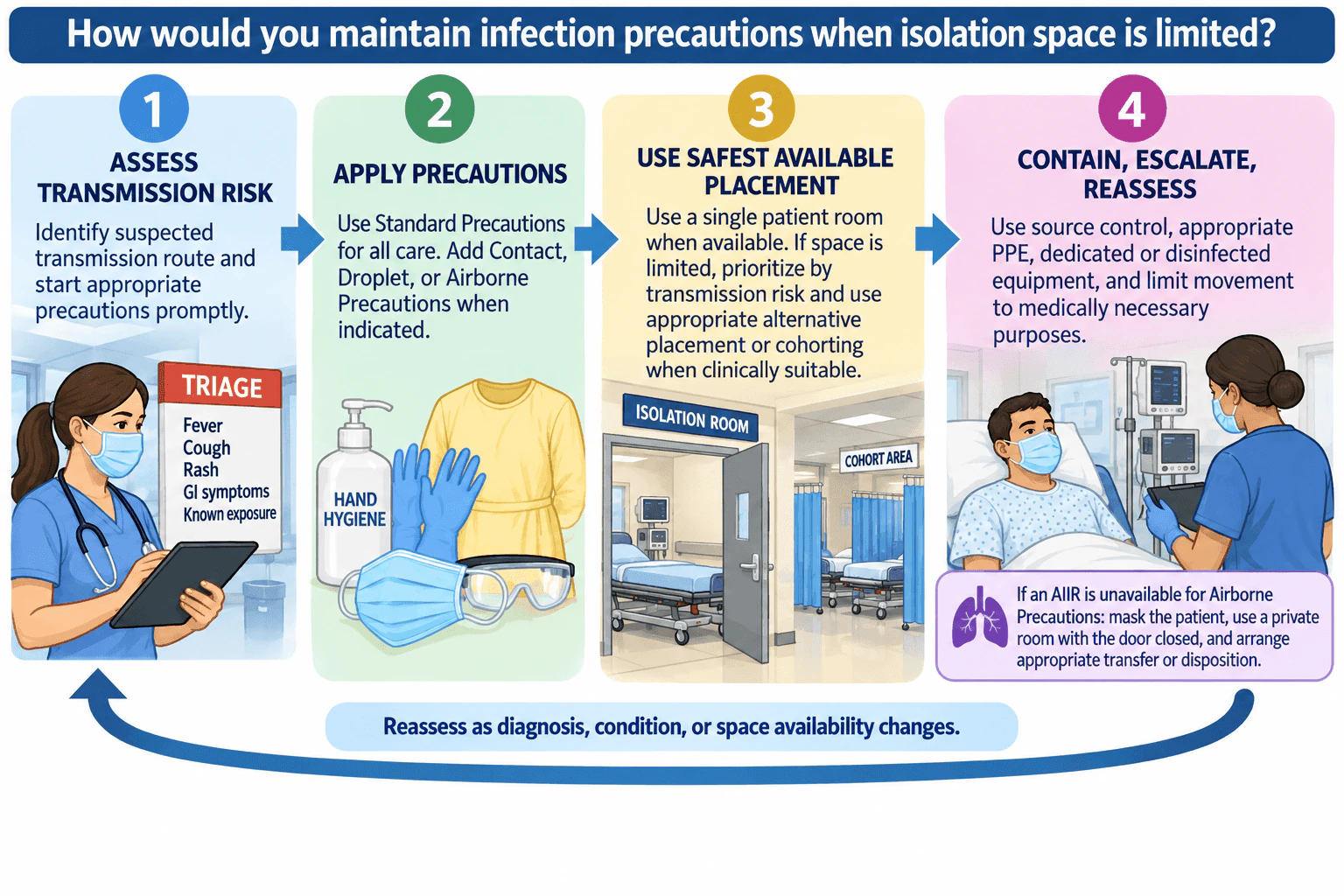
I would identify the suspected transmission route, start appropriate precautions promptly, and use Standard Precautions for every patient. If a single patient room is unavailable, I would prioritize placement by transmission risk and use an appropriate alternative, including cohorting when clinically suitable. I would maintain source control, appropriate PPE, dedicated or disinfected equipment, and limit movement to medically necessary purposes. If an airborne infection isolation room is required but unavailable, I would mask the patient, use a private room with the door closed, and escalate for appropriate transfer or disposition. I would reassess as the diagnosis, patient condition, and available space change. cdc.gov
Detailed Explanation
The central principle is that limited isolation space changes placement decisions, not the need for infection precautions. Standard Precautions continue for every patient, and Transmission Based Precautions are added when the suspected or confirmed route of transmission requires them. cdc.gov
Useful Questions to Ask the Interviewer
What infection prevention resources or escalation pathway should the nurse use when the preferred isolation space is unavailable?
What alternative placement options are available when a patient needs Contact, Droplet, or Airborne Precautions?
Who should be contacted when the required level of isolation cannot be safely provided?
How to Explain It in an Interview
Nursing Priorities
I would first assess the suspected transmission route and begin appropriate precautions promptly. Standard Precautions remain in place for every patient. If the presentation suggests a transmissible infection, I would add the indicated Contact, Droplet, or Airborne Precautions while further information is obtained. cdc.gov
Safe Placement
I would use a single patient room when indicated and available. If space is limited, I would prioritize placement according to transmission risk and use an appropriate alternative placement strategy. Cohorting can be considered when patients have the same infection and the placement is clinically suitable, with infection prevention input when needed. cdc.gov
Exposure Control
I would continue source control, appropriate PPE, hand hygiene, environmental cleaning, and dedicated or properly disinfected equipment. I would also limit patient movement outside the care area to medically necessary purposes when required by the applicable precautions. cdc.gov
Airborne Precautions
If Airborne Precautions are required and an airborne infection isolation room, or AIIR, is unavailable, I would mask the patient and use a private room with the door closed while arranging medically appropriate transfer or disposition. I would escalate through local infection prevention or clinical leadership rather than improvising an unverified isolation arrangement. cdc.gov
Reassessment
I would reassess the precautions and placement whenever the diagnosis, clinical condition, or space availability changes and communicate the required precautions during any transfer of care.
Why Interviewers Ask This
This question evaluates whether the nurse can maintain infection prevention standards when ideal room placement is unavailable. It tests recognition of transmission risk, appropriate use of Standard and Transmission Based Precautions, safe prioritization of limited space, escalation to infection prevention or clinical leadership, and reassessment as new information becomes available.
Common interview mistakes
Common mistakes include delaying precautions because an isolation room is unavailable, using the same placement strategy for every transmission route, cohorting patients without confirming that the placement is clinically appropriate, overlooking source control or equipment disinfection, allowing unnecessary patient movement, and failing to escalate when required precautions cannot be safely maintained.
Interview tip
Organize the response around four decisions: assess transmission risk, apply the correct precautions, choose the safest available placement, then contain exposure, escalate when necessary, and reassess. Make clear that limited space changes placement decisions, not whether required infection precautions are followed.
Interviewer may ask next
How would you verify that the alternative placement is appropriate?
I would verify the suspected or confirmed transmission route, the patient's transmission risk, the risk to nearby patients, the available room options, and whether any proposed cohorting is clinically appropriate. I would use current infection prevention guidance and escalate to infection prevention or clinical leadership when the safest placement is uncertain. cdc.gov
What would change if the patient required Airborne Precautions and no AIIR was available?
I would treat that as a higher level placement problem rather than simply using ordinary shared space. I would mask the patient, use a private room with the door closed, maintain the required precautions, and promptly escalate for medically appropriate transfer or disposition if an AIIR cannot be provided. cdc.gov
4. How would you explain the capabilities of a freestanding ER without promising services you have not verified?Communication And DelegationMediumHca Healthcare
i Question Details
Original practice question for this employer context, not a reported employer interview question. Explain the relevant ED nursing judgment and identify information or authority you would need. Do not assume an internal employer protocol.
Short Interview Answer (30-60 seconds)
I would explain what I know is verified and be transparent about what I still need to confirm. I might say that the freestanding ER can evaluate, stabilize, and treat emergency conditions, but exact services, specialists, procedures, and resources can vary by location and current availability. If a patient asks whether a specific service is available, I would verify it rather than guess. If additional resources are needed, I would explain that the clinical team will determine the safest next step. I would use plain language, obtain a qualified interpreter when applicable, and use teach back to confirm understanding rather than relying on a simple yes.
Detailed Explanation
A safe explanation separates verified facts from assumptions. I would never turn a general description of a freestanding ER into a promise about one specific facility.
Useful Questions to Ask the Interviewer
What approved resource should nurses use to verify the services available at this specific freestanding ER?
Who should the nurse contact when a patient needs a service whose availability is uncertain?
How are changes in available services or transfer resources communicated to bedside staff?
How to Explain It in an Interview
Start With What Is Verified
I would tell the patient that the freestanding ER provides emergency evaluation, stabilization, and treatment, while making clear that exact resources can vary. HCA Healthcare publicly describes its freestanding ERs this way and notes that patients may be connected with additional resources after treatment or stabilization when needed.
I would not say, "We can definitely do that here," unless I had confirmed the specific service. A system wide description does not prove that a particular specialist, procedure, test, bed, or resource is currently available at one location.
Verify Before Promising
If the patient asked about a specific capability, I would say that I want to give accurate information and will verify it. I would use the approved local resource or contact the appropriate clinician or operational leader. If uncertainty could affect immediate care, I would escalate promptly rather than delay evaluation or treatment.
For a freestanding ER that is a dedicated emergency department of a Medicare participating hospital, EMTALA requires an appropriate medical screening examination and, when an emergency medical condition is identified, stabilizing treatment within the hospital's capability or an appropriate transfer when the condition cannot be stabilized within that capability. I would not assume those legal details establish the availability of any particular service without verification.
Confirm Understanding
I would use plain language and clearly distinguish current facts from possibilities. When applicable, I would obtain a qualified interpreter or other appropriate language assistance rather than relying on an unqualified person for important clinical communication.
I would then use teach back by asking the patient or family to explain in their own words what this location can provide and what may happen next. I would not rely only on asking whether they understand, because agreement does not demonstrate understanding.
Manage Competing Assignments Safely
If another urgent assignment arose while I was verifying information, I could delegate an appropriate support task only when it matched the other team member's role, competence, applicable law, and required supervision. I would retain nursing assessment and judgment. I would use closed loop communication to confirm who accepted the task, what was expected, and whether responsibility had actually transferred.
Why Interviewers Ask This
This question evaluates whether the nurse can communicate accurately, protect patient trust, recognize the limits of personal knowledge, advocate for the patient, and escalate uncertainty when it could affect care. It also tests whether the nurse checks understanding rather than mistaking agreement for comprehension and whether competing assignments are handled through safe delegation without transferring nursing assessment or judgment to assistive personnel.
Common interview mistakes
Common mistakes include promising a specialist, test, procedure, admission, or transfer destination before verifying availability; treating organization wide capabilities as proof that every location has identical resources; giving vague reassurance instead of acknowledging uncertainty; delaying escalation when the answer could affect immediate care; relying on an unqualified interpreter for important clinical communication when qualified language assistance is required; asking only whether the patient understands instead of using teach back; and delegating nursing assessment or judgment to assistive personnel.
Interview tip
Frame the response around accuracy, patient trust, and verification. State what you know, identify what you still need to confirm, explain how you would obtain the information, and close the communication loop with both the patient and the team. Do not invent an employer procedure. Saying that you will verify a capability is safer and more professional than making a confident promise that may be wrong.
Interviewer may ask next
What would you do if a patient asked whether a specific specialist or procedure was available at that freestanding ER?
I would not guess or infer availability from the facility name. I would explain that I want to provide accurate information, verify the current capability through the approved local resource or appropriate clinical or operational contact, and return with the confirmed answer. If the requested service is needed for an emergency medical condition and the facility cannot provide the required stabilizing capability, the appropriate clinician and care team would determine the next steps, including transfer when indicated. My nursing role would include prompt communication, advocacy, reassessment as appropriate, and making sure the patient understands what has been confirmed and what remains uncertain.
How would your communication change if the patient had limited English proficiency and became more clinically unstable while you were discussing the facility's capabilities?
Clinical deterioration would take priority over a lengthy explanation. I would promptly reassess the patient within my nursing role, communicate the change to the appropriate clinician, and support urgent care according to applicable orders, protocols, scope, and local policy. For essential communication, I would obtain qualified language assistance as applicable and give short, clear updates about what is happening. Once immediate safety needs were addressed, I would use teach back to confirm understanding and clarify remaining questions about services or possible transfer.
5. How would you coordinate a time sensitive task when the available helper has a restricted scope?Communication And DelegationMediumHca Healthcare
i Question Details
Original practice question for this employer context, not a reported employer interview question. Explain the relevant ED nursing judgment and identify information or authority you would need. Do not assume an internal employer protocol.
Short Interview Answer (30-60 seconds)
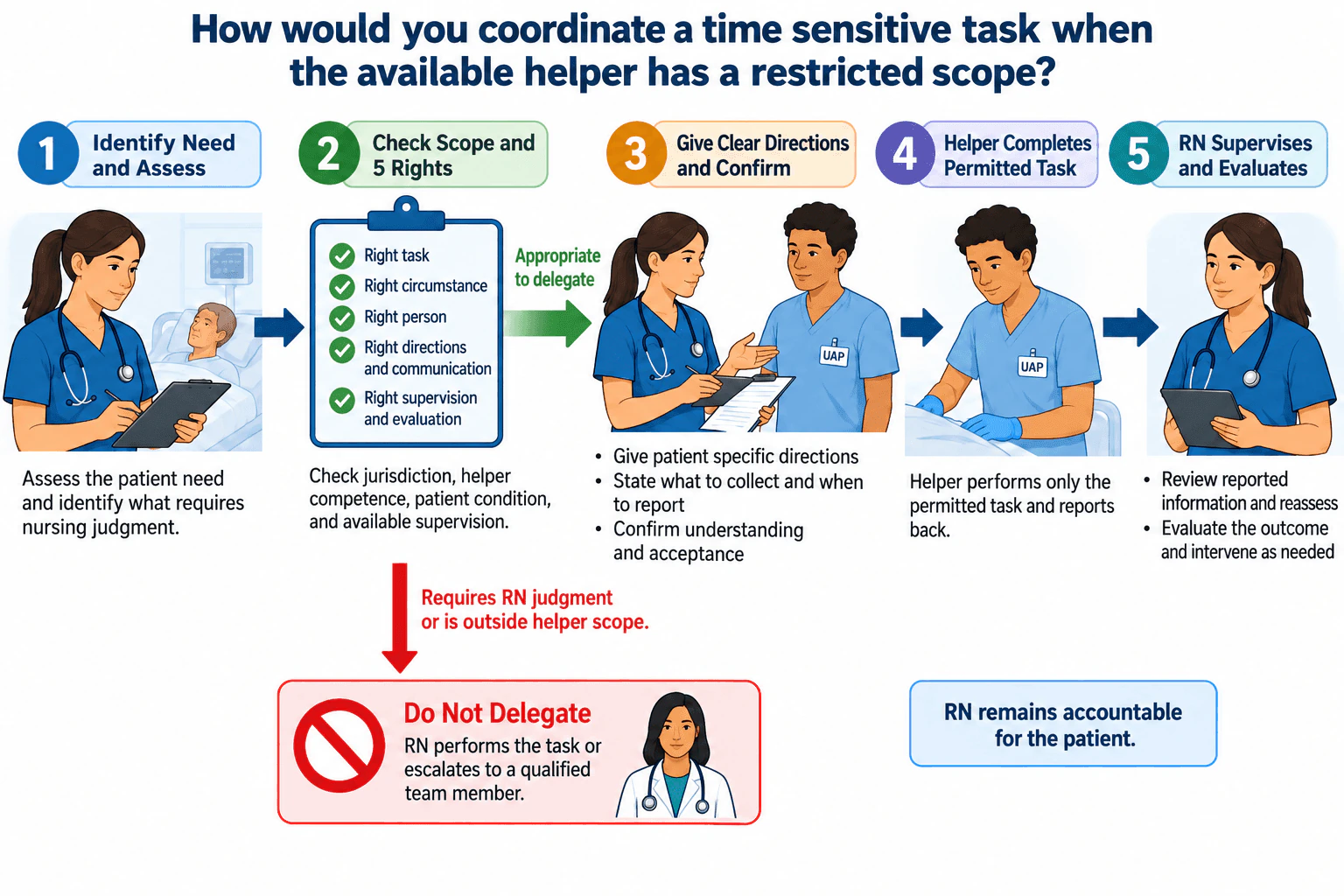
I would assess the patient need first and separate anything requiring RN assessment or nursing judgment from work that may be delegated. I would verify the helper's permitted role, competence, the patient's condition, jurisdiction requirements, and available supervision. If the task is appropriate to delegate, I would give clear patient specific directions, state what to collect and when to report it, and confirm understanding and acceptance. I would remain available, review the information reported back, reassess the patient, and evaluate the outcome. If the task requires RN judgment or falls outside the helper's permitted role, I would keep the task or escalate it to an appropriately qualified team member.
Detailed Explanation
The central principle is that urgency does not expand the helper's permitted role or make nursing judgment delegable. The RN first assesses the patient need and identifies what requires nursing assessment, clinical reasoning, or nursing judgment. Those responsibilities remain with the RN.
Useful Questions to Ask the Interviewer
What state or jurisdiction rules and role descriptions apply to this helper?
What competencies has this team member demonstrated for the proposed task?
What supervision and escalation resources are available during the assignment?
How to Explain It in an Interview
I would start by assessing the patient need and identifying what requires RN assessment, clinical reasoning, or nursing judgment. I would not delegate those responsibilities to assistive personnel.
For the remaining work, I would use the Five Rights of Delegation as a structured check: right task, right circumstance, right person, right directions and communication, and right supervision and evaluation. I would verify that the task is permitted under the applicable jurisdiction and the helper's role, that the helper has demonstrated competence, that the patient's condition makes delegation appropriate, and that adequate supervision is available.
If those conditions are met, I would give patient specific directions. I would state exactly what task to perform, what information to collect, when to report it, and what changes require immediate communication. I would confirm understanding and acceptance rather than assuming agreement means the instructions were understood.
The helper would perform only the permitted task and report back as directed. I would remain available for supervision and intervention. After receiving the information, I would review it, reassess the patient when nursing assessment is required, evaluate the outcome, and intervene or escalate if the clinical situation changes.
If the task requires RN judgment, falls outside the helper's permitted role, or cannot be supervised safely, I would not delegate it. I would perform it myself if it is within my own scope and competence or escalate it to an appropriately qualified team member. The RN remains accountable for the patient while the helper remains responsible for correctly performing the delegated activity.
Why Interviewers Ask This
This question tests whether the nurse can manage an urgent workload without allowing time pressure to override patient safety, nursing scope, or delegation requirements. A strong answer shows that the RN assesses the patient first, distinguishes nursing judgment from delegable activity, verifies the helper's role and competence, gives clear directions, remains available for supervision, and evaluates the patient's response after the delegated activity.
Common interview mistakes
Common mistakes include delegating before assessing the patient, delegating nursing assessment or nursing judgment to assistive personnel, assuming a job title alone proves competence, failing to check jurisdiction or role limits, giving vague directions, treating agreement as proof of understanding, failing to specify what information must be reported and when, becoming unavailable after delegation, or accepting reported information without appropriate RN reassessment and evaluation.
Interview tip
Present the answer as a patient safety decision rather than a staffing shortcut. Move in the same sequence as the clinical workflow: assess the need, check scope and the Five Rights, give clear directions and confirm understanding, allow only the permitted task, then supervise, reassess, and evaluate. State clearly that time pressure does not authorize delegation of nursing judgment or work outside the helper's permitted role.
Interviewer may ask next
How would you verify that the helper can safely perform the task?
I would verify what the applicable jurisdiction permits, confirm the helper's authorized role or job responsibilities, and determine whether the person has the education, training, and demonstrated competence required for that specific activity. I would also consider the patient's condition, the nature of the task, and whether appropriate supervision is available. I would not rely only on the person's title, availability, or willingness to help.
What would you do if the patient's condition changed after you delegated the task?
I would reassess the situation because a change in patient condition can make the original delegation inappropriate. The helper should report the change according to the directions given. I would resume the nursing assessment and judgment needed to determine the next action, stop or redirect the delegated activity if it is no longer appropriate, and escalate care to an appropriately qualified professional when needed.
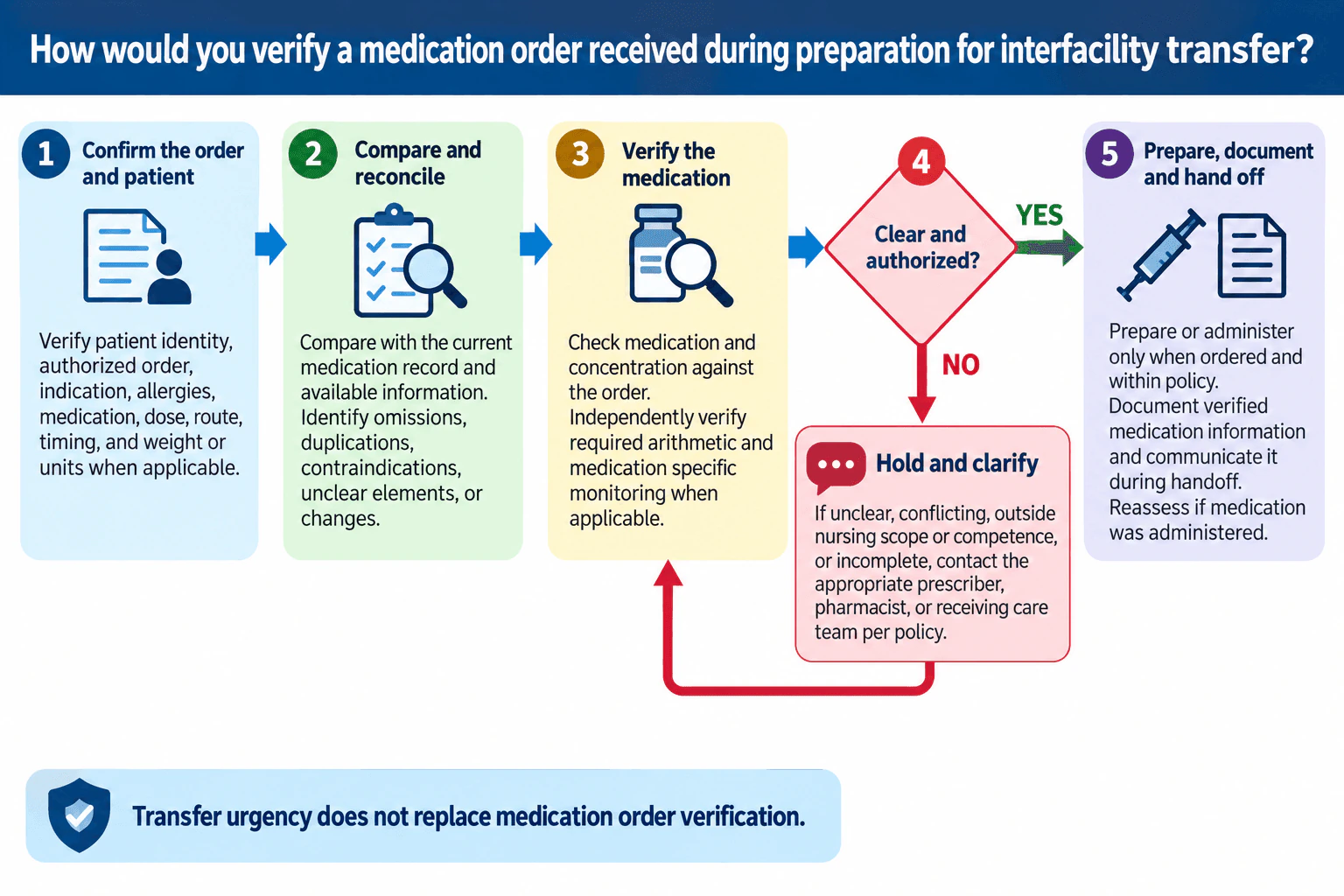
6. How would you verify a medication order received during preparation for interfacility transfer?Medication And ProceduresMediumHca Healthcare
i Question Details
Original practice question for this employer context, not a reported employer interview question. Explain the relevant ED nursing judgment and identify information or authority you would need. Do not assume an internal employer protocol.
Short Interview Answer (30-60 seconds)
I would first confirm the patient and the authorized order, including the indication, allergies, medication, dose, route, timing, concentration, and any applicable weight or units. Then I would compare the order with the current medication record and available transfer information, independently verify any required arithmetic, and confirm medication specific monitoring. If anything is unclear, conflicting, incomplete, or outside my scope or competence, I would hold and clarify it with the appropriate prescriber, pharmacist, or receiving care team according to applicable policy. Once the order is clear and authorized, I would prepare or administer only when ordered and within policy, document the verified information, communicate it during handoff, and reassess if the medication was given.
Detailed Explanation
The central principle is that transfer urgency does not replace medication order verification. I would use a deliberate safety process during transfer preparation while also making sure the receiving team receives accurate information about what was ordered and what actually occurred.
Useful Questions to Ask the Interviewer
Which transfer medications in your Emergency Department require an independent second check or pharmacist review?
What medication information should be included in the transfer handoff and documentation?
What escalation pathway should a nurse use when a transfer order is unclear or incomplete?
How to Explain It in an Interview
Order And Patient Verification I would first confirm the patient using the required identification process and confirm that the medication order is authorized. I would verify the indication, allergies, medication, dose, route, timing, concentration, and any applicable patient weight or units. I would not assume missing information or create a dose from incomplete inputs.
Reconciliation And Clarification Next, I would compare the order with the current medication record and available transfer information. Medication reconciliation at transitions of care is intended to identify discrepancies between the current regimen and transfer orders. If the order is unclear, incomplete, conflicting, or outside my nursing scope or competence, I would hold and clarify it with the appropriate prescriber, pharmacist, or receiving care team according to applicable policy.
Calculation And Monitoring If a calculation is required, I would independently verify the ordered dose, concentration, weight basis, units, conversions, and arithmetic before preparation. I would also confirm the medication specific monitoring that is required and whether additional review is required by applicable policy.
Preparation, Documentation, And Handoff Once the order is clear and authorized, I would prepare or administer the medication only when ordered and within my role and applicable policy. For an injectable medication, I would use aseptic technique during preparation and administration. I would document the verified medication information and what was actually administered. If medication was given, I would reassess the patient as clinically appropriate and communicate the medication, timing, patient response, and ongoing monitoring needs during transfer handoff.
Why Interviewers Ask This
Interviewers are evaluating whether you can maintain medication safety during a time pressured transition of care. They want to hear that you verify the order and patient, reconcile medication information, recognize discrepancies, perform required calculations carefully, escalate uncertainty appropriately, remain within nursing scope and competence, and communicate clearly during transfer.
Common interview mistakes
Letting transfer urgency shorten the verification process, relying on memory rather than the active order and medication record, overlooking allergies or medication changes, calculating from an unconfirmed concentration or weight, assuming an unclear order is acceptable, acting outside nursing scope or competence, and failing to document or communicate what was actually administered.
Interview tip
Use the same five part flow as the clinical decision: confirm the patient and authorized order, compare and reconcile the medication information, verify the medication details and any required arithmetic, hold and clarify anything that is not clear or authorized, then document, hand off, and reassess if medication was administered.
Interviewer may ask next
What would you do if the medication concentration available does not match the concentration expected from the order?
I would pause preparation and compare the authorized order with the available product. I would verify the medication, intended dose, route, concentration, units, and any required calculation rather than assuming the formulations are interchangeable. If the discrepancy remains, I would clarify it with the appropriate prescriber or pharmacist before administration. Once resolved, I would document the verified information and communicate any relevant change during transfer handoff.
How would your approach change if the patient had already received a sedating medication before transfer?
The medication verification sequence would stay the same, but reassessment and handoff would become especially important. I would assess the patient's current clinical status, confirm the monitoring required for that medication and patient, verify that ongoing care and rescue resources are appropriate within my role and applicable policy, and communicate the medication, timing, patient response, and continuing monitoring needs to the receiving team. If the patient's condition made transfer unsafe, I would escalate the concern rather than allowing the transfer timeline to override patient safety.
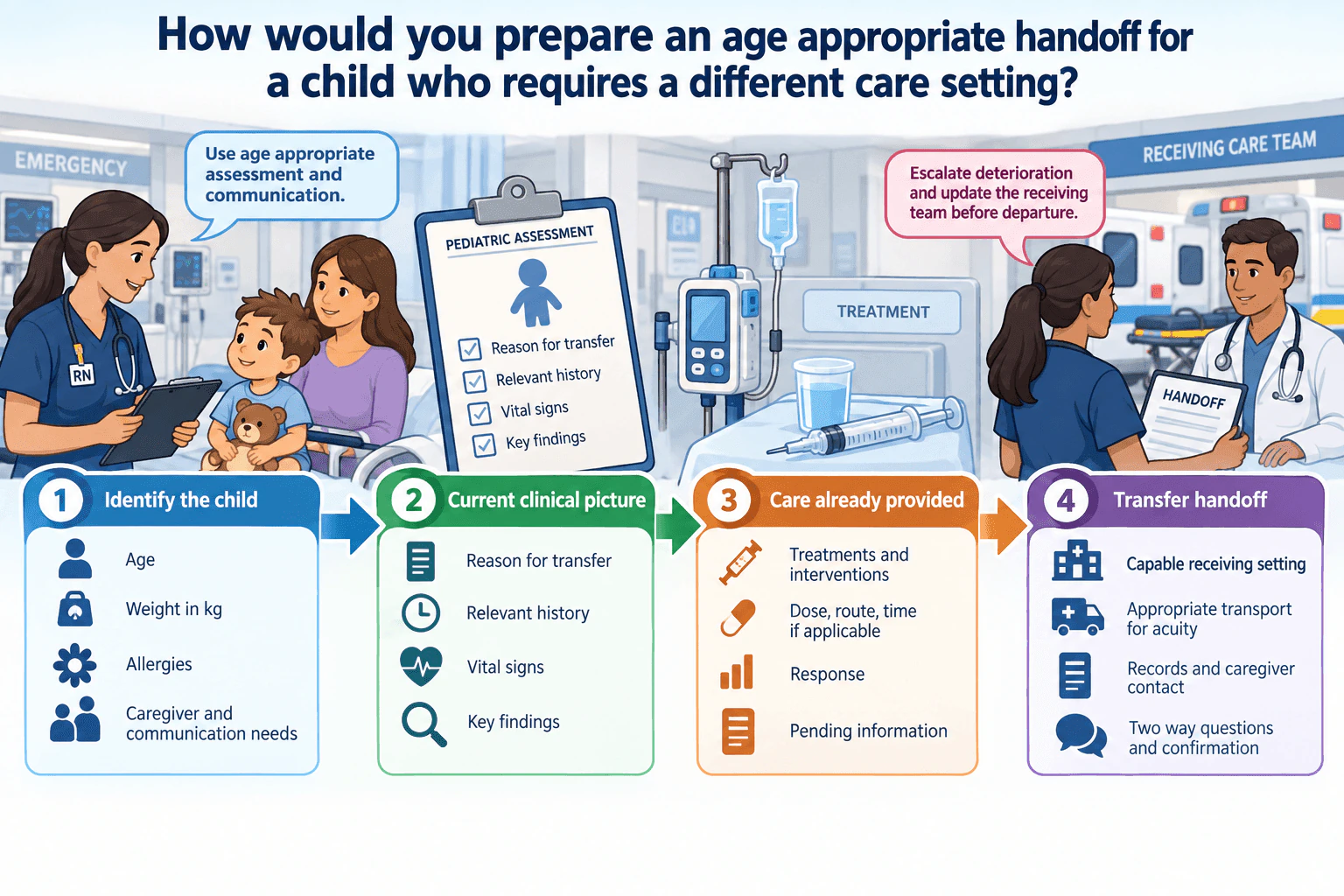
7. How would you prepare an age appropriate handoff for a child who requires a different care setting?Trauma And Special PopulationsMediumHca Healthcare
i Question Details
Original practice question for this employer context, not a reported employer interview question. Explain the relevant ED nursing judgment and identify information or authority you would need. Do not assume an internal employer protocol.
Short Interview Answer (30-60 seconds)
I would use a structured pediatric handoff. I would identify the child's age, weight in kilograms, allergies, caregiver, and communication needs, then give the reason for transfer, relevant history, current vital signs, and key findings. I would report treatments and interventions, medication dose, route, and time when applicable, the child's response, and pending information. I would then follow the established transfer process to confirm a capable receiving setting, transport appropriate for acuity, required records, and two way communication. If the child deteriorates, I would reassess, escalate, and update the receiving and transport teams before departure.
Detailed Explanation
An age appropriate pediatric handoff should give the receiving team a concise picture of who the child is, why another care setting is required, the child's current condition, what care has already been provided, and what still needs attention.
Useful Questions to Ask the Interviewer
What transfer process and handoff structure does this emergency department use for pediatric patients?
How is the appropriate receiving setting and transport service selected for a child's acuity and care needs?
Who is responsible for confirming acceptance and coordinating changes if the child's condition deteriorates before departure?
How to Explain It in an Interview
Patient Context
I would begin with the child's age, weight in kilograms, allergies, caregiver information, and developmental, language, behavioral, or communication needs. Pediatric assessment and communication should be appropriate to the child's age and clinical context rather than treated as an adult handoff with smaller numbers.
Nursing Priorities
Next, I would communicate the reason for transfer, relevant history, current vital signs, and the key findings that explain the child's present condition. I would keep the information focused on what the receiving team needs to safely continue care.
I would then summarize care already provided. That includes treatments and interventions, medication dose, route, and time when applicable, the child's response, and any pending information. I would not invent missing medication details or clinical findings.
Transfer Handoff
I would work through the established transfer process to communicate with a receiving setting capable of providing the required pediatric care and to confirm transport appropriate for the child's acuity. I would make the required clinical records and caregiver contact information available to the receiving team. Selection of the destination, transport resources, medical orders, and transfer authority may involve the responsible clinician, receiving facility, transport service, and local procedures rather than independent bedside nursing authority.
Reassessment
I would use two way communication so the receiving team can ask questions and confirm critical information. If the child deteriorates before departure, I would reassess, perform appropriate nursing actions within my scope and applicable protocols, escalate promptly to the responsible clinician, and update the receiving and transport teams. A significant change in acuity may require the transfer plan to be reevaluated before departure.
Why Interviewers Ask This
This question evaluates whether the nurse can organize a safe pediatric transition of care, communicate age and weight specific information, recognize the importance of caregiver and developmental needs, identify deterioration, and coordinate with the receiving and transport teams without assuming authority or an employer specific transfer protocol.
Common interview mistakes
Common mistakes include omitting the child's age or weight in kilograms, failing to communicate allergies or caregiver and communication needs, giving an incomplete clinical picture, reporting treatments without the child's response, omitting pending information, assuming the destination or transport service is appropriate without following the transfer process, using one way communication, or failing to update the receiving team when the child's condition changes.
Interview tip
Organize the answer in the same four part flow the receiving team needs: identify the child, describe the current clinical picture, summarize care already provided, and complete the transfer handoff. Mention reassessment and escalation for deterioration, and distinguish bedside nursing responsibilities from destination selection, transport coordination, orders, and transfer authority that depend on the responsible clinical and facility process.
Interviewer may ask next
How would you verify that the pediatric handoff was complete?
I would verify that the receiving team has the child's age, weight in kilograms, allergies, caregiver and communication needs, reason for transfer, relevant history, current vital signs, key findings, treatments and interventions, medication dose, route, and time when applicable, response to care, and pending information. I would confirm that required records and caregiver contact information are available, then use two way communication so the receiving team can ask questions and confirm critical details.
What would you do if the child's condition worsened while you were preparing the transfer?
I would prioritize the child's immediate condition, reassess, perform appropriate nursing actions within my scope and applicable protocols, and promptly escalate the change to the responsible clinician. I would update the receiving and transport teams because the new acuity could change stabilization needs, transport resources, timing, or the appropriate receiving setting. The transfer plan would be reevaluated through the responsible clinical and transfer process before departure.
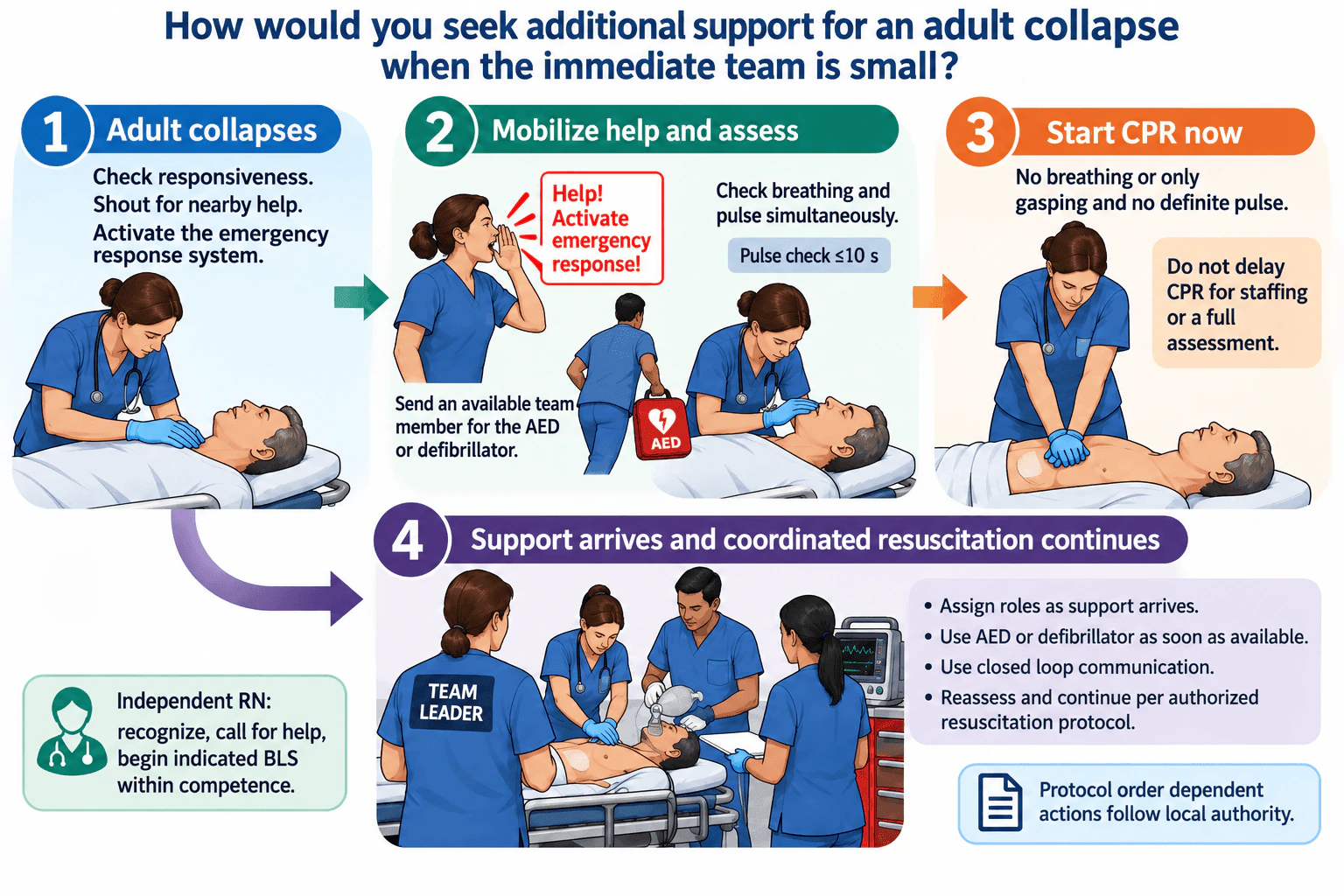
8. How would you seek additional support for an adult collapse when the immediate team is small?Scenario BasedMediumHca Healthcare
i Question Details
Original practice question for this employer context, not a reported employer interview question. Explain the relevant ED nursing judgment and identify information or authority you would need. Do not assume an internal employer protocol.
Short Interview Answer (30-60 seconds)
I would check responsiveness, shout for nearby help, activate the emergency response system, and send an available team member for the AED or defibrillator. I would check breathing and pulse simultaneously, taking no more than 10 seconds for the pulse check. If there is no breathing or only gasping and no definite pulse, I would start CPR immediately rather than waiting for more staff. As help arrives, I would assign roles, use closed loop communication, use the AED or defibrillator as soon as available, reassess continuously, and follow applicable protocols, orders, scope, and local authority.
Detailed Explanation
The priority is to mobilize help while beginning the actions that cannot safely wait. A small immediate team should not delay recognition of cardiac arrest, activation of the emergency response system, CPR, or access to an AED or defibrillator.
Useful Questions to Ask the Interviewer
What emergency response or code activation process is used in this care setting?
Which resuscitation actions may an ED nurse initiate independently or under standing protocols here?
How are additional staff and emergency equipment typically mobilized when the immediate team is limited?
How to Explain It in an Interview
Immediate Actions
For an adult who suddenly collapses, I would first check responsiveness, shout for nearby help, activate the emergency response system, and direct an available team member to obtain the AED or defibrillator. I would then assess breathing and pulse simultaneously. The pulse check should take no more than 10 seconds.
If there is no breathing or only gasping and I cannot definitely feel a pulse, I would begin CPR immediately. I would not wait for a full team or complete a broader assessment before starting indicated CPR. The AED or defibrillator should be used as soon as it becomes available.
Team Coordination
With limited personnel, I would make requests specific and closed loop. For example, I would identify who is activating the response system and who is retrieving the AED or defibrillator. As additional support arrives, I would help assign clear roles so essential tasks are not duplicated or missed.
Scope and Authority
Recognizing collapse, calling for help, beginning indicated basic life support within competence, and communicating deterioration are immediate nursing responsibilities. Additional interventions may depend on the nurse's scope, approved protocols, orders, available equipment, and local authority. I would not assume a particular employer protocol.
Reassessment
I would continue reassessing the patient's response and the effectiveness of the resuscitation effort while support arrives. If the clinical picture changes, I would reprioritize actions accordingly and communicate those changes to the responding team.
Why Interviewers Ask This
This question tests whether the nurse can recognize a time critical collapse, summon additional resources without delaying lifesaving care, use limited personnel effectively, and distinguish immediate nursing actions from protocol authorized or order dependent interventions. It also evaluates communication, role coordination, reassessment, and the ability to avoid waiting for ideal staffing before beginning indicated resuscitation.
Common interview mistakes
Common mistakes include waiting for a full team before starting indicated CPR, delaying emergency response activation while completing a broad assessment, assigning several urgent tasks without identifying who is responsible, failing to send someone for the AED or defibrillator, extending the pulse check beyond 10 seconds, using vague communication instead of closed loop confirmation, and assuming that local protocols or order dependent interventions are universally authorized.
Interview tip
Frame the answer around parallel priorities: summon help immediately, obtain the AED or defibrillator, perform the brief breathing and pulse assessment, start CPR without delay when arrest is identified, and organize arriving support with clear roles and closed loop communication. State explicitly that protocol authorized and order dependent actions follow applicable scope and local authority rather than an assumed employer policy.
Interviewer may ask next
How would you verify that additional support is actually on the way?
I would use closed loop communication. I would direct a specific available person to activate the emergency response system and ask for verbal confirmation that the activation occurred. I would similarly confirm who is obtaining the AED or defibrillator. If there is no confirmation or response, I would repeat or redirect the request while continuing lifesaving care.
What would change if the patient had abnormal breathing but a definite pulse?
I would not treat that finding as pulseless cardiac arrest. I would provide rescue breathing within my training and applicable protocols, using 1 breath every 6 seconds or 10 breaths per minute, and reassess the pulse every 2 minutes while maintaining emergency escalation. If the pulse were subsequently lost, I would begin CPR immediately and continue the resuscitation pathway.
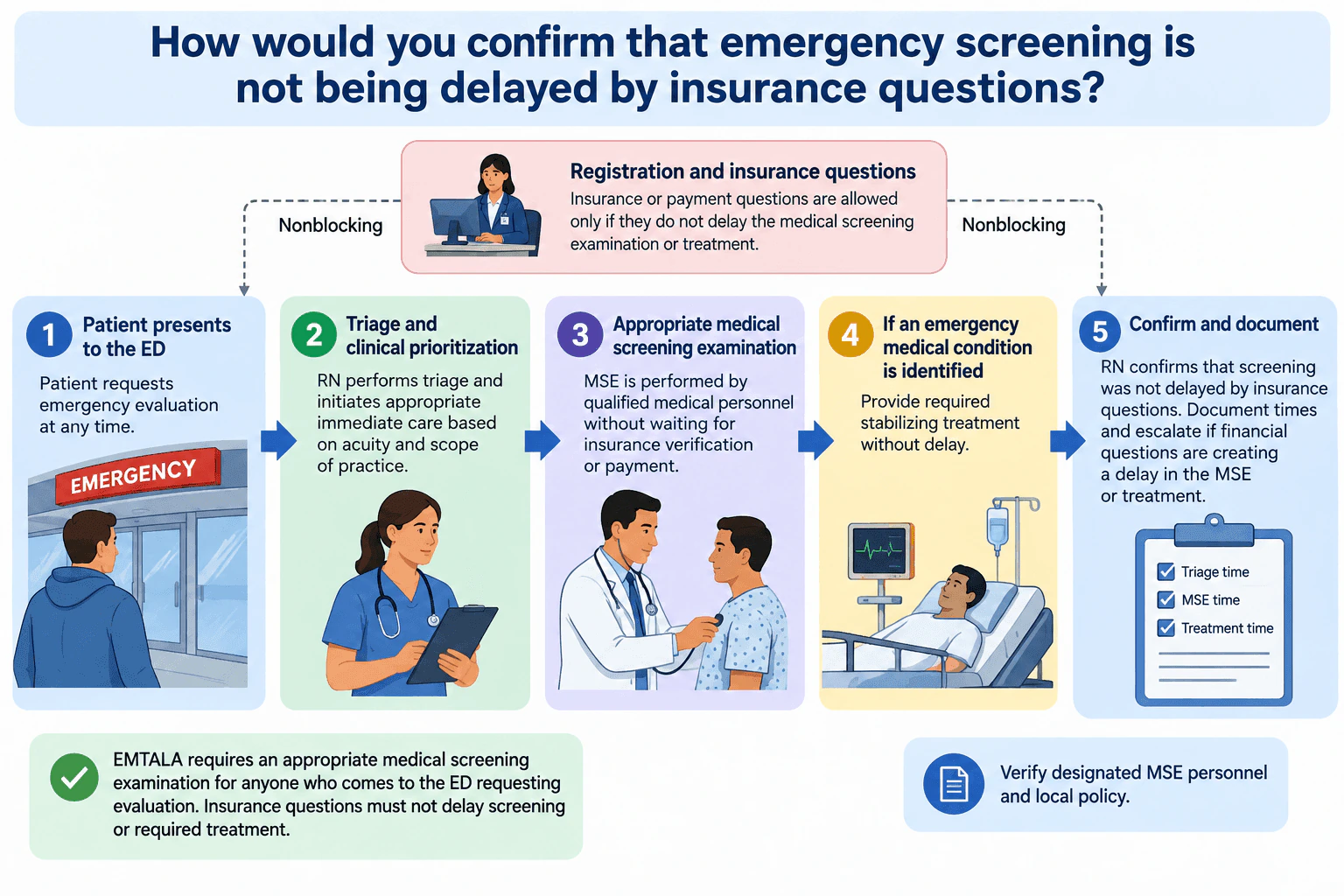
9. How would you confirm that emergency screening is not being delayed by insurance questions?Documentation ComplianceHardHca Healthcare
i Question Details
Original practice question for this employer context, not a reported employer interview question. Explain the relevant ED nursing judgment and identify information or authority you would need. Do not assume an internal employer protocol.
Short Interview Answer (30-60 seconds)
I would compare the actual timeline from arrival through triage, the medical screening examination, and any required treatment with the timing of registration and insurance questions. Insurance questions can occur, but they cannot delay the examination or treatment. cms.gov I would verify who is designated to perform the medical screening examination, document objective times and actions, and escalate any financial process that is interrupting clinical care.
Detailed Explanation
The central check is whether emergency evaluation continues while registration and insurance processing remain nonblocking. I would follow the same sequence shown in the clinical workflow: patient arrival, triage and clinical prioritization, the appropriate medical screening examination by qualified personnel, stabilizing treatment if an emergency medical condition is identified, and confirmation through objective documentation.
Useful Questions to Ask the Interviewer
Who is designated under the hospital bylaws or rules to perform the EMTALA medical screening examination?
What records or time stamps are available to compare arrival, triage, screening, treatment, and registration activity?
What local escalation pathway should staff use if a financial process appears to be delaying emergency care?
How to Explain It in an Interview
I would start with the documented timeline. I would review arrival time, triage documentation, the medical screening examination time, treatment initiation when applicable, and the timing of registration or insurance activity. I would look for objective evidence that the clinical process continued without waiting for insurance verification, payment information, or authorization.
I would keep triage and the medical screening examination distinct. Triage helps prioritize care based on acuity, but the EMTALA medical screening examination determines whether an emergency medical condition exists. The examination must be performed by personnel who are qualified under the hospital bylaws or rules. cms.gov
Reasonable registration may include asking about insurance, but those questions cannot delay screening or treatment or discourage the patient from remaining for evaluation. CMS also states that hospitals may not delay screening or stabilizing services to obtain payment information or insurance authorization. cms.gov
If the medical screening examination identifies an emergency medical condition, necessary stabilizing treatment should proceed without delay. cms.gov
From the nursing perspective, I would document only what actually occurred: observed findings, actions, relevant times, notifications, receipt of critical information, and the patient response. I would not chart unperformed care or imply that every RN is independently authorized to perform the medical screening examination. If the timeline showed that insurance activity was delaying care, I would promptly escalate that barrier through the appropriate clinical and administrative chain while continuing nursing care within my scope and local policy.
Why Interviewers Ask This
This question tests whether the nurse can recognize an EMTALA risk, separate clinical care from financial registration, distinguish nursing triage from the medical screening examination, use objective documentation, and escalate a workflow problem without inventing an employer policy. It also tests whether the nurse understands that insurance processing may occur only when it remains nonblocking to screening and treatment.
Common interview mistakes
Common mistakes include assuming that all insurance questions are prohibited, treating triage as automatically equivalent to the EMTALA medical screening examination, waiting for insurance verification or authorization before required screening or stabilizing care, assuming every RN is qualified to perform the medical screening examination, documenting care that did not occur, failing to compare objective time stamps, and claiming a specific employer escalation process without confirming local policy.
Interview tip
Anchor the answer to the timeline. Explain that you would compare arrival, triage, medical screening examination, treatment, and registration activity to determine whether insurance processing remained nonblocking. Then state that you would verify designated medical screening examination personnel and escalate any financial barrier while documenting objective facts.
Interviewer may ask next
What documentation would you review to verify that insurance questions did not delay screening?
I would review objective time stamps for arrival, triage, the medical screening examination, treatment initiation when applicable, and registration or insurance activity. I would also review documented notifications and responses if staff identified or escalated a delay. The conclusion should come from the actual sequence of documented events rather than assumptions.
What changes if an emergency medical condition is identified while registration is still in progress?
Necessary stabilizing treatment takes priority and should proceed without delay while registration remains nonblocking. EMTALA prohibits delaying the required examination or stabilizing treatment to inquire about payment or insurance status. cms.gov I would continue nursing care within scope, communicate the change promptly, document the relevant times and responses, and escalate any financial process that interferes with the clinical pathway.
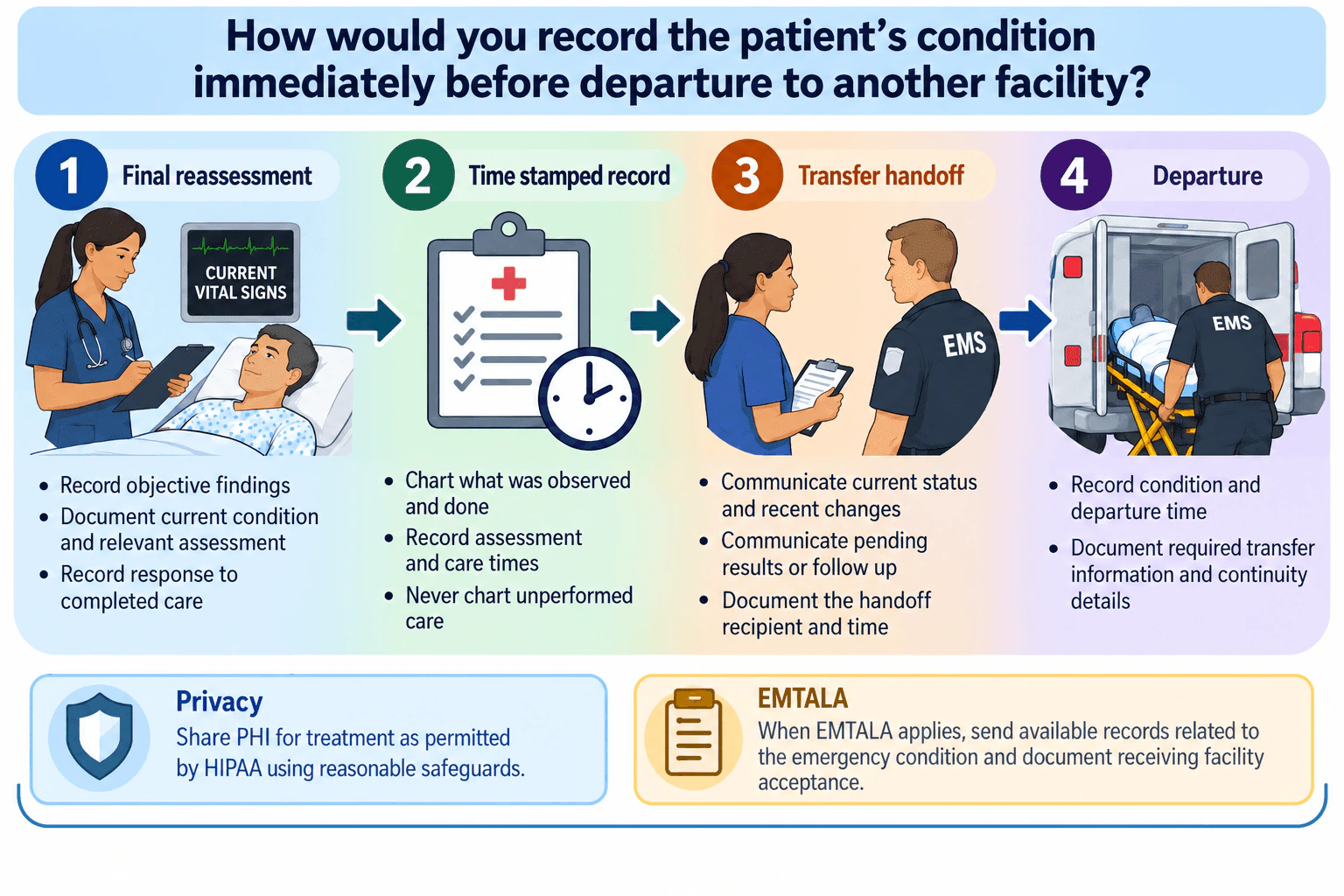
10. How would you record the patient's condition immediately before departure to another facility?NEWDocumentation ComplianceHardHca Healthcare
i Question Details
Original practice question for this employer context, not a reported employer interview question. Explain the relevant ED nursing judgment and identify information or authority you would need. Do not assume an internal employer protocol.
Short Interview Answer (30-60 seconds)
I would complete and time stamp a final nursing reassessment immediately before departure, documenting the patient's current condition, relevant objective findings, completed care, and response. I would document the handoff recipient and time, current status, recent changes, pending results or follow up, and the patient's condition and departure time. I would never chart unperformed care. When EMTALA applies, I would verify the required transfer information, including receiving facility acceptance and transmission of available records related to the emergency condition. I would share treatment information using HIPAA permitted channels and reasonable safeguards.
Detailed Explanation
The goal is to create a clear final snapshot of the patient's condition immediately before transfer and connect that snapshot to the handoff and departure record. I would document facts, actions, times, and responses rather than assumptions. The final record should show what I assessed, what was completed, what information was handed off, what remained pending, and when responsibility transitioned.
Useful Questions to Ask the Interviewer
Who is responsible in this setting for confirming receiving facility acceptance and completing each part of the transfer documentation?
What approved process is used to document the interfacility handoff and identify the person receiving report?
How are pending results or required follow up communicated after the patient has departed?
How to Explain It in an Interview
Final Reassessment And Time Stamped Record
Immediately before departure, I would reassess the patient within my nursing scope and document the current condition using objective findings. I would record what I observed, what care was completed, the patient's response, and the relevant assessment and care times. I would never chart care that was not performed or copy an earlier assessment as though it represented the patient's condition at departure.
Transfer Handoff
I would document the handoff recipient and handoff time. I would communicate the patient's current status, meaningful recent changes, completed care, and pending results or follow up. If something remained unresolved, I would make the responsible person or team clear rather than leaving follow up responsibility ambiguous.
EMTALA And Transfer Information
When EMTALA transfer requirements apply, I would verify the applicable transfer elements rather than assuming authority outside my role. For an appropriate EMTALA transfer, the receiving facility must have agreed to accept the patient, and available medical records related to the emergency condition must be sent to the receiving facility. Records that are not yet available must be sent as soon as practicable after transfer. cms.gov I would document the information assigned to the nursing role and verify any required authorization, certification, or transfer decision through the appropriate professional and local process.
Privacy And Scope
I would share protected health information needed for treatment through approved communication channels using reasonable safeguards. HIPAA permits covered health care providers to share protected health information for treatment without separate patient authorization, and HHS requires reasonable safeguards for those communications. hhs.gov I would avoid unnecessary disclosure outside the treatment process.
Departure Record
Finally, I would record the patient's condition at departure and the departure time, along with the completed handoff and required transfer information. If the patient's condition changed before leaving, I would reassess, document the change and response, notify the appropriate clinician, update the handoff, and verify that the transfer plan remained appropriate before departure.
Why Interviewers Ask This
This evaluates whether the nurse can create an objective and defensible record at a critical transition of care. The interviewer is looking for accurate reassessment, clear timing, safe handoff communication, recognition of pending information, appropriate privacy practices, and awareness that transfer requirements and authority depend on applicable law, professional scope, orders, and facility process rather than assumptions about what every RN independently performs.
Common interview mistakes
Common mistakes include documenting an earlier assessment instead of the patient's actual condition immediately before departure, charting care that was not performed, omitting assessment or departure times, failing to identify the handoff recipient, leaving pending results or follow up responsibility unclear, assuming receiving facility acceptance without verification, disclosing information outside the treatment process without appropriate safeguards, or implying that every RN independently performs medical screening, certification, or transfer decisions.
Interview tip
Answer in the same order shown in the transfer workflow: final reassessment, time stamped record, transfer handoff, and departure. Emphasize objective findings, completed care, patient response, recipient and time of handoff, pending information, and condition at departure. State what you would verify under applicable law, professional scope, orders, and local process rather than claiming a universal employer procedure.
Interviewer may ask next
What would you verify before finalizing the transfer documentation?
I would verify that the final reassessment reflects the patient's actual condition immediately before departure, that assessment and departure times are accurate, that only completed care is documented, that the patient's response is recorded, that the handoff recipient and time are documented, and that pending results or follow up responsibility are clear. When EMTALA applies, I would also verify the applicable transfer information, including receiving facility acceptance and transmission of available records related to the emergency condition. cms.gov
What would you do if the patient's condition changed immediately before departure?
I would reassess and document the new objective findings, time, nursing actions, notifications, and patient response. I would notify the appropriate clinician and update the transport and receiving teams so they were not relying on outdated information. I would also verify that the transfer plan, required personnel, transport resources, and authorization remained appropriate before the patient departed rather than treating the earlier documentation as the final record.
Emergency Department Nurse Resume Examples
Explore the resume examples below to find the one that best matches your target Emergency Department Nurse role.
New Graduate Emergency Department Nurse0-1 years; supervised transition to emergency nursing
Disclaimer: This interview guide is for educational and informational purposes only. It is designed to help readers prepare, but it does not guarantee any interview result, hiring decision, offer, or outcome. Interview questions, hiring criteria, and preferred answers can vary by employer, interviewer, industry, location, and time. All answers, examples, and explanations in this guide are suggested examples for interview preparation, not definitive answers or instructions for professional practice. They are based on research and judgment, are provided without warranties of any kind, and should be adapted to the question, role, and applicable laws and professional requirements. Diagrams are simplified illustrations intended to highlight the main concepts and their relationships; actual situations, systems, and practices may be more complex. Alternative approaches may be equally valid or better suited to a particular question, context, or interviewer. To the fullest extent permitted by applicable law, the contributors and publisher are not liable for decisions made, actions taken, or losses incurred based on this guide.
State Laws and Professional Responsibilities: Laws and requirements governing an occupation vary by state and jurisdiction. You are responsible for checking the current laws, licensing requirements, and scope-of-practice rules that apply to your location and role, and for ensuring that your answers and actions comply with them. Adapt examples in this guide to those requirements. This guide is not legal advice.
Company Notice: This guide is an independent educational resource and is not affiliated with, endorsed by, sponsored by, or approved by the company named in this guide. Company names identify reported interview experiences or the employer context of clearly labeled original practice exercises. Interview practices can change without notice, and inclusion of company-specific content does not mean these questions are official, complete, or guaranteed to be asked. To the fullest extent permitted by law, the author, contributors, and publisher are not responsible for outcomes related to use of this material.
Content Accuracy and Verification: To the fullest extent permitted by applicable law, we do not represent or warrant that interview guides, questions, answers, examples, or diagrams are accurate, complete, current, error-free, or suitable for any particular purpose. You are responsible for independently reviewing and verifying the information before relying on it.