This interview guide is for educational and informational purposes only. It is designed to help readers prepare, but it does not guarantee any interview result, hiring decision, offer, or outcome. Interview questions, hiring criteria, and preferred answers can vary by employer, interviewer, industry, location, and time. All answers, examples, and explanations in this guide are suggested examples for interview preparation, not definitive answers or instructions for professional practice. They are based on research and judgment, are provided without warranties of any kind, and should be adapted to the question, role, and applicable laws and professional requirements. Diagrams are simplified illustrations intended to highlight the main concepts and their relationships; actual situations, systems, and practices may be more complex. Alternative approaches may be equally valid or better suited to a particular question, context, or interviewer. To the fullest extent permitted by applicable law, the contributors and publisher are not liable for decisions made, actions taken, or losses incurred based on this guide.
State Laws and Professional Responsibilities
Laws and requirements governing an occupation vary by state and jurisdiction. You are responsible for checking the current laws, licensing requirements, and scope-of-practice rules that apply to your location and role, and for ensuring that your answers and actions comply with them. Adapt examples in this guide to those requirements. This guide is not legal advice.
Identity, Image, and Privacy Notice
To respect individual privacy, some names, profile photographs, avatars, biographical details, and other identifying information displayed in this guide may be replaced with pseudonyms, licensed stock images, illustrative avatars, composite images, or representative descriptions. Unless a person is expressly identified as an actual contributor, a displayed name, image, or profile should not be understood as depicting or identifying a specific candidate, interviewer, employee, or other real individual. These representations are provided for editorial and illustrative purposes only and do not imply endorsement, employment, participation, or affiliation with this guide or any company mentioned in it. Any resemblance to an actual person is coincidental.
Company Notice
This guide is an independent educational resource and is not affiliated with, endorsed by, sponsored by, or approved by the company named in this guide. Company names identify reported interview experiences or the employer context of clearly labeled original practice exercises. Interview practices can change without notice, and inclusion of company-specific content does not mean these questions are official, complete, or guaranteed to be asked. To the fullest extent permitted by law, the author, contributors, and publisher are not responsible for outcomes related to use of this material.
Content Accuracy and Verification
To the fullest extent permitted by applicable law, we do not represent or warrant that interview guides, questions, answers, examples, or diagrams are accurate, complete, current, error-free, or suitable for any particular purpose. You are responsible for independently reviewing and verifying the information before relying on it.
Questions or comments?
Contact us for general questions, or share feedback, technical corrections, and comments with the community.
1. How would you explain your triage reasoning to a preceptor when you are uncertain about acuity?Clinical KnowledgeEasyNorthwell Health
i Question Details
Original practice question for this employer context, not a reported employer interview question. Explain the relevant ED nursing judgment and identify information or authority you would need. Do not assume an internal employer protocol.
Short Interview Answer (30-60 seconds)
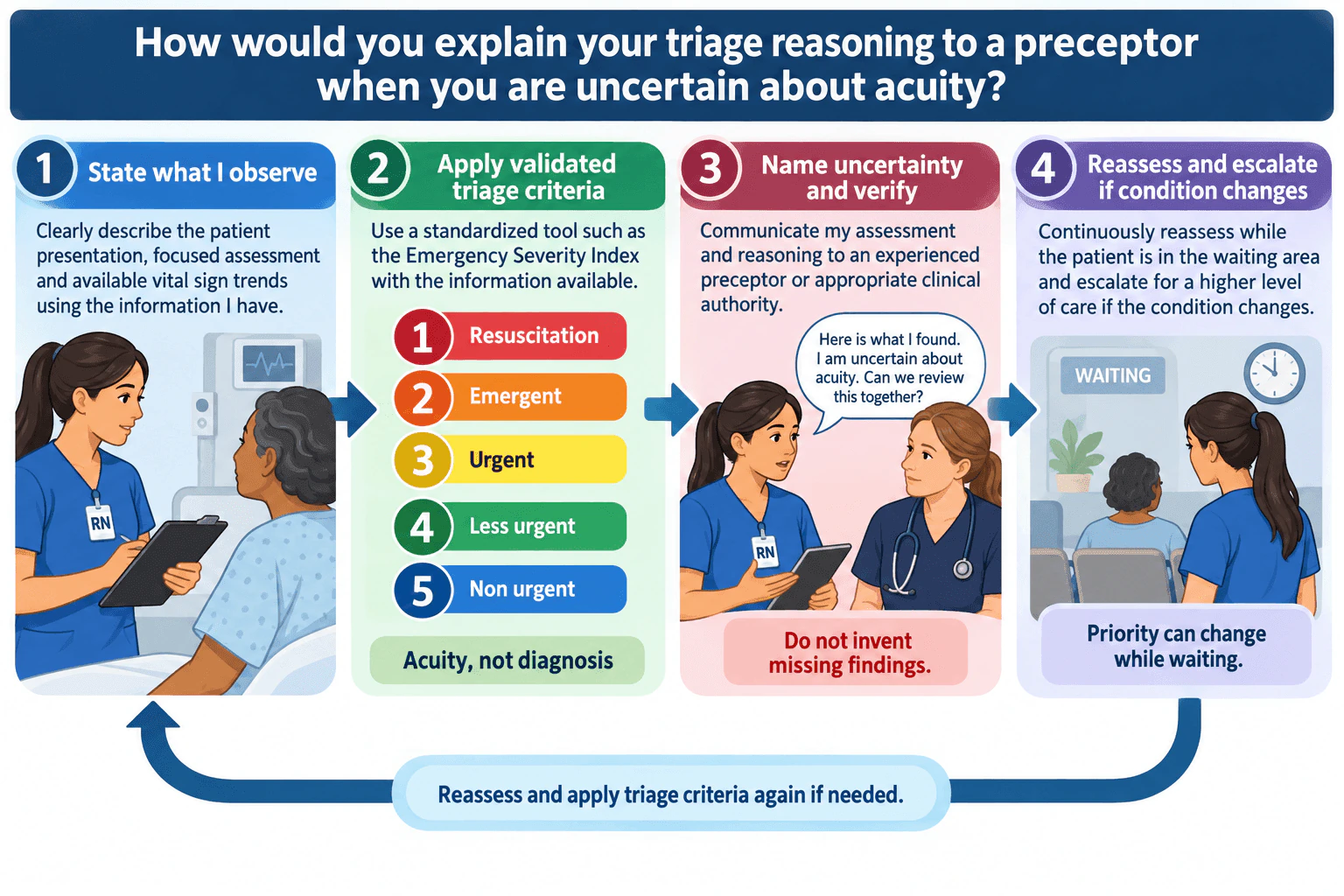
I would start by stating what I observed, including the patient's presentation, focused assessment findings, and available vital sign trends. Then I would explain how I applied a validated triage method such as ESI. If I was still uncertain, I would name the specific uncertainty and ask my preceptor or other appropriate clinical authority to review my reasoning. I would not invent missing findings. I would continue reassessing the patient while waiting and escalate if the condition changed because the patient's priority can change.
Detailed Explanation
Triage reasoning means deciding how urgently a patient needs evaluation based on the information available at that time. It is not the same as making a diagnosis, and it is not simply treating patients in order of arrival. A validated five level triage scale such as the Emergency Severity Index helps organize acuity decisions. ESI considers physiologic stability and risk for deterioration, with expected resource needs helping distinguish acuity among appropriate stable patients.
Useful Questions to Ask the Interviewer
Which validated triage framework does this emergency department use?
When a nurse is uncertain about acuity, who should be consulted according to local policy?
How is reassessment of patients who remain in the waiting area organized here?
How to Explain It in an Interview
State what I observe
I would begin with the facts I actually have. I would describe the presenting concern, focused assessment findings, available vital signs and trends, and any findings suggesting physiologic instability or increased risk. I would not fill gaps with assumptions.
Apply validated triage criteria
I would explain how the observed findings relate to the validated triage method being used. ESI is a five level emergency department acuity scale, with levels ranging from resuscitation through non urgent acuity. I would use the applicable decision points rather than treating the ESI level as a diagnosis.
Name uncertainty and verify
If I am uncertain, I would state exactly what remains unclear. I would explain my assessment and reasoning to my preceptor or another appropriate clinical authority and ask for review rather than guessing. If information is missing, I would say that it is missing instead of inventing a finding.
Reassess and escalate
If the patient remains in the waiting area, I would continue reassessment according to clinical need and local policy. New symptoms, changes in vital signs, mental status, or other relevant findings could change the patient's priority. If the patient's condition worsened or suggested greater urgency, I would escalate promptly and apply the triage criteria again as appropriate.
The reasoning sequence is straightforward: state what I observed, apply validated triage criteria, identify and verify uncertainty, then reassess and escalate if the clinical picture changes.
Why Interviewers Ask This
Interviewers are evaluating whether the nurse can organize limited clinical information, distinguish acuity from diagnosis, communicate uncertainty clearly, seek appropriate verification, and reassess rather than treating the initial triage decision as permanent.
Common interview mistakes
Common mistakes include treating ESI as a diagnosis, assigning priority simply by order of arrival, inventing missing clinical findings, giving an acuity level without explaining the observations that support it, failing to identify the specific uncertainty, and assuming the first triage decision remains correct when the patient's condition changes.
Interview tip
Use the same sequence shown in safe triage reasoning. State what you observed, explain how you applied the validated triage criteria, identify exactly what is uncertain, describe how you would verify the decision with the appropriate person, and finish with reassessment and escalation if the patient's condition changes.
Interviewer may ask next
What would you do to verify your acuity decision if you were still uncertain after your initial assessment?
I would compare the patient's actual findings with the decision points in the validated triage framework and identify which decision remains uncertain. I would then present the findings and my reasoning to my preceptor or other appropriate clinical authority for review. I would not invent information to force an acuity assignment, and I would continue reassessment according to clinical need and local policy.
How would your reasoning change if the patient's condition worsened while waiting?
I would reassess the patient rather than relying on the original triage assignment. I would compare the new symptoms, vital signs, mental status, and other relevant findings with the previous assessment, reconsider acuity using the applicable triage framework, and escalate promptly if the change suggested greater urgency or instability. The original priority would not prevent a higher priority assignment when the clinical picture changes.
2. How would you recognize that a familiar assessment pattern does not fit the current patient?Clinical KnowledgeEasyNorthwell Health
i Question Details
Original practice question for this employer context, not a reported employer interview question. Explain the relevant ED nursing judgment and identify information or authority you would need. Do not assume an internal employer protocol.
Short Interview Answer (30-60 seconds)
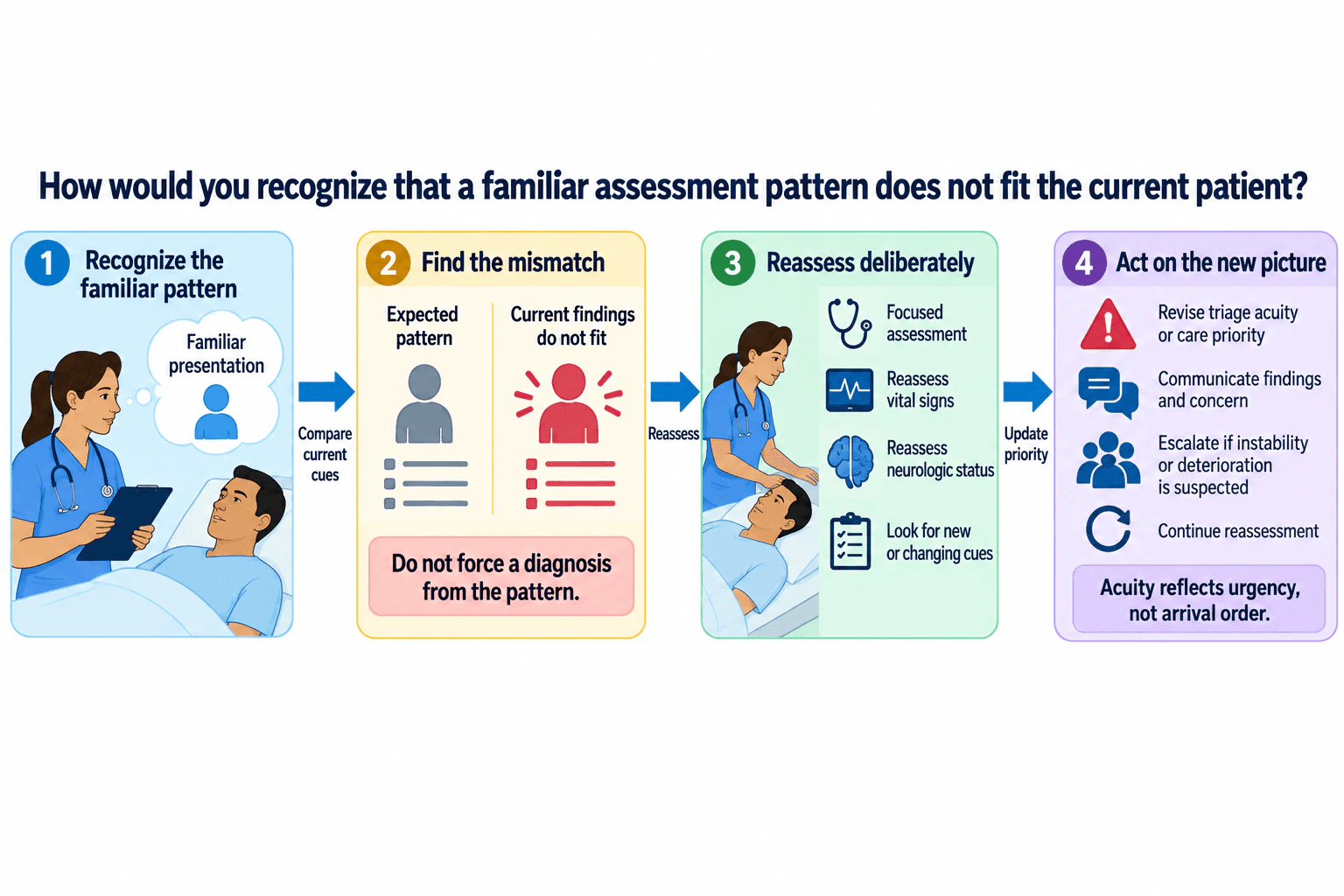
I would look for discordance between what I expected and what the patient is actually showing. If the current findings do not fit the familiar pattern, I would deliberately reassess rather than force the patient into that pattern. I would repeat the focused assessment, reassess vital signs and neurologic status when relevant, look for new or changing cues, and reconsider urgency. If the new picture suggests greater risk, I would update the triage acuity or care priority within the applicable validated process, communicate the change, escalate suspected instability or deterioration, and continue reassessment.
Detailed Explanation
A familiar assessment pattern can help an emergency nurse organize information quickly, but it should never replace assessment of the patient who is actually in front of you. The key signal is discordance. The patient's current findings, trends, or overall presentation do not fit what the familiar pattern would lead you to expect.
Useful Questions to Ask the Interviewer
Which validated triage framework does this emergency department use?
What are the department's expectations for reassessment when a patient's condition may be changing?
Which escalation pathways or authorized protocols may the RN use when new findings increase concern?
How to Explain It in an Interview
Core Concept
I would treat a familiar assessment pattern as a starting point, not as a diagnosis. If the patient's current findings do not fit that pattern, I would deliberately interrupt the assumption and return to objective assessment.
Recognize the Mismatch
I would compare the expected pattern with the patient's actual presentation. If the current findings do not fit what I expected, I would not force a diagnosis from the familiar pattern or invent missing findings.
Reassess Deliberately
I would repeat the focused nursing assessment, reassess relevant vital signs and neurologic status, and look for new or changing cues. Serial findings matter because the patient's condition can change after the initial assessment. I would distinguish independent nursing assessment and reassessment from actions that require an authorized protocol, order, or another professional.
Update Priority and Escalate
If the reassessment changes the apparent urgency, I would revise the triage acuity or care priority according to the applicable validated triage process and local policy. Triage acuity reflects clinical urgency rather than simple arrival order. I would communicate the specific changed findings and my concern, escalate promptly if instability or deterioration is suspected, and continue reassessment.
Limitations
Before assuming authority for an intervention, I would need to know the department's triage framework, reassessment expectations, escalation pathway, and any applicable authorized protocols. The Emergency Severity Index is an emergency department triage framework for stratifying acuity and anticipated resource needs. It is not a medical diagnosis or a disaster triage system.
Why Interviewers Ask This
Interviewers are evaluating whether the nurse can recognize when pattern recognition is becoming unsafe, return to objective assessment data, detect deterioration, prioritize by clinical urgency rather than familiarity or arrival order, communicate concerns, and seek appropriate authority when the next action depends on local protocols or another clinician.
Common interview mistakes
Common mistakes are anchoring on the first impression, treating a familiar presentation as a confirmed diagnosis, ignoring new or changing findings because the initial assessment seemed reassuring, relying on arrival order instead of clinical urgency, acting outside nursing authority or an authorized protocol, and communicating concern without stating the specific findings that changed.
Interview tip
Describe the moment you would recognize discordance, then explain the same sequence shown in the clinical reasoning flow: compare the expected pattern with current findings, reassess deliberately, update urgency, communicate the change, escalate when indicated, and continue reassessment. Make clear that you would use the applicable validated triage method and local scope or protocol rather than assuming an employer specific process.
Interviewer may ask next
How would you verify that your concern reflects a real change rather than an isolated finding?
I would repeat the relevant focused assessment, verify vital signs and other appropriate observations, compare them with prior findings, reassess neurologic status when relevant, and look for additional new or changing cues. I would communicate the objective findings and seek another qualified clinical assessment when needed rather than dismissing the concern or assuming a diagnosis.
What would change if the patient initially appeared stable but developed new signs of deterioration while waiting?
I would reassess promptly, reconsider the patient's triage acuity or care priority using the applicable validated process, communicate the changed findings and concern, and escalate suspected instability or deterioration according to the emergency department's established pathway. I would continue reassessment while the patient awaits the next level of evaluation or care. The new clinical urgency would take priority over the original arrival sequence.
3. How would you speak up about a break in precautions while working alongside a preceptor?Patient SafetyEasyNorthwell Health
i Question Details
Original practice question for this employer context, not a reported employer interview question. Explain the relevant ED nursing judgment and identify information or authority you would need. Do not assume an internal employer protocol.
Short Interview Answer (30-60 seconds)
I would speak up promptly, respectfully, and specifically. I might say, "I noticed a break in the required precautions. Can we correct that before we continue?" If there were an immediate exposure risk, I would address the hazard within my nursing role before proceeding. If I was unsure which precaution applied, I would verify the requirement rather than guess. If the issue was not corrected and safety remained at risk, I would escalate through the appropriate clinical chain of command. My goal would be to protect the patient and team while keeping the conversation focused on the safety issue rather than the person.
Detailed Explanation
The key is to treat speaking up as a patient safety action rather than a challenge to the preceptor. I would identify the specific break in precautions, address any immediate risk within my role, communicate clearly, verify anything I was uncertain about, and escalate if a meaningful safety concern remained unresolved. CDC guidance states that Standard Precautions are used for all patient care and that personal protective equipment is selected according to anticipated exposure risk. cdc.gov
Useful Questions to Ask the Interviewer
What resources are available to nurses who need to verify an infection prevention precaution during patient care?
How are nurses expected to escalate an unresolved patient safety concern?
What support is available to nurses who are learning with a preceptor and need clarification about a safety practice?
How to Explain It in an Interview
Recognize the concern
I would first identify exactly what I observed, such as missed hand hygiene, incorrect personal protective equipment, or another break in the required precautions. I would avoid assuming intent or criticizing the person.
Speak up promptly and respectfully
If the break could expose the patient, staff, or others to infection, I would address it when it occurs. I could say, "I noticed we need to complete hand hygiene before continuing," or, "Can we confirm the required precautions before we enter?" Clear language keeps the focus on the safety action.
Correct what is within my role
I would complete the nursing safety actions independently within my role, such as performing my own hand hygiene and using appropriate protective equipment based on the verified precautions. I would not invent an employer procedure or perform an action outside my competence or authority.
Verify uncertainty
If I was unsure whether an additional precaution applied, I would check the patient's documented precautions and use an appropriate current clinical or infection prevention resource rather than guess. CDC describes Standard Precautions as applying to all patient care and Transmission Based Precautions as additional measures for certain known or suspected transmissible infections. cdc.gov
Escalate if needed
If the concern was not resolved and a meaningful safety risk remained, I would communicate the concern to the appropriate supervising nurse or other person in the clinical chain of command. I would remain factual and describe what I observed, what I verified, and what safety risk remained.
Reassess
After the issue was addressed, I would confirm that the required precautions were in place and reassess if the patient's condition or infection risk changed.
Why Interviewers Ask This
This question evaluates whether I can recognize an infection prevention hazard, communicate respectfully within a preceptor relationship, protect patients and staff, verify uncertain requirements, and escalate an unresolved safety concern appropriately. It also tests whether I understand that working with a more experienced clinician does not remove my responsibility to speak up about a potential safety issue.
Common interview mistakes
Common mistakes include staying silent because the other person is more experienced, correcting the person in an accusatory way, guessing which precaution applies, continuing an unsafe step when an immediate correctable hazard is present, or escalating before first communicating a straightforward concern when the situation safely allows that discussion. Another mistake is assuming that every safety concern requires the same response instead of matching the response to the actual risk.
Interview tip
Show that you can balance respect for a preceptor with responsibility for patient safety. Use one brief example of the words you would say, explain how you would verify an uncertain precaution, and make clear that escalation is based on an unresolved safety risk rather than hierarchy or disagreement.
Interviewer may ask next
How would you verify that the precaution you are concerned about is actually required?
I would check the patient's documented precautions and use an appropriate current infection prevention resource or local clinical policy. If uncertainty remained, I would ask the preceptor, supervising nurse, infection prevention resource, or another appropriate clinician for clarification. I would distinguish Standard Precautions, which CDC recommends for all patient care, from additional Transmission Based Precautions used when certain transmission risks are known or suspected. cdc.gov
What would you do if the clinical context changed and the patient was suddenly suspected of having a transmissible infection?
I would reassess the immediate exposure risk, continue Standard Precautions, and promptly verify whether additional Transmission Based Precautions and patient placement measures were indicated for the suspected infection. I would communicate the change to the appropriate team members and follow authorized local processes for implementing any additional precautions. CDC recommends implementing additional precautions as soon as possible when the clinical presentation suggests a transmissible infection, then adjusting them as more information becomes available. cdc.gov
4. How would you ask for supervision of a task while keeping the patient informed?Communication And DelegationMediumNorthwell Health
i Question Details
Original practice question for this employer context, not a reported employer interview question. Explain the relevant ED nursing judgment and identify information or authority you would need. Do not assume an internal employer protocol.
Short Interview Answer (30-60 seconds)
I would pause before performing any part of the task that requires supervision, identify exactly what help I need, and contact an appropriate licensed supervisor. I would briefly explain the relevant patient context, the task, what I can safely perform, and the specific oversight I need, then confirm responsibilities using closed loop communication. I would tell the patient in plain language that I am bringing in another qualified team member to make sure the care is completed safely. I would answer questions and use teach back when appropriate rather than assuming a yes response means the patient understood.
Detailed Explanation
The key is to protect the patient while being transparent about what is happening. Asking for supervision is appropriate when a task exceeds my current competence or requires oversight, but supervision does not authorize me to practice outside registered nurse scope or replace an order when one is legally required. New York guidance states that an RN cannot perform nursing services the RN is not competent to perform and describes who may supervise RN nursing practice. op.nysed.gov
Useful Questions to Ask the Interviewer
What resources are available when a nurse needs direct supervision or assistance with an unfamiliar task?
How are responsibilities confirmed when another licensed clinician becomes involved in the task?
How does the team support escalation when competing assignments make it difficult to complete a task safely?
How to Explain It in an Interview
Recognize the Need for Supervision
I would first identify what part of the task is within my competence and authority and what part requires supervision. I would not proceed beyond my scope or competence simply because the department is busy. If an order or protocol is required for the activity, supervision would not substitute for that authorization.
Make a Clear Request
I would contact an appropriate licensed professional authorized to supervise registered nursing practice in New York. I would communicate the relevant patient context, the task, what has already been completed, and exactly what supervision or assistance I need. I would then use closed loop communication to confirm who will supervise, who will perform each part of the task, and what follow up is expected.
If the issue arose because competing assignments made safe completion difficult, I would escalate the workload concern rather than silently accepting an unsafe situation. I would confirm any transfer of responsibility so the task is not left ambiguous.
Keep the Patient Informed
I would explain in plain language that I am involving another qualified team member to make sure the task is completed safely. I would avoid unnecessary staffing details or language that could make the patient believe something unsafe has already occurred.
If language assistance is needed, I would use qualified interpretation according to applicable requirements rather than treating a family member as the default interpreter. If the task involves a consent decision, I would make sure the patient receives the information needed from the appropriate clinician and has an opportunity to ask questions.
When understanding matters to the patient's participation or next steps, I would use teach back by asking the patient to explain the plan in their own words. AHRQ recommends this approach because a yes response alone does not demonstrate understanding. ahrq.gov
Maintain Safe Responsibility
If I delegate an appropriate task, I would match it to the patient's needs, the other person's competence, jurisdictional rules, and required supervision. I would not delegate clinical reasoning, nursing judgment, or critical decision making to assistive personnel. NCSBN specifically identifies those functions as nondelegable. ncsbn.org I would remain responsible for appropriate nursing assessment, follow up, escalation, and advocacy within my role.
Why Interviewers Ask This
This evaluates whether the nurse recognizes professional limits, requests appropriate supervision before proceeding, communicates clearly with the care team, and keeps the patient informed without creating confusion or undermining trust. It also evaluates whether the nurse understands that supervision or delegation does not expand nursing scope and that patient needs, staff competence, jurisdictional rules, and appropriate supervision must guide decisions. NCSBN emphasizes that licensed nurses must consider the practice setting, patient needs, jurisdictional requirements, delegatee competence, and available supervision when making delegation decisions. ncsbn.org
Common interview mistakes
Common mistakes include attempting an unfamiliar or unauthorized task without requesting supervision, assuming supervision permits practice outside nursing scope, making a vague request that does not identify the needed help, failing to confirm who accepted responsibility, failing to escalate an unsafe workload, discussing unnecessary staffing problems with the patient, assuming agreement means understanding, using family as the default interpreter when qualified interpretation is needed, or delegating nursing assessment, clinical reasoning, nursing judgment, or critical decision making to assistive personnel.
Interview tip
Frame asking for supervision as a patient safety and professional judgment decision. State what you can safely do, what specific help you need, who you would contact, how you would confirm responsibility, and how you would keep the patient informed and verify understanding. Make clear that you would escalate if workload or a change in the patient's condition made the original plan unsafe.
Interviewer may ask next
How would you verify that both the supervisor and the patient understood the plan?
With the supervisor, I would use closed loop communication by stating the task and requested supervision, listening to the response, and confirming the agreed responsibilities and next step. With the patient, I would explain the plan in plain language and, when understanding affects participation or next steps, ask the patient to describe the plan in their own words. AHRQ describes teach back as a way to confirm that information was explained clearly rather than relying on a yes or no response. ahrq.gov
What would you do if the patient's condition changed while you were waiting for supervision?
I would reassess the patient, address immediate nursing safety needs within my registered nurse scope and competence, and promptly escalate the change to the appropriate clinician. I would communicate the new clinical context because it could change whether the original task remains appropriate, how urgently supervision is needed, or whether a different plan or order is required. I would keep the patient informed and would not proceed with a task that had become unsafe because the clinical situation changed.
5. How would you distinguish a learning opportunity from a task you are not yet authorized to perform?Communication And DelegationMediumNorthwell Health
i Question Details
Original practice question for this employer context, not a reported employer interview question. Explain the relevant ED nursing judgment and identify information or authority you would need. Do not assume an internal employer protocol.
Short Interview Answer (30-60 seconds)
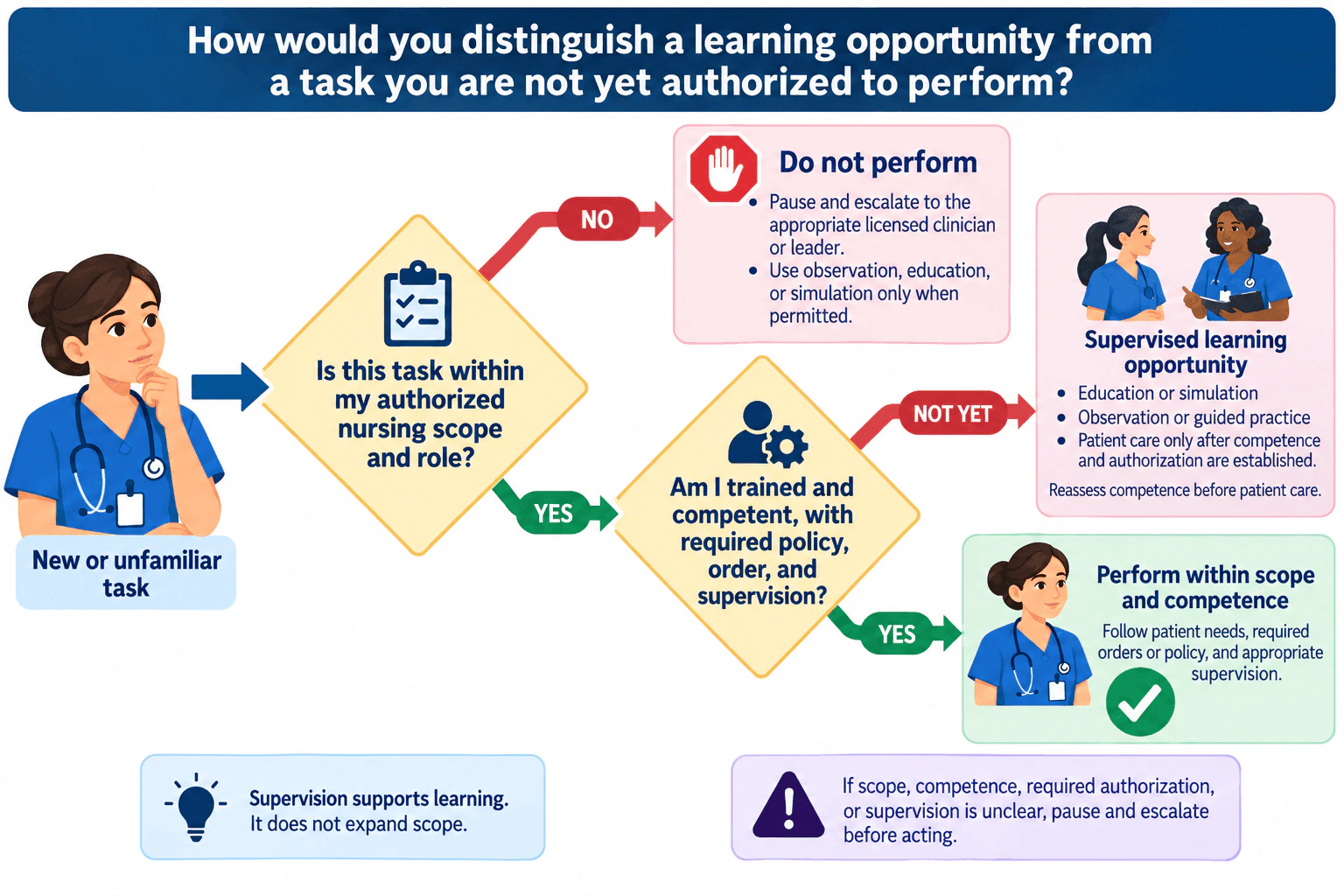
I would first ask whether the task is within my authorized nursing scope and role. If it is not, I would not perform it and would escalate. If it is within scope, I would then determine whether I am trained and competent and whether any required order, policy, or supervision is in place. If I am not yet competent, I would use permitted education, simulation, observation, or guided practice and reassess my competence before providing patient care. Supervision supports learning, but it does not expand scope.
Detailed Explanation
The key distinction is that authorization and competence are separate questions. A task may fall within the legal scope of registered nursing while still being inappropriate for an individual nurse to perform until that nurse has the necessary training and competence. New York guidance states that a nurse may provide nursing services allowed by law only when personally competent to provide them. op.nysed.gov
Useful Questions to Ask the Interviewer
What resources are available when a nurse needs education or competency validation before performing an unfamiliar task?
How is competence confirmed for responsibilities that require additional preparation?
Who should a nurse contact when the scope, required authorization, or supervision for a task is unclear?
How to Explain It in an Interview
I would use two checks.
First, I would determine whether the task is within my authorized nursing scope and role. If it is outside that scope, I would not perform it. I would pause and escalate to the appropriate licensed clinician or nursing leader. Observation, education, or simulation may still be appropriate when permitted, but supervision does not expand nursing scope.
Second, if the task is within scope, I would determine whether I am personally trained and competent and whether any required policy, order, or supervision is in place. The NCSBN scope framework likewise directs nurses to consider licensure, education, competence, and applicable jurisdiction when deciding whether an activity is appropriate to perform. ncsbn.org
If I am not yet competent, I would identify the situation as a learning opportunity rather than perform the task independently. I could participate in permitted education, simulation, observation, or guided practice. I would reassess my competence before providing patient care, and patient care would occur only after competence and authorization are established.
If I am competent and authorized, I would proceed within my role while considering the patient's needs and any applicable order, policy, or supervision requirements. New York law defines RN practice to include nursing assessment and treatment of human responses and execution of prescribed medical regimens within the RN role. op.nysed.gov
If scope, competence, required authorization, or supervision is unclear at any point, I would pause and clarify before acting. That protects the patient while still supporting appropriate professional learning.
Why Interviewers Ask This
Interviewers are evaluating whether I can recognize the boundary between professional development and unsafe practice. They want to hear that I distinguish legal scope from personal competence, identify when an order, policy, or supervision requirement applies, and pause rather than perform a task when those requirements are unclear. The judgment is especially important in an emergency department because urgency does not remove scope or competence requirements.
Common interview mistakes
Common mistakes include treating supervision as permission to work outside nursing scope, assuming that observing a procedure establishes competence, performing an unfamiliar task because the unit is busy, confusing a task that is within RN scope with a task the individual nurse is already competent to perform, or failing to clarify whether an order, policy, or supervision requirement applies.
Interview tip
Use a simple sequence in your answer: scope first, competence second, then any required order, policy, or supervision. State clearly that a task outside your authorized scope is not performed, while a task within scope that exceeds your current competence may become a supervised learning opportunity. Finish by saying that unclear boundaries are escalated before patient care begins.
Interviewer may ask next
How would you verify whether an unfamiliar task is appropriate for you to perform?
I would identify the exact activity and verify that it is within my nursing scope under the applicable jurisdiction. I would then confirm that I have the education, training, and current competence to perform it and determine whether an order, policy, or supervision requirement applies. New York guidance places responsibility on the nurse to practice within both legal authority and personal competence. op.nysed.gov If any part remains unclear, I would pause and obtain clarification from the appropriate licensed clinician, educator, or nursing leader before acting.
What would change if the patient's condition became unstable while you were preparing for a supervised learning opportunity?
The patient's immediate clinical needs would take priority over the learning opportunity. I would stop treating the situation as a teaching exercise, stay within my authorized scope and competence, communicate the change promptly, and obtain appropriate help. I would not attempt an unfamiliar intervention merely because the situation had become urgent. The learning activity could resume later when the patient context, authorization, competence, and supervision requirements were appropriate.
6. How would you prepare for an unfamiliar nursing procedure without implying that reading alone establishes competence?Medication And ProceduresMediumNorthwell Health
i Question Details
Original practice question for this employer context, not a reported employer interview question. Explain the relevant ED nursing judgment and identify information or authority you would need. Do not assume an internal employer protocol.
Short Interview Answer (30-60 seconds)
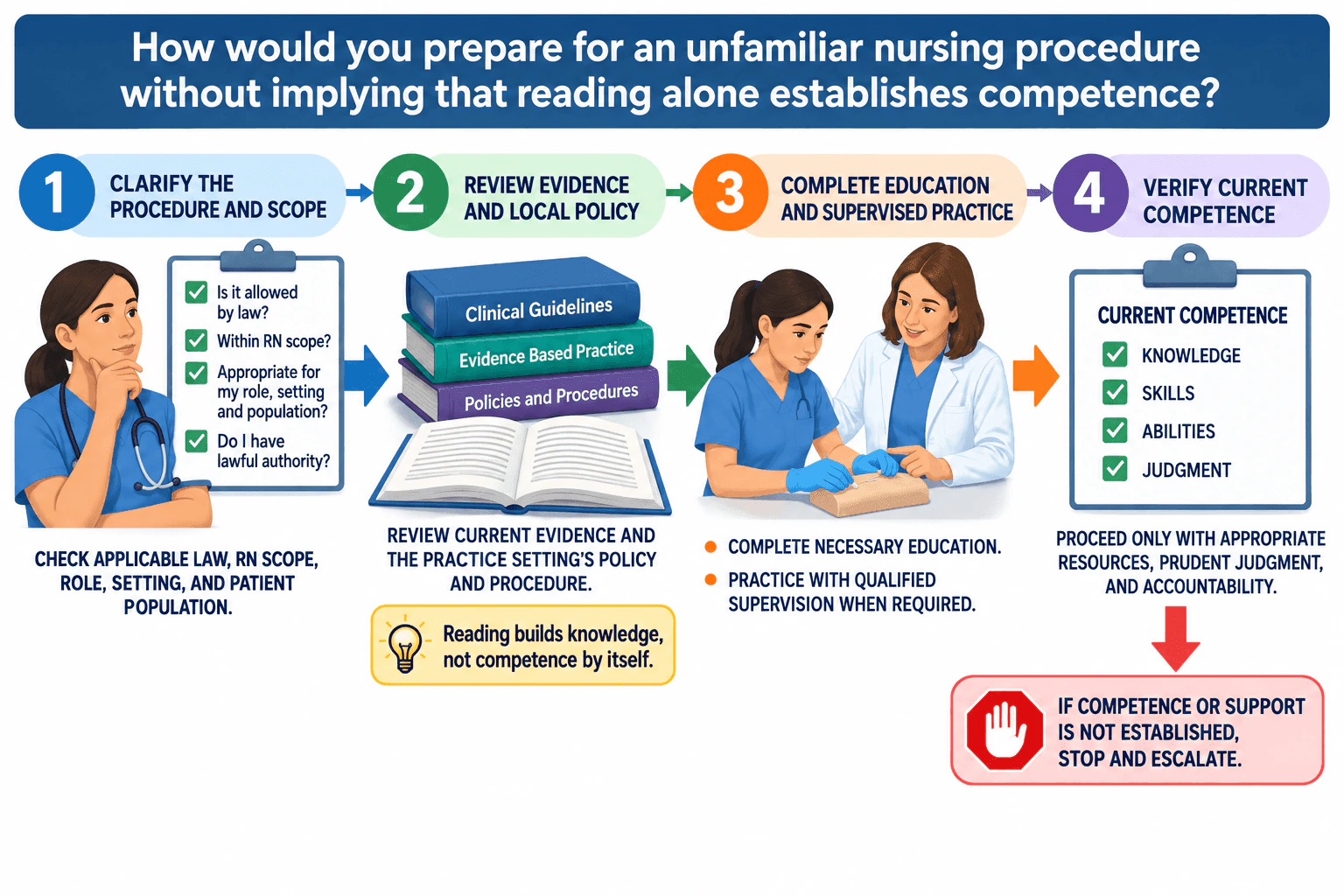
I would start by clarifying the exact procedure and confirming that it is permitted by applicable law, within RN scope, and appropriate for my role, setting, and patient population. I would review current evidence and the practice setting's policy, but I would not treat reading as proof of competence. If needed, I would complete the required education and qualified supervised practice. I would proceed independently only after my current knowledge, skills, abilities, and judgment have been verified and appropriate resources are available. If competence, authority, or support is not established, I would stop and escalate.
Detailed Explanation
The key distinction is between preparation and competence. Reading current evidence and a procedure policy can build knowledge, but independent performance also requires appropriate scope, necessary education, demonstrated current competence, clinical judgment, resources, and accountability. For a bedside RN in New York, an activity must be permitted within nursing practice, and the individual nurse must also be personally competent to perform it. If the procedure involves carrying out a prescribed medical regimen, I would verify the applicable authorized order or protocol before proceeding.
Useful Questions to Ask the Interviewer
What education and supervised practice are required before a nurse performs this procedure independently in this setting?
How is current competence for this procedure evaluated and documented?
Who should I contact if I am unsure about my authority, competence, or available support for this procedure?
How to Explain It in an Interview
I would begin by clarifying exactly what procedure is being requested. I would confirm that it is permitted by applicable law, within RN scope, appropriate for my role, setting, and patient population, and supported by the practice setting's policy and procedure.
Next, I would review current evidence and the relevant procedural guidance. That gives me the knowledge base, but I would not say that reading alone makes me competent. Competence also requires the knowledge, skills, abilities, and judgment needed to perform the procedure safely.
If the procedure were unfamiliar to me, I would complete the necessary education and participate in qualified supervised practice when required. I would use the practice setting's established competency process rather than assuming that observation, reading, or confidence alone establishes readiness for independent performance.
Before proceeding independently, I would verify documented current competence and confirm that the necessary human and material resources are available. I would also consider whether a reasonable and prudent nurse with similar education and experience would perform the procedure in that setting and whether I am prepared to accept accountability for my actions and the related outcome.
If the procedure requires an authorized order or protocol, I would verify that authority before proceeding. I would not assume that working in an emergency department automatically expands my legal scope or personal competence.
If I could not establish the required authority, competence, resources, or qualified support, I would stop and escalate to an appropriately qualified clinician. That protects the patient while allowing me to continue learning through the proper education, supervision, and competency pathway.
Why Interviewers Ask This
Interviewers are evaluating whether the nurse can distinguish learning about a procedure from being competent and authorized to perform it. The question also tests judgment about legal scope, evidence, practice setting requirements, education, supervised practice, documented current competence, available resources, prudent decision making, accountability, and escalation when safe independent performance has not been established.
Common interview mistakes
Common mistakes include treating reading, a policy review, or observation as proof of competence, assuming that every legally permitted nursing activity is appropriate for every individual RN, performing independently before necessary education or supervised practice is complete, failing to verify an authorized order or protocol when one is required, assuming an emergency automatically expands nursing authority, and proceeding when appropriate resources or qualified support are unavailable.
Interview tip
Use a clear sequence: clarify the procedure and scope, review current evidence and the practice setting's policy, complete necessary education and qualified supervised practice when required, verify documented current competence and resources, then proceed only when doing so is prudent and within your accountability. State clearly that reading builds knowledge but does not by itself establish competence.
Interviewer may ask next
How would you verify that you are competent to perform the procedure independently?
I would use the practice setting's established competency process rather than relying on confidence alone. I would confirm completion of the necessary education and demonstrate the required knowledge, skills, abilities, and judgment to an appropriately qualified evaluator or supervisor. I would verify any required documentation of current competence, confirm that the procedure remains within my legal scope, and make sure appropriate resources are available before independent performance.
What would you do if the patient's condition suddenly became urgent before you had completed competency validation for the procedure?
The change in urgency would not by itself establish competence or expand my authority. I would immediately obtain appropriate help and activate available emergency resources while continuing assessment, monitoring, communication, and other actions that are within my current competence and authorized nursing role. I would perform only actions I am competent and authorized to perform under applicable law, orders, and protocols, and I would not attempt the unfamiliar procedure independently merely because the situation became urgent.
7. How would you prepare for your first supervised pediatric emergency assessment?NEWTrauma And Special PopulationsMediumNorthwell Health
i Question Details
Original practice question for this employer context, not a reported employer interview question. Explain the relevant ED nursing judgment and identify information or authority you would need. Do not assume an internal employer protocol.
Short Interview Answer (30-60 seconds)
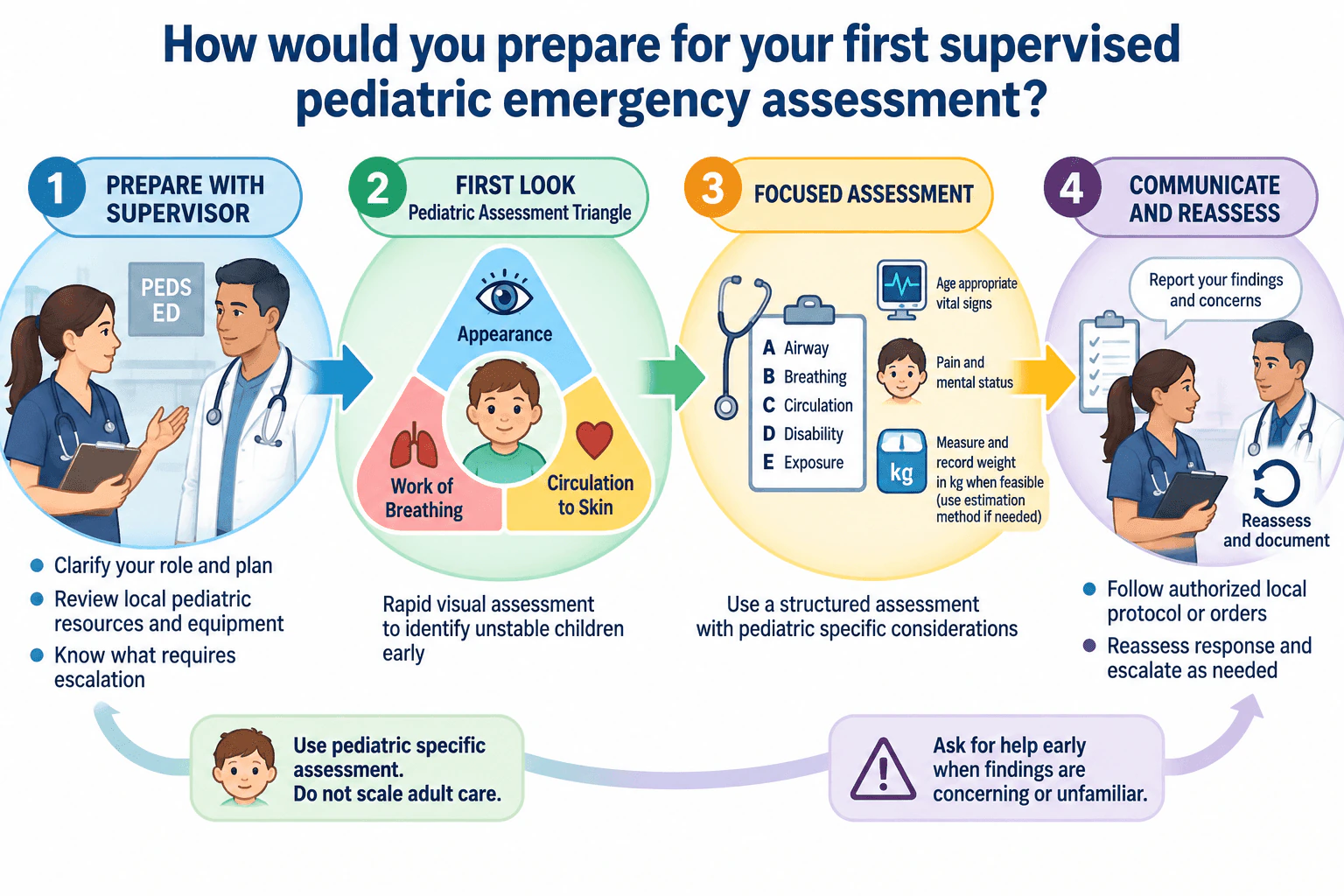
I would prepare with my supervisor by clarifying my role, reviewing the available pediatric resources and equipment, and confirming when to escalate. I would start with a rapid Pediatric Assessment Triangle first look at appearance, work of breathing, and circulation to skin, then complete a structured ABCDE assessment with age appropriate vital signs, pain and mental status assessment, and weight in kilograms when feasible. I would report concerning findings early, follow authorized protocols or orders, document clearly, and reassess. I would not simply scale adult care to a child.
Useful Questions to Ask the Interviewer
What pediatric assessment resources and equipment are available to nurses in this emergency department?
How is supervision structured for a nurse completing an early pediatric emergency assessment?
What escalation process should a nurse use when pediatric findings are concerning or unfamiliar?
Detailed Explanation
How to Explain It in an Interview
Nursing Priorities
I would begin by clarifying my role with the supervising clinician, identifying available pediatric resources and equipment, and confirming when I should ask for help or escalate. I would not assume an employer specific protocol or perform an action beyond my competence or authorization.
My first clinical step would be a rapid Pediatric Assessment Triangle first look at appearance, work of breathing, and circulation to skin. This gives me an immediate impression of whether the child may be unstable and whether urgent support is needed. I would then continue with a structured ABCDE assessment of airway, breathing, circulation, disability, and exposure.
Patient Context
I would interpret findings in the context of the child's age and development. I would obtain age appropriate vital signs, assess pain and mental status using developmentally appropriate methods, and measure and record weight in kilograms when feasible. If an accurate measured weight cannot be obtained immediately, I would use an approved estimation method only when appropriate to the clinical situation and local process.
Safety Checks
I would report abnormal, concerning, or unfamiliar findings promptly to my supervisor and the appropriate team member. Treatments would follow authorized local protocols or orders and remain within my nursing role. I would not convert an adult dose or resuscitation pathway into pediatric care by simple scaling.
Reassessment
After an intervention or meaningful clinical change, I would reassess the child's appearance, respiratory status, circulation, vital signs, pain, and mental status as relevant. I would communicate the response, document important findings and actions, and escalate if the child failed to improve or deteriorated.
Why Interviewers Ask This
Interviewers are evaluating whether I can approach an unfamiliar pediatric emergency safely, recognize that children require pediatric specific assessment, identify deterioration early, use supervision appropriately, communicate concerns, and stay within nursing scope. The question also tests whether I can distinguish preparation for pediatric care from simply applying an adult pathway to a smaller patient.
Common interview mistakes
Common mistakes include treating pediatric assessment as a smaller version of adult assessment, skipping the rapid first look, interpreting vital signs without considering age, overlooking pain or mental status assessment, failing to obtain or document weight in kilograms when feasible, delaying communication about concerning findings, and assuming authority for treatment that requires a protocol, order, or another professional.
Interview tip
Keep the answer focused on safe preparation and supervised clinical judgment. Walk through the same sequence as the diagram: prepare with the supervisor, perform the Pediatric Assessment Triangle first look, complete the structured ABCDE assessment with pediatric specific observations, then communicate, document, and reassess. Emphasize that asking for help early is appropriate when findings are concerning or unfamiliar.
Interviewer may ask next
How would you verify that your pediatric assessment approach is appropriate before using it?
I would verify the current pediatric resources available in the department, confirm expectations with my supervising clinician, and use current pediatric emergency guidance rather than relying on an adult pathway or memory alone. I would also verify the child's age, measured weight in kilograms when feasible, available vital signs, symptoms, and other supplied observations before making decisions that depend on those details.
What would change if the child suddenly appeared unstable during your assessment?
I would immediately communicate the change, call for appropriate help, and shift from routine assessment preparation to urgent pediatric stabilization within my role. I would prioritize immediate threats identified through the rapid first look and ABCDE assessment, follow authorized emergency protocols or orders, and repeatedly reassess the child's response. I would escalate promptly if the child continued to deteriorate or if the findings were beyond my experience or authority.
8. How would you confirm your assigned role when joining an adult resuscitation team during orientation?Scenario BasedMediumNorthwell Health
i Question Details
Original practice question for this employer context, not a reported employer interview question. Explain the relevant ED nursing judgment and identify information or authority you would need. Do not assume an internal employer protocol.
Short Interview Answer (30-60 seconds)
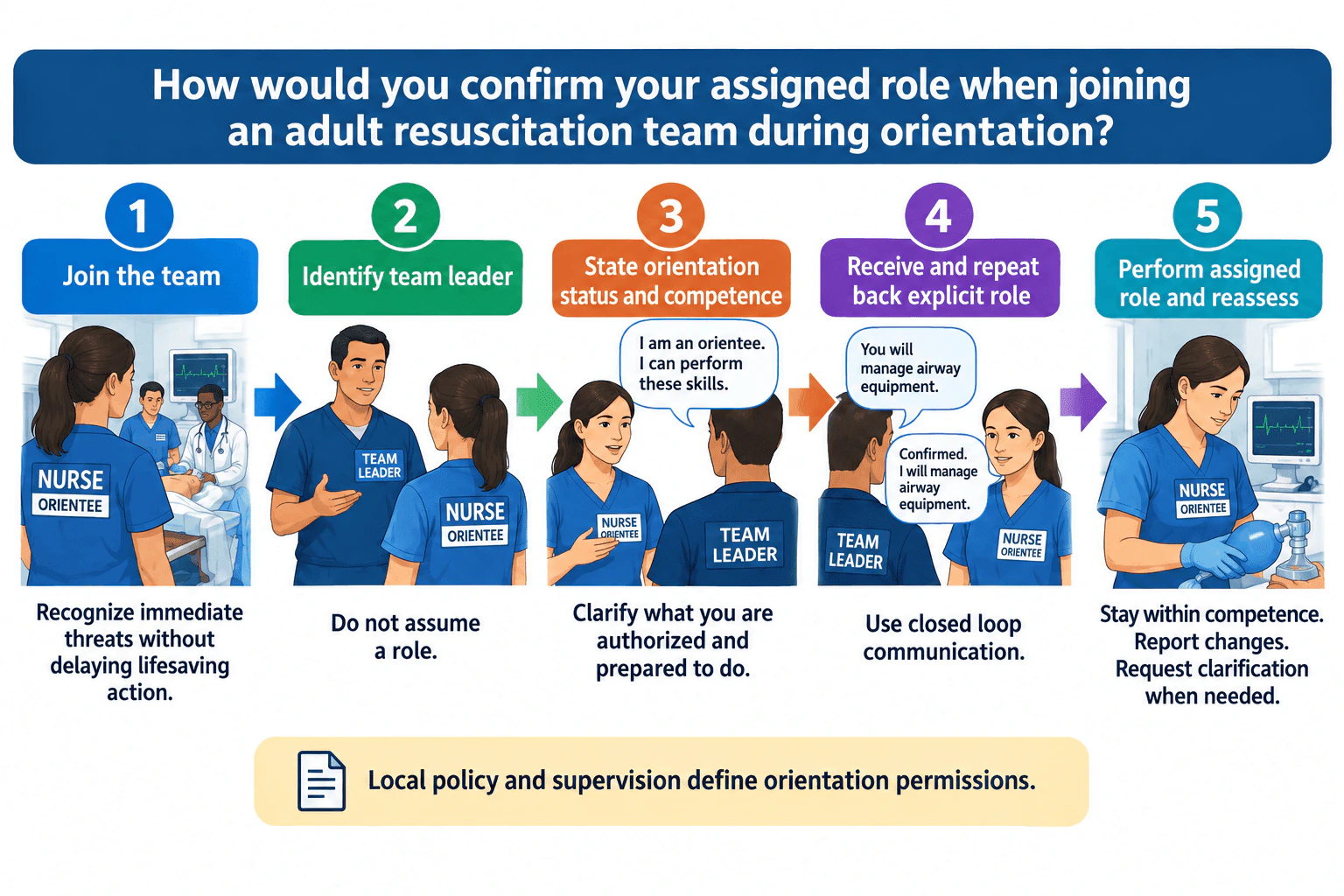
I would identify the team leader, state clearly that I am orienting, and briefly communicate what I am competent and authorized to do. I would receive an explicit assignment and repeat it back, for example, "Confirmed. I will manage the airway equipment." I would then perform only the responsibilities within my competence and supervision, report changes promptly, and request clarification if the role changes or becomes unclear. I would not let role clarification delay immediately necessary resuscitation.
Detailed Explanation
The key is to confirm the role explicitly instead of assuming it. During orientation, I need to contribute promptly while also being transparent about my competence, supervision, and authority.
Useful Questions to Ask the Interviewer
During orientation, who confirms the orientee's assigned role during an adult resuscitation?
Which resuscitation responsibilities may an orientee perform independently, and which require supervision, an order, or an authorized protocol?
What is the expected escalation process if an assigned task exceeds the orientee's current competence?
How to Explain It in an Interview
Join the Team
I would enter the resuscitation without interrupting immediately necessary care and identify the team leader as quickly as possible. If cardiac arrest or another immediate life threat were already being treated, I would not delay indicated resuscitation merely to complete a formal role discussion. The 2025 American Heart Association adult basic life support guidance emphasizes rapid recognition of cardiac arrest, activation of emergency response, cardiopulmonary resuscitation, and defibrillation when indicated. cpr.heart.org
Confirm the Role
I would state that I am orienting and briefly communicate the tasks I am competent and authorized to perform. I would not infer my assignment from where I am standing or what equipment is nearby. I would receive an explicit role from the team leader and repeat it back using closed loop communication. If assigned to manage airway equipment, for example, I could respond, "Confirmed. I will manage the airway equipment." American Heart Association team training materials identify closed loop communication and role coordination as elements of effective resuscitation teamwork. shopcpr.heart.org
Stay Within Competence
I would perform only activities that fall within my legal scope, personal competence, supervision, local policy, and any applicable orders or authorized protocols. New York State guidance states that registered professional nurses may provide nursing services when appropriately trained and competent, and that they may not perform nursing services for which they are not competent. op.nysed.gov
Reassess and Communicate
I would remain focused on my confirmed responsibility, report important clinical changes, and ask for clarification if priorities or assignments changed. I would not assume that my initial role remains unchanged throughout the resuscitation.
The sequence is simple: join the team, identify the team leader, state orientation status and competence, receive and repeat back the assigned role, then perform within that role while reassessing and communicating.
Why Interviewers Ask This
This question evaluates whether the nurse can enter a high acuity resuscitation safely without making assumptions about role, competence, or authority. It tests situational awareness, communication with the team leader, closed loop confirmation, recognition of personal limits, and willingness to request clarification while urgent care continues. New York State guidance states that a registered professional nurse must be appropriately trained and competent for the nursing services performed and may not perform nursing services for which the nurse is not competent. op.nysed.gov
Common interview mistakes
Common mistakes include assuming a role without confirming it, failing to identify the team leader, not disclosing orientation status, accepting a task beyond current competence, failing to repeat the assignment back, continuing when the assignment becomes unclear, or allowing a routine role discussion to delay immediately necessary resuscitation.
Interview tip
Describe the same five step flow shown in the diagram: join the team, identify the team leader, state orientation status and competence, receive and repeat back the explicit role, then perform the assignment while reassessing. This keeps the answer concrete and demonstrates both urgency and safe professional boundaries.
Interviewer may ask next
How would you verify that you are permitted to perform the assigned task during orientation?
I would confirm that the task is within my legal nursing scope and my demonstrated competence, then verify the required supervision, local orientation policy, and any applicable order or authorized protocol. If any part were uncertain, I would tell the team leader immediately and request clarification, supervision, or another assignment rather than proceeding on assumption. New York State guidance specifically ties RN practice to appropriate training and competence. op.nysed.gov
What would you do if the patient deteriorated into cardiac arrest before your role was fully clarified?
I would not allow routine role clarification to delay immediately indicated resuscitation. I would support activation of the emergency response and provide appropriate life saving nursing actions within my competence while identifying the team leader as quickly as possible. Once leadership was clear, I would receive and repeat back a defined assignment and continue within that role. The 2025 American Heart Association adult basic life support guidance prioritizes recognition of cardiac arrest, activation of emergency response, cardiopulmonary resuscitation, and defibrillation when indicated. cpr.heart.org
9. How would you document care that you performed under supervision?Documentation ComplianceHardNorthwell Health
i Question Details
Original practice question for this employer context, not a reported employer interview question. Explain the relevant ED nursing judgment and identify information or authority you would need. Do not assume an internal employer protocol.
Short Interview Answer (30-60 seconds)
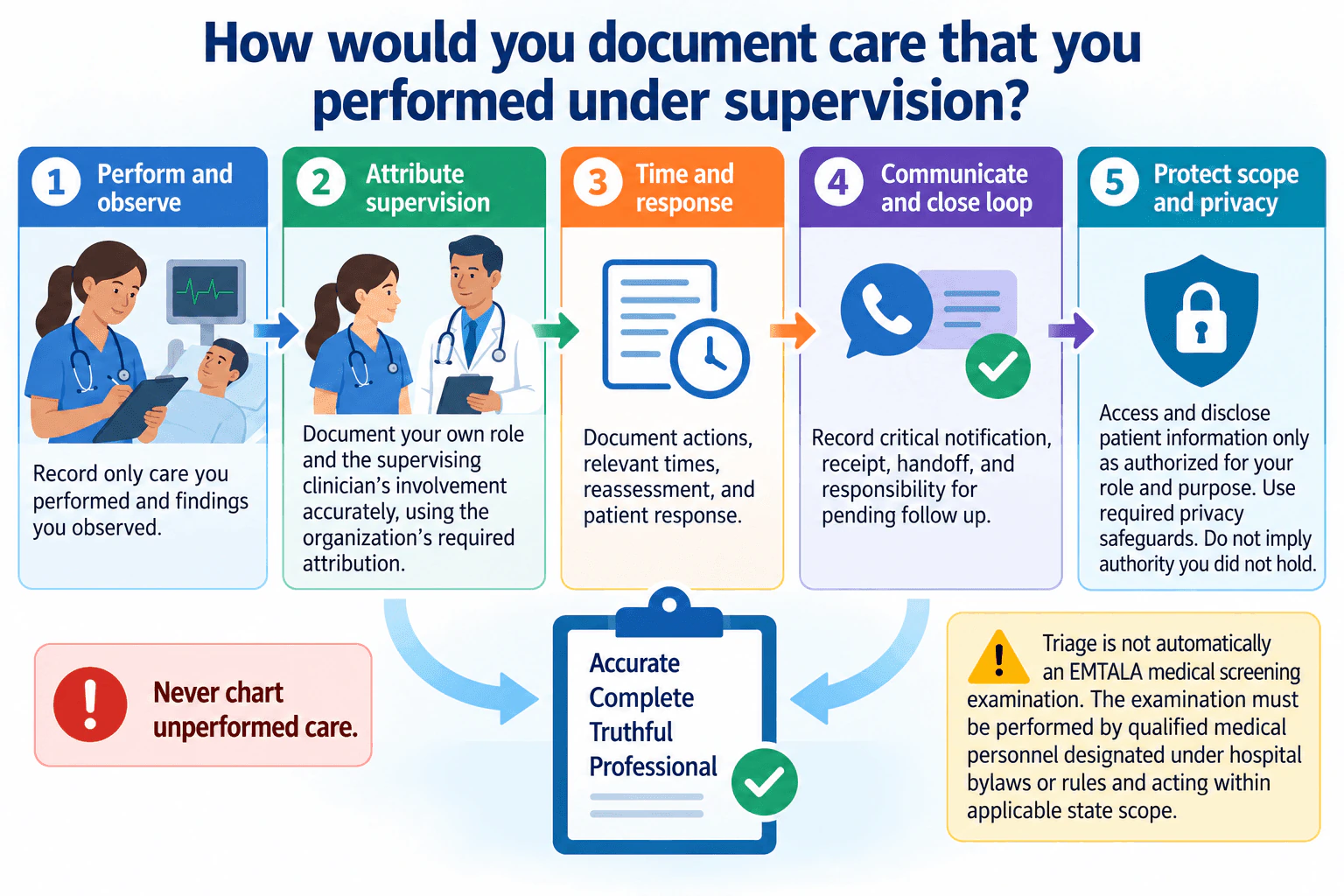
I would chart only what I actually performed and observed. I would document the relevant findings, actions, times, reassessment, and patient response, then accurately describe my role and the supervising clinician's involvement using the organization's required attribution process. I would record critical notifications, who received them, and any pending follow up responsibility. I would protect patient information, avoid implying authority I did not have, and never chart care that I did not perform.
Detailed Explanation
The record should be an accurate account of what happened, what I personally did or observed, who was involved, and how the patient responded. In New York hospital nursing practice, nursing documentation describes the care given, significant information and observations, nursing interventions, and patient responses. When care is performed under supervision, I would clearly represent my own actions and the supervising clinician's involvement without making supervised care appear independent.
Useful Questions to Ask the Interviewer
What documentation or attribution method does the organization require when care is performed under supervision?
Which personnel are formally authorized to perform specific emergency department assessments or examinations, and what supervision is required?
What is the expected process for documenting critical notifications, handoff, and responsibility for pending results or follow up?
How to Explain It in an Interview
Observed Findings And Timeline
I would document only findings I observed and care I actually performed. I would include clinically relevant times, assessments, interventions, reassessments, and the patient's response. I would never document an intervention as mine if another clinician performed it.
Supervision And Attribution
If I performed care under supervision, I would document my own role and the supervising clinician's involvement accurately using the organization's required attribution process. I would not assume that one signature, attestation, or supervision format applies everywhere because those details depend on role, policy, and applicable requirements.
Notifications And Handover
For a critical result or significant clinical change, I would document the information communicated, the relevant time, who received it, and the response or next responsibility when appropriate. During handoff, transfer, or discharge, I would make responsibility for unresolved issues or pending follow up clear so continuity of care is maintained.
Privacy And Scope
I would access and disclose patient information only as authorized for my role and purpose and use required privacy safeguards. HIPAA permits appropriate information sharing for treatment, including disclosures between health care providers for treatment, so I would follow the applicable privacy requirements and organizational process rather than withholding information needed for care.
I would also distinguish triage from an Emergency Medical Treatment and Labor Act medical screening examination. A hospital with a dedicated emergency department must provide an appropriate medical screening examination when EMTALA applies, and the hospital formally determines which qualified medical personnel may perform that examination through its approved bylaws or rules. I would therefore verify my authority rather than assume that every registered nurse independently performs the examination.
The core principle is accurate care, accurate attribution, timely communication, appropriate privacy, clear responsibility, and no documentation of care that did not occur.
Why Interviewers Ask This
Interviewers are evaluating whether the nurse understands that documentation is both a clinical communication tool and a professional record. They want to hear that the nurse can distinguish personally performed care from supervised or observed care, document reassessment and patient response, accurately attribute supervision, close communication loops, protect patient information, and recognize when scope or organizational authority must be verified.
Common interview mistakes
Charting an intervention that was not personally performed, making supervised care appear independent, copying information without verifying it, omitting relevant times or patient responses, failing to document receipt of an important notification, leaving responsibility for pending follow up unclear, accessing or disclosing patient information outside an authorized role or purpose, or assuming that routine triage automatically constitutes an EMTALA medical screening examination.
Interview tip
Use a simple sequence in your answer: what you observed, what you did, when you did it, how the patient responded, who supervised or was notified, and what responsibility remained. State clearly that you would verify the organization's required attribution and scope rather than inventing a local policy.
Interviewer may ask next
How would you verify the correct way to document supervised care?
I would verify my role, the supervising clinician's role, the organization's documentation and attribution requirements, and any applicable scope or regulatory requirements before representing the care in the record. If additional authentication or attestation is required, I would follow that process rather than assume one format applies everywhere.
What would you do differently if you observed an intervention but did not perform it?
I would not chart the intervention as care I performed. I could document my own observations, assessments, communications, or subsequent nursing actions when relevant, and I would identify the other clinician's involvement accurately according to the record and organizational process. My documentation should never make another person's action appear to be my own.
10. How would you clarify accountability when you and your preceptor both contribute to a handoff?Documentation ComplianceHardNorthwell Health
i Question Details
Original practice question for this employer context, not a reported employer interview question. Explain the relevant ED nursing judgment and identify information or authority you would need. Do not assume an internal employer protocol.
Short Interview Answer (30-60 seconds)
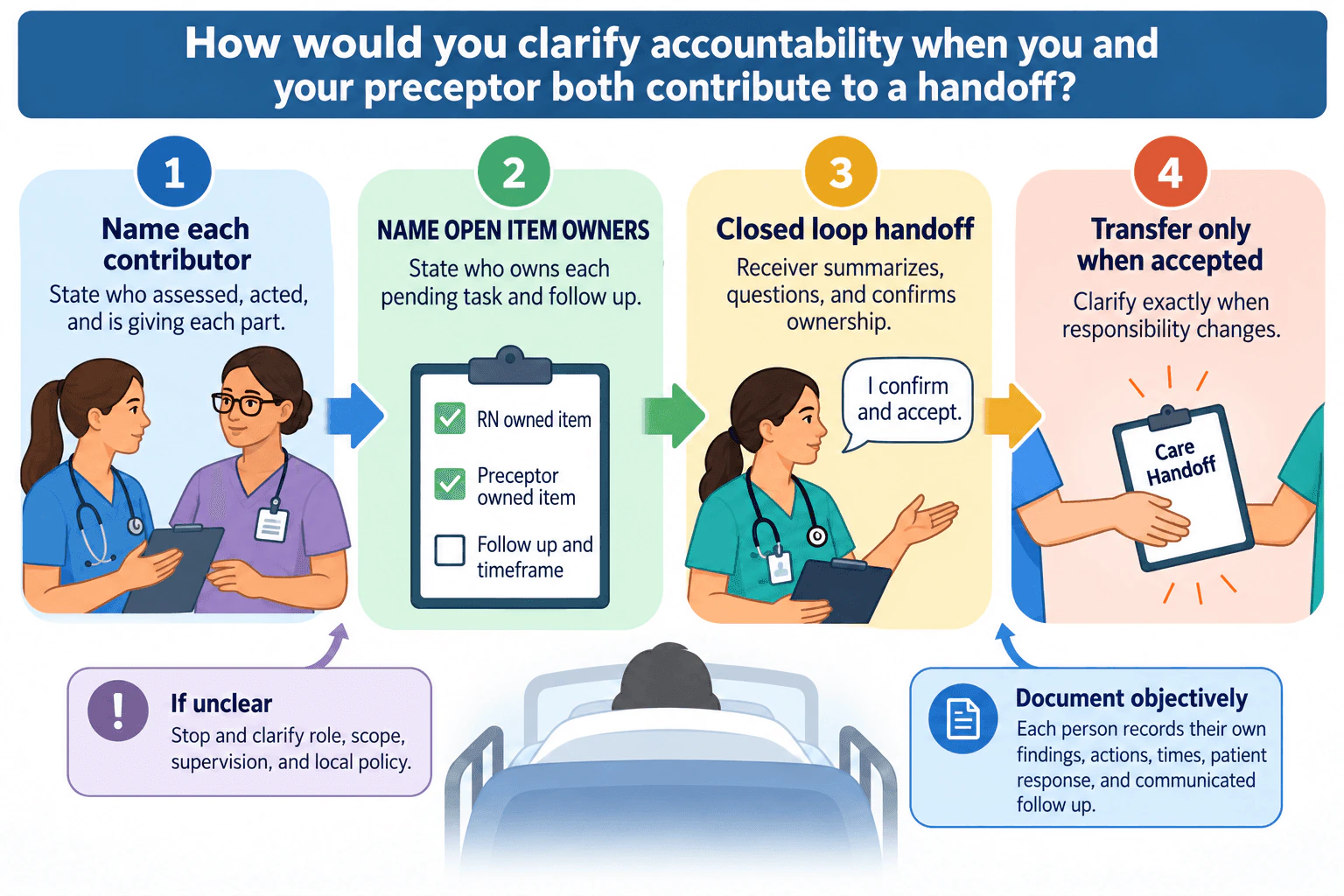
I would clearly state who contributed each assessment, action, or update, identify who owns every pending task and follow up, and use closed loop communication so the receiver can summarize, ask questions, and confirm acceptance. I would not assume responsibility has transferred until the handoff is acknowledged and accepted. If roles are unclear, I would clarify supervision, scope, and local policy, and I would document my own findings, actions, times, patient response, and communicated follow up accurately.
Detailed Explanation
The key is to remove ambiguity about both information and ownership. AHRQ describes a handoff as transferring information together with authority and responsibility, and states that responsibility should not be relinquished until the receiver understands and accepts the transfer. ahrq.gov
Useful Questions to Ask the Interviewer
How does this department define the responsibilities of the preceptor and the nurse being supervised during handoff?
What local policy determines ownership of pending tasks during a supervised transition?
What handoff process does the department use to confirm that responsibility has been accepted?
How to Explain It in an Interview
Name Each Contributor
I would clearly identify which assessments, actions, notifications, and updates I completed and which were completed by my preceptor. I would not document care I did not perform as though I performed it. Clear and accurate nursing documentation is an essential part of safe nursing practice. nursingworld.org
Name Open Item Owners
I would identify every unresolved task or follow up and state who owns it and the expected timeframe. AHRQ's I PASS framework specifically includes an action list with timelines and ownership. ahrq.gov
Use Closed Loop Handoff
I would ask the receiving clinician to summarize what was heard, ask questions, and restate important actions. I would then confirm that the receiver understands and accepts the handoff. AHRQ states that responsibility cannot be relinquished until the transfer is acknowledged and accepted. ahrq.gov
Transfer Only When Accepted
I would be explicit about exactly when responsibility changes rather than assuming that giving a report automatically transfers accountability. If the receiver has not acknowledged the handoff or an open item remains ambiguous, I would clarify it before treating the transfer as complete.
Clarify Scope When Needed
If there were uncertainty about my role relative to the preceptor, I would clarify the applicable supervision arrangement, nurse practice requirements, competence expectations, and organizational policy rather than inventing a universal rule. NCSBN notes that nursing scope and permitted responsibilities depend on licensure, competence, jurisdiction, and applicable organizational requirements. ncsbn.org
Document Objectively
I would document my own relevant findings, actions, times, patient response, and communicated follow up accurately. The record should make the sequence of care and communication understandable without implying that I performed care completed by someone else or that an unconfirmed transfer occurred.
Why Interviewers Ask This
This question tests whether the nurse recognizes that a safe handoff involves both information exchange and clear accountability. The interviewer is evaluating whether the nurse can distinguish individual contributions, assign ownership of open work, confirm acceptance, document objectively, and recognize when supervision, scope, or local policy must be clarified.
Common interview mistakes
Common mistakes include giving a vague handoff without identifying contributors, leaving pending work without a named owner, assuming the receiver accepted responsibility without confirmation, documenting another person's care as though it were your own, failing to communicate unresolved follow up, or assuming the same preceptor accountability rules apply in every jurisdiction and organization.
Interview tip
Organize the answer around the same four decisions used at the bedside: name each contributor, name the owner of every open item, obtain closed loop confirmation, and identify when responsibility actually transfers. Then explain that uncertainty about supervision, scope, or local policy should be clarified rather than assumed.
Interviewer may ask next
How would you verify that accountability actually transferred?
I would ask the receiving clinician to summarize the key information, ask questions, and restate the important pending actions. I would confirm that the receiver understands and accepts responsibility. I would not treat the handoff as complete merely because information was sent or spoken. AHRQ specifically states that responsibility cannot be relinquished until the handoff is acknowledged and accepted. ahrq.gov
What would you do if the patient's condition changed while the handoff was occurring?
I would address the change immediately within my nursing scope, communicate the new findings to the appropriate clinician, and clarify who is responsible for the immediate next actions. I would update the handoff so the receiver has the current assessment, response, pending work, and contingency information, then reconfirm acceptance when it is safe to continue the transfer. I would document my own assessment, actions, notifications, times, patient response, and communicated follow up.
Emergency Department Nurse Resume Examples
Explore the resume examples below to find the one that best matches your target Emergency Department Nurse role.
New Graduate Emergency Department Nurse0-1 years; supervised transition to emergency nursing
Disclaimer: This interview guide is for educational and informational purposes only. It is designed to help readers prepare, but it does not guarantee any interview result, hiring decision, offer, or outcome. Interview questions, hiring criteria, and preferred answers can vary by employer, interviewer, industry, location, and time. All answers, examples, and explanations in this guide are suggested examples for interview preparation, not definitive answers or instructions for professional practice. They are based on research and judgment, are provided without warranties of any kind, and should be adapted to the question, role, and applicable laws and professional requirements. Diagrams are simplified illustrations intended to highlight the main concepts and their relationships; actual situations, systems, and practices may be more complex. Alternative approaches may be equally valid or better suited to a particular question, context, or interviewer. To the fullest extent permitted by applicable law, the contributors and publisher are not liable for decisions made, actions taken, or losses incurred based on this guide.
State Laws and Professional Responsibilities: Laws and requirements governing an occupation vary by state and jurisdiction. You are responsible for checking the current laws, licensing requirements, and scope-of-practice rules that apply to your location and role, and for ensuring that your answers and actions comply with them. Adapt examples in this guide to those requirements. This guide is not legal advice.
Company Notice: This guide is an independent educational resource and is not affiliated with, endorsed by, sponsored by, or approved by the company named in this guide. Company names identify reported interview experiences or the employer context of clearly labeled original practice exercises. Interview practices can change without notice, and inclusion of company-specific content does not mean these questions are official, complete, or guaranteed to be asked. To the fullest extent permitted by law, the author, contributors, and publisher are not responsible for outcomes related to use of this material.
Content Accuracy and Verification: To the fullest extent permitted by applicable law, we do not represent or warrant that interview guides, questions, answers, examples, or diagrams are accurate, complete, current, error-free, or suitable for any particular purpose. You are responsible for independently reviewing and verifying the information before relying on it.