
11. How would you hand over a workload that includes patients still awaiting reassessment?
Original practice question for this employer context, not a reported employer interview question. Explain the relevant ED nursing judgment and identify information or authority you would need. Do not assume an internal employer protocol.
I would first identify patients who are unstable, changing, or due for reassessment and address any urgent deterioration before routine handoff. I would give the receiving nurse the current assessment, recent changes, response to care, and any uncertainty. I would state exactly what still needs reassessment, the expected timing, who is accepting responsibility, and what should trigger escalation. I would ask the receiver to summarize the priorities and pending actions and confirm responsibility. I would document only findings, actions, times, and responses that actually occurred.
The central goal is to make unfinished reassessment work visible and transfer responsibility deliberately. A handoff should communicate both the patient's current condition and exactly what still needs attention. If a patient is unstable or deteriorating, I would not defer an urgent reassessment simply because the shift is changing.
- What structured handoff process does your emergency department use for patients with pending reassessments?
- How is responsibility for a pending reassessment documented when nursing care transfers?
- What escalation process should be used if a patient's condition changes during handoff?
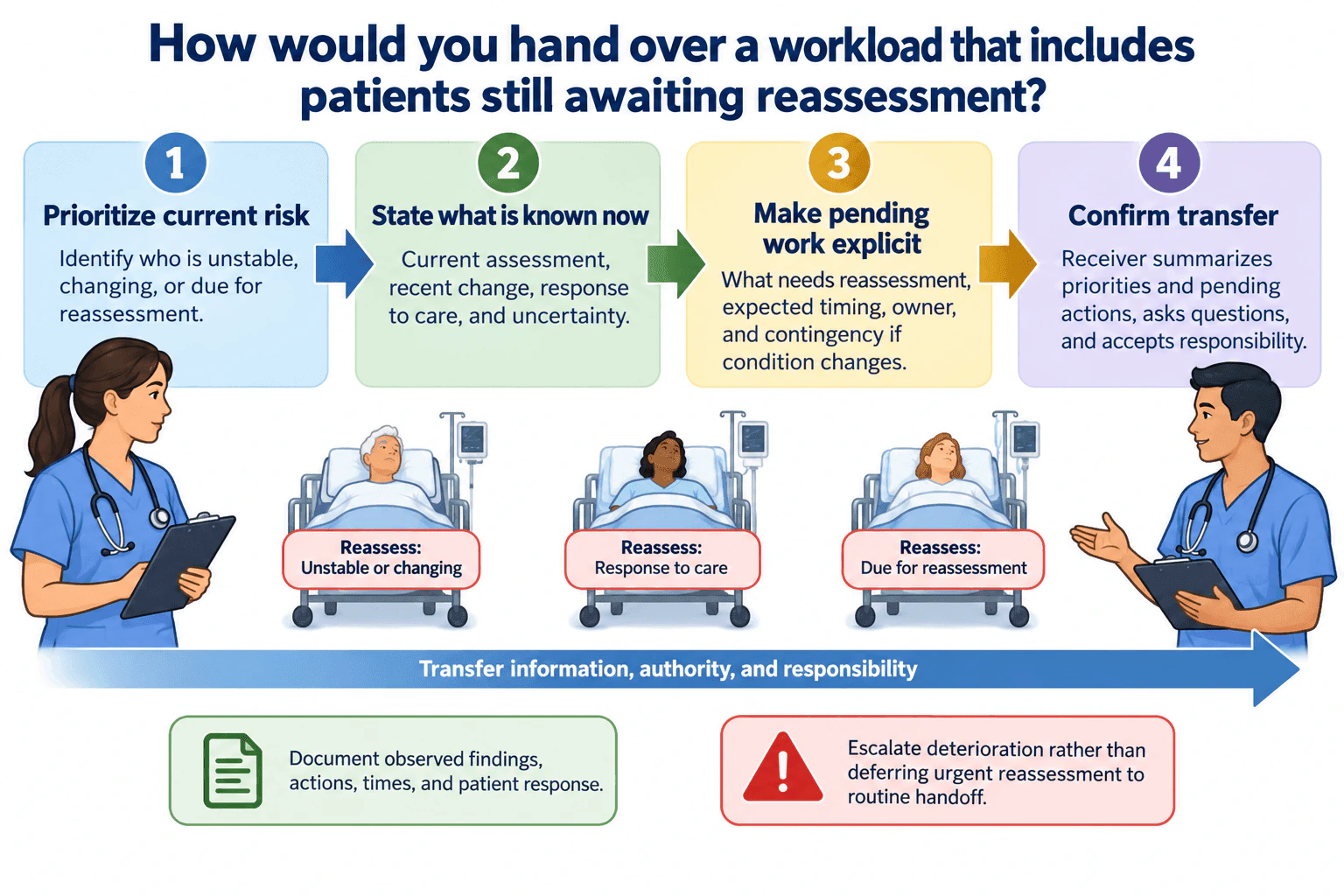
I would organize the handoff in four steps.
First, I would prioritize current risk. I would identify patients who are unstable, changing, or due for reassessment. If someone is deteriorating, I would address and escalate that change rather than delaying an urgent reassessment until routine handoff is complete.
Second, I would state what is known now. For each relevant patient, I would communicate the current assessment, recent changes, response to care, and any important uncertainty. That gives the receiving nurse a clear picture of the patient's present status rather than only a list of tasks.
Third, I would make pending work explicit. I would state what needs reassessment, the expected timing, who is accepting responsibility, and the contingency if the patient's condition changes. Structured handoff guidance supports communicating ongoing assessment, action ownership, timelines, uncertainty, treatment response, recent changes, and contingency plans. ahrq.gov
Fourth, I would confirm the transfer. I would ask the receiving nurse to summarize the priorities and pending actions, ask questions, and confirm acceptance of responsibility. Effective handoff guidance emphasizes receiver acknowledgment and the opportunity to clarify information before responsibility is relinquished. ahrq.gov
I would document observed findings, actions, relevant times, and the patient's response accurately. I would not document a reassessment that I did not perform. If an Emergency Medical Treatment and Labor Act medical screening examination were relevant, I would verify who is designated as qualified to perform it under hospital rules and applicable scope rather than assuming every registered nurse independently performs that examination. CMS states that the medical screening examination must be performed by personnel designated as qualified under hospital bylaws or rules and applicable scope requirements. cms.gov
This question evaluates whether the nurse can maintain continuity and accountability when important clinical work remains unfinished. It tests prioritization of current risk, communication of changes and uncertainty, explicit transfer of pending reassessment responsibilities, contingency planning, confirmation that the receiving nurse understands the plan, appropriate escalation of deterioration, and accurate documentation.
Common mistakes include listing patients without identifying who is unstable or due for reassessment, mentioning pending work without naming the responsible receiver or expected timing, omitting contingency plans, assuming documentation alone completes the handoff, failing to confirm that the receiving nurse understands the plan, charting a reassessment that was not performed, and allowing deterioration to wait for routine handoff instead of escalating it.
Use the same sequence shown in the handoff diagram: prioritize current risk, state what is known now, make pending work explicit, and confirm the transfer. Include timing, ownership, contingencies, receiver acknowledgment, accurate documentation, and immediate escalation when a patient's condition worsens.