This interview guide is for educational and informational purposes only. It is designed to help readers prepare, but it does not guarantee any interview result, hiring decision, offer, or outcome. Interview questions, hiring criteria, and preferred answers can vary by employer, interviewer, industry, location, and time. All answers, examples, and explanations in this guide are suggested examples for interview preparation, not definitive answers or instructions for professional practice. They are based on research and judgment, are provided without warranties of any kind, and should be adapted to the question, role, and applicable laws and professional requirements. Diagrams are simplified illustrations intended to highlight the main concepts and their relationships; actual situations, systems, and practices may be more complex. Alternative approaches may be equally valid or better suited to a particular question, context, or interviewer. To the fullest extent permitted by applicable law, the contributors and publisher are not liable for decisions made, actions taken, or losses incurred based on this guide.
State Laws and Professional Responsibilities
Laws and requirements governing an occupation vary by state and jurisdiction. You are responsible for checking the current laws, licensing requirements, and scope-of-practice rules that apply to your location and role, and for ensuring that your answers and actions comply with them. Adapt examples in this guide to those requirements. This guide is not legal advice.
Identity, Image, and Privacy Notice
To respect individual privacy, some names, profile photographs, avatars, biographical details, and other identifying information displayed in this guide may be replaced with pseudonyms, licensed stock images, illustrative avatars, composite images, or representative descriptions. Unless a person is expressly identified as an actual contributor, a displayed name, image, or profile should not be understood as depicting or identifying a specific candidate, interviewer, employee, or other real individual. These representations are provided for editorial and illustrative purposes only and do not imply endorsement, employment, participation, or affiliation with this guide or any company mentioned in it. Any resemblance to an actual person is coincidental.
Company Notice
This guide is an independent educational resource and is not affiliated with, endorsed by, sponsored by, or approved by the company named in this guide. Company names identify reported interview experiences or the employer context of clearly labeled original practice exercises. Interview practices can change without notice, and inclusion of company-specific content does not mean these questions are official, complete, or guaranteed to be asked. To the fullest extent permitted by law, the author, contributors, and publisher are not responsible for outcomes related to use of this material.
Content Accuracy and Verification
To the fullest extent permitted by applicable law, we do not represent or warrant that interview guides, questions, answers, examples, or diagrams are accurate, complete, current, error-free, or suitable for any particular purpose. You are responsible for independently reviewing and verifying the information before relying on it.
Questions or comments?
Contact us for general questions, or share feedback, technical corrections, and comments with the community.
31. What is thermal fatigue?Reliability Safety And Failure AnalysisEasy
Short Interview Answer (30-60 seconds)
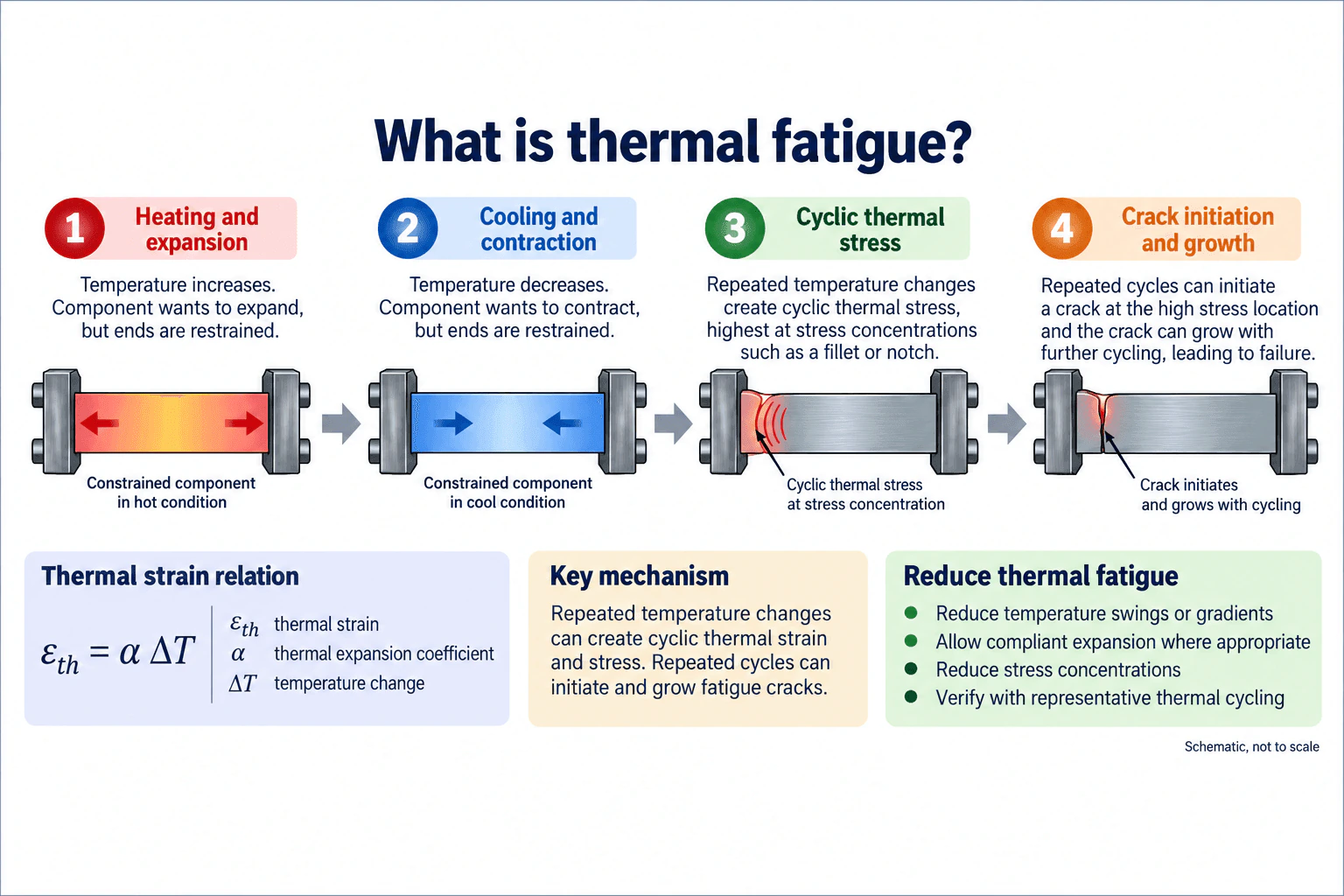
Thermal fatigue is progressive fatigue damage caused by repeated temperature changes or temperature gradients. A component naturally expands when heated and contracts when cooled. If that movement is restrained, or if different regions expand by different amounts, cyclic thermal stress can develop. Repeated cycles can concentrate stress at locations such as notches, fillets, joints, or interfaces, eventually initiating a crack and driving further crack growth. Risk is reduced by limiting temperature swings or gradients, allowing compliant expansion where appropriate, reducing stress concentrations, and verifying the design with representative thermal cycling.
Detailed Explanation
Thermal fatigue occurs when repeated heating and cooling create cyclic thermal strain and stress that progressively damage a component. For a uniform temperature change and approximately constant coefficient of thermal expansion, the free thermal strain is εth = αΔT, where εth is thermal strain, α is the coefficient of thermal expansion, and ΔT is the temperature change. This describes the strain the material would experience if it were free to expand or contract. Restraint, temperature gradients, geometric discontinuities, or expansion mismatch can convert that thermal deformation into cyclic stress.
Useful Questions to Ask the Interviewer
Is the component free to expand, partially restrained, or strongly restrained during thermal cycling?
Is the temperature change approximately uniform, or are significant temperature gradients present?
Is there a known critical location such as a fillet, notch, joint, or interface where cracking is expected or has been observed?
How to Explain It in an Interview
A simple way to explain thermal fatigue is to follow one constrained component through repeated heating and cooling.
During heating, the component wants to expand. For free expansion, the thermal strain is approximately εth = αΔT. If the ends or interfaces restrain that movement, thermal stress develops instead of completely free expansion.
During cooling, the component wants to contract. Restraint again creates stress. Repeated heating and cooling therefore produce cyclic thermal loading.
The local stress can be highest at a stress concentration such as a fillet, notch, joint, or material interface. After enough damaging cycles, a fatigue crack can initiate there. Additional cycles can then extend the crack and eventually reduce structural reliability or cause fracture.
Temperature change alone does not determine thermal fatigue severity. Important factors include the temperature range, temperature gradients, degree of restraint, material expansion behavior, geometry, stress concentration, cycle history, and fatigue resistance. Spatial temperature gradients can also generate thermal stress because hotter and cooler regions constrain one another.
To reduce thermal fatigue, I would reduce unnecessary temperature swings or gradients where practical, allow compliant thermal expansion when appropriate, reduce stress concentrations, and consider expansion compatibility at joined materials. I would verify the design using representative thermal cycling and inspect critical regions for crack initiation or growth.
For real equipment, I would use documented operating history, temperature limits, material data, geometry, boundary conditions, and applicable requirements rather than assuming a universal allowable temperature change or number of cycles.
Why Interviewers Ask This
Interviewers want to know whether the candidate understands how repeated temperature changes create cyclic thermal strain and stress, how restraint and stress concentrations contribute to fatigue cracking, and how a Thermal Engineer would reduce and verify the resulting reliability risk.
Common interview mistakes
Common mistakes include assuming that every temperature change creates severe thermal fatigue, ignoring restraint or temperature gradients, confusing free thermal strain with thermal stress, overlooking expansion mismatch between joined materials, ignoring local stress concentrations where cracks can begin, and assuming that the thermal strain relation alone proves that a component is safe.
Interview tip
Explain the physical sequence clearly: heating creates an expansion tendency, cooling creates a contraction tendency, restraint or expansion mismatch creates cyclic thermal stress, stress concentrations promote crack initiation, and repeated cycles drive crack growth. Then mention practical controls such as reducing temperature swings or gradients, allowing compliant expansion where appropriate, reducing stress concentrations, and verifying the design with representative thermal cycling.
Interviewer may ask next
Would thermal fatigue still occur if the component could expand and contract completely freely?
For a uniform temperature change, a component that can expand and contract freely develops free thermal strain but little restraint induced thermal stress. Thermal fatigue risk is therefore much lower from that mechanism. However, significant temperature gradients, local constraints, joints, geometric discontinuities, or interacting materials can still create cyclic thermal stress even when the component is not globally restrained.
What changes if two joined materials have different coefficients of thermal expansion?
For the same temperature change, the materials naturally want to change length by different amounts because εth = αΔT. If the joint forces compatible deformation, the expansion mismatch can create cyclic stress near the interface. Repeated cycling can promote crack initiation or interface damage, so the engineer should evaluate material compatibility, joint compliance, local stress concentration, temperature gradients, and representative thermal cycling.
32. What is thermal runaway?Reliability Safety And Failure AnalysisEasy
Short Interview Answer (30-60 seconds)
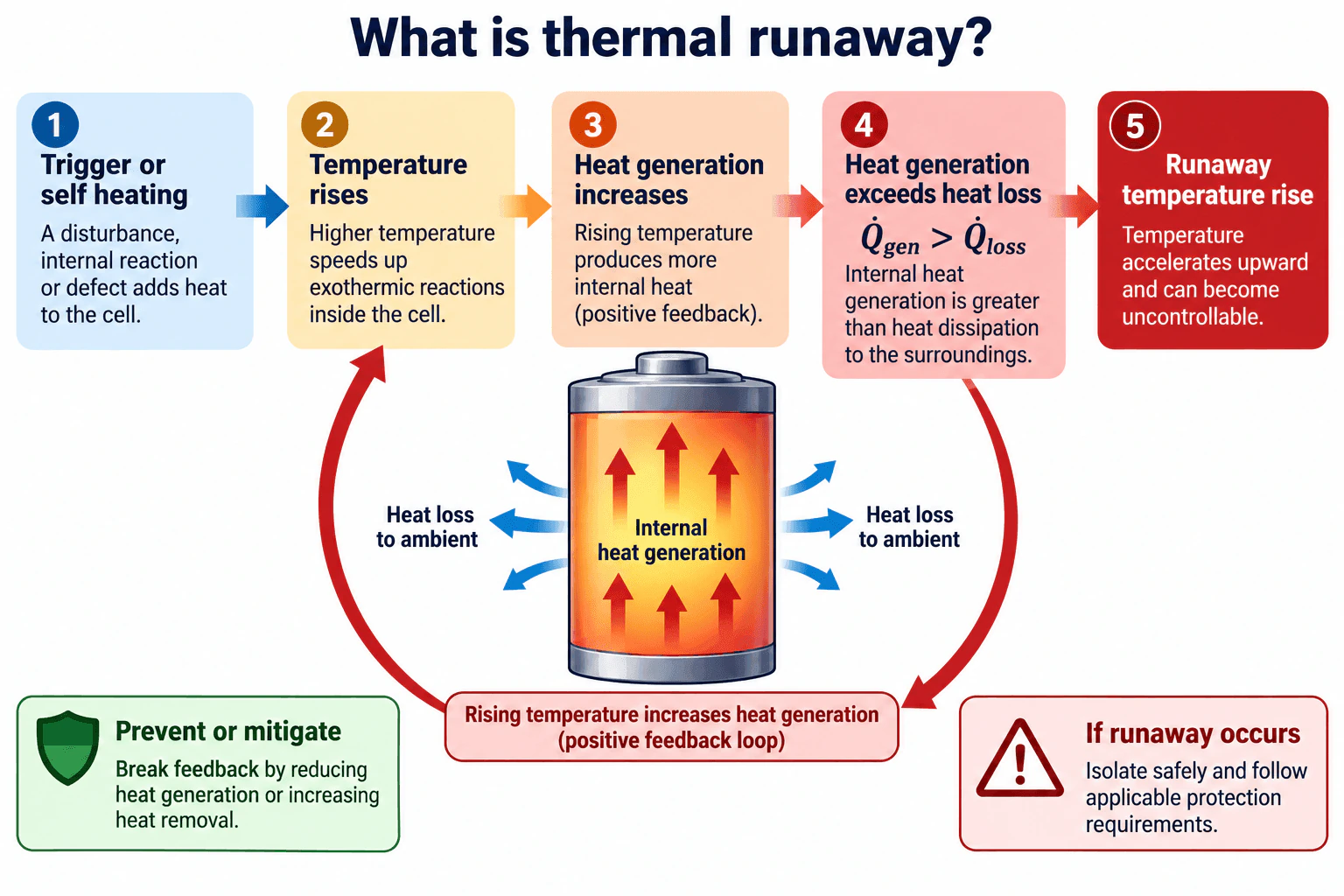
Thermal runaway is an unstable positive feedback condition in which a rise in temperature causes more internal heat generation, which raises the temperature further. If the internal heat generation rate becomes greater than the heat loss rate to the surroundings, temperature can accelerate upward and become uncontrollable. A lithium ion cell is one example. Prevention or mitigation focuses on breaking the feedback by reducing heat generation or increasing heat removal, while an actual runaway condition requires safe isolation according to the applicable protection requirements.
Detailed Explanation
Thermal runaway is a self accelerating thermal condition. A trigger, internal reaction, defect, or other heat source raises the temperature. If the higher temperature increases internal heat generation, the system develops positive feedback. The critical comparison is between the internal heat generation rate, Qgen, and the heat loss rate, Qloss. When Qgen becomes greater than Qloss and continues increasing with temperature, the system can move away from thermal equilibrium and the temperature can rise uncontrollably.
A lithium ion cell is a useful example that matches the diagram. A disturbance or internal reaction adds heat to the cell. The temperature rises. Higher temperature can accelerate exothermic reactions, causing more internal heat generation. If that heat generation exceeds heat dissipation to the ambient surroundings, the temperature can accelerate upward into thermal runaway.
Useful Questions to Ask the Interviewer
Are we discussing a battery cell or another thermal system?
What operating conditions and documented temperature limits apply?
What cooling, protection, and isolation mechanisms are available?
How to Explain It in an Interview
Start with the physical feedback loop. A trigger or self heating event raises the temperature. If rising temperature causes the system to generate still more heat, positive feedback develops.
Define Qgen as the internal heat generation rate and Qloss as the heat loss rate to the surroundings. If Qloss can keep pace with Qgen, the system may reach a stable temperature. If Qgen becomes greater than Qloss and keeps increasing with temperature, the temperature can continue accelerating upward. That is the key thermal runaway mechanism.
For a lithium ion cell, increasing temperature can accelerate exothermic internal reactions. Those reactions generate more heat, which raises the temperature again. The resulting loop is temperature rise, increased heat generation, additional temperature rise, and potentially runaway.
From a reliability and safety perspective, I would define the physical boundary and operating conditions, review the observed overheating history, and identify the documented temperature limits and protection requirements that apply to the actual equipment. I would not assume one universal runaway temperature because the relevant limits depend on the system, materials, design, and applicable requirements.
Prevention or mitigation means breaking the feedback loop. Depending on the system, that can mean reducing internal heat generation, increasing heat removal to the ambient surroundings, or using appropriate protective shutdown. If runaway occurs, I would isolate the equipment safely according to the applicable protection procedure rather than bypassing safeguards.
Finally, I would verify the corrective action under representative operating conditions and confirm that the residual risk meets the documented requirements.
Why Interviewers Ask This
Interviewers want to see whether the candidate understands the positive thermal feedback mechanism, can compare internal heat generation with heat removal, recognizes when overheating can become unstable, and considers protection and safe isolation without inventing universal temperature limits.
Common interview mistakes
Common mistakes include describing thermal runaway as ordinary overheating, ignoring the positive feedback loop, assuming that every temperature rise is runaway, quoting a universal temperature threshold, considering heat generation without heat loss, or suggesting that protective devices should be bypassed during testing or troubleshooting.
Interview tip
Explain thermal runaway as a feedback problem, not simply a high temperature problem. Define Qgen and Qloss, state that runaway can develop when Qgen becomes greater than Qloss, and use one concise example such as a lithium ion cell.
Interviewer may ask next
How would you determine whether an observed temperature rise is actually thermal runaway?
I would check whether increasing temperature is accompanied by increasing internal heat generation and whether the system is moving away from thermal equilibrium. I would review calibrated temperature and operating data, compare Qgen with Qloss, examine whether the heating persists or accelerates after the original disturbance changes, and compare the behavior with documented system limits. A temperature rise alone does not prove thermal runaway.
What is the effect of increasing heat removal?
Increasing heat removal raises Qloss and can move the system away from the condition where Qgen is greater than Qloss. That can improve thermal stability if the added heat removal remains effective over the relevant operating range. It does not automatically remove the underlying failure mechanism, so the internal heat source, protection response, operating limits, and residual risk still need to be evaluated.
33. How do you determine whether a heat exchanger performance loss is caused by fouling, flow maldistribution, or incorrect operating conditions?Reliability Safety And Failure AnalysisHard
Short Interview Answer (30-60 seconds)
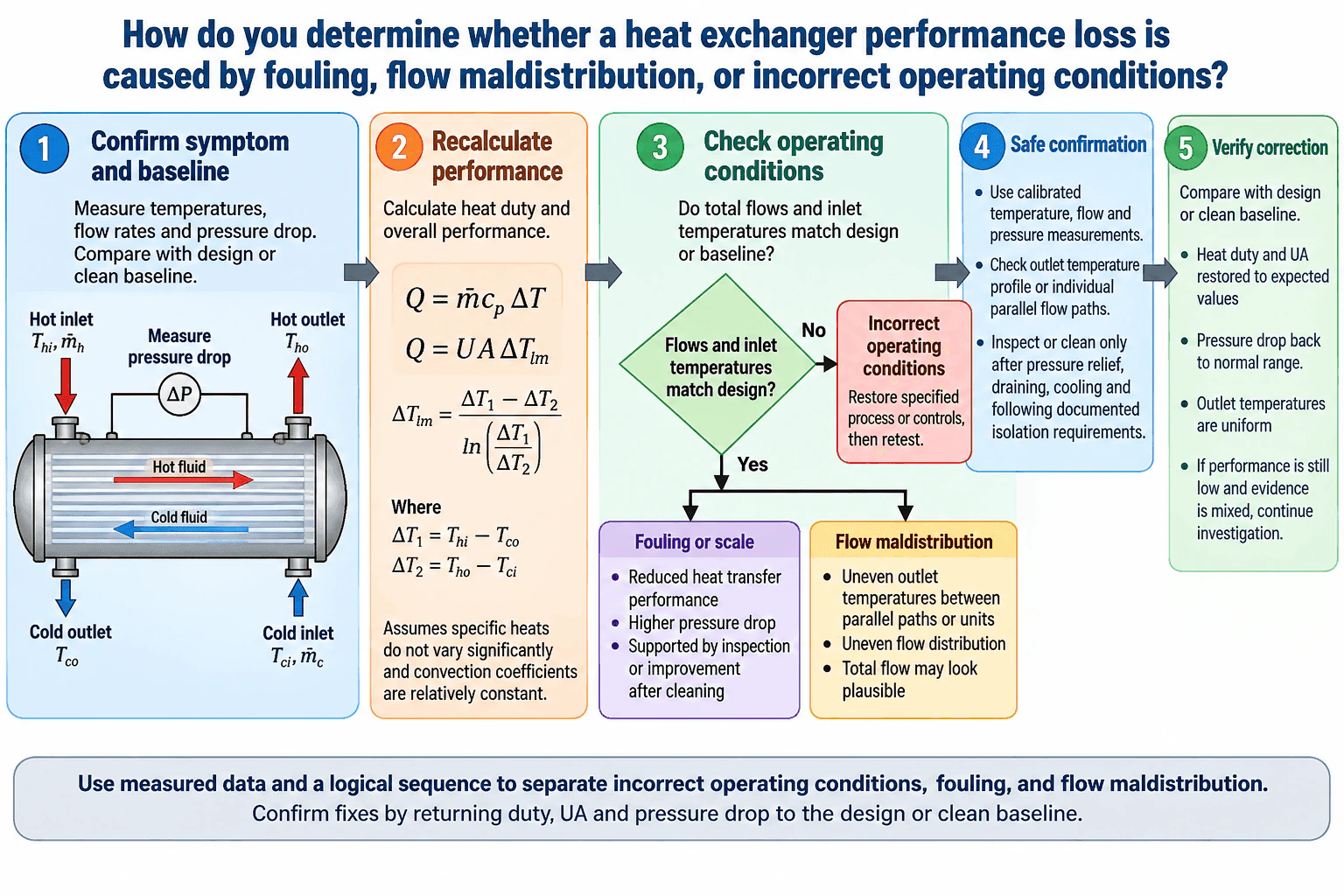
I would first confirm the performance loss with calibrated inlet and outlet temperatures, flow rates, and pressure drop, then compare those measurements with the design point or a known clean baseline. I would recalculate heat duty and UA using Q = ṁcpΔT and Q = UAΔTlm. If total flows or inlet temperatures do not match the required operating point, I would correct the operating conditions and retest. If the operating point is correct, reduced heat transfer performance with increased pressure drop and supporting inspection evidence suggests fouling, while uneven outlet temperatures or unequal parallel path flows suggest flow maldistribution. After any correction, I would repeat the measurements and verify that duty, UA, pressure drop, and outlet temperature distribution have returned toward the applicable baseline.
Detailed Explanation
The diagnosis should use measured thermal and hydraulic evidence together. Low heat exchanger duty alone does not identify the cause because fouling, maldistribution, and incorrect operating conditions can all reduce apparent performance. I would define the exchanger boundary and collect the hot and cold inlet temperatures, outlet temperatures, mass flow rates, and pressure drop using calibrated instruments. I would compare those values with the design condition or a documented clean baseline.
Useful Questions to Ask the Interviewer
Do we have the design data or a known clean baseline for flow rates, inlet temperatures, outlet temperatures, pressure drop, heat duty, and UA?
Are the fluid properties, total flow rates, and inlet temperatures currently close to the reference operating condition?
Does the exchanger have parallel channels, passes, headers, or units where individual flow or outlet temperature measurements are available?
How to Explain It in an Interview
First, I confirm the symptom instead of assuming the exchanger is dirty. I measure hot and cold inlet and outlet temperatures, mass flow rates, and pressure drop, then compare them with the design or clean baseline.
I calculate heat duty from each fluid side using Q = ṁcpΔT when cp can reasonably be treated as constant over the measured range. I also calculate the log mean temperature difference and compare effective UA using Q = UAΔTlm. The hot side and cold side duties should be reasonably consistent after accounting for measurement uncertainty and known heat losses.
Next, I check operating conditions. If total flow rates or inlet temperatures differ from the design or baseline, the performance loss may be caused by the operating point rather than an exchanger fault. I restore the specified process or control condition where appropriate, then retest.
If the operating conditions are correct, I separate the remaining hypotheses. Fouling is supported by reduced heat transfer performance, often with increased pressure drop, plus inspection evidence or a measurable improvement after cleaning. Pressure drop alone is not sufficient because it also depends on flow rate and fluid properties.
Flow maldistribution is more likely when total flow appears reasonable but outlet temperatures or individual parallel path flows are uneven. Restrictions, unequal hydraulic resistance, header distribution problems, or valve position can create this pattern.
Any inspection or cleaning should occur only after pressure relief, draining, cooling, and documented isolation according to the applicable procedure and requirements. After corrective action, I repeat the same measurements. I expect heat duty and UA to return toward the reference values, pressure drop to return toward its normal range, and outlet temperatures or parallel path behavior to become more uniform. If the evidence remains mixed, I continue the root cause investigation rather than forcing a conclusion.
Why Interviewers Ask This
Interviewers want to see whether you can separate a performance symptom from its physical cause using thermal and hydraulic evidence. They are evaluating whether you can establish a valid baseline, test competing explanations in a logical order, use safe confirmation methods, and verify that the corrective action actually restores expected exchanger performance.
Common interview mistakes
Common mistakes include blaming fouling from low duty alone, comparing current measurements with a design point that has different inlet conditions or flow rates, using pressure drop without considering flow rate and fluid properties, ignoring measurement uncertainty, assuming correct total flow means correct flow distribution, cleaning before collecting useful baseline evidence, and declaring the problem solved without repeating the original performance measurements.
Interview tip
Present the diagnosis as a sequence: confirm the symptom and baseline, recalculate duty and UA, check operating conditions, distinguish fouling from maldistribution using independent evidence, perform any inspection or cleaning under safe isolation, and verify the correction with the same measurements used to establish the problem.
Interviewer may ask next
What would you do if the heat duty calculated from the hot side does not agree with the heat duty calculated from the cold side?
I would resolve the energy imbalance before making a strong root cause conclusion. I would check temperature and flow sensor calibration, fluid properties, steady operating conditions, external heat losses, phase change, and whether every relevant stream is included within the analysis boundary. A large unexplained mismatch means the measurements or assumptions are not reliable enough to distinguish fouling from maldistribution confidently.
What if pressure drop remains normal but UA has decreased significantly?
Normal pressure drop does not rule out fouling. A deposit can add meaningful thermal resistance without yet creating a large hydraulic restriction, and fouling can also be localized. I would reconfirm the operating point, examine outlet temperature distribution for evidence of maldistribution, and use appropriate inspection or controlled cleaning evidence to determine whether surface fouling is responsible. I would base the conclusion on several consistent measurements rather than one indicator.
34. Tell me about a technical disagreement with a teammate and how you resolved it.BehavioralHard
Interview tip:
Use STAR to structure your answer: briefly explain the Situation and Task, make Action the most detailed part, and finish with the Result. For example, describe a thermal design decision where you and a teammate disagreed about the likely cause of a temperature problem, explain your responsibility, show how you compared assumptions and test data, describe how you kept the discussion focused on evidence instead of opinions, and explain how you reached a shared technical decision.
Situation
During a previous thermal project, a teammate and I disagreed about the main cause of a component running hotter than expected during testing. My teammate believed the issue came mainly from insufficient airflow. I believed the thermal interface between the component and its heat sink was also an important factor because the measured temperature rise did not fully match the airflow data.
Task
I was responsible for helping identify the cause and recommending a practical correction. I also wanted to resolve the disagreement without turning it into a personal argument because we both had reasonable technical points and the project needed a decision based on evidence.
Action
I first asked my teammate to walk me through the airflow measurements and assumptions behind the conclusion. I then explained my concern about the interface resistance, which is the resistance to heat flow where two surfaces touch. Instead of arguing about which explanation was correct, I suggested that we separate the possible causes and test them one at a time. We reviewed the temperature sensor locations, fan operating condition, airflow path, heat sink mounting, and interface material. I compared the measured temperatures with our thermal model and showed where the model differed from the test result. We then agreed to repeat the test after checking the heat sink mounting and interface contact while keeping the airflow condition unchanged. That gave us a cleaner comparison. When the new result showed that the interface condition had a meaningful effect, we also tested an airflow adjustment because my teammate's concern was still valid. I made sure we documented both findings and agreed on the final recommendation together.
Result
We resolved the disagreement by using test evidence instead of defending our original positions. The team corrected the interface condition and also improved the airflow path. The temperature behavior became more consistent with our expectations, and we had a clearer understanding of the thermal system. I learned that technical disagreements are most useful when I separate the people from the problem, make assumptions visible, and create a simple test that can distinguish between competing explanations.
Why Interviewers Ask This
Interviewers ask this question to understand how you handle technical conflict when another engineer has a different interpretation of the same problem. A strong answer shows that you listen carefully, explain your reasoning clearly, use data and testing to evaluate competing ideas, remain respectful, and focus on reaching the best engineering decision rather than proving that you were right.
Interviewer may ask next
How did you make sure your teammate did not feel that you were dismissing their technical opinion?
I started by asking my teammate to explain the airflow evidence and assumptions before presenting my own view. I also acknowledged that airflow could still be part of the problem. I suggested a test that could evaluate both explanations instead of trying to prove only my idea. That kept the discussion focused on the thermal behavior and made the final decision feel like a shared engineering conclusion.
What would you do differently if you faced a similar disagreement now?
I would make the key assumptions and available evidence visible earlier in the discussion. In this case, we reached that point after some debate. Now I would quickly list the possible causes, identify what data supports each one, and agree on the smallest test that can separate them. That would make the discussion more efficient while keeping the same collaborative approach.
35. Can you describe a difficult problem you solved in thermal engineering and what approach you took?BehavioralMedium
Interview tip:
Use STAR to structure your answer: briefly explain the Situation and Task, make Action the most detailed part, and finish with the Result. For example, describe a difficult thermal problem where expected temperatures did not match test results, explain your responsibility for finding the cause, show how you used data and thermal analysis to narrow the possible causes, describe how you worked with the team to verify the problem, and finish with the solution and what you learned.
Situation
During a previous project, we were testing a system that was operating hotter than expected. The thermal model predicted acceptable component temperatures, but the physical test showed a critical area getting close to its temperature limit. The difference between the model and the test results made the problem difficult because we first had to understand whether the issue came from the design, the model, or the test setup.
Task
I was responsible for finding the main cause of the temperature difference and recommending a practical solution. I also needed to make sure we did not change the design based on an incorrect assumption, so I wanted to separate measurement issues from real thermal behavior before proposing any hardware changes.
Action
I started by reviewing the temperature data and comparing the sensor locations with the thermal model. I checked whether the sensors were attached correctly and whether nearby heat sources could affect the readings. I then reviewed the model assumptions one at a time, including heat generation, contact resistance, airflow, and boundary temperatures. Contact resistance is the difficulty heat has when moving across the surfaces where two parts touch. I found that the model assumed better thermal contact between two parts than the hardware was actually providing. I worked with the test team to repeat the test with additional temperature measurements around that interface. The new data supported the same conclusion. I then updated the model with a more realistic contact condition and compared the prediction with the repeated test. The model and test results became much closer. Based on that evidence, I recommended improving the thermal interface rather than making a larger change to the cooling system. I explained the evidence, the remaining uncertainty, and the reason for the recommendation to the wider engineering team before we moved forward.
Result
The team corrected the thermal interface, and the following test showed that the critical area was operating within its required temperature range. We also had much better agreement between the model and the hardware. I learned that when analysis and test results disagree, I should not immediately assume that one of them is wrong. A better approach is to check measurements, assumptions, and physical interfaces in a structured way until the evidence points to the actual cause.
Why Interviewers Ask This
Interviewers ask this question to understand how a Thermal Engineer handles an unclear technical problem, especially when analysis and test data do not agree. A strong answer shows structured problem solving, technical judgment, ownership, careful use of evidence, communication with other engineers, and the ability to choose a practical solution instead of making unnecessary changes.
Interviewer may ask next
Why did you check the test setup before changing the thermal design?
I wanted to make sure the high temperature was real before recommending a design change. If a sensor was installed poorly or affected by a nearby heat source, changing the hardware could have added cost and complexity without solving the actual problem. Checking the measurement first gave me more confidence that the temperature difference represented real thermal behavior.
What would you do differently if you faced a similar problem again?
I would review the most uncertain model assumptions and physical interfaces earlier in the test planning process. In this case, the thermal contact between two parts had a large effect on the result. I would also plan a few extra measurement points around important interfaces so that we could compare the model and the hardware more quickly if the results did not agree.
36. Tell me about a time you had to use innovation to solve a problem. What resources did you use?BehavioralEasy
Interview tip:
Use STAR to structure your answer: briefly explain the Situation and Task, make Action the most detailed part, and finish with the Result. For example, describe a thermal problem where the normal solution was not practical, explain how you used available test data, engineering tools, technical references, and input from teammates to develop a creative solution, and show how you verified that the solution addressed the problem.
Situation
During a previous project, I was supporting thermal testing of an electronic assembly. The measured component temperature was higher than expected, but the schedule did not allow us to redesign the full cooling system. I needed to understand whether the problem came from the design itself or from the way heat was moving through the test setup.
Task
My responsibility was to identify the main heat path, find a practical way to reduce the component temperature, and make sure any proposed change could be verified with the resources we already had.
Action
I first reviewed the thermocouple data and compared the measured temperature pattern with the expected thermal behavior. I also reviewed the existing CAD model, material properties, component data sheets, and our earlier thermal calculations. That helped me see that part of the heat was being trapped near the component because the local airflow was weak and a nearby structure was limiting heat transfer. Instead of proposing a major mechanical redesign, I looked for a simpler way to improve the local heat path. I used our thermal analysis software to test several concepts and then discussed the most practical options with the mechanical and test engineers. Based on that work, I proposed a small conductive path that moved heat from the hot area into an existing metal structure that had more surface area for cooling. I used available material samples and standard hardware to build a simple prototype. I then repeated the thermal test using the same sensor locations and test conditions so the comparison would be meaningful. I also checked nearby components to make sure the change did not simply move the thermal problem somewhere else. The main resources I used were test data, CAD, thermal analysis tools, component and material data sheets, available prototype materials, and the experience of the mechanical and test teams.
Result
The prototype reduced the local temperature and produced a more balanced thermal pattern without requiring a major redesign. The team used the test results to move forward with a refined version of the concept. I learned that innovation does not always mean creating something completely new. In engineering, it can mean understanding the real constraint, using the resources already available, and combining them in a simpler and more effective way.
Why Interviewers Ask This
Interviewers ask this question to understand how a candidate solves problems when the standard approach is not enough. They want to see whether the candidate can use available information and resources creatively, make sound engineering decisions, work with others, and verify that an innovative idea actually solves the problem.
Interviewer may ask next
Why did you choose the conductive path instead of changing the entire cooling system?
I chose it because the test data showed that the problem was concentrated in one area, while the rest of the cooling system was performing reasonably well. A full redesign would have added more time, cost, and risk. The conductive path addressed the specific heat transfer problem and could be tested quickly with materials we already had.
How did you make sure your solution did not create a new thermal problem somewhere else?
I repeated the test under the same conditions and monitored both the original hot component and the nearby components. I compared the temperature pattern before and after the change instead of looking at only one sensor. That helped me confirm that the added heat path improved the local condition without creating another obvious hot area.
Disclaimer: This interview guide is for educational and informational purposes only. It is designed to help readers prepare, but it does not guarantee any interview result, hiring decision, offer, or outcome. Interview questions, hiring criteria, and preferred answers can vary by employer, interviewer, industry, location, and time. All answers, examples, and explanations in this guide are suggested examples for interview preparation, not definitive answers or instructions for professional practice. They are based on research and judgment, are provided without warranties of any kind, and should be adapted to the question, role, and applicable laws and professional requirements. Diagrams are simplified illustrations intended to highlight the main concepts and their relationships; actual situations, systems, and practices may be more complex. Alternative approaches may be equally valid or better suited to a particular question, context, or interviewer. To the fullest extent permitted by applicable law, the contributors and publisher are not liable for decisions made, actions taken, or losses incurred based on this guide.
State Laws and Professional Responsibilities: Laws and requirements governing an occupation vary by state and jurisdiction. You are responsible for checking the current laws, licensing requirements, and scope-of-practice rules that apply to your location and role, and for ensuring that your answers and actions comply with them. Adapt examples in this guide to those requirements. This guide is not legal advice.
Content Accuracy and Verification: To the fullest extent permitted by applicable law, we do not represent or warrant that interview guides, questions, answers, examples, or diagrams are accurate, complete, current, error-free, or suitable for any particular purpose. You are responsible for independently reviewing and verifying the information before relying on it.