This interview guide is for educational and informational purposes only. It is designed to help readers prepare, but it does not guarantee any interview result, hiring decision, offer, or outcome. Interview questions, hiring criteria, and preferred answers can vary by employer, interviewer, industry, location, and time. All answers, examples, and explanations in this guide are suggested examples for interview preparation, not definitive answers or instructions for professional practice. They are based on research and judgment, are provided without warranties of any kind, and should be adapted to the question, role, and applicable laws and professional requirements. Diagrams are simplified illustrations intended to highlight the main concepts and their relationships; actual situations, systems, and practices may be more complex. Alternative approaches may be equally valid or better suited to a particular question, context, or interviewer. To the fullest extent permitted by applicable law, the contributors and publisher are not liable for decisions made, actions taken, or losses incurred based on this guide.
State Laws and Professional Responsibilities
Laws and requirements governing an occupation vary by state and jurisdiction. You are responsible for checking the current laws, licensing requirements, and scope-of-practice rules that apply to your location and role, and for ensuring that your answers and actions comply with them. Adapt examples in this guide to those requirements. This guide is not legal advice.
Identity, Image, and Privacy Notice
To respect individual privacy, some names, profile photographs, avatars, biographical details, and other identifying information displayed in this guide may be replaced with pseudonyms, licensed stock images, illustrative avatars, composite images, or representative descriptions. Unless a person is expressly identified as an actual contributor, a displayed name, image, or profile should not be understood as depicting or identifying a specific candidate, interviewer, employee, or other real individual. These representations are provided for editorial and illustrative purposes only and do not imply endorsement, employment, participation, or affiliation with this guide or any company mentioned in it. Any resemblance to an actual person is coincidental.
Company Notice
This guide is an independent educational resource and is not affiliated with, endorsed by, sponsored by, or approved by the company named in this guide. Company names identify reported interview experiences or the employer context of clearly labeled original practice exercises. Interview practices can change without notice, and inclusion of company-specific content does not mean these questions are official, complete, or guaranteed to be asked. To the fullest extent permitted by law, the author, contributors, and publisher are not responsible for outcomes related to use of this material.
Content Accuracy and Verification
To the fullest extent permitted by applicable law, we do not represent or warrant that interview guides, questions, answers, examples, or diagrams are accurate, complete, current, error-free, or suitable for any particular purpose. You are responsible for independently reviewing and verifying the information before relying on it.
Questions or comments?
Contact us for general questions, or share feedback, technical corrections, and comments with the community.
1. What is the difference between load and force?NEWEngineering MechanicsEasyBosch
Short Interview Answer (30-60 seconds)
A force is a push or pull acting on an object and is measured in newtons. A load describes how one or more forces, moments, or distributed actions are applied to a component or structure. For example, a 1,000 N downward force applied to a bracket is a force, while from the bracket's perspective it is part of the applied load. Loads can also be static, dynamic, cyclic, concentrated, distributed, axial, bending, or torsional. So, force is the physical quantity, while load describes the engineering loading condition.
Detailed Explanation
A force is a physical interaction that can change the motion of a body or deform it. In SI units, force is measured in newtons, N. Newton's second law relates the net force on a body to its mass and acceleration as F = ma.
A load is the engineering description of the external actions applied to a body, component, or structure. A load may consist of a single force, several forces, an applied moment, a distributed force, or a combination of these. The term also describes how those actions are applied in space and how they vary with time.
For example, suppose a bracket supports equipment that applies a downward force of 1,000 N. The 1,000 N value is a force. From the bracket's point of view, that force is part of its applied loading condition. Depending on the geometry, point of application, and supports, the load may create shear force, axial force, and bending moment within the bracket.
Loads are commonly classified by how they act. A static load changes slowly enough that inertia effects are negligible. A dynamic load varies in a way that makes acceleration or inertia effects important. A concentrated load is idealized as acting at a point, while a distributed load acts over a length, area, or volume. A cyclic load repeatedly varies and may be important for fatigue. Impact loading acts over a short time and can produce significant dynamic effects compared with a slowly applied load of similar magnitude.
The free-body boundary is important. A force that is external to one selected body may represent an interaction between components when a larger assembly is considered. Before solving a mechanics problem, I would define the body being analyzed, identify the external forces and moments, specify the supports and coordinates, and then decide whether static equilibrium or equations of motion are appropriate.
Useful Questions to Ask the Interviewer
Are we discussing a single applied force or the complete loading condition on a component?
Is the loading static, dynamic, cyclic, or impact loading?
Is the load concentrated at a point or distributed over a length or area?
Should applied moments or torque be included in the loading condition?
How to Explain It in an Interview
I would say that force is the fundamental physical quantity, while load describes the engineering condition created by applying forces, moments, or distributed actions to a system. I would then give a simple example: if a 1,000 N force acts downward on a beam, 1,000 N is the force, while the beam experiences that force as part of its applied load. I would also mention that engineers classify loads as static, dynamic, concentrated, distributed, cyclic, impact, axial, bending, or torsional because the type and application of the load determine the reactions, internal forces, deformation, stress, fatigue behavior, and possible failure modes.
Technical Approach
Define the body or component being analyzed and establish the free-body boundary.
Identify all external forces, moments, support reactions, and distributed actions.
Describe the external actions collectively as the loading condition on the body.
Classify the load as static or dynamic and, when relevant, as concentrated, distributed, cyclic, impact, axial, shear, bending, or torsional.
Choose static equilibrium equations or equations of motion based on whether acceleration and inertia effects are significant.
Check units, directions, sign conventions, and boundary conditions before calculating reactions, internal forces, stresses, deformation, or motion.
Practical Insights
The main engineering consideration is that a single force value does not fully describe how demanding a loading condition is. The same force can produce very different reactions, stresses, and deformation depending on where it acts, its direction, how quickly it changes, the geometry, and the support conditions. A static approximation may be sufficient for slowly applied loading when inertia effects are negligible, while dynamic, impact, or cyclic loading may require additional analysis.
Why Interviewers Ask This
Interviewers want to confirm that the candidate understands basic mechanics terminology and can distinguish a fundamental physical quantity from the engineering loading condition used to analyze a component or structure. This distinction matters when creating a free body diagram, calculating support reactions, determining stresses, and evaluating how a component responds to its operating conditions.
Common interview mistakes
A common mistake is treating the words force and load as exactly interchangeable in every context. Another is assuming that a load must be a single point force, even though a loading condition may include distributed forces or applied moments. Candidates may also ignore whether a load is static, dynamic, or cyclic, or forget that boundary conditions, force direction, and point of application can change the resulting internal forces and stresses.
Interview tip
Start with the simple distinction: force is the physical push or pull, while load describes how forces, moments, or distributed actions are applied to the engineering system. Then give one concrete example and explain that the way the load is applied determines the resulting reactions, stresses, deformation, and possible failure modes.
Interviewer may ask next
How would you determine whether a load can be treated as static?
I would consider how quickly the load changes compared with the response of the system. If it is applied slowly enough that acceleration and inertia effects are negligible, it can usually be analyzed with static equilibrium, such as ΣF = 0 and ΣM = 0. If the loading changes rapidly, causes significant acceleration, or excites vibration, I would treat it as dynamic and use an appropriate equations-of-motion model. I would verify the actual operating conditions rather than classifying the load from its magnitude alone.
Can the same force produce different effects on a component?
Yes. The effect depends on the force direction, point of application, geometry, and boundary conditions. For example, a force applied along the axis of a member may primarily produce axial stress, while the same force magnitude applied perpendicular to the member and away from a support may produce shear and bending. If the force varies repeatedly or is applied rapidly, fatigue or dynamic effects may also become important.
2. How do trains take turns, though there is no differential?NEWEngineering MechanicsMediumBosch
Short Interview Answer (30-60 seconds)
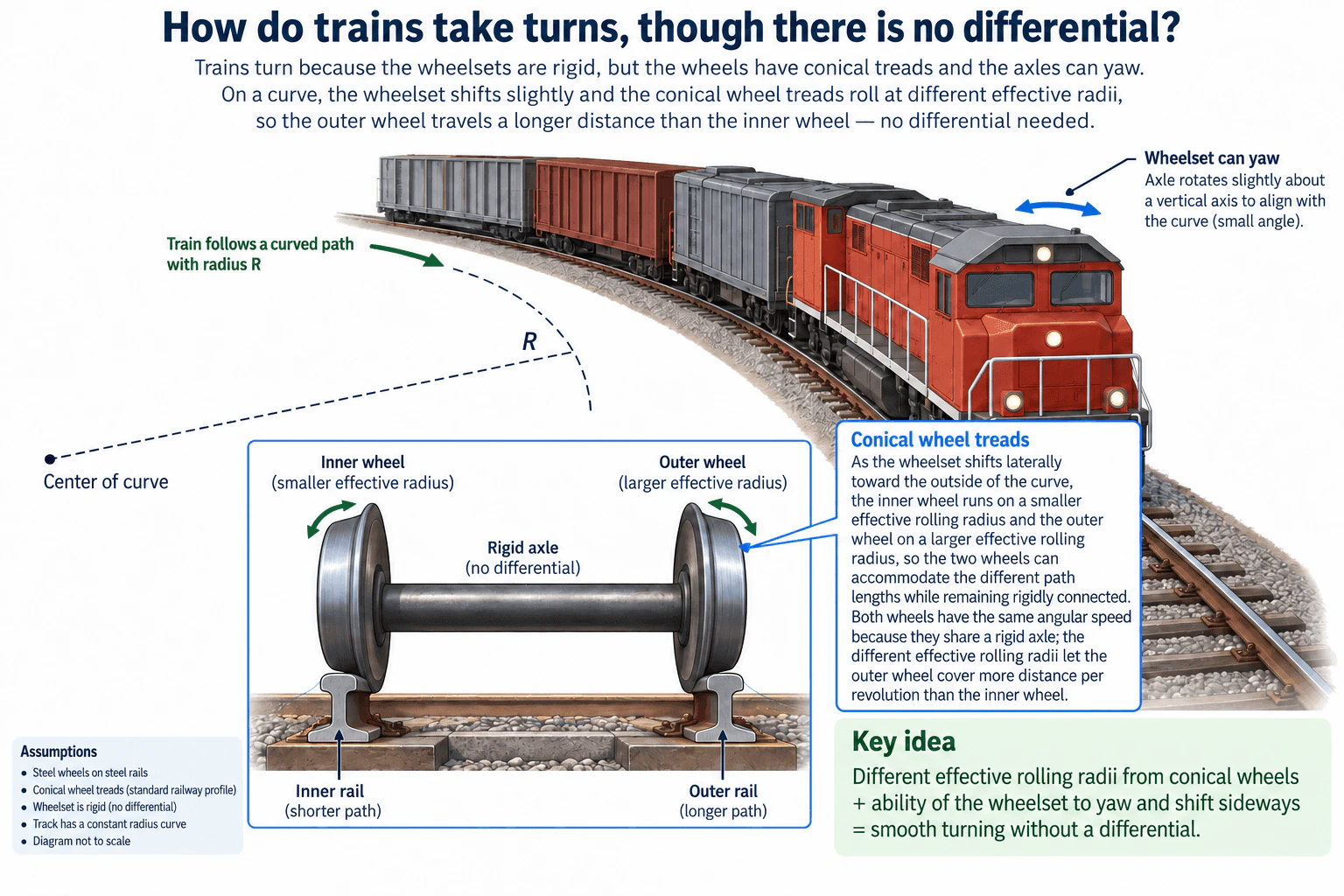
Train wheels on a conventional wheelset are rigidly connected, so both wheels rotate at the same angular speed. They do not need a differential because the wheel treads are conical or profiled. On a curve, the wheelset shifts slightly sideways so the outer wheel runs on a larger effective rolling radius and the inner wheel on a smaller one. The outer wheel therefore covers more distance per revolution even though both wheels turn together. The wheelset can also yaw slightly to align with the curve and reduce unnecessary slip.
Detailed Explanation
A train does not negotiate a curve in the same way as a road vehicle. A conventional railway wheelset has two wheels rigidly fixed to one axle, so there is no differential and both wheels have the same angular speed.
The important idea is that the wheel treads are not simple cylinders. They are conical or specially profiled. On a curve, the wheelset can shift slightly sideways relative to the rails. For the curve shown, that lateral shift is toward the outside of the curve. This changes the effective rolling radius at each wheel-rail contact: the outer wheel runs on a larger effective radius, while the inner wheel runs on a smaller effective radius.
If the axle angular speed is ω, the rolling distance for one revolution is determined by the effective rolling radius:
outer-wheel distance = 2πr_outer
inner-wheel distance = 2πr_inner
with r_outer > r_inner.
Both wheels still complete the same number of revolutions because they share one rigid axle. However, the larger effective radius of the outer wheel means that it covers more distance during each revolution. That matches the longer path of the outer rail, while the smaller effective radius of the inner wheel matches the shorter inner-rail path. Therefore, different wheel angular speeds are not required.
The wheelset can also yaw slightly about a vertical axis so that it aligns more closely with the direction of the curved track. This helps reduce the angle of attack and unnecessary lateral slip. On broad curves, the combination of different effective rolling radii and limited yaw allows relatively smooth curving. On tighter curves, the available rolling-radius difference may not be sufficient, so wheel-rail creep, flange contact, higher lateral forces, noise, and wear can occur.
Useful Questions to Ask the Interviewer
Are we discussing a conventional solid railway wheelset rather than independently rotating wheels?
Should I explain only the ideal kinematics, or also discuss real wheel-rail creep and flange contact on tight curves?
Can I assume standard conical or profiled railway wheel treads and limited wheelset yaw?
How to Explain It in an Interview
Start with the key constraint: both wheels are locked to the same axle, so they must have the same angular speed. Then resolve the apparent contradiction using rolling radius. Because the wheel treads are conical or profiled, a slight lateral shift of the wheelset toward the outside of the curve makes the outer wheel run on a larger effective radius and the inner wheel run on a smaller effective radius. With the same axle rotation, the outer wheel therefore covers more distance per revolution. The wheelset can also yaw slightly to align with the curve. Conclude by noting that this is an idealized explanation and that tight curves can still produce creep and flange contact.
Technical Approach
Define the system as one conventional rigid wheelset with two wheels fixed to a common axle.
Apply the kinematic constraint that both wheels have the same angular speed, ω.
Recognize that the outer rail follows a longer path than the inner rail on a curve.
Use the conical or profiled tread geometry: lateral wheelset displacement toward the outside of the curve produces a larger effective rolling radius on the outer wheel and a smaller effective rolling radius on the inner wheel.
Compare rolling distances per revolution using s = 2πr.
Verify that r_outer > r_inner gives the outer wheel a greater rolling distance per revolution without requiring a different angular speed.
Include limited wheelset yaw as a mechanism that helps align the wheelset with the curved track.
Check the limiting case: if the curve is too tight for the available rolling-radius difference and yaw freedom, expect creep, flange contact, higher lateral forces, and increased wear.
Practical Insights
The main engineering tradeoff is between self-steering behavior and wheel-rail contact performance. A useful rolling-radius difference helps a rigid wheelset negotiate curves with less longitudinal slip, but the wheel profile must also provide stable behavior on straight track and acceptable contact stresses and wear. Wheelset yaw helps alignment with a curve, but suspension characteristics and track geometry limit that motion. On tight curves, the ideal rolling-radius difference may be insufficient, so creep forces and flange contact increase.
Why Interviewers Ask This
This question tests whether the candidate can explain a mechanical system from first principles instead of incorrectly applying an automobile differential model to railway wheelsets. A strong answer should recognize the rigid axle constraint, distinguish angular speed from rolling distance, explain how conical or profiled treads create different effective rolling radii, and understand how wheelset yaw and wheel-rail contact influence real curving behavior.
Common interview mistakes
A common mistake is saying that the two wheels on a conventional wheelset rotate at different angular speeds. They are rigidly attached to the same axle, so their angular speeds are the same. Another mistake is saying that bogie or wheelset yaw alone provides the differential effect; yaw helps alignment, but the different effective rolling radii created by the wheel-tread geometry allow different rolling distances at the same axle rotation. It is also incorrect to assume that every curve is negotiated with perfect pure rolling and no lateral forces. Tight curves can produce creep, flange contact, noise, and wear.
Interview tip
Lead with the constraint: "Both wheels are fixed to the same axle, so they have the same angular speed." Then resolve the apparent contradiction with one relationship: distance per revolution is 2πr. Explain that conical or profiled wheel treads create a larger effective rolling radius on the outer wheel and a smaller one on the inner wheel, so the outer wheel travels farther without a differential. Finish by mentioning limited wheelset yaw and the possibility of creep or flange contact on tight curves.
Interviewer may ask next
What assumption would you validate before using the ideal rolling-radius explanation for a real train?
I would first confirm that the vehicle uses a conventional rigid wheelset with suitable conical or profiled treads and that the curve is broad enough for the available lateral displacement and rolling-radius difference to accommodate most of the required path-length difference. For a real vehicle, I would then check the actual wheel and rail profiles, curve radius, track gauge, suspension constraints, wheelset yaw, contact conditions, and evidence of creep or flange contact rather than assuming perfect pure rolling.
What changes when the train enters a very tight curve?
A tighter curve increases the difference between the required outer- and inner-rail path lengths. The available difference in effective rolling radii may no longer be sufficient, and the wheelset may not align perfectly with the track. The result can be larger creep forces, a greater angle of attack, flange contact, increased lateral forces, noise, and wear. Wheel and rail profiles, suspension characteristics, bogie geometry, and curve geometry then become increasingly important.
3. Can you explain the function of bearings and the importance of lubrication in mechanical systems?NEWMechanical DesignEasyBosch
Short Interview Answer (30-60 seconds)
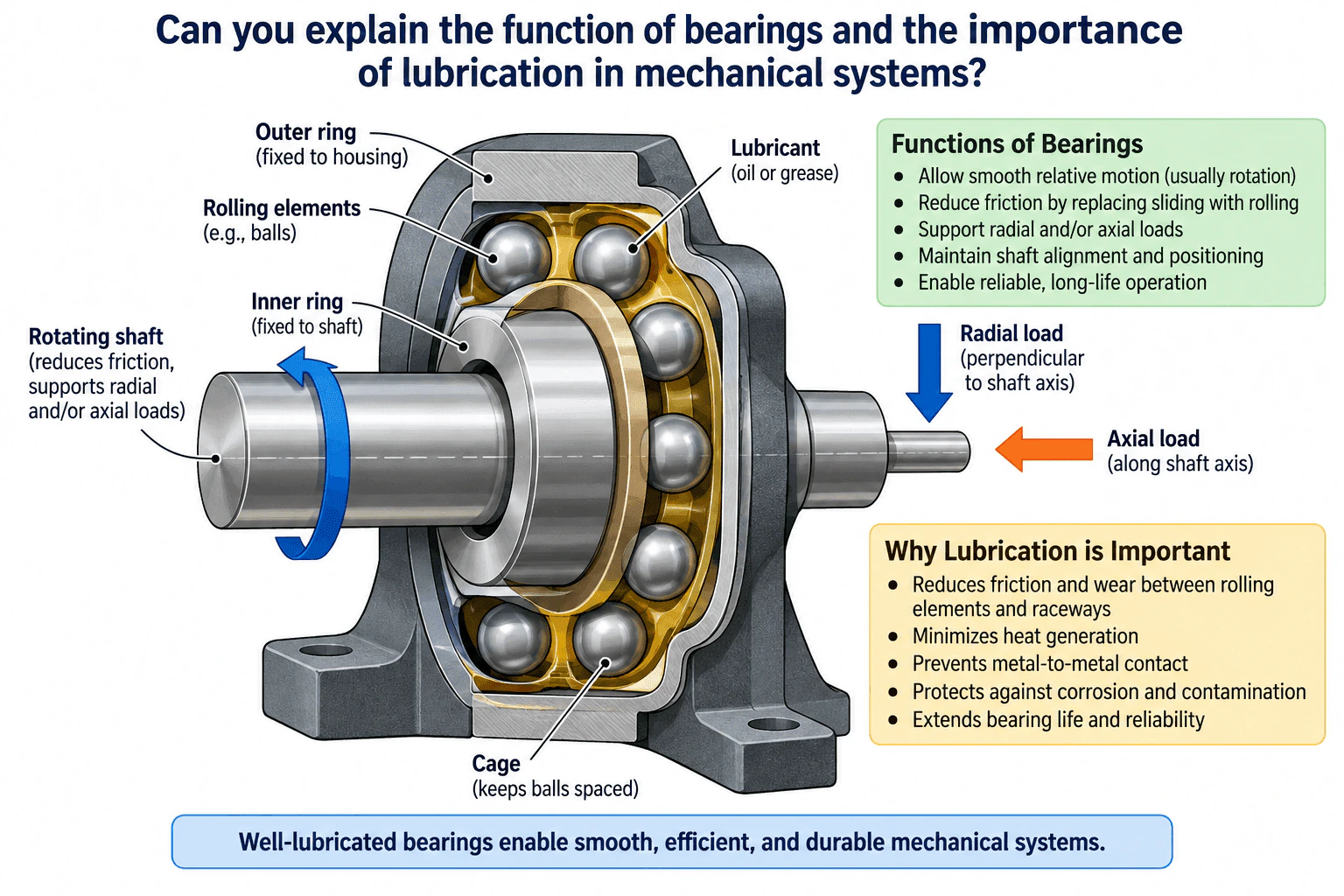
A bearing supports and positions a rotating shaft while allowing low-friction relative motion between the shaft and housing. Depending on the bearing type, it can carry radial loads, axial loads, or both. In a rolling-element bearing, the inner ring normally fits on the shaft, the outer ring is supported by the housing, balls or rollers transfer the load, and the cage keeps the rolling elements spaced. Lubrication is critical because oil or grease creates a film at the rolling and sliding contacts, reducing friction, wear, and heat while helping prevent metal-to-metal contact, corrosion, and contamination. Good bearing selection and proper lubrication give smoother operation, higher reliability, and longer service life.
Detailed Explanation
Bearings provide a controlled interface between moving and stationary machine parts. In a typical shaft-and-housing arrangement, the shaft rotates, the bearing inner ring is fitted to the shaft, and the outer ring is supported by the housing. Rolling elements such as balls transfer load between the rings while allowing the shaft to rotate with relatively low friction. A cage keeps the rolling elements spaced correctly.
A bearing may carry a radial load, which acts perpendicular to the shaft axis, an axial or thrust load, which acts along the shaft axis, or a combination of both. A deep-groove ball bearing is a common example that can support radial load and axial load in either direction within its design limits. The exact bearing type must still be selected from the actual load magnitude and direction, speed, stiffness, alignment, available space, operating environment, and required life.
Lubrication is just as important as the bearing itself. Oil or grease forms a lubricant film at the rolling and sliding contacts between the rolling elements, raceways, cage interfaces, and other contacting surfaces. This film reduces direct surface interaction, friction, wear, and heat generation. Lubrication also helps protect bearing surfaces from corrosion and, together with an appropriate sealing arrangement, can help keep contaminants away from critical contacts. The lubricant type, viscosity, quantity, delivery method, relubrication interval, temperature range, speed, and sealing arrangement must match the application. Too little lubricant can cause inadequate film formation and rapid wear, while excessive lubricant can increase churning, temperature, and energy loss.
Useful Questions to Ask the Interviewer
What loads must the bearing carry: radial, axial, or combined?
What are the shaft speed, operating temperature, and expected duty cycle?
Is the environment clean, dusty, wet, chemically aggressive, or exposed to vibration or shock?
What shaft and housing fits, alignment limits, space constraints, and service-life targets apply?
Is grease preferred for simple retention and lower maintenance, or is oil circulation needed for cooling, high speed, or continuous lubricant supply?
What inspection or relubrication access is available during service?
How to Explain It in an Interview
I would start with the load path. The external load enters through the shaft or housing, passes through one bearing ring, the rolling elements, and the opposite ring, and then reaches the supporting structure. Radial load acts perpendicular to the shaft axis, while axial load acts along it. The bearing therefore has two main jobs: support and position the rotating component, and allow controlled low-friction relative motion.
Next, I would select the bearing concept from the actual requirements instead of choosing a type by habit. I would check radial and axial load capacity, speed capability, stiffness, alignment sensitivity, available space, shaft and housing interfaces, expected life, manufacturing tolerances, installation method, sealing, maintenance access, and cost. Fits must prevent unwanted ring creep while avoiding excessive interference that could reduce internal clearance or increase operating temperature.
Then I would define the lubrication strategy. The goal is to maintain an adequate lubricant film at the contacts over the full operating range. Grease is often attractive because it stays in place, can simplify retention and sealing, and may reduce lubrication-system complexity. Oil can be preferable when heat removal, high speed, filtration, or continuous lubricant circulation is important. The final choice depends on speed, load, temperature, contamination, orientation, service interval, and manufacturer guidance.
Important failure modes include lubricant starvation, unsuitable lubricant viscosity, contamination, corrosion, excessive temperature, incorrect fit, misalignment, overload, poor installation, and lubricant overfill. These can lead to increased friction, wear, surface damage, noise, vibration, and shortened bearing life.
Before releasing the design, I would validate the bearing arrangement under representative load, speed, temperature, and environmental conditions. I would monitor temperature, vibration, noise, lubricant condition, leakage, and evidence of contamination or abnormal wear. If validation shows excessive temperature, wear, or vibration, I would revisit bearing selection, fits, alignment, sealing, lubricant choice, lubricant quantity, and lubrication interval. The main design principle is that the bearing and lubrication system must be engineered together because even a correctly selected bearing can fail prematurely if lubrication is inadequate.
Why Interviewers Ask This
Interviewers want to see whether the candidate understands the mechanical interface between a rotating shaft and a stationary housing, how rolling-element bearings support radial and axial loads, and why lubrication is essential to friction control, wear prevention, heat management, corrosion protection, contamination control, reliability, and service life. They are also checking whether the candidate can connect basic bearing function to practical design decisions such as bearing type, fit, lubricant choice, operating environment, maintenance, and validation.
Interviewer may ask next
How would you validate that the bearing and lubrication system are working correctly?
I would test the assembled system under representative radial and axial loads, speed, duty cycle, temperature, and environmental conditions. I would establish expected acceptance limits before the test and monitor bearing temperature, vibration, noise, shaft behavior, lubricant leakage, and lubricant condition. After an appropriate test interval, I would inspect for abnormal wear, discoloration, contamination, corrosion, or surface damage. If temperature or vibration rises unexpectedly, I would investigate alignment, shaft and housing fits, bearing internal clearance, lubricant type and quantity, sealing, contamination, and actual load before approving the design.
How would your design change if the shaft speed or operating temperature increased significantly?
I would recheck the bearing speed capability, internal clearance, cage suitability, lubricant viscosity at operating temperature, heat generation, sealing method, and required lubricant delivery. Higher speed can increase frictional heating and may make controlled oil delivery more attractive than grease in some applications. Higher temperature can reduce lubricant viscosity and grease life, change fits through thermal expansion, and affect seals and bearing materials. I would therefore recalculate the operating conditions, follow the bearing and lubricant manufacturers' limits, and validate the revised arrangement at the new speed and temperature rather than assuming the original design remains acceptable.
4. What will happen if petrol is fed to diesel engine and diesel is fed to petrol engine?NEWTroubleshooting And Failure AnalysisMediumBosch
i Question Details
Will either engine run?
Short Interview Answer (30-60 seconds)
A diesel engine is designed for compression ignition, while a petrol engine uses a spark to ignite a prepared air-fuel mixture. Petrol in a diesel engine can cause difficult starting, misfire, excessive ignition delay, harsh combustion, power loss, and reduced lubrication of fuel-system components. Diesel in a petrol engine vaporizes poorly under normal petrol-engine conditions and may cause rough running, smoke, spark-plug fouling, stalling, or a no-start condition. A very small contamination may still allow an engine to run, but with significant wrong fuel, either engine may stop or fail to start, so the correct response is to remove the contaminated fuel rather than continue operating it.
Detailed Explanation
The key is that the two engines rely on different fuel properties and ignition methods. A diesel engine compresses air until its temperature is high enough for injected diesel fuel to auto-ignite. Diesel fuel is therefore selected for good compression-ignition behavior and also provides lubricity to parts of many diesel fuel systems. Petrol has very poor cetane quality compared with diesel fuel and is formulated to resist uncontrolled auto-ignition in a spark-ignition engine. If petrol is fed into a diesel engine, ignition can be delayed or irregular, producing difficult starting, misfire, harsh combustion, loss of power, or a no-start condition. Petrol also has lower lubricity than diesel fuel, which can increase the risk of wear or damage in diesel pumps and injectors, particularly in high-pressure systems.
A petrol engine normally meters a relatively volatile fuel that vaporizes readily, mixes with air, and is then ignited by a spark plug. Diesel fuel is less volatile and does not form the intended combustible mixture as readily under normal petrol-engine operating conditions. If diesel enters a petrol engine, combustion may become incomplete or inconsistent. Likely symptoms include difficult starting, rough running, loss of power, smoke, spark-plug fouling, stalling, or a complete no-start. The exact behavior depends on the contamination ratio, temperature, engine technology, and whether the wrong fuel has already reached the injectors or cylinders.
From a troubleshooting viewpoint, I would separate the symptom from the root cause. A misfueled vehicle might initially present as a no-start, misfire, smoke complaint, loss of power, or abnormal combustion, but replacing ignition or injection components without first confirming the fuel would miss the actual cause. Useful evidence includes the fueling history, an appropriate fuel sample, diagnostic trouble codes where available, observed combustion symptoms, and inspection of affected fuel-system components after contamination is confirmed.
If the engine has not been started after significant misfuelling, avoiding operation usually reduces the chance of spreading the incorrect fuel through the system. The contaminated fuel should be removed and the system restored with the specified fuel using the applicable service procedure. If the engine has already been operated, the diagnosis should also consider whether pumps, injectors, filters, spark plugs, exhaust-aftertreatment components, or other parts were affected. Any repair should be verified by confirming correct fuel, normal starting and running, absence of abnormal combustion symptoms, and appropriate diagnostic results under representative operating conditions.
Useful Questions to Ask the Interviewer
Are we considering a small amount of cross-contamination or a tank containing mostly the wrong fuel?
Has the engine already been started or driven after the misfuelling?
Is the diesel engine a modern high-pressure common-rail system or an older fuel system?
Are there symptoms such as harsh combustion, smoke, misfire, loss of power, or a no-start condition?
These details matter because the quantity of contamination, engine design, and whether the fuel has circulated determine both the likely symptoms and the potential damage.
How to Explain It in an Interview
I would first state that petrol and diesel engines use different ignition principles and therefore require fuels with different properties. Petrol in a diesel engine has poor compression-ignition quality and can reduce fuel-system lubrication, so the engine may misfire, experience excessive ignition delay or harsh combustion, lose power, fail to start, or damage pumps and injectors. Diesel in a petrol engine does not vaporize properly for normal spark-ignition operation, so it can cause incomplete combustion, rough running, smoke, plug fouling, stalling, or no start. Whether the engine runs at all depends mainly on how much wrong fuel is present and the engine design. I would confirm the fuel contamination before replacing components, remove the incorrect fuel, inspect for any resulting damage, and verify normal operation after the system is restored.
Technical Approach
Establish safe conditions and determine whether the engine has been started or driven after the suspected misfuelling.
Confirm the intended fuel type and obtain the fueling history instead of assuming the symptom is an ignition- or injection-component failure.
Inspect or sample the fuel using the appropriate service method to confirm contamination.
Identify the observed failure mode: no start, misfire, harsh or abnormal combustion, smoke, rough running, stalling, or loss of power.
Relate the failure mode to the likely mechanism: poor compression-ignition behavior and reduced lubricity for petrol in a diesel system, or poor vaporization and incomplete combustion for diesel in a petrol system.
Determine how far the contaminated fuel has circulated and inspect affected components where justified by the evidence.
Remove the contaminated fuel and restore the system with the specified fuel according to the applicable service procedure.
Perform a verification test by checking starting, idle, load response, abnormal noise or smoke, and relevant diagnostic information.
If symptoms remain, continue root-cause analysis rather than assuming every remaining fault was caused by the fuel contamination.
Practical Insights
The severity is not determined only by which fuels were mixed. The contamination ratio, engine design, fuel-system pressure, operating time, temperature, and whether the wrong fuel reached the high-pressure pump, injectors, cylinders, exhaust system, or spark plugs all affect the outcome. Petrol contamination can be especially serious for diesel fuel-system lubrication and compression-ignition behavior, while diesel contamination in a petrol engine mainly creates poor mixture preparation and incomplete combustion. Therefore, a small contamination may produce different symptoms from a nearly complete wrong-fuel fill.
Why Interviewers Ask This
The interviewer is testing whether the candidate understands the different ignition principles of petrol and diesel engines and can connect fuel properties to symptoms, failure mechanisms, diagnostic evidence, and a sensible corrective action without jumping directly to component replacement.
Common interview mistakes
Common mistakes are saying that either engine will definitely run or definitely not run without considering the contamination amount; assuming petrol and diesel differ only in octane or cetane rating; ignoring the lubricity risk of petrol in a diesel fuel system; describing diesel in a petrol engine as if the spark alone guarantees normal combustion; replacing injectors, plugs, or pumps before confirming the fuel; and continuing to operate an engine with known significant contamination, which can spread the wrong fuel and increase the risk of damage.
Interview tip
Start with the ignition principle: diesel uses compression ignition and petrol uses spark ignition. Then connect the wrong fuel to its physical failure mechanism and expected symptoms. Finish with the diagnostic response: confirm the contamination, avoid unnecessary operation, remove the wrong fuel, inspect components according to the evidence, and verify the repair. Also state that whether the engine runs depends on the contamination ratio and engine design rather than giving an absolute yes-or-no answer.
Interviewer may ask next
How would you confirm that wrong fuel is actually the root cause rather than an injector or ignition-system fault?
I would first obtain the fueling and service history, then confirm the fuel in the tank or fuel system with an appropriate sample or service test. I would compare that evidence with the symptoms and diagnostic information. If the fuel is incorrect, I would treat it as the primary suspected cause before replacing components. After removing the contamination and restoring the correct fuel, I would repeat the starting and operating tests. If the original symptoms disappear, that supports the diagnosis; if they remain, I would continue testing for component damage or an independent fault.
Would the outcome change if only a very small amount of the wrong fuel were added?
Yes. A small amount of contamination may still allow the engine to run and can produce less severe symptoms than a high concentration of the wrong fuel. However, there is no universal safe contamination percentage because acceptable limits depend on the engine and fuel-system design. I would therefore avoid choosing an arbitrary dilution limit and follow the applicable manufacturer or service guidance for the specific engine.
5. Do you see yourself as a team player or lone wolf?NEWBehavioralEasyBosch
i Question Details
Discuss how you prefer to work.
Interview tip:
Use STAR to structure your answer: briefly explain the Situation and Task, make Action the most detailed part, and finish with the Result. For example, describe a mechanical engineering project where you worked closely with others, took ownership of your individual tasks, shared technical information clearly, asked for input when needed, and helped the team reach a sound engineering decision.
Situation
During a previous project, I was part of a team reviewing a mechanical assembly that had shown inconsistent performance during testing. The work involved design, manufacturing, and test activities, so no single person had all the information needed to understand the issue.
Task
I was responsible for reviewing the mechanical design and identifying possible causes related to fit, loading, and component interaction. I also needed to work with the rest of the team so that our findings could be compared with manufacturing observations and test results.
Action
I prefer working as a team player while still taking clear ownership of my own work. I first reviewed the drawings, tolerances, and test observations on my own so I could bring useful information to the discussion. I then shared the areas I thought were most important and explained why I wanted the team to check them. I asked the manufacturing team whether they had seen variation during assembly, and I worked with the test team to understand when the inconsistent behavior appeared. When someone raised a different possible cause, I did not treat it as competition with my idea. I compared both possibilities against the available evidence. I also made sure that my own calculations and design checks were completed carefully so the team could rely on my part of the analysis. This balance worked well because I could make progress independently, but I did not make decisions in isolation when other people had information that affected the design.
Result
The team was able to narrow the issue to the most likely mechanical causes and agree on the next checks without creating confusion between functions. The experience reinforced that I work best as a team player who can also handle individual responsibility. I am comfortable working independently when a task requires focus, but I believe stronger engineering decisions usually come from sharing the right information and using the experience of the full team.
Why Interviewers Ask This
Interviewers ask this question to understand how a candidate balances collaboration with individual ownership. A strong Mechanical Engineer should be able to complete focused technical work independently while also communicating clearly, using input from other functions, and supporting shared engineering decisions.
Interviewer may ask next
How do you handle a situation when another team member disagrees with your technical opinion?
I try to move the discussion toward evidence instead of defending my position personally. In this project, when another possible cause was suggested, I compared both ideas with the drawings, assembly observations, and test behavior. If the other explanation fits the evidence better, I am comfortable changing my view. My goal is to help the team reach the best engineering decision, not to prove that my first idea was correct.
Are there times when you prefer to work independently?
Yes. I prefer independent work when I need focused time for calculations, drawing reviews, or detailed design checks. In this project, I completed my own design review before the team discussion so I could contribute something useful. I still shared the results afterward because independent analysis is most valuable when the important findings are communicated to the people making the broader decision.
6. What quality do you expect from a good boss?NEWBehavioralEasyBosch
i Question Details
Describe the quality you expect in a supervisor.
Interview tip:
Use STAR to structure your answer: briefly explain the Situation and Task, make Action the most detailed part, and finish with the Result. For example, describe a situation where a supervisor communicated expectations clearly, listened to technical concerns, helped the team understand priorities, and gave you enough ownership to make sound engineering decisions.
Situation
In my last role, I was working on a mechanical design change that needed to move through analysis, drawing updates, and testing. Several tasks were competing for attention, and some requirements were still being clarified. My supervisor communicated the main priority clearly and encouraged me to raise technical concerns early.
Task
I was responsible for reviewing the design change, identifying possible risks, and preparing the updated design for testing. I also needed to keep my supervisor informed when an unclear requirement could affect the design or test plan.
Action
I value clear and open communication most in a good boss, and this situation showed me why. I reviewed the requirements and found one area where the expected operating condition was not clear enough for me to make a confident design decision. Instead of making an assumption, I explained the concern to my supervisor and showed how different interpretations could affect the part and the test approach. My supervisor listened to the technical reasoning, clarified the priority, and asked me to recommend the safest practical path. I then compared the available options, discussed the impact with the people involved in analysis and testing, and proposed an approach that protected the important requirement without adding unnecessary complexity. I kept my supervisor updated as the work progressed, but I still had ownership of the engineering details and decisions within my responsibility.
Result
The team moved forward with a clear design direction and a test plan that matched the agreed requirement. The experience reinforced that I do my best work with a boss who communicates expectations clearly, listens to technical concerns, and gives people appropriate ownership. That combination helps me make better engineering decisions and raise problems before they become larger issues.
Why Interviewers Ask This
Interviewers ask this question to understand what type of leadership helps the candidate perform well and whether those expectations are reasonable in a professional engineering environment. A strong answer shows that the candidate values clear communication, sound judgment, respectful discussion, and appropriate ownership rather than expecting constant direction.
Interviewer may ask next
How did your supervisor's communication affect the way you handled the unclear requirement?
It made it easier for me to raise the concern before making an assumption. Because the priority was clear and technical questions were welcomed, I could explain the risk, recommend an approach, and then take ownership of the engineering work with greater confidence.
What would you do if a supervisor did not communicate priorities clearly?
I would ask focused questions about the most important requirement, timing, and decision criteria rather than waiting for perfect direction. I would summarize my understanding, explain any engineering risk I see, and propose a practical next step so the supervisor can confirm or correct the direction.
7. Tell me about a time when you got bogged down in the details of a project.NEWBehavioralMediumBosch
i Question Details
Use a project from your own experience.
Interview tip:
Use STAR to structure your answer: briefly explain the Situation and Task, make Action the most detailed part, and finish with the Result. For example, describe a mechanical engineering project where you spent too much time refining lower priority details, recognized that it was affecting progress, reset your priorities, communicated with the team, and focused on the decisions needed to deliver a reliable result.
Situation
During a previous project, I was helping develop a mechanical assembly that had several interacting parts. I was responsible for checking the design before it moved to the next stage. I became very focused on small details such as individual tolerances, fastener choices, and minor geometry changes. Those details mattered, but I was spending too much time trying to make every part perfect before the main design decisions were settled.
Task
My responsibility was to make sure the design was safe, manufacturable, and ready for review. I realized that my attention to small details was slowing my progress and could delay the broader design work. I needed to separate the decisions that affected function and risk from the details that could be refined later.
Action
I first reviewed the open design items and grouped them by their effect on function, safety, manufacturing, and schedule. I identified the items that could change the overall design, such as load paths, interfaces, clearances, and material choices, and I made those my first priority. I moved smaller items, such as noncritical tolerance refinements and minor hardware choices, to a separate list for later review. I then discussed the priorities with the other engineers so that I could confirm which decisions were actually blocking their work. That conversation helped me see that some details I had been studying were not important enough to hold up the project. I also started setting a clear purpose for each analysis or design review before I began it. If the result would not change an important decision, I avoided spending extra time on it. This helped me keep enough technical depth to protect the design without trying to perfect every detail too early.
Result
I was able to move the important design decisions forward and complete the review without sacrificing the quality of the work. The remaining smaller details were handled at the appropriate stage instead of delaying the whole project. I learned that good engineering judgment is not only about finding more detail. It is also about knowing which details matter most at a particular point in the project and communicating those priorities clearly.
Why Interviewers Ask This
Interviewers ask this question to understand how a candidate manages priorities when technical work becomes complex. A strong answer shows self awareness, practical engineering judgment, and the ability to recognize when additional detail is no longer helping the project move forward.
Interviewer may ask next
How did you decide which details were important enough to address immediately?
I looked at whether each issue could affect function, safety, manufacturing, an important interface, or another engineer's ability to continue working. If it could change one of those areas, I treated it as a priority. If it was a smaller refinement that could be completed later without affecting the main design, I recorded it and moved on.
What would you do differently if you faced the same situation again?
I would define the main design decisions and review priorities earlier. I would also check those priorities with the team before spending significant time on detailed analysis. That would help me keep the right level of technical depth from the beginning and reduce the chance of spending too much time on details that are not yet critical.
8. What makes you better than the other candidates?NEWBehavioralEasyBosch
i Question Details
Focus on what distinguishes you from the other applicants.
Interview tip:
Use STAR to structure your answer: briefly explain the Situation and Task, make Action the most detailed part, and finish with the Result. For example, describe a mechanical engineering project that shows what distinguishes you, the responsibility you took, how you combined technical analysis with practical communication, the decisions you made, and the value your approach created.
Situation
In my last role, I worked on a mechanical assembly that was showing inconsistent fit during prototype builds. The design met the basic requirements on paper, but the technicians assembling it were seeing variation that could create reliability problems later.
Task
I was responsible for helping identify the cause and improving the design before the next build. I also wanted to make sure the solution was practical for manufacturing, not just technically correct in the design model.
Action
I first reviewed the drawings, tolerances, interfaces, and assembly sequence instead of changing parts immediately. I compared the intended dimensions with what the team was observing during assembly. I then spoke with the technicians to understand where alignment became difficult and which features were sensitive to normal manufacturing variation. That helped me separate the real problem from assumptions based only on the CAD model. I updated the tolerance analysis, checked how variation could accumulate across the assembly, and proposed a small design change that made alignment easier without changing the main function. Before finalizing it, I reviewed the idea with manufacturing and the rest of the engineering team so we could confirm that it was practical to produce and inspect. I think this approach is one of the things that distinguishes me. I combine engineering analysis with hands on feedback, communicate early, and take ownership of getting a solution that works in the real world.
Result
The revised design assembled more consistently in the next build and gave the team more confidence in the design direction. I learned that my strongest contribution is not only solving the technical problem, but also connecting design decisions with manufacturing reality and working closely with the people who build and test the product.
Why Interviewers Ask This
Interviewers ask this question to understand what specific value a candidate believes they bring compared with other qualified applicants. A strong answer shows self awareness, confidence without arrogance, and clear evidence of professional strengths that are relevant to mechanical engineering work.
Interviewer may ask next
Why did you involve the technicians before making the design change?
I involved them because they were seeing the problem directly during assembly. Their feedback helped me understand where the design was sensitive to normal variation. That allowed me to focus my analysis on the real cause and avoid making a change based only on assumptions from the CAD model.
What did this experience teach you about your strengths as an engineer?
It showed me that one of my main strengths is connecting technical analysis with practical execution. I am comfortable reviewing tolerances and design details, but I also listen to manufacturing feedback, communicate with the team, and take responsibility for making sure the final solution works outside the design environment.
9. What was a problem you encountered while at your recent co op?NEWBehavioralMediumBosch
i Question Details
How did you overcome it?
Interview tip:
Use STAR to structure your answer: briefly explain the Situation and Task, make Action the most detailed part, and finish with the Result. For example, describe a problem you encountered during your co op, what you were responsible for, how you investigated the cause, how you communicated with the team, what actions you took to solve it, and what you learned from the result.
Situation
During my recent co op, I was helping with a mechanical assembly when we found that a newly manufactured bracket did not align correctly with the mating components. The parts matched the dimensions shown on the drawing I had been using, but the assembly still could not be completed as expected.
Task
I was responsible for helping determine why the parts did not fit and for providing the engineer with clear information so we could decide whether the issue came from manufacturing, the drawing, or the design itself.
Action
I first compared the physical bracket with the drawing and measured the important hole locations and mounting dimensions with calipers. The measurements were consistent with the drawing, so I did not immediately assume that manufacturing had made the part incorrectly. I then checked the CAD model and noticed that its mounting geometry was different from the drawing. I reviewed the revision information and found that the drawing being used for the bracket did not reflect the latest design change. I documented what I found and showed the engineer the physical measurements, the drawing dimensions, and the corresponding CAD geometry so the difference was easy to verify. We reviewed the assembly together and confirmed which geometry was intended. I then helped update the documentation and made sure the correct revision was available before another part was produced. I also checked the related drawings to make sure the same revision issue had not affected another component.
Result
We identified the source of the problem before producing more incorrect parts, and the corrected documentation allowed the assembly work to continue with the intended geometry. I learned that when a physical part does not fit, I should verify the full information path instead of assuming the first visible component is the cause. I also learned how important revision control and clear communication are when several people depend on the same engineering documents.
Why Interviewers Ask This
Interviewers ask this question to understand how a candidate responds when something goes wrong in a real engineering environment. A strong answer shows structured problem solving, attention to technical details, ownership, communication, and the judgment to verify the cause before making a correction.
Interviewer may ask next
Why did you check the drawing and CAD model before assuming the bracket was manufactured incorrectly?
I wanted to separate a manufacturing problem from a documentation or design problem before recommending any action. The bracket measurements matched the drawing, so blaming manufacturing would not have been supported by the evidence. Comparing the drawing with the CAD model helped me find the actual revision mismatch and gave the engineer clear information to review.
What would you do differently if you encountered a similar problem now?
I would check revision status earlier, especially before a part is released or used in an assembly. I would confirm that the drawing, CAD model, and related documents all show the same approved geometry. That extra check could identify a documentation mismatch before the part reaches manufacturing or assembly.
Mechanical Engineer Resume Examples
Explore the resume examples below to find the one that best matches your target Mechanical Engineer role.
Disclaimer: This interview guide is for educational and informational purposes only. It is designed to help readers prepare, but it does not guarantee any interview result, hiring decision, offer, or outcome. Interview questions, hiring criteria, and preferred answers can vary by employer, interviewer, industry, location, and time. All answers, examples, and explanations in this guide are suggested examples for interview preparation, not definitive answers or instructions for professional practice. They are based on research and judgment, are provided without warranties of any kind, and should be adapted to the question, role, and applicable laws and professional requirements. Diagrams are simplified illustrations intended to highlight the main concepts and their relationships; actual situations, systems, and practices may be more complex. Alternative approaches may be equally valid or better suited to a particular question, context, or interviewer. To the fullest extent permitted by applicable law, the contributors and publisher are not liable for decisions made, actions taken, or losses incurred based on this guide.
State Laws and Professional Responsibilities: Laws and requirements governing an occupation vary by state and jurisdiction. You are responsible for checking the current laws, licensing requirements, and scope-of-practice rules that apply to your location and role, and for ensuring that your answers and actions comply with them. Adapt examples in this guide to those requirements. This guide is not legal advice.
Company Notice: This guide is an independent educational resource and is not affiliated with, endorsed by, sponsored by, or approved by the company named in this guide. Company names identify reported interview experiences or the employer context of clearly labeled original practice exercises. Interview practices can change without notice, and inclusion of company-specific content does not mean these questions are official, complete, or guaranteed to be asked. To the fullest extent permitted by law, the author, contributors, and publisher are not responsible for outcomes related to use of this material.
Content Accuracy and Verification: To the fullest extent permitted by applicable law, we do not represent or warrant that interview guides, questions, answers, examples, or diagrams are accurate, complete, current, error-free, or suitable for any particular purpose. You are responsible for independently reviewing and verifying the information before relying on it.