This interview guide is for educational and informational purposes only. It is designed to help readers prepare, but it does not guarantee any interview result, hiring decision, offer, or outcome. Interview questions, hiring criteria, and preferred answers can vary by employer, interviewer, industry, location, and time. All answers, examples, and explanations in this guide are suggested examples for interview preparation, not definitive answers or instructions for professional practice. They are based on research and judgment, are provided without warranties of any kind, and should be adapted to the question, role, and applicable laws and professional requirements. Diagrams are simplified illustrations intended to highlight the main concepts and their relationships; actual situations, systems, and practices may be more complex. Alternative approaches may be equally valid or better suited to a particular question, context, or interviewer. To the fullest extent permitted by applicable law, the contributors and publisher are not liable for decisions made, actions taken, or losses incurred based on this guide.
State Laws and Professional Responsibilities
Laws and requirements governing an occupation vary by state and jurisdiction. You are responsible for checking the current laws, licensing requirements, and scope-of-practice rules that apply to your location and role, and for ensuring that your answers and actions comply with them. Adapt examples in this guide to those requirements. This guide is not legal advice.
Identity, Image, and Privacy Notice
To respect individual privacy, some names, profile photographs, avatars, biographical details, and other identifying information displayed in this guide may be replaced with pseudonyms, licensed stock images, illustrative avatars, composite images, or representative descriptions. Unless a person is expressly identified as an actual contributor, a displayed name, image, or profile should not be understood as depicting or identifying a specific candidate, interviewer, employee, or other real individual. These representations are provided for editorial and illustrative purposes only and do not imply endorsement, employment, participation, or affiliation with this guide or any company mentioned in it. Any resemblance to an actual person is coincidental.
Company Notice
This guide is an independent educational resource and is not affiliated with, endorsed by, sponsored by, or approved by the company named in this guide. Company names identify reported interview experiences or the employer context of clearly labeled original practice exercises. Interview practices can change without notice, and inclusion of company-specific content does not mean these questions are official, complete, or guaranteed to be asked. To the fullest extent permitted by law, the author, contributors, and publisher are not responsible for outcomes related to use of this material.
Content Accuracy and Verification
To the fullest extent permitted by applicable law, we do not represent or warrant that interview guides, questions, answers, examples, or diagrams are accurate, complete, current, error-free, or suitable for any particular purpose. You are responsible for independently reviewing and verifying the information before relying on it.
Questions or comments?
Contact us for general questions, or share feedback, technical corrections, and comments with the community.
1. What is the 2nd law of thermodynamics?NEWThermodynamics And Heat TransferEasySiemens Energy
Short Interview Answer (30-60 seconds)
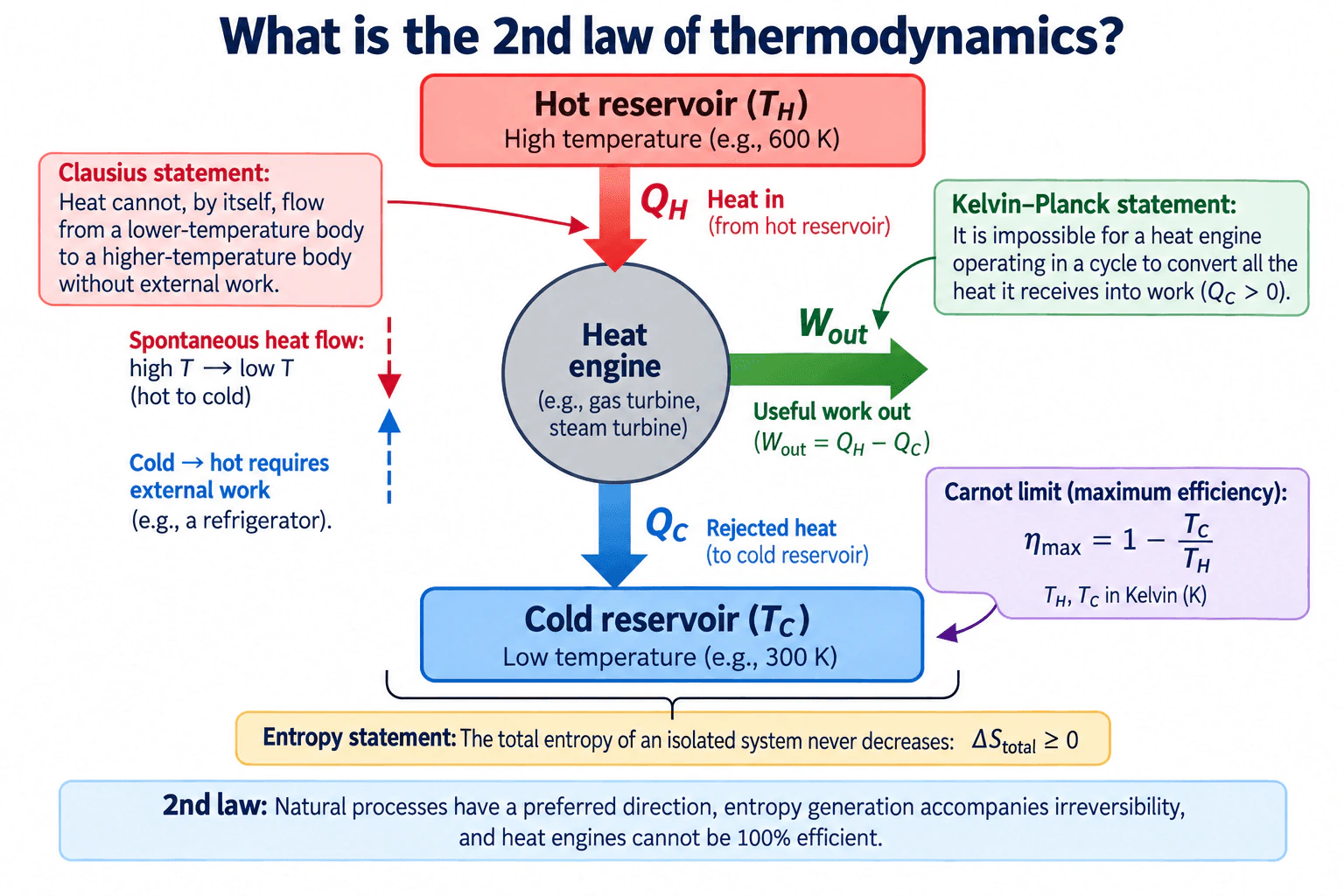
The 2nd law of thermodynamics says that natural processes have a preferred direction: heat flows spontaneously from a higher-temperature body to a lower-temperature body, while moving heat from cold to hot requires external work. It also means a cyclic heat engine cannot convert all the heat it receives into useful work, so some heat must be rejected. In entropy terms, the total entropy of an isolated system never decreases.
Detailed Explanation
In plain English, the 2nd law of thermodynamics explains why energy has quality limits even though energy is conserved. The 1st law tells us how much energy is conserved, while the 2nd law tells us which processes are physically possible and how much of that energy can become useful work.
For a simple two-reservoir heat engine, define the heat engine as the system boundary. Assume cyclic operation, take heat into the engine as positive, and take work out of the engine as positive. The engine receives heat Q_H from a hot reservoir at absolute temperature T_H, produces useful work W_out, and rejects heat Q_C to a cold reservoir at absolute temperature T_C.
For a complete cycle, the 1st-law energy balance is: Q_H = W_out + Q_C
Therefore: W_out = Q_H - Q_C
The 2nd law adds a restriction that the 1st law alone does not provide. For this two-reservoir cyclic heat-engine model, Q_C must be greater than zero. A device cannot operate in a cycle with the sole effect of taking heat from a single reservoir and converting all of it into net work. This is the Kelvin–Planck statement.
The Clausius statement gives an equivalent view: heat cannot, by itself, flow from a lower-temperature body to a higher-temperature body. Reverse heat transfer requires external work, as in a refrigerator or heat pump.
The entropy form of the law is: ΔS_total ≥ 0 for an isolated system. For a reversible process, ΔS_total = 0. For an irreversible process, ΔS_total > 0. This entropy generation is a measure of irreversibility.
For an ideal reversible heat engine operating between two thermal reservoirs, the maximum possible thermal efficiency is the Carnot limit: η_max = 1 - T_C/T_H
Here, T_H and T_C must be absolute temperatures in Kelvin.
Using the temperatures shown in the worked diagram as a hypothetical example, T_H = 600 K and T_C = 300 K: η_max = 1 - 300/600 = 0.50
So the maximum ideal efficiency between those two reservoir temperatures is 50%. A real engine operating between the same reservoirs would have a lower efficiency because real processes contain irreversibilities.
The engineering takeaway is that the 2nd law sets the natural direction of heat transfer, explains why cold-to-hot heat transfer requires work, introduces entropy generation as a measure of irreversibility, and establishes fundamental limits on heat-engine performance.
Useful Questions to Ask the Interviewer
Should I explain the second law using the entropy statement, the heat-engine statements, or both?
Would you like me to connect it to a practical example such as a gas turbine, steam turbine, or refrigerator?
Should I include the Carnot efficiency limit for a two-reservoir heat engine?
Should I assume cyclic operation between fixed-temperature hot and cold reservoirs?
How to Explain It in an Interview
Start with the physical meaning: the second law gives natural processes a preferred direction, so heat moves spontaneously from high temperature to low temperature.
Then connect that idea to the heat-engine model. Heat Q_H enters from the hot reservoir, part becomes W_out, and the remainder Q_C is rejected to the cold reservoir. The energy balance is Q_H = W_out + Q_C.
Next state the two common forms of the second law. Kelvin–Planck says a cyclic heat engine cannot convert all the heat it receives from a single reservoir into net work. Clausius says heat cannot move from cold to hot by itself; external work is required.
Then give the entropy statement: the total entropy of an isolated system never decreases. Reversible processes have zero total entropy generation, while irreversible processes generate entropy.
If the interviewer wants a quantitative limit, use η_max = 1 - T_C/T_H for an ideal reversible engine between two reservoirs, with both temperatures in Kelvin.
Finish with the practical meaning: the second law explains irreversibility and places a fundamental upper limit on thermal efficiency.
Technical Approach
1. Define the system boundary, such as a cyclic heat engine operating between a hot and a cold reservoir. 2. State the sign convention: heat into the engine is positive and work out of the engine is positive. 3. Identify Q_H, Q_C, W_out, T_H, and T_C. 4. Apply the 1st-law cycle balance: Q_H = W_out + Q_C. 5. Apply the Kelvin–Planck form of the 2nd law: complete conversion of heat from a single reservoir into net work in a cycle is impossible. 6. Apply the Clausius form when considering heat-flow direction: spontaneous heat flow is from high temperature to low temperature; reverse flow requires external work. 7. Apply the entropy condition for an isolated system: ΔS_total ≥ 0. 8. If an ideal two-reservoir efficiency limit is needed, use η_max = 1 - T_C/T_H with T_H and T_C in Kelvin. 9. Check physical feasibility and distinguish the reversible ideal limit from real irreversible performance.
Practical Insights
The calculations are usually simple; the main challenge is applying the law to the correct physical model. The Carnot relation is an ideal upper bound for a reversible engine operating between two thermal reservoirs. Real machines have irreversibilities such as friction, pressure losses, finite-temperature-difference heat transfer, mixing, and other entropy-generating effects, so their efficiency is lower. Correct system boundaries, sign conventions, and absolute temperatures are more important here than computational complexity.
Why Interviewers Ask This
Interviewers ask this to check whether you understand the physical meaning of irreversibility, entropy, and the direction of heat flow rather than only a memorized definition. They want to see whether you can connect the second law to engineering systems such as turbines, power cycles, heat exchangers, and refrigeration systems, and recognize that it limits heat-engine efficiency.
Common interview mistakes
Common mistakes include confusing the 1st and 2nd laws; saying only that heat flows from hot to cold without discussing entropy or performance limits; claiming a cyclic heat engine can convert all heat input into work; treating the Carnot efficiency as the actual efficiency of every engine; using Celsius instead of Kelvin in T_C/T_H; forgetting that cold-to-hot heat transfer requires external work; and confusing heat-engine thermal efficiency with refrigerator or heat-pump coefficient of performance.
Interview tip
Give the answer in three layers: first say that heat naturally flows from hot to cold, then explain that a cyclic heat engine cannot convert all absorbed heat into work, and finally state that total entropy of an isolated system never decreases. If the interviewer asks for a quantitative limit, add the Carnot relation η_max = 1 - T_C/T_H with temperatures in Kelvin.
Interviewer may ask next
How would you check that a proposed heat-engine result is consistent with the 2nd law?
I would first define the system boundary and confirm that the device is operating cyclically between the stated thermal reservoirs. I would check the 1st-law balance Q_H = W_out + Q_C, then verify that the proposed result does not convert all heat from a single reservoir into net work. If reservoir temperatures are available, I would compare the proposed thermal efficiency with the reversible Carnot limit η_max = 1 - T_C/T_H using Kelvin. I would also check that the total entropy change of the isolated system, or equivalently the entropy generation for the overall process, is nonnegative. A result that violates any of those checks is not physically feasible.
What changes if the device is a refrigerator instead of a heat engine?
The direction of the desired energy transfer changes. A refrigerator uses external work to move heat from a cold region to a hotter region, which cannot occur spontaneously according to the Clausius statement. Instead of maximizing work output, the performance measure is usually coefficient of performance, or COP. The 2nd law still establishes the best possible reversible performance for the specified hot and cold temperatures, and real refrigerators require more work because of irreversibilities.
2. How do you find the heat transfer coefficient of a flat plate?NEWThermodynamics And Heat TransferMediumSiemens Energy
Short Interview Answer (30-60 seconds)
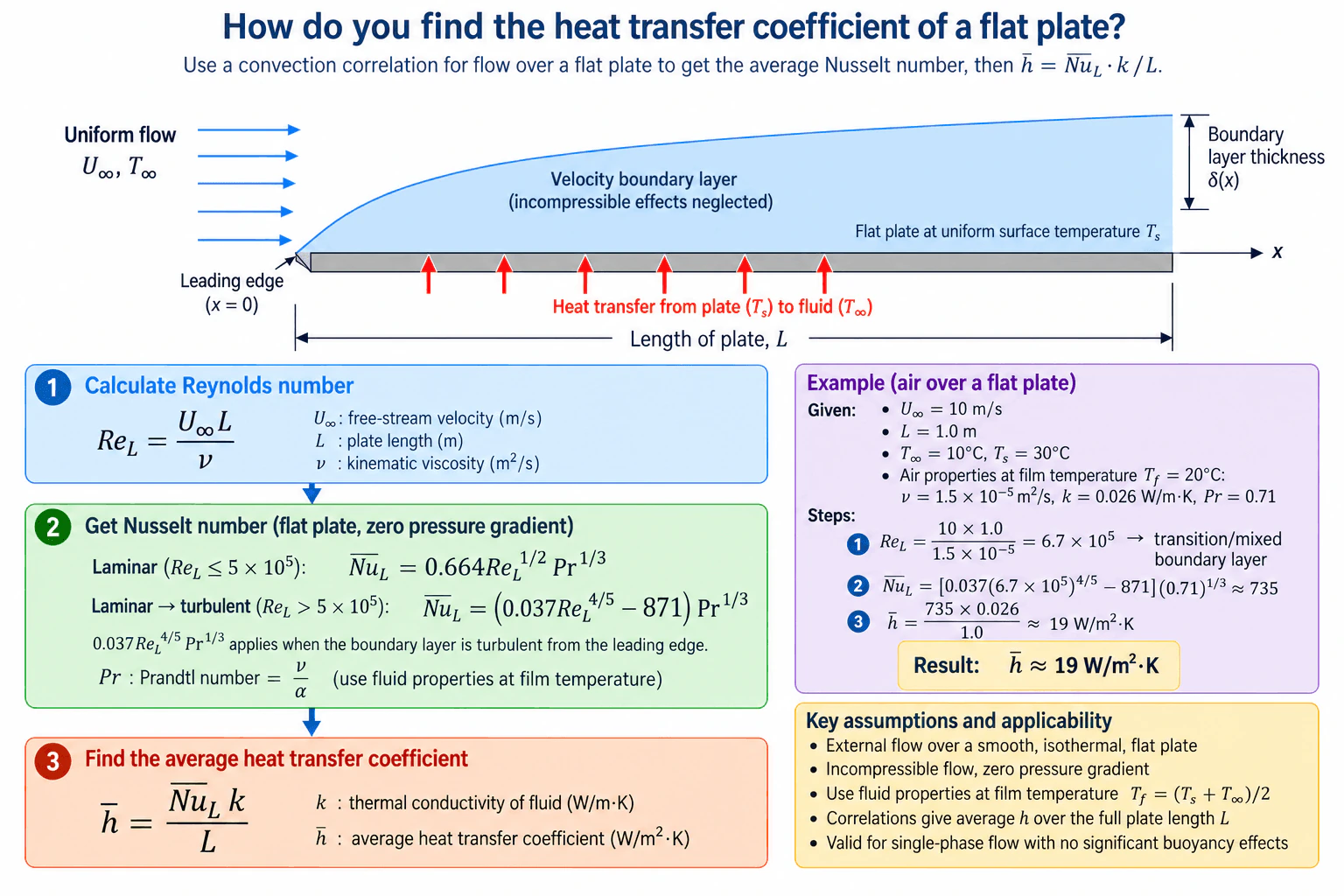
For forced convection over a flat plate, I first calculate the Reynolds number at the plate length, Re_L = U∞L/ν. That tells me whether the boundary layer remains laminar or transitions toward turbulence. For a smooth isothermal plate, a common laminar average correlation is Nū_L = 0.664 Re_L^(1/2) Pr^(1/3). If the flow starts laminar and transitions near Re_x = 5 × 10^5, a common average mixed-flow correlation is Nū_L = (0.037 Re_L^(4/5) − 871) Pr^(1/3). Then I calculate the average coefficient from h̄ = Nū_L k/L, using fluid properties evaluated consistently, typically at the film temperature.
Detailed Explanation
The heat-transfer coefficient of a flat plate is normally found from an external-convection correlation. The coefficient is not a universal material property; it depends on the fluid, velocity, plate length, fluid properties, surface condition, and boundary-layer regime.
For the case shown here, assume steady, incompressible external forced convection over a smooth, isothermal flat plate with approximately zero pressure gradient. Let x run from the leading edge along the plate, and let L be the full plate length. The free stream has velocity U∞ and temperature T∞, while the plate is at a uniform surface temperature Ts.
Useful Questions to Ask the Interviewer
Is the flow forced convection or natural convection?
Is the plate surface approximately isothermal, or is a uniform heat flux specified?
What is the plate length L in the flow direction?
What are U∞, T∞, and Ts?
Which fluid is flowing over the plate?
Can the fluid properties be treated as approximately constant?
Should I assume a smooth plate and approximately zero pressure gradient?
Do we expect the boundary layer to remain laminar, transition along the plate, or be turbulent from the leading edge?
How to Explain It in an Interview
Define the physical model. Use a control surface around the external flow adjacent to the plate. Heat flows from the plate to the fluid when Ts > T∞. The boundary layer starts at the leading edge and grows as x increases.
Evaluate the fluid properties consistently. A common approximation is to evaluate the kinematic viscosity ν, thermal conductivity k, and Prandtl number Pr at the film temperature: Tf = (Ts + T∞)/2.
Calculate the Reynolds number based on the full plate length: Re_L = U∞L/ν, where U∞ is in m/s, L is in m, and ν is in m²/s.
Select an average Nusselt-number correlation that matches the boundary-layer regime and surface condition. For a smooth isothermal flat plate with approximately zero pressure gradient, a commonly used laminar average correlation is: Nū_L = 0.664 Re_L^(1/2) Pr^(1/3). For a simplified interview calculation, this is commonly applied when the boundary layer remains laminar, approximately Re_L ≤ 5 × 10^5.
If the flow begins laminar and transitions near Re_x = 5 × 10^5, a common mixed laminar-to-turbulent average correlation is: Nū_L = (0.037 Re_L^(4/5) − 871) Pr^(1/3). The −871 term accounts for the laminar portion before transition.
If the boundary layer is turbulent from the leading edge instead, the corresponding fully turbulent form is approximately: Nū_L = 0.037 Re_L^(4/5) Pr^(1/3).
Convert the average Nusselt number to the average heat-transfer coefficient: h̄ = Nū_L k/L, where k is the fluid thermal conductivity in W/(m·K). The result has units of W/(m²·K).
For a hypothetical example consistent with the diagram, let air flow at U∞ = 10 m/s over a plate of length L = 1.0 m. Let T∞ = 10°C and Ts = 30°C, so the film temperature is Tf = 20°C. Using ν = 1.5 × 10^-5 m²/s, k = 0.026 W/(m·K), and Pr = 0.71:
Re_L = (10 × 1.0)/(1.5 × 10^-5) ≈ 6.7 × 10^5.
Because this exceeds the assumed transition Reynolds number, use the mixed laminar-to-turbulent correlation: Nū_L = [0.037(6.7 × 10^5)^(4/5) − 871](0.71)^(1/3) ≈ 735.
Then: h̄ = (735 × 0.026)/1.0 ≈ 19 W/(m²·K).
This is the average convection coefficient over the full plate length L. A local coefficient h_x would vary with position because the boundary layer thickens as the flow moves downstream.
I would validate the calculation by checking that the dimensions are consistent, the selected correlation matches an isothermal flat plate and the intended Reynolds-number regime, the properties are evaluated at a consistent reference temperature, and buoyancy, roughness, pressure-gradient, compressibility, and strong property-variation effects are not large enough to invalidate the model.
The final method is therefore: calculate Re_L, select the correct average Nusselt-number correlation, and calculate h̄ = Nū_L k/L.
Technical Approach
Define the plate length L, flow direction x, free-stream velocity U∞, free-stream temperature T∞, and uniform plate temperature Ts.
State the assumptions: steady external forced convection, smooth isothermal flat plate, single-phase incompressible flow, and approximately zero pressure gradient.
Calculate the film temperature Tf = (Ts + T∞)/2 when that property-evaluation approximation is appropriate.
Obtain ν, k, and Pr at the selected reference temperature.
Calculate Re_L = U∞L/ν.
Identify whether the boundary layer remains laminar, transitions from laminar to turbulent, or is turbulent from the leading edge.
Select the matching average Nusselt-number correlation.
Calculate Nū_L.
Calculate h̄ = Nū_L k/L.
Confirm the result has units of W/(m²·K) and verify that the correlation assumptions and operating range are appropriate.
Practical Insights
The main engineering tradeoff is simplicity versus fidelity. Flat-plate correlations are fast and useful for preliminary engineering estimates, but the answer depends strongly on the boundary-layer regime, transition location, surface condition, characteristic length, and fluid properties. Surface roughness, pressure gradients, strong temperature-dependent properties, buoyancy, separation, and compressibility can make the simple correlation inaccurate. For higher-confidence work, use a correlation validated for the actual operating range and compare against test data or a more detailed analysis.
Why Interviewers Ask This
Interviewers want to see whether you can recognize an external forced-convection problem, identify the developing boundary layer, calculate Reynolds and Prandtl numbers, choose a flat-plate Nusselt-number correlation that matches the flow regime and surface condition, evaluate properties consistently, and convert the result into a physically meaningful heat-transfer coefficient.
Common interview mistakes
Common mistakes include using a local Nusselt correlation when an average coefficient is required; selecting a turbulent correlation only because Re_L exceeds the transition value without accounting for the upstream laminar region; forgetting the −871 term in the mixed laminar-to-turbulent average correlation; using fluid properties at an inconsistent temperature; confusing dynamic viscosity μ with kinematic viscosity ν; using the wrong characteristic length; mixing isothermal and constant-heat-flux correlations; ignoring the correlation's assumptions; and reporting h without the correct units of W/(m²·K).
Interview tip
Start with the physical picture: flow develops a boundary layer from the leading edge, so convection depends on Reynolds number and the boundary-layer regime. Then give the calculation sequence clearly: Re_L first, then the appropriate Nū_L correlation, then h̄ = Nū_L k/L. State the surface condition and property-evaluation temperature so the interviewer can see that the correlation was chosen deliberately.
Interviewer may ask next
How would you validate that the flat-plate correlation is appropriate?
I would confirm that the geometry is reasonably represented by a smooth flat plate, the flow is external and single phase, the surface thermal condition matches the correlation, the Reynolds and Prandtl numbers are within the correlation's applicable range, and pressure-gradient, roughness, buoyancy, compressibility, and large property-variation effects are small enough to neglect. I would also verify the characteristic length and property-evaluation temperature and compare against test data or another validated method when the result affects an important design decision.
What changes if the boundary layer is turbulent from the leading edge?
The average correlation changes because there is no upstream laminar region to subtract. For the simplified relationship used here, I would use Nū_L = 0.037 Re_L^(4/5) Pr^(1/3) instead of the mixed-transition form Nū_L = (0.037 Re_L^(4/5) − 871) Pr^(1/3). For the same Reynolds number, Prandtl number, thermal conductivity, and plate length, this generally gives a higher average Nusselt number and therefore a higher average heat-transfer coefficient.
3. Why are you shifting to the energy sector?NEWBehavioralEasySiemens Energy
i Question Details
Explain your reason for moving into the energy sector.
Interview tip:
Use STAR to structure your answer: briefly explain the Situation and Task, make Action the most detailed part, and finish with the Result. For example, describe a previous mechanical engineering project that increased your interest in energy systems, the responsibility you had, the steps you took to understand energy performance and equipment behavior, how you worked with others, and why that experience led you to pursue the energy sector.
Situation
In my last role, I worked on mechanical equipment where reliability, efficiency, and operating conditions were important. As I became more involved in understanding how the equipment used energy and how design choices affected performance, I became more interested in the broader energy sector.
Task
My responsibility was to support the mechanical work while making sure the equipment could meet its operating needs safely and reliably. I also wanted to understand why certain design and operating choices affected energy use, thermal performance, and long term equipment behavior.
Action
I started looking beyond the immediate mechanical task and tried to understand the complete energy flow through the equipment. I reviewed operating conditions, heat transfer, fluid behavior, material limits, and efficiency considerations when they were relevant. I discussed these points with engineers from other disciplines so I could understand how mechanical decisions affected the larger system. I also paid closer attention to tradeoffs between reliability, efficiency, maintenance, and cost. That experience showed me that energy projects need strong mechanical engineering judgment because equipment such as turbines, pumps, compressors, heat exchangers, and piping must perform reliably under demanding conditions. I realized that this type of work matches what I enjoy most, which is solving practical mechanical problems while also thinking about system performance and long term impact. That is why I decided to focus my next career step on the energy sector.
Result
The experience gave me a clearer direction for my career. I learned that I am most motivated by mechanical engineering work where reliability, thermal performance, efficiency, and system level decisions come together. Moving into the energy sector is therefore a deliberate choice based on the type of engineering problems I want to keep solving and developing my skills around.
Why Interviewers Ask This
Interviewers ask this question to understand whether the move into the energy sector is intentional and based on a realistic view of the work. A strong answer shows clear motivation, transferable mechanical engineering skills, curiosity about energy systems, and a long term reason for choosing the sector rather than simply looking for a different job.
Interviewer may ask next
What part of your previous mechanical engineering experience is most transferable to the energy sector?
My strongest transferable experience is evaluating mechanical equipment as part of a larger system. I learned to consider operating conditions, thermal behavior, fluid flow, material limits, reliability, maintenance, and efficiency together instead of treating each issue separately. That approach is directly useful in energy projects because equipment performance depends on how the full system operates.
Why does the energy sector interest you more than staying in your previous area?
I found that I was most engaged when the work involved energy flow, equipment efficiency, thermal performance, and system reliability. Those problems require both detailed mechanical knowledge and broader system thinking. I want to build my career around that combination, so moving into the energy sector is a natural next step for me.
4. What's the most important skill to have as an engineer?NEWBehavioralEasySiemens Energy
i Question Details
Identify the skill you consider most important for an engineer.
Interview tip:
Use STAR to structure your answer: briefly explain the Situation and Task, make Action the most detailed part, and finish with the Result. For example, describe a realistic engineering situation where clear communication helped you explain a technical concern, understand input from others, make a sound decision, and reach a reliable result.
Situation
I believe clear communication is the most important skill an engineer can have. During a previous mechanical design project, I noticed that a proposed component change could affect how the part handled load, but different team members had different assumptions about the design conditions.
Task
My responsibility was to evaluate the concern and help the team reach a decision based on the same technical information. I needed to explain the issue clearly so that people with different responsibilities could understand why it mattered.
Action
I first reviewed the design requirements, drawings, and load conditions so I could separate facts from assumptions. I then summarized the concern in simple terms and showed which design condition could create a problem. Instead of only saying that I disagreed with the change, I explained the engineering reason behind my concern and asked the other team members to confirm their assumptions. This helped us find that we were using different interpretations of the operating condition. I worked with the team to agree on the correct condition, reviewed the design again using that shared understanding, and clearly documented the decision and the reason for it. I also made sure everyone had a chance to raise questions before we moved forward.
Result
The team reached a clear decision and avoided moving ahead with conflicting assumptions. The experience reinforced my view that technical knowledge is essential, but communication is what allows that knowledge to be understood and used correctly. I learned that a strong engineer should be able to explain a technical issue clearly, listen carefully, and help others make informed decisions.
Why Interviewers Ask This
Interviewers ask this question to understand which professional quality the candidate values most and how that quality influences engineering work. A strong answer shows practical judgment and explains how an important skill such as communication supports sound technical decisions, collaboration, and reliable engineering outcomes.
Interviewer may ask next
Why do you consider communication more important than technical knowledge alone?
Technical knowledge is essential, but an engineer also has to make that knowledge useful to other people. In this situation, the technical concern only became valuable when I explained it clearly and helped the team recognize that we were using different assumptions. Good communication helps technical decisions become shared, understood, and acted on correctly.
What did you learn about communicating technical concerns from that experience?
I learned to start with the facts, explain why the issue matters, and avoid assuming that everyone is working from the same information. I also learned that listening is part of good communication. Asking others to explain their assumptions helped us identify the real source of the disagreement and reach a better decision.
Mechanical Engineer Resume Examples
Explore the resume examples below to find the one that best matches your target Mechanical Engineer role.
Disclaimer: This interview guide is for educational and informational purposes only. It is designed to help readers prepare, but it does not guarantee any interview result, hiring decision, offer, or outcome. Interview questions, hiring criteria, and preferred answers can vary by employer, interviewer, industry, location, and time. All answers, examples, and explanations in this guide are suggested examples for interview preparation, not definitive answers or instructions for professional practice. They are based on research and judgment, are provided without warranties of any kind, and should be adapted to the question, role, and applicable laws and professional requirements. Diagrams are simplified illustrations intended to highlight the main concepts and their relationships; actual situations, systems, and practices may be more complex. Alternative approaches may be equally valid or better suited to a particular question, context, or interviewer. To the fullest extent permitted by applicable law, the contributors and publisher are not liable for decisions made, actions taken, or losses incurred based on this guide.
State Laws and Professional Responsibilities: Laws and requirements governing an occupation vary by state and jurisdiction. You are responsible for checking the current laws, licensing requirements, and scope-of-practice rules that apply to your location and role, and for ensuring that your answers and actions comply with them. Adapt examples in this guide to those requirements. This guide is not legal advice.
Company Notice: This guide is an independent educational resource and is not affiliated with, endorsed by, sponsored by, or approved by the company named in this guide. Company names identify reported interview experiences or the employer context of clearly labeled original practice exercises. Interview practices can change without notice, and inclusion of company-specific content does not mean these questions are official, complete, or guaranteed to be asked. To the fullest extent permitted by law, the author, contributors, and publisher are not responsible for outcomes related to use of this material.
Content Accuracy and Verification: To the fullest extent permitted by applicable law, we do not represent or warrant that interview guides, questions, answers, examples, or diagrams are accurate, complete, current, error-free, or suitable for any particular purpose. You are responsible for independently reviewing and verifying the information before relying on it.