1. What methods can be used to join plastics to metals and plastics to plastics?
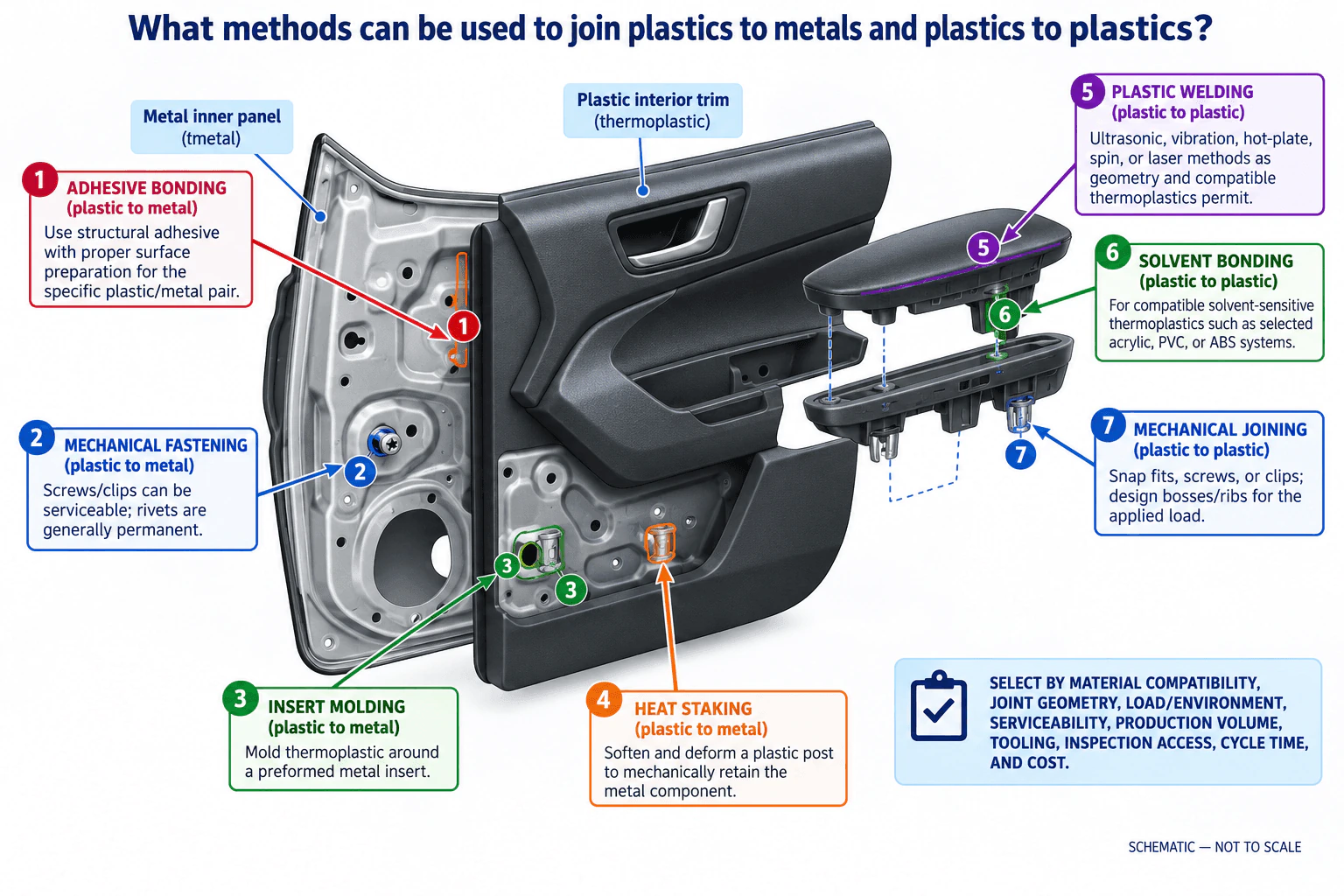
For plastic-to-metal joints, common methods include structural adhesive bonding, mechanical fastening with screws, clips, or rivets, insert molding around a preformed metal insert, and heat staking where a molded plastic post is softened and deformed to mechanically retain the metal. For plastic-to-plastic joints, I would consider plastic welding such as ultrasonic, vibration, hot-plate, spin, or laser welding when the thermoplastics and geometry are compatible, solvent bonding for suitable solvent-sensitive polymers, and mechanical joining such as snap fits, screws, or clips. I would choose among them based on material compatibility, joint geometry, load and environment, serviceability, production volume, tooling, inspection access, cycle time, and cost.
There is no single best joining method for every plastic assembly. I would first separate the problem into plastic-to-metal and plastic-to-plastic joints because the available joining mechanisms and material constraints are different.
For plastic to metal, structural adhesive bonding can provide a continuous bond and distribute load over a relatively large area, but the adhesive and surface preparation must be suitable for the specific plastic and metal pair. Mechanical fastening is useful when a discrete attachment is acceptable. Screws and clips can be serviceable, while rivets are generally permanent. Insert molding is useful when a preformed metal insert can be placed in the mold and thermoplastic molded around it. Heat staking is another option when a molded plastic post passes through or around a metal feature and is then softened and deformed to mechanically retain the metal component.
For plastic to plastic, welding can create a direct thermoplastic joint when the polymers, part geometry, and selected process are compatible. Depending on the application, methods can include ultrasonic, vibration, hot-plate, spin, or laser welding. Solvent bonding can be used for selected solvent-sensitive thermoplastics, such as suitable acrylic, PVC, or ABS systems, where the solvent temporarily softens the mating surfaces so the parts can form a bonded joint as the solvent leaves the interface. Mechanical joining is also common through snap fits, screws, or clips. Bosses and ribs should be designed for the applied load rather than added without considering local stress, stiffness, tolerances, and manufacturing limits.
The manufacturing decision is not simply whether a process can make a joint. The process must repeatedly make the required joint at the intended production rate and cost. I would therefore consider material compatibility, joint geometry, expected mechanical and environmental loads, whether the assembly must be serviced, production volume, available tooling, inspection access, cycle time, expected scrap, and cost. A prototype may use screws or another easily changed method even when a production design later uses molded features, insert molding, heat staking, welding, or another process that is more suitable for volume production.
Validation should match the selected process. I would define the critical joint characteristics, choose inspection methods that can actually access or measure those characteristics, verify the measurement system is suitable, and confirm the process is stable before interpreting capability metrics such as Cp or Cpk. A control plan can then be used for critical characteristics that affect function or durability. Mechanical testing, visual inspection, dimensional inspection, leak testing, or other tests may be appropriate depending on the joint's actual requirement. I would not claim a joint is acceptable until the selected materials, process window, tooling, and inspection method have been validated for the real application.
- What are the exact plastic and metal materials or grades?
- Is the joint structural, cosmetic, sealing, locating, or mainly retaining another component?
- What loads, temperatures, chemicals, moisture, vibration, or aging conditions must the joint withstand?
- Does the assembly need to be disassembled or serviced?
- What production volume and target cycle time are expected?
- Is there access for fasteners, welding equipment, heat-staking tools, mold tooling, and inspection?
- Are there restrictions on visible fasteners, witness marks, solvents, added mass, or secondary operations?
- Which joint characteristics are critical, and how will they be inspected in production?
I would say that I start with the material pair and functional requirement, then remove incompatible processes. For a plastic-to-metal joint that must be serviceable, a screw or clip may be attractive. If a permanent bonded interface is appropriate, I might evaluate a structural adhesive with the correct surface preparation. For high-volume molded production, an embedded metal insert may integrate the attachment into the molding operation. If the geometry includes a molded plastic post that can retain the metal, heat staking may be a simple secondary assembly process. For plastic-to-plastic parts made from compatible thermoplastics, I would evaluate welding because it can create a direct joint without separate fasteners. If welding is unsuitable, I would consider a compatible solvent-bonding process or mechanical features such as snap fits, screws, or clips. I would then compare tooling, cycle time, process control, inspection access, scrap risk, serviceability, and total manufacturing cost before validating the selected process.
- Identify the material pair: plastic-to-metal or plastic-to-plastic, including the actual polymer and metal grades when known.
- Define the joint function, load paths, environment, allowable appearance, and serviceability requirement.
- Screen candidate processes for material compatibility and joint geometry.
- For plastic-to-metal, evaluate structural adhesive bonding, mechanical fastening, insert molding, and heat staking where their physical joining mechanisms fit the design.
- For plastic-to-plastic, evaluate compatible thermoplastic welding, solvent bonding for suitable polymers, and mechanical joining such as snap fits, screws, or clips.
- Compare production factors including tooling, fixture requirements, inspection access, production volume, cycle time, automation potential, scrap risk, and cost.
- Design the joint for manufacturability, including appropriate bosses, ribs, inserts, bond areas, weld features, or staking features as applicable.
- Define critical characteristics and a practical inspection and control plan.
- Validate the joint and manufacturing process under representative mechanical and environmental conditions.
- After process stability and suitable measurement capability are established, use appropriate statistical process control and capability analysis for critical characteristics.
The main tradeoff is between joint performance and manufacturing simplicity. Mechanical fasteners are easy to understand and can support serviceability, but they add parts, assembly operations, access requirements, and local stresses. Structural adhesive bonding can spread load over a larger area in plastic-to-metal joints, but material compatibility, surface preparation, dispensing, cure behavior, and inspection can be important. Insert molding can create an integrated high-volume plastic-to-metal part but requires mold tooling and reliable insert placement. Heat staking can be fast and economical for suitable molded plastic features retaining metal, but the stake geometry and process settings must be controlled. Plastic welding can be very fast and avoid added hardware, but it depends on compatible thermoplastics, suitable joint geometry, tooling, and process control. Solvent bonding can produce a clean plastic-to-plastic joint for compatible solvent-sensitive polymers but is material-specific and requires controlled processing. Snap fits can reduce added hardware and assembly time but require careful strain, tolerance, stiffness, and durability design. The best choice is therefore based on total production requirements rather than joint strength alone.
Interviewers want to see whether you can select an appropriate joining process from the material pair, joint geometry, loads and environment, serviceability, production volume, tooling, inspection access, cycle time, and cost rather than choosing a process by habit. They also want you to recognize that plastic-to-metal and plastic-to-plastic joints have different material-compatibility and manufacturing constraints.
Common mistakes are choosing a joining method without identifying the actual polymer; assuming all plastics can be welded or solvent bonded; treating plastic-to-metal heat staking as direct fusion of the plastic to the metal instead of mechanical retention by a deformed plastic feature; saying all mechanical fasteners are removable even though rivets are generally permanent; ignoring surface preparation for plastic-to-metal adhesive bonding; using bosses, ribs, or snap fits without checking local stresses and tolerances; overlooking differential thermal expansion between plastic and metal; ignoring tooling and inspection access; choosing a prototype-friendly process without considering production cycle time and scrap; and quoting Cp or Cpk before confirming that the measurement system is suitable and the process is stable.
Organize the answer by material pair first. For plastic-to-metal, discuss adhesive bonding, mechanical fastening, insert molding, and heat staking. For plastic-to-plastic, discuss compatible thermoplastic welding, solvent bonding, and mechanical joining. Then show engineering judgment by connecting the choice to material compatibility, geometry, loads and environment, serviceability, production volume, tooling, inspection access, cycle time, scrap, and cost. Finish by explaining how you would validate and control the selected production process.