This interview guide is for educational and informational purposes only. It is designed to help readers prepare, but it does not guarantee any interview result, hiring decision, offer, or outcome. Interview questions, hiring criteria, and preferred answers can vary by employer, interviewer, industry, location, and time. All answers, examples, and explanations in this guide are suggested examples for interview preparation, not definitive answers or instructions for professional practice. They are based on research and judgment, are provided without warranties of any kind, and should be adapted to the question, role, and applicable laws and professional requirements. Diagrams are simplified illustrations intended to highlight the main concepts and their relationships; actual situations, systems, and practices may be more complex. Alternative approaches may be equally valid or better suited to a particular question, context, or interviewer. To the fullest extent permitted by applicable law, the contributors and publisher are not liable for decisions made, actions taken, or losses incurred based on this guide.
State Laws and Professional Responsibilities
Laws and requirements governing an occupation vary by state and jurisdiction. You are responsible for checking the current laws, licensing requirements, and scope-of-practice rules that apply to your location and role, and for ensuring that your answers and actions comply with them. Adapt examples in this guide to those requirements. This guide is not legal advice.
Identity, Image, and Privacy Notice
To respect individual privacy, some names, profile photographs, avatars, biographical details, and other identifying information displayed in this guide may be replaced with pseudonyms, licensed stock images, illustrative avatars, composite images, or representative descriptions. Unless a person is expressly identified as an actual contributor, a displayed name, image, or profile should not be understood as depicting or identifying a specific candidate, interviewer, employee, or other real individual. These representations are provided for editorial and illustrative purposes only and do not imply endorsement, employment, participation, or affiliation with this guide or any company mentioned in it. Any resemblance to an actual person is coincidental.
Company Notice
This guide is an independent educational resource and is not affiliated with, endorsed by, sponsored by, or approved by the company named in this guide. Company names identify reported interview experiences or the employer context of clearly labeled original practice exercises. Interview practices can change without notice, and inclusion of company-specific content does not mean these questions are official, complete, or guaranteed to be asked. To the fullest extent permitted by law, the author, contributors, and publisher are not responsible for outcomes related to use of this material.
Content Accuracy and Verification
To the fullest extent permitted by applicable law, we do not represent or warrant that interview guides, questions, answers, examples, or diagrams are accurate, complete, current, error-free, or suitable for any particular purpose. You are responsible for independently reviewing and verifying the information before relying on it.
Questions or comments?
Contact us for general questions, or share feedback, technical corrections, and comments with the community.
1. Define entropy.Thermodynamics And Heat TransferEasyCaterpillar
Short Interview Answer (30-60 seconds)
Entropy is a thermodynamic state property that measures how energy is distributed and, practically, how much energy is unavailable for conversion into useful work. It is represented by S, with SI units of J/K, or by specific entropy s in J/(kg·K). For reversible heat transfer, dS = δQ_rev/T, using absolute temperature. The second law says that the total entropy of an isolated system cannot decrease: it stays constant for an ideal reversible process and increases when irreversible effects such as friction, mixing, or heat transfer across a finite temperature difference occur.
Detailed Explanation
Entropy is a thermodynamic state property used with the second law to determine the direction and feasibility of processes. Unlike heat or work, entropy belongs to the thermodynamic state of a system, so its change depends only on the initial and final equilibrium states, not on the path between them.
Entropy is usually written as S, with SI units of J/K. For a unit mass, specific entropy is s = S/m and has units of J/(kg·K).
For an internally reversible differential process involving heat transfer,
dS = δQ_rev/T,
where dS is the entropy change, δQ_rev is reversible heat transfer into the system, and T is the absolute temperature in kelvin. Absolute temperature is required in entropy relations.
The second law gives entropy its most important engineering meaning. For an isolated system,
ΔS_total ≥ 0.
An ideal reversible process has zero entropy generation, while a real irreversible process produces entropy. Sources of entropy generation include friction, viscous effects, mixing, electrical resistance, unrestrained expansion, and heat transfer through a finite temperature difference.
For a general system, it is useful to separate entropy transfer from entropy generation. In a closed system, an entropy balance can be expressed conceptually as:
change in system entropy = entropy transferred with heat + entropy generated internally.
For a control volume, entropy can also cross the boundary with flowing mass. The important check is that entropy generation cannot be negative for a physically possible process.
Entropy should not be described simply as 'disorder.' That analogy can sometimes help intuition, but in mechanical engineering the more useful definition is based on thermodynamic state, heat transfer divided by absolute temperature for a reversible path, and entropy generation caused by irreversibility.
Useful Questions to Ask the Interviewer
Would you like the engineering thermodynamics interpretation or the microscopic/statistical interpretation of entropy?
Should I explain entropy for a closed system, a control volume, or in the context of a thermodynamic cycle?
How to Explain It in an Interview
Start with the definition: entropy is a thermodynamic state property associated with energy distribution and the second law. Then state the units and the reversible relation dS = δQ_rev/T. Next connect it to the second law by explaining that entropy generation is zero for an ideal reversible process and positive for real irreversible processes. Finish with one practical example, such as heat flowing from a hot body to a colder body: energy is conserved by the first law, but total entropy increases because the transfer occurs across a finite temperature difference. This shows why entropy is useful for judging process direction and irreversibility.
Technical Approach
1. Define the thermodynamic system or control volume being considered. 2. Identify the initial and final equilibrium states. 3. Treat entropy as a state property and use absolute temperature in entropy relations. 4. Account for entropy transferred by heat and, for a control volume, by mass flow. 5. Include entropy generation caused by irreversibilities. 6. Apply the second-law check that entropy generation must satisfy S_gen ≥ 0. 7. Use the result to assess whether the proposed process is reversible, irreversible, or physically impossible.
Practical Insights
The main engineering tradeoff is that reducing entropy generation generally improves thermodynamic performance, but doing so can require larger heat exchangers, smaller temperature differences, lower frictional losses, slower processes, or more expensive equipment. Entropy calculations also depend on having appropriate thermodynamic property data and clearly defined system boundaries. Simplified relations should only be used under the assumptions for which they are valid.
Why Interviewers Ask This
This question tests whether the candidate understands a fundamental second-law property and can distinguish entropy from energy, heat, and temperature. A strong answer should connect entropy to energy distribution, irreversibility, absolute temperature, and the direction of real thermodynamic processes without relying only on the simplified phrase 'disorder.'
Common interview mistakes
Common mistakes include defining entropy only as 'disorder,' confusing entropy with energy or heat, using Celsius instead of absolute temperature in entropy equations, assuming entropy of every individual system must always increase, and forgetting that entropy can cross a system boundary with heat or mass. Another mistake is treating an isentropic process as automatically reversible without checking the assumptions that make zero entropy generation reasonable.
Interview tip
Give a concise definition first, then connect entropy to the second law. Mention S in J/K, the reversible relation dS = δQ_rev/T, and the condition S_gen ≥ 0. A short example of heat flowing across a finite temperature difference demonstrates that you understand entropy as an engineering tool for identifying irreversibility rather than merely as an abstract concept.
Interviewer may ask next
What is the difference between an isentropic process and a reversible process?
An isentropic process has constant entropy, so ΔS = 0 for the system or flowing fluid being considered. A reversible adiabatic process is isentropic because there is no entropy transfer by heat and no entropy generation. However, constant entropy by itself does not universally prove that every part of a process is reversible; the complete entropy balance and system boundary must be checked. In common turbine and compressor analysis, 'isentropic' usually represents the ideal reversible adiabatic reference process.
What happens to entropy when heat flows from a hot body to a colder body?
The hot body loses entropy and the cold body gains entropy. If an amount of heat Q is transferred between two bodies that remain approximately at constant absolute temperatures T_hot and T_cold, the total entropy change is ΔS_total = -Q/T_hot + Q/T_cold. Because T_cold < T_hot, Q/T_cold is larger than Q/T_hot, so ΔS_total > 0. Energy is conserved, but entropy is generated because heat transfer through a finite temperature difference is irreversible.
2. What is an internal combustion (IC) engine?Thermodynamics And Heat TransferEasyCaterpillar
Short Interview Answer (30-60 seconds)
An internal combustion engine is a heat engine in which fuel burns inside the engine itself. Combustion converts the fuel's chemical energy into thermal energy, creating high-temperature, high-pressure gases. These gases expand and produce mechanical work, commonly by pushing a piston that turns a crankshaft. Gasoline and diesel engines are common examples. The key distinction is that the combustion process occurs inside the engine's working chamber rather than in a separate external heat source.
Detailed Explanation
An internal combustion, or IC, engine converts the chemical energy stored in fuel into mechanical work by burning the fuel inside the engine's working chamber.
For a typical reciprocating engine, the useful control volume can be considered the gas inside the cylinder. Air, and depending on the engine type fuel, enters the cylinder. Combustion releases energy and raises the temperature and pressure of the gases. The gases then expand and push the piston. The piston transfers force through the connecting rod to the crankshaft, producing rotating mechanical output.
From a thermodynamics viewpoint, the engine is a heat engine. Fuel supplies chemical energy, combustion releases that energy within the working fluid, and only part of the released energy becomes useful work. The remainder leaves through exhaust gases, cooling systems, friction, and other losses. Energy conservation still applies: the energy entering the engine must be accounted for by useful work, heat rejection, exhaust energy, and other losses.
Two common reciprocating IC-engine types are spark-ignition and compression-ignition engines. In a spark-ignition engine, typically associated with gasoline, a spark initiates combustion. In a compression-ignition engine, typically associated with diesel fuel, air is compressed until its temperature is high enough for injected fuel to ignite.
IC engines can also be classified by operating cycle, such as four-stroke or two-stroke reciprocating engines. A four-stroke engine typically uses intake, compression, power, and exhaust strokes. During the power stroke, combustion-generated pressure acts on the piston and produces useful mechanical work.
The important distinction is where combustion occurs. In an IC engine, combustion occurs within the engine's working chamber. In an external-combustion engine, combustion or another heat source is outside the working fluid's expansion device, and energy is transferred to the working fluid through heat transfer.
Useful Questions to Ask the Interviewer
Are you asking specifically about reciprocating piston engines or IC engines more broadly?
Would you like the explanation in terms of the four-stroke cycle, thermodynamic efficiency, or gasoline-versus-diesel operation?
How to Explain It in an Interview
Start with the definition: an IC engine burns fuel inside its working chamber. Then describe the energy path: chemical energy in the fuel is released by combustion, the gas temperature and pressure rise, the gas expands, and that expansion produces mechanical work. Use a piston and crankshaft as the simplest example. Finally, distinguish it from an external-combustion engine and, if useful, mention gasoline spark ignition and diesel compression ignition as common examples. This gives a complete answer without forcing calculations into a definition question.
Technical Approach
Define the system as a heat engine in which combustion occurs inside the working chamber.
Identify the energy source as the chemical energy of the fuel.
Explain that combustion raises the working-gas temperature and pressure.
Explain that gas expansion converts part of that energy into mechanical work.
Give a common mechanical example, such as a piston driving a crankshaft.
Distinguish internal combustion from external combustion by the location of the combustion process.
Mention representative IC-engine types, such as spark-ignition gasoline and compression-ignition diesel engines.
Practical Insights
The main engineering tradeoff is that an IC engine cannot convert all fuel energy into useful work. Some energy leaves with the exhaust, some is transferred to the cooling system, and some is lost through friction and other effects. Higher combustion temperatures can improve ideal thermal efficiency but can also increase thermal loading and influence emissions and material requirements. Engine design therefore balances efficiency, power, durability, cooling, emissions, size, cost, and operating conditions.
Why Interviewers Ask This
Interviewers use this question to check whether the candidate understands the basic energy-conversion principle of an IC engine and can distinguish internal combustion from external-combustion systems. A strong answer should connect combustion, heat release, gas expansion, pressure, and mechanical work without adding unnecessary detail.
Common interview mistakes
Common mistakes include saying that an IC engine simply converts heat directly into motion without explaining combustion and gas expansion, confusing internal combustion with external combustion, claiming that all fuel energy becomes useful work, or describing only gasoline engines as IC engines. Another mistake is giving detailed cycle equations when the question only asks for a clear definition.
Interview tip
Give the definition first, then explain the energy conversion in one simple sequence: fuel burns inside the engine, gas temperature and pressure rise, the gas expands, and mechanical work is produced. A short comparison with an external-combustion engine makes the definition especially clear.
Interviewer may ask next
How would you verify that the energy conversion description of an IC engine is physically consistent?
Use a control-volume energy balance around the engine. Over steady operation, the fuel's chemical energy input must be accounted for by useful shaft work, energy carried away in the exhaust, heat rejected to the cooling system and surroundings, and other losses such as friction. The exact quantities require measurements, but the basic check is that energy is conserved and that useful work is only one part of the total input energy.
How does a diesel engine differ from a gasoline spark-ignition engine?
The main difference is how combustion is initiated. In a typical gasoline spark-ignition engine, a prepared air-fuel mixture is ignited by a spark plug. In a diesel compression-ignition engine, air is compressed to a high pressure and temperature, then fuel is injected and ignites because of the hot compressed air. Both are internal combustion engines because combustion occurs inside the engine's working chamber.
3. Draw the Otto and Diesel cycles.Thermodynamics And Heat TransferMediumCaterpillar
Short Interview Answer (30-60 seconds)
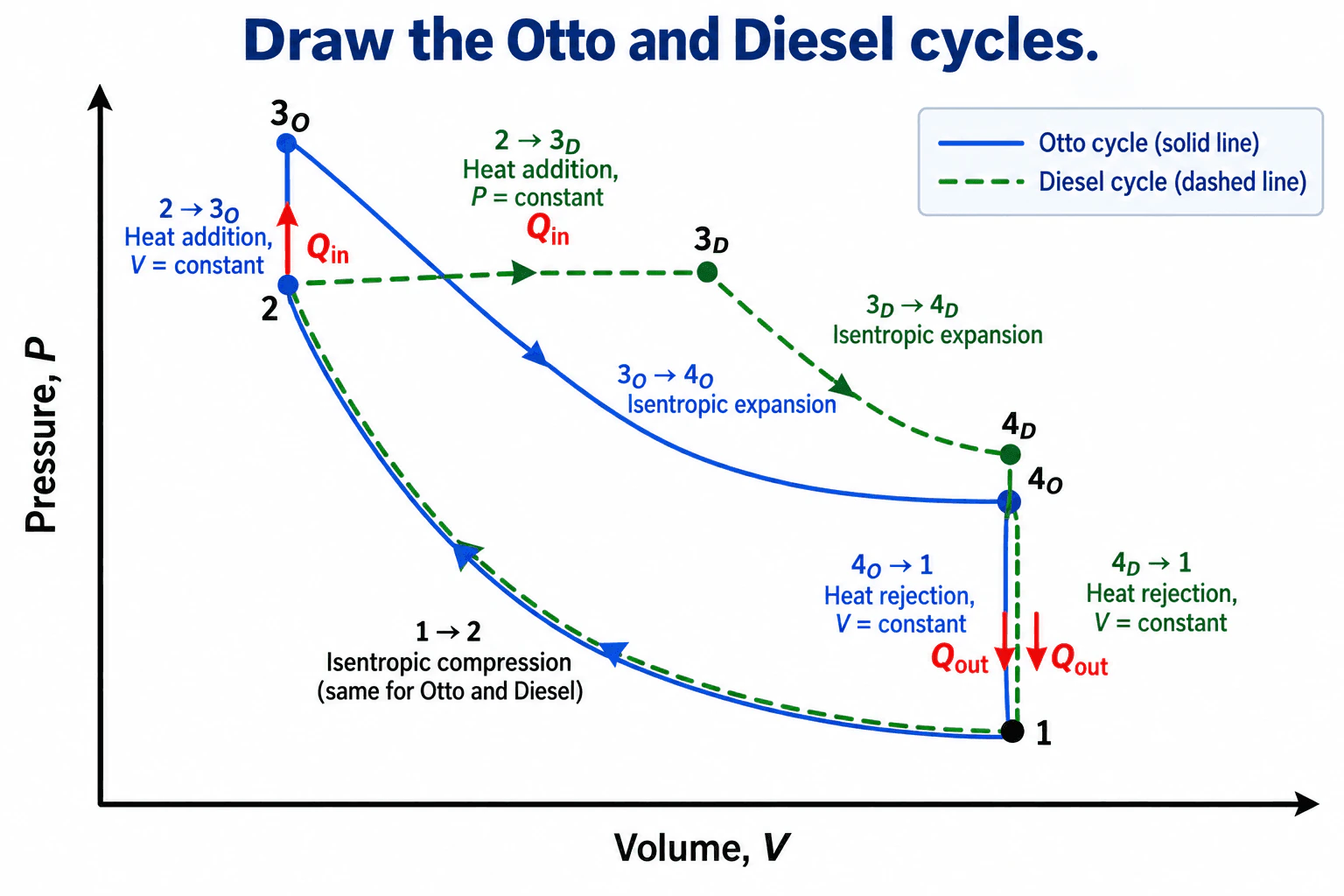
On a P–V diagram, both ideal cycles have 1→2 isentropic compression. For the Otto cycle, 2→3O is constant-volume heat addition, 3O→4O is isentropic expansion, and 4O→1 is constant-volume heat rejection. For the Diesel cycle, 2→3D is constant-pressure heat addition, 3D→4D is isentropic expansion, and 4D→1 is constant-volume heat rejection. In the supplied comparison sketch, both cycles use the same reference compression path and return to state 1's volume before heat rejection. The key difference is the heat-addition process: constant volume for Otto and constant pressure for Diesel.
Detailed Explanation
The Otto and Diesel cycles are idealized air-standard engine cycles. A useful way to draw them is on a pressure-volume, or P–V, diagram, with pressure P on the vertical axis and volume V on the horizontal axis.
For this idealized analysis, treat the working fluid as a closed system. Take heat added to the working fluid as positive and work done by the working fluid as positive. The supplied comparison diagram uses common reference states 1 and 2 for both cycles.
State 1 is the low-pressure, large-volume state before compression. Process 1→2 is isentropic compression. Volume decreases while pressure and temperature increase. In the ideal model, isentropic means internally reversible and adiabatic, so there is no heat transfer during this process.
The cycles differ during heat addition. In the Otto cycle, process 2→3O adds heat at constant volume. On the P–V diagram this is a vertical line upward because V remains constant while pressure rises. In the Diesel cycle, process 2→3D adds heat at constant pressure. On the P–V diagram this is a horizontal line to the right because P remains constant while volume increases.
After heat addition, both cycles undergo isentropic expansion. The Otto path is 3O→4O and the Diesel path is 3D→4D. Pressure and temperature decrease while volume increases, and the expanding gas produces work. In the supplied diagram, states 4O and 4D lie at the same volume as state 1, so the following heat-rejection processes are vertical on the P–V plot.
Both cycles then reject heat at constant volume. The Otto path is 4O→1 and the Diesel path is 4D→1. These processes are shown as vertical downward paths because volume is constant while pressure falls. Each cycle therefore closes back at state 1.
Over one complete cycle, the working fluid returns to its initial thermodynamic state, so the total change in internal energy is zero. From the first law for a closed cycle, the net work output equals the net heat added: Wnet = Qin - Qout.
The most important distinction is simple: the ideal Otto cycle models heat addition at constant volume, whereas the ideal Diesel cycle models heat addition at constant pressure. The compression, expansion, and heat-rejection processes follow the same basic four-process structure.
Useful Questions to Ask the Interviewer
Do you want only the P–V diagram, or should I also discuss the corresponding T–s diagram?
Should I use the ideal air-standard assumptions with isentropic compression and expansion?
Do you want only a qualitative sketch, or should I also discuss compression ratio and thermal efficiency?
How to Explain It in an Interview
I would first draw the P and V axes and mark state 1 at relatively high volume and low pressure. Then I would draw 1→2 as an isentropic compression curve toward lower volume and higher pressure. For the Otto cycle, I would draw 2→3O vertically upward for constant-volume heat addition, 3O→4O as an isentropic expansion curve, and 4O→1 vertically downward for constant-volume heat rejection. For the Diesel cycle, I would use the same reference 1→2 compression path shown in the comparison diagram, draw 2→3D horizontally to the right for constant-pressure heat addition, then draw 3D→4D as isentropic expansion and 4D→1 vertically downward for constant-volume heat rejection. I would finish by stating that the defining difference is constant-volume heat addition for Otto versus constant-pressure heat addition for Diesel, then trace both loops in the 1→2→3→4→1 direction to confirm that the processes and arrows close correctly.
Technical Approach
Draw one P–V coordinate system with pressure on the vertical axis and volume on the horizontal axis.
Mark state 1 at relatively large volume and low pressure.
Draw 1→2 as an isentropic compression curve toward lower volume and higher pressure.
For the Otto cycle, draw 2→3O vertically upward to represent constant-volume heat addition.
Draw 3O→4O as an isentropic expansion curve toward larger volume and lower pressure.
Draw 4O→1 vertically downward at the same volume as state 1 to represent constant-volume heat rejection.
For the Diesel cycle, start from state 2 and draw 2→3D horizontally to the right to represent constant-pressure heat addition.
Draw 3D→4D as an isentropic expansion curve.
Place 4D at the same volume as state 1 and draw 4D→1 vertically downward for constant-volume heat rejection.
Add arrows showing the cycle direction and label Qin on the heat-addition processes and Qout on the heat-rejection processes.
Check that the Otto path is solid, the Diesel path is distinct, both loops close at state 1, constant-volume paths are vertical, and the Diesel constant-pressure heat-addition path is horizontal.
Practical Insights
The main modeling tradeoff is how combustion is idealized. The Otto cycle treats heat addition as occurring at constant volume, so pressure rises strongly during 2→3O. The Diesel cycle treats heat addition as occurring at constant pressure, so volume increases during 2→3D. Real engines do not follow either ideal path exactly because combustion takes finite time and real processes include heat transfer, friction, pumping effects, pressure losses, and irreversibility. These cycles are therefore useful thermodynamic comparison models rather than exact descriptions of real engines.
Why Interviewers Ask This
Interviewers use this question to check whether you understand the ideal air-standard models behind spark-ignition and compression-ignition engines, can place the four thermodynamic processes correctly on a pressure-volume diagram, and can clearly distinguish constant-volume heat addition in the Otto cycle from constant-pressure heat addition in the Diesel cycle.
Common interview mistakes
Common mistakes include drawing Diesel heat addition vertically instead of horizontally, forgetting that Otto heat addition is at constant volume, reversing the cycle arrows, drawing 4→1 as a sloped path instead of a constant-volume vertical path, confusing compression with expansion, labeling the axes incorrectly, or failing to close the cycle at state 1. Another mistake is treating the ideal air-standard cycle as an exact representation of real combustion. When matching the supplied diagram, also keep states 4O and 4D at state 1's volume so both 4→1 heat-rejection paths are vertical.
Interview tip
Draw the common reference compression path first, then state the distinction that organizes the rest of the sketch: Otto adds heat at constant volume, while Diesel adds heat at constant pressure. Label each process as you draw it and finish by tracing 1→2→3→4→1 for both cycles to confirm that the arrows, state locations, and heat-rejection paths close correctly.
Interviewer may ask next
What assumptions are made when we call these ideal air-standard Otto and Diesel cycles?
The working fluid is modeled as air circulating in a closed cycle. Combustion is replaced by idealized external heat addition, and the exhaust process is replaced by heat rejection that returns the fluid to its initial state. Compression and expansion are modeled as internally reversible adiabatic processes, so they are isentropic. Otto heat addition is idealized as constant volume, while Diesel heat addition is idealized as constant pressure. These assumptions simplify real engine behavior so the thermodynamic effects of compression, expansion, heat addition, and heat rejection can be studied clearly.
How would the comparison change if the Otto and Diesel cycles used different compression ratios?
Compression ratio strongly affects ideal thermal efficiency, so the assumed compression ratios must be stated before comparing the two cycles. Increasing compression ratio generally increases ideal-cycle efficiency. Real compression-ignition engines commonly use higher compression ratios than spark-ignition engines, so a real-engine comparison is not the same as comparing ideal Otto and Diesel cycles at an identical compression ratio. I would therefore define the comparison basis first rather than claiming that one cycle is always more efficient.
4. What is a turbocharger?Fluid Mechanics And Fluid SystemsEasyCaterpillar
Short Interview Answer (30-60 seconds)
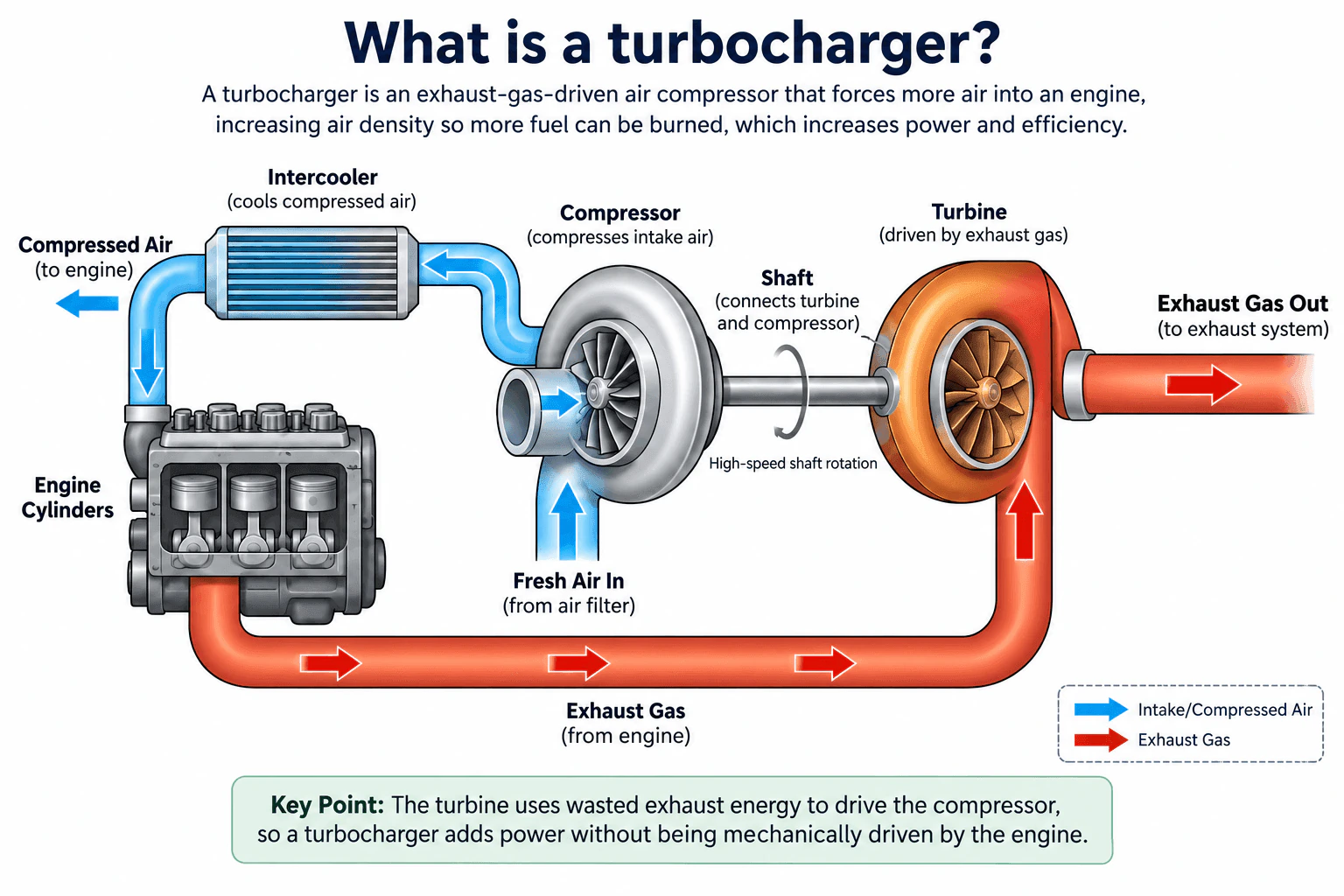
A turbocharger uses energy in the engine's exhaust gas to drive a turbine. The turbine is connected by a shaft to a compressor that draws in fresh air and raises its pressure. The compressed air is typically cooled in an intercooler and then sent to the engine. The denser intake air allows more fuel to be burned, which can increase engine power. Because the compressor is driven by recovered exhaust-gas energy rather than directly by the crankshaft, turbocharging can also improve overall efficiency depending on the operating condition.
Detailed Explanation
A turbocharger is an exhaust-driven compressor. It has two main rotating fluid components: a turbine on the exhaust side and a compressor on the intake side. They are connected by a common high-speed shaft.
The exhaust path and intake path are separate. Exhaust gas leaves the engine, flows into the turbine, transfers energy to the turbine wheel, and then leaves toward the exhaust system. The rotating turbine drives the shaft. On the intake side, the compressor draws in fresh air and increases its pressure. Compression also raises the air temperature, so the compressed air is commonly sent through an intercooler before entering the engine. Cooling increases the air density further. The result is a greater mass of air entering the cylinders, allowing more fuel to be burned and increasing the engine's potential power output.
From a fluid-mechanics viewpoint, both sides involve flowing gases and pressure changes. The exhaust and intake gases are compressible, so pressure, temperature, density, and mass flow rate can all change through the turbine and compressor. For a basic conceptual explanation, the system can be treated as operating at approximately steady conditions when engine speed and load are not changing rapidly. A detailed analysis would use conservation of mass and steady-flow energy balances for separate control volumes around the turbine, compressor, and intercooler rather than applying an ideal incompressible Bernoulli equation.
Useful Questions to Ask the Interviewer
Are you asking for a conceptual explanation or a thermodynamic performance analysis?
Should I discuss the compressor and turbine separately as steady-flow control volumes?
Do you want the effect of the intercooler included?
Should I discuss practical limits such as pressure losses, turbo lag, compressor surge, or choke?
How to Explain It in an Interview
Start with the energy path: exhaust gas leaving the engine carries pressure and thermal energy. As it expands through the turbine, part of that energy is converted into turbine shaft work. The turbine and compressor are mounted on the same shaft, so the turbine drives the compressor.
Next, explain the intake path separately. Fresh air enters the compressor. The compressor raises the air pressure, which also raises its temperature. The compressed air then passes through the intercooler shown in the system, where it is cooled before flowing into the engine. At a given pressure, lowering the temperature increases the air density, allowing a greater mass of air to enter the cylinders.
The important engineering point is that the turbocharger recovers part of the energy available in the exhaust stream to perform compressor work. It is not mechanically driven directly by the engine crankshaft. This can increase specific power and, depending on the engine and operating point, can improve overall efficiency by making useful use of exhaust energy that would otherwise leave through the exhaust system.
In a real system, useful boost depends on compressor and turbine efficiency, exhaust mass flow, pressure ratios, intercooler effectiveness, shaft speed, and pressure losses through the intake and exhaust systems. At low exhaust flow, the turbine may not produce enough power for significant boost, contributing to turbo lag. Excessive compressor pressure ratio or unsuitable mass flow can move the compressor toward surge or choke. High compressor-outlet temperature reduces charge-air density and increases thermal loading, which is why intercooling is useful.
To validate a real design, I would obtain compressor-inlet conditions, compressor pressure ratio, mass flow rate, charge-air temperature, turbine inlet and outlet pressures and temperatures, and shaft-speed limits. I would then check the operating points against the turbocharger manufacturer's compressor and turbine maps and verify that temperature, speed, pressure ratio, surge margin, and flow limits remain within allowable ranges.
Technical Approach
Define the two separate gas-flow paths: fresh intake air through the compressor and intercooler to the engine, and exhaust gas from the engine through the turbine to the exhaust system.
State that the gases are compressible and use an approximately steady-flow assumption only when engine speed and load are not changing rapidly.
Apply conservation of mass separately to the intake and exhaust control volumes.
Track the energy transfer: exhaust gas expands through the turbine and produces shaft work, and that shaft work drives the compressor.
Evaluate the compressor pressure rise and associated temperature rise.
Include intercooler heat removal and realistic intake and exhaust pressure losses when estimating actual engine-inlet conditions.
Check the compressor and turbine operating points against appropriate performance maps for the required mass flow and pressure ratio.
Verify practical limits such as shaft speed, temperature, compressor surge, compressor choke, and allowable pressure ratios before applying the design to real equipment.
Practical Insights
The main tradeoff is that more boost can increase the mass of air supplied to the engine, but a higher compressor pressure ratio also requires more shaft work and usually raises the compressed-air temperature. The turbine obtains this power from the exhaust flow, which increases exhaust-side backpressure. An intercooler reduces charge-air temperature and increases density, but it also introduces pressure drop and packaging requirements. Turbocharger response depends on rotating inertia and exhaust flow, so a unit sized for high maximum flow may respond more slowly at low engine speed, while a smaller unit may respond quickly but reach its flow limit sooner.
Why Interviewers Ask This
Interviewers are checking whether you understand the basic energy and fluid-flow path of a turbocharger: exhaust gas drives a turbine, the turbine drives a compressor through a shaft, and the compressor increases intake-air pressure and density. They also want to see whether you can distinguish the exhaust and intake flow paths and explain the concept without confusing a turbocharger with a mechanically driven compressor.
Common interview mistakes
Common mistakes are saying that exhaust gas enters the engine through the turbocharger, mixing the intake and exhaust flow paths, saying the exhaust gas directly compresses the intake air, or describing the turbocharger as mechanically driven by the crankshaft. Another mistake is ignoring the temperature rise during compression or assuming that the intercooler increases pressure; its main purpose is to remove heat from the compressed intake air, while a real intercooler also causes some pressure loss. For detailed analysis, another error is treating the gases as incompressible and applying an ideal Bernoulli equation without accounting for compressor work, turbine work, compressibility, and pressure losses.
Interview tip
Use a simple flow sequence: engine exhaust → turbine → exhaust system, while fresh air → compressor → intercooler → engine. Then explain that the turbine and compressor share a shaft. That makes the energy transfer and the two separate fluid paths easy to understand and prevents the most common conceptual mistakes.
Interviewer may ask next
Why is an intercooler commonly used after the turbocharger compressor?
Compressing the intake air raises both its pressure and temperature. Hotter air is less dense than cooler air at the same pressure, so an intercooler removes heat from the compressed air before it enters the engine. This increases charge-air density and can reduce thermal loading. A real intercooler also causes some pressure loss, so its benefit must be evaluated using both temperature reduction and pressure drop.
What changes if the engine produces less exhaust-gas flow?
Lower exhaust mass flow generally gives the turbine less available power, so the shaft and compressor may run more slowly and produce less boost. This is why turbochargers often provide limited boost at low engine speed or load. Turbocharger sizing is therefore a tradeoff: a smaller turbine and compressor can respond more quickly at low flow, while a larger unit can support greater high-flow operation but may respond more slowly.
5. What does safety mean to you in a working environment?SafetyEasyCaterpillar
Short Interview Answer (30-60 seconds)
Safety means identifying hazards before they cause harm and reducing risk in a systematic way. In a mechanical engineering environment, I would stop work if there were an immediate hazard, assess the risk, and use the hierarchy of controls, preferring elimination or engineering controls over relying only on PPE. I would also make sure stored energy is properly isolated before maintenance, guards and interlocks are working, and any remaining risk is clearly communicated. To me, safety is part of every engineering decision, not something checked only after the design or job is complete.
Detailed Explanation
Safety in a working environment means protecting people by identifying hazards, understanding their potential consequences, and reducing risk systematically using appropriate controls. For a mechanical engineer, that responsibility applies during design, operation, troubleshooting, maintenance, testing, and equipment changes.
A useful principle is the hierarchy of controls. I would first ask whether the hazard can be eliminated. If it cannot, I would consider substitution or an engineering control such as guarding, an interlock, physical separation, pressure containment, ventilation, or another design feature. Administrative controls such as procedures and training can then reduce exposure further, while personal protective equipment is normally a final layer rather than the primary solution.
I would also consider the actual forms of hazardous energy associated with the equipment. Depending on the system, these could include electrical energy, pressure, heat, gravity, springs, or rotating components. Before maintenance or intervention, hazardous energy should be isolated using the authorized procedure, such as lockout tagout where applicable, and the isolation should be verified rather than assumed. Pressure may need to be released, elevated equipment may need secure support, and rotating parts must be prevented from moving unexpectedly.
Machine protection is equally important. Guards, interlocks, and emergency-stop functions should not be bypassed simply to make a task faster. If an immediate unsafe condition exists, I would stop the work within my authority and escalate the issue through the appropriate process. The exact legal or procedural requirements depend on the jurisdiction, equipment, and workplace, so I would follow the applicable rules rather than assuming one universal standard.
Safety also continues after an initial control is introduced. I would check whether the control actually addresses the hazard, document any residual risk, and communicate the safe operating requirements to the people affected. If equipment, tooling, materials, operating conditions, or procedures change, I would reassess the risk because the previous assessment may no longer be valid. Incident and near-miss investigations can also provide evidence for improving the design or process.
Useful Questions to Ask the Interviewer
What types of equipment or mechanical hazards are most important in this role?
How are engineers involved in job hazard analysis, risk assessment, or design reviews?
What process is used when an engineer identifies an immediate safety concern?
How are equipment modifications or process changes reviewed for new hazards?
What responsibilities do engineers have for documenting and communicating residual risk?
How to Explain It in an Interview
Start with the principle that safety means preventing harm through deliberate engineering decisions. Then explain that you identify the hazard, assess the risk, and apply the hierarchy of controls, with engineering controls preferred over depending only on PPE. Mention practical mechanical hazards such as stored energy, rotating equipment, hot surfaces, pressure, pinch points, and lifting. Explain that maintenance requires authorized isolation and verification and that guards or interlocks should never be bypassed. Finish by showing that safety is continuous: verify the control, communicate residual risk, and reassess when conditions change.
Technical Approach
Identify the task, equipment, people exposed, and operating or maintenance conditions.
Identify credible hazards, including moving machinery, pinch points, lifting, hot surfaces, pressure, and electrical, thermal, gravity, spring, or rotating stored energy where applicable.
Assess the likelihood and consequence of each hazard using the workplace's applicable risk-assessment method.
Stop and escalate the work if an immediate unacceptable hazard exists.
Apply the hierarchy of controls, starting with elimination and favoring engineering controls before administrative controls or PPE.
For maintenance or intervention, use the authorized energy-isolation procedure and verify isolation before work begins.
Confirm required guards, interlocks, emergency stops, and other protective measures are in place and functional before operation.
Communicate procedures and remaining hazards to affected personnel and document residual risk where required.
Validate that the controls work under the intended operating conditions.
Reassess the hazards after equipment, process, tooling, material, or operating-condition changes and use incident or near-miss findings to improve the controls.
Practical Insights
Safety decisions involve tradeoffs between reducing risk and maintaining practical operation, maintenance access, reliability, and productivity. The key is not to remove a protective control simply because it makes a task slower or less convenient. A strong solution reduces the hazard at its source while still allowing the equipment to be operated and maintained correctly. Some hazards cannot be completely eliminated, so the remaining risk must be understood, controlled, communicated, and reassessed when conditions change.
Why Interviewers Ask This
Interviewers ask this question to evaluate whether the candidate treats safety as an engineering responsibility rather than only a rule-following exercise. They want to see sound judgment about recognizing hazards, stopping unsafe work, using risk assessment and the hierarchy of controls, controlling hazardous energy, respecting guards and interlocks, and communicating residual risk.
Common interview mistakes
Common mistakes include treating safety as only wearing PPE, continuing work despite an immediate hazard, assuming equipment is safe because it is switched off, failing to identify stored pressure or mechanical energy, bypassing guards or interlocks, relying on procedures when an engineering control is reasonably available, assuming one safety standard applies universally, and failing to reassess risk after equipment or process changes.
Interview tip
Give a direct definition of safety first, then support it with a simple engineering process: identify the hazard, assess the risk, apply the hierarchy of controls, isolate hazardous energy when necessary, verify protective measures, and communicate residual risk. Showing that you would stop work for an immediate danger and prefer engineering controls over relying only on PPE demonstrates practical safety judgment.
Interviewer may ask next
How would you verify that a safety control you introduced is actually effective?
I would first define what hazard the control is intended to reduce and what successful protection should look like. Then I would verify the control under the relevant operating and maintenance conditions without exposing anyone to unnecessary risk. For example, I would confirm that a guard prevents access to the hazard, that an interlock produces the intended safe response, or that an energy-isolation method controls all identified energy sources. I would also review whether the control introduces a new hazard, document any residual risk, and reassess the solution if operating conditions or equipment configuration change.
What would you do if meeting a production target required bypassing a machine guard or interlock?
I would not bypass the guard or interlock simply to meet the production target. I would stop or escalate the work according to my authority, explain the hazard, and work with the appropriate team to find a safe solution. That might involve correcting the equipment problem, changing the process, or developing another properly reviewed engineering control. Production pressure does not justify removing a protection that is intended to prevent exposure to a hazardous condition.
6. Describe a situation where you provided safety.SafetyMediumCaterpillar
i Question Details
Use a situation from your own experience.
Short Interview Answer (30-60 seconds)
In one maintenance-support situation involving hydraulically powered equipment, I noticed that work was about to begin without fully addressing possible stored hydraulic pressure. I stopped the activity because shutting a machine off does not necessarily remove stored energy. I worked with the authorized maintenance personnel to ensure the applicable isolation and pressure-release process was completed and the safe energy state was verified using the required equipment-specific procedure before work continued. Before operation resumed, I also confirmed that the required guarding was restored. The key lesson was to control the hazard at its source and verify the control rather than relying only on PPE or assumptions.
Detailed Explanation
A strong safety response starts by identifying what can cause harm, stopping work if an immediate hazard exists, and controlling the hazard using the hierarchy of controls. In this situation, the concern was stored hydraulic energy during maintenance. A machine that is switched off can still contain pressurized fluid, so assuming that power-off means safe could expose someone to a sudden pressure release, unexpected actuator movement, or a pinch-point hazard.
I first treated the equipment boundary and energy state as unknown until they were verified. I stopped the maintenance activity and raised the concern with the authorized personnel responsible for the isolation. I did not attempt to bypass an interlock, remove a guard, or improvise an isolation method. Instead, the applicable equipment, site, and jurisdictional requirements needed to define the required isolation points, pressure-release steps, and verification method.
The reasoning follows the hierarchy of controls. The preferred control was to eliminate or isolate the hazardous energy before anyone entered the danger area. Administrative controls, such as the safe operating procedure and job hazard analysis, supported that process. PPE remained useful as a final protective layer, but it was not treated as the primary control for stored energy.
After the authorized isolation and pressure-release process was completed, the important validation step was verifying the safe energy state rather than assuming the procedure had worked. Before the equipment returned to operation, the required guards and protective devices also needed to be restored and checked. Any remaining or residual risk should be documented and communicated according to the applicable procedure.
Useful Questions to Ask the Interviewer
What type of equipment or maintenance environment is most relevant to this role?
What hazards are most important in the facility, such as hydraulic pressure, rotating equipment, lifting, electrical energy, or hot surfaces?
Which site-specific lockout/tagout and energy-isolation procedures apply to the equipment?
How are changes to guarding, interlocks, or maintenance procedures reviewed and approved?
How to Explain It in an Interview
I would explain the situation in a simple sequence: I recognized the hazard, stopped the work before exposure occurred, identified stored hydraulic energy as the key risk, involved the authorized personnel responsible for isolation, and required verification before work resumed. I would emphasize that I did not rely only on PPE and did not assume that switching the machine off removed all energy. I would close by explaining that the safest engineering decision is to control the hazard at its source, verify that the control is effective, restore guards and protective devices, and communicate any residual risk.
Technical Approach
Identify the task, equipment boundary, and people who could be exposed.
Identify hazardous energy sources, including hydraulic pressure, electrical energy, gravity, springs, thermal energy, and rotating components as applicable.
Stop and escalate the work if an immediate uncontrolled hazard exists.
Use the hierarchy of controls and prefer elimination, isolation, or another engineering control over relying on PPE.
Require the applicable authorized energy-isolation and lockout/tagout procedure; do not bypass guards or interlocks.
Release, block, restrain, or otherwise control stored energy using the approved equipment-specific method.
Verify the safe energy state using the required procedure before maintenance begins.
Complete the work while maintaining the required controls.
Restore guards and protective devices and follow the applicable return-to-service process.
Document and communicate any residual risk, lessons learned, or required change-management action.
Practical Insights
The main tradeoff is between production or maintenance speed and the time required to control and verify hazards correctly. A quick shutdown may appear sufficient, but stored pressure, gravity, rotating inertia, springs, thermal energy, or other hazardous energy can remain. Engineering controls and verified isolation usually require more preparation than simply adding PPE, but they reduce exposure more effectively. The exact isolation and verification method depends on the equipment, jurisdiction, and site procedure, so the engineer should not assume that one universal process applies everywhere.
Why Interviewers Ask This
Interviewers ask this to evaluate whether I recognize hazards early, exercise appropriate stop-work judgment, understand stored energy and the hierarchy of controls, involve authorized personnel, and verify that risk controls are effective before equipment returns to service.
Common interview mistakes
Common mistakes include assuming that switching equipment off removes all hazardous energy, relying on PPE instead of controlling the hazard at its source, beginning work before isolation is verified, overlooking hydraulic or other stored energy, bypassing guards or interlocks to save time, allowing personnel who are not authorized under the applicable procedure to perform required isolation steps, and restarting equipment before guards and protective devices are restored.
Interview tip
Use a clear situation-action-result structure and emphasize judgment rather than trying to sound heroic. State the hazard you recognized, why it mattered, why you stopped or changed the work, how you used the hierarchy of controls and authorized isolation process, and how you verified the condition before work resumed. Avoid claiming that an action made equipment completely safe unless the required verification supports that conclusion.
Interviewer may ask next
How would you verify that the equipment was safe to work on instead of simply assuming the isolation was successful?
I would follow the applicable equipment-specific, site, and jurisdictional procedure and have the authorized personnel verify the isolated energy state using the required method. The verification should address each relevant energy source, including stored hydraulic pressure or other residual energy, rather than relying only on the position of a switch or valve. I would also confirm that the work boundary and remaining hazards were understood before maintenance began.
What would you do if production pressure made someone want to bypass the isolation or guarding step?
I would not support bypassing a required isolation, guard, or interlock to save time. If the hazard could expose someone to injury, I would stop the activity within my authority and escalate it through the appropriate safety and engineering channels. I would look for a safer engineering or scheduling alternative, but production urgency would not justify knowingly accepting an uncontrolled hazardous-energy or machine-guarding risk.
7. Tell me about a situation where you had to deal with a quality issue.ManufacturingMediumCaterpillar
i Question Details
Describe your experience handling that quality issue.
Short Interview Answer (30-60 seconds)
Because no real incident was provided, I would present this as a hypothetical example. A critical machined feature was showing more variation than expected during inspection. I would first contain the affected parts and confirm that the measurement method was reliable. Then I would review the machine setup, tooling, fixture, and process data with manufacturing and quality personnel. Once the evidence identified the process condition causing the variation, I would correct it and verify the result through additional inspection and continued monitoring. I would not close a quality issue just because one part passes; I would want evidence that the process itself is stable and can consistently produce acceptable parts.
Detailed Explanation
Because no actual personal quality incident was supplied, the following is a hypothetical interview example and should be replaced with real experience when available.
A quality issue in manufacturing should be handled in a controlled sequence: protect the customer or downstream process first, confirm that the problem is real, determine why it happened, correct the cause, and then prove that the process remains under control.
In this example, a critical machined feature begins showing excessive variation during inspection. I would avoid assuming that every out-of-tolerance reading represents the same root cause. The variation could come from the machining process, tool wear, fixture movement, incorrect setup, material variation, temperature effects, or the measurement system itself.
My first action would be containment. I would identify the potentially affected production window, separate questionable parts according to the applicable quality process, and prevent suspect product from moving forward until the risk was understood. The purpose of containment is not to solve the root cause; it is to limit the effect while the investigation is happening.
Next, I would confirm the measurement. Before changing the manufacturing process, I would check that the inspection method, datum setup, gauge or measurement equipment, and measurement technique were appropriate for the feature. If the measurement system is inconsistent, process changes based on that data could make the real problem harder to diagnose.
After confirming the measurement, I would review the manufacturing process. For a machined feature, that could include the machine setup, fixture condition, cutting tool condition, offsets, feeds and speeds where relevant, coolant or thermal conditions, and recent process changes. I would also look at inspection results over time instead of focusing only on one failed part. A trend, shift, or increasing spread can provide useful evidence about what changed.
If enough trustworthy data were available and the process were reasonably stable, I could use statistical process control or process capability information to understand whether the process was centered and whether its natural variation was compatible with the tolerance. I would not quote Cp or Cpk from a few measurements or from an unstable process because those numbers would not provide reliable evidence of process capability.
Once the likely cause was supported by evidence, I would correct that specific cause rather than simply sorting parts indefinitely. Depending on the evidence, corrective action might involve replacing or controlling tooling, correcting a fixture or setup condition, adjusting an approved process parameter, improving inspection access, or updating a control plan for the critical characteristic. Any change would follow the applicable engineering and quality approval process.
Finally, I would verify the corrective action with new production and inspection data. I would confirm that the characteristic returned to an acceptable and stable condition and that the improvement persisted over an appropriate production period. I would also document what was learned so the same failure mode was less likely to recur.
Useful Questions to Ask the Interviewer
Was the issue discovered internally, at final inspection, or after the product reached a customer?
Was the problem a dimensional defect, surface-finish issue, material issue, assembly problem, or another type of nonconformance?
Was the characteristic identified as critical or otherwise subject to a specific control plan?
What measurement method was being used, and was its reliability already established?
Was the issue isolated to a single part, one machine or tool, one production lot, or a broader population?
Were process-control or capability data available before the issue occurred?
These questions matter because the appropriate response depends on the risk, the affected population, the reliability of the evidence, and where the defect was discovered.
How to Explain It in an Interview
I would keep the story focused on four things: containment, investigation, corrective action, and verification. I would explain what evidence showed there was a real quality problem, what I did to prevent questionable product from continuing, how I separated possible measurement error from manufacturing variation, and how the team narrowed the cause using process data and physical inspection. Then I would explain the corrective action and, most importantly, how we verified that the process was stable afterward. I would avoid claiming that one passing inspection proved the problem was solved. The stronger engineering answer is that the corrective action was supported by repeatable measurements and continued process evidence.
Technical Approach
Define the nonconformance and determine which characteristic or requirement is affected.
Contain potentially affected parts or production so the issue does not continue downstream.
Confirm the inspection or measurement method before changing the manufacturing process.
Review the affected production window and look for patterns in the data.
Investigate likely process causes such as tooling, fixtures, machine setup, process parameters, material, environment, and recent changes.
Use process-control or capability analysis only when there is enough reliable data and the process is sufficiently stable.
Identify the most strongly supported root cause and implement a controlled corrective action.
Produce and inspect additional parts to verify the correction.
Continue monitoring the critical characteristic for recurrence.
Update relevant work instructions, control plans, inspection requirements, or preventive controls when justified by the findings.
Practical Insights
The main manufacturing tradeoff is between reacting quickly and changing the process intelligently. Production pressure may encourage immediate sorting, adjustment, or tool replacement, but an unsupported change can hide the root cause. Inspection also has a cost and cycle-time impact, so 100% inspection may be useful as temporary containment without being the best permanent solution. A stronger long-term solution makes the process consistently capable and uses an appropriate control plan to detect meaningful changes. Scrap, rework, tooling cost, inspection effort, production interruption, and the risk of passing defective parts all need to be considered together.
Why Interviewers Ask This
Interviewers want to see whether I can respond to a manufacturing quality problem in a disciplined way rather than immediately blaming an operator, machine, design, or supplier. They are evaluating how I contain risk, separate measurement problems from true process variation, investigate root causes, work across manufacturing and quality functions, use evidence such as inspection and process data, implement corrective action, and verify that the solution actually controls the critical characteristic.
Common interview mistakes
Common mistakes include adjusting the machine before confirming the measurement, treating sorting as a permanent corrective action, blaming an operator without evidence, calculating Cp or Cpk from an unstable or inadequate data set, checking only the failed part instead of the affected production window, ignoring fixture or tooling condition, and declaring the problem solved after one acceptable part. Another mistake is making a process change without documenting and verifying its effect.
Interview tip
Use a real quality problem if you have one and make your personal engineering contribution clear. Explain what you did to contain the issue, what evidence you reviewed, how you separated possible causes, what corrective action was taken, and how you verified that it worked. If you have real numbers such as scrap reduction, dimensional variation, capability improvement, or production impact, use only the numbers you can genuinely support. Do not invent Cp, Cpk, defect rates, savings, or employer procedures just to make the story sound stronger.
Interviewer may ask next
How would you verify that the corrective action really solved the quality issue?
I would first make sure the inspection method itself was reliable. Then I would collect new production data after the corrective action and compare the behavior of the critical characteristic with the earlier condition. I would look for both conformance and stability rather than relying on one passing part. If the process were stable and enough representative data were available, I could evaluate process capability against the tolerance. I would also continue monitoring for an appropriate period or production quantity to make sure the problem did not return. The corrective action would be considered effective only when the evidence showed sustained control, not simply temporary improvement.
What would you do if production could not stop while you investigated the issue?
I would separate temporary containment from the permanent corrective action. If continued production were permitted by the applicable quality and engineering process, I would establish a controlled containment method such as increased inspection, segregation of affected production, tighter monitoring of the critical characteristic, or another approved control that prevents questionable parts from moving downstream. At the same time, I would continue the root-cause investigation. I would also consider the added inspection time, scrap risk, cycle-time impact, and capacity required for containment. Once the root cause was corrected and the process was verified, I would remove temporary controls only when the evidence and required approvals supported doing so.
8. What would you do if you learned your boss was working against the company?NEWBehavioralHardCaterpillar
i Question Details
You have previously been obedient to this boss.
Interview tip:
Use STAR to structure your answer: briefly explain the Situation and Task, make Action the most detailed part, and finish with the Result. For example, describe a situation where you had normally followed your manager's direction but discovered conduct that could harm the company, verified the facts, raised the concern directly, protected accurate engineering records, used the proper reporting path when needed, and helped reach a responsible outcome.
Situation
During a previous mechanical engineering project, I normally followed my manager's direction because that was part of working effectively within the team. During testing, however, I noticed that a recurring test problem was being left out of information prepared for a design review. My manager had asked me to use only the results that supported moving forward. I became concerned because the complete test record could affect an engineering decision and the company needed accurate information.
Task
My responsibility was to make sure the engineering record was accurate while handling the concern professionally. I did not want to make an accusation based only on an assumption, but I also knew that simply obeying the instruction could expose the company to technical, quality, and trust problems.
Action
I first reviewed the test records, procedures, and my own notes to make sure I understood the facts correctly. I separated what I could prove from what I suspected. I then spoke with my manager privately. I explained that the omitted results were relevant to the design decision and that I was not comfortable presenting an incomplete record. I focused on the engineering risk and the company's interests rather than questioning my manager's motives. I asked whether there was information I was missing and gave my manager an opportunity to clarify the decision. When I was still directed to leave the results out, I kept the original records intact and did not change or hide the data. I explained that I needed to follow the established quality and reporting process. I then raised the concern through the appropriate internal channel and provided the factual records needed for an independent review. I kept the matter confidential and continued treating my manager professionally while the issue was reviewed.
Result
The full test information was reviewed before the design decision moved forward, and the engineering record remained complete. The team was able to address the concern using the proper process rather than relying on incomplete information. I learned that respecting a manager does not mean following an instruction that could harm the company. My responsibility is to verify the facts, speak up professionally, protect accurate engineering information, and use the proper escalation path when a serious concern cannot be resolved directly.
Why Interviewers Ask This
Interviewers ask this question to evaluate integrity, professional judgment, courage, and respect for proper reporting processes. They want to know whether a candidate can question inappropriate direction without reacting emotionally, verify facts before making an accusation, protect the company's interests, and escalate serious concerns responsibly when necessary.
Interviewer may ask next
Why did you speak with your manager before escalating the concern?
I wanted to make sure I understood the situation correctly and give my manager a fair opportunity to explain the decision. I had verified the technical records, but I still did not want to assume intent. Speaking privately first allowed me to raise the engineering risk directly and professionally. I escalated only after the concern remained unresolved and I was still being asked to present incomplete information.
How would you handle a similar situation now?
I would follow the same basic approach. I would verify the facts, preserve accurate records, and discuss the concern directly when it was safe and appropriate to do so. If the instruction still created a serious ethical, quality, or company risk, I would use the established reporting channel and provide objective evidence. I would stay focused on the issue rather than the person and continue acting professionally throughout the process.
9. Describe a time when you had to pay attention to details to solve a problem.NEWBehavioralMediumCaterpillar
i Question Details
Focus on your attention to detail in that situation.
Interview tip:
Use STAR to structure your answer: briefly explain the Situation and Task, make Action the most detailed part, and finish with the Result. For example, describe a mechanical assembly problem where you carefully reviewed drawings, tolerances, inspection information, and part orientation, identified a small detail causing the issue, communicated the finding clearly, and helped implement a reliable correction.
Situation
During a previous project, our team was assembling a mechanical unit and found that one component did not fit correctly with the surrounding parts. The individual parts looked acceptable during a quick review, so the cause was not immediately clear.
Task
I was responsible for finding the source of the fit problem and determining whether it came from the design, manufacturing, inspection, or assembly process. I needed to understand the issue before recommending any change because changing the wrong part could create another problem.
Action
I started by reviewing the latest engineering drawings instead of relying only on the dimensions that were easy to see on the parts. I checked the specified tolerances, datum references, mating surfaces, and required part orientation. I then compared those details with the inspection information and the actual assembly condition. During that review, I noticed that one feature had been evaluated from a different reference surface than the drawing required. The individual dimension appeared acceptable, but the reference difference changed how the feature aligned with the mating component. I confirmed this by checking the related dimensions together and reviewing how the parts located against each other during assembly. I also spoke with the manufacturing and inspection team so we could compare our interpretation of the drawing. Once we agreed on the cause, I documented the correct reference and assembly checks so the team could verify the part consistently before installation.
Result
The team was able to correct the fit issue without making an unnecessary design change. The assembly could then be completed correctly, and the clearer inspection approach helped prevent the same misunderstanding on later parts. I learned that small details such as datum references, orientation, and how dimensions relate to each other can be just as important as the main dimensions when solving a mechanical problem.
Why Interviewers Ask This
Interviewers ask this question to understand how carefully a candidate works when small details can affect mechanical performance, quality, or assembly. A strong answer shows that the candidate verifies information systematically, looks beyond obvious symptoms, communicates findings with others, and avoids making changes before understanding the real cause.
Interviewer may ask next
Why did you review the drawing references instead of changing the part that did not fit?
I wanted to confirm the actual cause before changing anything. The part could have been manufactured correctly while the problem came from another component, the inspection method, or the assembly setup. Reviewing the drawing references helped me understand how the dimensions were intended to work together and prevented an unnecessary design change.
What would you do differently if you faced a similar problem again?
I would bring the design, manufacturing, and inspection views together earlier and verify the important datum references and mating conditions before assembly begins. The problem showed me that everyone can read the same drawing but focus on different details, so confirming the critical references early can reduce confusion and prevent the issue from reaching assembly.
10. What is the achievement that you are most proud of?NEWBehavioralEasyCaterpillar
i Question Details
Choose your proudest achievement.
Interview tip:
Use STAR to structure your answer: briefly explain the Situation and Task, make Action the most detailed part, and finish with the Result. For example, describe a mechanical engineering achievement that mattered to you, the problem you were responsible for solving, the decisions and technical steps you personally took, how you worked with others, and why the final outcome made you proud.
Situation
During a previous project, our team was preparing a mechanical assembly for production when testing showed that one component was wearing faster than expected. The design met the basic functional requirement, but I was concerned that the wear could reduce reliability over time.
Task
I was responsible for investigating the cause and helping improve the design without creating unnecessary changes for the rest of the assembly. My goal was to find a practical solution that improved durability while still meeting the existing fit, manufacturing, and schedule needs.
Action
I first reviewed the test observations, drawings, material information, and contact surfaces to understand where the wear was starting. I then inspected the assembly and compared the physical condition with the intended load path, which is how force moves through the parts. I found that the contact area was concentrating force more than we expected. I created a few design options that changed the geometry around the contact area while keeping the surrounding interfaces, which are the places where the component connects to the surrounding parts, unchanged. I discussed the options with manufacturing and the test team because I wanted to make sure the solution could be produced and evaluated without creating a new problem. After considering their feedback, I selected the simplest change that improved how the load was distributed. I updated the design, documented the reason for the change, and worked with the team to test the revised part under the same type of conditions as before. I also reviewed the results carefully instead of assuming that the design change had solved the issue.
Result
The revised design showed more even contact and better wear behavior during testing, and the team was able to move forward with greater confidence in the assembly. I am proud of that achievement because I did more than correct a design issue. I took ownership of the problem, worked across functions, and made a focused change that improved reliability without adding unnecessary complexity. It also taught me to look closely at how real parts carry loads, not only at how they appear in the design.
Why Interviewers Ask This
Interviewers ask this question to understand what kind of work gives the candidate a sense of achievement and how the candidate defines success. A strong answer shows ownership, sound judgment, personal contribution, collaboration, and the ability to explain why an accomplishment was meaningful.
Interviewer may ask next
Why did you choose the simpler design change instead of a larger redesign?
I chose the simpler change because it addressed the main cause of the wear while preserving the existing interfaces, which are the existing connection points with the surrounding parts, and manufacturing approach. A larger redesign could have introduced new risks and required more changes to surrounding parts. I wanted the solution to be effective, practical, and easy for the team to validate.
What did you learn from that achievement that you would apply to a similar problem now?
I learned to connect test evidence with the actual load path, which means how force moves through the parts, before changing a design. I also learned that involving manufacturing and testing early helps identify practical concerns before a design is released. If I faced a similar problem now, I would use the same approach of finding the root cause, comparing a few focused options, and validating the final choice with the people who build and test the part.
More questions load as you scroll
Mechanical Engineer Resume Examples
Explore the resume examples below to find the one that best matches your target Mechanical Engineer role.
Disclaimer: This interview guide is for educational and informational purposes only. It is designed to help readers prepare, but it does not guarantee any interview result, hiring decision, offer, or outcome. Interview questions, hiring criteria, and preferred answers can vary by employer, interviewer, industry, location, and time. All answers, examples, and explanations in this guide are suggested examples for interview preparation, not definitive answers or instructions for professional practice. They are based on research and judgment, are provided without warranties of any kind, and should be adapted to the question, role, and applicable laws and professional requirements. Diagrams are simplified illustrations intended to highlight the main concepts and their relationships; actual situations, systems, and practices may be more complex. Alternative approaches may be equally valid or better suited to a particular question, context, or interviewer. To the fullest extent permitted by applicable law, the contributors and publisher are not liable for decisions made, actions taken, or losses incurred based on this guide.
State Laws and Professional Responsibilities: Laws and requirements governing an occupation vary by state and jurisdiction. You are responsible for checking the current laws, licensing requirements, and scope-of-practice rules that apply to your location and role, and for ensuring that your answers and actions comply with them. Adapt examples in this guide to those requirements. This guide is not legal advice.
Company Notice: This guide is an independent educational resource and is not affiliated with, endorsed by, sponsored by, or approved by the company named in this guide. Company names identify reported interview experiences or the employer context of clearly labeled original practice exercises. Interview practices can change without notice, and inclusion of company-specific content does not mean these questions are official, complete, or guaranteed to be asked. To the fullest extent permitted by law, the author, contributors, and publisher are not responsible for outcomes related to use of this material.
Content Accuracy and Verification: To the fullest extent permitted by applicable law, we do not represent or warrant that interview guides, questions, answers, examples, or diagrams are accurate, complete, current, error-free, or suitable for any particular purpose. You are responsible for independently reviewing and verifying the information before relying on it.