188 Data Scientist Interview Questions & Answers

92 top • 12 Amazon • 15 Apple • 13 Google • 12 Meta • 15 Microsoft • 15 Netflix • 14 NVIDIA

Data Scientist icon

Questions with Detailed ExplanationsWith Detailed Explanations

(Last Updated: September 8, 2026)

81. Group strings that are anagrams.CodingMedium

Question Details

Using Python 3.14, implement def group_anagrams(strs: list[str]) -> list[list[str]]. The input has 1 to 10,000 strings; each string has length 0 to 100 and contains only lowercase English letters. Group strings with identical character multisets, preserving duplicate input strings. Group order and order inside each group are unrestricted, but no string may be dropped or added. Return new lists, do not mutate strs, and use only the standard library. Inputs outside the contract need not be handled. Example: for ["eat","tea","tan","ate","nat","bat"], one valid output is [["eat","tea","ate"],["tan","nat"],["bat"]].

Short Interview Answer (30-60 seconds)

I would use a dictionary with a 26-number frequency tuple as the key. For each string, I count how many times each lowercase letter appears, convert the count list to a tuple, and append the original string to that key's group. Anagrams produce the same frequency tuple, so they go into the same list. Finally, I return all dictionary groups. The expected time is O(n * k), and the space complexity shown by this solution is O(n * k).

Detailed Explanation

See the Code while reading this explanation.

We receive a list of lowercase English strings and need to put strings with exactly the same letters and letter counts into the same group. Every input occurrence must appear in the result, so duplicate strings must stay. We return new lists and do not change the input list. The order of the groups and the order inside each group do not matter. I use the count of each letter from a through z as a signature because anagrams always have the same counts.

Useful Questions to Ask the Interviewer
  1. Can I rely on every string containing only lowercase English letters? Yes, that is guaranteed by the problem.
  2. Does the order of the groups or the strings inside each group matter? No, either order is accepted.
  3. Should duplicate input strings be preserved? Yes, every occurrence must remain in the output.
Group strings that are anagrams. diagram
How to Explain It in an Interview
1. Understand the input and required output

The function receives strs: list[str]. There can be 1 to 10,000 strings. Each string has length 0 to 100 and contains only lowercase English letters. We return a new list[list[str]]. Strings with identical character counts belong in the same group. We must preserve duplicate strings, and we must not mutate strs.

2. Create a frequency signature

For each string, I create a list of 26 zeros. Position 0 represents a, position 1 represents b, and so on through position 25 for z. I count every character in the string. After counting, I convert the list to a tuple. A tuple is hashable, so it can be used as a dictionary key.

3. Group strings in a dictionary

The dictionary maps frequency tuple -> list of original strings. If two strings have the same 26 counts, they produce the same key and are appended to the same list. The central invariant is that all strings stored under one key have exactly the same character counts.

4. Walk through the example

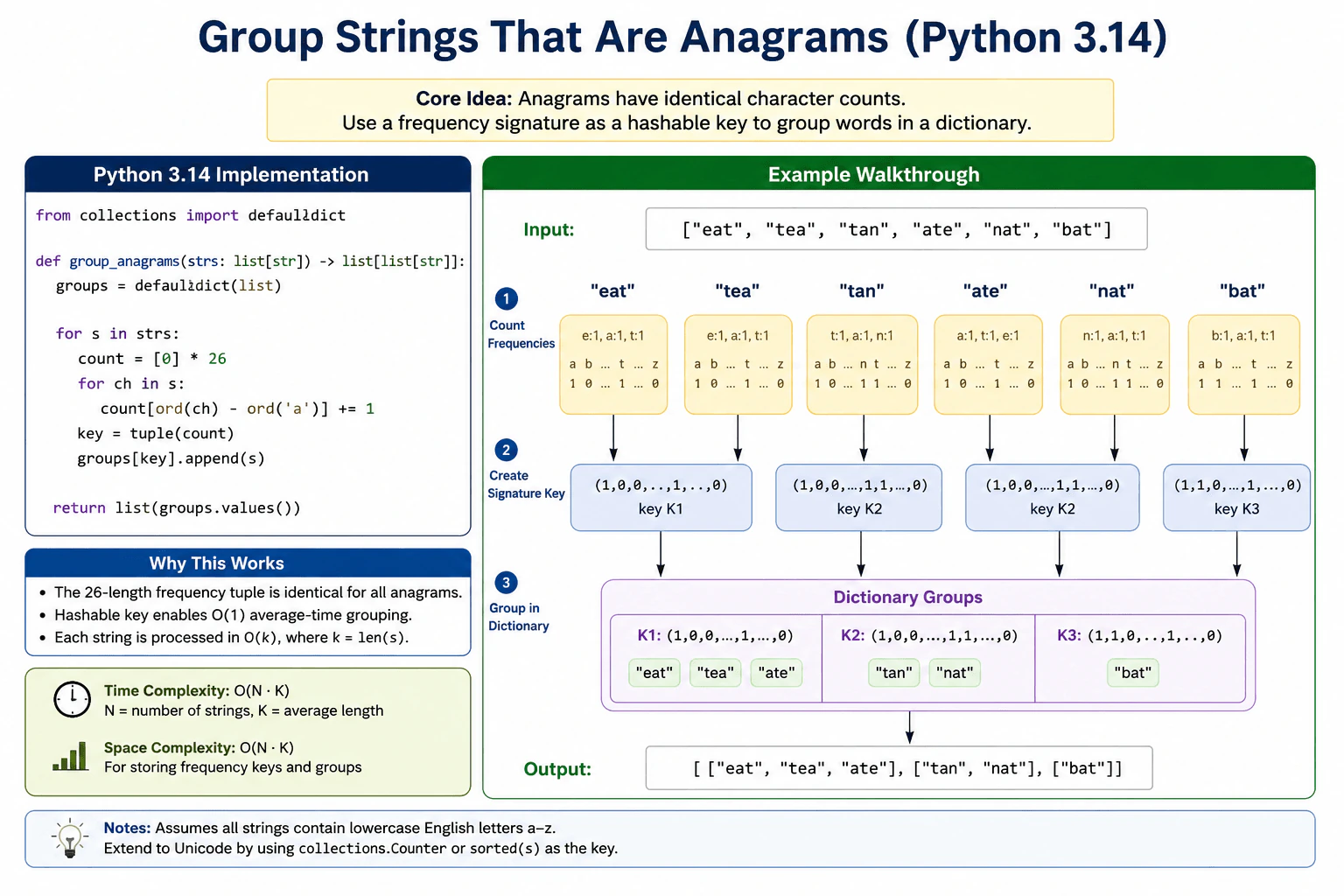
The input is ["eat", "tea", "tan", "ate", "nat", "bat"].

For "eat", the counts for a, e, and t are each 1. Its signature becomes key K1, so the dictionary starts K1 with ["eat"].

For "tea", the same three letters occur once, so it produces K1 and joins the same group. K1 becomes ["eat", "tea"].

For "tan", the letters a, n, and t each occur once. That produces a different signature K2, so K2 starts as ["tan"].

For "ate", the counts match K1, so K1 becomes ["eat", "tea", "ate"].

For "nat", the counts match K2, so K2 becomes ["tan", "nat"].

For "bat", the letters a, b, and t each occur once. That creates a third signature K3 with ["bat"].

The dictionary therefore contains K1 -> ["eat", "tea", "ate"], K2 -> ["tan", "nat"], and K3 -> ["bat"]. One valid returned result is [["eat", "tea", "ate"], ["tan", "nat"], ["bat"]].

5. Explain why the result is correct

Two lowercase strings are anagrams exactly when every letter appears the same number of times in both strings. The 26-number tuple records those counts. Therefore, anagrams create identical keys and enter the same group. Strings with different character counts create different keys. Every input string is appended exactly once, so no string is dropped or added and duplicates are preserved.

6. Explain the Python implementation and complexity

I use defaultdict(list) so a new signature automatically starts with an empty list. For every character, ord(ch) - ord('a') converts the letter to an index from 0 through 25. After the whole string is counted, tuple(count) creates the dictionary key and groups[key].append(s) stores the unchanged original string. Finally, list(groups.values()) returns the groups as a new outer list.

Let n be the number of strings and k be the average string length. Counting all characters takes O(n * k) work. Python dictionary lookup and insertion are O(1) on average, so the expected total time is O(n * k). The diagram gives O(n * k) space for storing the frequency keys and grouped strings. Empty strings, repeated characters, and duplicate strings all work with the same logic.

Key Insight / Why This Solution Works

The key insight is that anagrams have identical character frequencies. For each string, build a canonical signature containing 26 counts, one for each lowercase English letter. Convert that count list to a tuple and use it as a dictionary key. The dictionary maps each signature to the original strings with that signature. The invariant is that every string stored under the same dictionary key has exactly the same 26 character counts. Because equal character counts mean the strings are anagrams, each dictionary value becomes one correct anagram group.

Code
from collections import defaultdict


def group_anagrams(strs: list[str]) -> list[list[str]]:
    # Map each 26-letter frequency signature to its original strings.
    groups = defaultdict(list)

    for s in strs:
        # Start a fresh frequency table for lowercase letters a through z.
        count = [0] * 26

        # Count every character in the current string at its a-z position.
        for ch in s:
            count[ord(ch) - ord("a")] += 1

        # Convert the mutable count list to a hashable dictionary key.
        key = tuple(count)

        # Append every original occurrence so duplicate strings are preserved.
        groups[key].append(s)

    # Return new lists containing all groups. Their order is unrestricted.
    return list(groups.values())


# Run the same example shown in the diagram.
example = ["eat", "tea", "tan", "ate", "nat", "bat"]
result = group_anagrams(example)
# One valid grouping is [["eat", "tea", "ate"], ["tan", "nat"], ["bat"]].
print(result)
Time & Space Complexity

Let n be the number of strings and k be the average length of a string. We examine each character once while building its 26-number frequency signature, so the expected total time is O(n * k). Dictionary lookup and insertion are O(1) on average. The diagram shows O(n * k) space for the frequency keys and grouped strings. The returned groups also preserve every input occurrence, including duplicates.

Where it is used

This grouping pattern is useful when many items can be placed into buckets by a canonical signature. Examples include grouping words by character composition or grouping records that are considered equivalent when they produce the same fixed set of counts. It avoids comparing every item directly with every other item.

Why Interviewers Ask This

This problem checks whether you can recognize a grouping problem and build a canonical key for equivalent values. It tests correct dictionary use, the difference between mutable and hashable objects, duplicate preservation, and careful handling of the input contract. It also shows whether you can explain why character counts identify anagrams, write clear Python, and reason accurately about expected hash-map performance, time complexity, and memory use.

Common interview mistakes

One mistake is reusing the same 26-element count list for multiple strings, which mixes their frequencies. Another is trying to use the mutable count list directly as a dictionary key instead of converting it to a tuple. Using a set for each group is also wrong because it would remove duplicate input strings. Another mistake is changing the original strings or input list even though the function must not mutate strs. Finally, do not claim that the displayed output order is the only valid order.

Interview tip

Explain the invariant before coding: two strings go to the same dictionary group exactly when their 26 lowercase-letter counts are identical. Then make the code follow that statement directly: count letters, convert the counts to a tuple, and append the original string.
Interviewer may ask next
How would you handle strings containing arbitrary Unicode characters instead of only lowercase English letters?

The fixed 26-element count array would no longer match the input. I would count characters with a standard-library mapping such as collections.Counter and convert the counts to a deterministic hashable key, for example a sorted tuple of (character, count) pairs. Equal character multisets would still create equal keys, so correctness is preserved. Counting each string is O(k), and sorting its distinct character-count pairs adds sorting work. The tradeoff is more flexible character support with more per-key work and memory.

How would you preserve the original input order inside each anagram group?

The shown solution already preserves that order inside each group. It scans strs from left to right and appends each string when it is encountered. Strings that share a signature therefore remain in their original relative order within that group's list. No algorithm change is needed. The expected time remains O(n * k), and the space complexity remains the same as the shown solution.

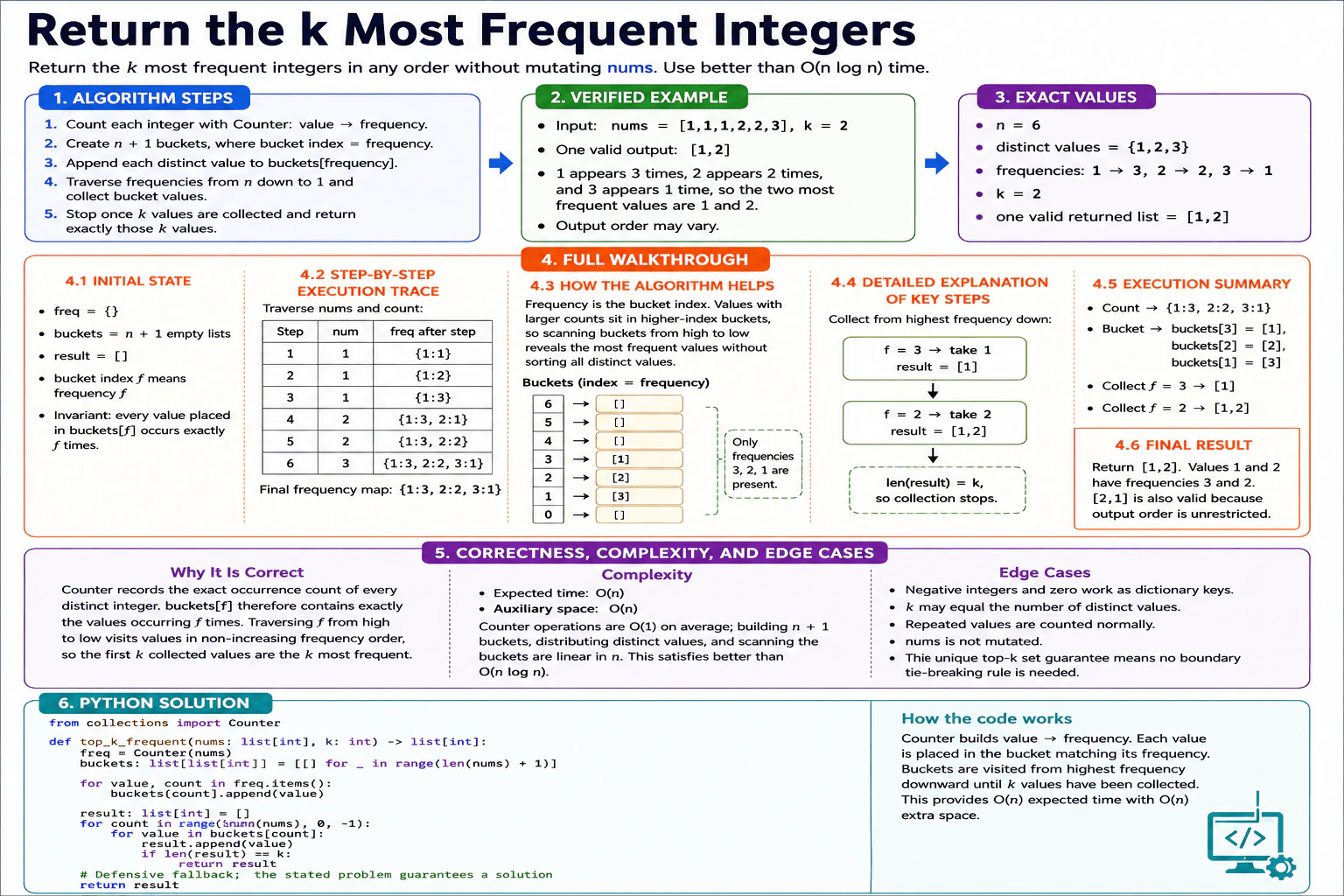
82. Return the k most frequent integers.CodingMedium

Question Details

Using Python 3.14, implement def top_k_frequent(nums: list[int], k: int) -> list[int]. nums has length 1 to 100,000, values are between -10^4 and 10^4, and 1 <= k <= the number of distinct values. The set of k most frequent values is guaranteed to be unique, so no tie-breaking rule is needed at the boundary. Return those values in any order without mutating nums; use only the standard library and achieve better than O(n log n) time. Example: top_k_frequent([1,1,1,2,2,3], 2) returns [1,2] in either order.

Short Interview Answer (30-60 seconds)

I would count how often each integer appears, then group the distinct values into buckets where the bucket index is the frequency. I scan those buckets from the highest frequency down and collect values until I have k of them. This avoids sorting the values by frequency. The bucket invariant makes the result correct because higher-frequency values are visited first. The solution uses O(n) auxiliary space and runs in O(n) expected time because Python dictionary operations are O(1) on average.

Detailed Explanation

See the Code while reading this explanation.

We are given a list of integers called nums and a number k. We need to return the k integer values that appear most often. We return the values themselves, not their positions. The order of the returned values does not matter. We must not change nums. The problem guarantees that the set of top-k values is unique, so no tie-breaking rule is needed at the boundary. Instead of sorting by frequency, we can count occurrences and place values into frequency buckets.

Useful Questions to Ask the Interviewer
  1. Can I return the k values in any order? Yes. The problem allows any order.
  2. Is a tie-breaking rule needed when deciding the kth value? No. The set of k most frequent values is guaranteed to be unique.
  3. Should nums remain unchanged? Yes. The function must not mutate nums.
Return the k most frequent integers. diagram
How to Explain It in an Interview
1. Understand the input and required output

The function is top_k_frequent(nums: list[int], k: int) -> list[int]. nums has from 1 to 100,000 integers. Each value is between -10^4 and 10^4. We must return k integer values, not indices. The returned order can be different. For nums = [1,1,1,2,2,3] and k = 2, one valid result is [1,2]. [2,1] is also valid.

2. Count frequencies and create buckets

First, use Counter to build a frequency map. The map stores value -> frequency. For the example, the final map is {1:3, 2:2, 3:1}. Next, create n + 1 empty buckets, where n = len(nums). Bucket index f represents frequency f. Each distinct value goes into the bucket that matches its frequency.

3. Initialize the state

Before counting, the logical frequency state is empty. The result starts as []. After counting, the example has 1 -> 3, 2 -> 2, and 3 -> 1. The bucket invariant is: every value stored in buckets[f] occurs exactly f times in nums. For this example, buckets[3] = [1], buckets[2] = [2], and buckets[1] = [3].

4. Walk through the example

Process nums = [1,1,1,2,2,3]. The running frequency states are {1:1}, {1:2}, {1:3}, {1:3, 2:1}, {1:3, 2:2}, and {1:3, 2:2, 3:1}. After building the buckets, scan frequencies from high to low. At f = 3, take 1, so result = [1]. At f = 2, take 2, so result = [1,2]. Now len(result) == k, so the function stops and returns [1,2].

5. Explain why the result is correct

Counter stores the exact occurrence count of every distinct integer. Therefore, buckets[f] contains exactly the values that occur f times. Scanning bucket indices from high to low visits values in non-increasing frequency order. The first k collected values are therefore the k most frequent values. The problem guarantees that no boundary tie-breaking rule is needed.

6. Explain the Python implementation

The code creates Counter(nums), allocates len(nums) + 1 bucket lists, and places each distinct value into the bucket matching its count. Then it scans bucket indices from len(nums) down to 1. Every encountered value is appended to result. The function returns immediately when result contains k values. The final return statement is only a defensive fallback because the stated problem guarantees that the earlier return will be reached.

7. Explain complexity and edge cases

The expected running time is O(n). Counter uses Python dictionary operations, which are O(1) on average. Creating the buckets, placing distinct values into them, and scanning the bucket structure are all linear in n. Auxiliary space is O(n) for the frequency map and buckets. Negative values and zero work normally as dictionary keys. Repeated values are counted correctly. k may equal the number of distinct values. nums is never changed.

Key Insight / Why This Solution Works

The key idea is to avoid sorting all values by frequency. First, build a frequency map with Counter, where each key is an integer and each stored count is its frequency. Then create frequency buckets so buckets[f] contains every integer that occurs exactly f times. The central invariant is that a value in buckets[f] occurs exactly f times. Because larger bucket indices mean larger frequencies, scanning from n down to 1 exposes the most frequent values first. We stop when k values have been collected.

Code
from collections import Counter


def top_k_frequent(nums: list[int], k: int) -> list[int]:
    # Count how many times each integer occurs without modifying nums.
    # Counter stores each integer as a key and its frequency as the value.
    freq = Counter(nums)

    # buckets[count] stores all distinct integers that occur exactly count times.
    # The largest possible frequency is len(nums), so n + 1 buckets are enough.
    buckets: list[list[int]] = [[] for _ in range(len(nums) + 1)]

    # Put each distinct integer into the bucket matching its exact frequency.
    for value, count in freq.items():
        buckets[count].append(value)

    # Visit higher frequencies first so the most frequent values are collected first.
    result: list[int] = []
    for count in range(len(nums), 0, -1):
        for value in buckets[count]:
            # Add the current value because its frequency is the current bucket index.
            result.append(value)

            # Stop immediately when exactly k values have been collected.
            if len(result) == k:
                return result

    # Defensive fallback; the stated problem guarantees a solution.
    return result
Time & Space Complexity

Let n be len(nums). Building Counter(nums) takes O(n) expected time because Python dictionary lookup and insertion are O(1) on average. Creating n + 1 buckets takes O(n). Placing every distinct value into one bucket takes at most O(n). Scanning the buckets also takes O(n). The total expected time is therefore O(n), which is better than O(n log n). The frequency map and bucket lists together use O(n) auxiliary space.

Where it is used

This frequency-bucket pattern is useful when software needs the most common values without fully sorting them. Examples include finding common event codes, repeated IDs, popular categories, or frequent values in data-processing systems. It works especially well when the maximum possible frequency is bounded by the input size.

Why Interviewers Ask This

This problem tests whether you can recognize that a full sort is unnecessary. The interviewer wants to see correct frequency counting, a useful bucket representation, and a clear invariant connecting each bucket index to an occurrence count. It also tests whether you stop after collecting k values, handle duplicates and negative integers correctly, avoid mutating the input, write valid Python, and describe hash-table complexity accurately as expected rather than guaranteed O(n).

Common interview mistakes

One common mistake is sorting the values by frequency and then claiming the solution is O(n). A full frequency sort can make the running time O(n log n) in the worst case. Another mistake is returning indices instead of integer values. Candidates may also create too few buckets and forget that a value can occur len(nums) times. Another error is continuing to scan after k values have already been collected. Finally, Python Counter relies on average O(1) hash operations, so the running time should be described as O(n) expected time rather than guaranteed worst-case O(n).

Interview tip

Before writing the descending loop, say what a bucket means: buckets[f] contains values that occur exactly f times. That invariant makes both the correctness argument and the O(n) expected-time explanation much easier.

Interviewer may ask next
What changes if the top-k set is not guaranteed to be unique because several values tie at the boundary?

The counting and bucket construction can stay the same, but the problem must define how to choose among values tied at the kth frequency. If any tied value is acceptable, the current scan can return any k values encountered. If a deterministic rule such as smaller numeric value first is required, values inside the relevant tied bucket must follow that rule. Sorting a large tied bucket can add O(u log u) time in the worst case, where u is the number of distinct values. The bucket invariant remains unchanged.

What changes if the returned values must be ordered from highest frequency to lowest frequency?

The main algorithm does not need to change because it already scans buckets from the highest frequency down. Instead of treating output order as arbitrary, we keep the values in the exact order they are appended during that scan. Values with different frequencies will automatically be in decreasing-frequency order. If two returned values have the same frequency and a deterministic order is also required, an additional tie rule is needed. Without that extra rule, the expected time remains O(n) and the auxiliary space remains O(n).

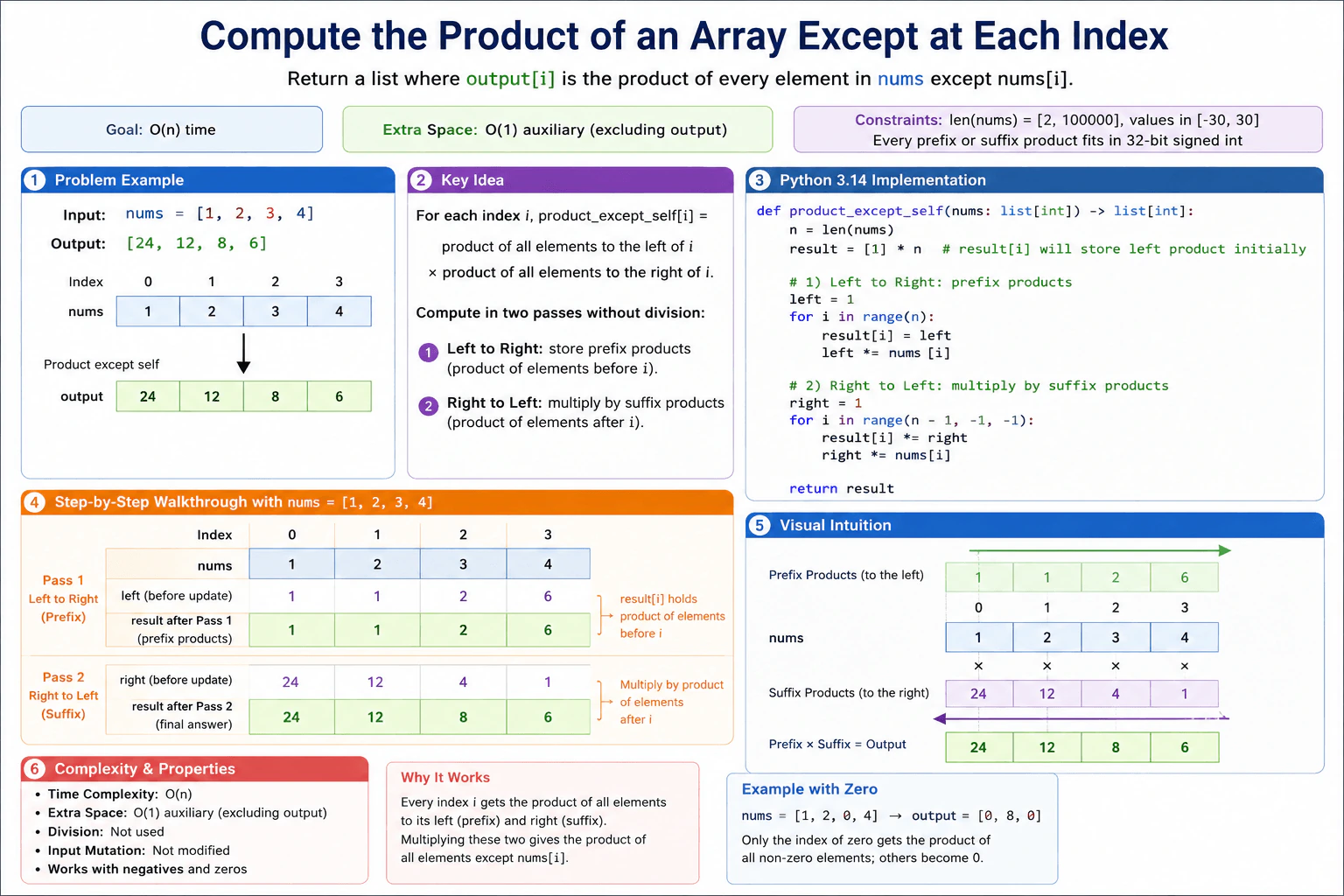
83. Compute the product of an array except at each index.CodingMedium

Question Details

Using Python 3.14, implement def product_except_self(nums: list[int]) -> list[int]. The list has length 2 to 100,000; each value is between -30 and 30, and every prefix or suffix product fits in a signed 32-bit integer. Return a new list where output index i is the product of every input value except nums[i]. Division is forbidden, nums must not be mutated, only the standard library may be used, and target time is O(n) with O(1) auxiliary space excluding the output. Inputs outside the contract need not be handled. Example: product_except_self([1,2,3,4]) returns [24,12,8,6].

Short Interview Answer (30-60 seconds)

I use two passes and store the answer directly in the result list. First, I move from left to right and store the product of all elements before each index. Then I move from right to left with a running suffix product and multiply it into the stored prefix value. This gives every index the product of all other elements without division. The algorithm takes O(n) time and O(1) auxiliary space, excluding the required output list.

Detailed Explanation

See the Code while reading this explanation.

We need to return a new list where each position contains the product of every input number except the number at that same position. We cannot use division, and we cannot change the input list. The example is nums = [1, 2, 3, 4], which must return [24, 12, 8, 6]. The main idea is to combine the product of everything on the left of each position with the product of everything on its right. Two passes let us do this in linear time without extra arrays.

Useful Questions to Ask the Interviewer
  1. Can I use the required output list as temporary storage for prefix products?
  2. Should I assume every input satisfies the stated length, value, and prefix or suffix product limits?
Compute the product of an array except at each index. diagram
How to Explain It in an Interview
1. Understand the input and required output

The function receives nums: list[int] and returns a new list[int]. At index i, the returned value must equal the product of all input elements except nums[i]. Division is forbidden. The input list must not be changed. The list length is from 2 to 100,000. Each value is from -30 to 30. Every prefix or suffix product fits in a signed 32-bit integer.

For the example nums = [1, 2, 3, 4], the result is [24, 12, 8, 6]. For example, index 1 contains 12 because 1 * 3 * 4 = 12.

2. Use prefix and suffix products

For each index i, I split the answer into two parts. The prefix product is the product of every value strictly to the left of i. The suffix product is the product of every value strictly to the right of i. Their product is exactly the product of every element except nums[i].

I do not create separate prefix and suffix arrays. The required result list stores the prefix products after the first pass. A single variable stores the running suffix product during the second pass.

3. Build prefix products from left to right

I initialize left = 1. The value 1 is the multiplicative identity, so it correctly represents an empty product before index 0.

At index 0, left is 1, so result[0] = 1. Then left becomes 1 * 1 = 1. At index 1, left is 1, so result[1] = 1. Then left becomes 1 * 2 = 2. At index 2, left is 2, so result[2] = 2. Then left becomes 2 * 3 = 6. At index 3, left is 6, so result[3] = 6. Then left becomes 6 * 4 = 24.

After the first pass, result = [1, 1, 2, 6]. Each value is the product of the elements before that index.

4. Multiply suffix products from right to left

I initialize right = 1. This represents the empty product to the right of the last index.

At index 3, right = 1. I calculate result[3] = 6 * 1 = 6. Then right = 1 * 4 = 4. At index 2, right = 4. I calculate result[2] = 2 * 4 = 8. Then right = 4 * 3 = 12. At index 1, right = 12. I calculate result[1] = 1 * 12 = 12. Then right = 12 * 2 = 24. At index 0, right = 24. I calculate result[0] = 1 * 24 = 24. Then right = 24 * 1 = 24.

The final result is [24, 12, 8, 6].

5. Explain why the result is correct

Before left is multiplied by nums[i], it contains exactly the product of all elements before index i. Therefore, the first pass stores the correct prefix product at every index.

Before right is multiplied by nums[i], it contains exactly the product of all elements after index i. During the second pass, multiplying the stored prefix by right combines every element before and after i. The current element is never included. Therefore, every final result value is correct.

6. Explain the Python implementation and complexity

The result list is initialized with ones so that every index exists before the prefix pass writes into it. The first loop moves left to right and stores prefix products. The second loop moves right to left and multiplies each prefix by the current suffix product. The input list is never modified, and division is never used.

There are two linear passes, so the time complexity is O(n). Apart from the required result list, the code uses only a constant number of variables. Therefore, auxiliary space is O(1), excluding the output. Negative numbers and zeros work naturally because the algorithm only uses multiplication.

Key Insight / Why This Solution Works

The key insight is that the answer for index i equals the product of everything before i multiplied by the product of everything after i. The first pass stores each prefix product directly in the required result list. The second pass keeps one running suffix product and multiplies it into each stored prefix. The central invariant is that, before updating left with nums[i], left equals the product of nums[0:i]. Similarly, before updating right with nums[i], right equals the product of nums[i+1:n]. This gives the required answer without division or extra prefix and suffix arrays.

Code
def product_except_self(nums: list[int]) -> list[int]:
    n = len(nums)

    # The required output list also stores prefix products during the first pass.
    result = [1] * n

    # left is the product of all elements strictly before the current index.
    left = 1
    for i in range(n):
        # Store the current prefix before including nums[i].
        result[i] = left
        # Include nums[i] so left is ready for the next index.
        left *= nums[i]

    # right is the product of all elements strictly after the current index.
    right = 1
    for i in range(n - 1, -1, -1):
        # Combine the stored prefix with the suffix after index i.
        result[i] *= right
        # Include nums[i] only after calculating the answer for this index.
        right *= nums[i]

    # nums was never modified. result now contains every required product.
    return result
Time & Space Complexity

Let n be the number of elements. The algorithm makes one left-to-right pass and one right-to-left pass. Each pass does constant work for every element, so the total time is O(n). The required result list contains n values, but the problem tells us to exclude that output from auxiliary-space counting. Apart from the result list, the algorithm uses only n, left, right, and the loop index. Therefore, auxiliary space is O(1).

Where it is used

This prefix-and-suffix pattern is useful when the value for each position depends on all items before it and all items after it. It is especially useful when separate prefix and suffix arrays would waste memory. Similar ideas are used in cumulative array calculations, range preprocessing, and algorithms that need to exclude one position from an aggregate value.

Why Interviewers Ask This

This problem tests whether you can recognize a prefix-and-suffix pattern and avoid the obvious division approach. It also checks whether you can reuse the required output list to meet a strict auxiliary-space target. The interviewer can see whether you understand loop invariants, update order, zeros and negative values, input immutability, and Python implementation details. It also tests whether you can clearly justify O(n) time and O(1) auxiliary space excluding the output.

Common interview mistakes

A common mistake is using division even though the problem forbids it. Another mistake is creating separate prefix and suffix arrays. That is correct logically, but it uses O(n) auxiliary space instead of the required O(1) auxiliary space excluding the output. A third mistake is updating left before assigning result[i], which incorrectly includes nums[i] in its own prefix product. The same error can happen in reverse by updating right before multiplying it into result[i]. Candidates may also accidentally modify nums instead of returning a new list, or claim O(1) total space without explaining that the required output list is excluded.

Interview tip

Explain the update order before writing the loops. Say that left must be stored before including nums[i], and right must be used before including nums[i]. That one invariant explains why the current element is excluded and makes the implementation much easier to verify.

Interviewer may ask next
How does the solution behave when the input contains zeros?

No special zero branch is needed. The same prefix-and-suffix multiplication works naturally. With exactly one zero, every output whose product includes that zero becomes 0, while the position containing the zero gets the product of all nonzero elements. For example, [1, 2, 0, 4] returns [0, 0, 8, 0]. With two or more zeros, every output is 0. The time remains O(n), and auxiliary space remains O(1) excluding the output.

Why not create separate prefix and suffix arrays?

Separate prefix and suffix arrays would still give a correct O(n) time solution, but they would require O(n) auxiliary space. The selected approach stores prefix products directly in the required result list and keeps only one running suffix value. This keeps the same O(n) time while reducing auxiliary space to O(1), excluding the output. The tradeoff is that the result list temporarily holds intermediate prefix values before it becomes the final answer.

84. Find the median of two sorted arrays in logarithmic time.CodingHard

Question Details

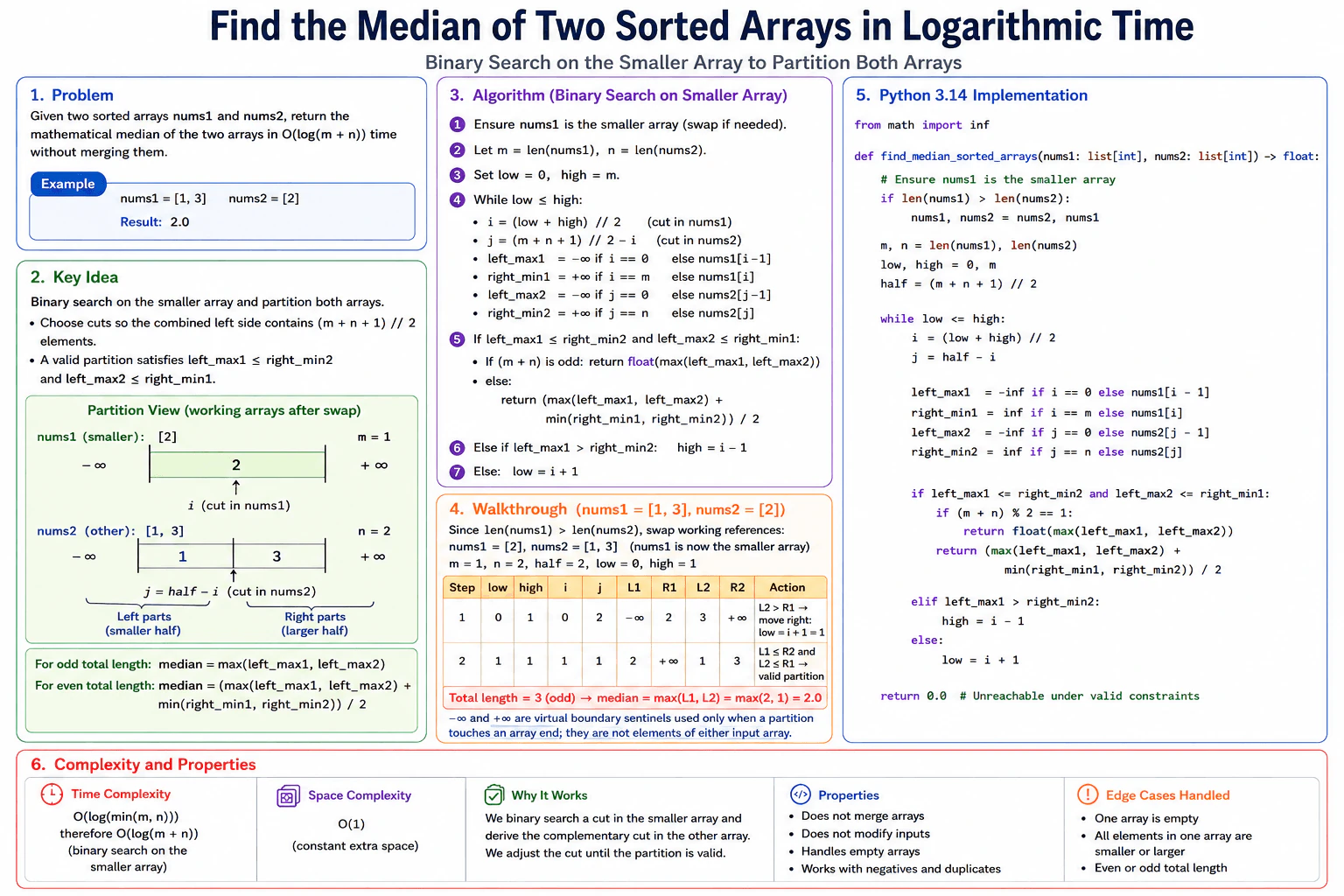
Using Python 3.14, implement def find_median_sorted_arrays(nums1: list[int], nums2: list[int]) -> float. Both lists are sorted in nondecreasing order; each length is 0 to 1,000, their combined length is at least 1, and values are between -10^6 and 10^6. Return the mathematical median as a float, without mutating either list and using only the standard library. The required time complexity is O(log(m+n)). Inputs outside the contract need not be handled. Example: find_median_sorted_arrays([1,3], [2]) returns 2.0.

Short Interview Answer (30-60 seconds)

I would binary search only the smaller array instead of merging both arrays. I choose a cut in the smaller array and derive the matching cut in the other array so the combined left side contains half of the elements. I compare the four values around the two cuts. If the partition is invalid, I move the binary-search range left or right. When both boundary conditions hold, I compute the median. This takes O(log(min(m, n))) time and O(1) auxiliary space.

Detailed Explanation

See the Code while reading this explanation.

We have two lists whose values are already in sorted order. We need the middle value we would get if we could view all values together in one sorted sequence. We must return that value as a float without changing either input list. Each list can be empty, but together they contain at least one value. Instead of building a combined list, we find where to split both lists so the values on the left and right meet in the correct place. Binary search makes this fast.

Useful Questions to Ask the Interviewer
  1. Can I assume both lists are already sorted in nondecreasing order?
  2. Is the combined input guaranteed to contain at least one value?
  3. Should the function always return a float, including when the total length is odd?
  4. May I use positive and negative infinity as virtual boundary values when a partition touches an array end?
Find the median of two sorted arrays in logarithmic time. diagram
How to Explain It in an Interview
1. Understand the input and required output

The function receives two sorted lists of integers. Each list has length from 0 to 1,000. Their combined length is at least 1. Values are between -10^6 and 10^6. We must return the mathematical median as a float. We must not mutate either list, and we may use only the Python standard library.

2. Choose binary search on the smaller array

I first make nums1 the smaller working array by swapping only the local references when needed. This does not modify the caller's lists. I binary search a cut position i from 0 through m, where m is the length of the smaller array. The matching cut in nums2 is j = half - i, where half = (m + n + 1) // 2.

The two cuts always place exactly half of the combined values, rounded up, on the left side. A partition is valid when left_max1 <= right_min2 and left_max2 <= right_min1.

3. Initialize the search state

After nums1 is the smaller working array, set m = len(nums1), n = len(nums2), low = 0, and high = m. Set half = (m + n + 1) // 2. In each iteration, choose i = (low + high) // 2 and calculate j = half - i.

The four values around the cuts are left_max1, right_min1, left_max2, and right_min2. If a cut is at the start or end of an array, the code uses -infinity or +infinity as a virtual boundary value. These values are not elements of the inputs.

4. Walk through the example

The supplied input is nums1 = [1, 3] and nums2 = [2]. Because nums1 is longer, the code swaps the working references. The binary search therefore uses nums1 = [2] and nums2 = [1, 3]. Now m = 1, n = 2, half = 2, low = 0, and high = 1.

First iteration: i = 0 and j = 2. The boundaries are left_max1 = -infinity, right_min1 = 2, left_max2 = 3, and right_min2 = +infinity. The condition left_max2 <= right_min1 fails because 3 > 2. The cut in nums1 is too far left, so low becomes i + 1 = 1.

Second iteration: low = 1 and high = 1, so i = 1 and j = 1. Now left_max1 = 2, right_min1 = +infinity, left_max2 = 1, and right_min2 = 3. Both partition conditions hold because 2 <= 3 and 1 <= +infinity. The total length is 3, so the median is max(2, 1) = 2.0. The function returns immediately.

5. Explain why the result is correct

The cuts are chosen so the combined left side always contains half = (m + n + 1) // 2 values. Because both input arrays are sorted, it is enough to compare the values directly around the cuts. When left_max1 <= right_min2 and left_max2 <= right_min1, no boundary value on the left is larger than a boundary value that belongs on the right. The partition is therefore correct. For an odd total length, the median is the largest value on the left. For an even total length, the median is the average of the largest left value and the smallest right value.

6. Explain the Python implementation

The code swaps the local references when nums1 is longer. It then binary searches the inclusive cut range from 0 to m. Each iteration calculates i and derives j. The code reads four boundary values and uses infinities when a cut touches an array end. If both cross-boundary conditions hold, it returns the median. If left_max1 > right_min2, the nums1 cut is too far right, so high becomes i - 1. Otherwise, the nums1 cut is too far left, so low becomes i + 1. Every update reduces the search interval.

7. Explain complexity and edge cases

The binary search runs only on the smaller list, so its tight running time is O(log(min(m, n))). This is also O(log(m+n)), which satisfies the required complexity. The algorithm uses only a fixed number of variables, so auxiliary space is O(1). It handles one empty array, non-overlapping value ranges, duplicate values, negative values, and both odd and even combined lengths without changing either input.

Key Insight / Why This Solution Works

The key insight is that we do not need to build the complete merged order. We only need the boundary between the lower half and upper half of the combined sorted values. We binary search the cut i in the smaller array and calculate the other cut as j = (m + n + 1) // 2 - i. The central invariant is that the two cuts together always place the required number of elements on the combined left side. A partition is correct when left_max1 <= right_min2 and left_max2 <= right_min1. If left_max1 > right_min2, the nums1 cut is too far right, so the search moves left. Otherwise the nums1 cut is too far left, so the search moves right. Merging both arrays would take O(m+n) time, while this partition search takes O(log(min(m, n))) time and O(1) auxiliary space.

Code
from math import inf


def find_median_sorted_arrays(nums1: list[int], nums2: list[int]) -> float:
    # Binary search the smaller working array so the search range is minimal.
    # Swapping local references does not mutate either caller-owned list.
    if len(nums1) > len(nums2):
        nums1, nums2 = nums2, nums1

    # Store the working lengths after the optional reference swap.
    m, n = len(nums1), len(nums2)

    # Every cut position from 0 through m is a binary-search candidate.
    low, high = 0, m

    # The combined left side must contain this many values.
    # The +1 gives the left side the extra value when the total length is odd.
    half = (m + n + 1) // 2

    while low <= high:
        # Pick a cut in nums1 and derive the matching cut in nums2.
        i = (low + high) // 2
        j = half - i

        # Read the four values around the cuts.
        # Virtual infinities handle cuts that touch an array boundary.
        left_max1 = -inf if i == 0 else nums1[i - 1]
        right_min1 = inf if i == m else nums1[i]
        left_max2 = -inf if j == 0 else nums2[j - 1]
        right_min2 = inf if j == n else nums2[j]

        # Both cross-boundary comparisons must hold for a valid partition.
        if left_max1 <= right_min2 and left_max2 <= right_min1:
            # With an odd total, the largest left-side value is the median.
            if (m + n) % 2 == 1:
                return float(max(left_max1, left_max2))

            # With an even total, average the two middle boundary values.
            return (max(left_max1, left_max2) + min(right_min1, right_min2)) / 2

        # left_max1 is too large, so the nums1 cut must move left.
        if left_max1 > right_min2:
            high = i - 1
        else:
            # left_max2 is too large, so the nums1 cut must move right.
            low = i + 1

    # Defensive fallback; valid inputs always produce a correct partition.
    return 0.0


# Supplied example. The expected result is 2.0.
print(find_median_sorted_arrays([1, 3], [2]))
Time & Space Complexity

Let m and n be the working list lengths after nums1 is made the smaller array. Binary search looks only at possible cut positions in nums1. Each iteration removes about half of the remaining cut positions, so the tight running time is O(log(min(m, n))). This also satisfies the required O(log(m+n)) bound. The algorithm does not create a merged list or any growing data structure. It keeps only a fixed number of indices and boundary values. Auxiliary space is therefore O(1).

Where it is used

This partition-based binary-search pattern is useful for order-statistic problems on sorted data. It is especially useful when we need a median or another ranked boundary value from multiple sorted collections without paying the cost of fully merging those collections first.

Why Interviewers Ask This

This problem tests whether a candidate can use the sorted structure to avoid an O(m+n) merge. It checks binary-search reasoning over partition positions, maintenance of a clear invariant, careful boundary handling, and correct treatment of odd and even totals. It also tests whether the candidate can justify why each search update is safe, write precise Python without mutating the inputs, and explain the tight O(log(min(m, n))) time and O(1) auxiliary space bounds.

Common interview mistakes

A common mistake is merging both lists first. That takes O(m+n) time and misses the required logarithmic target. Another mistake is not making nums1 the smaller working array before binary search. Candidates also sometimes calculate j incorrectly instead of using half - i. A valid partition requires both cross-boundary checks, not just one. The search direction is also easy to reverse: left_max1 > right_min2 means move high left, while the other invalid case means move low right. Finally, -infinity and +infinity are only virtual boundary sentinels. They are not actual values added to either list.

Interview tip

Before writing the loop, draw the two cuts and name left_max1, right_min1, left_max2, and right_min2. Then write the two valid-partition conditions. From those comparisons, derive the binary-search direction instead of trying to memorize it.

Interviewer may ask next
Why do we binary search the smaller array instead of either array?

Searching the smaller array gives the tight bound O(log(min(m, n))) and keeps the binary-search interval as small as possible. After nums1 is the smaller array, every candidate cut i is between 0 and m, and the derived cut j = half - i stays within the valid range for nums2. The partition conditions remain symmetric, so correctness does not change. Auxiliary space remains O(1). The main benefit is a smaller search space and simpler boundary handling.

How does the solution handle the case where one input array is empty?

No separate branch is needed. After the optional swap, the empty list becomes nums1, so m = 0 and the only possible cut is i = 0. The nums1 boundaries are represented by -infinity and +infinity. The derived cut j splits nums2 at the correct middle position. The normal partition test and odd or even median formulas still work. The running time is O(log(1)), which is constant for this case, and auxiliary space remains O(1).

85. Find the minimum window containing all characters of another string.CodingHard

Question Details

Using Python 3.14, implement def min_window(s: str, t: str) -> str. Both strings have length 1 to 100,000 and contain case-sensitive English letters. Return the shortest contiguous substring of s containing every character of t with at least its required multiplicity; return "" if none exists. The answer is guaranteed unique when it exists. Do not mutate inputs, use only the standard library, and target O(len(s)+len(t)) time. Example: min_window("ADOBECODEBANC", "ABC") returns "BANC".

Short Interview Answer (30-60 seconds)

I would use a sliding window with two pointers and a Counter. I move the right pointer across s and track how many required character occurrences are still missing. When missing becomes zero, the current window is valid, so I move the left pointer right while it stays valid and record the shortest window. For the example, the answer is "BANC". The expected time is O(len(s) + len(t)), and auxiliary space is O(|Σ|), at most 52 character keys here.

Detailed Explanation

See the Code while reading this explanation.

We need the shortest continuous part of s that contains every character required by t. If t repeats a character, the returned part must contain enough copies of that character. Uppercase and lowercase letters are different. Both strings have length from 1 to 100,000. The answer is unique when it exists. If no valid substring exists, we return "". We must not change the input strings. A sliding window fits because it lets us grow a candidate substring and then remove unnecessary characters from its left side.

Useful Questions to Ask the Interviewer
  1. Should repeated characters in t be satisfied with the same multiplicity? The stated requirement says yes.
  2. Should uppercase and lowercase letters be treated as different characters? The stated requirement says yes.
  3. Should I return the substring itself rather than its indices? The stated contract says to return the substring.
Find the minimum window containing all characters of another string. diagram
How to Explain It in an Interview
1. Understand the input and output

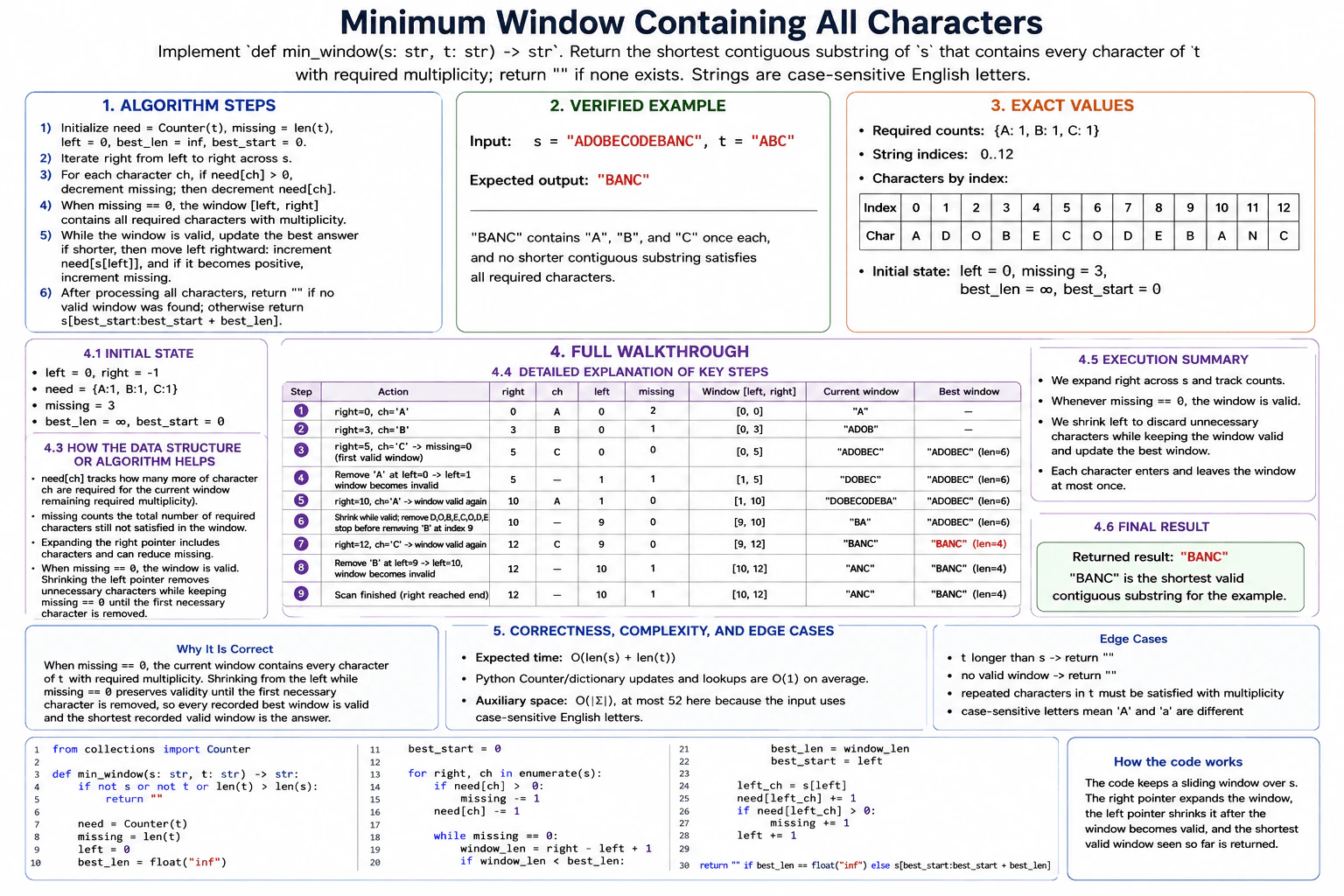
The function is min_window(s: str, t: str) -> str. We return the shortest contiguous substring of s containing every character of t with the required multiplicity. The strings contain case-sensitive English letters. If no valid window exists, we return "". The inputs are not mutated. For s = "ADOBECODEBANC" and t = "ABC", the required counts are A:1, B:1, and C:1, and the final answer is "BANC".

2. Choose a sliding window and Counter

I use two pointers, left and right, to describe the current window s[left:right + 1]. I use Counter(t) as need. A positive need[ch] means the current window is still missing that many copies of ch. Zero means the requirement for that character is exactly satisfied. A negative value means the window has extra copies. The variable missing counts the total required character occurrences that are still unsatisfied. The key invariant is: when missing == 0, the current window contains every required character with the required multiplicity.

3. Initialize the state

We start with need = Counter(t), missing = len(t), left = 0, best_len = infinity, and best_start = 0. For t = "ABC", need begins as {A: 1, B: 1, C: 1} and missing begins as 3. No valid window has been recorded yet.

4. Walk through the example

At right = 0, the character is A. Since need['A'] > 0, this A satisfies one requirement, so missing changes from 3 to 2. Then need['A'] is decremented.

At right = 3, the character is B. It satisfies another requirement, so missing becomes 1.

At right = 5, the character is C. It satisfies the last missing requirement, so missing becomes 0. The window [0, 5] is "ADOBEC". Its length is 6, so it becomes the first best window.

The window is now valid, so we shrink it. We remove the A at index

  1. need['A'] becomes positive again, so missing becomes
  2. The left pointer becomes 1, and the window is invalid.

The right pointer continues. At right = 9, another B enters the window, giving an extra B. At right = 10, A enters and missing becomes 0 again. The current valid window is [1, 10], or "DOBECODEBA".

We now shrink repeatedly while the window remains valid. We remove D at index 1, O at index 2, the extra B at index 3, and E at index 4. The window is still valid. When we remove C at index 5, need['C'] becomes positive, so missing becomes 1 and shrinking stops. The left pointer is now 6. The best length is still 6.

At right = 12, the character is C. It satisfies the missing C, so missing becomes 0. The valid window is [6, 12], or "ODEBANC". We remove O at index 6 and D at index 7 while the window stays valid. The window [8, 12] is "EBANC", so the best length improves to 5. We then remove E at index 8. The window [9, 12] is "BANC", so the best length improves to 4 and best_start becomes 9. Removing the B at index 9 makes need['B'] positive, so missing becomes 1 and shrinking stops. The scan is finished, so we return s[9:13], which is "BANC".

5. Explain why the result is correct

Whenever missing == 0, the current window contains every character from t with the required multiplicity. While that condition remains true, moving left right removes characters that are unnecessary or available in extra quantity. Before each removal, the code records the current window if it is shorter than the best one seen so far. Shrinking stops as soon as a required occurrence is lost. Therefore, the algorithm considers the smallest valid windows produced by each right boundary and keeps the shortest one overall.

6. Explain the Python implementation

The for loop expands the window with right. If need[ch] > 0, the new character satisfies one missing occurrence, so missing decreases. The code then decrements need[ch] because the character is inside the window. When missing == 0, the inner while loop measures the current window, updates the best answer when it is shorter, and removes s[left]. Removing a character increments its need value. If that value becomes positive, the window has lost a required occurrence, so missing increases. The function finally returns the best slice or "" if no valid window was found.

7. Explain complexity and edge cases

Building Counter(t) takes O(len(t)) expected time. The right pointer moves across s once. The left pointer also moves only forward, so each position leaves the window at most once. Counter operations use Python dictionary behavior and are O(1) on average. Therefore, the total expected time is O(len(s) + len(t)). Auxiliary space is O(|Σ|). Because the stated alphabet contains only uppercase and lowercase English letters, there are at most 52 distinct character keys. Relevant edge cases are t being longer than s, no valid window existing, repeated characters in t, and case-sensitive matching.

Key Insight / Why This Solution Works

The key idea is to avoid testing every substring. The right pointer expands one sliding window. need stores the remaining requirement for each character, and missing stores the total number of required character occurrences that are still unsatisfied. The central invariant is that missing == 0 exactly when the current window satisfies every requirement from t. Once the window is valid, the left pointer moves right repeatedly to discard unnecessary or extra characters. The best answer is updated before each removal. This finds the smallest valid window for each useful right boundary and keeps the shortest one overall.

Code
from collections import Counter


def min_window(s: str, t: str) -> str:
    # Defensive checks. The stated inputs are non-empty, but t may be longer than s.
    if not s or not t or len(t) > len(s):
        return ""

    # need[ch] is the remaining required count for character ch.
    need = Counter(t)

    # missing is the total number of required character occurrences still unsatisfied.
    missing = len(t)

    # left is the start of the current sliding window.
    left = 0

    # Track the shortest valid window found so far.
    best_len = float("inf")
    best_start = 0

    # Expand the window by moving right from left to right across s.
    for right, ch in enumerate(s):
        # A positive count means this occurrence is still required.
        if need[ch] > 0:
            missing -= 1

        # Record that ch has entered the window.
        # Negative values mean the window contains extra copies.
        need[ch] -= 1

        # A zero missing count means the current window is valid.
        while missing == 0:
            window_len = right - left + 1

            # Record the current valid window if it is the shortest so far.
            if window_len < best_len:
                best_len = window_len
                best_start = left

            # Remove the leftmost character before advancing left.
            left_ch = s[left]
            need[left_ch] += 1

            # If the count becomes positive, that required occurrence is missing again.
            if need[left_ch] > 0:
                missing += 1

            # Move the left boundary one position to the right.
            left += 1

    # Return the shortest valid substring, or an empty string if none was found.
    return "" if best_len == float("inf") else s[best_start : best_start + best_len]
Time & Space Complexity

The expected time is O(len(s) + len(t)). Creating the Counter reads t once. The right pointer reads each character of s once. The left pointer also only moves forward, so each position is removed from the window at most once. Python Counter uses dictionary operations, whose lookups and updates are O(1) on average. Auxiliary space is O(|Σ|), meaning extra memory proportional to the number of distinct character keys. Under the stated case-sensitive English-letter alphabet, there are at most 52 possible keys.

Where it is used

This sliding-window pattern is useful when software must find a smallest or largest contiguous range that satisfies frequency rules. Examples include finding a short text span containing required tokens, locating the smallest log interval containing required event types, and analyzing a moving range of stream data while tracking required categories.

Why Interviewers Ask This

This problem tests whether you recognize the sliding-window pattern and can maintain a precise invariant while two pointers move independently. It also checks frequency counting, especially for repeated characters, and whether you update state in the correct order. Interviewers can evaluate your ability to shrink a valid window safely, handle edge cases, write correct Python, distinguish a substring from a subsequence, and explain expected complexity accurately when dictionary-based structures are used.

Common interview mistakes

A common mistake is treating the problem as a subsequence problem instead of requiring a contiguous substring. Another is tracking only whether a character appears and forgetting that repeated characters in t require repeated occurrences in the window. Candidates may also shrink the window only once instead of repeatedly while it remains valid. Updating the best answer after the window becomes invalid is another error. It is also easy to change missing for extra copies incorrectly. Finally, the complexity should be described as expected linear time because Counter operations use average O(1) dictionary behavior.

Interview tip

Explain missing before writing the loop. Say that missing == 0 means the current window is valid. Then describe the two actions in order: expand with right, and repeatedly shrink with left while the window remains valid. This makes the Counter updates and the best-window update much easier to reason about.

Interviewer may ask next
What changes if `t` contains many repeated copies of the same character?

The algorithm does not change. Counter(t) already stores the required multiplicity. If t contains three A characters, need['A'] starts at 3 and missing includes all three required occurrences. Each required A entering the window reduces missing. Extra copies make need['A'] negative. The same validity rule, missing == 0, still works. Expected time remains O(len(s) + len(t)), and auxiliary space remains O(|Σ|).

Can this be called guaranteed O(len(s) + len(t)) time in Python?

The two pointers themselves each move only forward, so the number of window operations is linear. However, Counter is based on Python dictionaries, and dictionary lookup and update are O(1) on average rather than guaranteed O(1) in the worst collision case. For that reason, the precise claim is O(len(s) + len(t)) expected time with O(|Σ|) auxiliary space.

86. Compute how much rainwater an elevation map traps.CodingHard

Question Details

Using Python 3.14, implement def trap(height: list[int]) -> int. height has length 1 to 20,000; every bar has width 1 and nonnegative integer height at most 100,000. Return the total integer volume of water retained after rain. Do not mutate the input, use only the standard library, and target O(n) time with O(1) auxiliary space. Valid inputs are guaranteed. Example: trap([0,1,0,2,1,0,1,3,2,1,2,1]) returns 6.

Short Interview Answer (30-60 seconds)

I would use two pointers, one at each end of the height array. I keep the highest bar seen from the left and from the right. At each step, I process the side with the lower current height because the opposite side already provides a sufficient boundary. I update that side's running maximum, add the water above the current bar, and move the pointer inward. Each bar is processed once, so the time is O(n) and the auxiliary space is O(1).

Detailed Explanation

See the Code while reading this explanation.

The input is a list of nonnegative bar heights. Every bar has width 1. After rain falls, lower bars between taller boundaries can hold water. We need to return the total number of water units that remain. We must not change the input list. The supplied example holds 6 units. The goal is O(n) time with O(1) extra space. A two-pointer method fits because it works inward from both ends and keeps only a few running values.

Useful Questions to Ask the Interviewer
  1. Can I assume the input is always valid and contains at least one bar?
  2. Should I return only the total trapped-water volume, not the amount stored at each index?
  3. Should I treat the requirement not to mutate height as strict?
Compute how much rainwater an elevation map traps. diagram
How to Explain It in an Interview
1. Understand the input and required output

The function receives height: list[int]. Each value is a nonnegative bar height, and each bar has width 1. The input length is between 1 and 20,000. Each height is at most 100,000. We return one integer: the total trapped-water volume. We do not return indices or a new height array. We also do not modify height.

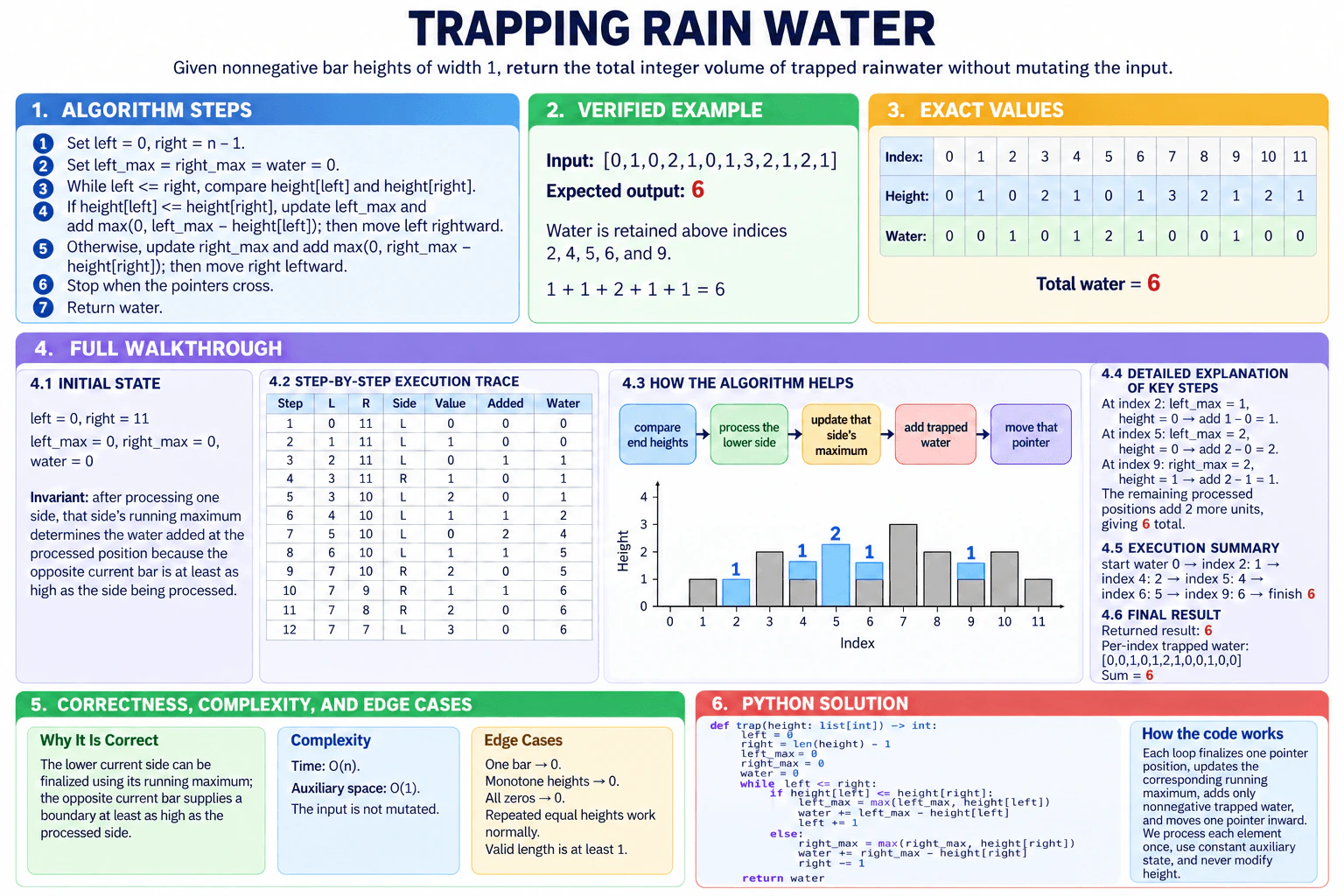
For height = [0,1,0,2,1,0,1,3,2,1,2,1], the trapped-water amounts by index are [0,0,1,0,1,2,1,0,0,1,0,0]. Their sum is 6.

2. Choose the two-pointer method

I put left at the first index and right at the last index. I keep left_max, the highest bar seen from the left, and right_max, the highest bar seen from the right.

On each loop, I compare height[left] with height[right]. If the left value is less than or equal to the right value, I process the left side. Otherwise, I process the right side.

The central invariant is that when I process the lower current side, the opposite current bar is at least as high as that side. Therefore the running maximum on the processed side is enough to determine the water at that position.

3. Initialize the state

For the supplied example, left = 0 and right = 11. We set left_max = 0, right_max = 0, and water = 0.

One pointer moves inward on every loop. The loop stops after the pointers cross.

4. Walk through the example

Step 1: left = 0, right = 11. The current heights are 0 and 1. We process the left side. left_max stays 0. We add 0 water. Total water is 0.

Step 2: left = 1, right = 11. Both current heights are 1. The condition uses <=, so we process the left side. left_max becomes 1. We add 0. Total water remains 0.

Step 3: left = 2, right = 11. The current left height is 0. left_max is 1, so we add 1 - 0 = 1. Total water becomes 1.

Step 4: left = 3, right = 11. The current heights are 2 and 1. The right side is lower, so we process index 11. right_max becomes 1. We add 0. Total water remains 1.

Step 5: left = 3, right = 10. Both current heights are 2. We process the left side. left_max becomes 2. We add 0.

Step 6: left = 4, right = 10. The height at index 4 is 1. left_max is 2, so we add 2 - 1 = 1. Total water becomes 2.

Step 7: left = 5, right = 10. The height at index 5 is 0. We add 2 - 0 = 2. Total water becomes 4.

Step 8: left = 6, right = 10. The height at index 6 is 1. We add 2 - 1 = 1. Total water becomes 5.

Step 9: left = 7, right = 10. The current heights are 3 and 2. We process the right side. right_max becomes 2. We add 0. Total water remains 5.

Step 10: left = 7, right = 9. The height at index 9 is 1. right_max is 2, so we add 2 - 1 = 1. Total water becomes 6.

Step 11: left = 7, right = 8. The height at index 8 is 2. right_max is 2, so we add 0. Total water remains 6.

Step 12: left = 7, right = 7. Both pointers are at the bar of height 3. The <= condition processes the left side. left_max becomes 3 and we add 0. Then left moves to 8. Now left > right, so the loop stops.

The function returns 6.

5. Explain why the result is correct

Suppose height[left] <= height[right]. The right current bar already gives a boundary at least as high as the current left bar. We can therefore finalize the left position using left_max. After updating left_max, the trapped water there is left_max - height[left]. The same reasoning works from the right when the right current bar is lower. This lets us safely finalize exactly one position per loop.

6. Explain the Python implementation

The code stores two indices, two running maximum heights, and the accumulated water. It updates the selected side's maximum before calculating its contribution. Because the running maximum includes the current bar, the subtraction cannot be negative. The code then moves that pointer inward. It only reads values from height, so the input is never changed.

7. Explain complexity and edge cases

Each loop moves exactly one pointer inward. Every position is therefore processed once, giving O(n) time. The algorithm stores only a fixed number of integer variables, giving O(1) auxiliary space.

A single bar returns 0. Monotone increasing or decreasing heights trap 0 water. An all-zero input also returns 0. Repeated equal heights work normally. The problem guarantees a valid input with at least one element.

Key Insight / Why This Solution Works

Use two pointers and two running maximum heights. left starts at the beginning and right starts at the end. If height[left] <= height[right], process the left side. Otherwise, process the right side. Before adding water, update that side's running maximum. The invariant is that the lower current side can be finalized because the opposite current bar is at least as high as the side being processed. This avoids separate prefix and suffix arrays while still calculating each position correctly.

Code
def trap(height: list[int]) -> int:
    # Start one pointer at each end of the elevation map.
    left = 0
    right = len(height) - 1

    # Store the highest boundary seen so far from each side.
    left_max = 0
    right_max = 0

    # Accumulate the total trapped-water volume.
    water = 0

    # Each iteration finalizes one position and moves one pointer inward.
    while left <= right:
        # Process the lower current side because the opposite current bar
        # is high enough to provide the needed boundary for this position.
        if height[left] <= height[right]:
            # Include the current bar in the best left boundary seen so far.
            left_max = max(left_max, height[left])

            # Add the water above this bar. The value is nonnegative because
            # left_max has already been updated with the current height.
            water += left_max - height[left]

            # The current left position is complete, so move inward.
            left += 1
        else:
            # Include the current bar in the best right boundary seen so far.
            right_max = max(right_max, height[right])

            # Add the water above this right-side bar.
            water += right_max - height[right]

            # The current right position is complete, so move inward.
            right -= 1

    # Return the total volume without modifying the input list.
    return water
Time & Space Complexity

Let n be the number of bars. The time complexity is O(n). One pointer moves inward on every loop, so each position is processed once. The auxiliary space is O(1). The algorithm stores only left, right, left_max, right_max, and water. The amount of extra memory does not grow with n. The input list is read but never copied or modified.

Where it is used

This pattern is useful for one-dimensional boundary problems where information from both ends lets us safely finalize one side at a time. A direct use is measuring water that can collect over an elevation profile. Similar two-pointer reasoning is useful in array problems where processing from both boundaries avoids extra prefix or suffix storage.

Why Interviewers Ask This

This problem tests whether you can recognize a two-pointer pattern and maintain a correct invariant. The interviewer is checking whether you know which pointer can move safely, whether you update state in the correct order, and whether you can avoid unnecessary extra arrays. It also tests careful Python implementation, handling of simple edge cases, respect for the no-mutation requirement, and accurate reasoning about O(n) time and O(1) auxiliary space.

Common interview mistakes

One common mistake is moving the wrong pointer. This solution processes the left side when height[left] <= height[right]; otherwise it processes the right side. Another mistake is calculating the contribution before updating the corresponding running maximum. Candidates may also build full left-max and right-max arrays, which would violate the O(1) auxiliary-space target. Other mistakes are modifying the input unnecessarily, using a loop condition that skips the final position, or claiming the wrong complexity.

Interview tip

State the invariant before coding: process the lower current side because the opposite current bar already provides a sufficient boundary. Then explain that the running maximum on the processed side determines the water at that position. This makes both the pointer movement and the O(n) time with O(1) auxiliary space easy to justify.

Interviewer may ask next
How would the solution change if O(n) auxiliary space were allowed?

We could store the maximum height seen from the left for every index and the maximum height seen from the right for every index. Then the water at index i would be max(0, min(left_max[i], right_max[i]) - height[i]). This is correct because the shorter of the best left and right boundaries limits the water level at that position. The time remains O(n), but the auxiliary space becomes O(n). The tradeoff is simpler per-index calculation in exchange for more memory.

How does this approach behave if the elevation map contains millions of bars?

The algorithm still uses O(n) time and O(1) auxiliary space. Each position is processed once, and only a fixed number of integer variables are stored. That makes it memory-efficient for a large in-memory array. The main tradeoff is that this exact implementation needs random access to both ends of the sequence. If the heights arrive only as a one-way stream, the same two-ended method cannot be applied directly without changing how the data is stored or processed.

87. Tell me about a data science project that had business impact.BehavioralEasy

Question Details

Use a real project from your experience. Explain the business problem, your personal responsibility, the data and analytical or modeling approach, how you validated the work, the decision or action it enabled, and the impact you could credibly measure. Include important limitations and one lesson you would apply to a similar project.

Interview tip:

Use STAR to structure your answer: briefly explain the Situation and Task, make Action the most detailed part, and finish with the Result. For example, describe a data science project where you identified an important business problem, owned the analysis or modeling work, validated the results carefully, explained uncertainty and tradeoffs to stakeholders, helped the business make a decision, measured the resulting impact, and learned how you would improve a similar project in the future.

Situation

In my last role, a business team was spending significant effort deciding which customer cases needed attention first. The existing process relied heavily on manual review, and the team wanted to know whether data could help them focus on the cases most likely to need action.

Task

I was responsible for turning that business problem into an analytical approach. My goal was not only to build a useful model, but also to make sure the output could support a real business decision. I needed to understand the available data, choose an approach that stakeholders could trust, validate its usefulness, and explain its limitations clearly.

Action

I first met with the stakeholders to understand how they were making decisions and what a useful result would look like. This helped me avoid optimizing a model for a technical metric that did not match the business need. I then reviewed the historical data and checked its quality, including missing values, inconsistent fields, and whether information available only after an outcome had accidentally entered the data. After cleaning the data, I created features that represented the information available when the business actually had to make the decision. I compared a simple baseline with a more flexible predictive model so I could understand whether the added complexity provided meaningful value. I validated the models on data that was kept separate from training and looked at performance from the business perspective, especially whether the model could identify useful cases without creating too much unnecessary review work. I also examined errors instead of looking only at an overall score. This showed stakeholders where the model was reliable and where uncertainty remained. I presented the findings in simple business terms, explained the tradeoff between finding more important cases and sending more cases for review, and worked with the team to choose a practical decision threshold. Rather than presenting the model as an automatic decision maker, I recommended using it to prioritize the existing review process. This reduced the risk of relying too heavily on predictions while still allowing the team to use the analytical signal.

Result

The team used the model output to prioritize its review work, which helped people focus attention on more relevant cases and made the process more consistent. The project also gave stakeholders a clearer way to discuss the tradeoff between coverage and review effort. One limitation was that the model depended on patterns in historical data, so I explained that its performance could change as customer behavior or business processes changed. My main lesson was that business impact comes from connecting the analysis to a clear decision, not from improving a model score alone. On a similar project, I would define the decision process and monitoring plan even earlier so that evaluation is tied to business use from the beginning.

Why Interviewers Ask This

Interviewers ask this question to see whether a candidate can connect data science work to a real business decision. A strong answer shows analytical ownership, sound validation, practical judgment, clear communication of uncertainty and tradeoffs, and an understanding that useful data science must create measurable or observable value rather than only produce a strong technical model.

Interviewer may ask next
How did you decide which model and decision threshold to recommend?

I compared the more flexible model with a simple baseline first because I wanted to know whether extra complexity created useful business value. I then looked at the types of errors each approach made and discussed the consequences with the stakeholders. For the threshold, I focused on the tradeoff between identifying more important cases and creating more review work. I recommended the point that gave the team useful prioritization without overwhelming the existing process.

What would you do differently if you worked on a similar project again?

I would define the business decision, success criteria, and monitoring plan earlier. In this project, I did that during the analysis, but doing it at the beginning would make model evaluation even more closely connected to how the result will be used. I would also plan earlier for changes in the data so the team could detect when the model was becoming less reliable and decide when it needed to be reviewed.

88. Tell me about a time you explained a complex data concept to a nontechnical audience.BehavioralEasy

Question Details

Choose a real situation in which another person needed to understand a statistical result, model, metric, or data limitation to make a decision. Describe the audience, what made the concept difficult, how you adapted your language or visual explanation, how you checked understanding, and what happened afterward.

Interview tip:

Use STAR to structure your answer: briefly explain the Situation and Task, make Action the most detailed part, and finish with the Result. For example, describe a situation where a business stakeholder needed to understand a statistical result or data limitation before making a decision, how you simplified the concept with familiar language and a clear visual, how you checked their understanding, and how the explanation helped them make a better informed decision.

Situation

In my last role, I worked on an analysis that compared performance across different groups. A business stakeholder wanted to use the results to decide where to focus attention. The difficult part was that some of the differences in the data looked meaningful at first, but the amount of data available for several groups was small. I needed to explain why a visible difference did not always mean that there was a reliable difference.

Task

My responsibility was to explain the uncertainty in the analysis in a way the stakeholder could use for the decision. I wanted to avoid giving a statistics lesson. I needed them to understand what the result could tell us, what it could not tell us, and why acting on a weak signal could lead to the wrong conclusion.

Action

I first removed technical language from my explanation. Instead of starting with statistical significance or confidence intervals, I used a simple comparison. I explained that if we observe only a few cases, one unusual case can change the result a lot, while a larger sample gives us more confidence that the pattern is stable. I then showed a simple visual that placed the group results next to the amount of data behind each result. This made it clear that two groups could have different averages but very different levels of certainty. After that, I introduced the idea of a confidence interval and described it as a reasonable range around our estimate rather than as a formula. I focused on the decision impact and explained which findings looked stable enough to act on and which ones should be treated as signals that needed more data. I also asked the stakeholder to explain back how they would interpret one of the uncertain results. That helped me confirm that the main idea was clear. When one part was still confusing, I changed the example and connected it directly to the decision they were considering.

Result

The stakeholder understood why we should not treat every visible difference as equally reliable. We used the stronger findings to guide the immediate decision and treated the weaker findings as areas for further investigation. The discussion also made later conversations easier because we had a shared way to talk about uncertainty. I learned that explaining a complex data concept is most effective when I start with the decision, use familiar language and visuals, and check understanding instead of assuming the explanation was clear.

Why Interviewers Ask This

Interviewers ask this question to evaluate whether a Data Scientist can turn complex analysis into information that nontechnical stakeholders can understand and use. A strong answer shows that the candidate can adapt their communication, explain uncertainty without hiding important details, connect technical results to business decisions, and confirm that the audience actually understood the message.

Interviewer may ask next
Why did you choose to explain the uncertainty before introducing the technical term confidence interval?

I wanted the stakeholder to understand the idea before hearing the technical name. Starting with a familiar example made the concept easier to connect to the decision. Once the idea was clear, the term confidence interval became a useful label instead of another piece of jargon they had to decode.

How did you know the stakeholder understood your explanation?

I asked the stakeholder to explain how they would interpret one of the uncertain results and what action they would take from it. Their first response showed that one part was still unclear, so I changed the example and explained it again using the decision they were considering. Their next explanation matched the intended interpretation, which gave me confidence that the key message was understood.

89. Tell me about a time you worked closely with a difficult colleague.BehavioralMedium

Question Details

Describe a real collaboration in which behavior or working style created observable friction on a data project. Keep people de-identified and focus on the work impact, your own contribution to the conflict, how you learned the other person's constraints, the direct conversation or working agreement you tried, any boundaries or escalation, and the realistic outcome.

Interview tip:

Use STAR to structure your answer: briefly explain the Situation and Task, make Action the most detailed part, and finish with the Result. For example, describe a data project where a colleague's working style created friction, explain your own contribution to the problem, show how you learned their constraints, agreed on a clearer way to work together, set reasonable boundaries, and improved the collaboration without making the conflict personal.

Situation

On one of my previous data projects, I worked closely with a colleague who reviewed analytical work very differently from me. I preferred to share early findings and improve them through discussion. They preferred to see a much more complete analysis before giving feedback. This difference created friction because I felt decisions were being delayed, while they felt I was bringing work to them before it was ready.

Task

I was responsible for completing the analysis and making sure the findings were reliable enough for stakeholders to use. I also needed a productive working relationship with this colleague because their input was important for validating assumptions and interpreting the data. I realized that simply pushing for faster feedback would not solve the problem. I needed to understand their concerns and also change how I was communicating my work.

Action

I first looked at my own contribution to the conflict. I realized that some of my early updates included open questions without clearly separating confirmed findings from areas that still needed investigation. That made it harder for my colleague to know what kind of feedback I wanted. I then asked for a direct conversation and focused on the work rather than their personality. I explained that late feedback was creating rework for me, and I asked what made the earlier reviews difficult for them. They explained that they were concerned about reacting to results before the data checks and assumptions were clear. That was a reasonable concern. We agreed on a simple working process. Before each review, I would clearly state the business question, the data used, the checks I had completed, the assumptions that were still uncertain, and the exact feedback I needed. In return, they agreed to review important assumptions earlier instead of waiting for the full analysis. I also started documenting decisions after our discussions so we would not reopen the same points later. When we disagreed, I asked us to compare the evidence and the risk of each option instead of debating preferences. I kept a clear boundary as well. If an unresolved disagreement could affect the delivery or the reliability of the analysis, I would raise the decision with the project lead rather than allowing it to remain blocked indefinitely.

Result

The working relationship became more predictable and less tense. I received useful feedback earlier, and my colleague had more confidence that the analysis was ready for the type of review I was requesting. We did not suddenly agree on every point, but we developed a better way to handle disagreement without slowing the work unnecessarily. I learned that difficult collaboration is often caused by different expectations about process, risk, and communication. I also learned to examine my own behavior before assuming the other person is the problem.

Why Interviewers Ask This

Interviewers ask this question to understand how a candidate handles conflict when they still need to work closely with the other person. A strong answer shows self awareness, respect, direct communication, practical judgment, and the ability to create a better working process instead of blaming the colleague or avoiding the problem.

Interviewer may ask next
What was the most important thing you changed in your own behavior?

The biggest change was making my review requests much clearer. Instead of sharing analysis with several open questions mixed together, I explained what had already been validated, what was still uncertain, and exactly where I needed input. That reduced confusion and also showed my colleague that I had taken their concerns about analytical quality seriously.

What would you do differently if you faced a similar situation now?

I would discuss working preferences earlier in the project instead of waiting until friction became obvious. I would agree on when we want early feedback, what level of validation is expected before a review, and how we will resolve disagreements. That would make expectations clear before either person becomes frustrated.

90. Tell me about a strongly held technical or product view that proved wrong.BehavioralMedium

Question Details

Use a consequential example from your own data work. Explain why your original position was reasonable with the evidence available at the time, which assumption or signal you missed, what new evidence changed your view, how you communicated the reversal, how you repaired any impact, and what changed in your later decision process.

Interview tip:

Use STAR to structure your answer: briefly explain the Situation and Task, make Action the most detailed part, and finish with the Result. For example, describe a consequential data project where you strongly supported a technical or product decision based on the evidence available, later discovered an important assumption or signal you had missed, changed your position when new evidence appeared, communicated the reversal clearly, repaired the impact, and improved how you make similar decisions.

Situation

In my last role, I worked on a product model that ranked which users should receive a particular recommendation. Early offline evaluation showed that a more complex model performed better on our main prediction metric. I strongly believed we should move forward with that model because the improvement was consistent across the validation data we were using.

Task

I was responsible for evaluating the model and recommending whether it was ready for broader use. My goal was to choose the approach that would create the best product outcome without adding unnecessary risk. At the time, I believed the stronger offline score was enough evidence to support the more complex model.

Action

After we tested the model with real product traffic, I noticed that the overall prediction metric still looked good, but some user behavior did not improve as expected. I went back to the evaluation instead of defending my original recommendation. I compared results across user groups and looked at how the model behaved for users with different amounts of historical data. That analysis showed that I had missed an important assumption. The validation data represented established users much better than newer users. The complex model learned patterns that worked well when rich history was available, but it was less reliable when history was limited. I then compared the complex model with the simpler alternative under those conditions. The simpler model was more stable for newer users even though its overall offline score was lower. I changed my recommendation based on that evidence. I explained the reversal to the product and engineering teams directly. I said that my original view had been reasonable based on the aggregate metric, but that I had placed too much weight on that metric and had not tested an important user segment deeply enough. I recommended reducing exposure to the complex model while we corrected the evaluation approach. I also worked with the team to add segment level checks and product outcome measures so future model reviews would not depend on one aggregate score.

Result

We moved away from treating the complex model as the clear winner and used a safer approach while improving the evaluation process. The main lesson for me was that a technically better aggregate metric does not automatically mean a better product decision. Since then, I make my assumptions explicit before recommending a model, examine important user segments separately, and define what evidence would cause me to change my position. That has made my decisions more careful and has also made it easier to communicate uncertainty to stakeholders.

Why Interviewers Ask This

Interviewers ask this question to see whether a candidate can recognize when evidence no longer supports a strongly held view. They are evaluating intellectual honesty, analytical judgment, comfort with uncertainty, ownership of mistakes, and the ability to change direction without becoming defensive. A strong answer shows that the candidate can update a decision when new evidence appears and improve the process that led to the original mistake.

Interviewer may ask next
What would you do differently if you were evaluating the same model today?

I would define the important user segments before comparing models and evaluate each model within those segments, not only on an overall metric. I would also include product outcome measures alongside prediction quality. Most importantly, I would write down the assumptions behind my recommendation and identify what evidence would make me change it before making the final decision.

How did you communicate your change of position without losing stakeholder confidence?

I focused on the evidence and took responsibility for the gap in my original evaluation. I explained why the first recommendation made sense with the information we had, showed the new segment level evidence, and clearly described the assumption I had missed. I also brought a specific correction plan instead of only saying the earlier recommendation was wrong. That helped keep the discussion focused on improving the decision rather than defending the original position.

More questions load as you scroll

Disclaimer: This interview guide is for educational and informational purposes only. It is designed to help readers prepare, but it does not guarantee any interview result, hiring decision, offer, or outcome. Interview questions, hiring criteria, and preferred answers can vary by employer, interviewer, industry, location, and time. The examples and explanations reflect the authors' research and judgment, are provided without warranties of any kind, and should not be treated as the only correct approach. Diagrams are simplified illustrations intended to highlight the main components and their interactions; actual systems and implementations may be more complex. Alternative approaches may be equally valid or better suited to a particular question, context, or interviewer. To the fullest extent permitted by applicable law, the author, contributors, and publisher are not liable for decisions made, actions taken, or losses incurred based on this guide.

Content Accuracy and Verification: To the fullest extent permitted by applicable law, we do not represent or warrant that interview guides, questions, answers, examples, or diagrams are accurate, complete, current, error-free, or suitable for any particular purpose. You are responsible for independently reviewing and verifying the information before relying on it.