This interview guide is for educational and informational purposes only. It is designed to help readers prepare, but it does not guarantee any interview result, hiring decision, offer, or outcome. Interview questions, hiring criteria, and preferred answers can vary by employer, interviewer, industry, location, and time. All answers, examples, and explanations in this guide are suggested examples for interview preparation, not definitive answers or instructions for professional practice. They are based on research and judgment, are provided without warranties of any kind, and should be adapted to the question, role, and applicable laws and professional requirements. Diagrams are simplified illustrations intended to highlight the main concepts and their relationships; actual situations, systems, and practices may be more complex. Alternative approaches may be equally valid or better suited to a particular question, context, or interviewer. To the fullest extent permitted by applicable law, the contributors and publisher are not liable for decisions made, actions taken, or losses incurred based on this guide.
State Laws and Professional Responsibilities
Laws and requirements governing an occupation vary by state and jurisdiction. You are responsible for checking the current laws, licensing requirements, and scope-of-practice rules that apply to your location and role, and for ensuring that your answers and actions comply with them. Adapt examples in this guide to those requirements. This guide is not legal advice.
Identity, Image, and Privacy Notice
To respect individual privacy, some names, profile photographs, avatars, biographical details, and other identifying information displayed in this guide may be replaced with pseudonyms, licensed stock images, illustrative avatars, composite images, or representative descriptions. Unless a person is expressly identified as an actual contributor, a displayed name, image, or profile should not be understood as depicting or identifying a specific candidate, interviewer, employee, or other real individual. These representations are provided for editorial and illustrative purposes only and do not imply endorsement, employment, participation, or affiliation with this guide or any company mentioned in it. Any resemblance to an actual person is coincidental.
Company Notice
This guide is an independent educational resource and is not affiliated with, endorsed by, sponsored by, or approved by the company named in this guide. Company names identify reported interview experiences or the employer context of clearly labeled original practice exercises. Interview practices can change without notice, and inclusion of company-specific content does not mean these questions are official, complete, or guaranteed to be asked. To the fullest extent permitted by law, the author, contributors, and publisher are not responsible for outcomes related to use of this material.
Content Accuracy and Verification
To the fullest extent permitted by applicable law, we do not represent or warrant that interview guides, questions, answers, examples, or diagrams are accurate, complete, current, error-free, or suitable for any particular purpose. You are responsible for independently reviewing and verifying the information before relying on it.
Questions or comments?
Contact us for general questions, or share feedback, technical corrections, and comments with the community.
11. What is a point of care infection risk assessment?Patient SafetyEasy
i Question Details
Explain the concept or decision in ED nursing scope. State relevant assumptions, missing information and when additional clinical authority is required.
Short Interview Answer (30-60 seconds)
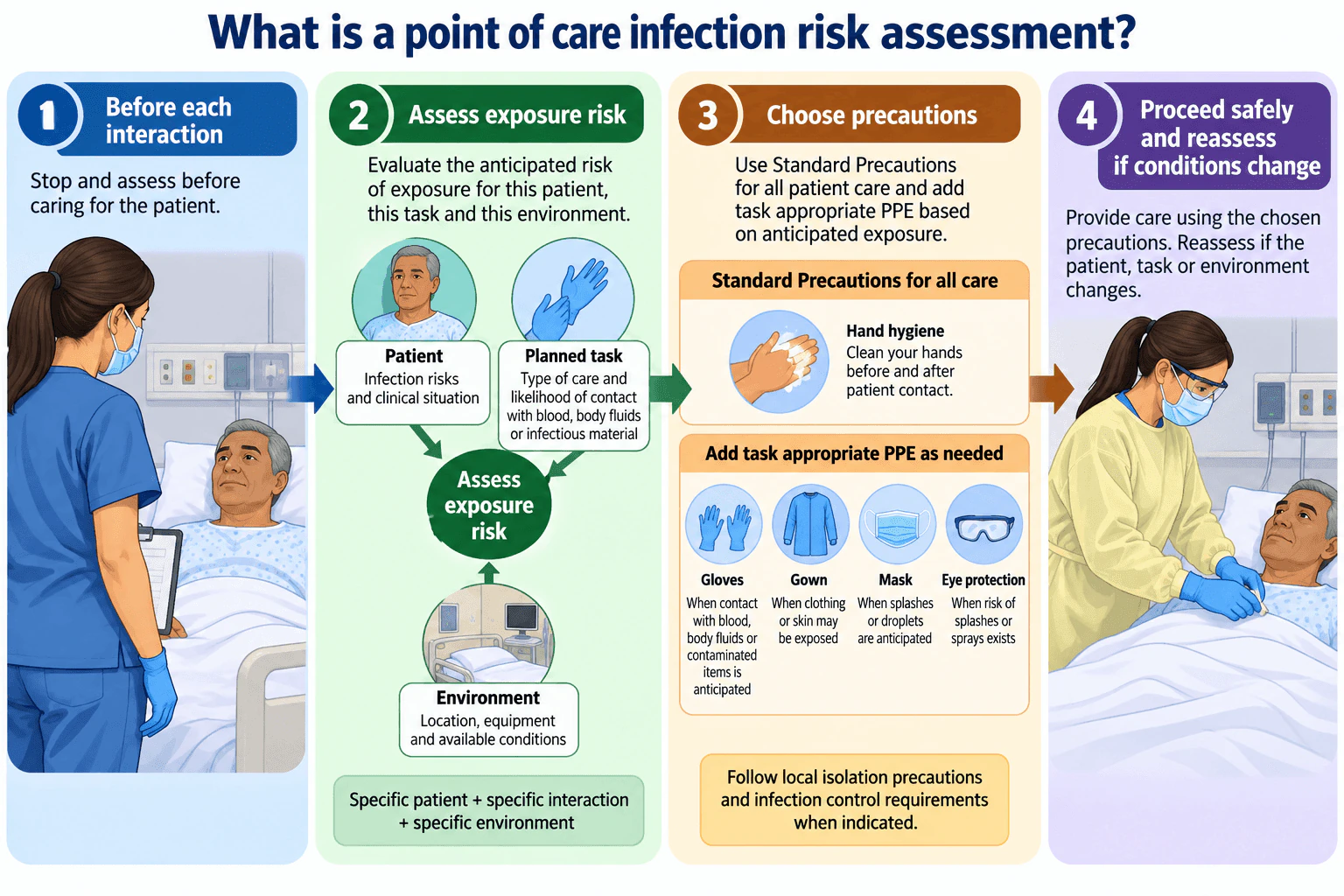
A point of care infection risk assessment is a quick assessment I perform before each patient interaction. I consider the patient and clinical situation, the planned task, and the environment to anticipate possible exposure to blood, body fluids, or other infectious material. Standard Precautions apply to every patient, including appropriate hand hygiene, and I select task appropriate personal protective equipment based on the expected exposure. I follow additional isolation precautions when indicated and reassess whenever the situation changes.
Detailed Explanation
A point of care infection risk assessment is a brief assessment made before a patient interaction to anticipate infection exposure and choose appropriate precautions. In a United States emergency department, the same reasoning supports Standard Precautions, which apply to all patients regardless of known infection status. The nurse assesses the specific patient and clinical situation, the planned task, and the environment before beginning care.
Useful Questions to Ask the Interviewer
Which infection prevention and isolation procedures does this emergency department use?
How are changes in isolation status communicated during triage, handoff, and transfer?
Which clinical or infection prevention resource should nurses contact when the appropriate precautions are uncertain?
How to Explain It in an Interview
I would describe it as a short safety assessment before each patient interaction. First, I consider the patient and the available clinical information. Next, I consider the planned task and whether contact with blood, body fluids, secretions, excretions, mucous membranes, nonintact skin, contaminated equipment, splashes, or sprays could reasonably occur. I also consider the environment, including the location, equipment, and conditions in which care will occur.
Standard Precautions remain the foundation for all patient care. I perform hand hygiene at the appropriate clinical moments and select personal protective equipment according to the anticipated exposure. Gloves are used when contact with blood, body fluids, mucous membranes, nonintact skin, potentially contaminated skin, or contaminated equipment can reasonably be anticipated. A gown is selected when the task could expose skin or clothing to blood, body fluids, secretions, or excretions. A mask with eye protection or a face shield is used when splashes or sprays could expose the eyes, nose, or mouth.
If the available clinical information indicates that additional isolation precautions are needed, I follow the applicable infection prevention requirements and local procedures. I would not assume that every patient interaction requires the same personal protective equipment because the expected exposure depends on the specific patient, task, and environment.
The assessment continues during care. If the procedure changes, new symptoms or information emerge, contamination occurs, or the environment changes, I reassess the exposure risk and adjust precautions. If the appropriate isolation approach is uncertain or requires a decision beyond my nursing scope or local protocol, I pause and seek the appropriate clinical or infection prevention authority before proceeding.
Why Interviewers Ask This
Interviewers want to know whether the nurse can anticipate infection exposure before care begins, select precautions according to the actual patient interaction rather than habit, and reassess when circumstances change. In the emergency department, this demonstrates practical infection prevention judgment and appropriate use of Standard Precautions and personal protective equipment.
Common interview mistakes
Common mistakes include choosing personal protective equipment by habit instead of anticipated exposure, forgetting that Standard Precautions apply to every patient, focusing only on a diagnosis while ignoring the planned task and environment, missing appropriate hand hygiene, and failing to reassess when the patient, task, or environment changes. Another mistake is assuming that every infection concern requires the same isolation response rather than using the precautions indicated by the clinical situation and applicable local requirements.
Interview tip
Keep the answer centered on the same sequence shown in the diagram: assess before each interaction, consider the specific patient, planned task, and environment, choose Standard Precautions and task appropriate personal protective equipment, then proceed safely and reassess if conditions change.
Interviewer may ask next
How would you verify that the precautions you selected are appropriate?
I would compare the anticipated exposure from the patient interaction and planned task with Standard Precautions and the applicable infection prevention guidance. I would review available clinical information and any indicated isolation status. If the correct precautions remain uncertain or depend on local procedure, I would pause and clarify with the appropriate clinical or infection prevention resource before proceeding.
What would you do if the clinical situation changed after you started care?
I would reassess the infection exposure risk because a change in symptoms, procedure, expected contact with infectious material, contamination, or environment may change the precautions needed. I would adjust personal protective equipment or isolation precautions as appropriate, perform hand hygiene when indicated, and seek additional clinical authority if the new situation requires guidance beyond my nursing scope or local protocol.
12. What is the difference between Standard Precautions and additional transmission precautions?Patient SafetyEasy
i Question Details
Explain the concept or decision in ED nursing scope. State relevant assumptions, missing information and when additional clinical authority is required.
Short Interview Answer (30-60 seconds)
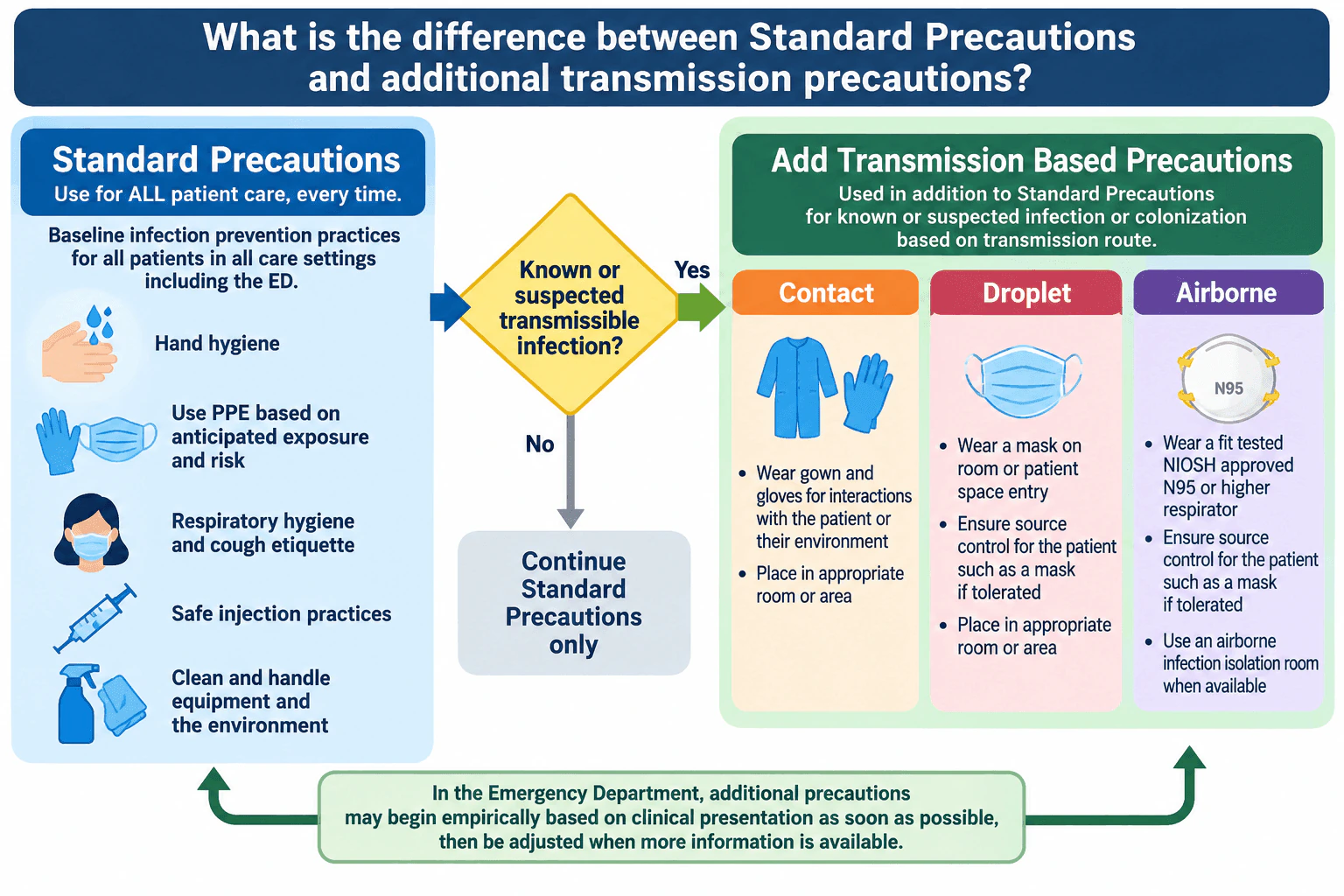
Standard Precautions apply to every patient and include hand hygiene, personal protective equipment based on anticipated exposure, respiratory hygiene and cough etiquette, safe injection practices, and appropriate cleaning and handling of equipment and the environment. Transmission Based Precautions are added when a known or suspected infection or colonization requires measures beyond Standard Precautions. Contact Precautions generally add gown and gloves for relevant patient or environmental contact. Droplet Precautions add a mask for room or patient space entry and patient source control. Airborne Precautions require appropriate respiratory protection, such as a fit tested NIOSH approved N95 or higher respirator, and appropriate patient placement. Standard Precautions remain in effect whenever additional precautions are used.
Detailed Explanation
Standard Precautions are the infection prevention baseline for every patient, regardless of whether infection is suspected or confirmed. In a United States emergency department, they include hand hygiene, personal protective equipment selected according to anticipated exposure, respiratory hygiene and cough etiquette, safe injection practices, and appropriate cleaning, disinfection, and handling of patient care equipment and the environment.
Transmission Based Precautions are added to Standard Precautions when a patient has a known or suspected infection or colonization for which extra measures are needed to interrupt transmission. They do not replace Standard Precautions.
Contact Precautions generally add gown and gloves for interactions that may involve contact with the patient or the patient's environment, along with appropriate patient placement. Droplet Precautions include wearing a mask when entering the patient room or patient space, using source control for the patient, and appropriate placement. Airborne Precautions require respiratory protection such as a fit tested NIOSH approved N95 or higher respirator and appropriate placement in an airborne infection isolation room. If an airborne infection isolation room cannot be implemented immediately, the nurse follows the facility's interim infection prevention procedures and escalates for appropriate placement.
In the emergency department, additional precautions may begin empirically when the clinical presentation suggests an infection requiring them, before the exact organism is confirmed. The precaution category can then be adjusted as diagnostic information becomes available.
Useful Questions to Ask the Interviewer
What isolation and infection prevention protocols does this emergency department use when a transmissible infection is suspected at triage?
How are airborne infection isolation needs managed when an appropriate room is not immediately available?
Who should the bedside nurse contact when the required precaution category is uncertain?
How to Explain It in an Interview
I would start by saying that Standard Precautions apply to every patient, while Transmission Based Precautions are extra measures added when a known or suspected infection requires additional protection against transmission. Standard Precautions continue throughout care.
For Standard Precautions, I would perform hand hygiene, select personal protective equipment according to anticipated exposure, follow respiratory hygiene and cough etiquette, use safe injection practices, and handle equipment and the environment safely.
If the clinical presentation suggests that additional precautions are needed, I would follow the appropriate Contact, Droplet, Airborne, or combined precautions according to the suspected transmission route and current protocol. Contact Precautions generally add gown and gloves for relevant contact. Droplet Precautions add a mask for entry into the patient room or patient space and patient source control. Airborne Precautions require appropriate respiratory protection, such as a fit tested NIOSH approved N95 or higher respirator, and appropriate patient placement.
In the emergency department, I would not necessarily wait for final laboratory confirmation when the presentation warrants empiric precautions. I would initiate the indicated precautions within protocol, communicate the isolation needs, and reassess them as more information becomes available. If the required precaution category or placement is uncertain, I would escalate to the responsible clinician or infection prevention resource rather than guessing.
Why Interviewers Ask This
Interviewers want to know whether the nurse understands that Standard Precautions apply to every patient and continue even when additional precautions are required. They are also evaluating whether the nurse can recognize a possible transmission risk, select appropriate precautions within emergency department protocols, communicate isolation needs, and reassess precautions as more clinical information becomes available.
Common interview mistakes
Common mistakes include treating Standard Precautions as practices used only for patients with known infections, stopping Standard Precautions when additional precautions begin, assuming every transmissible infection requires the same category, selecting personal protective equipment without considering anticipated exposure or transmission route, waiting for laboratory confirmation when empiric precautions are indicated, and treating local placement procedures as universal rules.
Interview tip
State the distinction first: Standard Precautions are the baseline for every patient, and Transmission Based Precautions are added when the suspected or confirmed infection requires extra measures. Then connect Contact, Droplet, and Airborne precautions to their additional protective measures and explain that emergency department precautions may begin empirically and change as more information becomes available.
Interviewer may ask next
How would you verify which additional precautions are required for a patient?
I would assess the clinical presentation and known infection information, identify the suspected route of transmission, and check the current facility isolation protocol and applicable infection prevention guidance. If the required category remains uncertain or falls outside the protocol, I would contact the responsible clinician or infection prevention resource rather than guess. Standard Precautions would continue while the additional requirement is clarified.
What changes if a patient initially placed on Droplet Precautions is later found to require Airborne Precautions?
I would continue Standard Precautions and transition to the Airborne requirements specified by the emergency department protocol. That includes appropriate respiratory protection, such as a fit tested NIOSH approved N95 or higher respirator, and appropriate patient placement in an airborne infection isolation room. If that room cannot be implemented immediately, I would follow local interim infection prevention procedures, communicate the change promptly, and escalate for appropriate placement.
13. How would you choose protective equipment for an anticipated blood or body fluid exposure?Patient SafetyEasy
i Question Details
Explain the concept or decision in ED nursing scope. State relevant assumptions, missing information and when additional clinical authority is required.
Short Interview Answer (30-60 seconds)
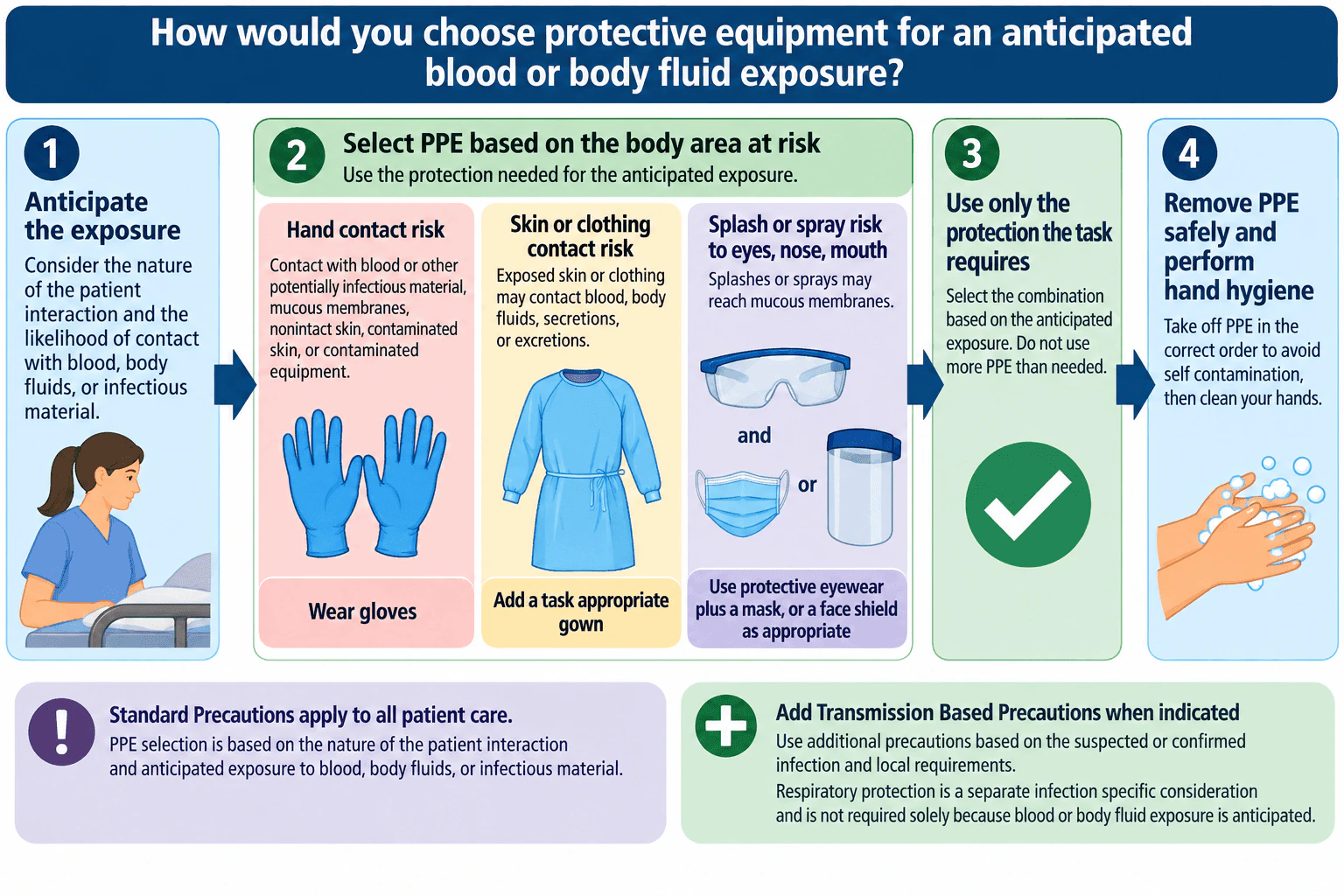
I would start by anticipating the type of exposure and which body areas are at risk. I would use gloves for expected hand contact with blood, body fluids, mucous membranes, nonintact skin, or contaminated equipment. I would add a task appropriate gown if my skin or clothing could be exposed. If splashes or sprays could reach my eyes, nose, or mouth, I would use protective eyewear plus a mask, or a face shield. I would use only what the task requires, remove the equipment safely, and perform hand hygiene. Standard Precautions apply to every patient, and I would add Transmission Based Precautions when the clinical situation indicates them.
Detailed Explanation
Choosing personal protective equipment for anticipated blood or body fluid exposure is a risk assessment. I first consider the nature of the patient interaction, what material I may contact, and which body areas could be exposed. Gloves are appropriate when hand contact with blood, body fluids, mucous membranes, nonintact skin, potentially contaminated skin, or contaminated equipment is reasonably anticipated. A task appropriate gown is added when skin or clothing could be exposed. When splashes or sprays could reach the eyes, nose, or mouth, I use protective eyewear plus a mask, or a face shield. I use only the protection required for the anticipated exposure. After the task, I remove the equipment in a way that limits self contamination and perform hand hygiene. Standard Precautions apply to all patients. Transmission Based Precautions may require additional measures when a suspected or confirmed infection warrants them.
Useful Questions to Ask the Interviewer
How are Contact, Droplet, and Airborne Precautions communicated in this emergency department?
What is the local escalation pathway when the appropriate level of protection is uncertain?
Are there specific unit procedures for activities with a high likelihood of splashes or sprays?
How to Explain It in an Interview
I would explain that I choose personal protective equipment by anticipating the exposure rather than automatically wearing every available item.
First, I consider the planned interaction and identify the body areas that could be exposed. If hand contact with blood, body fluids, mucous membranes, nonintact skin, potentially contaminated skin, or contaminated equipment is reasonably anticipated, I wear gloves.
If the activity could expose my skin or soil my clothing with blood, body fluids, secretions, or excretions, I add a gown appropriate to the task.
If the activity could generate splashes or sprays that may reach my eyes, nose, or mouth, I use protective eyewear plus a mask, or a face shield. The exact combination depends on the anticipated exposure.
I would emphasize that Standard Precautions apply to all patient care, but the equipment selected within those precautions depends on the interaction. I would not use more equipment than the task requires. If the patient has a suspected or confirmed infection requiring Contact, Droplet, or Airborne Precautions, I would add those measures according to the clinical situation and local requirements. Respiratory protection is therefore an infection specific consideration and is not required solely because blood or body fluid exposure is anticipated.
After completing the task, I remove and discard or process the equipment according to its intended use and local procedure while avoiding self contamination, then perform hand hygiene. If I am uncertain about the required isolation or respiratory protection, I would stop and follow the local infection control escalation pathway before proceeding.
Why Interviewers Ask This
Interviewers want to assess whether you can apply Standard Precautions through a practical exposure risk assessment rather than selecting the same equipment for every encounter. They are evaluating whether you can match protection to the body area at risk, recognize splash and contact hazards, avoid unnecessary equipment, remove equipment safely, perform hand hygiene, and recognize when additional infection control guidance is needed.
Common interview mistakes
Common mistakes include choosing equipment by habit instead of anticipated exposure, assuming every blood or body fluid interaction requires the same combination, forgetting eye and face protection when splashes or sprays are possible, failing to protect skin or clothing when contact is expected, using more equipment than the task requires, removing equipment in a way that causes self contamination, and skipping hand hygiene after removal. Another mistake is assuming that blood or body fluid exposure alone automatically requires a respirator rather than evaluating infection specific precautions separately.
Interview tip
Use a simple sequence in your answer: anticipate the exposure, identify the body area at risk, match the protective equipment to that risk, use only what the task requires, then remove the equipment safely and perform hand hygiene. Mention additional Transmission Based Precautions only when the clinical context indicates them.
Interviewer may ask next
How would you verify that your protective equipment choice is appropriate before starting care?
I would reassess the planned interaction and confirm the anticipated route of exposure. I would ask whether my hands, skin, clothing, eyes, nose, or mouth could contact blood, body fluids, infectious material, or contaminated equipment. I would also verify whether additional Contact, Droplet, or Airborne Precautions are indicated for the patient. If the appropriate isolation level or respiratory protection is uncertain, I would follow the local infection control escalation pathway before proceeding.
How would your choice change if the patient also had a suspected transmissible respiratory infection?
I would still select gloves, gown, and eye or face protection according to the anticipated blood or body fluid exposure, but I would also add the Transmission Based Precautions indicated by the suspected infection. That may include additional mask or respiratory protection requirements depending on the route of transmission and local guidance. The key distinction is that protection for blood or body fluid exposure and infection specific precautions are assessed together, but they are not automatically the same.
14. How do you prevent contamination when moving between a dirty task and a clean task?Patient SafetyMedium
i Question Details
Explain the concept or decision in ED nursing scope. State relevant assumptions, missing information and when additional clinical authority is required.
Short Interview Answer (30-60 seconds)
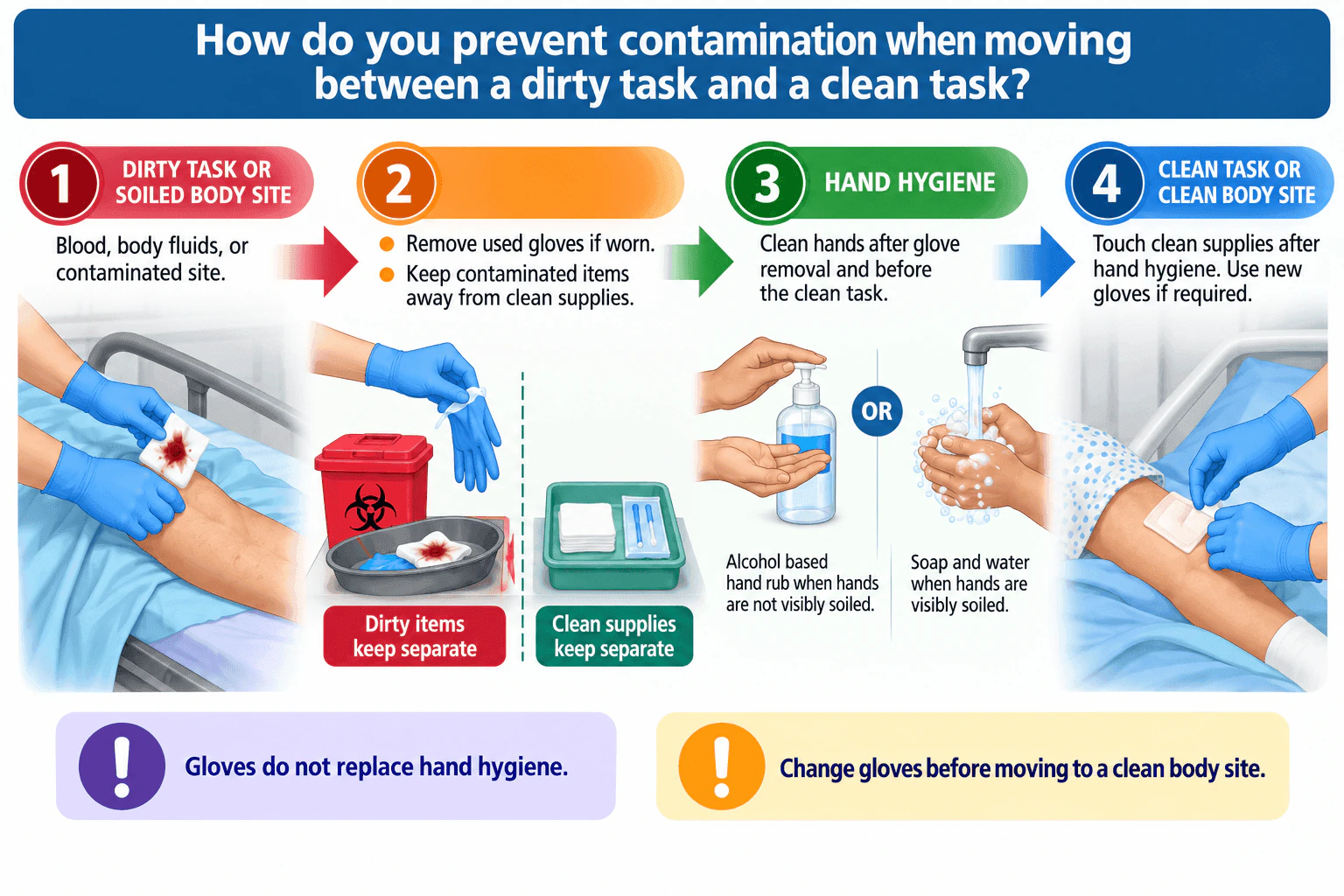
I create a clear contamination boundary. I finish the dirty task, remove used gloves if worn, keep contaminated items away from clean supplies, and perform hand hygiene before touching the clean body site or clean supplies. If the clean task requires gloves, I put on a new pair after hand hygiene. I use alcohol based hand rub when hands are not visibly soiled and soap and water when they are visibly soiled. Gloves do not replace hand hygiene.
Detailed Explanation
The key principle is to prevent microorganisms from being carried from a contaminated task or body site to a clean task, body site, supply, or piece of equipment. In a United States emergency department, I would apply Standard Precautions and treat the transition between dirty and clean care as a deliberate safety checkpoint.
Useful Questions to Ask the Interviewer
Are you asking about moving between body sites on the same patient or between separate patient care tasks?
Are the nurse's hands visibly soiled, or is there another situation requiring soap and water?
Are any additional isolation or pathogen specific precautions in effect?
How to Explain It in an Interview
I would first complete the dirty task without reaching into clean supplies. If I am wearing gloves, I remove the used gloves when the contaminated task is complete. I keep contaminated waste, equipment, and supplies physically separate from clean supplies so I do not carry contamination forward.
Next, I perform hand hygiene before starting the clean task. Alcohol based hand rub is preferred in most clinical situations when hands are not visibly soiled. If my hands are visibly soiled, I wash them with soap and water.
Only after hand hygiene do I touch the clean body site or clean supplies. If gloves are required for the clean task, I put on a new pair after hand hygiene. Gloves provide a barrier when indicated, but they do not replace hand hygiene.
A key failure to avoid is continuing the same contaminated gloves into the clean task. Other errors include touching clean supplies with contaminated gloves, allowing dirty items to contact the clean area, or skipping hand hygiene after glove removal. If additional isolation precautions or a pathogen specific situation changes routine practice, I follow the applicable infection prevention procedure and obtain additional clinical guidance when needed.
Why Interviewers Ask This
Interviewers are assessing whether the nurse recognizes cross contamination risk and can interrupt transmission between contaminated and clean activities. A strong answer shows deliberate sequencing, separation of dirty items from clean supplies, correct glove use, and hand hygiene before moving to the clean task.
Common interview mistakes
Keeping contaminated gloves on for the clean task, touching clean supplies before hand hygiene, allowing dirty equipment or waste to contact the clean supply area, skipping hand hygiene after glove removal, assuming gloves replace hand hygiene, or using alcohol based hand rub when the hands are visibly soiled.
Interview tip
Describe the transition in a clear sequence: finish the dirty task, remove used gloves if worn, separate contaminated items from clean supplies, perform hand hygiene, and then begin the clean task with new gloves if they are required. This matches the contamination prevention flow shown in the diagram.
Interviewer may ask next
How would you verify that the transition from dirty care to clean care was performed safely?
I would confirm that used gloves were removed if worn, contaminated items remained separate from clean supplies, hand hygiene occurred before the clean task, and any gloves needed for the next task were a new pair applied after hand hygiene. I would also confirm that any additional isolation or pathogen specific precautions were followed.
What changes if your hands are visibly soiled after the dirty task?
I would wash my hands with soap and water before beginning the clean task. After hand hygiene, I would touch clean supplies or the clean body site and apply a new pair of gloves only if the next task requires them.
15. How would you handle reusable equipment that has not been cleaned between patients?Patient SafetyMedium
i Question Details
Explain the concept or decision in ED nursing scope. State relevant assumptions, missing information and when additional clinical authority is required.
Short Interview Answer (30-60 seconds)
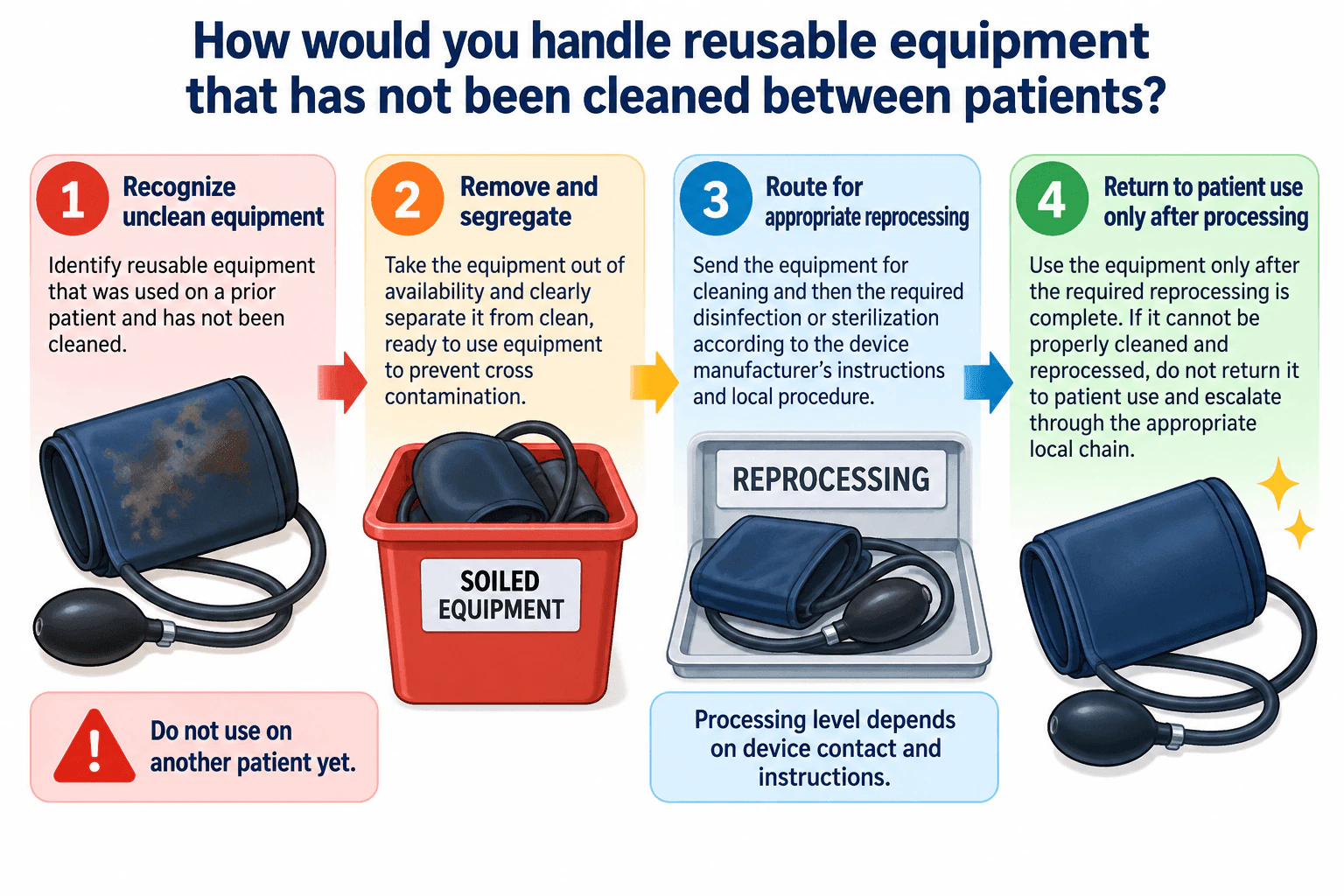
I would stop the equipment from being used on another patient, remove it from ready to use supplies, and clearly separate it from clean equipment. I would route it for cleaning and the required disinfection or sterilization according to the manufacturer instructions and local procedure. I would return it to patient use only after the required reprocessing is complete. If safe reprocessing cannot be confirmed, I would keep it out of service and escalate the concern.
Detailed Explanation
Reusable medical equipment should not move directly from one patient to another without the required cleaning and reprocessing. In a United States emergency department, my immediate priority would be to prevent another patient from being exposed to equipment that may still be contaminated.
Useful Questions to Ask the Interviewer
What is the department process for separating soiled equipment from clean, ready to use equipment?
Where are the manufacturer reprocessing instructions available for this device?
Who should I contact if the correct reprocessing method cannot be confirmed?
How to Explain It in an Interview
Stop reuse
I would recognize that the equipment has not been cleaned and would not use it on another patient. I would remove it from availability so it is not mistaken for clean equipment.
Separate and route
I would keep the item separate from clean, ready to use equipment to reduce cross contamination. I would then route it to the staff or area responsible for reprocessing according to the local procedure.
Follow the correct processing method
Reusable equipment must be cleaned and then receive the level of disinfection or sterilization required for that device. The correct method depends on the intended patient contact, device design, and manufacturer instructions. For example, a blood pressure cuff contacts intact skin and is considered noncritical equipment, so it generally requires cleaning and low level disinfection according to applicable instructions. I would not choose a stronger or weaker process based only on appearance or personal preference.
Return only after processing
The equipment would return to patient use only after the required reprocessing is complete. A reusable blood pressure cuff used on a previous patient should remain unavailable until it has been processed according to its instructions and the department procedure.
Escalate uncertainty
If the instructions are unavailable, the equipment is damaged, the required process cannot be completed, or I cannot verify that processing occurred, I would keep the item out of service and escalate to the appropriate clinical, infection prevention, equipment, or supervisory resource. I would not assume that an item is safe merely because it looks clean.
The key safety sequence is to recognize the unclean equipment, prevent reuse, separate it from clean equipment, complete the correct reprocessing, and only then return it to patient care.
Why Interviewers Ask This
This question evaluates whether an emergency department nurse recognizes unclean reusable equipment as an infection prevention hazard, prevents its use on another patient, maintains separation between clean and soiled equipment, follows device specific reprocessing requirements, and escalates when safe reprocessing cannot be confirmed.
Common interview mistakes
Common mistakes include leaving unclean equipment with ready to use supplies, using it on another patient because it appears visually clean, applying an arbitrary cleaning method instead of following the device instructions, assuming every reusable item requires the same level of processing, and returning equipment to service when completion of the required reprocessing cannot be verified.
Interview tip
Give the answer as a clear safety sequence: stop reuse, separate the item, send it for the correct reprocessing, verify completion, and then return it to service. Mention that the required processing level depends on the device, its patient contact, and its manufacturer instructions. Explain that uncertainty should lead to keeping the equipment out of service and escalating rather than guessing.
Interviewer may ask next
How would you verify that the equipment is safe to use again?
I would confirm that the required cleaning and reprocessing process for that specific device has been completed according to the manufacturer instructions and local procedure. I would also confirm that the item has the appropriate clean or ready to use status. If I could not verify completion, I would keep it out of service and contact the appropriate reprocessing, infection prevention, equipment, or supervisory resource.
What would you do if the reusable equipment had visible blood or body fluid contamination?
I would immediately keep the equipment out of patient use and separate it from clean equipment. I would use the appropriate precautions for handling contaminated equipment and route it for cleaning followed by the level of disinfection or sterilization required for that device according to the manufacturer instructions and local procedure. I would not return it to patient care until the required reprocessing was complete.
16. How would you reduce respiratory exposure at the first point of patient contact?Patient SafetyMedium
i Question Details
Explain the concept or decision in ED nursing scope. State relevant assumptions, missing information and when additional clinical authority is required.
Short Interview Answer (30-60 seconds)
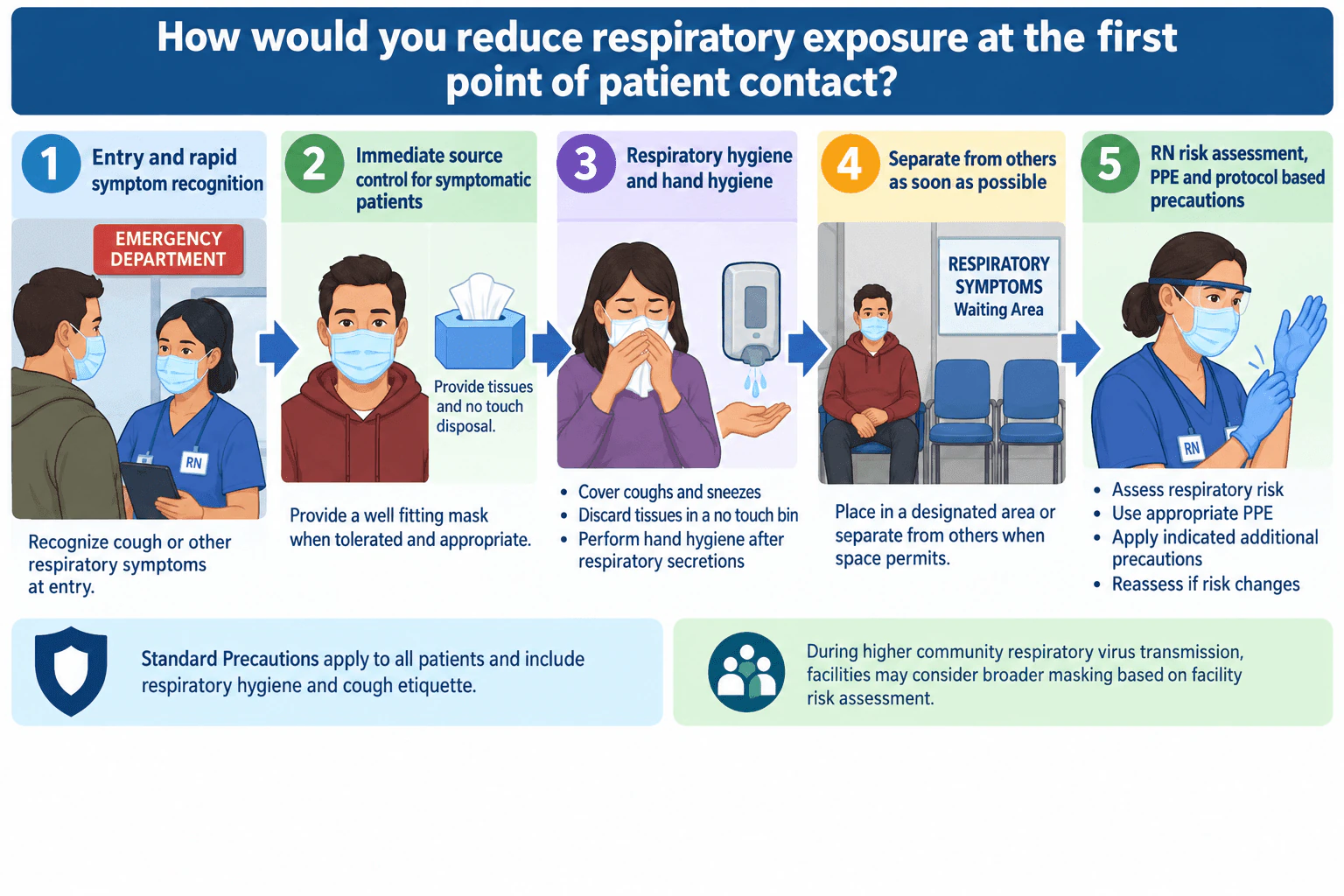
I would recognize respiratory symptoms immediately at entry, offer source control such as a well fitting mask when tolerated and appropriate, and provide tissues and hand hygiene supplies. I would reinforce cough and sneeze etiquette, use no touch tissue disposal, and separate the symptomatic patient from others as soon as possible when space permits. I would assess respiratory risk, use appropriate personal protective equipment, apply any indicated additional precautions according to the suspected infection and facility protocol, and reassess if the risk changes.
Detailed Explanation
Reducing respiratory exposure starts at the first patient encounter. In a United States emergency department, I would identify respiratory symptoms early, contain respiratory secretions, reduce exposure to other people, and then match personal protective equipment and additional precautions to the assessed risk. Standard Precautions apply to every patient.
Useful Questions to Ask the Interviewer
What respiratory screening and source control process does this emergency department use at entry?
How does the department separate symptomatic patients when normal waiting space is limited?
Which facility protocols guide personal protective equipment and additional precautions for suspected respiratory infections?
How to Explain It in an Interview
I would use a five step sequence that starts at the door.
First, I would recognize cough or other respiratory symptoms promptly. Early recognition allows exposure reduction measures to begin before the patient has prolonged contact with other patients, visitors, or staff.
Second, I would provide source control. I would offer a well fitting mask when tolerated and appropriate and provide tissues with no touch disposal. This helps contain respiratory secretions close to the person producing them.
Third, I would reinforce respiratory hygiene and hand hygiene. I would ask the patient to cover coughs and sneezes, discard used tissues in a no touch bin, and perform hand hygiene after contact with respiratory secretions. Necessary hand hygiene supplies should be readily accessible.
Fourth, I would separate the symptomatic patient from others as soon as possible when space permits. A designated area or appropriate room can reduce unnecessary exposure while the patient awaits further assessment.
Fifth, I would assess respiratory risk and use personal protective equipment appropriate to the interaction and anticipated exposure. If the clinical presentation suggests an infection requiring additional precautions, I would apply the indicated precautions according to facility protocol and obtain additional clinical authority when required. I would reassess if the patient's condition, suspected diagnosis, planned procedures, or exposure risk changes.
During periods of higher community respiratory virus transmission, a facility may consider broader masking at entry based on its risk assessment. The key is to combine early recognition, source control, respiratory hygiene, separation, appropriate personal protective equipment, and reassessment rather than relying on a single measure.
Why Interviewers Ask This
This question evaluates whether the nurse can identify a potential respiratory transmission risk at the first patient encounter and combine early recognition, source control, respiratory hygiene, hand hygiene, separation, appropriate personal protective equipment, and reassessment. It also tests whether the nurse understands that Standard Precautions apply to all patients while additional precautions depend on the clinical presentation, suspected infection, exposure risk, and applicable facility protocol.
Common interview mistakes
Common mistakes include waiting until the patient reaches a treatment room before addressing respiratory exposure, relying only on staff personal protective equipment instead of also using source control and separation, failing to provide tissues or hand hygiene supplies, forgetting no touch disposal, leaving a symptomatic patient in a crowded general waiting area when separation is feasible, applying the same additional precautions to every respiratory presentation, or failing to reassess precautions when the clinical situation changes.
Interview tip
Explain the response in the same order shown in practice: recognize symptoms at entry, provide source control, reinforce respiratory hygiene and hand hygiene, separate the patient when possible, then assess respiratory risk and select appropriate personal protective equipment and additional precautions. Mention that Standard Precautions apply to all patients and that additional measures depend on the suspected infection, anticipated exposure, facility protocol, and changing clinical context.
Interviewer may ask next
How would you verify that the respiratory exposure controls are appropriate for the patient?
I would verify the patient's current respiratory symptoms, suspected or confirmed infection when known, anticipated patient interactions or procedures, and the applicable facility infection prevention guidance. I would confirm that source control, tissues, hand hygiene supplies, and appropriate separation are available and that my personal protective equipment matches the anticipated exposure. If the appropriate additional precautions are uncertain, I would consult the applicable facility protocol or infection prevention resource and obtain additional clinical authority when required.
What would change if the patient's respiratory condition or suspected diagnosis changed after triage?
I would reassess both the patient and the exposure risk promptly. A changed clinical presentation may alter placement needs, personal protective equipment, or additional precautions. I would continue source control when tolerated and appropriate, limit unnecessary exposure to others, use personal protective equipment appropriate to the updated risk, apply newly indicated additional precautions according to facility protocol, and communicate the change to the appropriate clinical team.
17. How do you escalate a lack of protective supplies during a crowded shift?Patient SafetyHard
i Question Details
Explain the concept or decision in ED nursing scope. State relevant assumptions, missing information and when additional clinical authority is required.
Short Interview Answer (30-60 seconds)
I would first identify exactly which protective supplies are unavailable and which patients or care activities are affected. I would assess the immediate exposure risk, notify the charge nurse or designated leader promptly, request replacement stock through the established process, and communicate if required protection is unavailable for a planned task. I would use only approved alternatives or conservation practices. If the problem remained unresolved or the clinical risk increased, I would continue through the local chain of command, involve the appropriate infection prevention or operational resource, reassess as conditions changed, and complete required safety reporting according to local policy.
Detailed Explanation
A protective supply shortage during a crowded shift is both an infection prevention concern and an operational safety concern. The first step is to determine exactly what is unavailable, what exposure the equipment is intended to prevent, and which current patients or care activities are affected. CDC Core Infection Prevention and Control Practices state that healthcare organizations should allocate sufficient material resources for infection prevention and ensure that healthcare personnel have immediate access to appropriate personal protective equipment.
Useful Questions to Ask the Interviewer
What is the usual escalation pathway when required protective supplies are unavailable?
Who can obtain emergency stock or authorize an appropriate alternative product?
How are unresolved supply hazards communicated during periods of crowding?
How to Explain It in an Interview
Safety Actions
I would identify the missing item and the care activities that require it. For example, the need for gloves, a gown, a mask, a respirator, or eye protection depends on the anticipated exposure and applicable precautions. Standard Precautions include selecting personal protective equipment according to the patient interaction and expected contact with blood, body fluids, secretions, excretions, or other infectious material.
I would promptly notify the charge nurse or other designated operational leader and request replacement supplies through the established process. I would make the escalation specific by stating what is missing, which care activities are affected, whether the available quantity is nearly exhausted or already unavailable, and whether safe care is being delayed or altered.
Hazards And Checks
I would check whether appropriate stock can be obtained from another approved location and whether infection prevention, supply services, nursing supervision, occupational safety, or another designated resource needs to be involved. I would not independently substitute equipment or create a conservation practice that has not been approved for the anticipated exposure.
If required protection is unavailable, I would immediately escalate before performing a nonurgent activity that would create an avoidable exposure. If a time critical patient need creates competing risks, I would promptly involve the responsible clinical leader and follow applicable emergency procedures and local policy rather than making an unsupported decision alone.
I would continue reassessing because a new isolation need, respiratory exposure, splash risk, or increase in patient volume could change the urgency of the shortage.
Prevention Rationale
CDC guidance emphasizes adequate infection prevention resources and immediate access to appropriate personal protective equipment. OSHA requirements also place responsibility on employers to provide appropriate personal protective equipment when workplace hazards require it. Escalation is therefore intended to correct the hazard before it results in preventable exposure, transmission, or disruption of necessary care.
If the initial notification does not resolve the problem, I would continue through the local chain of command, communicate the unresolved hazard during operational handoffs when relevant, and complete required incident or safety reporting according to local policy. I would verify that appropriate supplies are actually available before considering the issue resolved.
Why Interviewers Ask This
Interviewers are evaluating whether the nurse recognizes a supply shortage as a patient and worker safety issue, identifies the immediate exposure risk, communicates specifically under pressure, escalates through appropriate operational channels, and avoids unsafe improvisation. They also want to see whether the nurse can maintain infection prevention priorities during crowding while recognizing when additional clinical or organizational authority is needed.
Common interview mistakes
Common mistakes include waiting until supplies are completely exhausted before escalating, reporting only that stock is low without describing the clinical risk, performing a nonurgent exposure prone activity without the required protection, assuming crowding permits lower infection prevention standards, using an unapproved substitute, failing to reassess when patient conditions or isolation needs change, or stopping after one notification even though the hazard remains unresolved.
Interview tip
Explain the response in a clear sequence: identify the missing protection, assess the affected patients and tasks, communicate the immediate risk, notify the appropriate leader, obtain approved supplies or guidance, reassess as conditions change, and continue escalation if the hazard is not resolved. Make clear that you would not invent a substitute or assume that crowding overrides required precautions.
Interviewer may ask next
How would you verify that the protective supply problem has actually been resolved?
I would verify that the required supplies are physically available where care is being delivered, that the available product is appropriate for the anticipated exposure, and that affected staff know where to obtain it. I would then reassess any patients or care activities that were delayed or modified because of the shortage. If the required protection is still unavailable, I would continue escalation rather than considering the issue closed.
What would change if a patient requiring transmission precautions arrived while supplies were still limited?
The urgency would increase because the shortage would now affect a specific infection prevention need. I would immediately communicate the changed clinical context to the charge nurse or designated leader, confirm the precautions indicated by the patient's presentation and local protocol, and obtain the required protective equipment or authorized guidance as quickly as possible. I would not independently reduce the indicated precautions or use an unapproved substitute. If safe care could not be maintained with the available resources, I would continue escalation and involve the appropriate clinical and infection prevention authority while reassessing the patient's needs and exposure risks.
18. How would you respond if an observed infection prevention lapse affected several patients?Patient SafetyHard
i Question Details
Explain the concept or decision in ED nursing scope. State relevant assumptions, missing information and when additional clinical authority is required.
Short Interview Answer (30-60 seconds)
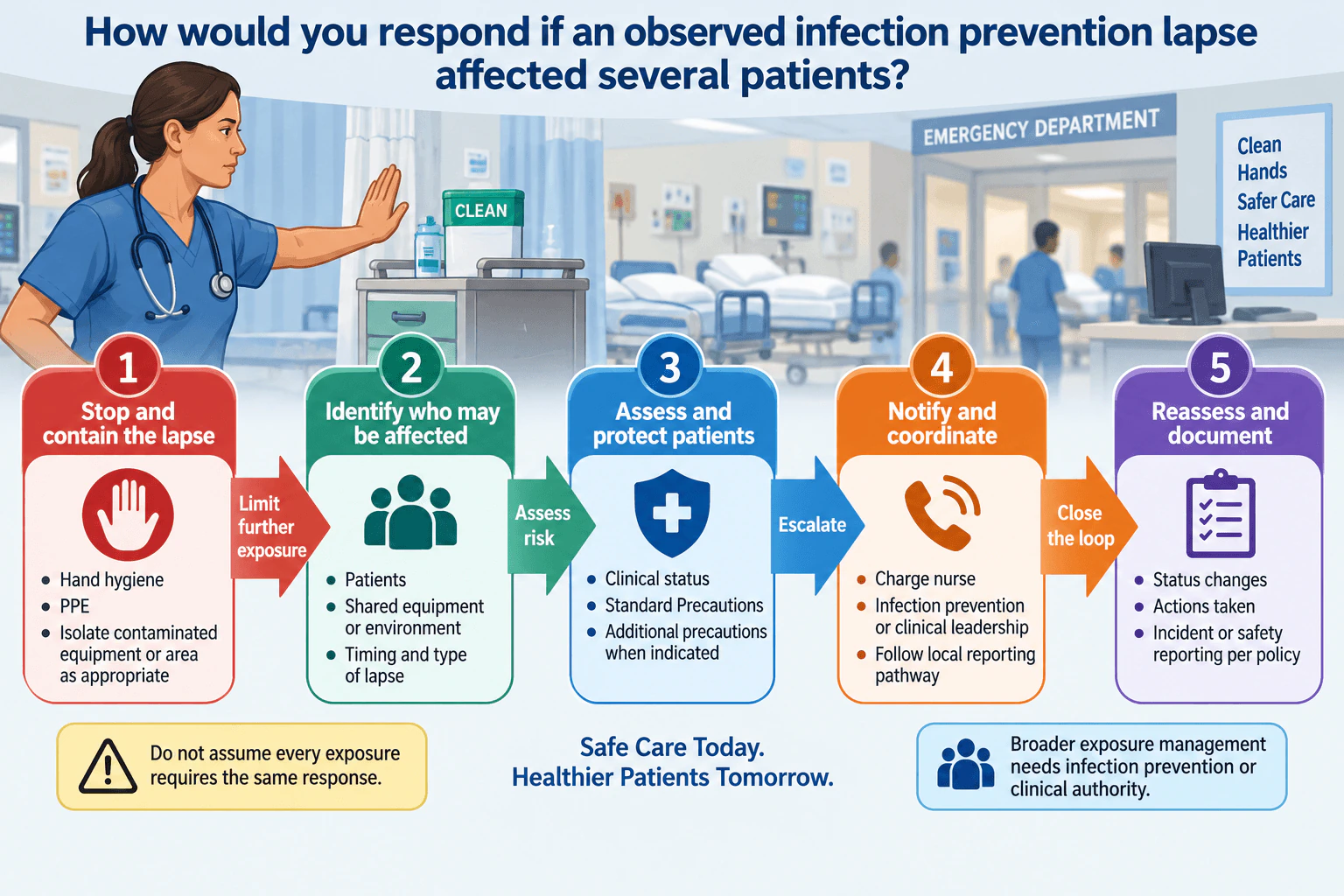
I would stop and contain the lapse first, then identify which patients, shared equipment, or care areas may have been affected and determine the timing and type of lapse. I would assess each patient's clinical status, continue Standard Precautions, and add other precautions only when indicated. Because several patients are involved, I would promptly notify the charge nurse and infection prevention or appropriate clinical leadership. I would then follow the local reporting pathway, reassess for status changes, document the facts and actions taken, and complete incident or safety reporting as required. The response should match the actual exposure rather than assuming every patient needs the same intervention.
Detailed Explanation
An infection prevention lapse affecting several patients is both an immediate bedside safety problem and a possible broader exposure problem. My priorities are to stop further exposure, determine who may be affected, assess and protect those patients, escalate appropriately, and then reassess and document.
Useful Questions to Ask the Interviewer
What type of infection prevention lapse occurred, and is it still occurring?
Which patients, shared equipment, or care areas may have been involved, and over what period?
What local infection prevention and safety reporting resources are available for a multi patient exposure?
How to Explain It in an Interview
Stop and Contain the Lapse
I would first interrupt the unsafe practice if that action is within my nursing scope and limit further exposure. I would perform hand hygiene and use personal protective equipment, or PPE, according to the anticipated exposure. If shared equipment or an area may be contaminated, I would prevent further use as appropriate until it can be managed according to infection prevention requirements. CDC Standard Precautions include hand hygiene, risk based PPE, environmental cleaning and disinfection, and appropriate handling and reprocessing of patient care equipment. cdc.gov
Identify Who May Be Affected
I would establish which patients may have been exposed, whether shared equipment or the environment was involved, and the timing and type of lapse. This defines who needs assessment without assuming that every nearby patient had the same exposure.
Assess and Protect Patients
I would assess each potentially affected patient's current clinical status. Standard Precautions continue for every patient. Additional Transmission Based Precautions are used when indicated for patients with suspected or documented infections requiring additional measures, and they are adapted to the clinical presentation and care setting. cdc.gov I would follow applicable protocols and obtain additional clinical authority when an action exceeds my independent nursing scope.
Notify and Coordinate
Because several patients may be affected, I would promptly notify the charge nurse and infection prevention or appropriate clinical leadership. Broader exposure management may require surveillance, environmental action, patient evaluation, or communication decisions that need multidisciplinary coordination. I would follow the local chain of command and reporting pathway.
Reassess and Document
I would reassess affected patients for status changes and modify nursing precautions as new information becomes available. I would document objective findings, notifications, and actions taken, and complete incident or safety reporting according to local policy. The key principle is to contain risk promptly while matching the response to the actual exposure rather than assuming every exposure requires the same intervention.
Why Interviewers Ask This
Interviewers are evaluating whether the nurse can recognize an infection prevention hazard, stop ongoing exposure, identify everyone who may be affected, assess and protect patients proportionately, escalate a multi patient event appropriately, and close the loop through reassessment and documentation.
Common interview mistakes
Common mistakes include allowing the unsafe practice to continue while investigating it, failing to identify all potentially affected patients, assuming every exposure requires the same additional precautions, allowing potentially contaminated shared equipment or an affected area to remain in use without appropriate management, delaying notification when several patients may be involved, failing to reassess patients as new information emerges, and treating an incident report as a substitute for clinical escalation and documentation.
Interview tip
Organize the response in the same sequence shown in safe practice: stop and contain the lapse, identify who may be affected, assess and protect patients, notify and coordinate, then reassess and document. Emphasize that Standard Precautions apply to all patients while additional precautions and broader exposure management depend on the specific risk and appropriate clinical authority.
Interviewer may ask next
How would you verify that the infection prevention risk had been addressed?
I would verify that the unsafe practice had stopped, further exposure had been limited, potentially affected patients had been identified and assessed, potentially contaminated shared equipment or areas were being managed appropriately, indicated precautions were in place, and the charge nurse plus infection prevention or appropriate clinical leadership had received the necessary information. I would continue reassessment and confirm that required documentation and local safety reporting were completed.
What would change if one of the affected patients developed symptoms suggesting a transmissible infection?
I would promptly reassess that patient, continue Standard Precautions, and use appropriate Transmission Based Precautions when indicated by the clinical presentation and applicable protocol. CDC states that additional precautions are used for suspected or documented infections when Standard Precautions alone are not sufficient and should be adjusted as more clinical information becomes available. cdc.gov I would notify the appropriate clinical team and infection prevention resources because the new symptoms change the exposure assessment. Diagnostic testing, treatment, or other actions requiring an order would be obtained through the appropriate clinician while nursing monitoring, communication, and documentation continue.
19. What is nursing delegation, and how does it differ from assignment?Communication And DelegationEasy
i Question Details
Explain the concept or decision in ED nursing scope. State relevant assumptions, missing information and when additional clinical authority is required.
Short Interview Answer (30-60 seconds)
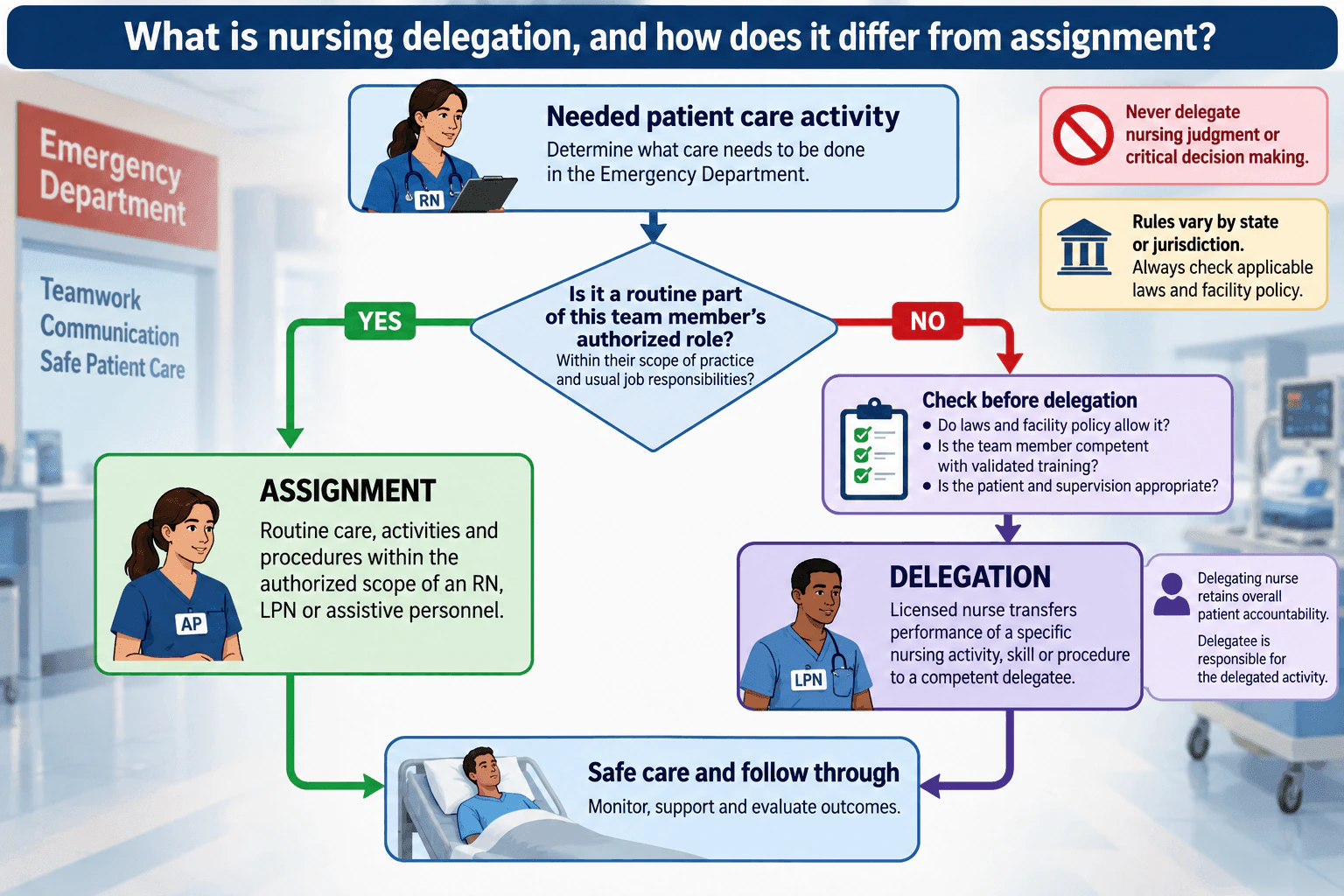
Assignment is giving a team member routine work that already falls within that person's authorized scope or usual responsibilities. Delegation is different because a licensed nurse transfers performance of a specific nursing activity, skill, or procedure to a competent delegatee when that responsibility is permitted and appropriate. The licensed nurse retains overall accountability for the patient, while the delegatee is responsible for the delegated activity. I would never delegate nursing judgment or critical decision making. I would verify competence, jurisdiction requirements, facility policy, patient needs, and supervision, then follow up after the activity is completed.
Detailed Explanation
Nursing delegation and assignment both distribute work, but they describe different responsibility relationships. For this answer, assume a bedside emergency department nurse practicing in the United States. Because no state is specified, the exact activities that may be delegated must be checked against the applicable nurse practice act, regulations, and facility policy. NCSBN states that delegation laws and rules differ among jurisdictions. ncsbn.org
Useful Questions to Ask the Interviewer
What state or jurisdiction requirements govern delegation in this department?
Which team roles and validated competencies are available for the activity being considered?
What supervision and follow up resources are available during the shift?
How to Explain It in an Interview
Assignment
An assignment is routine care, activities, or procedures that are already within the authorized scope of an RN or LPN or VN, or within the routine functions of assistive personnel. In other words, the work already belongs to that team member's established role. NCSBN specifically distinguishes these routine functions from delegation. ncsbn.org
Delegation
Delegation occurs when a licensed nurse transfers performance of a specific nursing activity, skill, or procedure to a delegatee. Under the NCSBN framework, this generally involves work beyond the delegatee's traditional role or routine responsibilities and requires appropriate education, training, and validated competence. The delegated responsibility must also be permitted by the applicable jurisdiction and be within the delegator's authority. When the delegatee is another licensed nurse, the responsibility must remain within that nurse's authorized scope. ncsbn.org
Accountability And Boundaries
The licensed nurse retains overall accountability for the patient, while the delegatee is responsible for correctly performing the delegated activity. Clinical reasoning, nursing judgment, and critical decision making cannot be delegated. Nursing assessment that requires nursing judgment therefore remains with the licensed nurse rather than being transferred to assistive personnel. ncsbn.org
Supervision And Follow Up
Before delegating, I would consider the patient's needs and condition, the specific activity, the delegatee's competence, the applicable state or jurisdiction rules, facility policy, and whether adequate supervision is available. I would communicate the responsibility and reporting expectations clearly, remain available to the delegatee, and evaluate the outcome. If the patient's condition or circumstances change, I would reassess whether delegation remains appropriate. ncsbn.org
Why Interviewers Ask This
Interviewers are evaluating whether the nurse can distinguish routine assignment from true delegation, protect nursing judgment, match responsibilities to staff competence, recognize legal and policy boundaries, communicate responsibility clearly, and provide appropriate supervision and follow up in a busy emergency department.
Common interview mistakes
Common mistakes include calling every distribution of work delegation, confusing routine assignment with delegation, delegating nursing judgment or critical decision making, transferring nursing assessment that requires nursing judgment to assistive personnel, assuming a job title alone proves competence, overlooking jurisdiction requirements or facility policy, failing to consider the patient's condition, and failing to supervise or evaluate the outcome.
Interview tip
State the distinction first. Assignment covers routine responsibilities already within the team member's authorized role. Delegation involves transferring performance of a specific nursing activity, skill, or procedure to a competent delegatee when delegation is legally and clinically appropriate. Then explain that the licensed nurse retains overall accountability, nursing judgment stays with the licensed nurse, and safe delegation requires competence verification, supervision, and follow up.
Interviewer may ask next
How would you verify that a nursing responsibility can safely be delegated?
I would identify the exact responsibility and assess the patient's current needs and condition. Then I would verify that the applicable state or jurisdiction requirements and facility policy permit delegation, confirm that the delegatee has the education, training, and validated competence needed for that responsibility, and determine whether appropriate supervision and follow up are available. I would communicate the responsibility and reporting expectations clearly and remain available to the delegatee. If those conditions are not met, I would not delegate the responsibility. ncsbn.org
What changes if the patient's condition becomes unstable after an activity has been delegated?
I would reassess the patient and reconsider whether the delegated responsibility remains appropriate because delegation decisions depend on the patient's needs, condition, and predictability. If the changed condition makes delegation inappropriate, I would redirect or take back the responsibility as clinically appropriate, provide or arrange care within the proper scope and authority, and escalate when needed. The licensed nurse remains accountable for overall patient care and for evaluating the outcome of the delegated responsibility. ncsbn.org
20. What is teach back, and what does it check?Communication And DelegationEasy
i Question Details
Explain the concept or decision in ED nursing scope. State relevant assumptions, missing information and when additional clinical authority is required.
Short Interview Answer (30-60 seconds)
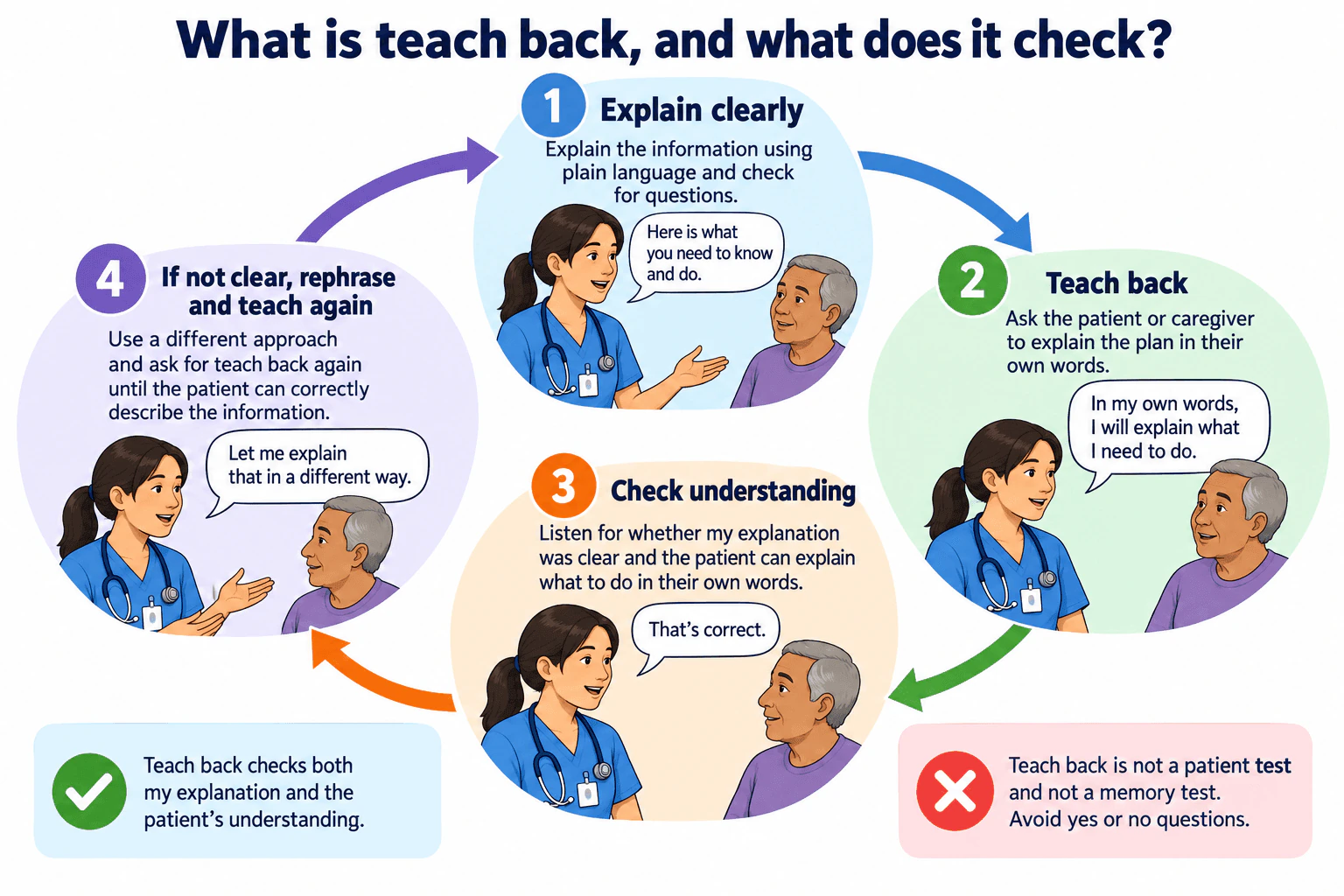
Teach back means explaining important information clearly and then asking the patient or caregiver to explain in their own words what they need to know or do. It checks both whether I communicated clearly and whether the patient understands. I would not rely on a yes response because agreement does not demonstrate understanding. If the teach back reveals a misunderstanding, I would explain the information in a different way and check again.
Detailed Explanation
Teach back is a communication method for confirming that important information has been explained in a way the patient or caregiver understands. After giving a clear explanation, I ask the person to describe in their own words what they need to know or do. The purpose is not to test the patient or test memory. It is a check of how clearly I communicated and whether the message was understood.
Useful Questions to Ask the Interviewer
How does your emergency department incorporate teach back into patient education and discharge communication?
What qualified interpretation resources are available when patients or caregivers have language communication needs?
How does the team support nurses when additional time or assistance is needed to confirm understanding?
How to Explain It in an Interview
Confirming Understanding
For a bedside emergency department RN in the United States, I would first explain the important information in plain language and invite questions. Then I would ask the patient or caregiver to explain in their own words what they understand and what they need to do. I would listen for the essential meaning rather than relying on agreement or a yes response.
Responding to Misunderstanding
If the response shows that the information was not understood, I would treat that as feedback about the communication. I would explain it again using a different approach and ask for teach back again. I would repeat that cycle until the patient or caregiver can accurately describe the important information in their own words.
Patient Context
I would adapt the communication to the patient's needs. If language assistance is needed, I would use qualified interpretation according to available resources and applicable requirements, then use teach back through that communication process to confirm understanding. Teach back does not replace interpretation.
Nursing Scope
Teach back is a communication and understanding check that a bedside nurse can use during appropriate patient education. It does not expand nursing authority or replace clinical assessment, informed consent requirements, or decisions that belong to another clinician. If a patient's questions require a decision outside my nursing scope, I would involve the appropriate clinician while continuing to communicate clearly.
Why Interviewers Ask This
Interviewers want to know whether the nurse verifies understanding instead of assuming that agreement means comprehension. Teach back demonstrates clear communication, patient centered education, recognition of misunderstanding, and willingness to change the explanation when the message has not been understood.
Common interview mistakes
Common mistakes include asking only whether the patient understands, treating a yes response as proof of comprehension, presenting teach back as a test of the patient, asking the patient merely to repeat the clinician's exact words, and failing to explain the information differently and check again when misunderstanding is identified.
Interview tip
Describe teach back as a feedback loop: explain clearly, ask the patient to state the information in their own words, listen for understanding, and explain it differently and check again when needed. Emphasize that the method checks the effectiveness of communication rather than testing the patient.
Interviewer may ask next
How do you verify that teach back was successful?
I listen for whether the patient or caregiver can accurately explain the important information or planned actions in their own words. I do not rely on agreement or a yes response. If important information is missing or incorrect, I explain it again using a different approach and ask for teach back again.
How would teach back change when a patient needs an interpreter?
I would use a qualified interpreter according to applicable requirements and available resources, then ask the patient to explain the important information in their own words through the interpreter. I would listen for evidence of understanding, explain the information differently if needed, and repeat the teach back process rather than assuming that interpretation alone confirms comprehension.
More questions load as you scroll
Disclaimer: This interview guide is for educational and informational purposes only. It is designed to help readers prepare, but it does not guarantee any interview result, hiring decision, offer, or outcome. Interview questions, hiring criteria, and preferred answers can vary by employer, interviewer, industry, location, and time. All answers, examples, and explanations in this guide are suggested examples for interview preparation, not definitive answers or instructions for professional practice. They are based on research and judgment, are provided without warranties of any kind, and should be adapted to the question, role, and applicable laws and professional requirements. Diagrams are simplified illustrations intended to highlight the main concepts and their relationships; actual situations, systems, and practices may be more complex. Alternative approaches may be equally valid or better suited to a particular question, context, or interviewer. To the fullest extent permitted by applicable law, the contributors and publisher are not liable for decisions made, actions taken, or losses incurred based on this guide.
State Laws and Professional Responsibilities: Laws and requirements governing an occupation vary by state and jurisdiction. You are responsible for checking the current laws, licensing requirements, and scope-of-practice rules that apply to your location and role, and for ensuring that your answers and actions comply with them. Adapt examples in this guide to those requirements. This guide is not legal advice.
Content Accuracy and Verification: To the fullest extent permitted by applicable law, we do not represent or warrant that interview guides, questions, answers, examples, or diagrams are accurate, complete, current, error-free, or suitable for any particular purpose. You are responsible for independently reviewing and verifying the information before relying on it.