This interview guide is for educational and informational purposes only. It is designed to help readers prepare, but it does not guarantee any interview result, hiring decision, offer, or outcome. Interview questions, hiring criteria, and preferred answers can vary by employer, interviewer, industry, location, and time. All answers, examples, and explanations in this guide are suggested examples for interview preparation, not definitive answers or instructions for professional practice. They are based on research and judgment, are provided without warranties of any kind, and should be adapted to the question, role, and applicable laws and professional requirements. Diagrams are simplified illustrations intended to highlight the main concepts and their relationships; actual situations, systems, and practices may be more complex. Alternative approaches may be equally valid or better suited to a particular question, context, or interviewer. To the fullest extent permitted by applicable law, the contributors and publisher are not liable for decisions made, actions taken, or losses incurred based on this guide.
State Laws and Professional Responsibilities
Laws and requirements governing an occupation vary by state and jurisdiction. You are responsible for checking the current laws, licensing requirements, and scope-of-practice rules that apply to your location and role, and for ensuring that your answers and actions comply with them. Adapt examples in this guide to those requirements. This guide is not legal advice.
Identity, Image, and Privacy Notice
To respect individual privacy, some names, profile photographs, avatars, biographical details, and other identifying information displayed in this guide may be replaced with pseudonyms, licensed stock images, illustrative avatars, composite images, or representative descriptions. Unless a person is expressly identified as an actual contributor, a displayed name, image, or profile should not be understood as depicting or identifying a specific candidate, interviewer, employee, or other real individual. These representations are provided for editorial and illustrative purposes only and do not imply endorsement, employment, participation, or affiliation with this guide or any company mentioned in it. Any resemblance to an actual person is coincidental.
Company Notice
This guide is an independent educational resource and is not affiliated with, endorsed by, sponsored by, or approved by the company named in this guide. Company names identify reported interview experiences or the employer context of clearly labeled original practice exercises. Interview practices can change without notice, and inclusion of company-specific content does not mean these questions are official, complete, or guaranteed to be asked. To the fullest extent permitted by law, the author, contributors, and publisher are not responsible for outcomes related to use of this material.
Content Accuracy and Verification
To the fullest extent permitted by applicable law, we do not represent or warrant that interview guides, questions, answers, examples, or diagrams are accurate, complete, current, error-free, or suitable for any particular purpose. You are responsible for independently reviewing and verifying the information before relying on it.
Questions or comments?
Contact us for general questions, or share feedback, technical corrections, and comments with the community.
31. How would you separate medication preparation from contaminated patient care equipment?Medication And ProceduresEasy
i Question Details
Explain the concept or decision in ED nursing scope. State relevant assumptions, missing information and when additional clinical authority is required.
Short Interview Answer (30-60 seconds)
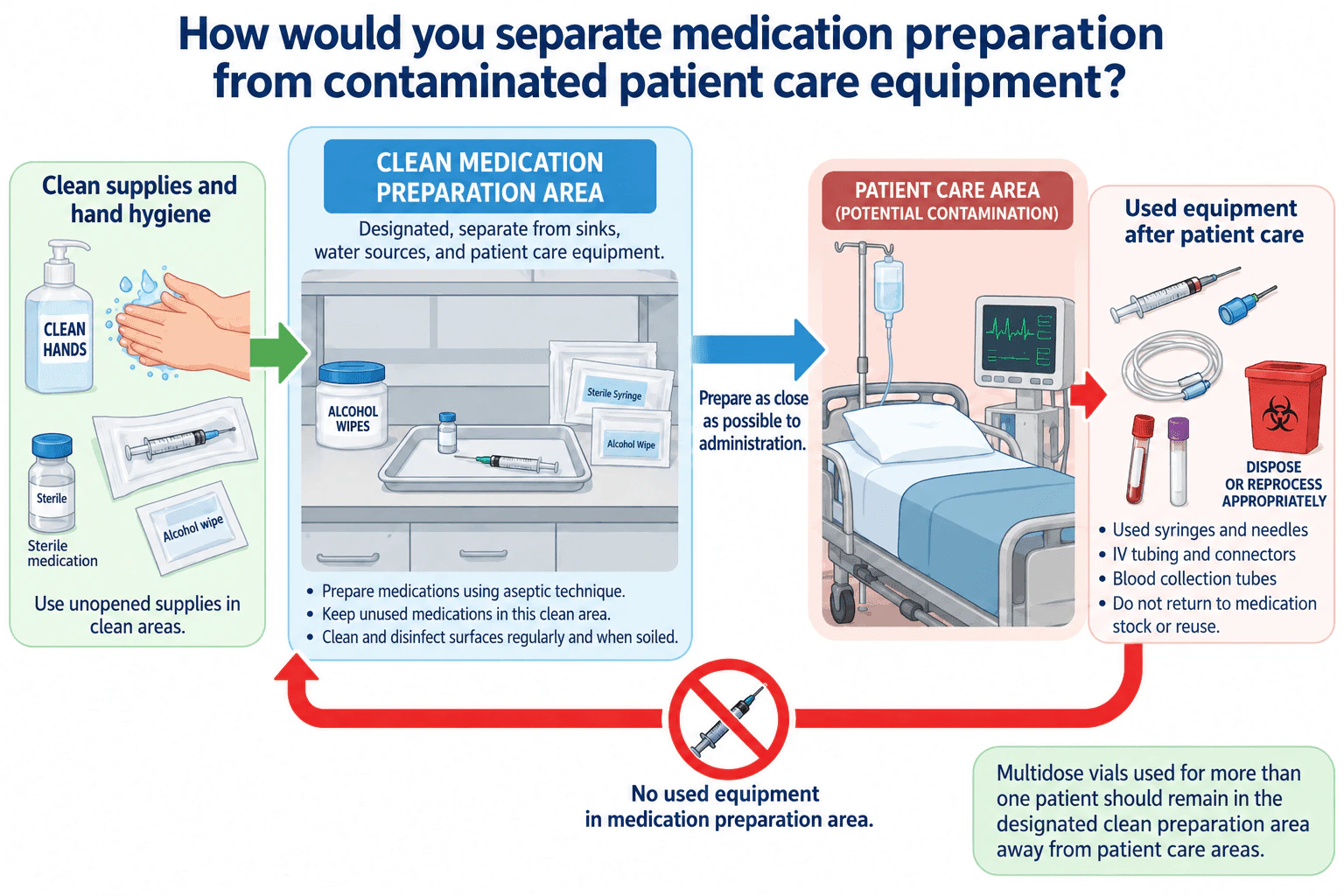
I would keep medication preparation in a designated clean area that is separate from sinks, water sources, patient care spaces, and contaminated equipment. I would perform hand hygiene, use unopened supplies and aseptic technique, and prepare medication as close as possible to administration. Once equipment has been used in patient care, it does not return to the clean preparation area or medication stock. Multidose vials used for more than one patient stay in the clean preparation area away from immediate patient treatment areas.
Detailed Explanation
The key principle is directional separation. Clean supplies enter a designated clean medication preparation area, prepared medication moves toward the patient, and equipment that has entered patient care does not move back into the clean preparation space. I would assume a bedside emergency department setting in the United States and would follow applicable infection prevention procedures, nursing scope, and facility policy when specific handling or reprocessing requirements are uncertain.
Useful Questions to Ask the Interviewer
Where is the designated clean medication preparation area in relation to patient bays and sinks?
What process does the department use for removing used equipment from patient care areas?
How are multidose vials managed when they may be used for more than one patient?
How to Explain It in an Interview
I would describe a one way workflow. I start with hand hygiene and unopened clean supplies. Medication preparation occurs in a designated clean area that is separated from potential contamination sources, including sinks, water sources, and used patient care equipment.
I use aseptic technique during preparation and prepare the medication as close as possible to administration. The prepared medication then moves from the clean area to the patient care area.
After patient care, used syringes, needles, intravenous tubing, connectors, blood collection tubes, and other potentially contaminated equipment do not travel back into the medication preparation area or medication stock. Single use equipment is discarded in the appropriate waste stream. Reusable equipment follows the applicable cleaning or reprocessing process outside the clean preparation area.
Multidose vials used for more than one patient remain in the designated clean medication preparation area away from immediate patient treatment areas. If such a vial enters an immediate patient treatment area, I would no longer return it to shared multidose stock and would follow the applicable process for dedicating it to that patient and subsequent handling.
The practical boundary is simple: clean supplies move toward preparation and patient care, while contaminated equipment moves toward disposal or appropriate reprocessing, never back toward medication preparation. If I am unsure whether an item is reusable, contaminated, or permitted to return to a medication area, I would stop and use the applicable facility policy or obtain guidance from the appropriate clinical resource before proceeding.
Why Interviewers Ask This
This question evaluates infection prevention judgment and whether the nurse can maintain a clear boundary between clean medication preparation and potentially contaminated patient care equipment. A strong answer shows recognition that contamination can move with equipment and supplies, so workflow direction, aseptic technique, and correct handling after patient care are essential.
Common interview mistakes
Common mistakes include preparing medication beside a sink or other contamination source, allowing used patient care equipment into the clean preparation area, returning exposed supplies to medication stock, treating the patient care area as part of the clean preparation workspace, or bringing a shared multidose vial into an immediate patient treatment area and then returning it to shared stock.
Interview tip
Explain the workflow visually in words: clean supplies, clean preparation, patient care, then disposal or appropriate reprocessing. Emphasize that movement after patient care is away from the medication preparation area, not back toward it.
Interviewer may ask next
How would you verify that the medication preparation area is remaining clean?
I would confirm that the area is designated for medication preparation, is separated from sinks and other water sources, contains clean unopened supplies, and is free from used syringes, needles, intravenous tubing, blood collection equipment, and other items that may have contacted the patient care environment. I would also confirm that the preparation surface is cleaned according to the applicable process and that aseptic technique can be maintained.
What changes if a multidose vial used for more than one patient enters the immediate patient treatment area?
I would not return that vial to shared multidose stock. It should be dedicated to that patient, and I would follow the applicable facility process for its subsequent storage, labeling, or disposal. This prevents an item that entered the patient treatment environment from reentering the shared clean medication workflow.
32. How do you respond when the labeling of a prepared syringe is incomplete?Medication And ProceduresMedium
i Question Details
Explain the concept or decision in ED nursing scope. State relevant assumptions, missing information and when additional clinical authority is required.
Short Interview Answer (30-60 seconds)
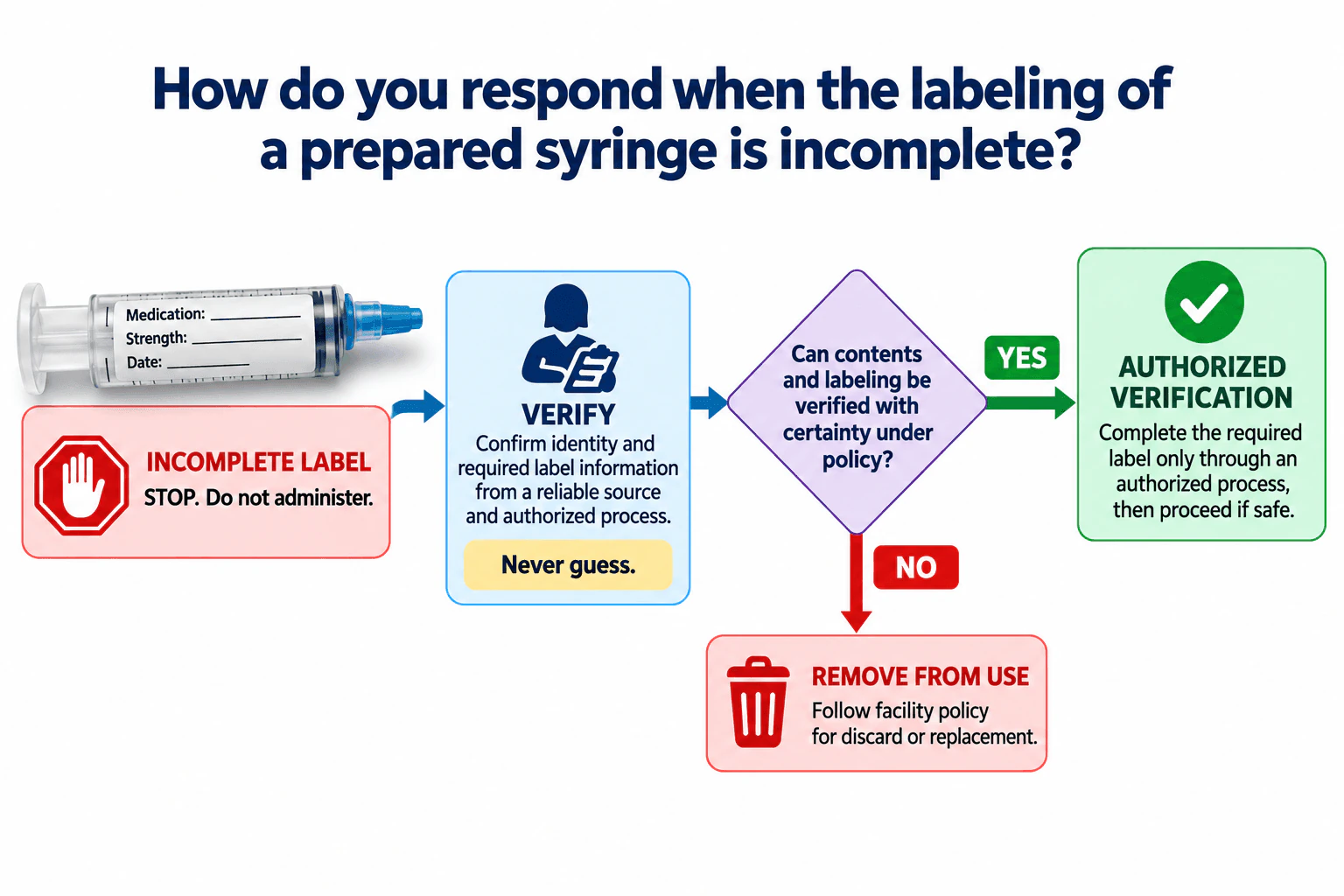
I would stop and not administer the syringe. I would verify its contents and the missing required label information from a reliable source through an authorized process, never by guessing. If the medication and labeling can be confirmed with certainty and facility policy permits completion of the label, I would complete that process before proceeding. If they cannot be verified with certainty, I would remove the syringe from use and follow facility policy for discard or replacement.
Detailed Explanation
An incomplete syringe label creates uncertainty about what is in the syringe or whether the information needed for safe administration is present. My first action is to stop and prevent administration. I would not identify the contents from appearance, location, memory, or assumption. I would determine whether the medication identity and required label information can be verified with certainty through a reliable and authorized process. Current Joint Commission medication safety requirements include labeling medication containers such as syringes in perioperative and other procedural settings and specify required verification when applicable. jointcommission.org CDC guidance also emphasizes safe injection preparation and aseptic technique. cdc.gov In the United States, the nurse must also remain within applicable law, licensure, competence, and practice setting requirements. ncsbn.org
Useful Questions to Ask the Interviewer
What process does this facility use when a prepared syringe has missing or unclear label information?
Who is authorized to verify and complete medication labeling in this setting?
What documentation or reporting is required when a prepared medication is removed from use?
How to Explain It in an Interview
Stop Before Administration
I would immediately stop the syringe from being administered. Incomplete labeling means I do not have enough verified information to treat the syringe as ready for use.
Verify Through An Authorized Process
I would determine whether the medication identity and required label information can be confirmed from a reliable source using the process authorized for that clinical setting. I would never reconstruct missing information from memory, appearance, or assumption.
Proceed Only When Verification Is Certain
If the contents and required labeling are verified with certainty and facility policy permits the label to be completed, I would complete the required verification and labeling process before administration. I would also confirm that the medication is otherwise appropriate for the intended patient, order or protocol, route, and clinical situation before giving it.
Remove From Use When Verification Fails
If the contents or required label information cannot be verified with certainty, I would remove the syringe from use and follow facility policy for discard or replacement. I would communicate the issue to the appropriate clinician or medication resource when additional authority is needed and complete any required documentation or safety reporting.
The key principle is simple: an incompletely labeled syringe does not proceed to the patient until its contents and required labeling are reliably verified through an authorized process.
Why Interviewers Ask This
This question evaluates medication safety judgment when important information is uncertain. The interviewer is looking for a nurse who stops a potentially unsafe administration, does not guess, verifies information through an authorized process, works within nursing scope and facility policy, and removes an unverifiable syringe from use.
Common interview mistakes
Common mistakes include administering because the syringe appears familiar, identifying its contents from memory or location, completing missing information by assumption, accepting partial labeling without reliable verification, or continuing to use a syringe whose contents cannot be established with certainty.
Interview tip
Lead with the safety decision: stop and do not administer. Then explain the two branches clearly. If reliable authorized verification establishes the contents and required label information, complete the permitted labeling process before proceeding. If certainty cannot be established, remove the syringe from use and follow facility policy.
Interviewer may ask next
What would you verify before allowing the prepared syringe to proceed to administration?
I would verify the medication identity and all label information required for that setting through a reliable and authorized process. I would then verify that the medication remains appropriate for the intended patient, applicable order or protocol, route, and clinical situation. If any material information remains uncertain, I would not administer the syringe.
What changes if the person who prepared the syringe is immediately available during an urgent procedure?
Urgency does not make guessing acceptable. The preparer's availability may allow the medication and label information to be verified through the authorized process for that setting. Where applicable, current Joint Commission requirements call for verbal and visual verification by two qualified individuals when the person preparing the medication is not the person administering it. jointcommission.org If the required information is verified with certainty and the permitted labeling process is completed, the syringe may proceed if otherwise safe. If certainty cannot be established, it should be removed from use.
33. How would you check whether an unfamiliar procedure is within your nursing scope?Medication And ProceduresMedium
i Question Details
Explain the concept or decision in ED nursing scope. State relevant assumptions, missing information and when additional clinical authority is required.
Short Interview Answer (30-60 seconds)
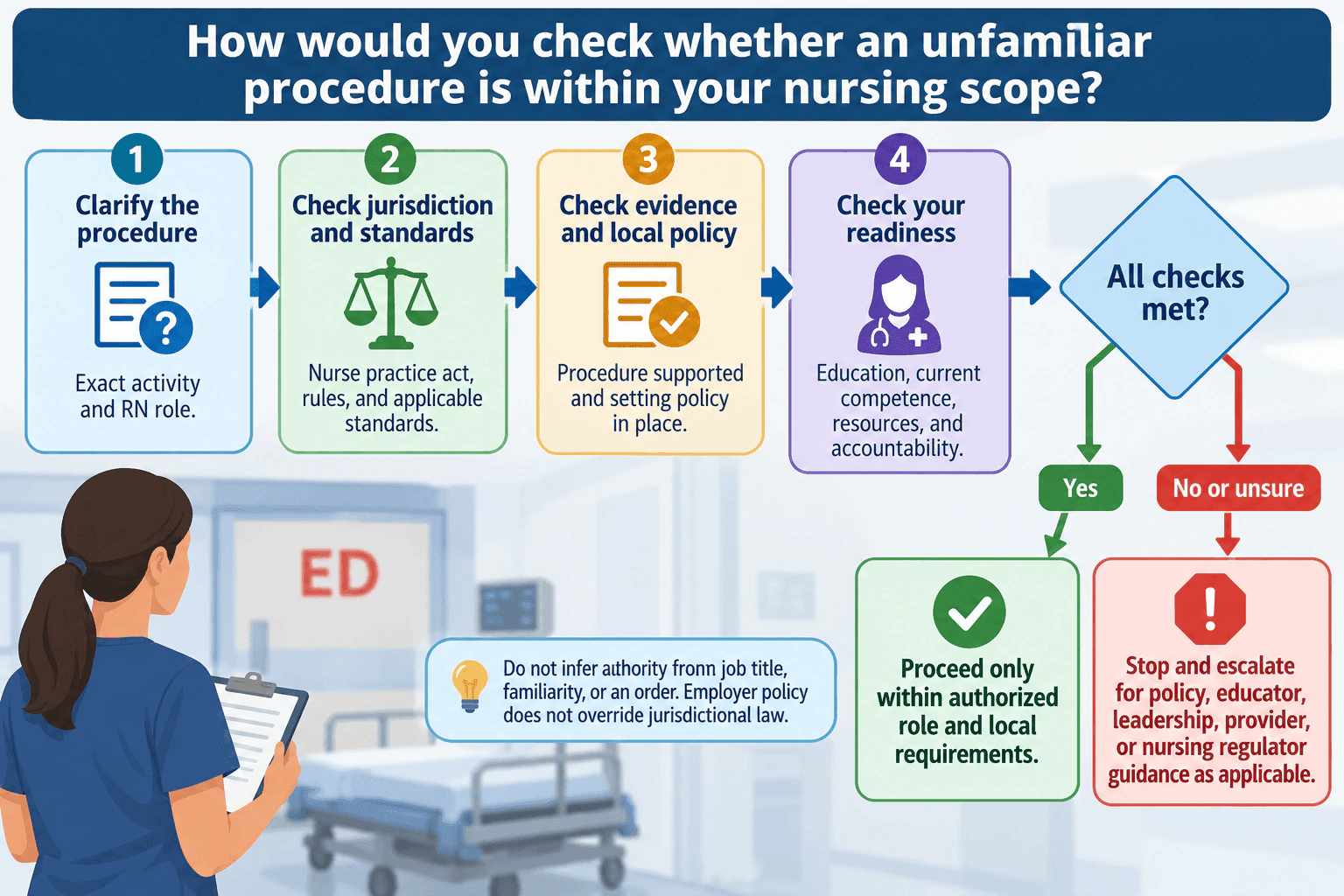
I would first clarify exactly what the procedure involves and what part I am expected to perform as the RN. Then I would check the applicable Nurse Practice Act, rules, laws, and professional standards. I would confirm that the procedure is supported by current evidence and local policy, and I would assess my education, current competence, available resources, and accountability. If all applicable requirements are met, I could proceed within my authorized role. If anything is prohibited, missing, or unclear, I would stop and obtain the appropriate guidance or authority rather than assume that familiarity, my job title, or an order expands my scope.
Detailed Explanation
The central question is whether the specific activity is legally permitted for the RN, supported in the practice setting, and safe for this particular nurse to perform. The missing information includes the exact procedure, the jurisdiction, the applicable facility requirements, whether an order or protocol is required, and the nurse's documented education and current competence. Because nursing scope is governed by the Nurse Practice Act and related rules of the applicable jurisdiction, the answer cannot be universal without that information.
Useful Questions to Ask the Interviewer
Which jurisdiction's Nurse Practice Act, rules, and nursing regulatory guidance apply to this role?
What policy, education, competency validation, or supervision requirements apply to this procedure in this setting?
Who should the bedside RN contact when the procedure or scope remains unclear?
How to Explain It in an Interview
Clarify the procedure
I would identify the exact activity, intervention, or role being requested and define which part I am expected to perform as the RN. I would not infer authority from the procedure's name, previous familiarity, my job title, or another professional's request.
Check jurisdiction and standards
I would review the applicable Nurse Practice Act, board rules, other relevant laws or regulations, and professional nursing standards. If the activity is prohibited for my level of licensure, I would not perform it. Facility policy cannot expand legal nursing scope beyond jurisdictional law.
Check evidence and local policy
If the activity is legally permissible, I would confirm that current nursing and health care literature supports it and that the practice setting has policies and procedures for it. I would also identify any required order, protocol, credentialing, supervision, equipment, or other resources. An order may be necessary for a procedure, but an order by itself does not expand the RN's legal scope.
Check my readiness
I would verify that I have completed the necessary education, have current competence to perform the activity safely, have appropriate resources, and can accept accountability for my actions and the related nursing care. Being allowed to perform an activity in general does not mean every individual nurse is prepared to perform it independently.
Decide or escalate
If all applicable checks are met, I could proceed within my authorized RN role and local requirements. If any requirement is not met or remains uncertain, I would stop. I would use nursing leadership or an educator for local competency and policy questions, the provider or other clinical professional when clarification of the clinical plan is needed, and the nursing regulator when legal scope remains uncertain. I would not perform the unfamiliar procedure until the relevant authority, requirements, and my competence are clear.
Why Interviewers Ask This
Interviewers are evaluating whether the nurse can recognize a scope question, identify what information is missing, and use a structured safety process instead of relying on habit or hierarchy. Strong judgment includes checking jurisdictional law and standards, current evidence, local policy, education, competence, resources, accountability, and any required order, protocol, supervision, or other authority before proceeding.
Common interview mistakes
Common mistakes include assuming that an order, job title, previous exposure, or employer request automatically authorizes the procedure; checking local policy without checking jurisdictional law; assuming that legal permission alone establishes personal competence; overlooking required education, supervision, resources, or protocols; and proceeding when the scope decision remains uncertain.
Interview tip
Explain the decision in the same sequence as the diagram: clarify the exact activity and RN role, check jurisdiction and professional standards, check evidence and local policy, assess education, current competence, resources, and accountability, then make the final decision. If every applicable check is met, proceed within authorized requirements. If any check fails or remains uncertain, stop and seek the appropriate guidance.
Interviewer may ask next
How would you verify the procedure if local policy says it is allowed but you are still unsure about nursing scope?
I would verify the applicable Nurse Practice Act, board rules, and nursing regulatory guidance for the jurisdiction rather than relying on facility policy alone. I would clarify the exact activity and RN role, then confirm whether the law and professional standards permit it. If legal scope remains unclear, I would contact the nursing regulator or another authorized regulatory resource and would not perform the procedure until the uncertainty is resolved.
What would change if the same procedure were requested after you moved to a different state or practice setting?
I would repeat the scope review because the governing Nurse Practice Act, rules, facility policies, competency requirements, resources, and required clinical authority may differ. I would verify the new jurisdiction's requirements, confirm the new setting's policy, and establish my current competence before performing the procedure. Previous authorization or experience in another setting would not automatically establish authority in the new context.
34. How would you handle a discrepancy between the prescribed route and the available preparation?Medication And ProceduresMedium
i Question Details
Explain the concept or decision in ED nursing scope. State relevant assumptions, missing information and when additional clinical authority is required.
Short Interview Answer (30-60 seconds)
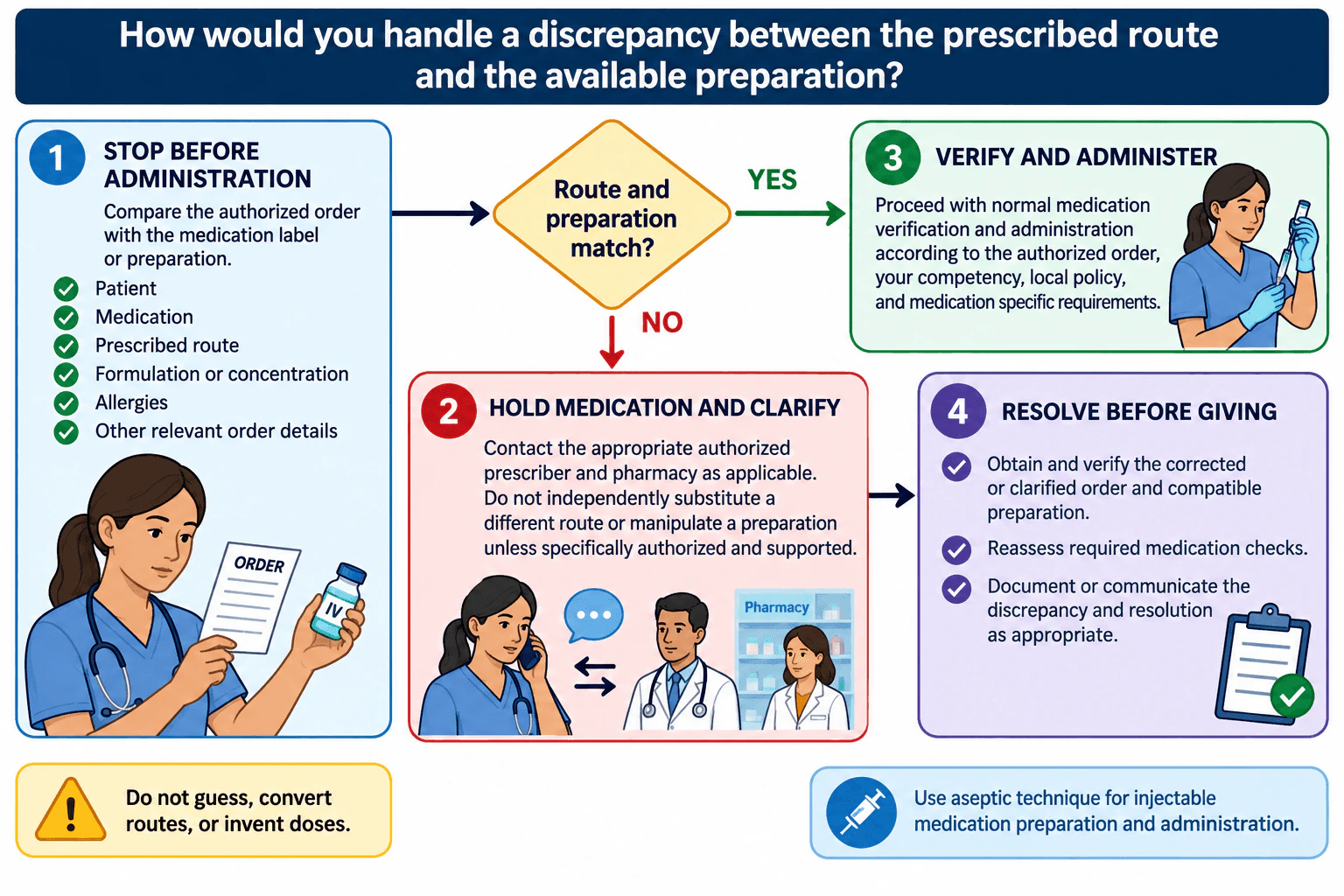
I would stop before administration and compare the authorized order with the available preparation, especially the patient, medication, prescribed route, formulation or concentration, and allergies. If the route and preparation do not match, I would hold the medication and clarify the discrepancy with the appropriate authorized prescriber and pharmacy as applicable. I would not independently convert the route or alter the preparation. After the discrepancy is resolved, I would verify the clarified or corrected order and compatible preparation, repeat the required medication checks, administer within my competence and applicable policy, and document or communicate the resolution as appropriate.
Detailed Explanation
A discrepancy between the prescribed route and the available preparation means I would stop before administration rather than assume the preparation can be given another way. The central safety decision is whether the authorized order and the available preparation actually match. In United States bedside emergency nursing practice, the exact authority to perform an activity depends on applicable nursing regulation, professional standards, competence, and practice setting requirements.
Useful Questions to Ask the Interviewer
What is the facility process for obtaining urgent clarification when an ordered route and available preparation do not match?
How is pharmacy involved when a different formulation or preparation may be needed?
What documentation or communication is expected after a medication discrepancy is resolved?
How to Explain It in an Interview
Stop Before Administration
I would compare the authorized order with the medication label or preparation. I would verify the patient, medication, prescribed route, formulation or concentration, allergies, and other relevant order details. If the route and preparation match, I would proceed with the normal medication verification process and administer according to the authorized order, my competence, applicable policy, and medication specific requirements.
Hold And Clarify A Mismatch
If the prescribed route and available preparation do not match, I would hold the medication. I would contact the appropriate authorized prescriber and pharmacy as applicable and clearly describe what was ordered and what preparation is available. I would not independently substitute another route or manipulate the preparation unless that action is specifically authorized, supported, within my competence, and permitted by applicable policy.
Resolve Before Giving
Before administration, I would obtain and verify the clarified or corrected order and confirm that the preparation is appropriate for the intended route. I would then repeat the required medication checks rather than relying on the earlier verification.
Administer And Follow Through
Once the order and preparation are reconciled, I would administer according to the authorized order and relevant medication requirements. For injectable medication preparation and administration, I would use aseptic technique. I would document or communicate the discrepancy and its resolution as appropriate.
The key principle is to stop, clarify, and resolve the mismatch before giving the medication. I would not guess, convert routes, invent a dose, or improvise an unsupported preparation.
Why Interviewers Ask This
This question evaluates whether the nurse recognizes a route and preparation mismatch as a medication safety issue, stops rather than improvises, verifies the order and preparation, obtains appropriate clarification, works within nursing scope and competence, and repeats the necessary medication checks after the discrepancy is resolved.
Common interview mistakes
Common mistakes include administering the available preparation despite a route mismatch, assuming routes are interchangeable, independently changing the prescribed route, manipulating a preparation without appropriate authorization or support, failing to verify the clarified or corrected order, skipping allergy or concentration checks, and failing to communicate or document the discrepancy and resolution when appropriate.
Interview tip
Use the same sequence shown in safe bedside practice: stop before administration, compare the order with the preparation, hold and clarify any mismatch, resolve the discrepancy, repeat the medication checks, then administer and document within scope. Emphasize that the nurse does not guess or independently convert the prescribed route.
Interviewer may ask next
What would you verify before contacting the prescriber or pharmacy about the discrepancy?
I would verify the patient, medication, prescribed route, available formulation or concentration, allergies, and the exact wording of the authorized order. I would also confirm that I have the correct medication and preparation so I can describe the discrepancy accurately when requesting clarification.
What would you do if the medication were time sensitive and the route discrepancy occurred during an emergency?
I would still avoid administering the preparation by an unverified route. I would escalate the clarification urgently through the appropriate authorized prescriber and pharmacy channels and follow any applicable authorized emergency protocol within my competence and local policy. The urgency changes the speed of communication and escalation, but it does not justify independently inventing a route, dose, preparation, or authority.
35. How would you respond if a syringe or vial may have been contaminated?Medication And ProceduresHard
i Question Details
Explain the concept or decision in ED nursing scope. State relevant assumptions, missing information and when additional clinical authority is required.
Short Interview Answer (30-60 seconds)
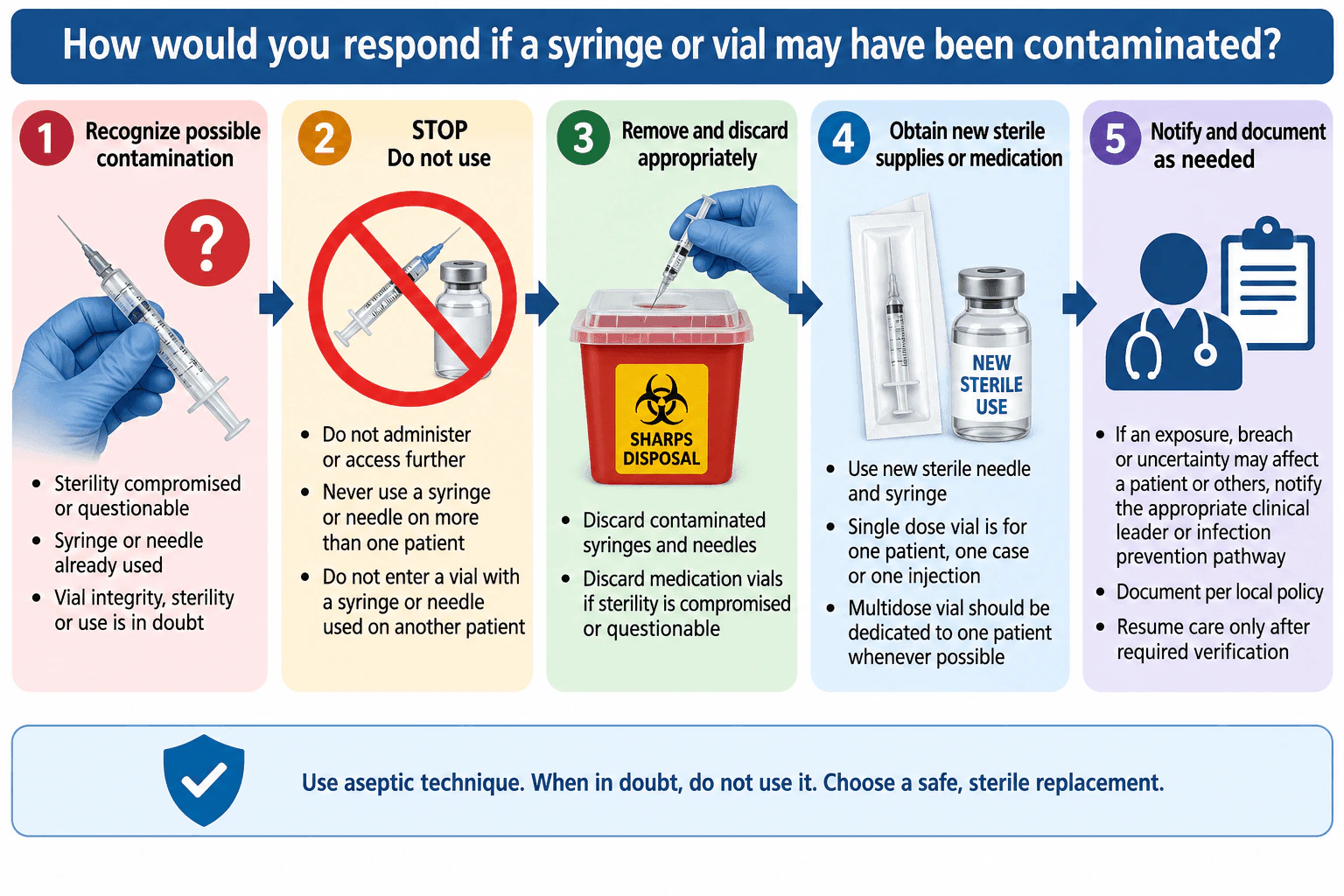
If a syringe or vial may have been contaminated, I would stop and not use it. I would discard a used syringe and needle appropriately and discard a vial if its sterility is compromised or questionable. I would obtain a new sterile needle, syringe, and safe medication supply and use aseptic technique. I would never reuse a syringe or needle for another patient or use one that contacted a patient to enter medication intended for another patient. If a possible exposure may have affected a patient or others, I would notify the appropriate clinical leader or infection prevention pathway and document according to local policy. cdc.gov
Detailed Explanation
The central decision is to treat compromised or questionable sterility as unsafe. I would stop use of the affected syringe, needle, or vial rather than trying to salvage it. CDC guidance states that a new sterile syringe and needle should be used for each patient, that used syringes and needles are contaminated, and that medication vials should be discarded whenever sterility is compromised or questionable. cdc.gov
Useful Questions to Ask the Interviewer
What is this emergency department's process for reporting a possible medication contamination or patient exposure?
Which clinical leader, pharmacy resource, or infection prevention contact should the bedside RN involve when the extent of a breach is uncertain?
What documentation pathway is used after a suspected injection safety breach?
How to Explain It in an Interview
Recognize And Stop
If sterility is compromised or questionable, I would stop and not administer or access medication further with the affected equipment. A syringe or needle that has already been used on a patient is contaminated. It must not be reused for another patient or used to enter medication or solution intended for another patient. cdc.gov
Remove And Discard
I would discard the contaminated syringe and needle in the appropriate sharps container. If vial sterility is compromised or questionable, I would remove the vial from use and discard it according to applicable handling procedures. cdc.gov
Replace With Sterile Supplies
I would obtain a new sterile needle and syringe and a safe medication supply, then continue using aseptic technique. Single dose medication is intended for one patient for a single case, procedure, or injection. Multi dose vials should be dedicated to one patient whenever possible. If a multi dose vial is used for more than one patient, CDC guidance requires a clean medication preparation area away from immediate patient treatment areas and a new sterile needle and syringe for access. cdc.gov
Escalate A Possible Exposure
If the questionable equipment or medication was already used, or uncertainty remains about whether a patient or others were affected, I would promptly use the appropriate clinical leadership and infection prevention pathway and document according to local policy. Decisions about exposure evaluation, testing, treatment, or patient notification would involve the appropriate clinical authority rather than being independently invented by the bedside RN. I would resume the medication process only with verified safe supplies and any required clarification. ncsbn.org
Why Interviewers Ask This
Interviewers are evaluating whether the nurse recognizes a contamination risk, stops an unsafe medication process, protects patients from cross contamination, uses appropriate sterile replacement supplies, understands safe use of single dose and multi dose vials, and escalates a possible exposure appropriately. They are also assessing whether the nurse distinguishes immediate nursing safety actions from decisions that require additional clinical authority or local policy. The NCSBN decision making framework emphasizes applicable law, evidence, competence, and practice setting policies when determining whether an activity is within nursing scope. ncsbn.org
Common interview mistakes
Common mistakes include continuing to use an item because contamination is only suspected, changing only the needle while reusing a syringe, using a syringe or needle that contacted a patient to enter medication intended for another patient, using single dose medication for multiple patients, keeping a vial whose sterility is questionable, or failing to escalate a possible exposure. CDC guidance states that once a syringe and needle have been used, both are contaminated and must be discarded. cdc.gov
Interview tip
Use the same clear sequence shown in the clinical response: recognize possible contamination, stop use, remove and discard affected items, obtain sterile replacements, then notify and document when an exposure or breach may have affected a patient or others. Emphasize aseptic technique and state when additional clinical authority or local policy is required.
Interviewer may ask next
How would you verify what to do if you are uncertain whether the syringe or vial was contaminated?
I would stop using the item while clarifying what happened. I would determine whether the syringe or needle had already contacted a patient or the patient's intravenous system and whether the vial's sterility may have been compromised. A used syringe and needle are considered contaminated, and CDC guidance says a medication vial should be discarded whenever sterility is compromised or questionable. If uncertainty remains, I would involve the appropriate clinical leader, pharmacy resource, or infection prevention pathway according to local policy before proceeding. cdc.gov
What changes if you discover that a used syringe or needle entered a multi dose vial?
I would stop further use of that vial because the event creates a potential contamination and exposure concern. I would remove the vial from use, obtain safe sterile replacement supplies and medication, and promptly follow the appropriate clinical leadership and infection prevention pathway. CDC guidance states that a syringe or needle used on a patient must not be used to enter medication intended for another patient. Any patient evaluation, notification, testing, or treatment decisions would follow the appropriate clinical authority and local policy. cdc.gov
36. How do you proceed when an urgent procedure is requested but your competency has not been validated?Medication And ProceduresHard
i Question Details
Explain the concept or decision in ED nursing scope. State relevant assumptions, missing information and when additional clinical authority is required.
Short Interview Answer (30-60 seconds)
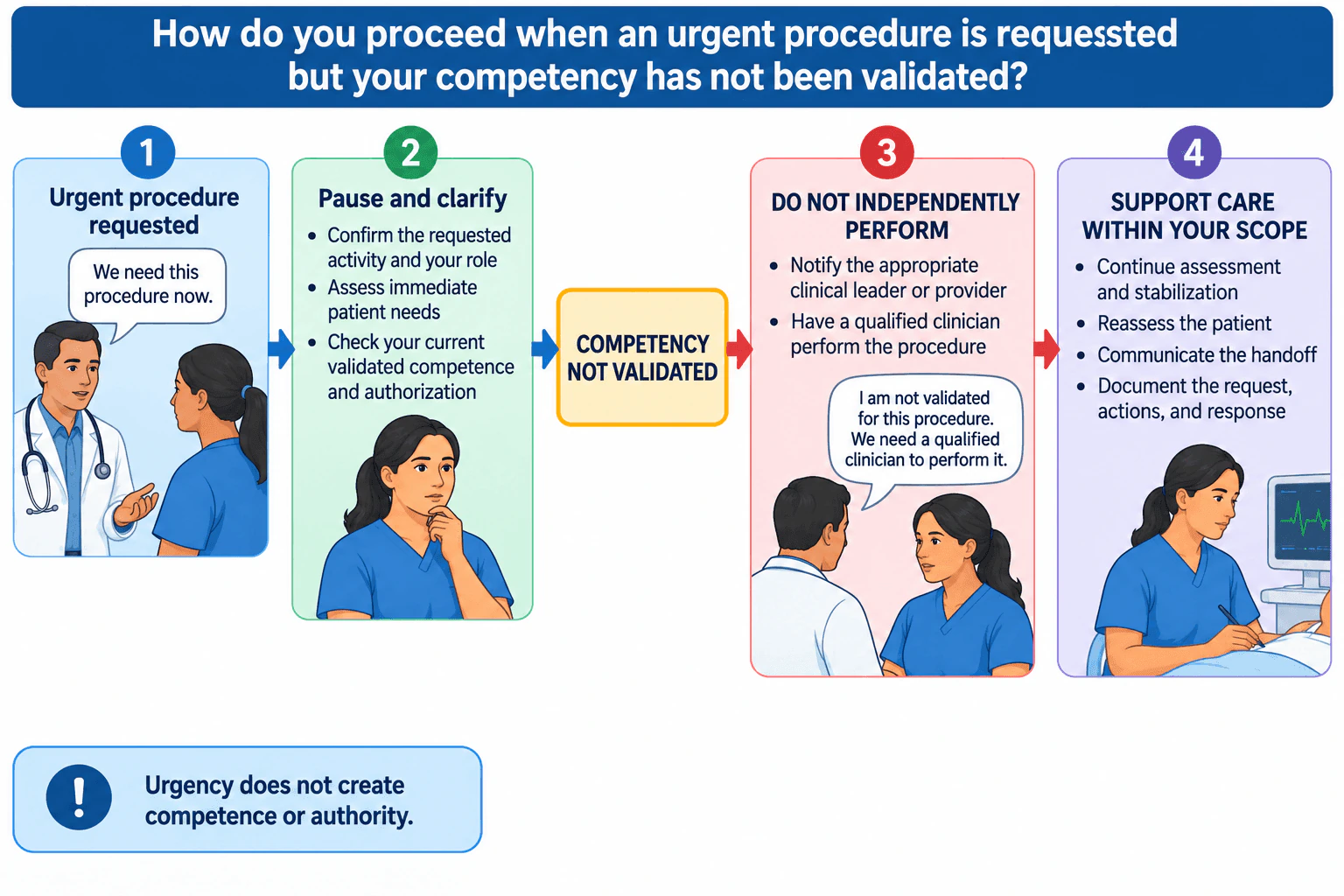
If my competency has not been validated, I would not independently perform the requested procedure. I would clarify the request, assess the patient's immediate needs, confirm my current competence and authorization, and promptly notify the appropriate clinical leader or provider. I would obtain a qualified clinician for the procedure while I continue assessment, stabilization, reassessment, communication, and documentation within my validated scope.
Detailed Explanation
The central principle is that urgency does not create competence or authority. I would first clarify exactly what procedure is being requested and what role I am expected to perform. I would assess the patient's immediate needs and continue any assessment or stabilization that is within my current competence and authorization.
The exact scope of practice depends on the applicable jurisdiction, nursing regulations, practice setting requirements, education, current competence, and available resources. NCSBN's scope framework specifically asks whether there is documented evidence of the nurse's current competence before the nurse proceeds with an activity. If that requirement is not met, the nurse should not independently perform that activity. ncsbn.org
Useful Questions to Ask the Interviewer
How does this department document competency for procedures that require validation?
Who should the nurse contact when an urgent procedure is requested but competency has not been validated?
What process is used to obtain a qualified clinician while necessary patient support continues?
How to Explain It in an Interview
I would start by clarifying the requested procedure and my expected role. At the same time, I would assess the patient's immediate needs so necessary care within my scope continues without avoidable delay.
I would then verify whether I have current documented competency and the required authorization for that specific activity. If my competency has not been validated, I would not independently perform the procedure. NCSBN's decision framework treats current documented competence as one of the conditions that must be satisfied before a nurse proceeds with an activity. ncsbn.org
I would promptly notify the appropriate clinical leader or provider and clearly state that I am not validated for the requested procedure. I would obtain a qualified clinician to perform the procedure. If the activity also requires an order, protocol authorization, or another professional's authority under the applicable jurisdiction or practice setting, I would make sure that requirement is addressed before the procedure proceeds.
While qualified help is being obtained, I would continue appropriate assessment, stabilization, monitoring, and other care that I am competent and authorized to provide. I would reassess the patient, communicate the handoff clearly, and document the request, escalation, actions taken, and patient response according to applicable requirements.
The important distinction is that declining to independently perform an unvalidated procedure does not mean stopping urgent patient support. I would continue safe care within my scope while promptly obtaining the qualified personnel and any additional clinical authority required for the requested procedure.
Why Interviewers Ask This
Interviewers are evaluating whether the nurse can balance urgency with patient safety, professional accountability, scope of practice, and timely escalation. The key judgment is recognizing that an urgent request does not remove the need for appropriate education, current competence, authorization, resources, and accountability before independently performing an activity. NCSBN's scope framework specifically includes documented evidence of current competence when determining whether a nurse may safely perform an activity. ncsbn.org
Common interview mistakes
Common mistakes include performing the procedure simply because the situation is urgent, assuming that another clinician's request automatically establishes authority, treating supervision as a substitute for validated competency, delaying all patient support while waiting for help, failing to escalate promptly, or omitting reassessment, handoff communication, and documentation.
Interview tip
State the safety boundary early: if your competency has not been validated, you do not independently perform the procedure. Then show that you still respond urgently by assessing and stabilizing the patient within your scope, escalating promptly, obtaining a qualified clinician, communicating the handoff, reassessing, and documenting.
Interviewer may ask next
How would you verify whether you are competent and authorized to perform the procedure?
I would identify the exact activity and verify the applicable nursing regulations, practice setting requirements, required education, documented current competency, available resources, and any required order or protocol authorization. If current competency cannot be confirmed, I would not independently perform the procedure and would obtain a qualified clinician. NCSBN's framework evaluates law and regulation, practice setting requirements, education, current competence, resources, prudent practice, and accountability when determining whether an activity may be performed. ncsbn.org
What changes if the patient's condition suddenly deteriorates while you are waiting for a qualified clinician?
I would immediately reassess the patient, escalate the clinical response, and continue assessment, stabilization, monitoring, and other interventions that I am competent and authorized to provide. I would communicate the deterioration and the need for qualified procedural support without delay. The patient's worsening condition increases the urgency of assessment, escalation, and stabilization, but it does not by itself validate my competency or create authority to independently perform the requested procedure.
37. What is a systematic trauma assessment?Trauma And Special PopulationsEasy
i Question Details
Explain the concept or decision in ED nursing scope. State relevant assumptions, missing information and when additional clinical authority is required.
Short Interview Answer (30-60 seconds)
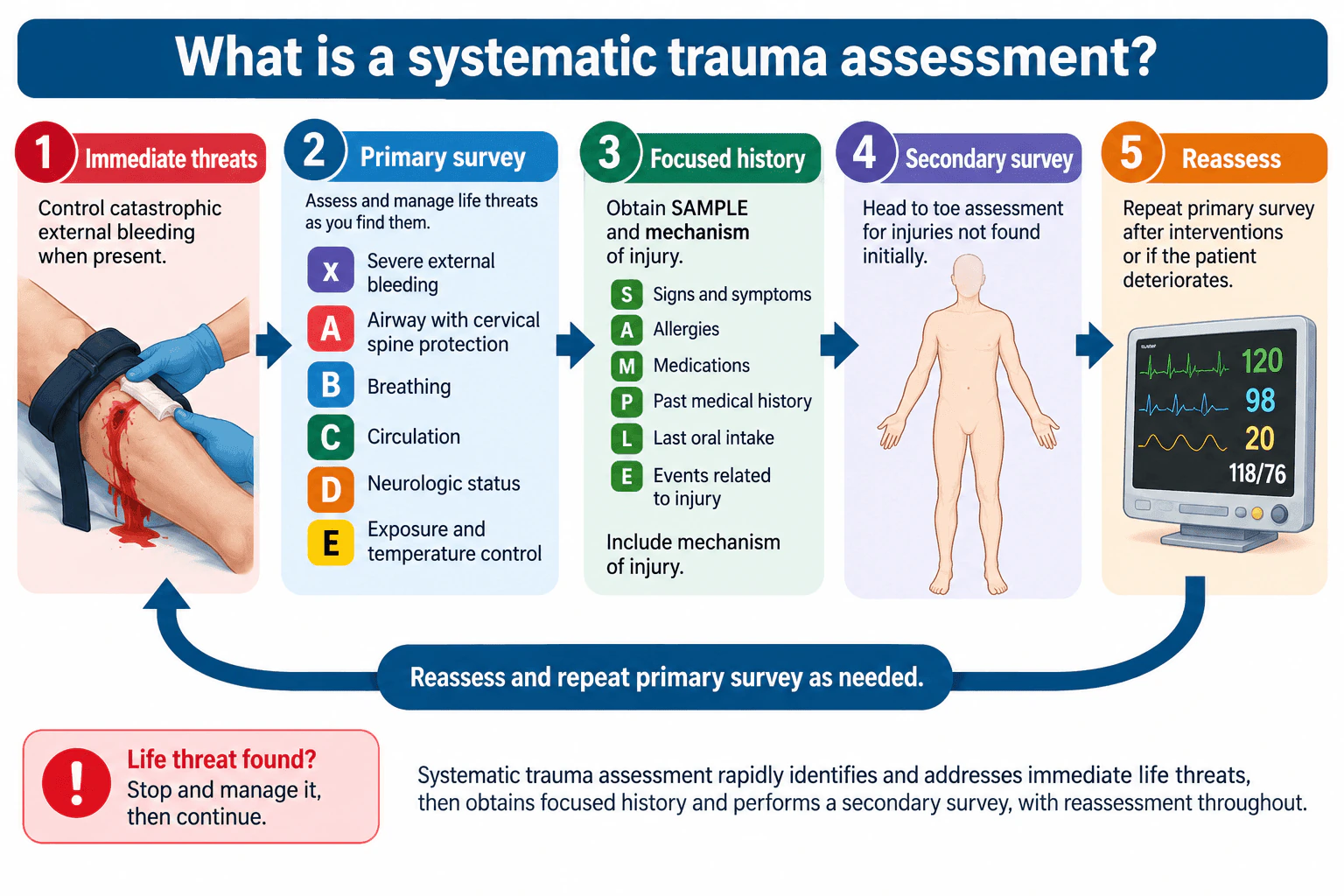
A systematic trauma assessment means evaluating an injured patient in a consistent order so the greatest threats to life are identified and managed first. I would control life threatening external hemorrhage when present, then use the xABCDE primary survey to assess airway with appropriate cervical spine motion restriction, breathing, circulation, neurologic status, and exposure with temperature control. After immediate threats are addressed, I obtain a focused SAMPLE history and mechanism, perform a secondary head to toe assessment, and repeat the primary survey after interventions or whenever the patient's condition changes.
Detailed Explanation
A systematic trauma assessment is a structured process for finding and addressing the problems most likely to threaten life before moving to less urgent injuries. It is not a one time checklist. Life threats are managed as they are identified, and reassessment continues throughout care.
Useful Questions to Ask the Interviewer
Which trauma activation criteria and nursing protocols does this emergency department use?
What resources are available for rapid escalation to the trauma team or receiving trauma center?
How are nursing roles assigned during a major trauma resuscitation?
How to Explain It in an Interview
I would begin with the patient's immediate condition and mechanism while looking for catastrophic external bleeding. If life threatening external hemorrhage is present, controlling it takes immediate priority within my training, nursing scope, and applicable protocol.
Next I perform the xABCDE primary survey. X addresses exsanguinating external hemorrhage. A is airway with appropriate restriction of cervical spine motion when indicated. B is breathing and ventilation. C is circulation and continued assessment for hemorrhage. D is neurologic status. E is exposure to identify injuries while limiting heat loss and maintaining temperature control. The key principle is to address life threats as they are found rather than waiting until the entire survey is complete.
Once immediate threats are controlled and the patient is sufficiently stable to continue, I obtain a focused SAMPLE history: signs and symptoms, allergies, medications, past medical history, last oral intake, and events related to the injury. I also clarify the mechanism because it can help identify injuries that may not be obvious during the initial assessment.
I then perform a secondary head to toe assessment for additional injuries not identified during the primary survey. The secondary survey is more detailed, but it never takes priority over a new or worsening primary survey problem.
Reassessment continues throughout care. I repeat the primary survey after interventions and whenever the patient deteriorates or develops new findings. I compare the patient's condition with earlier findings, communicate significant changes promptly, document the assessment and response, and escalate according to clinical need, trauma activation criteria, applicable protocols, and orders when required.
The central idea is priority followed by repetition: identify immediate threats, intervene within scope, obtain focused history, examine for additional injuries, and return to the primary survey whenever the patient's condition changes.
Why Interviewers Ask This
Interviewers are evaluating whether the nurse can prioritize life threats, use a consistent trauma assessment framework, avoid becoming distracted by less urgent injuries, recognize that important injuries may not be immediately visible, and reassess after interventions or clinical change. They also want to hear appropriate escalation when findings require trauma team involvement, another clinician, protocol authorized action, or additional clinical authority.
Common interview mistakes
Common mistakes include focusing on an obvious injury before assessing immediate threats, delaying necessary action until the entire assessment is complete, failing to control severe external bleeding promptly, continuing a secondary survey while a primary survey problem is worsening, assuming all injuries are visible, and failing to repeat the primary survey after an intervention or clinical deterioration. Another mistake is applying adult medication doses or resuscitation pathways directly to children instead of using age and weight appropriate guidance.
Interview tip
Describe the assessment as a repeating priority process rather than a memorized checklist. Emphasize that immediate threats are treated when identified, the focused history and secondary survey follow control of those threats, and deterioration redirects attention to the primary survey. Distinguish independent nursing assessment from protocol authorized interventions and actions that require an order or additional clinical authority.
Interviewer may ask next
How do you verify that the trauma assessment and interventions are working?
I repeat the primary survey and compare the patient's airway, breathing, circulation, neurologic status, exposure findings, vital signs, symptoms, and overall response with the previous assessment. I determine whether the intervention produced the intended clinical response, look for new or worsening findings, communicate significant changes, and escalate promptly if the patient is not improving or is deteriorating.
How would your approach change for a pediatric trauma patient?
The priority of finding and managing immediate life threats remains, but assessment, equipment, medication, fluid decisions, vital sign interpretation, communication, and escalation must use pediatric and weight appropriate guidance. I would preserve the child's exact age, weight, mechanism, and observed findings rather than scaling an adult pathway or dose. I would also involve appropriate pediatric and trauma resources according to local capability and protocol.
38. What is the purpose of a secondary trauma survey?Trauma And Special PopulationsEasy
i Question Details
Explain the concept or decision in ED nursing scope. State relevant assumptions, missing information and when additional clinical authority is required.
Short Interview Answer (30-60 seconds)
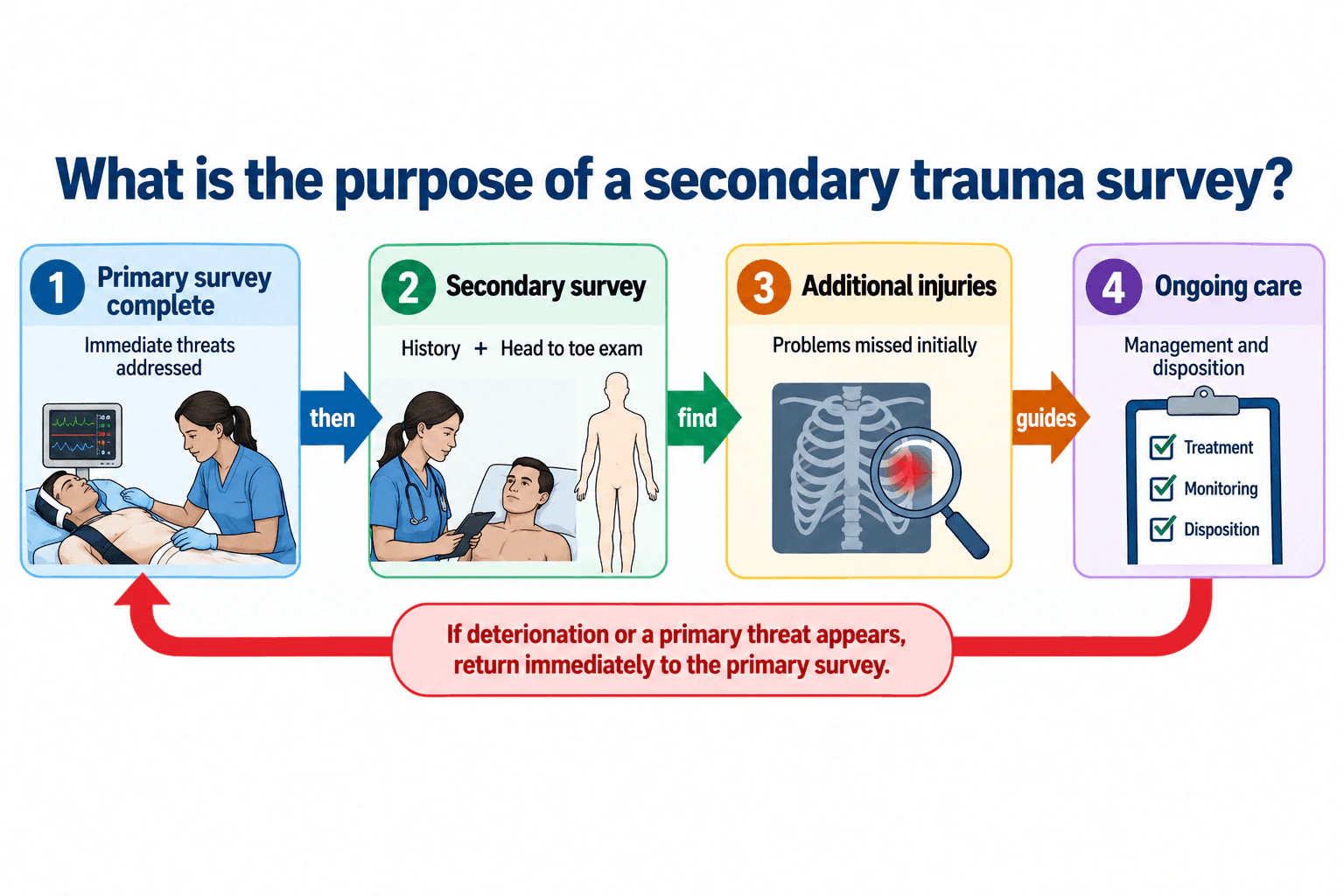
A secondary trauma survey is a systematic assessment performed after the primary survey and management of immediate life threatening problems. Its purpose is to identify additional injuries or problems that may have been missed initially through relevant history and a head to toe examination. The findings guide treatment, monitoring, consultation, and disposition. If the patient deteriorates or a primary survey threat appears, I would stop and return immediately to the primary survey.
Detailed Explanation
A secondary trauma survey is the more complete assessment that follows the primary survey after immediate life threatening problems have been addressed. Its purpose is to identify additional injuries or issues that may not have been obvious during the initial rapid assessment and to provide information for ongoing care and disposition.
Useful Questions to Ask the Interviewer
How does your emergency department structure and document the secondary trauma survey?
What findings typically trigger trauma, surgical, or specialty escalation in your department?
How to Explain It in an Interview
Nursing Priorities
I would first distinguish the secondary survey from the primary survey. The primary survey focuses on finding and addressing immediate life threatening problems. After that, the secondary survey uses relevant history and a systematic head to toe examination to look for additional injuries or abnormalities that were not recognized initially.
As the emergency department nurse, I would contribute through focused history gathering, systematic assessment within nursing scope, monitoring, reassessment, communication of new findings, and accurate documentation. Diagnostic testing, procedures, and treatments that require an order or another clinician's authority remain subject to professional scope and local protocol.
Clinical Rationale
Some injuries may not be obvious during the primary survey because attention is appropriately directed toward immediate threats. Pain, altered mental status, distracting injuries, clothing, or the urgency of resuscitation can also make less obvious injuries harder to recognize. A structured secondary survey provides an organized way to examine the patient for additional injuries and use those findings to guide treatment, monitoring, consultation, and disposition.
Reassessment
The sequence changes immediately if the patient's condition worsens. If deterioration occurs or a primary survey threat appears, I would stop the secondary survey and return to the primary survey immediately. This keeps immediate life threats ahead of the more detailed examination.
The exact assessment and escalation pathway depends on the patient's age, mechanism, clinical findings, available resources, and local trauma protocols. Pediatric, pregnant, older, and other vulnerable patients require population appropriate assessment rather than simply applying an adult pathway unchanged.
Why Interviewers Ask This
Interviewers want to know whether the nurse can distinguish rapid identification of immediate life threats from the more complete assessment that follows. They are also evaluating whether the nurse understands that trauma assessment is continuous and that deterioration requires immediate reprioritization.
Common interview mistakes
Common mistakes include starting or continuing the secondary survey while an immediate primary survey threat remains unresolved, assuming that all important injuries are visible, performing an incomplete head to toe assessment, failing to reassess when the patient's condition changes, and applying adult assumptions without adapting assessment and escalation for pediatric, pregnant, older, or other vulnerable patients.
Interview tip
State the sequence clearly: address immediate life threats first, then use relevant history and a systematic head to toe assessment to identify additional injuries, use the findings to guide ongoing care, and return immediately to the primary survey if the patient deteriorates.
Interviewer may ask next
How do you verify that the secondary trauma survey is complete?
I would verify that the relevant history and systematic head to toe assessment were completed, review abnormal findings and trends, confirm that concerns were communicated and documented, and make sure needed escalation or further evaluation was initiated according to the trauma team's plan and local protocols. I would continue reassessment because completion of the secondary survey does not end trauma assessment.
How does the approach change for a pediatric trauma patient?
The purpose remains the same: identify additional injuries after immediate life threatening problems have been addressed. The assessment must be adapted to the child's age, developmental level, size, mechanism, communication ability, and clinical findings. Pediatric assessment and escalation guidance should be used rather than simply applying an adult pathway unchanged.
39. What is a pediatric emergency assessment, and why is age relevant?Trauma And Special PopulationsEasy
i Question Details
Explain the concept or decision in ED nursing scope. State relevant assumptions, missing information and when additional clinical authority is required.
Short Interview Answer (30-60 seconds)
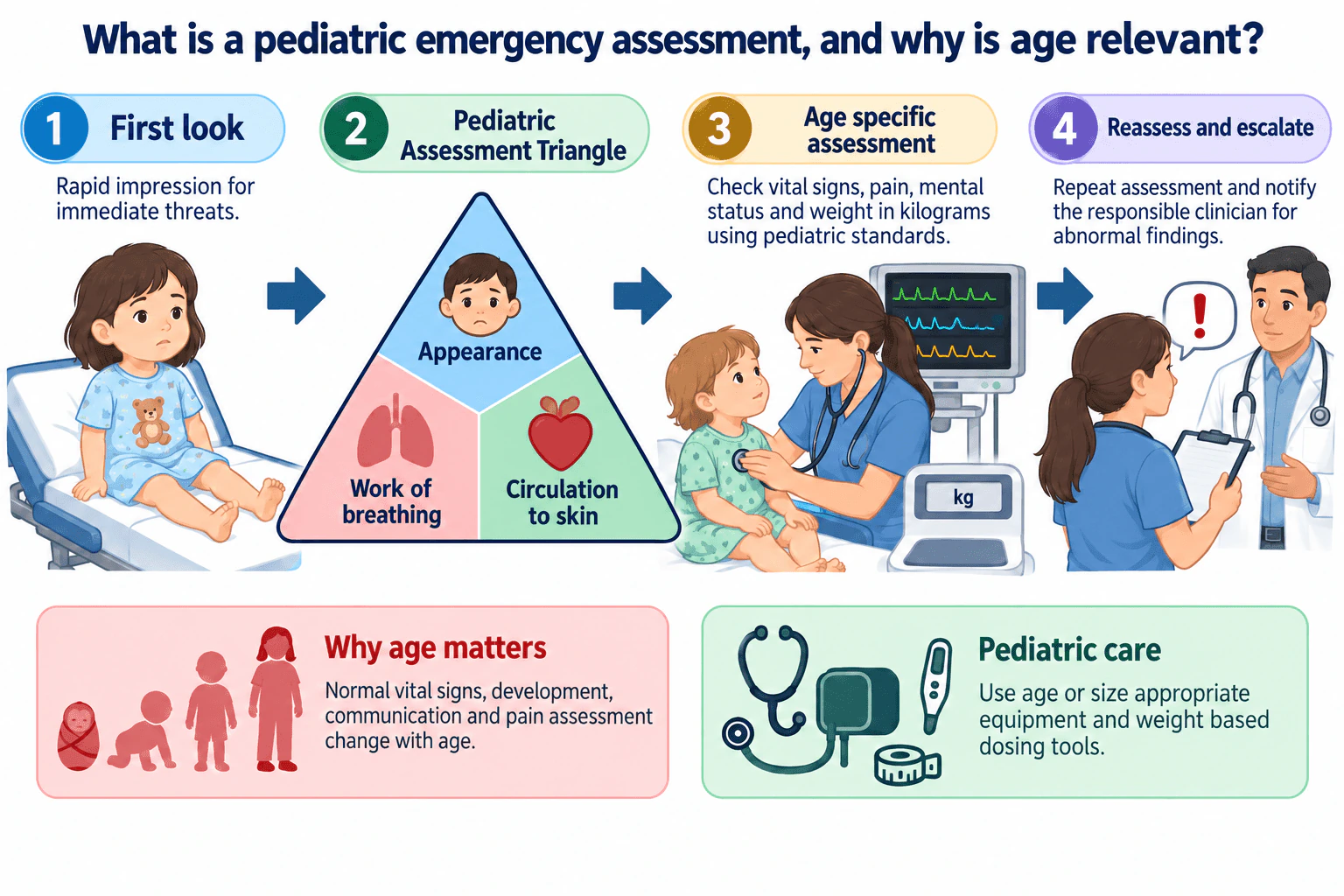
A pediatric emergency assessment starts with a rapid first look for immediate threats, followed by a pediatric focused assessment such as the Pediatric Assessment Triangle, then age appropriate measurement of vital signs, pain, mental status, and weight in kilograms. Age matters because normal findings, communication, pain expression, equipment size, and medication dosing needs change as children grow. I would interpret findings using pediatric standards, reassess the child, and escalate abnormal findings to the responsible clinician. heart.org
Detailed Explanation
A pediatric emergency assessment is a systematic way to recognize immediate threats, form a rapid impression of the child, obtain appropriate measurements, and identify deterioration. The central point is that pediatric findings must be interpreted in the context of age and development rather than by simply applying adult expectations.
Useful Questions to Ask the Interviewer
Which pediatric triage and assessment framework does this emergency department use?
What pediatric equipment and kilogram based medication safety tools are available?
What is the local escalation process for abnormal pediatric findings?
How to Explain It in an Interview
Nursing Priorities
I would start with a rapid first look for immediate threats. The Pediatric Assessment Triangle is useful for forming an initial impression through appearance, work of breathing, and circulation to skin. It helps identify whether the child needs immediate further assessment or intervention. heart.org
Next, I would obtain age appropriate measured findings, including a complete set of vital signs, pain assessment, mental status, and weight in kilograms. Current pediatric emergency readiness guidance recommends pediatric assessment and reassessment, kilogram weights, documentation of vital signs, and notification of the responsible clinician when findings are abnormal for age. publications.aap.org
Patient Context
Age changes what normal looks like. Heart rate, respiratory rate, blood pressure, behavior, communication, and pain expression vary across development. Equipment must fit the child's size, and medication safety systems use kilogram based information to support appropriate dosing. I would not simply reduce an adult dose or use adult assessment expectations. publications.aap.org
If the child's exact age, measured weight, vital signs, medical history, mechanism, or observations are not provided, I would not invent them. I would gather those data and interpret them using current pediatric standards and local resources.
Reassessment
Assessment is repeated as the child's condition changes and after relevant interventions. Within nursing scope, the emergency nurse performs observation, measurement, reassessment, communication, and documentation. Protocol authorized actions depend on the facility's approved pathways. Medications, procedures, and interventions requiring an order or another professional's authority follow the applicable protocol, order, and local scope.
In an interview, I would summarize the process as rapid first look, Pediatric Assessment Triangle, age appropriate measured assessment, and repeated reassessment with escalation.
Why Interviewers Ask This
Interviewers are evaluating whether the nurse understands that children are not simply smaller adults. They want to hear a systematic pediatric assessment, recognition of developmental and physiologic differences, safe use of kilogram weight and appropriately sized equipment, repeated assessment, and timely escalation when findings are abnormal.
Common interview mistakes
Common mistakes include applying adult normal values to children, reducing adult medication doses without using pediatric dosing guidance, recording or relying on weight in pounds for medication decisions, overlooking developmental differences in communication or pain assessment, using equipment that is not appropriate for the child's size, failing to reassess, and delaying escalation of abnormal findings.
Interview tip
Keep the answer organized around four ideas that match the clinical workflow: rapid first look, Pediatric Assessment Triangle, age appropriate measured assessment, and reassessment with escalation. Emphasize that age changes interpretation, communication, equipment selection, and medication safety rather than trying to recite memorized normal ranges.
Interviewer may ask next
How would you verify that a pediatric finding is abnormal?
I would confirm the child's age and measured data, repeat a questionable measurement when clinically appropriate, compare the findings with current pediatric reference standards or approved emergency department tools, assess the overall clinical picture, and communicate abnormal findings to the responsible clinician. I would not substitute an adult reference range or invent a threshold. publications.aap.org
How would the assessment change if the child required emergency stabilization?
Immediate recognition and treatment of life threatening problems would take priority while pediatric assessment and reassessment continue. If an actual weight cannot be obtained because stabilization is underway, current pediatric readiness guidance supports a standardized method for estimating weight in kilograms, such as an approved length based system. Equipment and medication support should remain pediatric specific, and actions beyond independent nursing scope should follow emergency protocols, orders, and local authority. publications.aap.org
40. How would you obtain a trauma history when the mechanism is uncertain?Trauma And Special PopulationsEasy
i Question Details
Explain the concept or decision in ED nursing scope. State relevant assumptions, missing information and when additional clinical authority is required.
Short Interview Answer (30-60 seconds)
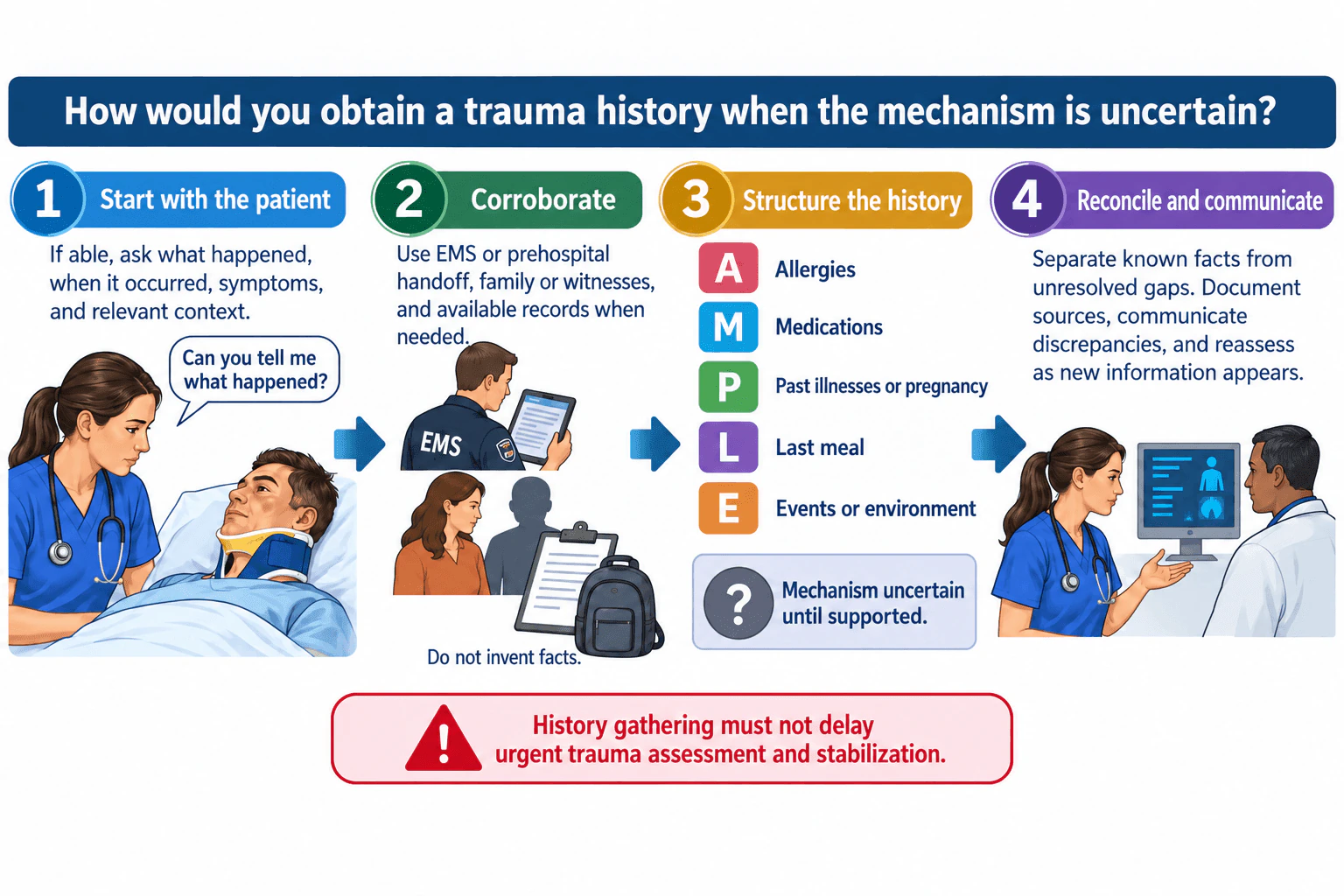
I would keep the mechanism documented as uncertain until the available evidence supports it. After immediate trauma priorities are addressed, I would obtain a focused history from the patient if possible, corroborate it with EMS, family, witnesses, and available records, and organize the information with AMPLE. I would distinguish known facts from unresolved gaps, document important sources, communicate discrepancies to the trauma team, and update the history as new information appears. History gathering must not delay urgent assessment or stabilization.
Detailed Explanation
The goal is to build the most reliable trauma history available without guessing at the mechanism and without delaying care for immediate threats. I would collect what is known, identify where each important fact came from, and keep unsupported details clearly labeled as uncertain.
Useful Questions to Ask the Interviewer
Is the patient able to provide a reliable history, or is their condition limiting the interview?
What information has already been provided by EMS, family, witnesses, or available records?
Are there conflicting details or unresolved gaps that could affect immediate care?
How to Explain It in an Interview
Nursing Priorities
I would first make sure history gathering does not interfere with urgent trauma assessment and stabilization. If the patient is able to participate, I would ask a brief, focused set of questions about what happened, when it occurred, current symptoms, and relevant context.
Corroboration
If the mechanism is unclear or the patient's history is incomplete, I would use collateral information from EMS or other prehospital personnel, family or witnesses, and available records when appropriate. I would not combine uncertain details into an assumed story. I would identify the source of important information and keep the mechanism documented as uncertain until it is supported.
Structured History
I would organize the focused history using AMPLE: Allergies, Medications, Past illnesses including relevant pregnancy status, Last meal, and Events or environment related to the injury. This gives the team a consistent way to capture clinically relevant information while still acknowledging unknown details.
Reconciliation and Communication
I would separate known facts from unresolved gaps, document important sources, and communicate discrepancies or concerning information to the trauma team. If uncertainty affects decisions outside my independent nursing scope, such as diagnostic or treatment decisions, I would promptly communicate that uncertainty to the responsible clinician or trauma team leader.
Reassessment
The history may change as EMS reports, witnesses, records, or the patient provide additional information. I would update the history and communicate meaningful changes. If the patient deteriorates, nonessential history gathering stops and attention returns to immediate assessment and stabilization.
Why Interviewers Ask This
Interviewers are evaluating whether the nurse can gather useful trauma information without delaying stabilization, distinguish verified facts from assumptions, use collateral sources appropriately, recognize uncertainty, communicate important gaps, and stay within emergency nursing scope. The question also tests whether the nurse can avoid inventing a mechanism simply because one explanation appears likely.
Common interview mistakes
Common mistakes include delaying urgent assessment while trying to obtain a complete history, assuming an unverified mechanism, recording collateral information as though the patient confirmed it, failing to identify important information sources, omitting relevant AMPLE elements, overlooking conflicting details, or failing to communicate unresolved uncertainty to the trauma team.
Interview tip
Describe a clear sequence that matches bedside priorities: address urgent trauma needs first, ask the patient when possible, corroborate with collateral sources, organize the history with AMPLE, keep unsupported mechanism details uncertain, communicate discrepancies, and reassess as new information appears.
Interviewer may ask next
How would you verify the history if different sources give conflicting accounts?
I would document the important information from each source rather than choosing one version without supporting evidence. I would compare the patient's account with EMS information, family or witness reports, available records, and relevant assessment findings. If the conflict remains unresolved, I would keep the mechanism documented as uncertain and communicate any discrepancy that could affect assessment or treatment to the responsible clinician or trauma team.
What would change if the patient became unstable while you were obtaining the history?
I would stop nonessential history gathering and return attention to immediate trauma assessment and stabilization with the team. Only information that directly supports urgent care should be gathered when doing so does not interfere with immediate priorities. A fuller history can resume after immediate threats are addressed and the patient's condition permits it.
More questions load as you scroll
Disclaimer: This interview guide is for educational and informational purposes only. It is designed to help readers prepare, but it does not guarantee any interview result, hiring decision, offer, or outcome. Interview questions, hiring criteria, and preferred answers can vary by employer, interviewer, industry, location, and time. All answers, examples, and explanations in this guide are suggested examples for interview preparation, not definitive answers or instructions for professional practice. They are based on research and judgment, are provided without warranties of any kind, and should be adapted to the question, role, and applicable laws and professional requirements. Diagrams are simplified illustrations intended to highlight the main concepts and their relationships; actual situations, systems, and practices may be more complex. Alternative approaches may be equally valid or better suited to a particular question, context, or interviewer. To the fullest extent permitted by applicable law, the contributors and publisher are not liable for decisions made, actions taken, or losses incurred based on this guide.
State Laws and Professional Responsibilities: Laws and requirements governing an occupation vary by state and jurisdiction. You are responsible for checking the current laws, licensing requirements, and scope-of-practice rules that apply to your location and role, and for ensuring that your answers and actions comply with them. Adapt examples in this guide to those requirements. This guide is not legal advice.
Content Accuracy and Verification: To the fullest extent permitted by applicable law, we do not represent or warrant that interview guides, questions, answers, examples, or diagrams are accurate, complete, current, error-free, or suitable for any particular purpose. You are responsible for independently reviewing and verifying the information before relying on it.