This interview guide is for educational and informational purposes only. It is designed to help readers prepare, but it does not guarantee any interview result, hiring decision, offer, or outcome. Interview questions, hiring criteria, and preferred answers can vary by employer, interviewer, industry, location, and time. All answers, examples, and explanations in this guide are suggested examples for interview preparation, not definitive answers or instructions for professional practice. They are based on research and judgment, are provided without warranties of any kind, and should be adapted to the question, role, and applicable laws and professional requirements. Diagrams are simplified illustrations intended to highlight the main concepts and their relationships; actual situations, systems, and practices may be more complex. Alternative approaches may be equally valid or better suited to a particular question, context, or interviewer. To the fullest extent permitted by applicable law, the contributors and publisher are not liable for decisions made, actions taken, or losses incurred based on this guide.
State Laws and Professional Responsibilities
Laws and requirements governing an occupation vary by state and jurisdiction. You are responsible for checking the current laws, licensing requirements, and scope-of-practice rules that apply to your location and role, and for ensuring that your answers and actions comply with them. Adapt examples in this guide to those requirements. This guide is not legal advice.
Identity, Image, and Privacy Notice
To respect individual privacy, some names, profile photographs, avatars, biographical details, and other identifying information displayed in this guide may be replaced with pseudonyms, licensed stock images, illustrative avatars, composite images, or representative descriptions. Unless a person is expressly identified as an actual contributor, a displayed name, image, or profile should not be understood as depicting or identifying a specific candidate, interviewer, employee, or other real individual. These representations are provided for editorial and illustrative purposes only and do not imply endorsement, employment, participation, or affiliation with this guide or any company mentioned in it. Any resemblance to an actual person is coincidental.
Company Notice
This guide is an independent educational resource and is not affiliated with, endorsed by, sponsored by, or approved by the company named in this guide. Company names identify reported interview experiences or the employer context of clearly labeled original practice exercises. Interview practices can change without notice, and inclusion of company-specific content does not mean these questions are official, complete, or guaranteed to be asked. To the fullest extent permitted by law, the author, contributors, and publisher are not responsible for outcomes related to use of this material.
Content Accuracy and Verification
To the fullest extent permitted by applicable law, we do not represent or warrant that interview guides, questions, answers, examples, or diagrams are accurate, complete, current, error-free, or suitable for any particular purpose. You are responsible for independently reviewing and verifying the information before relying on it.
Questions or comments?
Contact us for general questions, or share feedback, technical corrections, and comments with the community.
41. How do you include a caregiver in a child's assessment without losing attention to the child?Trauma And Special PopulationsMedium
i Question Details
Explain the concept or decision in ED nursing scope. State relevant assumptions, missing information and when additional clinical authority is required.
Short Interview Answer (30-60 seconds)
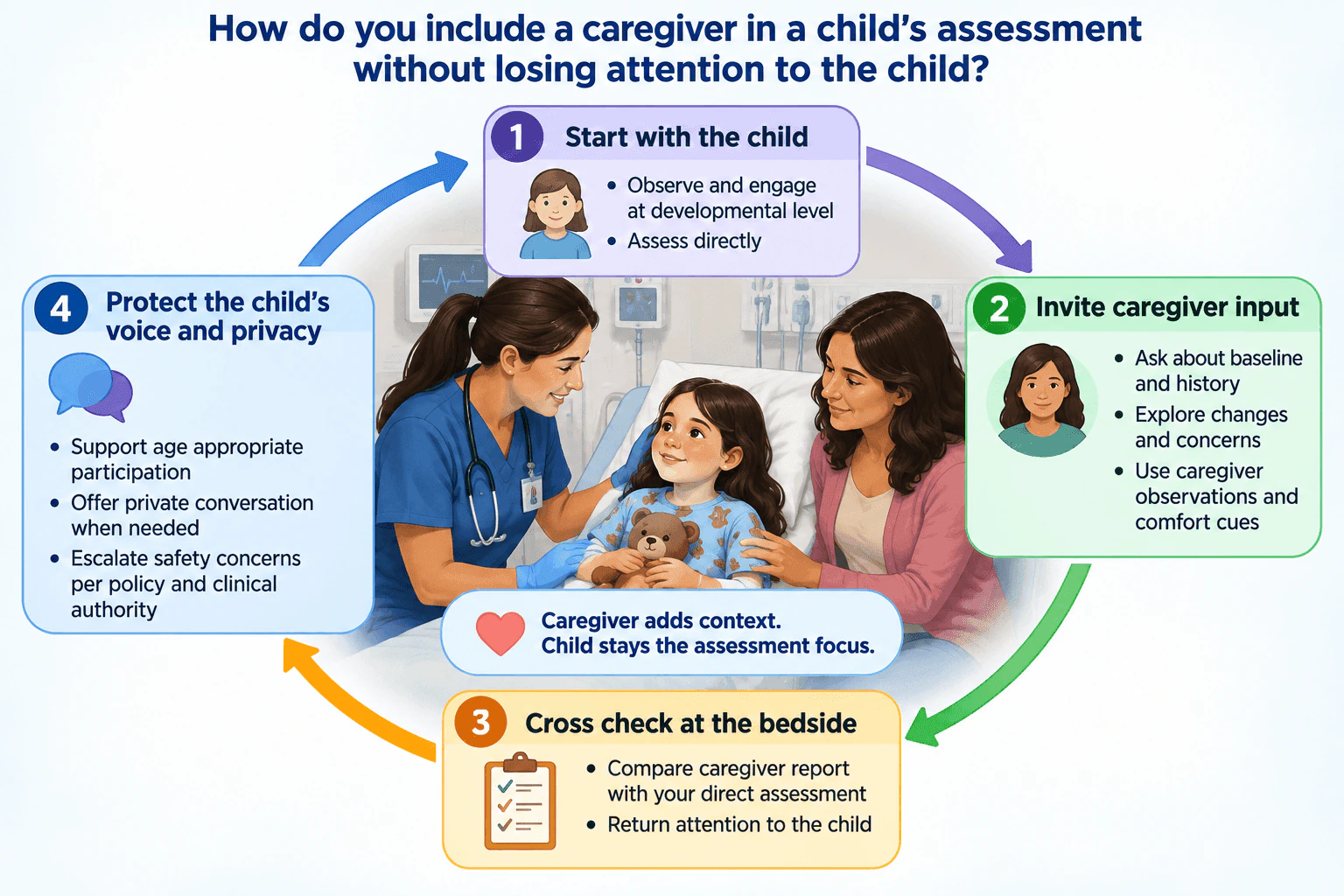
I keep the child as the primary assessment focus and use the caregiver as a complementary information source. I start by observing and engaging the child at a developmentally appropriate level and assessing the child directly. Then I ask the caregiver about baseline behavior, history, recent changes, concerns, observations and comfort cues. I compare that information with my own assessment and keep returning attention to the child. I support age appropriate participation and arrange private conversation when appropriate for development, privacy or safety. The caregiver adds context, but the child stays the assessment focus. publications.aap.org
Detailed Explanation
The central idea is to use the caregiver's knowledge without letting the caregiver replace the child as the patient. In pediatric emergency care, caregiver participation is valuable, while the child's dignity, privacy and evolving independence still need to be respected. publications.aap.org
Useful Questions to Ask the Interviewer
What resources are available for interpreters, child life support and pediatric specific communication?
How does this department handle private conversations with older children and adolescents?
What is the escalation process when a caregiver's report and the child's presentation do not agree?
How to Explain It in an Interview
Nursing Priorities
I start with the child. I observe appearance, behavior, interaction and distress, and I communicate at the child's developmental level. When the child can participate, I direct appropriate questions to the child instead of speaking only through the caregiver.
Next, I invite caregiver input. I ask about baseline behavior, relevant history, recent changes and concerns, and I use caregiver observations and comfort cues as additional information. Caregivers can know subtle differences from the child's usual state, but their report does not replace my direct assessment.
Then I cross check at the bedside. I compare the caregiver's description with what I observe and what the child reports when able. If information conflicts, I clarify the discrepancy, reassess the child and communicate significant concerns to the appropriate clinician rather than assuming either source is automatically correct.
Patient Context
The balance changes with age and development. A young child may depend more on the caregiver for history and comfort. An older child or adolescent may provide more of the history directly and may need time to speak privately. Pediatric emergency guidance supports caregiver involvement while recognizing the child's privacy and evolving independence. publications.aap.org
Clinical Rationale
Keeping visual and conversational attention on the child helps prevent the caregiver's narrative from replacing direct observation. At the same time, caregiver knowledge can reveal baseline behavior, recent changes and concerns that may not be obvious during a short emergency visit.
I also protect the child's voice and privacy. When age, development, the presenting concern or safety makes a private conversation appropriate, I follow applicable law, professional standards and local policy. Confidentiality rules for minors vary by jurisdiction and circumstance, so I would not make a universal confidentiality promise. publications.aap.org
My sequence is simple: start with the child, invite caregiver input, cross check both information sources and protect the child's voice and privacy. The caregiver adds context, while the child remains the assessment focus.
Why Interviewers Ask This
Interviewers are evaluating whether I can combine family centered pediatric care with independent nursing observation and child centered communication. A strong answer shows that I value caregiver knowledge without allowing the caregiver's account to replace direct assessment of the child, that I adapt communication to development and that I recognize when privacy or safety requires a different approach. Current pediatric emergency guidance includes family centered care and also recognizes privacy needs and the child's evolving independence. publications.aap.org
Common interview mistakes
Common mistakes include directing the entire conversation to the caregiver, allowing caregiver history to replace direct assessment of the child, ignoring useful caregiver observations, asking questions that do not fit the child's developmental level, overlooking discrepancies between the caregiver report and the child's presentation, failing to offer appropriate privacy and making universal promises about confidentiality without considering applicable law, safety and local policy.
Interview tip
Describe the interaction as a deliberate cycle that mirrors bedside practice: start with the child, invite caregiver input, cross check the caregiver report against your direct assessment, then return attention to the child and protect the child's voice and privacy. That shows how caregiver participation strengthens the assessment without displacing the patient.
Interviewer may ask next
How would you verify information provided by the caregiver?
I would compare the caregiver's report with my direct observations, the child's own account when developmentally appropriate, available records and objective assessment findings. If there is a meaningful discrepancy, I would clarify what each person means, reassess the child and communicate the concern to the appropriate clinician. I would not assume that either source is automatically correct.
How would your approach change with an older child or adolescent?
I would give the patient a larger role in the conversation and direct more appropriate questions to them while still using the caregiver for relevant context. I would also provide an opportunity for private conversation when appropriate. Privacy and confidentiality requirements for minors depend on the jurisdiction and clinical circumstance, so I would explain the applicable limits and follow law, professional standards and local policy rather than make a universal promise of confidentiality. publications.aap.org
42. How would you adapt communication for an older trauma patient with hearing difficulty?Trauma And Special PopulationsMedium
i Question Details
Explain the concept or decision in ED nursing scope. State relevant assumptions, missing information and when additional clinical authority is required.
Short Interview Answer (30-60 seconds)
I would ask the patient how they communicate best and whether they normally use a hearing aid or another assistive device. I would reduce background noise when possible, face the patient directly at eye level, keep my mouth visible, and speak clearly at a natural pace without shouting. I would give one important point at a time and use writing or an available amplification device if needed. I would confirm understanding by asking the patient to explain key information back in their own words. I would continue the trauma assessment at the same time and would not assume that poor responses are simply due to age or hearing loss.
Detailed Explanation
Communication should be adapted without delaying necessary trauma assessment. Hearing difficulty can interfere with obtaining symptoms, explaining care, assessing orientation, and confirming understanding, so I would make communication as accessible as possible while maintaining clinical priorities. Current National Institute on Aging guidance supports facing the patient directly, reducing background noise, speaking clearly in a normal tone rather than shouting, checking whether a hearing aid is available and working, and using written information or amplification when helpful. CDC guidance also supports limiting background noise, speaking clearly, and communicating face to face. nia.nih.gov
Useful Questions to Ask the Interviewer
Does the patient normally use a hearing aid or another communication device?
What communication method does the patient say works best for them?
Has the patient's ability to hear or respond changed since the injury?
How to Explain It in an Interview
Patient Context
I would first identify the communication barrier rather than assuming that reduced responses reflect confusion. I would ask the patient how they hear best, whether they normally use a hearing aid, and whether the current difficulty is usual for them. If a hearing aid is present, I would help make it available and usable when clinically appropriate.
Nursing Priorities
I would face the patient at eye level, provide good lighting on my face, keep my mouth visible, reduce unnecessary background noise, and try to have one person speak at a time. I would speak clearly at a natural pace and increase volume only as needed without shouting, because shouting can distort speech. I could use clearly written information or an available amplification device if verbal communication remained difficult. nia.nih.gov
I would use short, plain statements and explain one important point at a time. For critical information such as symptoms, allergies, medications, planned care, or safety instructions, I would confirm understanding by asking the patient to explain the information back in their own words.
Clinical Rationale
Trauma can introduce other causes of poor communication, including pain, distress, medication effects, neurologic injury, or an acute change in cognition. I would therefore avoid attributing difficulty answering solely to hearing loss or older age. A new change in responsiveness, speech, hearing, or cognition would be communicated promptly to the responsible clinician while assessment continues.
My goal is to preserve the patient's ability to participate in care while maintaining trauma priorities, documenting the communication barrier and methods that were effective, and escalating findings that may represent more than an established hearing impairment.
Why Interviewers Ask This
This question evaluates whether the nurse can maintain patient centered communication while trauma assessment continues. It also tests whether the nurse recognizes barriers created by hearing difficulty and a noisy emergency department, confirms understanding rather than assuming it, and identifies a new change in communication or cognition as a finding that may require prompt escalation.
Common interview mistakes
Common mistakes include shouting, speaking while turned away, covering the mouth, allowing several people to speak at once, assuming a hearing aid is functioning, interpreting a nod as proof of understanding, directing all communication to a family member instead of the patient, and assuming slow or incomplete responses are caused only by age or hearing loss. Another mistake is failing to assess a new change in speech, responsiveness, hearing, or cognition as a potentially significant trauma finding.
Interview tip
Show that communication adaptation and trauma assessment occur together. Explain how you make speech easier to hear, verify that the patient actually understands, and remain alert for an acute change that cannot safely be explained by established hearing difficulty.
Interviewer may ask next
How would you verify that the patient understood important information?
I would ask the patient to explain the key information back in their own words rather than asking only whether they understand. If the response showed that information was missed, I would rephrase it in simpler language, reduce communication barriers further, and use writing or an available amplification device when appropriate. I would then reassess understanding and document significant communication needs and the methods that were effective.
What would you do if the patient's difficulty responding appeared new after the trauma?
I would treat a new communication change as a clinical finding rather than assuming it is chronic hearing loss. I would continue the appropriate trauma and neurologic assessment within nursing scope, compare the finding with available baseline information, assess for associated changes in responsiveness or speech, and promptly communicate the change to the responsible clinician. Further diagnostic evaluation or treatment would follow applicable orders, authorized protocols, and local policy.
43. How do you identify which pediatric assessment information is missing before discussing a care plan?Trauma And Special PopulationsMedium
i Question Details
Explain the concept or decision in ED nursing scope. State relevant assumptions, missing information and when additional clinical authority is required.
Short Interview Answer (30-60 seconds)
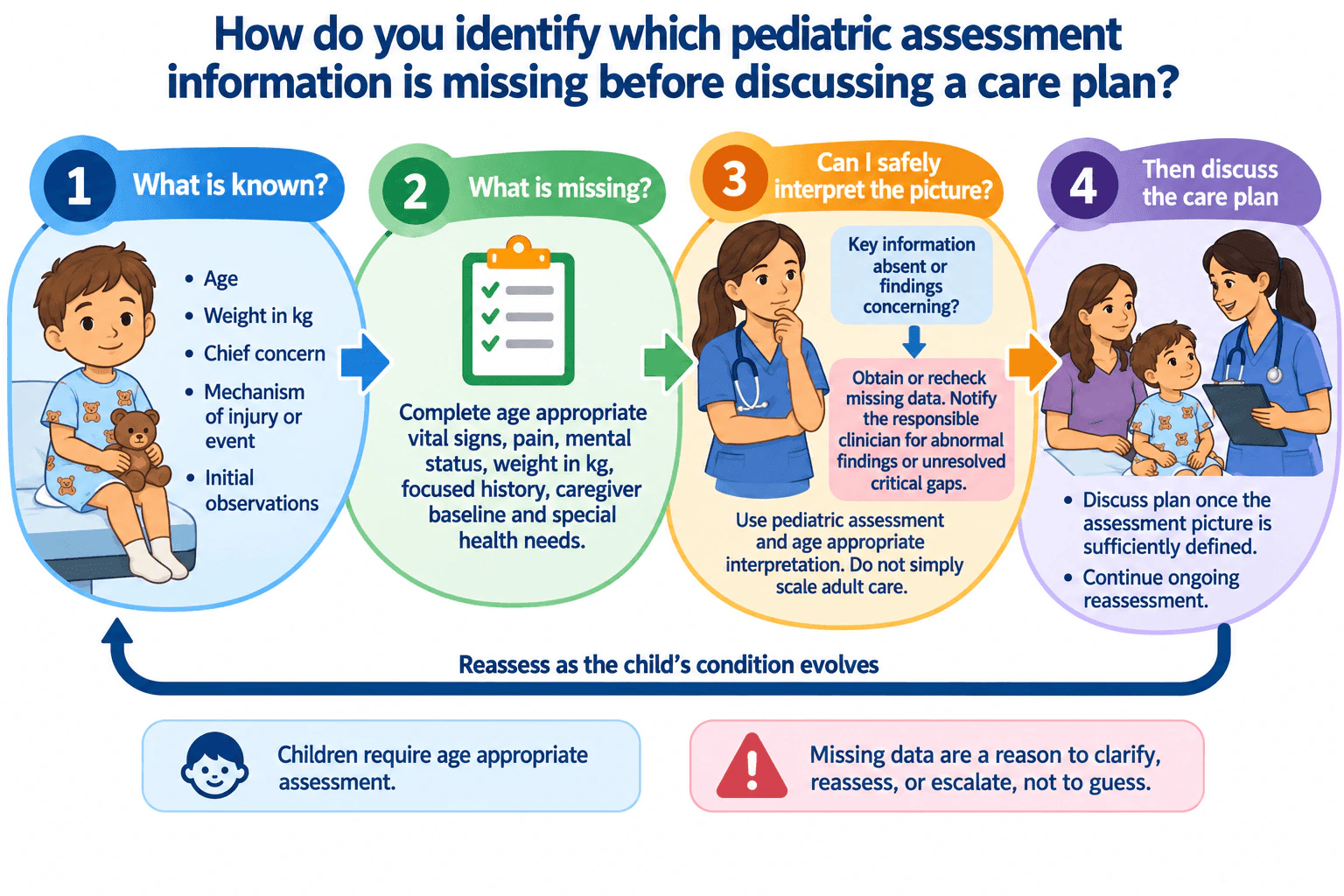
I first identify what is already known, such as age, weight in kilograms, chief concern or mechanism, and initial observations. Then I check whether I have complete age appropriate vital signs, pain, mental status, focused history, caregiver baseline, and relevant special health care needs. Missing or questionable information should be obtained or rechecked, not guessed. I use pediatric interpretation, notify the responsible clinician about abnormal findings or unresolved critical gaps, and continue reassessment as the child's condition evolves.
Detailed Explanation
The key decision is whether the pediatric assessment is sufficiently complete and current to support a safe care plan. I compare what is already known with the information still needed to interpret the child's condition accurately.
Useful Questions to Ask the Interviewer
What age, weight in kilograms, chief concern or mechanism, and initial observations are already available?
Are complete age appropriate vital signs, pain, mental status, focused history, caregiver baseline, and relevant special health care needs documented?
What findings or unresolved information gaps would require notification of the responsible clinician under local pediatric protocols?
How to Explain It in an Interview
Patient Context
I would begin with the information already available, including age, weight in kilograms, chief concern or mechanism, and initial observations. I would not assume that missing findings are normal or interpret the child using adult expectations.
Nursing Priorities
Next I would identify gaps in the pediatric assessment. I would look for a complete age appropriate set of vital signs, pain, mental status, focused history, caregiver description of the child's usual baseline, and relevant special health care needs. Current pediatric emergency readiness guidance supports complete pediatric vital signs, weight in kilograms, pain assessment, mental status assessment, reassessment, and notification of the responsible clinician for abnormal findings.
If information is absent, inconsistent, or questionable, I would obtain or recheck it within nursing scope and applicable local protocol rather than guess.
Safety Checks
I would interpret findings using pediatric expectations. I would notify the responsible clinician about abnormal findings or unresolved critical gaps. Actions that depend on an order, another professional, or a protocol would follow the appropriate local process rather than being assumed independently.
Reassessment
The information picture can change. I would continue reassessment as the child's condition evolves and update the assessment before discussing the care plan. The care discussion should therefore be based on sufficiently complete, current pediatric information while any remaining uncertainty is stated clearly.
Why Interviewers Ask This
Interviewers are assessing whether the nurse can recognize an incomplete pediatric assessment, use age appropriate information rather than adult assumptions, verify uncertain findings, incorporate caregiver knowledge, recognize when additional clinical authority is needed, and reassess before presenting a care plan.
Common interview mistakes
Common mistakes include discussing a care plan before identifying major information gaps, using adult expectations for pediatric findings, documenting weight in pounds instead of kilograms, overlooking pain or mental status, failing to use caregiver knowledge of the child's baseline, assuming an unobserved finding is normal, failing to recheck uncertain data, and not notifying the responsible clinician about abnormal findings or unresolved critical gaps.
Interview tip
Use a simple sequence: state what is known, identify what pediatric information is missing, explain how you would obtain or verify it, identify what would require clinician notification, and finish with reassessment. This demonstrates pediatric judgment and appropriate nursing scope without inventing patient facts.
Interviewer may ask next
How would you verify that the pediatric assessment is complete enough to discuss the care plan?
I would compare the available information with the child's presentation and the local pediatric assessment process. I would confirm age, weight in kilograms, chief concern or mechanism, initial observations, complete age appropriate vital signs, pain, mental status, focused history, caregiver baseline, and relevant special health care needs. I would recheck questionable information and notify the responsible clinician about abnormal findings or unresolved critical gaps before presenting the plan.
What changes if the child's condition deteriorates while you are still gathering missing information?
The priority shifts to immediate pediatric assessment, stabilization, escalation, and repeated reassessment. I would address urgent concerns within nursing scope and approved protocols, call for the appropriate clinical response, and gather missing information in parallel when feasible. If emergency stabilization prevents obtaining a measured weight, current pediatric readiness guidance supports use of a standardized method for estimating weight in kilograms according to the local pediatric process. I would not delay urgent care merely to complete routine information gathering, and I would not substitute adult assumptions for pediatric guidance.
44. How would you coordinate reassessment when several injuries compete for attention?Trauma And Special PopulationsHard
i Question Details
Explain the concept or decision in ED nursing scope. State relevant assumptions, missing information and when additional clinical authority is required.
Short Interview Answer (30-60 seconds)
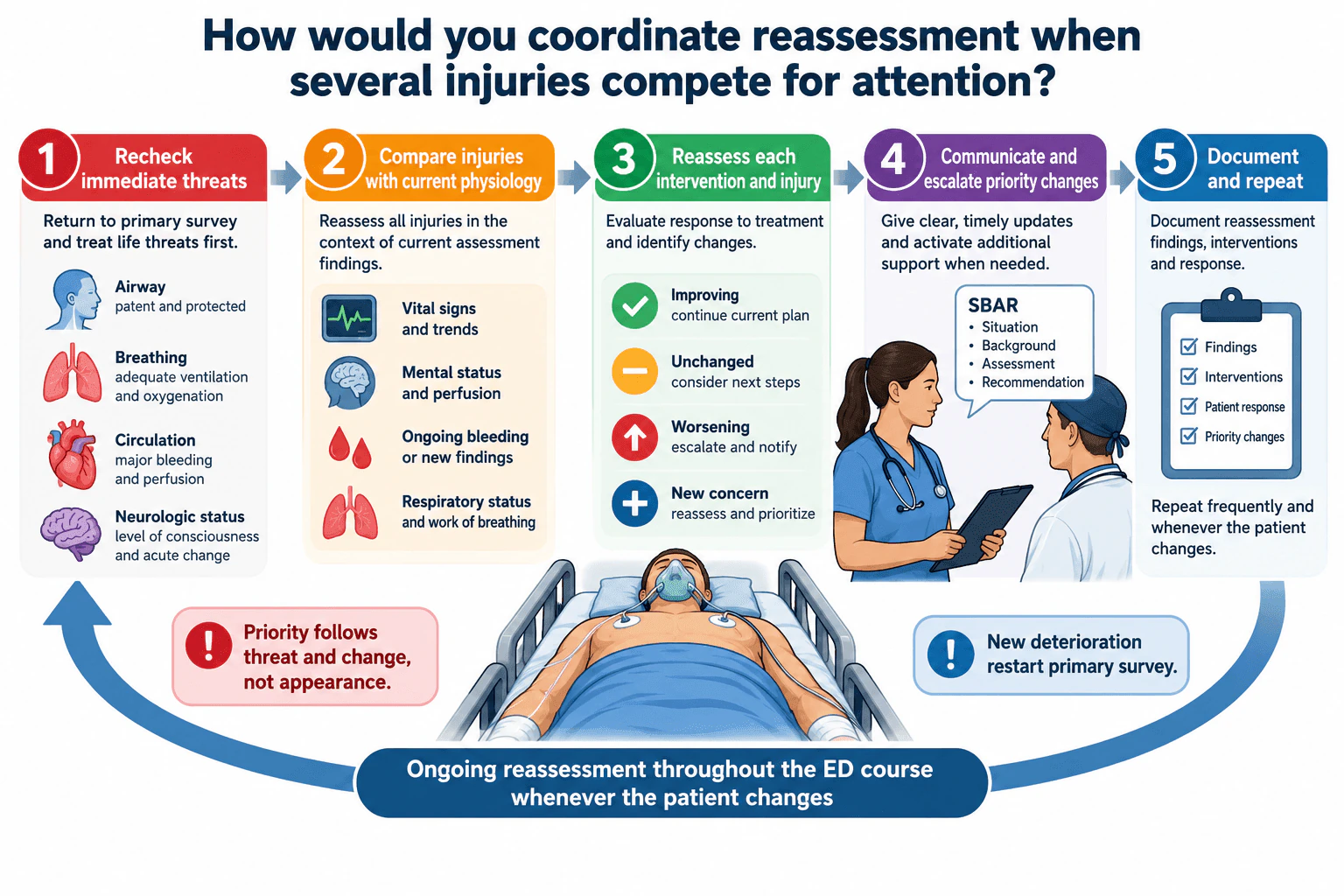
I would repeatedly return to immediate threats first, then reassess every significant injury in the context of the patient's current physiology. I would compare vital sign trends, mental status, perfusion, bleeding, respiratory status, new findings, and response to interventions. Any deterioration or new concern could immediately change the priority. I would communicate those changes promptly, escalate when additional clinical authority or resources are needed, document the reassessment and response, and repeat the cycle whenever the patient changes.
Detailed Explanation
Several injuries should not be managed as a fixed list. Their priority can change as the patient's physiology changes, so in a United States emergency department I would coordinate care around repeated assessment, response to treatment, communication, documentation, and reprioritization.
Useful Questions to Ask the Interviewer
What trauma team resources and escalation pathways are available in this emergency department?
How are reassessment findings and priority changes communicated among bedside nurses, physicians, and other trauma team members?
What patient context should I assume, such as age, weight, pregnancy status, mechanism, or current observations?
How to Explain It in an Interview
Nursing Priorities
I would first return to the trauma primary survey and recheck immediate threats. Airway protection, breathing and oxygenation, circulation and major bleeding, and neurologic status take priority over injuries that look dramatic but are currently less threatening. If the patient deteriorates, I would restart that primary assessment rather than continue mechanically with the previous plan. WHO emergency care guidance supports repeating the trauma primary survey when the patient's condition worsens.
Next, I would compare the competing injuries with the patient's current physiology. I would look at vital sign trends, mental status and perfusion, ongoing bleeding or new findings, respiratory status, and work of breathing. That tells me which problem is becoming more urgent now.
Reassessment
For each active problem, I would reassess both the injury and the response to interventions. If the patient is improving, I can continue the current plan. If findings are unchanged, I would consider what additional assessment, protocol authorized intervention, consultation, diagnostic evaluation, or order may be needed. A worsening finding or new concern would trigger reprioritization and prompt escalation.
Patient Context
I would preserve relevant facts such as age, weight, pregnancy status, mechanism, comorbidities, medications, communication needs, and supplied observations. Pediatric and obstetric patients require population appropriate assessment and escalation rather than simple application of an adult pathway.
Communication and Documentation
When priorities change, I would give a concise update to the appropriate clinician or trauma team and state what changed, what I assessed, and what I need. SBAR means Situation, Background, Assessment, and Recommendation or Request and can support communication when deterioration or another urgent change requires team attention. Independent nursing assessment remains within nursing scope, protocol authorized actions follow local policy, and actions requiring an order or another professional are escalated accordingly.
I would document reassessment findings, interventions, patient response, and priority changes, then repeat the cycle throughout the emergency department course and whenever the patient's condition changes.
Why Interviewers Ask This
This question tests whether the nurse can maintain a threat based trauma priority when several injuries demand attention at the same time. It also evaluates recognition of deterioration, reassessment after interventions, communication with the trauma team, escalation within nursing scope, and avoidance of anchoring on the most visible injury.
Common interview mistakes
Common mistakes include focusing on the most visible injury instead of the greatest current threat, completing one assessment without repeating it after an intervention or deterioration, overlooking trends in physiology, failing to reprioritize after a new concern appears, assuming all important injuries are externally visible, applying an adult pathway directly to children or pregnant patients, delaying escalation, and documenting tasks without recording the patient's response.
Interview tip
Describe reassessment as a loop rather than a one time checklist. Make it clear that immediate threats come first, every important intervention needs a response check, new deterioration can restart the primary survey, and changes in priority must be communicated and documented.
Interviewer may ask next
How would you verify that your current injury priority is still correct?
I would repeat the focused trauma assessment and compare current findings with earlier findings. I would review vital sign trends, mental status, perfusion, bleeding, respiratory status, new findings, and the patient's response to interventions. I would also look for deterioration or concerns that were not apparent earlier. If those findings no longer support the existing priority, I would reprioritize and communicate the change promptly.
How would your approach change if the patient were a child or pregnant?
The same principle of reassessing immediate threats first still applies, but assessment and escalation must be appropriate to the population. For a child, I would preserve age and weight and use pediatric assessment and treatment guidance rather than scaling an adult pathway. For a pregnant patient, I would preserve pregnancy and gestational information, prioritize maternal assessment and stabilization, recognize pregnancy specific concerns, and involve appropriate obstetric and trauma expertise when indicated. In either case, I would follow applicable local protocols and obtain additional clinical authority for actions outside independent nursing scope.
45. How would you challenge an adult care assumption that may not fit a child with trauma?Trauma And Special PopulationsHard
i Question Details
Explain the concept or decision in ED nursing scope. State relevant assumptions, missing information and when additional clinical authority is required.
Short Interview Answer (30-60 seconds)
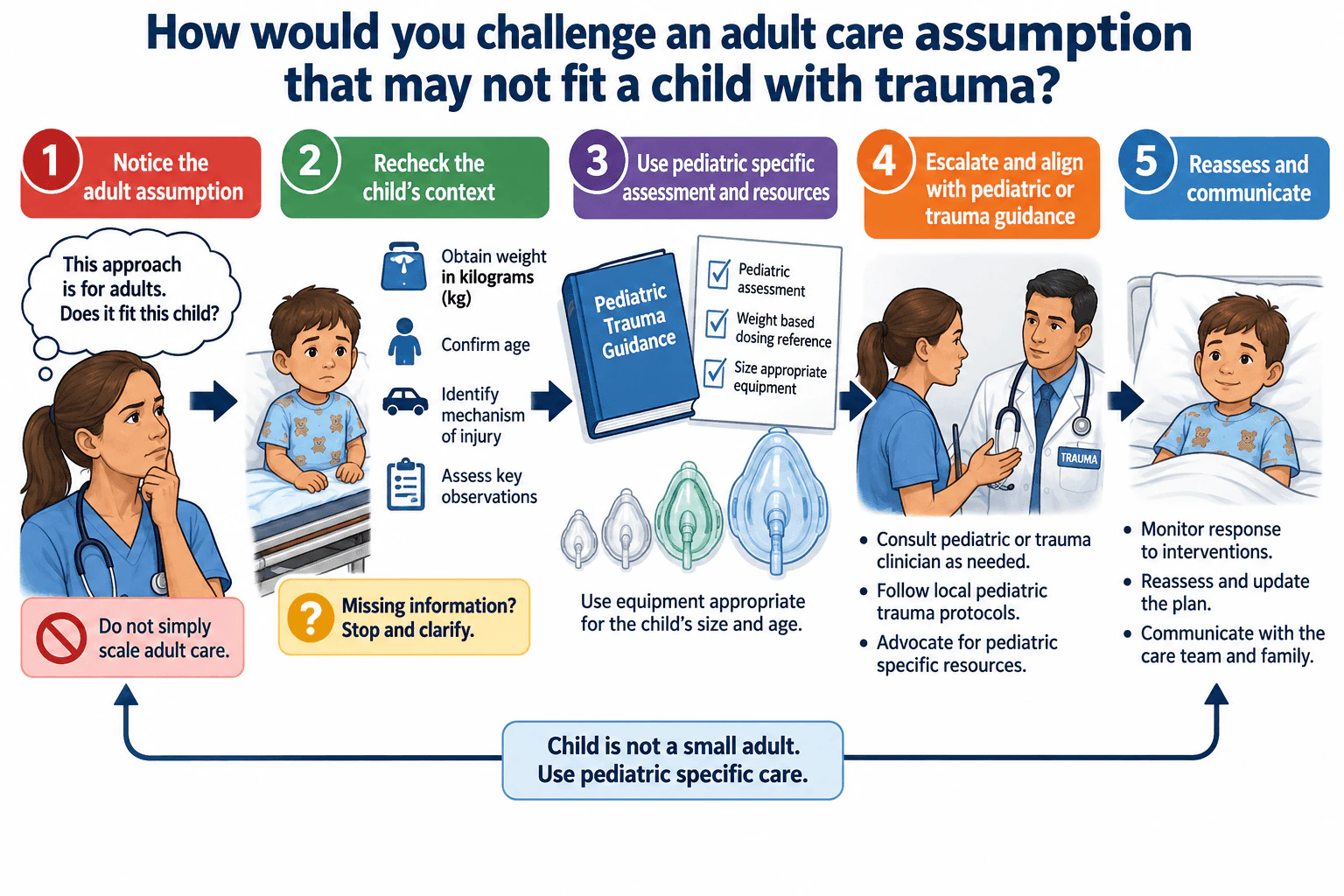
I would not simply scale adult care to a child. I would identify the assumption, confirm the child's age, weight in kilograms, mechanism and current observations, and clarify anything important that is missing. I would use pediatric specific assessment guidance, weight based medication references and equipment appropriate for the child's size and age. If the decision requires additional clinical authority, I would escalate to the appropriate emergency, pediatric or trauma clinician. After any intervention, I would reassess the child, update the plan and communicate with the team and family.
Detailed Explanation
The key idea is that a child with trauma should not automatically receive an adult approach scaled down. I would identify the specific adult assumption, then verify whether it fits the child's age, size, development, mechanism of injury and current clinical findings.
Useful Questions to Ask the Interviewer
What pediatric trauma resources and escalation pathways are available in this emergency department?
What pediatric dosing and equipment sizing resources are used at the bedside?
When should the bedside nurse involve pediatric or trauma expertise?
How to Explain It in an Interview
Patient Context
I would start by naming the adult assumption instead of accepting it automatically. Then I would confirm the child's age, obtain and document weight in kilograms when clinically feasible, identify the mechanism of injury and review the relevant observations. If an actual weight cannot be obtained during emergency stabilization, I would use the standardized pediatric weight estimation method authorized in that setting rather than inventing a value.
Nursing Priorities
I would use pediatric specific assessment guidance and choose equipment appropriate for the child's size and age. Medication decisions should use an approved pediatric weight based dosing reference rather than simply reducing an adult dose. I would also recognize that age appropriate findings and responses may differ from adult expectations.
Safety Checks
If important information is missing, I would stop and clarify it instead of filling the gap with an adult assumption. Within bedside nursing scope, I can assess, identify risk, advocate, communicate, use authorized protocols and prepare appropriate resources. Decisions requiring an order or additional medical judgment should be escalated to the responsible emergency, pediatric or trauma clinician.
Reassessment
After interventions, I would monitor the child's response, repeat the relevant assessment and update the plan. I would communicate important changes to the care team and family. The overall principle is simple: notice the adult assumption, recheck the child's context, use pediatric specific resources, escalate when needed and reassess.
Why Interviewers Ask This
Interviewers are evaluating whether the nurse recognizes that an adult approach may be unsafe when transferred directly to a child. They want to hear pediatric specific clinical reasoning, verification of age and weight, appropriate equipment and medication safeguards, recognition of missing information, escalation within nursing scope and continued reassessment.
Common interview mistakes
Common mistakes include treating a child as a small adult, scaling an adult medication dose instead of using an approved pediatric weight based reference, using equipment without checking appropriate size, failing to verify weight in kilograms, overlooking the mechanism or current observations, filling in missing information by assumption, or failing to escalate when additional clinical authority is required.
Interview tip
Use a clear sequence that mirrors bedside judgment: identify the adult assumption, verify the child's context, choose pediatric specific assessment and resources, clarify missing information, escalate when the decision exceeds nursing authority, then reassess and communicate. This keeps the answer focused on patient safety and nursing judgment.
Interviewer may ask next
How would you verify that the pediatric approach is appropriate before proceeding?
I would verify the child's age, weight in kilograms, mechanism of injury, current observations and any important missing information. I would compare the proposed action with current pediatric guidance and approved local resources, confirm appropriate equipment sizing and use an authorized pediatric weight based dosing reference when medication is involved. If the decision requires an order or additional medical judgment, I would confirm it with the responsible clinician.
What would change if the child's condition deteriorated during reassessment?
I would increase the urgency immediately. I would repeat the relevant assessment, address immediate nursing priorities within my scope, activate the appropriate emergency or pediatric trauma response according to local protocol and promptly notify the responsible clinician. I would continue monitoring, prepare for ordered or protocol authorized interventions and communicate the change to the care team and family.
46. What is an automated external defibrillator used for?Scenario BasedEasy
i Question Details
Explain the concept or decision in ED nursing scope. State relevant assumptions, missing information and when additional clinical authority is required.
Short Interview Answer (30-60 seconds)
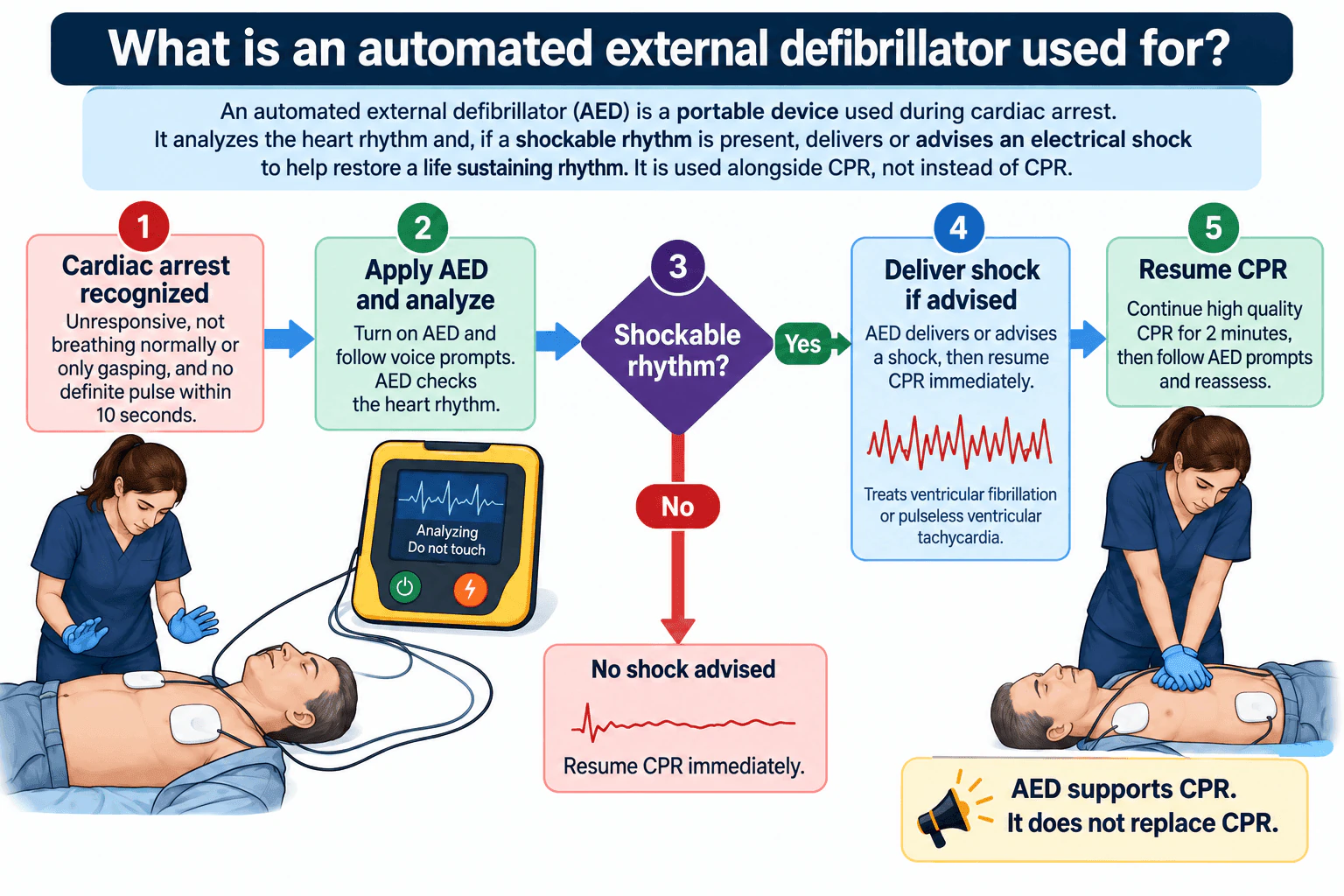
An AED is used during cardiac arrest to analyze the heart rhythm and determine whether a shock is indicated. If a shockable rhythm is detected, it directs or delivers defibrillation. CPR remains essential and should resume immediately after a shock or when no shock is advised.
Detailed Explanation
An automated external defibrillator, or AED, is used during cardiac arrest to analyze the heart rhythm and determine whether defibrillation is appropriate. For an adult who is unresponsive, is not breathing normally or is only gasping, and has no definite pulse within 10 seconds, a healthcare professional should recognize cardiac arrest and begin resuscitation promptly.
Useful Questions to Ask the Interviewer
Are we discussing an adult cardiac arrest in the emergency department?
Should I describe the nurse's actions within the facility code response process?
Do you want the answer limited to the AED's purpose or also the immediate CPR sequence?
How to Explain It in an Interview
Immediate Actions
I would explain that the AED supports the cardiac arrest response by analyzing the patient's rhythm and determining whether defibrillation is indicated. CPR should begin promptly and continue until the AED is ready to analyze the rhythm. During rhythm analysis and shock delivery, nobody should be touching the patient. If the AED identifies a shockable rhythm, the team follows the device prompts and delivers the indicated shock. CPR then resumes immediately. If no shock is advised, CPR also resumes immediately.
Decision Rationale
The AED is useful because not every cardiac arrest rhythm should be shocked. Ventricular fibrillation and pulseless ventricular tachycardia are shockable rhythms. The AED analyzes the rhythm and advises or delivers defibrillation only when appropriate. Early CPR and prompt defibrillation are both important parts of adult cardiac arrest care.
Safety and Scope
In the emergency department, the bedside nurse would activate the appropriate resuscitation response, begin or support CPR, apply the AED or available defibrillator according to training and local protocol, follow device prompts, use closed loop communication, and reassess continuously. Medication administration and other advanced interventions depend on applicable protocols, orders, scope of practice, and the responding clinical team.
Why Interviewers Ask This
Interviewers are checking whether the nurse understands that an AED is part of cardiac arrest resuscitation and does not replace CPR. A strong answer shows recognition of cardiac arrest, safe AED use, understanding that only shockable rhythms receive defibrillation, minimal interruption of CPR, and prompt reassessment.
Common interview mistakes
Common mistakes include saying that an AED restarts every stopped heart, assuming every cardiac arrest rhythm should be shocked, delaying CPR while waiting for the AED, touching the patient during rhythm analysis or shock delivery, or failing to resume CPR immediately after a shock or a no shock decision.
Interview tip
Keep the explanation centered on three points: the AED analyzes the rhythm, shocks only when indicated, and works together with CPR. Briefly mention that nobody should touch the patient during rhythm analysis or shock delivery and that CPR resumes immediately afterward.
Interviewer may ask next
How would you verify that the AED is being used appropriately during an adult cardiac arrest?
I would confirm that the patient meets adult cardiac arrest criteria, activate the resuscitation response, begin CPR, apply the AED as soon as it is available, follow its prompts, make sure nobody is touching the patient during rhythm analysis or shock delivery, and resume CPR immediately after either a shock or a no shock decision. I would continue reassessment and follow current resuscitation guidance and the authorized team response.
Would the same AED approach apply to a pediatric patient?
The AED still analyzes the rhythm and provides defibrillation when an appropriate shockable rhythm is present, but pediatric resuscitation guidance and device considerations differ from adult care. I would use population appropriate pediatric resuscitation guidance, the available device instructions, and the emergency department's authorized protocol rather than automatically applying the adult sequence.
47. How would you activate help when an adult becomes unresponsive in the ED?Scenario BasedEasy
i Question Details
Explain the concept or decision in ED nursing scope. State relevant assumptions, missing information and when additional clinical authority is required.
Short Interview Answer (30-60 seconds)
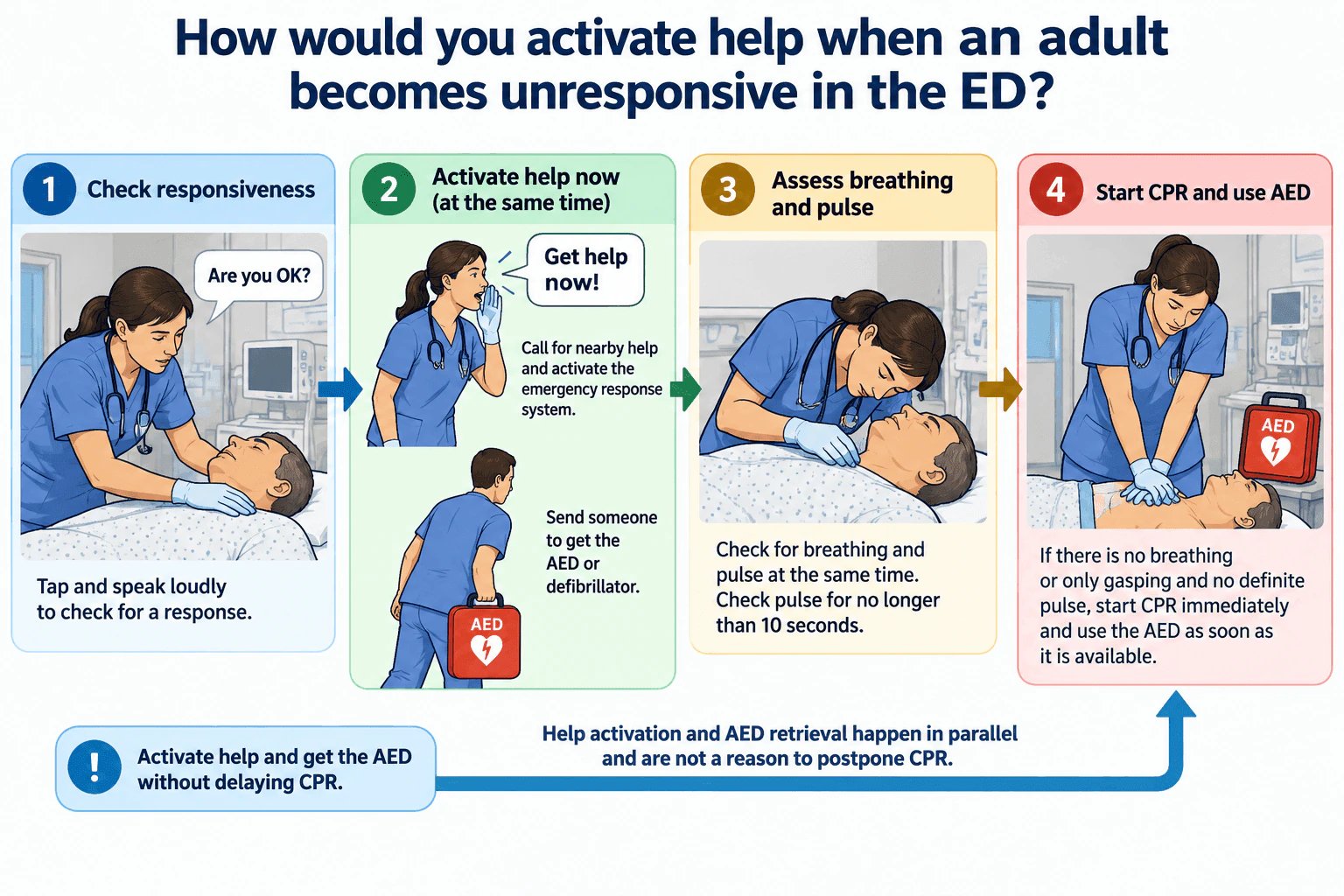
I would check responsiveness, shout for nearby help, activate the ED emergency response system, and direct someone to bring the AED or defibrillator. At the same time, I would assess breathing and pulse, deciding within 10 seconds whether a definite pulse is present. If there is no breathing or only gasping and no definite pulse, I would begin CPR immediately and use the AED or defibrillator as soon as it arrives. Activating help and retrieving equipment should occur in parallel rather than delay CPR.
Detailed Explanation
An adult who becomes unresponsive in the ED may be in cardiac arrest, so I would recognize the immediate threat while activating help without delaying resuscitation. I would check responsiveness, shout for nearby help, activate the emergency response system, and direct someone to retrieve the AED or defibrillator. At the same time, I would look for no breathing or only gasping and check for a pulse simultaneously. I would determine whether a definite pulse is present within 10 seconds. If there is no breathing or only gasping and no definite pulse, I would start CPR immediately and use the AED or defibrillator as soon as it becomes available.
Useful Questions to Ask the Interviewer
What emergency response system does this ED use when an adult becomes unresponsive?
Where are the nearest AED or defibrillator and emergency equipment located?
Which resuscitation actions are authorized by standing protocols in this department?
How to Explain It in an Interview
Immediate Actions
I would first check responsiveness and call loudly for nearby help. I would activate the emergency response system and direct a specific team member to retrieve the AED or defibrillator. These actions should happen promptly while the patient is being assessed, not after a prolonged assessment.
Rapid Assessment
At the same time, I would look for no breathing or only gasping and check for a pulse simultaneously. As a healthcare professional, I should determine whether a definite pulse is present within 10 seconds. If the patient has no breathing or only gasping and no definite pulse, I would start CPR immediately and use the AED or defibrillator as soon as it is available.
Nursing Scope
Recognizing unresponsiveness, summoning help, activating the emergency response system, beginning indicated basic resuscitation, and communicating clearly are immediate nursing actions within training and organizational policy. Advanced interventions depend on the resuscitation team, applicable protocols, professional role, and additional clinical authority.
Reassessment
I would continue reassessing the patient as the response develops and communicate any change in condition to the arriving team. The central principle is that help activation and AED retrieval support immediate lifesaving care and do not postpone CPR when cardiac arrest is identified.
Why Interviewers Ask This
This question evaluates whether the nurse can recognize a potentially life threatening collapse, activate the appropriate emergency response without delaying lifesaving care, coordinate immediate resources, and respond according to current adult resuscitation guidance and local role expectations.
Common interview mistakes
Common mistakes include delaying help activation while completing a prolonged assessment, checking for a pulse longer than 10 seconds, treating gasping as normal breathing, failing to assign someone to retrieve the AED or defibrillator, performing a lengthy ABCDE assessment before indicated CPR, and waiting for equipment or additional staff before beginning CPR when cardiac arrest is identified.
Interview tip
Describe the response as coordinated actions that happen rapidly and in parallel. Emphasize checking responsiveness, activating help, assigning AED or defibrillator retrieval, assessing breathing and pulse simultaneously for no more than 10 seconds, and starting CPR immediately when there is no breathing or only gasping and no definite pulse.
Interviewer may ask next
How would you verify that help activation was successful?
I would direct the activation and equipment task to a specific team member and confirm that the emergency response system was activated and the AED or defibrillator was being brought to the bedside. If CPR were already indicated, I would not delay compressions while waiting for that confirmation.
What would change if the adult were unresponsive and not breathing normally but had a definite pulse?
That finding follows a different adult basic life support pathway because a definite pulse is present. I would maintain the activated emergency response, provide appropriate ventilatory support according to current resuscitation guidance and local protocol, reassess the pulse at recommended intervals, and start CPR immediately if the pulse is lost.
48. How do you prepare to assist with resuscitation within your assigned role?Scenario BasedEasy
i Question Details
Explain the concept or decision in ED nursing scope. State relevant assumptions, missing information and when additional clinical authority is required.
Short Interview Answer (30-60 seconds)
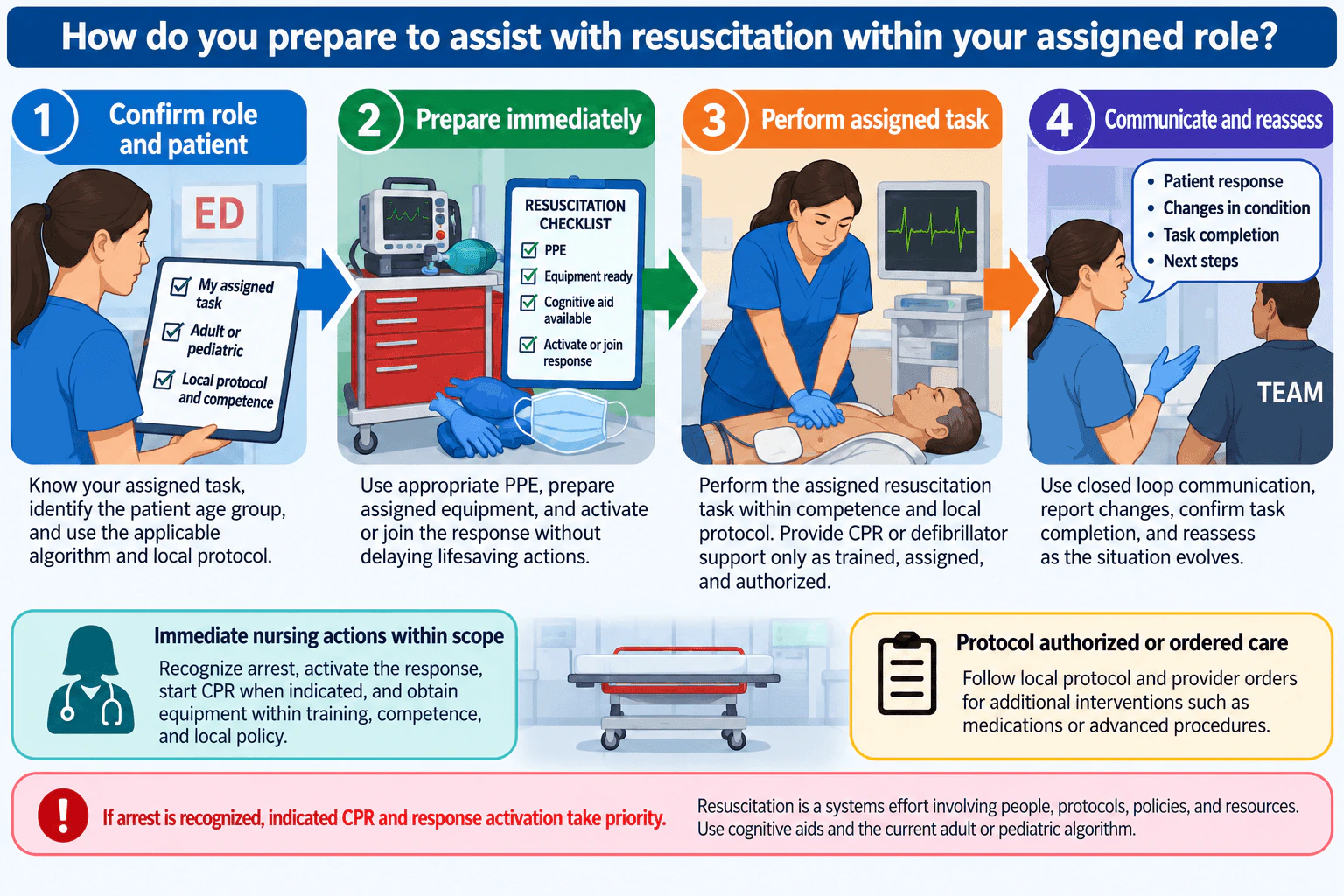
I first confirm my assigned role, identify whether the patient requires the adult or pediatric pathway, and use the applicable resuscitation algorithm and local protocol. I put on appropriate personal protective equipment and prepare the equipment needed for my task. If arrest is recognized, I activate or join the response and begin indicated cardiopulmonary resuscitation without delaying for a broader assessment. I perform only tasks that are within my training, competence, assignment, and authorization. Throughout the event, I use closed loop communication, report changes, confirm task completion, and reassess the patient and team priorities.
Detailed Explanation
Preparation means being ready to perform one clearly assigned part of the resuscitation safely while avoiding delays in lifesaving care. I would assume a bedside emergency department RN role in the United States, with specific authority governed by applicable law, local protocol, orders, training, and competence. Adult and pediatric resuscitation are not interchangeable, so identifying the patient age group matters before selecting the applicable cognitive aid or algorithm. Current American Heart Association guidance supports prompt arrest recognition, response activation, high quality cardiopulmonary resuscitation, and timely defibrillator use when indicated. cpr.heart.org
Useful Questions to Ask the Interviewer
What patient age group and assigned resuscitation role should I assume?
What local protocol, equipment, and team resources are available?
Which actions are authorized by protocol, and which require an order or another clinician?
How to Explain It in an Interview
Confirm Role and Patient
I would first confirm my assigned task and identify whether I am using an adult or pediatric resuscitation pathway. If important information is missing, I would clarify it while still responding immediately to an obvious life threat.
Prepare Immediately
I would use appropriate personal protective equipment and prepare the equipment needed for my assignment. I would know where the current resuscitation cognitive aids and emergency equipment are located. Preparation should support the response, not delay indicated lifesaving actions.
Perform the Assigned Task
If cardiac arrest is recognized, I would activate or join the emergency response and begin indicated cardiopulmonary resuscitation within my competence rather than waiting to complete a broad assessment. I would then perform the assigned task within my training, competence, local protocol, and authorization. Depending on the assignment, that may include chest compressions, obtaining equipment, assisting with the defibrillator, documenting events, or another appropriate nursing function. American Heart Association training guidance notes that registered nurses may perform different resuscitation roles and that assigned roles should reflect what the individual may actually perform in practice. cpr.heart.org
I would not assume that every intervention during a code is independently authorized. Medications, advanced procedures, and other interventions must follow the applicable protocol, order, professional scope, and local process.
Communicate and Reassess
I would use closed loop communication, report patient changes, acknowledge instructions, and confirm when my task is complete. I would continually reassess the patient's response and the team's next priorities. This matches the diagram's flow from role confirmation through preparation, assigned task performance, communication, and reassessment.
Why Interviewers Ask This
Interviewers are assessing whether I can recognize an immediate life threat, enter a resuscitation with clear role awareness, act promptly without delaying indicated cardiopulmonary resuscitation, work within nursing scope and local authorization, communicate effectively, and reassess as the situation changes. Current team training guidance emphasizes assigned roles, closed loop communication, and reassessment during resuscitation. cpr.heart.org
Common interview mistakes
Common mistakes include delaying indicated cardiopulmonary resuscitation while completing a broad assessment, failing to clarify the assigned role, using the wrong age appropriate resuscitation pathway, assuming authority for an intervention that requires protocol authorization or an order, focusing on equipment preparation instead of the immediate life threat, failing to confirm task completion, and not reassessing as the patient's condition changes.
Interview tip
Describe your approach in the same sequence you would use clinically: confirm your role and the patient context, prepare immediately, perform the assigned task within scope, then communicate and reassess. Make clear that recognized cardiac arrest triggers immediate response activation and indicated cardiopulmonary resuscitation rather than a delayed full assessment.
Interviewer may ask next
How would you verify that you are ready to perform your assigned role?
I would verify that I understand the assigned task, have identified the patient age group and applicable resuscitation pathway, have the necessary personal protective equipment and assigned equipment available, and know the limits of my training and authorization. During the event, I would use closed loop communication to confirm instructions and would immediately state if a requested task exceeded my competence or authority.
What changes if the patient is pediatric rather than adult?
I would use current pediatric resuscitation guidance rather than automatically applying the adult pathway. Pediatric guidance differs in areas such as compression technique, ventilation, and defibrillator considerations. I would confirm the child's age or developmental category, use the appropriate pediatric equipment and cognitive aid, and continue working within my assigned role and authorization. Current pediatric basic life support guidance emphasizes rapid arrest recognition, emergency response activation, high quality cardiopulmonary resuscitation, and early use of an automated external defibrillator when appropriate. cpr.heart.org
49. How would you respond when an unresponsive adult has abnormal breathing?Scenario BasedMedium
i Question Details
Explain the concept or decision in ED nursing scope. State relevant assumptions, missing information and when additional clinical authority is required.
Short Interview Answer (30-60 seconds)
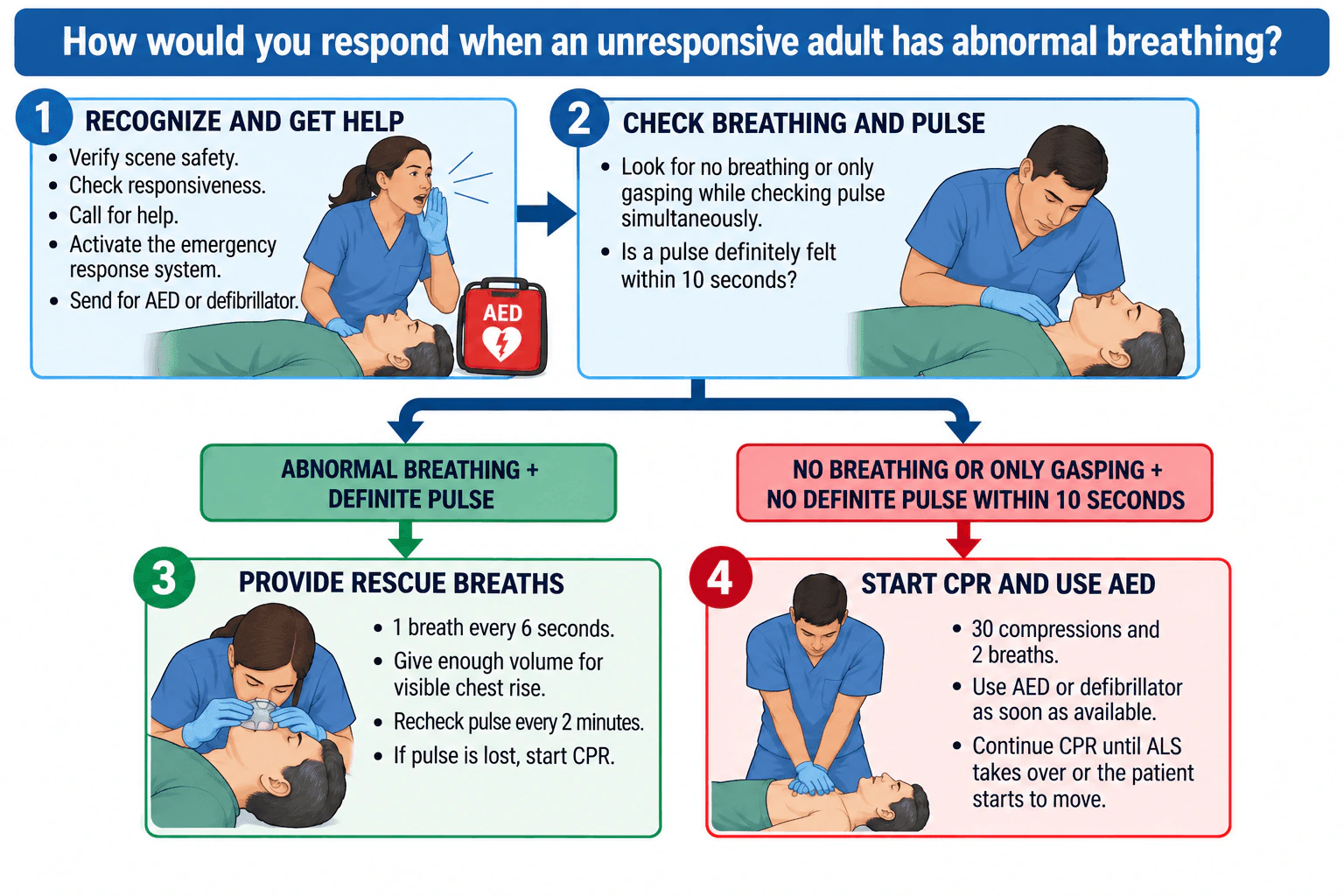
I would verify scene safety, check responsiveness, call for help, activate the emergency response system, and send for an AED or defibrillator. I would simultaneously look for no breathing or only gasping and check for a definite pulse, taking no more than 10 seconds. If a definite pulse is present but breathing is abnormal, I would give 1 breath every 6 seconds with visible chest rise and recheck the pulse every 2 minutes. If no definite pulse is felt, I would immediately start CPR with cycles of 30 compressions and 2 breaths and use the AED or defibrillator as soon as available.
Detailed Explanation
The key decision is whether this unresponsive adult with abnormal breathing has a definite pulse. No breathing or only gasping is not normal breathing, so I would activate the resuscitation response while assessing breathing and pulse together.
Useful Questions to Ask the Interviewer
Should I assume this occurs in a United States emergency department with the usual resuscitation team and equipment immediately available?
Should I describe my actions as the bedside nurse before the full advanced life support team arrives?
Should I assume there is no known special circumstance that would change standard adult resuscitation care?
How to Explain It in an Interview
Immediate Actions
I would first verify scene safety and check responsiveness. I would call for nearby help, activate the emergency response system, and have an AED or defibrillator brought immediately. These actions should occur rapidly without delaying lifesaving care.
I would look for no breathing or only gasping while checking for a definite pulse at the same time. I would complete this assessment within 10 seconds.
Definite Pulse Present
If a definite pulse is present but breathing is abnormal, I would provide 1 breath every 6 seconds. Each breath should produce visible chest rise. I would recheck the pulse every 2 minutes. If the pulse is lost, I would immediately start CPR.
No Definite Pulse
If I cannot definitely feel a pulse within 10 seconds and the patient has no breathing or only gasping, I would treat this as cardiac arrest. I would begin CPR using cycles of 30 compressions and 2 breaths and use the AED or defibrillator as soon as it becomes available. I would continue CPR until advanced life support professionals take over or the patient starts to move.
Nursing Scope and Reassessment
The bedside nurse can immediately perform trained basic life support actions such as activating help, providing ventilations, starting CPR, using an AED, and reassessing the patient within applicable professional scope and organizational policy. Advanced interventions require the appropriate authorization, protocol, order, and qualified clinical team.
A broader ABCDE assessment must not delay indicated CPR. The immediate breathing and pulse decision determines whether the patient follows the rescue ventilation branch or the CPR and AED branch.
Why Interviewers Ask This
This question tests whether the nurse can rapidly recognize a possible respiratory or cardiac arrest, activate help without delaying lifesaving care, distinguish respiratory arrest from cardiac arrest, choose the correct adult basic life support response, and reassess for deterioration. It also tests whether the nurse can separate immediate trained nursing actions from advanced interventions performed under authorized protocols, orders, and the responsibilities of the responding resuscitation team.
Common interview mistakes
Common mistakes include spending longer than 10 seconds checking for a pulse, treating gasping as normal breathing, delaying activation of help or AED retrieval, providing rescue breaths without starting CPR when no definite pulse is present, starting chest compressions despite a definite pulse, failing to recheck the pulse during rescue ventilation, or completing a lengthy ABCDE assessment before starting indicated CPR.
Interview tip
State the decision point clearly: assess breathing and pulse simultaneously for no more than 10 seconds, then follow the correct branch. A definite pulse with abnormal breathing requires rescue ventilation and pulse reassessment. No definite pulse with no breathing or only gasping requires immediate CPR and AED or defibrillator use.
Interviewer may ask next
How would you verify that your initial assessment is not delaying treatment?
I would assess breathing and pulse simultaneously and limit the pulse decision to no more than 10 seconds. If I cannot definitely feel a pulse and the patient has no breathing or only gasping, I would start CPR rather than continue searching for a pulse. I would continue reassessment during resuscitation rather than delaying the initial intervention.
What would you do differently if the adult has a definite pulse but still is not breathing normally?
I would not perform chest compressions while a definite pulse remains present. I would provide 1 breath every 6 seconds, using enough volume to produce visible chest rise, and recheck the pulse every 2 minutes. If the pulse is subsequently lost, I would immediately begin CPR and use the AED or defibrillator as indicated.
50. How do you maintain team communication during a change in resuscitation roles?Scenario BasedMedium
i Question Details
Explain the concept or decision in ED nursing scope. State relevant assumptions, missing information and when additional clinical authority is required.
Short Interview Answer (30-60 seconds)
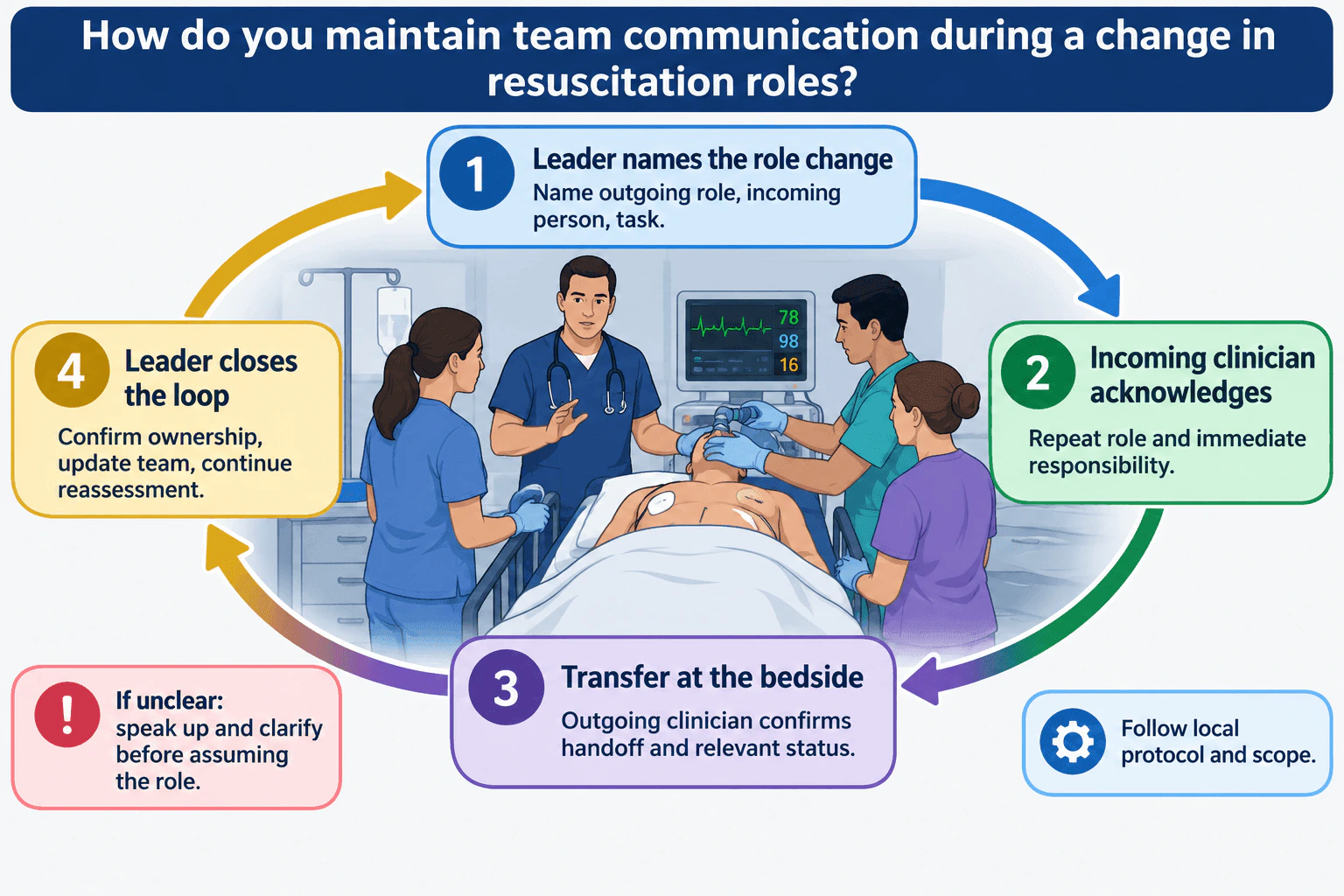
I make the role transfer explicit and use closed loop communication. The leader identifies the outgoing role, the incoming clinician, and the immediate task. The incoming clinician repeats the role and responsibility. The outgoing clinician gives a concise bedside handoff with the relevant patient status, and the leader confirms who now owns the role, updates the team, and continues reassessment. If anything is unclear or outside my scope, I speak up and clarify it immediately rather than assuming. The transition must not interrupt indicated lifesaving care.
Detailed Explanation
A safe role change during resuscitation is a deliberate transfer of responsibility, not an informal assumption that someone else has taken over. For this answer, I assume a bedside emergency department resuscitation in the United States with a designated team leader and clinicians working within their credentials and local protocols. The exact patient population, resuscitation type, staff credentials, and hospital role assignments are not provided, so I would not assume treatment authority that has not been established.
Useful Questions to Ask the Interviewer
How are resuscitation roles assigned and transferred in this emergency department?
What communication method does the department expect during a code or other resuscitation?
Who has authority to lead the resuscitation and resolve an unclear role assignment?
How to Explain It in an Interview
Immediate Actions
I would first make sure the current lifesaving task continues during the transition. The team leader should identify the role being transferred, name the incoming clinician, and state the immediate responsibility. The incoming clinician should acknowledge the assignment by repeating the role and key task so the sender can confirm that the message was understood.
The outgoing clinician should then provide a concise bedside handoff containing only information needed to continue that role safely, such as the current patient status, what has just been completed, what is in progress, and what requires immediate attention. The leader closes the loop by confirming that the incoming clinician now owns the role and by updating the rest of the team when the change affects their work.
Risk Signals
I would speak up immediately if two people appear to own the same role, no one clearly owns a critical task, an instruction was not heard, or the transfer would require me to perform an activity outside my competence, authorization, or local policy. I would not guess at an unclear instruction or silently accept responsibility for a task I cannot safely perform.
Decision Rationale
Closed loop communication reduces ambiguity because the assignment is stated, acknowledged, transferred, and confirmed. The bedside handoff preserves relevant situational information without turning the role change into a lengthy report. Confirming ownership also reduces the risk that a task is abandoned during the transition.
After the change, I continue reassessing the patient and the effectiveness of the team response. If the patient's condition changes or the assigned clinician cannot perform the role, the team leader should reprioritize and reassign responsibilities promptly. Speaking up, clarifying communication, sharing assessment findings, and reassessing are appropriate nursing responsibilities. Protocol authorized interventions depend on local policy. Treatment decisions, procedures, or orders requiring another clinician's authority remain with the appropriately authorized professional.
Why Interviewers Ask This
Interviewers are assessing whether the nurse can maintain situational awareness and patient safety while responsibilities change during a high acuity resuscitation. They want to hear clear role assignment, closed loop communication, concise handoff, verification of ownership, reassessment, and appropriate escalation without allowing communication tasks to delay indicated resuscitation.
Common interview mistakes
Common mistakes include allowing a role change to occur without naming the new owner, giving vague instructions to the whole room, failing to obtain acknowledgment, transferring a role without sharing essential current status, assuming an unclear assignment, allowing two clinicians to believe they own the same task, or focusing on handoff communication so long that indicated lifesaving care is interrupted.
Interview tip
Describe the transfer as a short communication loop: name the role change, obtain acknowledgment, give the essential bedside handoff, confirm ownership, then reassess. Emphasize that you would speak up about ambiguity or scope concerns and would not allow the handoff itself to delay indicated resuscitation.
Interviewer may ask next
How do you verify that the role transfer was actually understood?
I ask the incoming clinician to repeat the assigned role and immediate responsibility, then I confirm that the repeated information is correct. The outgoing clinician completes the essential handoff, and the leader explicitly confirms that responsibility has transferred. If the response is incomplete, contradictory, or absent, I clarify it immediately rather than assuming the message was understood.
What changes if the patient's condition suddenly worsens during the role transfer?
The immediate clinical threat takes priority. The team should continue or initiate the indicated lifesaving action without waiting for a lengthy handoff. The leader can rapidly restate assignments, confirm who owns each critical task, and postpone nonessential information until the patient is stable enough for a fuller transfer. I would continue reassessment and escalate any deterioration through the appropriate resuscitation pathway and authorized clinical leadership.
More questions load as you scroll
Disclaimer: This interview guide is for educational and informational purposes only. It is designed to help readers prepare, but it does not guarantee any interview result, hiring decision, offer, or outcome. Interview questions, hiring criteria, and preferred answers can vary by employer, interviewer, industry, location, and time. All answers, examples, and explanations in this guide are suggested examples for interview preparation, not definitive answers or instructions for professional practice. They are based on research and judgment, are provided without warranties of any kind, and should be adapted to the question, role, and applicable laws and professional requirements. Diagrams are simplified illustrations intended to highlight the main concepts and their relationships; actual situations, systems, and practices may be more complex. Alternative approaches may be equally valid or better suited to a particular question, context, or interviewer. To the fullest extent permitted by applicable law, the contributors and publisher are not liable for decisions made, actions taken, or losses incurred based on this guide.
State Laws and Professional Responsibilities: Laws and requirements governing an occupation vary by state and jurisdiction. You are responsible for checking the current laws, licensing requirements, and scope-of-practice rules that apply to your location and role, and for ensuring that your answers and actions comply with them. Adapt examples in this guide to those requirements. This guide is not legal advice.
Content Accuracy and Verification: To the fullest extent permitted by applicable law, we do not represent or warrant that interview guides, questions, answers, examples, or diagrams are accurate, complete, current, error-free, or suitable for any particular purpose. You are responsible for independently reviewing and verifying the information before relying on it.