This interview guide is for educational and informational purposes only. It is designed to help readers prepare, but it does not guarantee any interview result, hiring decision, offer, or outcome. Interview questions, hiring criteria, and preferred answers can vary by employer, interviewer, industry, location, and time. All answers, examples, and explanations in this guide are suggested examples for interview preparation, not definitive answers or instructions for professional practice. They are based on research and judgment, are provided without warranties of any kind, and should be adapted to the question, role, and applicable laws and professional requirements. Diagrams are simplified illustrations intended to highlight the main concepts and their relationships; actual situations, systems, and practices may be more complex. Alternative approaches may be equally valid or better suited to a particular question, context, or interviewer. To the fullest extent permitted by applicable law, the contributors and publisher are not liable for decisions made, actions taken, or losses incurred based on this guide.
State Laws and Professional Responsibilities
Laws and requirements governing an occupation vary by state and jurisdiction. You are responsible for checking the current laws, licensing requirements, and scope-of-practice rules that apply to your location and role, and for ensuring that your answers and actions comply with them. Adapt examples in this guide to those requirements. This guide is not legal advice.
Identity, Image, and Privacy Notice
To respect individual privacy, some names, profile photographs, avatars, biographical details, and other identifying information displayed in this guide may be replaced with pseudonyms, licensed stock images, illustrative avatars, composite images, or representative descriptions. Unless a person is expressly identified as an actual contributor, a displayed name, image, or profile should not be understood as depicting or identifying a specific candidate, interviewer, employee, or other real individual. These representations are provided for editorial and illustrative purposes only and do not imply endorsement, employment, participation, or affiliation with this guide or any company mentioned in it. Any resemblance to an actual person is coincidental.
Company Notice
This guide is an independent educational resource and is not affiliated with, endorsed by, sponsored by, or approved by the company named in this guide. Company names identify reported interview experiences or the employer context of clearly labeled original practice exercises. Interview practices can change without notice, and inclusion of company-specific content does not mean these questions are official, complete, or guaranteed to be asked. To the fullest extent permitted by law, the author, contributors, and publisher are not responsible for outcomes related to use of this material.
Content Accuracy and Verification
To the fullest extent permitted by applicable law, we do not represent or warrant that interview guides, questions, answers, examples, or diagrams are accurate, complete, current, error-free, or suitable for any particular purpose. You are responsible for independently reviewing and verifying the information before relying on it.
Questions or comments?
Contact us for general questions, or share feedback, technical corrections, and comments with the community.
61. How do you document a change in condition while transfer arrangements are already underway?Documentation ComplianceHard
i Question Details
Explain the concept or decision in ED nursing scope. State relevant assumptions, missing information and when additional clinical authority is required.
Short Interview Answer (30-60 seconds)
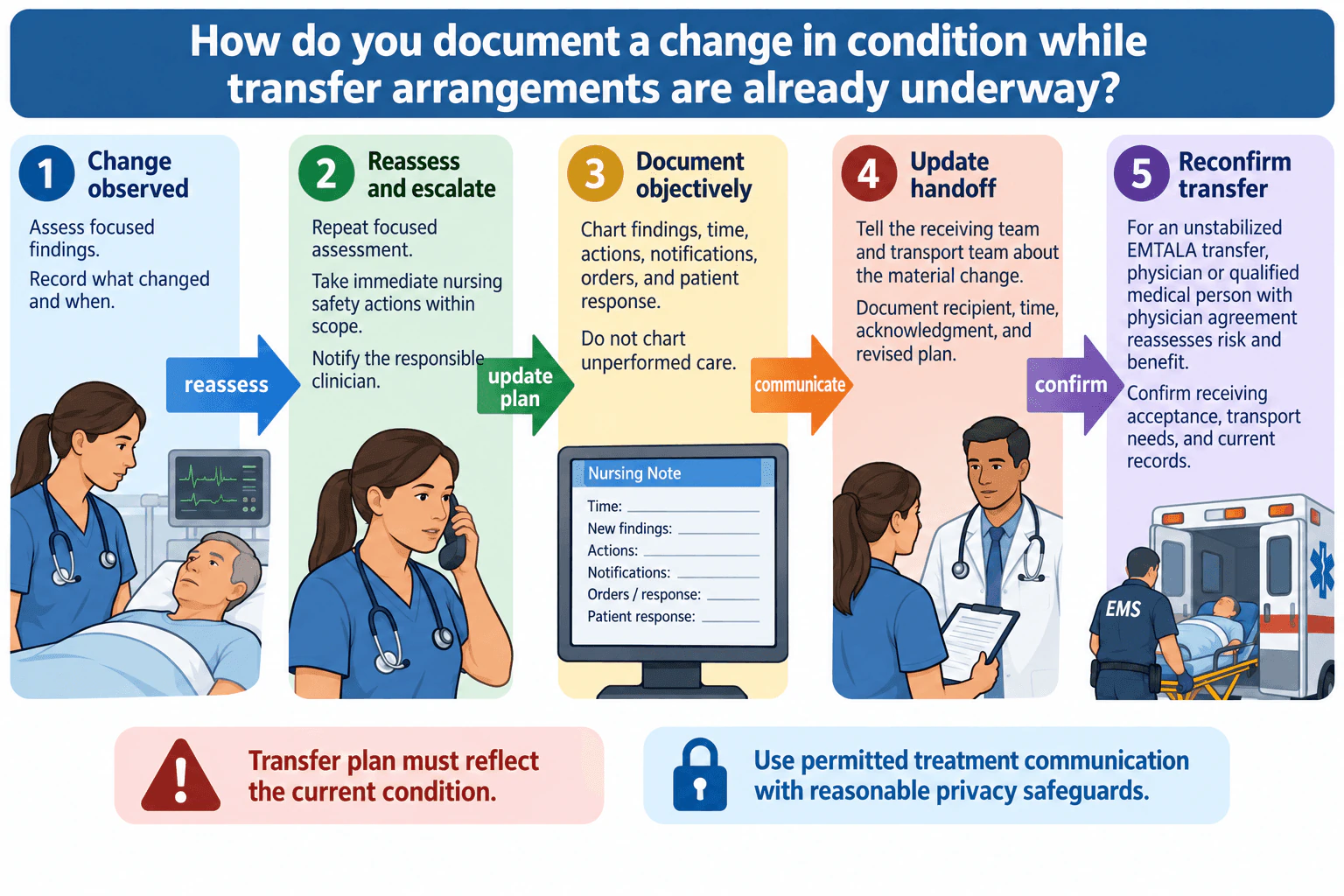
I would repeat a focused assessment, perform immediate nursing safety actions within my scope, notify the responsible clinician, and document exactly what changed and when. I would chart the findings, actions, notifications, orders, and patient response. I would then update the receiving team and transport team, document the recipient, time, acknowledgment, and revised plan, and reconfirm that the transfer arrangements match the patient's current condition. If EMTALA applies to an unstabilized emergency medical condition, I would follow the applicable transfer requirements and obtain the required additional clinical authority rather than making that determination independently.
Detailed Explanation
A change in condition means the existing transfer plan cannot simply be treated as unchanged. The nurse should reassess the patient, document the new facts, escalate appropriately, update the handoff, and make sure the transfer process reflects the patient's current status.
Useful Questions to Ask the Interviewer
Is the patient stabilized, or is there still an unstabilized emergency medical condition under EMTALA?
Who is the responsible clinician for reassessing the transfer decision, and has the receiving facility accepted the patient?
What communication and transfer documentation process does this organization use?
How to Explain It in an Interview
Change Observed
I would repeat a focused nursing assessment and document objective findings with the time they were observed. I would record what changed, the patient's response, and only the care I actually performed. I would not chart anticipated or unperformed care.
Reassess And Escalate
I would take immediate nursing safety actions that are within my scope and any applicable authorized protocol, then notify the responsible clinician. A significant change may alter the treatment needed before transport or the risks associated with transfer.
Document Objectively
My record would include the updated findings, time, nursing actions, clinician notifications, orders received, and patient response. This creates a clear timeline showing what was known and what was done.
Update Handoff
I would communicate the material change to both the receiving team and the transport team. I would document the recipient, time, acknowledgment, and revised plan. AHRQ describes effective handoff as including recent changes in condition, the care plan, clear transfer of responsibility, and acknowledgment by the receiver. ahrq.gov
Reconfirm Transfer
I would not assume the original transfer arrangement remains appropriate. For an unstabilized emergency medical condition, EMTALA permits transfer only under specified conditions. One pathway is a patient requested transfer after appropriate information is provided. Another is clinician certification that expected medical benefits outweigh increased transfer risks. When a qualified medical person signs because the physician is not physically present, CMS requires physician consultation and later countersignature as specified. CMS also requires appropriate risk minimizing treatment within the transferring hospital's capacity, receiving facility acceptance, available pertinent records, and qualified transport personnel and equipment. cms.gov
Privacy
Necessary protected health information may be shared for treatment without separate patient authorization by covered health care providers, while reasonable privacy safeguards still apply. hhs.gov
Why Interviewers Ask This
Interviewers are evaluating whether the nurse recognizes that a transfer plan must respond to a patient's current condition rather than continue automatically. They are looking for timely reassessment, objective documentation, escalation within nursing scope, reliable handoff communication, privacy awareness, and recognition of decisions that require physician or other designated clinical authority.
Common interview mistakes
Common mistakes include continuing the original transfer plan without reassessing the patient, documenting vague conclusions instead of objective findings, omitting notification times or patient response, assuming that sending a message proves receipt, failing to update the receiving or transport team, charting care that was not performed, sending transfer information that no longer reflects the patient's condition, disclosing information outside permitted treatment communication, or implying that the bedside RN independently makes every EMTALA transfer determination.
Interview tip
Organize the response around the same five actions shown in the clinical workflow: observe the change, reassess and escalate, document objectively, update the handoff, and reconfirm the transfer. Clearly separate nursing actions from decisions that require a physician or other properly designated clinician.
Interviewer may ask next
How would you verify that the updated transfer information was received?
I would use the approved communication process and obtain acknowledgment from the receiving clinician or team rather than relying only on an unconfirmed message. I would document who received the update, the time, the important information communicated, and any revised plan. AHRQ specifically identifies acknowledgment by the receiver and clarity about responsibility as important parts of an effective handoff. ahrq.gov
What changes if the patient becomes unstable immediately before transport?
I would repeat the focused assessment, initiate immediate nursing safety actions within my scope, notify the responsible clinician, document the change and response, and have the transfer arrangements reassessed against the patient's current condition. I would not independently assume that the existing plan remains appropriate. If an unstabilized emergency medical condition is present and EMTALA applies, the applicable transfer pathway and requirements must be satisfied, including any required clinician certification or patient request process, receiving facility acceptance, pertinent records, and transport resources appropriate to the patient's condition. cms.gov
62. Describe a time you asked for help before performing an unfamiliar clinical task.BehavioralEasy
i Question Details
Use a truthful, deidentified experience. Describe your responsibility, actions, outcome and learning; do not invent personal history.
Interview tip:
Use STAR to structure your answer: briefly explain the Situation and Task, make Action the most detailed part, and finish with the Result. For example, describe a time when you were asked to perform a clinical task that was within the nursing role but unfamiliar to you, recognized that you needed guidance before proceeding, clearly told an experienced nurse what you knew and what you had not yet done independently, reviewed the correct process, completed the task with appropriate supervision, and used the experience to strengthen your competence.
Situation
During a previous emergency department shift, I was caring for a patient who needed an ordered therapy through an implanted venous port. I understood the purpose of the device and the general safety principles, but I had not yet accessed that type of port independently in that setting.
Task
My responsibility was to support the ordered care while protecting the patient and staying within my level of competence. I knew that being familiar with the theory was not the same as being ready to perform the task independently.
Action
Before touching the port, I told an experienced nurse that I had not performed that task independently and asked for help. I explained what I understood so the nurse could see where I needed guidance. We reviewed the required equipment and the applicable procedure guidance before starting. I asked the nurse to observe me rather than simply take over because I wanted to learn the correct process while keeping the patient safe. I performed each step carefully under that supervision and stopped to ask questions whenever I was unsure. After the task, I reviewed what I had done with the nurse and made sure I understood the points I needed to remember before doing it again. I also treated the experience as a reminder that asking for help early is part of safe nursing practice, not a sign that I should try to work beyond my current competence.
Result
The task was completed with appropriate support, and I gained a clearer understanding of the procedure and the limits of my own experience. The biggest lesson for me was to identify a knowledge or skill gap before beginning care and communicate it clearly. Since then, I have been more deliberate about asking for supervision when a task is unfamiliar instead of assuming that general knowledge is enough to perform it safely.
Why Interviewers Ask This
Interviewers ask this question to evaluate clinical judgment, self awareness, communication, and willingness to protect patient safety when a nurse reaches the edge of current competence. A strong answer shows that the candidate recognizes limits early, seeks qualified guidance, learns from supervision, and does not perform an unfamiliar responsibility simply because they feel pressure to proceed. NCSBN guidance similarly frames safe nursing responsibilities around education, licensure, competence, applicable jurisdiction rules, and communication when assistance is needed. For this example, the jurisdiction is Illinois, United States.
Interviewer may ask next
Why did you ask the experienced nurse to observe you instead of asking them to perform the task for you?
I wanted to keep the patient safe while also building my competence. I already understood the purpose of the task, but I lacked independent experience with it in that setting. Having an experienced nurse observe me gave me immediate guidance if I reached a point of uncertainty and helped me learn the correct process rather than avoiding the skill.
How would you handle a similar unfamiliar task now?
I would use the same basic approach. I would first decide whether the task is appropriate for my nursing role and whether I have the knowledge and competence to perform it safely. If I had a gap, I would say so before starting, review the applicable procedure, and ask a qualified nurse for guidance or supervision. I would rather ask early than create unnecessary risk by pretending to know something I have not yet learned.
63. Tell me about a time you changed your explanation after a patient did not understand.BehavioralEasy
i Question Details
Use a truthful, deidentified experience. Describe your responsibility, actions, outcome and learning; do not invent personal history.
Interview tip:
Use STAR to structure your answer: briefly explain the Situation and Task, make Action the most detailed part, and finish with the Result. For example, describe a time when a patient did not understand your first explanation, how you recognized the confusion, changed your words or teaching approach, checked the patient's understanding, and made sure the patient could explain the important information clearly before moving forward.
Situation
During a previous emergency department shift in the United States, I was reviewing important care instructions with a patient. After my first explanation, the patient gave a brief answer but then asked a question that showed me the main point was still not clear.
Task
My responsibility was to communicate the information in a way the patient could understand and to confirm that my explanation had actually worked. I did not want to assume that a simple yes meant the patient understood.
Action
I stopped and changed how I was explaining the information. I removed clinical terms that were not necessary and used shorter, simpler sentences. I explained one point at a time instead of giving several instructions together. I then asked the patient to tell me, in their own words, what they understood and what they planned to do next. Their response showed me which part was still confusing, so I explained that part again using a more concrete example. I kept my tone respectful because I did not want the patient to feel embarrassed for asking questions. I also gave the patient time to ask anything that was still unclear. Before finishing, I asked the patient again to explain the key information in their own words so I could check understanding rather than simply asking whether everything made sense.
Result
The patient was then able to explain the important information clearly and asked more focused questions. The experience reminded me that patient education is not complete just because I have delivered the information. I need to watch for signs of confusion, adjust my communication, and confirm understanding in a respectful way.
Why Interviewers Ask This
Interviewers ask this question to assess whether a nurse notices when communication is not working and can adapt instead of repeating the same explanation. A strong answer shows clear communication, patient focused judgment, respect, ownership, and a practical way to confirm understanding.
Interviewer may ask next
How did you know the patient had not understood your first explanation?
The patient's follow up question showed that the main point had not been understood even though the patient had initially given a brief response. That reminded me not to rely only on a yes or no answer. I needed the patient to explain the information in their own words so I could see what was clear and what still needed another explanation.
What would you do if the patient still did not understand after you changed your explanation?
I would keep the communication simple and work through one point at a time instead of continuing with more information. I would ask what part was confusing and try another clear way of explaining it. I would continue checking understanding through the patient's own words, and if there were communication needs outside what I could address independently, I would involve the appropriate resources or team members within my role and local practice requirements.
64. Describe how you responded to constructive feedback about patient care.BehavioralEasy
i Question Details
Use a truthful, deidentified experience. Describe your responsibility, actions, outcome and learning; do not invent personal history.
Interview tip:
Use STAR to structure your answer: briefly explain the Situation and Task, make Action the most detailed part, and finish with the Result. For example, describe a time another nurse gave you constructive feedback about how you assessed, communicated, reassessed, or documented patient care, explain how you listened without becoming defensive, clarified the concern, changed your practice, and used the feedback to improve future care.
Situation
In a deidentified emergency department example, an experienced nurse gives constructive feedback after reviewing how I documented a patient's reassessment. My initial assessment is clear, but my later note does not make the change in the patient's condition and my follow through as easy to understand as it should be.
Task
My responsibility would be to make sure my assessment, reassessment, communication, and documentation give the care team a clear picture of the patient's condition. I would also want to respond professionally to the feedback and use it to improve my practice rather than simply correct one note.
Action
I would first listen carefully and ask the nurse to show me which part of the documentation is unclear. I would not try to defend my original wording. I would compare the initial assessment with the later reassessment and identify that I documented separate facts without clearly connecting what had changed. I would thank the nurse for pointing that out. I would then review the patient's current condition again and make sure any important change was communicated through the appropriate clinical team process. I would correct the documentation in a way that accurately reflected my assessment and actions without adding information that had not occurred. After that feedback, I would become more deliberate about completing reassessments and documenting what changed, what I did, and what happened next. I would also ask for clarification when feedback was not specific enough for me to act on safely.
Result
The feedback would improve the clarity of my documentation and make me more thoughtful about closing the loop after patient care actions. The lesson would be that constructive feedback is most useful when I listen for the patient safety issue behind it, confirm what needs to change, and then apply that lesson consistently in future care.
Why Interviewers Ask This
Interviewers ask this question to understand whether a nurse can receive feedback without becoming defensive, recognize a possible gap in patient care, communicate professionally, take ownership, and turn feedback into a lasting improvement in practice.
Interviewer may ask next
Why would you ask the nurse to show you exactly what was unclear?
I would want to understand the specific problem instead of making assumptions about the feedback. Seeing the unclear part would help me recognize that the issue was not simply the amount of documentation. It was whether another clinician could clearly understand what had changed and what I had done in response.
What would you do if you received similar feedback today?
I would use the same approach. I would listen carefully, clarify the concern, review my assessment and actions, address any patient care or communication issue that still needed attention, and make sure the documentation accurately reflected what occurred. I would also apply the lesson to future reassessments instead of treating the feedback as a one time correction.
65. Tell me about a time you clarified an unclear responsibility with a teammate.BehavioralEasy
i Question Details
Use a truthful, deidentified experience. Describe your responsibility, actions, outcome and learning; do not invent personal history.
Interview tip:
Use STAR to structure your answer: briefly explain the Situation and Task, make Action the most detailed part, and finish with the Result. For example, describe a busy emergency department situation where responsibility for part of a patient's care was unclear, how you spoke with your teammate to confirm ownership, how you kept patient assessment and communication clear, and what you learned about preventing gaps in care.
Situation
During a busy shift in an Illinois emergency department, another RN and I were working together to care for the same patient. We were both helping with immediate needs, but it became unclear who was responsible for the ongoing nursing assessment, documentation, and communication with the rest of the care team.
Task
I needed to make sure the responsibility was clear before either of us assumed the other person was handling an important part of the patient's care. My goal was to clarify ownership quickly while keeping the conversation respectful and focused on safe, coordinated care.
Action
I spoke directly with the other RN and explained what I thought I was responsible for. I then asked her to explain what she understood her responsibility to be. That showed us exactly where our assumptions overlapped. We agreed that I would maintain responsibility for the ongoing nursing assessment, reassessment, documentation, and communication about changes in the patient's condition. She would complete the support task she had already started and tell me when it was finished or if she noticed anything that needed my attention. I repeated the plan back in simple terms so we both had the same understanding. I also made sure our responsibilities remained within our nursing roles and the patient's plan of care. After that conversation, I continued assessing the patient, communicated relevant information to the appropriate members of the care team, and documented my nursing care.
Result
The responsibility was clear, and we were able to work together without leaving an important task to assumption. The experience taught me that when ownership is unclear, a short and respectful conversation can prevent gaps, duplication, and confusion. Since then, I have been more deliberate about confirming who owns each responsibility when several team members are helping with the same patient.
Why Interviewers Ask This
Interviewers ask this question to understand how a nurse handles unclear responsibilities in a fast moving team environment. A strong answer shows clear communication, ownership, respect for team roles, and the judgment to clarify responsibility before confusion can affect patient care.
Interviewer may ask next
Why did you address the unclear responsibility directly with your teammate instead of just continuing with the work yourself?
I wanted to remove the uncertainty rather than make another assumption. If I had simply continued without speaking with her, we might have duplicated work or each believed the other person was responsible for something important. A direct conversation gave us a shared understanding and kept the focus on coordinated patient care.
What would you do if you and your teammate still disagreed about who was responsible?
I would first restate the specific responsibility and explain why I thought it needed clarification. If we still could not resolve it, I would involve the appropriate charge nurse or nurse leader so the responsibility could be clarified without delaying care. I would continue any nursing actions that were clearly within my responsibility while making sure the disagreement did not create a gap in assessment, communication, or documentation.
66. Describe a time you raised a safety concern respectfully.BehavioralMedium
i Question Details
Use a truthful, deidentified experience. Describe your responsibility, actions, outcome and learning; do not invent personal history.
Interview tip:
Use STAR to structure your answer: briefly explain the Situation and Task, make Action the most detailed part, and finish with the Result. For example, describe a situation in the emergency department where you noticed a patient safety risk, explain your responsibility, show how you raised the concern using clear observations and respectful communication, describe how you worked with the appropriate team member to address it, and explain the outcome and what you learned.
Situation
During a busy shift in an Illinois emergency department, I was caring for a patient whose condition appeared to be changing while the department was under significant pressure. I was concerned that the patient's current care location did not provide the level of observation that the changing condition might require.
Task
My responsibility was to continue assessing the patient, protect the patient's safety, and communicate my concern clearly without making assumptions or creating unnecessary conflict. Under the Illinois RN scope of practice, ongoing comprehensive nursing assessment, care coordination, and patient advocacy are within the RN role.
Action
I first reassessed the patient so I could base the concern on what I was observing rather than on a general feeling. I then spoke directly with the charge nurse and described the change in the patient's condition and why I was concerned about the current care location. I kept the conversation focused on the patient and used a calm, respectful tone. Instead of telling the charge nurse what had to be done, I explained what I had observed and asked whether we could reassess the placement together. While that discussion was happening, I continued the nursing assessment and observation that were within my responsibility. The charge nurse reviewed the situation with me, and we involved the appropriate clinical team members in the decision. I also made sure the relevant assessment findings and communication were documented according to the normal clinical workflow.
Result
The concern was taken seriously, and the team adjusted the plan so the patient could receive closer observation. More importantly, the discussion stayed collaborative because I focused on specific patient findings instead of criticizing another person's decision. I learned that speaking up about safety is most effective when I communicate early, stay factual, respect each person's role, and remain focused on the patient's needs.
Why Interviewers Ask This
Interviewers ask this question to understand whether a nurse is willing to advocate for patient safety while still communicating professionally with colleagues. A strong answer demonstrates sound judgment, respectful escalation, clear communication, accountability, and the ability to keep patient needs at the center of a difficult conversation.
Interviewer may ask next
How did you make sure your concern was received respectfully?
I focused on the patient's observable change and the safety issue rather than criticizing the original placement decision. I spoke calmly, explained why I was concerned, and invited the charge nurse to reassess the situation with me. That kept the conversation centered on a shared goal of safe patient care.
What would you have done if your concern had not been addressed?
I would have continued assessing the patient within my RN responsibilities and escalated the concern through the appropriate clinical chain while clearly communicating the patient findings and the reason for my concern. I would stay respectful and factual throughout the process because the goal would still be to protect the patient, not to prove that I was right.
67. Tell me about a time you recognized the limits of your knowledge.BehavioralMedium
i Question Details
Use a truthful, deidentified experience. Describe your responsibility, actions, outcome and learning; do not invent personal history.
Interview tip:
Use STAR to structure your answer: briefly explain the Situation and Task, make Action the most detailed part, and finish with the Result. For example, describe a patient care situation where you recognized that you did not have enough knowledge or experience to safely make a decision alone, paused before acting, sought help from the right clinical resource, communicated clearly, and used the experience to strengthen your practice.
Situation
In an Illinois emergency department, I was caring for a patient who arrived with an implanted medical device that I had not managed before. I understood the patient's immediate nursing needs, but I realized that I did not know enough about that specific device to safely make assumptions about how it could affect routine care.
Task
My responsibility was to continue the nursing assessment, protect the patient from avoidable risk, and make sure the care team knew where I needed additional expertise. I also needed to stay within my knowledge and competence rather than trying to appear confident about something I did not fully understand. Illinois law places comprehensive nursing assessment and care coordination within RN practice, while medical diagnosis and prescribing are outside registered professional nursing practice.
Action
I first identified exactly what I did not know instead of treating the whole situation as unfamiliar. I continued the assessment and other nursing care that I was competent to provide. I did not manipulate the unfamiliar device or make a clinical assumption about it. I told the charge nurse that I needed guidance before taking any action related to the device. I also communicated the concern to the appropriate clinician so the team could decide what additional expertise or orders were needed. While that was happening, I reviewed an approved clinical resource so I could understand the basic purpose of the device and ask better questions. I documented the relevant assessment information and the escalation. That approach was important because recognizing a knowledge limit is only useful if I act on it. The NCSBN scope framework specifically directs nurses to consider education, current competence, available resources, and accountability before performing an activity.
Result
The patient continued to receive coordinated care while the unfamiliar device related questions were handled with the right level of expertise. I learned that safe practice does not mean knowing every answer immediately. It means recognizing when my knowledge is not enough, continuing the care I am competent to provide, and escalating early rather than guessing.
Why Interviewers Ask This
Interviewers ask this question to assess self awareness, patient safety judgment, professional accountability, and willingness to seek help. A strong answer shows that the nurse can recognize a limit in knowledge without becoming passive, continue appropriate nursing responsibilities, communicate the concern clearly, and obtain the right support before proceeding. The NCSBN decision making framework similarly emphasizes education, competence, resources, and accountability when deciding whether a nurse should perform an activity.
Interviewer may ask next
How did you decide that you needed to ask for help instead of handling the situation yourself?
I separated what I knew from what I did not know. I was comfortable continuing the nursing assessment and routine care that were within my competence, but I did not have enough knowledge about the implanted device to make a safe device related decision. Once I recognized that gap, asking for help was the safest and most accountable choice.
What would you do if you faced a similar knowledge gap again?
I would use the same basic approach. I would identify the specific knowledge gap, continue the care I am competent to provide, avoid guessing, and involve the appropriate clinical resource early. I would also review an approved resource afterward so that I understand the issue better the next time while still recognizing that reading about something does not automatically establish competence to perform it.
68. Describe a time you helped resolve competing priorities within your team.BehavioralMedium
i Question Details
Use a truthful, deidentified experience. Describe your responsibility, actions, outcome and learning; do not invent personal history.
Interview tip:
Use STAR to structure your answer: briefly explain the Situation and Task, make Action the most detailed part, and finish with the Result. For example, describe a busy emergency department shift where several patients needed attention at the same time, explain how you identified the most urgent needs, communicated with the team, helped adjust responsibilities, and kept everyone focused on safe patient care.
Situation
During a busy shift in a U.S. emergency department, our team had several patients who needed attention at the same time. One nurse was focused on a patient whose condition had changed, while other patients still needed reassessment and routine care. The competing demands were creating pressure across the team.
Task
My responsibility was to continue caring for my assigned patients while helping the team organize the immediate priorities. I wanted to make sure that changes in patient condition received prompt attention without allowing less urgent responsibilities to be forgotten.
Action
I first reviewed what needed attention based on patient condition, immediate safety concerns, and any recent changes. I shared what I was seeing with the charge nurse and the other nurses so we had the same picture of the workload. I identified a reassessment that I could complete within my own assignment and took care of it rather than adding another request to an already busy teammate. I also clearly communicated which remaining tasks could safely wait and which concerns needed nursing attention sooner. When responsibilities needed to be adjusted between nurses, I worked through the charge nurse so the assignments stayed clear. I kept communication short and specific because the department was busy. After completing my immediate responsibility, I checked back with the team to see whether priorities had changed and made sure important patient needs had not been lost as we moved between competing demands.
Result
The team was able to focus first on the patients with the most urgent needs while still keeping track of the remaining care. Clear communication reduced confusion about who was handling each responsibility. I learned that resolving competing priorities is not about trying to do everything at once. It is about recognizing what matters most for patient safety, communicating that clearly, and continuing to reassess as the situation changes.
Why Interviewers Ask This
Interviewers ask this question to understand how a nurse handles competing demands in a fast moving team environment. A strong answer shows practical judgment, patient focused prioritization, clear communication, collaboration, ownership, and the ability to adjust when conditions change.
Interviewer may ask next
How did you decide which priorities needed attention first?
I focused first on patient condition, immediate safety concerns, and any new change that could require prompt nursing assessment or escalation. I also communicated with the charge nurse and the team so that I was not making workload decisions in isolation. That helped us separate urgent needs from responsibilities that could safely wait.
What would you do differently if you faced a similar situation again?
I would use the same patient focused approach, but I would start the team check in even earlier when I noticed several priorities building at once. A brief early discussion can make responsibilities clearer before the workload becomes harder to manage. I would also continue reassessing because priorities in an emergency department can change quickly.
69. Tell me about a time you took responsibility for a mistake and supported follow up.BehavioralHard
i Question Details
Use a truthful, deidentified experience. Describe your responsibility, actions, outcome and learning; do not invent personal history.
Interview tip:
Use STAR to structure your answer: briefly explain the Situation and Task, make Action the most detailed part, and finish with the Result. For example, describe a time you recognized your own mistake in patient care or communication, reported it promptly, helped assess any impact, corrected what you could within your nursing role, supported appropriate follow up, and explained what you changed afterward to reduce the chance of it happening again.
Situation
During a busy emergency department shift in Illinois, I gave a verbal handoff about a patient and later realized that I had left out an important recent change in the patient's condition. The information was documented in the record, but I knew the receiving nurse should also have heard it directly because it could affect ongoing assessment and priorities.
Task
I was responsible for correcting my communication mistake quickly, making sure the receiving nurse had the missing information, and supporting any follow up needed for safe continuity of care.
Action
As soon as I recognized the omission, I did not wait for someone else to discover it. I contacted the receiving nurse and clearly explained what I had missed in my handoff. I also informed the appropriate nurse leading the shift so the issue was transparent. I reviewed the relevant patient information with the receiving nurse and confirmed that the current assessment and care plan reflected the information I had failed to communicate verbally. I stayed available for questions and supported the team with any reassessment or communication that was appropriate within my RN role. I documented factual information according to the applicable process rather than trying to hide or minimize the mistake. Afterward, I thought about why the omission happened. I had allowed the pace of the department to rush my handoff. I changed my approach by using a consistent handoff sequence and pausing before I finished to check for recent changes, pending concerns, and information the next nurse needed to know. That helped me make my communication more deliberate even when the department was busy.
Result
The missing information was communicated, the team was able to continue the patient's care with the relevant context, and I supported the follow up rather than distancing myself from the mistake. The experience reinforced that taking responsibility means acting promptly, being transparent, and staying involved until the communication gap has been addressed. It also taught me that a simple, consistent handoff routine can help protect against omissions when the emergency department is moving quickly.
Why Interviewers Ask This
Interviewers ask this question to understand how a nurse responds when something goes wrong. They are looking for accountability, patient focused judgment, prompt communication, appropriate escalation, and a willingness to support follow up instead of hiding or minimizing an error. A strong answer also shows that the candidate learns from the event and changes future practice.
Interviewer may ask next
Why did you tell the receiving nurse and the nurse leading the shift immediately instead of first trying to determine whether the omission had caused a problem?
I felt the safest approach was to correct the communication gap as soon as I recognized it. I did not want my own judgment about the possible impact to delay information that another nurse needed. By being transparent and sharing the missing information promptly, I allowed the team to evaluate the situation with the full context and decide what follow up was appropriate.
What would you do differently if you faced a similar situation now?
I would still report the omission promptly and support the same follow up, but I would try to prevent the mistake earlier. I now use a consistent handoff sequence and deliberately check for recent changes and unresolved concerns before I finish. The main lesson for me was that being busy is not a reason to rush an important communication step.
70. Describe a time you used reflection after a difficult shift to change your practice.BehavioralHard
i Question Details
Use a truthful, deidentified experience. Describe your responsibility, actions, outcome and learning; do not invent personal history.
Interview tip:
Use STAR to structure your answer: briefly explain the Situation and Task, make Action the most detailed part, and finish with the Result. For example, describe a difficult emergency department shift, what you noticed when you reflected on your own decisions and communication, the specific change you made to your practice, how you involved the team when appropriate, and what you learned from using that change on later shifts.
Situation
During a difficult shift in an Illinois emergency department, I was caring for several patients whose needs were changing while I was also managing frequent interruptions. The team worked together and the shift was completed, but afterward I felt that I had spent too much of the shift reacting to the next urgent request instead of regularly stepping back to review my priorities.
Task
My responsibility was to reflect on my own practice and identify something I could change. I wanted a simple approach that would help me stay aware of changing patient needs, communicate concerns sooner, and keep important reassessments visible during busy periods.
Action
After the shift, I reviewed the sequence of events without focusing on blame. I asked myself where I had felt rushed, where interruptions had pulled my attention away, and when earlier communication would have helped. I realized that I needed more deliberate priority checks during crowded periods. On later shifts, I began pausing briefly after major changes, new information, or interruptions to review which patient needed my attention first and what still required follow through. I kept my nursing assessment and judgment with me, and I communicated clearly with other team members when I needed help with appropriate tasks. When a patient's situation or my workload raised a concern, I brought it forward rather than assuming I could manage everything alone. I also made a habit of checking whether I had completed the reassessment, communication, and documentation that followed an important change. This gave me a repeatable way to recover my focus after interruptions instead of relying on memory alone.
Result
The change made my practice more organized and deliberate during later busy shifts. I became more comfortable recognizing when my attention was becoming fragmented and taking a brief moment to reset my priorities and communicate. The main lesson for me was that reflection is useful only when I turn it into a specific change in behavior. I now use difficult shifts as a chance to identify one practical improvement that I can carry into the next shift.
Why Interviewers Ask This
Interviewers ask this question to understand whether a nurse can examine personal performance without becoming defensive, identify a useful lesson, and turn that lesson into a practical change. A strong answer shows self awareness, accountability, sound judgment, communication, and a commitment to improving practice after difficult experiences.
Interviewer may ask next
How did you know that the change you made was actually helping you?
I looked at whether I was recognizing competing priorities earlier and whether I was consistently following through after interruptions. I also paid attention to whether I was communicating concerns and requests for help sooner. The change felt useful because it gave me a clear process for regaining focus instead of simply trying to remember everything during a busy shift.
What would you do differently if you faced a similar difficult shift now?
I would use that priority check earlier instead of waiting until I already felt overloaded. I would also communicate sooner when several competing needs were developing at the same time. Reflection taught me that asking for appropriate team support and deliberately reviewing my priorities are part of managing a difficult shift safely, not signs that I should have handled everything alone.
Disclaimer: This interview guide is for educational and informational purposes only. It is designed to help readers prepare, but it does not guarantee any interview result, hiring decision, offer, or outcome. Interview questions, hiring criteria, and preferred answers can vary by employer, interviewer, industry, location, and time. All answers, examples, and explanations in this guide are suggested examples for interview preparation, not definitive answers or instructions for professional practice. They are based on research and judgment, are provided without warranties of any kind, and should be adapted to the question, role, and applicable laws and professional requirements. Diagrams are simplified illustrations intended to highlight the main concepts and their relationships; actual situations, systems, and practices may be more complex. Alternative approaches may be equally valid or better suited to a particular question, context, or interviewer. To the fullest extent permitted by applicable law, the contributors and publisher are not liable for decisions made, actions taken, or losses incurred based on this guide.
State Laws and Professional Responsibilities: Laws and requirements governing an occupation vary by state and jurisdiction. You are responsible for checking the current laws, licensing requirements, and scope-of-practice rules that apply to your location and role, and for ensuring that your answers and actions comply with them. Adapt examples in this guide to those requirements. This guide is not legal advice.
Content Accuracy and Verification: To the fullest extent permitted by applicable law, we do not represent or warrant that interview guides, questions, answers, examples, or diagrams are accurate, complete, current, error-free, or suitable for any particular purpose. You are responsible for independently reviewing and verifying the information before relying on it.