This interview guide is for educational and informational purposes only. It is designed to help readers prepare, but it does not guarantee any interview result, hiring decision, offer, or outcome. Interview questions, hiring criteria, and preferred answers can vary by employer, interviewer, industry, location, and time. All answers, examples, and explanations in this guide are suggested examples for interview preparation, not definitive answers or instructions for professional practice. They are based on research and judgment, are provided without warranties of any kind, and should be adapted to the question, role, and applicable laws and professional requirements. Diagrams are simplified illustrations intended to highlight the main concepts and their relationships; actual situations, systems, and practices may be more complex. Alternative approaches may be equally valid or better suited to a particular question, context, or interviewer. To the fullest extent permitted by applicable law, the contributors and publisher are not liable for decisions made, actions taken, or losses incurred based on this guide.
State Laws and Professional Responsibilities
Laws and requirements governing an occupation vary by state and jurisdiction. You are responsible for checking the current laws, licensing requirements, and scope-of-practice rules that apply to your location and role, and for ensuring that your answers and actions comply with them. Adapt examples in this guide to those requirements. This guide is not legal advice.
Identity, Image, and Privacy Notice
To respect individual privacy, some names, profile photographs, avatars, biographical details, and other identifying information displayed in this guide may be replaced with pseudonyms, licensed stock images, illustrative avatars, composite images, or representative descriptions. Unless a person is expressly identified as an actual contributor, a displayed name, image, or profile should not be understood as depicting or identifying a specific candidate, interviewer, employee, or other real individual. These representations are provided for editorial and illustrative purposes only and do not imply endorsement, employment, participation, or affiliation with this guide or any company mentioned in it. Any resemblance to an actual person is coincidental.
Company Notice
This guide is an independent educational resource and is not affiliated with, endorsed by, sponsored by, or approved by the company named in this guide. Company names identify reported interview experiences or the employer context of clearly labeled original practice exercises. Interview practices can change without notice, and inclusion of company-specific content does not mean these questions are official, complete, or guaranteed to be asked. To the fullest extent permitted by law, the author, contributors, and publisher are not responsible for outcomes related to use of this material.
Content Accuracy and Verification
To the fullest extent permitted by applicable law, we do not represent or warrant that interview guides, questions, answers, examples, or diagrams are accurate, complete, current, error-free, or suitable for any particular purpose. You are responsible for independently reviewing and verifying the information before relying on it.
Questions or comments?
Contact us for general questions, or share feedback, technical corrections, and comments with the community.
21. How would you explain an unfamiliar ED process using plain language?Communication And DelegationEasy
i Question Details
Explain the concept or decision in ED nursing scope. State relevant assumptions, missing information and when additional clinical authority is required.
Short Interview Answer (30-60 seconds)
I would first explain the process using simple words and a few clear steps. I would tell the patient what will happen, why it matters, and what they can expect. I would avoid unnecessary medical terms, pause for questions, and then use teach back by asking the patient to explain the important points in their own words. If language assistance is needed, I would use qualified language assistance. If the discussion reaches a consent decision or information outside my nursing scope, I would involve the appropriate clinician.
Detailed Explanation
I would make an unfamiliar emergency department process easier to understand by explaining one idea at a time. I would focus on what will happen, why it is happening, what the patient can expect, and what the patient needs to do. I would not assume that a nod or agreement proves understanding. AHRQ describes teach back as asking patients to explain information in their own words so the clinician can confirm that the explanation was understandable. ahrq.gov
Useful Questions to Ask the Interviewer
What language assistance resources are available for patients who need them?
How does the department support clear patient education during busy periods?
Which emergency department processes should nurses be prepared to explain consistently?
How to Explain It in an Interview
Start With the Purpose
I would begin with the most important point in plain language. For example, I might say that there are several steps before a test or treatment and explain the purpose of the next step without adding unnecessary clinical terminology.
Give Small Amounts of Information
I would explain a few points at a time, pause, and invite questions. This helps me identify confusion before adding more information.
Confirm Understanding
I would use teach back rather than asking only whether the patient understands. I might say, "I want to make sure I explained this clearly. Can you tell me in your own words what will happen next?" AHRQ advises framing teach back as a check on how clearly the clinician explained the information, not as a test of the patient. If the response shows a misunderstanding, I would explain the point differently and check again. ahrq.gov
Meet Communication Needs
If the patient has limited English proficiency or another communication need, I would arrange qualified language assistance and continue communicating directly with the patient. The National CLAS Standards call for language assistance and for competent individuals to provide that assistance while discouraging reliance on untrained individuals or minors as interpreters. thinkculturalhealth.hhs.gov
Stay Within Nursing Scope
I can explain established nursing care, expected workflow, and information that has already been communicated by the care team within my role. I would not invent findings or independently answer questions that require authority outside my nursing scope. If the patient asks about a diagnosis, treatment decision, consent issue, or another matter requiring additional clinical authority, I would acknowledge the question and involve the appropriate clinician.
Why Interviewers Ask This
Interviewers are evaluating whether the nurse can make unfamiliar information understandable while protecting patient autonomy and safety. They also want to see whether the nurse checks actual understanding instead of assuming that agreement means comprehension, recognizes when qualified language assistance is needed, and stays within nursing scope when explaining clinical decisions.
Common interview mistakes
Common mistakes include using unexplained medical terms, giving too much information at once, speaking too quickly, asking only whether the patient understands, treating agreement as proof of understanding, relying on untrained individuals when qualified language assistance is needed, and answering questions that require authority outside the nurse's scope.
Interview tip
Use a simple sequence in your interview answer: explain the purpose, break the process into small steps, invite questions, use teach back, clarify any misunderstanding, and involve qualified language assistance or the appropriate clinician when needed. Keep the focus on patient understanding, autonomy, and nursing scope.
Interviewer may ask next
How would you verify that the patient actually understood your explanation?
I would use teach back. I would ask the patient to explain the important steps in their own words rather than simply asking whether they understand. If their response reveals a misunderstanding, I would explain the information again using clearer wording or a different approach and then check understanding again. AHRQ specifically describes teach back as a way to confirm that information was explained in a manner the patient understands. ahrq.gov
What would you change if the patient had limited English proficiency?
I would arrange qualified language assistance, speak directly to the patient, use clear and concise statements, and provide information in small sections. I would use teach back through the language assistance process to confirm understanding. I would avoid relying on an untrained person when competent language assistance is needed and would involve the appropriate clinician for questions or decisions outside my nursing scope. The National CLAS Standards specifically call for language assistance and competent individuals to provide it. thinkculturalhealth.hhs.gov
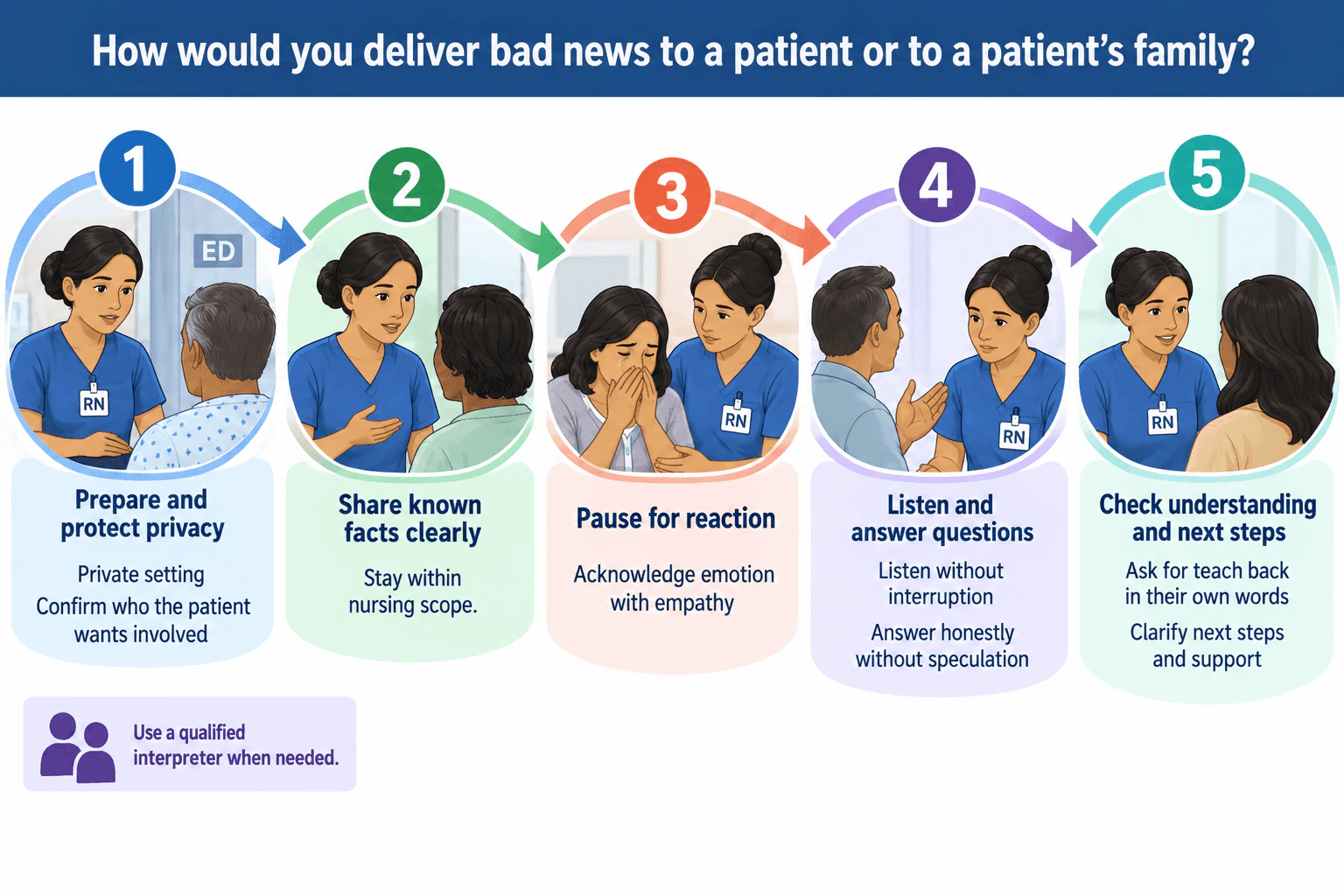
22. How would you deliver bad news to a patient or to a patient’s family?Communication And DelegationEasy
i Question Details
Explain the nursing reasoning relevant to this question. State the care setting and jurisdiction when they affect scope. Identify missing information rather than inventing patient findings or institutional policies.
Short Interview Answer (30-60 seconds)
I would provide privacy, confirm whom the patient wants involved, and share known facts clearly without speculation or going beyond my nursing scope. I would pause for the patient or family to react, acknowledge the emotion, listen carefully, and answer questions honestly. I would use a qualified interpreter when needed. Finally, I would use teach back to confirm understanding in their own words and clarify the next steps and support available.
Detailed Explanation
Delivering bad news should be a compassionate conversation rather than simply passing along information. For a bedside RN in a United States emergency department, the exact nursing scope and responsibility for formally communicating a diagnosis, prognosis, or treatment decision can depend on state law, professional scope, and organizational policy. No specific state, patient findings, or institutional policy are provided here, so I would stay with general bedside nursing responsibilities and involve the appropriate clinician when information falls outside my role.
Useful Questions to Ask the Interviewer
How does your emergency department coordinate difficult conversations when several clinicians are involved?
What qualified interpreter resources are available when a patient or family needs language assistance?
How should a nurse obtain additional clinical or communication support during a difficult conversation?
How to Explain It in an Interview
Prepare and protect privacy
I would begin by creating as much privacy as the emergency setting permits. If the patient can make decisions, I would confirm whom the patient wants involved before sharing relevant health information with family or others.
Share known facts clearly
I would use plain language, communicate what is known, and avoid speculation. I would stay within my nursing scope. If a diagnosis, prognosis, or treatment decision needs explanation by another clinician, I would coordinate with that clinician rather than guess or overstate what I know.
Pause and acknowledge emotion
After sharing difficult information, I would allow time for the patient or family to react. I would acknowledge the emotion with empathy and avoid rushing immediately into more information.
Listen and answer questions
I would listen without interruption and answer questions honestly using the information available to me. If I do not know an answer, I would say so and identify who can provide the needed information. When language assistance is needed, I would request a qualified interpreter and continue addressing the patient directly.
Check understanding and next steps
I would not assume that a nod or yes means the information was understood. I would use teach back by asking the patient or family member to explain the important information in their own words. If their explanation shows a misunderstanding, I would clarify the information and check again. I would finish by explaining the immediate next steps, who will provide additional information, and what support is available.
Why Interviewers Ask This
Interviewers are evaluating whether the nurse can communicate difficult information with empathy while protecting privacy, respecting patient preferences, staying within nursing scope, recognizing language needs, responding appropriately to emotion, and confirming actual understanding rather than assuming that agreement means comprehension.
Common interview mistakes
Common mistakes include discussing difficult information without reasonable privacy, assuming family members may automatically receive information, giving a diagnosis or prognosis beyond the nurse’s applicable scope, speculating when facts are uncertain, using overly complex language, rushing past an emotional response, interrupting questions, defaulting to an accompanying person when qualified language assistance is needed, asking only whether the person understands, and ending the conversation without confirming understanding or clarifying next steps.
Interview tip
Present the answer as the same five step sequence shown in the diagram: prepare and protect privacy, share known facts clearly, pause for the reaction, listen and answer questions, then check understanding and clarify next steps. Mention a qualified interpreter when language assistance is needed and make clear that you stay within nursing scope.
Interviewer may ask next
How would you verify that the patient or family actually understood the difficult information?
I would use teach back and ask the person to explain the key information and next steps in their own words. I would not rely only on a yes response when asking whether they understand. If their explanation reveals a misunderstanding, I would clarify the information in a different way and check understanding again.
What would you do differently if the patient could not participate in the conversation because of incapacity?
I would recognize that the patient cannot currently express a preference about who should be involved. In a United States emergency department, relevant information may be shared with family or others involved in the patient’s care when permitted by applicable privacy law and professional judgment, with disclosure limited to information relevant to that involvement. I would follow applicable law and organizational procedure, involve the appropriate clinician when needed, avoid unnecessary disclosure, and continue to advocate for the patient’s interests.
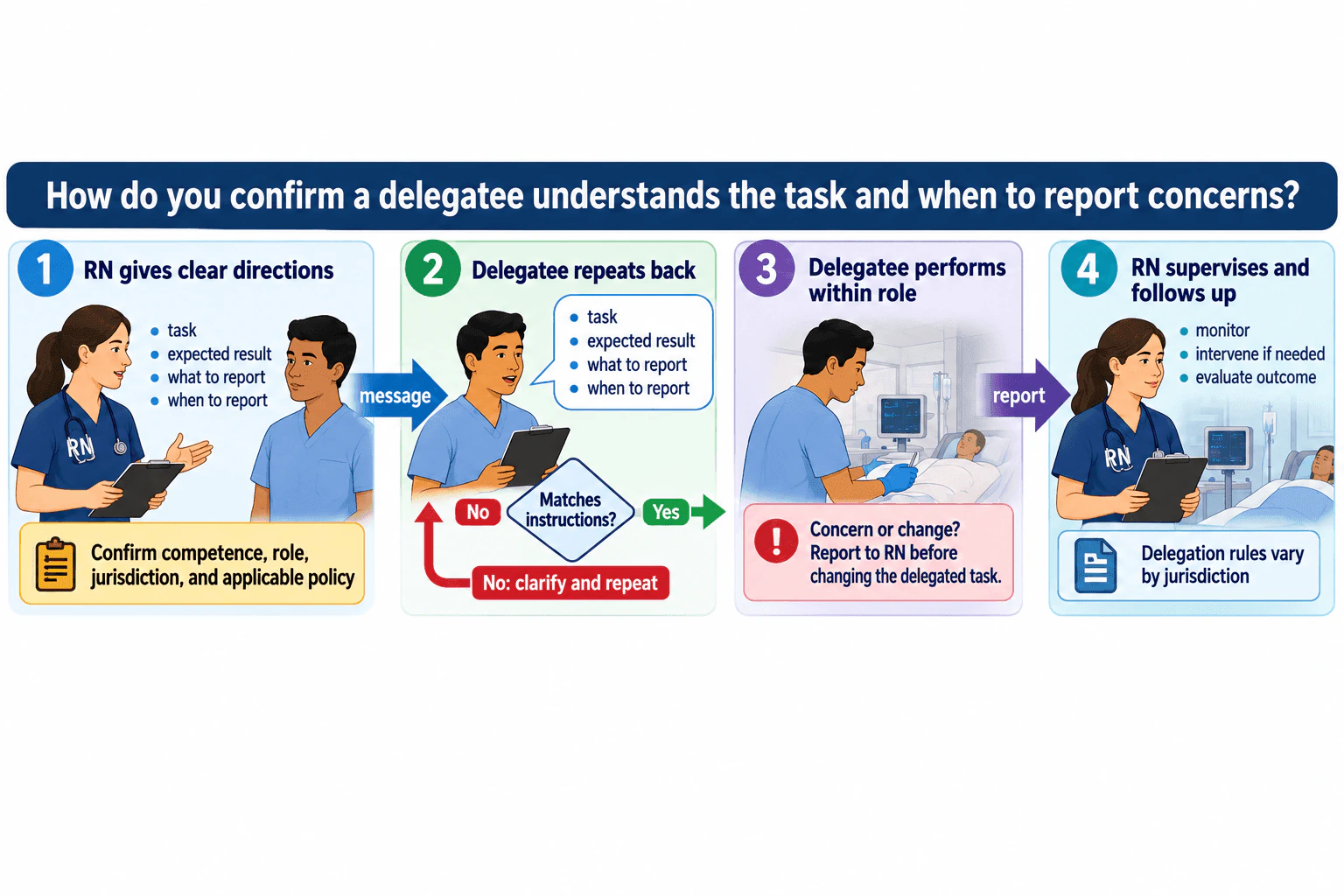
23. How do you confirm a delegatee understands the task and when to report concerns?Communication And DelegationMedium
i Question Details
Explain the concept or decision in ED nursing scope. State relevant assumptions, missing information and when additional clinical authority is required.
Short Interview Answer (30-60 seconds)
I first confirm that the task is appropriate for the delegatee's competence, role, jurisdiction, and applicable policy. I give clear directions that include the task, expected result, what to report, and when to report. Then I use repeat back so the delegatee explains those instructions back to me. If anything does not match, I clarify and repeat the confirmation. During the task, I expect concerns or changes to be reported before the delegatee independently changes the delegated activity. I remain available, monitor progress, intervene if needed, follow up, and evaluate the outcome.
Detailed Explanation
The key is to confirm understanding through two way communication rather than treating a simple yes as proof that the delegatee understands. Delegation decisions depend on the patient's situation, the delegatee's authorized role and competence, applicable jurisdictional requirements, and organizational policy.
Useful Questions to Ask the Interviewer
What delegation roles and competency validation processes are used in this emergency department?
What jurisdiction specific delegation requirements should I be familiar with here?
How does the department expect staff to escalate concerns when a delegated task can no longer be completed safely?
How to Explain It in an Interview
Give Specific Directions
I would first determine whether the activity is appropriate to delegate in the current situation and whether the delegatee has the required competence and authorized role. I would then communicate the task, expected result, what information or changes must be reported, and when that report is expected.
Confirm Understanding
I would ask the delegatee to repeat the instructions back in their own words. The repeat back should cover the task, expected result, what to report, and when to report. If the explanation does not match what I intended, I would clarify the specific point and ask for another repeat back before the task proceeds.
Set Reporting Boundaries
The delegatee should know that a concern, unexpected finding, or change in the patient's condition must be reported to the RN. The delegatee should consult the RN before independently modifying the delegated activity when that change requires nursing judgment or falls outside the delegated directions. A changed patient condition may also require the RN to reassess whether the delegation remains appropriate.
Supervise And Follow Up
Delegation does not end when the instruction is given. I remain available for questions, monitor the delegated activity at a level appropriate to the situation, intervene when necessary, follow up after completion, and evaluate the patient outcome. If the situation requires RN assessment or clinical decision making outside the delegatee's authorized role, I perform the appropriate nursing responsibility or obtain additional clinical authority when required.
This creates a closed loop: clear direction, repeat back, safe performance within role, prompt reporting of concerns, and RN supervision and evaluation.
Why Interviewers Ask This
Interviewers are assessing whether the nurse can delegate safely while retaining appropriate nursing responsibility and judgment. They want to hear that the RN checks the delegatee's competence and permitted role, communicates specific expectations and reporting triggers, verifies actual understanding rather than assuming agreement means understanding, remains available for supervision, and reassesses the delegation when the clinical situation changes.
Common interview mistakes
Common mistakes include asking only whether the delegatee understands, accepting agreement without repeat back, giving a task without stating the expected result or reporting triggers, delegating without checking competence and authorized role, allowing the delegatee to independently modify a delegated activity when nursing judgment or new authorization is required, failing to remain available for supervision, and not reassessing the delegation when the patient's condition changes.
Interview tip
Describe delegation as a closed communication loop rather than a one time instruction. A strong answer should connect four ideas in order: clear directions, repeat back, reporting concerns before independently changing the delegated activity, and RN supervision with outcome evaluation. Also state that delegation rules vary by jurisdiction and that activities requiring RN assessment or clinical judgment must remain within the appropriate licensed nursing role.
Interviewer may ask next
How would you verify that the delegatee truly understood your instructions?
I would ask the delegatee to repeat the task, expected result, what findings or concerns must be reported, and when reporting is required. I would compare that repeat back with my original instructions. If anything is missing or incorrect, I would clarify that point and ask for another repeat back before the task proceeds. I would also remain available for questions during the delegated activity.
What would you do if the patient's condition changed while the delegatee was performing the task?
I would expect the delegatee to report the change promptly rather than independently altering the delegated activity. I would reassess the patient and determine whether the delegation is still appropriate. If the changed situation requires RN assessment, clinical judgment, intervention, or additional authority beyond the delegatee's authorized role, I would take the appropriate nursing action and escalate according to the patient's needs, applicable scope, and local policy.
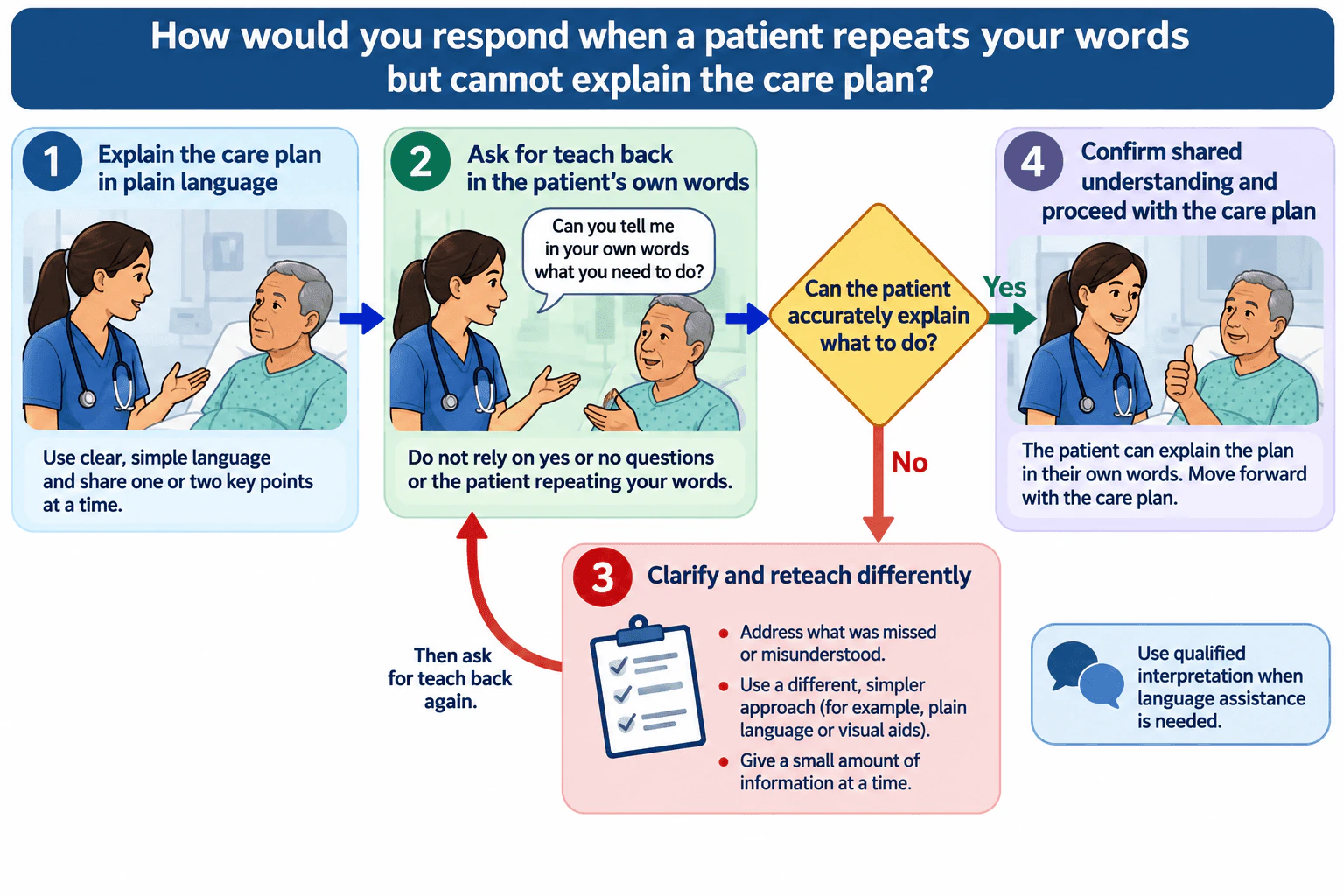
24. How would you respond when a patient repeats your words but cannot explain the care plan?Communication And DelegationMedium
i Question Details
Explain the concept or decision in ED nursing scope. State relevant assumptions, missing information and when additional clinical authority is required.
Short Interview Answer (30-60 seconds)
I would not assume the patient understands just because they can repeat my words. I would explain the care plan again using clear, simple language and a small amount of information at a time, then ask the patient to tell me in their own words what they need to do. If they cannot explain it accurately, I would clarify what was missed, reteach it differently, and repeat teach back. Once they can explain the essential plan correctly, I would confirm shared understanding and proceed. If language assistance is needed, I would use qualified interpretation.
Detailed Explanation
The key distinction is between repeating information and demonstrating understanding. A patient who can repeat my wording but cannot explain the care plan in their own words has not yet demonstrated understanding. I would use teach back as a check on how clearly I communicated, not as a test of the patient.
Useful Questions to Ask the Interviewer
Does this emergency department have a standard process for obtaining qualified language assistance when it is needed?
Are there department expectations for confirming patient understanding before discharge or transfer?
What resources are available when communication barriers require additional support?
How to Explain It in an Interview
Confirming Understanding
I would first explain the care plan again in plain language and focus on a small amount of information at a time. I would not rely on a yes response, nodding, or verbatim repetition. Instead, I would ask a nonjudgmental teach back question such as, "Can you tell me in your own words what you need to do?"
Reteaching When Understanding Is Incomplete
If the patient cannot accurately explain the plan, I would identify what was missed or misunderstood. I would then reteach that information differently rather than simply repeat the same wording. I could use simpler language, another explanation, or an appropriate visual aid. After reteaching, I would ask for teach back again. This clarification and teach back cycle continues until the patient can accurately explain the essential plan in their own words.
Communication Needs
If a language barrier is contributing, I would use qualified language assistance according to applicable requirements and available hospital resources. I would continue teach back through the interpretation process so the patient can demonstrate understanding in their own words.
Clinical Boundaries
If the patient remains unable to explain the plan despite appropriate communication support, I would consider whether factors such as hearing difficulty, distress, cognition, medication effects, or another clinical issue require further nursing assessment or escalation to the appropriate clinician. I would not infer a diagnosis from communication difficulty alone.
Once the patient can accurately explain the essential plan, I would confirm shared understanding and proceed with the appropriate care plan.
Why Interviewers Ask This
This question evaluates whether the nurse recognizes that agreement, nodding, or repeating words does not demonstrate understanding. It also tests patient centered communication, appropriate use of teach back, recognition of language needs, and the judgment to continue clarification until the patient can explain the essential care plan accurately.
Common interview mistakes
Common mistakes include asking only whether the patient understands, accepting agreement or nodding as proof of understanding, accepting verbatim repetition as successful teach back, repeating the same explanation after misunderstanding, giving too much information at once, treating teach back as a test of the patient, and failing to obtain qualified language assistance when it is needed.
Interview tip
Describe teach back as a check on how clearly you communicated. A strong answer follows the same loop as the diagram: explain simply, ask the patient to describe the plan in their own words, identify gaps, reteach differently, ask again, and confirm shared understanding only when the patient can accurately explain the essential plan.
Interviewer may ask next
How would you verify that the patient truly understands after you reteach the plan?
I would ask the patient to explain the essential care plan in their own words rather than asking for a yes or no response. I would listen for whether they can accurately describe what they need to do. If important information is still missing or misunderstood, I would reteach it differently and repeat teach back until understanding is demonstrated.
What would change if the patient needed language assistance?
I would use qualified language assistance according to applicable requirements and available hospital resources rather than relying on the patient's ability to repeat English phrases. I would continue using clear language and teach back through the interpretation process, asking the patient to explain the care plan in their own words. If understanding remained uncertain, I would reassess for other communication or clinical barriers and involve the appropriate clinician when additional evaluation or authority was needed.
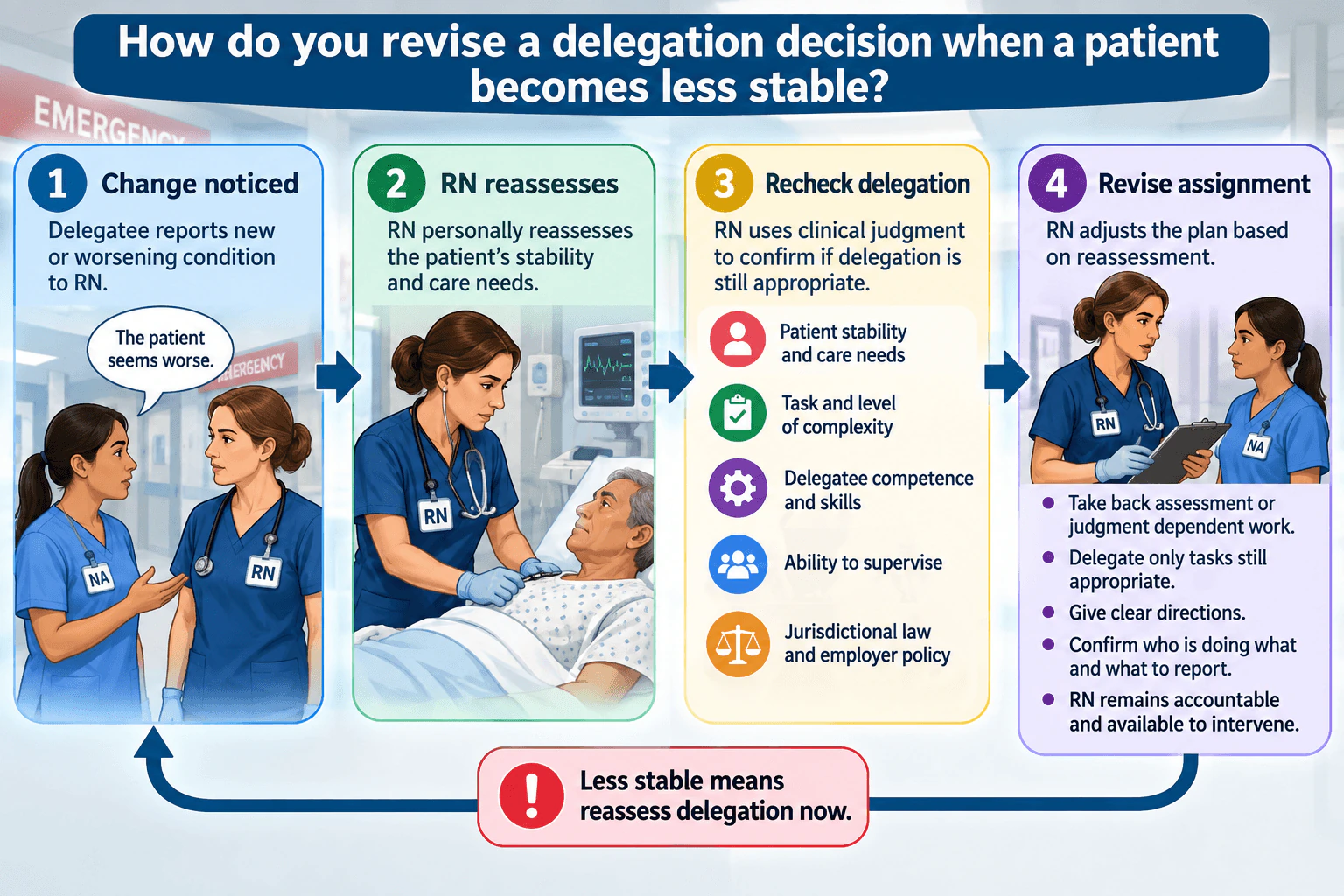
25. How do you revise a delegation decision when a patient becomes less stable?Communication And DelegationMedium
i Question Details
Explain the concept or decision in ED nursing scope. State relevant assumptions, missing information and when additional clinical authority is required.
Short Interview Answer (30-60 seconds)
If a patient becomes less stable, I reassess the patient myself and immediately recheck the delegation decision. I review the patient's current stability and care needs, the task and its complexity, the delegatee's competence, my ability to supervise, and applicable jurisdiction and employer requirements. I take back assessment or judgment dependent work when needed, delegate only tasks that remain appropriate, give clear updated directions, and confirm who is doing what and what must be reported. I remain accountable and available to intervene, and I escalate when the patient's needs require authority or resources beyond my role.
Detailed Explanation
A delegation decision depends on the patient's condition and care needs at the time it is made. If the patient becomes less stable, those circumstances have changed. The delegatee should report the new or worsening condition to the RN, and the RN should personally reassess the patient before deciding what work can safely remain delegated. Nursing assessment and clinical judgment are not transferred to assistive personnel.
Useful Questions to Ask the Interviewer
What delegation rules in this jurisdiction and organization apply to the staff members working in this emergency department?
What resources are available when patient acuity changes and an assignment is no longer appropriate?
What escalation pathway is expected when additional clinical authority or staffing support is needed?
How to Explain It in an Interview
Change noticed
If a delegatee reports a new or worsening condition, I treat that as a reason to reassess both the patient and the delegation decision rather than assuming the original assignment still applies.
RN reassesses
I personally reassess the patient's stability and current care needs. I do not delegate nursing assessment or clinical judgment to assistive personnel.
Recheck delegation
I reconsider the patient's stability and care needs, the task and its complexity, the delegatee's competence and skills, my ability to supervise, and applicable jurisdiction and employer requirements. A task that was appropriate when the patient was stable may no longer be appropriate after the patient's condition changes.
Revise the assignment
I take back assessment or other judgment dependent work when necessary and delegate only tasks that remain appropriate. I give clear updated directions and confirm who is doing what, what findings must be reported, and when I need to be notified. I remain accountable, available to supervise, and prepared to intervene.
Escalate when necessary
If the patient's deterioration requires treatment, orders, resources, or decisions beyond my independent nursing authority or applicable protocols, I involve the appropriate clinician or leadership resource promptly. If the patient's condition changes again, I reassess again and revise the delegation plan as needed. The key principle is that less stability means the delegation decision must be reassessed.
Why Interviewers Ask This
Interviewers are assessing whether the nurse understands that delegation is a continuing clinical judgment rather than a one time handoff. They want to hear that a new or worsening condition triggers RN reassessment, reconsideration of the delegation decision, revision of the assignment, clear communication, continued supervision, and escalation when the patient's needs exceed available nursing authority or resources.
Common interview mistakes
Common mistakes include assuming the original delegation remains appropriate after the patient's condition changes, allowing assistive personnel to perform nursing assessment or clinical judgment, failing to personally reassess the patient, considering the task without considering the patient's current stability, overlooking the delegatee's competence or the RN's ability to supervise, giving revised directions without confirming responsibility and reporting expectations, and failing to escalate when the patient's needs exceed available nursing authority or resources.
Interview tip
Describe delegation as a dynamic decision. Connect a new or worsening condition to RN reassessment, renewed review of the patient, task, delegatee competence, supervision, and applicable requirements, followed by revision of the assignment, clear communication, continued accountability, and escalation when additional authority or resources are required.
Interviewer may ask next
How would you verify that the revised delegation plan is being carried out safely?
I would confirm that the delegatee understands the revised task, expected observations, reporting expectations, and when to notify me. I would remain available for questions, supervise as required, review information reported back to me, reassess the patient, and intervene or revise the plan again if the patient's condition or care needs change.
What would change if the patient continued to deteriorate after you revised the delegation?
I would reassess the patient again and further reduce or stop delegation when the patient's needs require direct nursing assessment, clinical judgment, or closer supervision. I would prioritize immediate nursing care, redistribute only tasks that remain appropriate, and escalate to the appropriate clinician or leadership resource if treatment, orders, staffing support, or other authority beyond my role is required.
26. How would you resolve a disagreement about whether a task is within a colleague's scope?Communication And DelegationHard
i Question Details
Explain the concept or decision in ED nursing scope. State relevant assumptions, missing information and when additional clinical authority is required.
Short Interview Answer (30-60 seconds)
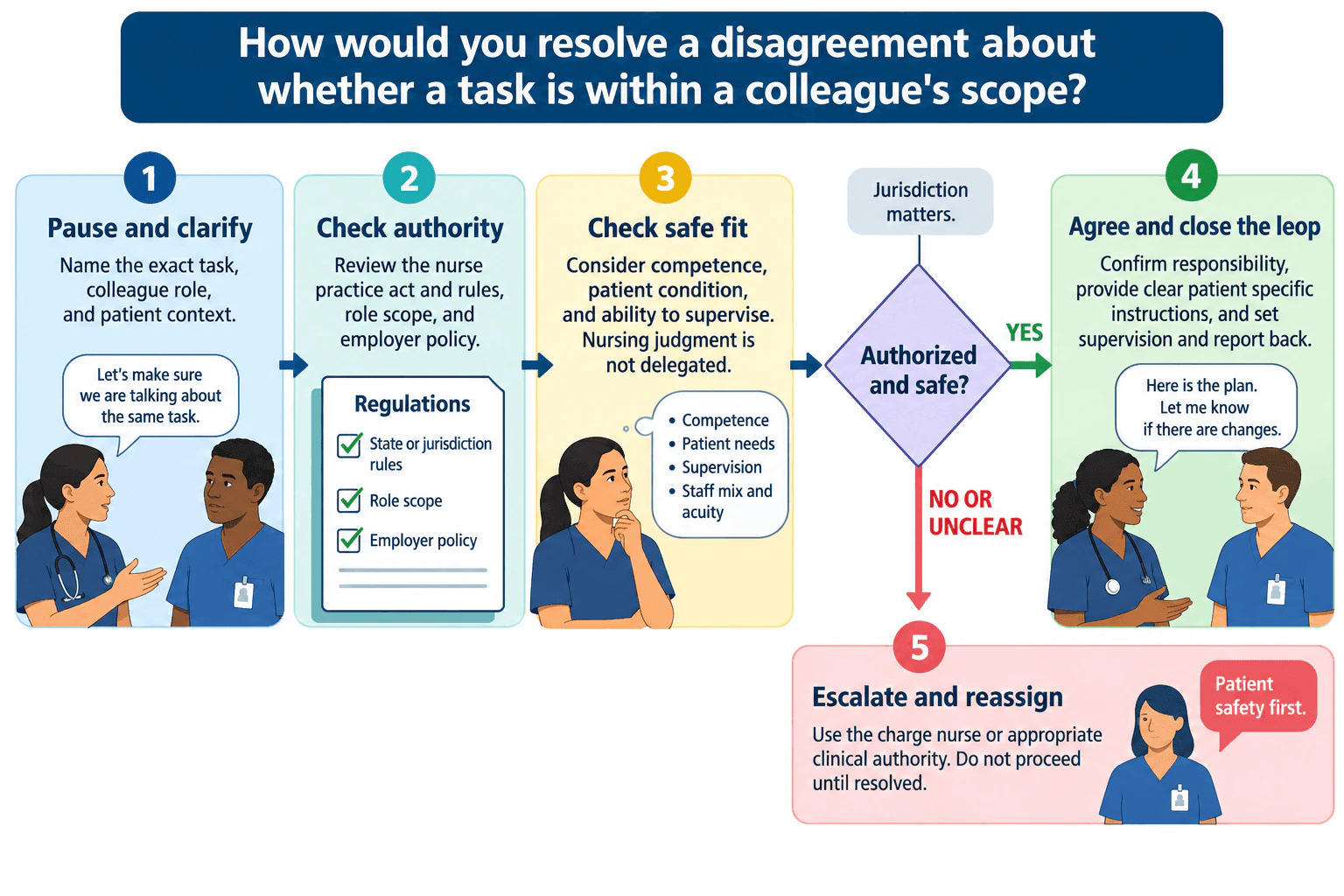
I would first pause and clarify the exact task, the colleague's role, and the patient context. I would then verify the applicable jurisdictional rules, role scope, employer policy, competence, and ability to supervise. I would not delegate nursing judgment or critical decision making, and I would not delegate nursing assessment requiring that judgment to assistive personnel. If the task is authorized and safe, I would confirm responsibility, instructions, supervision, and report back. If it is outside scope or still unclear, I would escalate to the charge nurse or appropriate clinical authority and reassign the task as needed rather than proceeding until the disagreement is resolved.
Detailed Explanation
The key principle is that a disagreement about scope should be resolved by checking authority, competence, patient context, and supervision rather than relying on opinion. For a bedside emergency department RN in the United States, the exact state or jurisdiction must be confirmed because delegation and scope rules vary by jurisdiction.
Useful Questions to Ask the Interviewer
Which state or jurisdiction and staff roles are involved?
What exact task is being considered, and what is the patient's current condition?
What employer policy and supervision resources apply to this task?
How to Explain It in an Interview
Pause and clarify
I would first make sure everyone is discussing the same task. I would identify the exact activity, the colleague's role, and the patient context. That keeps a focused scope question from becoming a general disagreement about someone's role.
Check authority
Next, I would review the applicable nurse practice act, regulations, authorized role scope, and employer policy. I would also confirm that the colleague has the education, training, and demonstrated competence needed for the specific task.
Check safe fit
I would then consider the patient's condition and needs, the complexity of the task, staffing and acuity, and whether appropriate supervision is available. A task may be authorized for a role but still be inappropriate in a particular clinical situation. Nursing judgment and critical decision making cannot be delegated. Nursing assessment requiring that judgment should not be delegated to assistive personnel.
Decide and close the loop
If the task is authorized, the colleague is competent, and the situation is safe, I would confirm who is responsible, give clear patient specific instructions, identify what changes must be reported, and establish supervision and follow up. I would use closed loop communication so responsibility and expectations are understood rather than assuming that agreement means understanding.
Escalate and reassign when needed
If the task is outside the colleague's authorized scope, is unsafe in the current patient context, or remains unclear after checking the available rules and policy, I would not proceed with the disputed assignment. I would escalate to the charge nurse, nurse leader, or other appropriate clinical authority and reassign the task as needed until the issue is resolved. Patient safety comes before resolving the disagreement quickly.
Why Interviewers Ask This
Interviewers are evaluating whether the nurse can protect patient safety while handling professional disagreement calmly. A strong response shows that scope questions are resolved through regulation, role authority, competence, patient context, supervision, and escalation rather than hierarchy, assumption, convenience, or simple agreement between coworkers.
Common interview mistakes
Common mistakes include deciding scope from job title alone, assuming that past performance proves current authorization, confusing willingness or agreement with competence and understanding, overlooking jurisdictional rules or employer policy, delegating nursing judgment or nursing assessment requiring that judgment to assistive personnel, ignoring the patient's changing condition, proceeding while authority remains unclear, or failing to confirm supervision and report back.
Interview tip
Structure the response as the same safety decision shown in the scope clarification flow: pause and clarify, check authority, check safe fit, decide whether the task is authorized and safe, then either agree and close the loop or escalate and reassign. This demonstrates respectful communication without allowing disagreement to override nursing scope or patient safety.
Interviewer may ask next
How would you verify whether the colleague is actually authorized to perform the task?
I would identify the exact role and task, then check the applicable state or jurisdiction nurse practice act, board rules or regulations, authorized role scope, and employer policy. I would separately confirm the colleague's education, training, and validated competence. If those sources do not clearly establish authority, I would seek clarification from the charge nurse, nurse leader, or another appropriate clinical authority before assigning the task.
What would you do if the task is normally within the colleague's role but the patient's condition suddenly becomes more complex?
I would reassess whether the task remains appropriate in the changed clinical context. A task that is normally suitable may no longer be safe when the patient's condition, acuity, required nursing judgment, or supervision needs change. I would retain nursing assessment and judgment, modify or withdraw the assignment, reassign the task when appropriate, provide care within my own scope, and escalate when additional clinical authority or resources are required.
27. How would you escalate an unsafe assignment while maintaining continuity of care?Communication And DelegationHard
i Question Details
Explain the concept or decision in ED nursing scope. State relevant assumptions, missing information and when additional clinical authority is required.
Short Interview Answer (30-60 seconds)
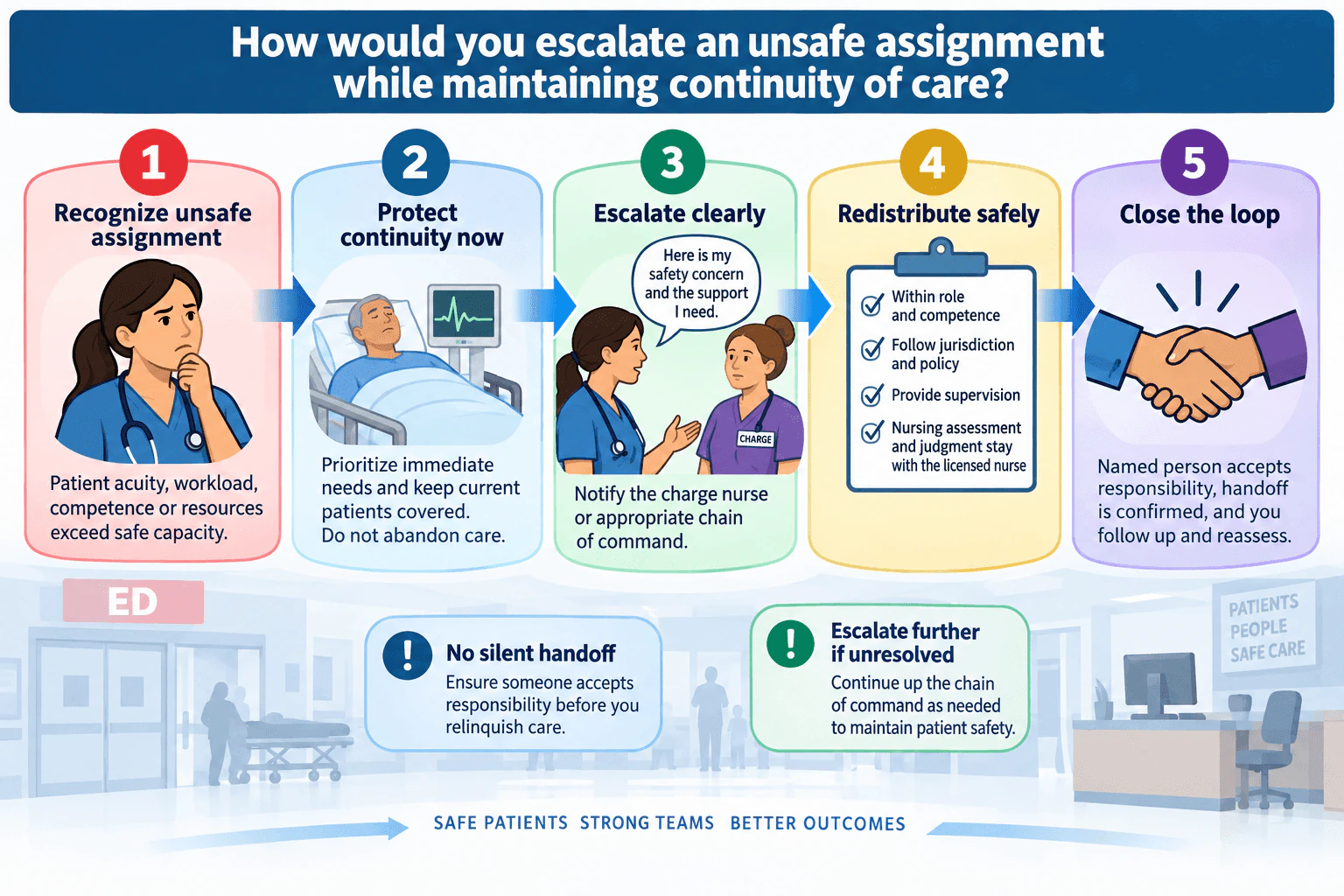
I would identify exactly why the assignment is unsafe, protect the immediate needs of my current patients, and promptly communicate the concern to the charge nurse or appropriate leader. I would state the patient safety risk and the support I need. If work is redistributed, I would match responsibilities to staff role and competence, follow jurisdiction and facility requirements, provide appropriate supervision, and keep nursing assessment and judgment with an appropriately licensed nurse. Before relinquishing any responsibility, I would confirm that a named qualified person accepts it through a clear handoff. I would then follow up and reassess, and if the risk remains unresolved, continue through the appropriate chain of command.
Detailed Explanation
An unsafe assignment should be handled as a patient safety and continuity problem. The goal is not simply to refuse work. The goal is to identify the specific risk, keep current patients covered, communicate the concern clearly, redistribute care only within appropriate scope and competence, and confirm responsibility before any handoff is complete.
Useful Questions to Ask the Interviewer
What chain of command is used when a bedside nurse believes an assignment cannot be carried out safely?
How are patient acuity, team competence, and available resources considered when assignments are changed?
How is acceptance of responsibility confirmed when a patient or task is reassigned?
How to Explain It in an Interview
Recognize the Unsafe Assignment
I would first identify the concrete reason the assignment is unsafe. Relevant factors can include patient acuity, workload, competing urgent needs, staff competence, or unavailable resources. I would communicate the specific safety risk rather than only saying that the workload feels too heavy.
Protect Continuity Now
While escalating, I would continue prioritizing the immediate needs of the patients already under my responsibility and make sure they remain covered. I would not leave or silently transfer responsibility while the assignment concern is being resolved.
Escalate Clearly
I would notify the charge nurse or other appropriate leader and state the concern, its effect on patient safety, and the support I need. If the concern remains unresolved, I would continue through the established chain of command. The exact pathway is organization and jurisdiction specific, so I would not assume a universal escalation sequence.
Redistribute Safely
If care is redistributed, I would consider each patient's needs, the receiving team member's authorized role and demonstrated competence, applicable jurisdiction requirements, facility policy, and the supervision required. Nursing activities requiring clinical reasoning, nursing judgment, or critical decision making are not appropriate for delegation to assistive personnel. ncsbn.org
Close the Loop
Before relinquishing responsibility, I would confirm that a named qualified person has accepted the assignment and received the information needed to continue care. The Joint Commission includes a process for handoff communication among its hospital patient safety requirements. jointcommission.org I would then follow up and reassess whether the redistribution actually addressed the safety concern.
Assumptions And Additional Authority
I am assuming routine bedside emergency department nursing in the United States, not mass casualty triage. Important missing information includes actual patient acuity, current staffing, individual competencies, jurisdictional scope rules, local policy, and whether any patient's condition is changing. Additional clinical authority is required when a needed action exceeds the nurse's independent scope or applicable protocol, and leadership authority may be needed to change staffing or assignments.
Why Interviewers Ask This
Interviewers are evaluating whether the nurse can recognize a specific patient safety risk, advocate for safer resources or assignments, communicate through the appropriate leadership structure, maintain continuity while the concern is being addressed, delegate only within authorized scope and competence, and confirm that responsibility has actually transferred. They also want to see that the nurse understands that delegation depends on patient needs, staff competence, required supervision, jurisdiction, and organizational policy. NCSBN guidance states that delegation decisions depend on the patient, setting, jurisdiction, employer requirements, and the delegatee's knowledge and abilities, and that activities requiring clinical reasoning, nursing judgment, or critical decision making cannot be delegated. ncsbn.org
Common interview mistakes
Common mistakes include describing the concern vaguely instead of naming the patient safety risk, abandoning current responsibilities while seeking help, assuming that notifying someone automatically transfers responsibility, redistributing work without considering role or competence, delegating nursing assessment or clinical judgment to assistive personnel, failing to provide required supervision, and stopping the escalation while the safety problem remains unresolved.
Interview tip
Organize the answer in the same sequence you would use at the bedside: recognize the unsafe assignment, protect continuity, escalate clearly, redistribute work within role and competence, and close the loop by confirming that a named qualified person accepts responsibility. Mention that you would continue through the appropriate chain of command if the concern remains unresolved.
Interviewer may ask next
How would you verify that the reassignment or delegation is safe?
I would verify who accepted responsibility, confirm that the assigned activity is permitted for that person's role and consistent with demonstrated competence, communicate the relevant patient information and expected responsibility, and confirm that the required supervision is available. I would then follow up on completion and patient status. I would not treat simple agreement as proof that responsibility was transferred safely. NCSBN guidance places responsibility on the licensed nurse to consider patient needs, delegatee competence, jurisdiction, employer requirements, and supervision when delegating. ncsbn.org
What would change if one of your patients suddenly deteriorated while you were escalating the unsafe assignment?
The immediate change in clinical condition would take priority. I would reassess the patient, initiate nursing actions that are within my scope and any applicable authorized protocol, obtain additional clinical assistance when indicated, and communicate the deterioration promptly to the appropriate team members. I would also make sure the other patients under my responsibility remain covered. After the immediate risk is addressed, I would continue the assignment escalation because the patient's increased acuity may change the staffing and resource needs.
28. What is aseptic technique during medication preparation?Medication And ProceduresEasy
i Question Details
Explain the concept or decision in ED nursing scope. State relevant assumptions, missing information and when additional clinical authority is required.
Short Interview Answer (30-60 seconds)
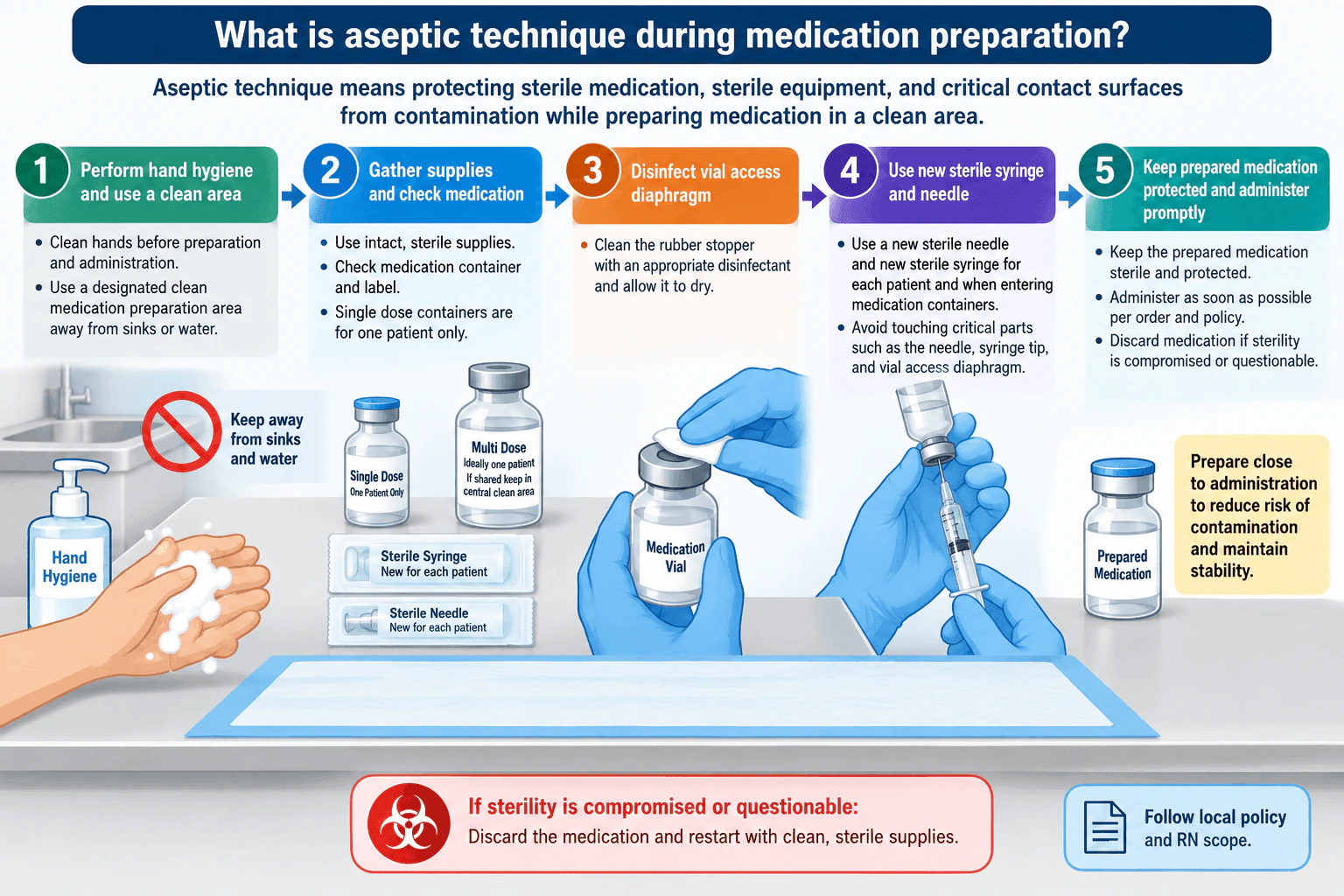
Aseptic technique means preparing medication without contaminating the medication, sterile equipment, or critical contact surfaces. I would perform hand hygiene, work in a designated clean medication preparation area away from sinks and other contamination sources, inspect the medication and supplies, disinfect a vial diaphragm and let it dry before access, and use a new sterile needle and syringe when entering the medication container. I would avoid touching critical parts, prepare the medication close to the time of administration, and discard it if sterility is compromised or questionable. I would also follow the authorized order, my nursing scope, and local policy.
Detailed Explanation
Aseptic technique during medication preparation is the set of practices used to prevent microorganisms or contaminated objects from reaching the medication, sterile equipment, or critical contact surfaces. In a United States emergency department, the exact workflow also depends on applicable nursing law, the medication order, product instructions, competency, and facility policy.
Useful Questions to Ask the Interviewer
What medication preparation area and infection prevention procedures does this emergency department use?
How does the department handle multidose vials and medications prepared before immediate administration?
What local policy governs medication preparation when sterility becomes uncertain?
How to Explain It in an Interview
I would describe aseptic preparation as a contamination prevention process.
First, I perform hand hygiene and use a designated clean medication preparation area that is separated from potential contamination sources such as sinks or other water sources. I gather intact supplies and verify the medication container and label before preparation.
If I need to access a medication vial, I disinfect the vial access diaphragm with an appropriate antiseptic and allow it to dry. I enter the medication container with a new sterile needle and a new sterile syringe. I avoid touching critical parts such as the needle, syringe tip, and disinfected vial diaphragm.
For single dose containers, I treat the contents as intended for one patient only. Multidose vials should be dedicated to one patient whenever possible. If a multidose vial is used for more than one patient, it should remain in a designated clean medication preparation area rather than the immediate patient treatment area.
I keep the prepared medication protected and prepare it as close as practical to administration because delay can increase the opportunity for contamination and may affect medication stability. I then administer it according to the authorized order, product requirements, my competency, and local policy.
If the medication, equipment, or critical surface becomes contaminated, or if sterility is questionable, I do not try to work around the breach. I discard the affected medication or supplies as appropriate and restart with clean sterile supplies. The key idea is that once aseptic integrity is lost, patient safety takes priority over avoiding waste or delay.
Why Interviewers Ask This
Interviewers are evaluating whether the nurse understands that medication safety includes infection prevention, not only checking the drug and order. A strong answer shows recognition of clean preparation space, hand hygiene, protection of critical parts, safe vial access, single patient injection equipment, and the need to stop when sterility is uncertain.
Common interview mistakes
Common mistakes include preparing medication near a sink or another contamination source, touching the syringe tip or another critical part, entering a medication container with previously used equipment, failing to disinfect the vial diaphragm or allow it to dry, treating a single dose vial as available for multiple patients, bringing a shared multidose vial into the immediate patient treatment area, preparing medication unnecessarily early, or continuing to use medication when sterility is questionable.
Interview tip
Give the answer as a simple sequence: clean hands and clean area, verify medication and supplies, disinfect the vial access point, use new sterile equipment while protecting critical parts, then keep the prepared medication protected until prompt administration. Finish by stating that any break in sterility means stopping and replacing the affected medication or supplies rather than improvising.
Interviewer may ask next
How would you verify that medication preparation remained aseptic before administration?
I would confirm that preparation occurred in the designated clean area, hand hygiene was performed, the medication and sterile supplies remained intact, the vial diaphragm was disinfected and allowed to dry before access, a new sterile needle and syringe were used, and critical parts were not touched or contaminated. I would also check the authorized order, medication label, patient specific requirements, and applicable local policy. If I could not confirm that sterility was maintained, I would not use the questionable medication or equipment.
What changes if a multidose vial must be used for more than one patient?
The contamination controls become especially important. A multidose vial should be dedicated to one patient whenever possible. If it must be used for more than one patient, it should be kept and accessed in a designated clean medication preparation area away from immediate patient treatment areas. Each entry requires a new sterile needle and new sterile syringe, and the vial access diaphragm must be disinfected before access. If the vial enters an immediate patient treatment area, current CDC guidance supports dedicating it to that patient rather than returning it to shared use.
29. What is the difference between a single dose vial and a multidose vial?Medication And ProceduresEasy
i Question Details
Explain the concept or decision in ED nursing scope. State relevant assumptions, missing information and when additional clinical authority is required.
Short Interview Answer (30-60 seconds)
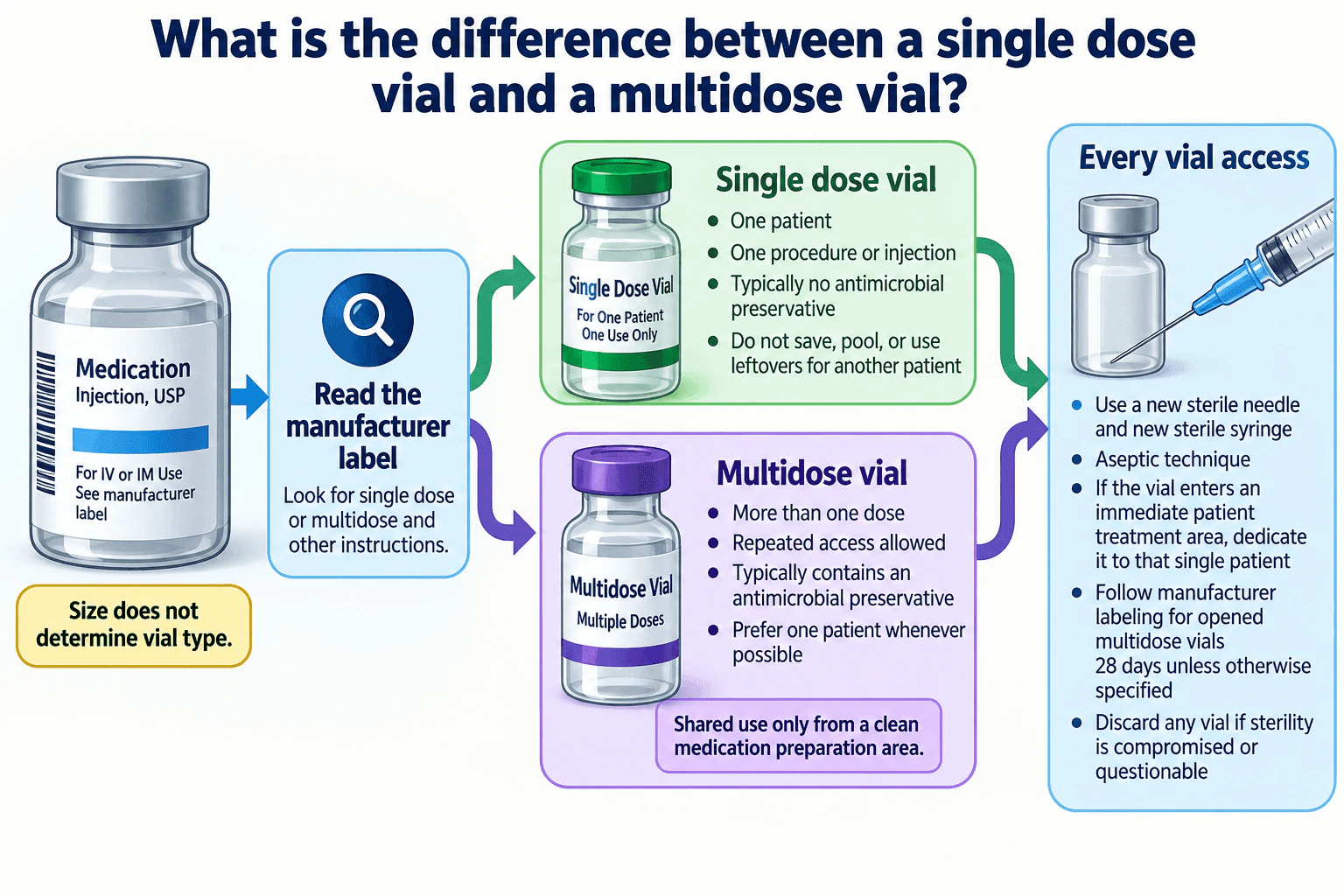
A single dose vial is intended for one patient for one case, procedure, or injection and usually has no antimicrobial preservative. Leftover contents should not be saved or pooled for later use. A multidose vial contains more than one dose and is approved for repeated access, usually with an antimicrobial preservative. Even so, it should be dedicated to one patient whenever possible. I would identify the vial from the manufacturer label and use aseptic technique with a new sterile needle and a new sterile syringe every time the vial is entered.
Detailed Explanation
The main difference is the manufacturer intended use. A single dose vial is intended for one patient for one case, procedure, or injection. A multidose vial contains more than one dose and is approved for repeated access. The manufacturer label determines the vial type, not its physical size.
Useful Questions to Ask the Interviewer
What infection prevention policy does this emergency department use for storing and accessing multidose vials?
Where is the designated clean medication preparation area for multidose vials that may be used for more than one patient?
How does the department document the date a multidose vial is first opened?
How to Explain It in an Interview
For a single dose vial, I would treat the contents as intended for one patient during one case, procedure, or injection. These vials typically do not contain an antimicrobial preservative. If medication remains after the intended use, I would not save, pool, or retain the leftover contents for later use, even for the same patient.
A multidose vial contains more than one dose and is approved for repeated access. It typically contains an antimicrobial preservative that helps limit bacterial growth, but the preservative does not provide complete protection against contamination. I would dedicate a multidose vial to one patient whenever possible.
If a multidose vial must be used for more than one patient, I would keep and access it in a designated clean medication preparation area away from immediate patient treatment areas. If it enters an immediate patient treatment area, I would dedicate it to that single patient.
For either vial type, I would use aseptic technique and enter the vial with a new sterile needle and a new sterile syringe each time. I would also discard any vial if sterility is compromised or questionable.
For an opened multidose vial, current guidance recommends dating it when first opened and discarding it within 28 days unless the manufacturer specifies another date. The beyond use date should not exceed the original manufacturer expiration date. Because no specific medication or product label is provided in this question, I would verify the actual manufacturer instructions before applying any product specific storage or discard requirement.
Why Interviewers Ask This
Interviewers are assessing whether the nurse understands medication vial labeling, contamination prevention, and safe injection practice. The key judgment is recognizing that the manufacturer label determines whether a vial is single dose or multidose, and that repeated access to a multidose vial does not make unrestricted sharing safe.
Common interview mistakes
Common mistakes include deciding vial type by container size instead of the manufacturer label, saving leftovers from a single dose vial, assuming a multidose preservative prevents all contamination, entering a vial with a previously used needle or syringe, sharing a multidose vial after it has entered an immediate patient treatment area, or ignoring manufacturer storage and discard instructions.
Interview tip
Start with the manufacturer intended use, then connect the distinction to infection prevention. State that single dose means one patient for one case, procedure, or injection, while multidose means more than one dose with repeated access permitted. Finish by emphasizing aseptic technique, a new sterile needle and syringe for every vial entry, and single patient dedication of multidose vials whenever possible.
Interviewer may ask next
How would you verify whether an unfamiliar vial is single dose or multidose?
I would read the manufacturer label and packaging rather than judging by the vial size or medication volume. I would confirm whether it is labeled for single dose or multidose use and review its storage, expiration, and discard instructions. If the labeling is unclear, I would pause and obtain clarification through the appropriate pharmacy, manufacturer information, or medication safety process rather than assume.
What changes if a multidose vial enters an immediate patient treatment area?
It should be dedicated to that single patient rather than returned to shared use. A multidose vial intended for use with more than one patient should instead remain in a designated clean medication preparation area away from immediate patient treatment areas.
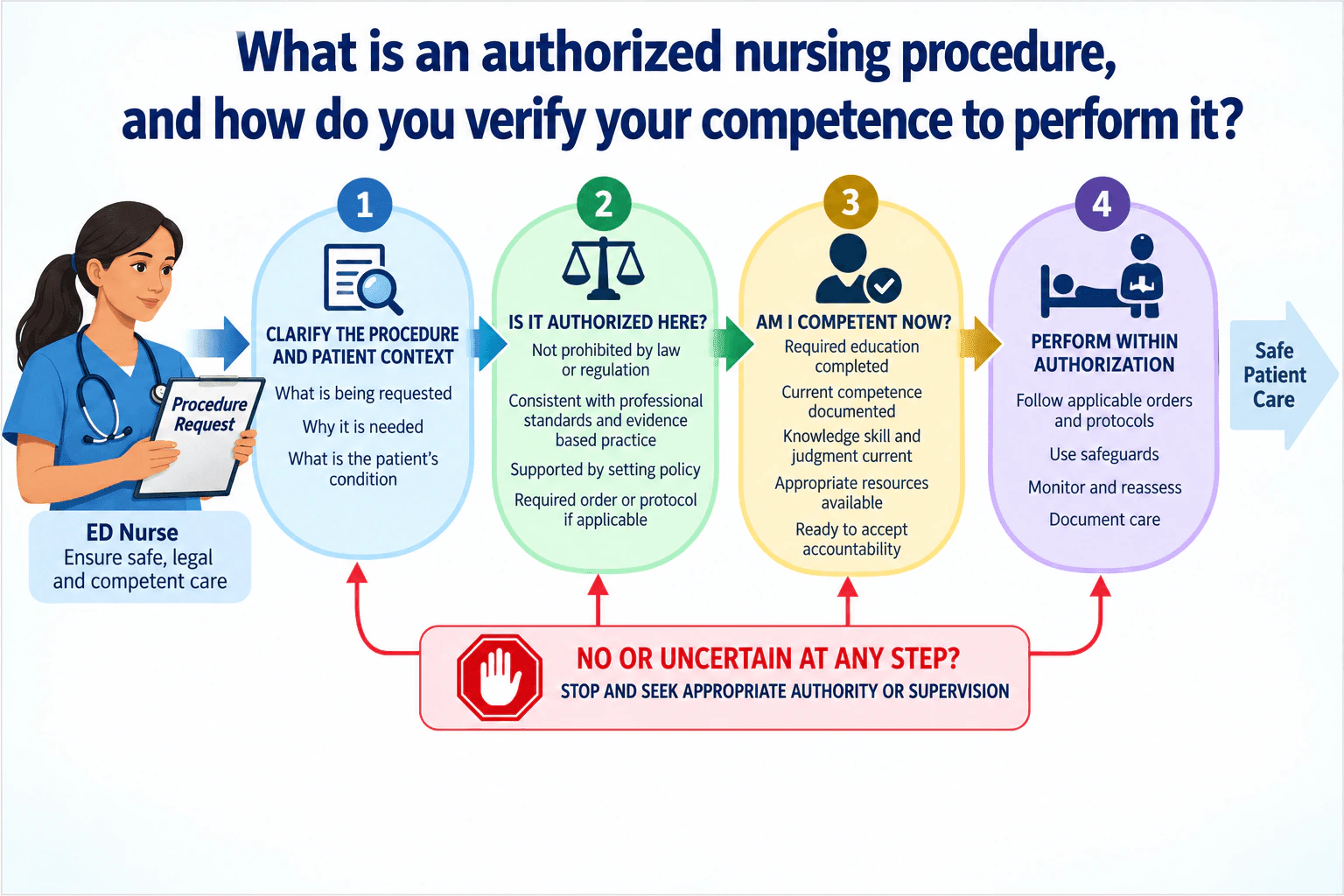
30. What is an authorized nursing procedure, and how do you verify your competence to perform it?Medication And ProceduresEasy
i Question Details
Explain the concept or decision in ED nursing scope. State relevant assumptions, missing information and when additional clinical authority is required.
Short Interview Answer (30-60 seconds)
I first clarify the exact procedure, why it is needed, and the relevant patient context. Then I confirm that it is not prohibited by applicable law or regulation, is consistent with professional standards and evidence based practice, is supported by practice setting policy, and has any required order or protocol. Next I verify my required education, documented current competence, current knowledge, skill, judgment, available resources, and readiness to accept accountability. If any step is no or uncertain, I stop and seek appropriate authority or supervision. If the checks are satisfied, I perform within the authorization, use appropriate safeguards, monitor and reassess the patient, and document the care.
Detailed Explanation
An authorized nursing procedure is not simply a procedure that nurses commonly perform. For a bedside emergency department RN in Illinois, the activity must be consistent with applicable nursing law and regulation and the RN scope of practice. The practice setting may also require policies, procedures, orders, protocols, education, competency validation, or supervision. I therefore treat authorization and my personal competence as separate decisions.
Useful Questions to Ask the Interviewer
What policies and competency validation processes does this emergency department use for procedures that require demonstrated competence?
Which procedures require a specific order or protocol before an RN performs them?
Who should an RN contact when authorization or current competence is uncertain?
How to Explain It in an Interview
Clarify The Procedure And Patient Context
I first identify exactly what activity is being requested, why it is needed, and which patient factors affect the decision. A vague request does not establish authorization.
Confirm Authorization
I confirm that the activity is not prohibited by applicable law or regulation. I also check that it is consistent with professional standards and evidence based practice, supported by practice setting policy, and accompanied by any required order or protocol. A procedure being common in an emergency department does not by itself establish that I am authorized to perform it.
Verify Current Competence
Next I confirm that I completed the required education and have documented current competence. I consider whether my knowledge, skill, and judgment are current, whether appropriate resources are available, and whether I am prepared to accept accountability for the procedure and related nursing care.
Perform Within Authorization
When those checks are satisfied, I perform within the applicable authorization, follow required orders and protocols, use appropriate safeguards, monitor and reassess the patient, and document the care and patient response.
If any step is answered no or remains uncertain, I do not proceed simply because the procedure is familiar or the department is busy. I stop and seek appropriate authority or supervision. The exact procedure, patient condition, local requirements, and required clinical authority must be clear before determining that a particular RN may safely perform it.
Why Interviewers Ask This
Interviewers are assessing whether the nurse understands that authorization and personal competence are separate safety decisions. They want to know that the nurse will clarify what is being requested, check applicable scope and practice requirements, verify current competence and available resources, and seek appropriate authority or supervision rather than proceeding when an important requirement is uncertain.
Common interview mistakes
Common mistakes include assuming that a commonly performed procedure is automatically authorized for every RN, confusing licensure with demonstrated current competence, relying on past experience without checking current competence requirements, overlooking a required order or protocol, proceeding without appropriate resources, and continuing when authorization or competence is uncertain instead of seeking appropriate authority or supervision.
Interview tip
Use the same sequence as the clinical decision flow: clarify the procedure and patient context, confirm authorization, verify current competence, then perform within authorization with safeguards, reassessment, and documentation. State clearly that a no or uncertain answer at any step means you stop and seek appropriate authority or supervision.
Interviewer may ask next
How would you verify that you are competent to perform a procedure you have done before?
I would not rely on familiarity alone. I would confirm that I completed the required education, that current competence is documented when required, and that my knowledge, skill, and judgment remain current. I would also confirm that appropriate resources are available and that I am prepared to accept accountability. If current competence is uncertain or has not been established for that setting, I would seek the required supervision or competency validation before performing the procedure.
What would you do if the patient's condition changes and the procedure becomes more complex than expected?
I would reassess the patient and reconsider both authorization and my competence for the changed situation. The change may require different resources, additional monitoring, another protocol, another professional, or additional expertise. If the revised situation exceeds my authorization or current competence, or if I am uncertain, I would stop when clinically appropriate, maintain patient safety, and seek appropriate clinical authority or supervision.
More questions load as you scroll
Disclaimer: This interview guide is for educational and informational purposes only. It is designed to help readers prepare, but it does not guarantee any interview result, hiring decision, offer, or outcome. Interview questions, hiring criteria, and preferred answers can vary by employer, interviewer, industry, location, and time. All answers, examples, and explanations in this guide are suggested examples for interview preparation, not definitive answers or instructions for professional practice. They are based on research and judgment, are provided without warranties of any kind, and should be adapted to the question, role, and applicable laws and professional requirements. Diagrams are simplified illustrations intended to highlight the main concepts and their relationships; actual situations, systems, and practices may be more complex. Alternative approaches may be equally valid or better suited to a particular question, context, or interviewer. To the fullest extent permitted by applicable law, the contributors and publisher are not liable for decisions made, actions taken, or losses incurred based on this guide.
State Laws and Professional Responsibilities: Laws and requirements governing an occupation vary by state and jurisdiction. You are responsible for checking the current laws, licensing requirements, and scope-of-practice rules that apply to your location and role, and for ensuring that your answers and actions comply with them. Adapt examples in this guide to those requirements. This guide is not legal advice.
Content Accuracy and Verification: To the fullest extent permitted by applicable law, we do not represent or warrant that interview guides, questions, answers, examples, or diagrams are accurate, complete, current, error-free, or suitable for any particular purpose. You are responsible for independently reviewing and verifying the information before relying on it.