143 Cybersecurity Engineer Interview Questions & Answers

90 top • 18 Amazon • 11 Apple • 8 Google • 4 Meta • 10 Microsoft • 1 Netflix • 1 NVIDIA

Cybersecurity Engineer icon

Questions with Detailed ExplanationsWith Detailed Explanations

(Last Updated: September 13, 2026)

1. What is cybersecurity architecture, and how do trust boundaries and defense in depth shape it?Security ArchitectureEasy

Question Details

Define cybersecurity architecture as the organization of security responsibilities, trust boundaries, identities, data flows, controls, failure behavior, and recovery across a system. Explain assets, actors, entry points, least privilege, defense in depth, secure defaults, blast-radius reduction, verification, and residual risk without presenting any framework as a complete design by itself.

Short Interview Answer (30-60 seconds)

Cybersecurity architecture organizes identities, assets, data flows, trust boundaries, controls, monitoring, failure behavior, and recovery. Trust boundaries show where access must be verified. Defense in depth adds independent network, identity, application, segmentation, and data controls so one failed layer does not expose everything.

Detailed Explanation

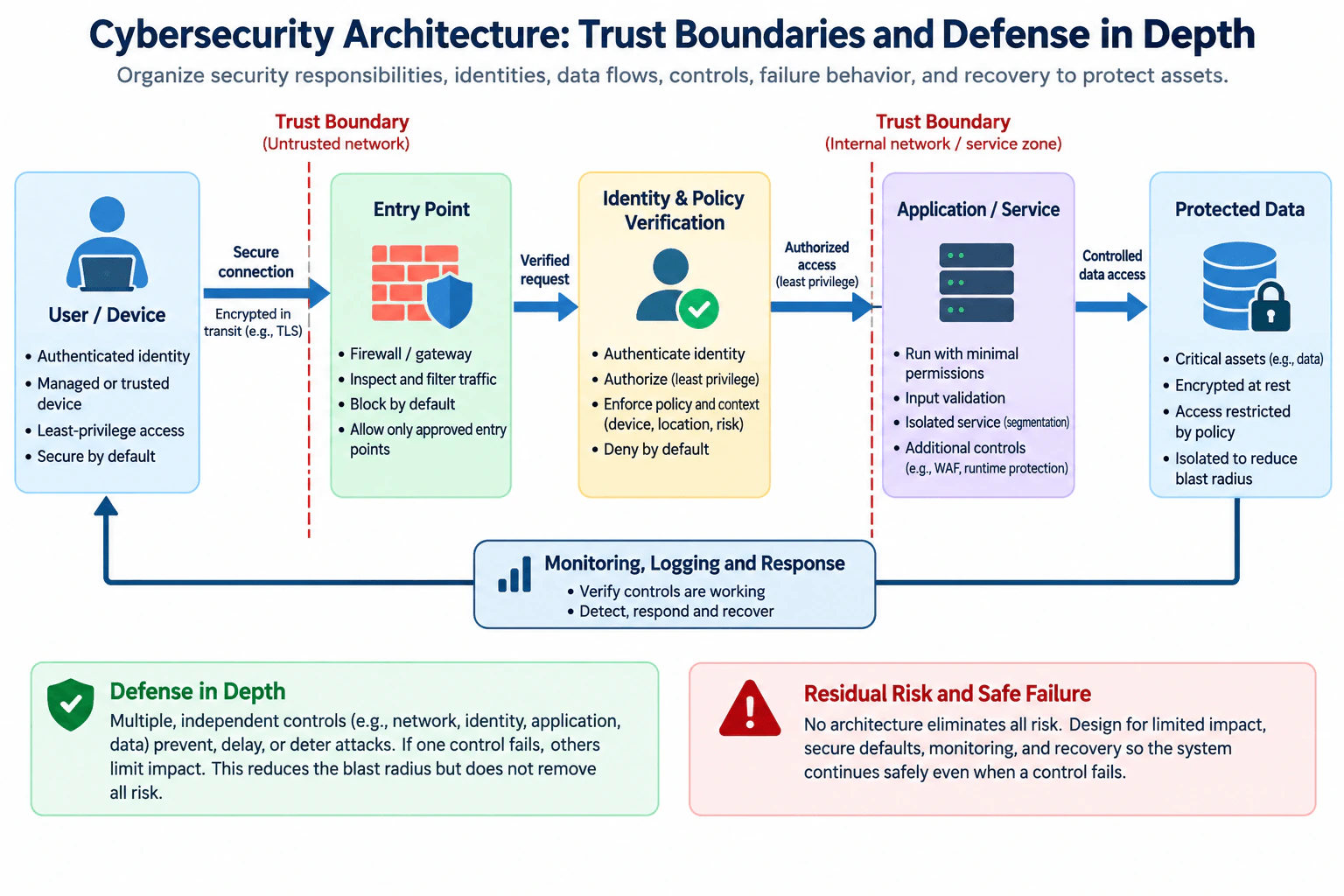
Cybersecurity architecture is the organized security design of a system. It shows what assets need protection, who or what may access them, where trust assumptions change, how data moves, what controls protect each crossing, and what happens when something fails. In this design, a user or device request crosses an untrusted-network boundary, passes through an entry point, receives identity and policy verification, enters a segmented application or service zone, and finally reaches protected data. Defense in depth means these independent controls work together, while monitoring, safe failure, recovery, and residual-risk decisions complete the architecture.

Useful Questions to Ask the Interviewer
  1. What assets and data are most important to protect?
  2. Which users, devices, services, or administrators need access?
  3. Where does trust change between the untrusted network, controlled entry point, application or service zone, and protected data?
  4. What should happen if an identity, policy, network, application, or monitoring dependency fails?
  5. Which remaining risks are acceptable after the selected controls are applied?
What is cybersecurity architecture, and how do trust boundaries and defense in depth shape it? diagram
How to Explain It in an Interview

Start with the practical decision: design security around assets, identities, data flows, and trust boundaries instead of assuming that network location alone makes a request safe.

The main actor in the diagram is the user or device. The important assets are the application or service and the protected data. The request follows one primary flow: user or device -> entry point -> identity and policy verification -> application or service -> protected data.

The first trust boundary separates the untrusted network from the controlled entry path. The connection is protected in transit, for example with TLS. The entry point uses a firewall or gateway to inspect and filter traffic, block unapproved traffic by default, and expose only approved entry points. This reduces externally reachable attack paths, but passing the gateway does not by itself authorize access to the application or data.

The next control is identity and policy verification. Authentication checks who or what is making the request. Authorization decides what that identity is allowed to do. The policy can use relevant context such as device, location, or risk signals. Access is denied by default unless policy allows it. Least privilege means granting only the minimum access required for the task.

After authorization, the request enters the application or service zone. The service runs with minimal permissions, validates input, and is isolated or segmented from unrelated services. Application-layer protections provide another independent control. If the service is compromised, restricted privileges and segmentation limit how far the compromise can spread and therefore reduce blast radius.

The second trust boundary separates the application or service from protected data. Crossing it requires controlled data access rather than automatic trust. The service should receive only the data permissions it needs. Protected data is access-restricted by policy and encrypted at rest, while sensitive data remains protected in transit between components.

This is defense in depth. Network filtering, identity verification, authorization, application controls, segmentation, data access restrictions, and encryption address different failure and abuse paths. They should not be treated as substitutes for one another. If one control fails, another independent layer can still prevent, detect, delay, or limit the impact.

Secure defaults appear throughout the design. Unapproved entry paths are blocked. Unauthorized requests are denied. Services run with minimal permissions. Protected data is not broadly accessible. For sensitive actions, a failure in a verification dependency should not silently grant access that cannot be validated. If availability requires a degraded mode, that mode should be explicitly designed so it does not bypass critical authorization decisions.

Monitoring, logging, and response provide the verification path around the architecture. Useful evidence includes gateway decisions, authentication and authorization events, application security events, and protected-data access records. Operators use this evidence to verify that controls are working, detect misuse, contain affected access, respond to incidents, and support recovery.

Recovery is part of the architecture. The system should have a defined way to restore affected services and data to a verified safe state after a failure or incident. Recovery procedures should be tested rather than merely assumed to work.

The main tradeoff is that each additional independent control can reduce risk and blast radius but also adds latency, policy complexity, operational work, monitoring volume, and possible availability dependencies. The goal is not to add every possible security control. The goal is to place justified controls at meaningful boundaries and around important assets.

Finally, no architecture removes all risk. Credentials can be stolen, software can contain defects, controls can be misconfigured, and dependencies can fail. Residual risk is the risk that remains after the selected controls are applied. A sound architecture makes that remaining risk visible, limits its possible impact, monitors for failures, and provides a path to respond and recover safely.

Technical Approach
  1. Identify the protected assets, especially important services and sensitive data.
  2. Identify actors and identities such as users, devices, services, and authorized operators.
  3. Trace the actual request and data flow from the user or device through the entry point, identity and policy verification, application or service, and protected data.
  4. Mark each place where trust assumptions change as a trust boundary.
  5. At the external boundary, allow only approved entry points, protect traffic in transit, inspect traffic, and block unapproved access by default.
  6. Authenticate the identity and authorize the request with least privilege and relevant policy context.
  7. Run the application or service with minimal permissions, validate input, and isolate it to reduce lateral movement and blast radius.
  8. Restrict protected-data access by policy and protect sensitive data at rest and in transit.
  9. Layer independent controls so a single failure does not become a complete compromise.
  10. Collect logs and security signals to verify controls, detect misuse, support response, and provide recovery evidence.
  11. Define safe failure behavior and test recovery so affected components can return to a verified safe state.
  12. Identify and communicate the residual risk that remains.
Practical Complexity & Trade-offs

The cost is not expressed as algorithmic Big O because this is an architecture question. The main costs are operational and technical. Gateways, identity checks, segmentation, encryption, logging, and recovery mechanisms add infrastructure and maintenance work. Policies and permissions need review. Security checks may add latency and create availability dependencies. Monitoring produces data that people and systems must process. The benefit is reduced exposure and smaller blast radius. The right design uses enough independent controls to protect meaningful boundaries and assets without creating unnecessary complexity.

Where it is used

This pattern is used in internet-facing applications, internal business systems, APIs, systems handling sensitive records, and service-based architectures. A typical request enters through a controlled gateway, is authenticated and authorized, reaches only an approved application or service, and then receives only the required access to protected data. The same principles also apply to privileged operational access: use controlled entry paths, verified identities, limited permissions, monitored actions, and restricted access to critical assets.

Why Interviewers Ask This

Interviewers want to see whether you understand security as an end-to-end architecture rather than as a list of tools. A strong answer identifies assets and actors, recognizes where trust changes, applies least privilege and secure defaults at those crossings, layers independent controls, limits blast radius, verifies control operation, plans for recovery, and acknowledges residual risk.

Common interview mistakes

Common mistakes include describing cybersecurity architecture as only a firewall or a list of products; treating an internal network as automatically trusted; confusing authentication with authorization; giving users or services more privilege than required; adding controls without connecting them to a boundary or protected asset; relying on one defensive layer; forgetting application and data controls after the perimeter; failing to define secure default or failure behavior; collecting logs without using them to verify controls or support response; assuming recovery will work without testing it; and claiming that defense in depth eliminates all risk.

Interview tip

Explain one end-to-end flow: identify the actor and asset, show each trust boundary, describe the entry control, verify identity and policy, enforce least privilege in the service, restrict protected-data access, then explain monitoring, safe failure, recovery, and residual risk. Emphasize that defense in depth limits the impact of a single control failure.
Interviewer may ask next
What happens if one layer of defense fails?

The architecture assumes that individual controls can fail. If the gateway misses a harmful request, identity and authorization checks can still deny unauthorized access. If the application or service is compromised, minimal permissions, segmentation, and restricted data access can limit lateral movement and exposure. Monitoring can reveal abnormal behavior and support containment and recovery. Defense in depth therefore reduces the chance that one failed control becomes a complete system compromise, although residual risk still remains.

What is the main tradeoff of adding more trust boundaries and security controls?

More meaningful boundaries and independent controls can reduce exposure and blast radius, but they also add policy complexity, latency, operational work, monitoring volume, and availability dependencies. A poorly placed control can increase complexity without reducing meaningful risk. I would add a control when it protects an important asset or boundary, give it the minimum required privilege, define its failure behavior, monitor its operation, and include it in recovery testing.

2. Design the authentication service for a web application.Security ArchitectureEasy

Short Interview Answer (30-60 seconds)

Use a dedicated authentication service behind the web application. Verify passwords and policy-required MFA against the identity store, rate-limit failures, and create a fresh server-side session on success. Return only an opaque session ID in a Secure, HttpOnly cookie and validate it on every subsequent HTTPS request.

Detailed Explanation

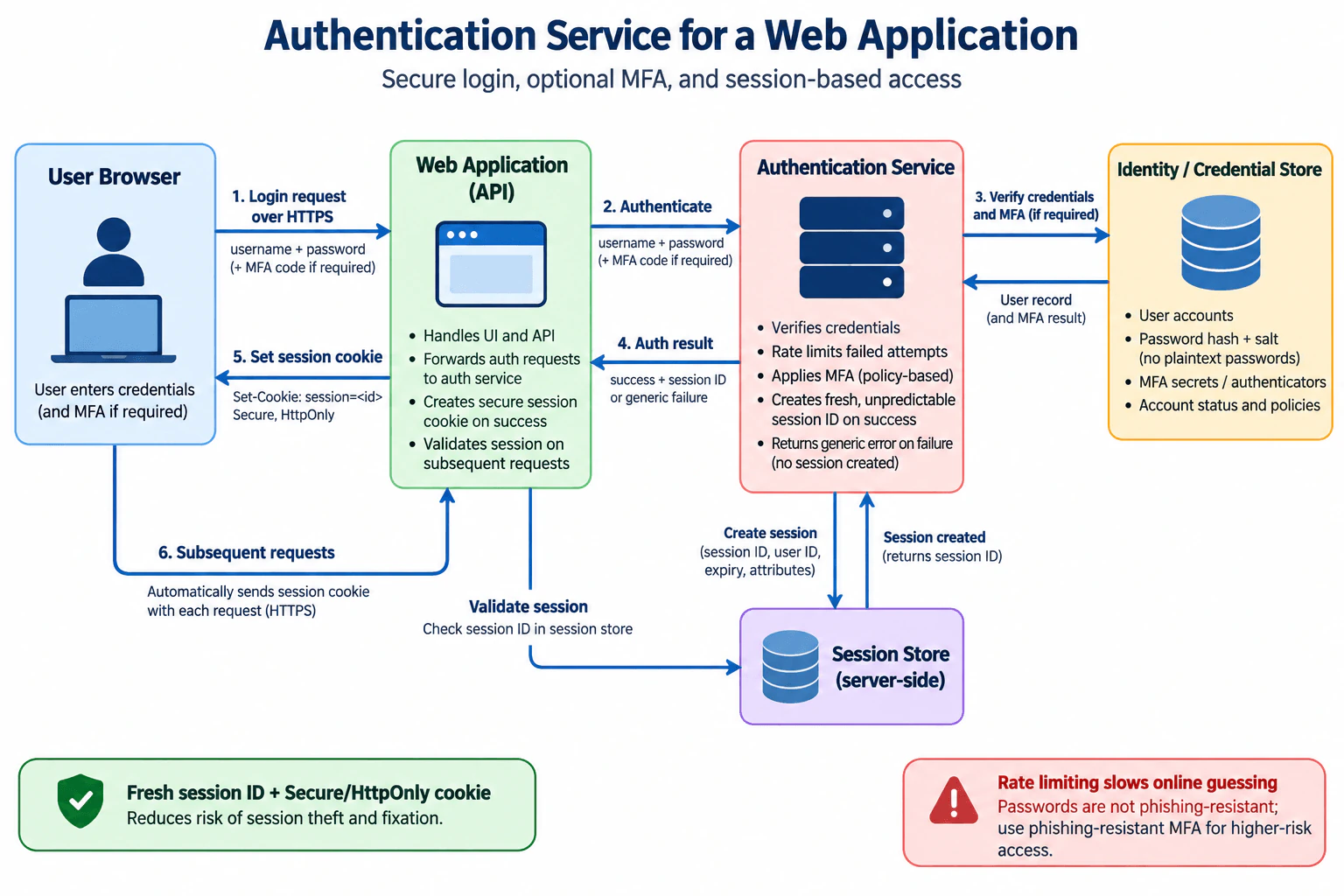
The question asks for the core architecture of a web authentication service, not a complete enterprise identity platform. I would focus on how the user proves identity, how credentials are checked, how authenticated state is created, and how later requests are recognized safely. The main components are the user browser, web application, authentication service, identity and credential store, and server-side session store. The important security decisions are HTTPS, salted password hashes, optional policy-based MFA, rate limiting, unpredictable session identifiers, secure cookies, generic failures, and server-side session validation.

Useful Questions to Ask the Interviewer
  1. Is this a traditional browser-based web application using server-side sessions?
  2. Is multi-factor authentication required for every user, or only when policy requires it?
  3. Do we need only login and session management, or also registration, password reset, and account recovery?
  4. What availability expectations apply if the authentication service or session store is temporarily unavailable?
Design the authentication service for a web application. diagram
How to Explain It in an Interview

I would start with one practical decision: keep credential verification in a dedicated authentication service and use opaque server-side sessions for the browser application.

The user enters a username and password in the browser and submits them to the web application over HTTPS. If policy requires MFA, the authentication flow also collects the required MFA evidence. The web application forwards the authentication request to the authentication service. The browser is an untrusted input source, while credential verification and session creation remain server-side.

The authentication service reads the relevant user record from the identity and credential store. That store contains user accounts, salted password hashes rather than plaintext passwords, MFA authenticators or related secrets when applicable, account status, and authentication policy. The authentication service verifies the submitted credentials and applies any required MFA check.

The service also rate-limits failed authentication attempts. This reduces the effectiveness of online password guessing, although rate limiting alone does not stop phishing or every credential attack.

Authentication fails safely. An incorrect password, failed required MFA check, disabled account, or other failed verification does not create a session. The service returns a generic authentication failure rather than exposing whether the username exists or which exact verification step failed. If the service cannot establish the user's identity, access is not granted.

After successful authentication, the authentication service generates a fresh, unpredictable session ID. It creates a corresponding record in the server-side session store containing the session ID, user ID, expiry, and any attributes required by the application. The session ID is an opaque reference; meaningful session state remains on the server.

The authentication service returns the successful authentication result and session ID to the web application. The web application then sends the browser a session cookie containing that ID. The cookie is marked Secure so it is transmitted over HTTPS and HttpOnly so normal browser JavaScript cannot read it.

For subsequent HTTPS requests, the browser automatically sends the session cookie back to the web application. The application takes the presented session ID and checks it against the server-side session store. Only a valid server-side session establishes the authenticated user for that request. A missing, unknown, expired, or otherwise invalid session must not be accepted as authenticated.

The main control points map directly to likely abuse paths. HTTPS protects credentials and the session identifier in transit. Salted password hashing protects stored passwords from being kept as reusable plaintext secrets. Rate limiting slows online guessing. Generic authentication failures reduce account-enumeration information. Policy-based MFA adds another authentication requirement when appropriate. Fresh, unpredictable session IDs reduce guessing and session-fixation risk, while server-side validation allows sessions to be invalidated centrally.

The design also has operational dependencies. The authentication service needs access to the identity store during login, and the web application depends on the session store when validating authenticated requests. If the session store is unavailable and the application cannot verify a session, protected requests should not be treated as authenticated. This is the secure failure behavior, but it creates an availability tradeoff.

The main residual risk is theft or misuse of a valid session ID. A session ID acts as a bearer secret for that session, so anyone who successfully obtains it may be able to act as that user until the session becomes invalid. HTTPS, fresh unpredictable identifiers, Secure and HttpOnly cookies, expiration, and server-side invalidation reduce this risk but cannot eliminate every browser compromise.

Passwords also are not phishing-resistant. For higher-risk access, the authentication policy can require a phishing-resistant MFA method rather than depending only on a password or manually entered authentication code.

To validate the design, I would test successful authentication, wrong passwords, failed required MFA, repeated failed attempts, disabled accounts, unknown session IDs, expired sessions, logout or revocation, and loss of the session-store dependency. I would verify that failed authentication never creates a session, plaintext passwords are not stored, session IDs are freshly generated and unpredictable, the cookie has the expected Secure and HttpOnly attributes, and protected requests require a valid server-side session.

Technical Approach
  1. Receive the browser's login request through the web application over HTTPS.
  2. Forward the username, password, and MFA evidence when required to the authentication service.
  3. Retrieve the relevant user record, account status, and authentication policy from the identity and credential store.
  4. Verify the password and any policy-required MFA evidence.
  5. Apply rate limiting to repeated failed authentication attempts.
  6. If authentication fails, return a generic failure and create no session.
  7. If authentication succeeds, generate a fresh, unpredictable session ID.
  8. Store the session ID with the user ID, expiry, and required session attributes in the server-side session store.
  9. Return the successful authentication result and session ID to the web application.
  10. Send the session ID to the browser in a Secure, HttpOnly cookie.
  11. On each subsequent HTTPS request, read the session ID supplied by the browser and validate it against the server-side session store.
  12. Treat the request as authenticated only when the stored session is valid.
Practical Complexity & Trade-offs

The main costs are operational rather than algorithmic. Each login requires credential verification and a session-store write. Each later authenticated request requires a session-store lookup, so that store must support the application's authenticated traffic and availability needs. Secure password hashing intentionally consumes computation, which adds login CPU cost. MFA adds user friction and account-recovery work. Rate limiting must balance resistance to guessing with the risk of denying legitimate users. Server-side sessions make central invalidation straightforward but add storage, expiration, replication, monitoring, and recovery responsibilities.

Where it is used

This design fits traditional browser-based applications where the server controls authentication and session state. Examples include customer portals, internal business applications, administrative web interfaces, and account-based websites that need centralized session validation and invalidation. It is useful when the application prefers an opaque session cookie in the browser while keeping the meaningful authenticated state on the server.

Why Interviewers Ask This

This question checks whether the candidate can turn authentication requirements into a simple, defensible security architecture. Interviewers want to see correct separation between the browser, web application, authentication service, credential store, and server-side session store. They also look for safe credential verification, MFA decisions, rate limiting, secure session handling, failure behavior, and an understanding that authentication establishes identity state that must be validated on later requests.

Common interview mistakes

Common mistakes include storing plaintext passwords; using predictable or reused session IDs; putting sensitive session state directly into an opaque session identifier; treating browser input as trusted; creating a session before all required authentication checks succeed; returning different login errors that reveal whether an account exists; failing to rate-limit repeated attempts; sending the session cookie without Secure or HttpOnly; accepting a session ID without checking the server-side session store; treating an unverifiable session as authenticated when the session store fails; and assuming that passwords or manually entered MFA codes are phishing-resistant.

Interview tip

Explain the flow in order: Browser -> Web Application -> Authentication Service -> Identity/Credential Store, followed by Authentication Service -> Session Store. Cover the failure path before the success path, then explain how the Secure, HttpOnly session cookie is validated on every subsequent request.

Interviewer may ask next
Why use a server-side session store instead of putting all authentication state in a self-contained token?

A server-side session store keeps the browser's session credential small and opaque and lets the server control whether that session remains valid. The application can reject an expired, revoked, or missing session record during validation. The tradeoff is that authenticated requests depend on a session-store lookup, so the store becomes an important scaling and availability dependency.

What should happen if the session store is unavailable?

The application should not treat an unvalidated session ID as authenticated. Protected requests should fail closed because the application cannot establish that the presented session is valid. The session store should therefore be operated with appropriate availability and recovery measures, but loss of the dependency must not cause the application to accept unverifiable sessions.

3. How would you protect sensitive production-database data through encryption?Security ArchitectureEasy

Short Interview Answer (30-60 seconds)

I would encrypt database traffic with TLS, encrypt the database and backups at rest, and protect master or key-encryption key material in a separate KMS or HSM. I would restrict and audit key use, rotate or revoke keys when required, apply least privilege, and verify encrypted-backup restores.

Detailed Explanation

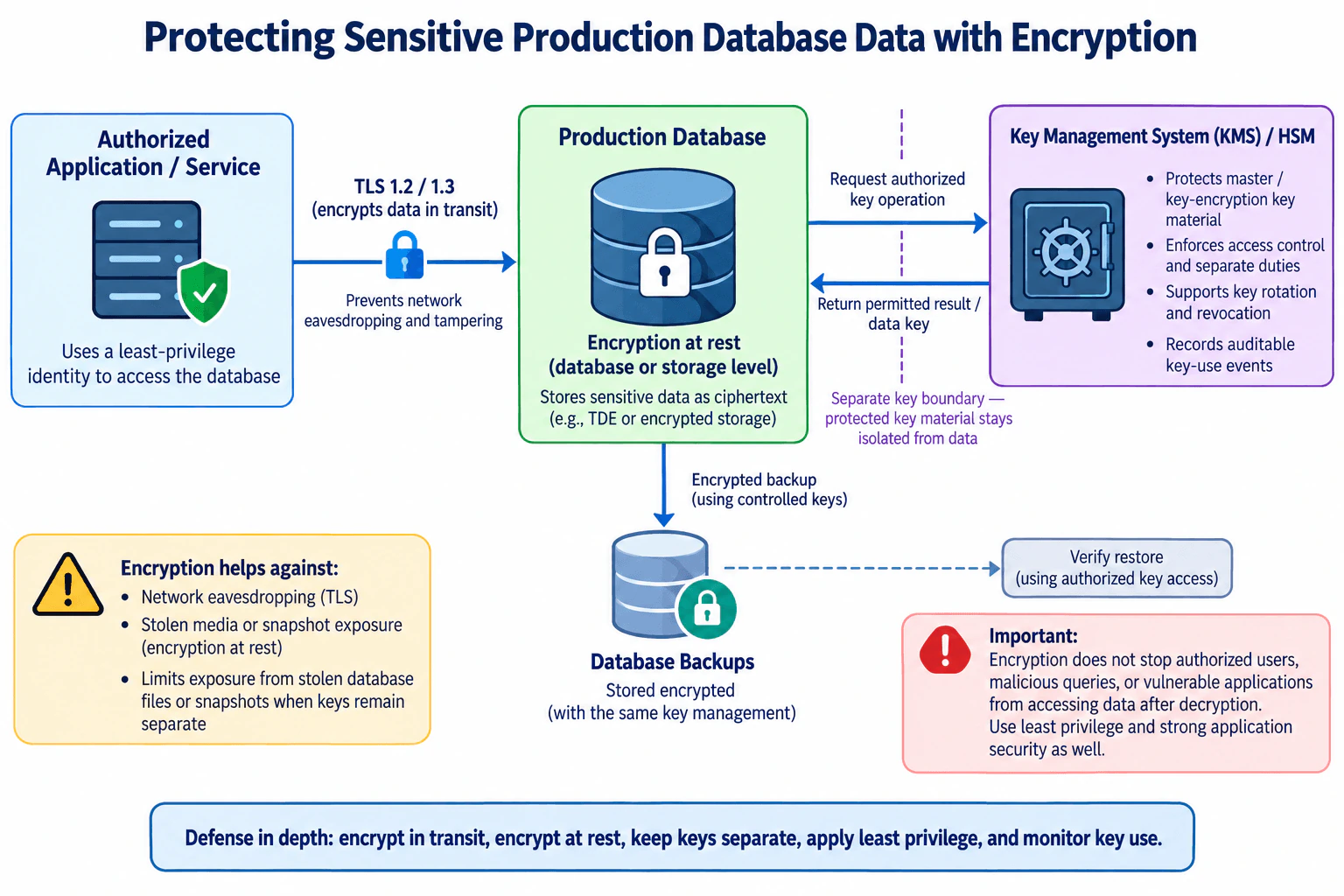
The practical goal is to protect sensitive production data both while it moves and while it is stored. I would use several connected controls instead of depending on one encryption setting. The authorized application would connect to the production database over TLS 1.2 or TLS 1.3. The database and its backups would remain encrypted at rest. Protected master or key-encryption key material would stay behind a separate KMS or HSM boundary. Database access and key access would be controlled separately, and recovery would be verified through authorized restore tests.

Useful Questions to Ask the Interviewer
  1. Which production data is considered sensitive and must be encrypted?
  2. Does the database platform already support database-level or storage-level encryption?
  3. Is there an existing KMS or HSM that should protect the encryption keys?
  4. Are backups and snapshots included in the encryption requirement?
  5. What availability and recovery behavior is required if key operations are temporarily unavailable?
How would you protect sensitive production-database data through encryption? diagram
How to Explain It in an Interview

I would start with defense in depth. The protected asset is sensitive production-database data. The main workload is an authorized application or service that needs database access. I would give that workload a least-privilege identity so it receives only the database permissions required for its function.

First, I would protect data in transit. The application-to-database connection would use TLS 1.2 or TLS 1.3. This protects the confidentiality and integrity of data moving across the network, reducing the risk from network eavesdropping and tampering. I would not intentionally fall back to an unencrypted database connection when protected transport is required.

Second, I would encrypt the production database at rest using the database or storage encryption capability. The objective is for sensitive information stored in database files or underlying storage to be ciphertext when it is not actively being processed. This helps protect against exposure of stolen database files, storage media, snapshots, or similar stored copies. Depending on the threat model and platform, encryption can exist at different layers, but for this design I would keep the implementation aligned with database-level or storage-level encryption shown in the architecture.

Third, I would separate key protection from the database-data boundary. A dedicated Key Management System, or KMS, or a Hardware Security Module, or HSM, would protect master or key-encryption key material. The production database would request an authorized key operation when cryptographic access is required. The key-management boundary would return only the permitted cryptographic result or data-key material required by the design. Protected master or key-encryption key material would remain isolated from the database data instead of being stored beside it.

Key access would use least privilege and separation of duties. Database administration should not automatically provide unrestricted access to protected key material, and key administration should not automatically provide unrestricted access to production data. The key-management process would support controlled rotation and revocation. Key-use events would also be recorded so security teams have evidence of authorized and unexpected cryptographic activity.

I would encrypt database backups and snapshots as well. Protecting the live database is not enough if a backup creates an unencrypted copy of the same sensitive data. Backups would therefore remain encrypted using controlled key management. I would perform authorized restore tests to confirm that encrypted backups can actually be recovered and that the required key access is still available.

For safe failure behavior, I would not bypass required encryption when TLS or a required key operation fails. A database connection that requires encrypted transport should not silently become plaintext. If the KMS or HSM cannot authorize a required key operation, the affected operation should fail safely or follow an explicitly designed degraded mode that does not expose sensitive data unencrypted. The exact availability behavior depends on the application's recovery and uptime requirements because key management becomes an important dependency.

The evidence I would review includes successful TLS-protected connections, database encryption configuration, encrypted-backup status, authorized key-use records, rotation and revocation tests, and successful controlled restore tests. These checks help verify that the architecture is operating as intended instead of existing only as a design document.

The important limitation is that encryption does not stop every way data can be exposed. An authorized user, malicious query executed through authorized access, or compromised application may still receive plaintext after legitimate decryption. That is why the architecture also relies on least privilege and strong application security. Encryption mainly protects data while crossing the network and ciphertext stored in database files, storage media, snapshots, and backups when the required key material remains separately protected.

The main tradeoff is operational complexity. Separate key management, access policies, rotation, revocation, auditing, backup encryption, dependency handling, and restore testing require engineering and operational effort. The benefit is stronger separation between encrypted data and the key material required to use it, reducing exposure when stored copies are lost or accessed without the authorized cryptographic path.

Technical Approach
  1. Identify the sensitive production-database data that requires encryption.
  2. Allow only the authorized application or service to access the database using a least-privilege identity.
  3. Require TLS 1.2 or TLS 1.3 for application-to-database traffic.
  4. Enable database-level or storage-level encryption at rest so stored database data is ciphertext.
  5. Protect master or key-encryption key material behind a separate KMS or HSM boundary.
  6. Permit only the key operations or data-key access required by the authorized workload.
  7. Separate database administration from key administration where practical.
  8. Support controlled key rotation and revocation and record auditable key-use events.
  9. Encrypt database backups and snapshots using controlled key management.
  10. Perform authorized restore tests to verify that encrypted backups and their required key access remain recoverable.
  11. Fail safely rather than falling back to plaintext when required TLS or key authorization is unavailable.
  12. Monitor encryption configuration, key-use evidence, and restore results while recognizing that encryption cannot prevent an authorized or compromised application from accessing plaintext after decryption.
Practical Complexity & Trade-offs

The main cost is operational rather than algorithmic. TLS and encryption at rest add some processing overhead, although the exact impact depends on the database, workload, hardware, and implementation. A KMS or HSM adds infrastructure cost, access-policy management, key lifecycle work, auditing, and an availability dependency. Encrypted backups require careful retention of usable key access and regular restore testing. Separation of duties also increases administrative work because database and key permissions must be managed independently. The security benefit is stronger protection for network traffic and stored database copies when an unauthorized party does not also obtain the required decryption path.

Where it is used

This architecture is appropriate for production systems that store sensitive customer, financial, business, authentication-related, or other confidential information. It is useful when database files, snapshots, storage media, or backups could be exposed outside the running database environment. The provider-neutral pattern can be applied to managed or self-hosted databases when the environment supports encrypted transport, encryption at rest, separate key management, encrypted backups, and authorized recovery operations.

Why Interviewers Ask This

The interviewer wants to see whether I understand that protecting production-database data requires more than enabling one encryption setting. A strong answer connects encryption in transit, encryption at rest, independent key management, least privilege, separation of duties, encrypted backups, controlled key lifecycle operations, audit evidence, recovery testing, safe failure behavior, and the limitation that legitimate access can still expose decrypted data.

Common interview mistakes

Common mistakes include enabling encryption at rest while leaving application-to-database traffic unencrypted; storing protected key material beside the encrypted database; giving applications or administrators broader database or key privileges than they need; assuming encryption prevents an authorized application from reading decrypted data; encrypting the live database while leaving snapshots or backups unencrypted; rotating, revoking, or deleting keys without considering existing encrypted data and backups; silently falling back to plaintext when an encryption dependency fails; and claiming backups are protected without testing an authorized restore. Another mistake is treating encryption as a replacement for least privilege and application security.

Interview tip

Lead with three layers: TLS for data in transit, encryption at rest for the database and backups, and a separate KMS or HSM boundary for protected key material. Then mention least privilege, separation of duties, rotation, revocation, audit evidence, and restore testing. End with the limitation that encryption cannot stop an authorized or compromised application from accessing data after decryption.

Interviewer may ask next
Why should encryption keys be kept separate from the encrypted production database?

Separating protected key material from encrypted data creates an additional authorization boundary. If someone obtains only database files or snapshots, they should not automatically obtain the protected master or key-encryption material needed to use them. The database requests only authorized cryptographic operations or permitted data-key material from the KMS or HSM. This does not fully protect against a compromised workload that is already authorized to decrypt data, but it reduces exposure when stored ciphertext is obtained without the authorized key path.

What should happen if the KMS or HSM is unavailable or required key access is lost?

I would not bypass encryption by falling back to plaintext. Operations that require an unavailable or unauthorized key operation should fail safely or enter an explicitly designed degraded mode that does not expose sensitive data unencrypted. Because key management is an availability dependency, its resilience and recovery must match the system's needs. Required historical key access must also remain available for encrypted backups, and controlled restore tests should verify recovery. If the only usable decryption key material is permanently lost, the encrypted data may become unrecoverable.

4. Design an enterprise platform for securely sharing files.Security ArchitectureMedium

Short Interview Answer (30-60 seconds)

Build one controlled path: authenticate users and devices, authorize each file action, quarantine and validate uploads, encrypt approved files with separately managed keys, issue short-lived recipient access, record tamper-resistant audit evidence, and maintain versioned backups with tested recovery.

Detailed Explanation

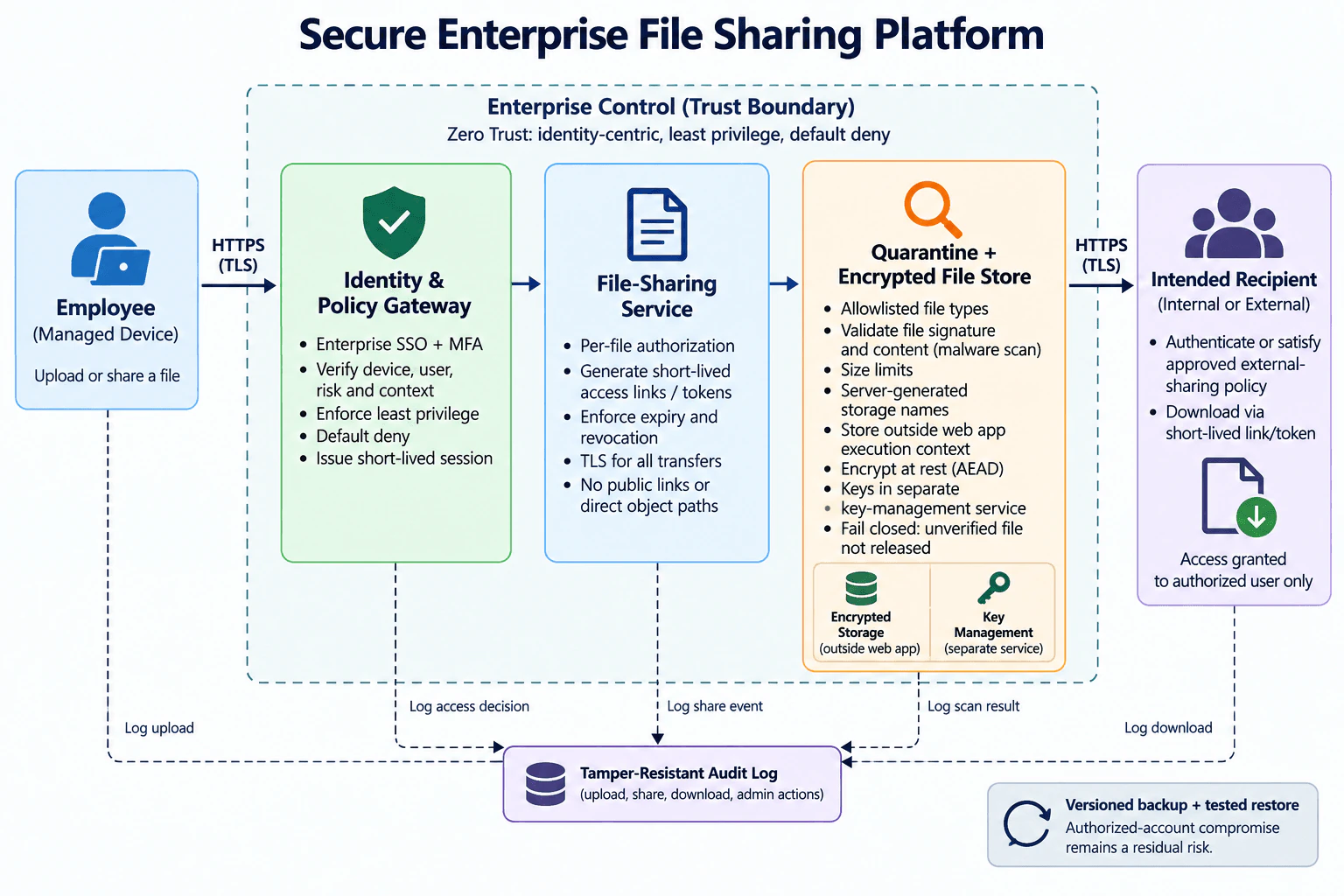
The question asks for one defensible enterprise architecture that lets employees share files with internal or approved external recipients without exposing storage directly. The design should protect file confidentiality and integrity, prevent unauthorized access, treat uploaded files as untrusted until validated, keep encryption keys separate from stored data, record reliable security evidence, and provide recoverability. The approved diagram places identity, policy, the file-sharing service, quarantine, encrypted storage, and key management inside an enterprise-controlled trust boundary, while employees and recipients cross that boundary through controlled HTTPS paths.

Useful Questions to Ask the Interviewer
  1. Are recipients only employees, or must approved external partners also receive files?
  2. What file types are required for the business, and which should be prohibited?
  3. Must every external recipient authenticate, or can an approved external-sharing policy allow time-limited access?
  4. What retention and recovery expectations apply to stored files and audit evidence?
  5. How quickly must an existing share be revocable?
Design an enterprise platform for securely sharing files. diagram
How to Explain It in an Interview

I would start with the trust boundary. The employee and intended recipient are outside the enterprise-controlled service boundary. The Identity & Policy Gateway, File-Sharing Service, Quarantine + Encrypted File Store, encrypted storage, and separate key-management service are inside it. Network location alone is not trusted. Authentication and authorization happen before access to the protected file-sharing resource.

The first control point is the Identity & Policy Gateway. The employee signs in through enterprise single sign-on with multi-factor authentication. The gateway evaluates the user, managed device, risk, and request context. It applies least privilege and a default-deny policy. If identity or policy cannot be verified, the request is denied instead of being allowed. A successful decision produces a short-lived session rather than an unnecessary long-lived credential.

The File-Sharing Service performs authorization at file level. Authentication alone does not mean the user may read or share every file. The service checks permission for the requested file, creates short-lived access links or tokens, and supports expiry and revocation. It does not expose public links or direct storage-object paths. This keeps the application in the authorization path and limits how long a stolen link or token remains useful.

Every new upload enters quarantine before it can be released. The platform allowlists business-approved file types, validates file signatures and content, enforces size limits, generates server-controlled storage names, and scans content for malware. These controls are layered because a filename extension or file signature alone is not sufficient validation. Uploaded files stay outside the web application's execution context. If validation is incomplete, fails, or a required scanning dependency is unavailable, the file remains quarantined and is not released. That is the diagram's fail-closed behavior.

After validation succeeds, the file is stored encrypted at rest using AEAD, meaning authenticated encryption with associated data. Encryption keys are kept in a separate key-management service rather than stored together with ordinary file data. Separating the file store from key management reduces the blast radius of a storage-only compromise. It does not eliminate risk if a highly privileged application identity or the key-management service itself is compromised.

Transfers across the employee and recipient boundaries use HTTPS with TLS. TLS protects confidentiality and integrity of data in transit after the secure channel is established. TLS does not replace authorization. An unauthorized user can still create an encrypted connection, so identity checks and per-file authorization remain required.

For the recipient path, an internal recipient authenticates normally. An external recipient must either authenticate or satisfy an approved external-sharing policy. The recipient downloads through a short-lived link or token and receives access only to the authorized file. Expired or revoked access is denied. The design intentionally avoids permanent anonymous public links.

Detection and evidence are separate from prevention. The architecture records uploads, access decisions, share events, scan results, downloads, and administrative actions in a tamper-resistant audit log. That evidence supports investigation of denied requests, suspicious sharing, scan failures, downloads, or administrative changes. The logging path should be protected so ordinary application access cannot silently rewrite its own history.

Recovery is also separate. The design uses versioned backups and tested restore procedures. A backup is useful only if the organization can restore from it successfully. Recovery should use authorized procedures and should not become a bypass around normal access controls.

Operational ownership should be separated by responsibility. The file-sharing platform operates the application and storage path, security ownership governs identity and sharing policy and reviews audit evidence, and key and recovery operations should use tightly controlled privileged access. Administrative actions are logged because privileged changes can affect the security of the entire platform.

The main tradeoff is security versus convenience, latency, cost, and operational complexity. MFA and contextual checks add authentication friction. Quarantine and malware scanning add upload latency. Short-lived links are safer but may expire while a legitimate recipient is still working. Separate key management, tamper-resistant logging, and tested recovery add infrastructure and operational effort. These costs are justified when enterprise files should not be exposed through direct or permanent public access.

The main residual risk is authorized-account compromise. A compromised user may still request files that the account is legitimately permitted to access, and a valid recipient may copy information after download. Least privilege, short-lived access, revocation, context-aware policy, audit evidence, and recovery reduce the impact, but they do not prove that every authorized user is benign.

Technical Approach
  1. Authenticate the employee through enterprise SSO with MFA.
  2. Evaluate user identity, managed-device state, risk, and request context at the Identity & Policy Gateway.
  3. Apply least privilege and default deny; reject the request when the policy decision does not explicitly allow it.
  4. Perform per-file authorization in the File-Sharing Service.
  5. Create only short-lived, revocable links or tokens and avoid public links or direct storage-object paths.
  6. Place every new upload in quarantine before release.
  7. Allowlist required file types, validate signatures and content, enforce size limits, generate server-controlled storage names, and perform malware scanning.
  8. Fail closed by keeping any unverified file quarantined rather than releasing it.
  9. Encrypt approved files at rest using authenticated encryption and keep keys in a separate key-management service.
  10. Require the intended recipient to authenticate or satisfy the approved external-sharing policy before download.
  11. Use HTTPS with TLS for transfers across the employee and recipient boundaries.
  12. Send upload, access-decision, share, scan, download, and administrative events to the tamper-resistant audit log.
  13. Maintain versioned backups and regularly test authorized restore procedures.
Practical Complexity & Trade-offs

The main costs are operational rather than algorithmic. Identity checks and per-file authorization add decision work to each request. Quarantine and malware scanning add upload delay and consume compute capacity. Encrypted storage, a separate key-management service, tamper-resistant audit logging, and versioned backups add infrastructure and administration. Short-lived links require expiry and revocation handling. More controls reduce exposure but also increase cost, maintenance, dependency count, and the chance that a failed dependency temporarily blocks legitimate sharing.

Where it is used

This architecture fits enterprise document exchange, internal collaboration, controlled sharing with business partners, engineering artifact exchange, and other authorized workflows where files must be available only to explicitly permitted users instead of through permanent public links. It is especially appropriate when uploaded files are untrusted input and when the enterprise needs reliable evidence of access and sharing activity.

Why Interviewers Ask This

This question tests whether a candidate can turn security principles into one coherent enterprise design rather than listing disconnected controls. A strong answer connects identity, authorization, secure upload handling, encrypted storage, key separation, controlled recipient access, audit evidence, safe failure behavior, recovery, and residual risk while explaining the tradeoffs between security, usability, latency, and operational complexity.

Common interview mistakes

Common mistakes include making file storage directly public; treating successful authentication as authorization for every file; creating permanent anonymous links; trusting only filename extensions or client-supplied content types; releasing a file before validation completes; storing uploaded content in the web application's execution context; keeping encryption keys together with ordinary stored data; treating TLS as a replacement for authorization; failing open when malware scanning is unavailable; logging only successful downloads while omitting access decisions, share events, scan results, and administrative actions; assuming backups are sufficient without testing restore; and claiming that MFA or malware scanning eliminates the risk of an already authorized account being compromised.

Interview tip

Explain the architecture as one path: identity decision, per-file authorization, quarantine and validation, encrypted storage with separate keys, controlled recipient access, tamper-resistant evidence, and tested recovery. For each control, explain what boundary or failure it addresses, then finish with the residual risk of authorized-account compromise.

Interviewer may ask next
What should happen if the malware scanner or another validation dependency is unavailable?

Fail closed for release. Keep the uploaded file in quarantine and do not make it available to recipients until required validation succeeds. Record the incomplete or failed scan state in the audit trail and retry according to the platform's operational policy. This protects users from treating a security-service outage as permission to bypass validation. The tradeoff is reduced availability for new files while scanning is degraded.

How would you reduce the risk from a stolen sharing link or a compromised authorized account?

Keep access file-specific, short-lived, and revocable; require recipient authentication or an explicitly approved external-sharing policy; evaluate identity and context before granting access; and prevent direct public storage paths. Record access decisions and downloads in tamper-resistant audit evidence. These controls reduce exposure and token lifetime, but they cannot fully prevent a compromised user from exercising permissions that account legitimately has, so authorized-account compromise remains residual risk.

5. Design a secrets-management service for a microservices system.Security ArchitectureMedium

Short Interview Answer (30-60 seconds)

I would centralize secrets, authenticate each microservice with workload identity over mTLS, enforce fine-grained least privilege, and return short-lived or dynamic credentials where possible. The workload uses the credential directly with the protected resource. Stored secrets are encrypted with separately controlled keys, rotated and revoked, audited, and denied fail closed when authorization fails.

Detailed Explanation

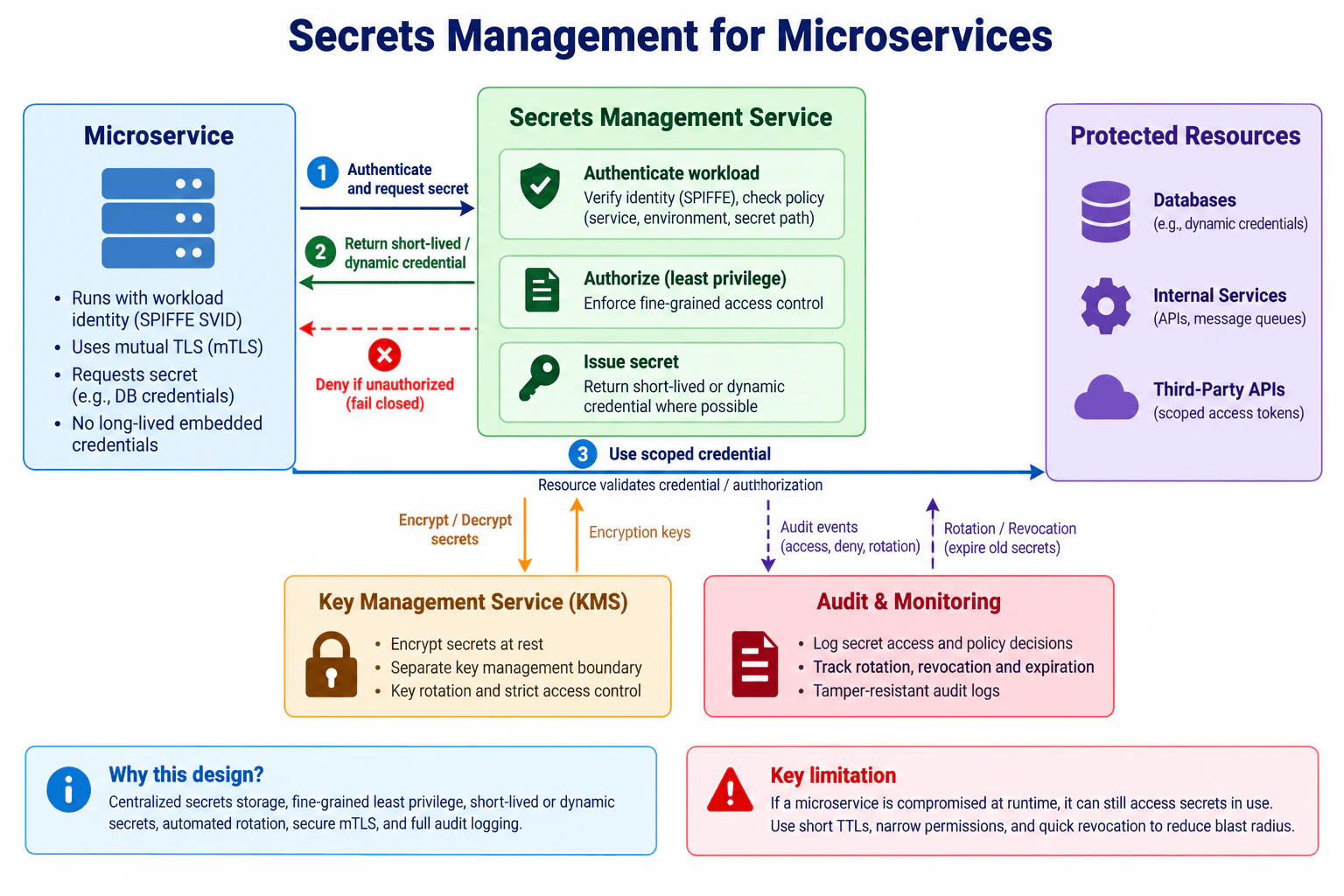
The practical design is a centralized secrets-management service between microservices and their sensitive credentials. A microservice proves its workload identity, requests only the credential it needs, and receives it only after authentication and authorization succeed. The credential should be short-lived or dynamically generated where the protected resource supports that model. The microservice then uses the scoped credential directly with the database, internal service, message queue, or third-party API. Stored secrets are protected through a separate key-management boundary. Rotation, revocation, expiration, and access decisions are audited. This reduces credential exposure and blast radius, while adding a security-sensitive runtime dependency and operational complexity.

Useful Questions to Ask the Interviewer
  1. Do the microservices already have a workload-identity system, or should the design provide one?
  2. Which protected resources need credentials: databases, internal services, message queues, third-party APIs, or a combination?
  3. Can those resources issue dynamic or short-lived credentials, or do some require centrally stored static secrets?
  4. What availability requirement applies to the secrets-management service and workload-identity dependency?
  5. How quickly must compromised credentials be revoked or rotated?
Design a secrets-management service for a microservices system. diagram
How to Explain It in an Interview

I would start with the runtime path. Each microservice runs with a workload identity rather than an embedded long-lived credential. In the approved design, that identity is represented by a SPIFFE Verifiable Identity Document, or SVID. An X.509 SVID is an X.509 certificate containing a SPIFFE workload identity and can be used to authenticate workloads and establish mutually authenticated TLS, or mTLS, channels.

The microservice establishes mTLS with the secrets-management service and requests a specific secret or credential. Authentication answers, "Which workload is calling?" Authorization answers, "May this workload obtain this credential?" The secrets service checks fine-grained least-privilege policy using the verified service identity and relevant approved context such as the environment and requested secret. A service receives only the secrets required for its role.

If identity validation fails, authorization denies the request, or the required authorization decision cannot be completed safely, the request fails closed and no credential is returned. This prevents a validation failure from becoming an access bypass. The availability tradeoff is that a workload needing a fresh credential may be unable to perform the protected operation while a required secrets or identity dependency is unavailable.

After authorization succeeds, the service returns a short-lived or dynamically generated credential where possible. Dynamic credentials reduce credential reuse and limit the useful lifetime of a stolen credential. When the protected system cannot support dynamic issuance, a centrally stored static secret can still be tightly authorized, encrypted, rotated, revoked, and audited. Long-lived credentials should not be embedded in source code or container images.

The direction of the credential flow matters. The secrets-management service returns the credential to the requesting microservice. The microservice then presents that scoped credential directly to the protected database, internal service, message queue, or third-party API. The protected resource validates the presented credential and applies its own authorization rules. The secrets-management service does not perform the microservice's normal application request to the protected resource.

Stored secrets need protection at rest. The design uses a separate Key Management Service, or KMS, boundary for cryptographic key operations. The secrets service uses authorized encryption and decryption operations while access to key material is separately controlled. This separation means access to stored ciphertext alone is not sufficient to recover plaintext secrets. KMS administration should be more restricted than normal secret consumption, with key access governed through strict policy.

Secrets also need a lifecycle. Dynamic credentials should have short expiration times appropriate to their use. Static secrets should be rotated automatically where possible. Credentials that are no longer required or are suspected of compromise should be revoked promptly. Rotation must be coordinated with the protected resource because updating a value only inside the secrets-management service does not necessarily change the credential that the downstream resource accepts.

Audit and monitoring provide evidence. Record which workload requested a secret, the access decision, and lifecycle events such as rotation, revocation, and expiration. Do not place plaintext secret values in logs. Protect audit evidence against unauthorized modification or deletion. Monitoring should detect suspicious access patterns, repeated denials, unexpected secret requests, failed rotations, expired-credential use, and other useful signals. Confirmed misuse should trigger the smallest safe response, such as revoking the affected credential and issuing a replacement after the workload is returned to a trusted state.

Operational ownership should also be separated. Application teams define which credentials their workloads require. The platform or security team operates the workload-identity and secrets-management infrastructure. Key-management administration is more restricted than application secret consumption. Policy changes, key administration, rotation, revocation, and emergency actions should produce auditable records.

The main residual risk is runtime compromise. If an attacker gains control of a microservice that is legitimately authorized to obtain and use a database credential, the attacker may be able to use that same capability while controlling the workload. Secrets management cannot remove permissions the application genuinely needs. The design reduces this blast radius through workload-specific identities, narrow authorization, scoped credentials, short lifetimes, rapid revocation, and audit monitoring.

The main tradeoff is stronger security versus availability and operational complexity. Short-lived credentials reduce exposure but require renewal and make the secrets service more important at runtime. Fine-grained policy reduces blast radius but requires careful maintenance. A separate KMS adds another protected dependency. These costs are justified because the design replaces scattered reusable credentials with a centralized, controlled, auditable lifecycle for authentication, authorization, issuance, use, rotation, revocation, and monitoring.

Technical Approach
  1. Give each microservice a verifiable workload identity instead of an embedded long-lived credential.
  2. Require the microservice to authenticate to the secrets-management service over mTLS.
  3. Authorize each request with fine-grained least-privilege policy tied to the verified workload and requested secret.
  4. Fail closed and return no credential when authentication or authorization fails or cannot be safely completed.
  5. Return a short-lived or dynamic credential where the protected resource supports it; otherwise tightly manage the required static secret.
  6. Have the microservice present the scoped credential directly to the protected resource, which validates the credential and performs its own authorization.
  7. Encrypt stored secrets through a separately controlled KMS boundary.
  8. Automate expiration, rotation, and revocation while coordinating credential changes with the protected resource.
  9. Record secret access, allow and deny decisions, rotation, revocation, and expiration without logging plaintext secrets.
  10. Monitor suspicious activity and use narrow permissions, short lifetimes, and rapid revocation to reduce the impact of compromise.
Practical Complexity & Trade-offs

The design adds network calls, policy management, key-management operations, rotation workflows, monitoring, and operational ownership. Short-lived credentials create more renewal traffic and can make secrets-service availability important to application operations. Fine-grained policies require maintenance but reduce the damage one compromised service can cause. Automated rotation reduces repeated manual work but must be coordinated with downstream resources. Separating key management adds another dependency and administrative boundary, but it reduces the risk of one component controlling both stored encrypted secrets and their protection.

Where it is used

This design fits microservice environments where workloads need database credentials, temporary database accounts, internal-service credentials, message-queue credentials, certificates, scoped API tokens, or third-party API secrets. It is especially useful when independently deployed services require different permissions and credentials must be centrally controlled, rotated, revoked, audited, and kept out of source code and container images.

Why Interviewers Ask This

This question tests whether the candidate can design a practical secrets lifecycle instead of scattering credentials through source code, images, or configuration. A strong answer connects workload identity, authentication, authorization, secret issuance, downstream resource access, encryption, key management, rotation, revocation, audit evidence, failure behavior, and residual risk. It also tests whether the candidate understands that secrets management reduces credential exposure but cannot stop a compromised workload from exercising every permission that the legitimate workload itself requires.

Common interview mistakes

Common mistakes include storing secrets in source code or container images; sharing one broad credential across unrelated services; confusing authentication with authorization; granting a workload access to more secrets than it needs; using long-lived static credentials when short-lived or dynamic credentials are supported; showing the secrets manager as if it performs the workload's downstream application request; logging plaintext secrets; rotating a stored value without coordinating the protected resource; granting application workloads unnecessary KMS administration permissions; failing open when authentication or authorization cannot be safely completed; and claiming that secrets management fully protects a workload that is already compromised at runtime.

Interview tip

Present the design as one three-step runtime flow: the workload authenticates and requests a credential, the secrets service authorizes and returns a short-lived or dynamic credential, and the workload uses that scoped credential directly with the protected resource. Then explain KMS-backed encryption, rotation and revocation, fail-closed behavior, audit monitoring, and the residual risk of runtime compromise.

Interviewer may ask next
How would you rotate a credential without breaking running microservices?

Prefer dynamic or short-lived credentials because expiration naturally limits old credentials. For a static credential, coordinate rotation with the protected resource. Where the resource supports overlapping credentials, create or activate the replacement, update the secrets-management service, allow workloads to retrieve the new value, verify successful use, and then revoke the old credential. Record the lifecycle events and alert on failures. The exact sequence depends on the downstream resource, so changing only the value stored in the secrets service is not sufficient.

What happens if a microservice is compromised and the attacker can request its secrets?

The secrets-management service cannot fully prevent a compromised workload from exercising permissions that the legitimate workload itself requires. Reduce the blast radius with a unique workload identity, narrow secret authorization, resource-scoped credentials, short lifetimes, rapid revocation, protected audit evidence, and monitoring for unusual requests or use. Avoid sharing credentials across unrelated services. These controls reduce how much an attacker can access and for how long, but runtime compromise remains a residual risk.

6. Design secure identity and access management for employees and external partners.Security ArchitectureHard

Short Interview Answer (30-60 seconds)

I would separate employee and partner identity trust, federate both into one policy layer, require phishing-resistant MFA where applicable, evaluate role and context, use short-lived restricted access, enforce least privilege on every protected request, and default deny when identity or policy checks fail.

Detailed Explanation

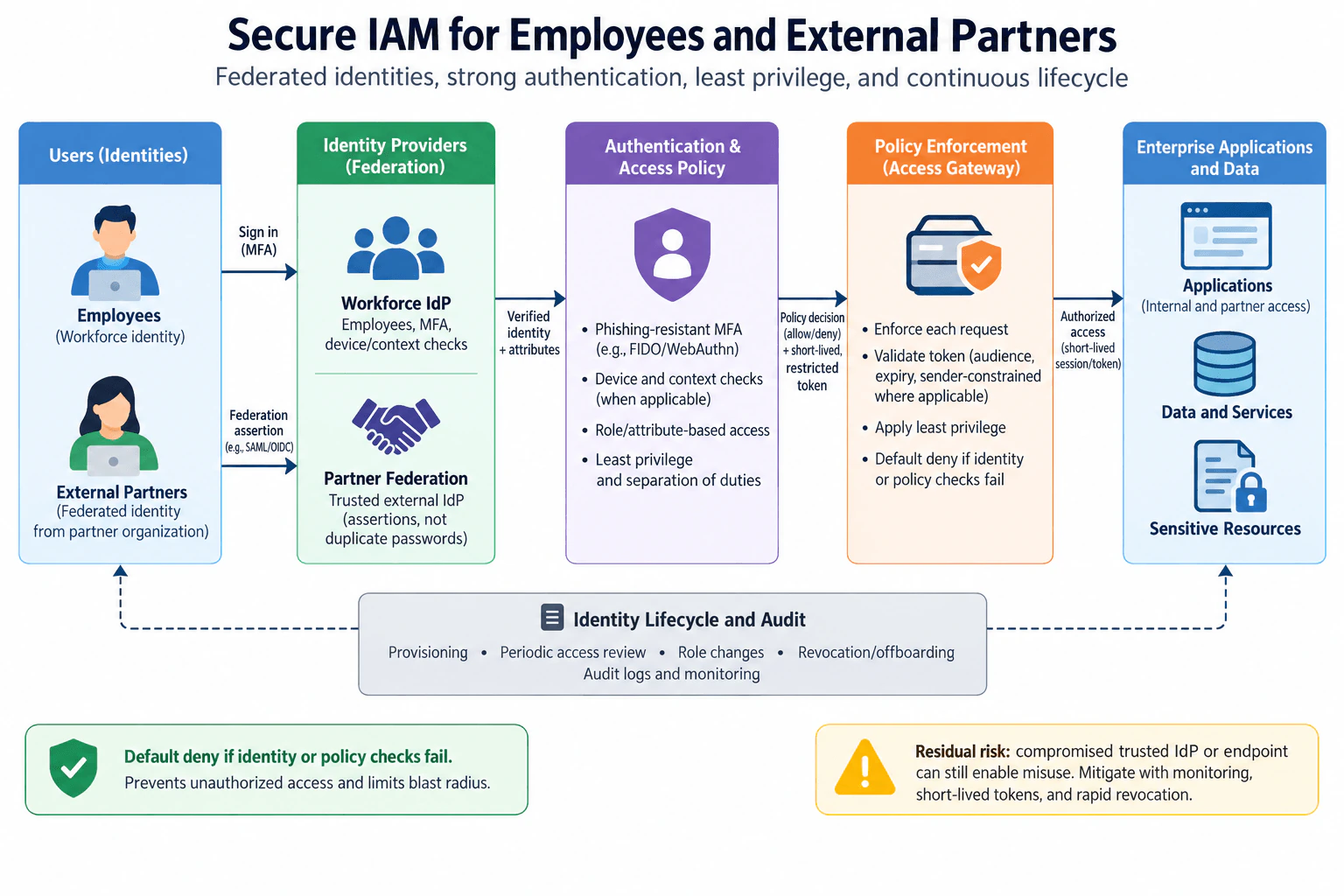
The question asks for one secure IAM design that supports employees controlled by the organization and external partners whose identities may be controlled by another organization. The key decision is to keep those trust paths separate while applying one consistent authorization policy before protected resources. Employees use the workforce identity provider, while partners federate from an approved external identity provider rather than receiving duplicate passwords. Both paths require strong authentication, least-privilege authorization, short-lived restricted access, lifecycle controls, useful audit evidence, and default-deny behavior when identity or policy validation cannot be trusted.

Useful Questions to Ask the Interviewer
  1. Are employee devices managed, and can device or context signals be used during access decisions?
  2. Do partner organizations already have trusted identity providers that support SAML or OpenID Connect federation?
  3. Which applications, data, services, or sensitive resources may partners access?
  4. Which roles require separation of duties or stronger approval?
  5. How quickly must access be revoked after an employee leaves, a role changes, or a partner relationship ends?
Design secure identity and access management for employees and external partners. diagram
How to Explain It in an Interview
1. Separate the two identity trust paths

Employees authenticate through a workforce identity provider, or IdP. That IdP manages workforce identities, MFA, and applicable device or context checks. External partners remain identities of their own organizations and federate through approved partner IdPs instead of receiving duplicate enterprise passwords.

The partner boundary matters because the enterprise is accepting identity information from another organization. SAML can carry signed federation assertions. OpenID Connect, or OIDC, is an identity layer on OAuth 2.0 that uses claims and ID Tokens to communicate authenticated identity information. openid.net The enterprise should trust only approved federation relationships and still make its own authorization decision for protected resources.

2. Require strong authentication

The authentication and access-policy layer should require phishing-resistant MFA where applicable. WebAuthn used with FIDO2 authenticators is a standard example of phishing-resistant authentication because it cryptographically binds authentication to the verifier rather than relying on a manually entered one-time code. NIST SP 800-63B-4 identifies WebAuthn/FIDO2 as an example that provides phishing resistance through verifier-name binding. pages.nist.gov

For employees, the workforce IdP can enforce the required authentication policy. For partners, the enterprise should accept federation only from trusted partner IdPs and require authentication strength appropriate to the requested access.

3. Separate authentication from authorization

Authentication establishes the user's identity. It does not automatically authorize access. The next stage evaluates the verified identity and relevant attributes against policy.

Use role-based access control when permissions naturally follow stable job or partner roles. Use attribute-based access control when the decision depends on subject, resource, requested operation, or environmental attributes. NIST describes ABAC as making authorization decisions by evaluating those attributes against policy. csrc.nist.gov

Apply least privilege to both populations. Employees receive only the access their roles require. Partners receive only the applications, data, services, and actions explicitly approved for the partner relationship. Apply separation of duties where one person should not control conflicting or sensitive actions.

4. Enforce policy before protected resources

Every protected request passes through the policy-enforcement point, shown in the diagram as an access gateway. It validates the authorization material and applies the current policy before allowing access to enterprise applications, data, services, or sensitive resources.

Validate important token properties such as the intended audience and expiration. Use short-lived sessions or tokens so stolen authorization material has a limited useful lifetime. Where the protocol and application support it, sender-constrained tokens can further reduce replay risk by requiring proof that the requester possesses the associated key. OAuth DPoP is one standardized example of sender-constraining OAuth tokens to reduce unauthorized reuse of stolen tokens. rfc-editor.org

The secure default is deny. If identity validation fails, required policy information is unavailable, the token is invalid or expired, or the policy decision cannot be trusted, the gateway does not silently grant access.

5. Manage the complete identity lifecycle

IAM security continues after login. Provision only the access initially required. Perform periodic access reviews. Update privileges when roles change. Revoke access promptly during offboarding or when a partner relationship ends.

The same lifecycle applies to both employees and partners, but the ownership differs. The workforce identity team controls employee identity state. The enterprise establishes and reviews partner federation trust. Application or resource owners approve the permissions that their systems expose. This supports separation of duties between identity administration and resource authorization.

6. Maintain audit evidence and monitoring

Record authentication events, federation events, policy decisions, important entitlement changes, access reviews, revocations, and access to protected resources. Protect those records from ordinary-user modification so they remain useful evidence.

Monitoring should detect signals such as repeated authentication failures, unexpected partner access, use after revocation, unusual privilege changes, or attempts to access resources outside approved scope. If misuse is confirmed, revoke the affected session or authorization, remove the underlying entitlement when appropriate, investigate the audit evidence, correct the identity or policy state, and verify the result before restoring access.

7. Understand the main trust boundaries

The first boundary is between an external partner organization and the enterprise. A partner IdP can provide trusted identity information only within the established federation relationship.

The second boundary is between an authenticated identity and protected enterprise resources. Crossing that boundary requires an explicit authorization decision and enforcement of least privilege.

The lifecycle and audit path provides the evidence and administrative control needed to create, review, change, and revoke access over time.

8. Explain safe failure and recovery

If the workforce IdP, partner federation path, or policy decision cannot provide trustworthy validation, new protected access should fail closed. Previously issued short-lived access naturally expires, and suspected sessions or tokens should be revoked when the system supports revocation.

Recovery means restoring a verified identity and policy state, not merely bringing the service back online. Confirm that revoked identities remain revoked, incorrect entitlements have been removed, approved access works as expected, and audit evidence shows the expected behavior.

9. State the tradeoff and residual risk

Strong authentication, device or context checks, frequent policy evaluation, short-lived access, lifecycle reviews, and rapid revocation reduce the blast radius of credential or authorization misuse. They also add user friction, integration work, policy-maintenance effort, and operational dependencies.

Partner federation avoids duplicate passwords and centralizes authorization at the enterprise boundary, but it creates dependency on the security and availability of the trusted partner IdP. The main residual risk shown in the diagram is that a compromised trusted IdP or compromised endpoint may still enable apparently valid misuse. Least privilege, short-lived access, monitoring, periodic reviews, and rapid revocation reduce that risk but cannot eliminate it.

Technical Approach
  1. Identify employees and external partners as separate identity populations.
  2. Authenticate employees through the workforce IdP and federate partners through approved external IdPs.
  3. Require phishing-resistant MFA where applicable and evaluate device or context when useful.
  4. Pass verified identity and necessary attributes to the authorization policy layer.
  5. Evaluate role-based or attribute-based policy and apply least privilege plus separation of duties.
  6. Produce an allow-or-deny decision and use short-lived restricted authorization.
  7. Enforce the decision at the access gateway before enterprise applications, data, services, or sensitive resources.
  8. Validate authorization properties such as audience and expiration, and use sender-constrained tokens where applicable.
  9. Default deny when identity, authorization, or policy validation fails.
  10. Manage provisioning, periodic access reviews, role changes, revocation, and offboarding throughout the identity lifecycle.
  11. Collect authentication, policy, privilege-change, revocation, and resource-access evidence for monitoring.
  12. During misuse or offboarding, revoke active access, remove inappropriate entitlement, and verify that protected access is denied.
Practical Complexity & Trade-offs

The biggest costs are operational. Strong authentication can add enrollment and support work. Device and context checks require reliable signals. Partner federation requires trust configuration and coordination with each partner. Fine-grained role or attribute policies need accurate identity data and ongoing ownership. Short-lived sessions can cause more frequent authentication or token renewal. Access reviews, revocation, monitoring, and investigation require staff time. These costs are justified when they reduce unnecessary privilege, shorten exposure time, and limit the impact of compromised identities.

Where it is used

This architecture is useful when an organization has an internal workforce plus contractors, suppliers, consultants, vendors, or business partners that need controlled access to enterprise applications, data, services, or sensitive resources. It is especially useful when partner organizations already operate their own identity providers and the enterprise wants federation instead of creating duplicate partner passwords.

Why Interviewers Ask This

This question tests whether the candidate can design identity and access management as an end-to-end security architecture. A strong answer separates employee and partner trust, distinguishes authentication from authorization, applies least privilege and separation of duties, limits token or session lifetime, handles the identity lifecycle, explains safe failure behavior, uses audit evidence, and recognizes the residual risk of a compromised trusted identity provider or endpoint.

Common interview mistakes

Common mistakes include mixing employees and partners into one unmanaged identity population, creating reusable enterprise passwords for every partner, treating successful authentication as sufficient authorization, giving partners broad employee-like access, using long-lived unrestricted sessions or tokens, failing to validate audience or expiration, failing open when identity or policy checks are unavailable, ignoring role changes and offboarding, and collecting logs without connecting them to authentication, authorization, lifecycle, and resource-access events. Another mistake is assuming federation makes a partner fully trusted; federation provides identity information, while the enterprise still decides what that identity may access.

Interview tip

Explain the architecture in the same order as the diagram: employees and partners, their identity providers, authentication and access policy, policy enforcement, then protected resources. Finish with the lifecycle loop, default-deny behavior, and the residual risk of a compromised trusted IdP or endpoint. This shows architecture judgment instead of simply listing IAM features.

Interviewer may ask next
How would you handle external partners whose organization does not support federation?

Use a separately managed partner identity rather than mixing the user into the normal workforce population. Give it an explicit business owner, narrowly scoped role, strong MFA, and a defined expiration or review date. Send it through the same authorization policy and enforcement path, apply least privilege, monitor its resource access, and revoke it promptly when the partner relationship ends.

What happens if a trusted partner identity provider or endpoint is compromised?

A compromised trusted IdP or endpoint can still create apparently valid activity, so federation and MFA do not remove all risk. Limit the blast radius with restricted partner roles, context checks where applicable, short-lived authorization, resource-level enforcement, monitoring, periodic access reviews, and rapid revocation. If compromise is suspected, revoke affected access, restrict or suspend the relevant federation trust when justified, investigate the audit evidence, correct identity and policy state, and restore access only after verification.

7. How would you segment an acquired company’s flat network without disrupting production?Security ArchitectureHard

Question Details

For the acquired flat network, explain dependency discovery and staged segmentation that preserves required production connectivity.

Short Interview Answer (30-60 seconds)

First discover real application and service dependencies instead of blocking traffic immediately. Then define DMZ, production, and internal zones, apply least-privilege firewall rules, pilot them on non-critical systems, validate production connectivity, and expand gradually while monitoring logs, behavior, and service health.

Detailed Explanation

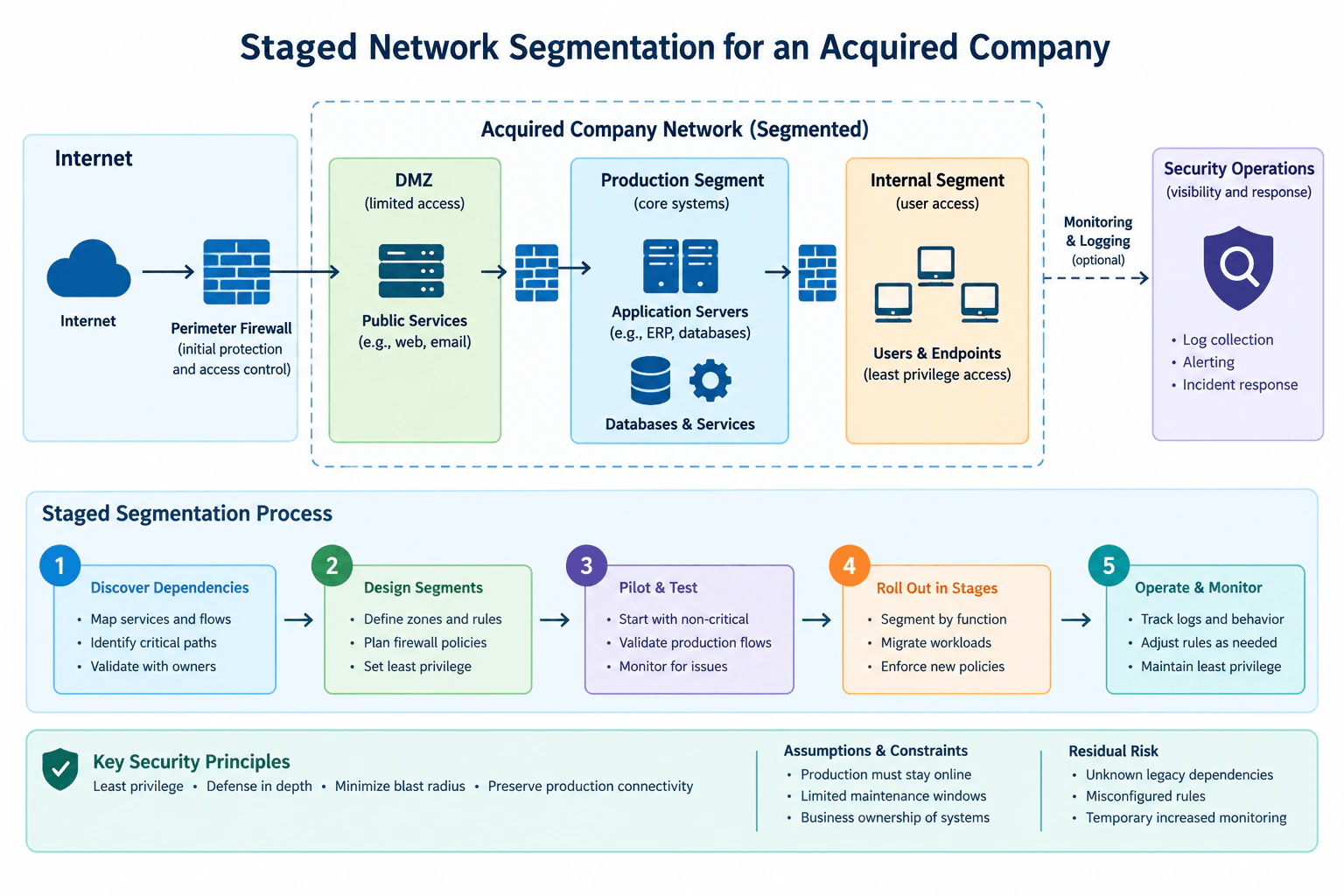
The main challenge is reducing the risk of a flat network while keeping production online. I would not begin with broad blocking rules. I would first map the services, network flows, critical paths, and business owners that production depends on. Then I would design clear network zones and firewall policies, test them on a small non-critical scope, and expand only after validating required connectivity. The goal is to preserve legitimate production traffic while gradually removing unnecessary reachability, reducing lateral-movement opportunities, and giving operators enough evidence to detect hidden dependencies before wider enforcement.

Useful Questions to Ask the Interviewer
  1. Which applications, databases, and services are considered production-critical?
  2. What network-flow, firewall, application, or endpoint telemetry is already available?
  3. Who owns the major public services, production systems, databases, and user environments?
  4. Are there legacy systems or limited maintenance windows that make network changes especially risky?
  5. Which non-critical systems can be used as the first segmentation pilot?
How would you segment an acquired company’s flat network without disrupting production? diagram
How to Explain It in an Interview

I would use a staged migration instead of a big-bang segmentation change.

  1. Discover dependencies. I would inventory the important public services, application servers, databases, user endpoints, and owners, then observe real communication patterns. The purpose is to identify required production paths before restrictive firewall policies are introduced. Documentation is useful, but observed traffic and owner validation provide stronger evidence of actual dependencies.
  1. Define the target security zones. The approved design separates the acquired environment into a DMZ, production segment, and internal segment. The DMZ, or demilitarized zone, contains limited-access public services such as web or email systems. The production segment contains core application servers, databases, and supporting services. The internal segment contains users and endpoints. The Internet reaches public services through a perimeter firewall, and additional firewall controls separate the internal zones.
  1. Design least-privilege rules. Least privilege means allowing only the connectivity that a user, endpoint, or workload requires for its business function. Required flows between zones stay permitted, while unnecessary cross-zone paths are restricted. The perimeter and internal firewall boundaries provide defense in depth and reduce the blast radius, meaning the amount of the environment that can be reached if one system is compromised.
  1. Pilot and test. I would begin with a non-critical scope where dependencies are relatively well understood. I would apply the proposed segmentation policies there, validate required production-related flows, and monitor for unexpected denies, service errors, latency changes, or user-impact signals. The pilot proves the operating process before the same approach is expanded.
  1. Roll out in stages. After the pilot succeeds, I would segment additional functions or migrate additional workloads in controlled waves. Each stage should have a defined owner, expected flows, approved firewall rules, and validation checks. If a stage reveals a legitimate dependency that was missed, I would stop expansion, keep the required production path available with the narrowest necessary rule, document the dependency, and retest before continuing. I would not solve the problem by reopening broad any-to-any connectivity.
  1. Validate every stage. I would confirm application functionality, database access, user workflows, required network connectivity, and service health after each change. Firewall and network logs provide evidence of allowed and denied traffic. Unexpected denies should be investigated with the responsible application or network owner before policy is widened.
  1. Operate and monitor. Security Operations receives monitoring and logging from the segmented environment for visibility, alerting, and incident response. During stages with more uncertainty, I would temporarily increase monitoring. The network team operates the segmentation controls, application owners validate required business connectivity, and security reviews whether the rules still meet the intended least-privilege objective.

The main constraint is that production must remain online, and maintenance windows may be limited. That makes staged enforcement slower than an aggressive cutover, but it reduces the chance that an undocumented dependency causes an outage.

The main tradeoff is speed versus operational safety. Faster isolation reduces exposure sooner, but it increases the risk of breaking hidden production dependencies. A staged rollout requires more analysis, testing, ownership, and monitoring, but it lets the team reduce unnecessary connectivity while preserving required service paths.

Residual risk remains because dependency discovery is never perfect. Legacy systems may communicate only occasionally, and firewall rules can be misconfigured. Segmentation also does not remove every security risk inside a permitted zone. Continuous monitoring, owner validation, and periodic rule review are therefore necessary after the initial rollout.

Technical Approach
  1. Inventory public services, production applications, databases, user endpoints, and responsible owners.
  2. Collect available network-flow, firewall, application, and endpoint telemetry to map real communication dependencies.
  3. Mark the critical production paths that must remain available.
  4. Define the DMZ, production segment, and internal user segment shown in the target architecture.
  5. Place perimeter and internal firewall controls at the relevant zone boundaries.
  6. Convert observed and owner-validated dependencies into least-privilege rules.
  7. Pilot the rules on a non-critical scope and monitor connectivity, service health, and unexpected denies.
  8. Correct legitimate missed dependencies with narrow rules, then retest.
  9. Roll out segmentation to additional systems in controlled stages only after the previous stage passes validation.
  10. Continue monitoring, alerting, incident-response visibility, and periodic rule review as part of normal operations.
Practical Complexity & Trade-offs

The largest cost is operational work. Engineers must inventory systems, analyze traffic, meet with application owners, design firewall policies, test changes, and investigate unexpected dependencies. More granular segmentation gives better isolation but creates more rules to review and troubleshoot. The staged approach also takes longer than a one-time cutover, but it lowers production risk. Limited maintenance windows can slow rollout further. Ongoing monitoring, alert handling, and policy cleanup are continuing maintenance costs because applications, users, and dependencies change over time.

Where it is used

This approach is useful during mergers and acquisitions, legacy-network modernization, data-center consolidation, ransomware-resilience programs, and zero-trust migration efforts where an existing environment has broad internal connectivity. It is especially useful when production availability matters and application dependencies are incomplete or poorly documented, making a staged and validated rollout safer than immediately enforcing restrictive rules everywhere.

Why Interviewers Ask This

This question tests whether the candidate can reduce the risk of a flat network without treating segmentation as a simple firewall change. A strong answer shows dependency discovery, production awareness, security-zone design, least-privilege policy decisions, staged rollout, validation, monitoring, operational ownership, and judgment about residual risk from unknown legacy dependencies or incorrect rules.

Common interview mistakes

Common mistakes are enforcing deny rules before discovering dependencies, trusting old documentation without validating real traffic, creating logical zones without enforcing traffic between them, starting with critical production systems instead of a safer pilot, opening broad any-to-any exceptions when something breaks, failing to identify application owners, treating monitoring as a substitute for segmentation, ignoring limited maintenance windows, and declaring the project complete without reviewing residual access and misconfigured rules.

Interview tip

Lead with the practical decision: discover first, then enforce gradually. Explain the flow as dependency discovery, zone and firewall design, pilot, staged rollout, validation, and continuous monitoring. Emphasize that success means reducing unnecessary connectivity while keeping required production paths working, not achieving maximum isolation in one change window.

Interviewer may ask next
What would you do if a new segmentation rule breaks a critical production dependency that was not discovered earlier?

I would stop expanding that stage and keep the specific required production path available with the narrowest rule needed to restore service. Then I would confirm the dependency with the responsible owner, document the source, destination, service, and business purpose, monitor the corrected flow, and retest before continuing. I would not reopen broad connectivity across the affected zones.

How would you decide which systems to segment first?

I would begin with a non-critical scope where dependencies are relatively well understood and the business impact of an error is limited. That pilot lets the team validate firewall policy design, monitoring, ownership, and service-health checks. Once that process works reliably, I would expand to additional workloads and eventually more critical production systems using the same staged validation gates.

8. What is threat modeling, and what does a useful threat model contain?Threat ModelingEasy

Question Details

Define threat modeling as a structured process for identifying what must be protected, what can go wrong, and what should be done about it. Explain scope, assets, security objectives, actors, attacker capabilities, entry points, trust boundaries, data flows, threats, abuse cases, mapped mitigations, assumptions, validation, and residual risk. Distinguish a living threat model from a one-time checklist.

Short Interview Answer (30-60 seconds)

Threat modeling is a structured way to identify what must be protected, what can go wrong, and what to do about it. A useful model covers scope, assets, actors, attacker capabilities, entry points, data flows, trust boundaries, threats, mitigations, assumptions, validation, and residual risk, and it is updated as the system changes.

Detailed Explanation

Threat modeling helps a team make security decisions before simply adding controls. First, define what is in scope and what must be protected. Then understand the system, its actors, attacker capabilities, entry points, data flows, and trust boundaries. From that model, identify realistic threats and abuse cases, prioritize them using likelihood, impact, feasibility, exposure, and business context, and map controls to the important threats. Finally, validate assumptions and mitigations, record the risk that remains, and update the model whenever the system, assets, threats, assumptions, or business context changes.

Useful Questions to Ask the Interviewer
  1. What system, feature, or workflow is in scope, and what is explicitly out of scope?
  2. Which assets and security objectives are most important to protect?
  3. Who are the legitimate actors, and what attacker capabilities should we reasonably consider?
  4. Where are the main entry points, data flows, and trust-boundary crossings?
  5. What level of residual risk can the business accept, and who owns that decision?
What is threat modeling, and what does a useful threat model contain? diagram
How to Explain It in an Interview
  1. Define the scope and what must be protected. Start by stating what is inside and outside the model. Identify the assets, such as data, services, systems, or people, and state their relevant security objectives. For example, important data may require confidentiality and integrity, while a service may also require availability. Record assumptions separately so an assumption is not mistaken for a verified fact.
  1. Map the system and the adversary. Describe the system components, entry points, data flows, actors, and trust boundaries. A trust boundary is a place where the level of trust changes, such as information moving from an external untrusted environment into an internal trusted environment. Identify who may interact with the system and what an attacker could realistically do. Attacker capabilities and motivations help keep the model grounded instead of assuming an unlimited adversary.
  1. Identify and prioritize threats. Ask what can go wrong at each important asset, entry point, data flow, and trust-boundary crossing. An abuse case describes how a feature or workflow could be intentionally misused. Keep the terminology distinct: a threat is a possible harmful event or action; a vulnerability is a weakness that can be exploited; an exploit is the method used to take advantage of that weakness; and risk represents the possible loss in context. Prioritize threats using likelihood, impact, feasibility, exposure, and business context. Use qualitative levels when precise evidence is not available rather than inventing false precision.
  1. Map mitigations and assess residual risk. Choose controls only after the important threats are understood. Map each mitigation to a specific threat or trust-boundary crossing. Depending on the threat, relevant controls can include input validation, authentication, least privilege, and monitoring. A control reduces risk but does not normally eliminate every possible failure. Residual risk is the risk that remains after the mitigations are applied. The remaining risk should be explicitly evaluated and handled according to the organization's risk decision process.
  1. Validate the model and keep it living. Review whether the system model, trust boundaries, assumptions, threats, and control mappings are correct. Validation can include testing, assume-breach scenarios, and security reviews. The resulting evidence can reveal incorrect assumptions, missing threats, or controls that do not work as expected. The threat model should be revisited when new features, assets, threats, dependencies, or business needs change the security context.

The main tradeoff is depth versus effort. A model that is too shallow can miss important threats, while an unnecessarily detailed model can become expensive to maintain and difficult to use. The goal is enough detail to support defensible security decisions. Threat modeling also cannot prove that a system is secure. Unknown vulnerabilities, incorrect assumptions, implementation defects, misconfigurations, or new attacker techniques can still leave residual risk. That is why validation and regular updates are part of the process rather than a one-time checklist.

Technical Approach
  1. Define the system scope and record what is out of scope.
  2. Identify the protected assets and their security objectives.
  3. Record assumptions separately from verified facts.
  4. Map system components, entry points, data flows, and trust boundaries.
  5. Identify legitimate actors and realistic attacker capabilities.
  6. Identify threats and abuse cases against important assets and boundary crossings.
  7. Distinguish each threat from any related vulnerability, exploit, and resulting risk.
  8. Prioritize threats using likelihood, impact, exposure, feasibility, and business context while stating uncertainty.
  9. Map each important mitigation to a named threat or trust-boundary crossing.
  10. Assess and record residual risk after the mitigations.
  11. Validate the model through testing, assume-breach scenarios, and security reviews.
  12. Revisit the model whenever the system, assets, threats, assumptions, dependencies, or business context changes.
Practical Insights

Threat modeling mainly costs engineering and review time. A small system can often be modeled with a focused discussion and a simple diagram, while a large system with many components, entry points, data flows, and trust boundaries requires more analysis and maintenance. Deeper modeling can find more problems but also increases review effort. Selected controls can add development work, operational cost, monitoring effort, or user friction. The model also needs ownership because stale assumptions, outdated flows, or forgotten system changes reduce its value.

Why Interviewers Ask This

Interviewers want to see whether you can reason about security before choosing controls. A strong answer shows that you can define what matters, understand the system and its trust boundaries, identify realistic threats, distinguish threats from vulnerabilities and exploits, prioritize risk using context, map mitigations to specific threats, validate the result, and explain the risk that remains.

Common interview mistakes

Common mistakes include treating threat modeling as a vulnerability scan or one-time checklist; choosing controls before defining scope, assets, security objectives, actors, assumptions, and trust boundaries; listing generic threats without connecting them to the actual system; treating threats, vulnerabilities, exploits, and risks as synonyms; assuming every attacker has unlimited capabilities; assigning precise risk scores without evidence; mapping controls without naming the threat they address; claiming that a mitigation removes all risk; forgetting residual risk and validation; and allowing the model to become stale after the architecture changes.

Interview tip

Lead with three practical questions: what are we protecting, what can go wrong, and what should we do about it? Then walk through scope, system and adversary modeling, threat prioritization, mapped mitigations, residual risk, and validation. Finish by emphasizing that the threat model is a living artifact rather than a one-time checklist.

Interviewer may ask next
What is the difference between a threat, vulnerability, exploit, risk, control, and residual risk?

A threat is a possible harmful event or action. A vulnerability is a weakness that could make harm possible. An exploit is a method used to take advantage of a vulnerability. Risk represents the possible loss in context, considering factors such as likelihood and impact. A control is a safeguard selected to reduce a specific risk. Residual risk is the risk that remains after those controls are applied. Keeping these terms separate prevents a list of weaknesses from being mistaken for a complete threat model or risk assessment.

Why should a threat model be treated as a living artifact instead of a one-time security review?

The assumptions behind a threat model can change. New features can add assets or entry points, architecture changes can create new data flows or trust-boundary crossings, attacker capabilities can evolve, and existing mitigations can become less effective or be implemented differently. A model that is never revisited can describe an old system rather than the current one. The useful approach is to update it when important system, asset, threat, dependency, assumption, or business-context changes occur and then revalidate the affected threats, mitigations, and residual risks.

9. How would you introduce threat modeling to someone unfamiliar with it?Threat ModelingEasy

Short Interview Answer (30-60 seconds)

Threat modeling is a structured way to ask what we are protecting, what could go wrong, what we should do about it, and whether our mitigations worked. We model assets, actors, data flows, trust boundaries, threats, vulnerabilities, risk, controls, and residual risk, then repeat the process as the system changes.

Detailed Explanation

Threat modeling helps a team think about security before an attacker forces them to. I would introduce it as a structured, repeatable process for understanding a system, identifying realistic ways it could be harmed, deciding which risks deserve attention, and selecting mitigations. The process starts with context, not controls: define the protected asset, security objective, actors, data flows, trust boundaries, assumptions, and plausible attacker capability. Then distinguish threats from vulnerabilities and exploits, prioritize risk, map mitigations to specific threats, validate the result, record residual risk, and revisit the model when the system changes.

Useful Questions to Ask the Interviewer
  1. Should I explain threat modeling at a high level, or use a simple web-application example?
  2. Do you want me to mention a framework such as STRIDE, or focus on the general process?
  3. Should I include how teams prioritize and validate risks after mitigations are chosen?
How would you introduce threat modeling to someone unfamiliar with it? diagram
How to Explain It in an Interview

I would use one simple example: a web application that lets customers view their data.

  1. Start with what we are protecting. The protected asset is customer data. The security objective is to keep that data confidential, correct, and available to authorized users. The main actors are a legitimate customer and an adversary. The application receives requests from the Internet and processes them before accessing customer data.
  1. Draw the trust boundary. The Internet is treated as untrusted input. Requests cross a trust boundary before reaching the application environment. A trust boundary is a point where the level of trust or responsibility changes. Crossing that boundary is important because inputs from outside the trusted environment should not automatically be trusted after they cross it.
  1. State assumptions and attacker capability. For this simple model, I would assume the application is reachable from the Internet and an attacker can send requests to it and look for weaknesses. I would not assume that the attacker already has administrator access, internal network access, or a specific vulnerability unless there is evidence for that.
  1. Ask: what can go wrong? A threat is a possible harmful event or action. In the example, a relevant threat is unauthorized access to customer data. A vulnerability is a weakness that could make that threat possible, such as weak authentication or an authorization flaw. An exploit is the technique or action that uses a vulnerability. These terms are related, but they are not interchangeable.
  1. Prioritize the risk. Risk represents the possibility and consequence of the harmful event. I would consider likelihood, impact, exposure, feasibility, and business context. I would avoid pretending that an early threat model can produce perfectly precise numbers. The goal is to decide which risks deserve attention first.
  1. Decide what to do about it. Each mitigation should map to a named threat. For the unauthorized-access threat, the diagram uses authentication and authorization as the primary mitigation. Authentication establishes who the user is, while authorization decides what that user is allowed to access. Input validation can reduce risk from malicious or malformed input, but it should not be presented as the control for every possible threat.
  1. Validate the mitigation. After implementing controls, I would verify that the intended threat is actually reduced. For example, I would test that unauthenticated requests are rejected and that authenticated users cannot access another customer's protected data. Useful evidence can include security tests, application behavior, authorization decisions, and relevant logs.
  1. Record residual risk. Security controls reduce risk; they rarely eliminate it completely. Authentication and authorization can still fail because of implementation defects, stolen credentials, configuration mistakes, or future changes. That remaining exposure is residual risk. The team should understand it, decide whether it is acceptable, and assign ownership for any additional work.
  1. Repeat the process when the system changes. Threat modeling is not a one-time checklist. New features, new data flows, changed trust boundaries, new dependencies, and new attacker techniques can change the model. The diagram's dashed loop back to the beginning represents this lifecycle and the need to repeat the analysis as the system changes.

A framework such as STRIDE can help teams systematically think about threat categories, but I would present it as a thinking aid, not proof that every threat has been found. For someone unfamiliar with threat modeling, the simplest summary is four questions: What are we working on? What can go wrong? What will we do about it? Did we do a good job?

The main tradeoff is effort versus coverage. More detail can uncover more risks, but an overly broad model becomes slow and difficult to maintain. I would therefore begin with the important assets, trust boundaries, and realistic abuse paths, then deepen the analysis where the potential impact justifies it.

Technical Approach
  1. Define the system and protected assets.
  2. State the security objective for each important asset.
  3. Identify legitimate actors and plausible adversaries without inventing unsupported capabilities.
  4. Map important data flows and trust boundaries.
  5. Record assumptions that affect the model.
  6. Identify credible threats and relevant vulnerabilities while keeping threats, vulnerabilities, and exploits distinct.
  7. Prioritize risk using likelihood, impact, exposure, feasibility, and business context.
  8. Map each mitigation to a named threat or trust-boundary crossing.
  9. Validate that the mitigation reduces the intended risk using tests, behavior, or other evidence.
  10. Record residual risk and its owner.
  11. Revisit the model when architecture, data flows, features, dependencies, or assumptions change.
Practical Insights

Threat modeling mainly costs engineering and review time. A small system may need only a short session and a simple data-flow diagram, while a large or sensitive system may require several people and repeated reviews. More detail usually gives better coverage but also increases maintenance work. Poorly scoped models can waste time on unlikely threats, while models that are too shallow can miss important trust-boundary or authorization problems. The useful balance is to focus first on high-value assets, important data flows, realistic attacker capabilities, and risks with meaningful business impact, then revisit the model as the system changes.

Why Interviewers Ask This

The interviewer wants to know whether I can explain threat modeling clearly to someone without security expertise while keeping the important distinctions correct. A strong answer should show that threat modeling starts with understanding the system and its assets, actors, assumptions, data flows, and trust boundaries before selecting controls. It should also distinguish a threat from a vulnerability, exploit, risk, mitigation, and residual risk, and explain that threat modeling is an iterative decision process rather than a one-time checklist.

Common interview mistakes

Common mistakes are starting with a list of security controls before understanding the system; treating threats, vulnerabilities, exploits, and risks as the same thing; assuming attacker capabilities without evidence; forgetting trust boundaries and data flows; using a framework such as STRIDE as if it guarantees complete coverage; assigning false numerical precision to risk; recommending controls without naming the threat they address; claiming that a mitigation eliminates all risk; and treating threat modeling as a one-time exercise instead of revisiting it when the system changes.

Interview tip

Use the four simple questions shown in the diagram: what are we working on, what can go wrong, what will we do about it, and did we do a good job. Then use one small web-application example to explain assets, actors, the trust boundary, a concrete threat, its mitigation, validation, and residual risk. Keep frameworks secondary to the reasoning.

Interviewer may ask next
What is the difference between a threat, vulnerability, exploit, and risk?

A threat is a possible harmful event or action, such as unauthorized access to customer data. A vulnerability is a weakness that could enable that threat, such as broken authorization. An exploit is the method or action that takes advantage of the vulnerability. Risk represents the possibility and consequence of that harmful event, considered with factors such as likelihood, impact, exposure, feasibility, and business context.

How do you know when a threat model is complete?

I would not claim that a threat model is ever provably complete. I would consider it useful enough for a decision when the important assets, actors, assumptions, data flows, trust boundaries, credible threats, mitigations, and residual risks have been reviewed and the highest-priority risks have clear owners and validation evidence. I would then revisit the model when the system, dependencies, assumptions, or threat environment changes.

10. What does analyzing an attack surface accomplish?Threat ModelingEasy

Question Details

For attack-surface analysis, include exposed system entry and exit points.

Short Interview Answer (30-60 seconds)

Attack-surface analysis maps exposed entry and exit points around a system. It shows where an attacker can interact with the system and where data can leave, helping security teams identify reachable paths, prioritize threat assessment, and reduce unnecessary exposure.

Detailed Explanation

Attack-surface analysis answers a practical question: where can an external actor interact with the protected system, and where can information leave it? The protected assets here are the application and sensitive data. The security objective is to limit unauthorized access or data exposure. The trust boundary separates the protected system from external actors and systems. By mapping exposed entry points such as web/API access, login, and file uploads, plus exit points such as API responses, exports, and external logs or messages, the team can see reachable paths and decide where deeper threat assessment matters most.

Useful Questions to Ask the Interviewer
  1. Are we analyzing only externally reachable interfaces, or should internal entry and exit points also be included?
  2. Which application data or services are considered the most important protected assets?
  3. Should the analysis cover only the current deployed system, or also planned changes to interfaces and data flows?
What does analyzing an attack surface accomplish? diagram
How to Explain It in an Interview

Start with the practical outcome: attack-surface analysis creates a map of system exposure. It identifies boundary points and reachable paths through which an external actor could interact with the protected system or through which data could leave it.

In the approved diagram, the protected system contains the application and sensitive data. The external actor is an attacker outside the trust boundary. The exposed entry points are Web/API access over HTTP or HTTPS, login or authentication, and file uploads. These represent ways requests or input can cross into the protected system.

The diagram also includes exposed exit points: API responses carrying data out, data exports such as files or reports, and logs or messages sent to external systems. Those external systems can include users, partners, integrations, or internet-connected destinations. Mapping exit paths matters because exposure is not only about how someone can reach the system; it also includes where system data can cross outward.

The main decision is where to focus security work. Once the reachable entry and exit paths are visible, the team can identify higher-exposure areas for deeper threat assessment. Unnecessary reachable paths can be removed or restricted, while necessary paths can receive appropriate security review and testing. This reduces exposure without claiming that attack-surface analysis itself blocks attacks.

A threat is a possible harmful event or action. A vulnerability is a weakness that could enable a threat. An exploit is a method used to take advantage of a vulnerability. Risk reflects factors such as likelihood, impact, exposure, feasibility, and business context. Attack-surface analysis primarily identifies exposure; it does not prove that a vulnerability or exploit exists.

The analysis should be validated against the real system by reviewing interfaces, application flows, authentication paths, uploads, responses, exports, messages, and external integrations. Useful evidence is an accurate inventory of reachable entry and exit points and the data flows that cross the trust boundary. When interfaces or flows change, the inventory should be reviewed again so the attack-surface map does not become stale.

There is no special fail-open or fail-closed behavior in attack-surface analysis because it is an analysis activity rather than an enforcement control. If the inventory is incomplete, the safe conclusion is that coverage is incomplete, not that an unlisted path is secure. That uncertainty should be recorded and investigated.

The main tradeoff is completeness versus effort. A detailed inventory gives better coverage but requires more maintenance. An overly simple inventory is easier to maintain but can miss meaningful exposure. The goal is to capture the reachable paths that matter to the application and sensitive data without turning the exercise into an unrelated security checklist.

Residual risk remains after the analysis. Mapping an entry or exit point does not remove it, prove it is secure, or prevent exploitation. The outcome is better visibility: teams can prioritize threat assessment and reduce unnecessary reachable paths, while required interfaces still need appropriate security review and testing.

Technical Approach
  1. Define the protected assets: the application and sensitive data.
  2. State the security objective: limit unauthorized access or data exposure.
  3. Identify the external actor and the trust boundary around the protected system.
  4. Inventory exposed entry points, such as Web/API access, login or authentication, and file uploads.
  5. Inventory exposed exit points, such as API responses, data exports, and logs or messages sent to external systems.
  6. Trace each reachable path across the trust boundary and note what interaction or data flow it enables.
  7. Prioritize areas for deeper threat assessment using exposure, plausible likelihood, impact, feasibility, and business context without inventing numeric precision.
  8. Remove or reduce unnecessary reachable paths and send necessary paths for appropriate security review or testing.
  9. Validate the map against the deployed system and update it when interfaces or data flows change.
  10. Record remaining uncertainty and residual risk instead of treating the analysis as proof that the system is secure.
Practical Insights

The main cost is engineering and maintenance time rather than algorithmic complexity. Teams must inventory interfaces, trace data flows, review authentication and upload paths, and confirm where responses, exports, logs, or messages leave the system. More detail improves coverage but takes more effort to maintain. Too little detail can miss important exposure. The analysis itself does not require a specific security product, and risk should not be expressed with false precision when evidence is limited.

Why Interviewers Ask This

Interviewers want to know whether you understand attack-surface analysis as a practical way to map system exposure rather than as a vulnerability scan or complete threat model. A strong answer identifies exposed entry and exit points, relates them to the protected assets and trust boundary, and explains how the map helps prioritize security review and reduce unnecessary reachable paths.

Common interview mistakes

Common mistakes include looking only at entry points and forgetting exit points; treating the trust boundary as proof that everything inside it is secure; assuming every exposed interface is automatically a vulnerability; confusing threats, vulnerabilities, exploits, and risks; listing generic controls instead of mapping actual reachable paths; ignoring API responses, exports, logs, or messages that leave the system; claiming that attack-surface analysis itself prevents attacks; and allowing the map to become stale after interfaces or integrations change.

Interview tip

Lead with the outcome: attack-surface analysis maps where an attacker can interact with the system and where data can leave. Then name a few concrete entry and exit points, explain the trust boundary, and finish with the benefit: better threat prioritization and fewer unnecessary reachable paths. Do not describe it as a vulnerability scan or a complete security guarantee.

Interviewer may ask next
Why do exit points matter in attack-surface analysis?

Exit points matter because they show where data can leave the protected system. In this model, API responses, file or report exports, and logs or messages sent to external systems are exposed exit paths. Mapping them helps identify where sensitive data could be exposed and where deeper threat assessment is needed.

Does reducing the attack surface eliminate security risk?

No. Reducing unnecessary reachable paths can lower exposure, but required entry and exit points still create residual risk. Attack-surface analysis also does not prove that an interface is vulnerable or secure. Necessary paths still need appropriate security review and testing, and the analysis should be updated when the system or its data flows change.

More questions load as you scroll

Disclaimer: This interview guide is for educational and informational purposes only. It is designed to help readers prepare, but it does not guarantee any interview result, hiring decision, offer, or outcome. Interview questions, hiring criteria, and preferred answers can vary by employer, interviewer, industry, location, and time. All answers, examples, and explanations in this guide are suggested examples for interview preparation, not definitive answers or instructions for professional practice. They are based on research and judgment, are provided without warranties of any kind, and should be adapted to the question, role, and applicable laws and professional requirements. Diagrams are simplified illustrations intended to highlight the main concepts and their relationships; actual situations, systems, and practices may be more complex. Alternative approaches may be equally valid or better suited to a particular question, context, or interviewer. To the fullest extent permitted by applicable law, the contributors and publisher are not liable for decisions made, actions taken, or losses incurred based on this guide.

State Laws and Professional Responsibilities: Laws and requirements governing an occupation vary by state and jurisdiction. You are responsible for checking the current laws, licensing requirements, and scope-of-practice rules that apply to your location and role, and for ensuring that your answers and actions comply with them. Adapt examples in this guide to those requirements. This guide is not legal advice.

Content Accuracy and Verification: To the fullest extent permitted by applicable law, we do not represent or warrant that interview guides, questions, answers, examples, or diagrams are accurate, complete, current, error-free, or suitable for any particular purpose. You are responsible for independently reviewing and verifying the information before relying on it.