143 Cybersecurity Engineer Interview Questions & Answers

90 top • 18 Amazon • 11 Apple • 8 Google • 4 Meta • 10 Microsoft • 1 Netflix • 1 NVIDIA

Cybersecurity Engineer icon

Questions with Detailed ExplanationsWith Detailed Explanations

(Last Updated: September 13, 2026)

41. Explain server-side request forgery and its significance in cloud applications.Application SecurityHard

Short Interview Answer (30-60 seconds)

SSRF lets an attacker influence where a server sends an outbound request. In cloud applications, that server may reach internal services or instance metadata that the attacker cannot access directly. Prevent it with destination allowlists, URL and IP validation, scheme and redirect restrictions, egress controls, metadata protections, safe rejection, and secret-free logging.

Detailed Explanation

Server-side request forgery, or SSRF, means an attacker controls a URL or destination that a server later requests. The important point is that the request originates from the server, not from the attacker's machine. In a cloud environment, that server may have network access that an external user does not have. A successful SSRF path can therefore reach internal services or instance metadata and may expose temporary credentials, access tokens, instance information, or other sensitive data. The security goal is to stop untrusted destination input from becoming unrestricted server-side network access across the cloud trust boundary.

Useful Questions to Ask the Interviewer
  1. Does the application need to fetch only a known set of destinations, or arbitrary public Internet URLs?
  2. Can the cloud workload reach an instance metadata service or private internal services?
  3. Which URL schemes are legitimately required by the feature?
  4. Are HTTP redirects required, or can they be disabled?
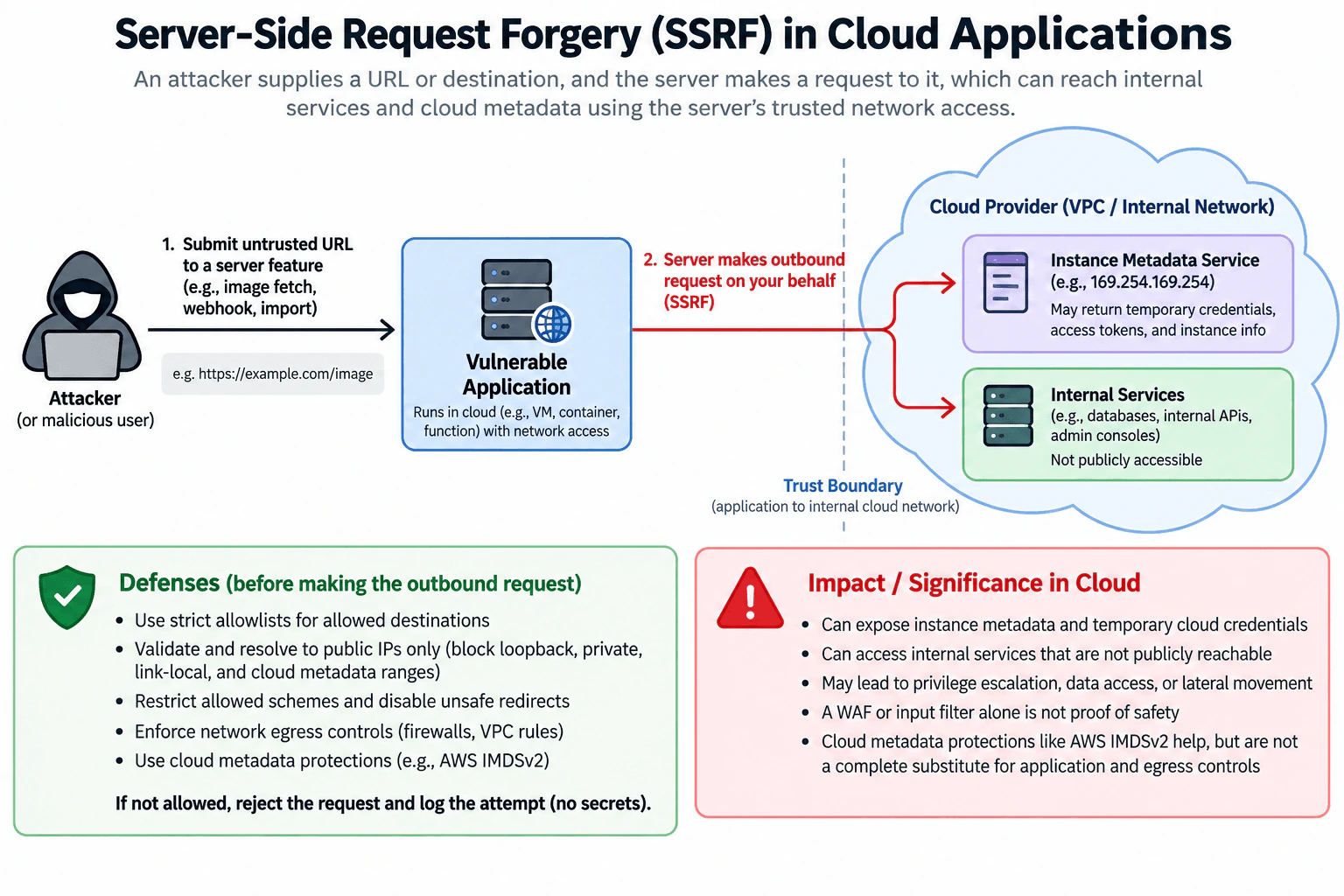
Explain server-side request forgery and its significance in cloud applications. diagram
How to Explain It in an Interview

Start with the approved request flow. A malicious user supplies an untrusted URL to a server feature such as an image fetcher, webhook handler, or import function. The vulnerable application runs in the cloud and makes the outbound request on the user's behalf. That request crosses the important trust boundary from the application toward the internal cloud network.

The protected assets are the internal services and cloud instance metadata that should not be reachable by an external user. Internal services can include databases, internal APIs, or administrative services. An instance metadata service can provide instance information and, depending on the cloud configuration and workload identity, temporary credentials or access tokens. This is why SSRF can be more significant in cloud applications than a normal external URL-fetching bug.

The first defensive decision is whether the application really needs arbitrary destinations. If it only needs known destinations, use a strict allowlist and reject everything else. This is easier to reason about than trying to recognize every malicious destination.

If the feature must fetch arbitrary public Internet resources, validate the URL with a trusted parser and restrict it to only the schemes the application actually needs. Resolve the destination and reject loopback, private, link-local, cloud-metadata, and other non-public or reserved addresses. The validation must apply to the destination actually used for the outbound connection.

Redirects are another important SSRF path. An initially acceptable public URL can redirect the server to an internal or metadata address. Disable redirects when the feature does not require them. If redirects are required, validate every redirect destination using the same scheme, hostname, and resolved-address rules before following it.

Use network egress controls as another layer. The cloud workload should not have unrestricted outbound access to internal networks or sensitive destinations that the application does not need. Firewalls and cloud network rules can reduce which destinations are reachable, but they are defense in depth rather than proof that the application is safe.

Cloud metadata protections provide an additional layer. For Amazon EC2, the Instance Metadata Service uses the link-local IPv4 address 169.254.169.254. IMDSv2 uses session-oriented requests and can be configured so metadata access requires a token. Requiring IMDSv2 can reduce exposure to some SSRF paths, but it does not protect unrelated internal services and is not a substitute for application validation and egress controls.

The safe failure path is fail closed. If the requested destination is not explicitly allowed or cannot be validated safely, the application rejects the outbound request rather than attempting a less-restricted fallback. It should log the rejected attempt for investigation without recording credentials, authorization headers, tokens, or other secrets.

Detection can use those sanitized rejection logs to identify repeated attempts to access private, link-local, metadata, or otherwise prohibited destinations. Monitoring is useful evidence of abuse or bypass attempts, but it does not replace prevention.

A concrete regression test should verify that approved public destinations work, prohibited loopback, private, link-local, and metadata destinations are rejected, unsafe redirects are blocked or revalidated, unsupported schemes are rejected, and the rejection log contains useful security context without secrets.

The main tradeoff is security versus flexibility. A strict allowlist provides a smaller attack surface but may not support features that genuinely need arbitrary public URLs. Allowing broad Internet destinations requires more complex URL parsing, DNS and resolved-address checks, redirect handling, and egress policy. A WAF or input filter can help as one layer, but passing through that layer does not prove the request is safe.

Technical Approach
  1. Identify every server feature that accepts a URL or network destination from an untrusted user.
  2. If the feature needs only known destinations, enforce a strict destination allowlist.
  3. If arbitrary public destinations are required, parse the URL with a trusted library and allow only the required schemes.
  4. Resolve the destination and reject loopback, private, link-local, cloud-metadata, and other non-public or reserved addresses.
  5. Disable redirects when they are unnecessary; otherwise revalidate every redirect destination before following it.
  6. Restrict outbound connectivity with firewall or cloud-network egress controls so the workload cannot freely reach sensitive internal destinations.
  7. Apply cloud metadata protections, such as requiring AWS IMDSv2 where applicable.
  8. If validation fails or the destination is prohibited, reject the request without a permissive fallback.
  9. Log rejected attempts without secrets and monitor repeated suspicious destinations.
  10. Add regression tests for allowed destinations, prohibited address ranges, schemes, redirects, safe rejection, and sanitized logging.
Practical Insights

Strict allowlists are simpler to operate and provide strong control, but they reduce flexibility when users need arbitrary external URLs. Broader URL-fetching features require more engineering for URL parsing, DNS resolution, address-range checks, redirects, and egress policies. Network controls also add infrastructure maintenance. Security logging adds storage and monitoring work. These costs are important because SSRF can turn one attacker-controlled URL into access from a more trusted cloud network position.

Why Interviewers Ask This

This question tests whether the candidate understands SSRF as a server-side trust-boundary problem rather than only an input-validation bug. A strong answer explains how attacker-controlled destination input becomes a request from a cloud workload with different network reachability, why internal services and instance metadata matter, how layered defenses reduce the risk, how the application should fail safely, and why a WAF, input filter, or metadata protection alone is not complete protection.

Common interview mistakes

Common mistakes include treating SSRF as only a string-filtering problem; relying only on a denylist; validating the hostname but not its resolved address; failing to block loopback, private, link-local, metadata, or other non-public destinations; permitting unnecessary URL schemes; following redirects without revalidating the new destination; assuming a WAF or input filter proves the request is safe; assuming network controls alone prevent SSRF; relying on IMDSv2 as complete protection; failing open when validation or DNS resolution fails; and recording credentials or tokens in security logs.

Interview tip

Explain SSRF as a trust-boundary problem: attacker-controlled destination input becomes an outbound request from a more trusted server. Walk through the flow from the malicious user to the vulnerable cloud application and then to internal services or metadata. Finish with layered defenses, fail-closed rejection, secret-free logging, verification tests, and the limitation that no single control completely removes SSRF risk.
Interviewer may ask next
Why is SSRF especially significant in cloud applications?

A cloud workload can often reach internal services or instance metadata that an external attacker cannot reach directly. If attacker-controlled input determines the server's outbound destination, the attacker may abuse that trusted network position to access internal APIs, databases, administrative services, or metadata. Metadata may contain instance information and, depending on configuration, temporary credentials or access tokens. The actual impact depends on which destinations the workload can reach and what those destinations expose.

Is AWS IMDSv2 enough to prevent SSRF?

No. IMDSv2 is an important defense-in-depth control for Amazon EC2 because it uses session-oriented requests and can require a token for metadata access. However, SSRF can also target internal APIs, databases, or other reachable services. Applications still need destination validation, scheme and redirect restrictions, egress controls, safe rejection, logging, and verification. A metadata protection reduces one important cloud risk but does not remove SSRF itself.

42. How does unsafe deserialization put an application at risk?Application SecurityHard

Short Interview Answer (30-60 seconds)

Unsafe deserialization lets untrusted serialized data influence reconstructed objects and their state. An attacker may abuse application logic, manipulate authorization or state, exhaust resources, or sometimes trigger arbitrary code through dangerous classes or deserialization hooks. Avoid native object deserialization of untrusted data when possible.

Detailed Explanation

Unsafe deserialization becomes risky when serialized data from an untrusted source crosses into an application and is used to rebuild program objects. The input may come from a request, file, or message. If unexpected types, field values, object graphs, or dangerous deserialization behavior are accepted, attacker-controlled data can change application state or trigger unintended behavior. The impact can include application-logic abuse, authorization or state manipulation, denial of service, and, in some environments, arbitrary code execution. The key decision is whether untrusted data should be deserialized at all and, if necessary, how narrowly the process is constrained.

Useful Questions to Ask the Interviewer
  1. Where does the serialized data come from: a request, file, message, or another system?
  2. Does the application need native object deserialization, or can it use a simpler data-only format?
  3. Which exact types or classes are expected to be reconstructed?
  4. What size, nesting-depth, and object-graph limits can be enforced?
  5. What application resources and privileges are reachable if deserialization is abused?
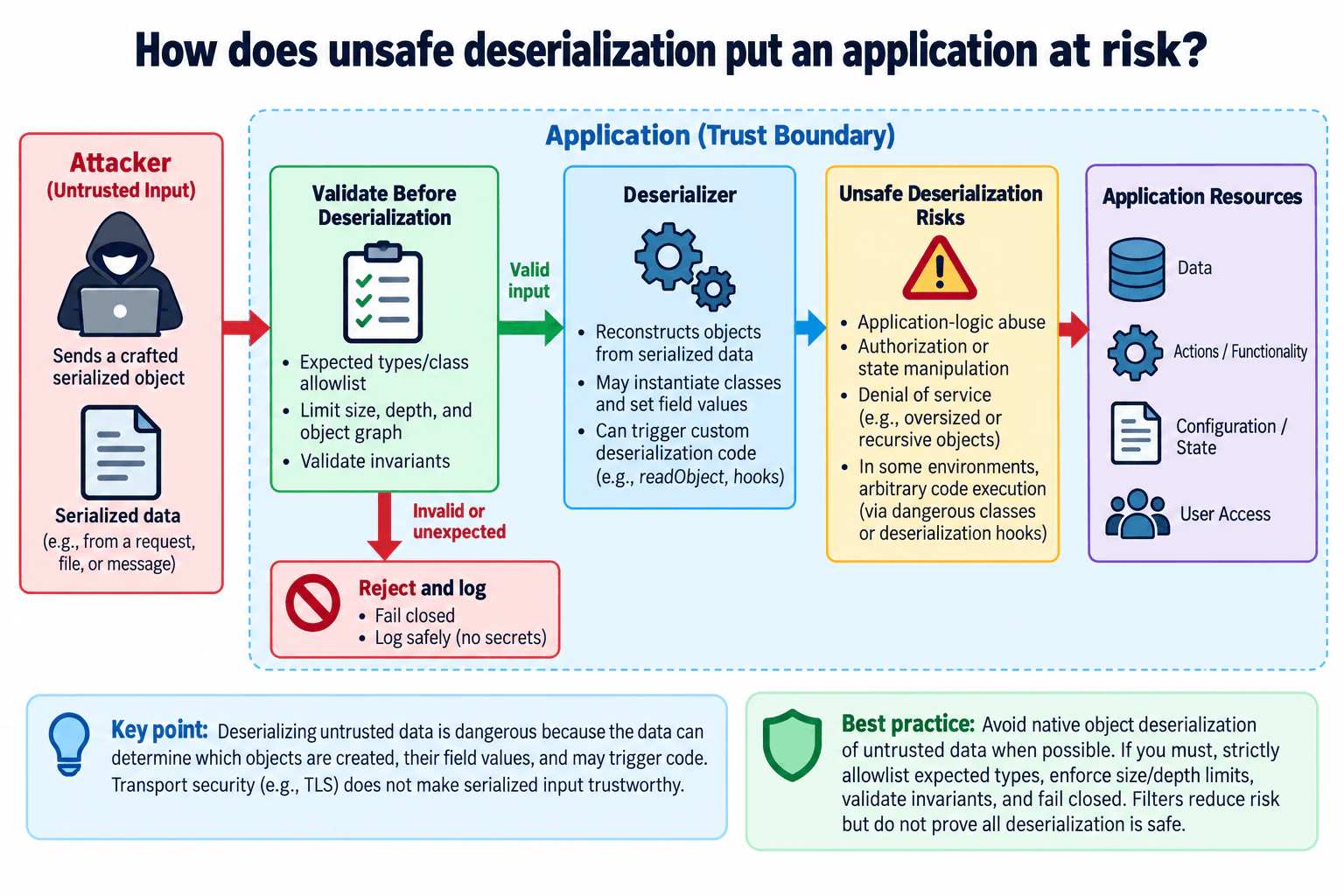
How does unsafe deserialization put an application at risk? diagram
How to Explain It in an Interview

Start with the trust boundary. The attacker controls or can influence serialized data before it enters the application. The application must treat that data as untrusted even when transport security such as TLS protects it while it travels over the network. TLS protects the connection, not the trustworthiness of the endpoint-supplied content.

Apply safe checks before object reconstruction where possible. Reject inputs that exceed expected size or structural limits. Configure the deserializer itself so that only explicitly expected types or classes can be instantiated. Validate important field relationships and application invariants before reconstructed state is trusted or used for protected actions.

If the input is invalid or unexpected, reject it and fail closed. Log the rejection safely without secrets or unnecessary serialized contents. This is the safe-failure path shown in the diagram.

If unsafe input reaches the deserializer, the deserializer may reconstruct objects from serialized data, instantiate classes, set field values, and invoke custom deserialization code or hooks. That is dangerous because the input may influence program behavior, not only ordinary values.

The resulting risks include application-logic abuse, authorization or state manipulation, and denial of service through oversized, deeply nested, or recursive object graphs. In some environments, dangerous classes, gadget behavior, or deserialization hooks can also lead to arbitrary code execution.

The protected application resources include data, actions and functionality, configuration and state, and user access. If code execution occurs, the effect is constrained by the permissions available to the application process, so least privilege reduces potential damage if prevention fails.

The preferred design is to avoid native object deserialization of untrusted data when possible. A simpler data-only representation reduces the attack surface because external input is not directly coupled to internal application classes and executable object behavior. If native deserialization is necessary, strictly allowlist expected types, enforce size and depth limits, validate invariants, and fail closed on unexpected input.

These controls reduce risk but do not prove that deserialization is completely safe. An allowed class or dependency may still contain dangerous behavior, and newly discovered gadget paths can change the risk over time. Input filters, scanners, a WAF, or TLS are defense-in-depth layers, not proof that all deserialization paths are secure.

For verification, create regression tests using unexpected object types, oversized input, excessive nesting or recursive structures, and invalid state combinations. The expected behavior is safe rejection without unauthorized state changes, privileged actions, secret leakage, or uncontrolled resource consumption. Monitor repeated rejection events and unusual CPU or memory usage as possible abuse signals.

The main tradeoff is convenience versus attack surface. Native serialization can make rich object transfer convenient, but it tightly couples external input to internal types and behavior. Data-only formats and explicit mapping require more development work, but they create a smaller and easier-to-review trust boundary.

Technical Approach
  1. Identify every request, file, message, or other entry point that can supply serialized data.
  2. Treat serialized input crossing the application trust boundary as untrusted.
  3. Prefer a data-only format instead of native object deserialization when possible.
  4. Apply pre-deserialization limits such as maximum input size and structural depth where the format permits them.
  5. Configure the deserializer to allow only the exact expected types or classes.
  6. Limit nesting depth and object-graph complexity during reconstruction where supported.
  7. Validate field relationships and application invariants before reconstructed state is used for protected actions.
  8. Reject invalid or unexpected input and fail closed.
  9. Log rejection events without secrets or unnecessary serialized content.
  10. Run the application with least privilege to limit impact if deserialization is abused.
  11. Regression-test unexpected types, oversized inputs, deep or recursive structures, and invalid state combinations.
  12. Monitor repeated failures and abnormal resource use for possible abuse.
Practical Insights

The main cost is development and maintenance rather than algorithmic complexity. Strict type allowlists, input limits, invariant checks, tests, and monitoring require engineering work. Replacing native serialization with explicit data mapping can also require more code. Runtime checks add some processing overhead, but the larger tradeoff is convenience versus a smaller attack surface. Teams must review allowed classes and dependencies over time because newly discovered dangerous behavior or gadget paths can change the risk.

Why Interviewers Ask This

Interviewers want to know whether you understand the trust boundary created by serialized input, why rebuilding objects from untrusted data is more dangerous than ordinary data parsing, what application resources can be affected, and how to reduce the risk without claiming that validation, filtering, TLS, or one other control makes deserialization completely safe.

Common interview mistakes

Common mistakes include deserializing untrusted data without restricting which classes can be created; allowing unlimited size, depth, or object graphs; trusting reconstructed fields merely because deserialization succeeded; performing only post-deserialization validation even though dangerous hooks may already have executed; treating authentication as proof that client-supplied data is trustworthy; assuming TLS prevents malicious content; treating a WAF, scanner, or input filter as complete protection; logging serialized secrets; running the application with unnecessary privileges; and assuming that a type allowlist permanently removes all deserialization risk.

Interview tip

Explain the chain in order: untrusted serialized data crosses the trust boundary, safe limits and type restrictions constrain what can reach or be created by the deserializer, the deserializer reconstructs objects, and unsafe behavior can affect data, application actions, configuration, state, or user access. Finish with fail-closed rejection, safe logging, least privilege, regression testing, and the limitation that these controls reduce rather than eliminate risk.

Interviewer may ask next
Why can validating an object only after deserialization be too late?

Some deserialization mechanisms can instantiate classes or invoke custom deserialization hooks while reconstruction is happening. Dangerous behavior may therefore occur before application code receives the final object for ordinary validation. Type restrictions and deserializer-level controls must operate before or during reconstruction, while field and business-rule validation should still occur before the application performs protected actions.

Does switching to JSON completely eliminate unsafe deserialization risk?

No. A simple data-only JSON representation generally reduces this risk because it does not inherently reconstruct arbitrary native application classes. However, risk can return if a framework lets attacker-controlled type metadata select classes or if the application automatically maps untrusted fields into privileged state. JSON can reduce the attack surface, but it is not a guarantee of security.

43. What security consequences should an architect consider when adopting GraphQL at scale?Application SecurityHard

Question Details

Address GraphQL resolver authorization, query cost and depth, introspection, batching, caching, and verification.

Short Interview Answer (30-60 seconds)

I would treat GraphQL as an untrusted, highly expressive request interface. Authenticate first, authorize every protected object and field, bound query cost and depth, limit batching, restrict introspection where appropriate, scope caching to the security context, reject unsafe requests, and continuously test and monitor the controls.

Detailed Explanation

GraphQL lets clients choose fields, relationships, nesting, variables, and sometimes multiple operations in one request. That flexibility is valuable, but at scale it increases the consequences of weak authorization and unbounded execution. The architect should treat GraphQL requests as untrusted input, authenticate the caller, authorize every protected object and field, enforce depth and query-cost limits, control introspection and batching, scope caching to the caller's security context, reject unsafe requests, and continuously verify these controls with regression tests, security logs, and monitoring.

Useful Questions to Ask the Interviewer
  1. Is the GraphQL API public, partner-facing, or only for first-party clients?
  2. Which objects and fields contain user-specific, tenant-specific, or otherwise sensitive data?
  3. Are clients allowed to submit arbitrary GraphQL operations or batched operations in production?
  4. What availability and latency requirements should guide depth, query-cost, timeout, concurrency, and rate limits?
  5. Is production introspection required for legitimate clients or operational tooling?
  6. Is any response or resolver cache shared across requests, users, tenants, or services?
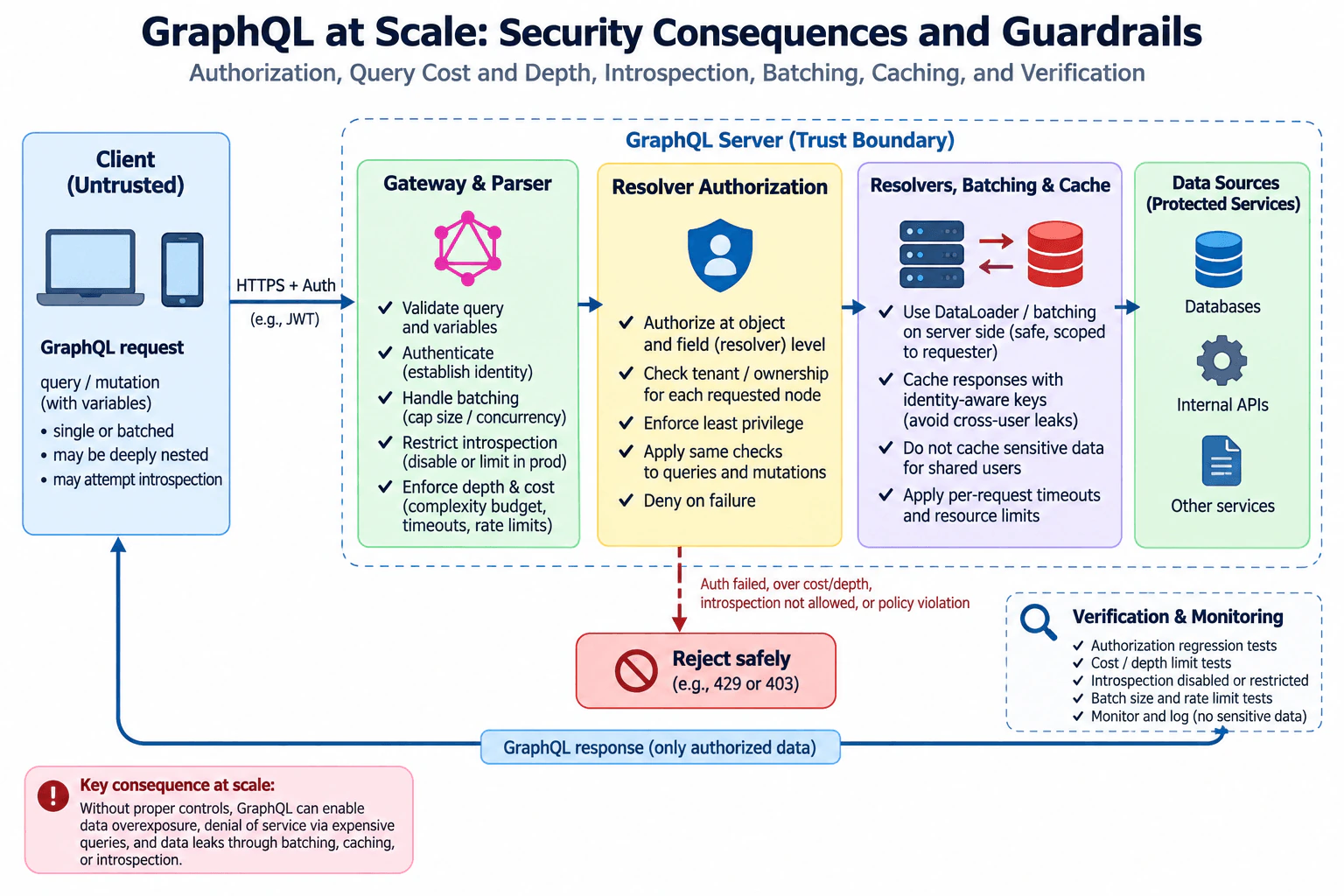
What security consequences should an architect consider when adopting GraphQL at scale? diagram
How to Explain It in an Interview

The practical decision is not whether GraphQL is inherently secure or insecure. The decision is whether the architecture can safely control the extra flexibility that GraphQL gives clients.

The entry point is the GraphQL request. A web, mobile, or service client sends a query or mutation with variables over HTTPS and may present an authentication token such as a JWT. HTTPS protects the network transport, but it does not establish that the caller is entitled to every object or field requested. The GraphQL document, variables, nesting, aliases, and batch contents therefore remain untrusted input when they cross into the server-side trust boundary.

The gateway or parser should first parse and validate the GraphQL operation and establish authenticated identity. Authentication answers, 'Who is the caller?' Authorization is a separate decision that answers, 'May this caller perform this action or access this object or field?' Authentication context should be server-established rather than trusted merely because the client supplied claims.

Resolver authorization is one of the most important consequences of GraphQL. A single request can traverse several object relationships and request fields that have different security requirements. Every protected object and field path must therefore invoke the same server-side authorization policy. Checks can include tenant membership, ownership, role, permission, and action. The resolver may trigger the check, but production authorization rules should have a single source of truth in the business or policy layer so alternate resolver paths cannot drift into different decisions. The same policy principles apply to queries and mutations. Authorization failure should deny access rather than allow protected data through.

The second major consequence is resource exhaustion. A query can be valid GraphQL and still be dangerous to availability. Deep nesting, large result sets, aliases, repeated fields, expensive resolvers, and combinations of these can consume CPU, memory, database capacity, or downstream-service capacity. Enforce a maximum depth and a field-aware query-cost or complexity budget before expensive execution. Add per-request timeouts and resource or rate limits as additional layers. Depth alone is not enough because a shallow operation can still request many expensive fields.

Batching also needs two different security considerations. A client can place multiple logical operations into one network request, so a simple HTTP request counter may underestimate the actual work. Cap batch size or concurrency and apply authorization and cost controls to the individual operations or requested objects. Separately, server-side batching such as a DataLoader-style pattern can reduce duplicate backend requests and improve efficiency, but its batching and memoization scope should normally stay inside one request or an equivalent authorization context. A cache shared across unrelated identities can become a data-isolation problem.

Caching must therefore be security-context-aware. GraphQL responses may differ by user, tenant, ownership, or authorization policy. If a cache key uses only the query text and variables, one caller's authorized response could be served to another caller. Include the relevant identity or authorization context in the cache partition or key, and do not place sensitive user-specific data into a broadly shared cache when safe isolation cannot be guaranteed.

Introspection is another explicit design decision. GraphQL introspection exposes schema metadata and is valuable for development and tooling. A private, first-party production API may disable or restrict it. A public GraphQL API may intentionally keep it available. Restricting introspection reduces schema discoverability, but it is not an authorization mechanism and must not be treated as protection for sensitive data. Resolver authorization and demand controls are still required.

The protected destinations are the databases, internal APIs, and other services reached by resolvers. Resolver execution should use least-privileged access to those dependencies. GraphQL should not turn a client-supplied object identifier into an implicit authorization decision. The application must verify whether the authenticated caller is permitted to perform the protected action or receive the requested data.

Safe failure is important at scale. If authentication cannot be established, authorization is denied, query cost or depth exceeds policy, a batch exceeds configured limits, introspection is not permitted, or a resource limit is reached, reject the unsafe operation without performing unauthorized protected work. Depending on the GraphQL-over-HTTP implementation and where enforcement occurs, the client may receive a GraphQL error or an HTTP status such as 403 for forbidden access or 429 for throttling. The security property is the important part: protected data and actions remain unavailable when policy fails, and error responses should not expose secrets or unnecessary internal details.

Verification closes the loop. Add authorization regression tests proving that one user or tenant cannot read another user's protected objects or fields. Test operations just below, at, and above depth and query-cost limits. Test oversized or concurrent batches. Verify the intended introspection policy. Test request timeouts and resource limits. Test the cache with different identities to prove that no cross-user or cross-tenant response is returned. Record security-relevant evidence such as denied authorization decisions, excessive depth or cost, rate-limit events, and abnormal failures without logging tokens, secrets, or sensitive response data.

The main tradeoff is client flexibility versus security and operational control. Higher cost and depth limits make rich client queries easier but increase resource-exhaustion risk. Lower limits protect the service but may reject legitimate requests or force extra round trips. Restricting introspection reduces discoverability but can reduce production tooling convenience. Server-side batching and caching improve performance but introduce isolation risk when scoped incorrectly. Strong object- and field-level authorization adds policy and testing work, but without it GraphQL can expose data through alternate graph paths that coarse endpoint-level controls do not cover.

Residual risk remains after these controls. Query-cost models are estimates, legitimate-looking requests can still stress downstream services, authorization rules can regress as the schema changes, and cache configuration can drift independently of resolver code. Continuous regression testing, secure logging, abuse monitoring, conservative rejection behavior, and review of new resolvers and schema relationships are therefore part of safely operating GraphQL at scale.

Key Insight / Why This Solution Works
  1. Treat the GraphQL document, variables, nesting, aliases, and batch contents as untrusted input.
  2. Parse and validate the operation at the server boundary.
  3. Authenticate the caller and create trusted server-side identity context.
  4. Apply configured batch-size or concurrency limits.
  5. Enforce introspection policy according to the production API's use case.
  6. Calculate and enforce depth and query-cost or complexity limits before expensive resolver execution.
  7. Apply per-request timeout, rate, and resource limits.
  8. For every protected object or field reached by execution, invoke centralized server-side authorization using identity, tenant, ownership, permission, and requested action as applicable.
  9. Execute resolvers with least-privileged access to databases, internal APIs, and other services.
  10. Keep DataLoader-style batching and memoization request-scoped or equivalently isolated by authorization context.
  11. Partition response caches by the relevant security context or avoid shared caching for sensitive responses.
  12. Reject failed authorization and resource-policy decisions safely.
  13. Log security-relevant decisions and abuse signals without secrets or sensitive response data.
  14. Continuously regression-test authorization, cost and depth limits, batching, introspection policy, timeouts, and cache isolation.
Why Interviewers Ask This

This question tests whether the candidate understands the security consequences created by GraphQL's flexible query model rather than treating GraphQL as only another API syntax. A strong answer separates authentication from authorization, recognizes expensive and deeply nested query risks, understands introspection and batching tradeoffs, prevents cross-user cache leakage, defines safe rejection behavior, and explains how authorization and resource controls are continuously verified.

Common interview mistakes

Common mistakes include authenticating the caller once and assuming all requested fields are authorized; checking only the top-level object while nested fields expose protected data; duplicating authorization rules independently across resolvers instead of calling a shared policy source; trusting client-supplied identity claims without server validation; relying only on HTTP request-rate limits while one request contains many expensive operations; using only a depth limit while shallow but expensive queries remain possible; allowing unlimited batching; treating disabled introspection as a substitute for authorization; sharing DataLoader-style caches across unrelated requests or users; caching authorized responses without identity-aware partitioning; caching sensitive data for shared users; omitting per-request timeouts or resource limits; returning excessive error details; logging tokens or sensitive response data; treating HTTPS as proof that the endpoint or caller is trusted; and assuming a passed test proves future schema changes are secure.

Interview tip

Walk through the same request path as the diagram: untrusted client, gateway and parser, authentication and demand controls, resolver authorization, request-scoped batching and security-aware caching, protected data sources, safe rejection, and verification. Emphasize the difference between authentication and authorization, and state that TLS and introspection restrictions are supporting layers rather than complete protection.

Interviewer may ask next
Why is object- and field-level authorization especially important in GraphQL?

GraphQL allows one request to traverse many relationships and request fields with different sensitivity levels, so an endpoint-level authorization decision is too coarse. After authentication establishes identity, every protected object and field path should invoke centralized server-side policy using context such as user, tenant, ownership, permission, and requested action. This prevents an alternate resolver path or newly added field from bypassing the access-control decision that protects the same underlying data.

How should an architect balance GraphQL query depth, cost, batching, and performance?

Use several complementary limits rather than one threshold. Depth blocks extreme nesting, while field-aware query-cost analysis catches expensive shallow operations. Batch-size or concurrency limits stop one request from representing excessive logical work. Per-request timeouts and rate or resource budgets provide further protection. The thresholds should be tested against legitimate operations and production telemetry because limits that are too high leave denial-of-service risk, while limits that are too low reject useful client requests. Requests above policy should be rejected before expensive protected work executes.

44. What is differential privacy, and how is it applied?Application SecurityHard

Short Interview Answer (30-60 seconds)

Differential privacy limits how much one person's data can affect an analysis result. You apply it by bounding query sensitivity, choosing privacy parameters such as epsilon, adding calibrated random noise, releasing only the noisy aggregate, and tracking cumulative privacy loss across repeated queries.

Detailed Explanation

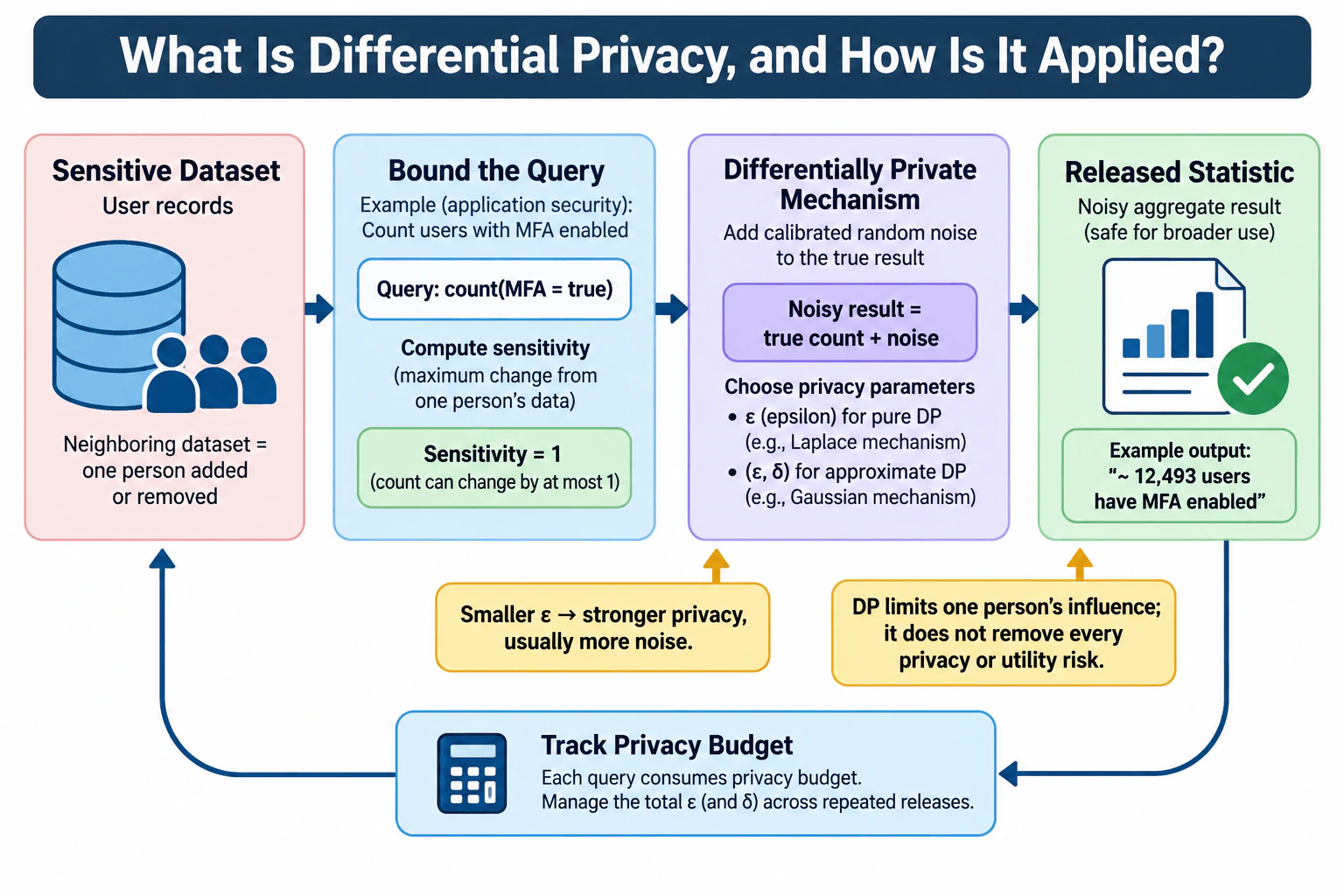
Differential privacy is useful when an application needs statistics from sensitive records but should limit what a released result reveals about any one person's participation. The practical decision is not simply to remove names. Instead, the system controls how much one person's data can influence the output. For the diagram's example, the application counts users with MFA enabled, computes the count's sensitivity, adds calibrated random noise, releases only the noisy aggregate, and tracks the privacy budget across repeated releases so cumulative privacy loss stays within the approved limit.

Useful Questions to Ask the Interviewer
  1. What is the protected unit: one record, one event, or one user's complete contribution?
  2. What aggregate queries need to be released, and how often will they be repeated?
  3. What accuracy loss is acceptable for the intended security analysis?
  4. Should the mechanism provide pure epsilon differential privacy or an epsilon-delta guarantee?
  5. Who is trusted to hold the sensitive records, and who should receive only the private aggregate output?
What is differential privacy, and how is it applied? diagram
How to Explain It in an Interview

Start with the privacy goal. Differential privacy compares neighboring datasets that differ in one protected individual's contribution. A differentially private mechanism makes the distributions of possible outputs similar enough that observing the result provides limited evidence about whether that person's data was included. The strength of this guarantee is controlled by privacy parameters such as epsilon and, for approximate differential privacy, delta.

Use the diagram's application-security example. The sensitive asset is the user-record dataset. The query asks for the number of users with MFA enabled. The raw user records remain on the trusted side of the release boundary. The broader audience receives only the noisy aggregate statistic.

Next, bound the query. Sensitivity means the largest possible change in the query result when one protected person's contribution is added or removed under the chosen neighboring-dataset definition. In the diagram's simple user-level count, one user can change the MFA-enabled count by at most one, so the sensitivity is 1.

Then apply a differentially private mechanism. For pure epsilon differential privacy, the Laplace mechanism is a standard example for numeric queries: it adds random noise calibrated to the query sensitivity and epsilon. For approximate epsilon-delta differential privacy, the Gaussian mechanism is a common choice when its noise is calibrated to the required sensitivity and privacy parameters.

The application releases the noisy aggregate instead of the exact count. The diagram illustrates this with an approximate result such as 12,493 users having MFA enabled. That number is only an example. In a real implementation, the noise must come from the selected mechanism with parameters derived from the sensitivity and privacy guarantee; engineers should not add arbitrary noise by hand.

Epsilon controls the privacy-versus-utility tradeoff. Holding the other assumptions and mechanism choices constant, a smaller epsilon means a stronger privacy guarantee and generally requires more noise, which can reduce accuracy. A larger epsilon generally permits more accurate results but weakens the privacy guarantee. When delta is used, it is also part of the guarantee and must be selected deliberately.

Repeated releases require privacy accounting. Differential privacy composes: multiple private releases can accumulate privacy loss. The system therefore needs to track the total privacy cost across repeated queries instead of treating each query independently. If another release would exceed the approved privacy budget, the safe behavior is to reject, delay, combine, reduce, or redesign the release rather than silently expose additional information.

Differential privacy limits one person's influence on released statistics, but it does not remove every privacy, security, or utility risk. It does not protect raw records if the underlying database is compromised, replace authorization or encryption, guarantee that every noisy answer is useful, or compensate for an incorrect sensitivity calculation. The sensitive data store, privacy mechanism, secrets, access controls, and execution environment still require normal application-security protections.

Validation should cover both privacy and usefulness. Verify the neighboring-dataset definition, contribution bounds, sensitivity calculation, mechanism parameters, privacy accounting, and release path. Test that only approved noisy aggregates cross the release boundary and that requests exceeding the configured privacy budget fail safely. Also measure statistical error so the released result remains useful for its intended purpose.

Technical Approach

1. Identify the sensitive dataset and define the protected unit, such as one user's contribution. 2. Define neighboring datasets consistently with that protected unit. 3. Select the aggregate query; in the diagram, count users with MFA enabled. 4. Bound the query sensitivity. Under the stated add-or-remove-one-user model, the shown count has sensitivity 1. 5. Select the privacy guarantee and parameters: epsilon for pure differential privacy or epsilon-delta when an approximate guarantee is intended. 6. Use a vetted differential-privacy mechanism and calibrate its random noise to the sensitivity and chosen privacy parameters. 7. Release only the noisy aggregate statistic, not the raw records or exact internal count. 8. Account for the privacy cost of the release together with previous releases using an appropriate composition or accounting method. 9. Reject or redesign additional releases when they would exceed the approved privacy budget. 10. Test the sensitivity assumptions, mechanism configuration, release boundary, privacy accounting, output accuracy, and safe budget-exhaustion behavior.

Practical Insights

Technical cost: engineers need a correct neighboring-dataset model, contribution bounds, sensitivity calculation, vetted differential-privacy mechanism, secure randomness, and privacy accounting. Operational cost: repeated releases must be tracked against the privacy budget. Human cost: security, privacy, and data teams must agree on the protected unit, privacy parameters, and acceptable accuracy. Financial cost: implementation, testing, specialist review, and supporting infrastructure can add engineering expense. Compliance cost: differential privacy may support a privacy program, but it does not by itself prove compliance with any law or policy. Maintenance cost: changing a query, contribution rule, or release schedule can change sensitivity or cumulative privacy loss and require revalidation. Utility cost: stronger privacy normally means noisier answers and can make small or sparse aggregates less useful.

Why Interviewers Ask This

This question tests whether the candidate understands that differential privacy is not ordinary anonymization or simple data masking. It evaluates reasoning about neighboring datasets, query sensitivity, calibrated random noise, privacy parameters, composition across repeated releases, the privacy-versus-utility tradeoff, and the boundary between sensitive individual records and released aggregate statistics.

Common interview mistakes

Common mistakes are treating differential privacy as simple anonymization; adding arbitrary noise instead of calibrating it to sensitivity and privacy parameters; calculating sensitivity incorrectly; assuming every count automatically has sensitivity 1 without checking contribution rules; claiming smaller epsilon improves both privacy and accuracy; ignoring delta when using an epsilon-delta guarantee; exposing the exact statistic alongside the noisy one; allowing unlimited repeated queries without privacy accounting; assuming differential privacy protects a compromised raw database; and claiming that differential privacy removes all privacy or utility risk.

Interview tip

Explain the flow in the same order as the diagram: sensitive dataset, bounded query, sensitivity, calibrated noise, noisy released statistic, then privacy-budget accounting. State the key tradeoff clearly: smaller epsilon gives stronger privacy but generally more noise. Finish by explaining that differential privacy limits individual influence on released statistics; it does not replace normal application security.

Interviewer may ask next
Why does the MFA-enabled count in this example have sensitivity 1?

Under the diagram's neighboring-dataset definition, two datasets differ by one user's inclusion or removal. A user contributes either one to the MFA-enabled count or zero. Adding or removing that user can therefore change the count by at most one, so the query has sensitivity 1. This depends on the contribution model; if one protected individual could contribute multiple counted items, the sensitivity calculation would have to reflect that larger possible contribution.

What happens when the same sensitive dataset is queried repeatedly with differential privacy?

Repeated private releases can accumulate privacy loss, so each query cannot be treated as though it were the only release. The system should use an appropriate composition or privacy-accounting method to track the cumulative privacy guarantee. If an additional query would exceed the approved privacy budget, the safe behavior is to stop, delay, combine, reduce, or redesign further releases rather than silently return more statistics.

45. What is incident response, and what outcomes should its lifecycle produce?Incident ResponseEasy

Question Details

Define incident response as the coordinated work used to prepare for, detect, analyze, contain, eradicate, and recover from cybersecurity incidents. Explain triage, scope, evidence preservation, timelines, containment tradeoffs, communications, restoration validation, recurrence monitoring, lessons learned, and improvement. Clarify that lifecycle activities can overlap and repeat rather than forming a rigid one-way sequence.

Short Interview Answer (30-60 seconds)

Incident response is coordinated work to prepare for, detect, analyze, contain, eradicate, and recover from cybersecurity incidents. It should limit damage, preserve evidence, restore and validate services, document impact, monitor for recurrence, and feed lessons learned into stronger preparation and defenses.

Detailed Explanation

The practical goal of incident response is to control a suspected security problem without causing unnecessary business harm or losing important evidence. Start with the alert context, affected assets, business impact, severity, scope, and evidence supporting the current hypothesis. Decide on the smallest safe containment action while investigation continues. Then remove the threat, address the cause where evidence supports it, restore systems from trusted sources, validate them before returning them to service, and monitor for recurrence. The lifecycle is iterative, so investigation, containment, and recovery may repeat as new evidence changes what the team knows.

Useful Questions to Ask the Interviewer
  1. Which assets and business services are most critical in the scenario?
  2. Which evidence sources are available, such as SIEM, endpoint, identity, cloud, network, DNS, or application telemetry?
  3. Are there legal, privacy, regulatory, disciplinary, or law-enforcement considerations that affect evidence handling or notification?
  4. How much operational disruption is acceptable during containment and recovery?
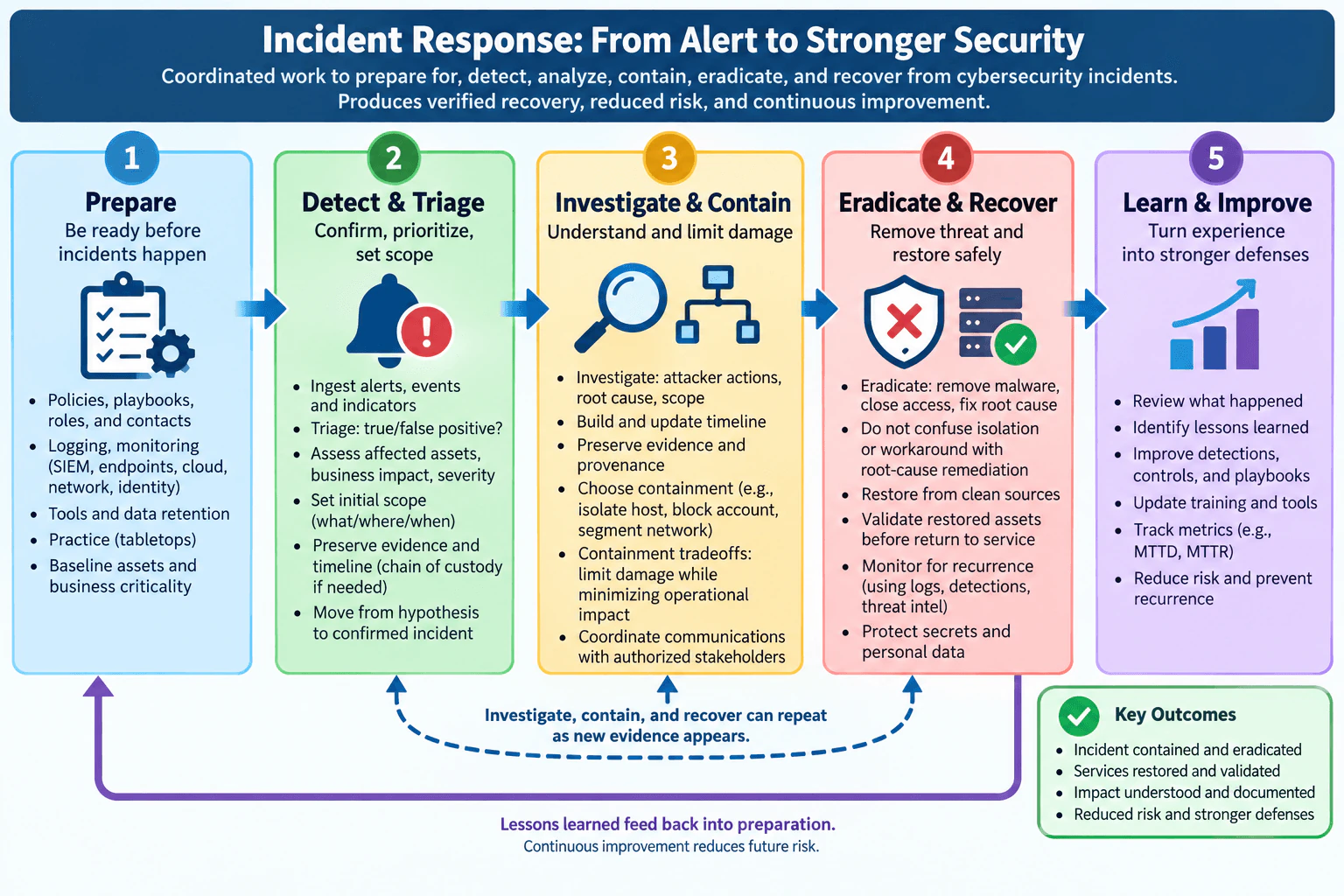
What is incident response, and what outcomes should its lifecycle produce? diagram
How to Explain It in an Interview
  1. Prepare. Define roles, contacts, playbooks, logging, monitoring, tools, data-retention needs, asset criticality, and practice exercises before an incident occurs. Preparation gives responders the information and authority needed to act quickly.
  1. Detect and triage. An event is an observed occurrence. An alert is a signal that something may need investigation. An indicator is a piece of evidence that can support suspicion but is not automatically proof of compromise. Triage checks whether the signal is benign, a false positive, or evidence of a possible incident. Assess affected assets, business impact, severity, and initial scope. Preserve relevant evidence and start a timeline. A hypothesis is a working explanation that must change when evidence contradicts it. A confirmed incident requires enough evidence to conclude that a cybersecurity incident has occurred.
  1. Investigate and contain. Correlate relevant evidence to understand attacker actions, scope, affected assets, and possible root cause. Build and update the timeline. Preserve evidence provenance, meaning where each item came from, and maintain chain of custody when later legal, regulatory, disciplinary, or law-enforcement use is possible. Choose the smallest safe containment action, such as isolating an affected host, blocking a compromised account, or segmenting part of the network. Containment is a tradeoff: stronger isolation may stop damage faster but can disrupt important services or reduce investigative visibility. Coordinate communications with authorized stakeholders throughout the response.
  1. Eradicate and recover. Containment limits the problem; it does not by itself remove the cause. Eradication removes malicious software or unauthorized access, closes the relevant weakness, revokes compromised credentials when applicable, and addresses the root cause when the evidence establishes one. Do not claim certainty when the cause remains unknown. Protect secrets and personal data while handling incident information. Restore systems and data from trusted sources. Validate both functionality and security before returning restored assets to service. Continue monitoring relevant telemetry for recurrence or signs of continued attacker activity.
  1. Learn and improve. Review what happened, document the known impact and remaining uncertainty, identify lessons learned, and update detections, controls, playbooks, training, and tools. These lessons feed back into preparation rather than ending the process permanently.

The main outcomes are an incident that is contained and eradicated where achievable, services that are restored and validated, impact that is understood and documented, evidence that is preserved when needed, and stronger defenses that reduce recurrence risk. The lifecycle is not a rigid one-way sequence. Investigation, containment, eradication, and recovery can overlap or repeat when new evidence changes scope, severity, or the current hypothesis.

Technical Approach
  1. Prepare roles, contacts, playbooks, logging, monitoring, tooling, retention, and asset criticality.
  2. Receive an alert and gather its context without treating it as proof of compromise.
  3. Triage affected assets, business impact, severity, and initial scope.
  4. Preserve relevant evidence, record provenance, and build an evolving timeline.
  5. Form and test hypotheses using appropriate telemetry.
  6. Confirm an incident only when evidence supports that conclusion.
  7. Choose the smallest safe containment action while balancing damage reduction, service availability, and investigative visibility.
  8. Investigate attacker actions, scope, and possible root cause while coordinating authorized communications.
  9. Eradicate malicious access and remediate the established cause where possible.
  10. Restore from trusted sources and validate functionality and security before returning assets to service.
  11. Monitor for recurrence.
  12. Conduct lessons learned and feed improvements into preparation, detections, controls, playbooks, training, and tools. Repeat earlier activities whenever new evidence changes the situation.
Practical Insights

Incident response has technical, operational, human, financial, compliance, and maintenance costs. More logging and evidence retention can improve investigations but require storage, tooling, and analyst time. Fast containment may reduce damage but can interrupt important services or reduce visibility into attacker behavior. Longer investigation may improve understanding but can allow risk to continue. Evidence-preservation and chain-of-custody procedures add work when they are needed. Recovery also requires validation time because restoring service without checking security can reintroduce the same problem. Communications, privacy review, legal review, and required notifications can add coordination cost. The goal is to balance these costs against the risk and impact of the incident.

Why Interviewers Ask This

Interviewers want to see whether you understand incident response as an evidence-driven lifecycle rather than a rigid checklist. A strong answer distinguishes an alert from a confirmed incident, explains triage and scoping, preserves evidence, weighs containment against operational impact, separates temporary containment from root-cause remediation, validates recovery, and uses lessons learned to reduce future risk.

Common interview mistakes

Common mistakes include treating every alert or indicator as a confirmed incident; taking disruptive containment action without considering business impact, evidence, or visibility; destroying or modifying evidence unnecessarily; failing to build a timeline; confusing isolation or a workaround with eradication; claiming a root cause without sufficient evidence; restoring systems without validating functionality and security; forgetting recurrence monitoring; exposing sensitive incident information to unauthorized people; and presenting the lifecycle as a rigid one-way sequence.

Interview tip

Describe incident response as an evidence-driven loop rather than only listing phases. Start with scope and the smallest safe containment decision, separate containment from root-cause remediation, mention evidence preservation, validation, communications, and recurrence monitoring, and finish with the outcomes: controlled impact, validated restoration, documented understanding, preserved evidence when needed, and stronger defenses.

Interviewer may ask next
How would you choose between immediately isolating a compromised system and keeping it online for investigation?

I would base the decision on severity, business impact, evidence, attacker activity, and the risk of continued damage. If leaving the system connected could cause unacceptable harm, I would isolate it quickly while preserving relevant evidence when practical. If risk can be controlled and continued visibility is important, a narrower containment action may be appropriate. I would document the decision, coordinate with authorized stakeholders, and reassess it as new evidence appears. Isolation is containment, not root-cause remediation.

How do you know when recovery is complete?

Recovery is not complete just because a service is running again. I would restore affected systems or data from trusted sources, validate expected functionality, verify that relevant malicious access or persistence has been removed, confirm that required remediation is in place, and review appropriate telemetry for continued attacker activity. I would then monitor for recurrence and document remaining uncertainty or residual risk. If new evidence appears, the team can return to investigation, containment, eradication, or recovery.

46. What is the purpose of a security incident response team?Incident ResponseEasy

Short Interview Answer (30-60 seconds)

A security incident response team coordinates how an organization handles cybersecurity incidents. It determines what happened, preserves evidence, limits damage, removes the cause, restores systems safely, communicates with the right stakeholders, and uses lessons learned to improve future detection, response, and recovery.

Detailed Explanation

A security incident response team gives an organization a coordinated way to handle cybersecurity incidents. Its purpose is broader than investigating alerts. The team determines whether suspicious activity is a real incident, identifies affected assets and business impact, preserves important evidence, and chooses safe response actions. It coordinates containment, investigation, eradication, recovery, communication, and required escalation. It also verifies that restored systems are trustworthy and watches for recurrence. Afterward, the team documents what happened and improves procedures, controls, monitoring, and readiness so future incidents can be handled more effectively.

Useful Questions to Ask the Interviewer
  1. Is the incident response team responsible only for technical response, or does it also coordinate legal, privacy, communications, and business stakeholders?
  2. Does the organization have a dedicated incident response team, or are responders drawn from security, IT, cloud, identity, application, and other teams when needed?
  3. What types of incidents are most important in this environment, such as account compromise, malware, ransomware, unauthorized access, or data exposure?
How to Explain It in an Interview

The practical purpose of the team is to make sure a cybersecurity incident is handled in a controlled, evidence-based, and coordinated way instead of having different people take unplanned or conflicting actions.

First, the team establishes context, scope, and severity. An alert is a notification that something may require investigation. It is not automatically proof of compromise. An event is an observable occurrence in a system or network. An indicator is a piece of information that may suggest malicious activity. A hypothesis is an explanation that investigators still need to test. A confirmed incident is a cybersecurity event that has been determined to require incident response. The team examines available evidence, affected assets, users, business impact, and uncertainty before making that determination.

Second, the team preserves relevant evidence. Depending on the incident, evidence may include endpoint data, authentication records, application logs, cloud activity, network information, DNS records, or other telemetry that can actually support the investigation. Evidence provenance means knowing where information came from and how it was collected. Chain of custody is a documented history of who collected, handled, transferred, or stored evidence. It becomes especially important when evidence may be used for legal, regulatory, disciplinary, or law-enforcement purposes.

Third, the team coordinates containment. Containment means limiting immediate harm or preventing an incident from spreading. The team should choose the smallest safe containment action that reduces risk while considering business impact, attacker behavior, and evidence preservation. For example, isolating one confirmed affected endpoint may be safer than shutting down an entire environment when there is no evidence that the whole environment is compromised. However, the correct action depends on the actual scope and risk. Containment is temporary risk reduction and must not be confused with root-cause remediation.

Fourth, the team continues investigation and builds a timeline. A timeline connects relevant evidence to understand what happened, when it happened, which assets or identities were involved, and how the incident developed. The team separates observed evidence from assumptions and distinguishes attacker actions from the root cause. Root cause is the underlying condition that allowed or caused the incident, while an attacker action is something the adversary did during the incident.

Fifth, the team coordinates eradication and recovery. Eradication removes malicious persistence or fixes the underlying security condition, such as removing malware, rotating compromised credentials, correcting an exploited weakness, or closing unauthorized access. Recovery restores affected systems and services in a controlled manner. Recovery is not considered verified simply because a system starts working again. The team validates restored assets, confirms required security controls are functioning, and monitors for evidence of recurrence or remaining compromise.

Sixth, the team coordinates communication and escalation. Depending on the incident, authorized stakeholders may include system owners, management, legal counsel, privacy teams, communications teams, vendors, customers, regulators, or law enforcement. The response team helps ensure accurate information reaches the appropriate people while sensitive evidence, secrets, and personal information remain protected. Notification requirements depend on the facts, jurisdiction, contracts, and applicable law, so the team should coordinate them with authorized legal and privacy stakeholders rather than assume one universal reporting rule.

Finally, the team performs lessons learned. It documents the timeline, impact, root cause when known, response actions, evidence, decisions, gaps, and improvements. Those findings can improve monitoring, security controls, response procedures, training, communications, and recovery readiness.

As of 2026, NIST SP 800-61 Revision 3 is the current NIST incident-response publication. It was finalized on April 3, 2025, supersedes Revision 2, and integrates incident response recommendations into Cybersecurity Framework 2.0 risk management. NIST emphasizes improving preparation and the efficiency and effectiveness of incident detection, response, and recovery. nist.gov

The main limitation is that an incident response team cannot guarantee that every incident will be detected or eliminate all cybersecurity risk. Its value is providing prepared people, clear responsibilities, reliable evidence handling, coordinated decisions, safe recovery, and continuous improvement. There is also a tradeoff between acting quickly and gathering more evidence: immediate containment may reduce damage but can disrupt business operations or alter evidence, while delaying containment may provide more visibility but can allow harm to continue. The team makes that decision based on risk and the evidence available.

Technical Approach
  1. Receive and triage the alert or report without assuming it proves compromise.
  2. Identify affected assets, users, business impact, severity, and initial scope.
  3. Preserve relevant evidence and record its provenance; maintain chain of custody when required.
  4. Determine whether the activity is an event, indicator, hypothesis, or confirmed incident, and document uncertainty.
  5. Choose the smallest safe containment action that reduces risk while considering business impact, attacker behavior, and evidence preservation.
  6. Investigate relevant evidence and maintain a timeline of confirmed observations and important decisions.
  7. Identify attacker actions, affected systems, remaining access, and the root cause when evidence supports that conclusion.
  8. Eradicate malicious persistence or the underlying security condition rather than treating containment as the final fix.
  9. Restore affected systems and services in a controlled manner, validate their integrity and controls, and monitor for recurrence.
  10. Coordinate communications, applicable notification or escalation, documentation, and lessons learned with authorized stakeholders.
Practical Insights

Running an incident response team requires trained people, monitoring and investigation tools, secure evidence storage, documented procedures, exercises, and time from system owners and other specialists. Serious incidents may also require legal, privacy, communications, vendor, forensic, or management support. Fast containment can reduce technical and financial damage but may interrupt business services or alter useful evidence. Waiting for more evidence can improve understanding but may allow the incident to continue. The team therefore balances response speed, evidence preservation, business continuity, recovery safety, legal or contractual obligations, operational cost, and remaining risk. Procedures and skills must also be maintained and tested over time.

Why Interviewers Ask This

Interviewers ask this question to confirm that the candidate understands incident response as a coordinated technical and business capability, not simply a team that investigates alerts. A strong answer should show that the team evaluates evidence and impact, coordinates safe containment and recovery, protects evidence, involves the right stakeholders, and helps the organization improve after an incident.

Common interview mistakes

Common mistakes include saying the team's only purpose is to stop attacks, treating every alert or indicator as proof of compromise, immediately shutting down systems without considering scope, business impact, attacker behavior, or evidence preservation, confusing temporary containment with eradication or root-cause remediation, failing to preserve evidence, failing to maintain a timeline, assuming the root cause before evidence supports it, restoring systems without validating them, declaring recovery complete without monitoring for recurrence, exposing sensitive incident information unnecessarily, ignoring relevant legal or privacy escalation, and ending the response without documenting lessons learned.

Interview tip

Describe the incident response team as a coordinated technical and business capability. A clear sequence is: assess scope and preserve evidence, contain safely, investigate and build a timeline, eradicate the cause, recover and validate, communicate appropriately, then learn and improve. Mention that an alert is not automatically a confirmed incident and that containment is not the same as root-cause remediation.

Interviewer may ask next
What are the main responsibilities of a security incident response team during an incident?

The team coordinates triage, investigation, evidence preservation, containment, eradication, recovery, communication, documentation, and lessons learned. It determines scope and severity, works with relevant technical and business owners, maintains an evidence-based timeline, chooses safe response actions, protects sensitive information, validates restored systems, and monitors for recurrence. The exact responsibilities depend on the incident and the organization's structure.

What is the difference between incident containment and incident eradication?

Containment limits immediate harm or prevents the incident from spreading, such as isolating an affected endpoint or disabling a compromised account. Eradication removes malicious persistence or addresses the underlying security condition, such as removing malware, replacing compromised credentials, or correcting an exploited weakness. Containment may be temporary, so the incident is not fully remediated merely because the immediate threat has been isolated. Recovery should follow eradication and include validation and monitoring for recurrence.

47. Distinguish a security event, an alert, and an incident.Incident ResponseEasy

Short Interview Answer (30-60 seconds)

An event is something observable that happened. An alert is a notification that detection logic found activity worth investigating. An incident is a confirmed security problem requiring response. Events may be benign, alerts may be false positives, and investigation determines whether an alert represents an incident.

Detailed Explanation

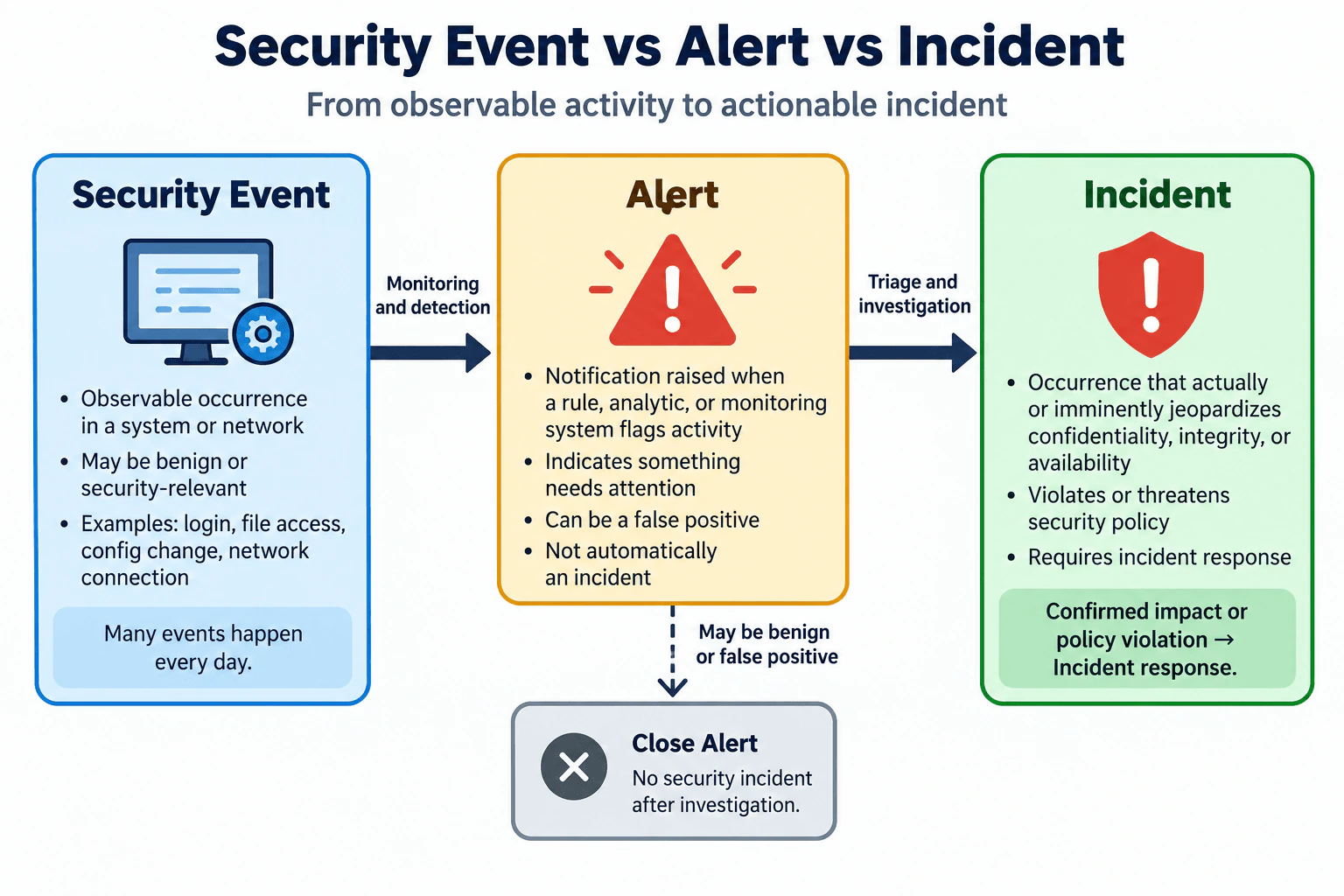
The practical difference is the level of evidence and the action required. A security event is an observable occurrence, such as a login, file access, configuration change, or network connection. Monitoring or detection logic may analyze events and raise an alert when activity matches a rule or analytic. An alert says that something deserves attention; it does not prove compromise. Triage and investigation determine the result. If the activity is benign or a false positive, the alert is closed. If the evidence confirms qualifying security impact or a policy violation, it is handled as an incident.

Useful Questions to Ask the Interviewer
  1. Are you asking only for the conceptual difference, or should I also explain how a security operations team handles each one?
  2. Would you like a short example showing how an event can lead to an alert and then, after investigation, to an incident?
Distinguish a security event, an alert, and an incident. diagram
How to Explain It in an Interview
  1. Security event — observable activity. A security event is an observable occurrence involving a system or network. NIST SP 800-61r3 describes an event as an observable occurrence involving computing assets. Typical examples include a login, file access, configuration change, or network connection. Many events are normal, so an event by itself does not prove a security problem.
  1. Alert — activity needs attention. Monitoring and detection logic analyze activity and can generate a notification when a rule, analytic, or other detection condition is met. In the diagram, this is the move from the Security Event box to the Alert box through monitoring and detection. The important point is that an alert is a signal for triage and investigation, not proof of compromise. It may be a false positive or benign activity.
  1. Triage and investigation decide the outcome. An analyst reviews the alert context and relevant evidence to determine whether the observed activity represents a real security problem. This is the decision boundary between an alert and an incident. Suspicion, an indicator, or a working hypothesis can support investigation, but they are not the same as a confirmed incident.
  1. Benign or false positive — close the alert. If investigation finds no qualifying security incident, the analyst documents the result and closes the alert. This matches the dashed path in the approved diagram from Alert to Close Alert: no security incident after investigation.
  1. Confirmed problem — classify and respond as an incident. NIST SP 800-61r3 defines a cybersecurity incident as an occurrence that actually or imminently jeopardizes, without lawful authority, confidentiality, integrity, or availability, or constitutes a violation or imminent threat of violation of applicable law, security policies, security procedures, or acceptable-use policies. Once the organization determines that the activity meets its incident criteria, incident response is required.

The easiest interview summary is: an event means something happened, an alert means detection says investigate it, and an incident means investigation has established a security problem that requires response. The tradeoff is that more sensitive detection may identify more suspicious activity but can also produce more false-positive alerts, while weaker detection can reduce noise but may miss activity that deserves investigation.

Technical Approach
  1. Observe and record system or network events.
  2. Apply monitoring or detection logic to the activity.
  3. Raise an alert when activity meets a detection condition.
  4. Triage and investigate the alert using relevant context and evidence.
  5. If investigation shows that no security incident occurred, document the result and close the alert.
  6. If the evidence establishes that the occurrence meets the organization's incident criteria, classify it as an incident and begin the appropriate incident-response process.
Practical Insights

Events can be very high volume, so collecting and analyzing them consumes logging, storage, and processing resources. Alerts reduce the amount of activity that analysts must review, but noisy detection can produce false positives and waste analyst time. Confirmed incidents usually require more effort because they may involve investigation, containment, recovery, communication, and coordination. The main operational tradeoff is finding enough suspicious activity without creating so much alert noise that important alerts are missed.

Why Interviewers Ask This

Interviewers want to know whether you can separate raw observable activity from a detection signal and from a confirmed security problem. This distinction is important because security teams see many normal events and false-positive alerts, while confirmed incidents require a different level of response and coordination.

Common interview mistakes

Common mistakes include treating every event as suspicious, treating every alert as proof of compromise, and calling suspicious activity an incident before the evidence supports that conclusion. Another mistake is assuming every incident must first generate an automated alert. An incident can also be discovered through another investigation, user reporting, external notification, or other evidence. The key distinction is that an alert is a detection signal, while an incident is a qualifying security occurrence that requires response.

Interview tip

Start with one simple sentence: event means something happened, alert means detection says investigate it, and incident means a security problem has been established and requires response. Then walk through the diagram's event → monitoring and detection → alert → triage and investigation → close alert or incident flow.

Interviewer may ask next
Can a security event become an incident without first generating an alert?

Yes. An alert is a detection or notification mechanism, not a mandatory lifecycle stage. An incident may be discovered through user reporting, external notification, forensic evidence, threat hunting, or another investigation. What matters is whether the occurrence meets the organization's incident criteria.

What should an analyst do when an alert turns out to be a false positive?

The analyst should document the investigation result and close the alert according to the organization's process. If the same benign activity repeatedly generates alerts, the detection logic can be reviewed and tuned carefully to reduce unnecessary noise without suppressing genuinely suspicious activity.

48. What does an incident-response tabletop exercise involve?Incident ResponseEasy

Short Interview Answer (30-60 seconds)

A tabletop exercise is a discussion-based rehearsal of a realistic cyber incident. A facilitator gives participants a scenario and changing information, and the team explains its response decisions. It tests roles, investigation, containment, escalation, communications, recovery, and evidence handling, then converts identified gaps into improvement actions.

Detailed Explanation

An incident-response tabletop exercise is a discussion-based practice session that tests how an organization would respond to a realistic cybersecurity incident without intentionally disrupting production. A facilitator presents a scenario and adds new information, often called injects, as the exercise continues. Participants explain what they would investigate, who would make important decisions, what evidence they would preserve, how they would contain the problem, whom they would notify, and how they would verify recovery. The purpose is to find weaknesses in plans, roles, communications, tools, and decision-making before a real incident occurs.

Useful Questions to Ask the Interviewer
  1. Is the exercise focused on a particular incident type, such as ransomware, credential compromise, insider activity, or cloud compromise?
  2. Which teams and decision-makers are expected to participate?
  3. Are we evaluating an existing incident-response plan or designing a tabletop exercise from scratch?
  4. Are there specific legal, privacy, contractual, regulatory, or executive-escalation processes that should be tested?
How to Explain It in an Interview

I would explain a tabletop exercise as a safe rehearsal of incident-response decisions, responsibilities, and coordination. Current NIST SP 800-61 Rev. 3, finalized in April 2025, recognizes incident-response exercises and tests as useful for evaluating the program and preparing staff and relevant third parties for future incident-response activities.

First, define the objective and scope. For example, the organization might test its response to a simulated ransomware incident. The exercise should identify which systems, business processes, procedures, teams, and decision paths are being evaluated. Because the scenario is simulated, a fictional alert or indicator used during the tabletop is not evidence that a real compromise occurred.

Next, identify the participants and their responsibilities. Depending on the scenario, participants may include incident responders, security operations, IT or cloud operations, identity administrators, application owners, business representatives, leadership, legal or privacy personnel, and communications staff. Important third parties may participate when they have a real response responsibility. The key responsibility boundary is clear decision authority: who investigates, who approves containment, who communicates externally, and who authorizes recovery actions.

A facilitator then introduces the initial scenario and provides additional injects as the exercise progresses. For example, the team may first receive a suspicious alert, then learn that several endpoints show unusual activity, and later receive evidence of possible business impact. Each new fact should cause the team to update its working hypothesis instead of assuming the first alert proves a confirmed incident.

The team talks through triage and investigation. Participants should explain how they would determine severity, affected assets, business impact, and likely scope. They should identify which evidence is relevant to the scenario, such as endpoint, identity, network, application, cloud, or SIEM telemetry. They should also explain how they would build a timeline and preserve evidence provenance. Chain of custody becomes especially important when evidence could support legal, regulatory, disciplinary, insurance, or law-enforcement activity.

The exercise should then test containment decisions. Participants should choose the smallest safe containment action justified by the known facts and consider both security risk and business impact. For example, isolating an affected endpoint may reduce immediate risk, but containment is temporary risk reduction. It is not the same as eradication or root-cause remediation.

Next, the team discusses eradication and recovery. Eradication addresses the cause or persistence of the incident, while recovery restores affected services safely. Participants should explain how they would validate restored assets, verify important services, confirm that required security controls are functioning, and monitor for recurrence. A system becoming available again is not by itself proof of verified recovery.

The tabletop should also test communications and escalation. Participants should know when to involve leadership, legal, privacy, communications, business owners, or third parties. The exercise can test how the organization decides whether notification or reporting duties apply, but it should not assume that every simulated incident automatically triggers a particular legal or regulatory notification requirement.

Finally, conduct an after-action review. CISA tabletop guidance uses an After-Action Report and Improvement Plan approach to capture strengths, weaknesses, corrective actions, responsible parties, and implementation timelines. The organization should prioritize important findings and assign clear owners. Examples include updating contact lists, clarifying containment authority, improving playbooks, adding missing telemetry, fixing escalation gaps, or scheduling additional training.

The main limitation is that a tabletop is primarily discussion-based. It can show whether people understand responsibilities, processes, communications, and decision paths, but it does not prove that every technical control, backup, integration, containment command, or recovery procedure will work in a real incident. Technical tests or more realistic exercises may therefore be needed for capabilities that require hands-on validation.

The main tradeoff is safety and cost versus realism. Tabletop exercises are usually easier and safer to run because they do not intentionally disrupt production, but their results depend on realistic scenarios, the right participants, good facilitation, honest discussion, and follow-through. The exercise provides little value if weaknesses are documented but corrective actions are never completed.

Technical Approach
  1. Define the exercise objective, realistic incident scenario, scope, assumptions, and success criteria.
  2. Identify participants, responsibilities, decision authority, and important third-party dependencies.
  3. Prepare a sequence of scenario injects without creating a real production incident.
  4. Present the initial alert or event and ask how participants would determine severity, affected assets, business impact, scope, and whether a confirmed incident exists.
  5. Walk through investigation decisions, relevant telemetry, evidence preservation, provenance, and timeline building.
  6. Test the smallest safe containment decision and discuss its security and business tradeoffs.
  7. Walk through eradication separately so temporary isolation is not mistaken for root-cause remediation.
  8. Test recovery decisions, validation of restored assets, service verification, and monitoring for recurrence.
  9. Test internal escalation, leadership communication, legal or privacy coordination, and any applicable notification decision process.
  10. Record observations, conduct an after-action review, assign corrective-action owners and priorities, and track improvements to completion.
Practical Insights

A tabletop exercise usually has low technical risk because it is discussion-based and normally does not intentionally change production systems. Its main costs are staff time, planning, facilitation, scenario preparation, documentation, and corrective work afterward. A broad exercise may require security, IT, legal, privacy, communications, leadership, business teams, and sometimes third parties. There can also be compliance and maintenance costs because plans, contact lists, systems, threats, vendors, and reporting obligations change over time. The largest hidden cost is failing to complete the improvements discovered during the exercise.

Why Interviewers Ask This

Interviewers want to confirm that I understand a tabletop exercise as more than a technical drill. It tests whether people understand their responsibilities, can make safe incident-response decisions with incomplete information, coordinate across teams, preserve important evidence, escalate appropriately, and turn discovered weaknesses into concrete improvements.

Common interview mistakes

Common mistakes include treating the tabletop as a presentation instead of requiring participants to make decisions; choosing an unrealistic scenario; inviting only security staff while ignoring important operational, business, legal, privacy, or communications dependencies; assuming an alert automatically proves compromise; jumping to aggressive containment without considering evidence or business impact; confusing containment with eradication; failing to distinguish restored service from verified recovery; assuming every scenario automatically creates a legal notification requirement; ignoring evidence preservation; failing to document uncertainty and decision reasoning; and writing an after-action report without assigning owners, priorities, or follow-up actions.

Interview tip

Describe a tabletop as a safe, discussion-based rehearsal of people, processes, decisions, and coordination rather than a live attack simulation. Walk through scope, participants, scenario injects, investigation, containment, communications, recovery, and the after-action review. Emphasize that its real value comes from finding gaps and ensuring corrective actions are completed.

Interviewer may ask next
Who should participate in an incident-response tabletop exercise?

Participants should match the scenario and the decisions being tested. A typical exercise may include incident responders, security operations, IT or cloud operations, identity or application owners, business representatives, leadership, legal or privacy personnel, and communications staff. Relevant third parties can participate when they have an actual response responsibility. The goal is not to invite everyone; it is to include the people who would investigate, make decisions, authorize actions, communicate, preserve evidence, or support recovery during the simulated incident.

What is a limitation of a tabletop exercise compared with a technical simulation?

A tabletop mainly demonstrates whether people understand procedures, responsibilities, decision paths, and coordination. Because participants usually describe what they would do instead of performing every technical action, it cannot prove that tools, integrations, backups, containment commands, or recovery procedures will actually work during a real incident. Technical tests or more realistic simulations are therefore useful when a capability needs hands-on validation. The tradeoff is that tabletop exercises are generally safer, less disruptive, and easier to organize.

49. How would you investigate a phishing incident?Incident ResponseMedium

Short Interview Answer (30-60 seconds)

I would preserve the phishing evidence, validate the message, scope recipients and user activity, correlate relevant endpoint and identity evidence, and build a timeline. Then I would contain only what the evidence supports, classify it as an email-only event or confirmed incident, document the findings, and monitor for recurrence.

Detailed Explanation

This question asks how I would move from a reported phishing email to a defensible conclusion. Receiving a phishing message does not by itself prove compromise. I would first preserve the original evidence and capture the affected user, mailbox, device, time, business impact, and initial severity. Then I would validate the message, search for related recipients and activity, build a timeline, and test the compromise hypothesis. Containment should match the evidence and minimize unnecessary disruption. I would finish by documenting the outcome, verifying that malicious activity is no longer present, and monitoring for recurrence.

Useful Questions to Ask the Interviewer
  1. Was this reported by a user, detected by email security, or raised by another alert?
  2. Do we know whether the user clicked the link, entered credentials, or executed an attachment?
  3. Which email, endpoint, identity, DNS, network, cloud, or application logs are available?
  4. Is there any indication that multiple users received the same message?
  5. Are there legal, regulatory, disciplinary, or law-enforcement requirements that affect evidence handling?
How would you investigate a phishing incident? diagram
How to Explain It in an Interview

I would use an evidence-first workflow.

  1. Intake and preserve evidence. I would start with the reported phishing email or alert. An alert is a signal that needs investigation; it is not automatically a confirmed incident. I would record the affected user, mailbox, device, time, business impact, and initial severity. I would preserve the original message, full headers, attachments or URLs, timestamps, and provenance. I would not click suspicious links or execute attachments during normal triage. If the evidence could be needed for legal, regulatory, disciplinary, or law-enforcement purposes, I would preserve its integrity and chain of custody.
  1. Validate the phish. I would analyze sender identity, routing information, email headers, message content, and lookalike or spoofing clues. I would check URL and domain reputation and evaluate attachments or files through approved reputation services or safe analysis tools. I would form a hypothesis and confirm it with multiple evidence sources where possible. A suspicious sender, URL, domain, or file is an indicator; it does not by itself prove that the user or device was compromised.
  1. Scope possible compromise. I would search email telemetry for other recipients and matching messages. Then I would correlate evidence that answers specific investigation questions. Endpoint telemetry can show file execution or suspicious process activity. Identity logs can show sign-ins and session activity. DNS and network telemetry can show connections to relevant infrastructure. Cloud or application logs can show related account activity. I would determine whether the user clicked, entered credentials, executed a file, or whether the event remained limited to email delivery. I would build and update a timeline as facts are verified.
  1. Contain based on evidence. I would choose the smallest safe containment action that reduces risk without causing unnecessary disruption. Where authorized, I could remove or quarantine matching messages and block confirmed malicious URLs, domains, or files. I would isolate an affected endpoint only when compromise evidence supports that action. If credential theft is suspected or confirmed, I would disable or reset affected credentials and revoke affected sessions according to the organization's incident-response process. CISA's current phishing guidance supports account remediation and access review after confirmed phishing-related credential compromise and workstation isolation when phishing results in malware execution. cisa.gov

Containment is not the same as root-cause remediation. Quarantining an email, isolating a device, or revoking a session can reduce immediate risk, but a confirmed incident may still require eradication and recovery. Current NIST incident-response guidance treats response and recovery as related but distinct activities and emphasizes validating restored assets and completing incident documentation. csrc.nist.gov

  1. Confirm the outcome and hand off. I would use the collected evidence to decide whether this is an email-only event or a confirmed incident. If there is no evidence of compromise, I would document the findings and uncertainty, keep monitoring for related activity, and close the event according to procedure. If compromise is confirmed, I would hand the case into continued containment, eradication, recovery, and broader incident response. I would preserve evidence, document the timeline and actions, protect sensitive information, and maintain chain of custody where required.

Finally, I would verify that there is no remaining malicious activity and monitor for recurrence, such as additional phishing messages, suspicious user activity, or related indicators. Recovery is verified through evidence rather than simply deleting the phishing email. A key limitation is telemetry coverage: absence of evidence in the available logs does not always prove that compromise never happened. I would document that uncertainty and any residual risk instead of claiming certainty that the evidence cannot support.

Technical Approach
  1. Receive the phishing report or alert and capture the affected user, mailbox, device, time, business impact, and initial severity.
  2. Preserve the original message, full headers, attachments or URLs, timestamps, and evidence provenance.
  3. Validate whether the message is malicious by analyzing sender identity, routing, content, spoofing clues, reputation data, and safe analysis results where appropriate.
  4. Form a compromise hypothesis instead of treating suspicious indicators as proof.
  5. Search email telemetry for other recipients and matching messages.
  6. Correlate relevant endpoint, identity, DNS, network, cloud, and application evidence to determine whether the user clicked, entered credentials, executed a file, or experienced other attacker activity.
  7. Build and continuously update a timeline of verified events and findings.
  8. Apply the smallest safe containment action supported by evidence, such as quarantining matching messages, blocking confirmed malicious indicators, isolating a compromised endpoint, or resetting affected credentials and revoking affected sessions.
  9. Determine whether the result is an email-only event or a confirmed incident.
  10. Document findings, evidence, uncertainty, provenance, and chain of custody where required.
  11. For a confirmed incident, continue containment and hand off into eradication, recovery, and broader incident response.
  12. Verify that malicious activity has stopped and monitor for recurrence before final closure.
Practical Insights

The main costs are analyst time, telemetry collection, evidence storage, and possible business disruption. A single email-only event may be quick to investigate, while a campaign affecting many recipients can require much more correlation across email, endpoint, identity, network, and cloud data. Endpoint isolation, credential resets, or session revocation can interrupt legitimate work, so containment should match the evidence and severity. Evidence retention and chain-of-custody requirements can increase operational and storage work. Missing logs or short retention periods also increase uncertainty. Continued monitoring requires additional analyst effort but helps detect activity that appears after the original phishing email is removed.

Why Interviewers Ask This

Interviewers want to see whether I can investigate a phishing report methodically instead of immediately assuming compromise. They are testing evidence handling, scoping, timeline analysis, judgment about containment, use of relevant telemetry, the distinction between indicators and proof, and whether I can distinguish an email-only event from a confirmed security incident.

Common interview mistakes

Common mistakes include assuming that a phishing email automatically proves compromise; deleting the message before preserving evidence; clicking links or executing attachments during triage; treating an indicator such as a suspicious URL or domain as proof of successful compromise; failing to search for other recipients; reviewing only email evidence while ignoring relevant endpoint or identity activity; failing to build a timeline; isolating devices or resetting accounts without considering the evidence and business impact; confusing temporary containment with root-cause remediation; failing to document uncertainty; neglecting chain of custody when it may matter; and closing the case immediately after removing the email without verifying that malicious activity has stopped.

Interview tip

Present the investigation as an evidence-driven flow: preserve, validate, scope, contain, and verify. Clearly state that a phishing alert is not automatically a confirmed incident and that containment should be proportional to the evidence. Finish by explaining how you distinguish an email-only event from compromise and how you verify the outcome before closure.

Interviewer may ask next
What would you do if the user says they entered their credentials into the phishing site?

I would treat credential compromise as a strong hypothesis and quickly review the affected identity's sign-ins, active sessions, authentication activity, and relevant cloud or application access. I would preserve that evidence and update the timeline. Following the organization's authorized process, I would reset or disable affected credentials as appropriate, revoke affected sessions, and review account access for unauthorized activity. I would also search for other recipients of the same phishing message and determine whether they entered credentials. CISA recommends remediating suspected or confirmed compromised accounts and auditing account access after confirmed phishing incidents. cisa.gov I would not consider the case resolved simply because the phishing email was removed; I would verify that unauthorized access has stopped and monitor for recurrence.

What if you find a malicious phishing email but no evidence that the user clicked it or that any system was compromised?

I would classify the current evidence as an email-only event rather than claim a confirmed compromise. Where authorized, I would remove or quarantine matching malicious messages, block confirmed malicious indicators when appropriate, document the evidence and uncertainty, and search for other recipients or related activity. I would continue monitoring for additional phishing messages, suspicious user activity, or related indicators before closure. If telemetry is incomplete, I would document that limitation because lack of observed malicious activity does not provide absolute proof that compromise never occurred.

50. How would you handle an alert you cannot confidently classify?Incident ResponseMedium

Question Details

For an inconclusive alert, explain further evidence gathering, escalation, and documenting uncertainty.

Short Interview Answer (30-60 seconds)

I would keep the alert open as an unresolved hypothesis, preserve evidence, gather targeted telemetry, update the timeline and scope, and document my confidence level. If uncertainty or potential impact exceeds my authority, I would escalate. I would contain only when a proportionate, preferably reversible action is justified.

Detailed Explanation

An alert I cannot confidently classify is neither automatically benign nor automatically a confirmed incident. My goal is to reduce uncertainty while protecting evidence and avoiding unnecessary business disruption. I first confirm what triggered the alert, which assets or identities may be affected, the possible business impact, current severity, and whether immediate containment is justified. Then I gather evidence that can answer the open questions, correlate observations into a timeline, record supporting and contradictory facts, and update my confidence. If important uncertainty remains, I escalate with the evidence, assumptions, risks, and recommended next action.

Useful Questions to Ask the Interviewer
  1. What asset, identity, application, or business process triggered the alert?
  2. What evidence caused the alert, and how was its severity assigned?
  3. Which endpoint, identity, network, DNS, cloud, application, and SIEM telemetry is available for the affected scope?
  4. Is there a documented escalation threshold or response playbook for inconclusive alerts?
  5. Would isolating the affected asset or restricting the identity cause significant business impact?
  6. Are there evidence-retention, legal, privacy, regulatory, disciplinary, or chain-of-custody requirements that apply?
How to Explain It in an Interview

I would begin by separating observations from conclusions. An event is something that happened in a system, such as a login or process execution. An alert is a monitoring system's signal that one or more events deserve investigation. An indicator is a piece of information that may support an investigative hypothesis. A hypothesis is a testable explanation for what may have happened. None of these alone proves compromise.

A confirmed incident means the available evidence supports the conclusion that a cybersecurity event actually threatens or has adversely affected the organization. An attacker action is a specific malicious activity supported by evidence, such as confirmed unauthorized credential use. Root cause is the underlying reason the incident was possible, such as a compromised credential or vulnerable component. Verified recovery is a later state in which affected systems have been restored, required remediation has been applied, expected security controls are functioning, and monitoring provides reasonable evidence that the harmful activity has not returned. I would not claim any of these stronger conclusions until the evidence supports them.

First, I validate the alert itself. I check the triggering detection, timestamps, source telemetry, affected asset or identity, severity, and nearby activity. I also check whether the evidence source is reliable and whether important telemetry is missing. Missing or delayed logs can make an alert inconclusive even when nothing malicious occurred.

Second, I define the possible scope and impact. I identify what could be affected if the suspicious activity is real: for example, one endpoint, one user identity, an application, a cloud resource, or a larger environment. I consider the asset's business criticality and the potential confidentiality, integrity, and availability impact. This helps determine urgency without pretending that severity proves compromise.

Third, I preserve relevant evidence before disruptive actions when practical. I retain the original alert information, important logs, timestamps, investigation notes, and other relevant evidence. I record provenance, meaning where evidence came from and when it was collected. If evidence may later be used for legal, regulatory, disciplinary, or law-enforcement purposes, I follow the organization's approved chain-of-custody process. I also protect secrets, personal information, and sensitive investigation data from unnecessary exposure.

Fourth, I create explicit competing hypotheses. For example, one hypothesis may be legitimate administrative activity, while another may be unauthorized use of an account. For each hypothesis, I identify evidence that would support it and evidence that would weaken it. This reduces confirmation bias and prevents me from treating my first theory as fact.

Fifth, I gather targeted evidence. I use only telemetry that can answer the investigation's open questions. SIEM correlation can connect observations from multiple systems. Endpoint evidence can show processes, files, execution relationships, or network connections from a host. Identity logs can show authentication and account activity. Network or DNS telemetry can help establish communications. Cloud and application logs can provide service-specific activity. Vulnerability information can show whether a relevant weakness exists. Threat intelligence can add context to an indicator, but a reputation match or known-bad value alone is not proof that the asset is compromised.

Sixth, I build and continuously update a timeline. I correlate what happened before, during, and after the alert and normalize timestamps when needed. Independent evidence pointing to the same explanation may increase confidence. Contradictory evidence may reduce confidence or require a different hypothesis. I document both rather than selecting only evidence that supports one conclusion.

Seventh, I reassess severity, scope, and confidence. Confidence and severity are related but different. Confidence describes how strongly the evidence supports a conclusion. Severity describes the potential or actual impact and urgency. A low-confidence alert involving a highly privileged identity or critical asset can still deserve rapid escalation because the consequence of waiting may be high.

Eighth, I make the smallest safe containment decision. I compare the expected harm of waiting with the expected harm of containment. If evidence suggests active abuse and the possible impact is high, a limited action such as restricting the affected identity or isolating the specific asset may be appropriate if authorized. If evidence is weak and isolation would interrupt a critical service, I may increase monitoring, gather additional evidence, and escalate instead. Whenever practical, I prefer containment that is proportionate and reversible.

I would clearly state that precautionary containment is not proof of compromise. It is also not eradication or root-cause remediation. Containment limits immediate risk. Eradication removes the identified malicious artifacts or conditions after the incident is sufficiently understood. Root-cause remediation addresses why the incident was possible. Recovery restores affected services and systems safely. Verification then checks that restored assets behave as expected, required controls are working, and monitoring does not show recurrence.

Ninth, if I still cannot classify the alert confidently, I escalate instead of guessing. My escalation should contain the alert summary, affected scope, business criticality, current severity, investigation timeline, evidence gathered, evidence provenance, supporting and contradictory observations, hypotheses considered, confidence level, missing information, actions already taken, potential impact, and my recommended next step. This gives the next responder enough context to continue without unnecessarily repeating the investigation.

I would explicitly document uncertainty. Instead of writing an unsupported conclusion such as 'malware detected,' I would state the observed behavior, the hypothesis being investigated, evidence supporting and contradicting it, the current confidence level, and what evidence is still needed. I would update that record as the investigation develops.

If sufficient evidence confirms an incident, I would transition to the organization's authorized incident-response process and keep investigation, containment, eradication, recovery, communication, required notification, and lessons learned distinct. If the evidence instead supports legitimate activity, I would close or reclassify the alert and preserve the reasoning so another analyst can understand and review the decision.

The main tradeoff is speed versus certainty. Waiting for perfect certainty can allow a real incident to spread. Acting too aggressively on weak evidence can interrupt legitimate operations, expose sensitive evidence, or make investigation harder. I therefore use evidence-driven hypotheses, risk-based escalation, and the smallest safe response while clearly recording what is known, what is inferred, and what remains uncertain.

Technical Approach
  1. Validate the alert trigger, source, timestamps, affected assets or identities, and telemetry quality.
  2. Assess possible business impact, current severity, likely scope, and whether immediate action may be necessary.
  3. Preserve relevant evidence, provenance, and sensitive investigation information before disruptive changes when practical.
  4. Define competing hypotheses instead of assuming either malicious or benign activity.
  5. Identify evidence that would support or contradict each hypothesis.
  6. Gather only relevant SIEM, endpoint, identity, cloud, network, DNS, application, vulnerability, or threat-intelligence evidence needed to answer the open questions.
  7. Build and update a timeline, recording supporting, contradictory, and missing evidence.
  8. Reassess scope, severity, and confidence as new evidence arrives.
  9. Compare the risk of waiting with the operational impact of containment.
  10. If containment is justified, use the smallest safe, authorized, and preferably reversible action.
  11. Escalate when uncertainty, potential impact, required expertise, or decision authority exceeds the analyst's responsibility.
  12. Document observations, hypotheses, evidence, confidence, assumptions, missing information, actions taken, and the recommended next step.
  13. Reclassify the alert when evidence supports a conclusion, or continue investigation and monitoring according to the approved response process.
Practical Insights

The main cost is investigation time. Analysts may need to examine several telemetry sources and coordinate with endpoint, identity, network, cloud, application, legal, privacy, or business teams. More telemetry and longer evidence retention increase storage, platform, and maintenance costs. Aggressive containment can interrupt legitimate work and create financial or operational impact, while delayed containment can increase damage if the alert represents a real attack. Maintaining useful playbooks, escalation paths, reliable time synchronization, telemetry coverage, evidence-handling procedures, and analyst training also requires ongoing effort. The goal is not to collect every possible log; it is to collect enough trustworthy evidence to make a defensible decision.

Why Interviewers Ask This

This question tests whether a Cybersecurity Engineer can make disciplined incident-response decisions when evidence is incomplete. The interviewer wants to see that the candidate does not confuse an alert or indicator with proof of compromise, gathers appropriate additional evidence, preserves evidence, documents uncertainty, escalates based on risk and authority, and balances the danger of delaying containment against the business impact of acting too aggressively.

Common interview mistakes

Common mistakes include immediately labeling an uncertain alert a false positive; treating an alert, indicator, threat-intelligence match, or vulnerability as proof of compromise; collecting large amounts of unrelated data instead of testing specific hypotheses; escalating without enough basic context for another responder to act; changing, rebooting, or wiping systems before preserving relevant evidence; failing to protect sensitive evidence; ignoring contradictory observations; hiding uncertainty behind overly confident language; treating severity as the same thing as confidence; taking highly disruptive containment actions without considering business impact; waiting for perfect certainty while a potentially serious incident continues; confusing precautionary containment with eradication or root-cause remediation; claiming recovery without verification; and closing an alert without preserving the reasoning behind the classification.

Interview tip

Frame the alert as an unresolved hypothesis. Explain that you preserve evidence, gather targeted telemetry, maintain a timeline, test competing explanations, document confidence and contradictory evidence, and escalate when risk or uncertainty exceeds your authority. Emphasize that containment should be proportionate and preferably reversible, and that an isolation action does not itself prove compromise.

Interviewer may ask next
What information would you include when escalating an inconclusive alert?

I would provide the alert summary, affected assets or identities, business criticality, current severity, scope, investigation timeline, evidence gathered, evidence sources and provenance, supporting and contradictory observations, hypotheses considered, current confidence, information still missing, containment or monitoring already performed, potential impact if the activity is malicious, and my recommended next action. I would distinguish confirmed observations from inferences so the next responder knows exactly what has and has not been established.

How would you decide whether to contain a system when you still are not sure the alert represents a real incident?

I would compare the expected harm of waiting with the expected harm of containment. Stronger evidence, continuing suspicious activity, a highly privileged identity, potential spread, sensitive assets, or high possible impact would push me toward faster containment. Weak evidence and an action that could interrupt a critical service would favor targeted evidence collection, increased monitoring, and escalation. If containment is justified, I would use the smallest safe, authorized, and preferably reversible action. I would document that the action is precautionary and does not itself prove compromise, establish an attacker action, identify root cause, or demonstrate verified recovery.

More questions load as you scroll

Disclaimer: This interview guide is for educational and informational purposes only. It is designed to help readers prepare, but it does not guarantee any interview result, hiring decision, offer, or outcome. Interview questions, hiring criteria, and preferred answers can vary by employer, interviewer, industry, location, and time. All answers, examples, and explanations in this guide are suggested examples for interview preparation, not definitive answers or instructions for professional practice. They are based on research and judgment, are provided without warranties of any kind, and should be adapted to the question, role, and applicable laws and professional requirements. Diagrams are simplified illustrations intended to highlight the main concepts and their relationships; actual situations, systems, and practices may be more complex. Alternative approaches may be equally valid or better suited to a particular question, context, or interviewer. To the fullest extent permitted by applicable law, the contributors and publisher are not liable for decisions made, actions taken, or losses incurred based on this guide.

State Laws and Professional Responsibilities: Laws and requirements governing an occupation vary by state and jurisdiction. You are responsible for checking the current laws, licensing requirements, and scope-of-practice rules that apply to your location and role, and for ensuring that your answers and actions comply with them. Adapt examples in this guide to those requirements. This guide is not legal advice.

Content Accuracy and Verification: To the fullest extent permitted by applicable law, we do not represent or warrant that interview guides, questions, answers, examples, or diagrams are accurate, complete, current, error-free, or suitable for any particular purpose. You are responsible for independently reviewing and verifying the information before relying on it.