31. How would you protect data lakes and data warehouses?
For lakes and warehouses, consider row- and column-level restrictions, private connectivity, query auditing, and bulk exports.
I would keep the lake and warehouse private, apply least privilege plus row- and column-level restrictions, and encrypt sensitive data. Bulk exports would require separate authorization and an approved encrypted destination. I would also record query, access, metadata, and export activity and monitor those records for suspicious behavior.
Protecting a data lake or warehouse means controlling both normal queries and large data extraction. I would keep the data services private, authenticate every analyst or workload, enforce least privilege, and restrict the exact rows and columns each identity can read. Sensitive data remains encrypted. Bulk export is treated as a separate capability and is denied unless the identity can read the source and write to an approved destination. Query, access, metadata, and export activity is centrally logged so misuse can be detected, investigated, and reviewed after the event.
- Is the sensitive data mainly in the data lake, the data warehouse, or both?
- Which analysts and service identities need access, and should different teams see different rows or columns?
- Are bulk exports part of normal business workflows, and which destinations are approved?
- Which query, access, metadata, and export events must be retained and reviewed?
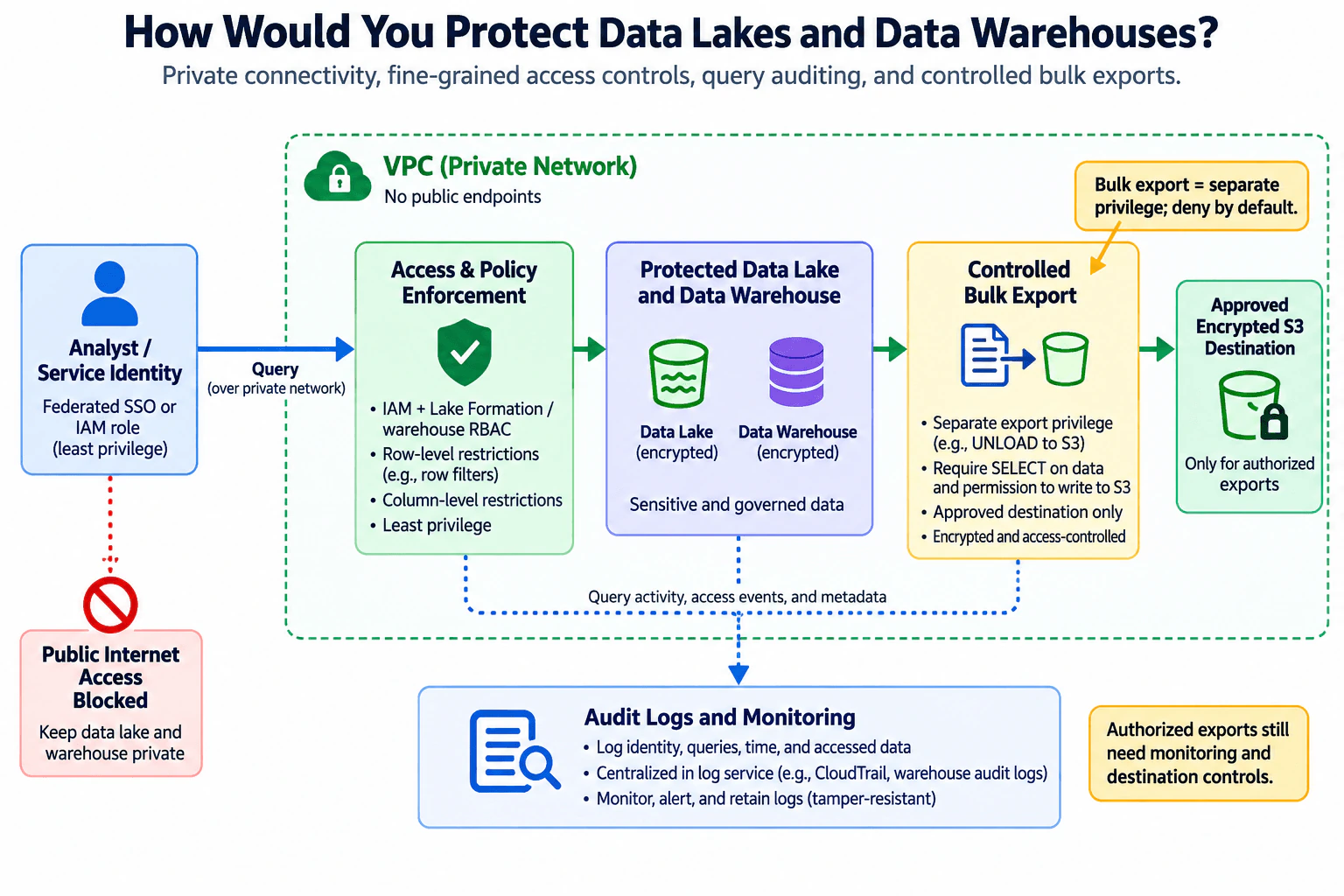
I would use the AWS-oriented design shown in the diagram. AWS operates the underlying managed infrastructure, while the customer configures identities, data permissions, network exposure, encryption choices, logging, and export destinations. My practical goal is to keep sensitive and governed data reachable only through authorized identities and approved paths.
First, I would keep the data plane private. The analyst or service identity sends the query over the private network into the VPC. The protected data lake and data warehouse are configured without public endpoints for this access path. For S3-based lake data, a VPC endpoint can provide private VPC-to-S3 connectivity without requiring an internet gateway or NAT device for that traffic. Public Internet access is not an alternate route to the protected stores in this design.
Second, I would enforce identity and policy before the query reaches the sensitive data. Human analysts use federated single sign-on, and workloads use IAM roles. Permissions follow least privilege. For lake data governed through AWS Lake Formation, data filters can enforce row-level and column-level restrictions for supported Data Catalog tables and integrated query engines. The warehouse uses corresponding role-based access control, or RBAC, so the principal can query only the data it is allowed to see. If no policy grants the requested access, the request is denied.
Third, I would encrypt the data lake and warehouse. Encryption protects stored data but does not replace identity controls, authorization, private connectivity, or monitoring. Administrative access to encryption settings should also be separated from ordinary analyst access so someone who can query data does not automatically control every security setting.
Fourth, I would make bulk export a separately controlled capability. The normal state is deny by default. In the diagram, Amazon Redshift UNLOAD to S3 is an example. AWS documents that UNLOAD needs SELECT privilege on the source data plus authorization to write to the target S3 location. I would use those separate enforcement points so ordinary query access does not automatically provide an approved export path. The destination must be an approved, encrypted, access-controlled S3 location.
Fifth, I would create an evidence path from the access-policy layer, the protected stores, and the export path into centralized audit logging and monitoring. The evidence should record the identity, query or relevant action, time, and associated access activity. Redshift database audit logging provides database activity records, while AWS CloudTrail records Redshift API activity. Logs should be retained in a centralized destination with permissions separated from ordinary analysts, and stronger retention or immutability controls should be applied when tamper resistance is required.
The safe failure behavior is fail closed for sensitive access and exports. If the identity is not authorized, the row or column rule does not permit the requested data, or the export destination is not approved, the operation should not proceed. A logging or monitoring problem should raise an operational alert rather than silently being treated as successful security evidence.
I would validate the controls with authorized tests. A restricted identity should see only permitted rows and columns. Attempts to reach the protected data through the public Internet should fail. An identity that can query but lacks the required export path should fail to export. An approved export should succeed only to the approved destination and should leave the expected audit evidence.
The main tradeoff is usability versus containment. Fine-grained authorization and separate export controls increase policy and operational work, and centralized auditing adds storage and monitoring cost. Private connectivity also requires network administration. However, these controls reduce the amount of sensitive data exposed by one compromised or misused identity. The important residual risk is that a legitimately authorized analyst or service can still misuse data it is allowed to read, so authorized exports still need monitoring and destination controls. Backup, restore, availability, and disaster recovery remain separate decisions.
- Identify the protected lake and warehouse data and the analyst or service identities that require access.
- Keep the protected data path private and remove public access paths for the lake and warehouse.
- Authenticate analysts with federation and workloads with IAM roles.
- Grant least-privilege access and enforce row- and column-level restrictions before returning sensitive data.
- Keep the data lake and warehouse encrypted.
- Deny bulk export by default and authorize it separately from ordinary querying.
- Require both source-data read permission and write permission to an approved encrypted destination.
- Centralize query, identity, metadata, access, and export evidence and monitor it for suspicious activity.
- Test both allowed and denied paths with representative identities and review permissions regularly.
The main cost is operational complexity, not algorithmic complexity. Fine-grained row and column policies need careful ownership and regular review. Private connectivity needs network configuration. Separate export authorization and approved-destination policies add administration. Query and export auditing adds log storage, monitoring, and investigation cost. Very strict controls can slow legitimate analysts, so permissions should be narrow without making normal work impractical. Teams also need clear ownership for access reviews, export approvals, log retention, alerts, and security-policy changes.
This approach is useful when many analysts or applications share a central lake or warehouse but should not all see the same sensitive data. Examples include limiting analysts to records for their own business area, hiding sensitive columns, allowing applications to query governed datasets only through private cloud connectivity, and permitting a small set of authorized workflows to export data to controlled encrypted storage.
This question tests whether the candidate can protect large analytical data stores with layered controls instead of relying on only encryption or network isolation. A strong answer connects identity, fine-grained authorization, private connectivity, controlled exports, auditing, safe denial behavior, and the remaining risk from legitimate users who already have authorized access.
Common mistakes include making the lake or warehouse publicly reachable because IAM is enabled; granting broad read or administrator access instead of row- and column-level restrictions; assuming encryption alone protects the data; allowing normal query permission to become an unrestricted bulk-export path; permitting exports to arbitrary destinations; collecting infrastructure events while ignoring database query activity; giving ordinary analysts control over the audit evidence; and assuming an approved export no longer requires monitoring. Another mistake is treating these access controls as a substitute for backup, restore, availability, or disaster recovery.
Explain the design as one path: private query access, least-privilege identity, row and column restrictions, encrypted data, separately authorized bulk exports, approved destinations, and centralized audit evidence. Emphasize that a permitted query and a permitted bulk export are different risk decisions.