This interview guide is for educational and informational purposes only. It is designed to help readers prepare, but it does not guarantee any interview result, hiring decision, offer, or outcome. Interview questions, hiring criteria, and preferred answers can vary by employer, interviewer, industry, location, and time. All answers, examples, and explanations in this guide are suggested examples for interview preparation, not definitive answers or instructions for professional practice. They are based on research and judgment, are provided without warranties of any kind, and should be adapted to the question, role, and applicable laws and professional requirements. Diagrams are simplified illustrations intended to highlight the main concepts and their relationships; actual situations, systems, and practices may be more complex. Alternative approaches may be equally valid or better suited to a particular question, context, or interviewer. To the fullest extent permitted by applicable law, the contributors and publisher are not liable for decisions made, actions taken, or losses incurred based on this guide.
State Laws and Professional Responsibilities
Laws and requirements governing an occupation vary by state and jurisdiction. You are responsible for checking the current laws, licensing requirements, and scope-of-practice rules that apply to your location and role, and for ensuring that your answers and actions comply with them. Adapt examples in this guide to those requirements. This guide is not legal advice.
Identity, Image, and Privacy Notice
To respect individual privacy, some names, profile photographs, avatars, biographical details, and other identifying information displayed in this guide may be replaced with pseudonyms, licensed stock images, illustrative avatars, composite images, or representative descriptions. Unless a person is expressly identified as an actual contributor, a displayed name, image, or profile should not be understood as depicting or identifying a specific candidate, interviewer, employee, or other real individual. These representations are provided for editorial and illustrative purposes only and do not imply endorsement, employment, participation, or affiliation with this guide or any company mentioned in it. Any resemblance to an actual person is coincidental.
Company Notice
This guide is an independent educational resource and is not affiliated with, endorsed by, sponsored by, or approved by the company named in this guide. Company names identify reported interview experiences or the employer context of clearly labeled original practice exercises. Interview practices can change without notice, and inclusion of company-specific content does not mean these questions are official, complete, or guaranteed to be asked. To the fullest extent permitted by law, the author, contributors, and publisher are not responsible for outcomes related to use of this material.
Content Accuracy and Verification
To the fullest extent permitted by applicable law, we do not represent or warrant that interview guides, questions, answers, examples, or diagrams are accurate, complete, current, error-free, or suitable for any particular purpose. You are responsible for independently reviewing and verifying the information before relying on it.
Questions or comments?
Contact us for general questions, or share feedback, technical corrections, and comments with the community.
21. What is DNS cache poisoning?Network SecurityMedium
i Question Details
Explain how poisoned DNS information can redirect clients and how resolvers can be protected.
Short Interview Answer (30-60 seconds)
DNS cache poisoning happens when a resolver accepts and caches a forged DNS answer. Later clients may receive the false IP address and connect to the wrong server. Protect resolvers with DNSSEC validation where available, unpredictable transaction IDs and UDP source ports, patched software, and DNS monitoring.
Detailed Explanation
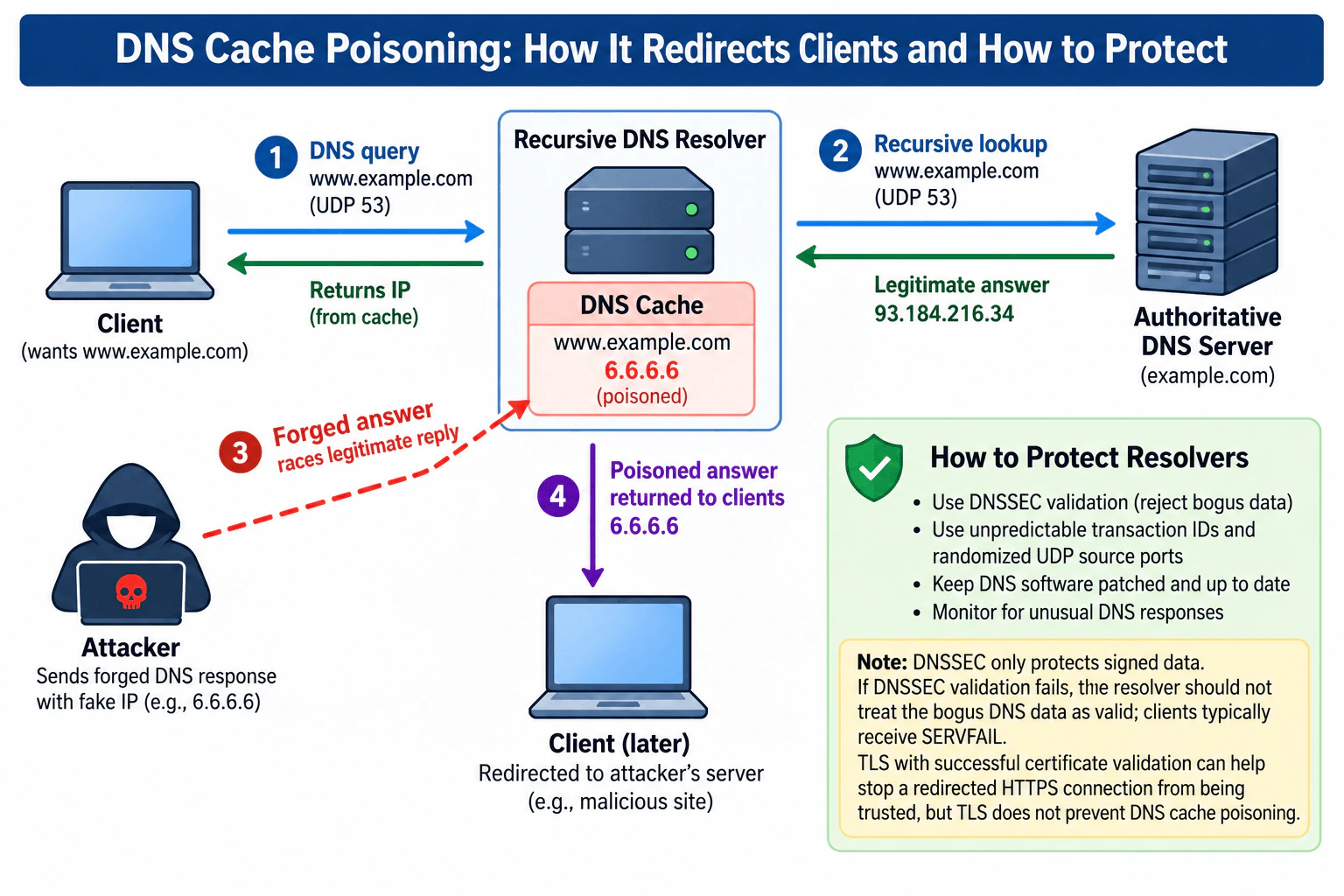
DNS cache poisoning is an integrity attack on DNS resolution. A client asks a recursive resolver for a domain name. If the resolver does not already have a usable cached answer, it queries authoritative DNS infrastructure. An attacker may try to send a forged response that matches the resolver's outstanding query and arrives before the legitimate response. If the resolver accepts the forgery, it can cache the attacker's IP address. Later clients then receive that poisoned value and may connect to the wrong destination. The practical goal is to stop forged answers from being accepted and to detect suspicious DNS behavior. datatracker.ietf.org
Useful Questions to Ask the Interviewer
Are we discussing an off-path forged-response attack against a recursive resolver, as shown in the diagram?
Is the domain DNSSEC-signed, and is the recursive resolver performing DNSSEC validation?
Should I focus only on prevention, or also explain detection and safe failure behavior?
How to Explain It in an Interview
Start with the normal path. A client sends a DNS query for a name such as www.example.com to a recursive DNS resolver. The approved diagram shows DNS over UDP port 53. If the resolver needs to look up the name, it sends a DNS query toward the authoritative DNS server and waits for a response.
The recursive resolver is the key decision point. It must decide whether an incoming DNS response belongs to an outstanding query before accepting it. RFC 5452 describes matching checks that include the question section, DNS transaction ID, expected source address, and the address and port on which the response is received. In general, the first response satisfying the required matching conditions can be accepted. datatracker.ietf.org
In the poisoning scenario, the attacker sends a forged DNS response containing a false mapping such as www.example.com to 6.6.6.6 and tries to make that response arrive before the legitimate answer. If the forged response also matches the resolver's outstanding query strongly enough to be accepted, the resolver may cache the false value. A later client asking for the same name can then receive that poisoned cached address and be redirected toward the attacker's server. RFC 5452 describes this exact consequence: a spoofed caching resolver can repeat wrongly accepted data to its clients and make them contact the wrong, possibly malicious, servers. datatracker.ietf.org
Resolvers should make forged-response guessing difficult. They should use unpredictable DNS transaction IDs and randomized UDP source ports and should strictly match incoming responses against the outstanding query. These controls increase the amount of information an off-path attacker must guess and therefore make successful forgery much harder, although they do not provide cryptographic proof that DNS data is authentic. datatracker.ietf.org
DNSSEC provides stronger integrity protection for signed DNS data. A validating resolver checks the DNSSEC chain of trust and signatures. If the resolver believes data should validate but cannot establish a valid chain, the data is classified as bogus. That can mean an attack, a configuration error, or corrupted DNSSEC data. The resolver must not treat that bogus data as authenticated. In the common validating-recursive-resolver case shown in the diagram, the client typically receives a failure such as SERVFAIL instead of a valid poisoned answer. datatracker.ietf.org
DNSSEC has an important limitation: it protects DNS data only where the required signatures and chain of trust exist. Unsigned DNS data does not become authenticated just because the resolver supports DNSSEC. Broken DNSSEC configuration can also cause legitimate lookups to fail, so the security benefit comes with operational and availability tradeoffs.
Keep resolver software patched and up to date because implementation weaknesses can reduce the effectiveness of DNS protections. Monitoring is also useful. Resolver logs can reveal unusual response patterns, repeated mismatches, unexpected address changes, or DNSSEC validation failures. Monitoring is detection, not prevention, so it complements rather than replaces validation and resolver hardening.
TLS is a separate protection after DNS resolution. DNS poisoning can still direct a client toward the wrong IP address. For HTTPS, certificate and hostname validation help the client detect that the wrong endpoint is not authorized for the intended hostname. The client should compare the hostname it intended to contact with the identity presented in the server certificate rather than trusting a name learned from insecure DNS. If that identity check fails, the connection should not be silently trusted. TLS therefore helps protect endpoint authentication, but it does not prevent the resolver's DNS cache from being poisoned. datatracker.ietf.org
For evidence and recovery, inspect DNS resolver logs, validation failures, suspicious answer changes, and rejected responses. Compare the resolver's current answer with expected authoritative DNS data using an authorized diagnostic query. If poisoning is confirmed, stop serving the known-bad cached mapping, correct the resolver weakness or configuration problem, and verify that later resolution returns the expected trusted data before declaring recovery complete.
The main tradeoff is that stronger response matching and DNSSEC validation improve integrity but increase implementation and operational complexity. DNSSEC can also turn a broken signed zone into an availability failure instead of accepting unverifiable data. That is the intended security tradeoff: prefer a visible lookup failure over silently trusting data that should have validated but did not.
Technical Approach
Receive the client's DNS query at the recursive resolver.
If no usable cached answer exists, query the appropriate authoritative DNS infrastructure.
Accept a DNS response only when it correctly matches the outstanding query, including the expected question, transaction ID, addresses, and port information.
Use unpredictable DNS transaction IDs and randomized UDP source ports so an off-path attacker has more values to guess.
When DNSSEC applies, validate the signed DNS data and chain of trust before treating the result as authenticated.
If DNSSEC validation produces bogus data, do not treat that data as valid; return the appropriate DNS failure behavior, commonly SERVFAIL for a validating recursive client.
Cache only data according to the resolver's normal validation and caching rules.
Monitor resolver logs for unusual responses, repeated mismatches, unexpected address changes, and DNSSEC failures.
If poisoning is confirmed, remove the bad usable mapping, correct the resolver weakness, and verify resolution against expected authoritative data.
Practical Insights
The main costs are operational rather than algorithmic. Random transaction IDs and source ports add little normal overhead but require correct resolver and network behavior. DNSSEC validation adds extra DNS records, cryptographic verification, key-management work for DNS operators, and troubleshooting when signatures or delegations are wrong. Monitoring adds log-storage and investigation work. A broken DNSSEC configuration can make a legitimate signed name fail to resolve, which is the availability cost of refusing data that should have validated but did not.
Why Interviewers Ask This
Interviewers want to see whether the candidate understands DNS cache poisoning as an integrity attack against name resolution. A strong answer should trace the client-to-recursive-resolver-to-authoritative-server path, explain how a forged response can enter the cache, show why later clients may be redirected, and distinguish complementary protections such as DNSSEC validation, query-response matching, source-port randomization, software maintenance, and monitoring.
Common interview mistakes
A common mistake is saying that DNS cache poisoning directly changes network routing; it changes name-resolution data that clients use to choose a destination IP address. Another mistake is saying DNSSEC protects every domain; DNSSEC authentication depends on signed data and a valid chain of trust. Do not claim transaction-ID or source-port randomization completely prevents poisoning; these measures mainly make off-path forgery harder. Do not claim TLS prevents DNS poisoning either. TLS operates after DNS resolution and can help prevent an HTTPS client from trusting the wrong endpoint when certificate and hostname validation succeeds. Finally, do not confuse monitoring with prevention or treat DNSSEC-bogus data as valid.
Interview tip
Explain the attack as one short flow: client query, recursive resolver lookup, forged response races the legitimate answer, false data is accepted into the cache, and later clients receive the wrong IP. Then separate defenses into response matching and randomization, DNSSEC validation, patched resolver software, monitoring, and safe failure. Mention that TLS is a separate protection after DNS resolution.
Interviewer may ask next
How does DNSSEC help prevent DNS cache poisoning?
DNSSEC lets a validating resolver verify signed DNS data using cryptographic signatures and a chain of trust. If data that should validate is bogus, the resolver must not treat it as authenticated. In the common recursive-resolver case, the client receives a failure such as SERVFAIL rather than a normal valid answer. DNSSEC does not provide authenticity for DNS data outside a valid DNSSEC chain of trust. datatracker.ietf.org
Why are random DNS transaction IDs and UDP source ports useful if DNSSEC exists?
They are complementary defenses. An off-path attacker trying to forge a traditional DNS response must make the response match the resolver's outstanding query. Unpredictable transaction IDs and source ports increase the attacker's guessing difficulty. DNSSEC adds cryptographic authentication where signed data and a valid trust chain exist, but not every DNS response is necessarily DNSSEC-authenticated. Randomization therefore remains useful resolver hardening. datatracker.ietf.org
22. Explain mutual TLS and when you would use it.Network SecurityMedium
Short Interview Answer (30-60 seconds)
mTLS is TLS where both client and server authenticate with certificates. Each validates the peer certificate and proof of its private key. I use it for managed service-to-service, partner, service-mesh, or device connections where strong endpoint identity is worth the PKI and certificate-management overhead.
Detailed Explanation
Mutual TLS, or mTLS, is TLS where both endpoints authenticate with certificates. In normal certificate-based HTTPS, the client usually authenticates the server. With mTLS, the server also authenticates the client. Each side validates the peer certificate and verifies CertificateVerify, which proves possession of the matching private key. If required authentication fails, the handshake is aborted. After the TLS handshake completes, normal application traffic is encrypted and mutually authenticated. I would use mTLS when both endpoints are managed and strong service or device identity justifies the certificate-management overhead.
Useful Questions to Ask the Interviewer
Are both endpoints managed by us, or is one an external partner or managed client?
Which certificate authorities or trust anchors should each endpoint trust?
Who owns certificate issuance, secure key storage, rotation, revocation, and trust-store updates?
Is the goal only endpoint authentication, or must separate authorization rules also restrict what the authenticated identity may do?
What should happen when a required certificate is missing, expired, untrusted, or otherwise unacceptable?
How to Explain It in an Interview
Start with the practical decision: use mTLS when both sides of a TLS connection need cryptographic endpoint identity and both sides can participate in a managed certificate lifecycle.
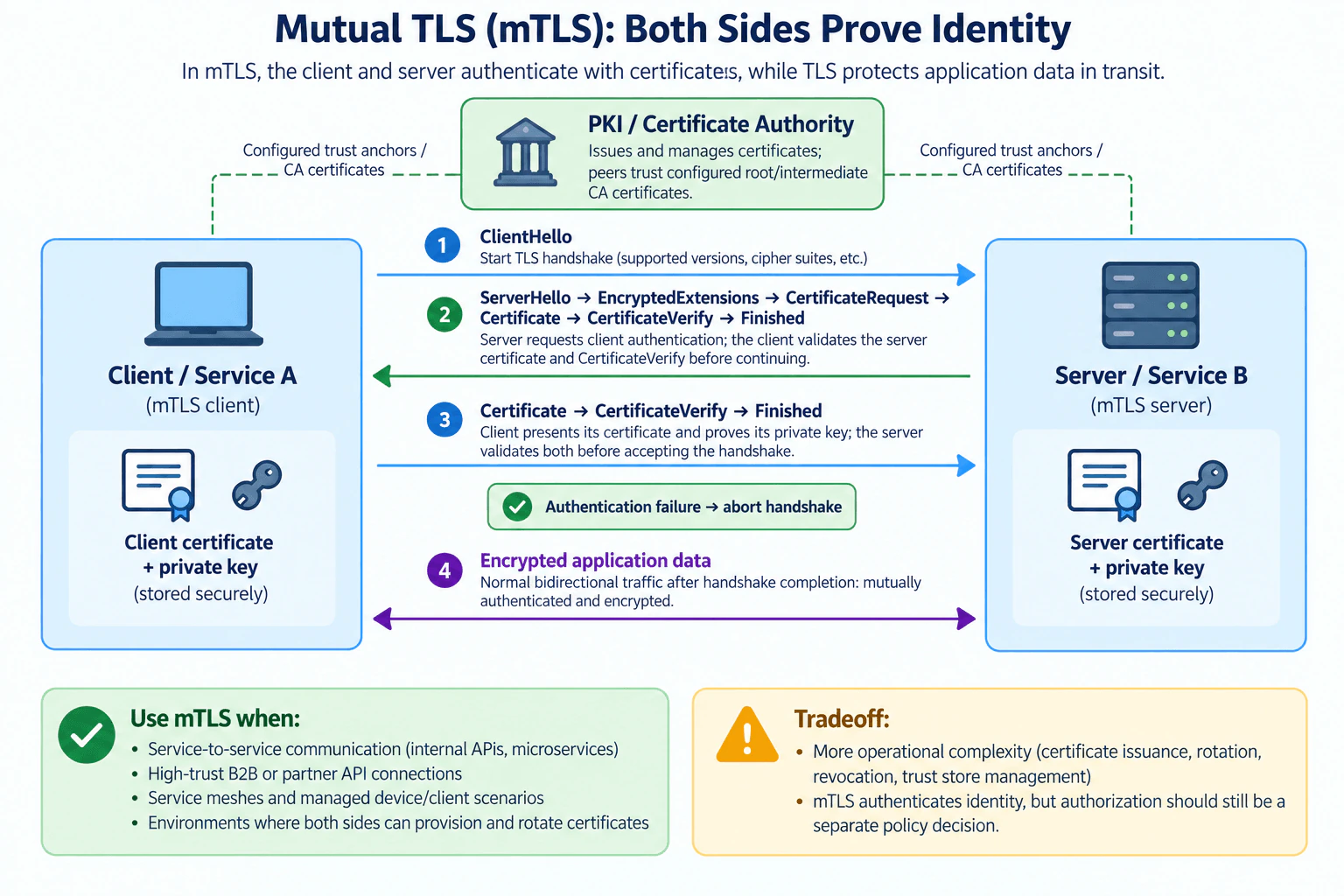
The trust model uses public key infrastructure, or PKI. The client and server each have their own certificate and corresponding private key. Each endpoint also has configured trust anchors, such as trusted CA certificates. The certificate authority issues and manages certificates, but it is not normally an active participant in each TLS handshake. Each peer validates the certificate presented by the other peer against its local trust policy.
In the TLS 1.3 flow shown in the approved diagram, the client begins with ClientHello. The server responds with ServerHello and EncryptedExtensions. Because the server requires certificate-based client authentication, it also sends CertificateRequest, followed by its Certificate, CertificateVerify, and Finished messages.
The client validates the server certificate and its identity according to the configured trust policy. It also verifies CertificateVerify, which proves that the server possesses the private key corresponding to the presented certificate. If those checks succeed, the client continues.
The client then sends its Certificate, CertificateVerify, and Finished messages. The server validates the client's certificate and identity and verifies CertificateVerify before accepting the client as authenticated. CertificateVerify proves possession of the private key corresponding to the client certificate.
If required authentication fails, the safe behavior is to abort the handshake rather than treat the connection as an authenticated mTLS session. Typical causes include an unacceptable certificate, an untrusted certificate chain, an expired certificate, or failed signature or handshake verification.
After successful handshake completion, normal bidirectional application traffic is protected by TLS and both endpoints have authenticated each other. mTLS provides authentication and encryption for the TLS connection, but it does not decide what an authenticated service is authorized to do. Authorization remains a separate policy decision.
I would commonly use mTLS for internal service-to-service communication, microservices, service meshes, high-trust business-to-business or partner API connections, and managed devices or clients. These are good fits because both endpoints can usually be provisioned with certificates and private keys and can participate in certificate rotation.
The main tradeoff is operational complexity. Teams must handle certificate issuance, secure private-key storage, trust-store management, certificate rotation, revocation, and recovery from certificate or trust configuration failures. Weak lifecycle management can turn a strong authentication control into an availability problem.
To verify the design safely, test an authorized connection with valid certificates and confirm the handshake succeeds. Then test controlled failure cases, such as an untrusted or expired test certificate, and confirm authentication is rejected. Operational telemetry should record handshake or certificate-validation failures without exposing private keys or other sensitive credential material.
Technical Approach
Decide whether both endpoints need certificate-based authentication in addition to encrypted transport.
Define the client and server identities and the trust anchors each endpoint accepts.
Issue each endpoint a certificate and securely protect the corresponding private key.
Configure the server to request client authentication and configure both peers to validate the other peer's certificate and identity.
During TLS 1.3, have the client validate the server Certificate and CertificateVerify messages before continuing.
Have the server validate the client Certificate and CertificateVerify messages before accepting the client as authenticated.
Abort the handshake when required authentication fails.
After handshake completion, exchange normal encrypted application traffic and apply authorization separately.
Operate certificate issuance, monitoring, rotation, revocation, and trust-store updates throughout the lifecycle.
Practical Insights
The cryptographic cost is usually small compared with the operational cost. Both sides perform certificate and signature verification during the handshake. The larger burden is running or depending on PKI, securely storing private keys, distributing trust anchors, rotating certificates before they expire, handling revocation, and recovering from certificate or trust-store mistakes. Automation can reduce manual work, but failed rotation or incorrect trust configuration can cause outages. Teams must also maintain separate authorization rules because successful mTLS authentication does not automatically grant every permission.
Why Interviewers Ask This
Interviewers want to see whether the candidate understands the difference between server-only TLS authentication and mutual certificate authentication, can explain certificate trust and private-key proof, knows where mTLS is useful, understands safe failure behavior, and recognizes that authentication and authorization are separate decisions.
Common interview mistakes
Common mistakes are describing mTLS as only encryption, forgetting that both endpoints authenticate, assuming a certificate alone proves possession of its private key, treating the certificate authority as an active participant in every handshake, accepting certificates without checking the required identity and trust policy, confusing authentication with authorization, failing open when required authentication fails, storing private keys insecurely, and ignoring certificate expiry, rotation, revocation, or trust-store management.
Interview tip
Explain mTLS in three steps: both sides present certificate-based identity, each side validates the peer certificate and private-key proof, and normal traffic is protected by TLS after the authenticated handshake. Then give one or two realistic use cases and finish with the main tradeoff: stronger managed endpoint identity in exchange for PKI and certificate-lifecycle complexity.
Interviewer may ask next
How is mTLS different from normal HTTPS?
In normal certificate-based HTTPS, the client usually authenticates the server using the server's certificate. In mTLS, the server also requires certificate-based client authentication. The client validates the server certificate and CertificateVerify, and the server validates the client certificate and CertificateVerify. This gives mutual TLS-level endpoint authentication plus encrypted transport. Authorization remains a separate application or policy decision.
What are the main failure modes and tradeoffs of mTLS?
Common failure modes include expired or otherwise unacceptable certificates, incorrect trust stores, failed certificate rotation, missing required client certificates, unavailable private keys, and PKI configuration errors. Required authentication failures should abort the handshake rather than produce an authenticated mTLS session. The tradeoff is that mTLS provides strong managed endpoint identity but requires certificate issuance, secure key storage, trust management, rotation, revocation, monitoring, and recovery. It also does not replace authorization or eliminate risk if a legitimately authenticated endpoint is compromised.
23. How does ARP work, and how can attackers misuse it?Network SecurityMedium
Short Interview Answer (30-60 seconds)
ARP maps a local IPv4 next-hop address to a MAC address. Requests are normally broadcast and replies are normally sent back to the requester. Because ARP has no built-in authentication, an attacker on the same Layer 2 network can forge mappings, poison ARP caches, and redirect traffic through the attacker's MAC address.
Detailed Explanation
ARP, or Address Resolution Protocol, answers a local-network question: which MAC address should receive an Ethernet frame for a particular IPv4 next hop? A host that does not know the mapping broadcasts an ARP request on its Layer 2 network. The matching device replies with its MAC address, and the requester stores that mapping in its ARP cache. The security problem is that ARP does not authenticate these mappings. An attacker on the same Layer 2 broadcast domain can therefore send forged ARP replies, replace legitimate cache entries, and redirect traffic through the attacker's device.
Useful Questions to Ask the Interviewer
Should I explain both the normal ARP exchange and ARP cache poisoning?
Should I assume the attacker is connected to the same Layer 2 broadcast domain?
Do you want the bidirectional man-in-the-middle case where both endpoints are poisoned?
How to Explain It in an Interview
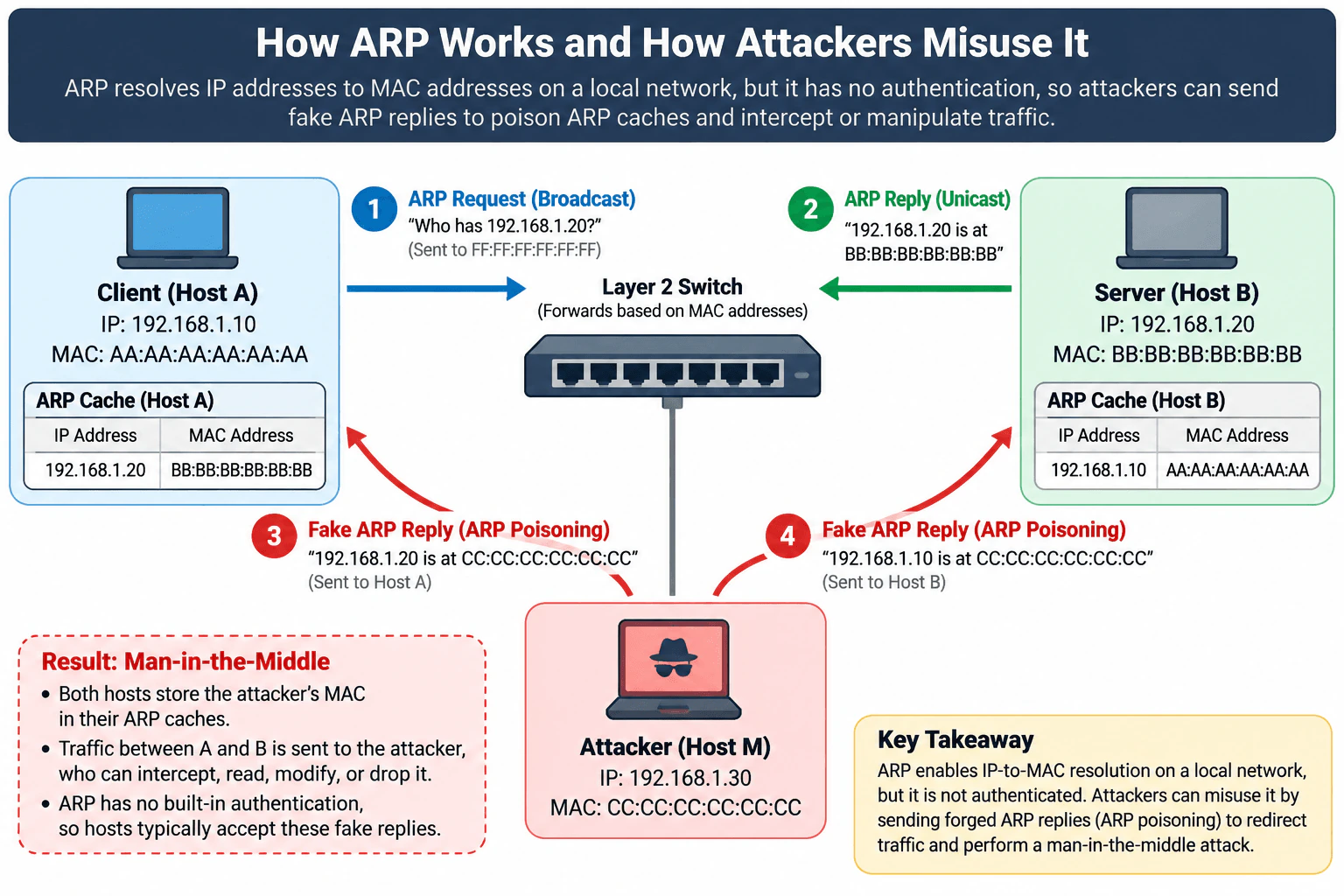
Start with the normal flow shown in the diagram. Host A is 192.168.1.10 with MAC address AA:AA:AA:AA:AA:AA. Host B is 192.168.1.20 with MAC address BB:BB:BB:BB:BB:BB. Both are attached to the same Layer 2 switch.
If Host A wants to send an IPv4 packet to Host B and does not already know Host B's MAC address, Host A broadcasts an ARP request. Conceptually it asks, "Who has 192.168.1.20?" The Ethernet destination is the broadcast MAC address FF:FF:FF:FF:FF:FF, so devices in that Layer 2 broadcast domain receive the request. Host B recognizes its IPv4 address and sends an ARP reply back to Host A stating that 192.168.1.20 is associated with BB:BB:BB:BB:BB:BB.
Host A records that IP-to-MAC mapping in its ARP cache. It can then send Ethernet frames for Host B using BB:BB:BB:BB:BB:BB as the destination MAC. The Layer 2 switch forwards those frames according to its MAC forwarding information. ARP supplies the host with the local IP-to-MAC mapping needed to address the Ethernet frame.
For a destination outside the local subnet, the host normally does not ARP for the remote destination's MAC address. It routes the packet toward a local next hop, such as the default gateway, and ARP resolves that local next hop's IPv4 address to a MAC address.
The weakness is ARP's trust model. ARP has no built-in authentication proving that the sender of an ARP message legitimately owns the IPv4 address it claims. A malicious device on the same Layer 2 network can exploit this by sending forged ARP information.
In the approved diagram, the attacker has IP address 192.168.1.30 and MAC address CC:CC:CC:CC:CC:CC. The attacker sends a forged ARP reply to Host A claiming, "192.168.1.20 is at CC:CC:CC:CC:CC:CC." Host A can then replace its legitimate mapping for Host B with the attacker's MAC address.
The attacker also sends Host B a forged ARP reply claiming, "192.168.1.10 is at CC:CC:CC:CC:CC:CC." If Host B accepts that mapping, both endpoints associate the other endpoint's IPv4 address with the attacker's MAC. Traffic that Host A intends for Host B, and traffic that Host B intends for Host A, is therefore sent toward the attacker.
That creates the man-in-the-middle position shown in the diagram. If the attacker forwards intercepted frames to the real destination using the correct destination MAC, communication can continue while passing through the attacker. Depending on the higher-layer protocol, the attacker may be able to observe or manipulate unprotected data. The attacker can also drop traffic rather than forward it, producing a denial-of-service effect.
The important boundary is the local Layer 2 broadcast domain. Normal ARP requests are not routed through ordinary Layer 3 router boundaries, so classic ARP cache poisoning generally requires the attacker to have access to the relevant Layer 2 network.
A critical limitation is that ARP poisoning does not automatically defeat higher-layer authentication or encryption. Correctly implemented authenticated encryption can protect application contents even if the Ethernet path has been redirected. In that case, the attacker may be able to relay, delay, or drop the protected traffic without being able to decrypt or silently alter the authenticated contents.
A strong interview summary is: ARP is necessary because an IPv4 host needs a local next-hop MAC address before it can send an Ethernet frame. The mapping is learned dynamically and cached, but ARP does not authenticate the claimed mapping. An attacker on the same Layer 2 network can therefore forge ARP replies, poison caches, and redirect traffic through the attacker's MAC address, potentially creating a man-in-the-middle or denial-of-service condition.
Technical Approach
Determine the local IPv4 next hop that needs a MAC address.
Check whether the required IPv4-to-MAC mapping is already present in the ARP cache.
If it is missing, send an ARP request as a Layer 2 broadcast.
Receive the matching device's ARP reply and learn its MAC address.
Store the mapping in the ARP cache and address Ethernet frames to that MAC.
For the abuse case, recognize that forged ARP replies can replace legitimate mappings with an attacker's MAC.
If both communicating endpoints are poisoned as shown in the diagram, traffic can be redirected through the attacker, who may forward, observe, modify unprotected traffic, or drop it.
Practical Insights
ARP is lightweight and normally adds only a small amount of local broadcast traffic when a mapping is unknown. Caching prevents a new ARP exchange for every packet. The security cost comes from ARP's lack of built-in authentication: a false IP-to-MAC mapping can redirect local traffic. Troubleshooting may require checking endpoint ARP caches, packet captures, and the Layer 2 path. The attack is generally limited to the relevant Layer 2 broadcast domain, but successful poisoning can affect confidentiality, integrity, and availability for traffic that crosses the poisoned path. Strong higher-layer encryption can reduce what a man-in-the-middle can read or modify.
Why Interviewers Ask This
Interviewers want to know whether you understand how IPv4 communication depends on Layer 2 address resolution and why ARP's trust model creates a security weakness. A strong answer explains the normal broadcast-request and reply flow, ARP caching, the Layer 2 scope, forged mappings, and how poisoning one or both endpoints can redirect traffic or create a man-in-the-middle path.
Common interview mistakes
Common mistakes include saying ARP resolves domain names, confusing ARP with routing, or saying the Layer 2 switch performs ARP resolution for the endpoint. Another mistake is claiming that every ARP reply is malicious; legitimate ARP replies and cache updates are normal. Candidates also forget that classic ARP poisoning is scoped to the relevant Layer 2 broadcast domain. For a bidirectional man-in-the-middle path like the diagram, both endpoints are commonly poisoned; poisoning only one endpoint does not by itself describe the same symmetric traffic path. Finally, ARP poisoning must not be described as automatically decrypting encrypted application traffic. Redirecting Ethernet frames and defeating higher-layer cryptographic authentication are separate problems.
Interview tip
Explain the normal path first, then the attack. Use the diagram's mapping 192.168.1.20 to BB:BB:BB:BB:BB:BB, then show how the forged mapping to CC:CC:CC:CC:CC:CC redirects frames. Finish by stating that ARP has no built-in authentication, the attacker generally needs access to the same Layer 2 broadcast domain, and higher-layer encryption can still protect content.
Interviewer may ask next
Why is an ARP request normally broadcast while the reply is sent directly to the requester?
The requester does not yet know the target's MAC address, so it places the ARP request in an Ethernet broadcast frame addressed to FF:FF:FF:FF:FF:FF. The target receives the request and learns the requester's MAC address from it, so it can send the ARP reply back directly to the requester rather than broadcasting the reply.
Does ARP poisoning always let an attacker read and modify all victim traffic?
No. ARP poisoning can redirect local Ethernet traffic through the attacker's device, but it does not automatically defeat higher-layer protection. If an application uses authenticated encryption correctly, the attacker may be able to forward, delay, or drop the encrypted traffic without being able to decrypt it or silently modify its authenticated contents. The network path is compromised, but the application's cryptographic security is a separate layer.
24. You discover RDP exposed to the internet. How would you secure it?Network SecurityMedium
i Question Details
For the exposed RDP service, consider immediate exposure reduction, authorized administrative access, and evidence of prior access.
Short Interview Answer (30-60 seconds)
First, I would block direct internet access to TCP 3389. Administrators would connect only through an MFA-protected VPN or RD Gateway. I would require NLA, patch the Windows host, apply least privilege, and review firewall, gateway, and Windows logs for prior access.
Detailed Explanation
The immediate decision is to stop exposing Remote Desktop Protocol, or RDP, directly to the internet while keeping a controlled path for authorized administrators. I would block unauthorized inbound TCP 3389 at the stateful firewall and require administrators to enter through an approved VPN or Remote Desktop Gateway protected by multifactor authentication, or MFA. The Windows RDP host would require Network Level Authentication, remain patched, and use least-privilege administration. I would then review network and Windows evidence to determine whether anyone accessed the service before it was secured.
Useful Questions to Ask the Interviewer
Is direct TCP 3389 currently reachable from any internet source, or only from specific addresses?
Is there already an approved VPN or Remote Desktop Gateway available for administrators?
Is MFA already integrated with the remote-access path?
How long has RDP been publicly reachable, and what firewall, gateway, and Windows logs are retained?
Do we have a defined incident-response process if the evidence shows suspicious or unauthorized access?
How to Explain It in an Interview
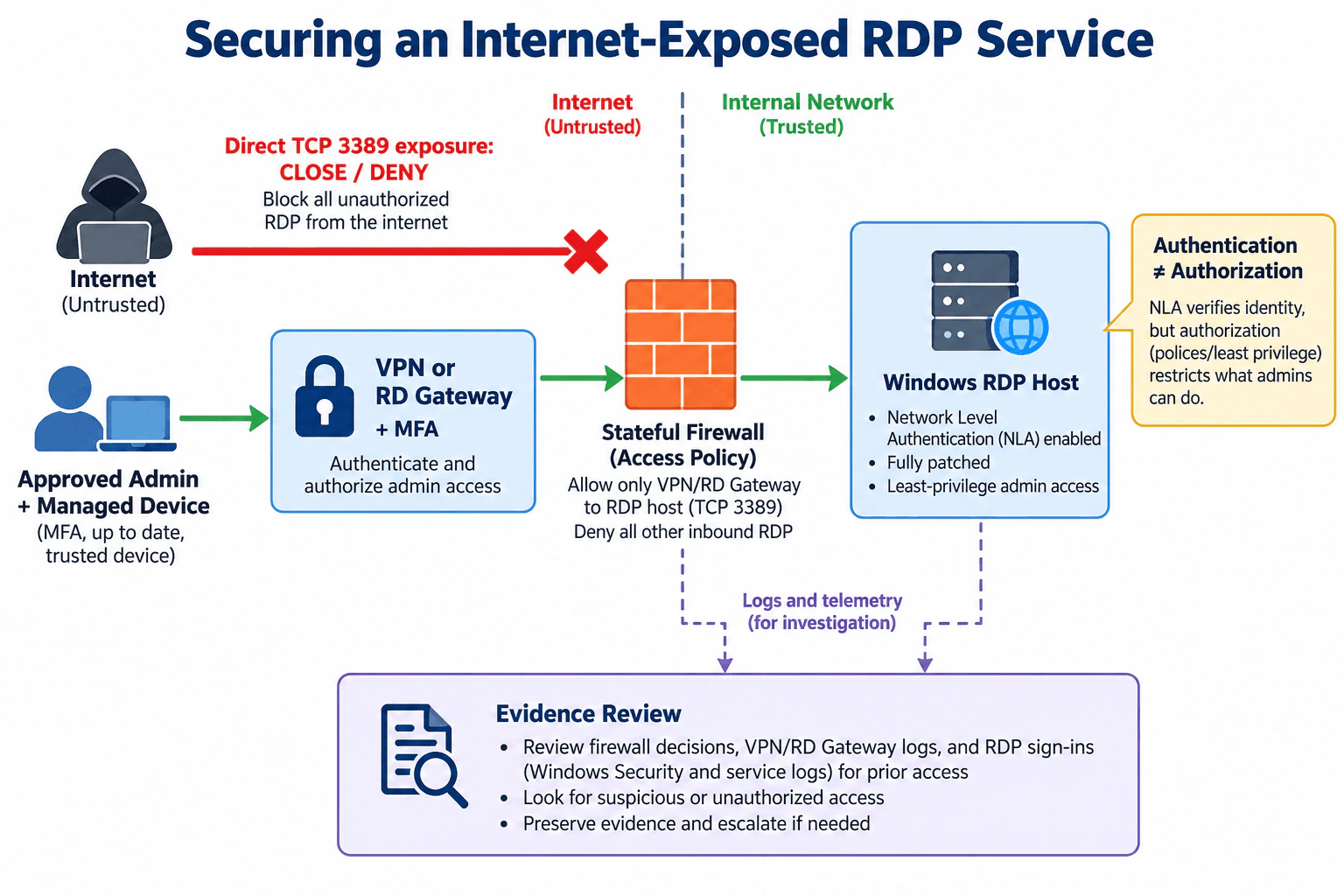
Reduce exposure immediately. I would first remove the unsafe path. The stateful perimeter firewall should deny direct, unauthorized internet traffic to the RDP service on TCP 3389. Routing only determines whether a path exists; the firewall policy is the filtering decision that blocks the unwanted public RDP connection.
Provide an authorized administrative path. Approved administrators using managed devices should first authenticate through the organization's VPN or Remote Desktop Gateway and complete MFA. The firewall should then allow TCP 3389 to the Windows RDP host only from that approved access path and deny other inbound RDP sources. A VPN protects the network path but does not by itself establish that a user or endpoint should receive administrative privileges.
Harden authentication and authorization on the host. I would enable Network Level Authentication, or NLA. NLA requires the user to authenticate before the full remote desktop session is established. I would separately restrict authorization to approved administrators and apply least privilege. Authentication establishes who the user is; authorization determines what that authenticated user is allowed to do.
Patch and maintain the RDP host. I would keep the Windows server and RDP components fully patched. Removing public TCP 3389 greatly reduces exposure, but it does not protect against every risk if an administrator account, managed device, VPN, gateway, or the server itself is compromised.
Investigate the period of prior exposure. I would review the stateful firewall's allow and deny decisions, VPN or RD Gateway authentication records, and Windows Security and RDP service logs. I would look for successful and failed sign-ins, unexpected source information, unusual administrative activity, and other evidence actually recorded by those systems. A firewall connection record can establish network activity, but it does not by itself prove a successful Windows login.
Preserve evidence and respond proportionally. If the records suggest unauthorized access, I would preserve the relevant logs and endpoint evidence and escalate through the incident-response process before making destructive changes that could remove evidence. I would then contain affected access and revoke or reset credentials when justified by the investigation before returning the host to a verified safe state.
Fail closed. If the VPN, RD Gateway, MFA service, or another required security dependency is unavailable, I would not reopen TCP 3389 to the internet as a workaround. Administrative RDP access should remain unavailable until the approved protected path is restored or an authorized recovery process is used.
Validate the result. From an untrusted external network, direct TCP 3389 should be denied. Through the approved administrative path, an authorized administrator who passes MFA should be able to reach the RDP host subject to firewall policy, NLA, and host authorization. I would also verify that firewall, VPN or RD Gateway, Windows Security, and RDP service telemetry is retained for investigation.
The main tradeoff is operational convenience versus attack-surface reduction. Requiring a VPN or RD Gateway, MFA, managed devices, least privilege, patching, and logging adds dependencies, cost, and administrative work. In return, it removes direct public RDP exposure and provides stronger access controls and better evidence. Residual risk still includes stolen administrator credentials, compromised managed endpoints, misconfigured access policies, gateway or VPN compromise, and vulnerabilities on the Windows host.
Technical Approach
Confirm the exposed RDP asset and whether TCP 3389 is directly reachable from the internet.
Block unauthorized inbound internet access to TCP 3389 at the stateful firewall.
Use the approved VPN or Remote Desktop Gateway path for administrators.
Require MFA for the administrative access path.
Restrict the firewall so TCP 3389 reaches the Windows host only from the approved VPN or RD Gateway path.
Enable NLA, patch the Windows host, and restrict RDP authorization to approved least-privilege administrators.
Review firewall decisions, VPN or RD Gateway logs, and Windows Security and RDP service logs covering the exposure period.
Preserve evidence and escalate if suspicious or unauthorized access is found.
Validate that public RDP is denied and the authorized path works only after the required identity and policy checks.
Keep the design fail closed rather than reopening public RDP when the protected access path is unavailable.
Practical Insights
The technical and financial cost is moderate because the organization needs to operate and maintain a VPN or RD Gateway, MFA, firewall rules, patching, and logging. Administrators have an extra authentication step, and remote administration depends on the secure access service being available. There is also ongoing work for access reviews, software updates, log retention, alert review, and incident response. The benefit is a much smaller internet attack surface and better evidence about administrative access. No single control removes all risk, so the protected path and Windows host still need continuous security management.
Why Interviewers Ask This
This question tests whether I can respond to a risky remote-access exposure without treating one control as a complete solution. The interviewer wants to see immediate exposure reduction, a defensible administrative access path, correct separation of authentication and authorization, host hardening, useful evidence collection, safe failure behavior, and judgment about residual risk.
Common interview mistakes
Common mistakes are leaving TCP 3389 publicly reachable and relying only on a strong password; changing the RDP port and treating that as sufficient protection; assuming a VPN alone proves user or device trust; enabling MFA but giving every authenticated user broad administrative rights; confusing NLA authentication with authorization; patching the host while leaving the unsafe public path open; deleting or overwriting evidence before investigating the exposure period; assuming firewall logs alone prove successful Windows logins; and reopening public RDP when the VPN or gateway fails.
Interview tip
Lead with the immediate action: remove direct internet exposure to TCP 3389. Then explain the approved MFA-protected administrative path, NLA and least privilege on the Windows host, and the evidence review. Clearly separate prevention from detection and authentication from authorization.
Interviewer may ask next
What would you check to determine whether the exposed RDP service was previously accessed?
I would correlate evidence from the period when RDP was exposed. I would review firewall allow and deny decisions for traffic to the host, VPN or RD Gateway records if those services were involved, and Windows Security and RDP service logs for successful and failed authentication or session activity. I would compare timestamps, accounts, and source information where available. A network connection alone does not prove a successful login, so I would use endpoint authentication and session evidence before concluding that access occurred. If the evidence indicates unauthorized access, I would preserve it and escalate through incident response.
What happens if the VPN or RD Gateway becomes unavailable?
I would fail closed. Direct TCP 3389 would remain blocked from the internet rather than being reopened as an emergency shortcut. Administrators would use an approved recovery or break-glass process if one exists. The tradeoff is temporary loss of remote administration, but reopening public RDP would recreate the exposure that the design was intended to remove.
25. What security changes distinguish TLS 1.3 from TLS 1.2?Network SecurityHard
Short Interview Answer (30-60 seconds)
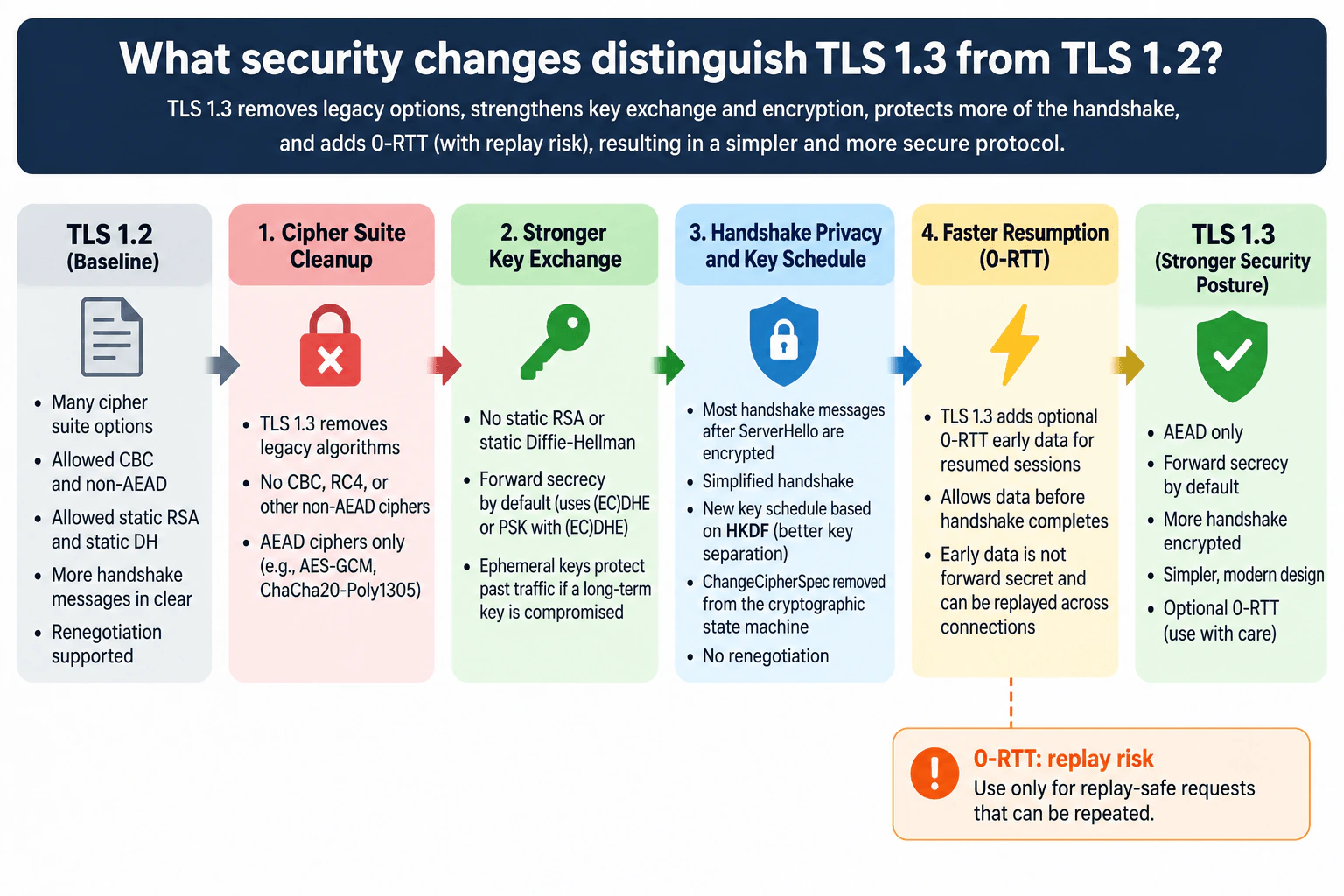
TLS 1.3 removes legacy algorithms and static RSA/DH, uses AEAD-only encryption, encrypts more of the handshake, and uses an HKDF-based key schedule. It also simplifies the protocol and adds optional 0-RTT resumption, which is faster but replayable and has weaker forward-secrecy guarantees.
Detailed Explanation
This question asks which security properties changed when moving from TLS 1.2 to TLS 1.3. The important point is that TLS 1.3 does more than shorten the handshake. It removes legacy cryptographic choices, requires authenticated encryption, eliminates static RSA and static Diffie-Hellman key exchange, protects more handshake messages, and redesigns key derivation. It also simplifies the protocol state machine. The main tradeoff is optional 0-RTT early data: it can reduce resumption latency, but it has weaker forward-secrecy guarantees and can be replayed across connections, so applications must use it carefully.
Useful Questions to Ask the Interviewer
Should I focus only on security changes, or also explain the handshake and latency changes that affect security?
Would you like me to include the 0-RTT replay tradeoff?
Should I distinguish certificate-based ephemeral key exchange from PSK-only TLS 1.3 when discussing forward secrecy?
How to Explain It in an Interview
Start with the practical decision: TLS 1.3 gives a smaller and safer cryptographic design than TLS 1.2 when both endpoints support it. The major improvements are cipher-suite cleanup, stronger key exchange, greater handshake confidentiality, a redesigned key schedule, and removal of legacy protocol behavior. Optional 0-RTT is the important exception because it trades some security guarantees for lower resumption latency.
Cipher-suite cleanup and AEAD-only protection TLS 1.2 supported a broader set of cipher constructions, including CBC-based and other non-AEAD choices. TLS 1.3 restricts record protection to Authenticated Encryption with Associated Data, or AEAD. AEAD provides confidentiality and integrity together. TLS 1.3 cipher suites identify the AEAD algorithm and hash, while authentication and key exchange are negotiated separately. Common TLS 1.3 choices include AES-GCM and ChaCha20-Poly1305. This is the cipher-suite cleanup shown in the diagram.
Static RSA and static Diffie-Hellman key exchange are removed TLS 1.2 could use static RSA or static Diffie-Hellman key exchange. TLS 1.3 removes those public-key key-exchange modes. Certificate-based public-key handshakes therefore use ephemeral Diffie-Hellman or elliptic-curve Diffie-Hellman, commonly written DHE or ECDHE. Ephemeral secrets give forward secrecy: if the server's long-term authentication key is compromised later, previously recorded sessions are not automatically exposed after the ephemeral secrets have been erased. TLS 1.3 can also use pre-shared keys, or PSKs. PSK combined with DHE or ECDHE provides forward secrecy, while PSK-only mode does not provide the same guarantee. That nuance is why 'forward secrecy by default' should not be interpreted as an unconditional property of every possible TLS 1.3 connection.
More of the handshake is encrypted ClientHello and ServerHello still have to expose information needed to establish the connection, but TLS 1.3 encrypts the handshake messages that follow ServerHello. The EncryptedExtensions message also moves negotiated information that was previously visible into the encrypted part of the handshake. This improves handshake privacy, although TLS still does not hide all connection metadata or everything carried in ClientHello.
The key schedule is redesigned around HKDF TLS 1.3 uses the HMAC-based Extract-and-Expand Key Derivation Function, or HKDF, to derive separate secrets for different handshake and application phases. This gives stronger key separation than the older TLS 1.2 design. Early-data secrets, handshake traffic secrets, and application traffic secrets are derived for different purposes rather than relying on one less-structured key-generation process.
The protocol state machine is simpler TLS 1.3 removes renegotiation and eliminates the old ChangeCipherSpec transition from the cryptographic state machine. A compatibility ChangeCipherSpec record can still appear for middlebox compatibility, but it does not control the TLS 1.3 key transition. Removing legacy negotiation paths and unnecessary cryptographic choices makes the protocol easier to reason about and reduces attack surface associated with obsolete mechanisms.
Optional 0-RTT resumption has an explicit security tradeoff A resumed TLS 1.3 connection can optionally send 0-RTT early application data before the normal handshake finishes. This saves a round trip, but early data has weaker guarantees than normal 1-RTT application data. The client cannot assume full forward secrecy for 0-RTT data, and TLS does not guarantee non-replay of that data between connections. Therefore, clients should send only data that is safe to replay, and servers should apply anti-replay controls. Operations with important side effects, such as creating a purchase or transferring money, should not be treated as ordinary replay-safe 0-RTT requests.
Negotiation failures should terminate the protected connection attempt The endpoints must agree on acceptable TLS parameters. If they cannot negotiate a supported version, cipher, key-exchange parameters, or other required security properties, the handshake fails rather than silently continuing as an unprotected TLS session. Applications may separately implement fallback policy, but that policy must not turn a TLS failure into plaintext communication without an explicit, safe design decision.
The interview takeaway is simple: TLS 1.3 removes legacy cryptography, makes AEAD record protection mandatory, eliminates static public-key key exchange, protects more of the handshake, strengthens key separation, and simplifies the protocol. Its optional 0-RTT feature is useful for latency but must be treated separately because replay and weaker forward-secrecy guarantees remain meaningful residual risks. TLS protects the communication channel; it does not by itself prove that an endpoint, user, or application action should be trusted.
Technical Approach
Establish the TLS 1.2 baseline: broader cipher choices, CBC and other non-AEAD options, static RSA/static DH possibilities, and more visible handshake information.
Explain TLS 1.3 cipher cleanup and AEAD-only record protection.
Explain removal of static RSA/static DH and the use of ephemeral DHE/ECDHE for public-key key exchange.
Explain that messages after ServerHello are encrypted and that TLS 1.3 uses an HKDF-based key schedule.
Explain removal of renegotiation and the old ChangeCipherSpec state transition.
Finish with optional 0-RTT and clearly state its replay and forward-secrecy limitations.
State that an unacceptable TLS negotiation should fail rather than silently become an unprotected connection.
Practical Insights
TLS 1.3 usually reduces protocol complexity because there are fewer legacy algorithms and negotiation paths to support. It can also reduce connection latency, especially during resumption. Migration can still have operational cost because older clients, servers, middleboxes, or inspection systems may require TLS 1.2 compatibility. 0-RTT adds application and monitoring work because replay-sensitive requests must be separated from replay-safe requests. Certificate management, implementation patching, endpoint security, and application authorization are still required; TLS 1.3 does not replace them.
Why Interviewers Ask This
Interviewers want to know whether you understand that TLS 1.3 is a security redesign, not just a faster version of TLS 1.2. A strong answer distinguishes cryptographic cleanup, stronger forward-secrecy properties, greater handshake confidentiality, the HKDF-based key schedule, protocol simplification, and the special replay risk of 0-RTT.
Common interview mistakes
Do not say TLS 1.3 is merely a faster TLS 1.2. Do not say TLS 1.3 invented forward secrecy; TLS 1.2 could already provide it with DHE or ECDHE. Do not claim every TLS 1.3 connection is automatically forward secret, because PSK-only mode is an important exception. Do not say the entire TLS 1.3 handshake is encrypted: ClientHello and ServerHello remain visible, while later handshake messages are encrypted. Do not describe 0-RTT as equally secure to normal application data because it can be replayed and has weaker forward-secrecy guarantees. Finally, do not say ChangeCipherSpec can never appear in TLS 1.3; compatibility records can still appear even though they no longer drive the cryptographic state transition.
Interview tip
Present four improvements and one tradeoff: legacy cryptography is removed, key exchange is strengthened, more of the handshake is encrypted, and the key schedule and state machine are simplified. Then finish with the 0-RTT replay risk. If the interviewer asks for depth, mention the PSK-only forward-secrecy exception and compatibility ChangeCipherSpec records.
Interviewer may ask next
Why does TLS 1.3 provide stronger forward-secrecy properties than TLS 1.2?
TLS 1.3 removes static RSA and static Diffie-Hellman public-key key exchange. Certificate-based public-key handshakes therefore use ephemeral DHE or ECDHE, so later compromise of the server's long-term authentication key does not by itself reveal previously recorded sessions after ephemeral secrets are erased. TLS 1.2 could also provide forward secrecy when configured with DHE or ECDHE, so the improvement is that TLS 1.3 removes the static public-key alternatives. PSK-only TLS 1.3 is an exception; PSK combined with DHE or ECDHE provides the stronger property.
Why is TLS 1.3 0-RTT a security tradeoff?
0-RTT lets a client send early application data during session resumption before the normal handshake completes, which can save one round trip. The tradeoff is that the client cannot assume full forward secrecy for that early data, and TLS does not guarantee that it cannot be replayed across connections. Servers should apply anti-replay protections, and clients should send only operations that remain safe when repeated. Side-effecting actions such as purchases or transfers are poor candidates for ordinary 0-RTT use.
Describe BGP routing abuse and the role of route-validation defenses.
Short Interview Answer (30-60 seconds)
BGP route hijacking is an unauthorized or mistaken announcement of another network's IP prefix. RPKI Route Origin Validation compares the route's prefix and origin AS with validated authorization data. The route receives a validation state, and operator policy can reject or de-preference an invalid route.
Detailed Explanation
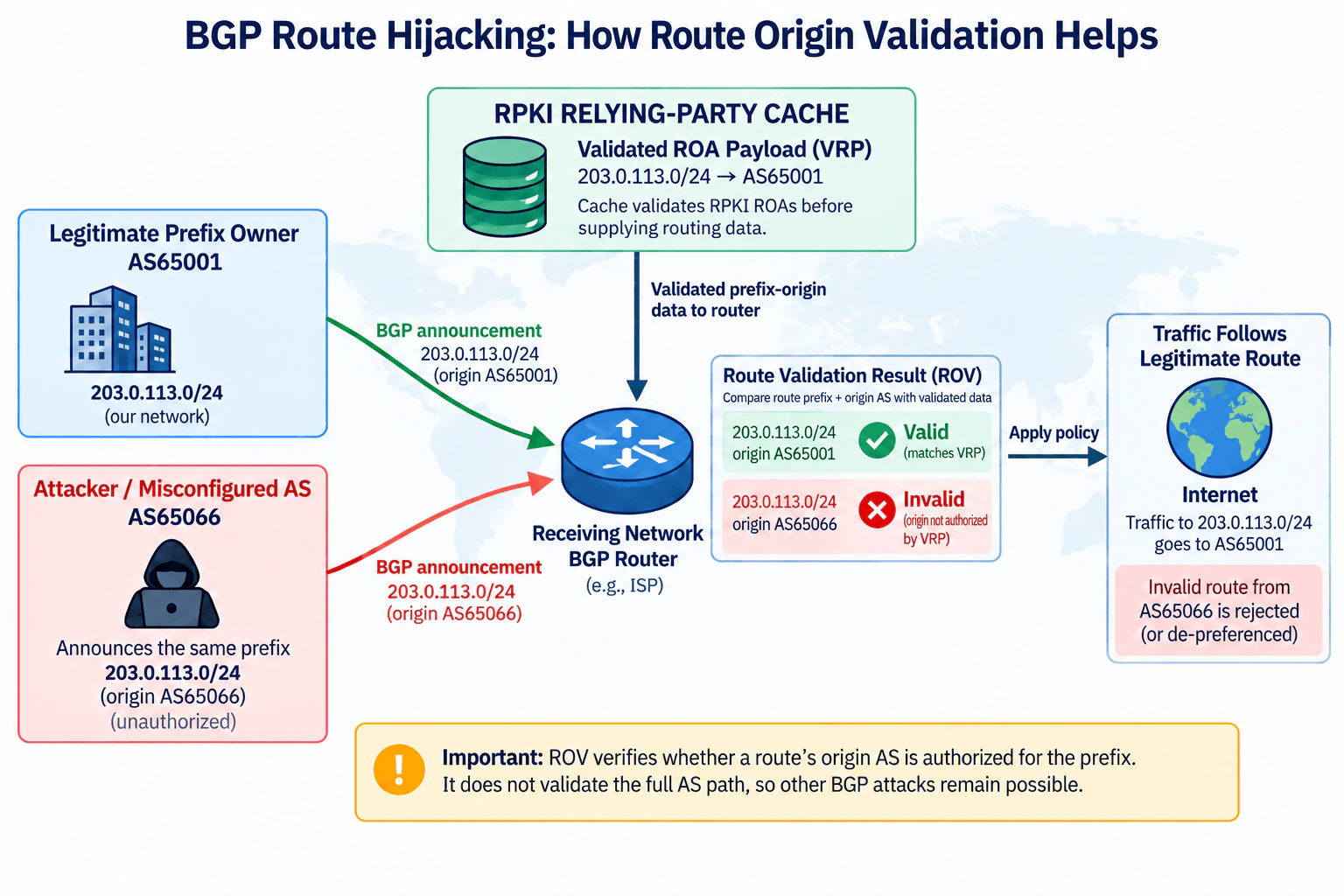
BGP route hijacking happens when an Autonomous System, or AS, announces an IP prefix that it is not authorized to originate. Other networks can accept that route and send traffic toward the wrong AS, which may cause diversion, misdelivery, interception, or loss of reachability. The defense shown in the diagram is Resource Public Key Infrastructure, or RPKI, with Route Origin Validation, or ROV. An RPKI relying-party cache validates signed routing authorization data and supplies validated prefix-origin information to a receiving BGP router, which uses it when evaluating routes and applying routing policy.
Useful Questions to Ask the Interviewer
Are you asking mainly about how the hijack works, or also how RPKI-based origin validation reduces the risk?
Should I include accidental BGP misconfiguration as well as malicious announcements?
Do you want me to explain the main limitation of ROV, which is that it validates the origin but not the complete AS path?
How to Explain It in an Interview
Start with the practical routing problem. Border Gateway Protocol, or BGP, lets Autonomous Systems exchange reachability information for IP prefixes. A received BGP route includes a prefix and an AS_PATH attribute from which the receiving router derives the route's origin AS. A normal BGP announcement by itself does not cryptographically prove that this AS is authorized by the prefix holder to originate that prefix.
In the diagram, AS65001 is the legitimate origin for 203.0.113.0/24. AS65066 is unauthorized but announces the same prefix. The receiving network therefore sees two possible BGP announcements for 203.0.113.0/24. Without an independent origin-validation mechanism, normal BGP routing policy could select an unauthorized announcement. If that happens, traffic for the prefix can be sent toward the wrong AS. That is the core route-hijacking problem. The false announcement may be malicious or may result from a configuration mistake.
RPKI provides the independent authorization data used by ROV. A prefix holder creates a Route Origin Authorization, or ROA, identifying an AS that is authorized to originate specified prefixes, subject to the ROA's prefix-length rules. A relying-party validator retrieves and cryptographically validates the relevant RPKI objects and derives Validated ROA Payloads, or VRPs. In the diagram's example, the validated data authorizes AS65001 for 203.0.113.0/24.
The RPKI relying-party cache supplies this validated prefix-origin data to the receiving BGP router. The router compares each route's prefix and derived origin AS with its local VRP data. The announcement for 203.0.113.0/24 with origin AS65001 is Valid because a VRP matches it. The announcement for the same prefix with origin AS65066 is Invalid because a VRP covers the prefix but no VRP matches that route's origin and prefix-length combination.
ROV has three possible origin-validation states in the standard model: Valid, Invalid, and NotFound. Valid means at least one VRP matches the route. Invalid means at least one VRP covers the route prefix but none matches it. NotFound means no VRP covers the route prefix. The diagram focuses on the Valid and Invalid cases because those are the two routes in this hijacking example.
The validation result and the routing decision are separate. ROV determines the validation state. Operator routing policy decides what to do with that state. In the diagram, the valid AS65001 route remains usable, while the invalid AS65066 route is rejected or de-preferenced. Rejecting Invalid routes gives stronger protection against accepting unauthorized origins, but the exact routing policy remains an operator decision.
Operational failure handling also matters. RPKI validation depends on correct authorization data and usable validated cache data. A mistaken ROA can make a legitimate BGP announcement Invalid, and rejecting such a route can cause loss of reachability. Cache or synchronization problems can also affect how current the router's validation data is. Operators therefore need controlled policy changes, cache-health monitoring, authorization lifecycle management, and testing rather than assuming that ROV is automatically safe in every failure condition.
Useful evidence includes the received BGP prefix, the AS_PATH and derived origin AS, the route's ROV state, the relevant VRPs available to the router, and the health and synchronization state of the RPKI relying-party cache. These observations help distinguish an unauthorized origin announcement from a normal routing change instead of treating every unexpected path as a confirmed attack.
The main limitation is that ROV validates route origin authorization, not the complete BGP AS path. It does not cryptographically prove that every AS in AS_PATH is legitimate. Therefore, other forms of BGP path manipulation can remain possible even when origin validation is working correctly. ROV is a strong control against unauthorized origin announcements, but it is not complete BGP path security.
Technical Approach
Identify the affected IP prefix and the origin AS derived from each received BGP route.
Obtain validated prefix-origin information from the RPKI relying-party cache.
Compare each route's prefix, prefix length, and origin AS with the relevant VRPs.
Classify the route as Valid, Invalid, or NotFound according to ROV rules.
Apply explicit operator routing policy to the resulting validation state.
For this diagram's example, keep the valid AS65001 route usable and reject or de-preference the invalid AS65066 route.
Verify the result using BGP route information, ROV state, relevant VRPs, and RPKI cache health.
Remember that successful origin validation does not prove the integrity of the complete AS path.
Practical Insights
RPKI and ROV add operational work rather than changing normal application traffic. Prefix holders must create and maintain accurate ROAs when routing changes. Network operators need reliable RPKI validators or caches, router integration, routing policy, monitoring, testing, and procedures for authorization mistakes or stale data. Incorrect authorization can make a legitimate route Invalid, so a strict rejection policy can cause reachability problems if the RPKI data is wrong. The benefit is much stronger resistance to unauthorized origin announcements. The remaining limitation is that ROV protects the route origin, not the entire BGP path.
Why Interviewers Ask This
This question tests whether the candidate understands how false BGP origin announcements can redirect traffic, why ordinary BGP announcements do not prove that an origin AS is authorized for a prefix, and how RPKI Route Origin Validation reduces this risk. It also tests whether the candidate understands the boundary between validation and routing policy and can explain ROV's important limitation: it does not validate the full AS path.
Common interview mistakes
Common mistakes include saying that ordinary BGP announcements prove prefix ownership, claiming that RPKI ROV validates the entire AS path, treating a VRP as a BGP route, or saying that ROV itself automatically rejects routes. ROV assigns an origin-validation state; routing policy decides how that state affects route selection. Another mistake is forgetting the NotFound state or describing every unexpected route as malicious, because routing mistakes can produce similar symptoms. Finally, operators can create outages if they reject Invalid routes while their own ROAs are incorrect or no longer match legitimate routing changes.
Interview tip
Use one simple flow: an unauthorized AS announces the prefix, the receiving router derives the route's origin AS, ROV compares the prefix and origin with validated RPKI data, the route receives a validation state, and operator policy decides whether to accept, reject, or de-preference it. Finish by saying that ROV validates origin authorization, not the full AS path.
Interviewer may ask next
What is the difference between a ROA, a VRP, and Route Origin Validation?
A Route Origin Authorization, or ROA, is a signed RPKI object that identifies an AS authorized to originate specified IP prefixes, subject to its prefix-length rules. After validating the RPKI objects, a relying-party validator derives Validated ROA Payloads, or VRPs, containing the validated prefix, maximum length, and origin AS information used for route-origin checks. Route Origin Validation is the router-side comparison of a BGP route's prefix and derived origin AS with those VRPs to produce a Valid, Invalid, or NotFound state. Routing policy then decides what to do with that state.
What important BGP risk remains after RPKI Route Origin Validation is deployed?
ROV does not validate the complete AS path. It checks whether the route's claimed origin AS is authorized for the prefix, but it does not cryptographically prove that every intermediate AS in AS_PATH is legitimate. Path manipulation and other attacks outside origin authorization can therefore remain possible. ROV should be described as protection against unauthorized origin announcements, not as complete BGP path security.
27. What is the cloud shared-responsibility model, and why does it vary by service?Cloud SecurityEasy
i Question Details
Define shared responsibility as the division of security duties between a cloud provider and its customer. Explain how responsibility changes across infrastructure, managed platforms, and software services; distinguish control-plane, data-plane, identity, configuration, workload, data, logging, backup, and compliance duties; and clarify that using a managed service does not transfer accountability for customer data and access decisions.
Short Interview Answer (30-60 seconds)
Shared responsibility means the provider secures the cloud components it operates, while the customer secures its data, identities, access decisions, configurations, and customer-managed workloads. From IaaS to PaaS to SaaS, the provider manages more of the stack, but customer accountability for its data and access decisions remains.
Detailed Explanation
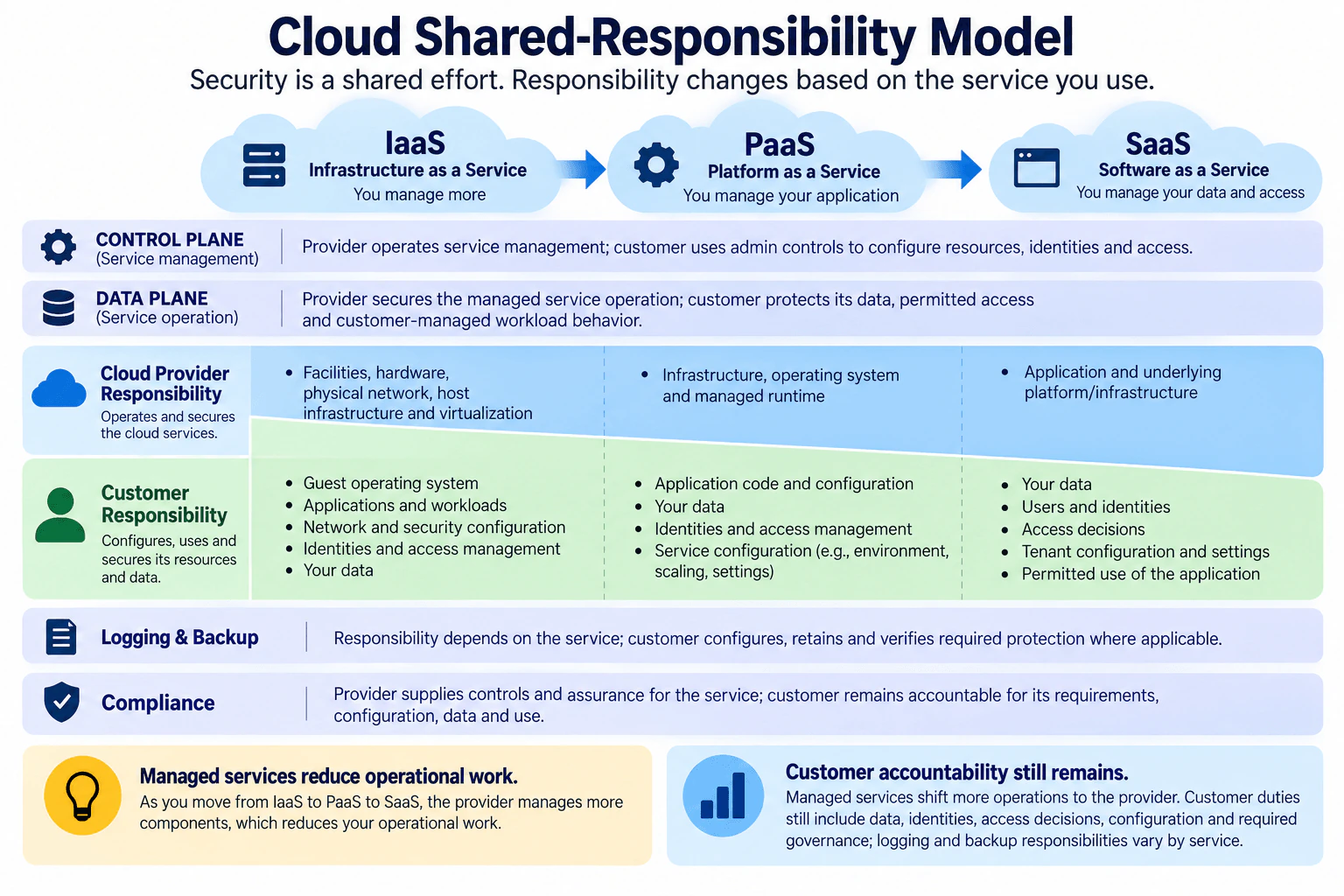
The practical question is: who is responsible for each security duty when a cloud service is used? The answer depends on how much of the technology stack the provider operates. In IaaS, the customer manages more. In PaaS, the provider also operates the operating system and managed runtime. In SaaS, the provider operates the application and underlying platform. Across all three, the customer still controls important decisions involving data, identities, access, configuration, and permitted use. Logging, backup, and compliance duties depend on the specific service and customer requirements.
Useful Questions to Ask the Interviewer
Are we discussing IaaS, PaaS, SaaS, or several service types?
Which customer data, identities, configurations, and workloads are in scope?
Which logging and backup capabilities are provider-operated, and which must the customer configure, retain, or verify?
Are there compliance, retention, or recovery requirements that change the customer's duties?
How to Explain It in an Interview
Start with the responsibility boundary. The cloud provider secures the parts of the service that it operates. The customer secures the parts it controls and remains accountable for how its data and access are managed.
For IaaS, the provider operates facilities, hardware, the physical network, host infrastructure, and virtualization. The customer manages the guest operating system, applications and workloads, network and security configuration, identities and access management, and its data. IaaS gives the customer more control, but it also creates more operational security work.
For PaaS, the provider also operates the underlying infrastructure, operating system, and managed runtime. The customer still manages application code and configuration, data, identities and access management, and service configuration such as environment, scaling, or other exposed settings. The responsibility boundary moves because the provider operates more of the platform.
For SaaS, the provider operates the application together with its underlying platform and infrastructure. The customer still manages its data, users and identities, access decisions, tenant configuration and settings, and permitted use of the application. SaaS removes much of the customer's platform operation, but it does not remove accountability for customer-controlled security decisions.
The control plane is the service-management side. The provider operates the service-management capability, while the customer uses administrative controls to configure resources, identities, access, and settings. A securely operated cloud service can still be exposed by an unsafe customer permission or configuration.
The data plane is where the service performs its main work with data or customer-managed workloads. The provider protects the managed service operation, while the customer protects its data, permitted access, and workload behavior that remains under customer control. Provider security therefore does not make an incorrect customer access decision safe.
Logging and backup are service-dependent responsibilities. A provider may operate logging or backup capabilities, but the customer may still need to enable them, select retention, configure required protection, verify coverage, and test recovery. The correct answer is not that logging and backup always belong entirely to one side.
Compliance is also shared. The provider can supply controls and assurance for the service it operates. The customer remains accountable for its own requirements, configuration, data, access, and use of that service. Provider assurance does not prove that the customer's deployment or operating practices satisfy its requirements.
A useful failure case is a SaaS tenant with excessive administrator access or incorrect sharing settings. The provider can securely operate the SaaS platform while customer data is still exposed because the customer made an unsafe access decision. Similarly, a managed backup capability does not prove recoverability if required protection was not configured or restore behavior was never tested.
Validation should follow the same boundary. Confirm which components the provider operates, review customer identities and permissions, verify service and tenant configuration, confirm logging and backup ownership, and test required recovery. If ownership or access is uncertain, do not assume the provider covers it; identify the responsible side and verify the control before relying on it.
The main tradeoff is control versus operational work. Moving from IaaS to PaaS to SaaS normally reduces the amount of infrastructure and platform operation performed by the customer, while increasing dependence on provider-managed behavior. Customer accountability for its own data, access decisions, configuration, and required governance remains.
Technical Approach
Identify whether the service is IaaS, PaaS, or SaaS.
Draw the boundary between provider-operated components and customer-controlled components.
For IaaS, place facilities, hardware, physical networking, host infrastructure, and virtualization with the provider; place the guest OS, workloads, network and security configuration, identities, access, and data with the customer.
For PaaS, move infrastructure, operating system, and managed runtime operation to the provider while keeping application code, data, identities, access, and service configuration with the customer.
For SaaS, move application and platform operation to the provider while keeping customer data, users, access decisions, tenant settings, and permitted use with the customer.
Identify control-plane responsibilities separately from data-plane responsibilities.
Treat logging and backup as service-dependent duties instead of assigning them automatically to one side.
Treat compliance as shared: provider assurance covers provider-operated controls, while the customer remains accountable for its requirements, configuration, data, and use.
Validate permissions, configuration, logging, backup coverage, restore behavior, and control ownership before relying on the design.
Time & Space Complexity
The main cost is the tradeoff between control and operational work. IaaS gives the customer more direct control, but the customer must secure and maintain more components. PaaS removes much of the operating-system and runtime work, while the customer still owns application, identity, data, and configuration decisions. SaaS removes even more technical operations, but customers still manage users, access, tenant settings, data, and permitted use. Logging, backup, compliance, and recovery can still require configuration, testing, storage, review, staff time, and cost. More managed services simplify operations but increase dependence on provider-managed capabilities.
Where it is used
The shared-responsibility model is used whenever an organization evaluates or operates cloud services. Examples include deciding who patches a virtual machine in IaaS, who operates the runtime in PaaS, who manages users and tenant settings in SaaS, who enables and retains logs, who configures and verifies backups, and who supplies compliance evidence. Security teams also apply it during cloud architecture reviews, migrations, access reviews, incident preparation, vendor assessments, recovery planning, and operational handoffs.
Why Interviewers Ask This
Interviewers want to know whether a candidate understands that moving to the cloud does not move every security duty to the provider. A strong answer identifies how the boundary changes across IaaS, PaaS, and SaaS, separates provider-operated technology from customer-controlled resources and decisions, distinguishes control-plane and data-plane responsibilities, and avoids treating managed services as automatic protection for customer data, access, configuration, logging, backup, or compliance obligations.
Common interview mistakes
A common mistake is saying that the cloud provider secures everything once a workload moves to the cloud. Another is using one fixed responsibility list for IaaS, PaaS, and SaaS. Candidates may also assign logging or backup entirely to the customer or provider without checking the service boundary. Other mistakes include assuming provider assurance makes the customer's use compliant, ignoring control-plane permissions, forgetting customer responsibility for data and access decisions, confusing provider operation of a managed service with customer configuration of that service, or assuming a backup capability guarantees recovery without verification.
Interview tip
Explain the model as a moving boundary, not as two fixed checklists. Walk from IaaS to PaaS to SaaS and show that the provider operates more of the stack at each step. Then emphasize the key point: managed services reduce operational work, but customer accountability for data, identities, access decisions, configuration, and required governance remains.
Interviewer may ask next
How does the shared-responsibility boundary change from IaaS to PaaS to SaaS?
In IaaS, the provider operates facilities, hardware, the physical network, host infrastructure, and virtualization, while the customer manages the guest OS, applications and workloads, network and security configuration, identities, access, and data. In PaaS, the provider also operates the operating system and managed runtime, leaving the customer responsible for application code, data, identities, access, and service configuration. In SaaS, the provider operates the application and underlying platform and infrastructure, while the customer still manages its data, users, access decisions, tenant settings, and permitted use.
Does using a managed cloud service mean the provider is responsible for backups, logging, and compliance?
Not automatically. Those responsibilities depend on the specific service and how it is configured. The provider may operate logging, backup, or compliance-related capabilities, but the customer may still need to enable them, choose retention, configure required protection, verify coverage, test recovery, and satisfy its own requirements. Provider assurance applies to provider-operated controls; it does not transfer accountability for the customer's configuration, data, access decisions, or use of the service.
28. How would you prevent an S3 bucket from becoming publicly accessible?Cloud SecurityEasy
Short Interview Answer (30-60 seconds)
I would enable all four S3 Block Public Access settings at the account and bucket levels, restrict IAM and bucket policies to trusted principals, and monitor for external access with IAM Access Analyzer for S3 and Security Hub CSPM. For multiple accounts, I would enforce the guardrail through AWS Organizations.
Detailed Explanation
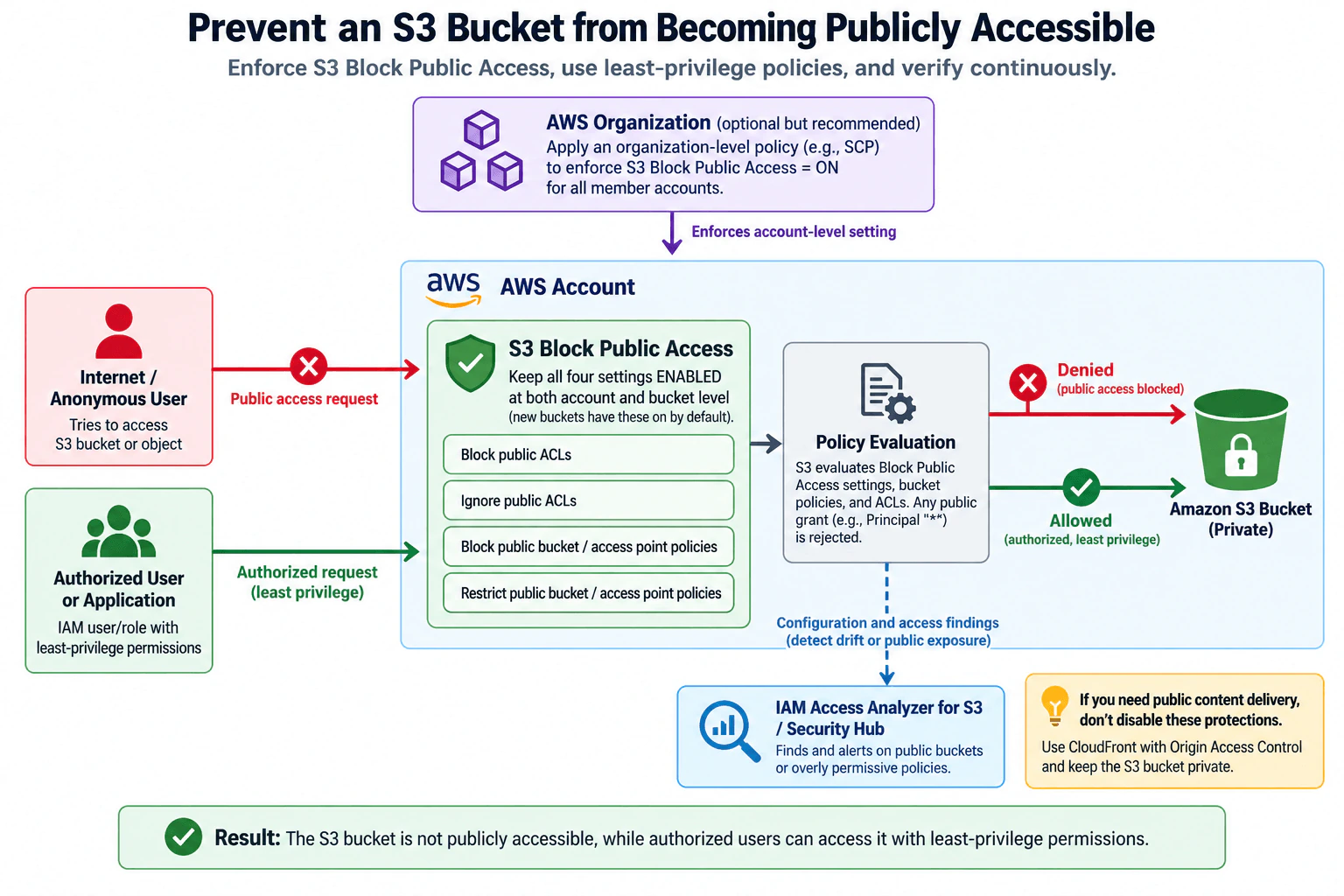
The goal is to prevent accidental or unauthorized public exposure while keeping the S3 bucket usable by approved users and applications. I would make S3 Block Public Access the main preventive control, enable all four settings at the AWS account and bucket levels, and grant only least-privilege permissions to trusted IAM identities. S3 evaluates applicable organization, account, bucket, and access-point controls and rejects access that violates the effective Block Public Access configuration. I would then use IAM Access Analyzer for S3 and Security Hub CSPM to detect public-access drift and verify that the bucket remains private. docs.aws.amazon.com
Useful Questions to Ask the Interviewer
Is the bucket intended to be completely private, or must any content be delivered publicly?
Is this a single AWS account or part of an AWS Organization with multiple accounts?
Which IAM users, roles, applications, or AWS services legitimately need access to the bucket?
How to Explain It in an Interview
Enable all four S3 Block Public Access settings. I would enable BlockPublicAcls, IgnorePublicAcls, BlockPublicPolicy, and RestrictPublicBuckets. AWS recommends enabling all four when public access is not required. These settings prevent public permissions from being granted or used through S3 ACLs and public resource policies. docs.aws.amazon.com
Apply the guardrail at both account and bucket level. Account-level Block Public Access protects all S3 buckets owned by the account, including current and future buckets. I would also leave the four controls enabled on the bucket itself as defense in depth. S3 uses the most restrictive effective combination of applicable settings. docs.aws.amazon.com
Use AWS Organizations for centralized enforcement. If there are multiple AWS accounts, I would use an AWS Organizations Amazon S3 policy to enforce all four Block Public Access settings for the selected accounts or organizational units. The attached diagram labels an organization-level policy and gives an SCP as an example; the current AWS feature specifically designed for centralized S3 Block Public Access is the AWS Organizations Amazon S3 policy type. docs.aws.amazon.com
Allow only authorized identities. The bucket can remain private while approved IAM users, roles, and applications access it. I would grant only the required S3 actions and resources. Block Public Access is not a replacement for normal IAM authorization or least-privilege bucket policies.
Fail closed for public access. When a request depends on a public ACL or public bucket or access-point policy that conflicts with the effective Block Public Access settings, Amazon S3 rejects the request. Properly authorized private requests can still succeed. docs.aws.amazon.com
Detect drift and exposure. IAM Access Analyzer for S3 identifies buckets that allow public or external-account access. Security Hub CSPM also has S3 controls, including S3.8, that evaluate whether general-purpose S3 buckets block public access. These findings give the security team evidence that the intended configuration is still in place. docs.aws.amazon.com
Keep public content delivery separate from public storage. If users must receive public content, I would normally keep the regular S3 bucket private and place CloudFront in front of it using Origin Access Control. CloudFront can authenticate requests to the S3 origin, so direct public S3 access does not need to be enabled. docs.aws.amazon.com
Responsibility boundary: AWS operates Amazon S3 and enforces the configured authorization and Block Public Access controls. The customer is responsible for configuring those controls, defining IAM and bucket permissions, choosing organization-level guardrails, and reviewing security findings.
Limitation and residual risk: S3 Block Public Access is specifically a guardrail against public access through S3 ACLs and resource policies. It does not make every authenticated identity safe. An IAM principal with excessive permissions can still access private data, and administrators who can change security configuration remain a risk unless their privileges are constrained.
Tradeoff: Account- or organization-level enforcement greatly reduces accidental public exposure, but it can break legitimate workloads that intentionally depend on direct public S3 access. Those requirements should be identified before enforcement. When public distribution is required, CloudFront with Origin Access Control provides a controlled delivery path while the S3 bucket stays private.
Technical Approach
Confirm that direct public S3 access is not required.
Enable all four S3 Block Public Access settings at the AWS account level.
Keep all four settings enabled on the bucket.
If multiple accounts are involved, enforce the configuration with an AWS Organizations Amazon S3 policy.
Grant only required S3 actions to trusted IAM users, roles, applications, or AWS services.
Verify that anonymous public access is denied while authorized access still works.
Review IAM Access Analyzer for S3 and Security Hub CSPM findings for public-access drift.
If public delivery is required, use CloudFront with Origin Access Control while keeping the S3 origin private.
Time & Space Complexity
The configuration itself is straightforward, but there are operational costs. Strong account- or organization-level blocking can break applications that intentionally use public S3 access, so existing workloads must be checked first. Least-privilege IAM and bucket policies need maintenance as applications change. IAM Access Analyzer and Security Hub findings need an owner and a response process. CloudFront adds another service and some cost when public delivery is required, but it allows the storage bucket to remain private.
Where it is used
This approach is used for private application assets, internal documents, backups, logs, software artifacts, data-lake objects, and other S3 data that should be available only to approved AWS identities or applications. Account- and organization-level enforcement is especially useful when many teams create buckets and the security team wants a safe default that prevents accidental public exposure.
Why Interviewers Ask This
This question tests whether the candidate understands S3 public-access controls, least-privilege authorization, centralized AWS governance, secure failure behavior, and how to detect configuration drift without preventing legitimate authenticated access.
Common interview mistakes
Common mistakes include enabling Block Public Access only on one bucket while leaving the account without a broader guardrail, disabling one of the four controls without a verified need, granting broad IAM or bucket-policy permissions, assuming private means every authenticated principal is trusted, ignoring IAM Access Analyzer or Security Hub findings, and disabling S3 protections merely to deliver public content. Another mistake is treating an SCP as the current dedicated mechanism for organization-wide S3 Block Public Access; AWS Organizations now provides an Amazon S3 policy type for this purpose. docs.aws.amazon.com
Interview tip
Lead with the main control: enable all four S3 Block Public Access settings. Then explain account or organization enforcement, least-privilege authorized access, rejection of public requests, and continuous verification. Finish with CloudFront Origin Access Control as the option for public content delivery without making the S3 bucket public.
Interviewer may ask next
What if the application must serve files publicly?
I would normally keep the regular S3 bucket private and serve the content through CloudFront using Origin Access Control. The S3 bucket policy grants the CloudFront service principal the required access for the intended distribution, while direct public access to the S3 origin remains blocked. docs.aws.amazon.com
Is S3 Block Public Access enough by itself?
No. It is a strong preventive guardrail against public access through S3 ACLs and resource policies, but authorized identities still need least-privilege permissions. I would also review IAM and bucket policies and use IAM Access Analyzer for S3 and Security Hub CSPM to detect unintended public or external access. docs.aws.amazon.com
29. How would you isolate cloud workloads using segmentation?Cloud SecurityEasy
Short Interview Answer (30-60 seconds)
I would separate ingress, application, data, and management workloads into distinct segments, deny inter-segment traffic by default, and explicitly allow only required flows. I would combine those network controls with least-privilege identities, MFA-protected administration, restricted egress, encryption, and centralized flow monitoring.
Detailed Explanation
This question asks how to reduce the blast radius between cloud workloads by creating clear trust boundaries. I would group workloads by role and sensitivity, place them in separate network segments, and deny communication between those segments unless a specific application flow requires it. In the approved design, Internet users reach only the ingress layer, ingress reaches the application segment, and the application segment reaches the data segment on the required database port. Administrators use a separate management segment. Network rules, workload identity, encryption, and centralized monitoring reinforce those boundaries.
Useful Questions to Ask the Interviewer
Which workload-to-workload connections are required for normal operation?
Are the application and data workloads expected to have any direct Internet exposure?
Should administrative access use a dedicated management path?
Which outbound destinations must the application workloads reach?
What centralized network-flow logging and alerting capabilities are available?
How to Explain It in an Interview
I would start by separating workloads according to trust level and function. The diagram uses four segments inside one cloud environment: ingress and policy enforcement, application workloads, data workloads, and management. These boundaries reduce the number of systems that a compromised workload can directly reach.
The first allowed path is from Internet users to the ingress segment over HTTPS on port 443. The ingress segment contains the load balancer and WAF or firewall function. It is the controlled entry point, so application and data workloads do not need direct Internet exposure.
The second allowed path is HTTPS from the ingress segment to the application workload segment. The application workloads also receive a dedicated workload identity and narrowly scoped network policy. Network segmentation controls reachability, while workload identity controls what the application is authorized to do through cloud APIs or other identity-aware services. Where the provider supports it, I would prefer temporary workload credentials rather than long-lived reusable credentials.
The third allowed path is from the application segment to the data segment on the required database connection. The diagram uses port 3306 as the database example. I would treat that as an application-specific port, not as a universal database requirement. The data segment should accept connections only from the application workloads that genuinely need them, and the data should be encrypted at rest and in transit.
All other unnecessary paths between segments should be denied by default. The important idea is not that every cloud firewall product literally contains a deny rule; some cloud controls use an allow-list model where traffic without an applicable allow rule is implicitly denied. The design goal is still the same: explicitly permit required traffic and leave unrelated lateral paths unavailable.
I would also control egress from application workloads. A compromised workload with unrestricted outbound connectivity may still reach unwanted destinations or move data outside the intended environment. Therefore, outbound access should be limited to legitimate dependencies where practical rather than automatically allowing every destination.
Administrative access follows a separate management path. The administrator identity must use multi-factor authentication, and permissions should follow least privilege. SSH or RDP should be available only through the approved management segment rather than being broadly exposed to the application or data segments. This separates operational access from normal application traffic.
For monitoring, I would centrally collect evidence about allowed and denied network flows and alert on unexpected attempts. In an AWS implementation, for example, VPC Flow Logs can record ACCEPT and REJECT outcomes. They are useful for validating segmentation, although they are not a complete packet-capture system and some records can be skipped under documented conditions.
I would verify the design by testing both permitted and prohibited paths. User-to-ingress HTTPS should work. Ingress-to-application HTTPS should work. Application-to-database traffic should work only on the required database path. Direct Internet access to application or data workloads and unauthorized lateral communication should fail. If a required rule is missing, the safer failure mode is for the protected path to remain denied instead of temporarily opening broad access.
The cloud provider and customer still have separate responsibilities. The provider secures the underlying cloud infrastructure according to its service model, while the customer is responsible for configuring the workload identities, network policies, administrative access, application exposure, and data protections represented in this design.
The main tradeoff is operational complexity. More precise segmentation reduces blast radius, but it creates more rules, dependencies, tests, logs, and troubleshooting work. Too much segmentation can also break legitimate application communication. I would therefore create meaningful trust boundaries rather than splitting the environment into unnecessary zones.
Segmentation reduces risk but does not eliminate it. A compromised workload may still misuse an explicitly allowed path or an authorized identity. That residual risk is why the design combines segmentation with least-privilege identity, restricted administration, encryption, egress control, monitoring, and regular validation.
Technical Approach
Identify workload roles and trust levels: ingress, application, data, and management.
Place those roles into separate network segments.
Start with no unnecessary inter-segment access.
Document each legitimate source, destination, protocol, and port.
Add only the rules required for user-to-ingress, ingress-to-application, application-to-data, and approved administration flows.
Restrict workload identities and outbound connectivity using least privilege.
Keep administrative access on the separate management path protected by MFA.
Encrypt data at rest and in transit.
Centrally collect allowed and denied flow evidence.
Test both required paths and representative forbidden paths whenever the architecture or dependencies change.
Practical Complexity & Trade-offs
The main cost is operational complexity. More segments require more network rules, identity policies, tests, alerts, documentation, and troubleshooting. Restricting egress also means legitimate external dependencies must be identified and maintained. Central logging adds storage and analysis cost. The security benefit is a smaller blast radius because one compromised workload has fewer reachable targets. The goal is to create useful trust boundaries without creating unnecessary segmentation that makes the application difficult to operate.
Where it is used
This pattern is used for production cloud applications where Internet-facing services, application workloads, databases or storage, and administrative tools have different trust levels. Typical uses include keeping application workloads behind a controlled ingress layer, preventing unrelated workloads from reaching sensitive databases, restricting outbound connectivity, and isolating administrator SSH or RDP access in a dedicated management segment.
Why Interviewers Ask This
Interviewers want to see whether the candidate understands how segmentation limits blast radius and lateral movement in cloud environments. A strong answer should define meaningful trust boundaries, permit only necessary communication, separate administrative access, combine network and identity controls, and explain how the design is validated without treating a private network as complete protection.
Common interview mistakes
Common mistakes include placing all workloads in one broadly connected network, allowing entire network ranges when only one workload relationship is needed, exposing application or data workloads directly to the Internet, assuming private addresses alone provide isolation, leaving outbound access unrestricted without reviewing dependencies, using network segmentation without least-privilege workload identities, exposing SSH or RDP broadly, mixing administrative access with normal application traffic, treating encryption as a replacement for segmentation, and enabling logging without testing whether required and forbidden paths actually behave as designed.
Interview tip
Lead with the core principle: separate workloads by trust level and deny unnecessary communication by default. Then walk through the exact approved flow from users to ingress, application, data, and the separate administration path. Finish with validation, residual risk, and the tradeoff between reduced blast radius and added operational complexity.
Interviewer may ask next
How would you verify that the segmentation rules are working as intended?
I would test both positive and negative paths. HTTPS from users to ingress should succeed, ingress-to-application HTTPS should succeed, and application-to-database traffic should succeed only on the required database path. Direct Internet access to the application or data segments and unauthorized lateral connections should fail. I would compare those results with centralized network-flow evidence and alert on unexpected accepted or rejected traffic. I would repeat the tests after network, identity, or application dependency changes.
Does segmentation completely prevent lateral movement after a workload is compromised?
No. Segmentation reduces reachable targets, but a compromised workload can still use an explicitly allowed network path or permissions granted to its workload identity. That is why I would combine segmentation with least-privilege workload credentials, restricted egress, MFA-protected administration, encryption, centralized monitoring, and regular validation. The goal is to reduce blast radius and make unauthorized movement harder, not to claim that segmentation alone eliminates the risk.
30. How would you secure cloud-native APIs?Cloud SecurityMedium
Short Interview Answer (30-60 seconds)
I would use HTTPS, OAuth 2.0 or OIDC, strict token validation, least-privilege scopes, rate limits, request validation, and API-level object authorization. Workloads would use short-lived identities for downstream access, protected service-to-service connections, encrypted data stores, scoped permissions, and centralized tamper-resistant monitoring.
Detailed Explanation
Securing a cloud-native API means protecting the whole request path, not only putting a firewall in front of it. I would authenticate callers, validate access tokens, authorize every requested action and object, control resource use, and validate untrusted input. The API workload should use its own short-lived, least-privilege identity when accessing databases, object storage, or other services. I would protect traffic and stored data, collect trustworthy logs, metrics, and traces, and reject requests when mandatory security checks fail. Each layer limits what a compromised caller or workload can reach.
Useful Questions to Ask the Interviewer
Is the API public, partner-facing, internal, or a mixture?
Are the callers end users, workload services, or both?
What authorization rules are required for functions and individual data objects?
Which databases, object stores, queues, caches, or other services can the API access?
What availability and traffic requirements affect rate limiting and dependency failure handling?
How to Explain It in an Interview
I would explain the design from left to right: Clients / Callers -> API Gateway / Ingress -> Cloud-Native API -> Data / Service Dependencies, with Monitoring & Audit receiving security telemetry from the protected path.
First, I secure caller identity. User-facing web or mobile applications use OAuth 2.0 or OpenID Connect, abbreviated OIDC. For public clients using the authorization-code flow, I use Proof Key for Code Exchange, or PKCE. Service callers use workload identity and short-lived tokens rather than reusable static credentials. Sender-constrained token mechanisms such as mutual TLS, or mTLS, and DPoP can be used when appropriate to reduce the usefulness of a stolen token.
All client requests enter over HTTPS using TLS 1.2 or newer in the diagram's design. The access token travels with the request to the API gateway or ingress. The gateway validates the token before forwarding the request. At minimum, the validation must establish that the token is cryptographically valid, has not expired, and comes from the expected issuer. Authorization policy then checks the permissions or scopes needed for the requested operation.
The gateway also limits resource consumption with rate limits or quotas and applies request protection such as schema validation, web application firewall controls, and denial-of-service protections when appropriate. Requests with invalid or expired tokens, insufficient authorization, exceeded rate limits, or detected malicious content are denied instead of being forwarded to the API.
A valid gateway decision is not enough by itself. The cloud-native API performs authorization again at the application and object level. For example, a caller who may read one record must not automatically gain permission to read another record simply by changing its identifier. The API's business logic also validates input before using it. This directly reduces broken object-level authorization and unsafe-input risks.
For downstream access, the API workload uses its own least-privilege workload identity and a short-lived token. It does not reuse the end user's credentials as a broad service credential. In the approved design, authorized downstream calls use mTLS. The workload receives only the permissions needed to reach its required database, object storage, queue, cache, or other service.
Databases are encrypted and accessible only through narrowly scoped permissions. Object storage is also encrypted and uses scoped access. Encryption protects data confidentiality, but it does not replace authorization. A valid but overprivileged identity can still misuse encrypted data, which is why identity and data permissions remain separate controls.
The monitoring path collects API logs, metrics, and traces centrally. Security evidence should be protected so the normal API workload cannot easily modify or erase the authoritative records. Useful signals include repeated authentication failures, authorization denials, rate-limit events, unusual error patterns, and unexpected downstream access. Those signals support detection, alerting, investigation, and response.
Safe failure behavior is important. If a mandatory token or authorization decision cannot be validated, the protected request should fail closed rather than bypassing security. Rate-limit enforcement intentionally rejects requests after configured limits are reached. A telemetry outage is different: it must generate operational attention, but whether the API should continue serving traffic during monitoring degradation is an explicit availability decision rather than an automatic authentication bypass.
Because the question does not name a cloud provider, I would keep the responsibility boundary provider-neutral. The customer remains responsible for the identities, API configuration, authorization logic, workload permissions, data-access policy, and security monitoring shown here. The provider's responsibility for underlying infrastructure depends on the specific managed service selected.
I would verify the design with invalid and expired token tests, insufficient-scope tests, object-level authorization tests, rate-limit tests, malformed-input tests, workload-permission reviews, mTLS connection tests, encryption checks, and confirmation that expected logs, metrics, and traces reach the protected monitoring system.
The tradeoff is operational complexity. Fine-grained authorization requires more application logic and testing. Rate limits can accidentally reject legitimate spikes if tuned badly. mTLS requires certificate lifecycle management. Detailed telemetry costs storage and processing and must avoid leaking sensitive data. Least-privilege policies require maintenance as dependencies change. These costs are justified because the controls reduce attack paths and limit the blast radius when one identity, request, or workload is compromised.
Technical Approach
Identify the API callers, protected endpoints, objects, workloads, and downstream dependencies.
Require HTTPS and strong identity using OAuth 2.0/OIDC for users or short-lived workload identity for services.
At the API gateway, validate tokens and enforce scopes, rate limits, quotas, request schemas, and applicable threat protections.
Deny invalid, expired, unauthorized, rate-limited, or malicious requests before they reach the workload.
Re-authorize inside the API at the application and object level and validate business input.
Give the API workload its own short-lived, least-privilege identity.
Use protected service-to-service communication such as mTLS for the approved downstream path.
Encrypt databases and object storage and restrict their access permissions.
Send logs, metrics, and traces to centralized tamper-resistant monitoring.
Test both allowed and denied paths and review permissions regularly.
Practical Complexity & Trade-offs
These controls increase security but also add work. OAuth 2.0 and OIDC require identity and token management. Fine-grained authorization adds application code and testing. Rate limits need tuning so normal traffic is not blocked. WAF and schema checks add configuration and can add processing time. mTLS requires certificate issuance, renewal, and rotation. Detailed logging increases storage and analysis cost. Least-privilege permissions need review whenever services change. The benefit is a smaller blast radius if a token, caller, or workload is compromised.
Where it is used
This layered approach is used for public web and mobile APIs, internal service APIs, partner APIs, containerized microservices, and serverless APIs that connect to databases, object storage, queues, caches, or other cloud services. It is especially useful when an API gateway handles common ingress controls while the application still performs its own fine-grained authorization.
Why Interviewers Ask This
Interviewers want to know whether you can secure the complete cloud-native API request path instead of depending on one control. They are testing your understanding of caller identity, token validation, least privilege, API-level authorization, abuse controls, workload identity, downstream data protection, monitoring, safe denial behavior, and the tradeoffs created by those controls.
Common interview mistakes
Common mistakes include trusting network location as proof of authorization, accepting a token without checking its cryptographic validity, expiration, and issuer, putting all authorization only at the gateway, skipping object-level authorization, using broad or long-lived workload credentials, assuming TLS or encryption alone secures the API, granting databases or object storage excessive permissions, relying on a WAF as complete API protection, ignoring resource-consumption limits, logging secrets or sensitive payloads, and collecting logs without protecting the authoritative evidence from modification.
Interview tip
Walk through the diagram in request order: caller identity, gateway validation and denial, API-level authorization, workload identity, downstream protection, data permissions, and monitoring. Emphasize that authentication is not authorization, valid tokens still require object-level checks, mandatory security checks should fail closed, and no single control such as TLS, a WAF, or private networking is enough.
Interviewer may ask next
How would you secure service-to-service API calls between cloud-native workloads?
I would give each workload its own short-lived identity and least-privilege permissions instead of sharing static credentials. The receiving service should authenticate the calling workload and authorize the requested action. In this design, service-to-service traffic uses mTLS. Where OAuth tokens are used, sender-constraining with mTLS or DPoP can reduce token-replay risk. Each workload should also validate input, restrict its downstream permissions, and send security-relevant telemetry to centralized monitoring.
What happens if token validation or another required authorization dependency is unavailable?
I would not bypass mandatory authentication or authorization to keep a protected operation available. If the system cannot establish that a request is authorized, it should fail closed and deny that request. I would monitor and alert on the dependency failure and design appropriate redundancy or safe caching only when the validation rules allow it. Monitoring degradation is handled separately because telemetry availability and authorization correctness are different decisions.
More questions load as you scroll
Disclaimer: This interview guide is for educational and informational purposes only. It is designed to help readers prepare, but it does not guarantee any interview result, hiring decision, offer, or outcome. Interview questions, hiring criteria, and preferred answers can vary by employer, interviewer, industry, location, and time. All answers, examples, and explanations in this guide are suggested examples for interview preparation, not definitive answers or instructions for professional practice. They are based on research and judgment, are provided without warranties of any kind, and should be adapted to the question, role, and applicable laws and professional requirements. Diagrams are simplified illustrations intended to highlight the main concepts and their relationships; actual situations, systems, and practices may be more complex. Alternative approaches may be equally valid or better suited to a particular question, context, or interviewer. To the fullest extent permitted by applicable law, the contributors and publisher are not liable for decisions made, actions taken, or losses incurred based on this guide.
State Laws and Professional Responsibilities: Laws and requirements governing an occupation vary by state and jurisdiction. You are responsible for checking the current laws, licensing requirements, and scope-of-practice rules that apply to your location and role, and for ensuring that your answers and actions comply with them. Adapt examples in this guide to those requirements. This guide is not legal advice.
Content Accuracy and Verification: To the fullest extent permitted by applicable law, we do not represent or warrant that interview guides, questions, answers, examples, or diagrams are accurate, complete, current, error-free, or suitable for any particular purpose. You are responsible for independently reviewing and verifying the information before relying on it.