61. What is YARA, and how do YARA rules identify files or memory artifacts?
Define YARA as a pattern-matching tool and rule language used to classify or identify content. Explain rule metadata, strings, conditions, text, hexadecimal and regular-expression patterns, modules, namespaces, and scanning context. Cover precise conditions, representative positive and negative samples, performance, false positives, and safe authorized use without treating a match as proof of maliciousness.
YARA is a pattern-matching rule language used to classify files, process memory, or supplied data. Rules define text, hexadecimal, or regular-expression patterns and a Boolean condition. YARA reports a match when that condition is true, but the match is an indicator for investigation, not proof of malware.
See the Code while reading this explanation.
YARA answers a practical question: does this file or memory artifact satisfy a precisely defined content rule? A rule can contain metadata and string definitions and must contain a condition. Strings can represent readable text, byte sequences, or regular expressions. The scanning engine searches the target and then evaluates the condition using those results and, when imported, module data. The scanning context matters because locations refer to file offsets for file scans and virtual addresses for running-process scans. Most importantly, a YARA match says the rule condition is true; it does not by itself prove maliciousness.
- Are we discussing scanning files, running-process memory, or both?
- Should the example focus mainly on rule syntax, operational tuning, or both?
- Is the goal broad classification or a high-confidence detection rule with low false positives?
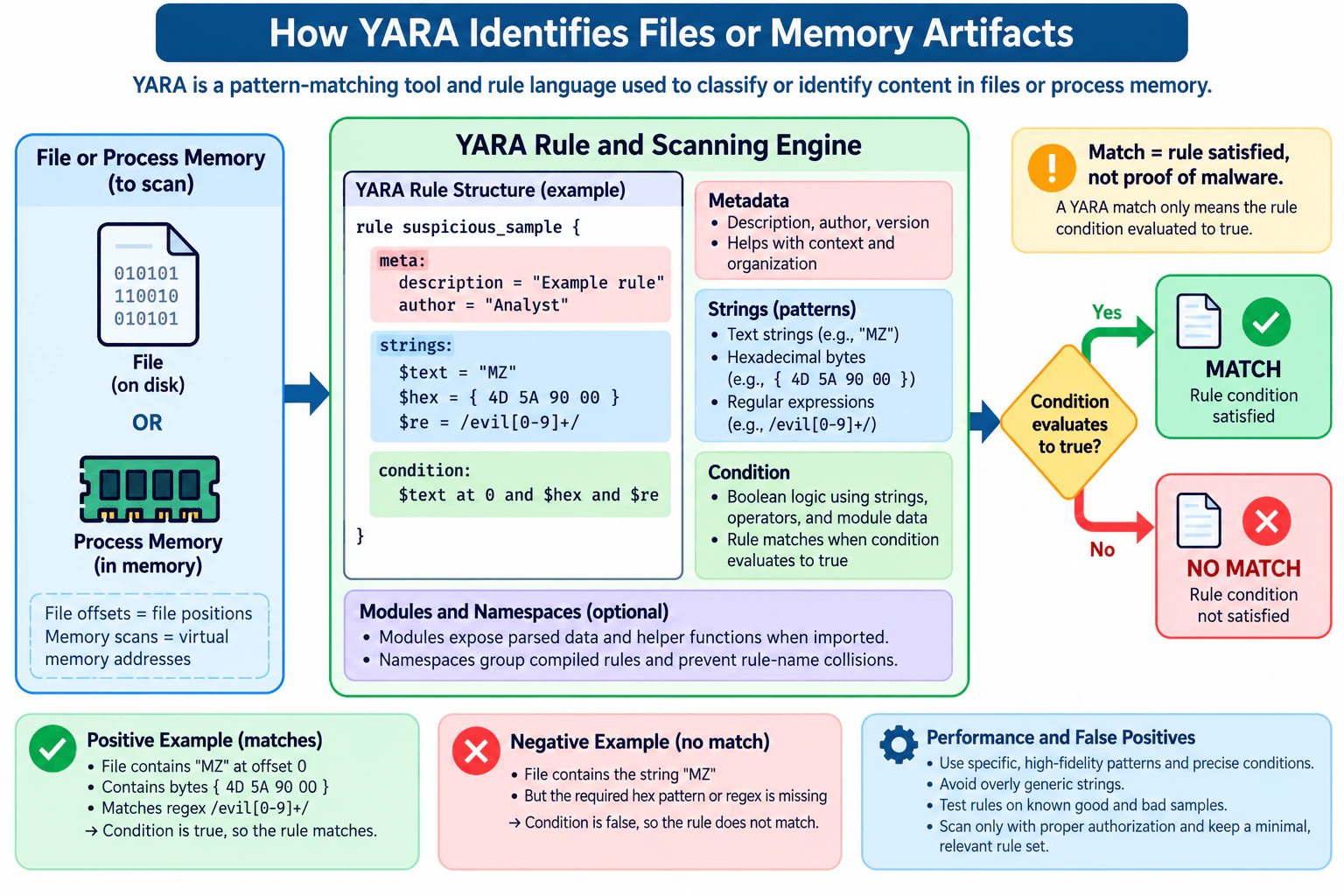
YARA evaluates whether supplied content satisfies a rule. The input can be a file, process memory, or other data supplied through an integration. For a file, location-based checks use file offsets. For a running process, they use virtual addresses in that process address space.
The approved diagram shows the core flow: a file or process-memory target enters the YARA rule and scanning engine, the engine searches for defined patterns, the condition is evaluated, and the result is either MATCH or NO MATCH.
A YARA rule has a rule name and can contain meta and strings sections, followed by the required condition section.
The meta section stores descriptive information such as description, author, or version. Metadata helps people manage and understand a rule, but metadata values are not automatically part of the matching decision.
The strings section defines patterns. YARA supports three important pattern types:
- Text strings, such as
"MZ". - Hexadecimal strings, such as
{ 4D 5A 90 00 }, for byte patterns. - Regular expressions, such as
/evil[0-9]+/, for text that follows a pattern rather than one fixed value.
The condition section is the Boolean decision. It can combine string identifiers with operators and expressions such as and, or, not, any, all, occurrence counts, locations, and module-backed values. The condition determines whether the rule matches.
In the diagram's example, the condition is $text at 0 and $hex and $re. For a file scan, all three requirements must be satisfied: the text string "MZ" must occur at file offset 0, the hexadecimal pattern must be found, and the regular expression must match.
For a running-process scan, an address used with at is interpreted as a virtual address rather than a file offset. This scanning context matters because a location-dependent condition designed for a file may not make sense unchanged for process memory.
Precise conditions matter because a generic string by itself can appear in many benign files. Combining meaningful observations can increase precision when those observations accurately describe the content being classified.
A representative positive sample contains "MZ" at file offset 0, contains the bytes { 4D 5A 90 00 }, and contains text that satisfies /evil[0-9]+/. All three expressions are true, so the condition evaluates to true and YARA reports the rule as matching.
A representative negative sample may still contain "MZ" at offset 0 but lack the required hexadecimal pattern or regular-expression match. Because the example condition uses and, a missing requirement makes the overall condition false, so the rule does not match.
These positive and negative cases test the complete decision instead of checking only whether individual strings can be found.
YARA modules expose structured data and helper functions that rules can use in conditions. A module is imported at the rule-source level before its exported values are referenced. Modules are useful when raw byte or text matching is not enough and additional structured context improves the rule.
The tradeoff is complexity and cost. Additional parsing or complex logic can make rules harder to maintain and can consume more scanning resources, so modules should be used when their context materially improves the detection.
Namespaces organize groups of rules and prevent rule-name collisions between separately loaded rule sources. They are assigned when rule sources are compiled or loaded; namespace is not a declaration placed inside the rule body shown in the diagram.
Namespaces are useful when a detection program loads independently maintained rule collections and needs to keep identically named rules separate.
A MATCH means the rule's condition evaluated to true for the scanned content. It is an observable detection result that may be used as an indicator or as input to an alerting workflow when combined with context. It is not automatically an incident and is not proof that the target is malware.
A NO MATCH means this particular rule condition was not satisfied. It does not prove that the target is benign. The artifact may contain suspicious or malicious content that the rule does not describe or that was not present in the scanned data.
False positives are more likely when a rule relies on short, common, or overly broad patterns. Prefer specific, meaningful patterns and combine independent observations when that reflects the artifact being classified.
Test against known positive and known negative samples. Add boundary cases where only some required strings are present. Keep a regression set so later edits do not accidentally broaden or break the rule. Do not claim a false-positive rate without measured test data.
Rule design affects scanning cost. Very broad patterns, expressions that generate many matches, large rule collections, or unnecessarily complicated conditions can increase CPU and memory use. Keep the active rule set relevant to the scanning purpose and test scan time on representative authorized samples.
At operational scale, review expensive or low-value rules, monitor rule execution health, and remove or revise rules that no longer provide useful detection coverage.
Run scans only against systems, files, process memory, and data you are authorized to inspect. Process-memory scanning can expose sensitive information, so access should be limited to authorized people and processes with a legitimate need.
Detection and response should remain separate decisions. A YARA match can justify enrichment, correlation, or analyst review, but disruptive or destructive actions should not be triggered solely because one pattern rule matched.
YARA recognizes content and properties expressed by its rules. It cannot infer malicious intent or prove compromise from a pattern match alone. Rules can miss artifacts when the relevant content is absent, transformed, outside the scanned region, or simply not described by the rule. Broad rules can improve potential coverage but increase false positives and processing cost. Narrow rules usually improve precision but can reduce coverage. A sound lifecycle includes representative testing, version control, peer review, staged deployment, tuning, regression testing, monitoring, and retirement of rules that are obsolete or no longer useful.
- Define exactly what content characteristic the rule should identify and whether the target is a file, running-process memory, or other supplied data.
- Select high-value observable patterns instead of generic strings.
- Express those observations as text strings, hexadecimal patterns, regular expressions, or relevant module-backed values.
- Add useful metadata such as description, author, and version for maintainability.
- Write a precise Boolean condition that states exactly when the rule should match.
- Compile the rule and resolve syntax errors or relevant performance warnings.
- Test a synthetic positive sample where every required observation is present.
- Test negative and boundary samples where one or more required observations are absent.
- Measure scan cost and observed false positives and false negatives on authorized representative data without inventing production results.
- Peer review and version the rule, deploy it gradually, monitor its usefulness and scan health, tune it when evidence changes, and retire it when it is obsolete.
This YARA rule mirrors the approved diagram. It defines one text pattern, one hexadecimal byte pattern, and one regular expression. The condition requires "MZ" at file offset 0 and also requires both other patterns to be present. Metadata is descriptive and does not affect the condition unless explicitly referenced through supported rule logic. The example is synthetic and intended only for authorized testing. For running-process memory, remember that an address used with at represents a virtual address rather than a file offset, so this file-oriented condition should not automatically be reused unchanged.
code = r"""rule suspicious_sample {
    meta:
        description = "Example rule"
        author = "Analyst"
        version = "1.0"

    strings:
        // Simple text observation.
        $text = "MZ"

        // Synthetic byte sequence used only for this teaching example.
        $hex = { 4D 5A 90 00 }

        // Synthetic regular expression used to demonstrate regex matching.
        $re = /evil[0-9]+/

    condition:
        // For a file scan, require $text at offset 0 and both other patterns anywhere.
        $text at 0 and $hex and $re
}"""

print(code)YARA is used in authorized malware analysis, endpoint investigation, digital forensics, threat hunting, file triage, memory analysis, incident-response tooling, and security pipelines that classify artifacts. A team might scan collected suspicious files or process memory with a controlled rule set and then send matching evidence for enrichment and analyst validation instead of treating a match itself as confirmed compromise.
Interviewers want to see whether you understand what YARA actually does, how a rule turns observable content into a deterministic match decision, and where its limits are. A strong answer distinguishes pattern matches from confirmed compromise, explains text, hexadecimal, and regular-expression patterns, understands conditions and scanning context, and recognizes that precise rules reduce false positives and unnecessary scanning cost.
A common mistake is saying that a YARA match proves malware or compromise. It only proves that the rule condition evaluated to true. Another mistake is using one generic string and assuming it is high confidence. Engineers should use meaningful observations and test benign samples. Do not confuse metadata with matching logic. Do not place a namespace declaration inside a rule; namespaces are assigned to rule sources when they are loaded or compiled. Do not forget that at refers to a file offset for a file scan but to a virtual address for a running-process scan. Also avoid assuming that NO MATCH means benign, because the rule may simply lack coverage.
Explain YARA as a simple pipeline: scan content, find defined patterns, evaluate the Boolean condition, and return match or no match. Then name the three pattern types, explain metadata, modules, and namespaces, and finish with the key limitation: a match is evidence for investigation, not proof of malware.