143 Cybersecurity Engineer Interview Questions & Answers

90 top • 18 Amazon • 11 Apple • 8 Google • 4 Meta • 10 Microsoft • 1 Netflix • 1 NVIDIA

Cybersecurity Engineer icon

Questions with Detailed ExplanationsWith Detailed Explanations

(Last Updated: September 13, 2026)

81. What does the Exploit Prediction Scoring System measure?Vulnerability ManagementMedium

Short Interview Answer (30-60 seconds)

EPSS estimates the probability that a published CVE will be exploited in the wild within the next 30 days. A score of 0.05 represents about a 5% predicted probability. It measures exploit likelihood, not severity or organization-specific risk.

Detailed Explanation

The practical purpose of EPSS is to help security teams decide which published vulnerabilities may deserve faster attention. It estimates the probability that a CVE will be exploited in the wild during the next 30 days. The result ranges from 0 to 1 and can also be read as a percentage. For example, 0.05 means about a 5% predicted probability. EPSS uses changing vulnerability and exploitation signals. It does not measure technical severity, business impact, or the complete risk a vulnerability creates for one organization.

Useful Questions to Ask the Interviewer
  1. Are you asking only what EPSS measures, or also how it differs from CVSS?
  2. Should I explain how EPSS is used in vulnerability prioritization?
  3. Would you like an example of how to interpret an EPSS score?
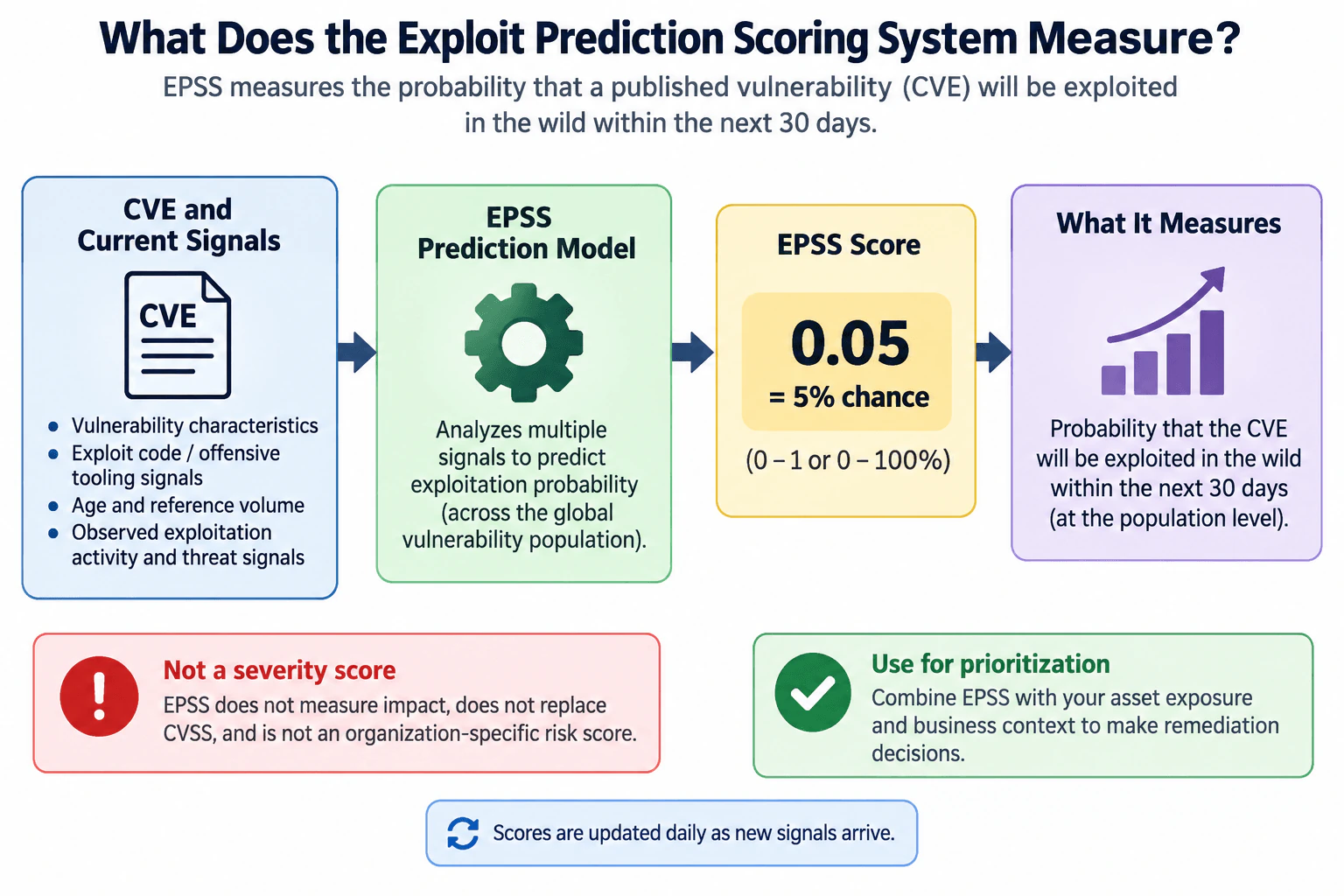
What does the Exploit Prediction Scoring System measure? diagram
How to Explain It in an Interview

Start with the practical decision: EPSS helps security teams estimate which published vulnerabilities are more likely to be exploited soon.

The input is a published CVE together with multiple current signals. As shown in the diagram, these can include vulnerability characteristics, exploit-code or offensive-tooling signals, age and reference activity, and observed exploitation or threat signals. The EPSS prediction model analyzes these signals and produces a calibrated probability.

The output is a number from 0 to 1. A score of 0.05 corresponds to about a 5% probability of exploitation within the next 30 days across the vulnerability population. A higher score means a higher predicted likelihood of exploitation. It does not mean exploitation is guaranteed.

The responsibility boundary is important. EPSS predicts exploitation likelihood at the population level. It does not know an individual organization's asset exposure, business importance, compensating controls, or potential impact. Therefore, it is not an organization-specific risk score.

EPSS also does not replace CVSS. CVSS communicates characteristics related to vulnerability severity, while EPSS answers a different question: how likely is this published vulnerability to be exploited in the wild during the next 30 days? A vulnerability can therefore have high severity but relatively low predicted exploitation probability, or the reverse.

For prioritization, combine EPSS with asset exposure, business context, severity, relevant threat activity, and compensating controls. This produces a more useful remediation decision than relying on EPSS or CVSS alone.

EPSS scores are recomputed daily as the underlying signals change. New exploit code, observed exploitation, references, or other signals can therefore change the score even though the CVE itself has not changed.

The main limitation is uncertainty. EPSS is a probabilistic prediction, not proof that exploitation will or will not occur. A low score does not make a vulnerability safe, and a high score does not guarantee exploitation. Residual risk must still be evaluated using the organization's own exposure and business context.

Technical Approach
  1. Identify the published CVE being evaluated.
  2. Obtain its current EPSS score.
  3. Interpret the value from 0 to 1 as the predicted probability of exploitation in the wild within the next 30 days.
  4. Do not treat the EPSS value as severity, impact, or a complete organization-specific risk score.
  5. Combine EPSS with severity, asset exposure, business criticality, relevant threat activity, and compensating controls when prioritizing remediation.
  6. Recheck EPSS during prioritization because scores are recomputed daily as signals change.
Practical Insights

EPSS can reduce the human effort needed to sort a large vulnerability backlog because it provides a consistent exploit-likelihood signal. Operational work is still required to obtain current scores, map CVEs to real assets, and combine EPSS with organizational context. Human judgment remains necessary because EPSS does not know asset exposure, business impact, compensating controls, remediation difficulty, or acceptable risk. Using EPSS alone is simpler but can produce poor priorities; combining several risk inputs is more accurate but adds process and maintenance complexity.

Why Interviewers Ask This

Interviewers want to see whether you understand the difference between exploit likelihood and vulnerability severity, can interpret an EPSS probability correctly, and know how to use it as one input to vulnerability prioritization rather than as a complete risk score.

Common interview mistakes

Common mistakes include saying EPSS measures severity, treating the score as proof that exploitation will occur, interpreting 0.05 as five points instead of about a 5% probability, assuming EPSS represents organization-specific risk, treating EPSS as a replacement for CVSS, ignoring asset exposure and business context, or assuming an EPSS score is permanent even though scores are recomputed daily as signals change.

Interview tip

Lead with one clear sentence: EPSS predicts the probability that a published CVE will be exploited in the wild within the next 30 days. Then distinguish exploit likelihood from severity and explain that EPSS should be combined with exposure and business context for prioritization.
Interviewer may ask next
How is EPSS different from CVSS?

EPSS and CVSS answer different questions. EPSS estimates the probability that a published CVE will be exploited in the wild within the next 30 days. CVSS communicates characteristics related to vulnerability severity. EPSS therefore supports exploit-likelihood prioritization, while CVSS helps communicate severity. Neither score alone represents the complete risk to a specific organization, so teams should also consider asset exposure, business impact, compensating controls, and relevant threat activity.

Does a low EPSS score mean a vulnerability is safe to ignore?

No. EPSS is a probability, not a safety guarantee. A low score means the model currently predicts a lower probability of exploitation within the next 30 days across the vulnerability population. The vulnerability may still require fast remediation because of asset exposure, severe potential impact, business criticality, weak compensating controls, or other threat evidence. Teams should combine EPSS with their own context and recheck the score as signals change.

82. What purpose does the Known Exploited Vulnerabilities catalog serve?Vulnerability ManagementMedium

Short Interview Answer (30-60 seconds)

The KEV catalog is CISA's living list of vulnerabilities known to be exploited in the wild. Security teams use it to identify affected assets and prioritize patching or mitigation of vulnerabilities with proven attacker activity, reducing exposure to active threats.

Detailed Explanation

The question asks why the Known Exploited Vulnerabilities catalog matters in vulnerability management. The practical answer is prioritization: it identifies vulnerabilities with evidence of exploitation in the wild, so defenders can focus on issues connected to active threat activity instead of relying only on severity scores. Teams compare KEV entries with their environment, identify affected assets, and remediate or mitigate them quickly. For Federal Civilian Executive Branch agencies, BOD 22-01 requires remediation by the catalog's specified due dates. CISA also strongly urges other organizations to prioritize timely remediation of KEV vulnerabilities.

Useful Questions to Ask the Interviewer
  1. Are you asking about KEV as a general prioritization tool or specifically about federal BOD 22-01 obligations?
  2. Should I explain how KEV fits with asset criticality and other risk factors?
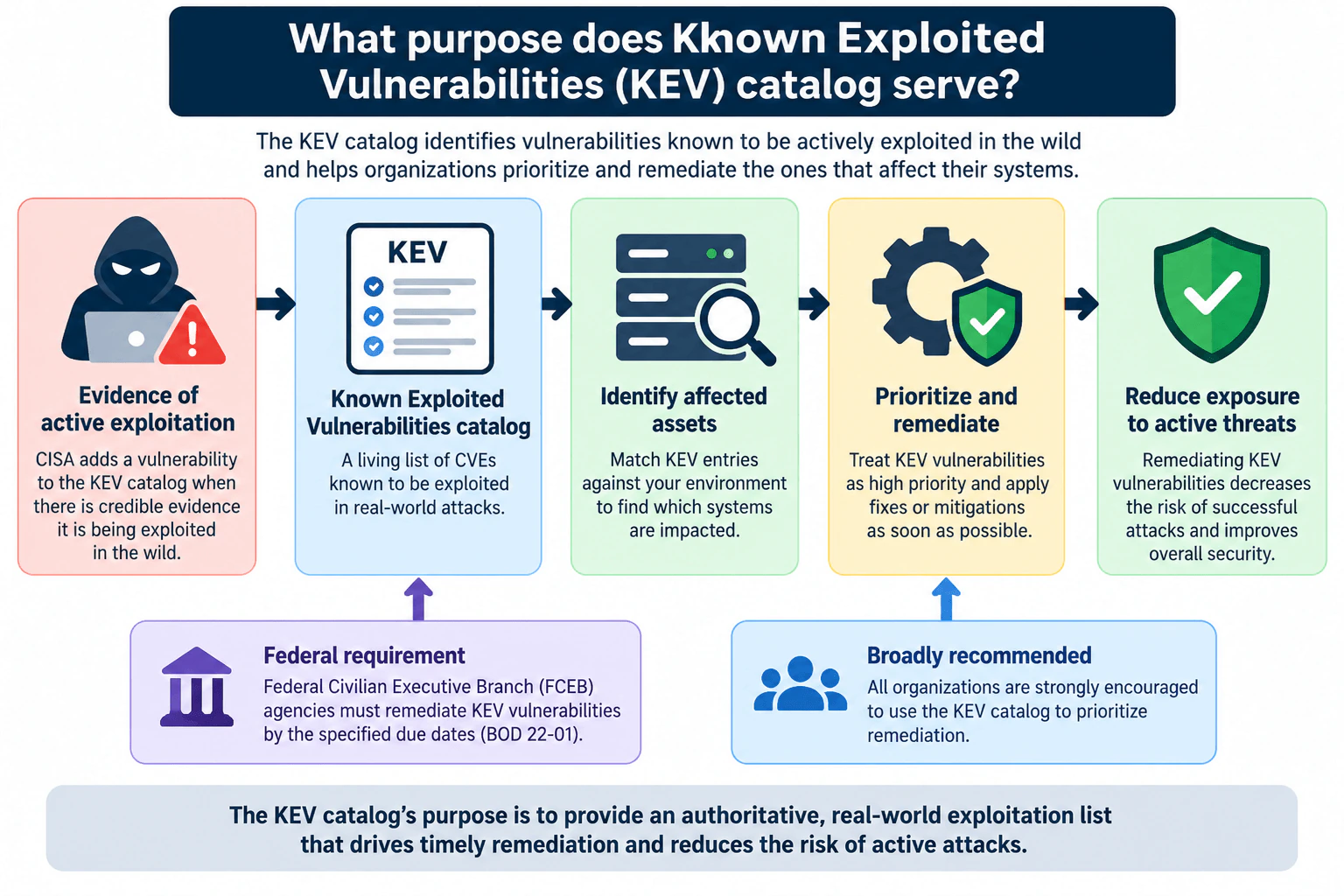
What purpose does the Known Exploited Vulnerabilities catalog serve? diagram
How to Explain It in an Interview

Start with the practical decision: a KEV-listed vulnerability should receive high remediation priority because CISA has evidence that it is being exploited in real-world attacks.

The flow is simple. First, CISA adds a vulnerability to the KEV catalog when it meets the catalog's criteria, including reliable evidence of active exploitation. The catalog is a living list, so new entries are added as qualifying vulnerabilities are identified.

Second, an organization compares KEV entries with its own environment. A KEV entry does not automatically mean every organization is affected. The team must determine whether the vulnerable product or component exists on its assets and whether the entry applies to those systems.

Third, when an affected asset is identified, the team prioritizes remediation. It follows the remediation action appropriate to the vulnerability, such as applying an available fix or supported mitigation. This reduces exposure to a vulnerability already being used by attackers.

Fourth, the organization validates the result. It should confirm that the affected asset has been remediated or that the mitigation is operating as intended, then retain appropriate closure evidence.

The responsibility boundary matters. CISA maintains the KEV catalog and publishes the required remediation due dates used by BOD 22-01. The organization remains responsible for matching KEV entries to its assets, assigning remediation ownership, implementing the required action, and validating the result.

For Federal Civilian Executive Branch agencies, BOD 22-01 requires remediation of KEV vulnerabilities by the applicable due dates. Although the directive applies to those federal agencies, CISA strongly urges all organizations to reduce exposure to cyberattacks by prioritizing timely remediation of KEV vulnerabilities as part of vulnerability management.

The main benefit is threat-informed prioritization. A technical severity score such as CVSS describes characteristics that contribute to vulnerability severity, while KEV contributes a different signal: evidence that exploitation is occurring in the wild. That makes KEV especially useful when a team has more vulnerabilities than it can remediate at once.

There are limits. KEV is not a complete list of every dangerous vulnerability, and absence from KEV does not mean a vulnerability is safe. A vulnerability may still deserve urgent action because of asset criticality, exposure, exploitability, business impact, other threat intelligence, or weak compensating controls. KEV should therefore be used as an important prioritization input rather than the organization's entire risk model.

Residual risk also remains after remediation decisions are made. Fixing one KEV vulnerability does not make a system completely secure, and a mitigation may reduce risk without eliminating the underlying vulnerability. Organizations must continue normal vulnerability management and verify remediation results.

Technical Approach
  1. Obtain the current KEV catalog from CISA.
  2. Match KEV entries against the organization's asset and software inventory.
  3. Determine which KEV entries actually affect systems in the environment.
  4. Prioritize confirmed matches because they have evidence of active exploitation.
  5. Apply the appropriate fix, remediation action, or supported mitigation.
  6. Track the remediation owner and applicable completion date, including BOD 22-01 due dates for Federal Civilian Executive Branch agencies.
  7. Retest or otherwise validate that the vulnerability was remediated or the mitigation is effective.
  8. Continue using KEV alongside exposure, asset criticality, business impact, compensating controls, other threat intelligence, and remediation feasibility.
Practical Insights

The main cost is operational rather than computational. Teams need an accurate asset inventory, a way to map products and vulnerabilities to KEV entries, people to remediate affected systems, suitable change windows, and time to validate the result. Fast remediation can introduce availability or compatibility risk, so testing and change control may be necessary. Delaying remediation can reduce immediate operational disruption but leaves a known exploited weakness exposed longer. Automation can reduce manual effort, but its results still depend on accurate inventory and ownership data.

Why Interviewers Ask This

Interviewers want to know whether you can distinguish ordinary vulnerability severity from evidence of real-world exploitation and use that evidence to make practical remediation decisions. A strong answer shows that you understand KEV as a threat-informed prioritization input, not as a complete vulnerability inventory or a replacement for asset context, validation, and broader risk management.

Common interview mistakes

Common mistakes are treating KEV as a complete vulnerability list, assuming every KEV entry affects every environment, using KEV as a replacement for asset inventory and validation, or treating KEV as simply another severity score. Another mistake is claiming that only federal agencies should use it. BOD 22-01 applies to Federal Civilian Executive Branch agencies, but CISA strongly urges all organizations to prioritize timely remediation of KEV vulnerabilities. It is also wrong to assume that a vulnerability not listed in KEV is low risk.

Interview tip

Lead with one sentence: KEV identifies vulnerabilities known to be exploited in the wild so organizations can prioritize affected assets for timely remediation. Then explain the flow: evidence of active exploitation -> KEV catalog -> identify affected assets -> prioritize and remediate -> reduce exposure. Finish by stating that KEV is a strong threat signal, not a complete risk model.

Interviewer may ask next
How should KEV be used with CVSS and business context?

Use KEV as a strong real-world exploitation signal, not as the only risk input. CVSS provides information about technical severity, while KEV indicates known exploitation in the wild. Then consider asset criticality, exposure, business impact, compensating controls, other threat intelligence, and remediation feasibility. A KEV-listed vulnerability on an exposed critical system will normally receive high priority, but the organization still needs environmental context.

What is the main limitation of relying on the KEV catalog?

KEV is focused on vulnerabilities with evidence of active exploitation, so it is not a complete list of every serious vulnerability. A vulnerability absent from KEV can still present high risk because of local exposure, critical business impact, emerging threat intelligence, or other contextual factors. Teams should use KEV alongside broader vulnerability discovery, asset context, and risk assessment.

83. A scan reports a medium-severity issue on Friday before a Monday launch. How would you decide what to do?Vulnerability ManagementHard

Short Interview Answer (30-60 seconds)

I would validate the finding first, then assess exposure, exploitability, business impact, asset criticality, compensating controls, and fix feasibility. Based on contextual risk, I would fix it, mitigate it, use an approved time-bounded exception, or delay the affected launch, followed by retesting.

Detailed Explanation

The question asks how I would make a security decision when an automated scan reports a medium-severity issue only a few days before launch. I would not automatically block the release, and I would not automatically approve it because the scanner says medium. The rating is useful triage information, but the decision should depend on whether the finding is real, whether the affected component is actually being launched and exposed, how practical exploitation is, what damage could result, what controls reduce the risk, and whether remediation can be completed and safely tested before Monday.

Useful Questions to Ask the Interviewer
  1. What asset, component, and version has the finding, and is that exact version part of Monday's launch?
  2. Will the affected component be internet-facing, internally reachable, or otherwise exposed to untrusted users?
  3. Has the scanner result been manually validated, or is it still only an automated finding?
  4. What could successful exploitation affect, such as confidentiality, integrity, availability, authentication, or privilege?
  5. Are there compensating controls that actually prevent or reduce access to the vulnerable path?
  6. Can engineering safely remediate and test the issue before Monday without introducing greater release risk?
  7. Who is authorized to accept any remaining risk or approve a temporary exception?
How to Explain It in an Interview

I would start with a simple rule: scanner severity starts the investigation, but contextual risk makes the launch decision.

First, I would confirm scope. I would identify the exact asset, software component, deployed version, environment, and release artifact associated with the finding. If the finding applies to something that is not part of Monday's deployment, it may not affect the launch decision, although it should still remain in the normal vulnerability-management process.

Second, I would validate the finding. A scanner finding is an automated observation that may indicate a weakness. A verified vulnerability is a weakness that has enough evidence to show that it actually exists in the relevant asset and configuration. I would review the scanner evidence, affected configuration or version, and available technical evidence. If manual validation is needed, I would keep it authorized, reproducible, low impact, and within the approved system and test boundaries.

Third, I would evaluate exposure. The same weakness can have very different risk depending on whether an attacker can reach it. I would determine whether the vulnerable path is internet-facing, internally accessible, restricted by authentication, protected by network controls, or otherwise difficult to reach. I would also identify what privileges or preconditions an attacker would need.

Fourth, I would assess realistic exploitability and impact. I would ask how practical exploitation is in the actual deployed configuration and what could happen if exploitation succeeds. Relevant impact could include unauthorized access, data disclosure, modification, privilege escalation, or service disruption. I would also consider the criticality of the affected service and any credible evidence that increases urgency.

Fifth, I would review compensating controls. A compensating control is another protection that reduces risk while the underlying vulnerability remains. Examples could include removing the vulnerable feature from exposure, restricting network access, disabling an unnecessary function, narrowing permissions, or applying an appropriate vendor-supported mitigation. I would verify that the selected control protects the actual vulnerable path instead of merely assuming that it helps.

Sixth, I would compare the available actions. If validation shows that the issue is realistically exploitable on an exposed or important asset and the possible impact is significant, I would recommend fixing it before launch or delaying the affected portion of the release. If a small, safe fix can be completed and fully tested before Monday, fixing before launch may be preferable. If the contextual risk is acceptably low and a reliable temporary mitigation can be verified, the organization may choose to launch with a documented, time-bounded exception.

The responsibility boundary is important. Security should provide the technical assessment and explain the remaining risk, engineering should own implementation and testing of the remediation or mitigation, and the person or group authorized by organizational policy should accept any remaining business risk. Security should not silently accept business risk on someone else's behalf.

If an exception is used, I would document the affected asset, evidence, remaining risk, compensating controls, accountable owner, remediation deadline, review or expiration date, and required verification. The exception should be temporary and should not become an indefinite way to avoid remediation.

I would also define safe failure behavior. If I cannot validate the finding and the possible exposure or impact is significant, I would not treat uncertainty as evidence that the system is safe. I would escalate the decision to the authorized risk owner and favor the safer release option until enough evidence is available. If a temporary control cannot be verified, I would not count it as effective risk reduction.

Finally, I would verify closure. If the issue is fixed before launch, I would retest the exact condition that produced the finding and preserve appropriate evidence that the vulnerable state is gone. If the team launches with a mitigation or exception, I would track the permanent remediation and retest after it is implemented. A scanner no longer reporting the finding is useful evidence, but depending on the weakness, additional validation may be needed to demonstrate that the original vulnerable condition has actually been removed.

The main tradeoff is launch speed versus residual security risk. Delaying a release can create operational and business costs, while launching with an exploitable weakness can create security, recovery, and reputational costs. A rushed remediation can also introduce instability. I would therefore choose the smallest defensible action that reduces the contextual risk to the level authorized by the organization's risk process, while clearly documenting what remains uncertain or unmitigated.

Technical Approach
  1. Confirm that the finding applies to the asset, component, version, and environment included in Monday's launch.
  2. Review scanner evidence and safely validate whether the reported weakness actually exists.
  3. Determine exposure, including who can reach the vulnerable path and what privileges or prerequisites are required.
  4. Assess realistic exploitability and the potential confidentiality, integrity, availability, or privilege impact.
  5. Consider asset criticality and any credible evidence that increases urgency.
  6. Identify possible remediation and compensating controls, and determine whether they can be safely implemented and tested before launch.
  7. Choose the appropriate action: remediate before launch, mitigate and launch, obtain a formally approved time-bounded exception, or delay the affected launch.
  8. Record the evidence, decision, responsible owner, remaining risk, deadline, and approval.
  9. Retest after remediation or mitigation and close the issue only when appropriate verification evidence supports closure.
Practical Insights

The technical cost includes validating the finding, understanding the affected configuration, implementing a fix or mitigation, testing the change, and retesting the vulnerability. The operational cost may include engineering work during a release window or delaying part of the launch. The human cost includes coordination among security, engineering, service owners, and the authorized risk owner. A rushed fix can introduce bugs or outages, so remediation speed must be balanced with safe testing. A temporary exception also creates maintenance work because its owner, mitigation, deadline, review date, permanent fix, and final closure must be tracked. The goal is to spend effort according to actual contextual risk rather than the scanner label alone.

Why Interviewers Ask This

This question tests whether the candidate can make a time-sensitive vulnerability decision without treating an automated severity rating as the final risk decision. A strong answer distinguishes a scanner finding from a verified vulnerability, evaluates contextual risk, considers exposure and exploitability, balances remediation risk against launch risk, uses compensating controls carefully, and makes risk ownership and verification explicit.

Common interview mistakes

Common mistakes are automatically blocking the launch because the scanner says medium, automatically approving the launch because medium sounds harmless, confusing a scanner finding with a verified vulnerability, looking only at severity without checking exposure or exploitability, ignoring asset criticality, claiming a compensating control works without validating the affected path, rushing a fix into production without sufficient testing, letting someone without proper authority accept remaining business risk, creating an exception without an owner or expiration date, and closing the finding without retesting. Another mistake is inventing exploitability, affected-version, or business-impact facts that the available evidence does not support.

Interview tip

Lead with the principle that scanner severity is an input, not the final launch decision. Then explain the decision in order: confirm scope, validate the finding, assess exposure and exploitability, evaluate impact and asset criticality, check compensating controls, compare remediation options, assign risk ownership, and retest. This shows both security judgment and practical release discipline.

Interviewer may ask next
What if the medium-severity finding is on an internet-facing authentication service?

I would increase the urgency because exposure and asset function can make contextual risk higher than the scanner label suggests. I would validate the finding, determine whether an unauthenticated or low-privilege attacker can reach the vulnerable path, evaluate what successful exploitation could affect, and verify whether existing controls materially reduce that path. If realistic exploitation could affect authentication, authorization, sensitive data, or broader access, I would favor remediation before launch or removing the affected functionality from exposure. A temporary mitigation could support a launch only if it is verified and the remaining risk is explicitly accepted through the authorized process with an owner, deadline, and retest requirement.

What if the team cannot verify the finding before the Monday launch?

I would treat uncertainty as part of the risk rather than assuming that an unverified issue is safe. I would gather the strongest available evidence about the affected asset, exposure, configuration, plausible impact, and existing controls. If the asset is highly exposed or the plausible impact is significant, incomplete validation would make me more cautious and I would escalate the release decision to the authorized risk owner. If exposure is tightly constrained and a temporary control can be verified, a time-bounded exception may be reasonable. Either way, I would assign rapid follow-up validation, a clear owner and deadline, and an explicit condition for reconsidering or stopping the deployment if new evidence increases the risk.

84. A critical CVE affects a transitive dependency on Monday morning. How would you respond?Vulnerability ManagementHard

Short Interview Answer (30-60 seconds)

I would verify the CVE and affected versions, trace the transitive dependency into deployed systems, assess exposure and exploitability, and prioritize the highest-risk assets. Then I would mitigate if necessary, apply a supported fix, test and deploy it safely, monitor closely, and verify closure with a fresh dependency scan.

Detailed Explanation

This question asks how I would handle an urgent vulnerability in a package that the application receives indirectly through another dependency. My response must balance speed with evidence. I would verify the CVE and affected versions, trace the transitive dependency to deployed assets, determine exposure and exploitability, and prioritize by contextual risk rather than severity alone. Then I would contain risk if needed, apply the safest supported remediation, test and deploy it through an expedited process, monitor for exploitation or regressions, and close only after retesting proves the affected version is gone.

Useful Questions to Ask the Interviewer
  1. Which applications, services, repositories, artifacts, and environments might contain the affected dependency?
  2. Do we have lockfiles, software composition analysis results, software bills of materials, container inventories, or artifact inventories that show the resolved version?
  3. Is the affected software Internet-facing, externally reachable, or used by a high-value system?
  4. What exploitation prerequisites does the CVE require, and is the vulnerable code path actually reachable in our environment?
  5. Has the vendor or upstream project released a supported fixed version or documented mitigation?
  6. Is there credible evidence of exploitation in the wild, including relevant vendor reporting or a CISA Known Exploited Vulnerabilities listing?
  7. Do we have an emergency change process for urgent production security fixes?
How to Explain It in an Interview

I would organize the response as verify, scope, prioritize, contain, remediate, validate, and improve.

1. Verify the vulnerability

I would confirm the CVE identifier, affected versions, exploitation prerequisites, vendor or upstream status, fixed versions, and documented mitigations using authoritative sources such as the vendor advisory, the CVE record, NVD when useful, and CISA threat information. Because the question does not name a specific CVE, I would not invent affected versions, exploit behavior, or a remediation.

A scanner reporting critical severity creates urgency, but the scanner result alone does not prove that a particular deployed application is exploitable. I would first establish whether our resolved package version is actually within the affected range.

2. Trace the transitive dependency

A transitive dependency is a package included indirectly. For example, application A may depend directly on library B, and library B may bring in vulnerable library C.

I would inspect the dependency graph, lockfile, software composition analysis results, build artifacts, software bill of materials if available, and container images to identify the exact dependency path and resolved version. I would then map those artifacts to running applications and environments so I know which production systems are truly affected.

This distinguishes three different things: a dependency exists, a scanner produced a finding, and a verified vulnerable component is present in a deployed asset. They are related, but they are not the same conclusion.

3. Assess contextual risk

I would not prioritize only from the scanner severity. I would combine severity with exposure, exploitability, required attacker access, vulnerable-function reachability, asset criticality, privileges of the affected process, sensitive data involved, compensating controls, threat activity, and remediation feasibility.

For example, an Internet-facing service with a reachable vulnerable function and evidence of active exploitation would normally receive faster action than an isolated internal service where the vulnerable feature is disabled. The lower-risk system would still remain tracked until it is fixed or formally accepted.

Checking CISA's Known Exploited Vulnerabilities catalog is useful because known exploitation materially changes prioritization. It does not replace environment-specific validation.

4. Decide whether immediate containment is required

If there is significant exposure and the permanent fix cannot be safely deployed immediately, I would apply the smallest reversible mitigation that directly addresses the documented exploit path.

Depending on the actual vulnerability, this could mean disabling the affected feature, restricting access, blocking a vulnerable request path, isolating a workload, or reducing privileges. I would only choose a mitigation supported by the CVE or vendor guidance rather than applying a generic control and assuming it works.

If logs, endpoint telemetry, application events, or other evidence suggest exploitation has already occurred, I would escalate to incident response. Vulnerability remediation and compromise investigation are different responsibilities and may need to run in parallel.

5. Select the safest supported remediation

The preferred permanent solution is a supported dependency combination that no longer resolves to an affected version.

Because the dependency is transitive, the correct fix may be upgrading the direct parent dependency so that it pulls a fixed child version. In some ecosystems, a dependency override or constraint may safely force a fixed version, but I would use that only when compatibility and upstream support are understood.

I would not blindly force a newer package version. That can introduce incompatible APIs, runtime failures, or an unsupported dependency combination. Security risk and availability risk both matter.

6. Test the remediation

Urgency does not mean skipping validation. I would rebuild from trusted sources, regenerate or inspect the dependency graph, rerun software composition analysis, run focused automated tests, and exercise important application paths.

For a critical production exposure, I would use an expedited change process rather than the normal slow release path, but I would still preserve review, artifact integrity, rollback capability, and deployment evidence.

If practical, I would begin with a limited production rollout and watch application health, errors, latency, security telemetry, and other relevant signals before expanding deployment.

7. Deploy and monitor

I would coordinate clear ownership between security, application engineering, operations, and the business or service owner. The remediation record should identify affected assets, the selected action, owner, priority, deployment state, and any remaining risk.

During and after deployment, I would monitor both for regressions and for signs of exploitation. If the patch causes serious instability, I would use the prepared rollback or another tested mitigation rather than leaving the service in an uncontrolled failure state.

8. Verify closure with evidence

I would not close the vulnerability just because a patch ticket says completed.

I would inspect or rescan the rebuilt and deployed artifact, confirm that the vulnerable version is no longer resolved, verify all known affected environments were remediated, and retain evidence such as the new lockfile, dependency graph, artifact identifier, test result, deployment record, and rescan result.

NIST enterprise patch-management guidance describes patch management as including identification, prioritization, acquisition, installation, and verification. Verification is therefore an important part of the remediation lifecycle, not an optional final step.

9. Handle exceptions explicitly

If a system cannot be remediated immediately, I would not silently extend the deadline. I would document an exception with the reason, accountable owner, affected assets, compensating controls, residual risk, review or expiration date, and permanent remediation plan.

A mitigation may reduce exploitability, but it does not automatically mean the vulnerable component has been removed. I would keep the item open or otherwise tracked under the organization's exception process until the permanent fix is verified or the remaining risk is formally accepted.

10. Improve future response

After the immediate risk is controlled, I would review why scoping or remediation was difficult. Useful improvements could include accurate lockfiles, continuously updated software composition analysis, software bills of materials where they add value, build-to-deployment traceability, ownership for shared dependencies, automated alerts for newly disclosed vulnerabilities, and tested emergency dependency-upgrade procedures.

The goal is not only to fix Monday's vulnerability. It is to make the next transitive-dependency disclosure faster to identify, safer to remediate, and easier to prove closed.

Limitations and tradeoffs

A rapid dependency upgrade reduces exposure sooner but can create availability risk if compatibility testing is weak. Longer regression testing may improve reliability while extending the vulnerability window. Temporary mitigations can reduce exploitability without removing the affected package, so residual risk remains. Software composition analysis can identify vulnerable package versions, but package presence alone does not prove a reachable exploit path, and a clean result from one scanner does not prove every deployed artifact is clean. I would therefore combine authoritative vulnerability information, dependency evidence, runtime context, controlled testing, deployment verification, and monitoring.

Technical Approach
  1. Verify the CVE identifier, affected versions, exploitation prerequisites, vendor status, fixed versions, and documented mitigations.
  2. Trace the transitive dependency through the lockfile or dependency graph to identify why it is present and which version is resolved.
  3. Map affected repositories and builds to artifacts, containers, applications, environments, and running production systems.
  4. Assess contextual risk using severity, exposure, exploitability, vulnerable-function reachability, threat activity, asset criticality, process privileges, sensitive data, compensating controls, and remediation feasibility.
  5. Escalate to incident response if there is evidence of exploitation or compromise.
  6. If immediate risk cannot wait for the permanent fix, apply a documented and reversible mitigation that matches the actual exploit path.
  7. Choose a supported fixed dependency path, preferably by upgrading the direct parent dependency or another supported dependency combination.
  8. Rebuild and test the application, rerun dependency analysis, and preserve rollback capability.
  9. Deploy through the appropriate expedited change process and monitor for security signals and regressions.
  10. Verify the deployed artifact no longer contains the affected version and collect closure evidence.
  11. Track any unresolved system through a time-limited exception process with an owner, compensating controls, residual risk, and remediation plan.
  12. Improve dependency inventory, automation, ownership, and emergency-update procedures to reduce recurrence.
Practical Insights

The technical cost is finding every application and artifact that inherits the vulnerable package and making sure the replacement does not break compatibility. The operational cost includes emergency rebuilding, testing, deployment, monitoring, and possible rollback. Human cost comes from coordinating security, engineering, operations, and service owners. Financial cost can include urgent engineering work or service disruption. Governance cost may include documenting exceptions and risk acceptance. Long-term maintenance requires accurate dependency data, continuous software composition analysis, supported package versions, clear ownership, and reliable build-to-deployment records. The main tradeoff is reducing vulnerability exposure quickly without causing an avoidable production outage.

Why Interviewers Ask This

This question tests whether the candidate can respond quickly to a high-severity supply-chain vulnerability without relying on the severity label alone. Interviewers want to see accurate dependency analysis, authoritative CVE verification, asset scoping, contextual risk assessment, safe remediation, emergency change judgment, validation, exception handling, communication, and evidence-based closure. It also tests whether the candidate understands that a transitive dependency is introduced indirectly through another package and may require changing the direct parent dependency or dependency resolution rather than simply editing one package version.

Common interview mistakes

Common mistakes include treating critical severity as proof of exploitability; trusting a scanner without verifying the CVE and resolved version; checking only direct dependencies; changing source code but forgetting older deployed artifacts or containers; assuming package presence proves the vulnerable function is reachable; ignoring exposure, asset criticality, and known exploitation when prioritizing; forcing an unsupported dependency version without compatibility testing; using a generic mitigation that does not block the documented exploit path; declaring the issue closed immediately after deployment without rescanning; failing to investigate possible compromise when exploitation evidence exists; and granting an indefinite exception with no owner, expiration date, compensating controls, or residual-risk decision.

Interview tip

Lead with a simple sequence: verify, scope, prioritize, contain if necessary, remediate, test, deploy, and prove closure. Explicitly explain the transitive dependency path because that is the key detail in the question. Also state that critical severity creates urgency, but contextual risk and evidence determine the exact remediation order.

Interviewer may ask next
What would you do if there is no fixed version available yet?

I would confirm through the vendor or upstream project that no supported fix is available and review documented mitigations. Then I would determine whether the vulnerable functionality is reachable in our environment. If exposure is meaningful, I would apply the smallest reversible compensating control that matches the exploit path, such as disabling the affected feature, restricting access, or isolating the workload. I would increase monitoring for relevant exploitation signals, document the owner and residual risk, make any exception time-limited, and track the upstream release so the permanent supported fix can be tested and deployed as soon as it becomes available.

What if upgrading the parent dependency fixes the CVE but causes application failures?

I would not replace a vulnerability with an uncontrolled availability outage. I would evaluate supported alternatives such as a compatible parent version, an upstream backport, a supported dependency constraint or override, or a temporary mitigation. I would test the feasible options in a representative environment and choose the one that reduces exploitable risk while preserving essential service behavior. If no immediate safe permanent fix exists, I would apply compensating controls, increase monitoring, document the residual risk and accountable owner, and continue expedited work on a permanent remediation.

85. Describe your cybersecurity background and experience.BehavioralEasy

Interview tip:

Use STAR to structure your answer: briefly explain the Situation and Task, make Action the most detailed part, and finish with the Result. For example, describe a previous cybersecurity role where you protected systems, investigated security issues, improved controls, worked with technical teams, and learned from the experience.

Situation

In my last role, I worked on protecting business systems and applications from security risks. My work covered areas such as vulnerability management, security monitoring, access control, and incident investigation. One recurring challenge was that security findings came from several tools, so the team needed a clear way to decide which issues required attention first.

Task

My responsibility was to review security findings, understand the real level of risk, help technical teams fix important issues, and confirm that the fixes reduced the exposure. I also needed to make sure urgent security events were investigated carefully without treating every alert as the same level of risk.

Action

I started by reviewing vulnerability scan results and security alerts together with information about the affected system. I looked at factors such as whether the system was exposed to the internet, what data it handled, how serious the weakness was, and whether there were signs of active exploitation. This helped me focus on the issues that could cause the most harm. For important vulnerabilities, I worked with system and application teams to explain the risk in simple terms and discuss practical fixes. I reviewed proposed changes before deployment when needed and then checked the system again after remediation to confirm that the issue was resolved. I also investigated suspicious security alerts by reviewing logs, authentication activity, network information, and related events. When an alert appeared legitimate, I documented what I found, communicated the risk clearly, and worked with the appropriate team on containment and recovery. I kept clear notes throughout the process so other team members could understand what happened, what actions were taken, and what still needed follow up. This experience helped me develop a practical approach to cybersecurity that combines technical analysis with communication and business priorities.

Result

My work helped the team focus on the most important security risks, improve coordination with technical teams, and handle investigations in a more consistent way. I also learned that strong cybersecurity work is not only about finding problems. It is about understanding the risk, explaining it clearly, choosing a practical response, and confirming that the response actually worked.

Why Interviewers Ask This

Interviewers ask this question to understand the candidate's practical cybersecurity experience, technical range, level of responsibility, and approach to risk. A strong answer shows that the candidate can connect security knowledge with investigation, prioritization, communication, remediation, and sound professional judgment.

Interviewer may ask next
How did you decide which security findings should be handled first?

I looked at more than the severity shown by a tool. I considered whether the affected system was exposed to the internet, what information or business function it supported, how easily the weakness could be exploited, and whether there were signs of active malicious activity. That gave me a better view of the real risk and helped me explain why certain issues needed faster action.

What did you learn from working with other technical teams on security issues?

I learned that security recommendations are more effective when I explain the reason behind them and understand the operational impact of the fix. Instead of only telling a team that something was vulnerable, I explained the possible risk, discussed realistic remediation options, and verified the result afterward. That approach made collaboration easier and helped ensure that the security issue was actually resolved.

86. How do you keep your cybersecurity knowledge current?BehavioralEasy

Interview tip:

Use STAR to structure your answer: briefly explain the Situation and Task, make Action the most detailed part, and finish with the Result. For example, describe a time when you needed to stay current on changing threats and security guidance, how you chose reliable sources, tested what you learned in practice, shared useful findings with your team, and applied the knowledge to improve security decisions.

Situation

In my last role, part of my responsibility was helping protect systems against threats that changed faster than our normal project cycle. New vulnerabilities, attack methods, and security guidance appeared regularly, so I needed a reliable way to keep my knowledge current without reacting to every headline.

Task

My goal was to build a practical learning routine that helped me identify information that mattered to our environment, understand the technical impact, and turn useful knowledge into better security decisions for my team.

Action

I used several layers of learning. First, I followed trusted security advisories, vulnerability disclosures, vendor security notices, and technical research instead of depending on social media summaries alone. I reviewed them regularly and focused first on technologies we actually used. When I found an important vulnerability or attack technique, I read the original technical details so I could understand the cause, affected conditions, and possible defenses. I then compared that information with our environment to decide whether it was relevant. When possible, I used a safe lab to reproduce the behavior or test a detection method. This helped me separate theory from what actually worked. I also kept short notes in simple language so I could remember the important points. If something could affect our systems, I shared the finding with the appropriate team members and explained why it mattered, what evidence I had reviewed, and what action I recommended. I also learned from incident reviews and conversations with other engineers because practical experience often showed details that written guidance missed.

Result

This routine helped me stay informed without becoming distracted by every new security story. I became better at identifying which developments required attention and which did not. It also helped me bring useful information to the team in a clear and practical way. I learned that staying current in cybersecurity is not only about reading more. It is about checking reliable information, testing important ideas, connecting them to the environment, and sharing what is useful.

Why Interviewers Ask This

Interviewers ask this question because cybersecurity changes constantly. They want to know whether the candidate has a disciplined way to learn about new threats, vulnerabilities, tools, and security practices. A strong answer shows curiosity, good judgment about information quality, practical learning habits, and the ability to turn new knowledge into useful security decisions.

Interviewer may ask next
How do you decide which security information deserves your attention?

I start with relevance and credibility. I give priority to trusted advisories, original vulnerability information, vendor notices, and technical research that relates to systems or technologies we use. I then look at the affected conditions and possible impact before deciding whether deeper investigation is needed. This keeps me focused on information that could change a real security decision.

How do you make sure that what you learn is useful in practice?

I try to connect new information to a real system, control, or threat scenario. When it is safe and practical, I reproduce the behavior in a lab or test a detection or mitigation approach. I also compare the finding with our environment and discuss important conclusions with other engineers. That process helps me confirm that I understand the issue and that the knowledge can support a practical security decision.

87. Tell me about a time you detected a security threat that others had missed.BehavioralMedium

Question Details

Identify the overlooked signal, your investigation, and the outcome of acting on it.

Interview tip:

Use STAR to structure your answer: briefly explain the Situation and Task, make Action the most detailed part, and finish with the Result. For example, describe a subtle security signal that had been overlooked, how you investigated it across multiple data sources, why you decided it was a real threat, how you communicated and contained the risk, and what changed as a result.

Situation

In my last role, I was reviewing security logs after the team had investigated a workstation that was behaving unusually. The endpoint security tool, which monitors activity on a user's computer, had not raised a malware alert, meaning an alert for malicious software, so the initial review did not find a clear threat. While checking the network activity, I noticed repeated DNS requests, which are requests used to translate domain names into network addresses, from that workstation to an unfamiliar and newly registered domain. The requests were low volume, so they had not triggered our normal alerts.

Task

My responsibility was to determine whether the DNS activity was harmless or evidence of a threat that had been missed. I also needed to avoid disrupting the user without enough evidence, while acting quickly if the system was compromised.

Action

I first reviewed the DNS history for the workstation and confirmed that the requests appeared repeatedly at regular intervals. That pattern concerned me because malware can use periodic network requests to contact an external command server, which is a system attackers use to send instructions to compromised devices. I then checked proxy logs, which record web traffic passing through an intermediary service, and firewall logs, which record network connections that security rules allow or block, to see whether the workstation had made other connections related to the same domain. Next, I reviewed the endpoint process activity, which shows programs running on the computer and what they are doing, and found that the network requests were associated with a process that did not match the user's normal work. I compared the process path, which shows where the program is stored on the computer, and execution history, which shows when and how the program ran, with activity from other systems and found that it was unusual for our environment. I documented the evidence and explained to the incident response team, the group responsible for investigating and containing security incidents, why the combination of the regular DNS pattern, unfamiliar domain, and unexpected process was more important than any single signal by itself. We agreed to isolate the workstation while I continued the investigation. I blocked the suspicious domain, helped collect endpoint evidence, and worked with the team to check for the same indicators on other systems. I also recommended reviewing the user's credentials, meaning the information used to access an account, because a compromised endpoint could expose account access.

Result

The investigation confirmed that the workstation had been compromised and was attempting to communicate with external infrastructure, meaning systems outside our environment controlled or used by the attacker. By connecting several weak signals that had been reviewed separately before, we were able to contain the threat before it caused further impact. The team also added detection logic, which means rules for identifying similar suspicious activity, for similar DNS and process patterns. I learned that a lack of a high severity alert does not mean there is no threat, and that carefully correlating small signals across different sources can reveal activity that automated tools miss.

Why Interviewers Ask This

Interviewers ask this question to understand whether a candidate can notice weak or unusual security signals, investigate beyond the first alert, and use evidence to make sound decisions. A strong answer shows curiosity, technical judgment, ownership, and the ability to explain why several small indicators together may represent a real threat.

Interviewer may ask next
What made you decide the DNS activity was suspicious enough to investigate further?

The domain alone was not enough. What concerned me was the combination of repeated requests at regular intervals, an unfamiliar newly registered domain, and activity from a process that did not match the user's normal work. I treated those signals together as a reason to investigate further rather than assuming the traffic was harmless.

What would you do differently if you handled a similar situation now?

I would begin the correlation, meaning connecting related signals from different sources, across DNS, proxy, firewall, and endpoint data, meaning information collected from the user's computer, even earlier and use a repeatable investigation checklist so weak signals are less likely to be reviewed in isolation. I would also look for the same indicators across the environment as soon as the initial pattern appeared suspicious, while still documenting enough evidence before taking disruptive containment actions, meaning steps used to stop or limit the threat.

88. Describe a security project you initiated without being asked.BehavioralMedium

Interview tip:

Use STAR to structure your answer: briefly explain the Situation and Task, make Action the most detailed part, and finish with the Result. For example, describe a security gap you noticed on your own, why you believed it created meaningful risk, how you proposed and carried out a practical security project, how you worked with other teams, and what improved as a result.

Situation

In my last role, I noticed that several internal systems were sending security logs, but there was no consistent process for reviewing whether important authentication events were actually being detected. No one had assigned this as a project, but I saw a risk. If an account was being targeted or misused, we might have useful evidence in the logs without getting an alert quickly enough.

Task

I decided to investigate the gap and build a practical detection process. My goal was to improve visibility into suspicious authentication activity without creating a large amount of noise for the security team. I also wanted to make sure any new alerts could be understood and acted on by the people who would receive them.

Action

I first reviewed the authentication logs we already collected and identified the events that could provide useful security signals. I focused on patterns such as repeated failed sign in attempts, unusual login sources, and changes involving privileged accounts, which are accounts with elevated access. I chose these because they could indicate account abuse while still being understandable to an analyst. I then created a small set of detection rules and tested them against recent log data. During testing, I found that some rules produced too many normal events, so I adjusted the conditions instead of simply sending every match as an alert. I documented what each rule was looking for, why it mattered, and what an analyst should check next. I also shared the idea with the security operations team and asked for feedback before putting the detections into normal use. Their feedback helped me improve the alert descriptions and make the response steps clearer. After that, I worked with the team responsible for the logging platform, which is the system used to collect and review security events, to put the rules into the existing monitoring process rather than creating a separate tool that would be harder to maintain.

Result

The project gave the team clearer visibility into suspicious authentication activity and a more consistent way to investigate those events. It also showed that useful security improvements do not always need to begin as formal assignments. I learned that taking initiative is most effective when I first confirm the risk, keep the solution practical, involve the people who will use it, and make the work easy to maintain.

Why Interviewers Ask This

Interviewers ask this question to understand whether a candidate notices security risks without waiting for instructions and can turn an observation into useful action. A strong answer shows initiative, sound judgment, ownership, collaboration, and the ability to improve security in a practical way.

Interviewer may ask next
How did you decide which authentication events were important enough to monitor?

I started with events that could point to account abuse and that analysts could investigate using the data we already had. I looked for patterns involving repeated failures, unusual login sources, and privileged account changes. I avoided creating rules for every unusual event because that would have produced too much noise and made the alerts less useful.

What would you do differently if you started the project again?

I would involve the security operations team even earlier in the first round of testing. Their feedback was useful because they understood which alert details made an investigation faster. Bringing them in sooner would help me tune the rules and response guidance earlier while still keeping the same basic approach.

89. Describe a security risk you were unable to eliminate.BehavioralHard

Question Details

For the risk you could not eliminate, explain the options, remaining exposure, accountable decision-maker, and subsequent outcome.

Interview tip:

Use STAR to structure your answer: briefly explain the Situation and Task, make Action the most detailed part, and finish with the Result. For example, describe For the risk you could not eliminate, explain the options, remaining exposure, accountable decision-maker, and subsequent outcome.

Situation

In my last role, I reviewed a legacy administrative application that used local passwords and did not support multifactor authentication. The application contained sensitive operational data, so a stolen administrator password could give an attacker significant access. The application was still required for daily work, and the vendor did not provide a supported way to add stronger authentication directly.

Task

I was responsible for assessing the risk, finding practical ways to reduce it, and clearly explaining any exposure that would remain. My goal was to reduce the chance of unauthorized access without breaking a system that the business still needed.

Action

I first confirmed how administrators reached the application, how accounts were managed, and what security controls the application supported. I then considered several options. Replacing the application would remove the underlying authentication weakness, but the system owner explained that an immediate replacement was not practical because other business processes depended on it. I also evaluated placing an identity service in front of the application, but testing showed that the application's authentication flow was not compatible with that approach without unsupported changes. Since I could not remove the root problem safely, I focused on reducing exposure. I worked with the infrastructure team to limit administrative access to trusted internal paths through the company VPN. I recommended stronger password requirements, removal of unused accounts, tighter administrator permissions, and alerting for suspicious login activity. I documented that these controls reduced the likelihood of an external attacker reaching the login page, but they did not eliminate the risk of a compromised administrator password being used by someone who gained access to the trusted network. I presented the replacement option, the compensating controls, and the remaining exposure to the system owner, who was accountable for the business risk. The system owner accepted the residual risk and agreed that replacing the application should remain part of the future system plan.

Result

The application remained in service, so I did not eliminate the original authentication risk. However, access was more restricted, unnecessary accounts were removed, and the remaining exposure was clearly documented and owned by the appropriate decision maker. The experience taught me that good security work is not always about removing every risk. Sometimes the responsible approach is to reduce the risk as much as practical, make the remaining exposure clear, and ensure that the person accountable for the business decision understands and accepts it.

Why Interviewers Ask This

Interviewers ask this question to see whether a candidate understands that some security risks cannot be completely removed because of technical, operational, or business constraints. A strong answer shows practical judgment, careful risk reduction, clear communication of residual risk, and respect for the accountable business decision maker.

Interviewer may ask next
How did you decide that the compensating controls were sufficient to present for risk acceptance?

I compared the controls with the main ways the risk could be exploited. Restricting access through the VPN reduced who could reach the application, stronger account controls reduced avoidable credential risk, and monitoring improved our ability to notice suspicious access. I was also clear that these controls did not solve the missing multifactor authentication problem. That allowed the system owner to make the decision with a clear view of both the protection we added and the exposure that remained.

What would you do differently if you faced a similar risk today?

I would follow the same basic process, but I would involve the system owner and application team even earlier when testing replacement and integration options. That could help identify a longer term migration path sooner. I would still document the residual risk clearly and make sure the accountable decision maker understands what the compensating controls can and cannot protect against.

90. Describe a time you deliberately decided not to follow a security framework’s recommendation.BehavioralHard

Interview tip:

Use STAR to structure your answer: briefly explain the Situation and Task, make Action the most detailed part, and finish with the Result. For example, describe a situation where a security framework recommended a control that created an unacceptable operational risk, how you evaluated the security risk, proposed compensating controls, communicated the exception, and reached a safer practical decision.

Situation

In my last role, I was reviewing server configurations against a security benchmark. One recommendation was to disable password based SSH access, meaning remote command line access to a server, and require key based authentication, which uses a cryptographic key instead of a password. That was the right security direction, but I found that an older administrative process still depended on password authentication. Applying the recommendation immediately could have stopped an important support process and made recovery harder during an incident.

Task

I was responsible for reducing the security risk without causing an avoidable operational failure. I needed to decide whether to apply the benchmark recommendation immediately or document an exception while we removed the dependency safely.

Action

I first confirmed exactly which systems and administrative processes still used password authentication. I reviewed the exposure rather than treating the benchmark as an automatic checklist. I found that the affected servers already had restricted network access and could only be reached from approved management systems. I decided not to disable password authentication immediately because the operational risk was higher than the additional short term security benefit. I documented the reason for the exception and explained that this was a temporary risk decision, not a rejection of the benchmark. I then added compensating controls. I restricted SSH access to the management network, reviewed the accounts that could log in, removed unnecessary access, strengthened monitoring for authentication activity, and made sure the exception had a clear owner. I worked with the operations team to replace the older process with key based authentication. I also defined a review point so the exception would not remain open simply because it was convenient. Once the dependency was removed and testing showed that the support process still worked, I applied the recommended setting.

Result

We avoided disrupting an important administrative process while still reducing the immediate security risk. The temporary exception was removed after the dependency was addressed, and the servers were brought into alignment with the benchmark. The experience reinforced for me that security frameworks are valuable guidance, but good security engineering also requires understanding context, documenting risk, using compensating controls, and knowing when a recommendation should be implemented in stages rather than blindly.

Why Interviewers Ask This

Interviewers ask this question to see whether a candidate can use security frameworks as informed guidance rather than treating them as rigid checklists. A strong answer shows risk based judgment, technical understanding, clear communication, ownership of exceptions, and the ability to balance security with operational needs without weakening accountability.

Interviewer may ask next
How did you make sure the exception did not become permanent?

I documented the reason for the exception, assigned ownership, tied it to the specific dependency, and defined a review point. I also tracked the work needed to move the administrative process to key based authentication. Once that dependency was removed and tested, I verified that the exception was no longer needed and applied the benchmark recommendation.

What would you have done if the operations team wanted to keep password authentication indefinitely?

I would have explained the security exposure and shown that the exception was approved only because of a specific temporary dependency. If the team still wanted to keep it, I would have required the remaining risk to be reviewed by the appropriate risk owner rather than accepting it informally. I would also have kept the compensating controls in place while continuing to push for removal of the dependency.

Disclaimer: This interview guide is for educational and informational purposes only. It is designed to help readers prepare, but it does not guarantee any interview result, hiring decision, offer, or outcome. Interview questions, hiring criteria, and preferred answers can vary by employer, interviewer, industry, location, and time. All answers, examples, and explanations in this guide are suggested examples for interview preparation, not definitive answers or instructions for professional practice. They are based on research and judgment, are provided without warranties of any kind, and should be adapted to the question, role, and applicable laws and professional requirements. Diagrams are simplified illustrations intended to highlight the main concepts and their relationships; actual situations, systems, and practices may be more complex. Alternative approaches may be equally valid or better suited to a particular question, context, or interviewer. To the fullest extent permitted by applicable law, the contributors and publisher are not liable for decisions made, actions taken, or losses incurred based on this guide.

State Laws and Professional Responsibilities: Laws and requirements governing an occupation vary by state and jurisdiction. You are responsible for checking the current laws, licensing requirements, and scope-of-practice rules that apply to your location and role, and for ensuring that your answers and actions comply with them. Adapt examples in this guide to those requirements. This guide is not legal advice.

Content Accuracy and Verification: To the fullest extent permitted by applicable law, we do not represent or warrant that interview guides, questions, answers, examples, or diagrams are accurate, complete, current, error-free, or suitable for any particular purpose. You are responsible for independently reviewing and verifying the information before relying on it.