This interview guide is for educational and informational purposes only. It is designed to help readers prepare, but it does not guarantee any interview result, hiring decision, offer, or outcome. Interview questions, hiring criteria, and preferred answers can vary by employer, interviewer, industry, location, and time. All answers, examples, and explanations in this guide are suggested examples for interview preparation, not definitive answers or instructions for professional practice. They are based on research and judgment, are provided without warranties of any kind, and should be adapted to the question, role, and applicable laws and professional requirements. Diagrams are simplified illustrations intended to highlight the main concepts and their relationships; actual situations, systems, and practices may be more complex. Alternative approaches may be equally valid or better suited to a particular question, context, or interviewer. To the fullest extent permitted by applicable law, the contributors and publisher are not liable for decisions made, actions taken, or losses incurred based on this guide.
State Laws and Professional Responsibilities
Laws and requirements governing an occupation vary by state and jurisdiction. You are responsible for checking the current laws, licensing requirements, and scope-of-practice rules that apply to your location and role, and for ensuring that your answers and actions comply with them. Adapt examples in this guide to those requirements. This guide is not legal advice.
Identity, Image, and Privacy Notice
To respect individual privacy, some names, profile photographs, avatars, biographical details, and other identifying information displayed in this guide may be replaced with pseudonyms, licensed stock images, illustrative avatars, composite images, or representative descriptions. Unless a person is expressly identified as an actual contributor, a displayed name, image, or profile should not be understood as depicting or identifying a specific candidate, interviewer, employee, or other real individual. These representations are provided for editorial and illustrative purposes only and do not imply endorsement, employment, participation, or affiliation with this guide or any company mentioned in it. Any resemblance to an actual person is coincidental.
Company Notice
This guide is an independent educational resource and is not affiliated with, endorsed by, sponsored by, or approved by the company named in this guide. Company names identify reported interview experiences or the employer context of clearly labeled original practice exercises. Interview practices can change without notice, and inclusion of company-specific content does not mean these questions are official, complete, or guaranteed to be asked. To the fullest extent permitted by law, the author, contributors, and publisher are not responsible for outcomes related to use of this material.
Content Accuracy and Verification
To the fullest extent permitted by applicable law, we do not represent or warrant that interview guides, questions, answers, examples, or diagrams are accurate, complete, current, error-free, or suitable for any particular purpose. You are responsible for independently reviewing and verifying the information before relying on it.
Questions or comments?
Contact us for general questions, or share feedback, technical corrections, and comments with the community.
71. How do access, ID, and refresh tokens differ?Identity And Access ManagementMedium
i Question Details
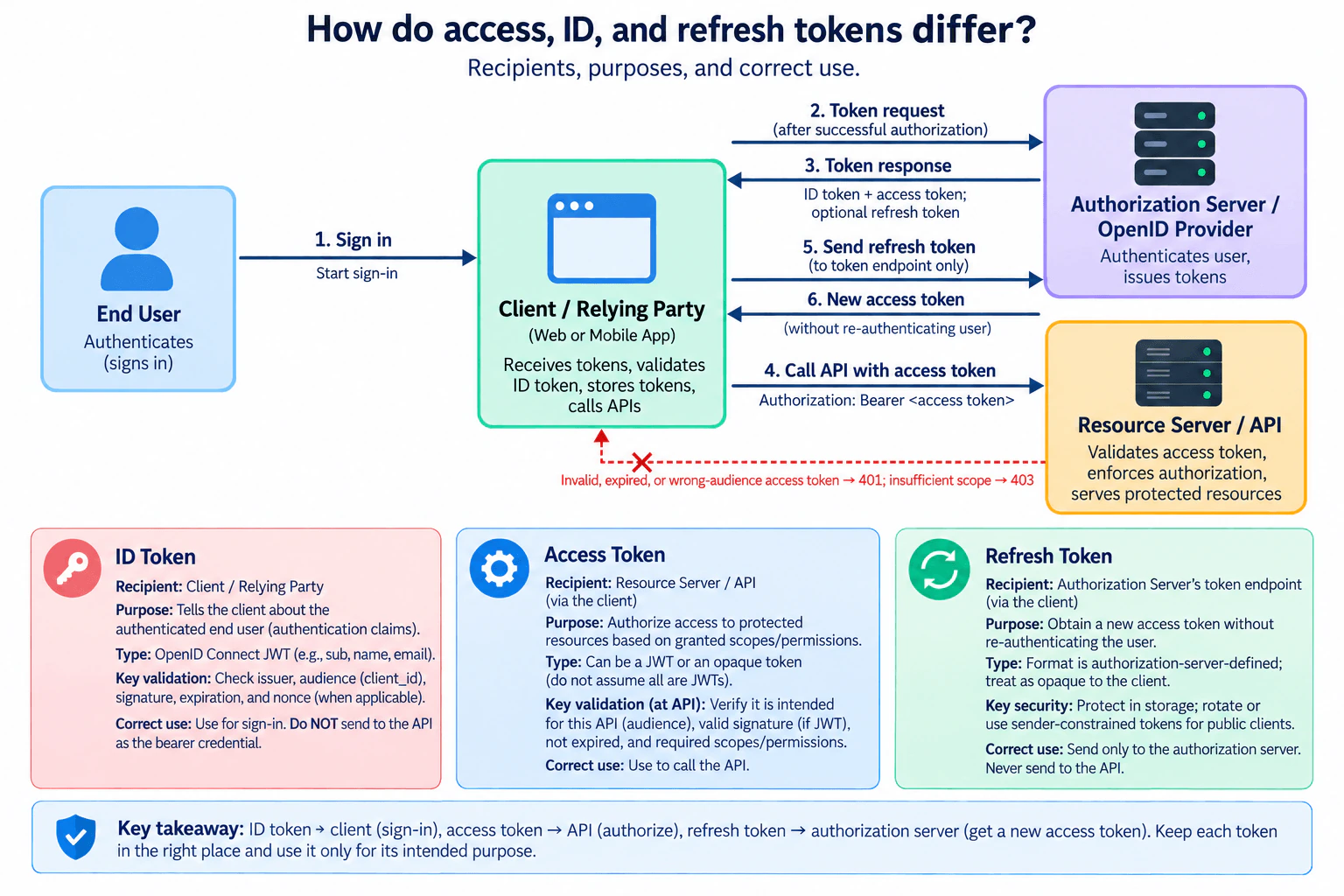
For access, ID, and refresh tokens, distinguish their recipients, purposes, and appropriate use.
Short Interview Answer (30-60 seconds)
ID tokens go to the client and describe the authentication result. Access tokens go to resource servers and authorize API access. Refresh tokens go back to the authorization server to obtain new access tokens. They differ in recipient, purpose, validation, lifetime, and exposure risk.
Detailed Explanation
The practical distinction is the recipient and the decision that recipient makes. An ID token is an OpenID Connect token for the client or relying party and describes the user's authentication result. An access token is presented to a resource server to authorize access to protected resources. A refresh token is presented back to the authorization server to obtain another access token without requiring the user to authenticate again. These tokens are not interchangeable. Each verifier must accept only the token intended for its trust boundary and apply the validation appropriate to that token.
Useful Questions to Ask the Interviewer
Are we discussing OAuth 2.0 together with OpenID Connect, so ID tokens are part of the flow?
Is the client a public client, such as a mobile or browser-based application, or a confidential server-side client?
Does the API receive JWT access tokens or opaque access tokens?
How to Explain It in an Interview
Start with the actors and trust boundaries. The end user starts sign-in through the client. The authorization server, acting as the OpenID Provider for OpenID Connect, authenticates the user and performs the authorization flow. After successful authorization and the applicable token request, it returns an ID token and access token and may also return a refresh token. The client is the relying party for the ID token. The resource server is the verifier for the access token and protects the requested resource. The authorization server is the verifier and recipient of the refresh token.
An ID token answers, "Who authenticated?" It is an OpenID Connect JWT containing claims about the authentication event and the subject. Its intended recipient is the client, not the protected API. The client validates the ID token according to OpenID Connect rules, including its issuer, audience, expiration, cryptographic integrity, and nonce when nonce validation applies. Its audience must identify the client, normally through the client's client_id. The client can then use the validated authentication result to establish its application session. It must not send the ID token to the API as a substitute bearer credential.
An access token answers, "What access is authorized?" The client sends the access token to the resource server, commonly using the Authorization: Bearer header when it is a bearer token. The resource server validates that the token is acceptable for that API and enforces the associated authorization, such as scopes or permissions. Current OAuth security guidance recommends restricting access-token privileges to the minimum required and audience-restricting tokens to the intended resource server where feasible. If the access token is a JWT, the API can validate properties such as issuer, audience, signature, expiration, and authorization claims according to its profile and policy. An access token can also be opaque, so a client or API must not assume every access token is a JWT.
A refresh token answers, "May this client obtain another access token?" If the authorization server chooses to issue one, the client stores it carefully and sends it only to the authorization server's token endpoint. It is never sent to the resource server. After validating the refresh request and applicable client binding or authentication, the authorization server can issue a new access token and may issue a new refresh token. Refresh-token issuance is optional. Its format is authorization-server-defined, so the client should treat it as opaque instead of depending on its internal representation.
The diagram's normal flow therefore has three different destinations: ID token to the client for the sign-in result, access token from the client to the API for authorization, and refresh token from the client back to the authorization server for renewal. That recipient distinction is the easiest way to avoid mixing the three token types.
Failure behavior is also important. The resource server should fail closed when an access token cannot be accepted. Under OAuth bearer-token error handling, an expired, revoked, malformed, or otherwise invalid access token results in HTTP 401 Unauthorized. A valid access token that lacks the required scope results in HTTP 403 Forbidden. A token intended for a different resource must not be accepted as authorization for this API.
Replay exposure differs by token. A stolen bearer access token may be replayed while it remains usable, which is one reason to keep its privileges and lifetime limited. A refresh token may remain useful longer and can be used to obtain new access tokens, so it needs particularly careful storage and lifecycle management. Current OAuth Security Best Current Practice requires refresh tokens issued to public clients to be sender-constrained or to use refresh-token rotation. With rotation, a new refresh token is issued during refresh and the previous token is invalidated, allowing reuse to reveal possible replay.
There are important limitations. Decoding a JWT does not prove that it is trustworthy; the verifier still has to perform the required cryptographic and claim validation. Revocation behavior also depends on the token type and deployment. A self-contained access token may remain usable until expiration unless the architecture provides an additional revocation mechanism. Refresh tokens can be revoked by the authorization server, but preventing misuse also depends on secure client storage and replay protections.
The practical summary is: ID token → client for the authentication result; access token → API for authorization; refresh token → authorization server for obtaining a new access token. Keep each token inside its intended trust boundary and never substitute one token type for another.
Technical Approach
Identify the intended recipient: client, resource server, or authorization server.
Use the ID token only at the client to validate the OpenID Connect authentication result.
Use the access token with the intended resource server and enforce its scopes, permissions, audience, lifetime, and other required validation.
If a refresh token was issued, send it only to the authorization server's token endpoint when another access token is needed.
Protect tokens from disclosure and replay according to their lifetime and sensitivity.
Fail closed when token validation fails: reject an invalid bearer access token and deny requests whose valid token lacks required authorization.
Rotate or sender-constrain refresh tokens for public clients as required by current OAuth security best practice.
Practical Insights
The main costs are security and operational tradeoffs rather than algorithmic complexity. Short-lived access tokens reduce the time a stolen token can be useful, but clients must refresh more often. JWT access tokens can allow local API validation, but the API must maintain correct validation rules and signing-key updates. Opaque access tokens avoid exposing an internal token structure to clients but may require another server-side validation mechanism. Refresh-token rotation adds state and replay-detection work, but it reduces the risk of silently reusing a copied refresh token. Secure token storage also adds implementation effort, especially for public clients.
Why Interviewers Ask This
Interviewers want to see whether you understand the boundary between authentication and authorization. A strong answer distinguishes the client, authorization server or OpenID Provider, resource server, and protected resource, and avoids common security mistakes such as using an ID token as an API access token or exposing a refresh token to an API.
Common interview mistakes
Common mistakes are sending an ID token to an API as its bearer credential, treating an access token as a general-purpose proof of user identity, sending a refresh token to a resource server, assuming every access or refresh token is a JWT, decoding a JWT without performing required validation, ignoring issuer, audience, expiration, scopes, or permissions where applicable, assuming a refresh token is always issued, storing refresh tokens carelessly, and confusing HTTP 401 for an invalid bearer token with HTTP 403 for insufficient scope.
Interview tip
Lead with the recipients: ID token → client, access token → API, refresh token → authorization server. Then explain each token's purpose, validation, lifetime, and failure behavior. This makes the authentication-versus-authorization boundary clear and matches the diagram.
Interviewer may ask next
Why should an API not accept an ID token instead of an access token?
An ID token is issued for the OpenID Connect client as evidence of the authentication result, and its audience identifies that client. The protected API is not its intended recipient. The API should instead require an access token intended for that resource server and evaluate the token's authorization information, such as scopes or permissions. Using an ID token as an API bearer credential mixes authentication with authorization and breaks the intended token boundary.
What happens if a refresh token is stolen?
A stolen refresh token may allow an attacker to obtain new access tokens while that refresh token remains usable, so it requires strong storage and replay protection. Current OAuth Security Best Current Practice requires refresh tokens issued to public clients to be sender-constrained or use refresh-token rotation. With rotation, the authorization server issues a new refresh token during refresh and invalidates the previous one. Reuse of an invalidated token can reveal replay, after which the server can revoke the active refresh token and force a new authorization grant.
72. What role does SCIM play in identity management?Identity And Access ManagementMedium
i Question Details
Explain how SCIM exchanges account and group lifecycle changes between identity systems and applications.
Short Interview Answer (30-60 seconds)
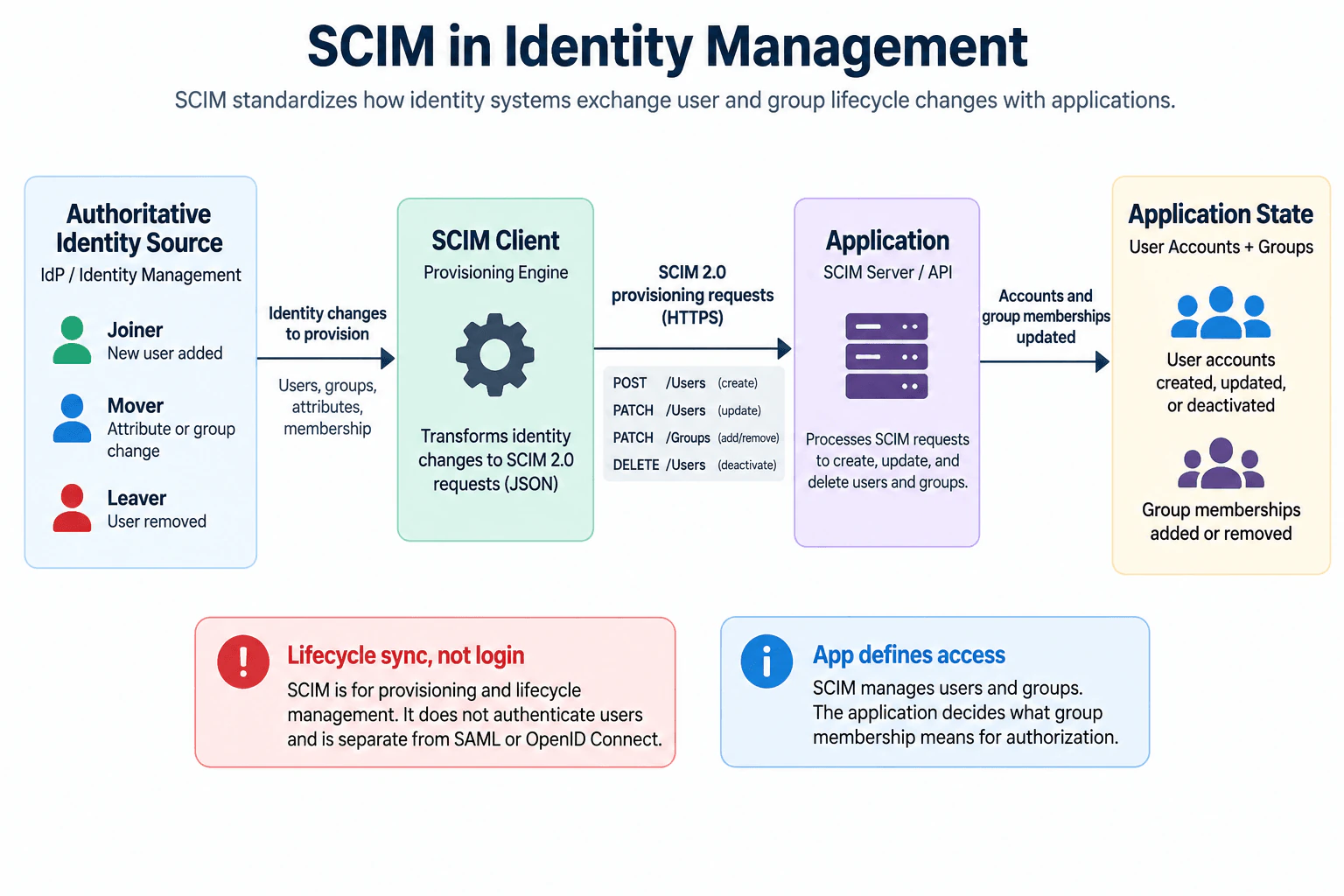
SCIM standardizes account and group lifecycle provisioning between identity systems and applications. It lets a provisioning client create users, update attributes and memberships, and handle leavers through an application's SCIM API. SCIM synchronizes identity data; it does not authenticate the user.
Detailed Explanation
SCIM, or System for Cross-domain Identity Management, is an HTTP-based standard for exchanging identity lifecycle data between systems. In the diagram, an authoritative identity source produces joiner, mover, and leaver changes. A SCIM client turns those changes into standardized SCIM requests and sends them over HTTPS to the application's SCIM server. The application then changes its local user accounts and group memberships. The key interview point is that SCIM handles provisioning and lifecycle synchronization. It does not perform the user's login, and the application still decides what access a synchronized user, attribute, or group membership actually provides.
Useful Questions to Ask the Interviewer
Is the upstream identity system authoritative for both user attributes and group memberships?
Should leavers be administratively disabled, deleted, or handled according to the target application's retention requirements?
Which SCIM capabilities does the target service support, including User, Group, PATCH, and attribute mappings?
How to Explain It in an Interview
Start with the practical role: SCIM keeps application identity records synchronized with an upstream identity-management system. The upstream system owns the lifecycle change, the SCIM client converts it into protocol operations, and the application's SCIM endpoint applies the supported change to its local identity state.
For a joiner, the client can use POST on the Users endpoint to create a User resource. For a mover, the client can update user attributes or group membership. PATCH is commonly used for partial updates, but SCIM defines PATCH as an optional server capability, so a client must use operations supported by that service provider. Group membership can be represented and modified through the Group resource. RFC 7644 defines POST for creation, PATCH for partial modification, and DELETE for deleting a resource. rfc-editor.org
For a leaver, the diagram shows a simplified DELETE /Users deactivation path. Strictly, SCIM DELETE removes the resource; administrative disablement is different. The SCIM User schema includes the boolean active attribute for the user's administrative status, so many lifecycle implementations disable a user by setting active to false rather than equating DELETE with disablement. A service provider may internally retain a deleted record, but after a successful SCIM DELETE it must behave as deleted to SCIM clients. rfc-editor.org
The main responsibility boundary is between the SCIM client and the application's SCIM server. Provisioning requests cross that boundary over the service's protected HTTP interface. The SCIM service authenticates and authorizes the provisioning client using its configured supported security mechanism. That machine-to-machine authorization is separate from the human user's authentication session.
SCIM also separates provisioning from authorization. Synchronizing a user into a group does not itself define what that group can do. The target application interprets the user, attributes, and group membership through its own roles, permissions, or policy system. This matches the diagram's 'App defines access' callout.
If a provisioning request fails, the provisioning system should not mark the lifecycle change as successfully applied. It should record the error, retry or escalate according to policy, and verify the downstream account state. This is especially important for leavers because an unsuccessful synchronization can leave stale access.
SCIM reduces custom integration work by providing common resource schemas and protocol operations for identity management. Its limitations are that service providers can support different capabilities and mappings, PATCH support is optional, and SCIM does not replace identity proofing, SSO, authentication, access reviews, or application authorization.
Technical Approach
Treat the authoritative identity system as the source of joiner, mover, and leaver changes.
Determine which user attributes or group memberships must change in the target application.
Map the change to the target application's supported SCIM User or Group schema.
Send the authorized SCIM request over HTTPS to the application's SCIM endpoint.
Use supported operations such as POST for creation and PATCH or PUT for modification; distinguish administrative disablement from resource deletion.
Check the SCIM response and do not record success when the service rejects the request.
Verify that the application's account and group state matches the intended authoritative state, and retain logs for troubleshooting and audit.
Practical Insights
SCIM reduces manual provisioning work and the need for many custom account-management integrations. The main costs are configuring attribute and group mappings, securing the provisioning client's credentials or authorization mechanism, testing each application's supported SCIM capabilities, monitoring failed updates, and maintaining mappings as identity data changes. Operational risk remains when synchronization is delayed or fails because an account or membership can become stale.
Why Interviewers Ask This
Interviewers want to know whether you understand the difference between identity provisioning and authentication, how joiner-mover-leaver changes propagate across a system boundary, and where SCIM stops. A strong answer explains user and group lifecycle synchronization without incorrectly treating SCIM as SSO or as the application's authorization decision engine.
Common interview mistakes
A common mistake is saying SCIM performs SSO or authenticates the user. It does not; its role is identity provisioning and lifecycle management. Another mistake is assuming a synchronized group automatically grants a specific permission. The application defines what that membership means. Also, do not say that SCIM DELETE means 'deactivate': DELETE removes the SCIM resource, while administrative disablement can be represented with the User active attribute. Finally, do not assume every service supports PATCH or identical attribute mappings.
Interview tip
Use the joiner-mover-leaver flow shown in the diagram. Say that the authoritative identity source produces the change, the SCIM client sends standardized User or Group operations to the application's SCIM API, and the application updates its local state. Then clearly state that SCIM is provisioning, not login, and the application still owns authorization decisions.
Interviewer may ask next
How is SCIM different from SAML or OpenID Connect?
SCIM manages identity lifecycle data such as users, attributes, and groups. SAML and OpenID Connect are federation protocols used during sign-in to communicate authentication information between security domains. They solve different problems and are often used together: SCIM can provision the account, while SAML or OpenID Connect can later support federated login.
What happens if a SCIM leaver update fails?
The provisioning system should treat the operation as failed rather than assuming access was removed. It should log the failure, retry or escalate according to policy, and verify the downstream account state. This matters because a failed leaver synchronization can leave an account or group membership active even though the authoritative identity source says it should no longer be active.
73. Which AWS identity does an EKS pod actually use?Identity And Access ManagementHard
Short Interview Answer (30-60 seconds)
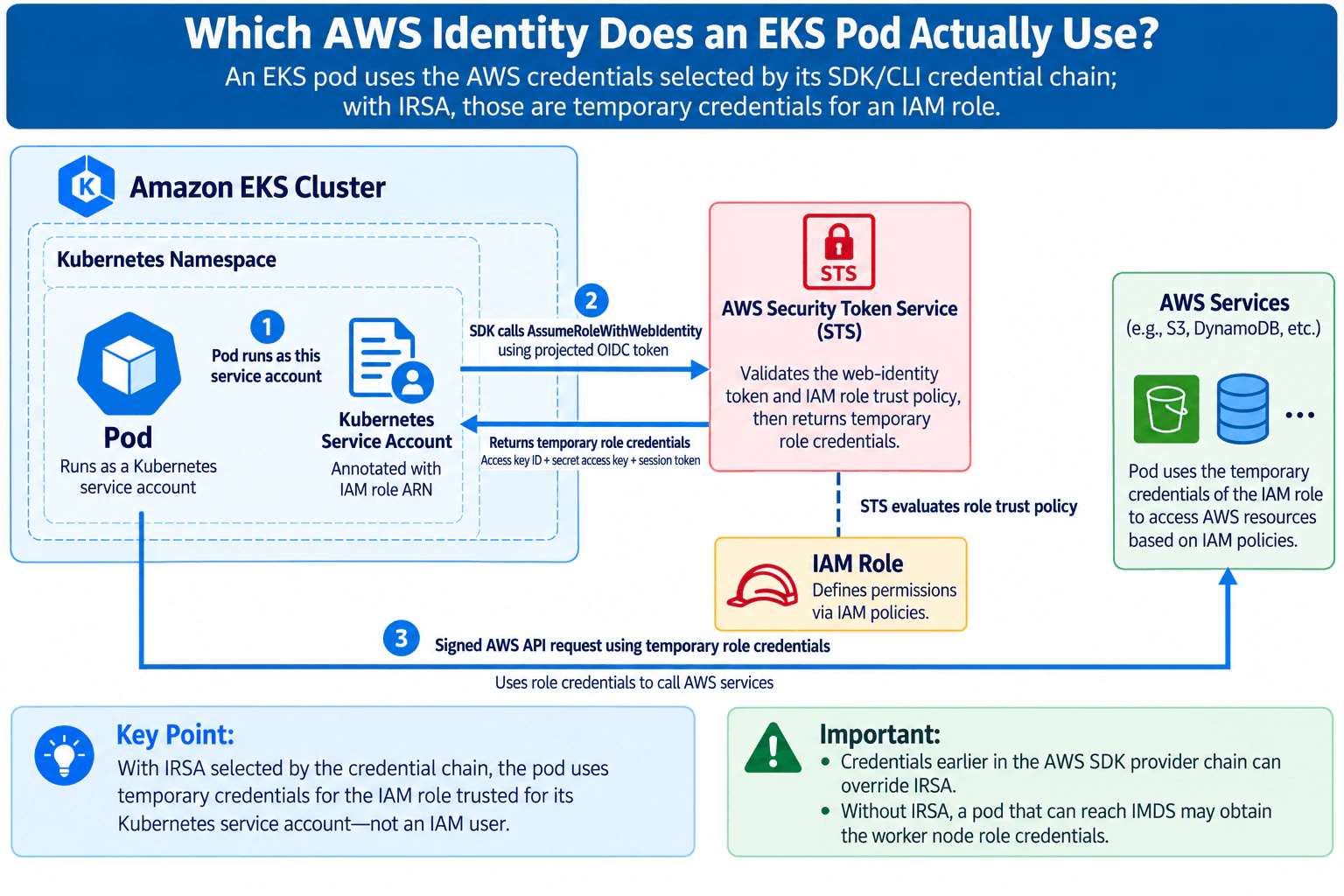
An EKS pod uses the AWS credentials selected by its SDK or CLI credential chain. With IRSA selected, the SDK exchanges the projected Kubernetes service-account OIDC token with STS and receives temporary credentials for the IAM role associated with that service account. docs.aws.amazon.com
Detailed Explanation
The question is really asking which AWS principal signs requests made by software inside an EKS pod. A pod does not automatically become an IAM user or permanently inherit one universal AWS identity. The answer depends on the credentials selected by the application's AWS SDK or CLI. In the approved IRSA flow, the pod runs as a Kubernetes service account associated with an IAM role. The SDK exchanges the projected OIDC service-account token with AWS STS and receives temporary credentials for that role. Those credentials then sign requests to AWS services. docs.aws.amazon.com
Useful Questions to Ask the Interviewer
Are we assuming IAM Roles for Service Accounts, or could the workload use another credential source such as EKS Pod Identity or the worker node role?
Is access to the EC2 Instance Metadata Service restricted for pods?
Which Kubernetes namespace and service account should be allowed to assume the IAM role?
Which AWS services and API actions does this workload actually need?
How to Explain It in an Interview
Start with credential selection. The pod itself is a Kubernetes workload, not an IAM user. An AWS SDK normally searches its credential provider chain for usable AWS credentials. IRSA is a provider in that chain. If the workload already has credentials from a provider earlier in the chain, those credentials continue to take precedence even when IRSA is configured. docs.aws.amazon.com
For the IRSA path shown in the diagram, the pod runs as a Kubernetes service account. That service account is annotated with the ARN of an IAM role. The EKS environment provides a projected OpenID Connect, or OIDC, service-account token to the pod. The IAM role trust policy can restrict which cluster OIDC provider, Kubernetes namespace, service account subject, and token audience are accepted. A common IRSA audience is sts.amazonaws.com. docs.aws.amazon.com
The EKS cluster OIDC issuer is the identity issuer for this federation path. AWS STS is the service that processes the web-identity role assumption. The workload's AWS SDK calls AssumeRoleWithWebIdentity using the projected OIDC token. STS validates the web-identity token and evaluates the IAM role trust policy. If the token or trust conditions are not accepted, temporary credentials are not issued. If the request is accepted, STS returns temporary role credentials to the workload. docs.aws.amazon.com
Those temporary credentials include an access key ID, secret access key, and session token. The workload uses them to cryptographically sign its own AWS API requests. AWS services such as Amazon S3 or DynamoDB then authorize those requests according to the permissions available to the assumed role and other applicable policies. STS does not send the credentials directly to S3 or DynamoDB; it returns them to the workload first. docs.aws.amazon.com
The important trust boundary is between the Kubernetes workload identity and AWS IAM. A Kubernetes service account by itself does not grant AWS resource access. The EKS OIDC issuer, IAM OIDC provider, projected service-account token, IAM role trust policy, STS validation, and role permissions connect that Kubernetes identity to temporary AWS credentials. This avoids storing reusable IAM user credentials in the container. docs.aws.amazon.com
The policy decisions happen at two important points. First, STS evaluates whether the web identity is trusted to assume the IAM role. Second, the target AWS service evaluates whether the resulting role session is authorized to perform the requested action on the protected resource. Least privilege means granting that IAM role only the actions and resources that the workload actually needs.
Credential precedence is an important limitation. Configuring IRSA does not by itself prove that the application is using the IRSA role. AWS documents that credentials found earlier in the SDK credential provider chain continue to be selected. That is why runtime verification matters. docs.aws.amazon.com
IMDS is another important limitation. If a pod running on EC2 worker nodes can reach the EC2 Instance Metadata Service, it may have access to credentials associated with the worker node IAM role. Restricting pod access to IMDS improves workload credential isolation when workloads should not be able to use the node role. docs.aws.amazon.com
For validation, inspect the Kubernetes service account annotation and the IAM role trust policy. Then call AWS STS GetCallerIdentity from inside the workload using the same credential environment as the application. The returned ARN shows the IAM principal associated with the credentials that actually signed that request. This gives practical evidence of the AWS identity being used at runtime. AWS STS API activity can also be recorded in CloudTrail for audit purposes. docs.aws.amazon.com
The main tradeoff is configuration complexity versus identity isolation. IRSA requires an EKS OIDC provider, a Kubernetes service account, an IAM role with an appropriate trust policy, and a supported AWS SDK using the credential chain. In return, workloads can use temporary credentials and different service accounts can receive different least-privilege IAM permissions instead of broadly relying on the worker node role. docs.aws.amazon.com
Technical Approach
Identify the credential provider the workload actually uses instead of assuming that every EKS pod has the same IAM identity.
If IRSA is intended, confirm that the pod runs as the expected Kubernetes service account.
Confirm that the service account is associated with the intended IAM role and that the cluster has the required IAM OIDC provider.
Review the IAM role trust policy so the federated OIDC provider, service-account subject, and token audience match the intended workload.
Confirm that the AWS SDK uses the projected OIDC token and AssumeRoleWithWebIdentity to obtain temporary credentials from STS.
Grant the IAM role only the AWS actions and resources required by the workload.
Restrict pod access to IMDS when the worker node role should not be available to workloads.
Verify the effective runtime identity with STS GetCallerIdentity and investigate any unexpected role ARN or credential source.
Practical Insights
The technical cost is moderate because IRSA needs an EKS OIDC provider, a Kubernetes service account, an IAM role, a correct trust policy, and a compatible AWS SDK. The operational cost comes from maintaining those mappings and troubleshooting credential-provider precedence. The security benefit is better workload isolation and temporary credentials. Important maintenance risks are overly broad IAM permissions, overly broad trust conditions, credentials earlier in the SDK chain overriding IRSA, and unrestricted IMDS making worker node role credentials available to pods.
Why Interviewers Ask This
This question tests whether you understand the difference between a Kubernetes workload identity and the AWS IAM identity that signs API requests. A strong answer recognizes that a pod is not automatically an IAM principal, credential-provider precedence matters, and IRSA maps a Kubernetes service account to temporary credentials for an IAM role rather than requiring long-lived IAM user access keys.
Common interview mistakes
Common mistakes are saying that every EKS pod automatically uses the worker node role, saying that every pod automatically uses IRSA, or treating the Kubernetes service account itself as the AWS IAM role. Another mistake is saying that STS sends temporary credentials directly to S3 or DynamoDB; STS returns credentials to the workload, which then signs its own AWS API requests. Engineers also forget credential-provider precedence, leave IMDS reachable when they expect strict workload isolation, or configure an IAM role trust policy that is broader than the intended namespace and service account.
Interview tip
Lead with the credential-chain rule: the pod uses whichever AWS credentials its SDK selects. Then explain the IRSA path in one sequence: Kubernetes service account and projected OIDC token, AssumeRoleWithWebIdentity to STS, temporary IAM role credentials back to the workload, and signed requests from the workload to AWS services. Finish with credential precedence and IMDS as the two important caveats.
Interviewer may ask next
How can you verify which IAM identity an EKS pod is actually using?
Call AWS STS GetCallerIdentity from inside the workload using the same credential environment as the application. Its response identifies the account and ARN associated with the credentials that signed the request. For an IRSA role session, that ARN should correspond to the expected assumed IAM role. Also inspect the pod's Kubernetes service account, its IAM role annotation, and the IAM role trust policy to explain why that identity was selected. docs.aws.amazon.com
What can cause a pod configured for IRSA to use a different AWS identity?
Credentials earlier in the AWS SDK credential provider chain can override IRSA. Also, if the pod can reach EC2 IMDS, node-role credentials may be available to the workload. The SDK's credential-provider precedence determines which usable credentials are actually selected, so verify the runtime identity rather than assuming that configuration alone proves which role is in use. docs.aws.amazon.com
74. How would you assess the risk of OAuth misconfiguration in a SaaS application?Identity And Access ManagementHard
i Question Details
Assess OAuth scopes, redirect handling, token lifetime, revocation, and consent in the SaaS integration.
Short Interview Answer (30-60 seconds)
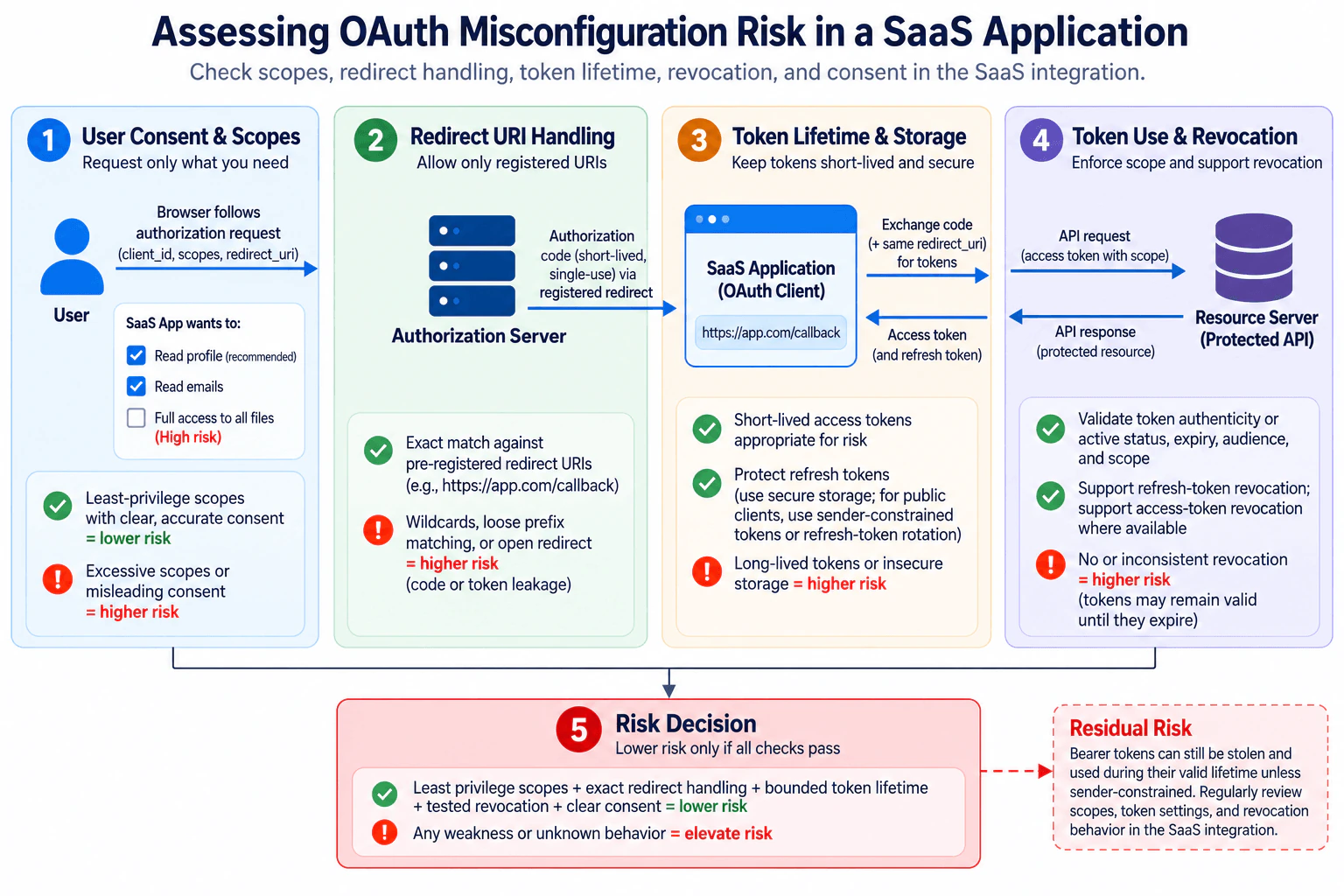
I would trace the OAuth flow end to end and assess five areas: least-privilege scopes and clear consent, exact redirect handling, short-lived and protected tokens, correct resource-server validation, and effective revocation. I would raise the risk for excessive permissions, loose redirects, long-lived or exposed tokens, weak validation, failed revocation, or unknown behavior.
Detailed Explanation
The question asks whether the SaaS integration's OAuth configuration limits access to what is needed and fails safely when something is wrong. I would examine the user, authorization server, SaaS application acting as the OAuth client, and resource server protecting the API. I would then assess scopes and consent, redirect URI handling, token lifetime and storage, token validation, and revocation. The audit boundary covers those components and their token and authorization-code flows. I would base the risk decision on tested behavior and configuration evidence, not on screenshots or assumptions alone.
Useful Questions to Ask the Interviewer
Which authorization server and protected APIs are in scope?
Which scopes does the SaaS client request, and which API actions actually require them?
What redirect URIs are registered for the SaaS client?
What are the access-token and refresh-token lifetimes?
How are refresh tokens stored and protected from replay?
What happens to refresh and access tokens when a user disconnects the integration or access is revoked?
How does the resource server validate that a token is valid for this API and requested action?
How to Explain It in an Interview
I would start with the trust path shown in the diagram. The human user reviews the requested permissions and gives consent. The browser follows the authorization request to the authorization server. The authorization server returns a short-lived authorization code to the SaaS application's registered redirect URI. The SaaS application, acting as the OAuth client, exchanges that code for tokens and then presents an access token to the protected API. The resource server is the enforcement point for access to the protected resource.
First, I assess scopes and consent. I compare each requested scope with the minimum API action the integration actually needs. OAuth security best current practice says access-token privileges should be restricted to the minimum required, which reduces the impact of token leakage. rfc-editor.org Broad permissions such as full access when only read access is needed increase the potential impact. I also check that the consent screen clearly and accurately describes the access being requested. Misleading consent or unexplained sensitive scopes raises the risk.
Second, I assess redirect handling. For this SaaS web-client flow, the authorization server should compare the supplied redirect URI with the client's pre-registered redirect URI using exact string matching. Current OAuth security best practice requires exact redirect matching and prohibits open redirectors because loose matching can let authorization codes or tokens reach unintended endpoints. rfc-editor.org I would therefore treat wildcards, loose prefix matching, or an open redirect in the callback path as high-risk findings.
Third, I assess token lifetime and storage. Access tokens should have a lifetime appropriate to the sensitivity and use case, and tokens must be stored as sensitive credentials. Longer-lived bearer tokens create a larger replay window if stolen. Refresh tokens deserve extra attention because they can extend access beyond one access-token lifetime. For public clients, RFC 9700 requires refresh tokens to be sender-constrained or protected with refresh-token rotation. rfc-editor.org For a confidential SaaS client, I would also verify strong client authentication and secure refresh-token storage rather than assume the storage design is safe.
Fourth, I verify resource-server enforcement. The protected API should accept a token only when it can establish that the token is valid for that API and requested action. Depending on token format and architecture, that can mean validating a self-contained token's authenticity and claims or checking active status through an authorization-server-backed mechanism. I would verify expiry, intended audience, and required scope. RFC 9700 says access tokens should be audience-restricted and that each resource server must verify the token was intended for that resource. rfc-editor.org Expired, wrong-audience, or insufficient-scope tokens should be denied.
Fifth, I test revocation. RFC 7009 says implementations must support refresh-token revocation and should support access-token revocation. rfc-editor.org I would revoke or disconnect the integration with an authorized test account, confirm the refresh token can no longer obtain new access tokens, and determine what happens to already-issued access tokens. If access-token revocation is not supported, those access tokens can remain valid until expiry, so their remaining lifetime becomes part of the residual risk. rfc-editor.org
For evidence, I would review the registered redirect URIs, requested scopes, consent text, token lifetime settings, token storage design, authorization-server logs, resource-server authorization logs, and results of safe positive and negative tests. The policy decision point is the resource server when it evaluates whether the presented token is valid for the requested protected resource and action. A failed validation should deny the API request rather than fall back to broader access.
My final risk decision combines the findings. Least-privilege scopes, exact redirect handling, bounded token lifetimes, protected refresh tokens, correct resource-server enforcement, tested revocation, and clear consent support a lower-risk conclusion. Excessive scopes, loose redirects, long-lived or insecurely stored tokens, weak validation, ineffective revocation, misleading consent, or behavior that cannot be verified raises the risk.
The main residual risk is a stolen bearer token that is still valid. Short lifetimes reduce that exposure window but do not eliminate it. RFC 9700 recommends sender-constrained access tokens where appropriate to reduce misuse of stolen tokens. rfc-editor.org The tradeoff is additional implementation, key-management, and operational complexity, so the control choice should match the application's risk.
Technical Approach
Map the user, authorization server, SaaS OAuth client, resource server, protected resource, authorization-code flow, token flow, and audit boundary.
Inventory requested scopes and compare them with the minimum API actions required.
Review the consent screen for clear and accurate permission disclosure.
Verify pre-registered redirect URIs and exact redirect matching; reject wildcards, loose prefix matching, and open redirects.
Review access-token and refresh-token lifetimes, storage, and refresh-token replay protections.
Verify resource-server checks for token validity, expiry, intended audience, and required scope.
Test refresh-token revocation and determine whether already-issued access tokens are revoked or remain valid until expiry.
Run safe negative tests for expired, wrong-audience, and insufficient-scope tokens and confirm denial.
Review logs and configuration evidence.
Rate risk based on permission breadth, redirect exposure, token replay window, validation strength, revocation behavior, consent quality, and any unverified behavior.
Practical Insights
The main cost is operational complexity. Exact redirect validation and least-privilege scopes are usually straightforward, but secure token storage, refresh-token protection, revocation, and negative testing need engineering and maintenance. Shorter access-token lifetimes reduce exposure but increase refresh activity. Sender-constrained tokens can reduce replay risk but add key management and integration work. Clear consent requires product and security review. If compliance requirements apply to the protected data, the evidence and review process may also need to satisfy those requirements. The final risk rating should reflect the sensitivity of the data, breadth of access, exposure time, and reliability of the controls.
Why Interviewers Ask This
This question tests whether the candidate can evaluate OAuth as an authorization system instead of reviewing isolated settings. It checks judgment around trust boundaries, least privilege, redirect security, token exposure and replay risk, resource-server enforcement, revocation limits, consent quality, safe denial behavior, and the evidence needed to support a risk decision.
Common interview mistakes
Common mistakes are treating OAuth itself as authentication; reviewing scopes without checking whether consent accurately describes them; accepting wildcard or prefix-based redirect matching; assuming every access token is a JWT that must be locally signature-validated; checking expiry but not audience and scope; focusing only on access tokens while ignoring refresh-token lifetime, storage, and replay protection; assuming logout automatically revokes every token; assuming access-token revocation is always immediate; and declaring the integration safe from configuration screenshots without testing allowed and denied behavior.
Interview tip
Present the answer as one end-to-end risk decision. Name the user, authorization server, SaaS OAuth client, and resource server first. Then walk through scopes and consent, redirects, token lifetime and storage, validation, and revocation. Finish with safe denial behavior, evidence you would test, and the residual risk of a stolen still-valid bearer token.
Interviewer may ask next
How would you validate that revocation really works in the SaaS integration?
I would use an authorized test account, obtain the normal tokens, and confirm expected API access. Then I would disconnect or revoke the integration and verify that the refresh token can no longer obtain new access tokens. I would also test whether an already-issued access token is immediately rejected or remains valid until expiry. RFC 7009 requires refresh-token revocation support and recommends access-token revocation support, so I would document the observed access-token behavior instead of assuming it. rfc-editor.org I would confirm the result in authorization-server and API logs.
Why are short-lived access tokens not enough to eliminate token theft risk?
A short lifetime reduces the period in which a stolen bearer token can be replayed, but it does not stop use during the remaining valid period. Audience restriction limits where the token can be used, and sender-constrained access tokens can make a copied token harder to replay by another sender. RFC 9700 recommends sender-constraining access tokens where appropriate. rfc-editor.org These protections reduce residual risk but add implementation and key-management complexity.
75. What can go wrong with IAM role-assumption chains?Identity And Access ManagementHard
Short Interview Answer (30-60 seconds)
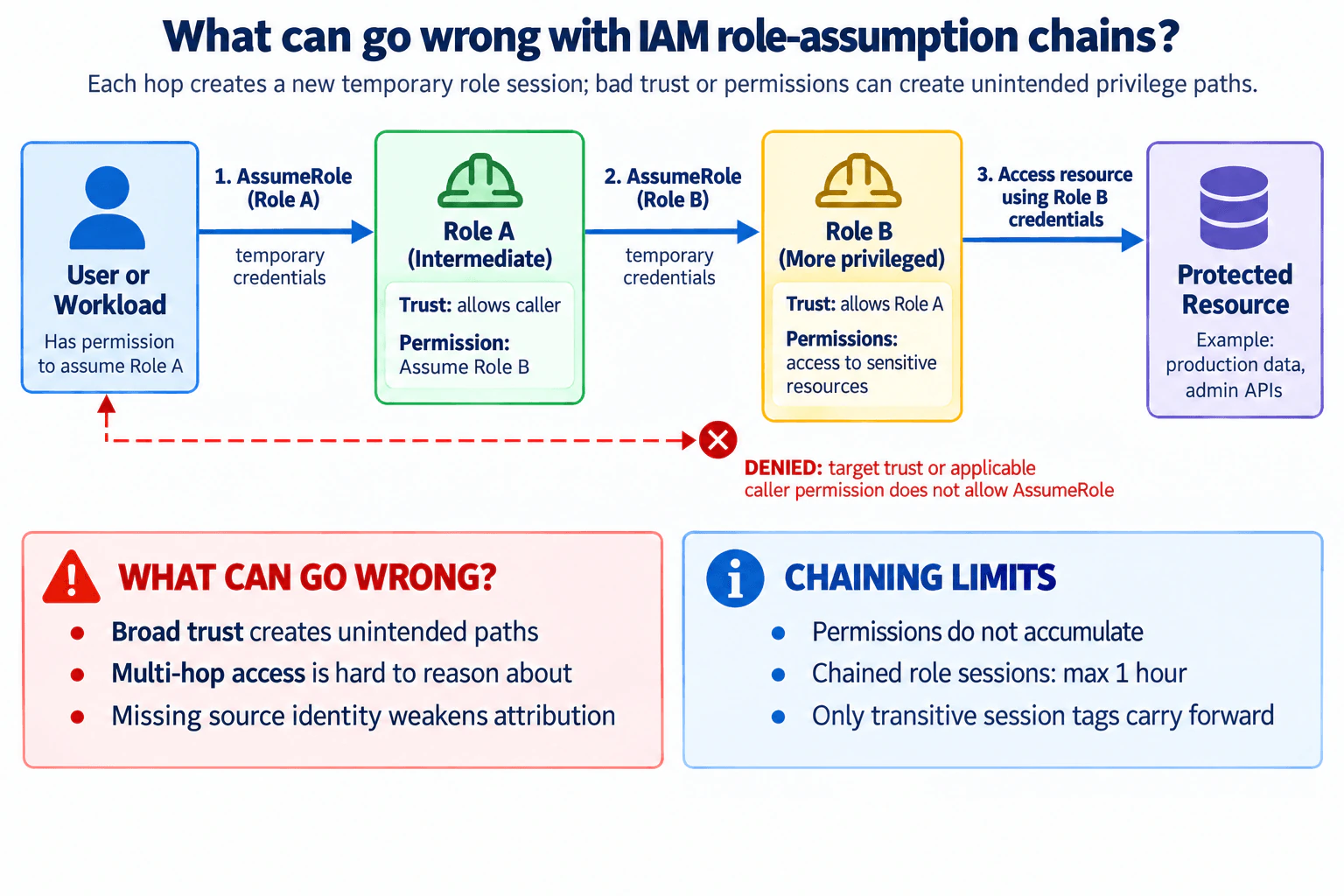
Role chains can create unintended privilege paths when trust or downstream permissions are too broad. Each hop receives new temporary credentials, permissions do not accumulate, and multi-hop access can become difficult to reason about and attribute. AWS also limits chained role sessions to one hour. docs.aws.amazon.com
Detailed Explanation
IAM role-assumption chains let a user or workload assume Role A, then use Role A's temporary credentials to assume a more privileged Role B and access a protected resource. The danger is not that permissions stack; they do not. The danger is that broad trust or excessive downstream permissions can create an unintended privilege path. Multi-hop access also becomes harder to reason about, and missing source identity can weaken attribution. In AWS, chained role sessions are limited to one hour, and only session tags explicitly marked transitive carry forward. docs.aws.amazon.com
Useful Questions to Ask the Interviewer
Are the roles in one AWS account or across multiple accounts?
Is the original caller a human identity, a workload, or either one?
Which role is supposed to assume the next role, and what protected resource does the final role need to access?
Do source identity or session tags matter for audit or downstream authorization?
How to Explain It in an Interview
Start with the practical decision: treat every AssumeRole hop as a separate trust and authorization boundary. In the approved flow, a user or workload assumes Role A. Role A is an intermediate role with permission to assume Role B. Role B is more privileged and can access the protected resource. Each AssumeRole operation returns temporary credentials for the new role session. docs.aws.amazon.com
The first failure mode is broad trust. If the target role trusts more principals than intended, an unintended caller can gain a path into the chain. The second failure mode is excessive downstream privilege. Even if the starting identity is limited, allowing it to reach a much more privileged Role B can expose sensitive resources beyond the intended task.
The third problem is reasoning complexity. Every hop adds another trust relationship, permission decision, and session. Reviewing Role A and Role B separately can miss an unsafe end-to-end path. The safest review follows the complete chain from the original caller to the protected resource.
The fourth problem is attribution. AWS source identity can identify the original caller in assumed-role activity and persists through role chaining once set. If useful source identity is missing, investigation and accountability can be weaker. CloudTrail can record source identity for assumed-role activity when it is configured. docs.aws.amazon.com
Session tags also need careful handling. Tags do not automatically propagate through every hop just because they exist in one role session. A session tag must be designated as transitive if it should automatically carry into subsequent role sessions. That matters when tags are used as authorization attributes. docs.aws.amazon.com
Permissions do not accumulate across the chain. When a principal assumes another role, it works with the permissions of the newly assumed role rather than adding those permissions to the previous identity or role's permissions. Session policies, when used, can restrict the resulting session further but cannot grant permissions beyond the role's allowed permissions. docs.aws.amazon.com
AWS also has a specific chaining limit: when credentials from one role are used to assume another role, the resulting chained role session cannot exceed one hour. Requesting a longer duration for that chained assumption fails. docs.aws.amazon.com
The safe failure behavior is denial. The target role's trust policy must allow the assumption through AWS's applicable authorization model. For cross-account role assumption, the caller needs an identity-based permission and the target account's role trust policy must permit the caller. Within the same account, a role trust policy is a resource-based policy, so a principal named directly in that trust policy can sometimes be allowed without a separate identity-based Allow. Explicit Deny and other applicable policy controls can still block the request. docs.aws.amazon.com
To validate the design, trace the complete path: USER OR WORKLOAD -> ROLE A -> ROLE B -> PROTECTED RESOURCE. For each AssumeRole hop, check who is trusted, what authorization permits the call, which permissions become active, and whether those permissions are actually required. Then verify that unauthorized assumptions are denied and that audit records let defenders reconstruct the chain.
The main tradeoff is flexibility versus complexity. Role chaining supports temporary, delegated access without distributing a separate long-lived credential for every task. But each added hop increases policy-review effort, troubleshooting difficulty, and the chance that broad trust or excessive privilege creates an unintended path.
Technical Approach
Identify the original user or workload and the protected resource.
Trace every AssumeRole hop in order.
Check the target role's trust policy and the applicable caller authorization at each hop.
Record the permissions that become active in the new role session; do not add previous-role permissions.
Look for broad trust and unnecessary downstream privilege.
Check whether source identity is available when attribution matters.
Verify that session tags intended to persist are explicitly transitive.
Confirm the one-hour chained-session limit where AWS role chaining applies.
Test that unauthorized role assumptions fail.
Review audit logs to reconstruct the full path to the protected resource.
Practical Insights
The technical cost is policy complexity because every extra role adds another trust relationship and permission set to review. The operational cost is troubleshooting because one failed or unexpected request may depend on several hops. The human cost is review effort because security teams must understand the full path, not one role at a time. Short chained sessions reduce credential lifetime but can require more frequent renewal. Strong attribution and logging improve investigations but add configuration and monitoring work.
Why Interviewers Ask This
Interviewers want to see whether you understand that role chaining is a sequence of separate trust and authorization decisions. A strong answer identifies broad trust, excessive downstream privilege, difficult multi-hop reasoning, weak attribution, safe denial behavior, and AWS-specific chaining limits without incorrectly assuming that privileges from earlier roles accumulate.
Common interview mistakes
Common mistakes are assuming permissions accumulate across roles, reviewing each role independently instead of tracing the complete privilege path, allowing overly broad trust, letting an intermediate role reach a more privileged role without a clear need, assuming all session tags automatically propagate, and failing to retain useful source identity for attribution. Another mistake is overlooking AWS's one-hour maximum for chained role sessions. docs.aws.amazon.com
Interview tip
Explain the chain left to right: USER OR WORKLOAD -> ROLE A -> ROLE B -> PROTECTED RESOURCE. Then state that each hop is a new trust and authorization decision. Lead with broad trust, excessive downstream privilege, hard-to-reason multi-hop access, and weak attribution. Finish with the key AWS limits: permissions do not accumulate, chained sessions are capped at one hour, and only transitive session tags carry forward. docs.aws.amazon.com
Interviewer may ask next
Do permissions from Role A and Role B accumulate when Role A assumes Role B?
No. When Role A assumes Role B, the caller uses the Role B session's permissions rather than combining Role A and Role B permissions. AWS states that permissions from the previous user or role and the assumed role are not cumulative. Session policies can restrict the new session further, but they cannot expand it beyond what the role allows. docs.aws.amazon.com
What important AWS limitations should I remember about role chaining?
A chained role session is limited to a maximum of one hour, even when the target role's configured maximum session duration is longer. Also, session tags propagate automatically to subsequent role sessions only when their keys are marked transitive. Source identity, once properly set, can persist through later role assumptions and support audit attribution. docs.aws.amazon.com
76. What is vulnerability management, and how does it differ from running a vulnerability scan?Vulnerability ManagementEasy
i Question Details
Define vulnerability management as a continuous, risk-informed process for discovering assets and weaknesses, validating findings, prioritizing remediation, assigning ownership, managing exceptions, retesting, and measuring closure. Explain inventory, coverage, authenticated and unauthenticated assessment, CVE, CVSS, exploitability, exposure, business impact, compensating controls, patching, and evidence. Clarify that a scanner is one input to the program.
Short Interview Answer (30-60 seconds)
Vulnerability management is a continuous risk-reduction process. A scan is only one input that identifies potential weaknesses. The program validates findings, combines technical severity with exploitability, exposure, business impact, and controls, assigns owners, remediates or mitigates risk, retests, records evidence, measures closure, and repeats.
Detailed Explanation
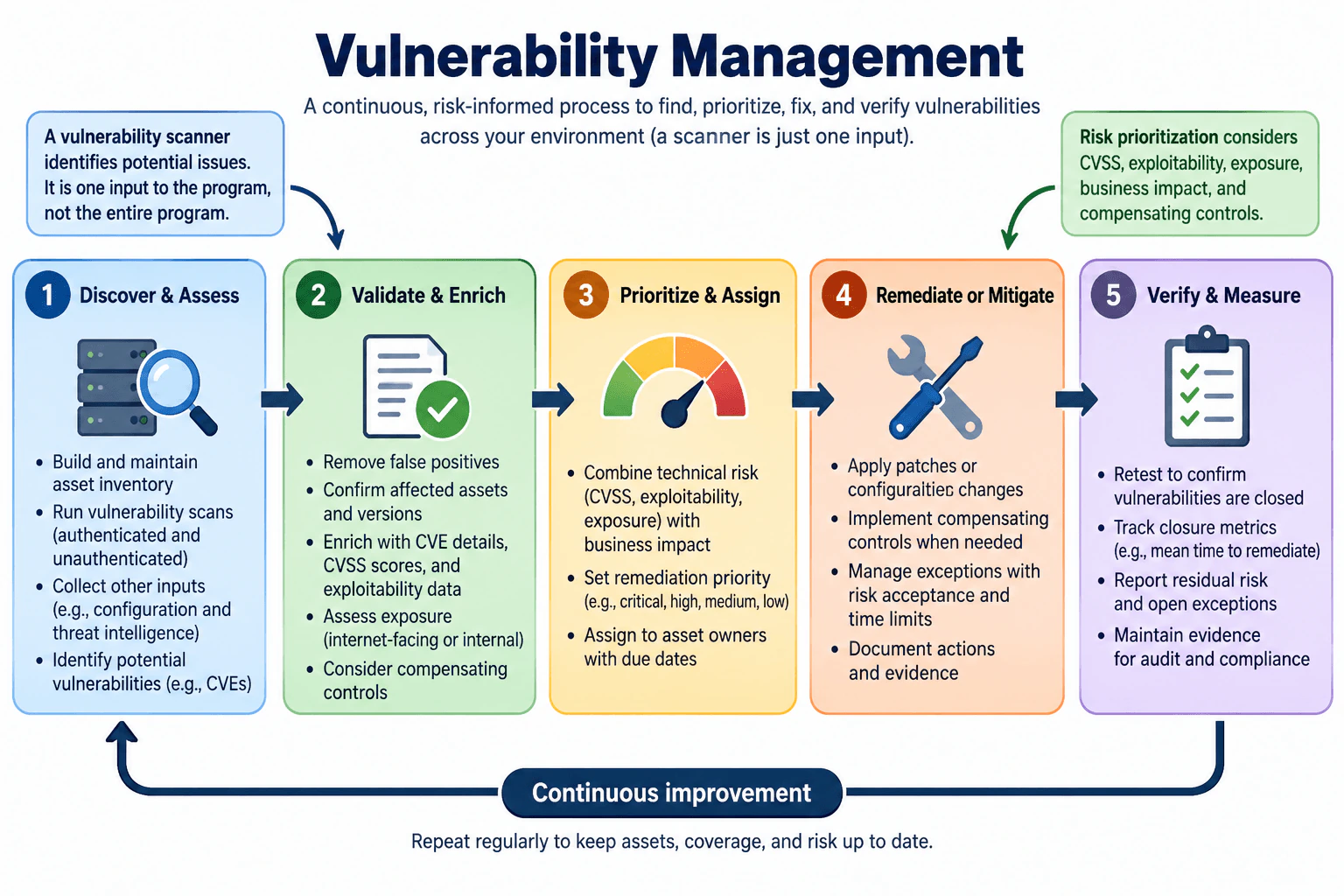
The practical difference is simple: a vulnerability scan is an assessment activity that identifies potential weaknesses during a scan run, while vulnerability management is the continuous process that turns findings and other inputs into verified risk reduction. It starts with asset inventory and coverage, uses authorized authenticated or unauthenticated assessment where appropriate, validates findings, adds CVE, CVSS, exploitability, exposure, and business context, then prioritizes work. It assigns owners and deadlines, applies patches or configuration changes, uses compensating controls or approved exceptions when necessary, retests the result, records evidence, measures progress, and repeats as assets and risk change.
Useful Questions to Ask the Interviewer
What kinds of assets are in scope, such as servers, endpoints, cloud resources, or applications?
How are asset ownership and business criticality maintained?
Which assessment methods are authorized, and where are authenticated versus unauthenticated scans used?
How are remediation deadlines and exception approvals defined?
What evidence is required before a vulnerability can be considered closed?
How to Explain It in an Interview
Start with the operating decision: do not ask only, “What did the scanner find?” Ask, “Which validated weaknesses create the most risk, who owns them, what action will reduce that risk, and how will we prove the action worked?”
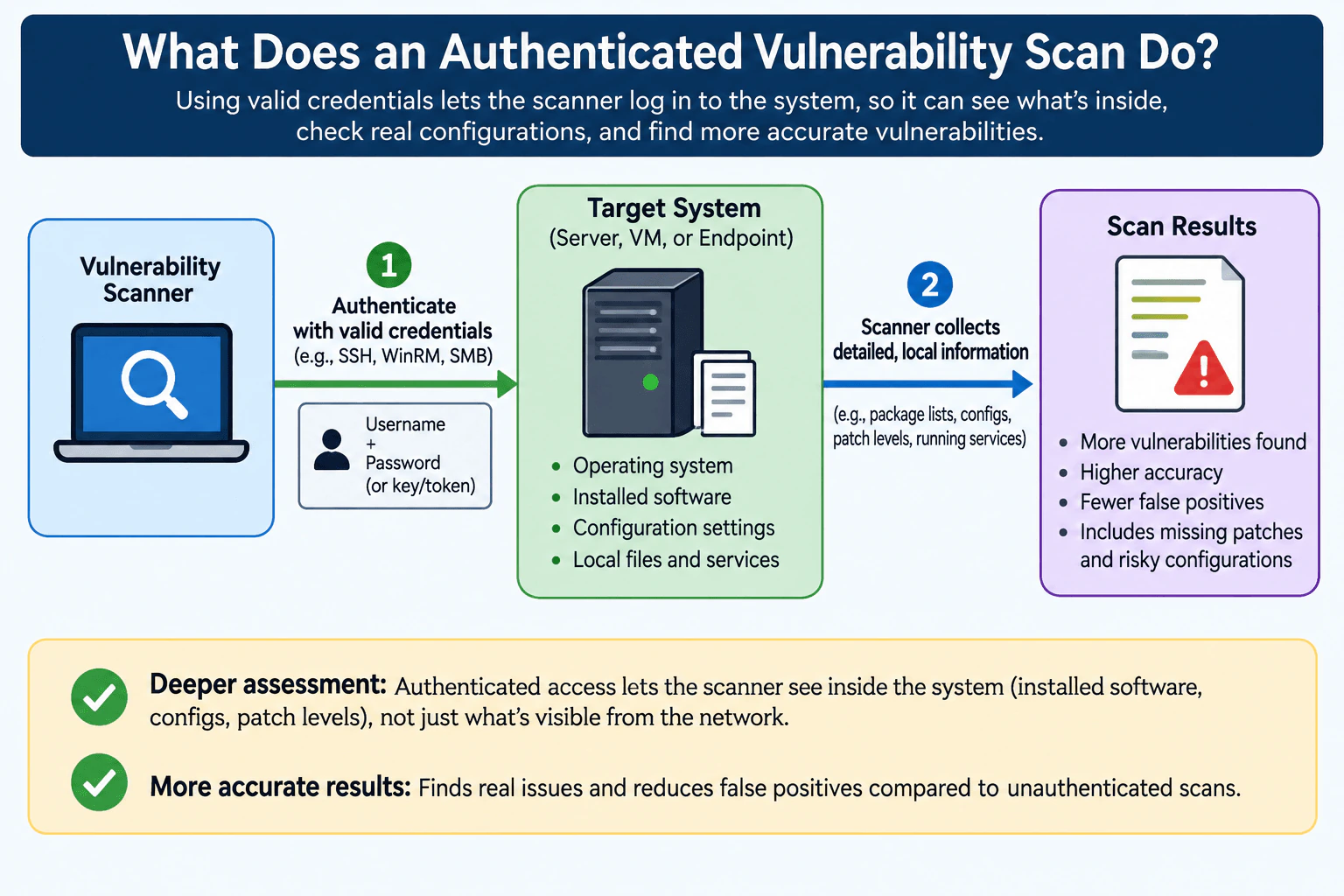
Discover and assess. Build and maintain the asset inventory so the team knows what exists and what should be covered. Coverage means checking that important systems are actually included in assessment. Run only authorized assessments. An authenticated scan uses approved credentials to inspect the target with additional system context, while an unauthenticated scan evaluates what the scanner can observe without logging in. Scanning identifies potential vulnerabilities, but a scanner result is still an input that may need validation.
Validate and enrich. Remove false positives and confirm the affected asset and version. A scanner finding is an observation reported by the tool; a verified vulnerability is a weakness that has been confirmed to apply to the asset. A CVE ID is a unique identifier used to reference a specific publicly disclosed vulnerability record. CVSS provides a standardized way to describe vulnerability severity. Severity is not the same as organizational risk. Add exploitability information, exposure such as internet-facing versus internal placement, threat information, business impact, and existing compensating controls.
Prioritize and assign. Combine technical severity with exploitability, exposure, business impact, asset criticality, and compensating controls. Two systems can have the same scanner severity or CVSS score but deserve different remediation priorities if one is exposed and supports a critical service while the other is isolated and protected by effective controls. Assign the work to the responsible asset owner and give it an appropriate due date.
Remediate or mitigate. Apply the appropriate fix, such as a security patch or configuration change. Patching replaces or updates vulnerable software components to address the weakness. If immediate remediation is not possible, apply a compensating control that reduces the likelihood or impact of exploitation, such as limiting access or isolating the affected system. If residual risk must temporarily remain, document a justified, time-limited exception with accountable risk acceptance and review rather than silently leaving the finding unresolved.
Verify and measure. Retest the affected asset to confirm that remediation or mitigation produced the expected result. Keep closure evidence such as a successful retest, change record, or other reproducible proof. Track useful measures such as remediation time, closure progress, residual risk, and open exceptions. Feed the results back into asset inventory, coverage, and the next assessment cycle.
The responsibility boundary matters. Security teams commonly discover, validate, enrich, prioritize, track, and verify vulnerabilities, while asset or service owners perform or coordinate the actual remediation. An accountable risk owner should approve accepted residual risk when an exception is necessary.
The main failure case is incomplete or misleading visibility. A scanner can miss an asset, lack required access, lack a detection check, or report a false positive. A successful scan also does not prove that a system has no vulnerabilities. Vulnerability management reduces this risk by maintaining inventory and coverage, using multiple inputs, validating findings, measuring unresolved risk, and repeating the cycle.
The main tradeoff is between speed, confidence, coverage, and operational impact. Authenticated assessment can provide deeper visibility but requires secure handling of credentials and appropriate authorization. Frequent assessments improve freshness but add operational load. Fast remediation reduces exposure time but rushed changes can increase service risk. Compensating controls and exceptions can reduce immediate risk or provide time for remediation, but they leave residual risk and require review.
Technical Approach
Build and maintain the in-scope asset inventory and map assets to responsible owners and business context.
Define authorized assessment coverage and run appropriate authenticated or unauthenticated vulnerability scans while collecting other relevant inputs such as configuration and threat information.
Validate findings, remove false positives, confirm affected assets and versions, and enrich findings with CVE, CVSS, exploitability, exposure, and compensating-control context.
Prioritize using contextual risk rather than scanner severity alone.
Assign an owner and remediation deadline.
Apply a patch or configuration change, or use compensating controls and a documented, time-limited exception when immediate remediation is not possible.
Retest to confirm that the vulnerability is remediated or that the intended mitigation is effective.
Record closure evidence, measure remediation progress and residual risk, update inventory and coverage, and repeat the cycle.
Practical Insights
The main costs are people time, scanning and management tools, secure credential handling, asset inventory maintenance, remediation engineering work, maintenance windows, and coordination with system owners. Authenticated scans can give deeper visibility but require careful protection of credentials. More frequent assessment improves freshness but adds compute, network, and operational load. Faster remediation can reduce exposure time but may increase change risk. Exceptions and compensating controls can help when immediate remediation is not possible, but they create review work and leave residual risk.
Why Interviewers Ask This
Interviewers want to know whether you understand the difference between operating a scanner and running a complete risk-reduction process. They are testing whether you can connect asset coverage, validation, contextual prioritization, ownership, remediation, exception handling, retesting, evidence, and continuous improvement instead of treating a scanner result or severity score as the final decision.
Common interview mistakes
Common mistakes are treating a scan report as the entire vulnerability management program, prioritizing only by scanner severity or CVSS, assuming every scanner finding is a verified vulnerability, ignoring asset inventory and coverage, failing to distinguish authenticated from unauthenticated assessment, not assigning clear ownership and deadlines, accepting exceptions without justification or review, treating compensating controls as permanent fixes, closing findings without retesting or evidence, and measuring success only by a lower open-finding count instead of verified risk reduction.
Interview tip
Lead with the key distinction: scanning discovers potential weaknesses; vulnerability management owns the continuous lifecycle from inventory and validation through contextual prioritization, remediation or mitigation, retesting, evidence, measurement, and repetition. Then walk through the same five stages shown in the diagram.
Interviewer may ask next
Why should a team not prioritize vulnerabilities only by CVSS score?
CVSS is useful for describing vulnerability severity, but organizational risk also depends on context. Consider exploitability, asset exposure, business impact, asset criticality, threat information, and compensating controls. Two vulnerabilities with the same CVSS score can therefore deserve different remediation priorities.
What should happen when an important vulnerability cannot be patched immediately?
Assign an accountable owner, evaluate exposure and exploitability, and apply a compensating control that reduces risk, such as restricting access or isolating the affected system. Document a justified, time-limited exception with accountable risk acceptance and review, track the remaining risk, schedule permanent remediation, and retest after the change to collect closure evidence.
77. Why is asset discovery needed in vulnerability management?Vulnerability ManagementEasy
Short Interview Answer (30-60 seconds)
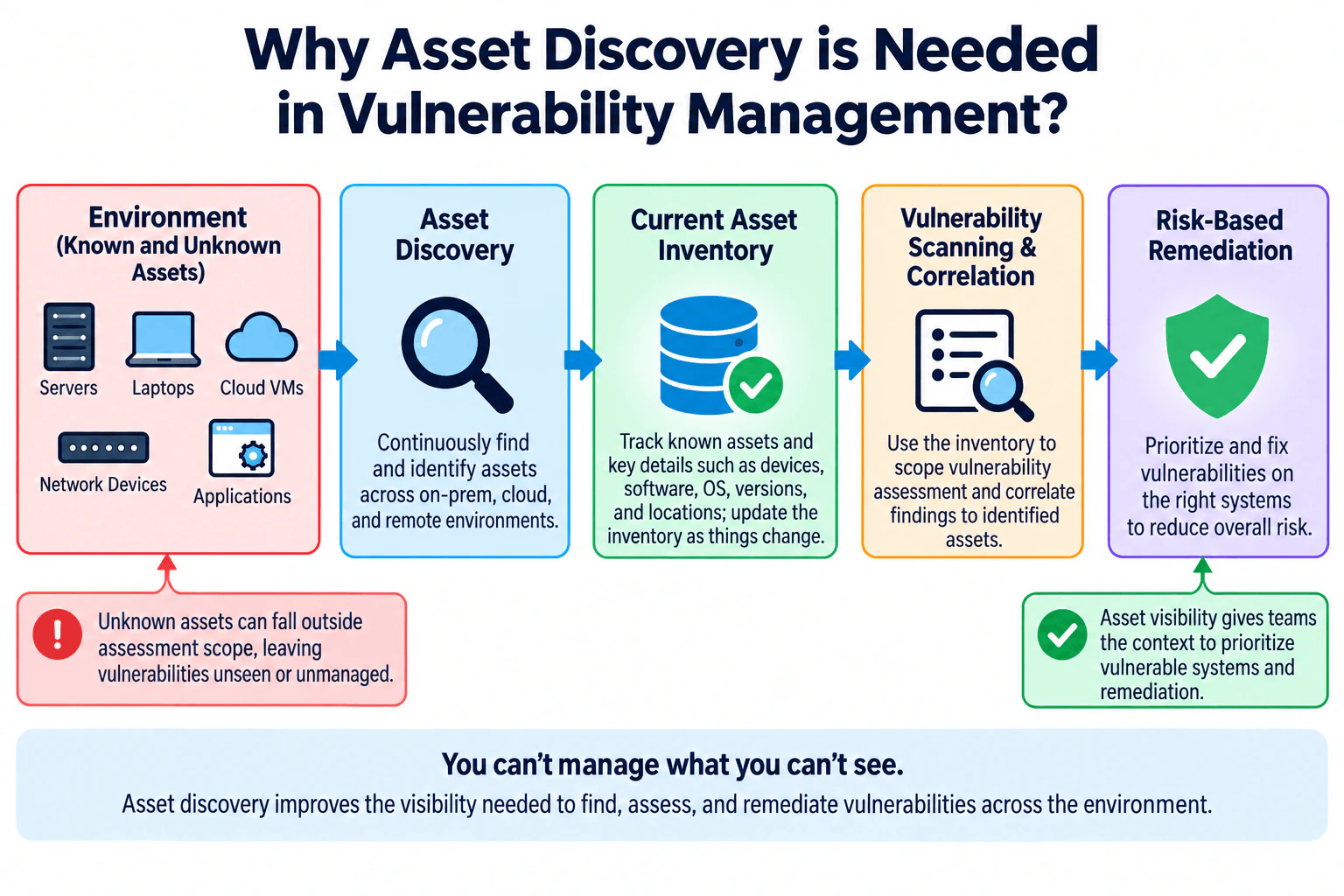
Asset discovery tells us what assets exist so vulnerability management can cover the right systems. It supports a current inventory used to scope assessments, correlate findings, and prioritize remediation. Without it, unknown assets can fall outside assessment scope and leave vulnerabilities unseen or unmanaged.
Detailed Explanation
Asset discovery is the visibility foundation of vulnerability management. Before a team can assess or remediate risk, it needs to know which servers, laptops, cloud virtual machines, network devices, applications, and other assets exist. Discovery continuously identifies assets and feeds a current inventory with useful details such as device type, software, operating system, version, and location. That inventory then helps define vulnerability-assessment scope and connect findings to the correct assets. The important limitation is that discovery improves visibility and coverage but does not prove that the inventory is perfectly complete.
Useful Questions to Ask the Interviewer
Are we discussing on-premises, cloud, remote, or mixed environments?
Is the main concern finding unknown assets, keeping the inventory current, or improving vulnerability-assessment coverage?
Should prioritization include asset criticality and business context after findings are identified?
How to Explain It in an Interview
Start with the practical decision: before assessing vulnerabilities, establish which assets exist and keep that inventory current.
Discover the environment. Continuously identify assets such as servers, laptops, cloud virtual machines, network devices, and applications across the environments the organization manages.
Maintain a current asset inventory. Track known assets and useful context such as device type, software, operating system, version, and location. Because environments change, discovery should be repeated or continuous rather than treated as a one-time activity.
Use the inventory to scope vulnerability assessment. The inventory helps determine which identified assets should be included in vulnerability-assessment activities. Discovery itself does not determine whether an asset is vulnerable; it provides the visibility needed to assess it.
Correlate findings to identified assets. Assessment findings need to be associated with the correct asset. Asset identity and inventory context help teams understand where a finding exists and who owns the affected system.
Prioritize remediation using context. After findings are associated with assets, teams can consider exposure, exploitability, asset criticality, business impact, and compensating controls when deciding what to remediate first. This is more useful than relying on scanner severity alone.
Understand the failure case. An unknown asset can fall outside the intended assessment scope. Vulnerabilities on that asset may therefore remain unseen or unmanaged, creating a blind spot in the vulnerability-management process.
Validate coverage. Compare discovery results with other trusted asset records and investigate mismatches, newly observed systems, stale records, or known assets that have not been assessed. Useful evidence includes discovery records, inventory history, assessment coverage, and ownership data.
State the limitation. Asset discovery improves visibility but does not guarantee perfect completeness. Short-lived cloud resources, isolated systems, temporary devices, incomplete data sources, and discovery failures can still create gaps. Continuous discovery and inventory reconciliation reduce this residual risk.
The main tradeoff is coverage versus operational cost. More discovery methods and more frequent updates can reduce blind spots, but they increase tooling, integration, data-quality, and maintenance work. The goal is a sufficiently current and reliable inventory that supports effective vulnerability assessment and risk-based remediation.
Technical Approach
Identify the environments and asset types that vulnerability management is responsible for.
Continuously discover assets across those environments.
Add identified assets and relevant attributes to the current inventory.
Reconcile new, changed, duplicate, and stale records.
Use the inventory to define vulnerability-assessment scope.
Correlate assessment findings to identified assets.
Add exposure, exploitability, asset criticality, and business context for prioritization.
Assign remediation to the appropriate owner.
Re-run discovery and assessment as the environment changes.
Investigate inventory or assessment-coverage gaps instead of assuming the inventory is complete.
Practical Insights
The main costs are operational. Teams need discovery data sources or tools, inventory storage, integrations, ownership information, and people to investigate mismatches. Frequent discovery improves freshness but can increase processing, duplicate records, false identification, and maintenance work. Less frequent discovery is cheaper but increases the time that a new or changed asset may remain outside normal vulnerability-management coverage. Data quality also needs ongoing attention because stale or incorrect inventory records can lead to incorrect assessment scope or remediation ownership.
Why Interviewers Ask This
Interviewers want to see whether you understand that vulnerability management starts with asset visibility, not just vulnerability scanning. They are testing whether you can connect asset discovery to a current inventory, assessment scope, finding correlation, prioritization, remediation, and the risk created by unknown or unmanaged assets.
Common interview mistakes
Common mistakes are treating asset discovery as a one-time inventory exercise, assuming discovery guarantees complete visibility, scanning only a manually maintained asset list, confusing asset discovery with vulnerability detection, failing to correlate findings with the correct asset, ignoring cloud or remote assets, and prioritizing only by scanner severity without asset or business context. Another mistake is dismissing unexplained inventory mismatches instead of investigating whether they represent unknown or unmanaged assets.
Interview tip
Lead with the dependency: you cannot manage vulnerabilities effectively on assets you do not know about. Then explain the flow shown in the diagram: discover assets, maintain the current inventory, scope assessments, correlate findings, prioritize remediation, and keep discovery continuous. Finish by stating that discovery reduces blind spots but cannot guarantee perfect completeness.
Interviewer may ask next
What happens if an asset is missing from the inventory?
It can fall outside normal vulnerability-assessment scope, so vulnerabilities or weaknesses on that system may remain unseen or unmanaged. The team should investigate the inventory gap, establish ownership, add the asset to the inventory when appropriate, and include it in the relevant vulnerability-management workflow.
Does asset discovery guarantee that vulnerability management covers every system?
No. Asset discovery improves visibility but does not prove perfect completeness. Short-lived cloud resources, isolated systems, temporary devices, unavailable data sources, or discovery failures can still create gaps. Continuous discovery, inventory reconciliation, and coverage checks reduce that residual risk.
78. What is the distinction between CVE and CVSS?Vulnerability ManagementEasy
Short Interview Answer (30-60 seconds)
CVE identifies a vulnerability; CVSS rates its technical severity. A CVE ID provides a common reference for the issue, while CVSS uses defined metrics to produce a score from 0.0 to 10.0. CVE tells you which vulnerability it is, while CVSS tells you how severe it is.
Detailed Explanation
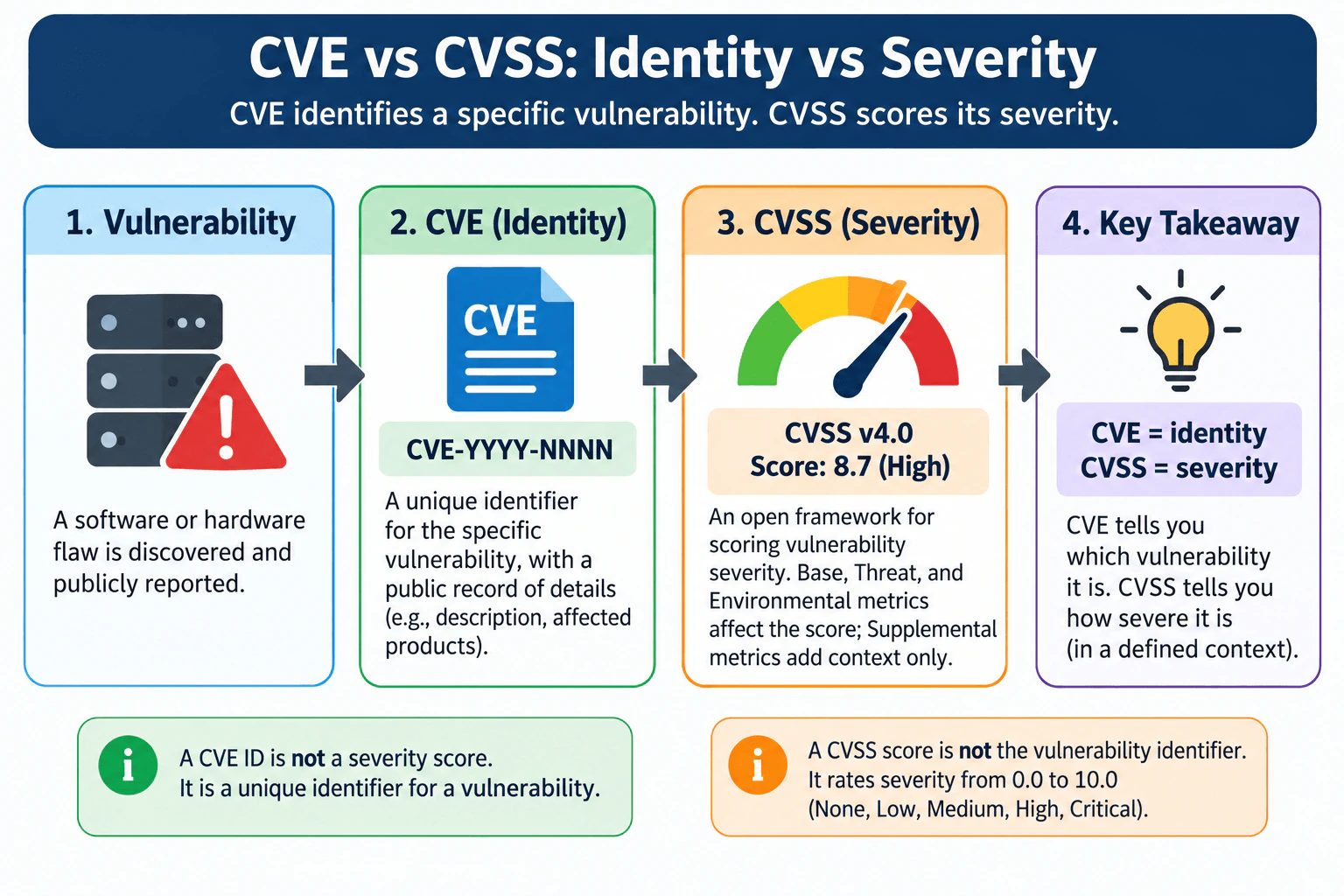
The practical distinction is simple: CVE is about identity, while CVSS is about severity. A CVE ID gives security teams a common identifier for a vulnerability represented in the CVE Program. CVSS is a separate scoring framework that evaluates technical characteristics and can produce a severity score from 0.0 to 10.0. The two are often used together, but they answer different questions. A CVE identifier does not itself tell you how severe a vulnerability is, and a CVSS score does not uniquely identify which vulnerability is being discussed.
Useful Questions to Ask the Interviewer
Do you want the basic distinction only, or should I also explain how CVSS v4.0 metrics work?
Should I explain how CVE and CVSS are used together when prioritizing remediation?
How to Explain It in an Interview
Start with the practical decision: use CVE when you need to identify and consistently reference a vulnerability, and use CVSS when you need a standardized assessment of its technical severity.
CVE stands for Common Vulnerabilities and Exposures. A CVE ID is a unique identifier assigned through the CVE Program. Its format contains the CVE prefix, a year, and four or more sequence digits. A simple generic example is "CVE-YYYY-NNNN." The identifier allows vendors, researchers, scanners, defenders, and vulnerability-management systems to refer to the same vulnerability consistently. A published CVE Record can also contain information such as a description and references. The identifier itself is not a severity score.
CVSS stands for Common Vulnerability Scoring System. It is an open framework for describing and scoring the technical severity of vulnerabilities. CVSS v4.0 uses a numeric range from 0.0 to 10.0. The qualitative ranges are None at 0.0, Low from 0.1 to 3.9, Medium from 4.0 to 6.9, High from 7.0 to 8.9, and Critical from 9.0 to 10.0. Therefore, the diagram's illustrative score of 8.7 is in the High range.
CVSS v4.0 contains four metric groups: Base, Threat, Environmental, and Supplemental. Base metrics represent intrinsic technical characteristics of the vulnerability. Threat metrics can adjust severity using current threat information. Environmental metrics refine severity for a particular computing environment. Supplemental metrics provide additional context but do not change the calculated CVSS score.
The diagram shows the relationship as one simple flow: a software or hardware flaw is discovered and publicly reported, a CVE identifier gives the vulnerability a common identity, and CVSS describes its technical severity. The final takeaway is therefore "CVE = identity" and "CVSS = severity."
There is an important responsibility boundary. CVE and CVSS describe the vulnerability and its severity; they do not by themselves prove that a specific organization's asset is vulnerable or determine its complete business risk. A security team still needs to verify the affected product and version and evaluate its own environment.
CVSS should therefore be one input to remediation prioritization rather than the only decision factor. Teams may also consider exposure, evidence of exploitation, asset criticality, compensating controls, business impact, threat activity, and remediation feasibility. For example, an actively exploited vulnerability on an Internet-facing critical service may deserve faster action than another vulnerability with a higher CVSS score but no meaningful exposure in that environment.
For validation, verify the CVE identifier and published record against the CVE Program or the relevant vendor advisory. For CVSS, verify the CVSS version, metric vector, and score against the authoritative scoring information or calculate the score from the stated metrics. If information is missing or inconsistent, do not infer severity merely from a CVE identifier and do not infer vulnerability identity from a CVSS score.
Practical Insights
There is little computational complexity to explain for this conceptual question. Operationally, CVE reduces confusion by giving teams a common vulnerability identifier, while CVSS provides a consistent severity method. The larger cost comes from human validation: teams must confirm that an asset is actually affected, check the correct CVSS version and vector, add environmental context, and avoid treating a numeric severity score as complete organizational risk.
Why Interviewers Ask This
Interviewers want to confirm that you understand the difference between vulnerability identification and vulnerability severity. Security teams often use CVE records and CVSS scores together, but they serve different purposes. Knowing the distinction also helps prevent the common mistake of treating a CVSS score as a complete measure of business risk.
Common interview mistakes
A common mistake is saying that CVE is a severity rating. CVE provides vulnerability identifiers and records, not severity scores. Another mistake is saying that CVSS identifies the vulnerability; different vulnerabilities can have the same CVSS score. Do not assume that the year in a CVE ID is necessarily the year the vulnerability was discovered. Also do not assume that the existence of a CVE proves a particular deployed asset is affected, or that the highest CVSS score automatically represents the highest business risk.
Interview tip
Lead with one sentence: "CVE identifies the vulnerability; CVSS rates its severity." Then briefly explain the CVE identifier, the 0.0-to-10.0 CVSS scale, and finish by noting that CVSS severity is only one input to real remediation prioritization.
Interviewer may ask next
Can two different CVEs have the same CVSS score?
Yes. CVE identifiers reference different vulnerabilities, while CVSS scores represent severity. Two unrelated vulnerabilities can receive the same CVSS score if their evaluated technical characteristics produce the same result. A CVSS score should therefore never be used as the identifier for a vulnerability.
Should a security team always remediate the vulnerability with the highest CVSS score first?
No. CVSS provides standardized technical severity, but remediation priority should also consider context such as exposure, evidence of exploitation, asset criticality, compensating controls, business impact, threat activity, and remediation feasibility. A lower-CVSS vulnerability that is actively exploited on an Internet-facing critical system can deserve attention before a higher-CVSS vulnerability that is unreachable or effectively mitigated.
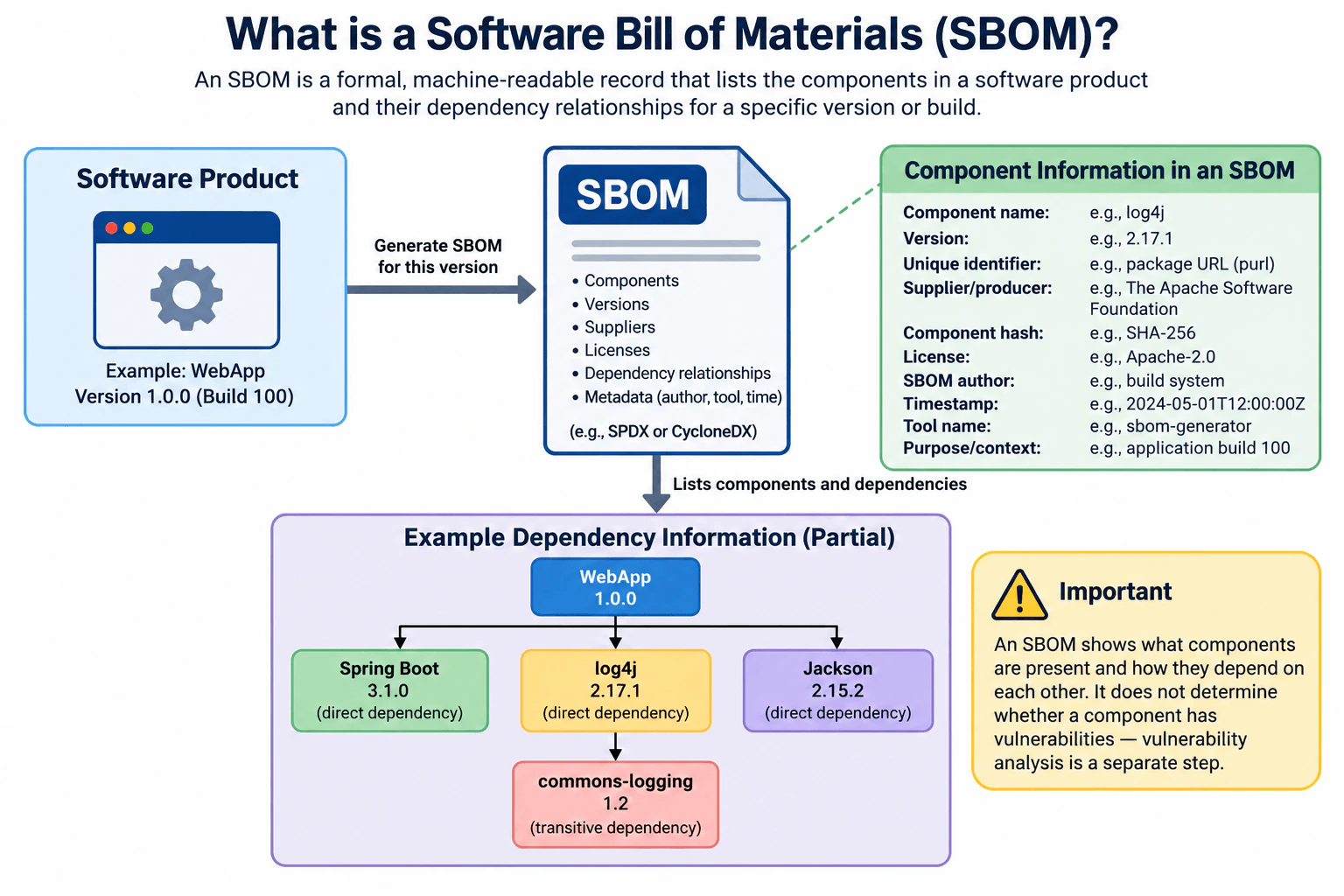
79. What is a software bill of materials?Vulnerability ManagementEasy
i Question Details
Describe the component and dependency information contained in an SBOM.
Short Interview Answer (30-60 seconds)
An SBOM is a machine-readable inventory of software components and their dependency relationships. It records information such as component names, versions, producers, identifiers, hashes, licenses, and metadata. Security teams can correlate that inventory with vulnerability data, but the SBOM itself does not prove exploitability.
Detailed Explanation
An SBOM answers two practical questions: what components are inside a specific software product or build, and how are those components related? It is a machine-processable inventory that lets teams identify both direct and indirect dependencies. Component records can include names, versions, producers or suppliers, software identifiers, hashes, and licenses. The SBOM also carries creation information such as its author, generation tool, timestamp, and generation context. This visibility supports vulnerability and supply-chain analysis, but an SBOM by itself does not determine whether a listed component is actually vulnerable or exploitable.
Useful Questions to Ask the Interviewer
Do you want me to focus only on the information contained in an SBOM, or also explain how vulnerability-management teams use it?
Should I explain the difference between direct and transitive dependencies?
Would you like examples of common machine-readable SBOM formats such as SPDX and CycloneDX?
How to Explain It in an Interview
Start with the software product or build. In the approved diagram, the example is WebApp version 1.0.0, build 100. The SBOM is generated for that particular software version so its inventory can be associated with the artifact being assessed.
Next, describe the component information. Current CISA minimum-element guidance includes fields such as SBOM author, software producer, component name, component version, software identifiers, component hash, license, dependency relationship, tool name, timestamp, and generation context. cisa.gov This is consistent with the diagram's component-information section, which shows a component name, version, unique identifier such as a package URL, supplier or producer, hash, license, SBOM author, timestamp, tool name, and purpose or context.
Then explain dependencies. A direct dependency is a component the application depends on directly. A transitive dependency is reached through another dependency. CycloneDX explicitly supports dependency graphs containing both direct and transitive relationships. cyclonedx.org The approved diagram illustrates WebApp with Spring Boot 3.1.0, log4j 2.17.1, and Jackson 2.15.2 as direct-dependency examples, and commons-logging 1.2 as a transitive-dependency example beneath log4j. Those package relationships should be treated as the diagram's teaching example rather than as a claim about the dependency graph of an actual production build.
The relationship information matters because a simple flat package list can hide how a component entered the software. A dependency graph lets an engineer trace from the application to a direct component and then to components introduced indirectly. SPDX also provides explicit relationship fields between software elements. spdx.github.io
For vulnerability management, keep the responsibility boundary clear. The SBOM establishes inventory and dependency evidence. A separate vulnerability-analysis process correlates those identifiers and versions with authoritative vulnerability records and supplier advisories, then evaluates whether the affected conditions apply. Therefore, finding a component in an SBOM is evidence of component presence, not proof that the application has an exploitable vulnerability.
Common SBOM formats include SPDX and CycloneDX. Both can represent component and relationship information, although their schemas and optional capabilities differ. CycloneDX, for example, can represent components, metadata, dependency relationships, and vulnerability information. cyclonedx.org The important interview point is not to memorize every field. Explain that the SBOM gives a version-specific, machine-processable view of software ingredients and their relationships.
The main limitation is completeness and freshness. If an SBOM misses a component, has an incomplete dependency graph, or belongs to an older build, a consumer may draw the wrong conclusion. CycloneDX guidance also distinguishes known dependency relationships from unknown or incomplete dependency information. cyclonedx.org Therefore, teams should keep SBOMs associated with the correct artifacts and regenerate or update them when the software changes.
Technical Approach
Identify the exact software product, version, or build the SBOM describes.
Inventory the software components contained in that artifact.
Record identifying information such as component name, version, producer or supplier, software identifier, hash, and license when applicable.
Record relationships between components, including direct and transitive dependencies.
Record SBOM metadata such as author, generation tool, timestamp, and generation context.
Validate that the inventory and dependency graph correspond to the intended software artifact.
For vulnerability management, correlate the SBOM with authoritative vulnerability and supplier-advisory data as a separate analysis step.
Practical Insights
The main cost of an SBOM is maintaining accurate data, not running a complicated algorithm. Generation is often automated during or around the software build, but teams still need to deal with missing metadata, indirect dependencies, changing versions, and incomplete dependency graphs. A richer SBOM gives better visibility but creates more information to validate and maintain. An outdated or incomplete SBOM can create false confidence because it may not describe the software that is actually deployed.
Why Interviewers Ask This
Interviewers want to know whether you understand an SBOM as both a component inventory and a dependency map. A strong answer explains the identifying information recorded for components, distinguishes direct from transitive dependencies, and recognizes the security limitation that an SBOM supports vulnerability analysis but does not by itself establish vulnerability or exploitability.
Common interview mistakes
One mistake is describing an SBOM as only a list of open-source packages; it can represent first-party and third-party components and their relationships. Another is ignoring transitive dependencies, which can hide components several levels below the application. A third mistake is treating component presence as proof of a vulnerability. The SBOM provides inventory evidence, while vulnerability status and exploitability require separate analysis. Finally, do not assume an SBOM stays correct after the software changes; it must remain associated with the correct product version or build.
Interview tip
Lead with one simple idea: an SBOM tells you what software components are present and how they depend on each other. Then mention a few identifying fields, explain direct versus transitive dependencies, and finish with the limitation that vulnerability determination is a separate correlation and validation step.
Interviewer may ask next
What is the difference between a direct and a transitive dependency in an SBOM?
A direct dependency is a component the application depends on directly. A transitive dependency is introduced through another dependency. For example, if application A depends on library B and library B depends on library C, B is a direct dependency of A and C is a transitive dependency of A. Recording these relationships helps teams trace components that are not obvious from the application's top-level dependencies.
Does finding a component associated with a vulnerability in an SBOM prove that the application is vulnerable?
No. The SBOM establishes that a component is present and can show how it is related to the application. The security team must still verify the affected version and conditions against authoritative advisories, determine whether the relevant vulnerable functionality is present or reachable when that matters, and evaluate exposure and other context. The SBOM improves visibility, but component presence alone does not establish exploitability.
80. What does an authenticated vulnerability scan do?Vulnerability ManagementEasy
i Question Details
Explain what authenticated scanner access changes about assessment depth and accuracy.
Short Interview Answer (30-60 seconds)
An authenticated vulnerability scan logs in to the target with authorized credentials and performs local checks. It can inspect software versions, patch levels, configurations, files, and services that may not be visible from the network, giving deeper coverage and generally more accurate results with fewer false positives.
Detailed Explanation
An authenticated vulnerability scan uses valid, authorized credentials to log in to a server, VM, or endpoint before performing vulnerability checks. This changes the assessment from mainly observing the system from the network to inspecting evidence inside the host. The scanner can examine the operating system, installed software, package versions, patch levels, configuration settings, local files, and running services. Because it can use direct evidence about the system's actual state, it usually gets deeper coverage, finds weaknesses that network-only scanning may miss, and produces more accurate results with fewer false positives.
Useful Questions to Ask the Interviewer
Are you asking about authenticated host scanning compared with a network-only vulnerability scan?
Should I explain how the scan account's permission level affects coverage?
Do you want me to cover what happens when authentication fails or the account lacks required privileges?
How to Explain It in an Interview
The practical decision is whether the scanner should assess the target only from the network or use authorized credentials to inspect the target from inside its authentication boundary. For an authenticated scan, the target must be explicitly authorized and in scope, and the scan account should have only the permissions needed for the approved checks.
The flow is simple:
Configure the vulnerability scanner with authorized credentials for the target.
Authenticate to the target server, VM, or endpoint through a supported mechanism such as SSH, WinRM, or SMB-based access.
After successful login, collect detailed host-local information such as operating-system details, installed software and package versions, patch levels, configuration settings, local files, and running services.
Run applicable vulnerability and configuration checks against that evidence.
Produce scan findings using the stronger local evidence.
This increases assessment depth because many important facts cannot be determined reliably from network responses alone. For example, a remotely visible service may not reveal enough information to determine its exact installed package or patch state. Authenticated access can let the scanner inspect that state directly.
Accuracy also improves because the scanner can base findings on what is actually installed and configured instead of depending only on remote fingerprinting or inference. That can expose missing patches and risky configurations that a network-only scan may not see, while also reducing false positives caused by uncertain identification.
The trust boundary is the target's authentication boundary. The scanner receives only the access granted to its scan account. Assessment depth therefore depends on the account's permissions. A more privileged account may enable additional local checks, while an account with insufficient permissions can leave parts of the system unassessed. Least privilege should still be used: the account should have the minimum access necessary for the approved assessment rather than unnecessary administrative access.
A key validation step is to confirm that authentication actually succeeded and that the expected local checks ran. Scan status, authentication results, and coverage information are important evidence. Without that confirmation, a report should not be assumed to represent a successful authenticated assessment.
The main failure case is unsuccessful or incomplete authentication. If credentials are invalid, the authentication service cannot be reached, or permissions are insufficient, some or all local checks may be skipped. The scanner may still perform network-visible checks, but the resulting coverage is reduced and should not be described as equivalent to a successful authenticated scan.
Authenticated scanning has limitations. A scanner finding is not automatically proof that a vulnerability is exploitable, and authenticated access does not guarantee complete coverage. Results still depend on scanner capabilities, permissions, reachable components, scan configuration, and the quality of the checks. Important findings may require separate validation before they are treated as verified vulnerabilities.
The main tradeoff is better visibility versus credential and privilege management. Authenticated scanning gives deeper and generally more reliable evidence, but the organization must securely provision, store, restrict, rotate, and revoke the scan credentials. Those credentials are sensitive because misuse of the account could create additional security risk.
Technical Approach
Confirm that the server, VM, or endpoint is authorized and in scope.
Configure a protected scan account with only the permissions needed for the planned checks.
Authenticate to the target through an approved supported mechanism.
Verify that authentication succeeded before treating the scan as credentialed.
Collect host-local evidence such as operating-system details, installed software, package versions, patch state, configurations, local files, and running services.
Run applicable vulnerability and configuration checks against that evidence.
Review the resulting scanner findings and separately validate important findings when necessary.
Record authentication or privilege failures because they reduce assessment coverage.
Protect, rotate, and revoke scan credentials according to the organization's credential-management process.
Practical Insights
Authenticated scanning needs more operational work than a network-only scan because credentials must be created, protected, given appropriate permissions, rotated, and eventually revoked. The scanner may also perform more checks and collect more local information, which can increase scan time and processing. The benefit is deeper visibility and stronger evidence. Human review is still needed for important findings because a scanner result alone does not prove exploitability or business risk. There is also a security cost: the scan account is sensitive access, so excessive privileges or poorly protected credentials create additional risk.
Why Interviewers Ask This
Interviewers want to know whether you understand why credentialed access changes vulnerability assessment depth and accuracy. A strong answer explains that the scanner crosses the target's authentication boundary with authorized credentials, gathers host-local evidence, performs checks within the permissions of the scan account, and therefore obtains deeper and generally more reliable results than a network-only assessment.
Common interview mistakes
A common mistake is saying that authenticated scanning simply scans more ports. Its main advantage is access to host-local evidence after successful login. Another mistake is claiming that authentication guarantees complete coverage; depth still depends on the scan account's permissions and whether authentication succeeds. Do not treat every scanner finding as a verified exploitable vulnerability. Also avoid giving the scan account unnecessary privileges or assuming that a scan was authenticated without checking authentication and coverage status.
Interview tip
Lead with the contrast: a network-only scan observes the system from outside, while an authenticated scan logs in and inspects its local state. Name examples such as installed software, patch levels, and configuration settings. Then explain that this improves depth and accuracy, while permissions, authentication success, and credential security remain important limitations.
Interviewer may ask next
Why can an authenticated scan be more accurate than an unauthenticated scan?
It can use direct host-local evidence instead of relying only on network observations or inference. After successful authentication, the scanner may inspect installed software, package versions, patch levels, configurations, local files, and running services. That stronger evidence can identify weaknesses that are not externally visible and reduce false positives caused by uncertain remote identification.
What happens if the scan credentials fail or do not have enough privileges?
Some or all local checks may not run, so assessment depth decreases. The scanner may still perform network-visible checks, but that result should not be treated as equivalent to a successful authenticated scan. The team should review authentication status and privilege-related failures before claiming authenticated coverage.
More questions load as you scroll
Disclaimer: This interview guide is for educational and informational purposes only. It is designed to help readers prepare, but it does not guarantee any interview result, hiring decision, offer, or outcome. Interview questions, hiring criteria, and preferred answers can vary by employer, interviewer, industry, location, and time. All answers, examples, and explanations in this guide are suggested examples for interview preparation, not definitive answers or instructions for professional practice. They are based on research and judgment, are provided without warranties of any kind, and should be adapted to the question, role, and applicable laws and professional requirements. Diagrams are simplified illustrations intended to highlight the main concepts and their relationships; actual situations, systems, and practices may be more complex. Alternative approaches may be equally valid or better suited to a particular question, context, or interviewer. To the fullest extent permitted by applicable law, the contributors and publisher are not liable for decisions made, actions taken, or losses incurred based on this guide.
State Laws and Professional Responsibilities: Laws and requirements governing an occupation vary by state and jurisdiction. You are responsible for checking the current laws, licensing requirements, and scope-of-practice rules that apply to your location and role, and for ensuring that your answers and actions comply with them. Adapt examples in this guide to those requirements. This guide is not legal advice.
Content Accuracy and Verification: To the fullest extent permitted by applicable law, we do not represent or warrant that interview guides, questions, answers, examples, or diagrams are accurate, complete, current, error-free, or suitable for any particular purpose. You are responsible for independently reviewing and verifying the information before relying on it.