11. What does STRIDE contribute to threat modeling?
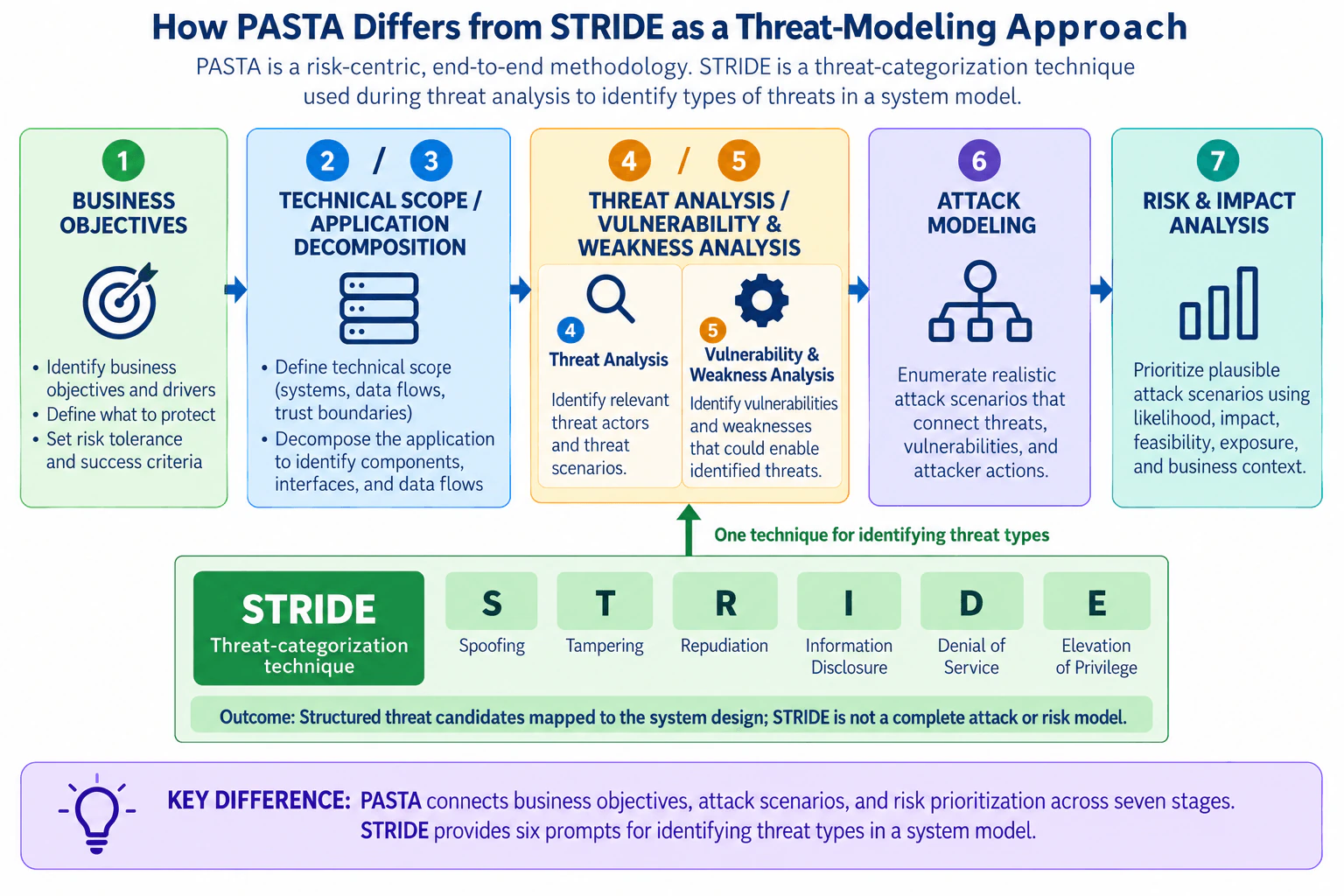
STRIDE gives threat modeling a systematic way to find and classify threats: Spoofing, Tampering, Repudiation, Information Disclosure, Denial of Service, and Elevation of Privilege. It improves coverage around system elements and trust boundaries, but separate risk analysis is still needed to prioritize and mitigate threats.
STRIDE contributes structure to threat identification. You first understand what is being protected, who interacts with it, how data moves, and where trust changes. Then STRIDE gives you six categories to systematically ask what could go wrong at relevant components, data flows, and trust-boundary crossings. The result is a set of candidate threats that can be assessed and mitigated. STRIDE does not tell you which threat matters most, prove the system is secure, identify every vulnerability, or replace business-context and residual-risk decisions.
- Are you asking only about what STRIDE contributes, or should I also explain how it fits into the wider threat-modeling process?
- Would you like a small example using an external user, an application, and a protected data store?
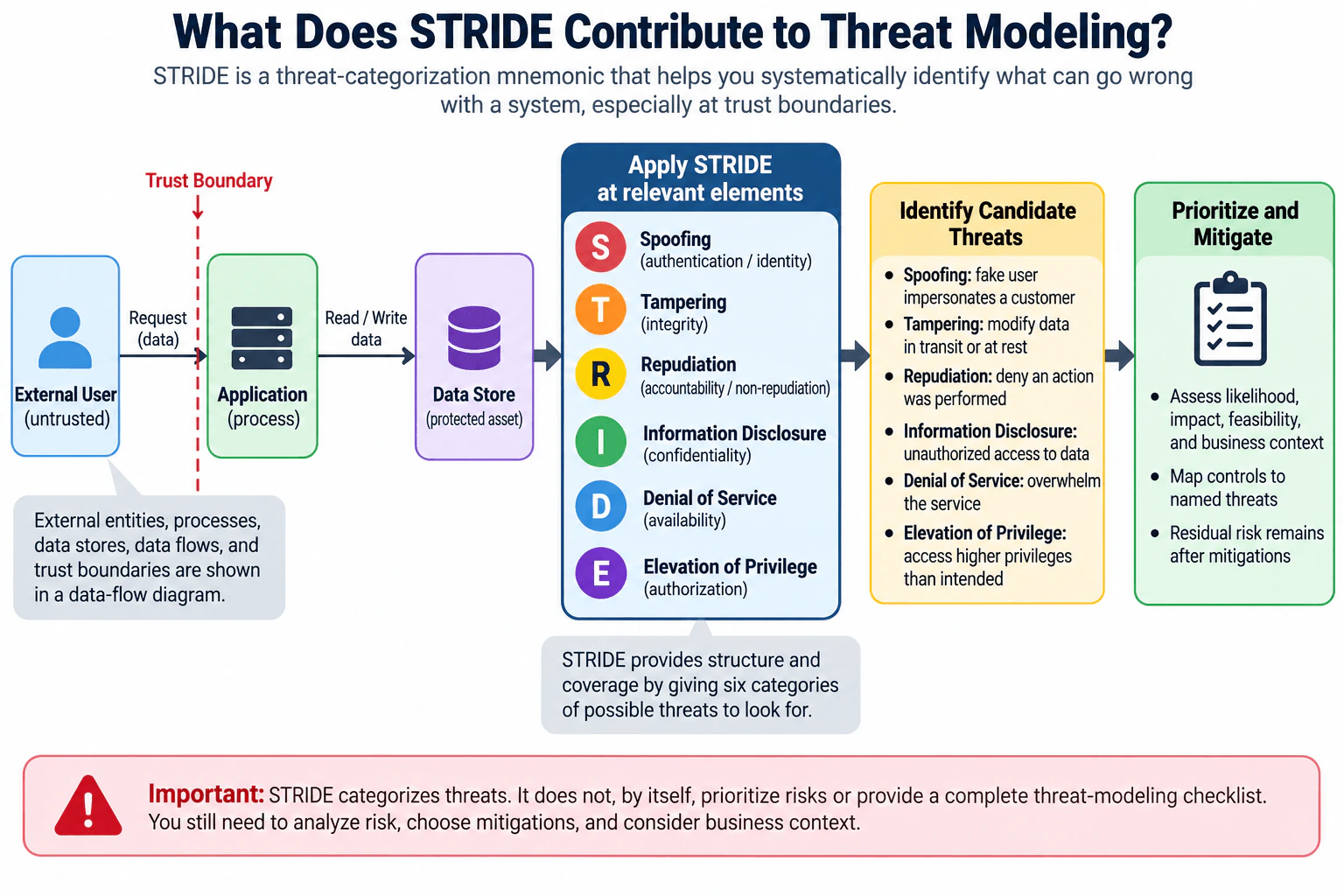
Start with the practical decision: STRIDE is mainly a structured threat-categorization technique. It helps a security engineer systematically identify candidate threats instead of relying only on intuition.
Using the diagram, the protected asset is the data in the data store and the service that processes it. The actor is an external user. The request crosses a trust boundary before reaching the application, and the application reads or writes the protected data store. The relevant security objectives are authentication or identity, integrity, accountability and non-repudiation, confidentiality, availability, and authorization. The external user is treated as untrusted. The diagram does not establish a specific vulnerability or detailed attacker capability, so I would not invent one; the only visible interaction capability is sending requests across the exposed trust boundary.
Then I would apply the six STRIDE categories where they are relevant:
- Spoofing concerns authentication and identity. A candidate threat is a fake user impersonating a legitimate customer.
- Tampering concerns integrity. A candidate threat is unauthorized modification of data in transit or at rest.
- Repudiation concerns accountability and non-repudiation. A candidate threat is someone denying that an action was performed when sufficient evidence is unavailable.
- Information Disclosure concerns confidentiality. A candidate threat is unauthorized access to protected information.
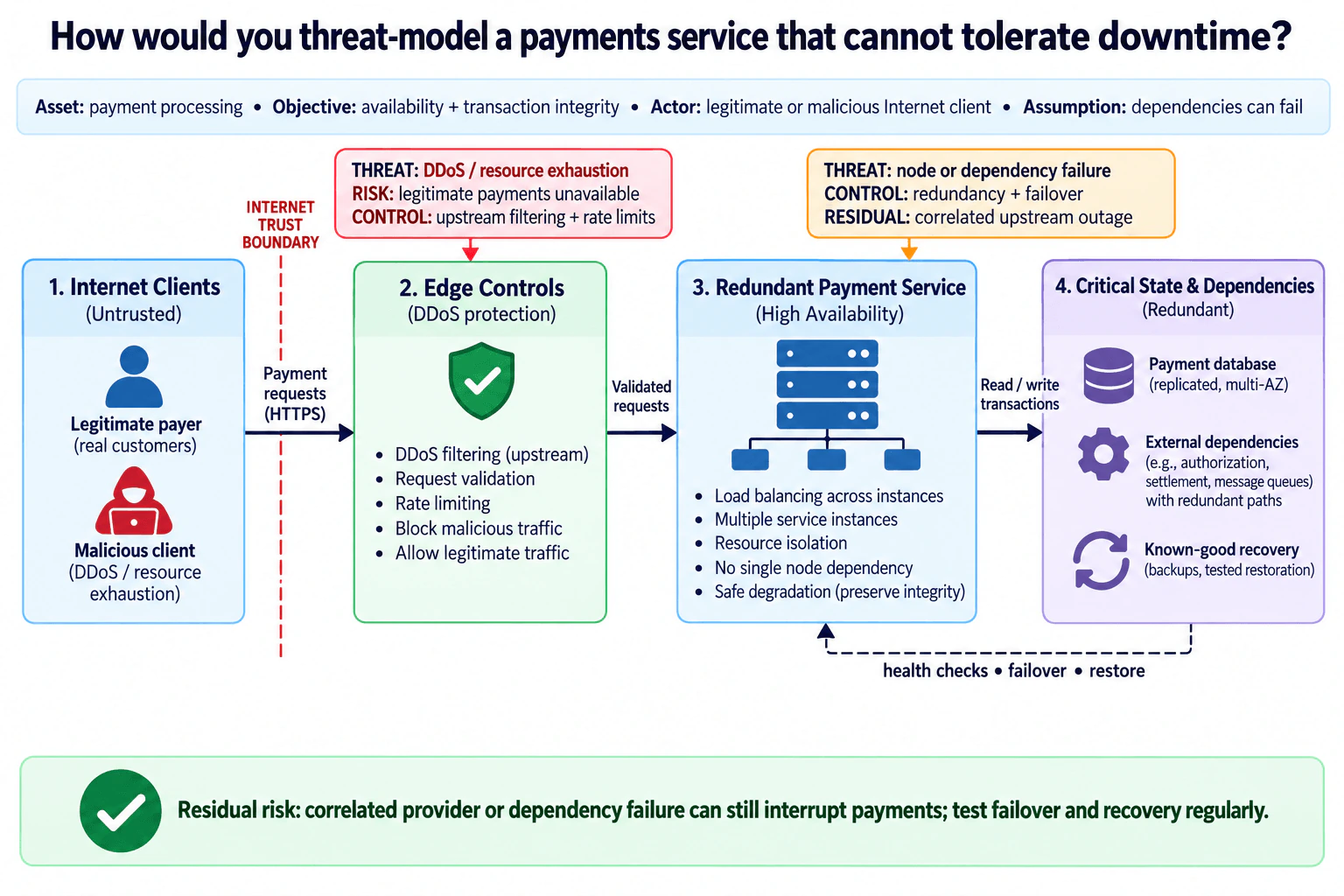
- Denial of Service concerns availability. A candidate threat is making the application or supporting service unavailable or unusable for legitimate users.
- Elevation of Privilege concerns authorization. A candidate threat is gaining permissions or capabilities beyond those intended.
The important contribution is structure and coverage. STRIDE gives the team six categories of possible threats to examine against relevant system elements and trust-boundary crossings. This helps uncover candidate threats that might otherwise be overlooked.
After identifying candidate threats, I would not treat every STRIDE item as equal risk. A threat is a potential cause of harm. A vulnerability is a weakness that could enable a threat. An exploit is a technique that takes advantage of a vulnerability. Risk reflects the significance of a threat in context, considering factors such as likelihood and impact. A control is a safeguard intended to reduce risk. Residual risk is what remains after controls are applied.
The next step is risk analysis. I would consider likelihood, impact, exposure, feasibility, uncertainty, and business context. Higher-priority threats receive attention first. Mitigations should be mapped to named threats or trust-boundary crossings rather than added as a generic checklist. For example, appropriate authentication can reduce a named spoofing threat, integrity protections can reduce a named tampering threat, and authorization controls can reduce a named elevation-of-privilege threat.
Validation means checking that the identified threats are documented, that each selected mitigation actually addresses the named threat, and that remaining risk is understood. Useful evidence can include the system diagram, threat records, control design, security tests, review results, and risk-acceptance decisions.
The main limitation is that STRIDE categorizes possible threats; it does not by itself rank them, prove that the threat model is complete, identify every vulnerability, or choose the best mitigation. The team still needs risk analysis, engineering judgment, testing, business context, and explicit residual-risk review. That is why STRIDE is best described as a structured input to threat modeling rather than the whole threat-modeling process.
- Define the protected asset, security objectives, actor, trust boundary, assumptions, and any known attacker capabilities without inventing unsupported details.
- Review the system elements, data flows, data stores, processes, external entities, and trust-boundary crossings.
- Apply the relevant STRIDE categories to those elements and crossings to identify candidate threats.
- Record each threat separately from any vulnerability or exploit that could enable it.
- Assess likelihood, impact, exposure, feasibility, uncertainty, and business context to prioritize risk.
- Map a specific mitigation to each important named threat or trust-boundary crossing.
- Validate the selected controls with documented evidence and safe testing.
- Record residual risk and revisit the model when components, data flows, assumptions, or trust boundaries change.
STRIDE itself is simple to learn, but applying it well takes engineering time. More components, data flows, and trust boundaries create more places to analyze. The main operational cost is reviewing relevant parts of the design, documenting useful threats, removing duplicates, prioritizing risks, designing controls, testing those controls, and revisiting the model when the architecture changes. Human judgment is still required because STRIDE does not calculate likelihood, business impact, or mitigation priority automatically. Using it as an exhaustive checklist can create unnecessary work, while applying it too narrowly can miss important threats.
Interviewers want to see whether you understand STRIDE as a threat-identification and categorization method rather than confusing it with the entire threat-modeling or risk-management process. A strong answer connects the six categories to system components, data flows, and trust boundaries, then explains that prioritization, mitigation decisions, validation, and residual-risk acceptance require additional analysis.
Common mistakes are treating STRIDE as a complete threat-modeling checklist, assuming every STRIDE category applies equally to every element, and confusing threats with vulnerabilities, exploits, or risks. Another mistake is listing the six categories without connecting them to actual system components, data flows, assets, or trust boundaries. Candidates may also claim that STRIDE automatically prioritizes threats or chooses mitigations; it does neither. Finally, adding controls without mapping them to a named threat makes it difficult to explain why the control is needed or what residual risk remains.
Lead with one sentence: STRIDE is a structured threat-identification and categorization method. Name the six categories, connect them to components, data flows, and trust boundaries, and then state the key limitation: STRIDE helps find threats, but separate risk analysis is needed to prioritize them, choose mitigations, validate controls, and accept residual risk.