192 Data Engineer Interview Questions & Answers

88 top • 15 Amazon • 15 Apple • 15 Google • 15 Meta • 15 Microsoft • 15 Netflix • 14 NVIDIA

Data Engineer icon

Questions with Detailed ExplanationsWith Detailed Explanations

(Last Updated: September 8, 2026)

51. Contrast Snowflake Time Travel with Fail-safe recovery.Reliability And Data QualityMedium

Question Details

Explain who initiates recovery, when each mechanism applies, and how transient tables differ.

Short Interview Answer (30-60 seconds)

Time Travel is customer-controlled recovery during the configured retention window using historical queries, cloning, or UNDROP. Fail-safe follows Time Travel for permanent tables, lasts seven days, and is a best-effort Snowflake recovery service. Transient tables have 0 or 1 day of Time Travel and no Fail-safe.

Detailed Explanation

Snowflake Time Travel and Fail-safe protect historical data at different stages of its lifecycle. Time Travel is the normal recovery mechanism available directly to authorized users while historical data remains within the object's retention period. Fail-safe applies afterward to historical data from permanent tables and is an exceptional, best-effort recovery service operated by Snowflake rather than a customer-accessible historical-query feature. The key interview distinction is control, timing, and table type: users perform Time Travel operations themselves, Snowflake handles Fail-safe recovery requests, and transient tables intentionally have no Fail-safe protection after their short Time Travel window expires.

Useful Questions to Ask the Interviewer
  1. Should I compare permanent and transient tables explicitly?
  2. Do you want me to include how Snowflake edition affects the maximum Time Travel retention period?
  3. Should I discuss the storage-cost and recoverability trade-off of transient tables?
How to Explain It in an Interview

Start with the recovery lifecycle. When data is modified or an eligible object is dropped, Snowflake can preserve historical state for the configured Time Travel retention period. While that historical state is still inside Time Travel, authorized users can directly perform supported Time Travel operations. These include querying historical table data, creating a clone from an earlier state, and using UNDROP for supported dropped objects. This makes Time Travel the normal first-line mechanism for investigating or recovering recent accidental changes.

After the Time Travel retention period ends, historical data for permanent tables transitions into Fail-safe. Fail-safe is separate from Time Travel and lasts for a non-configurable seven-day period. Customers cannot use Fail-safe as an extended historical-query window, cannot issue normal Time Travel queries against Fail-safe data, and cannot use CLONE or UNDROP to recover an object once its usable Time Travel history has expired. If an extreme failure requires recovery and other recovery options have been exhausted, the customer can contact Snowflake Support. Snowflake may be able to recover the data on a best-effort basis; recovery is not guaranteed.

Table type is an important part of the comparison. Permanent tables have a seven-day Fail-safe period after their Time Travel retention ends. Transient tables can have a Time Travel retention period of only 0 or 1 day and have no Fail-safe period. After the retained historical data for a transient table is gone, neither the customer nor Snowflake can recover it through Fail-safe. Therefore, transient tables are appropriate only when the data does not require Fail-safe protection or can be reconstructed independently.

Time Travel retention also depends on Snowflake edition and table type. For permanent tables in Standard Edition, the retention period is 0 or 1 day. With Enterprise Edition or higher, permanent-table retention can be configured from 0 through 90 days. Transient tables remain limited to 0 or 1 day. A retention setting of 0 effectively disables usable Time Travel for the object, although permanent-table historical data can still transition to Fail-safe through Snowflake's background processing.

For example, suppose a production permanent table is accidentally dropped. If it is still within Time Travel, an authorized user should use the supported Time Travel recovery mechanism, such as UNDROP, rather than depend on Fail-safe. If Time Travel is no longer available but the relevant historical data is still within the following Fail-safe period, the organization must contact Snowflake Support and recovery is best effort. If the same object were a transient table and its Time Travel window had expired, there would be no Fail-safe fallback.

The trade-off is protection versus storage cost and recoverability. Permanent tables are appropriate for important data that is difficult to reconstruct because they include Fail-safe protection. Transient tables avoid Fail-safe storage and can be useful for reproducible staging or intermediate data, but the team must explicitly accept that the historical data is unrecoverable through Snowflake after its Time Travel retention ends.

Technical Approach
  1. Identify whether the affected table is permanent or transient.
  2. Determine whether the required historical state is still within the table's effective Time Travel retention period.
  3. If it is, use the appropriate customer-controlled Time Travel operation, such as a historical query, clone, or UNDROP.
  4. If Time Travel has expired and the table is permanent, determine whether the historical data is still within the following seven-day Fail-safe period.
  5. If exceptional recovery is necessary and other options have been exhausted, contact Snowflake Support; understand that Fail-safe recovery is best effort rather than guaranteed.
  6. If the table is transient and Time Travel has expired, reconstruct the data from an independent source if one exists because Fail-safe is unavailable.
  7. Validate the recovered or reconstructed data before resuming normal downstream use.
Practical Insights

The main cost is storage rather than application CPU or memory. Snowflake must retain historical data changed or deleted during Time Travel, so longer retention can increase storage usage, particularly for high-churn tables. Permanent tables also retain historical data for the seven-day Fail-safe period. Transient tables avoid Fail-safe storage and have at most one day of Time Travel, reducing historical-storage overhead but also reducing recoverability. Time Travel is operationally simpler because authorized users can perform supported recovery operations themselves. Fail-safe involves escalation to Snowflake and should not be treated as a normal or guaranteed recovery workflow. Network and compute costs are usually secondary to the storage and operational implications for this comparison.

Why Interviewers Ask This

Interviewers want to see whether you understand Snowflake's recovery lifecycle instead of treating Time Travel and Fail-safe as interchangeable backup features. A strong answer distinguishes who performs recovery, when each mechanism applies, what operations are available, the best-effort nature of Fail-safe, and why transient tables trade additional recoverability for lower historical-storage overhead.

Common interview mistakes

A common mistake is describing Fail-safe as seven extra days of Time Travel. It is not: normal Time Travel querying, historical cloning, and UNDROP are not available once the relevant history has left Time Travel. Another mistake is claiming customers directly restore Fail-safe data with SQL; Snowflake operates Fail-safe recovery, and customers must contact Snowflake Support for exceptional recovery. Candidates also sometimes present Fail-safe recovery as guaranteed, although Snowflake describes it as best effort. Finally, transient tables have no Fail-safe period, and their Time Travel retention is limited to 0 or 1 day regardless of the longer retention available for permanent tables on higher Snowflake editions.

Interview tip

Explain the lifecycle in order: Time Travel first, then Fail-safe for permanent-table historical data. Emphasize three contrasts: customer-controlled versus Snowflake-operated recovery, retention-period timing, and permanent versus transient table protection. Mention that Fail-safe is best effort so you do not accidentally present it as a guaranteed backup.
Interviewer may ask next
What happens if a permanent table has DATA_RETENTION_TIME_IN_DAYS set to 0?

A value of 0 effectively disables usable Time Travel for the table, so a dropped table cannot be recovered with UNDROP through Time Travel. For a permanent table, modified or deleted historical data transitions toward Fail-safe through Snowflake's background processing, and the seven-day Fail-safe period still applies. Fail-safe remains a best-effort Snowflake recovery service rather than a customer-accessible restore command.

Why would a Data Engineer deliberately choose a transient table if it has no Fail-safe?

A transient table is appropriate when the data is temporary, reproducible, or recoverable from another authoritative source and the team wants to avoid Fail-safe storage overhead. It can retain 0 or 1 day of Time Travel but has no seven-day Fail-safe period. That makes it useful for some ETL staging or intermediate datasets, but inappropriate for unique business data that cannot be reconstructed after the Time Travel window expires.

52. How does dbt build differ from running models and tests separately?Reliability And Data QualityMedium

Question Details

Trace the effect of an error-severity upstream test on dependent models and contrast run, test, and build.

Short Interview Answer (30-60 seconds)

dbt run builds models without running tests, while dbt test validates resources that already exist without materializing the models. dbt build executes models and tests in DAG order. If an error-severity test on model_a fails, dependent model_b is skipped.

Detailed Explanation

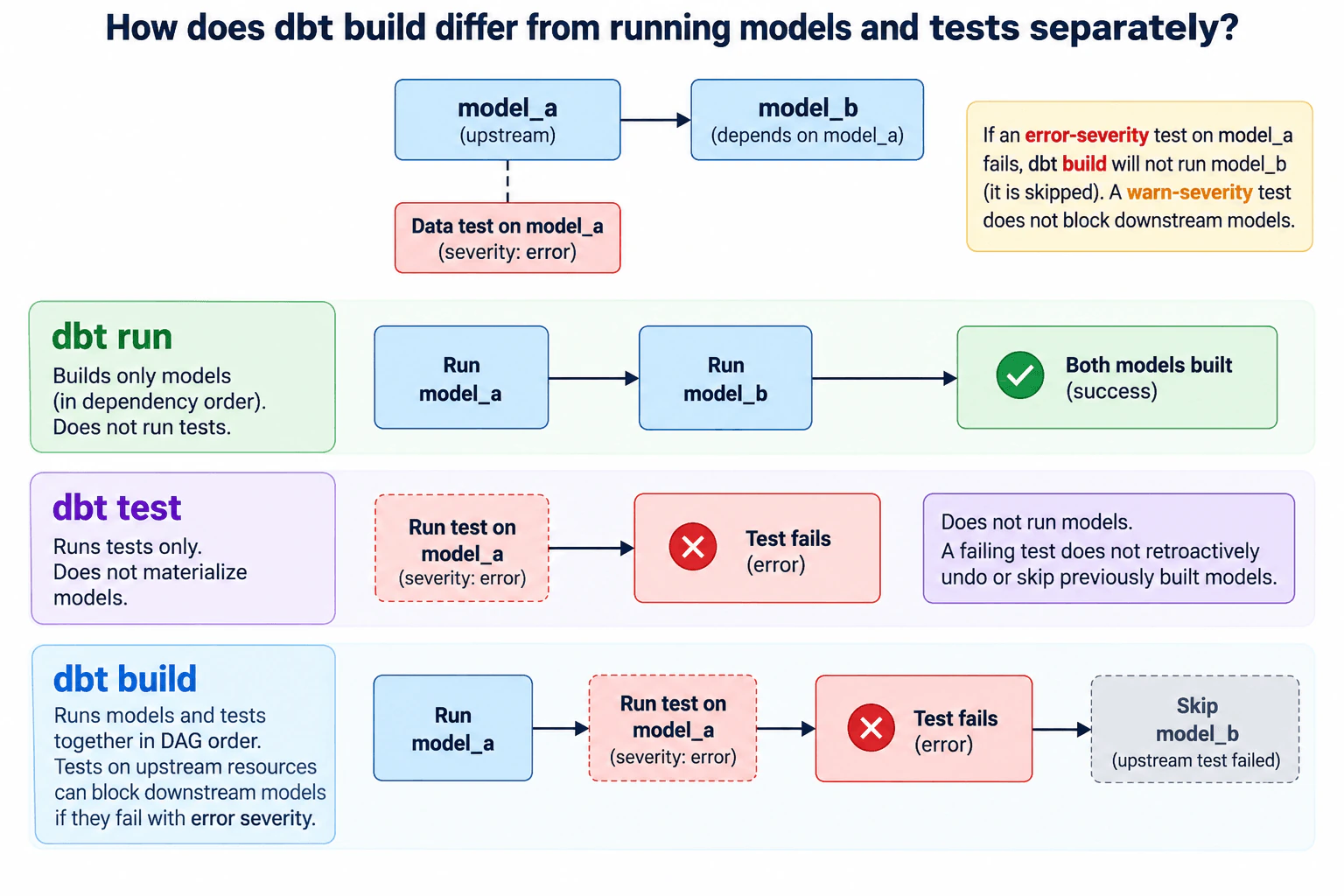
The key difference is whether tests participate in the dependency-aware execution path. dbt run materializes selected models in dependency order but does not run their tests. dbt test executes tests against resources that already exist and does not materialize those models. dbt build combines selected resources in DAG order, so tests can gate downstream execution. In the diagram, model_a is materialized first and its data test then fails with error severity. Because model_b depends on model_a, model_b is skipped. If that test is warn severity instead, the warning does not block model_b.

Useful Questions to Ask the Interviewer
  1. Should I focus specifically on data tests attached to an upstream model and their effect on downstream models?
  2. Do you want the comparison to emphasize execution order as well as what each command runs?
  3. Should I also explain how error severity differs from warn severity?
How does dbt build differ from running models and tests separately? diagram
How to Explain It in an Interview

Start with the dependency shown in the diagram: model_b depends on model_a.

With dbt run, dbt materializes model_a and then model_b according to the dependency graph. The command applies to models and does not execute their tests, so there is no test gate between model_a and model_b in this run path. In the diagram, both models build successfully.

With dbt test, dbt executes the selected tests against resources that already exist. It does not materialize the models first as part of that command. If the error-severity test on model_a fails during this separate testing step, that failure reports the data-quality problem, but it does not retroactively undo or skip model_b if model_b was already built by an earlier dbt run.

With dbt build, model execution and testing participate in the same DAG-aware operation. For the diagram's path, dbt first materializes model_a, then runs the data test on model_a. The test fails with severity error. Because model_b is downstream of that failed upstream test, dbt skips model_b rather than executing it.

That is the main operational advantage of dbt build for this scenario: the test becomes a quality gate in the dependency graph. Bad upstream results can stop affected downstream work before it is materialized.

Severity changes the behavior. An error-severity failure can cause affected downstream resources to skip during dbt build. A warn-severity result records the warning without applying that blocking behavior, so model_b can still run.

The trade-off is that dbt build introduces validation work into the DAG before downstream execution, which adds test-query compute and latency. In return, it can avoid building downstream models from an upstream model that failed a blocking test. Running dbt run and dbt test separately gives independent control over execution and validation, but it does not provide the same in-DAG quality gate for models already built during the separate run.

Technical Approach
  1. Identify the DAG dependency: model_b depends on model_a.
  2. For dbt run, materialize model_a and then model_b; tests are not executed by this command.
  3. For dbt test, execute the selected tests against resources that already exist; do not materialize the models as part of the command.
  4. For dbt build, execute the selected resources in DAG order: materialize model_a, then run its data test before dependent model_b proceeds.
  5. If the model_a test fails with severity error, record the failed test and skip model_b.
  6. If the same test produces warn severity instead, record the warning and allow model_b to run.
Practical Insights

There is no meaningful Big-O algorithm analysis here. The important costs are warehouse compute, latency, and operations. dbt run spends compute on model SQL. dbt test spends compute on test queries against existing resources. dbt build performs the relevant model and test work in one DAG-aware operation, so tests can add latency before downstream models run. That extra validation can save downstream compute when an upstream error-severity test fails because affected dependent models are skipped. Memory, storage, and network costs depend on the warehouse, materializations, and test queries rather than on the dbt command name itself.

Why Interviewers Ask This

This question checks whether you understand the execution boundaries of dbt run, dbt test, and dbt build, especially how dependency-aware testing changes downstream behavior. A strong answer should explain why an error-severity upstream test can prevent a dependent model from running during dbt build while a separately executed test cannot retroactively stop a model that has already been built.

Common interview mistakes

A common mistake is describing dbt build as simply dbt run followed by dbt test. That misses the DAG-aware execution behavior that allows an upstream failed test to block affected downstream resources. Another mistake is saying dbt run executes tests; it applies to models and does not run those tests. It is also incorrect to say dbt test materializes the models it tests. Finally, do not say every non-passing test blocks downstream execution: the diagram specifically distinguishes an error-severity failure, which blocks model_b, from warn severity, which does not.

Interview tip

Use the diagram's tiny DAG: model_a -> model_b. Explain that run builds the models without tests, test validates resources that already exist, and build materializes model_a, tests it, and skips model_b when the upstream test fails with error severity.

Interviewer may ask next
What happens if the upstream test uses warn severity instead of error severity?

The test result is treated as a warning rather than a blocking error. In this diagram's dbt build flow, dependent model_b is not skipped because of that warning, so it can still run. Warn severity provides visibility into the test issue without applying the downstream blocking behavior of an error-severity failure.

Why might a team prefer dbt build over running dbt run and dbt test as separate commands?

dbt build makes the test part of the dependency-aware execution path. After model_a is materialized, its test can run before dependent model_b executes. If that upstream test fails with error severity, model_b is skipped. With a separate dbt run followed by dbt test, model_b may already have been materialized before the test failure is discovered, so the test cannot provide the same in-run downstream gate.

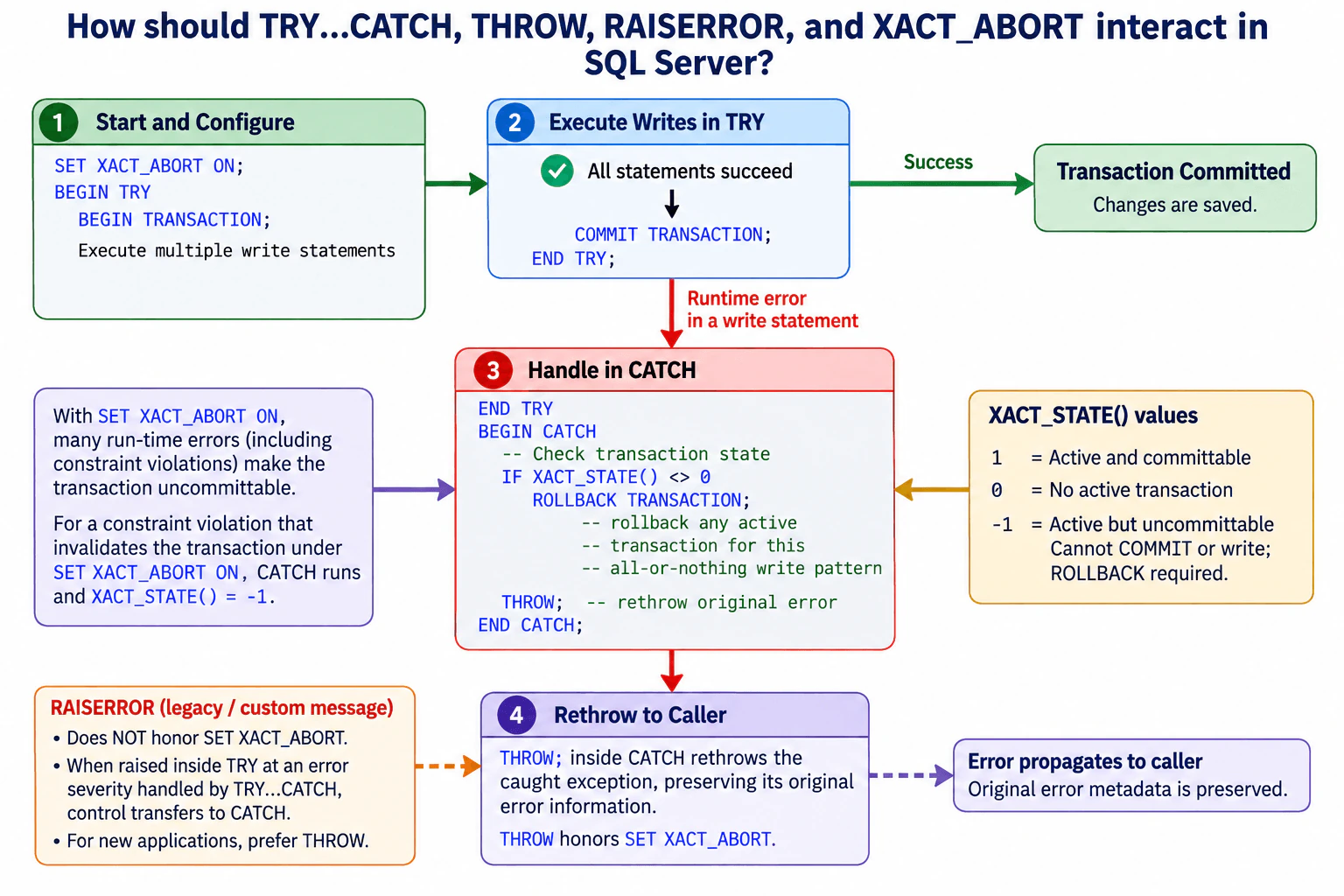
53. How should TRY...CATCH, THROW, RAISERROR, and XACT_ABORT interact in SQL Server?Reliability And Data QualityMedium

Question Details

Explain error propagation and transaction-state handling after a multi-statement write fails.

Short Interview Answer (30-60 seconds)

Use SET XACT_ABORT ON with TRY...CATCH for an all-or-nothing multi-statement write. Commit only on complete success. In CATCH, check XACT_STATE(), roll back any active transaction, then use THROW; to preserve and propagate the caught error. Prefer THROW because RAISERROR does not honor XACT_ABORT.

Detailed Explanation

The goal is to make a multi-statement write behave as one all-or-nothing unit while still returning useful error information to the caller. Put the transaction inside TRY with SET XACT_ABORT ON. If every write succeeds, COMMIT. If a run-time error transfers control to CATCH, inspect XACT_STATE() before deciding what transaction cleanup is possible. For this pattern, roll back any remaining active transaction, then use parameterless THROW; to propagate the caught exception. RAISERROR can participate in TRY...CATCH error handling, but it does not honor SET XACT_ABORT.

Useful Questions to Ask the Interviewer
  1. Should these writes be strictly all-or-nothing, with no partial commit allowed?
  2. Should the original SQL Server error be propagated unchanged to the caller?
  3. Is the existing code required to keep RAISERROR for legacy compatibility, or can it use THROW?
How should TRY...CATCH, THROW, RAISERROR, and XACT_ABORT interact in SQL Server? diagram
How to Explain It in an Interview

Start with SET XACT_ABORT ON, enter TRY, begin the transaction, execute the related write statements, and commit only after every statement succeeds. That makes the success path simple: all writes complete, then the transaction is committed.

If a run-time error is handled by TRY...CATCH, control moves into CATCH. At that point, inspect XACT_STATE(). A return value of 1 means there is an active transaction and it is committable. A value of 0 means there is no active transaction. A value of -1 means there is an active but uncommittable transaction: it cannot be committed or perform further writes and requires a full rollback.

For the all-or-nothing write pattern shown in the diagram, the CATCH block uses IF XACT_STATE() <> 0 and executes ROLLBACK TRANSACTION. This deliberately rolls back any still-active transaction instead of attempting to continue or partially commit after one of the coordinated writes has failed. For a constraint violation that invalidates the transaction under SET XACT_ABORT ON, the transaction can be in the -1 state, so COMMIT is not allowed and rollback is required.

After transaction cleanup, use THROW; with no parameters inside the CATCH block. Parameterless THROW; rethrows the caught exception, so the original error information is propagated to the calling batch, procedure, or application instead of being silently swallowed.

RAISERROR is different. It can generate an error and, when raised inside TRY at a severity handled by TRY...CATCH, can transfer control to CATCH. However, RAISERROR does not honor SET XACT_ABORT. THROW does honor SET XACT_ABORT, so for new application code THROW is the preferred choice when using this transaction pattern.

The core flow is therefore: success leads to COMMIT; a handled write failure leads to CATCH; CATCH checks transaction state and rolls back any active transaction for the all-or-nothing policy; then THROW; propagates the original failure to the caller.

Technical Approach
  1. Execute SET XACT_ABORT ON before the transactional work.
  2. Enter TRY and begin the transaction.
  3. Execute all related write statements.
  4. Commit only if every statement succeeds.
  5. If an error transfers control to CATCH, evaluate XACT_STATE().
  6. For this all-or-nothing pattern, if XACT_STATE() <> 0, execute a full ROLLBACK TRANSACTION.
  7. Use parameterless THROW; inside CATCH to rethrow the caught exception.
  8. Prefer THROW over RAISERROR in new code because THROW honors SET XACT_ABORT while RAISERROR does not.
Practical Insights

The error-handling logic itself adds very little CPU or memory work. The important costs come from the transaction. A longer multi-statement transaction can hold locks longer, increase transaction-log usage, delay competing work, and make rollback more expensive if many changes have already occurred. THROW or RAISERROR adds negligible data or network cost compared with the writes. Operationally, predictable rollback and error propagation reduce the risk and maintenance cost of recovering from partial writes.

Why Interviewers Ask This

This question tests whether a candidate understands SQL Server error propagation, explicit transaction boundaries, committable versus uncommittable transaction states, and the difference between THROW and RAISERROR. It also tests whether the candidate can prevent partial multi-statement writes, clean up a failed transaction safely, and propagate the original failure back to the caller.

Common interview mistakes

Common mistakes include committing inside CATCH without considering transaction state, assuming every caught error always produces XACT_STATE() = -1, forgetting to roll back an active transaction after an all-or-nothing write fails, swallowing the original error after cleanup, replacing THROW; with a new error and losing the caught exception's original information, and assuming RAISERROR honors SET XACT_ABORT. Another mistake is saying that nothing can run when XACT_STATE() = -1: SQL Server prohibits commit and writes, but reads can still occur until the transaction is rolled back.

Interview tip

Explain the answer as two paths. On success, commit. On failure, enter CATCH, inspect XACT_STATE(), roll back any active transaction for the all-or-nothing policy, and rethrow with THROW;. Then explicitly contrast THROW with RAISERROR: THROW honors SET XACT_ABORT, while RAISERROR does not.

Interviewer may ask next
What do the three XACT_STATE() return values mean in SQL Server?

XACT_STATE() returns 1 when there is an active and committable user transaction, 0 when there is no active user transaction, and -1 when there is an active but uncommittable transaction. In the -1 state, the transaction cannot be committed and cannot perform further writes; a full rollback is required. Reads are still possible until that rollback occurs. In this all-or-nothing pattern, CATCH rolls back whenever XACT_STATE() <> 0.

Why use THROW instead of RAISERROR after rolling back in CATCH?

Parameterless THROW; inside CATCH rethrows the caught exception and preserves its original error information. THROW also honors SET XACT_ABORT. RAISERROR can generate errors and can transfer control to CATCH when raised with a severity handled by TRY...CATCH, but RAISERROR does not honor SET XACT_ABORT. For new code, THROW therefore fits this transaction pattern more consistently.

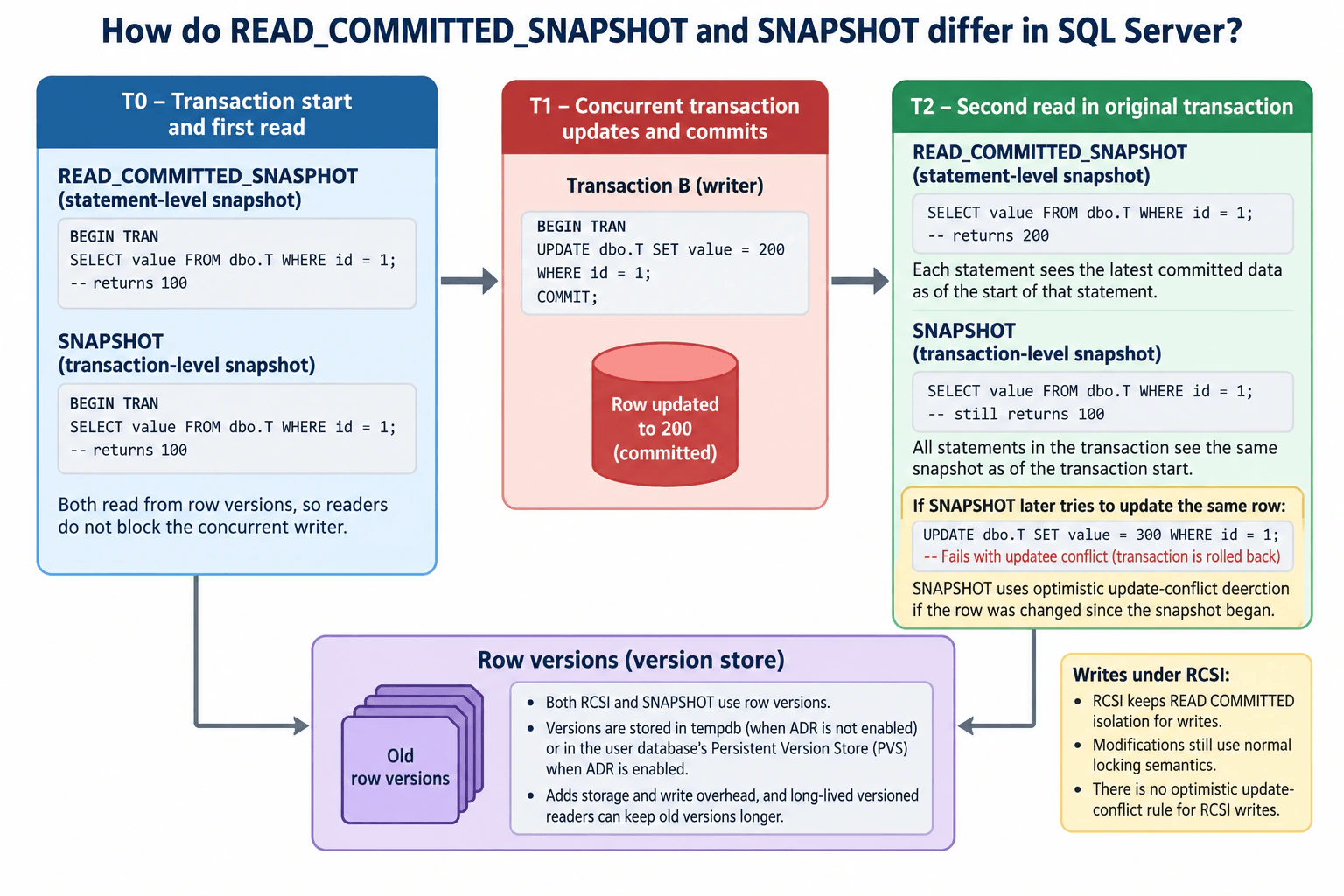
54. How do READ_COMMITTED_SNAPSHOT and SNAPSHOT differ in SQL Server?Reliability And Data QualityMedium

Question Details

Address visibility across successive statements, concurrent updates, and version-storage overhead.

Short Interview Answer (30-60 seconds)

READ_COMMITTED_SNAPSHOT gives each statement its own committed snapshot, so a later statement can see a newer commit. SNAPSHOT keeps one transaction-level view, so later statements continue seeing the older value. Both use row versions, while SNAPSHOT also performs optimistic update-conflict detection.

Detailed Explanation

READ_COMMITTED_SNAPSHOT, or RCSI, changes READ COMMITTED reads to use row versions at the statement level. SNAPSHOT uses a transaction-level versioned view. In the diagram, Transaction A first reads value 100. Transaction B then updates the same row to 200 and commits. A later RCSI statement sees 200 because that statement starts after the commit, while the SNAPSHOT transaction still sees 100. Both reduce ordinary reader-writer blocking through row versioning, but SNAPSHOT can reject a conflicting update, and both add row-version storage and write overhead.

Useful Questions to Ask the Interviewer
  1. Are we comparing only read visibility, or should I also explain what happens if the original transaction later updates the same row?
  2. Should I include the operational effect of long-running versioned transactions on version-store retention?
How do READ_COMMITTED_SNAPSHOT and SNAPSHOT differ in SQL Server? diagram
How to Explain It in an Interview

Start with the visibility boundary. With READ_COMMITTED_SNAPSHOT enabled, a transaction using READ COMMITTED gets a transactionally consistent row-versioned view for each statement as of that statement's start. Therefore, successive statements in the same transaction can observe different committed values. In the diagram, Transaction A first reads 100. Transaction B then updates the row to 200 and commits. Because the second RCSI SELECT starts after that commit, it returns 200.

SNAPSHOT instead provides transaction-level consistency. In the diagram, Transaction A's transaction snapshot contains the value 100. After Transaction B commits 200, a later SELECT in that same SNAPSHOT transaction still returns 100. Changes committed by other transactions after the SNAPSHOT transaction's snapshot began are not visible to that transaction's later statements.

For ordinary reads, both mechanisms use row versions, so readers do not need shared locks to protect the data from concurrent updates in this example. The important write difference is that SNAPSHOT uses optimistic update-conflict detection. If Transaction A later tries to update the same row that Transaction B changed after A's snapshot began, SQL Server aborts the SNAPSHOT transaction with an update conflict. RCSI does not add that SNAPSHOT optimistic-conflict rule; modifications continue under READ COMMITTED locking semantics.

Both mechanisms have version-storage cost. SQL Server must retain prior row versions that active versioned transactions may still need. When Accelerated Database Recovery is not enabled, these row versions are stored in tempdb. When ADR is enabled, they are stored in the user database's Persistent Version Store. Maintaining versions adds write and storage overhead, and long-running versioned transactions can keep older versions longer and increase version-store space.

The interview takeaway is: RCSI gives statement-level consistency, while SNAPSHOT gives transaction-level consistency plus optimistic update-conflict detection. The choice depends on whether successive statements must share one stable view and whether the workload can handle SNAPSHOT update conflicts and row-version retention.

Technical Approach
  1. Identify the visibility boundary: each statement for RCSI versus the transaction snapshot for SNAPSHOT.
  2. Start with the row value 100 and let Transaction A read it.
  3. Let concurrent Transaction B update that row to 200 and commit.
  4. Run the second read: RCSI returns 200 because the new statement starts after the commit; SNAPSHOT still returns 100 from its transaction snapshot.
  5. Compare writes: SNAPSHOT can abort with an update conflict if Transaction A tries to modify the row changed after its snapshot began, while RCSI modifications use READ COMMITTED locking semantics.
  6. Account for row-version storage and the impact of long-running versioned transactions.
Practical Insights

There is no useful Big-O complexity comparison here. The important costs are database and operational costs. Both RCSI and SNAPSHOT require SQL Server to generate and retain row versions, adding write work and storage use. Versions are stored in tempdb when ADR is not enabled or in the user database's Persistent Version Store when ADR is enabled. Long-running versioned transactions can keep older versions alive longer, increasing version-store space. The benefit is reduced ordinary reader-writer blocking. SNAPSHOT also introduces update-conflict failures that applications or pipelines must be prepared to retry or otherwise handle.

Why Interviewers Ask This

This question tests whether you understand SQL Server row-versioning semantics well enough to reason about visibility across successive statements, reader-writer concurrency, conflicting updates, and version-store overhead. For a Data Engineer, those trade-offs matter when long-running queries or pipelines read tables while other transactions continue modifying them.

Common interview mistakes

Common mistakes are saying RCSI and SNAPSHOT provide the same visibility, claiming an RCSI transaction always sees one fixed snapshot, or saying a SNAPSHOT transaction sees commits made after its transaction snapshot began. Another mistake is ignoring writes: SNAPSHOT can abort with an update conflict when the transaction tries to modify a row another transaction changed after the snapshot began, while RCSI does not use that SNAPSHOT optimistic-conflict rule. It is also incorrect to treat row versioning as free; both approaches add version-storage and write overhead, and long-running versioned transactions can retain older versions longer.

Interview tip

Use the diagram's simple timeline: first read 100, concurrent transaction commits 200, then say, 'RCSI sees 200 on the next statement; SNAPSHOT still sees 100 for the transaction.' Finish by mentioning SNAPSHOT update conflicts and the shared row-version storage cost.

Interviewer may ask next
What happens if the SNAPSHOT transaction tries to update the row after another transaction has already changed it?

SQL Server uses optimistic update-conflict detection for SNAPSHOT. In the diagram, Transaction B changes the row from 100 to 200 and commits. If Transaction A, which is still operating from its earlier snapshot, then tries to update that same row, SQL Server aborts the SNAPSHOT transaction with an update conflict rather than allowing it to overwrite the concurrent change.

What is the main operational trade-off of using row-versioned isolation for long-running Data Engineer queries?

Readers can avoid much of the ordinary reader-writer blocking, but SQL Server must retain older row versions while active versioned transactions can still need them. Long-running RCSI or SNAPSHOT transactions can therefore increase version-store retention and storage use. The versions are stored in tempdb when ADR is not enabled or in the user database's Persistent Version Store when ADR is enabled.

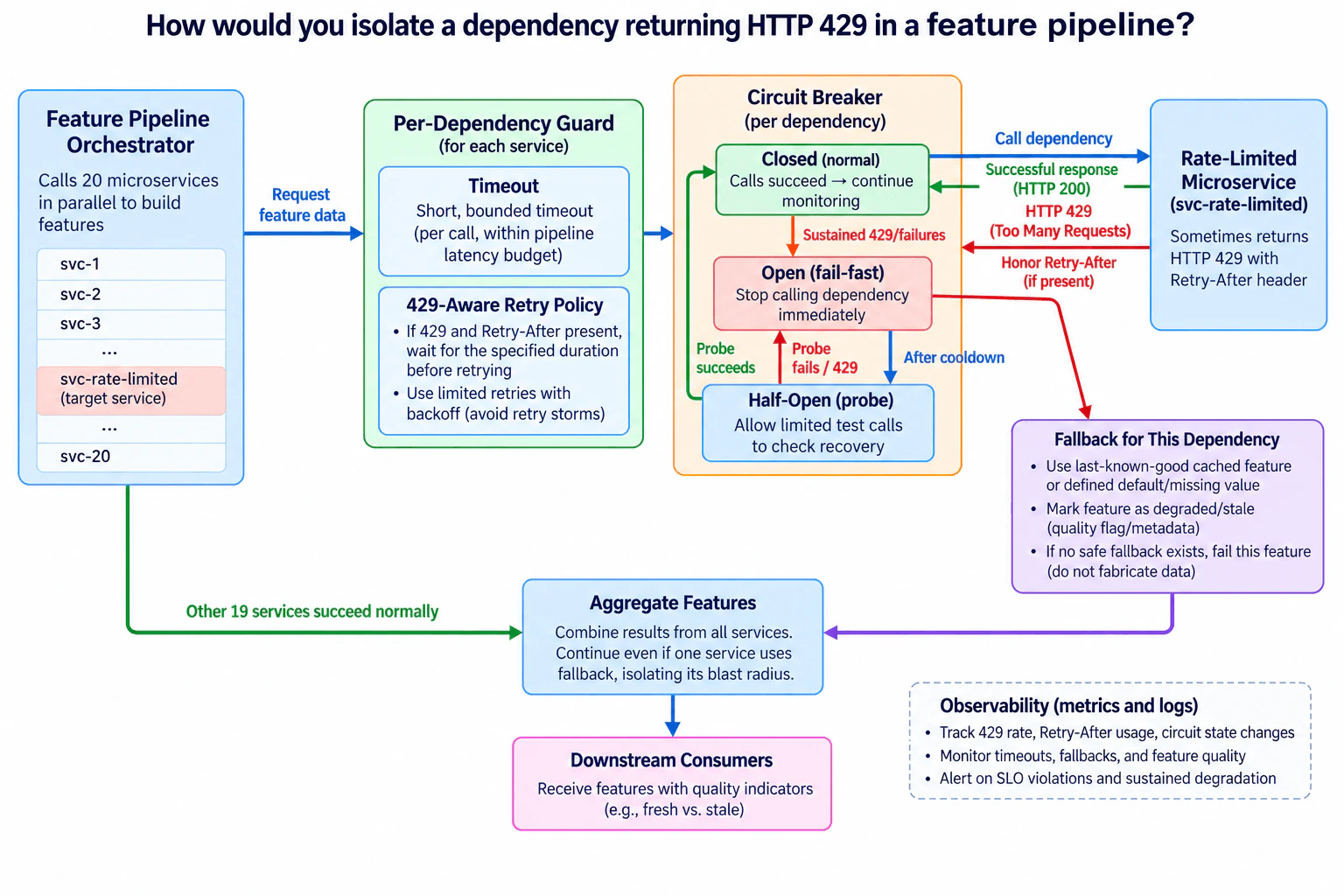
55. How would you isolate a dependency returning HTTP 429 in a feature pipeline?Reliability And Data QualityHard

Question Details

The pipeline contacts twenty microservices. Choose circuit-breaker, timeout, and fallback behavior while limiting SLO violations and feature-quality regressions.

Short Interview Answer (30-60 seconds)

I would isolate each dependency with a bounded timeout, limited 429-aware retries, and its own circuit breaker. When it opens, fail fast and use a safe cached or default feature with quality metadata. Keep the other services running, then probe recovery after cooldown while monitoring SLO and feature-quality impact.

Detailed Explanation

The main risk is letting one rate-limited microservice consume the feature pipeline's latency budget or degrade every downstream result. I would isolate each of the twenty dependencies so one HTTP 429 response affects only its own feature path. The contract is simple: calls have bounded latency, retries are limited, rate-limit guidance is respected, and unavailable features are replaced only by an approved fallback. The pipeline continues with the other nineteen services while clearly marking stale, degraded, or missing feature values for downstream consumers and monitoring both reliability and feature-quality impact.

Useful Questions to Ask the Interviewer
  1. Is a last-known-good cached value acceptable for this feature, or must the feature become explicitly missing when the service is unavailable?
  2. How much of the pipeline latency budget can one dependency consume before we must fail fast?
  3. Are some features critical enough that the pipeline should fail instead of serving a degraded result?
  4. Do downstream consumers already understand freshness or degradation metadata on individual features?
  5. What SLO and feature-quality signals determine whether degradation is acceptable during a dependency outage?
How would you isolate a dependency returning HTTP 429 in a feature pipeline? diagram
How to Explain It in an Interview

I would put a separate resilience guard around every microservice call rather than sharing one breaker across all twenty services. For the affected dependency, the call gets a short, bounded timeout that stays inside the overall pipeline latency budget. A slow or unresponsive dependency therefore cannot hold the whole feature assembly open indefinitely.

For HTTP 429, I would treat it as a transient rate-limit response. If Retry-After is present, I would honor that server guidance before retrying. Retries must remain limited and use backoff so the pipeline does not create a retry storm that increases load on an already rate-limited service.

The dependency also has its own circuit breaker. In Closed state, requests flow normally to that service. Sustained 429s or other configured failures move only that dependency to Open. Open means fail fast: the pipeline stops calling that dependency immediately instead of repeatedly spending request capacity and latency budget on it. After the cooldown, the breaker enters Half-Open and allows limited probe calls. A successful probe moves the breaker back to Closed. A probe that fails or returns another 429 moves it back to Open.

When the dependency cannot provide a usable value, I would invoke its feature-specific fallback. The preferred fallback is a last-known-good cached feature when staleness is acceptable. Otherwise I would use an explicitly defined default or missing value. In either case, the feature carries quality metadata such as degraded or stale. If there is no safe fallback, I would fail that feature rather than fabricate data.

The other nineteen services continue normally. Their successful results and the affected dependency's fallback are combined in the feature-aggregation stage. That limits the blast radius to one dependency instead of failing the complete feature pipeline. Downstream consumers receive the resulting features together with quality indicators, such as fresh versus stale, so they can distinguish degraded data from normal data.

Operationally, I would monitor the 429 rate, Retry-After usage, timeout frequency, circuit-breaker state changes, fallback usage, feature-quality signals, and SLO violations. Alerts should focus on sustained degradation or SLO impact. The key trade-off is that shorter timeouts and earlier fail-fast behavior protect latency but can increase fallback use, while longer waits and more retries may preserve fresh values but increase pipeline latency and pressure on the rate-limited dependency.

Technical Approach
  1. Give each of the twenty microservices an independent resilience boundary so one dependency cannot cascade into the others.
  2. Apply a short, bounded timeout to each call and keep it inside the feature pipeline's latency budget.
  3. When the target service returns HTTP 429, honor Retry-After when present and allow only limited retries with backoff.
  4. Track sustained 429s or other configured failures in that dependency's circuit breaker. Keep normal calls in Closed state and move to Open when the breaker policy is met.
  5. While Open, stop calling that dependency and fail fast into its fallback path.
  6. Use a last-known-good cached feature or an explicitly defined default or missing value. Mark the result degraded or stale. If no safe fallback exists, fail that feature instead of inventing data.
  7. Continue processing the other nineteen services and aggregate their results with the affected feature's fallback state.
  8. After cooldown, move the breaker to Half-Open and allow limited probe calls. A successful probe returns the breaker to Closed; a failed or 429 probe returns it to Open.
  9. Deliver feature-quality indicators downstream and monitor 429 rate, Retry-After usage, timeouts, fallback use, circuit state changes, feature quality, and SLO violations.
Practical Insights

The main cost is network, latency, and operational overhead rather than heavy CPU work. Under normal conditions, the pipeline still makes its service calls, with a small amount of in-memory circuit-breaker state per dependency. Limited retries add extra network requests and latency only when a call is rate-limited or transiently fails, so retries must be bounded. Last-known-good fallback values require cache storage and a freshness policy. Shorter timeouts and earlier circuit opening reduce wasted latency and upstream load but may increase stale, degraded, or missing features. Longer waits and additional retries may improve the chance of receiving a fresh value but increase request volume, latency, and SLO risk. Monitoring adds metrics and logs that also have storage and maintenance cost.

Why Interviewers Ask This

This tests whether the candidate can contain one failing or rate-limited dependency without turning it into a pipeline-wide outage. It also evaluates whether they can balance latency SLOs against feature quality, use bounded timeouts and retries correctly, understand circuit-breaker state transitions, choose safe fallbacks, prevent retry storms, surface degraded data to consumers, and monitor both reliability and feature-quality consequences.

Common interview mistakes

Common mistakes are using one shared circuit breaker for all twenty services, allowing one dependency to consume the whole pipeline latency budget, retrying HTTP 429 indefinitely, ignoring Retry-After, or retrying aggressively enough to create a retry storm. Another mistake is treating a fallback as normal fresh data instead of marking it stale or degraded. It is also unsafe to invent a feature value when no valid fallback exists. The circuit states must remain consistent: Open fails fast, cooldown leads to Half-Open probes, successful probes return to Closed, and failed or 429 probes return to Open. Finally, monitoring only service availability is insufficient; the pipeline should also observe timeout frequency, fallback usage, feature quality, and downstream SLO impact.

Interview tip

Frame the answer around blast-radius isolation: protect each dependency separately, bound latency, respect 429 rate limiting, fail fast through a circuit breaker, degrade only the affected feature with explicit quality metadata, and explain the latency-versus-feature-quality trade-off.

Interviewer may ask next
What would you do if the cached fallback becomes too stale to be trusted?

Treat cache freshness as part of the feature contract. Once the cached value is no longer acceptable, stop using it as a valid fallback. Use an explicitly defined missing or default representation if that is safe, attach the corresponding quality metadata, and let downstream consumers see that the feature is degraded. If the feature is critical and there is no safe fallback, fail that feature rather than fabricate data. Continue isolating the dependency and probing recovery through the circuit breaker.

How would you choose between waiting longer for the dependency and opening the circuit sooner?

I would make that decision from the pipeline latency budget and the business cost of degraded features. A shorter timeout and earlier fail-fast behavior protect the SLO and reduce load on a rate-limited service, but they increase fallback usage and potential feature-quality regression. Waiting longer or retrying more can preserve fresh data but increases latency and can worsen rate limiting. I would keep retries bounded, honor Retry-After, use per-dependency circuit state, and monitor both SLO violations and feature-quality degradation to validate the policy.

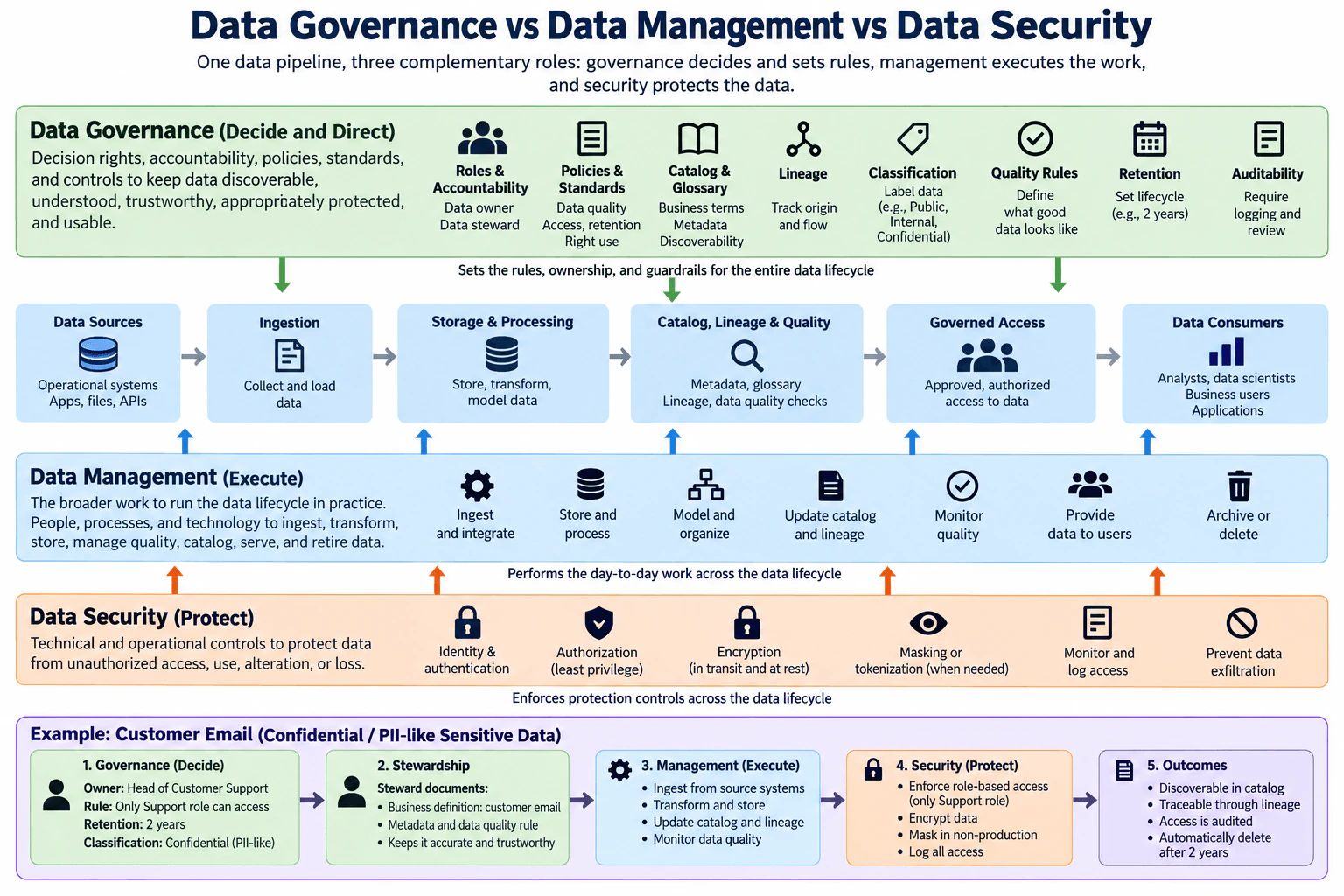
56. What is data governance, and how is it different from data security and data management?Security And GovernanceEasy

Question Details

Define data governance as the decision rights, accountability, policies, standards, and controls used to keep data discoverable, understood, trustworthy, appropriately protected, and usable. Distinguish governance from the broader execution of data management and from security controls, and explain ownership, stewardship, catalogs, lineage, classification, access, quality, retention, and auditability.

Short Interview Answer (30-60 seconds)

Data governance defines ownership, accountability, policies, standards, and controls for data. Data management executes the lifecycle work, such as ingesting, storing, transforming, cataloging, serving, and deleting data. Data security protects data with controls such as authentication, authorization, encryption, masking, monitoring, and access logging.

Detailed Explanation

Data governance is about deciding how an organization should handle its data. It answers simple questions such as: Who is responsible for the data? Who may use it? What should the data mean? How good should it be? How long should it be kept? How can people find and understand it? Data management is the work of collecting, organizing, storing, changing, sharing, and deleting the data. Data security is the protection that prevents the wrong people from seeing, changing, stealing, or losing it. All three work together across the same data lifecycle.

Useful Questions to Ask the Interviewer
  1. Do you want the distinction explained conceptually, or should I also give a concrete Data Engineer example?
  2. Should I focus on the whole data lifecycle or emphasize ownership, catalog, access, quality, and retention?
What is data governance, and how is it different from data security and data management? diagram
How to Explain It in an Interview

Start with one sentence: governance decides and directs, data management executes, and data security protects.

1. Data governance: decide and direct

Data governance defines decision rights, accountability, policies, standards, and controls for data. It decides who owns a dataset, who stewards it, how it is classified, what quality is expected, who may access it, how long it is retained, and what evidence is required for review.

A data owner is accountable for business decisions about a dataset. A data steward maintains its business meaning, metadata, quality rules, and other governance information. Governance also defines catalog information, business terms, lineage expectations, classifications such as Public, Internal, or Confidential, access rules, retention rules, and audit requirements.

Governance answers questions such as:

  • Who owns this data?
  • What does it mean?
  • Where did it come from and where does it go?
  • What quality rules must it pass?
  • Which roles may access it?
  • How long should it be retained?
  • What activity must be logged and reviewed?
2. Data management: execute the lifecycle

Data management is the broader day-to-day work that makes data usable. People, processes, and technology ingest and integrate data, store and process it, model and organize it, update catalogs and lineage, monitor quality, provide data to approved users, and archive or delete it.

The lifecycle shown in the diagram is: data sources -> ingestion -> storage and processing -> catalog, lineage, and quality -> governed access -> data consumers.

Data management performs the operational work at these stages under governance rules. For example, governance can define a two-year retention rule. Data management implements the process that deletes the data after two years. Governance can require lineage. Data management records and updates the lineage as data moves and changes.

3. Data security: protect the data

Data security is the set of technical and operational controls that protect data from unauthorized access, use, alteration, or loss. The diagram shows identity and authentication, authorization with least privilege, encryption in transit and at rest, masking or tokenization when needed, access monitoring and logging, and controls that reduce data exfiltration risk.

Security enforces protection requirements, but it does not replace governance decisions. Governance can classify a dataset as Confidential and decide that only a specific business role may use it. Security then applies controls such as authentication, role-based authorization, encryption, masking, and logging to enforce that decision.

4. How the three responsibilities work together

The three responsibilities are complementary.

Governance sets the rules, ownership, accountability, and guardrails for the entire lifecycle. Data management performs the operational work. Data security applies protection controls across that same lifecycle.

A catalog shows the difference clearly. Governance decides what metadata, ownership, classification, business terms, and lineage must exist. Data management creates and maintains that information. Security restricts unauthorized access or modification when protection is required.

Quality works the same way. Governance defines what acceptable quality means and who is accountable. Data management runs and monitors the quality checks. Security helps prevent unauthorized changes to the data and controls.

5. Example: customer email data

The diagram uses customer email as Confidential, PII-like sensitive data.

Governance assigns the Head of Customer Support as the owner, allows only the Support role to access the data, sets retention to two years, classifies the data as Confidential, and requires catalog metadata, lineage, quality rules, and auditability.

The data steward documents the business definition of customer email, maintains metadata and quality rules, and keeps the governance information accurate and trustworthy.

Data management ingests the data from source systems, transforms and stores it, updates the catalog and lineage, monitors data quality, provides it to approved users, and implements deletion after the two-year retention period.

Data security enforces role-based access so only the approved Support role can use the data, encrypts the data, masks it in non-production, and logs access. An access attempt from an unauthorized role follows a rejected path and must fail instead of bypassing the governed-access control.

The approved flow is source systems -> ingestion -> storage and processing -> catalog, lineage, and quality -> governed access -> authorized consumers. The important enforcement boundary is governed access: approved users continue to the data, while unauthorized users are rejected.

The intended outcomes are that the data is discoverable in the catalog, traceable through lineage, trustworthy through quality controls, accessed only by approved roles, auditable through access records, and deleted after two years.

6. Ownership and verification

Governance is not complete just because a policy exists. The organization needs evidence that its decisions are being followed. Useful evidence includes recorded data ownership, stewardship metadata, classifications, lineage records, quality results, approved access assignments, access logs, retention status, and deletion records.

Responsibilities remain separate but connected. The owner approves business rules and access decisions. The steward maintains meaning and governance metadata. Data engineers operate ingestion, transformation, storage, catalog updates, lineage, quality checks, serving, and lifecycle processes. Security controls enforce authentication, authorization, encryption, masking, monitoring, and logging. Consumers use the data only through approved access paths.

7. Tradeoffs and limitations

Governance adds policy, ownership, and review work, so too many approvals can slow legitimate data use. Too little governance creates unclear ownership, inconsistent definitions, poor quality, uncontrolled access, and weak audit evidence.

A catalog entry alone does not make data governed. Encryption alone does not make data secure or compliant. Logging alone does not prevent misuse. Effective governance needs clear ownership and enforceable rules, data management needs reliable execution, and security needs layered controls plus monitoring and review.

Technical Approach
  1. Identify the dataset and its business purpose.
  2. Assign a data owner and data steward.
  3. Define governance rules for classification, business meaning, quality, access, retention, and auditability.
  4. Record required metadata, business terms, and lineage in the catalog.
  5. Execute the lifecycle through ingestion, processing, storage, serving, and deletion.
  6. Enforce security with authentication, least-privilege authorization, encryption, masking or tokenization when needed, and access logging.
  7. Allow consumers to access data only through the governed-access path and reject unauthorized access.
  8. Review ownership, lineage, quality results, access records, retention status, and deletion evidence to verify that governance decisions are being followed.
Practical Insights

There is no meaningful algorithmic Big-O complexity for this conceptual question. The main costs are operational and maintenance costs. Governance requires people to define ownership, policies, classifications, quality rules, retention, and reviews. Data management requires engineering work for pipelines, storage, catalogs, lineage, quality checks, serving, and deletion. Security adds identity, access control, encryption, masking, monitoring, and logging. More controls add work and review time, but too few controls increase the risk of bad data, unclear ownership, unauthorized access, and missing audit evidence.

Why Interviewers Ask This

Interviewers want to know whether a Data Engineer can clearly separate governance decisions from operational data management and security enforcement. A strong answer should connect ownership, stewardship, catalogs, lineage, classification, access, quality, retention, and auditability to one data lifecycle and explain how the three responsibilities work together.

Common interview mistakes

A common mistake is saying governance and security are the same thing. Governance defines ownership, policies, classification, acceptable access, quality, retention, and accountability; security enforces protection controls. Another mistake is treating governance as only a catalog. A catalog supports governance but does not replace ownership or policy decisions. Candidates also confuse governance with data management: governance decides what should happen, while management performs the operational work. Other mistakes include assuming encryption alone solves governance, forgetting stewardship and lineage, ignoring retention and deletion, or treating logs as useful evidence without review and accountability.

Interview tip

Use the phrase: governance decides and directs, management executes, security protects. Then apply all three to one dataset. Mention ownership, stewardship, catalog, lineage, classification, quality, access, retention, and auditability, and use the customer-email example to show how the responsibilities connect.

Interviewer may ask next
Can you give a concrete example of governance, data management, and data security working together on the same dataset?

For customer email data, governance classifies it as Confidential, assigns the Head of Customer Support as owner, assigns stewardship responsibilities, allows only the Support role, defines quality expectations, and sets a two-year retention period. Data management ingests, transforms, stores, catalogs, tracks lineage, monitors quality, serves approved users, and deletes the data after two years. Data security authenticates users, applies least-privilege role-based authorization, encrypts the data, masks it in non-production, and logs access. Unauthorized users are rejected at the governed-access boundary.

If a company has strong encryption and access control, does it already have good data governance?

No. Encryption and access control are security controls. Governance still requires ownership, stewardship, business definitions, classification, quality rules, access decisions, retention, lineage, and auditability. Security can enforce governance decisions, but it does not replace them. For example, encryption protects customer email, while governance decides that it is Confidential, who may use it, what quality is required, and that it should be deleted after two years.

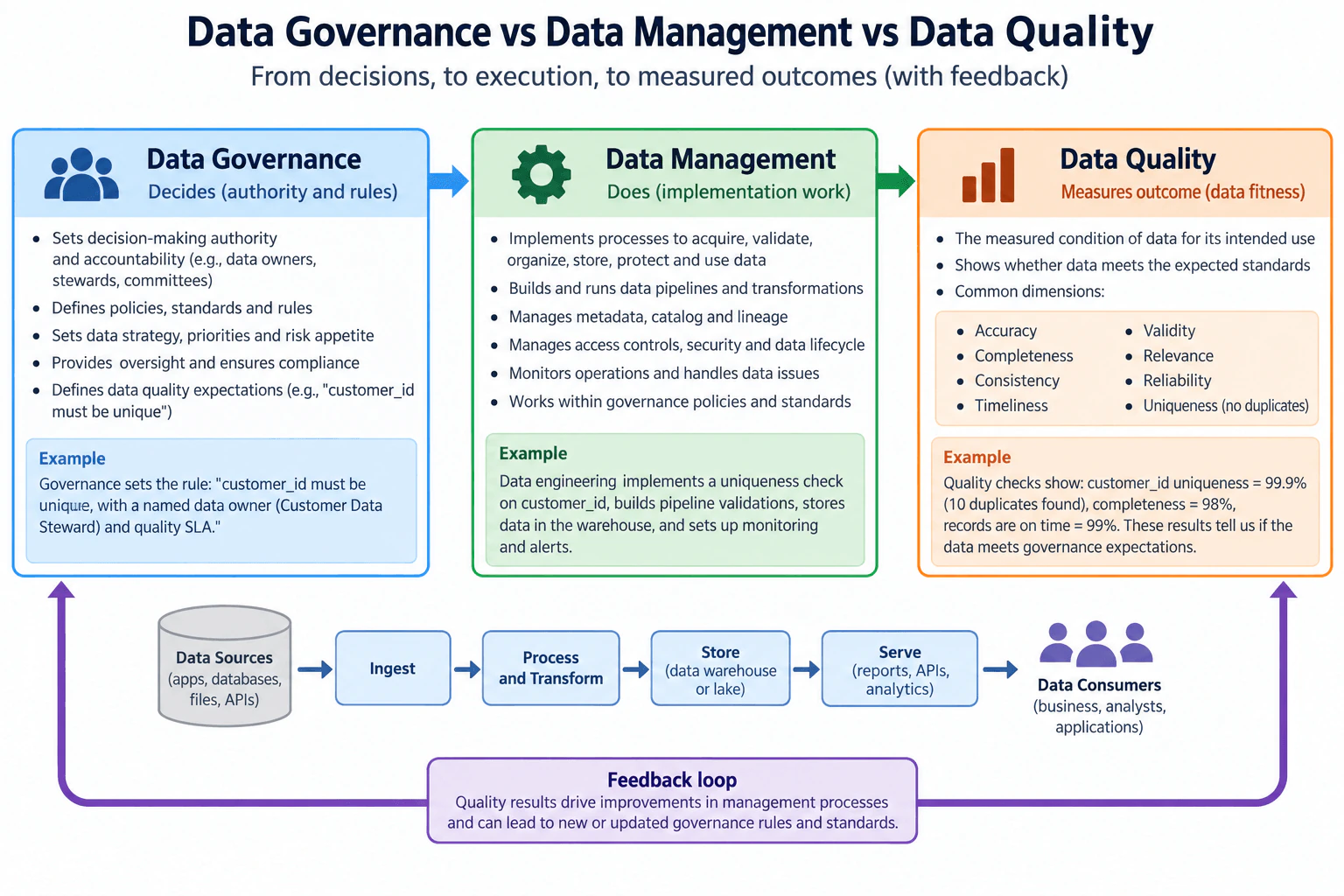
57. Distinguish data governance, data management, and data quality.Security And GovernanceEasy

Question Details

Clarify the boundaries between decision-making authority, implementation work, and measured data outcomes.

Short Interview Answer (30-60 seconds)

Data governance decides the rules, ownership, and accountability. Data management implements and operates those decisions across the data lifecycle. Data quality measures whether the resulting data is fit for its intended use. Quality results then provide feedback for improving processes or updating governance standards.

Detailed Explanation

This question asks you to separate three ideas that often sound similar. Data governance is about deciding the rules, responsibilities, and expectations for data. Data management is the work of putting those decisions into practice and operating data from its sources to the people and systems that use it. Data quality describes the measured condition of that data and whether it is good enough for its intended purpose. A simple way to remember the difference is: governance decides, management does, and quality measures. Quality results can then lead to better processes or updated rules.

Useful Questions to Ask the Interviewer
  1. Would you like me to explain the distinction mainly by responsibilities, or also walk through a Data Engineer example?
  2. Should I distinguish data quality itself from the broader practice of data quality management?
Distinguish data governance, data management, and data quality. diagram
How to Explain It in an Interview

Start with the practical boundary: data governance decides, data management does, and data quality measures.

Data governance — decision-making authority and rules Data governance defines who can make decisions about data and who is accountable for those decisions. It establishes policies, standards, ownership, priorities, risk expectations, compliance oversight, and data-quality expectations. Typical governance roles include data owners and data stewards.

For example, governance can define the rule that customer_id must be unique, assign a named Customer Data Steward, and establish a quality service-level expectation. Governance defines what should happen and who is responsible; it does not itself represent the pipeline implementation or the measured quality result.

Data management — implementation and operational work Data management turns governance decisions into working processes and systems. In the diagram, data moves through Data Sources → Ingest → Process and Transform → Store → Serve → Data Consumers. Data management operates this lifecycle.

For a Data Engineer, management work can include acquiring and validating data, building pipelines and transformations, organizing and storing data, maintaining metadata, catalogs, and lineage, applying access controls and security processes, monitoring operations, handling data issues, and managing data through its lifecycle. This work operates within governance policies and standards.

For the customer_id example, data engineering implements a uniqueness check, builds pipeline validation, stores the data in the warehouse, and sets up monitoring and alerts.

Data quality — measured data outcome Data quality is the measured condition of data for its intended use. It shows whether the data meets expected standards. The diagram illustrates dimensions such as accuracy, completeness, consistency, timeliness, validity, relevance, reliability, and uniqueness.

For example, quality checks might report customer_id uniqueness of 99.9%, with 10 duplicate records found, completeness of 98%, and 99% of records arriving on time. These are measured outcomes. They tell the team whether the data meets the expectations defined through governance.

The important boundary is that a quality measurement is not the governance decision and is not the implementation work. It is evidence about the resulting data.

How the three work together

  1. Governance defines the expectation, ownership, and rule.
  2. Management implements and operates the processes that apply that rule.
  3. Quality measures the resulting data against the expectation.
  4. Quality results create a feedback loop. They can drive improvements in management processes and can also lead governance teams to review or update rules and standards.

A concise interview summary is: Governance asks, "What are the rules, who decides, and who is accountable?" Management asks, "How do we implement and operate those decisions?" Quality asks, "What is the measured condition of the data, and does it meet the expected standard?"

Assumption: The question does not name a governance framework, catalog, cloud provider, warehouse, or processing platform, so the answer remains platform-neutral.

Tradeoffs: More governance can improve accountability, consistency, and oversight, but excessive approval steps can slow delivery. More management automation can make standards easier to apply consistently, but pipelines, metadata, lineage, controls, and monitoring require operational and maintenance effort. More quality checks provide better evidence about the data, but they also add processing and monitoring cost.

Technical Approach
  1. Identify the decision or expectation, such as a rule that customer_id must be unique.
  2. Classify the rule, decision authority, ownership, accountability, and standard as data governance.
  3. Identify the engineering and operational work that implements the rule across ingestion, processing, storage, serving, metadata, lineage, access controls, and monitoring; classify that as data management.
  4. Measure the resulting data using appropriate quality dimensions such as uniqueness, completeness, accuracy, consistency, timeliness, or validity.
  5. Compare the measured results with the governance expectation.
  6. Use failures and trends as feedback to improve management processes or, when justified, review and update governance standards.
Practical Insights

There is no algorithmic time or memory complexity to calculate because this is a conceptual question. Operational cost comes from building and running data-management processes such as pipelines, transformations, metadata, lineage, access controls, monitoring, and quality checks. Additional quality checks can increase compute and monitoring work. Governance adds human coordination and review effort. Maintenance cost comes from keeping policies, ownership, implementations, quality rules, alerts, and data-lifecycle processes aligned as requirements change.

Why Interviewers Ask This

Interviewers want to see whether you can separate three closely related responsibilities. A Data Engineer should understand that governance establishes decision-making authority, accountability, policies, and expectations; data management implements and operates those decisions across the data lifecycle; and data quality measures the resulting condition of the data. This distinction helps teams identify whether a problem comes from an unclear rule, an implementation issue, or a poor measured outcome.

Common interview mistakes

A common mistake is treating governance, management, and quality as interchangeable. Another is saying governance directly builds and operates pipelines; governance sets authority, policies, standards, ownership, and expectations, while data management performs the implementation and operational work. A third mistake is defining data quality only as data cleaning. In this distinction, data quality is the measured condition of data for its intended use. Also avoid assuming that one good quality metric proves an entire dataset is trustworthy, because different quality dimensions can produce different results.

Interview tip

Start with the phrase "governance decides, management does, quality measures." Then use one consistent example: governance requires unique customer_id values, management implements the validation and monitoring, and quality reports the measured uniqueness result. Finish by explaining the feedback loop from quality results to process improvements or revised governance standards.

Interviewer may ask next
Can you give one example that shows data governance, data management, and data quality together?

Suppose customer records contain customer_id. Data governance defines that customer_id must be unique, assigns an accountable data owner or steward, and establishes the expected quality level. Data management implements that decision by building a uniqueness validation in the pipeline, processing and storing the records, maintaining supporting metadata and lineage, and monitoring failures. Data quality is the measured result, such as 99.9% unique customer IDs and 98% completeness. If results fall below expectations, the team can improve the management process or governance can review the standard.

What should happen when measured data quality does not meet a governance standard?

The quality result becomes feedback. The team first determines whether the issue comes from the source, ingestion, processing, transformation, storage, serving, or another management process. Data management can then correct the implementation, validation, monitoring, or operating procedure. If the governance standard is no longer appropriate because business requirements have changed, the responsible governance authority can review and update it. Engineers should not silently redefine a governance standard simply because a quality check fails.

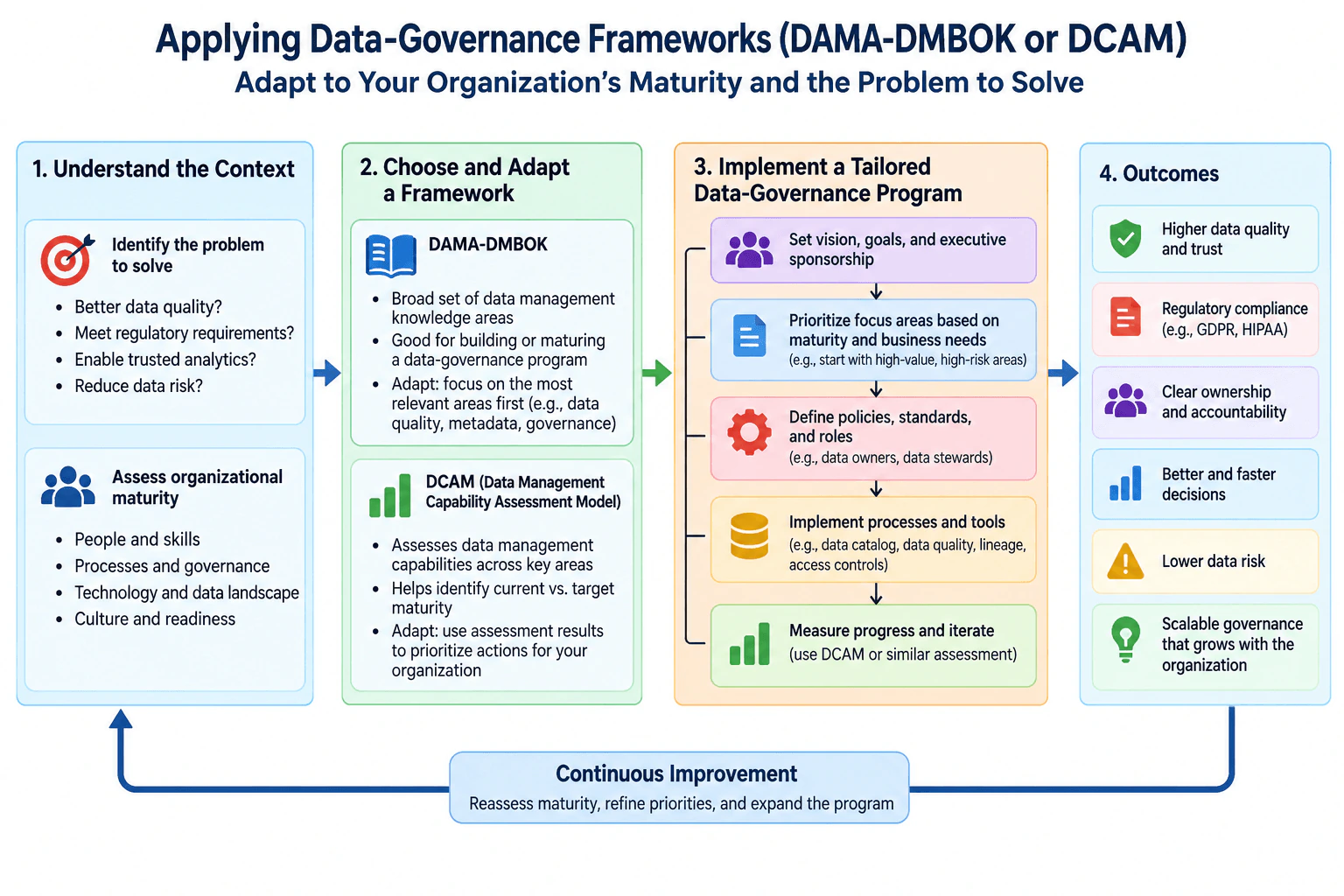
58. How would you apply data-governance frameworks rather than merely list them?Security And GovernanceMedium

Question Details

Discuss adapting DAMA-DMBOK or DCAM to organizational maturity and the problem the program must address.

Short Interview Answer (30-60 seconds)

I would begin with the business problem and maturity level, tailor DAMA-DMBOK or DCAM to the highest-priority gaps, define ownership and policies, implement the needed processes and tools, measure outcomes, and reassess maturity so governance expands only where business value or risk justifies it.

Detailed Explanation

This question asks how I would make a governance framework useful in a real organization instead of simply naming its parts. I would first understand what problem the organization wants to solve, such as unreliable information, legal obligations, poor trust, or unnecessary risk. I would also understand how ready the organization is to change. Then I would choose only the parts of the framework that help with that problem, give people clear responsibilities, put practical rules and checks in place, measure whether they work, and expand the program gradually when the organization is ready.

Useful Questions to Ask the Interviewer
  1. What problem should the governance program solve first: data quality, regulatory requirements, trusted analytics, or data risk?
  2. What is the organization's current maturity in people and skills, processes and governance, technology and data landscape, and culture and readiness?
  3. Which data domains or business areas have the highest value or risk?
  4. Is the organization already using DAMA-DMBOK, DCAM, or both?
  5. What outcomes would show that the governance program is successful?
How would you apply data-governance frameworks rather than merely list them? diagram
How to Explain It in an Interview

I would explain the approach as one continuous loop: understand the context, choose and adapt the framework, implement a tailored governance program, measure outcomes, and then reassess maturity.

First, I would understand the context. I would identify the problem the governance program must solve. The diagram shows examples such as improving data quality, meeting regulatory requirements, enabling trusted analytics, or reducing data risk. I would then assess organizational maturity across people and skills, processes and governance, technology and the data landscape, and culture and readiness. This tells me what the organization can realistically operate today.

Second, I would choose and adapt the framework. DAMA-DMBOK gives a broad set of data-management knowledge areas. I would not implement every area at once. I would select the areas that directly support the current problem, such as data quality, metadata, or governance. DCAM can be used to assess data-management capabilities, compare current maturity with the desired maturity, and identify priority gaps. The framework should guide decisions, not become a checklist.

Third, I would implement a tailored governance program. I would establish the vision, goals, and executive sponsorship. Then I would prioritize focus areas based on organizational maturity and business needs, starting with high-value or high-risk areas. I would define policies, standards, and roles such as data owners and data stewards. A data owner is accountable for decisions about a data domain. A data steward supports the day-to-day governance work, such as definitions, quality, and metadata.

Next, I would implement the processes and tools needed for those priorities. The diagram shows a data catalog, data-quality controls, lineage, and access controls. A data catalog helps people discover and understand governed data. Data-quality controls check whether data meets agreed expectations. Lineage shows where data came from and how it changed. Access controls restrict who or what can use the data. These controls should support the policy and ownership model rather than exist as isolated technical features.

Fourth, I would measure progress and iterate. The outcomes should connect back to the original problem. The diagram shows higher data quality and trust, stronger regulatory compliance, clearer ownership and accountability, better and faster decisions, lower data risk, and governance that can scale with the organization. I would collect evidence for the selected outcomes, review whether the controls and processes are working, and use DCAM or a similar assessment to reassess maturity.

Finally, I would use continuous improvement. I would refine priorities and expand the governance program only when business needs and maturity justify it. This prevents a low-maturity organization from receiving a large, bureaucratic program that it cannot operate. It also prevents a mature organization from staying with weak manual practices when stronger standardized processes are needed.

The main tradeoff is breadth versus adoption. Implementing too much governance too early creates cost, complexity, and resistance. Implementing too little leaves important quality, compliance, ownership, or risk problems unresolved. I would therefore start with the highest-value or highest-risk problem, implement a focused set of governance practices, measure the result, and expand based on evidence.

Technical Approach
  1. Identify the business problem to solve, such as data quality, regulatory requirements, trusted analytics, or data risk.
  2. Assess organizational maturity across people, processes, technology, data landscape, and culture.
  3. Select the relevant DAMA-DMBOK knowledge areas or use DCAM to identify current-to-target capability gaps.
  4. Prioritize high-value and high-risk areas instead of implementing the entire framework.
  5. Establish vision, goals, executive sponsorship, policies, standards, data owners, and data stewards.
  6. Implement the necessary processes and tools, such as a data catalog, data-quality controls, lineage, and access controls.
  7. Measure outcomes against the original problem.
  8. Reassess maturity, refine priorities, and expand the governance program through continuous improvement.
Practical Insights

There is no normal algorithmic time or memory complexity for this question. The important costs are organizational and operational. A broader governance program needs more ownership, policy work, training, metadata maintenance, controls, reviews, and tooling. Starting with a focused scope reduces initial cost and change burden, but some lower-priority gaps remain for later phases. As maturity increases, the organization can standardize more processes and scale governance across additional domains.

Why Interviewers Ask This

The interviewer wants to know whether the candidate can turn a governance framework into a practical program. The key judgment is choosing governance work based on the business problem and organizational maturity, assigning clear ownership, implementing useful controls and processes, measuring outcomes, and improving the program over time instead of merely naming framework components.

Common interview mistakes

Common mistakes are listing DAMA-DMBOK knowledge areas without explaining how they solve a business problem; treating DCAM as a checklist instead of a capability and maturity assessment; trying to implement the entire framework at once; ignoring organizational maturity and culture; creating policies without clear data owners or data stewards; buying catalog, quality, lineage, or access-control tools without connecting them to governance goals; measuring activity instead of outcomes; and expanding governance without reassessing maturity and priorities.

Interview tip

Present the answer as a loop: business problem and maturity, tailored framework, ownership and implementation, measurable outcomes, then reassessment. Emphasize that DAMA-DMBOK or DCAM guides priorities rather than forcing a full checklist. Use one concrete example, such as improving data quality with clear ownership, catalog metadata, quality controls, and lineage, and finish by explaining how measured results drive the next maturity step.

Interviewer may ask next
How would you decide whether to use DAMA-DMBOK, DCAM, or both?

I would choose based on the problem. DAMA-DMBOK is useful when I need a broad body of data-management practices and want to select relevant areas such as data quality, metadata, or governance. DCAM is especially useful when I need to assess current capabilities, compare current and target maturity, and prioritize a roadmap. They can also be combined: DCAM can help identify maturity gaps, while relevant DAMA-DMBOK practices can help shape the operating processes used to address those gaps.

What would you do if the organization has low governance maturity but an urgent regulatory or data-risk problem?

I would not wait for a complete enterprise-wide governance program. I would identify the urgent problem, prioritize the affected high-risk area, establish executive sponsorship and an accountable data owner, define the minimum required policies and standards, and implement the necessary controls such as cataloging, lineage, data-quality checks, or access controls where relevant. I would measure whether the immediate risk is reduced, then use those results to reassess maturity and expand the program gradually.

59. Why does the EU AI Act matter to data governance?Security And GovernanceMedium

Question Details

Focus on the data-related obligations associated with high-risk AI, including dataset quality, documentation, and accountability.

Short Interview Answer (30-60 seconds)

For high-risk AI, the EU AI Act makes data governance part of compliance. Teams need traceable data origin and lineage, suitable training, validation, and testing datasets, documented preparation and quality checks, technical records, applicable logs, conformity evidence, and clear provider accountability.

Detailed Explanation

The practical point is that a high-risk AI system needs controlled and explainable data, not only a good model. The organization should know where the data came from, how it was changed, whether important errors or gaps exist, and whether the data is suitable for the system's purpose. It also needs records showing what was done and why. This makes data governance important because the data pipeline becomes part of the evidence used to show that the AI system was prepared, checked, released, and operated in a responsible way.

Useful Questions to Ask the Interviewer
  1. Is the AI system considered high-risk in this scenario?
  2. Who is the provider responsible for the high-risk AI system?
  3. What training, validation, and testing datasets are used, and where do they come from?
  4. What lineage, metadata, quality, bias, and gap checks are already captured?
  5. Which system logs are under the provider's control and need to be retained?
  6. What documentation and conformity evidence must be ready before release?
Why does the EU AI Act matter to data governance? diagram
How to Explain It in an Interview

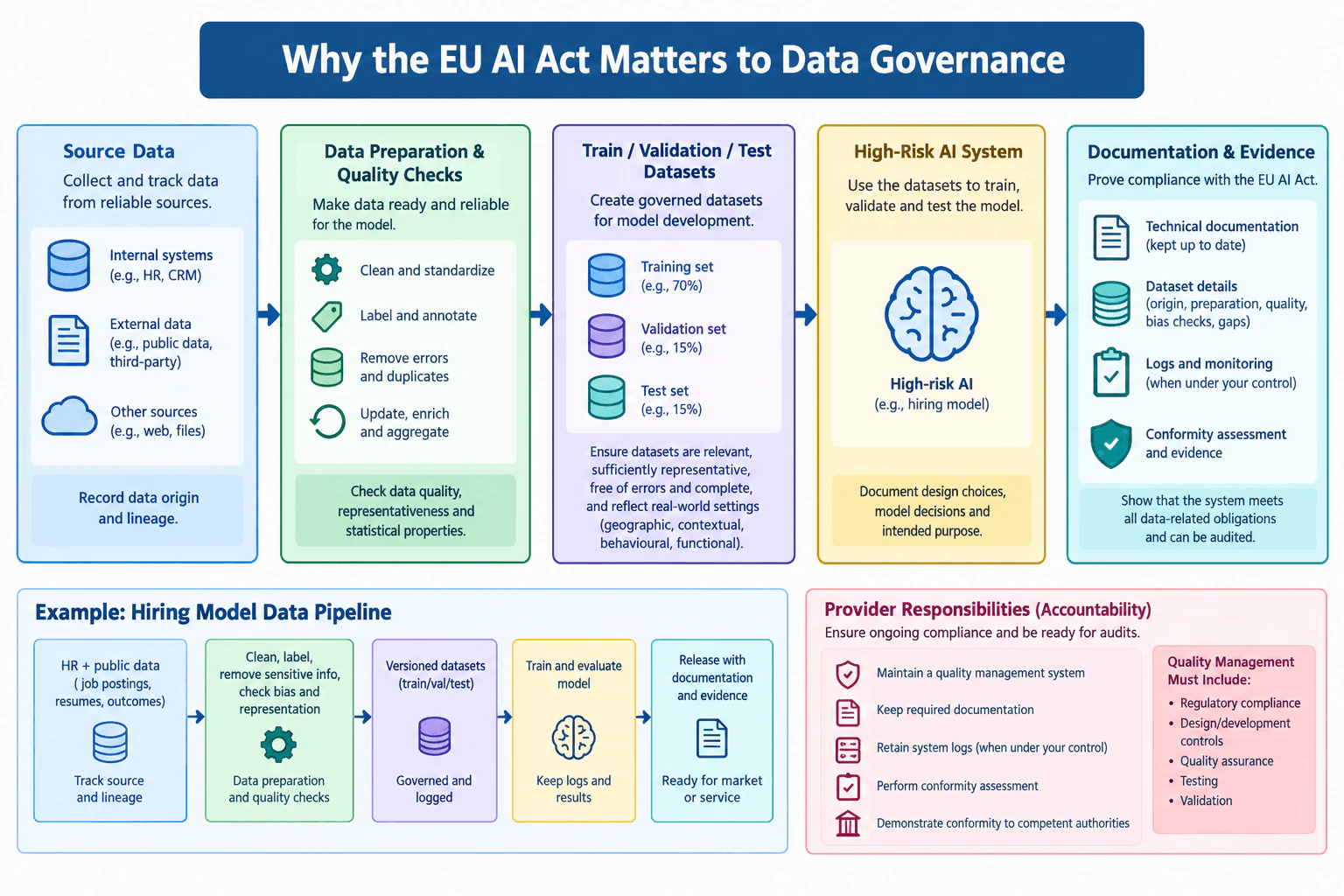
I would explain it as one governed data flow from source data to compliance evidence.

First, start with source data. In the diagram, sources include internal systems such as HR or CRM data, external data such as public or third-party data, and other sources such as web or files. The Data Engineer records data origin and lineage so the organization can trace where data came from and how it moved through the pipeline.

Second, prepare the data under controlled processes. The diagram shows cleaning and standardizing data, labeling and annotating it, removing errors and duplicates, and updating, enriching, or aggregating it. These steps should be documented. The team also checks data quality, representativeness, and relevant statistical properties instead of treating preparation as an undocumented preprocessing step.

Third, create governed training, validation, and testing datasets. The diagram uses separate train, validation, and test sets and treats them as controlled datasets for model development. The important point is not the example percentages but that the datasets are versioned, documented, and checked for suitability. The team should assess whether they are relevant, sufficiently representative, as complete and error-free as reasonably possible for the intended purpose, and whether important geographic, contextual, behavioral, or functional conditions are reflected. Bias and data gaps should be identified and addressed when relevant.

Fourth, use those governed datasets to train, validate, and test the high-risk AI system. The diagram's example is a hiring model. Design choices, model decisions, intended purpose, dataset versions, and evaluation results should remain connected so the organization can later reconstruct what data and decisions produced a given model version.

Fifth, maintain documentation and evidence. The diagram includes technical documentation kept up to date, dataset details such as origin, preparation, quality, bias checks, and gaps, system logs when they are under the provider's control, and conformity-assessment evidence. These records allow the provider to demonstrate how the system was built and checked.

The diagram also shows provider accountability. The provider maintains a quality management system, keeps required documentation, retains applicable system logs when under its control, performs the conformity assessment, and demonstrates conformity to competent authorities. The quality management system covers regulatory compliance, design and development controls, quality assurance, testing, and validation.

The trust boundaries in this design are between raw source data, governed preparation, versioned model datasets, the high-risk AI system, and the documentation and evidence used for release and oversight. Raw or inadequately governed data should not bypass preparation and quality checks and feed the model directly. A system should also not be treated as release-ready when required documentation or conformity evidence is missing.

For the Data Engineer, the main responsibility is making the data lifecycle reproducible and auditable: source tracking, lineage, transformations, dataset versions, metadata, quality results, bias and gap findings, and relevant logs or evidence generated by the data platform. The provider remains accountable for the high-risk AI system as a whole.

Assumption: this scenario concerns a high-risk AI system for which the organization is acting as the provider, consistent with the attached hiring-model example. The tradeoff is extra engineering and operational work. Versioned datasets, lineage, repeated quality checks, documentation, and evidence retention consume storage, processing, and maintenance effort. The benefit is stronger traceability, reproducibility, auditability, and earlier detection of unsuitable data.

Technical Approach
  1. Identify the high-risk AI system, its intended purpose, and the provider accountable for it.
  2. Inventory every data source and record origin and lineage.
  3. Run controlled preparation such as cleaning, standardization, labeling, error and duplicate removal, enrichment, aggregation, and updates.
  4. Create and version the training, validation, and testing datasets with metadata.
  5. Check relevance, suitability, quality, representativeness, statistical properties, bias, errors, completeness, and important data gaps.
  6. Train, validate, and test the model using only the governed datasets, and keep evaluation results linked to dataset and model versions.
  7. Maintain technical documentation, dataset details, applicable logs, and conformity evidence.
  8. Release only when the required documentation and evidence are available.
  9. Continue quality management, logging where applicable, review, and accountability after release.
Practical Insights

The main cost is operational rather than algorithmic. Quality checks require extra processing over the datasets. Versioning, metadata, lineage, documentation, evaluation results, and logs require additional storage. Teams also spend time maintaining quality rules, reviewing bias and gaps, updating documentation, and keeping evidence synchronized with system changes. These costs grow with dataset size, update frequency, number of versions, and number of checks. The benefit is stronger traceability, reproducibility, auditability, and earlier detection of unsuitable data.

Why Interviewers Ask This

Interviewers want to see whether a Data Engineer understands that high-risk AI governance is not only about model accuracy or legal paperwork. The candidate should connect source data, lineage, preparation, dataset quality, representativeness, bias and gap checks, documentation, logging, quality management, conformity assessment, and provider accountability into one auditable data lifecycle.

Common interview mistakes

Common mistakes are treating the EU AI Act as only a legal-documentation task; checking model accuracy while ignoring dataset relevance, quality, representativeness, and suitability; losing source lineage after cleaning or aggregation; using unversioned training, validation, or test data; treating one bias check as complete governance; failing to document preparation choices and known data gaps; assuming every log exists even when it is not under the provider's control; allowing raw or inadequately governed data to bypass quality checks; releasing before required documentation and conformity evidence are ready; or assuming technical controls transfer the provider's regulatory accountability.

Interview tip

Explain the answer as one end-to-end governed flow: source and lineage, preparation and quality checks, governed training/validation/test datasets, the high-risk AI system, then documentation and evidence. Emphasize that dataset quality and accountability are continuous engineering responsibilities, not checks added only after the model is finished.

Interviewer may ask next
What should a Data Engineer capture to make a high-risk AI dataset auditable?

Capture the dataset's source and origin, lineage, preparation steps, version, metadata, quality results, representativeness and statistical checks, relevant bias findings, errors, completeness, identified gaps, and the relationship between the dataset version and the model evaluation that used it. Keep associated technical documentation and applicable logs so the provider can reconstruct what data was used and what controls were applied.

What should happen if a training dataset fails quality or bias checks shortly before release?

Do not let that dataset bypass the governance path and proceed as though the evidence were acceptable. Record the failed check, investigate the affected data and gap, correct or replace the data when possible, rerun the relevant checks, create a new governed dataset version, and repeat the affected model evaluation. Update the documentation and conformity evidence so they match the final dataset and model rather than the rejected version.

60. When are a DPIA and a FRIA needed, and how do their scopes differ?Security And GovernanceHard

Question Details

Compare a Data Protection Impact Assessment with a Fundamental Rights Impact Assessment for an AI deployment.

Short Interview Answer (30-60 seconds)

Use a DPIA when personal-data processing is likely to create high risk to people's rights and freedoms. Use a FRIA when EU AI Act Article 27 covers the high-risk AI system and deployer. DPIA focuses on data protection; FRIA examines broader fundamental-rights impacts.

Detailed Explanation

This question asks when two different safety reviews must happen before an AI system is used and what each review should examine. One review mainly checks how people's personal information is used, whether that use is necessary, and whether it may seriously harm them. The other looks more widely at how the AI system may affect people or groups, including fairness, equal treatment, dignity, privacy, oversight, and ways to challenge harmful decisions. The important point is to check each requirement separately. Sometimes one applies, sometimes both apply, and required risks should be reduced before deployment.

Useful Questions to Ask the Interviewer
  1. Does the planned AI deployment process personal data in a way that is likely to create a high risk to people's rights and freedoms?
  2. Is the system a high-risk AI system covered by EU AI Act Article 27, and is the organization a deployer within one of Article 27's covered categories?
  3. Has a DPIA already been completed for the same deployment, and can relevant evidence be reused in the FRIA without treating the two assessments as identical?
  4. Who will be affected by the deployment, what human oversight exists, and what complaint and response mechanisms are available?
When are a DPIA and a FRIA needed, and how do their scopes differ? diagram
How to Explain It in an Interview

Start with two separate decision gates.

First, ask whether the planned deployment processes personal data in a way that is likely to result in a high risk to the rights and freedoms of natural persons. If yes, the controller performs a Data Protection Impact Assessment, or DPIA, under GDPR Article 35 before the processing begins.

Typical Article 35 cases include systematic and extensive automated evaluation of personal aspects where decisions produce legal or similarly significant effects, large-scale processing of special-category data or data about criminal convictions and offences, and systematic monitoring of publicly accessible areas on a large scale.

The DPIA focuses on the personal-data processing. It describes the envisaged processing and its purposes, evaluates necessity and proportionality, assesses risks to data subjects' rights and freedoms, and documents safeguards and mitigation measures. The controller owns the DPIA. Where a data protection officer is designated, the controller seeks the DPO's advice. If the DPIA shows that processing would still result in high risk without sufficient measures to reduce that risk, the controller consults the supervisory authority before processing.

Second, independently check whether EU AI Act Article 27 requires a Fundamental Rights Impact Assessment, or FRIA. The diagram's decision gate applies to a high-risk AI system referred to in Article 6(2), except systems intended for the area listed in Annex III point 2, when the deployer is a body governed by public law, a private entity providing public services, or a deployer of the high-risk systems referred to in Annex III points 5(b) or 5(c).

When that Article 27 trigger is met, the deployer performs the FRIA before first deployment or use. Its scope is broader than data protection. It covers the processes in which the system will be used, the intended duration and frequency of use, the people and groups likely to be affected, specific fundamental-rights risks, human-oversight measures, governance, complaint mechanisms, and measures for responding if risks materialize. Relevant impacts can include non-discrimination, dignity, privacy, freedom of expression, and access to an effective remedy.

The applicant-ranking example in the diagram shows the difference. For the DPIA, examine the personal data used, such as income, family situation, or location; test necessity and proportionality; identify risks to data subjects, such as unfair decisions or lack of transparency; and apply safeguards such as data minimization, access controls, and human review.

For the FRIA on the same AI deployment, look beyond personal-data processing. Examine broader fundamental-rights effects, including non-discrimination and equal treatment, impacts on vulnerable groups, human oversight of decisions, complaint and appeal routes, and overall governance and monitoring.

The two assessments are complementary. A FRIA does not automatically replace a DPIA, and a DPIA does not automatically satisfy the FRIA. When both apply, relevant evidence can be reused so work is not unnecessarily duplicated, but each assessment must still cover its own required scope. The practical deployment rule is: determine both triggers, complete every applicable assessment, apply the required mitigation measures, document the evidence, and deploy only after the applicable assessment and mitigation obligations have been addressed.

Technical Approach
  1. Define the planned AI use, purpose, affected people, deployer, controller, and personal data involved.
  2. Test the GDPR Article 35 gate: is the planned personal-data processing likely to result in high risk to natural persons' rights and freedoms?
  3. If yes, have the controller perform the DPIA before processing, assess necessity and proportionality, identify risks, document safeguards, and seek DPO advice where a DPO is designated.
  4. If high risk would remain without sufficient mitigation, consult the supervisory authority before processing.
  5. Independently test the EU AI Act Article 27 gate by checking the high-risk AI classification, the Annex III point 2 exclusion, and whether the deployer is within a covered category.
  6. If Article 27 applies, have the deployer perform the FRIA before first deployment or use.
  7. Cover deployment processes, duration and frequency, affected people and groups, fundamental-rights risks, human oversight, complaints, governance, and risk-response measures.
  8. Reuse relevant DPIA evidence when appropriate without treating the assessments as substitutes.
  9. Update the FRIA when relevant elements change and complete the required notification to the market-surveillance authority.
  10. Deploy only after all required assessments and mitigations are complete.
Practical Insights

There is no useful Big-O time or memory complexity because this is a governance process, not an algorithm. The main costs are operational: mapping the deployment and personal-data processing, involving privacy, legal, governance, and operational owners, consulting the DPO where applicable, identifying affected groups, documenting mitigations, maintaining evidence, supporting human oversight and complaints, and updating assessments when relevant conditions change. Reusing evidence between a DPIA and FRIA can reduce duplicate work, but combining them so much that one assessment's required scope is missed creates legal and governance risk.

Why Interviewers Ask This

This tests whether the candidate can distinguish two related regulatory assessments, identify their different legal triggers, understand their scopes, assign responsibility to the correct actor, and explain how privacy-risk assessment fits into the broader governance of a high-risk AI deployment.

Common interview mistakes

Common mistakes are assuming that any processing of personal data automatically requires a DPIA instead of applying the GDPR Article 35 high-risk test; assuming that every high-risk AI system automatically requires an Article 27 FRIA without checking the system and deployer categories; forgetting the Annex III point 2 exclusion shown in the diagram; treating the FRIA as only a privacy review; treating a DPIA and FRIA as interchangeable; assigning DPIA responsibility to the deployer instead of the controller; ignoring affected groups, non-discrimination, human oversight, complaints, remedies, and governance in the FRIA; failing to perform an applicable assessment before the required point in the lifecycle; and deploying before required mitigations and residual-risk actions are complete.

Interview tip

Present this as two separate gates. State the GDPR Article 35 DPIA trigger and its personal-data focus, then state the EU AI Act Article 27 FRIA trigger and its broader fundamental-rights scope. Finish by explaining that both may apply to one deployment and can share evidence without replacing each other.

Interviewer may ask next
If a DPIA has already been completed for the AI deployment, does the organization still need a FRIA?

Yes, if the separate EU AI Act Article 27 trigger is met. The existing DPIA can provide useful evidence about personal-data processing, privacy risks, safeguards, necessity, and proportionality. However, the FRIA must still cover its broader required scope, including the deployment process, duration and frequency, affected people and groups, wider fundamental-rights risks, human oversight, complaint mechanisms, governance, and response measures. Evidence can be reused, but the DPIA does not automatically replace the FRIA.

What should happen if a DPIA identifies high risk that cannot be sufficiently reduced before processing?

The controller should not simply proceed. If the DPIA indicates that the planned processing would result in high risk in the absence of measures taken by the controller to mitigate that risk, GDPR Article 36 requires the controller to consult the supervisory authority before processing. This is separate from the FRIA decision. If EU AI Act Article 27 also applies, the deployer must still complete the FRIA and its required mitigation and governance steps before the covered deployment or use.

More questions load as you scroll

Disclaimer: This interview guide is for educational and informational purposes only. It is designed to help readers prepare, but it does not guarantee any interview result, hiring decision, offer, or outcome. Interview questions, hiring criteria, and preferred answers can vary by employer, interviewer, industry, location, and time. The examples and explanations reflect the authors' research and judgment, are provided without warranties of any kind, and should not be treated as the only correct approach. Diagrams are simplified illustrations intended to highlight the main components and their interactions; actual systems and implementations may be more complex. Alternative approaches may be equally valid or better suited to a particular question, context, or interviewer. To the fullest extent permitted by applicable law, the author, contributors, and publisher are not liable for decisions made, actions taken, or losses incurred based on this guide.

Content Accuracy and Verification: To the fullest extent permitted by applicable law, we do not represent or warrant that interview guides, questions, answers, examples, or diagrams are accurate, complete, current, error-free, or suitable for any particular purpose. You are responsible for independently reviewing and verifying the information before relying on it.