This interview guide is for educational and informational purposes only. It is designed to help readers prepare, but it does not guarantee any interview result, hiring decision, offer, or outcome. Interview questions, hiring criteria, and preferred answers can vary by employer, interviewer, industry, location, and time. All answers, examples, and explanations in this guide are suggested examples for interview preparation, not definitive answers or instructions for professional practice. They are based on research and judgment, are provided without warranties of any kind, and should be adapted to the question, role, and applicable laws and professional requirements. Diagrams are simplified illustrations intended to highlight the main concepts and their relationships; actual situations, systems, and practices may be more complex. Alternative approaches may be equally valid or better suited to a particular question, context, or interviewer. To the fullest extent permitted by applicable law, the contributors and publisher are not liable for decisions made, actions taken, or losses incurred based on this guide.
State Laws and Professional Responsibilities
Laws and requirements governing an occupation vary by state and jurisdiction. You are responsible for checking the current laws, licensing requirements, and scope-of-practice rules that apply to your location and role, and for ensuring that your answers and actions comply with them. Adapt examples in this guide to those requirements. This guide is not legal advice.
Identity, Image, and Privacy Notice
To respect individual privacy, some names, profile photographs, avatars, biographical details, and other identifying information displayed in this guide may be replaced with pseudonyms, licensed stock images, illustrative avatars, composite images, or representative descriptions. Unless a person is expressly identified as an actual contributor, a displayed name, image, or profile should not be understood as depicting or identifying a specific candidate, interviewer, employee, or other real individual. These representations are provided for editorial and illustrative purposes only and do not imply endorsement, employment, participation, or affiliation with this guide or any company mentioned in it. Any resemblance to an actual person is coincidental.
Company Notice
This guide is an independent educational resource and is not affiliated with, endorsed by, sponsored by, or approved by the company named in this guide. Company names identify reported interview experiences or the employer context of clearly labeled original practice exercises. Interview practices can change without notice, and inclusion of company-specific content does not mean these questions are official, complete, or guaranteed to be asked. To the fullest extent permitted by law, the author, contributors, and publisher are not responsible for outcomes related to use of this material.
Content Accuracy and Verification
To the fullest extent permitted by applicable law, we do not represent or warrant that interview guides, questions, answers, examples, or diagrams are accurate, complete, current, error-free, or suitable for any particular purpose. You are responsible for independently reviewing and verifying the information before relying on it.
Questions or comments?
Contact us for general questions, or share feedback, technical corrections, and comments with the community.
61. Which SQL Server protections defend against a malicious database administrator?Security And GovernanceHard
i Question Details
Contrast Always Encrypted with TDE, dynamic masking, and row-level security under that threat.
Short Interview Answer (30-60 seconds)
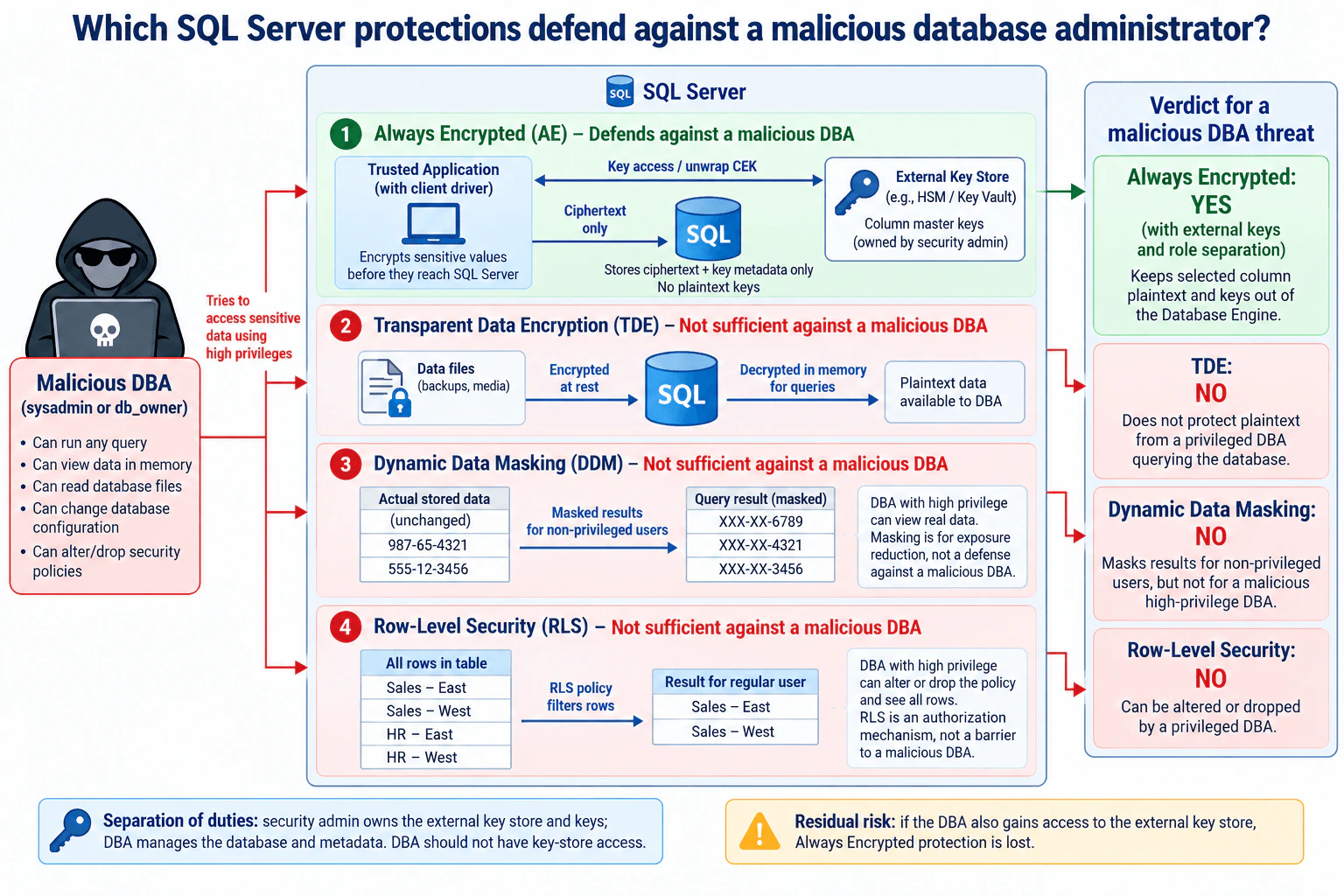
Use Always Encrypted when the threat includes a malicious DBA. The trusted client encrypts and decrypts selected values while keys stay outside SQL Server. TDE, Dynamic Data Masking, and Row-Level Security solve other security problems, but a sufficiently privileged DBA can still access or bypass their protections.
Detailed Explanation
This question asks which protection can keep sensitive information hidden even from the person who has full control over the database. That person may be able to read stored information, run powerful searches, change settings, and remove normal access rules. The key decision is where readable information and the means to unlock it are kept. One option keeps them outside that administrator's control. The other options protect stored files or limit what ordinary users see, but a powerful administrator can still get around them. The design therefore depends on keeping key ownership separate from database administration.
Useful Questions to Ask the Interviewer
Should I assume the malicious DBA has sysadmin-level SQL Server privileges but no access to the external key store?
Are we protecting selected sensitive columns from database administrators, or mainly protecting database files and backups if storage is stolen?
Should I assume standard Always Encrypted with an enabled client driver and no secure enclave in the Database Engine?
How to Explain It in an Interview
The practical answer is Always Encrypted when the threat model includes a malicious SQL Server DBA. For the design shown in the diagram, assume standard Always Encrypted without a secure enclave. A trusted application uses an Always Encrypted-capable client driver. The application encrypts sensitive values before they reach SQL Server and decrypts returned encrypted values on the client side.
Always Encrypted uses a column encryption key, or CEK, to encrypt column values. The CEK is itself protected by a column master key, or CMK. The CMK is held in a trusted external key store such as a hardware security module or key vault. SQL Server stores ciphertext, CMK metadata, and encrypted CEK values, but not plaintext CMKs or CEKs. The client driver uses the external key store to perform the key operation needed to unwrap the CEK. Microsoft specifically recommends role separation when the goal is preventing DBAs from reading sensitive data. learn.microsoft.com
That separation of duties is the core defense. A security administrator owns the external key store and keys. The DBA manages SQL Server and the key metadata stored in the database, but must not have access to the actual key material or the credentials that provide key-store access. The malicious DBA can therefore query an encrypted column, but without key access the database returns ciphertext rather than plaintext. learn.microsoft.com
Transparent Data Encryption, or TDE, protects a different threat. It encrypts SQL Server data and log files at rest, and backups of a TDE-protected database are also encrypted. Database pages are decrypted when SQL Server reads them into memory. Because the running Database Engine can read the plaintext, TDE does not stop a malicious administrator who can query SQL Server or inspect the running system. It is valuable against stolen disks, copied files, and exposed backups, but it is not the malicious-DBA boundary shown in the diagram. learn.microsoft.com
Dynamic Data Masking, or DDM, changes how selected values appear in query results for users who do not have permission to see the original value. The stored value is unchanged. SQL Server administrative roles such as sysadmin and db_owner can view unmasked data because they have the required control permissions. DDM therefore reduces accidental or routine exposure for less-privileged users, but it does not defend against the malicious DBA in this threat model. learn.microsoft.com
Row-Level Security, or RLS, applies security predicates that determine which rows a user can access. It is an authorization mechanism rather than encryption. Its policies apply even to dbo users, but sufficiently privileged administrators can alter or drop those policies. A malicious DBA who controls those policies can therefore remove the restriction and expose rows that ordinary users could not see. learn.microsoft.com
The residual risk is also important. Always Encrypted does not help if the same malicious DBA gains control of the external key store, obtains the key-store credentials, or compromises the trusted client environment that can decrypt the values. The security boundary therefore depends on real separation between database administration and key administration.
The interview takeaway is simple: Always Encrypted can defend selected column plaintext against a malicious DBA because the Database Engine does not receive the plaintext keys. TDE protects files at rest. Dynamic Data Masking limits what less-privileged users see in query results. Row-Level Security controls which rows users can access. Those controls can complement one another, but TDE, DDM, and RLS do not replace Always Encrypted for the malicious-DBA threat shown in the approved diagram.
Technical Approach
Define the adversary as a highly privileged SQL Server DBA who can run queries and change database configuration or security policies.
Draw the trust boundary around SQL Server and assume the DBA does not control the trusted application or external key store.
Evaluate Always Encrypted: the client encrypts selected values, SQL Server stores ciphertext and key metadata, and the client performs the external key operation needed to unwrap the CEK. Treat this as the protection against the malicious DBA only when key ownership is separated.
Evaluate TDE: it encrypts database storage at rest, but SQL Server decrypts pages for processing, so a privileged DBA can still obtain plaintext through the running database.
Evaluate Dynamic Data Masking: it masks query results for less-privileged users, but administrative users can retrieve unmasked values.
Evaluate Row-Level Security: it filters rows using an authorization policy, but a sufficiently privileged DBA can alter or drop that policy.
State the residual risk: if the DBA also gains the external keys, key-store credentials, or control of the trusted client, the Always Encrypted protection is lost.
Practical Insights
Always Encrypted has the highest application and operational cost of these four controls because the client must support encryption-aware drivers, encrypted columns can limit some query operations, and key administration must be separated from DBA duties. It also adds external key-store management and key rotation work. TDE is largely transparent to applications and is simpler when the goal is protecting files at rest. Dynamic Data Masking and Row-Level Security are relatively convenient for limiting normal user exposure, but their policies require ongoing permission and policy maintenance. None of those lower-cost controls should be presented as a substitute for Always Encrypted when the adversary is the DBA.
Why Interviewers Ask This
This question tests whether the candidate understands security boundaries rather than simply recognizing SQL Server feature names. A strong candidate should distinguish client-side encryption from encryption at rest, masking, and row authorization; explain what a highly privileged DBA can bypass; and recognize that Always Encrypted depends on separation of duties between database administration and key administration.
Common interview mistakes
The first mistake is saying TDE protects against the DBA simply because the database is encrypted. TDE protects stored files, while the running Database Engine can still read the data. The second mistake is treating Dynamic Data Masking as encryption; it only changes result presentation for users without unmasking privileges. The third mistake is treating Row-Level Security as an unbreakable security boundary; privileged administrators can alter or remove its policies. The fourth mistake is saying Always Encrypted automatically defeats every DBA. It only provides the intended protection when the DBA cannot access the external keys, key-store credentials, or trusted client that can decrypt the protected values.
Interview tip
Organize the answer by security boundary. Start with Always Encrypted because plaintext keys stay outside SQL Server, then contrast each alternative by the threat it actually addresses: TDE for data at rest, Dynamic Data Masking for result exposure, and Row-Level Security for row authorization. Finish with the separation-of-duties requirement and the residual risk if the DBA gains key-store access.
Interviewer may ask next
Why is TDE still useful if it does not protect against a malicious DBA?
TDE protects a different threat surface. It encrypts SQL Server data and log files at rest, and backups of a TDE-protected database are encrypted as well. This helps if physical storage or backup files are stolen or copied. SQL Server decrypts pages when it reads them into memory, so a privileged administrator of the running database can still obtain plaintext. TDE therefore complements Always Encrypted rather than replacing it. learn.microsoft.com
What happens if the DBA gains access to the external key store used by Always Encrypted?
The key separation that protects the data is lost. Always Encrypted relies on the DBA being able to manage database metadata without having access to the plaintext keys or the external key store that protects them. If the malicious DBA also obtains the required key-store credentials, keys, or control of a trusted client that can decrypt the data, the DBA may be able to recover protected plaintext. The organization should therefore keep database and key administration separate and tightly restrict key-store access. learn.microsoft.com
62. What is a data test, and how does it differ from a unit or integration test?Testing And DebuggingEasy
i Question Details
Define a data test as an assertion about the values or relationships in a dataset, such as non-nullness, uniqueness, accepted values, referential integrity, reconciliation, or freshness. Contrast data tests with code-focused unit tests and boundary-focused integration tests, and explain where each belongs in development and pipeline execution.
Short Interview Answer (30-60 seconds)
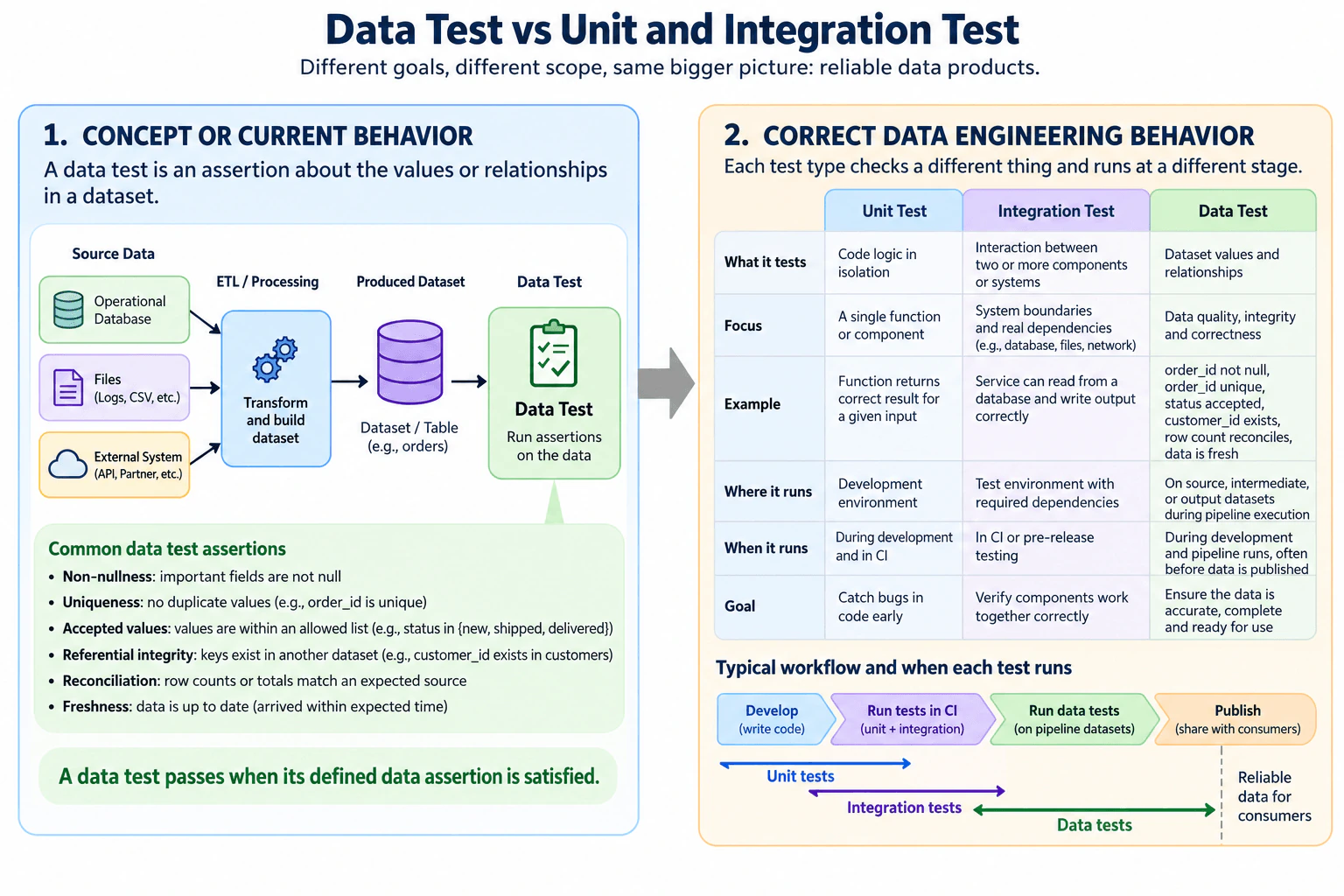
A data test asserts something about dataset values or relationships, such as non-nullness, uniqueness, accepted values, referential integrity, reconciliation, or freshness. Unit tests validate isolated code, integration tests validate components working together, and data tests validate source, intermediate, or output datasets.
Detailed Explanation
This question asks how we check three different kinds of correctness. One check asks whether a small piece of a program behaves as expected. Another asks whether separate parts can work together correctly. The third asks whether the information moving through a data process is trustworthy. For example, we may want to know that important fields are present, identifiers are not unexpectedly repeated, allowed choices are respected, related records exist, totals agree with a source, and information arrives on time. The key idea is that working software and trustworthy data are related but different goals.
Useful Questions to Ask the Interviewer
Should I explain only the conceptual differences, or also where each test type normally runs during development and pipeline execution?
Would you like examples of common data assertions such as non-nullness, uniqueness, accepted values, referential integrity, reconciliation, and freshness?
How to Explain It in an Interview
A data test is an assertion about the values or relationships in a dataset. It checks whether the data satisfies a defined rule. Examples include checking that order_id is not null, that order_id is unique, that status contains only accepted values, that each customer_id has a corresponding customer record, that source and target counts or totals reconcile, and that the data is fresh enough for its intended use.
A unit test has a different target. It checks a small piece of code in isolation, such as a transformation function or component. The inputs are controlled, the expected output is known, and external infrastructure is normally excluded. Unit tests are commonly run during development and in continuous integration so code defects can be caught early.
An integration test checks whether two or more components work together correctly. In data engineering, this can mean confirming that a pipeline component can correctly interact with a database, file system, API, queue, or another dependency. Integration tests therefore focus on system boundaries and real dependencies rather than one isolated function. They commonly run in a test environment, in continuous integration, or during pre-release testing.
A data test focuses on the dataset itself rather than only the code that produced it. Data tests can run against source, intermediate, or output datasets during pipeline execution, and they may also run during development. They are often placed before publication so invalid data does not reach consumers, but they are not limited to the final output stage.
A simple way to remember the difference is: unit tests ask, "Does this isolated code work?" Integration tests ask, "Do these components work together?" Data tests ask, "Does this dataset satisfy the required rules?"
All three complement one another. A transformation can pass its unit tests and successfully write to a database in an integration test while the actual dataset still contains duplicate identifiers, unexpected nulls, invalid values, missing relationships, mismatched totals, or stale records. Data tests provide the dataset-level protection that code-focused tests alone cannot provide.
A data test passes when its defined data assertion is satisfied. The exact implementation depends on the testing system, but the vendor-neutral concept is the same: the observed dataset must satisfy the rule being checked.
Technical Approach
Identify the thing being validated: isolated code, interaction between components, or dataset values and relationships.
Use a unit test for isolated transformation or function logic.
Use an integration test for boundaries such as databases, files, APIs, queues, or other dependencies.
Use data tests on source, intermediate, or output datasets for rules such as non-nullness, uniqueness, accepted values, referential integrity, reconciliation, and freshness.
Run unit tests during development and CI, integration tests in environments where required dependencies are available, and data tests during development or pipeline execution at the datasets where the assertions matter.
Before publishing a data product, require the appropriate checks for that stage to pass.
Practical Insights
Unit tests are usually the fastest and cheapest because they check small pieces of code without real external systems. Integration tests need more setup and time because multiple components or dependencies must be available. Data-test cost depends on the dataset size and the assertion. For example, uniqueness, reconciliation, or referential-integrity checks over large datasets can require substantial scanning and compute. There is also maintenance cost because tests must be updated when valid schemas, business rules, or data contracts change.
Why Interviewers Ask This
Interviewers want to know whether you can distinguish code correctness, component interaction, and data correctness. A Data Engineer should understand that a pipeline can execute successfully while still producing incorrect, incomplete, duplicated, inconsistent, or stale data. The question also checks whether you know where unit tests, integration tests, and data tests belong during development, continuous integration, and pipeline execution.
Common interview mistakes
A common mistake is saying that data tests and unit tests are the same because both use assertions. Their targets are different: unit tests primarily validate isolated code behavior, while data tests validate dataset properties. Another mistake is calling every database-related test an integration test. A check that order_id is unique is a data test, while a test that verifies a pipeline component can correctly read from and write to a database is an integration test. It is also incorrect to say that data tests run only after the final dataset is produced; they can check source, intermediate, or output datasets throughout pipeline execution.
Interview tip
Start with one clear sentence: unit tests check isolated code, integration tests check components working together, and data tests check the data itself. Then give one concrete example of each. Finish by explaining that a reliable data pipeline usually needs all three because correct code and successful integrations do not automatically guarantee correct data.
Interviewer may ask next
Can a pipeline pass all of its unit and integration tests but still produce bad data?
Yes. Unit tests can show that individual functions behave correctly for their tested inputs, and integration tests can show that components communicate correctly, but neither guarantees that real data satisfies quality and business rules. For example, a pipeline may successfully read, transform, and write records while the output still contains duplicate order_id values, missing customer references, invalid status values, mismatched source-to-target totals, or stale data. Data tests are designed to detect those dataset-level problems.
Where should data tests run in a data pipeline?
They can run at several stages. Source datasets can be checked for freshness, required values, and other source expectations. Intermediate datasets can be checked after transformations. Output datasets can be tested before publication to consumers. The best location is the earliest useful point where an invalid condition can be detected. Important assertions may run during development as well as normal pipeline execution, and critical publication checks can prevent bad data from reaching downstream consumers.
63. How does a source-to-target mapping document guide ETL tests?Testing And DebuggingEasy
i Question Details
Explain how field mappings, derivations, defaults, and filter rules become expected-result checks.
Short Interview Answer (30-60 seconds)
A source-to-target mapping document becomes the ETL test specification. Field mappings define equality checks, derivations define calculated expected values, defaults define expected replacements for missing inputs, and filters define the expected row set. Tests compare actual target output with those documented expectations.
Detailed Explanation
Think of the document as a written agreement that describes what the finished information should look like. Before checking the finished result, the tester uses each written rule to decide what should happen. A copied value should stay the same. A value built from other values should follow the stated calculation. A missing value may receive a stated replacement. Some records should be included while others should be left out. The finished information is then compared with these expected results so mistakes can be found in a consistent and repeatable way.
Useful Questions to Ask the Interviewer
Should I treat the approved source-to-target mapping document as the source of expected results?
Does the mapping include both field-level transformation rules and row-level filter rules?
Would you like me to walk through examples for direct mappings, derivations, defaults, and filters?
How to Explain It in an Interview
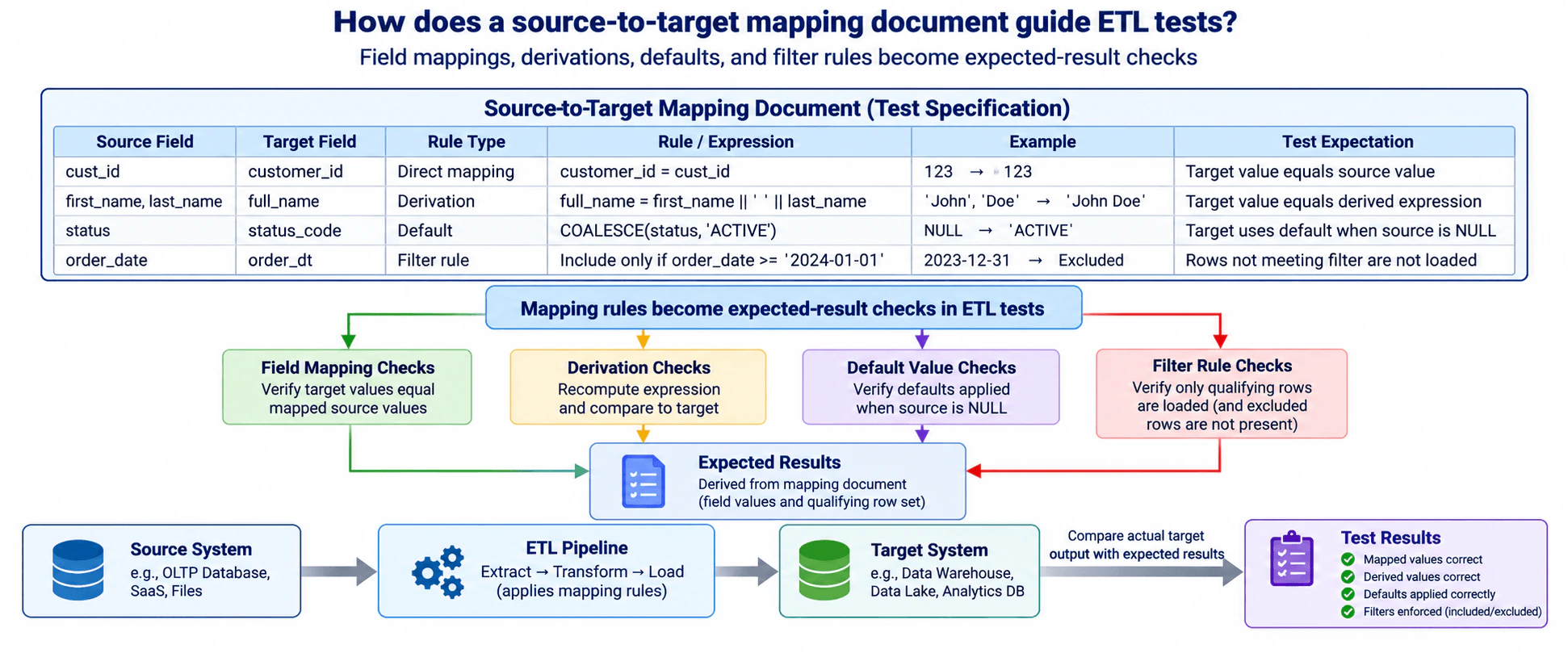
I would treat the source-to-target mapping document as the ETL test specification, or test oracle. A test oracle is the trusted definition of what the correct result should be.
The mapping document first describes how source fields become target fields. I convert each rule into an expected-result check before comparing it with the ETL output.
For a direct field mapping, the expected target value should equal the mapped source value. In the diagram, cust_id maps to customer_id. If the source cust_id is 123, the expected target customer_id is also 123.
For a derivation, I independently calculate the expected value from the documented expression. In the diagram, full_name = first_name || ' ' || last_name. With source values John and Doe, the expected full_name is John Doe. I then compare that expected value with the actual target value.
For a default rule, I test the condition that activates the default. The diagram defines status_code as COALESCE(status, 'ACTIVE'). If the source status is NULL, the expected target value is ACTIVE. I would also test a non-NULL status to confirm that an existing source value is retained rather than replaced by the default.
For a filter rule, I derive the expected qualifying row set. The diagram says to include only rows where order_date >= '2024-01-01'. Therefore, a source row with order_date = '2023-12-31' should be excluded. I test both sides of the boundary: qualifying rows should appear in the target, and non-qualifying rows should not appear.
The complete flow is: Source System -> ETL Pipeline -> Target System for the actual data path. Separately, the source-to-target mapping document defines Field Mapping Checks, Derivation Checks, Default Value Checks, and Filter Rule Checks. Those checks produce Expected Results containing expected field values and the expected qualifying row set. The actual Target System output is then compared with those Expected Results. The Test Results should confirm mapped values, derived values, defaults, and filter behavior.
The important testing principle is independence. I should derive the expected results from the approved mapping document instead of copying the ETL implementation into the test. Otherwise, the same mistake could exist in both the pipeline and the test and still appear to pass.
I would assume the mapping document is the approved specification. If the pipeline output and the mapping disagree, I would record the mismatch and determine whether the ETL implementation is wrong or the mapping document is outdated. I would not silently change the expected result to match the current implementation.
The main tradeoff is maintenance. Mapping-driven tests are clear, traceable, and easy to connect to requirements, but approved rule changes require the mapping document and its corresponding tests to be updated together.
Technical Approach
Select representative source records for each documented rule, including normal values, NULL values, and filter-boundary cases.
Read the source-to-target mapping document and derive the expected target field values and expected qualifying row set.
For direct mappings, expect the mapped source value in the target.
For derivations, independently calculate the documented expression.
For defaults, test both the condition that activates the default and a case where the source already contains a value.
For filters, test rows that should be included and rows that should be excluded.
Run the ETL pipeline so the source data reaches the target system.
Compare actual target output with the expected results derived from the mapping document.
Report any mismatch against the exact mapping rule that produced the expectation.
Practical Insights
The amount of testing work grows with the number of records and mapping rules being checked. Direct mappings are simple comparisons. Derivations require recalculating values. Default tests need both missing-value and normal-value cases. Filter tests require checking both the rows that should exist and the rows that should be absent. Large data sets can be checked in smaller batches or representative samples when appropriate. The main maintenance cost is keeping tests synchronized with approved mapping changes.
Why Interviewers Ask This
Interviewers want to know whether the candidate can turn documented data rules into precise and repeatable ETL checks. A strong answer shows that the candidate understands how to establish expected results independently and compare them with the actual target output instead of assuming that a successfully completed pipeline produced correct data.
Common interview mistakes
Common mistakes include checking only whether the ETL job completed, validating only row counts, testing direct mappings but ignoring derivations, defaults, or filters, copying the ETL implementation into the test instead of independently deriving expectations, failing to test NULL values, testing only included rows without confirming that excluded rows are absent, missing filter-boundary cases, and changing expected results merely because the current implementation behaves differently from the approved mapping document.
Interview tip
Describe the mapping document as the test oracle, then walk through the four rule types in the same order as the diagram: field mapping, derivation, default, and filter. For each one, explain how the rule produces an expected result and finish by saying that the actual target output is compared with those expectations.
Interviewer may ask next
How would you test a default rule such as COALESCE(status, 'ACTIVE')?
I would test at least two cases. With a source status of NULL, the expected target status_code is ACTIVE. With a non-NULL source status, the expected target should retain that source value instead of applying the default. I would derive both expectations from the mapping document and compare them with the actual target output.
What should you do if the ETL output does not match the source-to-target mapping document?
I would treat the mismatch as a failed test and identify the exact mapping rule involved. Then I would determine whether the ETL implementation is incorrect or the approved mapping document is outdated. I would not change the expected result just to match the implementation. The specification and implementation should be reconciled through the normal change process, and the test should continue to represent the approved rule.
64. How are generic dbt tests different from singular tests?Testing And DebuggingEasy
i Question Details
Compare reusable parameterized checks with one-off SQL assertions and explain how test results indicate failure.
Short Interview Answer (30-60 seconds)
Generic dbt tests are reusable and parameterized, usually referenced from YAML. Singular tests are one-off SQL assertions for specific rules. Both return failing records: by default, zero returned rows passes, while one or more returned rows fails the test.
Detailed Explanation
This question asks you to explain two ways of checking whether information is correct. One kind is a reusable rule that can be applied in many places by changing a few inputs. The other kind is a special rule written for one specific need. You should also explain how the result tells you whether the check passed or failed. The main idea is simple: reusable rules reduce repeated work, while one-off rules are useful when a check is unique to a particular situation or business requirement.
Useful Questions to Ask the Interviewer
Should I focus on the basic difference between generic and singular dbt data tests, or also discuss custom generic tests?
Would you like a short example of each test type?
How to Explain It in an Interview
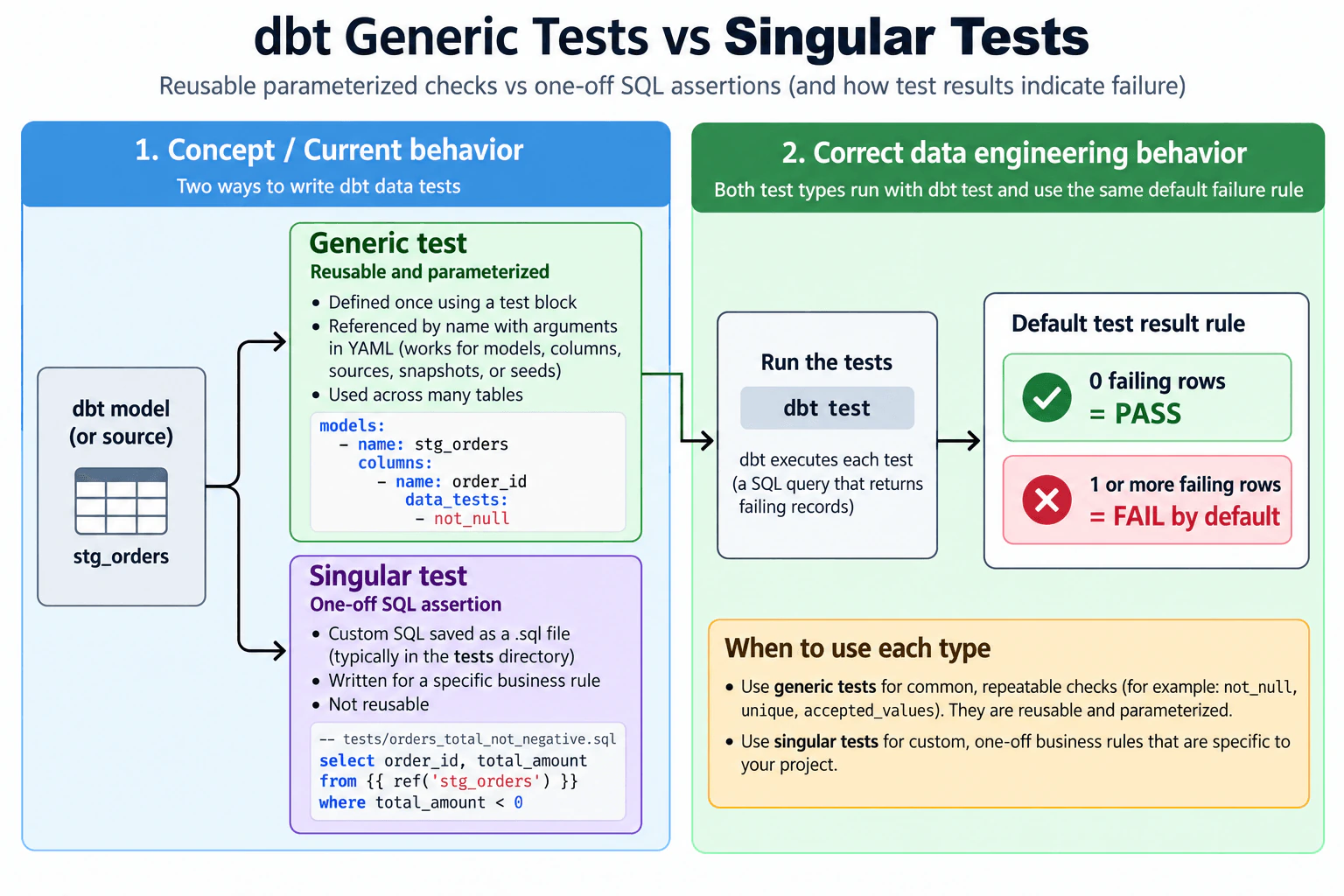
A generic dbt data test is reusable and parameterized. The reusable logic is defined once in a test block, and you reference that test by name with arguments, commonly in YAML. The same generic test can be applied to many models, columns, sources, snapshots, or seeds. For example, a column such as order_id can use data_tests: with not_null. Common repeatable checks include not_null, unique, and accepted_values.
A singular test is a one-off SQL assertion. It is normally written as a standalone .sql file in the tests directory for a specific business rule. For example, a singular test can select orders where total_amount < 0. The query returns the records that violate the rule. Because the SQL is written for that specific condition, it is not reusable in the same parameterized way as a generic test.
Both test types use the same basic result model when they run with dbt test. dbt executes each test as a query that identifies failing records. With the default rule shown in the diagram, zero failing rows means PASS. One or more failing rows means FAIL by default.
The practical choice is simple. Use generic tests for common, repeatable checks because they reduce duplicated logic and can be parameterized. Use singular tests for custom, project-specific business rules where a direct SQL assertion is clearer. Generic tests usually have lower maintenance cost when the same rule is used repeatedly. Singular tests give more freedom for unique SQL conditions, but many similar singular tests can create duplicated logic.
Technical Approach
Decide whether the data-quality rule is common and reusable or specific to one business condition.
Use a generic test when the same check can be defined once and applied with different arguments.
Reference the generic test from YAML, such as not_null under data_tests: for a column.
Use a singular test when the rule needs one-off SQL for a specific business condition.
Write the singular SQL so it returns only records that violate the rule.
Run the tests with dbt test.
Interpret zero failing rows as PASS and one or more failing rows as FAIL by default.
Practical Insights
The main runtime cost comes from the SQL query that each test executes. A simple generic check such as not_null may scan one column, while a singular test can cost more if its SQL uses joins or complex conditions. Memory and processing cost depend on the query and data size, not simply on whether the test is generic or singular. Generic tests usually reduce maintenance work because one reusable definition can be applied many times. Singular tests are simple for unique rules, but many similar singular files can duplicate logic.
Why Interviewers Ask This
Interviewers want to know whether you understand the difference between reusable parameterized quality checks and one-off SQL assertions, when each test type is appropriate, and how dbt interprets the rows returned by a test query.
Common interview mistakes
Common mistakes are saying generic and singular tests use different pass/fail mechanics, writing a singular test that returns valid rows instead of failing rows, treating a singular test as reusable and parameterized like a generic test, or writing many one-off SQL files for checks that should be reusable generic tests. Another mistake is forgetting that the diagram shows the default result rule: zero failing rows passes, while one or more failing rows fails by default.
Interview tip
Start with the reuse difference: generic tests are reusable and parameterized, while singular tests are one-off SQL assertions. Then explain the shared result behavior: both identify failing records, so zero rows passes and one or more rows fails by default. Finish with one short example of each.
Interviewer may ask next
When would you choose a singular dbt test instead of a generic test?
Choose a singular test when the rule is specific to one project or business condition and a direct SQL assertion is clearer. For example, selecting orders with a negative total amount is a good one-off check. If the same pattern must be used repeatedly across models or columns, a reusable generic test is usually a better design.
How does dbt know whether a generic or singular test passed?
Both test types produce a query that identifies failing records. Under the default rule shown in the diagram, the test passes when the query returns zero failing rows. If it returns one or more failing rows, the test fails by default.
65. What operational controls belong in a reusable custom dbt test?Testing And DebuggingMedium
i Question Details
Discuss parameterization, failure thresholds, restricting costly checks, and retaining failing rows for investigation.
Short Interview Answer (30-60 seconds)
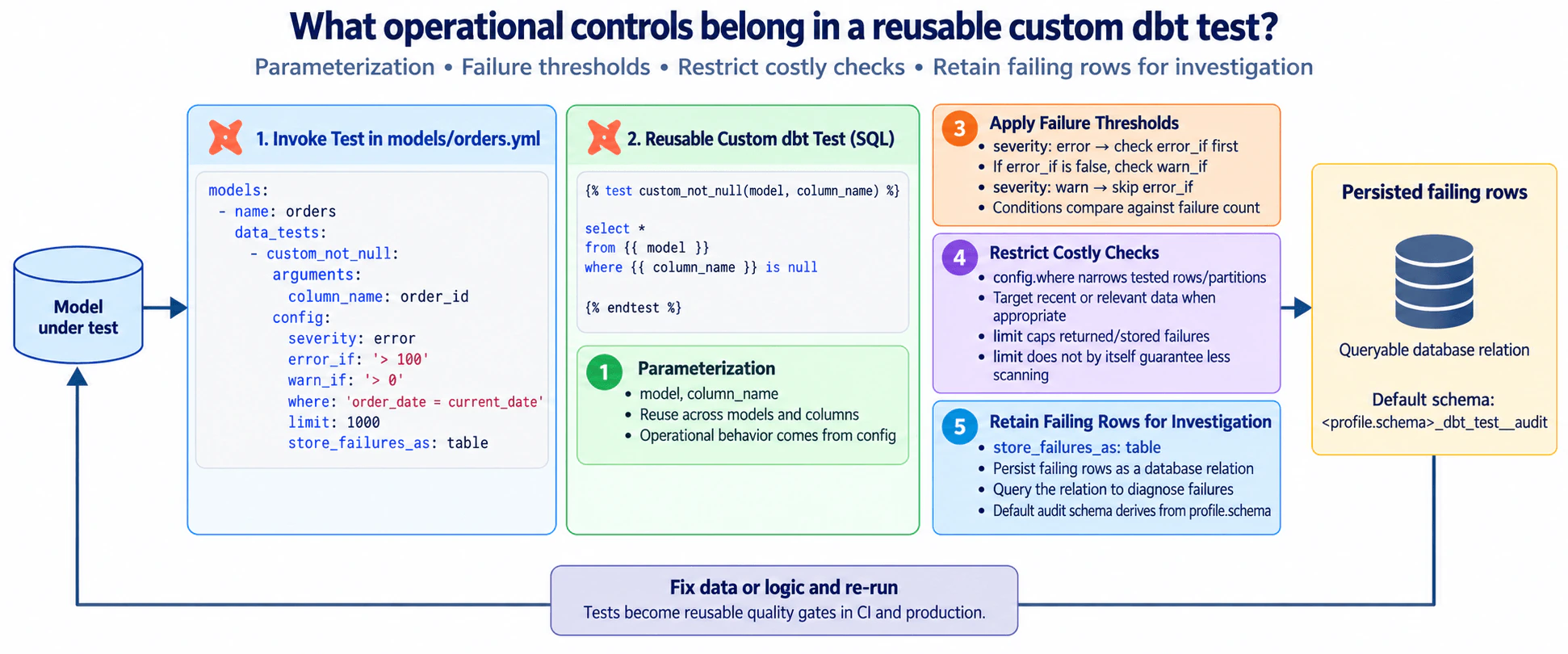
Parameterize the reusable rule, configure error_if and warn_if, narrow expensive checks with where, use limit to cap failure output, and persist failing rows with store_failures_as. Then investigate those rows, correct the data or test logic, and rerun the test to verify the fix.
Detailed Explanation
This question asks how to make one reusable check practical and safe for everyday work. The same check should work in many places without being rewritten each time. It should allow small problems to be treated differently from large problems. It should avoid looking through more information than needed when a smaller slice is enough. It should also keep the bad records so someone can study what went wrong. After the cause is corrected, the same check should run again to prove the result is now acceptable.
Useful Questions to Ask the Interviewer
Should a small number of failing rows produce a warning while a larger number should fail the run?
Can routine checks be restricted to recent or otherwise relevant rows instead of scanning all history?
Should failing rows be persisted for investigation, and are there retention or sensitive-data restrictions on them?
Will the test be used mainly in CI, scheduled production runs, or both?
How to Explain It in an Interview
I would organize the reusable test around four operational controls: parameterization, failure thresholds, cost control, and retained failure evidence.
First, I would parameterize the reusable test logic. In the diagram, the custom generic test accepts model and column_name and returns rows where the selected column is null. The same SQL/Jinja definition can therefore be reused for different models and columns. The test arguments describe what is being checked, while operational behavior such as severity, filtering, failure limits, and persistence belongs in the test config.
Second, I would make failure behavior explicit. The diagram uses severity: error, error_if: '> 100', and warn_if: '> 0'. With severity: error, dbt checks error_if first. More than 100 failures therefore return an error. If that condition is false, dbt checks warn_if; 1 through 100 failures produce a warning, and 0 failures pass. If severity is instead set to warn, dbt skips error_if and evaluates warn_if. This lets the team distinguish tolerated small problems from failures that should stop the quality gate.
Third, I would restrict costly checks with config.where. The diagram uses where: 'order_date = current_date', which filters the resource before the test condition is evaluated. That lets routine checks focus on recent or relevant rows and can reduce work when the underlying data platform can prune unrelated data. This is different from limit: 1000. The limit configuration caps the number of failing rows returned by the test query, which is useful when failures are persisted, but it does not by itself guarantee a smaller underlying scan.
Fourth, I would retain failing rows for investigation. The diagram sets store_failures_as: table, so the failing records are stored as a queryable database relation. An engineer can query that relation to determine whether the problem comes from the source data, an upstream transformation, or the test logic itself. The diagram shows the default audit schema as derived from the active profile schema and ending in _dbt_test__audit. Because failure records may contain sensitive values, access, retention, and database permissions should be considered before persistence is enabled.
Finally, I would close the loop by using the persisted evidence to diagnose the problem, correcting the data or the test logic, and rerunning the same test. The rerun provides verification that the correction worked. Used consistently, these controls turn a custom test into a reusable quality gate for CI and production.
The main tradeoff is coverage versus operating cost. Testing all historical rows gives broader coverage but may be expensive. A targeted where filter lowers routine work but can miss older defects, so a team may combine frequent scoped checks with less frequent wider validation. Persisting failures improves diagnosis but adds storage, permission, retention, and sensitive-data considerations.
Technical Approach
Define a generic test whose query returns only failing rows.
Parameterize reusable inputs such as model and column_name.
Keep operational controls in the test config.
Configure severity, error_if, and warn_if so pass, warning, and error behavior is explicit.
Add where when the routine test should cover only recent or relevant data.
Use limit to cap the number of failure rows returned or persisted, not as a substitute for reducing the source data scanned.
Set store_failures_as: table when investigators need durable failing rows.
Query those failures, identify whether the defect is in the data or test logic, make the appropriate correction, and rerun the test.
Treat the successful rerun as verification before considering the issue resolved.
Practical Insights
The largest operating cost is usually how much data the test reads. A test over all history can be expensive. A selective where filter may reduce that work when the data platform can avoid reading unrelated rows or partitions. limit controls how many failures are returned or stored, but it does not necessarily reduce the amount of source data read. Persisting failures adds storage and permission requirements. Parameterization lowers maintenance cost because one test definition can be reused instead of copying similar SQL for every model or column.
Why Interviewers Ask This
Interviewers want to see whether you can turn a simple data-quality rule into a reusable and operationally safe control. A strong answer distinguishes test inputs from configuration, understands dbt warning and error thresholds, knows how to restrict expensive checks without confusing where with limit, and preserves failing rows so engineers can investigate and verify corrections.
Common interview mistakes
Common mistakes include hard-coding model-specific values into the reusable test, mixing test arguments with operational configuration, treating every nonzero failure count as the same severity, misunderstanding the order in which error_if and warn_if are evaluated, scanning full history on every run when a justified where scope is enough, and assuming limit guarantees a cheaper scan. Another mistake is discarding failure evidence or persisting it without considering permissions, retention, storage growth, and sensitive-data exposure.
Interview tip
Structure the answer around four controls: parameterization, thresholds, cost scope, and retained failures. Explicitly distinguish where from limit: where restricts the data being tested, while limit caps failure output. Finish with the investigation, correction, and rerun loop shown in the diagram.
Interviewer may ask next
How would you configure the test so a few failures warn but many failures fail the run?
Use severity: error with both error_if and warn_if. For example, with error_if: '> 100' and warn_if: '> 0', dbt checks the error condition first. More than 100 failures return an error. If that condition is false, 1 through 100 failures satisfy the warning condition and return a warning. Zero failures satisfy neither condition and pass. The actual thresholds should come from an agreed data-quality tolerance.
What is the difference between where and limit when controlling an expensive dbt test?
where filters the resource being tested before the test condition is evaluated, so it can restrict a routine check to recent or otherwise relevant data and may reduce scan cost when the platform can prune unrelated data. limit caps the number of failing rows returned by the test query. It is useful for bounding failure output and persisted evidence, but it does not by itself guarantee that less source data is scanned.
66. How are verification and validation different in ETL testing?Testing And DebuggingMedium
i Question Details
Address a transformation that follows its mapping specification accurately but still fails the business requirement.
Short Interview Answer (30-60 seconds)
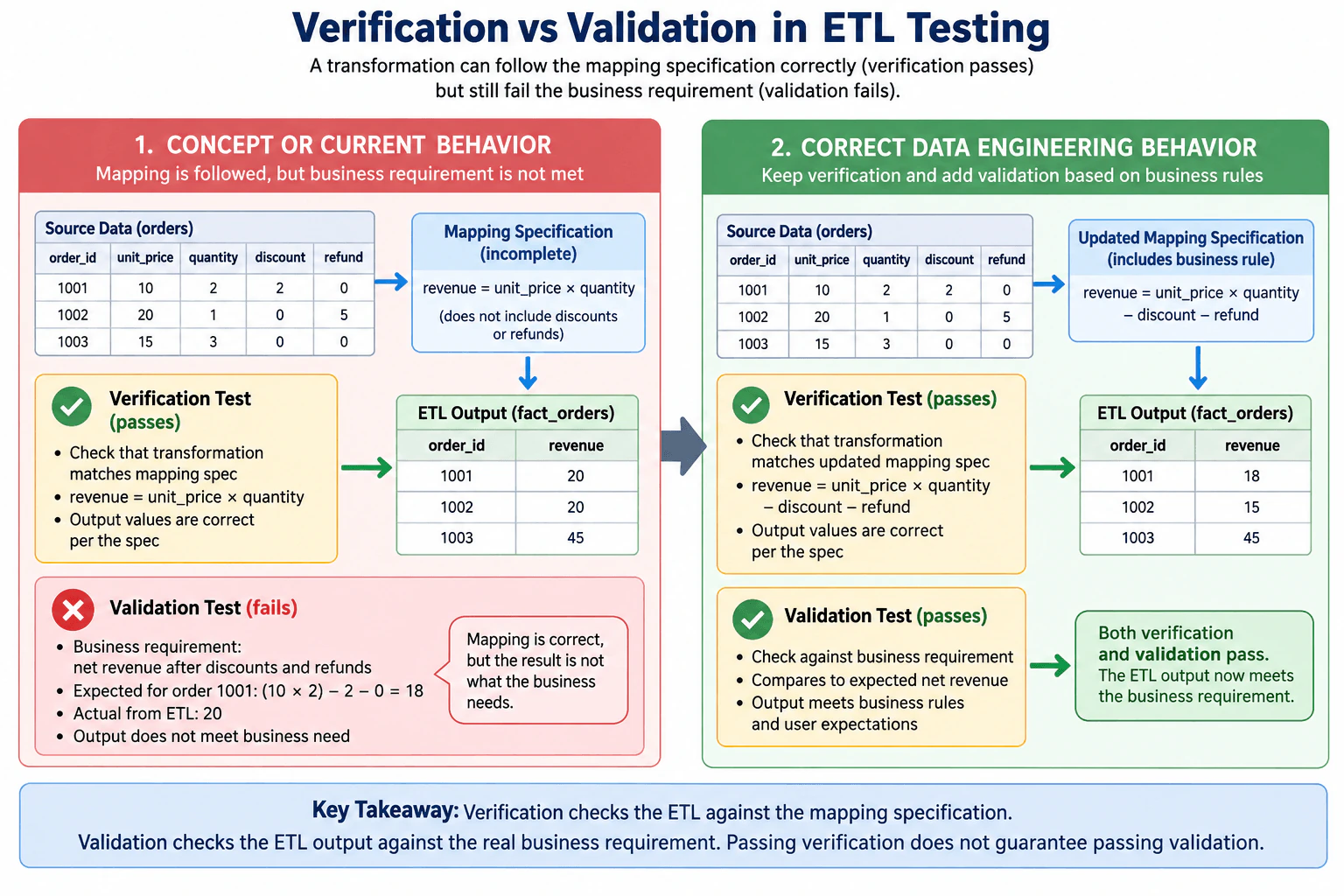
Verification asks, "Did the ETL follow the mapping specification correctly?" Validation asks, "Does the output meet the real business requirement?" A transformation can therefore pass verification but fail validation when the documented mapping is incomplete or does not represent the business rule.
Detailed Explanation
This question asks whether you can tell the difference between checking that work follows written instructions and checking that the final result is actually useful to the people who need it. A result can exactly follow the written rule and still be wrong for its real purpose. In the example, the written rule calculates money from price and quantity, so the result follows the instructions. But the people using the result need discounts and refunds included too. The correct response is to correct the written rule and test the result again.
Useful Questions to Ask the Interviewer
What is the documented mapping rule for the revenue field?
What does the business define as the expected revenue value?
Should both discounts and refunds reduce revenue?
Are there approved expected values that can be used for validation testing?
How to Explain It in an Interview
Verification checks the ETL transformation against its mapping specification. It answers: "Did we implement the documented transformation correctly?"
In the diagram, the original mapping specification says: revenue = unit_price × quantity
For order 1001, unit_price is 10 and quantity is 2. The ETL produces revenue = 20. That exactly matches the documented mapping, so verification passes. The same rule produces 20 for order 1002 and 45 for order 1003.
Validation checks the resulting data against the real business requirement. It answers: "Does this output represent what the business actually needs?"
The business requirement says revenue should represent net revenue after discounts and refunds. For order 1001, the expected value is (10 × 2) − 2 − 0 = 18, but the ETL produces 20. For order 1002, the original ETL produces 20, while the business rule expects (20 × 1) − 0 − 5 = 15. The transformation therefore implements the original mapping correctly but still fails the business requirement. Verification passes, while validation fails.
This indicates that the original mapping specification is incomplete for the stated business requirement, rather than showing that the original transformation was implemented incorrectly. After confirming the business definition, update the approved mapping to: revenue = unit_price × quantity − discount − refund
With that updated mapping, the diagram's expected outputs are 18 for order 1001, 15 for order 1002, and 45 for order 1003. Verification should confirm that the ETL follows the updated mapping specification. Validation should independently confirm that those results satisfy the business definition of net revenue. Both checks then pass.
The key distinction is that verification checks conformance to the documented specification, while validation checks whether the output fulfills the intended business use. Passing verification does not guarantee passing validation because a specification can itself be incomplete or incorrect. I would not silently change working ETL logic just to make a validation test pass. I would confirm the business requirement, update the controlled mapping and expected test cases, implement the approved change, and rerun both checks.
Technical Approach
Read the documented mapping specification and identify the exact transformation rule.
Create or review expected outputs based on that mapping.
Run verification tests and compare the ETL output with those specification-based expectations.
Separately identify the real business requirement and its expected results.
Run validation tests against the business expectations.
If verification passes but validation fails, compare the mapping specification with the business requirement instead of immediately treating the ETL implementation as defective.
Confirm the intended business rule with the appropriate owner.
Update the approved mapping specification and expected test cases.
Implement the approved transformation change.
Rerun verification against the updated mapping and validation against the business requirement.
Practical Insights
The row-level calculation is simple and adds very little processing or memory cost because each row can be evaluated independently. The more important cost is maintenance: the business requirement, mapping specification, ETL logic, and test expectations must stay synchronized. Keeping separate verification and validation checks requires extra test design and review, but it catches a valuable failure mode where code correctly implements a specification that does not represent the business need.
Why Interviewers Ask This
Interviewers want to see whether you understand that technical correctness against a specification is different from business correctness. A Data Engineer must recognize that an ETL job can implement its documented rule perfectly while the rule itself is incomplete for the intended business use. The question also tests whether you would identify the requirement or mapping problem before changing correctly implemented transformation logic.
Common interview mistakes
A common mistake is treating verification and validation as the same test. Another is assuming that passing mapping-based tests proves the business result is correct. Engineers may also change correctly implemented ETL code when the real defect is an incomplete mapping specification. Another mistake is validating only against the documented formula instead of independently checking the business expectation. In the diagram, ignoring discount and refund makes the original output conform to the original mapping while producing the wrong net revenue for orders 1001 and 1002.
Interview tip
Use the simple distinction: verification means "built according to the specification," while validation means "meets the business need." Then use the diagram's concrete example: revenue = unit_price × quantity passes verification, but validation fails because net revenue must subtract discounts and refunds. Finish by explaining that the approved mapping and its tests should be updated before rerunning both checks.
Interviewer may ask next
What would you do if verification passes but validation fails?
I would first confirm the business expectation and compare it with the documented mapping. If the transformation matches the mapping exactly, I would investigate the mapping or requirement before changing the implementation. In this example, the original rule revenue = unit_price × quantity ignores discount and refund. After confirming that the business needs net revenue, I would update the approved mapping to revenue = unit_price × quantity − discount − refund, update the expected test values, implement the approved change, and rerun both verification and validation.
Why should verification still be rerun after the business rule is corrected?
Because validation and verification answer different questions. Updating the business rule changes the mapping specification, so verification must confirm that the ETL now implements that new specification correctly. Validation must then independently confirm that the resulting values satisfy the business requirement. In the diagram, the updated transformation produces 18, 15, and 45. Verification confirms those values follow the updated formula, while validation confirms they represent the required net revenue.
67. How would you test type conversions in an ETL mapping?Testing And DebuggingMedium
i Question Details
Consider precision loss, changed date representations, shortened strings, and identifiers whose leading zeros must survive.
Short Interview Answer (30-60 seconds)
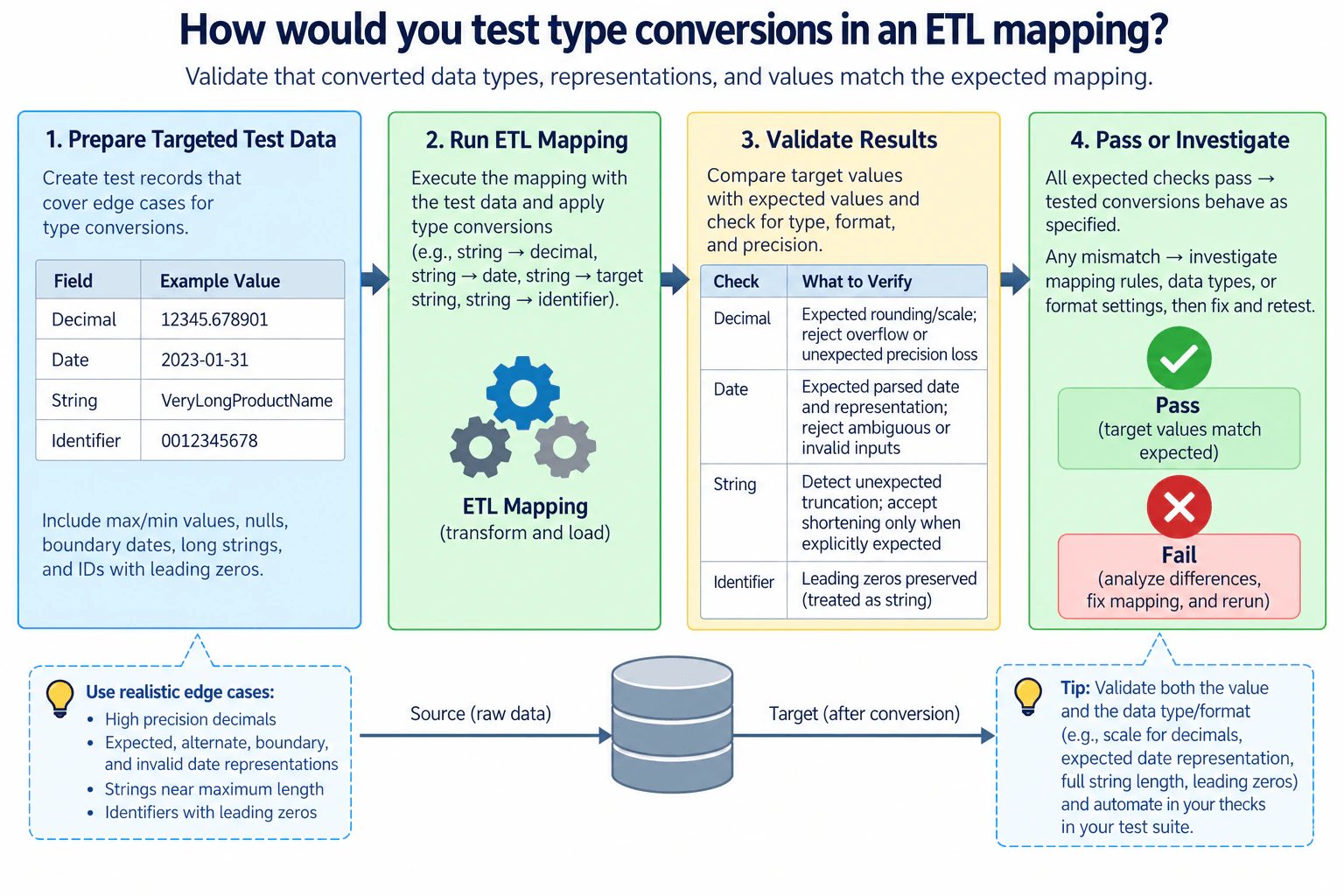
I would create edge-case source records, run the ETL mapping, and compare target types and values with explicit expected results. I would test decimal rounding and overflow, date parsing and representation, unexpected string truncation, nulls, invalid values, and identifiers whose leading zeros must remain intact.
Detailed Explanation
The goal is to prove that information still has the expected meaning after the ETL mapping converts it. I would prepare examples that are easy to mishandle: precise numbers, boundary or invalid dates, long text, null values, and identifiers that start with zero. Then I would run those records through the mapping and compare each result with a known expected result. A test should fail when a value is unexpectedly rounded, shortened, rejected, interpreted differently, or stripped of meaningful zeros. These checks should also run automatically after mapping changes.
Useful Questions to Ask the Interviewer
What source and target types are defined for each field?
What rounding and scale behavior is expected for decimal values?
Which date representations are accepted, and what target representation is expected?
Is string shortening ever intentional, or should overlength values be rejected?
Which identifiers must remain textual so leading zeros survive?
How should null, invalid, ambiguous, and out-of-range values be handled?
How to Explain It in an Interview
I would treat every type conversion as a contract between a source value and an expected target value and type.
First, I would prepare targeted test data. For decimals, I would include high-precision values, values near the target precision and scale boundaries, nulls, and values that may exceed the target range. I would assert the exact expected rounding or scale behavior. Expected rounding can be correct behavior; unexpected precision loss or overflow is a failure.
For dates, I would test the expected input representation, any alternate representations that the mapping intentionally accepts, boundary dates, and ambiguous or invalid inputs. I would compare the parsed target value and representation with the expected mapping instead of assuming the original source text must remain unchanged.
For strings, I would test values below, at, and above the expected target length. If shortening is not part of the mapping contract, truncation is a failure. If shortening is intentional, I would assert the exact expected shortened result so silent data loss is not mistaken for success.
For identifiers, I would use values such as "0012345678" and compare the exact target value. When leading zeros are meaningful, the identifier should remain in a textual representation rather than being treated as a number. A result such as "12345678" would fail because the identifier changed.
Next, I would run the ETL mapping and validate both the converted value and its resulting type or representation. This matches the core flow: prepare targeted test data, run the mapping, validate results, and then either pass or investigate. A passing case means the tested conversion behaves as specified. A mismatch means I inspect the mapping rule, target type, or format setting, correct the issue, and rerun the same test case.
Finally, I would automate these assertions in the ETL test suite. The main tradeoff is strictness versus intentional conversion behavior. Rounding, alternate date parsing, or string shortening can be valid only when the mapping explicitly requires them and the expected behavior is encoded in the tests.
Technical Approach
List each source-to-target conversion and define the expected target type, value, and allowed representation changes.
Create targeted test records for normal values, nulls, boundaries, and invalid inputs.
For decimals, test expected rounding and scale, plus overflow and unexpected precision loss.
For dates, test expected, alternate, boundary, ambiguous, and invalid representations according to the mapping contract.
For strings, test values below, at, and above the target length and distinguish intentional shortening from unexpected truncation.
For identifiers, assert exact textual equality so leading zeros survive.
Run the ETL mapping.
Compare actual target values and types with the expected results.
If a mismatch occurs, inspect the mapping rule, target type, or representation setting.
Correct the mapping and rerun the same cases.
Add the checks to the automated regression test suite.
Practical Insights
These tests usually use a small number of carefully chosen records, so runtime and memory cost are low. The main cost is maintaining expected results as approved mapping rules change. Adding more boundary and invalid cases slightly increases test time, but it reduces the risk of silent data corruption. Automated checks also add a small amount of pipeline or CI runtime, which is usually much cheaper than finding precision loss, truncation, bad dates, or damaged identifiers after data has been published.
Why Interviewers Ask This
This question tests whether the candidate treats type conversion as a data-correctness contract rather than merely checking that a cast succeeds. The interviewer is looking for boundary testing, explicit expected results, awareness of precision and representation changes, protection against silent truncation, preservation of identifier semantics, and repeatable regression testing.
Common interview mistakes
Common mistakes are checking only whether the ETL job completes, testing only ordinary values, ignoring target data types, assuming all decimal rounding is an error, accepting silent string truncation, converting meaningful identifiers to numeric types, testing only one date representation, ignoring ambiguous or invalid dates, skipping null and boundary cases, and failing to automate the tests. Another mistake is treating every representation change as a failure even when that change is explicitly required by the mapping contract.
Interview tip
Structure the answer around four risks: decimal precision, date representation, string length, and leading-zero identifiers. For each one, state the test input, expected target result, and failure condition. Then explain that both target values and target types or representations should be validated automatically.
Interviewer may ask next
How would you test a decimal conversion when the target has a smaller scale than the source?
I would first define the expected target precision, scale, and rounding behavior. Then I would test values with fewer, equal, and more fractional digits than the target permits, plus boundary values and values that may overflow. I would compare the exact target result with the expected rounded value. Expected rounding can pass when it is part of the mapping contract; unexpected precision loss, overflow, or inconsistent behavior should fail.
What would you do if a source identifier such as 001234 is loaded as 1234?
I would treat that as a failed conversion because the leading zeros are part of the identifier. I would inspect the mapping and target type and keep the identifier in a textual representation when arithmetic is not its purpose. The regression test would assert exact equality between the expected value "001234" and the target value so loss of leading zeros cannot recur silently.
68. How would you verify that an ETL pipeline preserves character encoding?Testing And DebuggingMedium
i Question Details
Describe tests using accented text, non-Latin characters, and emoji across source and destination encodings.
Short Interview Answer (30-60 seconds)
I would send known accented text, non-Latin characters, and emoji through the ETL pipeline, decode the destination with its intended encoding, and compare the resulting Unicode text exactly with the source. I would fail or quarantine data if characters are lost, replaced, or garbled.
Detailed Explanation
I would start with a small set of known words and symbols that are easy to recognize. The set should include accented letters, writing systems from different languages, and emoji. I would send those values through the same path as normal data and then read them back from the final location. The returned text must be exactly the same as the original text. I would also look for missing symbols, changed letters, replacement characters, or strange-looking output. If a value cannot be stored safely, I would keep it separate instead of silently changing it.
Useful Questions to Ask the Interviewer
What encoding is declared by the source?
What encoding or character set is expected at the destination?
Are source and destination expected to use the same encoding, or is transcoding allowed?
Does the pipeline process files, database text columns, messages, or several of these?
Should values that cannot be represented by the destination encoding fail the load or be quarantined?
How to Explain It in an Interview
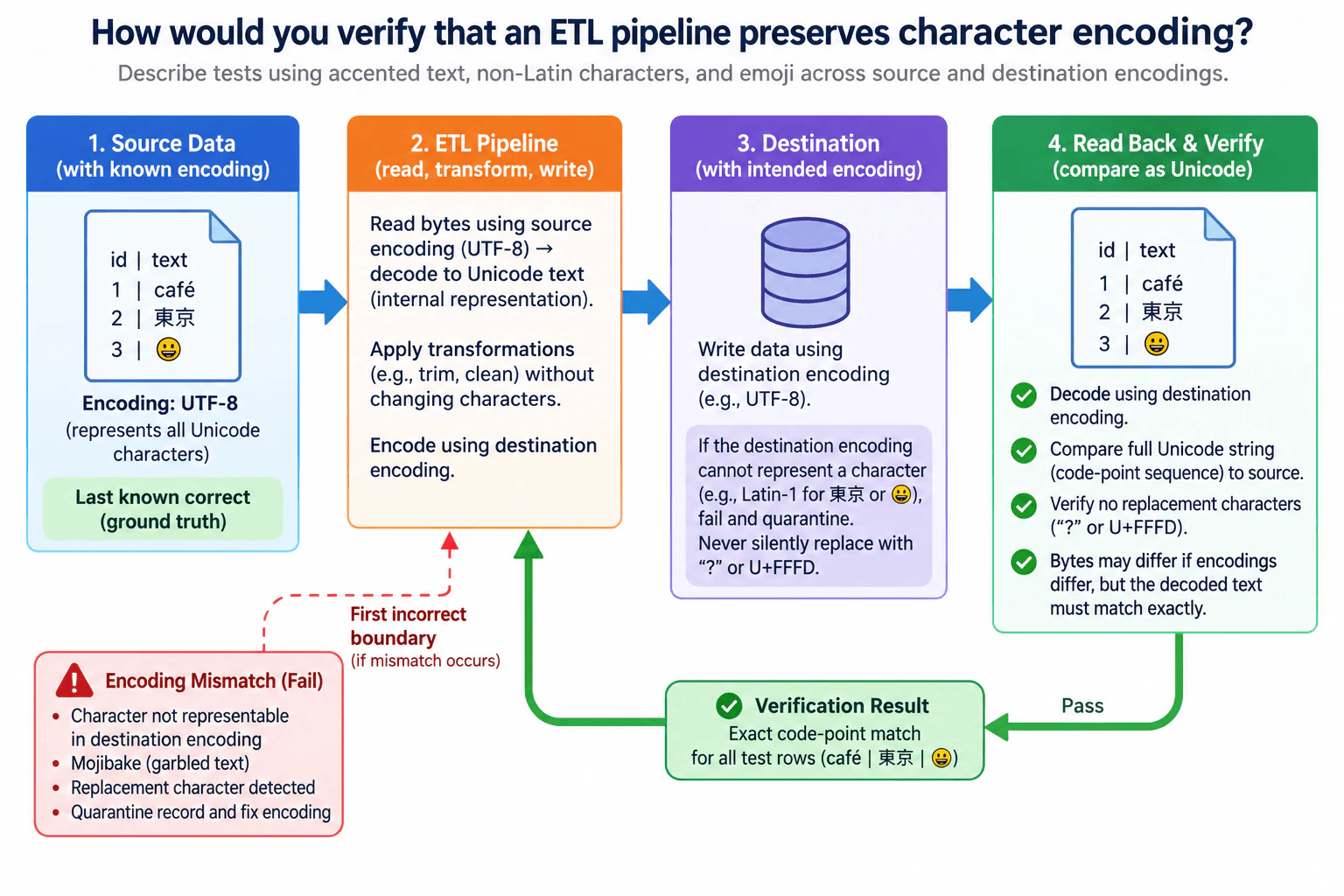
I would begin with controlled ground-truth rows such as café for accented Latin text, 東京 for non-Latin text, and 😀 for emoji. The source is the last known correct boundary because I know exactly which Unicode characters should be present before the pipeline runs.
First, I would decode the source bytes using the declared source encoding, such as UTF-8. After decoding, the pipeline should operate on Unicode text. Transformations such as trimming or cleaning must not unintentionally change the test characters.
Next, I would write the text using the intended destination encoding. For example, if the destination uses UTF-8, all three test values can be represented. If a destination encoding cannot represent a required character, such as Latin-1 for 東京 or 😀, the safe behavior is to fail or quarantine the affected record rather than silently replace the character.
Then I would read the destination back using its declared encoding and compare the complete decoded Unicode value with the source ground truth. I would compare the full string or its Unicode code-point sequence. The pass condition is an exact decoded-text match for every test row.
I would not require raw source and destination bytes to match when intentional transcoding occurs. Different encodings can use different byte sequences for the same text. In that case, decoded Unicode equality is the correct test.
I would also verify that no character has been replaced, dropped, or garbled. I would look for unexpected ?, the Unicode replacement character U+FFFD, missing characters, and mojibake, which is garbled text caused by decoding bytes with the wrong character encoding. An expected literal question mark in the source would not be treated as an error because the final value is compared against the known source string.
If a mismatch occurs, I would inspect the value at each pipeline boundary to find the first incorrect boundary while keeping the original source as the last known correct ground truth. If corruption appears immediately after the read step, I would investigate source decoding. If the text stays correct through transformation but changes after the destination write or read, I would investigate destination encoding or transcoding.
The safe response is to quarantine affected records, correct the smallest encoding or conversion defect, and rerun only the affected test scope. I would not publish corrected data until the destination values have been read back and reconciled exactly with the source.
Technical Approach
Create ground-truth rows containing accented text such as café, non-Latin text such as 東京, and emoji such as 😀.
Record the source encoding and verify that the source bytes decode correctly.
Run the test rows through the normal ETL read, transformation, and write path.
Verify that transformations operate on decoded text and do not unintentionally change characters.
Encode the output using the intended destination encoding.
If a required character cannot be represented by that encoding, fail or quarantine the record instead of silently replacing it.
Read the destination back using the destination encoding.
Compare the complete decoded Unicode string or code-point sequence with the source ground truth.
Check for unexpected ?, U+FFFD, missing characters, mojibake, or other substitutions.
If a mismatch occurs, inspect each boundary to identify the first incorrect boundary and the last known correct boundary.
Correct the smallest encoding defect, rerun the affected scope, and require exact source-to-destination text reconciliation before considering the test successful.
Practical Insights
For n characters, comparing the source and destination text takes about O(n) time because each character must be checked. Memory can be O(n) when both strings are held at once, although records can also be checked one at a time. Operational cost is low for a small integration test. The main maintenance cost is keeping representative characters and expected encodings up to date as sources and destinations change.
Why Interviewers Ask This
This question tests whether the candidate understands the difference between encoded bytes and Unicode text, can design representative encoding tests, can locate the boundary where corruption begins, and knows how to prevent silent character replacement or data loss when text moves between systems.
Common interview mistakes
Common mistakes are testing only ASCII, assuming a successful ETL job means text was preserved, relying on implicit encodings, comparing raw bytes even when intentional transcoding is allowed, and checking only whether the destination value is non-null. Another mistake is silently accepting replacement characters, question-mark substitutions, dropped text, or mojibake. The correct test uses known multilingual and emoji values and compares the decoded destination text exactly with the source ground truth.
Interview tip
Explain the test as one end-to-end flow: known Unicode ground truth → explicit source decoding → transformations → explicit destination encoding → read back → exact Unicode comparison. Mention that bytes may differ across valid encodings, and emphasize failing or quarantining unrepresentable characters rather than silently replacing them.
Interviewer may ask next
What if the source and destination use different character encodings?
I would treat that as intentional transcoding. I would decode the source bytes using the source encoding, obtain the Unicode text, encode that text using the destination encoding, and then read it back using the destination encoding. I would compare the decoded Unicode text with the original Unicode text rather than requiring identical raw bytes. If the destination encoding cannot represent a required character, I would fail or quarantine the record instead of silently substituting another character.
How would you troubleshoot a case where café is correct but non-Latin text or emoji is corrupted?
I would keep the source as the ground truth and inspect the value after each boundary: source decode, ETL read, transformation, destination write, and destination read. The first boundary where the Unicode text changes identifies the likely defect. I would check for an encoding that cannot represent those characters, incorrect decoding, implicit conversion, unexpected replacement characters, or mojibake. I would quarantine affected records, correct the encoding configuration, rerun the affected scope, and require exact Unicode reconciliation before publication.
69. How would you implement selective continuous integration for a dbt project?Testing And DebuggingHard
i Question Details
Address production manifests, state:modified+, deferral to unchanged upstream relations, and isolated pull-request schemas.
Short Interview Answer (30-60 seconds)
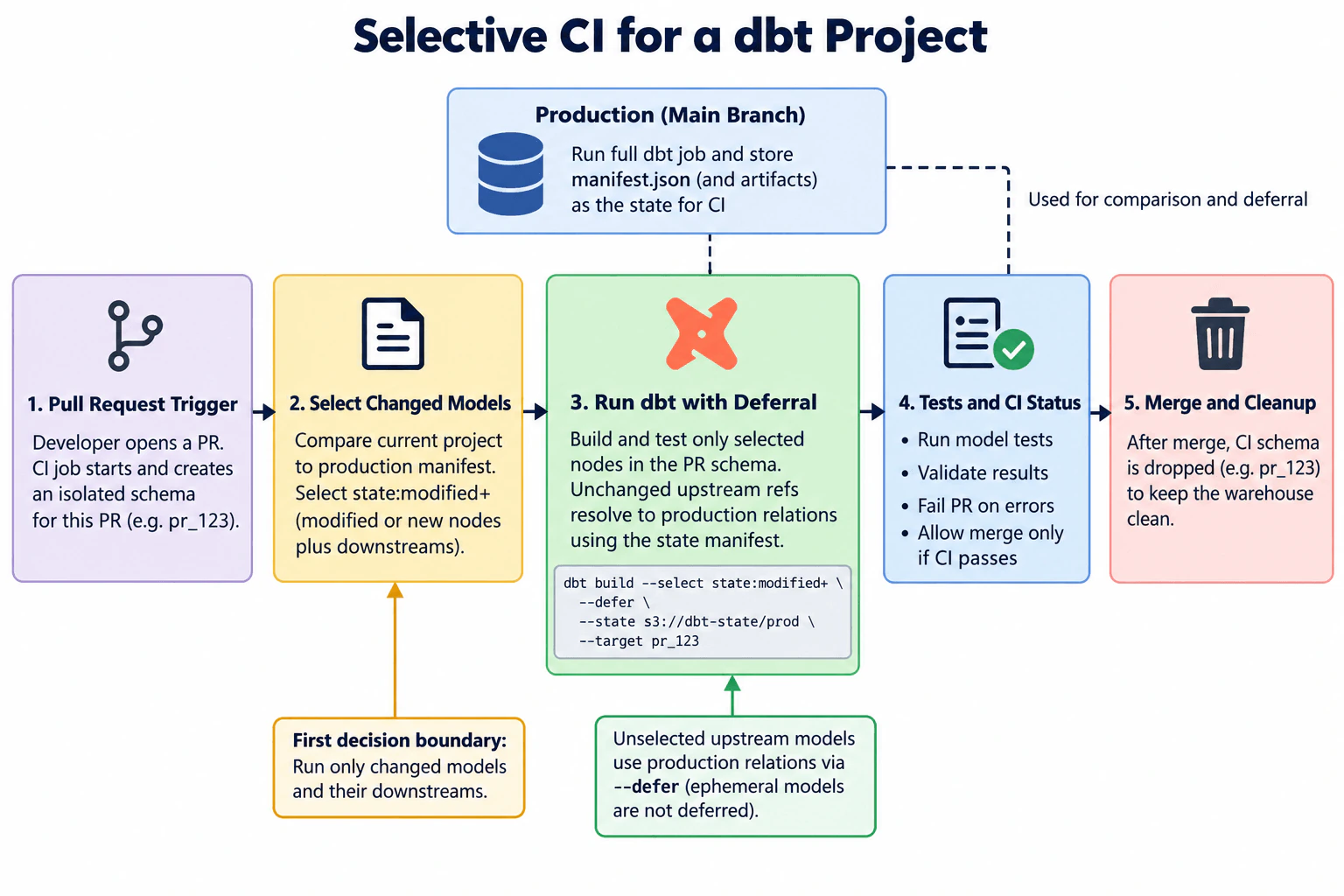
Keep the production manifest as CI state, give every pull request its own schema, select state:modified+, and run dbt build with --defer. Changed nodes and downstreams build in the PR schema, eligible unchanged upstream refs use production relations, and merge happens only after the build and tests pass.
The goal is to check only the parts of the project that a proposed change can affect instead of rebuilding everything each time. I would keep a trusted description of the last successful live version, give every proposed change its own temporary workspace, compare the new version with the trusted one, and process only what changed plus anything that depends on it. Unchanged earlier results can be reused. The change is accepted only after its work and checks succeed. The temporary workspace is then removed when the change is accepted or abandoned.
Useful Questions to Ask the Interviewer
Where is the manifest from the last successful production run stored, and how does CI retrieve it?
Does each pull request already receive a unique warehouse schema, or should the CI workflow create one?
Should state:modified+ be the default selector for all pull requests, or are there models or tests that must always run?
Is the isolated PR schema guaranteed to start empty, or should CI use --favor-state when production state must take precedence over existing development relations?
How to Explain It in an Interview
I would start with the last successful production dbt run. That run produces manifest.json, which describes the dbt project graph and node definitions. I would retain that manifest in dedicated state storage so CI has a trusted production baseline for later comparisons.
When a pull request starts, CI creates or targets a unique schema such as pr_123. That schema is the execution target for the pull request. It prevents two pull requests from writing into the same namespace and prevents CI from writing selected models into the production schema.
Next, CI compares the pull-request project with the production manifest using dbt state selection. The selector state:modified+ starts with nodes that dbt considers modified relative to the supplied state and expands the selection to their downstream descendants. The trailing plus matters because an unchanged downstream model can still be affected by a changed upstream model.
Then CI runs dbt build with --defer and the same production state. In a fresh isolated PR schema, eligible unselected upstream refs can resolve to the corresponding production relations represented by that state instead of being rebuilt. This is the selective part of the design. Ephemeral models are not deferred because they do not exist as persistent warehouse relations; their SQL is compiled into dependent nodes.
The production manifest and the PR schema serve different purposes. The manifest is the comparison and deferral state. The PR schema is the write target for selected CI work. Keeping those boundaries separate avoids accidentally using CI output as the trusted production baseline.
The main tradeoff is speed versus complete environmental independence. Deferral reduces warehouse work because unchanged upstream relations can be reused from production. However, the pull-request build is therefore not a full isolated rebuild of the entire project. If production data cannot safely be referenced, or if a particular integration test requires complete isolation, that part of the graph should be built in a separate test environment instead of deferred.
Finally, dbt build executes the selected resources and applicable tests. A nonzero dbt exit status fails CI and blocks the merge. If CI passes, the pull request can merge. When the pull request is merged or closed, the temporary PR schema is removed. After the next successful production run, its new manifest becomes the trusted state baseline for future pull requests.
Key Insight / Why This Solution Works
Run the normal production dbt job and retain manifest.json from the last successful production run.
Store that artifact in dedicated production-state storage, separate from pull-request targets.
When a pull request starts, create or select a unique schema such as pr_123.
Retrieve the production manifest into a local state directory available to the CI runner.
Run dbt with state:modified+ so modified nodes and their downstream descendants are selected.
Enable --defer and point --state at the production manifest directory.
Build selected resources in the isolated PR schema while eligible unselected upstream refs resolve to production relations.
Let dbt build execute the applicable tests for the selected graph.
Treat any nonzero dbt exit status as a failed CI check and block the merge.
Allow the merge only after CI succeeds.
Drop the temporary PR schema after the pull request is merged or closed.
Publish the manifest from the next successful production run as the new CI baseline.
Code
#!/usr/bin/env python3.14# Create a dedicated local directory for the trusted production state artifact.# Diagnostic intent: keep comparison state separate from the PR target directory.# Safety: this creates only a local CI workspace directory and does not modify warehouse data.from pathlib import Path
import subprocess
prod_state = Path("./prod_state")
prod_state.mkdir(parents=True, exist_ok=True)
# The CI system should retrieve manifest.json from the last successful production run# into ./prod_state before dbt starts. The storage-provider command is intentionally# omitted because no artifact provider was specified and no credentials should be invented.# Expected evidence: the trusted production manifest exists at this exact local path.
manifest = prod_state / "manifest.json"ifnot manifest.is_file():
print("Production manifest is missing")
raise SystemExit(1)
# Run only nodes modified relative to production plus their downstream descendants.# --defer lets eligible unselected upstream refs use relations represented by production state.# --state points to the local directory containing the trusted production manifest.# --target must be configured to use this PR's isolated schema, for example pr_123.# Safety: verify that target pr_123 never writes to the production schema before enabling CI.
result = subprocess.run(
[
"dbt",
"build",
"--select",
"state:modified+",
"--defer",
"--state",
"./prod_state",
"--target",
"pr_123",
],
check=False,
)
# Verification: dbt returns a nonzero exit status when the selected build or tests fail.# CI must propagate that status so a failure blocks the pull request from merging.
dbt_status = result.returncode
if dbt_status != 0:
print("Selective dbt CI failed; merge must remain blocked")
raise SystemExit(dbt_status)
# A zero exit status means the selected dbt build and applicable tests completed successfully.# State-changing cleanup is intentionally not executed here because schema-drop syntax is# warehouse-specific. Cleanup should run only after the PR is merged or closed.# Rollback for failed cleanup: retain the isolated schema name and retry only that cleanup;# never delete or overwrite production relations as a recovery action.print("Selective dbt CI passed")
Why Interviewers Ask This
The interviewer is testing whether you understand dbt state comparison, graph-aware selection, production artifacts, deferral, environment isolation, and the tradeoff between fast CI and a completely independent rebuild. A strong answer should also show that production remains the trusted baseline while pull-request writes stay isolated.
Common interview mistakes
Common mistakes are comparing against a manifest produced by the current PR instead of the last successful production manifest; putting production state and the PR target in the same directory or namespace; using state:modified without considering affected downstream descendants; rebuilding the whole upstream graph instead of using deferral; assuming ephemeral models can be deferred; reusing one schema for multiple simultaneous pull requests; configuring the PR target to write into production; assuming --defer always prefers production even when relations already exist in the current target; treating a successful model build as sufficient while ignoring tests; and leaving disposable PR schemas behind after pull requests are closed.
Interview tip
Present the design as four boundaries: production manifest for state, state:modified+ for selection, --defer for eligible unchanged upstream refs, and one disposable schema per pull request. Then state the safety rule clearly: selected CI work writes only to the PR schema, and merge is blocked unless dbt build and its applicable tests succeed.
Interviewer may ask next
Why use state:modified+ instead of only state:modified?
state:modified starts with nodes whose definitions differ from the supplied production state. The trailing + expands that selection to downstream descendants. That is important because a downstream model can produce different output even when its own file did not change if one of its upstream dependencies changed. Using state:modified+ therefore tests the affected dependency path rather than only directly edited nodes.
What edge case should you consider when using --defer with an isolated PR schema?
Deferral is safest when the PR schema is fresh. For an eligible unselected node, dbt can use the relation represented by the production state when the corresponding relation is not present in the current target. If stale relations already exist in the PR schema, they can affect resolution. The cleanest approach is to create a fresh schema per pull request. If the intended policy is to prefer the state relation even when a current-target relation exists, evaluate --favor-state deliberately rather than assuming ordinary --defer always does that.
70. What is SQL, and how do data engineers use it?CodingEasy
i Question Details
Define SQL as a declarative language for defining, querying, and changing relational data. Explain tables, rows, columns, keys, SELECT, filtering, joins, grouping, window functions, transactions, and set-based operations. Connect SQL to transformation, validation, warehouse modeling, and pipeline work, while noting that SQL dialects and engine behavior differ.
Short Interview Answer (30-60 seconds)
SQL is a declarative language for defining, querying, and changing relational data. I use it to work with tables, rows, columns, and keys. SQL lets me select and filter records, join related tables, aggregate data, use window functions, and make controlled changes with transactions. In data engineering, I use SQL to transform, validate, and model warehouse data inside pipelines. There is no single time or space complexity because performance depends on the query, data, indexes, execution plan, and database engine.
Detailed Explanation
SQL gives us a simple way to describe what data we want or what change we want to make. Relational data is stored in tables. Rows represent records, columns represent fields, and keys identify or connect records. Data engineers use SQL to read, filter, combine, summarize, transform, validate, and model data. They also use it inside pipelines that move data from source systems into warehouses and then to downstream users. The exact syntax and execution behavior can differ between SQL platforms.
Useful Questions to Ask the Interviewer
Would you like a conceptual explanation, or should I also show small SQL examples?
Should I discuss a particular SQL database or warehouse dialect?
How to Explain It in an Interview
1. Start with relational data
A relational system organizes data into tables. A row represents one record. A column represents one field. In the diagram, the customers table contains customer_id, name, email, and country. The customer_id column is the primary key, so it uniquely identifies each customer. The orders table contains order_id, customer_id, order_date, and amount. Its customer_id is a foreign key that links each order to a customer.
2. Explain what declarative SQL means
SQL is declarative. I describe the result I want instead of writing every low-level processing step. For example, SELECT customer_id, name FROM customers; asks the database for two columns. A statement such as CREATE TABLE can define relational structures, while statements such as SELECT query data and statements such as UPDATE change data. The database engine decides how to execute the request.
3. Cover the common SQL operations
SELECT reads data. WHERE filters rows. The diagram shows SELECT * FROM orders WHERE amount > 100;, which keeps only orders above 100. A JOIN combines related tables. The diagram joins orders and customers using o.customer_id = c.customer_id. GROUP BY creates groups so aggregate functions such as COUNT and SUM can summarize each customer's orders.
4. Explain window functions, set operations, and transactions
A window function calculates across related rows while keeping the individual rows in the result. The diagram uses ROW_NUMBER() with PARTITION BY customer_id and ORDER BY order_date to number each customer's orders by date. SQL also supports set-based operations. The diagram uses UNION to combine the results of two queries. Transactions group related changes into one logical unit. The diagram starts a transaction with BEGIN, updates order 101, and finishes with COMMIT.
5. Connect SQL to data engineering work
The diagram shows data moving from source systems to ingestion, SQL transformation, a data warehouse, SQL validation, and then consumers. Data engineers use SQL to clean and standardize data, join multiple sources, aggregate metrics, build warehouse models, and run data-quality checks. Warehouse models can include fact and dimension tables. SQL work can also be part of repeatable pipelines run with data-transformation or orchestration tools. The final trusted data can serve analytics, business intelligence, machine learning, and other downstream uses.
6. Explain the important platform difference
SQL has common concepts, but SQL dialects and database engines are not identical. PostgreSQL, MySQL, SQL Server, Snowflake, BigQuery, and other systems can differ in syntax, functions, supported features, transaction behavior, and query optimization. A data engineer should understand the general SQL ideas and also check the rules and documentation for the specific platform being used.
Key Insight / Why This Solution Works
This is a conceptual SQL question, so there is no single algorithm or data structure to select. The central idea is relational and set-based processing. Tables contain rows and columns. Primary keys uniquely identify rows, and foreign keys connect related tables. SQL statements describe the desired result or data change. The database engine chooses the physical execution plan. Data engineers combine filtering, joins, grouping, window functions, set operations, and transactions to transform and validate data. The key invariant is that each operation must preserve the intended meaning and grain of the data while using the correct keys and relationships.
Time & Space Complexity
There is no single time complexity or auxiliary space complexity for SQL as a language. Performance depends on the exact query, number of rows, indexes, join strategy, grouping or sorting work, available memory, data distribution, and the execution plan chosen by the engine. For example, a filter that can use a suitable index may behave very differently from a full table scan. Joins can also use different execution strategies. In practice, a data engineer checks the query plan and engine behavior when query performance matters.
Where it is used
Data engineers use SQL throughout data pipelines and data warehouses. They use it to select and filter source data, join datasets, calculate aggregates, create or maintain modeled tables and views, build fact and dimension models, perform data-quality checks, and prepare trusted datasets for analytics, business intelligence, machine learning, and other downstream consumers.
Why Interviewers Ask This
The interviewer is checking whether you understand SQL beyond basic SELECT statements. They want to see whether you understand relational tables, rows, columns, keys, filtering, joins, aggregation, window functions, transactions, and set-based processing. They also want to know whether you can connect those concepts to real data-engineering work such as transformations, data-quality validation, warehouse modeling, and pipelines. Mentioning dialect and engine differences shows that you understand SQL behavior is not identical across platforms.
Common interview mistakes
A common mistake is describing SQL only as a language for reading data and forgetting that it can also define and change relational data. Another mistake is confusing rows with columns or primary keys with foreign keys. Candidates may join tables without using the correct relationship key. They may also use GROUP BY without realizing that aggregation changes the result grain. Another common mistake is treating a window function like a normal aggregation even though a window function can keep individual rows. Finally, candidates should not assume every SQL dialect has identical syntax, functions, transaction behavior, or execution characteristics.
Interview tip
Explain SQL from a data engineer's point of view. Start with tables and keys, then describe SELECT, filtering, joins, grouping, window functions, set operations, and transactions. Finish by connecting those operations to transformation, validation, warehouse modeling, and repeatable pipeline work.
Interviewer may ask next
What is the difference between GROUP BY and a window function?
GROUP BY normally combines many input rows into fewer result rows. For example, grouping by customer_id can produce one row per customer with COUNT(*) and SUM(amount). A window function can calculate across related rows while keeping the individual rows. In the diagram, ROW_NUMBER() partitions rows by customer_id and orders them by order_date, so every order remains visible while receiving a position within that customer's orders.
Why do SQL dialects and engine behavior matter to a data engineer?
The main relational ideas are shared, but platforms can differ in syntax, functions, supported features, transaction rules, and query optimization. The same logical task may therefore require slightly different SQL or behave differently on another engine. A data engineer should preserve the intended schema, keys, data grain, and transformation logic while checking the documentation and execution behavior of the actual database or warehouse being used.
More questions load as you scroll
Disclaimer: This interview guide is for educational and informational purposes only. It is designed to help readers prepare, but it does not guarantee any interview result, hiring decision, offer, or outcome. Interview questions, hiring criteria, and preferred answers can vary by employer, interviewer, industry, location, and time. All answers, examples, and explanations in this guide are suggested examples for interview preparation, not definitive answers or instructions for professional practice. They are based on research and judgment, are provided without warranties of any kind, and should be adapted to the question, role, and applicable laws and professional requirements. Diagrams are simplified illustrations intended to highlight the main concepts and their relationships; actual situations, systems, and practices may be more complex. Alternative approaches may be equally valid or better suited to a particular question, context, or interviewer. To the fullest extent permitted by applicable law, the contributors and publisher are not liable for decisions made, actions taken, or losses incurred based on this guide.
State Laws and Professional Responsibilities: Laws and requirements governing an occupation vary by state and jurisdiction. You are responsible for checking the current laws, licensing requirements, and scope-of-practice rules that apply to your location and role, and for ensuring that your answers and actions comply with them. Adapt examples in this guide to those requirements. This guide is not legal advice.
Content Accuracy and Verification: To the fullest extent permitted by applicable law, we do not represent or warrant that interview guides, questions, answers, examples, or diagrams are accurate, complete, current, error-free, or suitable for any particular purpose. You are responsible for independently reviewing and verifying the information before relying on it.