This interview guide is for educational and informational purposes only. It is designed to help readers prepare, but it does not guarantee any interview result, hiring decision, offer, or outcome. Interview questions, hiring criteria, and preferred answers can vary by employer, interviewer, industry, location, and time. All answers, examples, and explanations in this guide are suggested examples for interview preparation, not definitive answers or instructions for professional practice. They are based on research and judgment, are provided without warranties of any kind, and should be adapted to the question, role, and applicable laws and professional requirements. Diagrams are simplified illustrations intended to highlight the main concepts and their relationships; actual situations, systems, and practices may be more complex. Alternative approaches may be equally valid or better suited to a particular question, context, or interviewer. To the fullest extent permitted by applicable law, the contributors and publisher are not liable for decisions made, actions taken, or losses incurred based on this guide.
State Laws and Professional Responsibilities
Laws and requirements governing an occupation vary by state and jurisdiction. You are responsible for checking the current laws, licensing requirements, and scope-of-practice rules that apply to your location and role, and for ensuring that your answers and actions comply with them. Adapt examples in this guide to those requirements. This guide is not legal advice.
Identity, Image, and Privacy Notice
To respect individual privacy, some names, profile photographs, avatars, biographical details, and other identifying information displayed in this guide may be replaced with pseudonyms, licensed stock images, illustrative avatars, composite images, or representative descriptions. Unless a person is expressly identified as an actual contributor, a displayed name, image, or profile should not be understood as depicting or identifying a specific candidate, interviewer, employee, or other real individual. These representations are provided for editorial and illustrative purposes only and do not imply endorsement, employment, participation, or affiliation with this guide or any company mentioned in it. Any resemblance to an actual person is coincidental.
Company Notice
This guide is an independent educational resource and is not affiliated with, endorsed by, sponsored by, or approved by the company named in this guide. Company names identify reported interview experiences or the employer context of clearly labeled original practice exercises. Interview practices can change without notice, and inclusion of company-specific content does not mean these questions are official, complete, or guaranteed to be asked. To the fullest extent permitted by law, the author, contributors, and publisher are not responsible for outcomes related to use of this material.
Content Accuracy and Verification
To the fullest extent permitted by applicable law, we do not represent or warrant that interview guides, questions, answers, examples, or diagrams are accurate, complete, current, error-free, or suitable for any particular purpose. You are responsible for independently reviewing and verifying the information before relying on it.
Questions or comments?
Contact us for general questions, or share feedback, technical corrections, and comments with the community.
71. What is Python, and how is it used in data engineering?CodingEasy
i Question Details
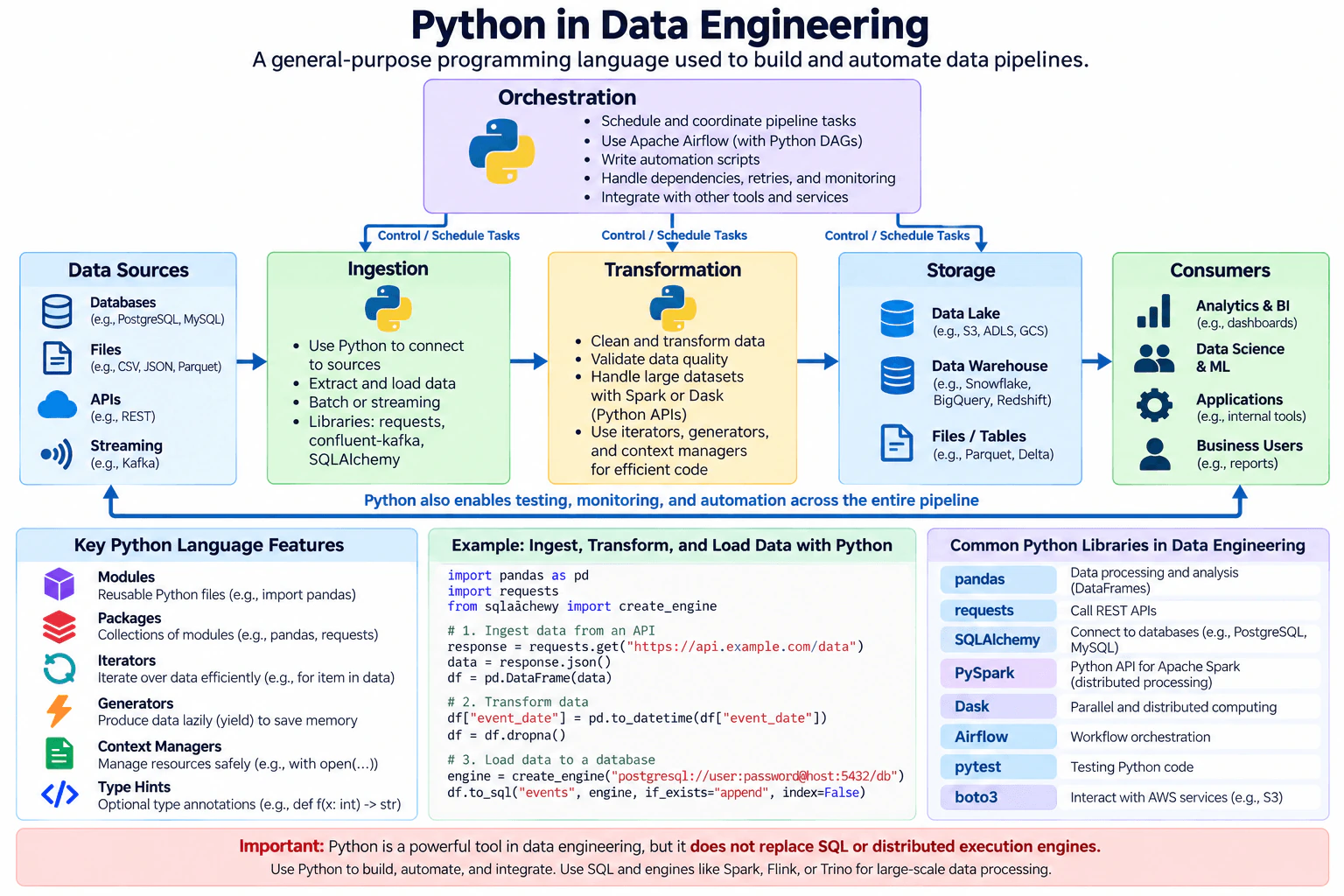
Define Python as a general-purpose programming language. Explain its role in data ingestion, transformation, orchestration, API integration, automation, testing, and distributed-processing clients. Mention modules, packages, iterators, generators, context managers, type hints, and common data libraries without presenting Python as a replacement for SQL or distributed execution engines.
Short Interview Answer (30-60 seconds)
Python is a general-purpose programming language that I use to build, automate, and connect data-engineering workflows. It can ingest data from databases, files, APIs, and streams, transform and validate data, coordinate tasks with Airflow, test code, and interact with distributed systems such as Spark through PySpark. I also use modules, packages, iterators, generators, context managers, and type hints. Python works with SQL and distributed engines rather than replacing them. This conceptual question has no single Big-O time or space complexity.
Detailed Explanation
Python is a general-purpose programming language that helps data engineers move, clean, organize, and connect data. It can read information from databases, files, APIs, and streams. It can transform that information, write it to storage, and help automate and coordinate the work. Python also has many reusable libraries, so engineers do not need to build every capability from scratch. For very large workloads, Python can call distributed systems such as Spark rather than replacing the engine that performs the distributed execution.
Useful Questions to Ask the Interviewer
Would you like a high-level explanation, or should I also walk through the small Python pipeline example?
Should I compare Python with SQL and distributed engines such as Spark?
How to Explain It in an Interview
1. Define Python and its building blocks
Python is a general-purpose programming language. It is used for many kinds of software, including data engineering.
A module is a reusable unit of Python code, commonly stored in a file. A package groups related modules. These make pipeline code easier to organize and reuse.
Iterators let code process items one at a time. Generators produce values lazily, which can avoid creating all values in memory at once. Context managers help manage resources such as files and connections safely. Type hints describe expected value types and help tools such as type checkers and IDEs, although Python does not enforce them at runtime by default.
2. Follow the data path
The diagram shows the main data flow as:
Data Sources -> Ingestion -> Transformation -> Storage -> Consumers.
Sources can include databases such as PostgreSQL or MySQL, files such as CSV, JSON, or Parquet, REST APIs, and streaming systems such as Kafka.
Python can connect to these sources and extract data. The diagram shows libraries such as requests, confluent-kafka, and SQLAlchemy for this type of integration.
3. Transform data and use distributed-processing clients
After ingestion, Python can clean, validate, and transform data. pandas is useful for DataFrame-based processing. Dask supports parallel and distributed computing in Python.
For larger distributed workloads, Python can use PySpark. PySpark is the Python API for Apache Spark. Python expresses the processing work through Spark APIs, while Spark provides the distributed execution engine.
This is an important boundary. Python is not a replacement for SQL, Spark, Flink, or Trino. It works with those systems.
4. Coordinate the work with orchestration
The orchestration box sits above the data path because orchestration coordinates tasks rather than acting as a stage that the records themselves pass through.
The diagram uses Apache Airflow as the example. Airflow can schedule and coordinate pipeline tasks, define task dependencies, run Python-based tasks, apply configured retry behavior, and support workflow monitoring. Its control connections point to ingestion, transformation, and storage.
5. Walk through the small Python example
The example imports pandas, requests, and create_engine from SQLAlchemy.
First, requests.get() calls a REST API. response.json() reads the JSON response. pd.DataFrame() converts that data into a DataFrame.
Next, pd.to_datetime() converts the event_date column to datetime values. dropna() removes rows that contain missing values.
Finally, create_engine() creates a PostgreSQL database engine. DataFrame.to_sql() appends the cleaned rows to the events table with if_exists="append" and index=False.
The example is intentionally small. It demonstrates how Python can connect ingestion, transformation, and storage steps.
6. Explain common libraries, testing, storage, and consumers
The diagram shows pandas for data processing, requests for REST APIs, SQLAlchemy for database access, PySpark as the Python API for Spark, Dask for parallel and distributed computing, Airflow for workflow orchestration, pytest for testing Python code, and boto3 for interacting with AWS services such as S3.
Python can help write results to data lakes, data warehouses, files, or database tables. The diagram shows examples including S3, ADLS, GCS, Snowflake, BigQuery, Redshift, Parquet, and Delta.
The stored data can then be used by analytics and BI systems, data science and machine-learning workloads, applications, and business users.
The main idea is simple: Python is a flexible language for building, automating, testing, and connecting data systems, while SQL and distributed execution engines continue to handle the work they are designed for.
Key Insight / Why This Solution Works
This is a conceptual language-and-data-engineering question, so there is no single algorithm or data structure to select. The clearest approach is to explain Python by following the architecture in the diagram. Data moves from sources to ingestion, transformation, storage, and consumers. Python provides code and libraries around those stages. Airflow is shown separately as a control layer that coordinates ingestion, transformation, and storage tasks. The central principle is that Python connects, automates, tests, and coordinates data work while SQL and distributed execution engines still perform workloads suited to them.
Time & Space Complexity
There is no single time complexity or auxiliary-space complexity for Python because Python is a programming language, not one algorithm. Complexity depends on the operation, data size, and library being used. In the small diagram example, the DataFrame uses memory that grows with the API data loaded into it. The transformation work grows with the amount of data being processed. The database-write cost depends on the number of rows and the database operation. PySpark and Dask have separate execution and memory behavior because they can distribute work across execution resources.
Where it is used
Python is used throughout real data-engineering systems. It can ingest data from APIs, databases, files, and streaming platforms. It can clean and transform records, automate jobs, coordinate workflows, test pipeline code, call cloud services, and act as a client for distributed-processing engines. It is especially useful as the programming layer that connects several data systems together while SQL, Spark, Flink, Trino, or another engine handles work that fits those systems better.
Why Interviewers Ask This
The interviewer is checking whether you understand Python as a practical data-engineering tool rather than only as a programming language. They want to see whether you can connect Python to ingestion, transformation, orchestration, APIs, testing, automation, storage integration, and distributed-processing clients. They are also checking whether you understand important Python language features and whether you can explain the boundary between Python, SQL, workflow orchestrators, and distributed execution engines.
Common interview mistakes
A common mistake is saying that Python replaces SQL. They solve different problems and are often used together. Another mistake is saying that Python itself performs all distributed execution when PySpark is the Python API used to work with Spark. Candidates may also describe Airflow as a data-processing hop instead of a control layer that coordinates tasks. Another mistake is listing library names without explaining what each one does. Finally, do not forget important Python features such as modules, packages, iterators, generators, context managers, and type hints.
Interview tip
Explain Python by following the diagram from source to consumer. Describe what Python does around ingestion, transformation, orchestration, API integration, storage integration, testing, and automation. Then state the boundary clearly: Python connects and coordinates the work, while SQL and distributed engines continue to perform the workloads that fit them.
Interviewer may ask next
When would you use PySpark instead of pandas for a data transformation?
I would normally use pandas when the data fits comfortably on one machine and a local DataFrame workflow is enough. I would use PySpark when the workload needs Spark's distributed execution across a cluster. PySpark gives Python code access to Spark's APIs, while Spark performs the distributed work. The tradeoff is that Spark adds distributed-system and scheduling overhead, but it can handle workloads that are too large or too parallel for a simple local pandas process.
How would you organize a larger Python data pipeline so the code stays reusable and testable?
I would split the pipeline into modules and packages instead of keeping everything in one file. Ingestion, transformation, and storage logic can be separate modules. I would use small functions, type hints where they improve clarity, context managers for resource handling, and iterators or generators when lazy processing is useful. I would test important logic with pytest and let an orchestrator such as Airflow coordinate task dependencies and schedules instead of mixing scheduling logic into the transformation code.
72. What is Scala, and why is it used in some data-engineering systems?CodingEasy
i Question Details
Define Scala as a statically typed language that combines object-oriented and functional programming and runs on the JVM. Explain immutability, higher-order functions, pattern matching, collections, concurrency, Java interoperability, and why Scala is associated with Apache Spark. Distinguish the Scala language from Spark itself.
Short Interview Answer (30-60 seconds)
Scala is a statically typed programming language that runs on the JVM and combines object-oriented and functional programming. In data engineering, it is useful because it supports immutable data, higher-order functions, pattern matching, rich collections, concurrency with Futures, and Java interoperability. Scala is strongly associated with Apache Spark because Spark is implemented in Scala and has a first-class Scala API. Scala is the programming language, while Spark is the distributed data-processing engine. Big-O complexity is not applicable to this conceptual question.
Detailed Explanation
This question asks what Scala is and why some data-engineering systems use it. Scala is a programming language that runs on the Java Virtual Machine, or JVM. It combines object-oriented programming with functional programming. Its useful features include immutable data, functions that work with other functions, pattern matching, collections, concurrency, and easy use of Java libraries. Scala is also closely connected with Apache Spark. A data engineer can use Scala code and Spark APIs to read, transform, and write large datasets. Scala and Spark are related, but they are not the same thing.
Useful Questions to Ask the Interviewer
Would you like me to focus mainly on Scala language features or also explain how Scala is used with Apache Spark?
Would you like me to walk through the small Scala examples for collections, pattern matching, and concurrency?
How to Explain It in an Interview
1. Define Scala
Scala is a statically typed programming language. Static typing means types are checked during compilation, so many type errors can be caught before the program runs. Scala combines object-oriented programming with functional programming. It also runs on the JVM, which means Scala code can work in the same runtime environment as Java.
2. Explain the main Scala features
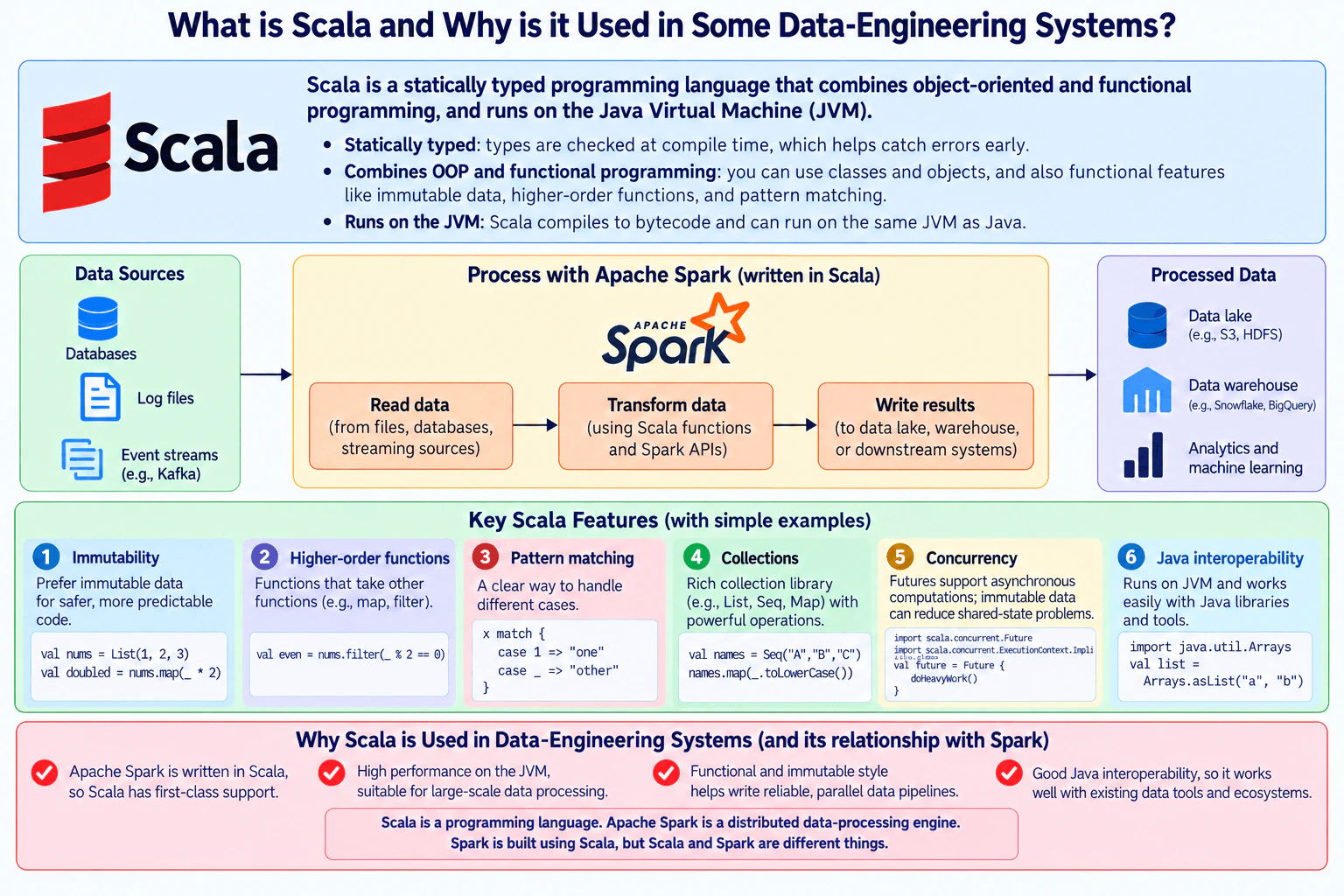
The diagram highlights six useful features. First, Scala commonly uses immutable data. Immutable means a value is not changed after it is created. The example starts with val nums = List(1, 2, 3) and creates a new list with nums.map(_ * 2) instead of changing the original list.
Higher-order functions are functions that accept other functions or return functions. Operations such as map and filter are common examples. The diagram shows nums.filter(_ % 2 == 0) to keep even values.
Pattern matching lets the program choose logic based on the shape or value of data. The diagram shows a match expression with separate cases such as case 1 => "one" and a default case.
Scala also has a rich collections library. The diagram uses Seq("A", "B", "C") and applies map(_.toLowerCase()) to create transformed values.
3. Explain concurrency and Java interoperability
Scala supports asynchronous computations with Future. A Future represents work that may finish later. It runs with an execution context. The diagram also connects immutability with concurrency because reducing shared mutable state can make concurrent code easier to reason about.
Scala runs on the JVM and interoperates with Java. The diagram shows Scala importing java.util.Arrays and calling Arrays.asList("a", "b"). This allows Scala programs to reuse Java libraries and existing JVM tools.
4. Connect Scala to the data-engineering flow
The diagram shows data coming from databases, log files, and event streams such as Kafka. A Spark application written in Scala reads that data, transforms it using Scala functions and Spark APIs, and writes the results to a data lake, data warehouse, or another downstream system. Those processed results can then support analytics or machine learning.
5. Explain why Scala is associated with Apache Spark
Apache Spark is implemented in Scala and provides strong Scala support. Scala's functional style works naturally with data transformations such as mapping and filtering. JVM execution also gives Scala access to the wider Java ecosystem. These reasons made Scala a common language for Spark-based data engineering.
6. Distinguish Scala from Spark
Scala is a programming language. Apache Spark is a distributed data-processing engine. A developer can write Spark applications in Scala, but Scala itself is not Spark. Spark also provides APIs for other languages. The important interview distinction is simple: Scala expresses the program logic, while Spark provides the distributed data-processing system.
Key Insight / Why This Solution Works
This is a conceptual language question, so there is no single algorithm or data structure to select. The key reasoning is to separate the responsibilities shown in the diagram. Scala provides programming-language features such as static typing, immutability, higher-order functions, pattern matching, collections, Futures, and Java interoperability. Spark provides distributed data processing. The diagram's flow is: data sources feed a Spark application written in Scala, the application reads data, transforms it with Scala functions and Spark APIs, and writes processed results to downstream storage or analytics systems. The central invariant is that Scala remains the language and Spark remains the processing engine throughout the explanation.
Time & Space Complexity
Big-O time complexity and auxiliary space complexity are not applicable to this question because it does not define one algorithm over an input of size n. The small Scala snippets in the diagram only demonstrate language features. A real Spark pipeline's cost depends on the operations being performed, the amount of data, partitioning, shuffles, storage, and execution plan. It would be incorrect to give one O(n) or O(1) complexity for Scala or Spark as a whole.
Where it is used
Scala is used in JVM-based backend systems and data-processing systems. In data engineering, it is especially associated with Apache Spark applications. A Scala Spark job can read from databases, log files, or event streams, transform the data, and write processed results to a data lake, data warehouse, or another downstream system. Java interoperability also makes Scala useful when a company already has JVM libraries and tools.
Why Interviewers Ask This
The interviewer is checking whether you understand an important language in the data-engineering ecosystem and whether you can explain it clearly. They want to hear that Scala is statically typed, runs on the JVM, and combines object-oriented and functional programming. They also want you to understand immutability, higher-order functions, pattern matching, collections, concurrency, Java interoperability, and the reason Scala is associated with Spark. Most importantly, they are checking whether you can distinguish the Scala language from the Spark processing engine.
Common interview mistakes
A common mistake is saying Scala and Apache Spark are the same thing. Scala is the programming language, while Spark is the distributed data-processing engine. Another mistake is calling Scala only a functional language. Scala supports both object-oriented and functional programming. Candidates may also forget that Scala runs on the JVM and interoperates with Java. Another mistake is saying Scala forces all data to be immutable. Scala supports mutable state, although immutable values are commonly preferred. Finally, do not say Spark can only be used with Scala because Spark also provides APIs for other languages.
Interview tip
Use a simple three-part structure. First define Scala and mention the JVM. Next explain the six features shown in the diagram: immutability, higher-order functions, pattern matching, collections, concurrency, and Java interoperability. Then connect Scala to the Spark pipeline and finish with the distinction: "Scala is the programming language; Spark is the distributed data-processing engine."
Interviewer may ask next
Why is immutability useful in concurrent or distributed data-processing code?
Immutable data is not changed after it is created. This reduces the amount of shared mutable state that several operations can change at the same time. That can make concurrent code easier to reason about and can reduce some synchronization problems. Immutability does not automatically make a distributed program correct, but it is a useful style for safer parallel transformations.
Do I have to use Scala to write Apache Spark applications?
No. Spark is strongly associated with Scala because Spark is implemented in Scala and provides a first-class Scala API, but Spark also provides APIs for other languages. A team may choose Scala when it wants direct JVM integration, Java interoperability, and Scala's functional programming features. The tradeoff is that the team must be comfortable developing and maintaining Scala code.
73. What is Java, and where does it fit in data engineering?CodingEasy
i Question Details
Define Java as a statically typed, general-purpose language compiled to JVM bytecode. Explain its role in long-running data services, connectors, streaming applications, distributed frameworks, and platform tooling. Cover the JVM, garbage collection, concurrency, build tools, and Java interoperability without implying that every data engineer must use Java.
Short Interview Answer (30-60 seconds)
Java is a statically typed, general-purpose language that is commonly compiled into JVM bytecode. In data engineering, I would use it for long-running services, connectors, streaming applications, distributed processing, and platform tooling. The JVM runs the bytecode and provides managed memory through garbage collection. Java also has strong concurrency support and mature build tools such as Maven and Gradle. It is important in the data ecosystem, but data engineers also use Python, SQL, Scala, and other tools. This conceptual question has no algorithmic time or space complexity.
Detailed Explanation
This question asks what Java is and why it appears in data engineering. Java is a programming language used to build software that can run for a long time and handle substantial workloads. Java source code is commonly turned into an intermediate form that a compatible Java runtime can execute. In data engineering, Java appears in connectors, streaming applications, distributed processing systems, services, and platform tools. The goal is also to understand memory management, parallel work, project build tools, and how Java works with other technologies without suggesting that every data engineer must use it.
Useful Questions to Ask the Interviewer
Would you like me to focus mainly on Java itself or on where it appears in a modern data platform?
Should I include concrete examples such as Kafka Connect, Spark, and Flink?
How to Explain It in an Interview
1. Explain what Java is
Java is a statically typed, general-purpose programming language. Statically typed means that variable types are checked when the program is compiled. Java source files normally use the .java extension. The Java compiler turns that source code into JVM bytecode, commonly stored in .class files. A compatible Java Virtual Machine, or JVM, executes that bytecode. This lets the same compiled Java code run on different systems that provide compatible JVM implementations.
2. Show where Java fits in a data pipeline
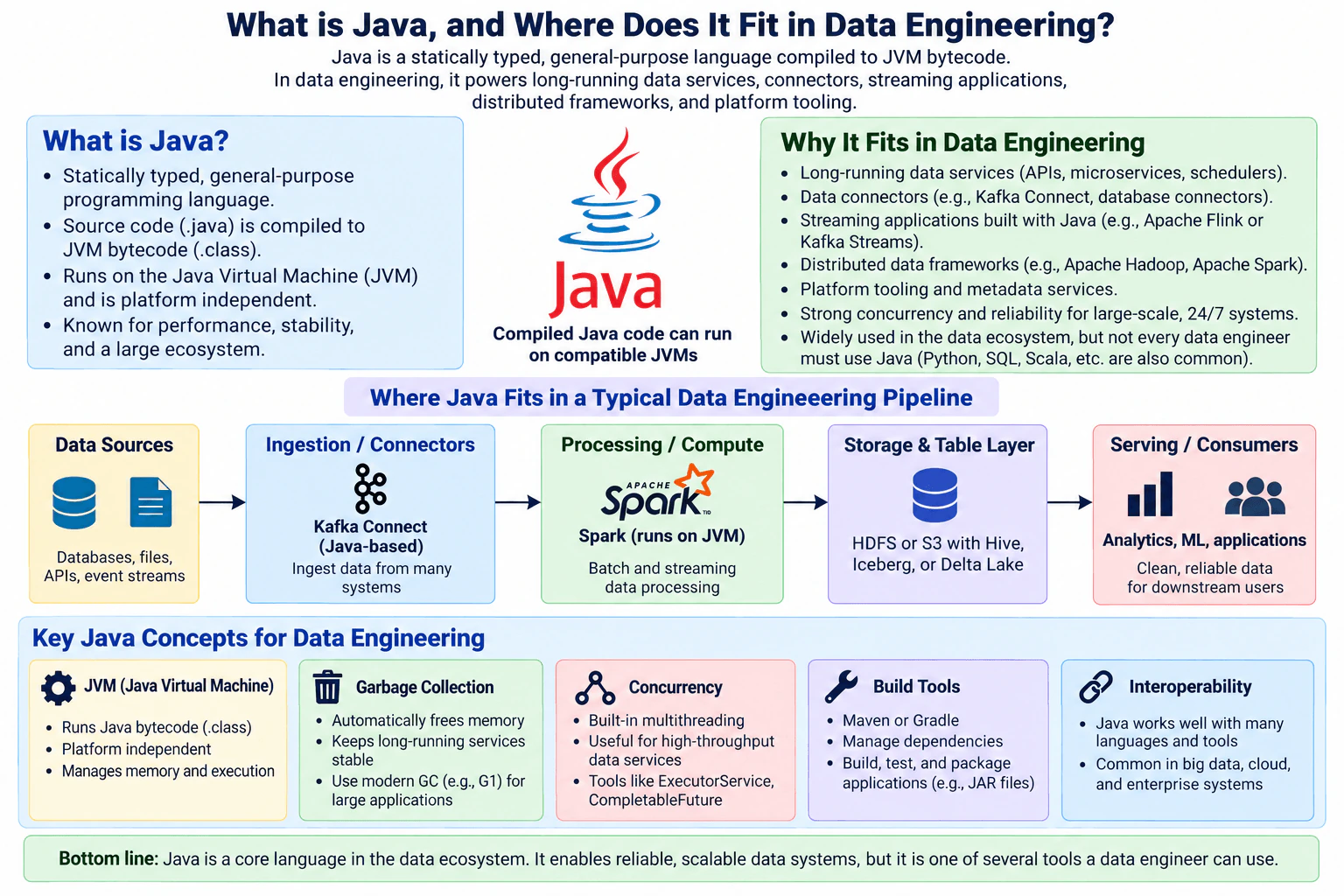
A typical data pipeline starts with sources such as databases, files, APIs, and event streams. Java can appear in the ingestion layer through connectors and services. The diagram uses Kafka Connect as an example of a Java-based ingestion framework. After ingestion, Java and JVM-based tools can participate in batch and streaming processing. The diagram shows Spark in the processing layer and also calls out Java streaming applications built with tools such as Apache Flink or Kafka Streams.
3. Connect processing to storage and consumers
The diagram moves processed data into a storage and table layer. Examples shown are HDFS or S3 together with Hive, Iceberg, or Delta Lake. Java and JVM-based data frameworks can read from and write to these systems through their supported interfaces. The resulting data can then be served to analytics, machine learning, and application consumers. Java can also be used for platform tooling and metadata services that support these pipelines.
4. Explain the JVM and garbage collection
The JVM runs Java bytecode and manages important runtime behavior. One major feature is garbage collection. Garbage collection automatically reclaims memory from objects that are no longer reachable. This means developers normally do not manually free ordinary Java objects. Long-running data services still need sensible memory settings because allocation rate and garbage-collection behavior can affect throughput and pauses. Modern JVMs provide collectors such as G1 for large applications.
5. Explain concurrency
Java has built-in support for multithreaded programs. Libraries such as ExecutorService and CompletableFuture help developers organize concurrent work. This is useful for long-running services and high-throughput data applications that perform many independent operations. Concurrency can improve throughput when work can safely happen in parallel, but developers still need to manage shared state, synchronization, resource limits, and failure handling correctly.
6. Explain build tools and interoperability
Java projects commonly use Maven or Gradle. These tools manage dependencies and help compile, test, build, and package applications, often into JAR files. Java also works with many other languages, libraries, data systems, and standard interfaces. This makes it useful in large data platforms where several technologies must work together.
7. State the main tradeoff
Java is a strong choice for long-running services, connectors, streaming applications, distributed frameworks, and platform tooling. Its JVM ecosystem, concurrency support, build tooling, and mature runtime are useful strengths. However, Java is only one tool in data engineering. SQL may be better for warehouse transformations, Python may be better for scripting or exploration, and Scala or other languages may fit particular JVM-based platforms or team preferences.
Key Insight / Why This Solution Works
There is no coding algorithm or special data structure for this conceptual question. The key reasoning is to explain Java from the runtime outward. Java source code is compiled into JVM bytecode. A compatible JVM executes that bytecode and provides runtime services such as memory management. Java can then be used in different parts of a data platform, including connectors, streaming applications, distributed processing, long-running services, and platform tooling. The central idea is that Java is an important implementation choice in data engineering, not a required language for every pipeline or every data engineer.
Time & Space Complexity
There is no meaningful algorithmic time complexity or auxiliary-space complexity for this question because it does not ask us to process an input with an algorithm. Runtime cost depends on the specific Java program being built. For example, a Spark job, Kafka Streams application, connector, or long-running service has its own processing and memory behavior. Java itself does not give one O(n) time or space value for this conceptual question.
Where it is used
Java is used in long-running APIs and services, data connectors, streaming applications, distributed processing systems, schedulers, metadata services, and other platform tooling. In the diagram, Kafka Connect represents ingestion and Spark represents processing. Java and JVM-based systems can also interact with storage and table technologies such as HDFS, S3, Hive, Iceberg, and Delta Lake before data is consumed by analytics, machine learning, or applications.
Why Interviewers Ask This
The interviewer is checking whether you understand Java beyond basic syntax. They want to see whether you know how Java source becomes JVM bytecode, what the JVM does, and why Java is useful for long-running and concurrent data systems. They are also testing whether you can connect Java to practical data-engineering components such as connectors, streaming applications, distributed frameworks, build tooling, metadata services, and storage interfaces without overstating Java's role.
Common interview mistakes
Saying Java source code runs directly instead of explaining that it is commonly compiled into JVM bytecode that a compatible JVM executes.
Treating Apache Kafka itself as a Java streaming application instead of distinguishing the Kafka platform from Java applications such as Kafka Streams applications.
Calling every storage technology in the diagram a data warehouse. HDFS and S3 are storage systems, while Hive, Iceberg, and Delta Lake serve different table or data-management roles.
Saying garbage collection means memory problems cannot happen. Java services can still have memory pressure, excessive allocation, or garbage-collection pauses.
Implying that every data engineer must use Java. Python, SQL, Scala, and other tools are also common and may be better choices for particular tasks.
Interview tip
Explain Java in layers: first the language, then JVM bytecode and the JVM, then where Java appears in the data pipeline. After that, mention garbage collection, concurrency, Maven or Gradle, and interoperability. Finish by saying that Java is an important option in the data ecosystem, not a requirement for every data engineer.
Interviewer may ask next
Why is the JVM useful for data engineering applications?
The JVM gives Java applications a managed runtime. It executes JVM bytecode, provides automatic memory management through garbage collection, supports mature concurrency libraries, and offers monitoring and runtime tooling. Compatible JVM implementations also let the same compiled bytecode run across different supported environments. These properties are useful for long-running services, connectors, streaming applications, and distributed data-processing systems.
When might a data engineer choose Python, SQL, or Scala instead of Java?
The choice depends on the task and platform. SQL is often simpler for relational transformations and warehouse queries. Python is convenient for scripting, orchestration, data exploration, and ecosystems with strong Python APIs. Scala can be useful in JVM-based environments and is closely associated with several distributed data tools. Java is a strong choice for long-running services, connectors, streaming applications, and JVM platform tooling, but there is no need to use it for every data-engineering task.
74. What is Bash, and how do data engineers use shell scripts safely?CodingEasy
i Question Details
Define Bash as a command language and Unix shell. Explain commands, pipelines, variables, quoting, exit statuses, redirection, functions, and environment handling. Connect it to job wrappers and operational automation, and discuss strict error handling, validation, safe quoting, secret handling, portability limits, and when a larger program is preferable.
Short Interview Answer (30-60 seconds)
Bash is a Unix shell and a command language. I use it mainly as a small job wrapper for data operations such as validating inputs, running commands, connecting commands with pipelines, logging progress, and returning useful exit codes. I use set -euo pipefail, quote variable expansions, and keep secrets out of the script. For the shown streaming pipeline, runtime is O(n + p) and auxiliary shell space is O(p), where n is input data size and p is expanded pathname data.
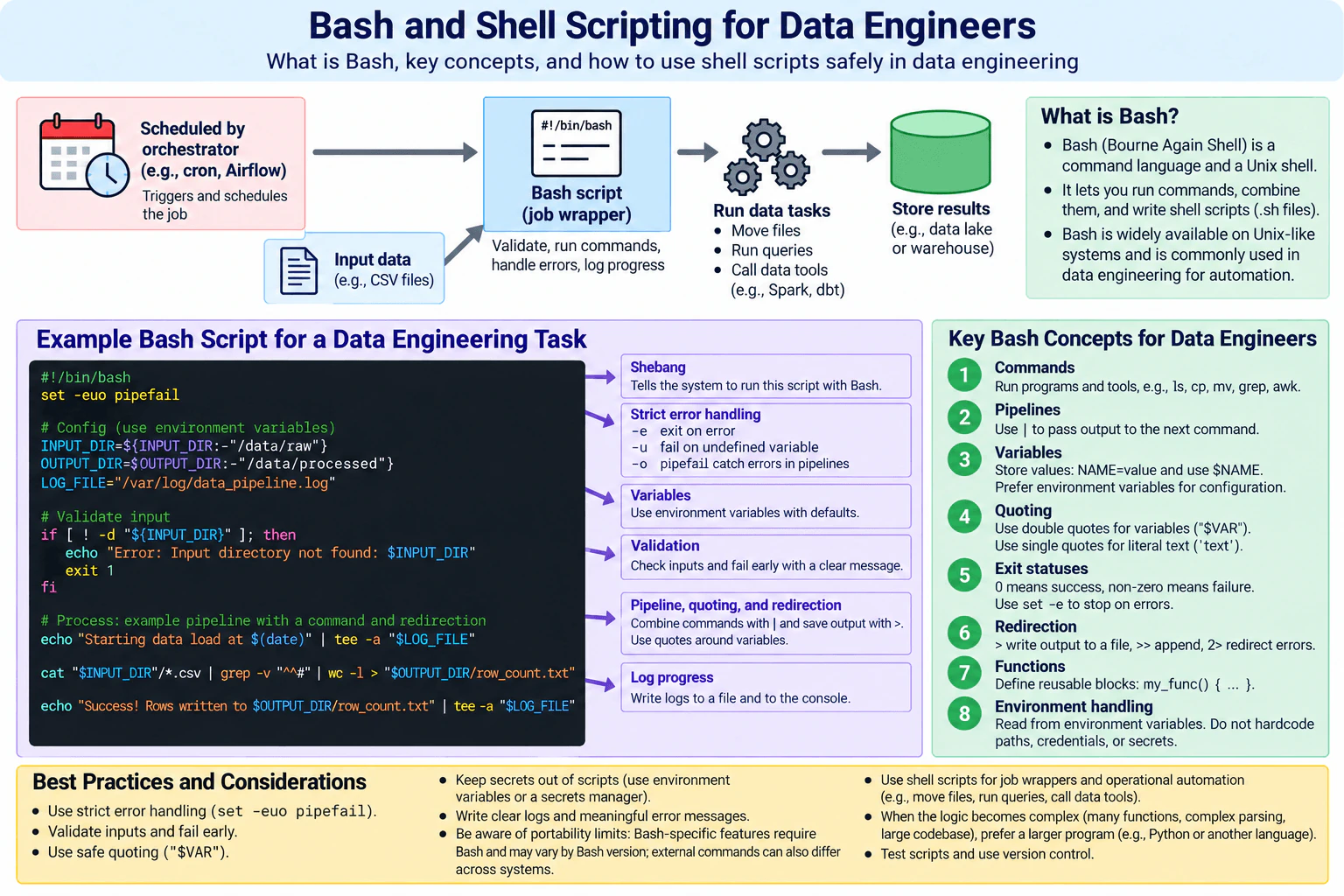
This question asks how Bash helps a data engineer automate small operational jobs safely. Bash can run programs, connect programs together, store configuration in variables, write output to files, and report whether a job succeeded or failed. In the diagram, a scheduler or orchestrator starts a Bash job wrapper. The wrapper validates its input directory, logs progress, processes CSV files through a pipeline, and writes a row count. Safe quoting, strict error handling, environment-based configuration, and careful secret handling make this kind of script safer.
Useful Questions to Ask the Interviewer
Should the script run only with Bash, or must it also work with another shell?
How should configuration and secrets be supplied in production?
What should happen when there are no matching CSV files or when an external command fails?
Does the job need retries, cleanup, signal handling, or atomic output replacement?
How to Explain It in an Interview
1. Explain Bash and the job-wrapper role
Bash is a command language and a Unix shell. A command runs a program such as grep, wc, or another data tool. A shell script stores commands in a reusable file. In the diagram, cron or Airflow triggers the Bash job wrapper. The wrapper validates inputs, runs data tasks, logs progress, and writes results to storage.
2. Read configuration from variables and the environment
The script reads INPUT_DIR and OUTPUT_DIR from environment variables when they are set and non-empty. Otherwise, it uses /data/raw and /data/processed. LOG_FILE is set to /var/log/data_pipeline.log. This keeps deployment-specific paths outside the processing logic. Sensitive credentials should not be hardcoded. For real secrets, use the environment only when appropriate for the platform, or use a dedicated secrets manager.
3. Validate input and use strict error handling
The script enables set -euo pipefail. -e causes many unhandled command failures to terminate the script. -u treats an expansion of an unset variable as an error. pipefail makes a pipeline return failure when one of its commands fails instead of considering only the last command. The script also checks [[ ! -d "$INPUT_DIR" ]]. If that directory is missing, it prints an error and exits with status 1. By convention, status 0 means success and a non-zero status means failure.
4. Use quoting, a pipeline, and redirection
The script quotes variable expansions such as "$INPUT_DIR" and "$LOG_FILE". This prevents unwanted word splitting and protects paths containing spaces or shell metacharacters. The expression "$INPUT_DIR"/*.csv intentionally leaves the wildcard active so Bash can expand matching CSV filenames. cat sends file contents to grep -v "^#", which keeps lines that do not begin with #. wc -l counts those lines. The > operator writes the final count to "$OUTPUT_DIR/row_count.txt".
5. Understand success, failure, logging, and reruns
The start and success messages pass through tee -a "$LOG_FILE", so they are shown on the console and appended to the log file. The result uses >, so a later run that reaches that command replaces the previous row_count.txt. The script does not create the output directory, so a missing or unwritable output directory causes the redirection to fail. If no CSV pathname matches, cat fails under normal Bash glob behavior. Also, if grep -v selects no lines, grep returns status 1; because pipefail is enabled, this exact script treats that pipeline as a failure rather than a successful zero-row result.
6. Know the other core Bash concepts
Commands run programs. Pipelines connect command output to the next command with |. Variables store values. Quoting controls how the shell expands text. Exit statuses communicate success or failure. Redirection such as >, >>, and 2> controls where output goes. Functions such as my_func() { ...; } group reusable shell commands. Environment variables pass configuration into the process. These features make Bash useful as glue between data tools.
7. Know when Bash is the right tool
Bash is useful for job wrappers and operational automation such as moving files, launching queries, calling data tools, connecting commands, and scheduling small jobs. Bash-specific syntax requires Bash and may vary with Bash versions. External commands can also differ across systems. When the logic grows into many functions, complex parsing, rich state management, or a large codebase, a larger programming language such as Python is usually easier to test and maintain.
Key Insight / Why This Solution Works
The diagram uses a Bash job-wrapper pattern rather than a data-structure algorithm. The execution invariant is that processing starts only after the required input directory has been validated, and the success message is reached only if the preceding commands and pipeline complete successfully under the script's error rules. A scheduler or orchestrator triggers the wrapper. The wrapper loads configuration, validates INPUT_DIR, logs the start, streams the matching CSV files through cat, grep, and wc, redirects the count to the output file, and finally logs success. Quoting protects expansions, while the exit status communicates failure or success to the caller.
Code
#!/bin/bashset -euo pipefail
# Read configurable directories from the environment and use the shown defaults when absent or empty.
INPUT_DIR=${INPUT_DIR:-"/data/raw"}
OUTPUT_DIR=${OUTPUT_DIR:-"/data/processed"}
LOG_FILE="/var/log/data_pipeline.log"# Validate the required input directory before starting any data processing.if [[ ! -d "$INPUT_DIR" ]]; thenecho"Error: Input directory not found: $INPUT_DIR"exit 1
fi# Log the start time to both the console and the append-mode log file.echo"Starting data load at $(date)" | tee -a "$LOG_FILE"# Expand matching CSV paths, remove lines beginning with '#', count the remaining lines,# and overwrite the result file with the count produced by this run.cat"$INPUT_DIR"/*.csv | grep -v "^#" | wc -l > "$OUTPUT_DIR/row_count.txt"# This line is reached only if the earlier commands complete successfully under the current error rules.echo"Success! Rows written to $OUTPUT_DIR/row_count.txt" | tee -a "$LOG_FILE"
Time & Space Complexity
Let n be the total number of bytes read from the matching CSV files, and let p be the total size of the expanded CSV pathnames passed to cat. The main data pipeline is O(n + p) time because Bash expands the file names and cat, grep, and wc then stream through the input. The shell needs O(p) auxiliary space for the expanded pathname arguments. The pipeline programs otherwise process the file data in a streaming way with bounded buffers relative to n. Log messages and the final count add only constant-size work relative to the input data.
Where it is used
This pattern is useful for small operational data jobs. A Bash wrapper can validate files or directories, call SQL or data-processing tools, move files, connect commands with pipelines, write logs, and return an exit status that a scheduler or orchestrator can observe. Bash works well as glue around existing programs. It is less suitable when the processing logic becomes large, deeply structured, or difficult to test in shell code.
Why Interviewers Ask This
The interviewer is checking whether you understand Bash as more than a list of commands. They want to see whether you can use shell scripts safely in data operations. Important signals are correct quoting, pipelines, redirection, exit statuses, validation, environment configuration, strict error handling, secret handling, portability awareness, and understanding failure behavior. They also want to see whether you know when Bash should stay a small wrapper instead of growing into a large application.
Common interview mistakes
Common mistakes are forgetting to quote variable expansions such as "$INPUT_DIR"; assuming set -e alone detects every failure inside a pipeline instead of using pipefail; skipping input validation; hardcoding credentials or secrets in the script; assuming /bin/bash, Bash-specific features, and external commands are identical on every system; overlooking that an unmatched *.csv pattern can make cat fail; and overlooking that grep -v returns status 1 when it selects no lines, which makes this exact pipeline fail under pipefail.
Interview tip
Explain the script in execution order: scheduler or orchestrator triggers it, configuration is read, the input directory is validated, strict error handling controls failure behavior, the CSV pipeline processes data, redirection writes the count, and the exit status tells the caller whether the job succeeded. Mention the zero-match and zero-selected-line behavior so the interviewer can see that you understand the exact shell semantics rather than only the happy path.
Interviewer may ask next
How would you change the script so zero matching data rows are treated as a successful result instead of a pipeline failure?
The current pipeline can fail when grep -v selects no lines because grep returns status 1 and pipefail propagates that status. I would change only that stage so status 1 means 'no selected lines' while real errors still fail the job. For example, I could replace the filtering/counting step with a tool whose zero-match behavior still returns success, such as an awk program that counts non-comment lines and prints 0 when none match. That changes the implementation of the filtering stage, so it would be a follow-up design rather than the exact diagram code.
How would you make the output safer if `row_count.txt` must never be partially replaced?
The diagram writes directly to row_count.txt, so it does not provide atomic replacement. I would write the completed count to a temporary file in the same filesystem and rename that temporary file to row_count.txt only after the pipeline succeeds. I would also arrange cleanup of the temporary file on failure or termination. The processing time remains O(n + p). The main extra storage is the temporary result file, which is constant-size for this count output.
75. What is R, and when might a data engineer encounter it?CodingEasy
i Question Details
Define R as a language and environment for statistical computing and graphics. Explain vectors, data frames, packages, scripts, and its use in analytical workflows. Describe how a data engineer may support R workloads through governed datasets, reproducible environments, scheduling, and production handoffs without confusing data engineering with statistical modeling.
Short Interview Answer (30-60 seconds)
R is a programming language and environment for statistical computing and graphics. A data engineer may encounter it when analysts or data scientists use R scripts and packages on trusted datasets. I would usually support the workflow by providing governed data, reproducible R environments, scheduling, monitoring, security, lineage, and reliable production handoffs. R commonly uses vectors and data frames. The statistical modeling normally remains the responsibility of analysts or data scientists.
Detailed Explanation
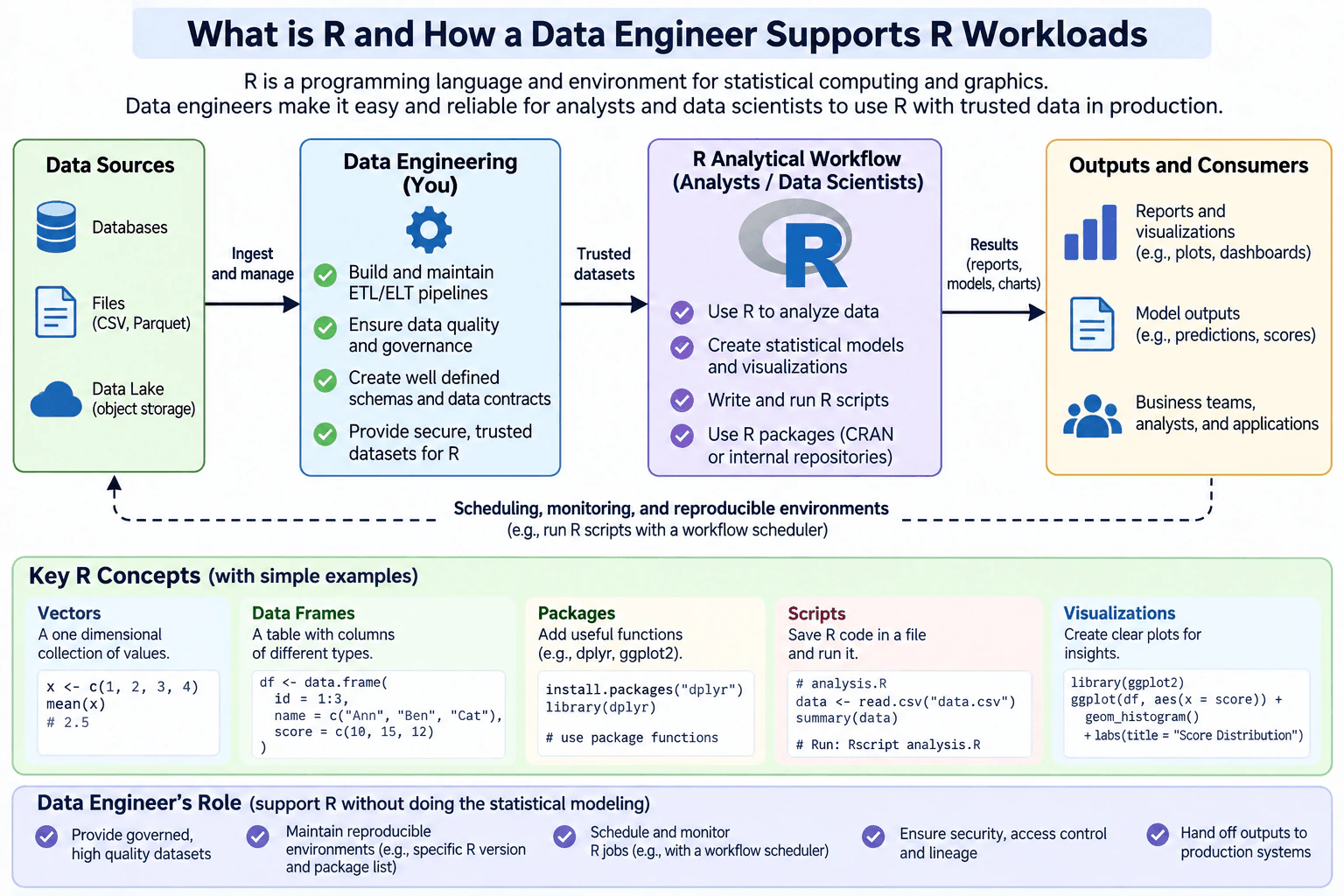
R is used to analyze data, perform statistical work, and create graphics. The diagram shows a clear division of responsibility. Data engineers prepare and govern the data before R uses it. Analysts or data scientists then use R for analysis, statistical models, scripts, packages, and visualizations. Data engineers also help make the surrounding workflow reliable by managing reproducible environments, scheduling, monitoring, security, lineage, and production handoffs.
Useful Questions to Ask the Interviewer
Do you want me to focus mainly on basic R concepts or on how a data engineer supports R in production?
Should I explain both the analyst's R responsibilities and the data engineer's responsibilities?
Would you like a small R example using vectors, data frames, packages, and scripts?
How to Explain It in an Interview
1. Define R
R is a programming language and environment for statistical computing and graphics. Analysts and data scientists commonly use it to analyze data, create statistical models, and build visualizations.
2. Explain the basic R concepts
A vector is a one-dimensional collection of values. The diagram uses x <- c(1, 2, 3, 4) and then mean(x), which gives 2.5. A data frame is a table with named columns. The diagram creates id, name, and score columns, where the rows contain Ann, Ben, and Cat with scores 10, 15, and 12. Packages add reusable functions. The diagram uses dplyr and ggplot2 as examples. An R script is a file containing R commands that can be run as a job.
3. Follow the data flow
The workflow starts with data sources such as databases, CSV or Parquet files, and object storage. Data engineering pipelines ingest and manage this data. The engineer applies data quality rules, governance, schemas, data contracts, security, and access controls. The result is a secure and trusted dataset for the R analytical workflow.
4. Explain the R analytical workflow
Analysts or data scientists use R to analyze the trusted data. They may create statistical models and visualizations, write and run R scripts, and use packages from CRAN or internal repositories. The diagram also shows a simple script that reads data.csv with read.csv() and summarizes the data with summary().
5. Explain the data engineer's role
The data engineer supports the R workload without taking over the statistical modeling. The engineer provides governed, high-quality datasets, maintains reproducible environments such as a specific R version and package list, schedules and monitors R jobs, manages security and access control, records lineage, and supports reliable production handoffs.
6. Explain scheduling and reproducibility
An R script can be run by a workflow scheduler. The scheduler starts the job at the required time and monitors whether it succeeds. A reproducible environment keeps the expected R version and package versions stable so the same script behaves consistently across environments.
7. Explain the outputs
The R workflow can produce reports, plots, dashboards, predictions, scores, or other model outputs. Those results may be consumed by business teams, analysts, or applications. The data engineer helps move these outputs into production systems reliably while the analytical or statistical logic remains with the analyst or data scientist.
Key Insight / Why This Solution Works
This is a conceptual R and data-engineering question, not an algorithm problem. The key idea is responsibility separation across one end-to-end workflow: data sources -> data engineering -> trusted datasets -> R analytical workflow -> outputs and consumers. The important invariant is that R receives governed, secure, well-defined data, while the data engineer manages reliability around the workflow rather than owning the statistical modeling. Scheduling, monitoring, reproducible environments, security, lineage, and production handoffs support that boundary.
Time & Space Complexity
There is no single time or auxiliary-space complexity for this question because no specific algorithm is being implemented. The cost of an R workload depends on the operations inside the R script, the amount of data, and the packages being used. For example, calculating a mean over a vector requires processing its values, while a larger analytical workflow may include data loading, transformations, modeling, and plotting. A data engineer should evaluate the actual workload instead of assigning one universal Big-O value to R.
Where it is used
A data engineer may encounter R when analysts or data scientists run analytical jobs on warehouse, lake, or file-based datasets. The engineer may prepare the governed datasets, maintain the R runtime and package environment, schedule and monitor R scripts, control access, track lineage, and deliver outputs such as reports, plots, predictions, or scores to downstream teams and applications.
Why Interviewers Ask This
The interviewer is checking whether you understand a language that can appear in analytical data environments even when it is not your main engineering language. They want to know whether you understand vectors, data frames, packages, scripts, and R's role in statistical computing and graphics. They are also testing whether you can separate analytical modeling from data engineering responsibilities such as governance, reproducibility, scheduling, monitoring, security, lineage, and production delivery.
Common interview mistakes
A common mistake is describing R only as a statistics tool instead of a programming language and environment. Another is confusing a vector with a data frame. A vector is one-dimensional, while a data frame is a table with columns that can have different types. Candidates may also forget that packages provide reusable functionality and that R scripts can be scheduled like other jobs. The biggest responsibility mistake is saying the data engineer owns the statistical modeling. In the diagram, the data engineer supports the workflow while analysts or data scientists perform the modeling.
Interview tip
Explain the workflow from left to right: data sources -> data engineering -> trusted datasets -> R analysis -> outputs. Then state the responsibility boundary clearly. The data engineer makes the data and execution environment reliable, while analysts or data scientists own the statistical analysis and modeling.
Interviewer may ask next
How would you make an R workload reproducible in production?
I would use a defined R version and a controlled package list so the same script runs with the expected dependencies. The diagram specifically shows maintaining reproducible environments with a specific R version and package list. I would also use governed input datasets, controlled access, scheduled execution, monitoring, and lineage so both the data and the execution environment are traceable and repeatable.
What should the data engineer own when an R model created by a data scientist moves toward production?
The data scientist or analyst should continue to own the statistical modeling logic. The data engineer can own the surrounding production support: governed input datasets, schemas and data contracts, security and access control, lineage, reproducible R environments, scheduling, monitoring, and reliable handoff of outputs such as reports, visualizations, predictions, or scores to downstream systems.
76. What is Julia, and when might it appear in a data platform?CodingEasy
i Question Details
Define Julia as a high-level, high-performance dynamic language designed for technical computing. Explain multiple dispatch, packages, environments, compilation, and interoperability. Describe where data engineers may encounter Julia in numerical pipelines or research-to-production workflows and the operational concerns around dependencies, reproducibility, serialization, and deployment.
Short Interview Answer (30-60 seconds)
Julia is a high-level, high-performance dynamic language designed for technical computing. I may see it in a data platform when numerical analysis, optimization, machine learning, or research code moves into a production pipeline. Julia uses multiple dispatch and just-in-time compilation. In production, I would focus on package environments, reproducible dependencies, serialization formats, interoperability, and deployment. This is a conceptual platform question, so algorithmic time and auxiliary-space complexity do not apply.
Detailed Explanation
Julia is a programming language built for technical and numerical work. A data engineer may encounter it when researchers or data scientists create calculations, statistics, optimization, or machine-learning workloads that later need to run as scheduled production jobs. The goal is to understand what Julia is, how its important language features work, where it fits in a data platform, and what operational concerns matter when moving Julia workloads from research into production.
Useful Questions to Ask the Interviewer
Are you asking mainly about Julia as a language, or also how I would operate Julia workloads in production?
Should I focus on numerical batch pipelines, research-to-production workflows, or both?
How to Explain It in an Interview
1. Explain what Julia is
Julia is a high-level, high-performance dynamic language designed for technical computing. It is easy to write like a high-level language, but it can compile code to efficient machine code. This makes it useful for numerical analysis, statistics, optimization, simulation, machine learning, and other compute-heavy technical work.
2. Show where Julia fits in the data platform
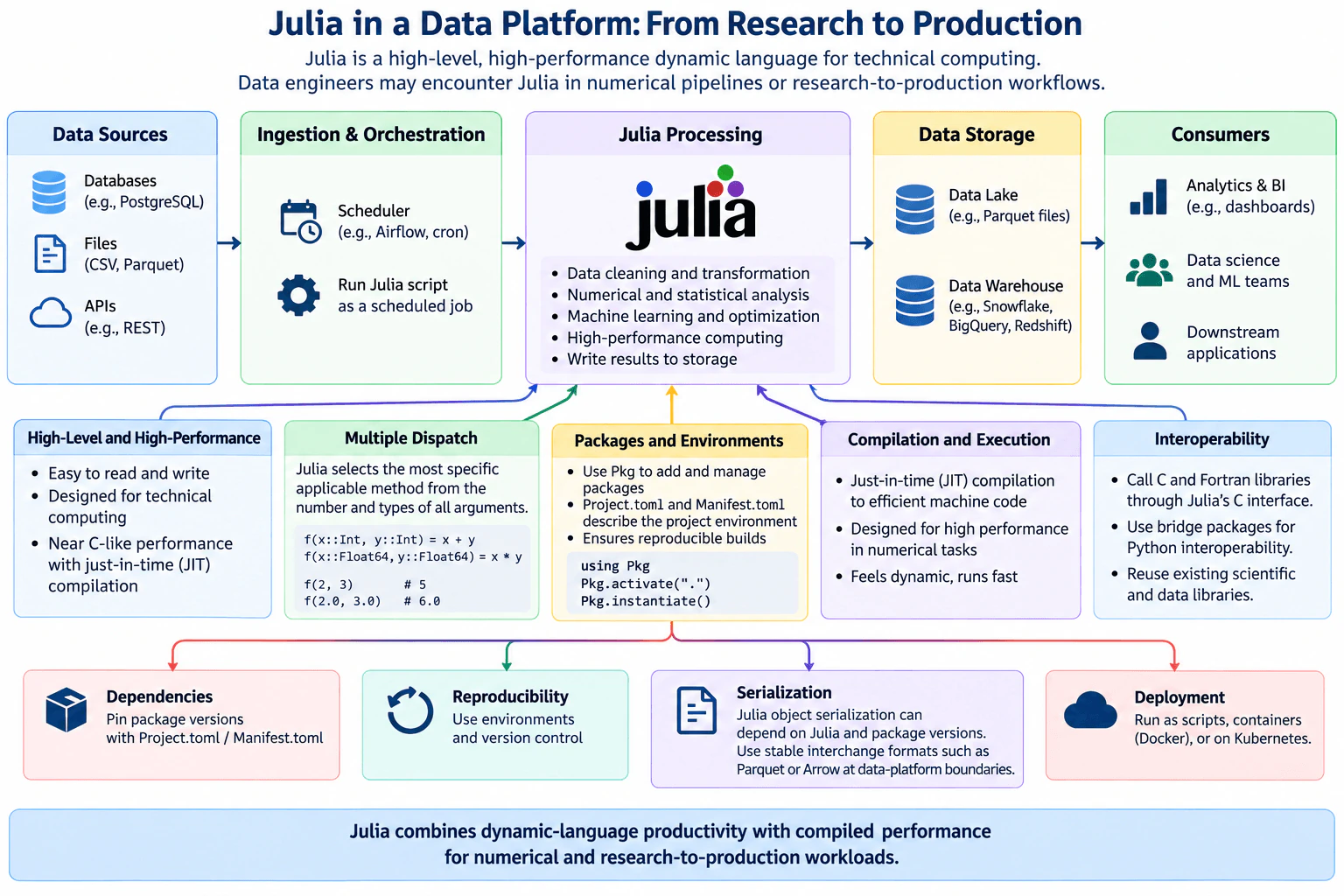
The diagram shows a normal left-to-right data flow. Data comes from databases, files such as CSV or Parquet, and APIs. An ingestion and orchestration layer schedules a Julia script. Julia then performs data cleaning, transformation, numerical or statistical analysis, machine-learning or optimization work, and other high-performance computations. The results are written to storage such as a data lake or data warehouse. Those results can then be used by analytics and BI tools, data-science or ML teams, and downstream applications.
3. Explain multiple dispatch
Julia lets one function name have several methods. Julia selects the most specific applicable method based on the number and types of all arguments. The diagram shows one method for integer arguments and another for floating-point arguments. This feature is called multiple dispatch. It lets developers write specialized behavior for different types while keeping a clean function interface.
4. Explain packages and environments
Julia uses Pkg to manage packages and project environments. Project.toml and Manifest.toml describe the project environment and its dependency state. The diagram shows using Pkg, Pkg.activate("."), and Pkg.instantiate(). Activating selects the project environment. Instantiating prepares the required dependencies from that environment. This is important for reproducibility because development and production should use the same intended dependency set.
5. Explain compilation and interoperability
Julia uses just-in-time compilation to produce efficient machine code. This helps numerical workloads run quickly, although the first execution of a method may include compilation work. Julia can also call C and Fortran libraries through its C interface. Bridge packages can provide Python interoperability. This is useful when a Julia workload needs to reuse existing scientific or data libraries.
6. Explain operational concerns
A production Julia workload needs careful dependency management and version control. Reproducibility matters because another environment should be able to recreate the intended setup. Julia object serialization can depend on Julia and package versions, so stable interchange formats such as Parquet or Arrow are better choices at data-platform boundaries. Deployment can use Julia scripts, containers such as Docker, or orchestration platforms such as Kubernetes.
7. Summarize the production tradeoff
Julia combines dynamic-language productivity with compiled performance, which can make it valuable for numerical and research-to-production workloads. The data engineering tradeoff is operational complexity. The team must manage dependencies, reproducibility, compilation behavior, serialization boundaries, orchestration, and deployment carefully so the Julia workload behaves reliably in production.
Key Insight / Why This Solution Works
This question does not require a coding algorithm or data structure. The key idea is to treat Julia as one processing runtime inside an end-to-end data platform. The consistent flow is: data sources feed an ingestion and orchestration layer, that layer runs a Julia workload, Julia performs transformation or numerical processing, results are written to storage, and downstream consumers use those results. The important production controls around that flow are package environments, reproducibility, serialization boundaries, interoperability, and deployment.
Time & Space Complexity
Algorithmic time complexity and auxiliary-space complexity do not apply because this is a conceptual language and platform question rather than an algorithm problem. The actual runtime and memory cost depend on the Julia program, the amount of data, the algorithms and libraries being used, and the execution environment. One important operational detail is compilation: the first execution of some Julia methods may include compilation overhead, while later executions of already compiled methods can run faster.
Where it is used
Julia may appear in numerical data pipelines, statistical processing, optimization, simulation, machine-learning workflows, and research-to-production systems. A data engineering team may provide the source data, schedule the Julia job, manage its package environment, containerize or deploy it, write results to a data lake or warehouse, and make those results available to analytics, data-science teams, or downstream applications.
Why Interviewers Ask This
The interviewer is checking whether you can recognize a less common language in a data platform and reason about it beyond syntax. They want to see whether you understand Julia's multiple dispatch, package environments, compilation, and interoperability. They also want to know whether you can connect those features to data engineering responsibilities such as orchestration, dependency control, reproducibility, serialization boundaries, storage, deployment, and support for downstream consumers.
Common interview mistakes
A common mistake is describing Julia only as a data-science language and not explaining how it fits into a production data pipeline. Another is saying multiple dispatch uses only one argument instead of the number and types of all arguments. Candidates may also confuse activating an environment with installing or preparing missing dependencies. Another mistake is treating Julia-specific object serialization as a stable cross-system contract without considering version compatibility. Finally, candidates often mention Julia's performance but forget dependency management, reproducibility, compilation startup cost, serialization boundaries, orchestration, and deployment.
Interview tip
Explain Julia in two layers. First describe the language features: high-level syntax, multiple dispatch, packages and environments, compilation, and interoperability. Then trace the diagram from data sources to orchestration to Julia processing to storage and consumers. Finish with dependencies, reproducibility, serialization, and deployment. This shows both language knowledge and data-platform thinking.
Interviewer may ask next
How would you make a Julia data pipeline reproducible across development and production machines?
I would keep the project's Project.toml and Manifest.toml under version control, activate that project environment when the workload starts, and run Pkg.instantiate() when preparing the runtime so the intended dependencies are available. I would also keep the Julia runtime version and important system dependencies consistent. At data-platform boundaries, I would prefer stable interchange formats such as Parquet or Arrow instead of depending on Julia-specific object serialization. Containers can also help keep the runtime and deployment environment consistent.
What operational issue can Julia's compilation behavior create in production?
The first execution of some methods can include compilation work, so startup latency may be higher than steady-state execution time. This can matter for short scheduled jobs or services that start frequently. I would measure startup time separately from processing time and avoid repeatedly creating short-lived Julia runtimes when that cost matters. If needed, precompilation or prepared images can reduce startup overhead, but they add build and deployment complexity.
77. What is JSON, and what should a data engineer know about its data model?CodingEasy
i Question Details
Define JSON as a text format for structured values. Explain objects, arrays, strings, numbers, booleans, and null; encoding expectations; the lack of native date and binary types; numeric-precision risks; duplicate-name interoperability concerns; and why schemas, validation, and consistent conventions matter in data pipelines.
Short Interview Answer (30-60 seconds)
JSON is a text format for structured values. Its data model has objects, arrays, strings, numbers, booleans, and null. For data engineering, I also care about how JSON moves between systems. I use UTF-8 for exchanged JSON, define conventions for dates and binary data, protect numeric precision, avoid duplicate object names, and validate records against an agreed schema. This is a conceptual data-model question, so there is no algorithmic time or auxiliary-space complexity to calculate.
Detailed Explanation
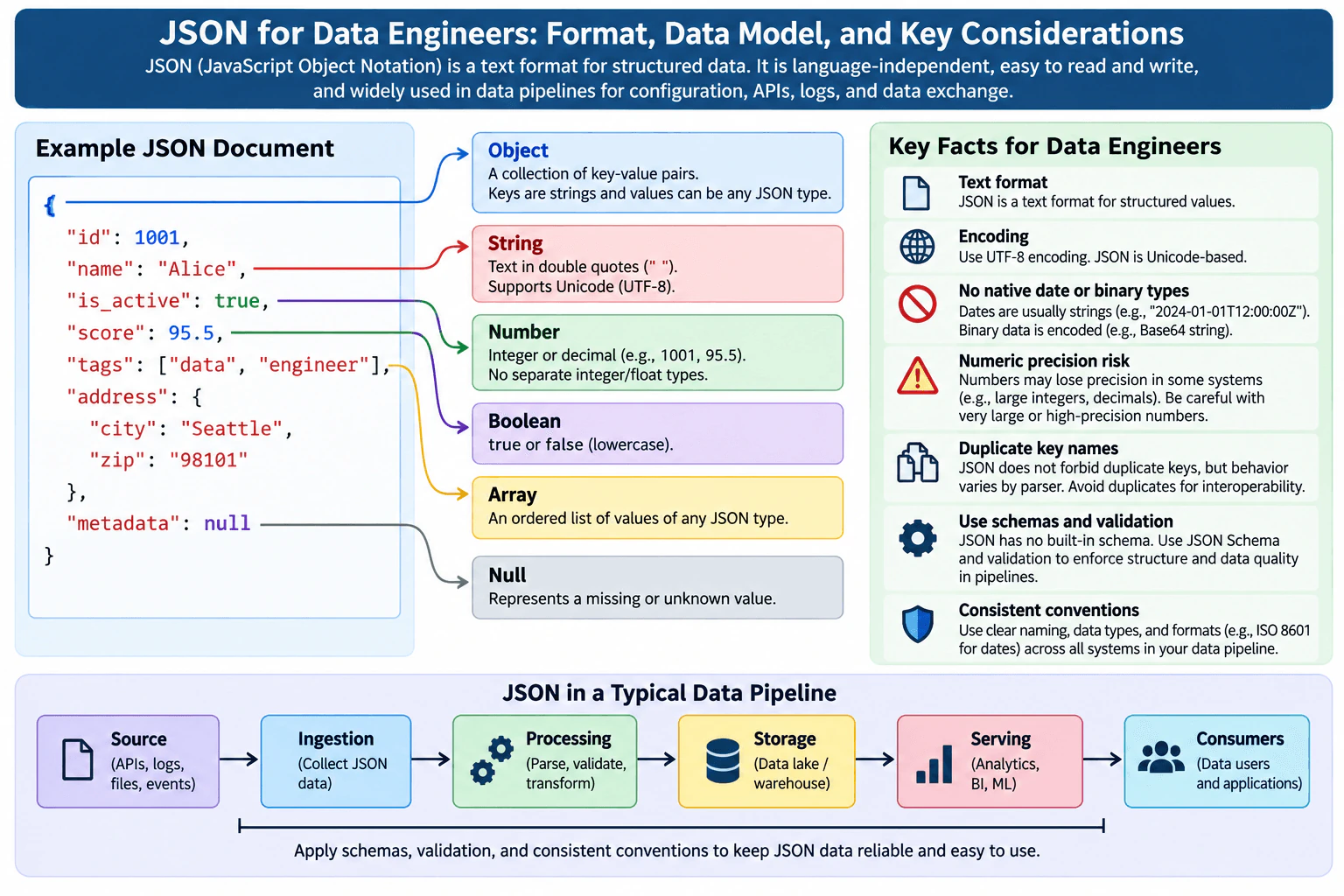
JSON lets systems represent structured values as text. The diagram uses one record with id 1001, name "Alice", is_active true, score 95.5, tags ["data", "engineer"], a nested address with city "Seattle" and zip "98101", and metadata set to null. A data engineer must understand both the JSON value types and the rules needed to move those values safely through a pipeline. Encoding, dates, binary data, numeric precision, duplicate names, schemas, and validation all affect whether different systems interpret the record consistently.
Useful Questions to Ask the Interviewer
Should I focus only on the JSON data model, or also explain the pipeline and interoperability concerns shown in the diagram?
Does the pipeline have required conventions for timestamps, binary values, numeric precision, or schema validation?
How to Explain It in an Interview
1. Explain the JSON data model
JSON represents structured values using six value types.
An object is a collection of name-value pairs inside braces. In the diagram, the top-level object contains fields such as "id", "name", "is_active", "score", "tags", "address", and "metadata". Object names are strings, and each value can be any JSON value.
An array is an ordered list of values. The diagram shows "tags": ["data", "engineer"]. Array elements may also be objects, arrays, strings, numbers, booleans, or null.
A string is text in double quotes. Examples in the diagram include "Alice", "Seattle", and "98101".
A number is a numeric JSON value. The diagram uses 1001 and 95.5. JSON itself does not define separate integer and floating-point value types.
A boolean is either true or false. The diagram uses true for "is_active".
The null literal represents a null value. In a data contract, teams may use it for a missing, unknown, or intentionally empty value, but that meaning should be agreed by the producer and consumer.
2. Use the expected encoding
The diagram calls out UTF-8. JSON exchanged between systems should use UTF-8 so APIs, files, events, and other pipeline components interpret text consistently.
3. Define conventions for dates and binary data
JSON has no native date or timestamp value type. A pipeline therefore needs an agreed representation. The diagram shows a string such as "2024-01-01T12:00:00Z" and recommends a consistent convention such as ISO 8601.
JSON also has no native binary value type. If binary content must be placed inside JSON, one possible convention is to encode the bytes as Base64 text. The producer and consumer must agree on that representation.
4. Protect numeric precision
JSON numbers do not carry a fixed database-style precision or scale. A parser or programming language may map the same JSON number to a type with different numeric limits. Very large integers or high-precision decimal values can therefore lose precision in some systems. A data engineer should choose safe target types or representations and test the full path from producer to consumer.
5. Avoid duplicate object names
Duplicate names inside one JSON object create an interoperability problem. Different parsers can handle duplicates differently. A pipeline should avoid or reject duplicate names instead of depending on parser-specific behavior.
6. Apply schemas, validation, and consistent conventions
The diagram shows one pipeline flow: Source -> Ingestion -> Processing -> Storage -> Serving -> Consumers.
The source may be APIs, logs, files, or events. Ingestion collects the JSON data. Processing parses, validates, and transforms it. Storage places the resulting data in a data lake or warehouse. Serving makes the data available for analytics, BI, or machine learning. Consumers are data users and applications.
A schema can define the expected structure, field names, data types, required values, and other constraints. Validation catches contract problems before bad data moves farther through the pipeline. Consistent naming, types, and formats make the data easier for every downstream system to interpret.
Key Insight / Why This Solution Works
There is no algorithm or data structure to implement for this conceptual interview question. The approach is to explain JSON in two layers. First, describe its six value types using the exact example in the diagram. Second, explain the data-engineering contract around those values: UTF-8 encoding, conventions for dates and binary data, numeric-precision risk, duplicate-name interoperability, schemas, validation, and consistent conventions. The central invariant is that each pipeline stage should interpret the same JSON fields and values according to the same agreed contract.
Time & Space Complexity
Algorithmic time complexity and auxiliary-space complexity are not applicable because the question does not ask for an executable algorithm. The diagram also does not define a parsing or validation implementation whose complexity should be analyzed. In a real system, parsing and validation costs would depend on the document size, nesting, schema, parser, and implementation, so assigning one fixed complexity here would be misleading.
Where it is used
JSON is commonly used for APIs, configuration, logs, event records, files, and data exchange between services. In the diagram, JSON moves from sources such as APIs, logs, files, and events into ingestion, then through parsing, validation, and transformation. The resulting data can be stored in a data lake or warehouse, served to analytics, BI, and machine-learning workloads, and consumed by data users and applications.
Why Interviewers Ask This
The interviewer is checking whether you understand JSON beyond braces and brackets. They want to see whether you know its real value model and can reason about what happens when JSON crosses system boundaries. Strong answers cover objects, arrays, strings, numbers, booleans, null, UTF-8 encoding, missing native date and binary types, numeric precision, duplicate-name interoperability, and the role of schemas and validation in keeping data pipelines reliable.
Common interview mistakes
One mistake is describing JSON as a JavaScript object instead of a language-independent text format. Another is forgetting one of the six JSON value types. Candidates may incorrectly claim that JSON has native date, timestamp, or binary types. They may also assume every system preserves all JSON numbers exactly, or rely on duplicate object names even though parser behavior can differ. A final mistake is thinking syntactically valid JSON is automatically valid pipeline data without checking schema, required fields, naming, types, and format conventions.
Interview tip
Explain JSON in two passes. First, use the diagram's record to name the six value types. Then explain the production concerns: UTF-8, date and binary conventions, numeric precision, duplicate names, schemas, validation, and consistent pipeline contracts. That keeps the answer simple while showing data-engineering depth.
Interviewer may ask next
How would you represent dates and binary data in JSON?
JSON has no native date or binary value type. I would define explicit conventions in the data contract. For a timestamp, I would normally use a consistently formatted string such as "2024-01-01T12:00:00Z". For binary data, Base64 text is one possible representation when the bytes must be embedded in JSON. The producer and consumer must agree on the representation and validate it.
Why do I need schema validation if the JSON is already syntactically valid?
Valid JSON syntax only proves that the text follows JSON grammar. It does not prove that fields are present, names are correct, values have the expected types, timestamps use the agreed format, or business constraints are satisfied. Schema validation checks those contract rules early, which helps stop bad data before it reaches storage, serving layers, and downstream consumers.
78. What is YAML, and why must data-pipeline configuration treat it carefully?CodingEasy
i Question Details
Define YAML as a human-readable data-serialization language often used for configuration. Explain mappings, sequences, scalars, indentation, anchors, aliases, tags, and multi-document streams. Discuss parsing with a declared YAML version, schema-dependent type interpretation, validation, secret handling, and why YAML configuration is not interchangeable with JSON in every tool.
Short Interview Answer (30-60 seconds)
YAML is a human-readable data-serialization language that is often used for configuration. For a data pipeline, I would parse the file using the intended YAML version, validate the resulting mappings, sequences, and scalar values against the expected schema, and only then apply the configuration. I would keep plaintext secrets out of YAML and use references instead. YAML also supports anchors, aliases, tags, and multiple documents, so I would not assume it is interchangeable with JSON in every tool. This question has no fixed algorithmic time or auxiliary-space complexity.
Detailed Explanation
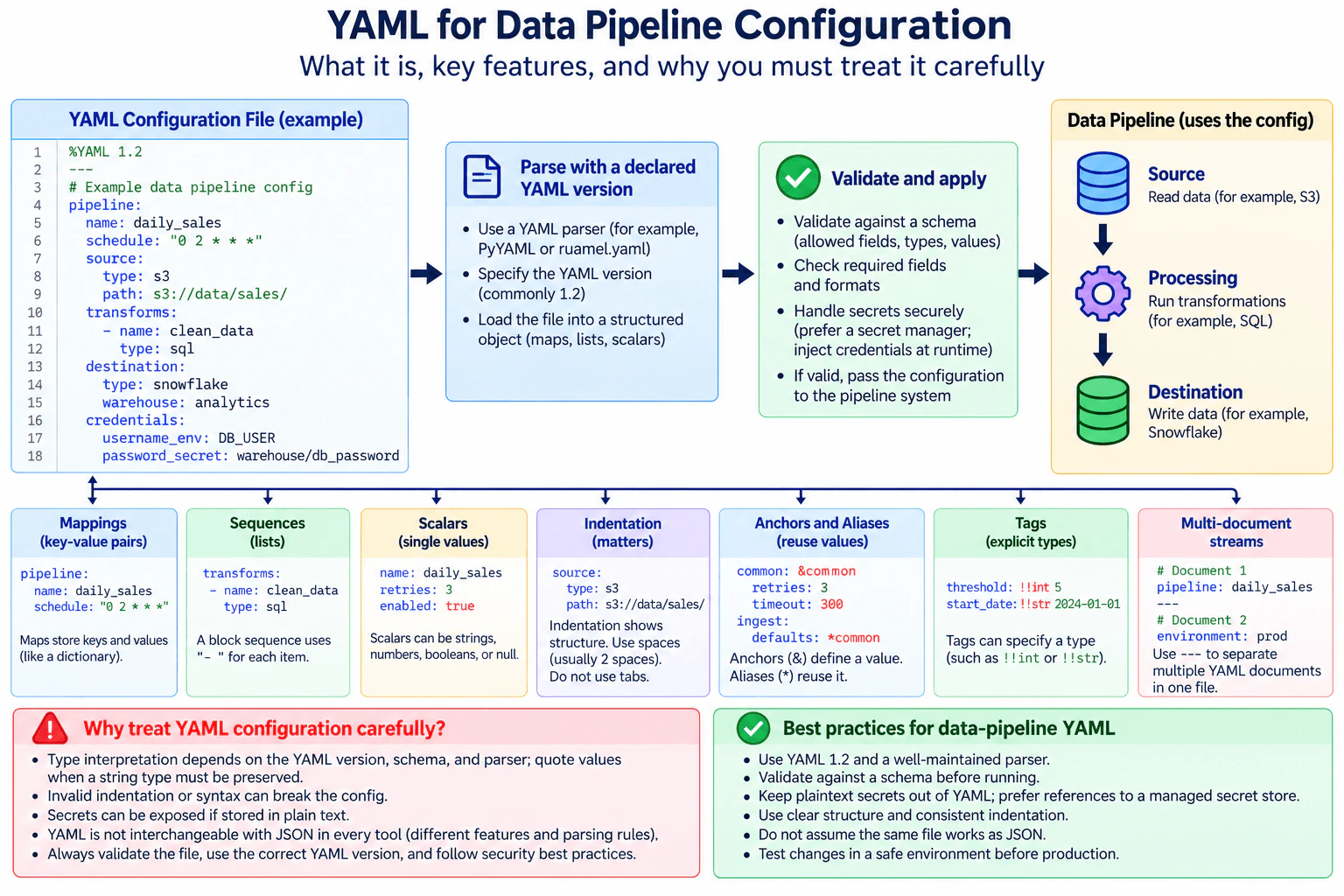
YAML lets people describe structured settings in a readable text file. In the diagram, one YAML document describes a pipeline named daily_sales, including its schedule, S3 source, SQL transformation, Snowflake destination, and credential references. The important goal is not only to parse the text. The system must interpret it using the intended YAML rules, validate that required fields and values are acceptable, keep real secrets outside the file, and pass only valid configuration to the pipeline. YAML-specific features also mean that a YAML file cannot always be treated exactly like JSON.
Useful Questions to Ask the Interviewer
Which YAML version and schema does the pipeline system expect?
Is the parsed configuration validated against a formal schema before execution?
How are credential and secret references resolved at runtime?
Does the consuming tool support anchors, aliases, tags, and multi-document YAML streams?
How to Explain It in an Interview
1. Understand the YAML structure
YAML represents structured data with mappings, sequences, and scalars. A mapping contains key-value pairs. In the diagram, pipeline contains fields such as name and schedule. A sequence is a list. The transforms field contains one list item with name: clean_data and type: sql. A scalar is one individual value, such as daily_sales, 3, or true.
Indentation is meaningful in YAML. It shows which values belong inside another mapping or sequence. In the example, type: s3 and path: s3://data/sales/ are indented under source. Incorrect indentation can change the structure or make the configuration invalid.
2. Parse with the declared YAML version
The example begins with %YAML 1.2, followed by ---. The first line declares YAML version 1.2 for the document. The --- marker starts the document after the directive.
A YAML parser reads the text and builds structured values such as mappings, sequences, and scalars. The diagram gives PyYAML and ruamel.yaml as parser examples. The application should use the YAML version and parsing behavior it expects instead of assuming every parser or schema interprets every scalar in the same way.
3. Understand anchors, aliases, tags, and streams
YAML supports anchors and aliases. An anchor gives a node a name, and an alias refers back to that anchored node. The diagram shows common: &common with retries: 3 and timeout: 300, followed by defaults: *common. Here, *common refers to the previously anchored mapping.
YAML also supports explicit tags. The diagram shows threshold: !!int 5 to mark the scalar as an integer and start_date: !!str 2024-01-01 to mark the value explicitly as a string.
A YAML stream can contain multiple documents. The diagram shows one document with pipeline: daily_sales, then another document starting after --- with environment: prod.
4. Validate before applying the configuration
Parsing and validation are different steps. Parsing answers, "Can this YAML be read as structured data?" Validation answers, "Is this structure allowed for this data pipeline?"
The diagram validates allowed fields, types, and values. It also checks required fields and formats. Only after those checks succeed is the configuration passed to the pipeline system. The pipeline then reads from a source such as S3, runs processing such as SQL transformations, and writes to a destination such as Snowflake.
5. Treat scalar interpretation carefully
A scalar that looks simple in the YAML text may be interpreted differently depending on the YAML version, schema, and parser behavior. This is why the diagram says to use the correct YAML version and validate the parsed result.
If a value must remain a string, its intended type should be made unambiguous. The tag example !!str 2024-01-01 explicitly says that the value is a string instead of relying on implicit type interpretation.
6. Keep secrets outside the YAML file
The main configuration contains username_env: DB_USER and password_secret: warehouse/db_password. These are references or identifiers, not plaintext credentials.
The application can use those references to obtain credentials at runtime. The diagram recommends keeping plaintext secrets out of YAML, preferring references to a managed secret store, and injecting credentials when the pipeline runs. This reduces the risk of passwords, keys, or tokens being exposed through source control or shared configuration files.
7. Do not assume YAML and JSON are interchangeable
YAML and JSON can represent many similar mappings, lists, and scalar values, but their text formats and supported features are not identical. YAML supports features such as comments, anchors, aliases, tags, document markers, and multi-document streams. A JSON-only tool may not understand those features, and different tools can impose different schemas or parsing rules. The safe approach is to use the exact format and contract required by the consuming system instead of assuming that YAML and JSON can always be exchanged without changes.
Key Insight / Why This Solution Works
The central approach is parse, validate, then apply. First, the YAML text is parsed according to the intended YAML version into mappings, sequences, and scalars. Next, the application validates required fields, allowed fields, types, values, and formats against the data-pipeline contract. Credential fields remain references rather than plaintext secrets. Only a configuration that passes validation is allowed to control the pipeline. The central invariant is: unvalidated configuration never reaches pipeline execution. This ordering protects the system from malformed structure, unexpected scalar interpretation, unsupported fields, and unsafe secret handling.
Time & Space Complexity
The diagram does not define a standalone algorithm with a fixed Big-O time or auxiliary-space bound, so giving one exact complexity would invent information. In practice, a YAML parser has to read the configuration and build a structured representation, and validation has to inspect the fields covered by the schema. The exact cost depends on the parser, document size, aliases, number of documents, and validation rules. For this interview question, the important complexity point is that no specific algorithmic time or auxiliary-space complexity is established by the supplied solution.
Where it is used
This pattern is common in data engineering systems where configuration controls ingestion, schedules, transformations, storage destinations, and runtime behavior. Teams often keep these settings in YAML because people can read and review it easily. The application then parses and validates the configuration before execution. The same pattern is useful for orchestrators, batch jobs, data-quality rules, deployment configuration, workflow definitions, and other systems where human-edited configuration must safely control automated processing.
Why Interviewers Ask This
The interviewer is checking whether you understand configuration as part of a production data system rather than as harmless text. They want to see whether you know YAML's main structures and YAML-specific features, understand the difference between parsing and validation, recognize that scalar interpretation can depend on version and schema, handle secrets safely, and avoid assuming YAML and JSON are interchangeable in every tool. They are also testing whether you can explain configuration behavior clearly and operationally.
Common interview mistakes
One mistake is treating successful parsing as successful validation. Syntactically valid YAML can still contain missing, unsupported, or incorrectly typed configuration. Another mistake is assuming every YAML version, schema, or parser interprets scalars identically. Incorrect indentation can also change the structure or make parsing fail. A serious security mistake is placing plaintext passwords or tokens directly in YAML instead of using secret references. Finally, candidates should not assume a JSON-only tool supports YAML-specific features such as anchors, aliases, tags, or multiple documents.
Interview tip
Explain the answer in three stages: structure, safety, and execution. First describe mappings, sequences, scalars, indentation, anchors, aliases, tags, and documents. Then explain that parsing is followed by schema validation because type interpretation and accepted fields matter. Finish by saying that real secrets stay outside the YAML file and only validated configuration is allowed to control the data pipeline.
Interviewer may ask next
How would you make a data-pipeline YAML configuration safer before production execution?
I would use the intended YAML version and a maintained parser, then validate the parsed structure against the pipeline's expected schema. I would check required fields, allowed fields, types, values, and formats before starting the job. I would keep plaintext credentials out of YAML and store only references to secrets that are resolved at runtime. I would also test configuration changes in a safe environment. The key rule is that invalid or unvalidated configuration must never control the production pipeline.
Why can a YAML configuration fail when a tool expects JSON even if the data looks similar?
The two formats can represent many of the same basic mappings, lists, and scalar values, but their text formats and supported features are not identical. YAML supports features such as comments, anchors, aliases, tags, document markers, and multiple documents. A JSON-only tool may not support those features. Even a tool that accepts both formats can apply its own schema or parsing rules. I would therefore use the exact format required by the consuming tool and validate the resulting structure instead of assuming automatic interchangeability.
79. What is CSV, and why is it harder to exchange reliably than it appears?CodingEasy
i Question Details
Define CSV as a delimited text representation of tabular records. Explain headers, delimiters, quoting, escaped quotes, embedded newlines, character encoding, null-versus-empty ambiguity, type inference, locale-sensitive values, and inconsistent dialects. Describe the explicit contract a reliable ingestion process needs.
Short Interview Answer (30-60 seconds)
CSV is a delimited text format for tabular records. A row normally represents one record, and delimiters such as commas separate fields. Reliable exchange is harder because both sides must agree on headers, quoting, escaped quotes, embedded newlines, character encoding, NULL versus empty values, types, locale-sensitive values, and CSV dialects. I would treat these rules as an explicit data contract between producer and consumer. This is a conceptual question, so algorithmic time and auxiliary-space complexity are not applicable.
Detailed Explanation
CSV stores table-like records as text. Each record normally contains fields separated by a delimiter such as a comma. That looks simple, but the same characters can also appear inside data. A field can contain a comma, quote, or newline. Empty fields can have different meanings. Systems can also disagree about encoding, types, date and number formats, and other CSV rules. Reliable exchange therefore needs a clear shared agreement that tells both the producer and consumer exactly how the file must be written and interpreted.
Useful Questions to Ask the Interviewer
Which delimiter, quote character, escape rule, and line ending should the consumer expect?
Is a header row always present, and are the column names and column order fixed?
Which character encoding should be used, such as UTF-8?
How should NULL and an empty string be represented differently?
What data type and format should each column use?
Which locale rules apply to numbers and dates?
What should ingestion do with missing columns, extra columns, malformed rows, or invalid values?
How to Explain It in an Interview
1. Start with the CSV structure
The diagram uses the header id,name,age,signup_date,notes. Each following record contains values for those columns. A comma is the delimiter in this example. A reliable consumer must know whether a header exists, what the column names are, and whether column order is part of the contract.
2. Explain delimiters and quoting
A delimiter separates fields, but that same character can appear inside a value. The diagram shows a name containing a comma, such as Bob, Jr.. That value must be quoted so its comma is treated as data rather than as another field separator. The producer and consumer must therefore agree on the exact delimiter and quote rules.
3. Explain escaped quotes
A quote can also appear inside a quoted field. The diagram shows a notes value containing quoted text around SQL. The normal CSV convention is to represent a double quote inside a quoted field as two double quotes. The escape rule must be part of the shared contract so the consumer reconstructs the original value correctly.
4. Explain embedded newlines
The diagram shows a quoted notes field that spans multiple physical text lines. This is still one logical field and one logical record. A parser that simply splits the file at every newline can break valid data. The contract must state whether embedded newlines are allowed and which line-ending convention is expected.
5. Explain NULL, empty values, types, and locale
The diagram also shows empty fields. CSV by itself does not say whether an empty field means NULL, an empty string, or something else. That meaning must be defined explicitly. CSV values are text, so a consumer can also guess types incorrectly. For example, numbers and dates can be interpreted differently depending on locale. The contract should therefore define column types, expected formats, NULL representation, empty-string handling, and locale-sensitive rules.
6. Explain character encoding and CSV dialects
The bytes in the file must be decoded with the correct character encoding, such as UTF-8. Using the wrong encoding can corrupt text or make ingestion fail. CSV files can also use different dialects. They may differ in delimiter, quoting, escaping, line endings, and related parsing rules. A reliable process must not guess these rules when they can be documented instead.
7. Define the explicit ingestion contract
The reliable approach shown in the diagram is an explicit contract. Under file format and structure, define delimiter, quote character, escape rule, header presence, character encoding, and line ending. Under schema and types, define column names, order, data types, formats, and type-conversion rules. Under special values, define NULL representation, empty-string handling, and locale-sensitive formats. Under data quality, define required and optional columns, allowed ranges, handling of extra or missing columns, validation, and error behavior. Finally, document the rules, provide real sample files, version schema changes, and agree on the exact CSV dialect.
The central lesson is that CSV is easy for a person to read, but dependable exchange requires a clear shared contract about format, types, and rules.
Key Insight / Why This Solution Works
There is no algorithm or special data structure to select for this conceptual question. The key idea is to treat CSV ingestion as a data-contract problem instead of assuming that every CSV-looking file follows the same rules. The central invariant is that the producer and consumer interpret the file using the same documented rules for delimiter, quoting, escaped quotes, headers, embedded newlines, encoding, line endings, schema, types, NULL values, empty strings, locale-sensitive formats, validation, and version changes. This shared interpretation removes ambiguity.
Time & Space Complexity
Algorithmic time complexity and auxiliary-space complexity are not applicable because the question asks for the meaning of CSV and the contract needed for reliable exchange. The diagram does not define a parsing algorithm or implementation, so inventing an O(n), O(1), or other complexity claim would not be justified.
Where it is used
This approach is useful in data ingestion, batch pipelines, exports, imports, partner feeds, analytics systems, and any workflow where tabular data is exchanged through CSV files. The explicit contract lets data producers and consumers interpret the same file consistently instead of relying on undocumented parser defaults or guesses.
Why Interviewers Ask This
The interviewer is checking whether you understand that reliable file exchange involves more than reading comma-separated text. They want to see whether you recognize practical ingestion risks such as headers, delimiters, quoting, escaped quotes, embedded newlines, encoding, NULL ambiguity, type inference, locale-sensitive values, and inconsistent dialects. They are also testing whether you can turn those assumptions into a clear, documented, testable contract between a data producer and consumer.
Common interview mistakes
Common mistakes are assuming every CSV uses the same delimiter and quoting rules, splitting records at every newline even when a quoted field contains an embedded newline, and treating every empty field as NULL. Candidates also often ignore character encoding, trust automatic type inference too much, overlook locale-sensitive number and date formats, or fail to define how extra columns, missing columns, invalid values, and schema changes should be handled.
Interview tip
Explain the problem in two stages. First, show why apparently simple text becomes ambiguous when values contain delimiters, quotes, newlines, empty fields, different encodings, or locale-sensitive formats. Then give the Data Engineer conclusion: reliable CSV ingestion requires an explicit shared contract instead of relying on parser defaults or guesses.
Interviewer may ask next
How would you make a CSV ingestion pipeline handle malformed or invalid files safely?
I would validate each file against the agreed contract before accepting it. I would check the expected header and columns, delimiter and quoting rules, encoding, required values, types, formats, and allowed ranges. Invalid rows or files should follow the documented error policy, such as rejection, logging, or quarantine, rather than being silently interpreted in a different way. The failure behavior itself should be part of the contract.
How would you handle a producer that needs to change the CSV schema or format?
I would version the schema and format as part of the contract. The producer should communicate incompatible changes before sending new files. Consumers should know which version they support and what changed, such as columns, types, delimiters, or formatting rules. Updated sample files and validation rules should be provided so both sides can test the new version before production data is exchanged.
80. What is Apache Avro, and what problems does its schema solve?CodingEasy
i Question Details
Define Apache Avro as a row-oriented data-serialization system with a JSON-defined schema and compact binary encoding. Explain writer and reader schemas, schema resolution, primitive and complex types, unions, defaults, logical types, compatibility, and why Avro is commonly used for event and streaming records.
Short Interview Answer (30-60 seconds)
Apache Avro is a row-oriented data-serialization system that uses a JSON-defined schema and compact binary encoding. I think of the schema as a contract between a producer and a consumer. The producer serializes data with a writer schema, and the consumer reads it with a reader schema. Avro resolves compatible schema differences, including some added fields with defaults and supported type promotions. That makes it useful for evolving event and streaming records. Algorithmic time and auxiliary-space complexity are not applicable to this conceptual question.
Detailed Explanation
Apache Avro gives producers and consumers a shared description of each record. A producer creates a record and writes it using a schema. Avro encodes that record into compact binary data that can move through systems such as Kafka or files. A consumer later reads the data using a reader schema. The reader schema may differ from the writer schema when Avro's schema-resolution rules allow it. This helps teams change record formats over time while keeping compatible producers, stored data, and consumers working together.
Useful Questions to Ask the Interviewer
Do you want me to focus mainly on schema evolution, or should I also explain Avro's binary serialization format?
Should I explain backward, forward, and full compatibility from the producer-consumer point of view?
How to Explain It in an Interview
1. Start with the producer and writer schema
The producer can be an application or microservice. It creates a record and serializes that record using a writer schema. The diagram shows an Avro record schema written in JSON. The example schema is named "User". It has an "id" field of type "long", a "name" field of type "string", and an "email" field with the union ["null", "string"] and a default value of null.
2. Serialize the record into compact binary data
Avro uses the writer schema to encode the record into compact binary form. The schema supplies the field structure and types, so the encoded record does not need to repeat field names as text for every value. This helps reduce storage and network size compared with verbose text representations.
3. Transport or store the encoded record
The compact binary record can be sent through a streaming system or stored in files. The diagram shows examples such as Kafka, HDFS, S3, and other storage or transport systems. The important point is that the data was written according to a known writer schema.
4. Read the record with a reader schema
The consumer can be a stream processor or analytics job. It deserializes the binary data using a reader schema. The writer schema describes the data that was actually written. The reader schema describes the data shape the consumer expects. These schemas do not have to be identical when Avro can resolve their differences.
5. Use schema resolution for evolution
During deserialization, Avro resolves the writer schema against the reader schema. Record fields are matched by name rather than by their position. If the reader has a field that is missing from the writer schema, Avro can use the reader field's default when one is defined. Avro also supports certain type promotions, such as int to long and float to double. These rules allow compatible schema changes over time.
6. Understand Avro's types
Primitive types include null, boolean, int, long, float, double, bytes, and string. Complex types include record, enum, array, map, and fixed. A union allows a field to use one of several schemas, such as ["null", "string"] for a nullable string. Logical types add domain meaning to underlying Avro types. Examples shown in the diagram include date, time-millis, timestamp-millis, and decimal.
7. Connect compatibility to event and streaming systems
Backward compatibility commonly means a newer consumer schema can read data written with an older schema when the changes satisfy the required schema-resolution rules. Adding a reader field with a suitable default is a common example. Forward and full compatibility depend on whether the schemas can be resolved in the required reading directions. Compact binary encoding, schema evolution, and producer-consumer compatibility make Avro well suited to events, logs, data lakes, Kafka pipelines, and real-time analytics.
Key Insight / Why This Solution Works
This question does not use a search, sorting, graph, or other coding algorithm. The processing model is schema-based serialization and deserialization. The producer writes a record using a writer schema. Avro encodes the record as compact binary data. A consumer later reads the data using a reader schema. The key invariant is that the reader must be able to resolve its schema against the writer schema according to Avro's schema-resolution rules. Defaults, unions, field-name matching, logical types, and supported type promotions help schemas evolve without requiring identical writer and reader schemas.
Time & Space Complexity
Algorithmic Big-O complexity is not applicable to the interview question or the approved diagram because no standalone algorithm is being implemented. In a real Avro library, serialization and deserialization work over the record's fields and encoded values, so the processing cost grows with the amount of data being encoded or decoded. The main interview topic here is the schema contract, compact binary representation, schema resolution, and compatibility rather than a specific time or auxiliary-space bound.
Where it is used
Avro is commonly used for event records, application logs, streaming pipelines, and data-lake ingestion. Producers can serialize records into compact binary data, send them through systems such as Kafka, or store them in files in systems such as HDFS or S3. Consumers such as stream processors and analytics jobs can later deserialize those records with compatible reader schemas. This is useful when producers and consumers evolve at different times but still need a controlled data contract.
Why Interviewers Ask This
The interviewer is checking whether you understand data contracts in real pipelines, not only whether you recognize the name Avro. They want to see whether you can distinguish writer and reader schemas, explain schema resolution, describe primitive, complex, union, default, and logical types, and reason about schema evolution. They are also testing whether you understand why compact binary serialization and controlled compatibility are useful when producers, storage systems, and streaming consumers change independently.
Common interview mistakes
A common mistake is saying the writer schema and reader schema must always be identical. Avro permits compatible differences through schema resolution. Another mistake is assuming a default value means a field is omitted during serialization. Avro still encodes a field when it exists in the writer schema. Reader defaults are used during schema resolution when the reader expects a field that the writer schema does not contain. A third mistake is saying record field order must match. Avro resolves record fields by name. Candidates also sometimes assume every schema change is automatically backward, forward, or fully compatible.
Interview tip
Explain Avro as a producer-consumer data contract. Start with the writer schema, follow the record into compact binary form, and then explain how the reader schema and schema resolution let a consumer read compatible data. Finish with one concrete evolution example, such as adding a reader field with a default value.
Interviewer may ask next
What happens if a newer reader schema adds a field that is not present in older data?
During schema resolution, the newer reader can read the older record when the new reader field has a suitable default value. Avro uses that reader default because the field is missing from the writer schema. This is a common backward-compatible evolution pattern. If the reader expects a field that the writer schema does not contain and the reader field has no applicable default, schema resolution fails.
Why is an Avro union such as ["null", "string"] useful for event data?
A union allows a field to use one of several schemas. In the diagram, the "email" field can contain either null or a string. This is useful when an event field may legitimately have no value. The default of null also gives the reader a defined value when schema resolution needs that field and the writer schema did not provide it. Producers and consumers still have to follow the union definition and Avro's schema-resolution rules.
More questions load as you scroll
Disclaimer: This interview guide is for educational and informational purposes only. It is designed to help readers prepare, but it does not guarantee any interview result, hiring decision, offer, or outcome. Interview questions, hiring criteria, and preferred answers can vary by employer, interviewer, industry, location, and time. All answers, examples, and explanations in this guide are suggested examples for interview preparation, not definitive answers or instructions for professional practice. They are based on research and judgment, are provided without warranties of any kind, and should be adapted to the question, role, and applicable laws and professional requirements. Diagrams are simplified illustrations intended to highlight the main concepts and their relationships; actual situations, systems, and practices may be more complex. Alternative approaches may be equally valid or better suited to a particular question, context, or interviewer. To the fullest extent permitted by applicable law, the contributors and publisher are not liable for decisions made, actions taken, or losses incurred based on this guide.
State Laws and Professional Responsibilities: Laws and requirements governing an occupation vary by state and jurisdiction. You are responsible for checking the current laws, licensing requirements, and scope-of-practice rules that apply to your location and role, and for ensuring that your answers and actions comply with them. Adapt examples in this guide to those requirements. This guide is not legal advice.
Content Accuracy and Verification: To the fullest extent permitted by applicable law, we do not represent or warrant that interview guides, questions, answers, examples, or diagrams are accurate, complete, current, error-free, or suitable for any particular purpose. You are responsible for independently reviewing and verifying the information before relying on it.