61. How can convergence in a finite element analysis be measured?
I measure FEA convergence by solving the same physical model with progressively refined meshes and tracking important quantities such as tip displacement, stress away from singularities, strain energy, or reactions. For a quantity Q, I can calculate the relative change between successive meshes as e_r = |Q_(i+1) - Q_i| / |Q_i| × 100%. If that change falls below a chosen engineering tolerance, often a few percent when appropriate, and the result continues to stabilize with further refinement, I have evidence of mesh convergence. I also check the solver's residual or iteration criteria and global equilibrium or conservation. Solver convergence alone is not enough; I would also compare with a hand calculation where possible and with test data for validation.
Convergence in finite element analysis means that further numerical refinement does not significantly change the quantities that matter to the engineering decision. I would therefore separate two ideas: mesh or solution convergence, which asks whether the result is becoming independent of the discretization, and solver convergence, which asks whether the numerical equations for a particular discretized model have been solved to the required tolerance.
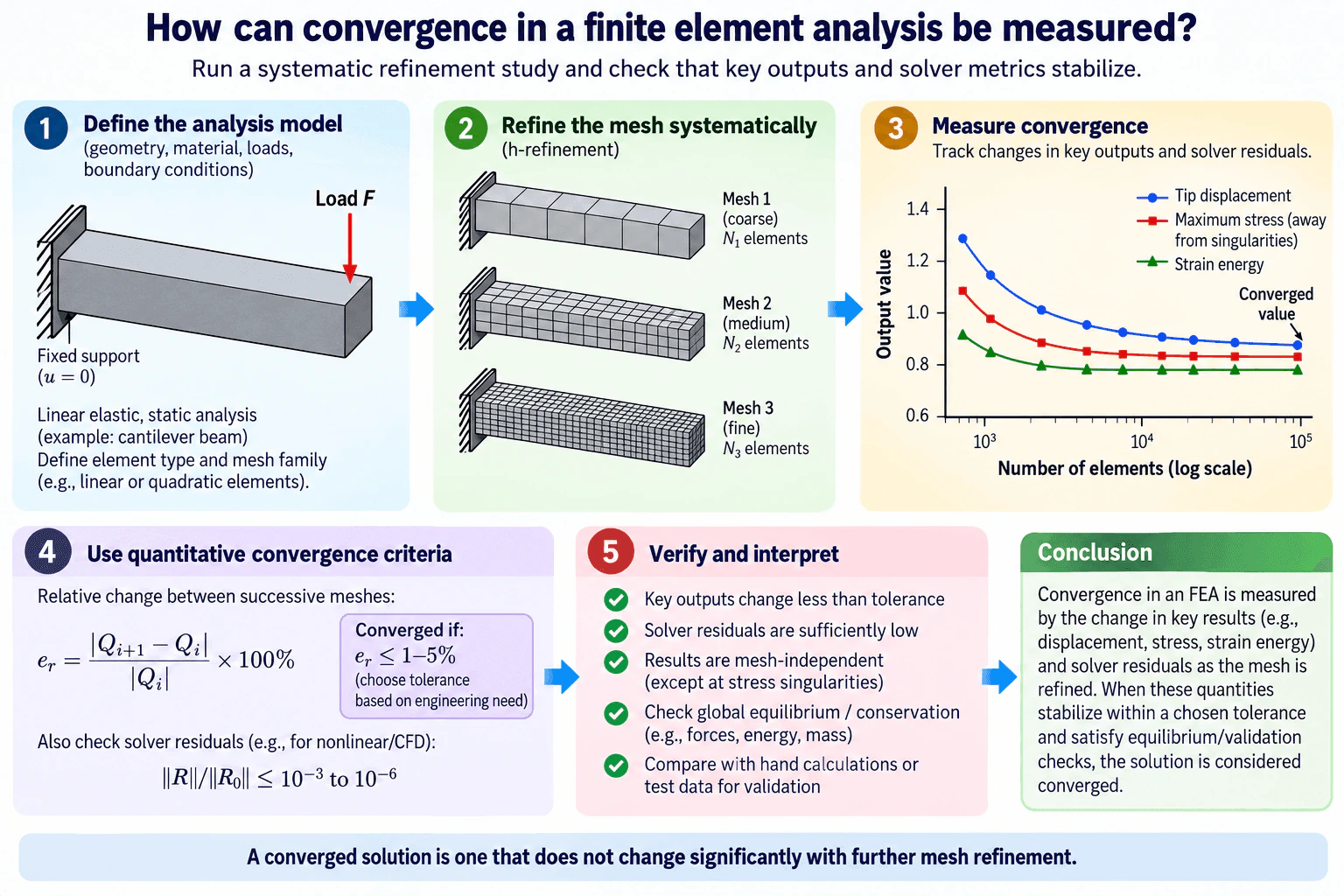
A practical convergence study starts by defining one consistent analysis model. For example, for a hypothetical linear-elastic static cantilever beam, I would keep the geometry, material model, load, fixed boundary condition, element family, and solver physics unchanged while refining the mesh. I might solve a coarse mesh with N1 elements, a medium mesh with N2 elements, and a fine mesh with N3 elements.
I would then track quantities that are physically meaningful for the engineering decision. Typical structural quantities include tip displacement, reaction force, strain energy, and stress at a location away from a mathematical singularity. Different outputs can converge at different rates, so checking more than one important quantity is useful.
For a monitored quantity Q, a simple quantitative convergence measure is the relative change between two successive meshes:
e_r = |Q_(i+1) - Q_i| / |Q_i| × 100%
Here, Q_i is the result from one mesh and Q_(i+1) is the result from the next refined mesh. If e_r falls below a chosen tolerance and additional refinement produces little further change, the result is becoming mesh-independent. A tolerance such as about 1–5% can be reasonable in some engineering studies, but it is not universal; it should be selected according to the required accuracy and the consequence of the decision.
I would also plot the monitored quantities against mesh density, characteristic element size, degrees of freedom, or number of elements. A curve that approaches a stable value as the mesh is refined gives visual evidence of convergence. In the cantilever example, tip displacement, representative stress away from singularities, and strain energy should each approach stable values if the discretization is adequate.
Solver convergence is a separate check. For nonlinear or iterative analyses, I would review the solver's documented residual, force, displacement, energy, or increment criteria. A normalized residual can be represented conceptually as ||R_i||/||R_0||. Numerical thresholds such as 10^-3 to 10^-6 may appear in some workflows, but the exact residual definition and acceptable limit depend on the solver, physics, scaling, and nonlinear formulation. I would therefore use the solver-specific convergence criteria rather than treating one residual value as universal.
Stress convergence needs special interpretation. At a sharp corner, point load, crack tip, or idealized restraint, an FEA model can contain a mathematical stress singularity. As the mesh is refined, the reported peak stress at that point may continue to increase instead of approaching a finite value. That does not automatically mean the entire analysis is unconverged. I would identify the singularity and evaluate quantities such as displacement, strain energy, reactions, or stresses at physically meaningful locations away from the singular point.
I would also check global equilibrium or the relevant conservation law. For a structural model, applied forces and reaction forces should balance within appropriate numerical precision. For other physics, energy or mass conservation may be relevant. These checks help detect modeling or solution problems that a convergence plot alone may not reveal.
Finally, I would separate verification from validation. A hand calculation, analytical solution, benchmark problem, or independent numerical check helps verify that the equations and model are being solved correctly. Experimental or test data are used to validate whether the model represents real physical behavior adequately. A credible FEA result therefore combines mesh convergence, solver convergence, equilibrium or conservation, independent verification, and validation evidence where available.
- Which quantity controls the engineering decision: displacement, stress, reaction, strain energy, temperature, frequency, or another output?
- Is the analysis linear or nonlinear, and are contact, large deformation, or nonlinear materials involved?
- Is there a hand calculation, analytical solution, benchmark, or test result available for comparison?
- Are any peak stresses located at sharp corners, point loads, crack-like features, or idealized restraints where a stress singularity may exist?
- What level of numerical accuracy is required for the decision, and what convergence tolerance would therefore be appropriate?
I would say that I do not call an FEA result converged simply because the solver finishes successfully. First, I keep the physical model and assumptions consistent and refine the mesh systematically. I track the outputs that matter to the engineering decision and calculate how much they change from one mesh to the next. When those quantities stabilize within a justified tolerance, I have evidence of mesh convergence. I separately check the solver's residual or iteration criteria and confirm global equilibrium or conservation. I also look for stress singularities because a singular peak stress may never converge with refinement. Finally, I compare the result with a hand calculation or benchmark for verification and with test evidence for validation when available.
- Define the analysis model and keep geometry, materials, loads, constraints, contacts, element family, and solver physics consistent during the convergence study.
- Choose the quantities of interest that control the engineering decision, such as displacement, reaction, strain energy, or stress away from singularities.
- Solve a coarse mesh and record the selected outputs and relevant solver convergence measures.
- Refine the mesh systematically using h-refinement or another justified refinement strategy while keeping the physical problem unchanged.
- Solve medium and fine meshes and record the same quantities for every refinement level.
- Calculate the relative change between successive meshes for each monitored quantity using e_r = |Q_(i+1) - Q_i| / |Q_i| × 100%.
- Plot or tabulate each quantity against mesh density, element count, or characteristic element size and check whether it approaches a stable value.
- Compare the relative change with a predefined engineering tolerance. A value around 1–5% may be appropriate in some applications, but the tolerance must be justified by the required accuracy.
- Separately review solver convergence measures such as residuals, nonlinear increments, force imbalance, or energy criteria using the definitions specified by the selected solver.
- Check global equilibrium or the relevant conservation law, such as forces, energy, or mass.
- Investigate outputs that do not converge, especially maximum stresses at sharp corners, point loads, crack tips, or idealized restraints that may create singularities.
- Compare the model with a hand calculation, analytical solution, or benchmark for verification where possible.
- Compare with experimental or test evidence for validation when available.
- Conclude that the solution is adequately converged when the important physical outputs no longer change significantly with further refinement and the solver and verification checks are also satisfied.
Mesh refinement increases spatial resolution but normally also increases the number of degrees of freedom, memory use, and solve time. The goal is therefore not to use the finest possible mesh everywhere, but to find a discretization that makes the important outputs sufficiently mesh-independent at an acceptable computational cost. Local refinement can be more efficient than uniform refinement when high gradients occur only in limited regions. Element order and element formulation can also affect convergence rate. Nonlinear contact, large deformation, and nonlinear material behavior can make solver convergence more difficult, so solver convergence and mesh convergence should be evaluated separately. Stress singularities are an important exception because the local peak stress can continue increasing as the mesh is refined even while displacement, strain energy, reactions, and stresses away from the singularity converge.
Interviewers want to see whether I can distinguish solver convergence from mesh or solution convergence and judge whether an FEA result is numerically credible. A strong answer should show that I can perform a systematic refinement study, monitor meaningful engineering outputs, choose a justified convergence tolerance, recognize stress singularities, check equilibrium or conservation, and support numerical verification with hand calculations and validation with test evidence.
Common mistakes include treating a successful solver termination as proof that the FEA result is accurate; checking only one mesh; changing loads, contacts, element type, material behavior, or other model assumptions at the same time as mesh density and then attributing all result changes to mesh refinement; monitoring only maximum stress when that value occurs at a singularity; using a universal percentage tolerance without relating it to the engineering decision; relying only on residuals without checking mesh independence; ignoring global equilibrium or conservation; and confusing numerical verification with experimental validation.
Organize the answer around three actions: refine, measure, and verify. Explain that you refine the mesh systematically, measure changes in physically meaningful quantities with a relative-change criterion, and verify solver convergence plus equilibrium or conservation. Then add the important engineering nuance that singular peak stresses may not converge. Finish by distinguishing verification with hand calculations or benchmarks from validation with test data.