189 DevOps Engineer Interview Questions & Answers

105 top • 14 Amazon • 12 Apple • 15 Google • 9 Meta • 14 Microsoft • 8 Netflix • 12 NVIDIA

DevOps Engineer icon

Questions with Detailed ExplanationsWith Detailed Explanations

(Last Updated: September 1, 2026)

31. How would you design persistent storage for a StatefulSet across zone failures?Containers And KubernetesHard

Question Details

A stateful workload needs one persistent volume per replica and must recover when a node or zone becomes unavailable. Design the StorageClass binding mode, access mode, volume topology, persistent volume claim templates, replica placement, snapshot and restore path, expansion, and failover procedure. Explain which recovery steps Kubernetes performs and which data replication guarantees must come from the storage system or application.

Short Interview Answer (30-60 seconds)

At a high level, the goal is to keep each StatefulSet replica’s data safe when a node or zone fails. The main challenge is moving a failed pod without losing access to its existing volume. I would explain the design through volume creation, replica placement, and recovery. Each pod gets its own PVC, while the CSI storage keeps data available across zones. Kubernetes reschedules pods and keeps their storage identity. The trade-off is that stronger cross-zone replication adds storage cost and write latency.

Detailed Explanation

The workload must keep its data when a machine or an entire zone becomes unavailable. Each StatefulSet replica owns separate stored data. A replacement pod must therefore reconnect to that replica’s existing data instead of starting with an empty volume. Kubernetes can recreate and schedule pods, but it does not copy application data between zones. The design combines one PVC per replica, zone-aware placement, and a CSI storage system that keeps the volume available from surviving zones. It also includes snapshots, restore, volume expansion, scaling, and clear recovery responsibilities.

Useful Questions to Ask the Interviewer
  1. Must the workload survive a complete zone failure without restoring from backup?
  2. Does the CSI storage replicate each volume across zones?
  3. What amount of data loss is acceptable during a zone failure?
  4. Does the CSI driver support ReadWriteOncePod and cross-zone attachment?
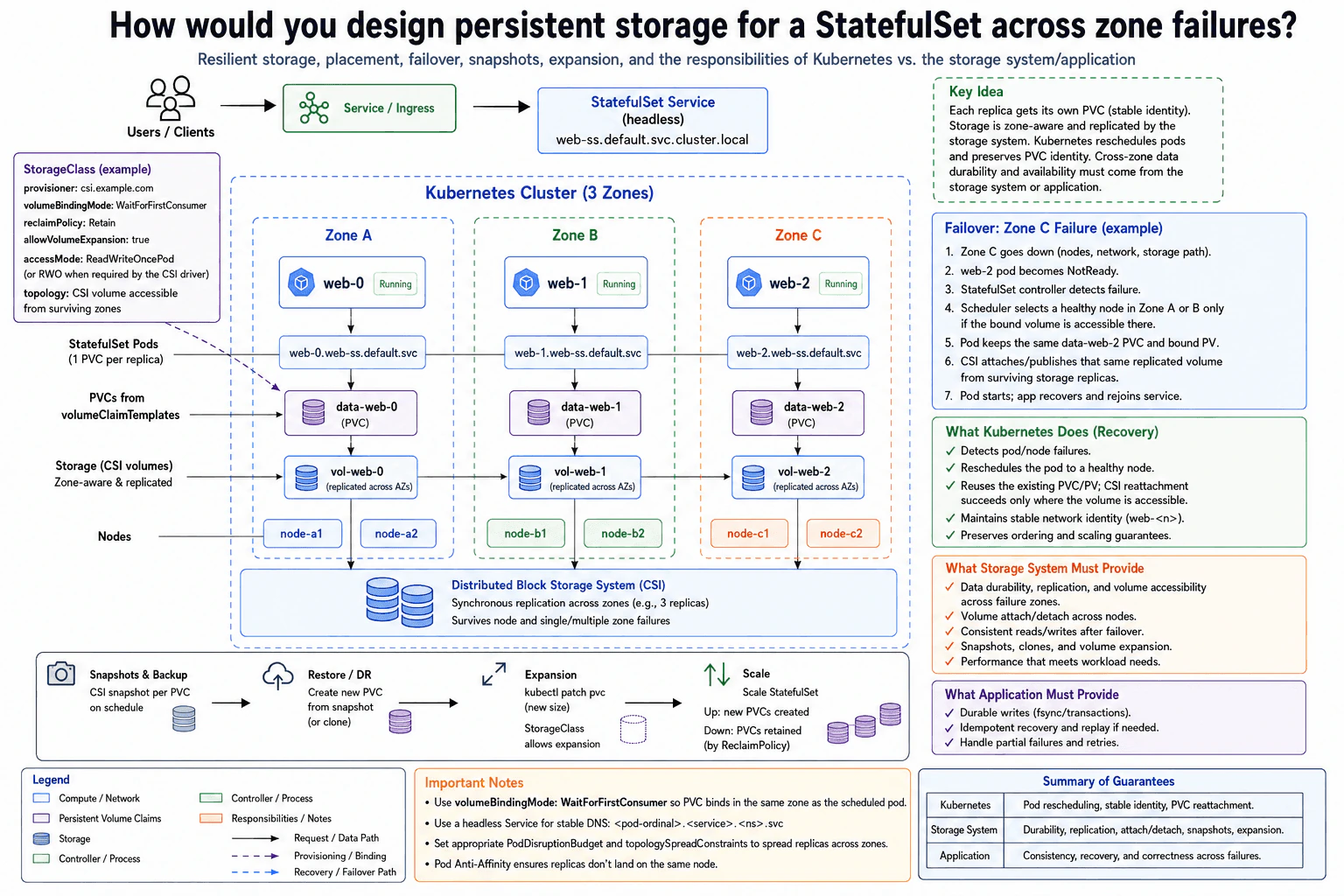
How would you design persistent storage for a StatefulSet across zone failures? diagram
How to Explain It in an Interview
1. Give every StatefulSet replica its own volume

I would start with one persistent volume claim for each replica. The StatefulSet creates these claims from volumeClaimTemplates. In the diagram, web-0 uses data-web-0, web-1 uses data-web-1, and web-2 uses data-web-2. These PVCs are independent.

The volumeClaimTemplate should request ReadWriteOncePod when the CSI driver supports it. This means one pod can mount that claim for read and write access. RWO can be used when required by the storage driver.

The headless StatefulSet Service also keeps stable network names. For example, web-0 uses web-0.web-ss.default.svc.

2. Bind storage after pod placement is known

The StorageClass uses volumeBindingMode: WaitForFirstConsumer. Kubernetes waits for pod scheduling before binding or provisioning the volume. This lets the scheduler consider storage topology together with node placement.

WaitForFirstConsumer does not copy data across zones. The CSI storage must separately provide volume accessibility from surviving zones.

3. Spread replicas across failure zones

I would spread the StatefulSet replicas across Zone A, Zone B, and Zone C. Topology spread constraints help distribute replicas across zones. Pod anti-affinity can also stop replicas from sharing the same node.

A PodDisruptionBudget protects availability during planned disruptions. These controls reduce the chance that one failure removes several replicas together.

4. Let the storage system protect the data

The distributed CSI storage layer keeps copies of each volume across zones. The diagram uses synchronous replication as its example. A write reaches the required storage replicas before it is considered complete.

This durability does not come from Kubernetes. The storage system must provide cross-zone replication, volume accessibility, attach and detach behavior, snapshots, expansion, and consistent reads and writes after failover. The application must still use durable writes and recover correctly from partial failures and retries.

5. Recover after a zone failure

If Zone C fails, web-2 becomes unavailable. Kubernetes detects the failed pod or node and works toward the StatefulSet’s desired replica count. After the failed pod can be replaced, the scheduler selects a healthy node in Zone A or B only if the bound volume is accessible there.

The replacement keeps the data-web-2 PVC and its bound PV. The CSI driver attaches and publishes that same replicated volume using surviving storage replicas. The pod mounts its data, starts, and rejoins the service.

6. Handle backup, expansion, and scaling

Each PVC can have a CSI snapshot. Recovery from backup creates a new PVC from a snapshot or clone. Volume expansion starts by increasing the PVC size when the StorageClass allows expansion.

Scaling up creates new PVCs for new StatefulSet replicas. Scaling down normally leaves StatefulSet PVCs in place under the shown retention behavior. If a PVC is later deleted, the StorageClass Retain reclaim policy keeps the underlying PV. The main trade-off is stronger durability versus extra storage cost and write latency.

Time & Space Complexity

The benefit is that a failed pod can move to another healthy zone and keep using its existing data. Cross-zone storage replication protects the volume when one zone disappears. The downside is that synchronous replication can make writes slower because data must reach several storage locations before completion. It also uses more storage. WaitForFirstConsumer improves topology-aware placement, but it does not create cross-zone durability itself. Snapshots provide another recovery path, but restoring from a snapshot is slower than attaching an already replicated volume. Keeping PVCs after scale-down protects data, but unused storage may need later cleanup.

Why Interviewers Ask This

Interviewers want to see whether you understand the boundary between Kubernetes and the storage layer. Kubernetes can manage StatefulSet identity, schedule replacement pods, and reuse existing PVCs. It does not automatically replicate the stored data across zones. A strong answer also shows judgment about storage topology, access modes, replica placement, snapshots, expansion, recovery steps, and the cost of stronger durability guarantees.
Interviewer may ask next
What would change if the storage system could not make a volume accessible from another zone?

I would keep the same StatefulSet and one-PVC-per-replica design, but automatic cross-zone reattachment would no longer be possible. WaitForFirstConsumer would still help Kubernetes place the original pod and volume correctly. It would not make a zone-local volume available in another zone.

If Zone C failed, Kubernetes could detect that web-2 was unavailable and work toward replacing it. However, a replacement in Zone A or B could not safely mount data-web-2 if its bound volume existed only in Zone C.

Recovery would then use the snapshot and restore path shown in the diagram. We would create a new PVC from a usable snapshot or clone in a healthy zone and recover the workload from that copy. The application may also need its own replication if the allowed data-loss window is very small.

The main downside is slower recovery. There may also be some lost recent data depending on when the latest usable snapshot was created.

What would you change if synchronous cross-zone replication made writes too slow?

I would first ask how much recent data the application can afford to lose during a zone failure. The current design uses synchronous replication, which gives stronger durability because a write reaches the required storage replicas before completion.

If lower write latency became more important, the storage system could use a weaker replication method only when the application accepts the resulting data-loss risk. The Kubernetes part of the design would stay mostly the same. Each StatefulSet replica would still have its own PVC. Replicas would still be spread across zones, and Kubernetes would still reuse the existing PVC when replacing a failed pod.

The important change would be the storage guarantee. A surviving storage replica might be missing some of the newest writes after a sudden zone failure. The application would need to understand and tolerate that recovery point.

The benefit is faster writes. The downside is a greater chance of losing the newest data during failure.

32. What is infrastructure as code, and how does it differ from manual infrastructure provisioning?Infrastructure As CodeEasy

Question Details

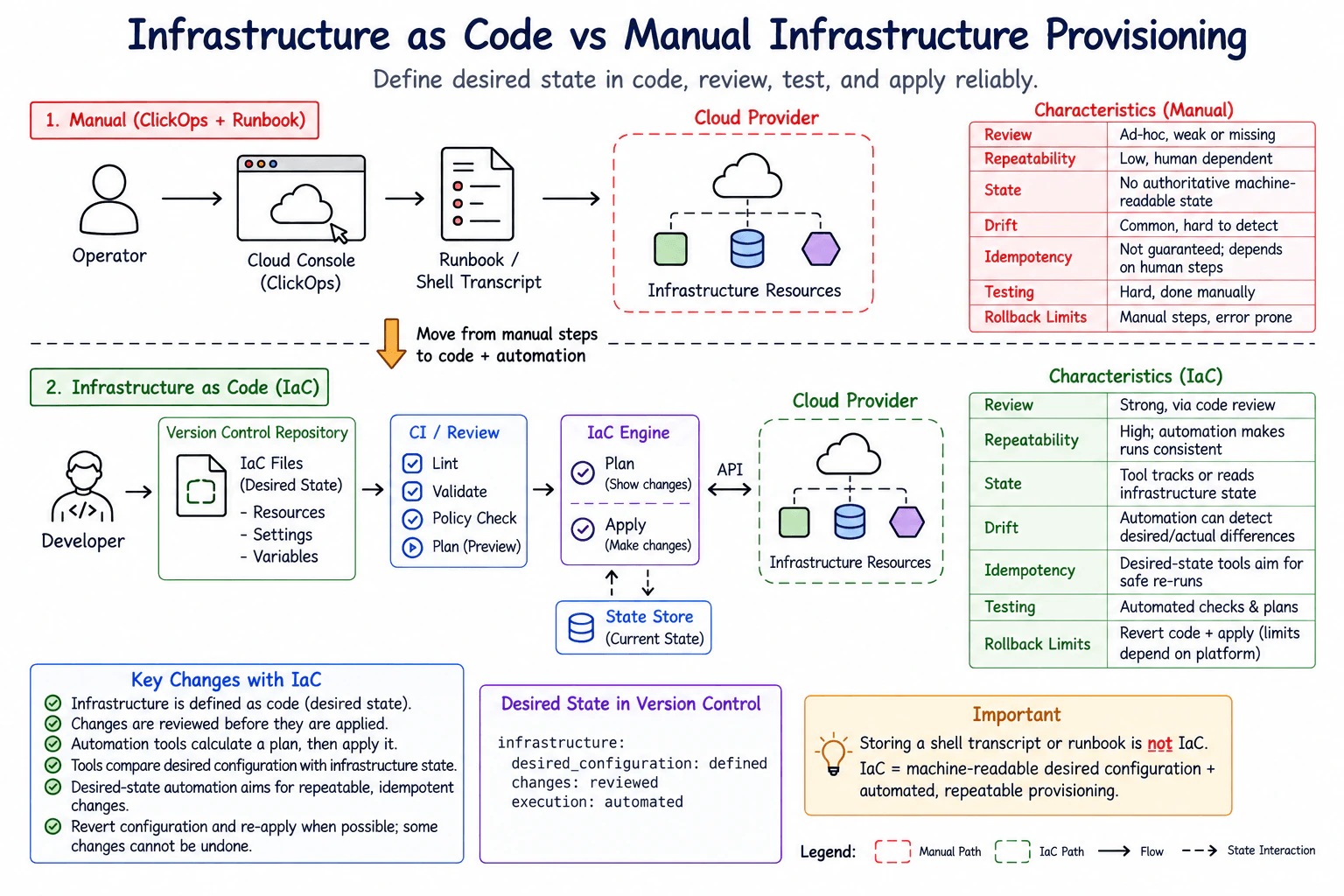
A team currently creates cloud resources through console clicks and records the steps in a runbook. Explain what changes when the desired infrastructure is defined in version-controlled files and applied by an automation tool. Compare review, repeatability, state, drift, idempotency, testing, and rollback limits without assuming that storing a shell transcript alone provides infrastructure as code.

Short Interview Answer (30-60 seconds)

Infrastructure as code defines desired infrastructure in version-controlled, machine-readable files and applies it through automation. Unlike manual console work, it supports review, repeatable execution, automated checks, state comparison, and drift detection. A runbook or shell transcript alone is not IaC, and rollback is not always guaranteed.

Detailed Explanation

The team is moving from people creating cloud resources by clicking through screens and writing down their steps to describing the wanted infrastructure in files that everyone can review. An automation tool reads those files and performs the changes. This makes the process more consistent because people do not need to remember or repeat the same clicks. It also creates a clear history of intended changes and allows checks before the real change happens. However, automation can still fail, outside changes can create differences, and some infrastructure changes cannot simply be undone.

Useful Questions to Ask the Interviewer
  1. Should I explain the answer in a tool-neutral way, or would you like an example using a specific infrastructure as code tool?
  2. Should I include how the team detects and handles changes made outside the IaC workflow?
  3. Do you want me to describe the review and approval process before production changes are applied?
What is infrastructure as code, and how does it differ from manual infrastructure provisioning? diagram
How to Explain It in an Interview

Infrastructure as code, or IaC, means defining the desired infrastructure in machine-readable configuration files, storing those files in version control, reviewing proposed changes, and using automation to make infrastructure move toward that desired configuration.

With manual provisioning, an operator may open a cloud console, click through screens, create resources, and record the steps in a runbook or shell transcript. That documentation can help another person repeat the procedure, but it is not an authoritative machine-readable description of the desired infrastructure. Human execution can vary, and the runbook can become different from what actually exists.

With IaC, the desired configuration is stored in a version-control repository. A common workflow is: propose a configuration change, review it, run linting, validation, tests, or policy checks, generate a plan or preview when the chosen tool supports one, review the proposed changes, and then apply the approved configuration through automation.

A plan is a preview, not a guarantee. The real infrastructure, provider behavior, concurrent changes, permissions, API responses, or other external conditions can change between plan and apply.

Review is stronger because infrastructure changes are represented as version-controlled file changes that can be examined before execution. Repeatability is higher because automation follows the same defined process instead of depending on a person repeating console actions. This improves consistency, although provider or platform behavior can still affect the final result.

State means information about the infrastructure that currently exists. Some IaC tools keep their own state data or state store, while others read the current infrastructure from the platform when evaluating changes. The important idea is that the automation can compare desired configuration with current infrastructure state instead of depending only on a written runbook.

Drift means the actual infrastructure no longer matches the desired configuration. For example, someone might manually change a resource through the cloud console after IaC created it. IaC tooling can often detect desired-versus-actual differences during a refresh, plan, preview, or similar comparison operation, depending on the tool.

Idempotency means repeating the same desired-state operation should normally converge toward the same intended state instead of creating unnecessary additional changes. Desired-state IaC tools aim for this behavior, but it is not an absolute guarantee. Provider behavior, scripts, external systems, or resource lifecycle operations can introduce non-idempotent effects.

Testing is easier because configuration can be linted, validated, checked against policies, and reviewed through a plan or preview before an approved apply. These checks reduce risk, but they cannot prove that the real apply will succeed.

Rollback also has limits. With IaC, a team can often revert configuration in version control and apply the previous desired configuration again. This is more controlled and traceable than trying to reverse console clicks manually. However, it is not a universal undo operation. Deleted data, irreversible API operations, resource replacements, external side effects, or cloud-platform limitations may require backups, restore procedures, or a controlled forward fix instead.

The key distinction is therefore not simply commands versus clicks. A shell transcript or runbook records actions. Infrastructure as code defines machine-readable desired configuration and combines it with version control, review, automated execution, state comparison, and a repeatable change process.

Technical Approach
  1. Define the desired infrastructure in machine-readable configuration files.
  2. Store the files in version control.
  3. Propose changes through a reviewed change request.
  4. Run linting, validation, automated tests, and policy checks that are appropriate for the selected tool.
  5. Generate and review a plan or preview when the tool supports one.
  6. Apply only the approved configuration through automation.
  7. Compare desired configuration with current infrastructure state to identify drift.
  8. Re-run desired-state automation when appropriate so infrastructure converges toward the intended configuration.
  9. For recovery, revert configuration and re-apply when that is safe; otherwise use backups, restore procedures, resource recreation, or a controlled forward fix.
Practical Insights

IaC adds setup and maintenance work because the team must maintain configuration files, automation, reviews, tests, policies, and any state mechanism used by the selected tool. In return, repeated infrastructure changes usually require less manual effort and are easier to review and audit. Large environments can make state refresh, planning, and apply operations slower. Teams must also coordinate concurrent changes, protect shared state when their tool maintains it, manage tool and provider versions, and carefully review destructive operations.

Why Interviewers Ask This

Interviewers want to verify that the candidate understands infrastructure as code as a desired-state, version-controlled, automated provisioning approach rather than simply scripting or documenting manual commands. The question also tests practical judgment about review, repeatability, infrastructure state, drift, idempotency, testing, plan-before-apply workflows, and realistic rollback limits.

Common interview mistakes

Common mistakes include saying that a runbook or saved shell transcript automatically becomes infrastructure as code; assuming every IaC tool uses a state file; claiming a plan guarantees the final apply result; saying IaC completely prevents drift; claiming every operation is automatically idempotent; treating a reverted configuration as a guaranteed rollback; running unreviewed production applies; making manual infrastructure changes without reconciling them with the desired configuration; and confusing IaC configuration behavior with provider or cloud-platform behavior.

Interview tip

Start with the practical contrast: manual provisioning records human steps, while IaC stores desired infrastructure as reviewed, machine-readable configuration and uses automation to apply it. Then compare review, repeatability, state, drift, idempotency, testing, and rollback limits one by one. Mention that plans are previews rather than guarantees and that some failures require restore procedures or a forward fix.

Interviewer may ask next
Is a shell script that creates cloud resources considered infrastructure as code?

Not automatically. A shell script can automate provisioning, but automation alone does not necessarily provide the desired-state model shown in a strong IaC workflow. A shell transcript mainly records commands that were run. Infrastructure as code normally keeps machine-readable desired configuration in version control, reviews changes, applies them through automation, and provides a way to compare the desired configuration with existing infrastructure. Imperative automation can be part of an infrastructure workflow, but simply saving commands does not provide all of these IaC properties.

Can infrastructure as code always roll infrastructure back safely?

No. IaC makes previous configuration versions easy to identify, so a team can often revert configuration and apply the earlier desired state again. However, that does not guarantee restoration of the previous real-world state. Deleted data, irreversible platform operations, resource replacements, external side effects, or provider limitations may prevent a true rollback. In those cases, the team may need backups, restore procedures, resource recreation, or a controlled forward fix.

33. What makes infrastructure as code declarative?Infrastructure As CodeEasy

Question Details

Compare declaring a desired end state with writing a sequence of imperative provisioning commands. Focus on planning, dependency ordering, repeatability, idempotent convergence, and how the tool determines the changes needed from the current state.

Short Interview Answer (30-60 seconds)

Declarative IaC describes what the final infrastructure should look like rather than every command needed to build it. The IaC engine compares desired and current state, calculates dependencies and required changes, produces a proposed plan, and applies approved changes so repeated runs converge toward the same result.

Detailed Explanation

The question asks why describing the final result is different from giving a computer a list of steps to run. With a list of commands, you decide what happens first, second, and later. With a declarative approach, you describe the result you want. The tool looks at what already exists, compares it with that result, works out which parts depend on other parts, and prepares only the changes that are needed. If you run it again and everything already matches, it should normally leave the infrastructure unchanged instead of creating the same things again.

Useful Questions to Ask the Interviewer
  1. Would you like me to explain the concept generally, or use a specific IaC tool as an example?
  2. Should I also cover planning, drift detection, and idempotent convergence?
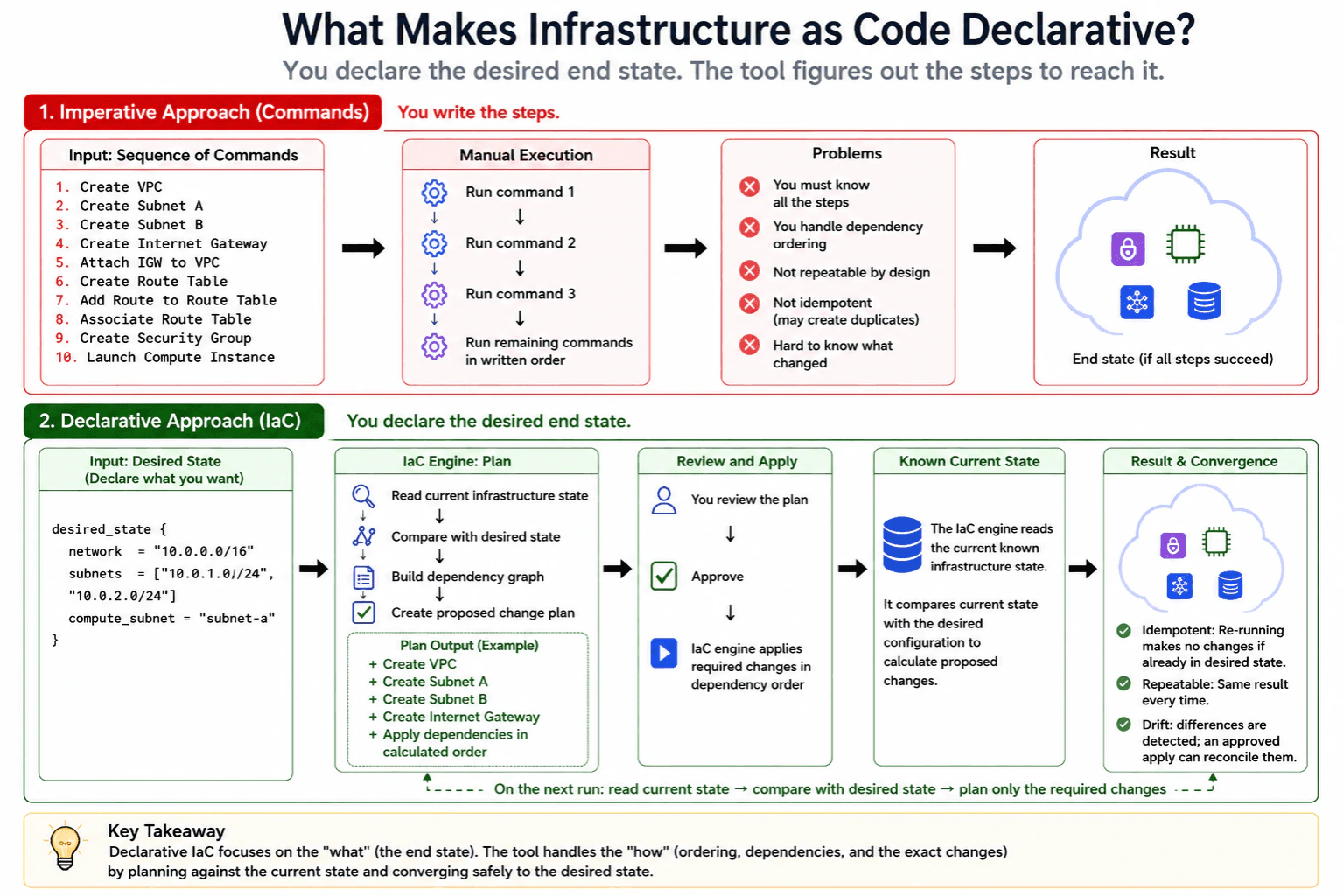
What makes infrastructure as code declarative? diagram
How to Explain It in an Interview

A declarative IaC configuration describes the desired end state: what infrastructure should exist and how important resources relate to one another. An imperative approach instead describes the sequence of commands that should run, so the author is responsible for the order and for handling dependencies manually.

In the declarative approach shown in the diagram, the IaC engine first reads the desired configuration and its current view of the infrastructure. It compares current infrastructure state with desired state, builds a dependency graph, and calculates the changes it believes are required. For example, if a compute resource depends on a subnet, the dependency graph lets the engine order those operations correctly instead of requiring the user to script every command in sequence.

The engine then creates a proposed change plan. The plan can show resources that would be created, changed, or removed. A person reviews the plan and approves the intended change boundary before apply. The plan is a preview, not a guarantee, because provider-visible state or the underlying platform can change between planning and applying.

During apply, the IaC engine performs the approved required changes in dependency order. Afterward, it has an updated known view of the infrastructure. On the next run, it reads the current state again, compares it with the desired configuration, and plans only the required differences.

This produces idempotent convergence. Idempotent means repeating the same operation does not keep creating unnecessary differences. If the infrastructure already matches the declared state, another run should normally make no infrastructure change. That also makes the process repeatable: the same desired configuration should keep converging toward the same intended end state rather than blindly replaying creation commands.

Drift means the real infrastructure has become different from the declared configuration, often because something changed outside the normal IaC workflow. The IaC engine can detect that difference when it refreshes or reads the current infrastructure state. It can then include the difference in a proposed plan. A reviewed and approved apply can reconcile supported drift with the desired configuration; drift detection by itself does not automatically repair anything.

The key distinction is simple: imperative provisioning says how to perform each step, while declarative IaC says what end state is wanted. The IaC engine determines the required changes and dependency order needed to converge toward that state. Declarative behavior does not remove provider or cloud-platform limitations, and it does not guarantee that every apply will succeed.

Technical Approach
  1. Read the desired infrastructure configuration.
  2. Read or refresh the current infrastructure state.
  3. Compare current state with desired state.
  4. Build the dependency graph.
  5. Calculate a proposed change plan containing the required operations.
  6. Review and approve the intended plan.
  7. Apply the approved required changes in dependency order.
  8. Update the tool's known current state.
  9. On later runs, compare again and plan only the required differences.
  10. If drift is detected, review the proposed reconciliation before applying it.
Practical Insights

This is not mainly an algorithm-complexity question. The practical cost grows with the number of resources, relationships, and provider operations that must be inspected and planned. Larger environments can take longer to refresh, compare, plan, and apply. Declarative configuration reduces maintenance effort because dependency ordering, comparison, and repeated convergence are handled by the IaC engine instead of being manually encoded in long command sequences. Apply time still depends on the real provider and infrastructure platform.

Why Interviewers Ask This

Interviewers want to know whether you understand the difference between declaring an infrastructure outcome and scripting a sequence of commands. They are testing whether you can explain desired state, current-state comparison, dependency ordering, planning, repeatability, idempotent convergence, and drift without incorrectly claiming that a plan guarantees the final apply result.

Common interview mistakes

A common mistake is saying declarative IaC simply means using configuration files instead of scripts. The important property is that you declare the desired state and the engine determines the changes needed to converge toward it. Another mistake is calling stored state the universal source of truth for desired infrastructure; the configuration declares the desired state, while the engine also needs a current view of real infrastructure to calculate differences. Do not say that a plan guarantees the apply result, because infrastructure or provider-visible state can change after planning. Do not say declarative tools eliminate dependencies; dependencies still exist, but the engine models and orders them. Finally, do not say drift detection automatically repairs infrastructure. A reviewed and approved apply is what can reconcile detected drift.

Interview tip

Use the phrase "imperative tells the steps; declarative describes the destination." Then explain current-versus-desired comparison, dependency ordering, a reviewed proposed plan, and idempotent convergence. Finish by noting that a plan is a preview rather than a guarantee.

Interviewer may ask next
Why is declarative infrastructure as code usually idempotent?

Because the IaC engine compares the current infrastructure with the declared desired state before deciding what to change. If a resource already matches the desired configuration, it should normally be left unchanged instead of being created again. Repeated runs therefore converge toward the same desired state rather than blindly repeating every provisioning command.

What happens if infrastructure changes outside the IaC workflow?

That creates drift: the real infrastructure no longer matches the declared configuration. On a later refresh or planning operation, the IaC engine reads the current infrastructure state, compares it with the desired configuration, and includes the difference in a proposed plan. The plan should be reviewed, and an approved apply can reconcile supported differences. Detection alone should not be described as an automatic repair.

34. What problem does Terraform state solve?Infrastructure As CodeEasy

Question Details

Explain how Terraform state maps configuration addresses to remote objects and stores dependency and attribute information needed for planning. Clarify why deleting or editing state casually can cause duplicate resources, destructive plans, or loss of management.

Short Interview Answer (30-60 seconds)

Terraform state maps configuration addresses to real infrastructure objects and records known attributes and dependencies. Terraform uses that information when planning changes. If state is deleted or edited carelessly, Terraform can create duplicates, produce destructive plans, or lose management of existing resources.

Detailed Explanation

Terraform needs a reliable memory of the real things it already manages. Your written instructions say what you want, but those instructions alone do not tell Terraform which existing thing belongs to each instruction. The saved record keeps that connection and remembers useful known values and relationships between things. This lets Terraform work out what should stay the same and what should change. If that saved record is damaged or removed, Terraform may create another copy, make a harmful change, or stop looking after something that still exists.

Useful Questions to Ask the Interviewer
  1. Would you like me to focus on how state maps configuration addresses to remote objects, or also explain what can go wrong when state is changed manually?
  2. Should I explain how Terraform refreshes remote data during planning to detect drift?
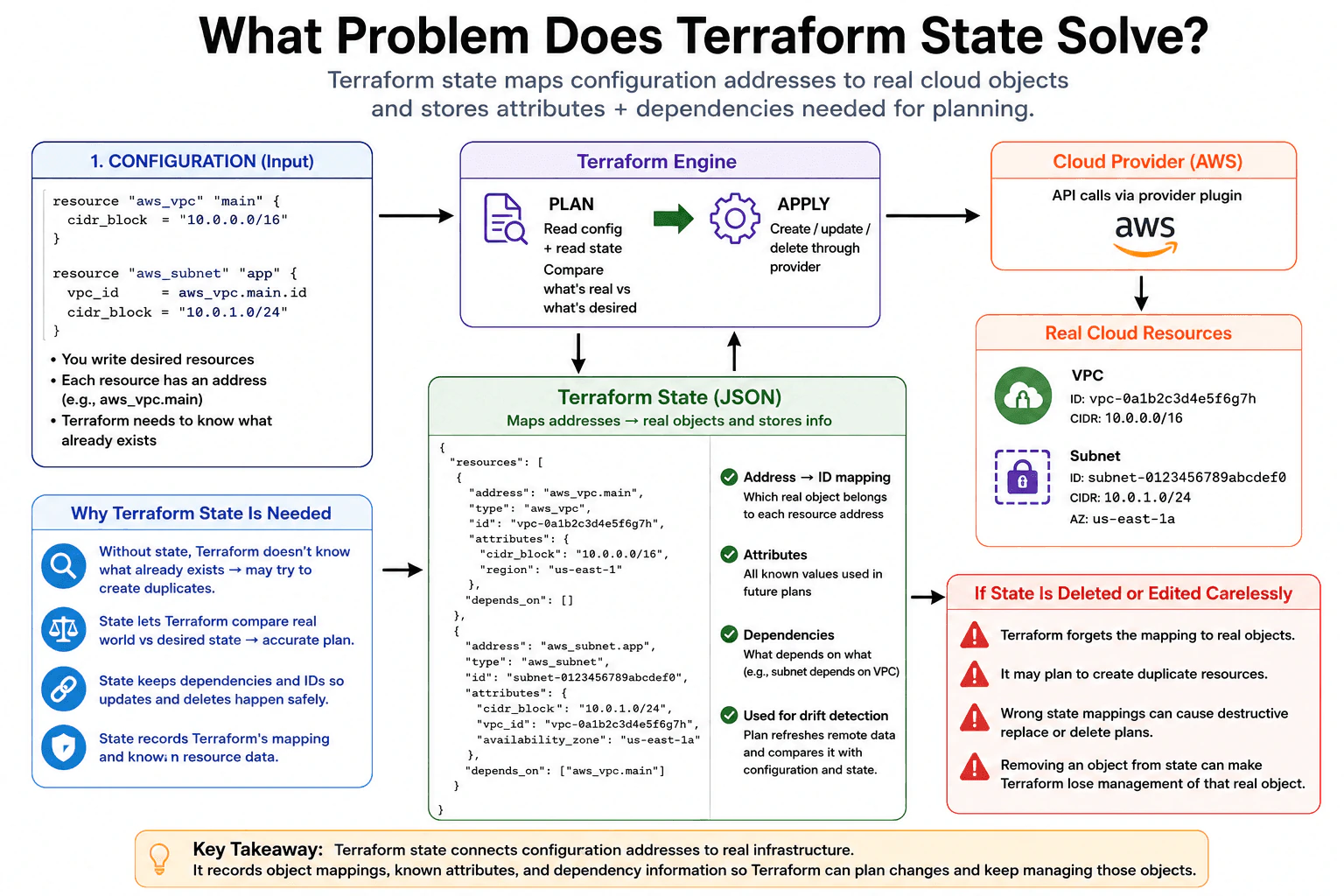
What problem does Terraform state solve? diagram
How to Explain It in an Interview

Terraform configuration describes the desired infrastructure. For example, the diagram uses configuration addresses such as aws_vpc.main and aws_subnet.app. Terraform state records which real remote object belongs to each address.

That mapping solves an identity problem. Terraform needs to know that aws_vpc.main represents a particular existing VPC rather than a new VPC that still needs to be created. State also records known resource attributes and dependency information. In the diagram, the subnet depends on the VPC, so Terraform can understand that relationship when planning and applying changes.

During terraform plan, Terraform reads the configuration and state and normally refreshes remote resource data through the provider. It then compares the desired configuration, the refreshed remote information, and the recorded state to determine what should be created, updated, replaced, deleted, or left unchanged. This also helps Terraform detect drift, which means a real resource changed outside Terraform. A plan is still a preview, not a guarantee, because the remote infrastructure can change before apply.

State is not the desired configuration itself. The configuration says what you want. State records Terraform's mapping to real objects and the known information Terraform uses to manage them.

Deleting or editing state casually can break that mapping. If Terraform forgets that a real resource belongs to a configuration address, the next plan may propose creating another resource. Incorrect state mappings can also cause destructive replacement or deletion plans. Removing an object from state can leave the real object running while Terraform no longer manages it.

The safe rule is to avoid casual manual state edits. When a mapping must change, use supported Terraform state operations such as import or move workflows, review the resulting plan carefully, and keep a recoverable backup of state before risky state changes.

Technical Approach
  1. Start with a Terraform configuration address, such as aws_vpc.main.
  2. Explain that state maps that address to the real remote object Terraform manages.
  3. Explain that state records known attributes and dependency information.
  4. Describe how planning reads configuration and state and refreshes remote data through the provider.
  5. Explain that Terraform compares desired configuration, refreshed remote data, and recorded state to determine changes.
  6. Explain the failure cases: lost or wrong mappings can cause duplicate creation, destructive replacement or deletion plans, or unmanaged resources.
  7. Finish with the safety rule: do not edit or delete state casually; use supported state workflows and review the resulting plan.
Practical Insights

The main cost is operational rather than algorithmic. Terraform must read state, refresh managed resources through the provider, and compare that information with configuration during planning. As the number of managed resources and dependencies grows, refresh and planning can take longer. State also needs careful protection because incorrect or missing mappings can lead to duplicate resources, destructive plans, or loss of management.

Why Interviewers Ask This

Interviewers want to know whether you understand why Terraform needs state to connect configuration to real infrastructure. They are checking whether you understand resource-address mapping, known attributes, dependencies, planning, drift detection, and the risks of corrupting or removing state, including duplicate resources, destructive plans, and loss of management.

Common interview mistakes

Common mistakes are saying that state is the desired configuration, calling state the only source of truth, assuming Terraform can always rediscover the correct resource mapping automatically, deleting or manually editing state without safeguards, assuming removing an object from state deletes the real object, and assuming a Terraform plan guarantees the exact apply result. Another mistake is forgetting that wrong mappings can cause duplicate creation or destructive replacement and deletion plans.

Interview tip

Use the word "mapping" early. Explain that Terraform state connects each configuration address to a real remote object and records known attributes and dependencies. Then give one failure example: if that mapping is lost, Terraform may try to create a duplicate or stop managing the existing object.

Interviewer may ask next
What happens if a resource is removed from Terraform state but still exists in the cloud?

The real resource can continue to exist, but Terraform no longer has the state mapping that says it manages that object. If the configuration still declares the resource, a later plan may propose creating another resource because Terraform no longer associates the existing object with that configuration address. To manage the existing object again, use a supported import workflow rather than inventing or casually editing state data.

How does Terraform state help detect drift?

During planning, Terraform normally refreshes managed-resource information through the provider and compares the remote values with the configuration and recorded state. If the real infrastructure changed outside Terraform, that difference can appear in the plan. State provides the existing resource mappings and known information Terraform needs to make that comparison.

35. Why would you package Terraform resources into a module?Infrastructure As CodeEasy

Question Details

A network pattern is repeated across several environments. Explain the module boundary, input variables, outputs, encapsulated resources, versioning, and how reuse can be achieved without copying environment-specific values into the module.

Short Interview Answer (30-60 seconds)

I would package the repeated network pattern into a module to define it once and reuse it consistently. Each environment passes its own values through inputs, the module hides the resource details, returns useful outputs, and callers pin versions for controlled upgrades.

Detailed Explanation

When the same network setup is needed in several places, copying it again and again creates extra work and more chances for mistakes. A better design keeps the shared setup in one reusable building block. Each place supplies only the values that are different, such as its address ranges and environment name. The shared building block creates the same network shape every time and gives back the information other parts need. Changes can then be made once and adopted carefully by each place instead of editing many copied files.

Useful Questions to Ask the Interviewer
  1. Which parts of the network pattern must remain identical across environments?
  2. Which values are expected to differ between dev, staging, and production?
  3. How are module releases published and versioned today?
  4. Which module outputs are needed by other Terraform resources or modules?
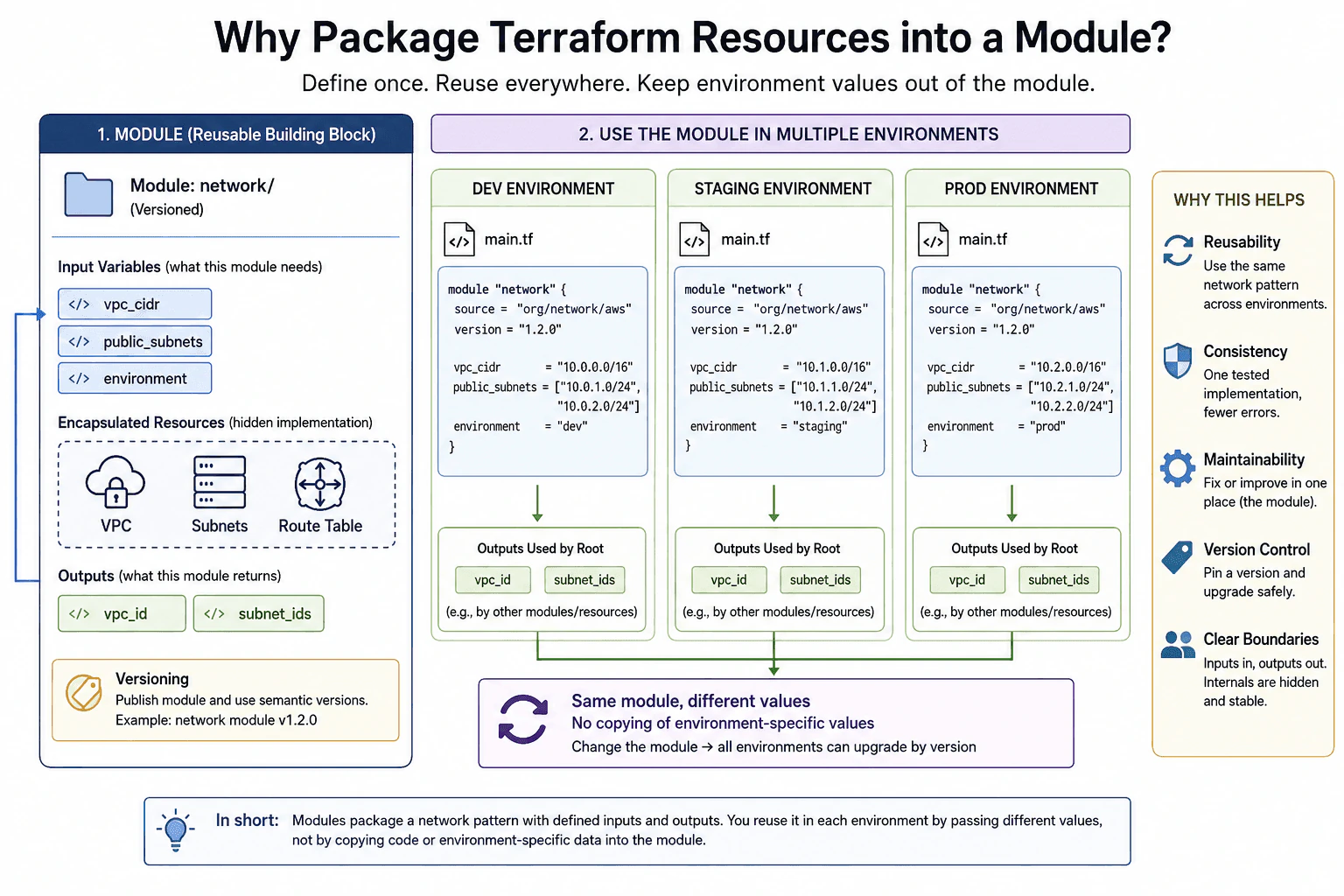
Why would you package Terraform resources into a module? diagram
How to Explain It in an Interview

I would create a small Terraform network module with a clear boundary. The module owns the reusable resources shown in the design: the VPC, subnets, and route table. Those resources are implementation details inside the module, so callers interact with the module's interface instead of duplicating or depending on its internal configuration.

The module exposes input variables for values that callers are allowed to change. In the diagram, those inputs are vpc_cidr, public_subnets, and environment. Dev, staging, and production call the same module but provide different CIDR ranges and environment names. These environment-specific values stay in each environment's root configuration rather than being hard-coded or copied into the reusable module.

The module exposes outputs such as vpc_id and subnet_ids. The calling root configuration, other resources, or other modules can consume these outputs without needing to reference the module's internal resource addresses. This creates a stable interface and allows the internal implementation to evolve more safely.

The diagram also shows module versioning. Each environment pins the same example module release, version 1.2.0. That is a module release version, not a Terraform CLI version. No Terraform CLI version is supplied in the question, so this answer assumes normal stable Terraform module behavior current in 2026. Using a pinned module release means a new module change is not automatically forced into every environment. Each caller can review and adopt a newer version deliberately.

The main benefits are reusability, consistency, maintainability, and clear boundaries. One implementation can be tested and maintained in one place. A correction or enhancement is made in the module and then adopted by environments through a controlled version change. The main tradeoff is that the module interface becomes a contract. Changing inputs, outputs, or behavior can affect callers, so releases should be versioned and reviewed carefully.

A Terraform module does not automatically create separate state. Resources instantiated by a module are recorded in the state used by the calling root configuration. Module versioning controls reusable configuration code; it does not replace state protection, plan review, or controlled apply practices.

Technical Approach
  1. Identify the VPC, subnet, and route-table resources that form the repeated network pattern.
  2. Put those related resources behind one small module boundary.
  3. Define explicit inputs such as vpc_cidr, public_subnets, and environment for values callers genuinely need to change.
  4. Keep dev, staging, and production values in their root configurations rather than inside the module.
  5. Expose only useful outputs such as vpc_id and subnet_ids.
  6. Publish and version the module.
  7. Pin an intended module release in each caller.
  8. Review module-version changes and let each environment upgrade deliberately.
Practical Insights

There is no meaningful algorithmic time or memory complexity in this design. The important cost is operational and maintenance complexity. Without a module, the same network configuration is copied into several environments, so every change may require several edits and reviews. With a module, the shared implementation is maintained once while each environment keeps only its own input values. The module adds some interface and version-management work, but that is usually much easier and safer than maintaining duplicated infrastructure definitions.

Why Interviewers Ask This

This checks whether the candidate understands why Terraform modules are useful beyond reducing repeated code. The interviewer wants to see a clear module boundary, explicit inputs and outputs, encapsulation of related resources, separation of reusable logic from environment-specific values, and controlled module versioning. It also tests whether the candidate can explain how dev, staging, and production can share one network implementation without copying the implementation into every environment.

Common interview mistakes

Common mistakes include copying the complete network configuration into every environment; hard-coding dev, staging, or production values inside the reusable module; exposing internal resource details instead of a small set of useful outputs; creating too many inputs that leak implementation details; placing unrelated infrastructure into one oversized module; using an unpinned moving module release; assuming a module automatically has separate Terraform state; and making breaking input or output changes without considering existing callers.

Interview tip

Explain the boundary first: reusable VPC, subnet, and routing resources stay inside the module; environment-specific values come in through inputs; and useful identifiers leave through outputs. Then mention version pinning and controlled upgrades. This shows that modules provide encapsulation and consistency, not just shorter Terraform files.

Interviewer may ask next
Should dev, staging, and production use separate copies of the network module?

No. They should normally reuse the same versioned module source rather than copy its implementation. Each environment keeps its own root configuration and passes different values such as vpc_cidr, public_subnets, and environment. The resources created for each environment can still be managed independently through that environment's calling configuration and state. Each environment can also update its pinned module version deliberately after review.

What happens if a future module version changes an input or output?

That can be a breaking interface change because callers depend on the module's inputs and outputs. I would treat the module interface as a contract, publish the change as an appropriate versioned release, document the required caller changes, and update environments deliberately. Existing callers can remain on their currently pinned release until they are ready. Before applying an upgrade, I would review the Terraform plan and confirm that the proposed infrastructure changes are intended.

36. How would you configure shared Terraform state and locking for a team?Infrastructure As CodeMedium

Question Details

Several engineers and a CI pipeline may run plans or applies against the same environment. Design a remote backend, exclusive locking, encryption, access control, version recovery, and a rule for handling an abandoned lock without permitting concurrent writes.

Short Interview Answer (30-60 seconds)

I would store Terraform state in an encrypted, versioned S3 backend and enable S3 lock-file locking with Terraform 1.10 or later. Engineers and CI use least-privilege roles. Every shared-state plan or apply keeps locking enabled, and I force-unlock only after confirming the original run has stopped.

Detailed Explanation

The team needs one shared place that records what has already been created and changed. Everyone must use the same copy so two people do not make conflicting changes at the same time. Before someone works with that shared copy, they temporarily reserve it so another person cannot change it at the same time. The shared information should be protected from unwanted access and older copies should be kept for recovery. If a reservation remains after a failed job, the team must first confirm that nobody is still working before removing it.

Useful Questions to Ask the Interviewer
  1. Are we using Terraform 1.10 or later so the S3 backend can use native lock-file locking?
  2. Is AWS the required backend platform, and may we use S3 versioning and KMS encryption?
  3. Will both local engineers and CI be allowed to run plans, or should production apply be restricted to CI?
  4. What approval or policy checks are required before a production apply?
  5. What recovery objective do we need for accidental state corruption or deletion?
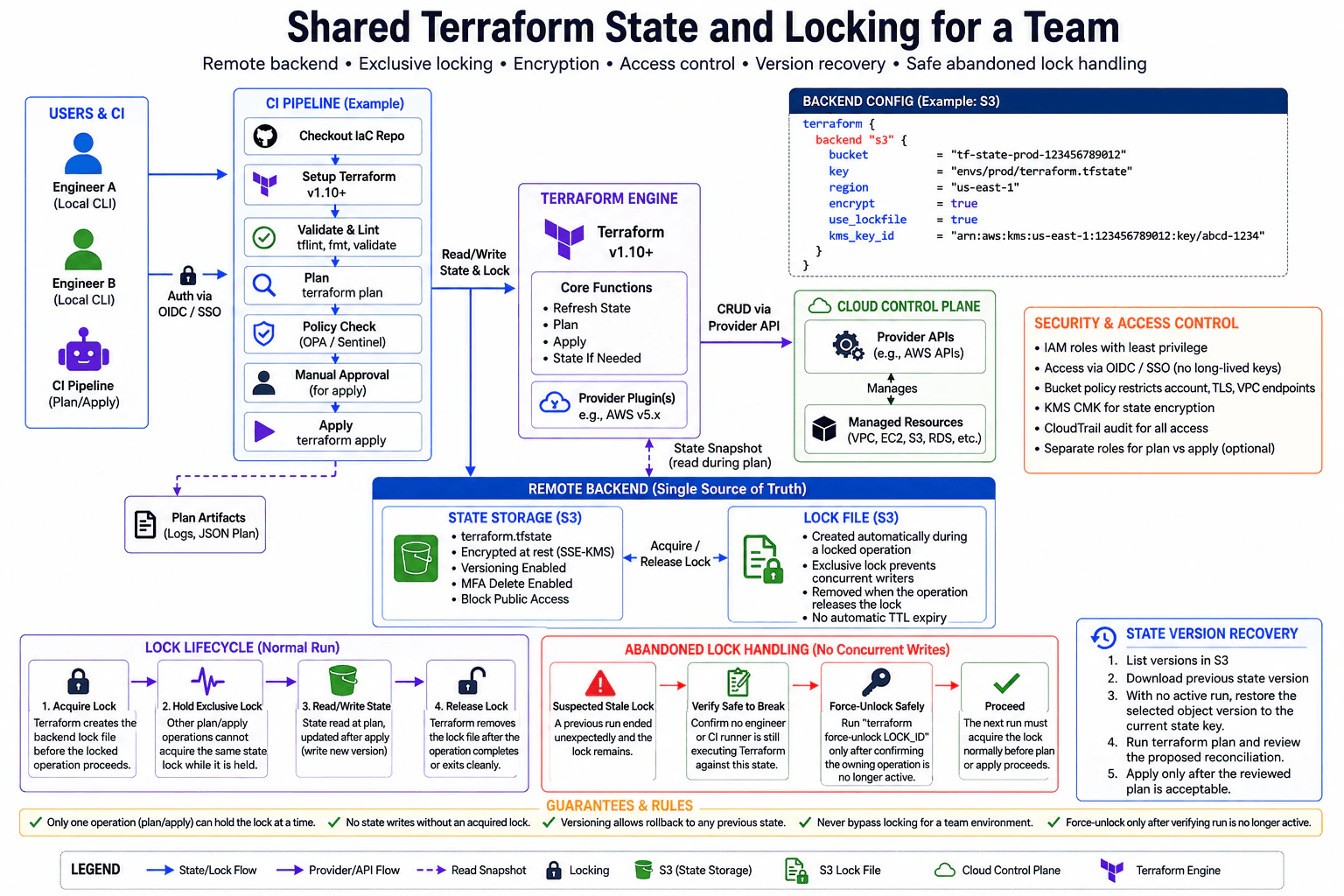
How would you configure shared Terraform state and locking for a team? diagram
How to Explain It in an Interview

I would make Amazon S3 the remote Terraform backend and treat the state object as the single source of truth for the environment. I would run Terraform 1.10 or later and configure the S3 backend with use_lockfile = true. Terraform uses an S3 lock file associated with the state key for operations that require state locking. If another engineer or CI job tries to operate on the same shared state while that lock is held, it cannot acquire the lock and must wait or fail rather than writing concurrently.

The normal workflow is: authenticate, initialize the remote backend, validate and lint the configuration, run terraform plan, review the plan and policy checks, approve the change, and then run terraform apply. Terraform reads the stored state, refreshes its view of managed objects through the provider, creates the plan, and during apply sends create, update, or delete requests through the provider API. A plan is only a preview based on the state and remote objects observed at that time. It does not guarantee that apply will succeed because the cloud environment can change after the plan was created.

For security, I would encrypt the S3 state at rest with SSE-KMS, block public access, require TLS, and use a restrictive bucket policy. Engineers should authenticate through SSO and CI should preferably use OIDC to assume an IAM role instead of storing long-lived AWS keys. Permissions should follow least privilege. The Terraform role needs only the S3 permissions required for its state object and lock file, including the ability to read and write the state and to create, read, and delete the lock file. It also needs the required KMS permissions for the configured key. CloudTrail can provide an audit history. Separate plan and apply roles can be used when production controls require stronger separation of duties.

I would enable S3 versioning so state updates leave recoverable historical object versions. The diagram also protects the state bucket with MFA Delete; this helps protect version history from permanent deletion, although it adds operational overhead and should be managed deliberately. Versioning is a recovery mechanism, not an automatic Terraform rollback. If state is damaged, I would first stop all runs and confirm that no engineer or CI runner is active. I would inspect the available S3 versions, select a known-good state object version, restore it to the current state key, run terraform plan, review the proposed reconciliation carefully, and apply only if the reviewed plan is acceptable. The real cloud resources may have changed since that state version was created, so the recovery plan must never be applied blindly.

An abandoned lock is handled conservatively. The S3 lock file has no automatic TTL that should be relied on to make a stale lock safe. If a previous process crashed and the lock remains, I would identify the owning run, check CI logs and engineer activity, and confirm that the original Terraform process is no longer operating on that state. Only then would I use terraform force-unlock LOCK_ID. I would never disable locking or remove a lock while another run may still be active, because that could permit two writers and damage shared-state consistency.

After the stale lock is safely removed, the next plan or apply must acquire the lock normally before it proceeds. The main tradeoff is that exclusive locking serializes operations against one state file. That reduces parallelism, but it is the correct safety boundary when multiple people manage the same environment. If unrelated infrastructure needs independent deployment concurrency, I would split it into deliberately separate state boundaries rather than bypassing locking.

Technical Approach
  1. Standardize on Terraform 1.10 or later and configure an Amazon S3 remote backend with use_lockfile = true.
  2. Enable S3 versioning, SSE-KMS encryption, Block Public Access, TLS enforcement, appropriate bucket-policy restrictions, and audit logging.
  3. Protect version history with the state-bucket recovery controls shown in the design, including MFA Delete where operationally appropriate.
  4. Give engineers SSO-based access and CI an OIDC-assumed IAM role with least-privilege S3, KMS, provider, and lock-file permissions.
  5. Run validation, linting, plan, policy checks, and human approval before production apply.
  6. Let Terraform acquire the backend lock before shared-state operations; never bypass locking in the team environment.
  7. During apply, let Terraform change resources through the provider, persist the resulting state to S3, and release the lock normally.
  8. For a suspected stale lock, verify through CI logs and team coordination that the owning process is no longer active before using terraform force-unlock LOCK_ID.
  9. For state recovery, stop active runs, restore a known-good S3 object version to the current state key, run and review a new plan, and apply only when the proposed reconciliation is understood and approved.
Practical Insights

There is little meaningful algorithmic time or memory complexity here. The important costs are operational. Remote state adds small network and storage overhead to plan and apply. S3 versioning keeps older state copies, so storage grows over time, although Terraform state is normally small. KMS, S3 requests, and audit logging add modest cloud cost. MFA Delete can make permanent version deletion and some administrative changes more deliberate, but it also adds operational work. Exclusive locking can make another engineer or CI job wait, but that serialization prevents concurrent state writes. The main maintenance work is managing IAM policies, backend permissions, state boundaries, recovery procedures, and Terraform version compatibility.

Why Interviewers Ask This

This question tests whether the candidate understands that Terraform state is shared coordination data, not just a file. Interviewers want to see safe remote-state design, exclusive concurrency control, encryption, least-privilege authentication, state-version recovery, CI integration, and disciplined handling of abandoned locks without creating concurrent writers.

Common interview mistakes

Common mistakes are keeping state only on an engineer's laptop, allowing different runners to use different copies of the same state, disabling locking to get around contention, using Terraform older than 1.10 while expecting S3 lock-file behavior, storing long-lived AWS keys in CI, granting broad S3 or KMS permissions, leaving the state bucket publicly reachable, treating a saved plan as a guarantee, assuming S3 version recovery automatically restores the real infrastructure, restoring an old state version while another run is active, deleting a stale lock without verifying ownership, and force-unlocking without first proving that the original Terraform process has stopped.

Interview tip

Start with the safety invariant: one shared state and only one lock holder for that state at a time. Then cover encryption, least-privilege access, plan and apply flow, version recovery, and the abandoned-lock rule. Emphasize that independent deployment concurrency should come from separate state boundaries, never from bypassing locking.

Interviewer may ask next
What would you do if a CI job crashed and left the Terraform state locked?

I would not immediately remove the lock. First I would identify the run that owns it, inspect the CI logs, check whether its Terraform process is still running, and confirm with the team that no engineer is operating on the same state. If the owning operation is definitely gone, I would use terraform force-unlock LOCK_ID. The next plan or apply must then acquire a new lock normally. I would never disable locking or break the lock while the original run might still be operating.

How would you recover if the current S3 Terraform state object became corrupted?

I would stop all Terraform runs and confirm there is no active writer. Because S3 versioning is enabled, I would inspect the historical object versions and choose a known-good state version. I would restore that version to the current state key, then run a fresh terraform plan. I would review how Terraform wants to reconcile the recovered state with the real AWS resources and apply only after the differences are understood and approved. Restoring state is not the same as rolling back the infrastructure itself.

37. When should you use Terraform workspaces instead of separate modules or state backends?Infrastructure As CodeMedium

Question Details

Compare workspaces, reusable modules, and separate root configurations for development, staging, and production. Address state isolation, permissions, provider accounts, configuration differences, failure blast radius, and the risk of selecting the wrong workspace.

Short Interview Answer (30-60 seconds)

Use workspaces for similar environments that share one root configuration and need separate state. Use modules for code reuse, not isolation. Use separate roots and state boundaries when environments require different permissions, provider accounts, substantially different configuration, stronger isolation, or safer production controls.

Detailed Explanation

This question asks how you would organize development, staging, and production when they are managed from code. The main decision is whether the environments are almost the same or need strong separation. If they are very similar, one shared setup with a separate saved record for each environment can be convenient. If they have different access rules, accounts, settings, ownership, or safety needs, stronger separation is usually better. Shared building blocks can still be reused in either design, so code reuse and environment separation should be treated as two different decisions.

Useful Questions to Ask the Interviewer
  1. How different are development, staging, and production configurations?
  2. Do the environments use different cloud accounts, subscriptions, projects, or credentials?
  3. Does production require stricter permissions, approvals, ownership, or compliance controls?
  4. Should each environment have an independent state backend and access policy?
  5. How much failure isolation is required between environments?
  6. How are Terraform plans and applies run: manually or through separate CI/CD pipelines?
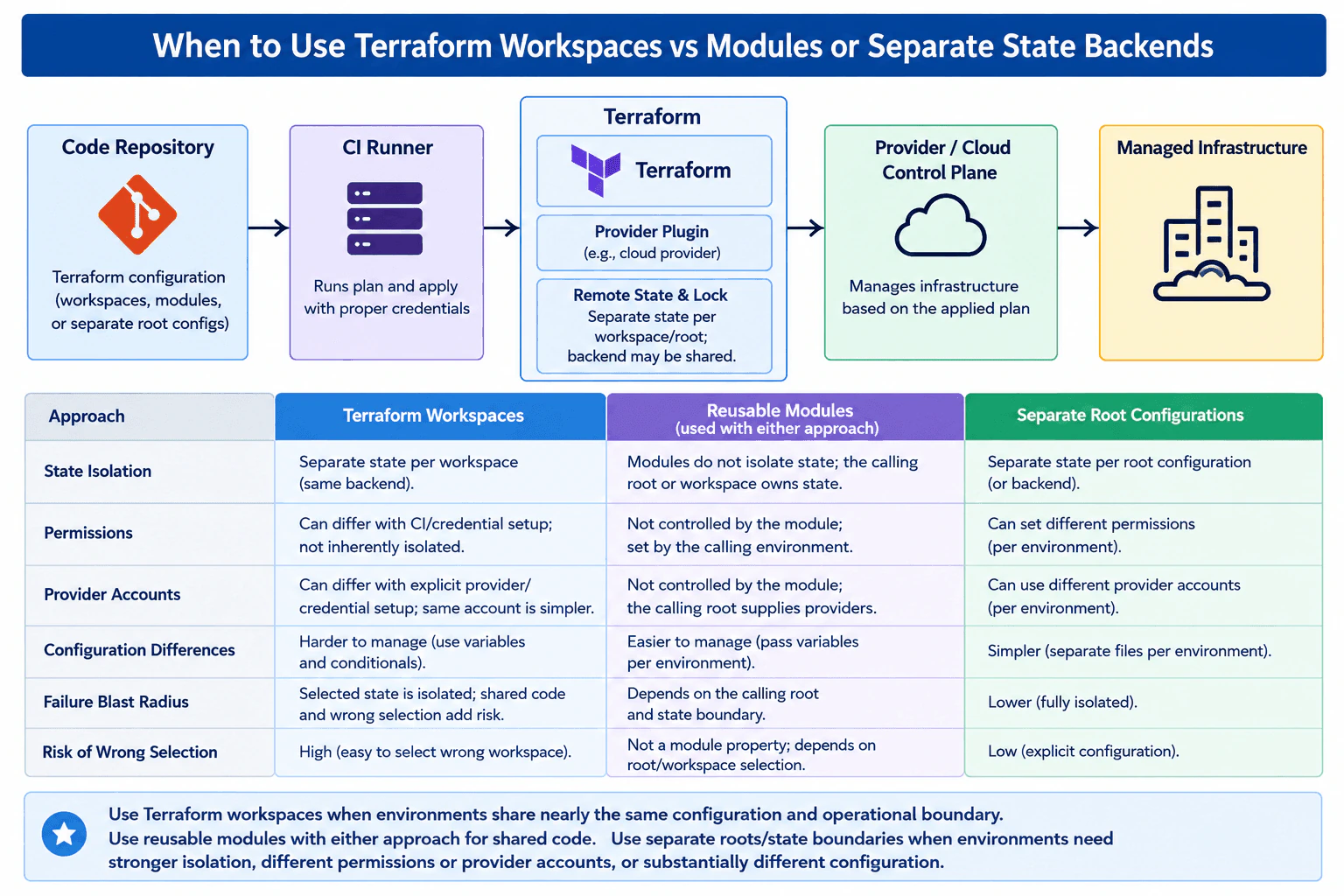
When should you use Terraform workspaces instead of separate modules or state backends? diagram
How to Explain It in an Interview

Assume current Terraform CLI behavior as of 2026. Exact remote-backend capabilities, including locking, depend on the selected backend.

Terraform CLI workspaces let one root configuration use multiple named state instances, such as development, staging, and production. With a remote backend, the backend configuration can be shared while Terraform stores distinct state for each workspace. This is useful when the infrastructure shape is nearly identical and the main differences are variable values or small conditional choices.

A workspace is not a strong security or operational isolation boundary. The environments still share the same root configuration and workspace-selection mechanism. A wrong workspace selection can cause a plan or apply to target the wrong state. Credentials and provider configuration can technically differ by workspace through CI configuration, variables, or explicit provider logic, but Terraform workspaces do not inherently isolate those credentials or permissions. If production requires materially different access controls, relying only on workspace selection is usually too weak.

Reusable modules solve a different problem. A module packages reusable infrastructure code behind explicit inputs and outputs. A module does not create an independent state boundary by itself. The calling root configuration or selected workspace owns the state. The same module can therefore be called from workspace-based environments or from completely separate root configurations.

Use separate root configurations when environments have substantially different configuration, independent ownership, different provider accounts, different permissions, or stronger production controls. Each root can use its own backend, credentials, CI pipeline, policy checks, and approval process. This creates clearer apply boundaries and normally reduces the failure blast radius because a mistake in one root or its state does not directly target another environment.

State isolation is a key distinction. Workspaces give separate state instances within one workspace-aware root and can use the same configured remote backend. Separate roots can use independently configured backends, access policies, credentials, and locking boundaries. Modules themselves do not isolate state.

For permissions and provider accounts, workspaces can be wired to different credentials, but that separation comes from the surrounding CI and credential design, not from the workspace feature itself. Separate roots make those boundaries more explicit and are usually easier to protect with least-privilege credentials.

For configuration differences, workspaces work best when differences are small. If the shared root accumulates many workspace-specific conditionals, environment maps, and exceptions, maintenance becomes harder and the environments are no longer truly the same design. Separate roots can still call the same reusable modules, giving code reuse without forcing every environment into one root configuration.

For failure blast radius, a workspace normally targets only the selected workspace state, so a normal apply does not automatically modify every workspace. The important risks are shared configuration and incorrect workspace selection. A bad shared code change can be capable of affecting each environment when it is later applied there, and an operator or pipeline can accidentally run against production if the wrong workspace is active. Separate roots make the target more explicit and can isolate credentials, state, pipelines, policies, and approvals.

For remote state, use a backend that supports the safety features you need. When locking is supported, it helps prevent concurrent operations from modifying the same state at the same time. State access should follow least privilege, and production state should have stronger access controls and recovery protections.

The delivery workflow should still be plan, review, then apply. A Terraform plan is a preview, not a guarantee, because provider or cloud state may change between planning and applying. Production applies should use explicit targeting, protected credentials, policy checks where required, and human or automated approval gates.

The practical rule is: use workspaces for similar environments within the same operational boundary; use modules for reusable code with either design; and use separate roots and state boundaries when environments need stronger isolation, different permissions or provider accounts, or substantially different configuration.

Technical Approach
  1. Compare the infrastructure shape of development, staging, and production. If they are nearly identical, workspaces are a possible fit.
  2. Identify differences in variables, providers, accounts, credentials, permissions, and ownership. Small value differences can fit workspaces; major differences favor separate roots.
  3. Decide the required state boundary. Workspaces provide distinct state per workspace, while separate roots can have independently configured backends and access controls.
  4. Evaluate production safety. If selecting the wrong workspace is an unacceptable risk, prefer an explicit production root, pipeline, credentials, and approvals.
  5. Evaluate failure blast radius. Stronger environment independence favors separate roots and state boundaries.
  6. Extract repeated infrastructure patterns into reusable modules regardless of which environment-isolation approach is chosen.
  7. Use a remote backend with appropriate state protection and locking support when available.
  8. Run plan before apply, review the intended environment and state boundary, and require stronger approvals for production. Treat the plan as a preview rather than a guarantee because external provider state can change before apply.
Practical Insights

Workspaces usually have the lowest setup cost because one root configuration is shared, but they increase operational risk if engineers or automation select the wrong workspace. Shared code can also accumulate environment-specific conditions over time. Reusable modules add some design and version-management work but reduce duplicated code. Separate roots and backends require more repository, pipeline, credential, state, locking, and policy administration, but they make ownership and environment boundaries clearer. The main cost is operational and maintenance complexity rather than algorithmic time or memory complexity.

Why Interviewers Ask This

Interviewers want to see whether you understand that Terraform workspaces, reusable modules, and separate root configurations solve different problems. They are testing whether you can choose safe state boundaries, control production access, reduce failure blast radius, avoid accidental changes to the wrong environment, and still reuse infrastructure code without coupling environments unnecessarily.

Common interview mistakes

A common mistake is treating workspaces as a strong security boundary. They separate state, but they do not automatically separate credentials, permissions, provider accounts, CI access, or approvals. Another mistake is treating modules as an alternative state-isolation mechanism; modules are reusable code and the caller owns state. Teams also overuse workspaces when environments have many structural differences, creating complicated conditionals. Other mistakes include assuming one bad apply changes every workspace automatically, forgetting that the selected workspace determines the targeted state, relying on a person's current workspace instead of explicit CI targeting, sharing overly broad production credentials, and allowing production applies without plan review, least-privilege access, state protection, or approvals.

Interview tip

Start with the decision rule: workspaces for nearly identical environments, modules for reuse, and separate roots or state boundaries for stronger isolation. Then compare state, permissions, provider accounts, configuration differences, blast radius, and wrong-workspace risk. Emphasize that modules and environment isolation are complementary choices rather than mutually exclusive alternatives.

Interviewer may ask next
Why are Terraform workspaces not considered a strong isolation boundary for production?

A workspace gives the selected environment a distinct Terraform state, but the environments still share the same root configuration and workspace-selection mechanism. Workspaces do not inherently provide separate credentials, provider accounts, IAM policies, CI pipelines, or approvals. Those controls must be added externally. Because an operator or pipeline can select the wrong workspace, high-risk production environments often benefit from a separate root, independent state boundary, dedicated credentials, and explicit approval process.

Can reusable Terraform modules still be used when development, staging, and production have separate root configurations?

Yes. That is often a strong design. Put reusable infrastructure patterns in modules and let each environment have its own root configuration. Each root can pass different inputs, use different provider credentials, choose its own backend and state, and enforce its own permissions and approvals. The module provides code reuse, while each root provides an independent operational and state boundary.

38. How would you detect and reconcile Terraform drift?Infrastructure As CodeMedium

Question Details

An operator changed a managed resource directly in the cloud console. Explain how refresh and plan reveal the difference among configuration, state, and the remote object, then compare restoring the declared value, importing the manual intent into code, or intentionally ignoring an attribute.

Short Interview Answer (30-60 seconds)

I detect drift by refreshing Terraform's view of the remote object and reviewing terraform plan against the declared configuration. Then I either restore the declared value, update code to adopt an intentional manual change, or narrowly ignore an externally managed attribute. I review before apply and verify afterward with another plan.

Detailed Explanation

A person may change a cloud resource directly instead of changing the saved instructions that normally control it. That creates a mismatch between what the team intended, what was previously recorded, and what actually exists now. The goal is to discover that mismatch safely, decide whether the manual change was a mistake or a new requirement, and choose the correct response. Usually I either put the resource back to the agreed setting, update the saved instructions to accept the new setting, or deliberately allow one value to be controlled somewhere else.

Useful Questions to Ask the Interviewer
  1. Was the manual change accidental, or is it now the desired behavior?
  2. Is the changed attribute supposed to be owned by Terraform or by another system or process?
  3. Is this production, and are human review or policy checks required before apply?
  4. Is Terraform state stored remotely with a supported locking mechanism to prevent concurrent runs?
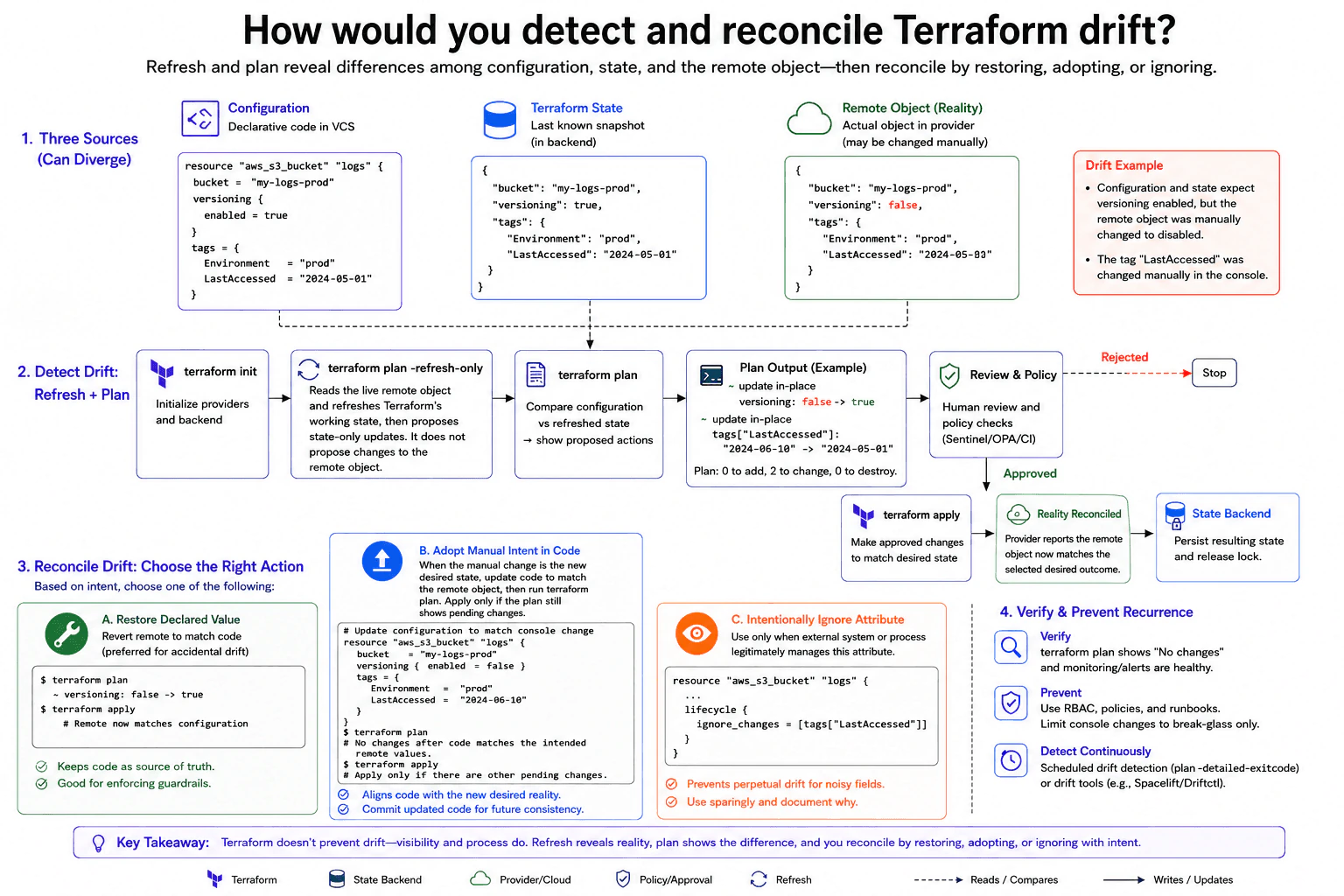
How would you detect and reconcile Terraform drift? diagram
How to Explain It in an Interview

I separate three views of the resource. The Terraform configuration is the desired state stored in version control. Terraform state records Terraform's current knowledge of the managed resource. The remote object is what actually exists in the provider. Drift occurs when the remote object changes outside Terraform and no longer matches what the configuration declares.

Assumption: I am describing modern Terraform 1.x-compatible behavior as used in 2026. Exact resource schemas, refresh behavior, import capabilities, and locking mechanisms still depend on the selected provider and backend.

In the diagram example, configuration and the previous state expect versioning to be enabled and the LastAccessed tag to be 2024-05-01. An operator changes the live object outside Terraform so versioning is disabled and the tag represents a different manually changed value. The plan example shows Terraform proposing to restore versioning from false to true and LastAccessed from the manually changed value 2024-06-10 back to 2024-05-01.

I first run terraform init when the working directory, providers, or backend need initialization. Terraform then needs a current observation of the remote object. A refresh-aware planning operation reads the resource through the provider and updates Terraform's working view of reality.

terraform plan -refresh-only is useful when I specifically want to inspect state-only updates caused by observing the live remote object. It proposes changes to Terraform state rather than changes to the remote object. It does not by itself make the remote infrastructure match the configuration.

I then run a normal terraform plan. Terraform compares the declared configuration with the refreshed view and shows the actions it would take to make the remote object match the desired configuration. In the example, it proposes in-place updates rather than creation or destruction.

A plan is a preview, not a guarantee. The provider or remote system can change again before apply. Therefore I review the plan and pass it through required human or policy checks. If review or policy rejects the change, the workflow stops and nothing should be applied.

There are three main reconciliation choices.

  1. Restore the declared value. If the console change was accidental, I keep Terraform configuration as the source of truth. After approval, I run terraform apply for the reviewed plan. Terraform uses the provider to change the remote object back to the declared settings. After the provider reports the resulting remote state, Terraform persists the resulting state to the configured backend and releases its lock.
  1. Adopt the manual intent in code. If the manual change is now the desired state, I update the Terraform configuration so code expresses that intent. In the diagram example, that means changing the declared versioning setting to disabled and, if Terraform should own the tag, setting LastAccessed to 2024-06-10. I commit and review that code, then run terraform plan again. When the configuration and intended remote values agree, the plan should show no changes for those attributes. I apply only if other legitimate pending changes remain.

This is different from blindly running terraform import. Import associates an existing remote object with a Terraform resource address when that object is not already represented correctly in Terraform state. It is not the normal way to adopt a changed attribute on a resource Terraform already manages.

  1. Intentionally ignore one attribute. If another trusted system or process legitimately owns a particular attribute, I can use Terraform lifecycle ignore_changes for that specific attribute. Terraform then stops trying to reconcile differences for that attribute during normal update planning. I keep this rule narrow and document the external owner because broad ignore rules can hide real drift.

For state safety, I use a remote backend and supported locking so concurrent Terraform runs cannot update the same state at the same time. I also limit direct console access, use least-privilege permissions, require reviewed plans for production, and keep break-glass changes controlled and documented.

For ongoing detection, I can schedule terraform plan -detailed-exitcode in CI or use a dedicated drift-detection service. A nonzero result that represents changes can trigger review rather than an automatic production apply.

After reconciliation, I run another terraform plan. The expected result is no unexpected changes, and monitoring or alerts should remain healthy. Terraform does not prevent every out-of-band change by itself. Reliable drift control comes from visibility, clear ownership, restricted manual access, reviewed plans, state safety, and regular verification.

Technical Approach
  1. Confirm whether the out-of-band change was accidental or intentional and identify who should own the changed attribute.
  2. Run terraform init when initialization of providers or the backend is required.
  3. Refresh Terraform's working view by reading the live remote object; use terraform plan -refresh-only when specifically reviewing state-only refresh effects.
  4. Run a normal terraform plan to compare the declared configuration with the refreshed view.
  5. Inspect whether the plan proposes update, replacement, creation, or destruction and stop if the result is unexpected.
  6. Send the plan through required human and policy review; if rejected, stop without applying.
  7. For accidental drift, keep configuration unchanged and apply the approved plan to restore the declared values.
  8. For intentional drift, update and review the Terraform configuration so code matches the new desired state, then plan again.
  9. If another system intentionally owns one attribute, add a narrowly scoped ignore_changes rule and document that ownership.
  10. During an approved apply, let Terraform update the remote object through the provider, then persist the resulting state and release the backend lock.
  11. Run another terraform plan and confirm that no unexpected changes remain.
  12. Continue scheduled drift detection and restrict direct production changes.
Practical Insights

The main cost is operational rather than algorithmic. Refresh and plan require provider API reads for the resources Terraform evaluates, so larger configurations take longer and use more provider API calls. Apply can require API writes and waits for remote operations. Remote state and locking add small storage and coordination costs but reduce the risk of concurrent state updates. The ongoing maintenance cost comes from reviewing plans, investigating recurring drift, documenting ownership, limiting ignore_changes, and running scheduled detection jobs. Plans also consume CI time, and provider rate limits can matter in very large environments.

Why Interviewers Ask This

This question tests whether the candidate understands that Terraform configuration, Terraform state, and the real remote resource are separate views that can diverge. It also tests safe drift detection, refresh and plan semantics, state ownership, lifecycle rules, review and policy gates, apply boundaries, locking, and the judgment needed to decide whether an out-of-band change should be reverted, adopted into code, or intentionally excluded from Terraform reconciliation.

Common interview mistakes

Common mistakes are treating Terraform state as the desired configuration, assuming terraform plan guarantees that apply will succeed unchanged, applying immediately without deciding whether the manual change was intentional, using terraform import just to adopt changed attributes on a resource Terraform already manages, and using broad ignore_changes rules that hide important drift. Other mistakes include allowing concurrent runs without supported backend locking, manually editing state instead of using supported Terraform workflows, automatically applying scheduled drift plans to production, ignoring policy rejection, and failing to run another plan after reconciliation.

Interview tip

Organize the answer around three things: configuration, Terraform state, and the real remote object. Explain detection with refresh and plan first. Then compare the three decisions: restore the declared value, adopt the new intent in code, or narrowly ignore an externally owned attribute. Finish with plan review, apply/state ordering, locking, and a final no-change verification.

Interviewer may ask next
When would you use terraform import during drift reconciliation?

I would use import when an existing remote object needs to be associated with a Terraform resource address because Terraform is not already managing that object correctly in state. I would first write or verify configuration that describes the intended resource, perform the supported import workflow, and then run terraform plan to inspect remaining differences. I would not use import merely because an operator changed an attribute on a resource Terraform already manages. For that case, I either restore the declared value or update the configuration to adopt the new desired value.

What are the risks of using lifecycle ignore_changes for drift?

ignore_changes deliberately prevents Terraform from planning updates for selected attribute differences. That is appropriate when another trusted system truly owns the attribute, but it reduces Terraform's enforcement and visibility for that value. If used too broadly, it can hide accidental or unsafe changes. I would scope it to the smallest necessary attribute, document the external owner and reason, review the lifecycle rule like other infrastructure code, and monitor that value through the system responsible for it.

39. How would you recover from corrupted or lost Terraform state?Infrastructure As CodeHard

Question Details

The remote state cannot be parsed after a failed operation, but cloud resources still exist. Build a recovery sequence using backend versions or backups, state integrity checks, locking, imports where necessary, a refresh-only review, and a no-destruction plan before resuming applies.

Short Interview Answer (30-60 seconds)

I would stop Terraform runs, prevent concurrent changes, restore the newest trustworthy state backup, validate it, review real infrastructure with refresh-only, import anything missing, and create a saved plan. I would resume applies only after the reviewed plan shows no unintended destruction or replacement.

Detailed Explanation

The goal is to rebuild a trustworthy record of what already exists without accidentally changing or deleting it. I would first stop all automatic changes so only one recovery effort is happening. Then I would find the newest good saved copy, check that it can be read, and restore it safely. Next, I would compare that record with what is really running, add anything that is missing from the record, and carefully review the proposed result. I would continue only when the team agrees that nothing important will be unexpectedly removed or replaced.

Useful Questions to Ask the Interviewer
  1. Does the remote backend keep previous state versions or separate state backups?
  2. What locking mechanism does the backend provide, and is another Terraform run currently active?
  3. Do we know approximately when the state became corrupted and what operation failed?
  4. Are all cloud resources still present, or are some resources also missing or partially changed?
  5. Is production apply gated by human approval, policy checks, or both?
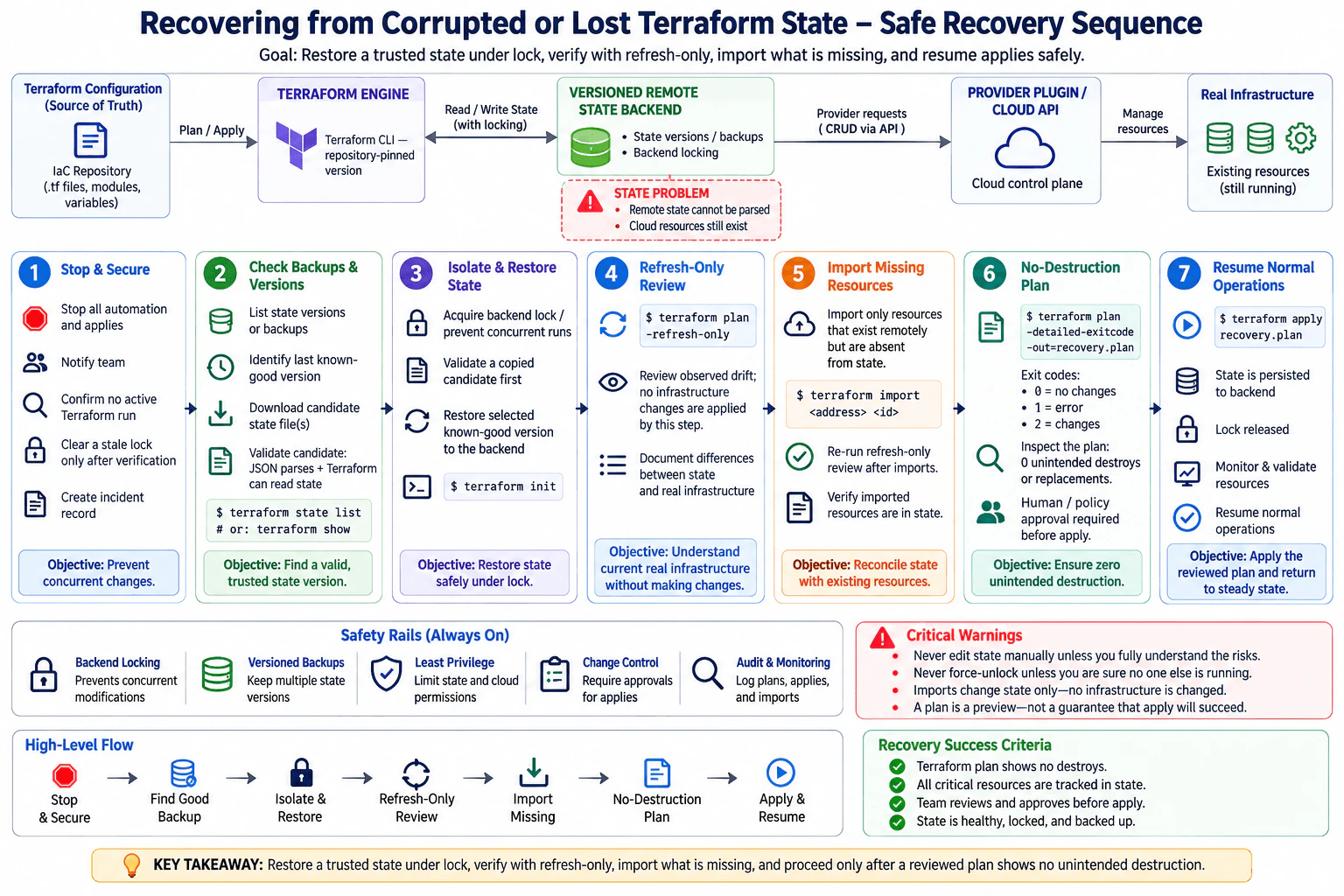
How would you recover from corrupted or lost Terraform state? diagram
How to Explain It in an Interview

I would treat an unreadable Terraform state as a recovery incident, not as a reason to run terraform apply. Terraform configuration is the source of the desired infrastructure, while Terraform state records the relationship between configured resource addresses and real remote objects. Terraform also uses provider plugins and cloud APIs to observe and manage those objects. If the state mapping is damaged or incomplete, an ordinary plan can propose incorrect or destructive actions.

1. Stop automation and secure the recovery

First I stop CI/CD jobs, scheduled Terraform operations, and manual applies for the affected state. I confirm that no Terraform process is still active. I also prevent concurrent runs through the remote backend's locking mechanism. If there is a stale lock, I clear it only after proving that no other process owns it. Force-unlocking an active run could allow two writers to modify the same state.

2. Find the last trustworthy state version

I use the versioned remote backend's state history or an independently stored state backup. I prefer the newest version from before the failed operation. I preserve existing versions and do not immediately overwrite the only remaining copy. I first keep or download a separate candidate so the original evidence and other backend versions remain available.

3. Validate state integrity before restoration

A candidate is not trustworthy merely because it is valid JSON. Terraform itself must also be able to understand it. I verify that the candidate can be loaded and inspected, for example with terraform state list or terraform show in an isolated recovery context. I also confirm that expected resource addresses are present. I do not manually edit state JSON as a normal recovery technique because state contains mappings, metadata, and relationships that are easy to damage.

4. Restore the selected state under lock

After validation, I restore the selected known-good version using the supported recovery mechanism of the configured remote backend while concurrent writers remain blocked. The exact restoration procedure is backend-specific, so I follow that backend's documented version-restore or backup-restore process instead of inventing a generic storage command.

I initialize the working directory with the repository-pinned Terraform and provider versions. Normally this is terraform init. I would use -reconfigure only if the backend configuration itself changed; state corruption alone does not require it.

5. Perform a refresh-only review

Once Terraform can read the restored state, I compare it with real infrastructure using terraform plan -refresh-only. Terraform asks the provider plugins to read remote objects through their cloud APIs and then shows how the recorded state differs from what currently exists.

A refresh-only plan is for observation and state reconciliation. It does not apply infrastructure changes. I review and document unexpected drift before moving forward. The result is still based on provider observations at that moment, so it is a review tool rather than a guarantee about a later apply.

6. Import resources that are missing from state

If a real resource still exists but its configured Terraform resource address is absent from the restored state, I import that specific object with terraform import <address> <id>. The resource address must match the configuration, and the identifier must use the format expected by that provider.

Import associates an existing remote object with Terraform state; it does not create that infrastructure object. After each set of imports, I run another refresh-only review and verify that the imported resources are represented correctly. I repeat this until the important existing resources are tracked in state.

7. Create a no-destruction recovery plan

When state and real infrastructure are reconciled, I create a saved plan with terraform plan -detailed-exitcode -out=recovery.plan.

The detailed exit codes mean:

  • 0: no changes
  • 1: Terraform encountered an error
  • 2: the plan contains changes

The exit code does not say whether changes are safe or destructive. I inspect the actual plan. The recovery gate is zero unintended destroys and zero unintended replacements. Any expected creation or update must also be understood before continuing.

8. Require human or policy approval

I have a human reviewer inspect the saved plan and use policy controls where the organization has them. Least-privilege credentials should be used for both state access and cloud-provider access, and plans, imports, and applies should be auditable.

If the plan shows an unexpected destroy or replacement, I do not apply it. I return to the restored state, configuration, imports, addresses, provider observations, and drift analysis until the cause is understood.

9. Apply only the reviewed saved plan

After approval, I apply the exact reviewed artifact with terraform apply recovery.plan. This avoids silently replacing the approved recovery plan with a newly generated one at apply time. In production, that command should still run through the organization's controlled approval process.

Terraform acquires the required state lock for the operation, communicates through the provider plugins and cloud APIs as needed, persists the resulting state to the remote backend, and releases the lock when the operation completes normally.

A saved plan is still a preview, not a guarantee that apply will succeed. Provider behavior, permissions, quotas, external changes, eventual consistency, or other remote conditions can cause apply-time failure.

10. Verify recovery

After recovery I verify that critical real infrastructure is healthy, expected resources are tracked in state, monitoring is normal, the remote state is readable and persisted, backend locking works, and state versions or backups remain available. I also review audit records for the recovery and document the incident and recovery steps.

The key principle is: restore a trusted state under lock, verify reality with refresh-only, import what is missing, and proceed only after a reviewed plan shows no unintended destruction.

Technical Approach
  1. Stop CI/CD, scheduled Terraform jobs, and manual applies for the affected state.
  2. Confirm no Terraform run is active and prevent concurrent writers; clear a stale lock only after verification.
  3. Preserve existing backend versions and select the newest known-good state version or backup.
  4. Validate the candidate by checking basic integrity and Terraform's ability to read and inspect its resource addresses.
  5. Restore that known-good version using the remote backend's supported recovery mechanism while concurrent runs remain blocked.
  6. Initialize the repository-pinned Terraform environment with terraform init.
  7. Run terraform plan -refresh-only and review observed drift without applying infrastructure changes.
  8. For real resources missing from state, use terraform import <address> <id> with the correct configured resource address and provider-specific identifier.
  9. Re-run refresh-only review after imports until important state mappings match real infrastructure.
  10. Create terraform plan -detailed-exitcode -out=recovery.plan.
  11. Inspect the actual saved plan for zero unintended destroys or replacements; do not infer safety from the exit code alone.
  12. Require human or policy approval.
  13. Apply only the reviewed saved plan with terraform apply recovery.plan through the controlled production workflow.
  14. Verify infrastructure health, persisted state, lock release, monitoring, backups, and recovery audit records.
Practical Insights

The main cost is operational rather than computational. A small state may be reviewed quickly, while a large state with many resources can require many provider API reads during refresh and more human review. Imports add work because every missing object needs the correct Terraform address and provider-specific identifier. Versioned state backups consume some storage, but that cost is normally small compared with the protection they provide. Maintenance work includes keeping backend versioning, locking, least-privilege access, monitoring, approvals, and recovery documentation working. This careful process is slower than immediately running apply, but it greatly reduces the risk of accidental destruction.

Why Interviewers Ask This

This question tests whether the candidate understands that Terraform state is the mapping between configuration and real infrastructure and knows how to recover that mapping without accidentally changing or deleting existing resources. It evaluates remote-state backups and versioning, locking and concurrency control, state validation, drift review, imports, safe plan inspection, approval boundaries, failure recovery, and the judgment to stop automation instead of immediately running apply when state is unknown.

Common interview mistakes

Common mistakes are running terraform apply immediately against unknown or incomplete state; allowing CI jobs or engineers to continue Terraform operations during recovery; force-unlocking without proving that the original owner is gone; restoring a backup without preserving and validating it first; treating valid JSON as proof that Terraform state is healthy; manually editing state JSON; assuming refresh-only modifies infrastructure; forgetting to import remote resources that are missing from state; using the wrong resource address or provider-specific import identifier; assuming -detailed-exitcode proves that a plan is non-destructive; applying a newly generated plan instead of the reviewed saved plan; assuming a plan guarantees apply success; and failing to verify state health, backups, locking, monitoring, and audit records after recovery.

Interview tip

Present the sequence as a safety workflow: stop writers, preserve backups, validate and restore state under lock, observe reality with refresh-only, import missing mappings, review a saved no-destruction plan, approve it, then resume controlled applies. Emphasize that a plan is only a preview and that any unexpected destroy or replacement means stop and investigate.

Interviewer may ask next
What would you do if no usable Terraform state backup exists but all cloud resources still exist?

I would keep all Terraform applies stopped and reconstruct state from the existing configuration and real infrastructure. I would initialize the repository-pinned Terraform environment, identify each configured resource address, and import the matching existing object using the provider's required identifier. Import establishes state ownership but does not prove that the configuration matches the remote object, so I would run terraform plan -refresh-only after rebuilding the important mappings, inspect the drift, and then create a saved normal plan. I would not resume applies until the plan has been reviewed and shows no unintended destroys or replacements.

What if the recovery plan still shows resources being destroyed or replaced after restoring state and importing missing objects?

I would not apply it. I would inspect the affected resource addresses and determine whether the difference comes from an incorrect or missing import, configuration drift, a renamed or moved resource, a provider schema or version difference, lifecycle behavior, or a genuine intended infrastructure change. I would reconcile those causes first and repeat the refresh-only review and planning. Destruction or replacement is acceptable only when it is understood, intentional, reviewed, and approved; it should never be accepted merely to make the recovery plan converge.

40. How would you protect sensitive data stored in Terraform state?Infrastructure As CodeHard

Question Details

A configuration manages credentials and provider-returned secrets that may appear in state even when outputs are marked sensitive. Design encryption, backend access control, short-lived CI identity, audit logging, version-retention policy, secret rotation, local-state prevention, and incident response for exposure.

Short Interview Answer (30-60 seconds)

I treat Terraform state as a secret. I store it in a private encrypted remote backend, use least-privilege short-lived CI access, enable locking, versioning and audit logs, block local state, rotate exposed credentials, and maintain tested state-recovery and incident-response procedures.

Detailed Explanation

This question is asking how I would protect a file that may quietly contain important private information. Hiding a value from normal screen output does not remove it from that file. I therefore need to control where the file is kept, who can read or change it, how access is recorded, how old copies are retained, and what happens if someone sees it. I also need to stop accidental copies on laptops or in source control, regularly replace exposed private values, and have a clear recovery process if a leak happens.

Useful Questions to Ask the Interviewer
  1. Which remote backend and cloud platform are used for Terraform state today?
  2. Does the CI/CD system support OIDC or another short-lived identity mechanism?
  3. What retention and recovery requirements exist for previous state versions?
  4. Which identities need read, plan, apply, or administrative access to state?
  5. Which audit or SIEM platform should receive state-access and key-usage events?
  6. Are provider-returned credentials or other secrets known to appear in state?
How would you protect sensitive data stored in Terraform state? diagram
How to Explain It in an Interview

My first decision is to treat the Terraform state file as sensitive data rather than relying on sensitive = true. That setting prevents Terraform from showing the value in normal CLI and output views, but it does not guarantee that the underlying value is absent from state. Provider-returned attributes, data-source results, credentials, resource identifiers, metadata, and sensitive outputs can still be stored there.

I would keep production state in a remote backend and prevent local state. In the AWS design shown in the diagram, the backend is a private S3 bucket. State is encrypted at rest with SSE-KMS using a customer-managed KMS key. The bucket has Block Public Access enabled, bucket-owner enforcement, versioning, lifecycle controls, and access logging. Retained versions provide a recovery path when state is damaged or an incident requires restoration to a known-good version.

Backend access follows least privilege. I would restrict the S3 bucket, KMS key, and locking mechanism to only the identities that need them. Where practical, I would separate plan and apply permissions, require strong authentication for human administrative access, and restrict backend access to approved network paths. I would avoid wildcard grants that allow unrelated identities to read state or use the encryption key.

For CI/CD, I would not use permanent AWS access keys. The pipeline uses OIDC federation to obtain a short-lived STS role for the job. The role is scoped to the required backend, lock table, KMS key, and managed resources. The runner is ephemeral, keeps no persistent credentials, masks sensitive environment values, removes its temporary workspace after the run, and fails when policy checks reject a high-risk change.

The pipeline follows a controlled flow that matches the diagram: initialize the backend, validate and format the Terraform configuration, run linting and tests, execute policy checks such as OPA or Conftest, create a plan, require human or policy review, and then apply through the approved identity. A Terraform plan is a preview based on the state and provider observations available when the plan is created. It is not a guarantee that apply will still succeed later because remote infrastructure can change.

The remote backend also needs concurrency protection. In the approved diagram, a DynamoDB table performs state locking with conditional writes so two Terraform operations do not safely modify the same state at the same time. I would not casually bypass a lock or manually edit state because that can create conflicting writes or corruption. For newer Terraform versions, I would verify the repository-pinned backend implementation because locking capabilities and recommended mechanisms can change across Terraform releases.

Audit logging is another security boundary. In this design, CloudTrail records AWS API activity, S3 access logging provides visibility into state-object access, DynamoDB lock activity can be monitored, CloudWatch provides alarms, and important events are forwarded to a SIEM for detection and investigation. I would alert on unexpected state reads, writes, deletions, backend-policy changes, unusual KMS usage, and access by identities that should not normally touch state. Audit logs need their own retention and integrity controls so an attacker cannot easily remove the evidence.

Version retention is useful for recovery, but it has a security tradeoff. Every old state version can contain an old credential or secret. The diagram shows recent versions being retained, older noncurrent versions moving to archival storage, and versions eventually expiring. I would choose the exact daily, weekly, archive, and expiration periods from recovery and compliance requirements rather than keeping every version forever.

Secrets themselves should live in a dedicated secret-management system such as AWS Secrets Manager. Terraform providers or workloads obtain those values through controlled references and least-privilege identity. When a credential is rotated, I rotate it in the secret manager, update any required Terraform references, run Terraform only if infrastructure reconciliation is needed, and then verify that the previous credential is no longer valid. Rotation does not erase an old secret from historical state versions, so backend protection and retention rules still matter.

I would also prevent accidental local state. The repository declares the remote backend in backend.tf, CI verifies the expected backend, pre-commit or CI checks reject terraform.tfstate and related state files, and .gitignore is only an additional safety layer rather than the primary control. Ephemeral CI workspaces are removed after runs. Developers should never copy state into source control, tickets, chat, logs, or command-line arguments for debugging.

If state is exposed, I would treat it as a credential-exposure incident. First, revoke the compromised access path, active sessions, roles, or OIDC trust where necessary. Second, rotate every credential, key, or secret that may have appeared in the exposed state. Third, preserve and review CloudTrail, S3, locking, KMS, and monitoring evidence to identify scope. Fourth, if state integrity was damaged, restore from the last known-good retained version. Then I would run a fresh reviewed plan, verify the real infrastructure, communicate and document the incident, and strengthen the guardrail that failed.

The main tradeoff is operational complexity. KMS keys, restrictive IAM, short-lived identity, logging, state locking, versioning, lifecycle rules, policy checks, rotation, and restore testing all require maintenance. That cost is justified because Terraform state is part of the infrastructure security boundary and can expose enough information or credentials to cause serious damage if it is not protected.

Technical Approach
  1. Treat every Terraform state file and retained state version as sensitive data.
  2. Store state only in an approved private remote backend and prevent local or committed state files.
  3. Encrypt state at rest with the backend encryption mechanism and a tightly controlled KMS key.
  4. Restrict backend, locking, and encryption-key access with least-privilege IAM.
  5. Give CI/CD an OIDC-federated short-lived role instead of static cloud credentials.
  6. Use an ephemeral runner that does not persist credentials, state, or workspace data after the job.
  7. Initialize the backend, validate and format Terraform, run linting and tests, execute policy checks, create a plan, review it, and then apply through the approved role.
  8. Protect concurrent state operations with backend locking; in the approved AWS design, DynamoDB conditional writes provide this lock.
  9. Record backend, API, lock, and KMS activity and send important events to CloudWatch and a SIEM.
  10. Enable versioning and lifecycle retention so known-good versions can be restored without retaining sensitive history forever.
  11. Keep credentials in a secret manager and rotate them regularly.
  12. If exposure occurs, revoke access, rotate all potentially exposed secrets, investigate audit evidence, restore known-good state if integrity was affected, run a fresh reviewed plan, verify infrastructure, and strengthen the failed control.
Practical Insights

There is little algorithmic CPU or memory cost in this design, but there is operational cost. Encryption requires key management. Versioning and archived state consume storage. Logging creates storage and monitoring work. Least-privilege IAM and separate CI permissions require policy maintenance. OIDC federation needs initial configuration. State locking adds coordination for concurrent runs. Secret rotation may require Terraform or application updates. Recovery requires restore testing. These costs are normally justified because state exposure can reveal credentials and detailed infrastructure information.

Why Interviewers Ask This

This question tests whether a DevOps Engineer understands that Terraform state can contain credentials, provider-returned secrets, resource identifiers, metadata, data-source values, and sensitive outputs. It also tests production judgment around encrypted remote state, backend IAM, short-lived CI identity, concurrency control, audit logging, retention, secret rotation, local-state prevention, and incident recovery.

Common interview mistakes

Common mistakes are assuming sensitive = true removes a value from state; putting credentials directly in Terraform source code or ordinary variables; committing terraform.tfstate; relying only on .gitignore; using long-lived CI access keys; granting broad S3, DynamoDB, or KMS permissions; letting developers and CI share one powerful role; leaving the backend publicly accessible; bypassing state locking during normal operation; keeping historical state forever without considering old secrets; logging state contents while debugging; assuming secret rotation removes old values from retained state versions; monitoring only writes while ignoring state reads; and keeping backups without testing restoration.

Interview tip

Start with the sentence, "Terraform state is a secret." Then explain the layers in order: encrypted remote backend, least-privilege access, short-lived CI identity, locking, audit logging, version retention, secret rotation, local-state prevention, and incident response. Explicitly mention that sensitive-output masking does not remove the underlying value from state.

Interviewer may ask next
Does marking a Terraform output as sensitive keep the value out of the state file?

No. Marking an output as sensitive prevents normal display of that value, but the underlying value can still be stored in Terraform state. Provider-returned sensitive attributes and data-source results can also appear there. I therefore protect the state backend itself with encryption, least-privilege IAM, short-lived identity, logging, retention controls, and incident-response procedures.

What would you do if an attacker obtained a copy of a Terraform state file?

I would assume every credential or secret present in the exposed state version may be compromised. I would revoke the exposed access path and active sessions, rotate affected credentials and keys, preserve and review audit logs to determine scope, and verify that backend IAM and KMS policies are trustworthy. If state integrity was changed, I would restore the last known-good retained version, run a fresh reviewed Terraform plan, verify the actual infrastructure, document the incident, and strengthen the control that allowed the exposure.

More questions load as you scroll

Disclaimer: This interview guide is for educational and informational purposes only. It is designed to help readers prepare, but it does not guarantee any interview result, hiring decision, offer, or outcome. Interview questions, hiring criteria, and preferred answers can vary by employer, interviewer, industry, location, and time. The examples and explanations reflect the authors' research and judgment, are provided without warranties of any kind, and should not be treated as the only correct approach. Diagrams are simplified illustrations intended to highlight the main components and their interactions; actual systems and implementations may be more complex. Alternative approaches may be equally valid or better suited to a particular question, context, or interviewer. To the fullest extent permitted by applicable law, the author, contributors, and publisher are not liable for decisions made, actions taken, or losses incurred based on this guide.

Content Accuracy and Verification: To the fullest extent permitted by applicable law, we do not represent or warrant that interview guides, questions, answers, examples, or diagrams are accurate, complete, current, error-free, or suitable for any particular purpose. You are responsible for independently reviewing and verifying the information before relying on it.