189 DevOps Engineer Interview Questions & Answers

105 top • 14 Amazon • 12 Apple • 15 Google • 9 Meta • 14 Microsoft • 8 Netflix • 12 NVIDIA

DevOps Engineer icon

Questions with Detailed ExplanationsWith Detailed Explanations

(Last Updated: September 1, 2026)

61. What is DevSecOps, and how does it change a CI/CD pipeline?SecurityEasy

Question Details

A delivery process currently performs one security review immediately before production release. Explain how a DevSecOps approach changes ownership and places preventive, detective, and verification controls throughout planning, development, build, test, artifact publication, deployment, and operations. Distinguish continuous security integration from merely adding one scanner or making a separate security team the final gate.

Short Interview Answer (30-60 seconds)

DevSecOps moves security from one final review into every stage of delivery. Engineering and security teams share ownership. The pipeline continuously prevents, detects, and verifies security issues using identity controls, code and dependency checks, secret protection, trusted artifacts, policy enforcement, deployment verification, and runtime monitoring.

Detailed Explanation

A traditional delivery process may wait until software is almost ready for customers before checking whether it is safe. That makes problems appear late, when they are harder and more expensive to fix. DevSecOps changes this by making safety part of everyday engineering work. The people who plan, build, test, release, and operate software share responsibility. Checks happen repeatedly as work moves forward. Some controls stop unsafe changes, some discover possible problems, and others confirm that the released software is the approved version. This gives teams earlier feedback, clearer ownership, and stronger evidence when problems occur.

Useful Questions to Ask the Interviewer
  1. Which source-control, CI/CD, artifact registry, deployment, and cloud platforms are in scope?
  2. Which security or compliance findings must block a release, and which may be tracked for later remediation?
  3. Does the organization already use workload identity, artifact signing, provenance, dependency scanning, policy-as-code, or centralized secrets management?
  4. Who owns remediation after a security issue is found: the application team, platform team, operations team, or security team?
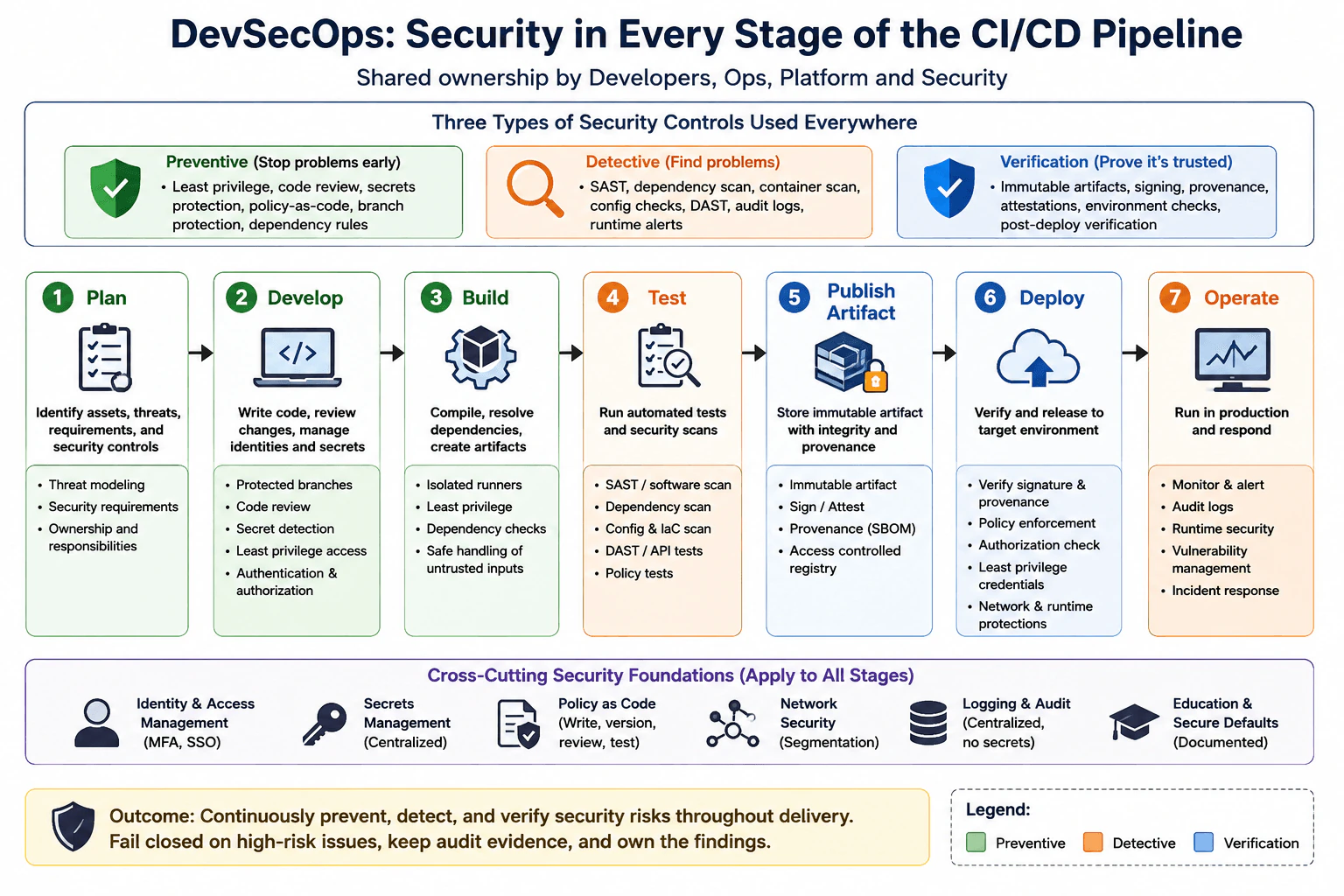
What is DevSecOps, and how does it change a CI/CD pipeline? diagram
How to Explain It in an Interview

DevSecOps means integrating security into the normal development and operations workflow instead of performing one security review immediately before production. The biggest change is ownership. Developers, platform engineers, operations engineers, and security specialists share responsibility throughout the software lifecycle.

I would explain the pipeline using three kinds of controls.

  1. Preventive controls stop unsafe actions before they progress. Examples include protected branches, mandatory code review, least-privilege permissions, approved dependency rules, secret detection, infrastructure policy checks, and deployment authorization policies.
  1. Detective controls identify suspicious or unsafe conditions. Examples include static application security testing, dependency vulnerability scanning, container or artifact scanning, configuration checks, audit logs, runtime alerts, and monitoring for unexpected behavior.
  1. Verification controls confirm that the software being promoted is the software that passed the approved process. Examples include immutable artifacts, cryptographic signatures, build provenance, attestations, deployment verification, and post-deployment health and security checks.

The controls should appear throughout the lifecycle.

Planning: The team identifies important assets, trust boundaries, likely threats, required security controls, and ownership before implementation begins. Security requirements become normal engineering requirements instead of a last-minute checklist.

Development: Developers use peer review, protected branches, secure coding practices, secret detection, and focused static analysis. Authentication answers, "Who is this user or workload?" Authorization answers, "What is this identity allowed to do?" Human access should use the organization's reviewed identity service and phishing-resistant MFA where appropriate. Automation should prefer short-lived federated credentials or managed workload identity over embedded long-lived keys.

Build: CI runners should receive only the permissions required for the current job. Build environments should be isolated where practical. Dependencies should be pinned or otherwise reproducibly resolved and checked against organizational policy and known vulnerability information. Untrusted pull requests, configuration, webhooks, archives, artifacts, and serialized data should be treated as hostile input. Parsers should use constrained formats and explicit schemas where practical. Build scripts must avoid passing untrusted values directly to shells, file paths, deserializers, or network destinations because doing so can enable command injection, path traversal, unsafe deserialization, or server-side request forgery.

Test: Security checks run with the normal test process where they provide useful signal. This can include static analysis, dependency checks, infrastructure-policy tests, authorization tests, configuration validation, and application-specific security tests. No single scanner provides complete protection. Different controls address different threats, and scanner findings still require prioritization and ownership.

Artifact publication: The pipeline should build an artifact once and promote that same immutable artifact through environments rather than rebuilding separately for production. The artifact can be accompanied by provenance that records how it was built and by a cryptographic signature or attestation that deployment systems can verify. The registry should enforce appropriate access controls and preserve audit evidence.

Deployment: The deployment system verifies the artifact identity, required provenance or attestations, policy results, target environment, and caller authorization before promotion. Deployment credentials should be short lived and narrowly scoped. Network controls, admission policies, runtime privileges, and platform hardening should limit what a compromised workload can reach or change. Required high-confidence security verification should fail closed: if an artifact cannot be verified, the system should not silently deploy it.

Operations: Security continues after release. The team collects audit logs, deployment records, identity activity, runtime signals, and security alerts while avoiding secrets or sensitive credentials in logs. Findings must have owners and response procedures. Teams should be able to determine what changed, which human or workload identity performed an action, which artifact was deployed, and whether that artifact passed the approved delivery process.

This is different from adding one scanner to CI. A scanner provides only one type of detective control. It does not automatically provide secure authentication, correct authorization, least privilege, secrets management, artifact integrity, provenance, deployment policy, runtime monitoring, or ownership of findings.

It is also different from making the security team a separate final gate. Security specialists should define standards, build reusable controls, review high-risk exceptions, provide expertise, and help teams respond to threats. Application and platform teams still own the security of the systems they build and operate.

For 2026, I would assume a modern delivery platform can support protected source changes, centralized human identity, MFA, short-lived workload credentials or federation, centralized secret storage, immutable artifact registries, automated scanning, policy enforcement, artifact signing or attestations, and centralized audit logging. I would use repository-pinned tool and policy versions when the environment supplies them rather than assuming a particular vendor or importing one platform's security guarantees into another.

The main tradeoff is delivery speed versus assurance. If every low-confidence scanner warning blocks every build, teams can suffer alert fatigue and may try to bypass controls. If nothing blocks releases, serious risks can reach production. I would therefore use risk-based gates. Deterministic failures such as exposed secrets, unauthorized deployment attempts, invalid required signatures, failed required provenance verification, or clearly prohibited configurations should normally block progression. Lower-confidence findings can create tracked remediation work with an owner, severity, due date, and reviewed exception process.

Safe failure behavior is important. If a required authorization, signing, policy, or provenance check cannot complete, the pipeline should not silently treat that as success. The failure should be logged without secrets, visible to the responsible team, and recoverable through an approved and auditable exception process. Security controls should also be tested periodically so the organization knows they still work instead of assuming that a configured tool provides permanent protection.

Technical Approach
  1. Map the delivery lifecycle from planning through production and identify important assets and trust boundaries.
  2. Assign shared ownership across application, platform, operations, and security teams.
  3. Add preventive controls such as protected changes, least privilege, secret protection, dependency rules, and policy-as-code.
  4. Add detective controls such as code, dependency, configuration, artifact, and runtime checks.
  5. Build once and publish an immutable artifact.
  6. Record build provenance and sign or attest artifacts when supported by the platform.
  7. Verify artifact identity, authorization, required policy, provenance, and environment conditions before deployment.
  8. Use short-lived workload identities and narrowly scoped permissions instead of embedded long-lived credentials.
  9. Monitor production with audit logs and runtime security signals without exposing secrets.
  10. Assign owners to findings and define blocking, remediation, exception, and incident-response paths.
  11. Regularly test and review controls to confirm that they remain effective.
Practical Insights

DevSecOps does not have normal algorithmic time or memory complexity. Its main costs are pipeline duration, CI compute, storage for logs and evidence, operational effort, and maintenance. More scanners and verification steps can slow builds and consume more resources. Security policies, identities, signing systems, exceptions, and tools also require maintenance. Teams usually keep feedback fast by running inexpensive high-confidence checks early and heavier checks at appropriate later stages. They also avoid rebuilding artifacts unnecessarily. Too many noisy findings create alert fatigue, while too few controls leave gaps. The long-term cost includes updating tools and policies, reviewing exceptions, fixing findings, retaining required audit evidence, and verifying that controls still function.

Why Interviewers Ask This

Interviewers want to know whether the candidate understands that DevSecOps is an engineering and ownership model, not a single security product. They evaluate whether the candidate can distribute appropriate security controls across the delivery lifecycle, use least privilege and secure identities, protect the software supply chain, distinguish preventive, detective, and verification controls, define safe release gates, and explain why product and platform teams must share responsibility with security specialists.

Common interview mistakes

A common mistake is saying DevSecOps means adding a vulnerability scanner to CI. That provides only one detective control. Another mistake is leaving all security ownership with a separate security team or making that team the only final approval gate. Other mistakes include giving CI runners excessive privileges, confusing authentication with authorization, storing long-lived credentials in repositories or pipeline variables, rebuilding a different artifact for production, trusting artifacts without required provenance or integrity verification, accepting untrusted pipeline inputs without safe parsing, passing untrusted values into shell commands or file paths, logging secrets, blocking releases on every low-confidence finding, allowing required verification failures to fail open, and assuming one CI, cloud, or Kubernetes platform's security guarantees automatically apply to another.

Interview tip

Start with the ownership change: security becomes part of every engineering stage instead of a final handoff. Then organize the answer around preventive, detective, and verification controls. Give concrete examples such as least-privilege workload identity, dependency checks, immutable signed artifacts, policy enforcement, and runtime monitoring. Finish by explaining why one scanner is not DevSecOps and why release gates should be risk based.
Interviewer may ask next
What security checks would you make blocking versus non-blocking in a DevSecOps pipeline?

I would make deterministic, high-confidence, high-impact failures blocking. Examples include exposed credentials, unauthorized deployment attempts, an invalid or missing required artifact signature, failed required provenance verification, or a configuration that clearly violates an established mandatory policy. Lower-confidence findings, such as some static-analysis warnings or vulnerabilities whose exploitability is uncertain, may initially be non-blocking but should create tracked remediation work. The decision should consider severity, confidence, exploitability, exposure, environment, and organizational policy. Any exception should be explicit, reviewed, auditable, assigned to an owner, and time limited where practical rather than becoming an undocumented bypass.

Why are artifact signing and provenance useful if the pipeline already scans the source code?

Source scanning can find problems in code, but it does not prove which binary, package, or container image was actually deployed. Provenance records information about how an artifact was produced, while a signature or attestation can provide verifiable evidence associated with that artifact. A deployment system can check this evidence before promotion. This helps detect replacement, unauthorized rebuilding, or promotion outside the approved process. Signing and provenance are still only layers of protection; the pipeline also needs secure identities, authorization, least privilege, dependency controls, hardened build infrastructure, policy enforcement, secret protection, and runtime monitoring.

62. How would you apply least privilege to a CI/CD deployment identity?SecurityEasy

Question Details

A pipeline principal deploys one application into one environment. Define the trust boundary, authentication method, allowed resource scope and actions, separation between build and deploy identities, credential lifetime, approval path, and audit evidence needed to prove the identity cannot administer unrelated infrastructure.

Short Interview Answer (30-60 seconds)

I would use a separate, short-lived deployment identity that only the trusted deployment job can obtain. Its policy would allow only the exact deployment actions on that application's resources in one environment. Build and deploy identities stay separate, sensitive releases can require approval, and audit evidence proves unrelated infrastructure is denied.

Detailed Explanation

This question asks how I would make sure an automated release process can change only the part of the system it is responsible for. It should not be able to change other applications, other environments, or important shared services. I need to explain who is allowed to use this access, how long the access lasts, what changes it may make, who approves sensitive releases, and what records prove the restrictions really work. The goal is to reduce damage if the release process is misused or taken over.

Useful Questions to Ask the Interviewer
  1. Which CI/CD platform and deployment target are being used?
  2. Is the deployment limited to one cloud account, project, subscription, cluster, namespace, or similar environment boundary?
  3. Which exact resources must the application deployment create, update, restart, or read?
  4. Does production deployment require a human approval or change-management step?
  5. Are short-lived federated credentials or a managed workload identity available on the platform?
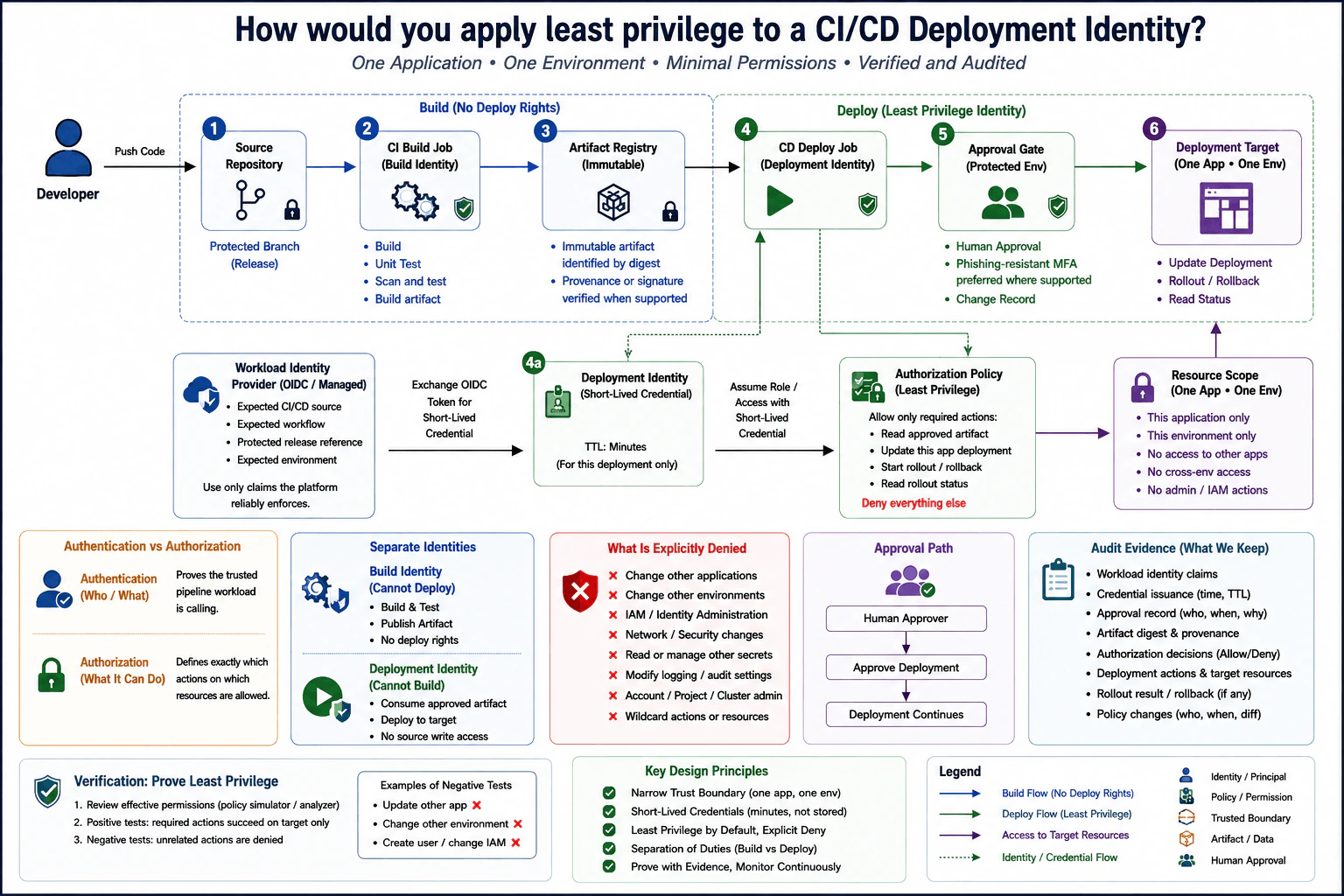
How would you apply least privilege to a CI/CD deployment identity? diagram
How to Explain It in an Interview

I would start by defining the trust boundary. The deployment identity belongs to one application and one environment, for example the production deployment of Application A. It must not be a general CI/CD administrator, cloud administrator, cluster administrator, or shared deployment identity used by unrelated applications.

Authentication and authorization are separate controls. Authentication proves that the trusted deployment workload is the caller. Authorization decides exactly what that caller may do. For authentication, my 2026 platform-neutral assumption is that the CI/CD system and deployment platform support short-lived workload federation, such as an OpenID Connect-based identity exchange, or a managed workload identity. I would prefer that over a stored access key. The trust policy would accept credentials only from the expected CI/CD organization or repository, expected deployment workflow, expected protected release reference, and expected environment when those claims are supplied by the platform and can be reliably enforced.

The issued credential should be short-lived, normally lasting only long enough for one deployment. It should not be reusable indefinitely, written into artifacts, committed to source control, printed in logs, or shared with another pipeline. Credential issuance should fail closed if the expected workload identity claims do not match.

Next I would create a dedicated deployment authorization policy. I would list the exact actions needed by the release process rather than granting broad administrator permissions. For example, the identity might need to read the approved release artifact, update the application's deployment definition, start a rollout, read rollout status, and perform a documented rollback. It should not automatically receive permissions to create users, change identity policies, manage unrelated networks, alter unrelated applications, disable security logging, change account-level settings, or modify arbitrary resources.

Resource scope is equally important. Permissions should target the application's specific environment resources wherever the platform supports resource-level authorization. A deployment for Application A production should not receive equivalent access to Application B, development environments, shared identity infrastructure, unrelated storage, unrelated databases, or organization-level administration. If a required platform operation cannot be narrowly resource-scoped, I would call that out as a risk and compensate with a smaller isolation boundary, a controlled deployment broker, admission policy, or another platform-specific control rather than silently granting broad access.

I would also separate the build identity from the deploy identity. The build identity can compile, test, scan, and publish an artifact, but it should not automatically have production deployment authority. The deployment identity can consume an already approved artifact and release it, but it should not be able to rewrite source history or silently replace the trusted build output. This separation reduces the damage from a compromised build job and creates a clearer software supply-chain boundary.

For artifact integrity, the deployment process should consume an immutable artifact identified by a digest or equivalent immutable identifier. Where the platform supports it, I would verify artifact provenance or signatures showing that the artifact came from the expected trusted build process. Provenance proves where the artifact came from; it does not replace authorization of the deployment identity.

For sensitive environments such as production, I would put the deployment behind the platform's protected-environment or approval mechanism when appropriate. Human approvers should authenticate through the organization's reviewed identity service, and phishing-resistant multi-factor authentication should be preferred where supported. The approval permits the deployment workflow to continue; it should not give the human permanent infrastructure administrator access.

I would keep secrets out of the deployment identity whenever federation removes the need for them. If the deployment still needs application secrets, those secrets should be retrieved only from the approved secret-management system, scoped to the exact application and environment, encrypted in transit and at rest using the platform's supported controls, and never written to CI/CD logs or artifacts. The deployment identity should not have permission to enumerate or read unrelated secrets.

Network restrictions can provide another boundary when they are meaningful for the selected platform. For example, access to a private deployment endpoint can be restricted to approved runners or a controlled deployment service. I would not treat network location as a replacement for workload identity and authorization because a compromised trusted runner could still originate from the approved network.

I would make the design fail safely. If authentication claims are unexpected, an approval is missing, the artifact is not the approved immutable artifact, or the requested operation is outside the authorization policy, the deployment stops. I would not add a fallback administrator credential simply to make a failed deployment succeed.

Auditability is part of least privilege. I would retain records of workload credential issuance, the identity claims used for authentication where available, authorization decisions, deployment approvals, artifact identity or digest, deployment actions, target resources, policy changes, denied actions, failures, and the resulting rollout. Logs must never contain tokens, private keys, passwords, or other secrets. Changes to the deployment identity or its policies should themselves require review and be auditable.

To prove that the identity cannot administer unrelated infrastructure, I would inspect effective permissions rather than trusting only the written policy. I would use the platform's policy simulator, access analyzer, authorization review, or equivalent feature where available, and I would run controlled negative tests. Required release actions against the intended application should succeed. Representative operations against another application, an unrelated environment, identity administration, shared infrastructure, or other forbidden resources should be denied. I would preserve the effective-access review and those denials as evidence.

I would also assign clear ownership to the deployment identity and its policy. The application or platform team should review the policy when deployment requirements change, periodically check for unused permissions, and remove privileges that are no longer necessary. Alerts should cover unexpected credential issuance, unusual denied or privileged operations, and unauthorized policy changes so the security or platform team can investigate quickly.

The main tradeoff is operational convenience versus blast radius. A broad shared deployment administrator is easier to configure, but one compromise can affect many systems. A dedicated identity per application and environment creates more policies and maintenance work, but it limits damage, makes ownership clearer, and produces much stronger evidence that unrelated infrastructure is outside the deployment boundary.

Technical Approach
  1. Define the deployment trust boundary as one application in one environment.
  2. Create a dedicated deployment identity instead of using a shared administrator identity.
  3. Use short-lived workload federation or managed workload identity so the trusted deployment job authenticates without a stored long-lived key.
  4. Restrict the authentication trust policy to the expected CI/CD source, workflow, protected release reference, and environment using claims the selected platform can reliably enforce.
  5. Enumerate the exact deployment actions required and exclude unnecessary administrative capabilities.
  6. Scope those actions to the application's exact environment resources wherever the platform supports resource-level authorization.
  7. Keep build and deployment identities separate so building an artifact does not automatically grant production deployment authority.
  8. Deploy only an approved immutable artifact and verify provenance or signing evidence when supported.
  9. Require protected-environment or human approval for sensitive releases where appropriate.
  10. Keep credentials short-lived, prevent secrets from entering logs or artifacts, and fail closed when trust, artifact, authorization, or approval checks fail.
  11. Record authentication, approval, artifact, authorization, deployment, denial, failure, and policy-change evidence without logging secrets.
  12. Review effective permissions and run controlled negative tests proving the identity is denied access to unrelated infrastructure.
  13. Assign an owner, periodically remove unused permissions, and investigate unexpected credential use or policy changes.
Practical Insights

The runtime cost is small because identity checks and policy evaluation happen as part of normal deployment requests. Short-lived credential issuance adds a small authentication step, and provenance or approval checks add a small amount of release latency. The larger cost is operational maintenance: teams must define and review separate identities and policies for applications and environments. More precise policies take longer to design than one broad administrator role, but they reduce the blast radius of mistakes or compromise. Audit logs consume storage, and permission reviews require ongoing ownership. Automation can reduce maintenance by generating policies, testing expected denials, expiring credentials, and collecting evidence.

Why Interviewers Ask This

Interviewers want to see whether the candidate can turn least privilege into an enforceable CI/CD deployment design. They are evaluating whether the candidate understands the difference between authentication, which proves who or what is requesting access, and authorization, which decides what that identity may do. A strong answer defines a narrow trust boundary, separates build from deployment authority, avoids long-lived credentials, scopes permissions to one application and environment, includes an appropriate approval path, and explains how audit evidence and negative authorization tests prove the identity cannot administer unrelated infrastructure.

Common interview mistakes

Common mistakes include using one administrator identity for every pipeline; storing long-lived cloud keys in CI/CD secrets when workload federation is available; confusing authentication with authorization; trusting any workflow from a repository instead of restricting workload trust conditions; granting wildcard actions or wildcard resources without proving they are necessary; using the same identity for building and production deployment; allowing the deployer to change its own identity or policy; giving access to unrelated secrets; relying only on network restrictions; allowing mutable or unverified artifacts to be deployed; using a human administrator account as the pipeline identity; treating an approval button as a substitute for technical authorization; logging tokens or secrets; granting emergency administrator fallback credentials to the pipeline; and reviewing only policy documents instead of testing effective permissions and expected denials.

Interview tip

Structure the answer around six points: trust boundary, authentication, authorization, separation of build and deploy identities, credential lifetime and approval, and audit proof. Emphasize that least privilege is not only a narrow policy on paper. You must prove the effective identity can complete the required deployment while representative unrelated administrative actions are denied.

Interviewer may ask next
How would you prove that the deployment identity really cannot modify unrelated infrastructure?

I would review the identity's effective permissions with the platform's authorization-analysis capability and then perform controlled positive and negative tests. Required deployment operations should succeed only on the intended application's environment. Representative operations against another application, an unrelated environment, identity administration, shared infrastructure, and other forbidden resources should be denied. I would retain the policy version, effective-access analysis, test results, authorization denials, workload credential issuance records, approval records, artifact identity, and deployment logs as evidence. I would repeat the verification whenever the policy or deployment architecture changes.

What would you do if the deployment platform requires one broad permission that cannot be restricted to a single resource?

I would first confirm that the broad permission is truly required and cannot be replaced with a narrower operation. If it is unavoidable, I would reduce the surrounding blast radius. Depending on the platform, that could mean placing the application in a separate account, project, subscription, cluster, namespace, or controlled deployment service so the broad permission is broad only inside a smaller boundary. I would protect policy changes, require approval where appropriate, monitor use of that permission, test unrelated operations for denial where possible, and document the residual risk. I would not hide the limitation or describe the resulting identity as perfectly resource-scoped.

63. When should security data be encrypted, hashed, or signed?SecurityEasy

Question Details

Compare confidentiality, one-way verification, and authenticity for a stored secret, a user password, and a release artifact. Name the principal that must decrypt or verify each item, where keys or salts live, and what each primitive does not protect against.

Short Interview Answer (30-60 seconds)

Encrypt data when an authorized principal must recover it, hash passwords because they should only be verified, and sign release artifacts so consumers can verify approved origin and integrity. Protect private keys separately, store unique password salts with hashes, and remember that cryptography does not replace identity, authorization, or system hardening.

Detailed Explanation

The question asks how to protect three different kinds of important information. Some information must stay private but still be readable later. A password should be checked without keeping a readable copy. Released software should let another system confirm that it came from an approved source and was not changed afterward. The correct choice depends on what must happen later: recover the original information, compare a provided password safely, or prove the source and unchanged state of software. These methods solve different problems, so using one does not remove the need for the others or for access controls.

Useful Questions to Ask the Interviewer
  1. Does the stored secret need to be recovered automatically by a workload, or only through an administrative or break-glass process?
  2. Which deployment system, registry, or policy engine is expected to verify the release artifact before it is trusted?
  3. Should I assume an existing managed key-management, secrets-management, identity, or artifact-signing service?
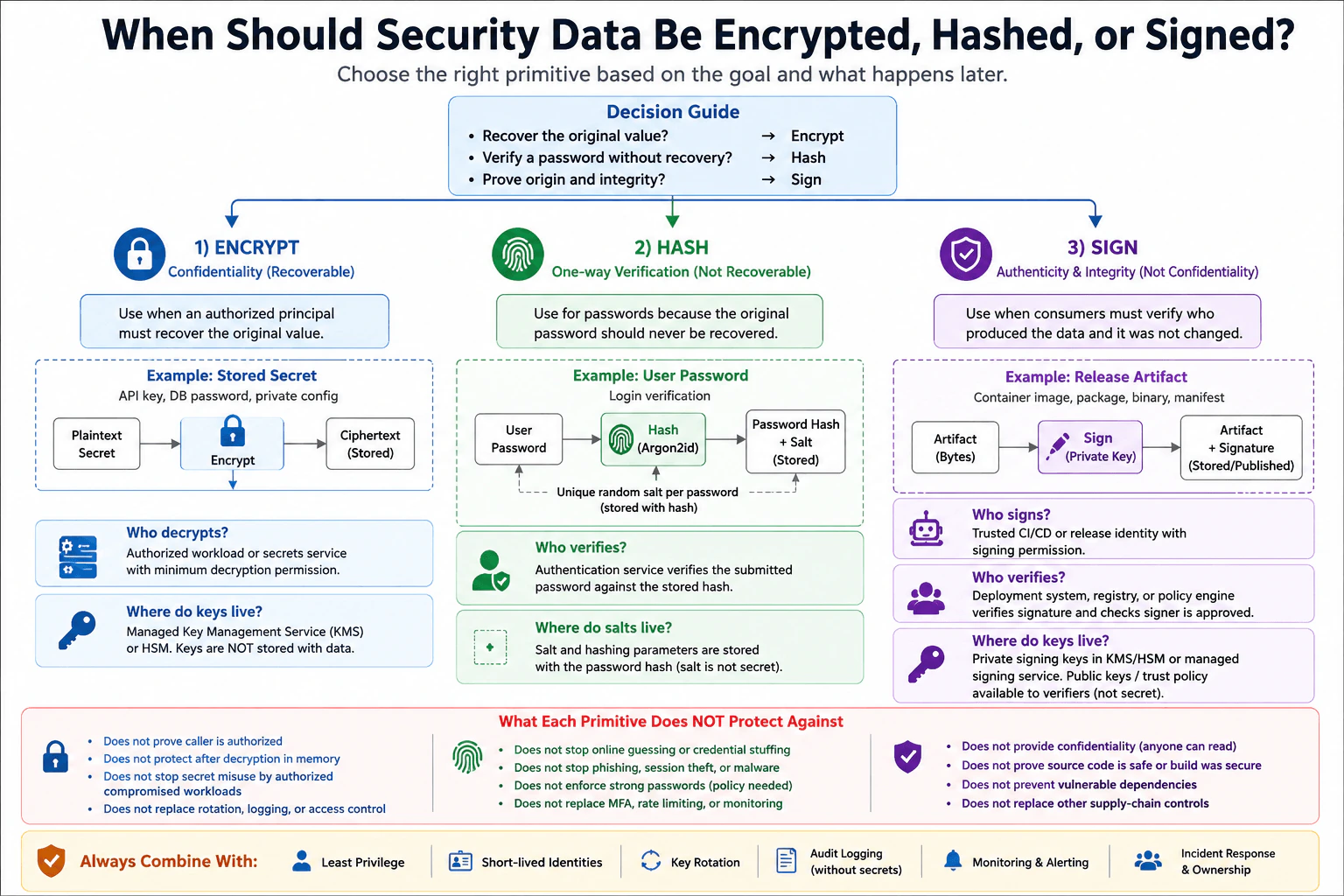
When should security data be encrypted, hashed, or signed? diagram
How to Explain It in an Interview

I would choose the cryptographic primitive from the security goal first.

1. Stored secret: encrypt it

Encryption provides confidentiality. It converts plaintext into ciphertext using cryptographic key material so that only an authorized path can recover the original value.

For a stored application secret, such as an API credential that a workload must use, the workload identity should have only the minimum permission required to retrieve or decrypt that specific secret. The cryptographic operation may be performed by a managed secrets service or key-management service rather than directly inside the application. The important authorization principal is the workload identity requesting access to the plaintext.

I would keep encryption keys in managed key infrastructure such as a cloud key-management service or hardware security module. I would not place a decryption key beside the ciphertext in source control, a container image, CI variables copied across projects, or ordinary application configuration. Where possible, the workload should authenticate with short-lived federated credentials or managed workload identity instead of a long-lived embedded credential.

Encryption does not prove that a caller is authorized to use the plaintext. Authentication establishes who the caller is; authorization decides what that identity may do. Encryption also does not protect a secret after an authorized but compromised workload has decrypted it, and it does not replace secret rotation, memory and host protection, network controls, audit logging, or incident response.

2. User password: hash it with a password-hashing function

A password normally should never need to be recovered. The authentication service only needs to verify whether a password supplied during login matches the one originally chosen. Therefore, I would use a dedicated slow, memory-hard password-hashing function such as Argon2id rather than reversible encryption or a fast general-purpose hash such as SHA-256 alone.

When a password is created, the password-hashing library generates or uses a unique cryptographically random salt for that password and applies configured cost parameters. The system stores the resulting password hash together with the salt and parameters needed for future verification. A salt is not a secret, so storing it beside the password hash is correct.

During login, the authentication service supplies the candidate password to the password-hashing library and verifies it against the stored hash representation. No principal needs a password decryption key because there is no password decryption operation. The authentication service is the principal performing verification against the stored password record.

A unique salt prevents users with the same password from normally having identical stored hashes and defeats useful precomputation across many password records. The intentionally expensive password-hashing operation also raises the cost of offline guessing if the password database is stolen.

Password hashing does not prevent online password guessing, credential stuffing, phishing, session theft, malware, or users choosing weak passwords. Those threats require additional controls such as rate limiting, breached-password screening, secure session handling, monitoring, and appropriate MFA. For privileged human access, phishing-resistant MFA should be preferred where the platform supports it.

3. Release artifact: sign it

A digital signature provides evidence of authenticity and integrity. The release process signs a cryptographic digest representing the artifact using an authorized signing identity or private signing key. A deployment system, registry, policy engine, or other consumer verifies that signature using the corresponding public verification material and, critically, an authorization policy that defines which signer is trusted.

The signing principal should normally be a tightly controlled CI/CD or release workload identity rather than an individual developer using a long-lived private key. Where supported, I would prefer short-lived identity-backed signing, keyless signing, or a managed signing service. If persistent private signing keys are required, they should remain in managed key infrastructure or an HSM, with signing permission restricted to the approved release workflow.

The verifying principal is the deployment gate, registry, policy engine, or workload admission mechanism that decides whether the artifact may be accepted. It needs trusted public-key, certificate, identity, issuer, and policy information as appropriate to the signing system. Public verification material does not need confidentiality, but its trust configuration must be protected from unauthorized modification.

Signature verification should fail closed. If the signature is missing, cryptographically invalid, made by an unauthorized signer, or cannot satisfy the required trust policy, the deployment should be denied rather than silently bypassing verification. The failure should be logged without exposing secrets and routed to the team that owns the release or supply-chain policy.

Signing does not encrypt the artifact, so it does not provide confidentiality. A valid signature also does not prove that the source code is safe, that dependencies are trustworthy, that tests were correct, or that the build environment was uncompromised. Those risks require separate software-supply-chain controls such as protected source changes, isolated builds, dependency verification, vulnerability scanning, provenance, policy enforcement, and audit logs.

Principal and storage summary

For a stored secret, the workload identity is authorized to request the plaintext, while a managed secrets or key-management service typically holds and uses the protected encryption key material. For a user password, nobody decrypts it; the authentication service verifies a candidate password against the stored password hash, and the unique salt and hashing parameters are stored with that record. For a release artifact, the approved release workflow signs it, while the deployment system or policy gate verifies both the signature and whether the signer is authorized. Private signing keys remain in strongly controlled key infrastructure; public verification information may be distributed to verifiers.

The main tradeoff is recoverability. Encryption deliberately permits authorized recovery, which creates key-management and authorization responsibilities. Password hashing deliberately avoids recovery and makes password guessing expensive. Signing leaves the artifact readable but lets trusted consumers verify its origin and integrity. In production, I would combine these controls with least privilege, workload identity, protected human access, key rotation, audit logging without secrets, monitoring, clear ownership, and safe failure behavior.

Technical Approach
  1. Identify the required security property: confidentiality, one-way password verification, or authenticity and integrity.
  2. If an authorized principal must recover the original value, encrypt it.
  3. Define exactly which workload identity may retrieve or decrypt that value and keep private key material in managed key infrastructure.
  4. If the original value should never need recovery, as with a password, use a dedicated salted password-hashing function such as Argon2id.
  5. Store each password's unique salt and hashing parameters with its hash.
  6. If consumers must verify who produced data and whether it changed, digitally sign the artifact.
  7. Restrict signing to an approved release identity and make verifiers check both cryptographic validity and signer authorization.
  8. Fail closed when decryption authorization or required signature verification fails.
  9. Add least privilege, short-lived workload identity, protected human access, rotation, audit logging, monitoring, and ownership.
  10. State which threats the chosen primitive does not solve and apply separate controls for those threats.
Practical Insights

Encryption and signature operations usually add modest processing or managed-service latency. Their larger production cost is operational: protecting keys, defining permissions, rotating keys or certificates, maintaining trust policies, auditing access, and planning recovery. Password hashing intentionally consumes noticeable CPU and memory because making each password guess expensive slows offline attackers; its parameters must therefore balance security with acceptable login capacity. Salts add negligible storage. Signature verification adds some work to artifact admission or deployment. Maintenance includes reviewing access, updating password-hashing parameters as hardware changes, rotating keys safely, preserving verification trust when needed, and monitoring failures.

Why Interviewers Ask This

Interviewers want to see whether the candidate can correctly choose between confidentiality, one-way password verification, and authenticity and integrity instead of treating encryption, hashing, and signing as interchangeable. They also evaluate whether the candidate understands which principal needs to decrypt or verify each item, where keys or salts belong, how least privilege should be applied, and which threats remain after each cryptographic control is used.

Common interview mistakes

Common mistakes include encrypting passwords because encryption is reversible; using a fast general-purpose hash such as SHA-256 alone for password storage; treating a password salt as if it must be secret; reusing one salt for every password; storing encryption or signing keys beside the protected data; embedding long-lived keys in source control, images, or CI configuration; giving many workloads permission to decrypt every secret; confusing authentication with authorization; assuming encryption proves who created data; assuming signing hides artifact contents; accepting any mathematically valid signature without checking whether the signer is authorized; silently bypassing signature verification when verification fails; logging plaintext secrets or passwords; and assuming cryptography replaces access control, MFA, secure builds, dependency controls, patching, monitoring, or incident response.

Interview tip

Organize the answer around the required outcome: encrypt when an authorized principal must recover the original value, hash when a password should only be verified, and sign when consumers must verify approved origin and integrity. Then name the principal, key or salt location, safe failure behavior, and one limitation of each method. This demonstrates practical security judgment rather than only memorized definitions.

Interviewer may ask next
Why should a user password be hashed instead of encrypted?

The service does not need to recover the original password after registration. It only needs to verify future login attempts, so reversible encryption creates unnecessary risk and requires a decryption key that could expose every password if compromised. A dedicated password-hashing function such as Argon2id combines a unique random salt with deliberately expensive CPU and memory work. The salt and parameters can be stored with the hash because they are not secrets. If the database is stolen, attackers can still guess weak passwords offline, so appropriate hashing cost parameters and complementary controls such as rate limiting, breached-password screening, secure sessions, and MFA remain important.

What should happen if a release artifact has a cryptographically valid signature but the signer is not an approved release identity?

The deployment should be denied. Cryptographic validity proves only that the signature corresponds to the signing key or identity and that the signed content has not changed. Authorization is a separate decision. The verifier must check the signer against an explicit trust policy, such as an approved release workload identity, certificate issuer, repository or workflow constraint, or managed signing key. If that authorization check fails, the artifact must not be trusted even though the signature is mathematically valid. The failure should be logged without exposing secrets and handled by the team responsible for the release or software-supply-chain policy.

64. How should secrets be protected in a delivery pipeline?SecurityEasy

Question Details

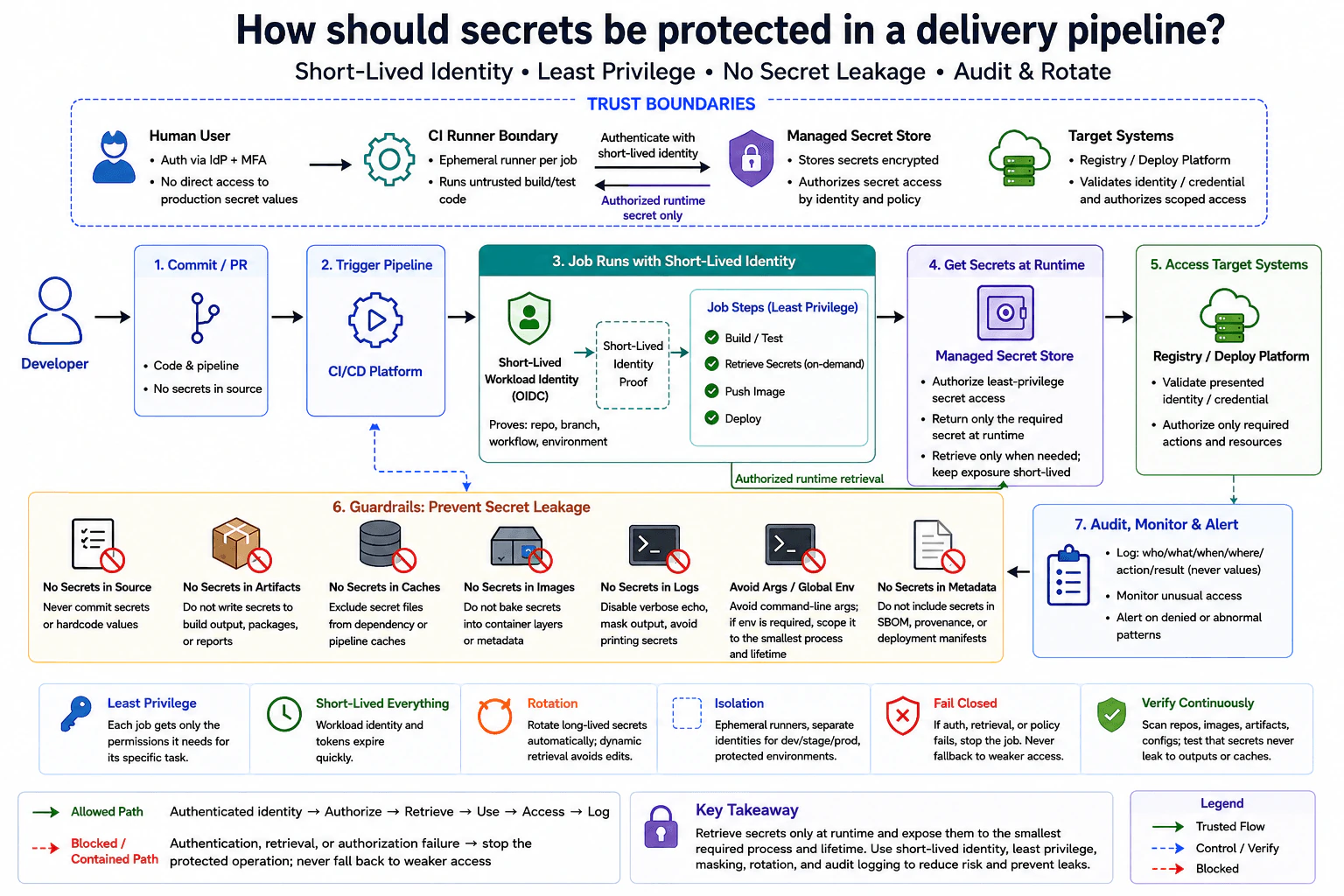
A build and deployment need registry and platform credentials. Identify the human, runner, secret-store, and target-system trust boundaries; design secret retrieval with short-lived identity, masking, non-export rules, rotation, and access logging; and explain how to prevent values from entering source, artifacts, caches, or command output.

Short Interview Answer (30-60 seconds)

I would keep secrets in a managed secret store, use short-lived workload identity for each pipeline job, grant only required permissions, and never place values in source, artifacts, caches, or logs. I would also mask output, rotate credentials, audit access, and fail closed when retrieval or authorization fails.

Detailed Explanation

A delivery process sometimes needs private values so it can sign in to other services. The main goal is to keep those values away from people, project files, saved build output, and messages that others can read. Each step should receive only the private value it needs and only while that step is running. People should not copy these values into source files. The system should record who requested access without recording the private value itself. If access is denied or something goes wrong, the process should stop safely rather than continue with weaker protection.

Useful Questions to Ask the Interviewer
  1. Which CI/CD platform, secret store, registry, and deployment platform are we using?
  2. Can the pipeline use workload identity or OIDC federation instead of stored access keys?
  3. Are the runners shared, ephemeral, or self-hosted, and how are they isolated between jobs?
  4. Which registry and platform permissions does each build or deployment stage actually need?
  5. What rotation, retention, approval, and audit requirements apply to production secret access?
How should secrets be protected in a delivery pipeline? diagram
How to Explain It in an Interview

I would design the solution around four trust boundaries: the human user, the CI runner, the secret store, and the target system such as the registry or deployment platform. A trust boundary is a point where one identity or system must prove who it is and what it is allowed to do before crossing into another protected area.

First, I would separate authentication from authorization. Authentication proves the identity of a developer or pipeline workload. Authorization decides which actions that identity may perform. Successfully authenticating should never automatically provide broad access.

For human access, I would use the organization's reviewed identity provider and phishing-resistant MFA where supported. Developers may be allowed to configure a reference to a production secret, but they normally should not be able to read the secret value directly. Any exceptional production access should be explicitly authorized, reviewed, time limited where possible, and logged.

For the runner, I would prefer short-lived federated credentials, such as OIDC-based workload identity, instead of permanent cloud, registry, or deployment keys stored as CI variables. For a typical 2026 CI/CD design, I assume the selected CI and target platforms support short-lived federation or an equivalent managed workload identity. If they do not, I would use the strongest supported secret-store integration and tightly control any remaining long-lived credential.

The target identity system should validate trusted claims before issuing credentials. Depending on the platform, those claims can include the organization, repository, workflow, protected branch or tag, deployment environment, and intended audience. Authorization policies should then limit what that identity can access.

The runner should authenticate to the secret store using its short-lived workload identity. The secret store should authorize only the exact secrets required by that job. Least privilege means giving an identity only the minimum permissions and resources needed for its task. For example, a build job may be allowed to push an image to one registry repository but should not automatically receive production deployment permissions.

I would use separate workload identities for different responsibilities and environments. Development, staging, and production should not share one powerful credential. A compromised development job should not automatically become a path to production.

Secrets should be retrieved only when needed and retained for the shortest possible time. I would keep them in memory or use a platform-supported secret injection mechanism when possible. I would avoid globally exporting secret values as environment variables because child processes, diagnostic tools, crash handlers, or careless commands can expose them. If a required tool accepts a secret only through an environment variable, I would scope that variable to the smallest possible process and remove it immediately after use.

I would enforce non-export rules throughout the pipeline. Secret values must never be committed to source control, written into generated files that later become artifacts, copied into container image layers, stored in dependency or build caches, included in test reports, placed in software provenance metadata, or uploaded with deployment packages. Artifact and cache steps should use explicit allowlists rather than blindly uploading entire working directories.

Command output also needs protection. I would disable shell tracing such as set -x around sensitive operations, avoid commands that print secret-bearing variables, and prefer tools that accept credentials through protected inputs rather than command-line arguments. Command-line arguments can sometimes be exposed through process inspection, debug output, or logs. CI masking is useful as a secondary control, but I would never depend on masking alone because transformed, encoded, split, or partially printed values may bypass it.

For registry access, I would prefer a short-lived token scoped to the required registry repository and actions such as push or pull. For the deployment platform, I would use a separate short-lived identity limited to the required environment, service, namespace, project, or equivalent target resource.

The secret store should encrypt secrets while stored and use an authenticated encrypted channel when delivering them. Access policy should be centrally controlled and reviewable. Network restrictions can further reduce exposure by limiting which trusted runners or endpoints can reach secret and deployment services, but network location should never replace strong identity and authorization checks.

Secrets also need rotation. Short-lived credentials reduce risk because they expire automatically. Long-lived values that cannot yet be eliminated should have a clear owner, the smallest possible permissions, an expiration policy, automated rotation where supported, and a tested replacement procedure. Pipelines should retrieve the current value dynamically so rotation does not require editing source code or rebuilding an image containing a credential.

I would treat pull requests, repository configuration, pipeline definitions, artifacts, caches, webhooks, and other pipeline inputs as potentially untrusted. Untrusted pull-request code should never receive production secrets. Build and test workflows for untrusted code should be separated from privileged deployment workflows. Production access should be issued only after trusted conditions such as reviewed changes, protected branches or tags, protected environments, and correctly validated workload-identity claims are satisfied.

Runner hardening is also important. Ephemeral runners are preferable for sensitive jobs because they can be destroyed after a run, reducing the chance that credentials, temporary files, processes, or modified tooling survive for the next job. Self-hosted runners require stronger isolation, patching, access controls, cleanup, and protection against one repository or job affecting another.

If authentication, workload-identity validation, secret retrieval, policy evaluation, or authorization fails, the pipeline should fail closed. It should stop the protected operation instead of falling back to a shared credential, bypassing the secret store, or silently broadening permissions.

Audit logs should record useful metadata such as the requesting human or workload identity, secret identifier, target resource, time, operation, policy result, and success or failure. They must never record the secret value. Logs should be protected from unauthorized modification and monitored for unusual access patterns such as unexpected repositories, environments, identities, or repeated denied requests.

Finally, I would verify the design continuously. I would use repository secret scanning, artifact and container-image inspection where appropriate, policy checks for pipeline configuration, tests confirming that known test secrets do not appear in artifacts or caches, and monitoring for suspicious secret-store access. No single scanner, masking rule, or network control provides complete protection.

The main tradeoff is convenience versus isolation. One shared permanent credential is easy to configure, but compromise of one runner or workflow can then affect many systems. Separate short-lived identities and narrowly scoped permissions require more policy and platform configuration, but they reduce the blast radius, simplify revocation, improve auditability, and prevent many accidental secret leaks.

Technical Approach
  1. Identify the human, CI runner, secret-store, registry, and target-platform trust boundaries.
  2. List each pipeline stage and the exact credential or permission it needs.
  3. Authenticate humans through the approved identity provider with strong MFA and authenticate jobs through short-lived workload identity.
  4. Authorize each identity with least privilege and separate build, staging, and production permissions.
  5. Retrieve secrets at runtime from the managed secret store instead of source code or static pipeline files.
  6. Limit secret exposure to the smallest process and shortest lifetime possible.
  7. Prevent secret values from entering source, temporary output, artifacts, container layers, caches, test reports, provenance data, command arguments, or logs.
  8. Mask sensitive output and disable verbose command tracing during secret use.
  9. Prefer ephemeral, isolated runners for privileged jobs and harden any persistent self-hosted runners.
  10. Rotate or eliminate long-lived credentials and assign clear ownership to any that remain.
  11. Record access metadata without recording values.
  12. Keep production secrets away from untrusted pull-request workflows and require protected deployment paths.
  13. Fail closed when authentication, identity validation, secret retrieval, or authorization fails.
  14. Continuously scan, test, and monitor repositories, artifacts, images, caches, logs, pipeline policies, and secret-store access for exposure or abnormal behavior.
Practical Insights

The runtime cost is usually small because the pipeline makes only a few extra identity, policy, and secret-store requests. Secret values themselves require very little memory, and keeping them only for the duration of the required process reduces exposure. The larger cost is operational: teams must configure identities, policies, protected environments, runner isolation, rotation, monitoring, and tests. Maintenance includes reviewing permissions and access logs and verifying that secrets are absent from artifacts and caches. The benefit is lower security risk because stolen credentials expire quickly and compromised jobs have a much smaller blast radius.

Why Interviewers Ask This

The interviewer wants to know whether you can design a delivery pipeline that uses registry and platform credentials without leaking them. They are evaluating your understanding of trust boundaries, authentication versus authorization, least privilege, short-lived workload identity, secure secret retrieval, masking, rotation, audit logging, artifact and cache protection, and safe failure behavior. They also want to see whether you can limit the impact of a compromised human account, repository, workflow, or runner instead of depending on one scanner or masking feature.

Common interview mistakes

Common mistakes include storing registry or cloud keys in source control; keeping permanent credentials in ordinary CI variables when workload federation is available; using one shared credential for every repository or environment; giving build jobs production deployment permissions; exposing production secrets to untrusted pull requests; exporting secrets globally as environment variables; putting credentials directly in command-line arguments; enabling verbose shell tracing while secrets are present; assuming CI masking prevents every leak; caching directories containing generated credential files; embedding credentials in container layers or build artifacts; placing secret values in provenance or test reports; logging values instead of access metadata; failing to rotate long-lived credentials; letting developers read production values unnecessarily; reusing persistent runners without adequate cleanup and isolation; and falling back to shared credentials when workload identity or authorization fails.

Interview tip

Organize the answer around four boundaries: human, runner, secret store, and target system. Then explain short-lived identity, least privilege, runtime retrieval, non-export rules, masking, rotation, logging, runner isolation, and fail-closed behavior. Emphasize that scanners and masking are secondary controls; the best design prevents secret values from being exposed in the first place.

Interviewer may ask next
How would you prevent a pull request from stealing a production secret?

I would treat pull-request code as untrusted and never provide an untrusted workflow with production credentials. Its runner identity would have only the permissions required for safe build and test operations. Production deployment would execute in a separate protected workflow after reviewed code reaches an approved branch, tag, or environment. The workload-identity policy would validate trusted claims such as repository, workflow, branch or environment, and audience before production access is issued. Protected environments can also require approval. Even if pull-request code compromises its runner, there should be no production secret available for it to steal.

What would you do if a platform cannot use short-lived workload identity and requires a long-lived credential?

I would store the credential only in a managed secret store, scope it to the minimum required resources and operations, and use separate credentials for separate environments or purposes. Only protected jobs would be authorized to retrieve it. I would assign an owner, set an expiration and rotation policy, rotate it automatically where supported, log every retrieval without logging the value, and test that it never appears in source, logs, caches, images, or artifacts. I would document the permanent credential as a remaining risk and migrate to short-lived federation when the platform supports it.

65. How would you combine Kubernetes RBAC and NetworkPolicy for service isolation?SecurityMedium

Question Details

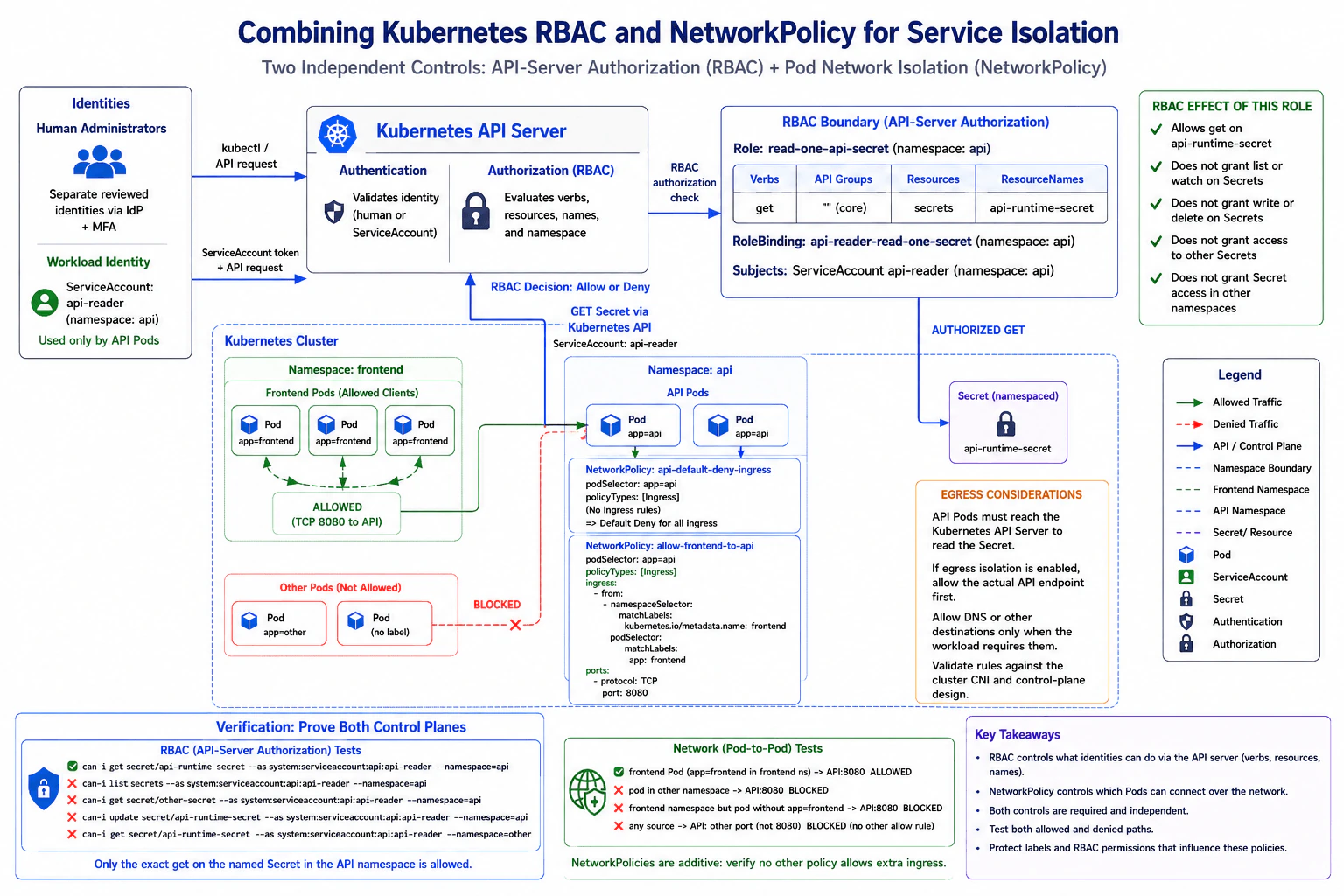
An API Pod may read one namespaced Secret and accept traffic only from a frontend namespace. Define the user and service-account principals, API-server authorization boundary, Pod network boundary, default-deny rules, allowed verbs and resources, and tests that prove both control planes enforce the intended access.

Short Interview Answer (30-60 seconds)

Give the API Pod its own ServiceAccount, bind a namespaced Role that allows only get on the required Secret, and default-deny API ingress. Then allow only selected frontend Pods on the API port and test both permitted and denied RBAC and network paths.

Detailed Explanation

See the Code while reading this explanation.

The goal is to let one part of the system do only two approved things: read one protected value and receive requests from one trusted area. Everything else should be blocked unless it is specifically allowed. People who manage the system should have separate access from the running application, so their permissions are never shared. I would build two independent barriers: one decides which actions an identity may perform, and the other decides which running parts may talk to each other. I would then test both allowed and blocked cases to prove the limits work.

Useful Questions to Ask the Interviewer
  1. Which namespace contains the API Pod and the Secret?
  2. What is the exact Secret name the API workload must read?
  3. Which labels identify the API Pods and the permitted frontend Pods?
  4. Which TCP port does the API listen on?
  5. Does the cluster use a CNI plugin that enforces Kubernetes NetworkPolicy?
  6. Does the API workload need any outbound access besides the Kubernetes API server, such as DNS or another service?
  7. How are human administrators authenticated, and what reviewed identity and MFA controls are required?
How would you combine Kubernetes RBAC and NetworkPolicy for service isolation? diagram
How to Explain It in an Interview

I would treat this as two independent trust boundaries.

First is the Kubernetes API-server boundary. Authentication answers, "Who is making the request?" Authorization answers, "What is that identity allowed to do?" The API Pod should run under a dedicated ServiceAccount, for example api-reader, in the API namespace. Humans should use separate reviewed identities and must never reuse the workload ServiceAccount. Where appropriate, human access should use the organization's identity provider and phishing-resistant MFA.

Because the application needs to read a Secret through the Kubernetes API, I would bind a namespaced Role to that ServiceAccount. The Role grants only the get verb on the secrets resource and restricts access with resourceNames to the exact Secret. I would not grant list, watch, create, update, patch, or delete. A RoleBinding then connects only the API ServiceAccount to that Role. This is least privilege and limits the permission to the namespace containing the RoleBinding.

The workload should use Kubernetes' projected, short-lived ServiceAccount token rather than an embedded static credential. The token authenticates the workload, but the Role and RoleBinding perform authorization. The Secret value should never be written to logs. API-server traffic should use TLS, and Secret encryption at rest should be enabled where the Kubernetes platform supports it.

Second is the Pod network boundary. Kubernetes NetworkPolicy controls traffic for selected Pods when the installed CNI plugin supports NetworkPolicy enforcement. I would create a default-deny ingress policy selecting the API Pods, then add one allow policy for the required API port.

The allow rule should require both the frontend namespace and the frontend Pod label. For example, the source must be a Pod labeled app=frontend in the namespace whose standard label is kubernetes.io/metadata.name=frontend. Putting the namespaceSelector and podSelector in the same from entry makes the rule an AND condition. This prevents unrelated Pods in the frontend namespace from being allowed.

I would also protect the labels that determine authorization. NetworkPolicy selectors trust labels, so RBAC must restrict who can create or modify relevant Pods, namespaces, and labels. Otherwise, a user who can assign the trusted label could potentially satisfy the network selector.

I would not automatically add default-deny egress without considering dependencies. In this scenario the API Pod must reach the Kubernetes API server to read the Secret. A blanket egress deny with only DNS allowed would break that requirement. If the environment requires egress isolation, I would first identify the platform-specific Kubernetes API endpoint and every other required destination, then add narrowly scoped egress allows before enabling default-deny egress. Kubernetes NetworkPolicy does not provide a portable Service selector for the API server, and traffic handling around Service translation can vary by implementation, so that egress rule must be validated against the actual CNI and control-plane design.

RBAC and NetworkPolicy protect different things. NetworkPolicy cannot stop a Pod from reading a Secret through the API server if its identity is authorized. RBAC cannot stop an otherwise reachable Pod from opening a TCP connection to the API. Both controls are therefore required.

I would verify the API-server boundary with positive and negative authorization tests. The API ServiceAccount should be allowed to get the required Secret. It should be denied when listing Secrets, reading another Secret, modifying the permitted Secret, or reading a Secret in another namespace. I would use kubectl auth can-i with ServiceAccount impersonation so testing does not expose a ServiceAccount token.

I would verify the network boundary from controlled test Pods. A correctly labeled frontend Pod in the frontend namespace should reach the API on the permitted TCP port. A Pod in another namespace should fail. A Pod in the frontend namespace without the required frontend label should also fail. A connection to an unapproved destination port should fail if no other policy allows it.

Finally, I would confirm that the CNI actually enforces NetworkPolicy. Creating a NetworkPolicy object is not enough if the networking implementation ignores it. I would keep these positive and negative checks in security validation so later label, RBAC, CNI, or policy changes do not silently weaken isolation.

Technical Approach
  1. Identify the API namespace, frontend namespace, API Pod labels, frontend Pod labels, exact Secret name, and API port.
  2. Create a dedicated ServiceAccount for the API workload and keep human identities separate.
  3. Create a namespaced Role allowing only get on the exact Secret with resourceNames.
  4. Bind that Role only to the API ServiceAccount with a RoleBinding.
  5. Apply default-deny ingress to the API Pods.
  6. Add one ingress allow policy that requires both the frontend namespace selector and frontend Pod selector and permits only the required TCP port.
  7. Do not default-deny egress until the Kubernetes API endpoint and other required destinations are explicitly identified and allowed.
  8. Verify that the cluster CNI enforces NetworkPolicy.
  9. Run positive and negative RBAC tests.
  10. Run positive and negative network tests.
  11. Audit policy and label changes without logging Secret values.
Practical Insights

The runtime cost is usually small because the Kubernetes API server already performs RBAC authorization and the CNI data plane already enforces network rules. The larger cost is operational: teams must maintain ServiceAccounts, Roles, RoleBindings, labels, NetworkPolicies, and tests. More precise policies take more maintenance, but they reduce the damage a compromised workload can cause. Network behavior depends on the installed CNI, so enforcement and any egress design must be tested in the real cluster instead of assumed.

Code
# Python 3.14-compatible wrapper preserving the supplied configuration and commands exactly.
CODE = r"""# Assumptions for this example:
# - The API workload and Secret are in namespace `api`.
# - The allowed callers are Pods labeled app=frontend in namespace `frontend`.
# - The API Pods are labeled app=api and listen on TCP 8080.
# - The only Secret the workload may read is `api-runtime-secret`.
# - The installed CNI must enforce Kubernetes NetworkPolicy.

apiVersion: v1
kind: ServiceAccount
metadata:
  name: api-reader
  namespace: api
# Trust boundary: this identity belongs only to the API workload.
# Human users must authenticate separately and must never reuse this credential.
---
apiVersion: rbac.authorization.k8s.io/v1
kind: Role
metadata:
  name: read-one-api-secret
  namespace: api
rules:
  - apiGroups: [""]
    resources: ["secrets"]
    # Least privilege: authorize only the one Secret required by the workload.
    resourceNames: ["api-runtime-secret"]
    # Safe failure behavior: every other Secret action remains denied by default.
    verbs: ["get"]
---
apiVersion: rbac.authorization.k8s.io/v1
kind: RoleBinding
metadata:
  name: api-reader-read-one-secret
  namespace: api
subjects:
  - kind: ServiceAccount
    name: api-reader
    namespace: api
roleRef:
  apiGroup: rbac.authorization.k8s.io
  kind: Role
  name: read-one-api-secret
# Authorization boundary: only this ServiceAccount receives the Role above.
---
apiVersion: networking.k8s.io/v1
kind: NetworkPolicy
metadata:
  name: api-default-deny-ingress
  namespace: api
spec:
  podSelector:
    matchLabels:
      app: api
  policyTypes:
    - Ingress
  # Safe failure behavior: selecting the API Pods with no ingress entries denies
  # incoming connections unless another NetworkPolicy explicitly allows them.
---
apiVersion: networking.k8s.io/v1
kind: NetworkPolicy
metadata:
  name: allow-frontend-to-api
  namespace: api
spec:
  podSelector:
    matchLabels:
      app: api
  policyTypes:
    - Ingress
  ingress:
    - from:
        - namespaceSelector:
            matchLabels:
              # Validate the namespace identity with Kubernetes' standard name label.
              kubernetes.io/metadata.name: frontend
          podSelector:
            matchLabels:
              # Both selectors are in the same entry, so both must match.
              app: frontend
      ports:
        - protocol: TCP
          # Network least privilege: expose only the application listener.
          port: 8080

# RBAC verification.
# Impersonation checks authorization without exposing a ServiceAccount token.

# Expected: yes. The workload may read only the required Secret.
kubectl auth can-i get secret/api-runtime-secret   --namespace=api   --as=system:serviceaccount:api:api-reader

# Expected: no. Collection access is intentionally not granted.
kubectl auth can-i list secrets   --namespace=api   --as=system:serviceaccount:api:api-reader

# Expected: no. A different Secret is outside the authorization boundary.
kubectl auth can-i get secret/another-secret   --namespace=api   --as=system:serviceaccount:api:api-reader

# Expected: no. The workload cannot modify the approved Secret.
kubectl auth can-i update secret/api-runtime-secret   --namespace=api   --as=system:serviceaccount:api:api-reader

# Expected: no. The namespaced RoleBinding does not grant access in `other`.
kubectl auth can-i get secret/api-runtime-secret   --namespace=other   --as=system:serviceaccount:api:api-reader

# Network verification should run from controlled test Pods.
# These test Pods should use an image that contains curl and should not print secrets.

# Expected: succeeds from a Pod labeled app=frontend in namespace frontend.
kubectl exec -n frontend frontend-test --   curl --fail --silent --show-error --max-time 3   http://api.api.svc.cluster.local:8080/health

# Expected: fails from a Pod in another namespace because no ingress rule allows it.
kubectl exec -n other unauthorized-test --   curl --fail --silent --show-error --max-time 3   http://api.api.svc.cluster.local:8080/health

# Expected: fails from a Pod in frontend that does not have app=frontend.
kubectl exec -n frontend nonfrontend-test --   curl --fail --silent --show-error --max-time 3   http://api.api.svc.cluster.local:8080/health

# Audit guidance: record authorization decisions, policy changes, and test results,
# but never log Secret values or ServiceAccount tokens."""
Why Interviewers Ask This

This question tests whether the candidate understands that Kubernetes service isolation needs separate authorization and network controls. The interviewer wants to see clear separation of human identity from workload identity, authentication from authorization, and API-server permissions from Pod-to-Pod connectivity. It also tests least-privilege judgment: one ServiceAccount should read only one Secret, and only the intended frontend Pods should reach the API port. A strong answer should use default deny, precise verbs and resources, safe failure behavior, auditability, and positive and negative tests that prove both control planes work independently.

Common interview mistakes

Common mistakes include using only RBAC and assuming it blocks Pod network traffic; using only NetworkPolicy and assuming it protects Kubernetes API objects; granting list or watch on all Secrets when only one named Secret is needed; using the default ServiceAccount for unrelated workloads; sharing workload credentials with humans; allowing an entire frontend namespace without also selecting the intended Pods; forgetting that NetworkPolicy requires CNI enforcement; assuming NetworkPolicies are ordered like firewall rules even though their allows are additive; trusting labels without restricting who may change them; enabling default-deny egress without first allowing the Kubernetes API server needed for Secret access; testing only the allowed path; and printing Secret values while debugging.

Interview tip

Present the design as two independent gates: RBAC controls Kubernetes API actions and NetworkPolicy controls Pod traffic. Name the exact principal, verb, Secret, source Pods, and port. Then explain default deny and prove the design with both positive and negative tests.

Interviewer may ask next
Why is `resourceNames` useful when granting access to a Kubernetes Secret, and what limitation should you remember?

resourceNames restricts the Role's get permission to one named Secret instead of every Secret in the namespace. That is useful for least privilege. I would still avoid granting list or watch, because those are collection operations and do not match the goal of reading one specific Secret. If the application later needs another Secret, I would explicitly review and add only that required name.

What if the frontend namespace contains both trusted and untrusted Pods?

I would not allow the namespace by itself. I would combine a namespaceSelector for the frontend namespace with a podSelector for the trusted frontend workload in the same from entry, so both conditions must match. I would also restrict RBAC permissions that let users create Pods or change the relevant Pod and namespace labels, because those labels participate in the network authorization decision.

66. How would you give a Kubernetes workload cloud access without static credentials?SecurityMedium

Question Details

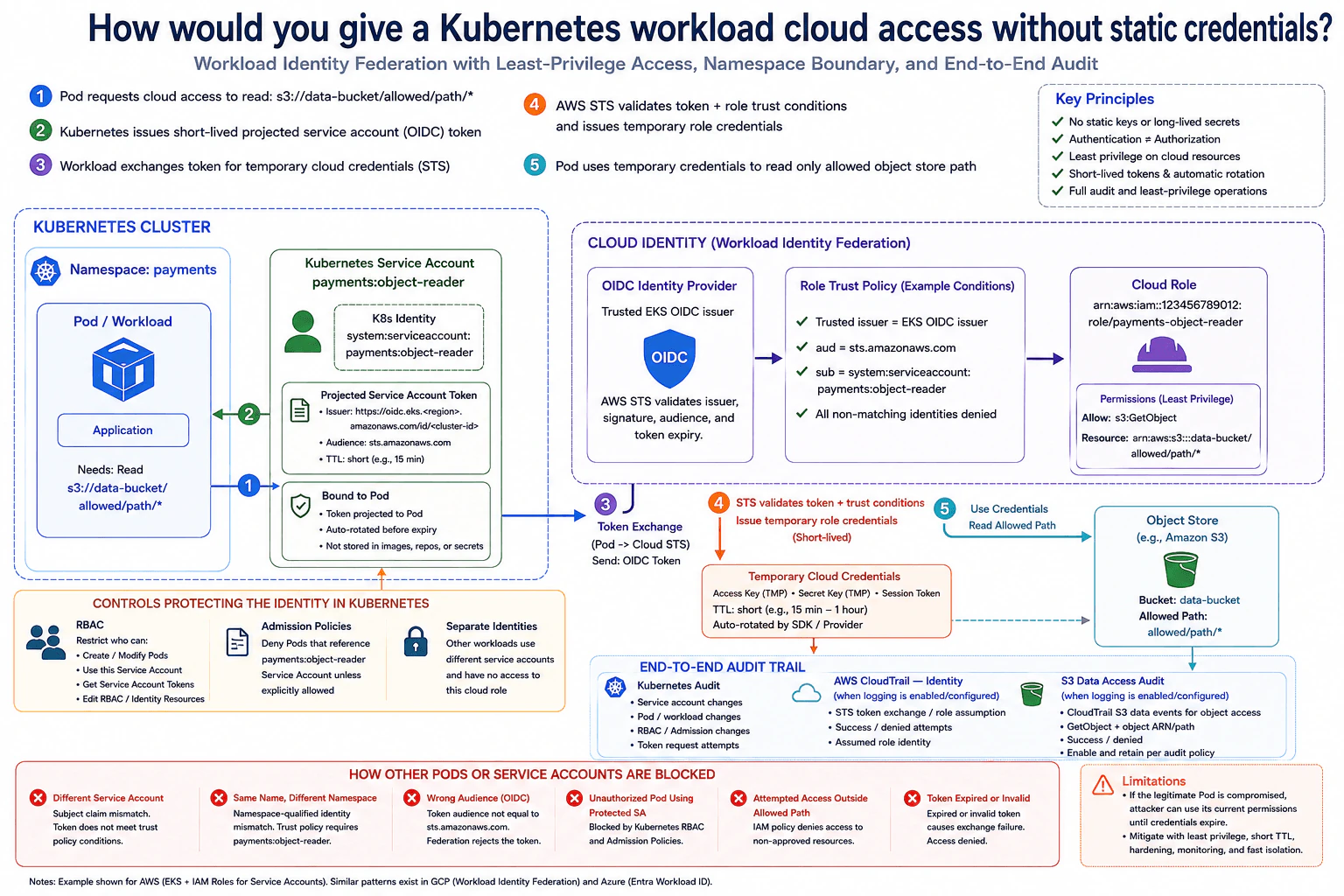
A Pod must read one cloud object store path. Design the mapping from Kubernetes service account to cloud workload identity, token audience and lifetime, role trust policy, resource permission, namespace boundary, and audit trail. Explain how the design blocks another Pod or service account from assuming the role.

Short Interview Answer (30-60 seconds)

I would use workload identity federation with a dedicated Kubernetes service account. The cloud accepts only that workload's short-lived identity under strict issuer, audience, namespace, and service-account conditions, then returns temporary credentials for a least-privilege role that can read only the required object-store path.

Detailed Explanation

A small application running in a shared computing system needs permission to read only one folder in online storage. I would not give it a permanent password or key. Instead, the system proves which application is asking, gives it temporary permission, and limits that permission to the exact data it needs. I would also make sure another application cannot pretend to be it. Every use should be recorded so the security team can see who accessed the data, when it happened, and whether an unexpected attempt was blocked.

Useful Questions to Ask the Interviewer
  1. Which cloud provider and managed Kubernetes service are we using?
  2. Does the workload need only object reads, or must it also list objects within the allowed path?
  3. Can this workload have its own Kubernetes service account and dedicated cloud role?
  4. What RBAC or admission-policy controls already prevent workloads from selecting another workload's service account?
  5. What audit-retention and alerting requirements apply to identity exchanges and object-store data access?
How would you give a Kubernetes workload cloud access without static credentials? diagram
How to Explain It in an Interview

I would use the cloud provider's supported workload identity federation instead of putting long-lived cloud access keys in a Kubernetes Secret. The exact implementation differs by platform. Examples include OIDC-based role federation such as AWS IAM Roles for Service Accounts, Google Cloud Workload Identity Federation for GKE, and Microsoft Entra Workload ID for AKS. I would preserve each provider's actual trust model rather than assuming that controls from one platform exist on another.

1. Give the workload a dedicated Kubernetes identity

I would create a Kubernetes service account specifically for this workload instead of using the namespace's default service account. Conceptually, its Kubernetes identity could be system:serviceaccount:payments:object-reader, where payments is the namespace and object-reader is the service-account name.

The Pod or its controller explicitly uses that service account. Other applications use different service accounts. This produces a narrow identity that can be independently authorized and audited.

Authentication answers, "Which workload is making this request?" The Kubernetes service-account identity participates in authentication. Authorization separately answers, "What is that workload allowed to do?" The cloud role and object-store permissions provide authorization.

2. Use a short-lived workload token

Where the provider integration uses Kubernetes-issued OIDC tokens, Kubernetes should project a short-lived service-account token for the workload rather than reuse a long-lived credential. The token must use the audience required by the selected cloud federation mechanism.

The audience identifies the intended recipient of the token. The cloud identity system must validate it according to that provider's federation design. A token intended for another audience must not be accepted for this role.

I would use a short practical token lifetime supported by the Kubernetes and cloud integration and rely on automatic rotation. The resulting cloud credentials should also be temporary and should use the shortest practical session lifetime allowed by the application and provider. Token lifetime and cloud credential lifetime are separate controls and should not be assumed to be identical.

I would never copy the token or temporary credentials into a container image, source repository, CI variable, configuration file, or long-lived Kubernetes Secret.

3. Build a narrow cloud trust relationship

The cloud identity system must trust only the intended Kubernetes workload identity through the provider-supported issuer or identity integration.

For an OIDC-based design, I would restrict the role trust conditions to the exact trusted issuer and the exact claims the provider supports for workload identification. At minimum, that normally means validating the intended audience and the namespace-qualified service-account identity, such as the subject claim representing system:serviceaccount:payments:object-reader.

The conceptual trust decision is:

  • issuer is the configured trusted cluster or workload-identity issuer;
  • audience is the value required by the selected cloud federation service;
  • namespace and service-account identity identify only the intended workload;
  • any additional provider-recommended workload claims are validated;
  • identities that do not match fail closed.

Some managed workload-identity implementations perform part of this mapping through provider-specific associations instead of a directly editable OIDC role-trust document. I would use the provider's supported mechanism while preserving the same security goal: only this Kubernetes identity can obtain this cloud identity.

The trust policy controls who may obtain the cloud role. It is different from the resource permissions attached to that role, which control what the authenticated workload may do afterward.

4. Give the cloud role only the required object permissions

The cloud role should contain only the permissions needed to read the required object-store path.

If the application reads known object names, I would grant object-read permission only for that bucket, container, or equivalent path prefix. If the application must discover object names, it may also require a list operation, which I would constrain to the required prefix when the provider supports prefix-level conditions.

I would not grant write, delete, bucket administration, identity administration, unrelated storage access, or broad wildcard permissions unless the application genuinely requires them.

Object-store encryption should remain enabled. If the objects use a customer-managed encryption key and the provider requires a separate decrypt permission, I would grant decrypt access only to the exact key required by those objects. I would not add key-management permissions when the storage configuration does not require them.

5. Protect the Kubernetes service account itself

A strict cloud trust policy is not enough if an attacker can simply create a new Pod that uses the trusted Kubernetes service account.

Kubernetes RBAC must restrict who can create or modify the protected workload, change its service-account assignment, request tokens for protected service accounts where that operation is exposed, or modify the identity-related resources and policies.

Where appropriate, I would also enforce admission policy so unauthorized workloads cannot reference the protected service account even if someone can submit a Pod specification.

Human administrative access should use the organization's reviewed human identity system with least-privilege roles and strong, preferably phishing-resistant MFA. Human credentials should not be shared with workloads.

A namespace is useful for isolation and policy scope, but I would not treat the namespace name alone as the complete security boundary. The cloud federation mapping must identify the intended namespace-qualified service account, while Kubernetes RBAC and admission controls must protect who can use or modify that identity.

6. Explain how another Pod is blocked

Suppose an attacker controls another Pod in the same cluster.

If that Pod uses a different service account, its workload identity does not satisfy the cloud trust conditions, so the identity exchange is denied.

If it creates a service account with the same name in another namespace, the namespace-qualified identity is different, so an exact subject or equivalent workload association still does not match.

If an OIDC-based integration receives a token with the wrong audience, the federation service rejects it because the required audience condition is not satisfied.

If the attacker tries to start a Pod using the legitimate object-reader service account, Kubernetes RBAC and admission policy should prevent the unauthorized Pod creation or workload modification. This protection is essential because a Pod that legitimately receives the trusted service-account identity may be able to satisfy the cloud federation rules.

If the legitimate Pod itself is compromised, the attacker can potentially act with that workload's current permissions until its temporary token or cloud credentials expire. Workload identity reduces credential persistence but does not eliminate runtime compromise. Least-privilege storage permissions, short credential lifetimes, workload hardening, appropriate network restrictions, detection, and rapid isolation reduce that remaining blast radius.

7. Keep an end-to-end audit trail

I would enable the Kubernetes control-plane audit facilities available on the selected platform and retain events relevant to changes in the protected workload, service account, RBAC rules, admission policies, and identity configuration.

On the cloud side, I would record workload-identity or security-token exchanges through the provider's identity audit service. The logs should identify the assumed cloud principal and retain useful workload context when the provider exposes it.

I would also enable object-store data-access auditing for the protected objects or path when supported and required. Identity-control-plane logs alone are not sufficient to prove which objects were actually accessed.

Logs should include the identity, action, resource, result, timestamp, and useful source context, but must never record raw workload tokens or temporary cloud credentials.

I would correlate Kubernetes identity changes, cloud role assumptions or token exchanges, and object-store access. Alerts should cover unexpected identity exchanges, repeated denied exchanges, access outside the expected path, unusual object-read volume, and unauthorized changes to the workload-to-cloud identity mapping.

8. Fail closed and verify the complete trust chain

If issuer validation, audience validation, workload identity matching, token validation, or cloud authorization fails, access must be denied. The application should handle that failure normally and must not fall back to an embedded key or a broader emergency role.

I would verify the design with both positive and negative tests:

  1. The intended workload can obtain temporary cloud credentials through the configured federation mechanism.
  2. It can read an allowed object.
  3. It cannot write or delete the object when those permissions were not granted.
  4. It cannot read an object outside the approved path.
  5. A different service account in the same namespace cannot obtain the role.
  6. A same-named service account in another namespace cannot obtain the role.
  7. For an OIDC-based integration, a token with the wrong audience is rejected.
  8. An unauthorized user or workload cannot attach the protected service account to another Pod.
  9. Changes to the workload identity mapping are visible in audit logs.
  10. Successful and denied cloud identity operations and required object-access events appear in the expected cloud audit trail.

The main tradeoff is that workload federation requires more identity configuration than storing a reusable key. However, it removes long-lived cloud secrets from the workload, supports automatic credential rotation, provides stronger workload-level attribution, and sharply reduces the long-term impact of a leaked static credential.

Technical Approach
  1. Create a dedicated Kubernetes service account for the workload.
  2. Configure the cloud provider's supported Kubernetes workload-identity federation mechanism.
  3. Where OIDC tokens are used, configure the exact required audience and a short token lifetime.
  4. Restrict the cloud identity association or role trust to the exact trusted issuer and namespace-qualified service-account identity.
  5. Map that identity to a dedicated cloud role.
  6. Grant only the object-read and, if necessary, prefix-restricted list permissions required for the exact object-store path.
  7. Protect use and modification of the service account through Kubernetes RBAC and, where appropriate, admission policy.
  8. Keep human administrative identity separate and protected with least privilege and strong MFA.
  9. Enable Kubernetes identity-change auditing, cloud identity-exchange auditing, and required object data-access logging without recording credentials.
  10. Test the legitimate workload plus negative cases for another service account, another namespace, an invalid audience where applicable, unauthorized service-account attachment, and access outside the permitted path.
Practical Insights

There is no important application algorithm whose CPU or memory complexity dominates this design. The workload periodically performs a small identity exchange or credential refresh, which adds a small network and control-plane cost. Shorter token and credential lifetimes cause refreshes more often but reduce how long copied credentials remain useful. The main cost is operational: maintaining service-account mappings, trust conditions, role permissions, RBAC, admission rules, audit retention, alerts, and negative tests. Separate identities and roles create more configuration objects, but they reduce blast radius and make investigations easier.

Why Interviewers Ask This

This question tests whether the candidate can securely connect a Kubernetes workload identity to cloud permissions without long-lived credentials. It evaluates authentication versus authorization, short-lived federation, token audience and lifetime, exact role-trust conditions, namespace and service-account isolation, least-privilege object-store access, protection against service-account impersonation, Kubernetes RBAC, admission controls, safe failure behavior, and end-to-end auditability.

Common interview mistakes

Common mistakes include storing long-lived cloud access keys in Kubernetes Secrets; using the namespace's default service account for privileged cloud access; trusting every service account in a cluster or namespace; checking a service-account name without its namespace-qualified identity; using an overly broad or incorrect token audience; assuming the Kubernetes token lifetime and cloud credential lifetime are the same; granting an entire bucket when only one prefix is needed; adding write, delete, key-management, or administrative permissions to a read-only workload; assuming namespace separation alone prevents impersonation; allowing users or workloads to create Pods with the protected service account; failing to protect token-request or workload-modification permissions; allowing unauthorized changes to workload-identity mappings; logging raw tokens; collecting identity logs but not required object data-access logs; relying on one cloud provider's security behavior when using another provider; and testing only successful access without proving incorrect identities and resources are denied.

Interview tip

Explain the chain in order: dedicated Kubernetes service account, short-lived workload identity, strict federation trust, dedicated cloud role, and one allowed object-store path. Clearly separate authentication from authorization. Then describe the main attack case: another Pod attempts to use the role, and show how cloud identity checks plus Kubernetes RBAC and admission controls prevent it.

Interviewer may ask next
What happens if an attacker compromises the legitimate Pod and steals its short-lived workload credentials?

The attacker may use the legitimate workload's current permissions until the stolen token or temporary cloud credentials expire, because the attacker is operating inside an identity that was legitimately trusted. Workload federation reduces credential persistence but does not make a compromised Pod harmless. I would limit the impact with the smallest possible object-store permissions, short practical token and credential lifetimes, automatic rotation, hardened containers, restricted administrative capabilities, relevant network controls, object data-access logging, anomaly alerts, and rapid workload isolation. I would never add a static fallback credential because that would reintroduce the long-lived-secret risk the design is intended to remove.

How would you prevent a different Pod in the same cluster from using the trusted Kubernetes service account?

I would protect the Kubernetes identity itself, not only the cloud role. The service account would be dedicated to the intended workload. Kubernetes RBAC would restrict who can create or modify that workload, change its service-account assignment, request protected service-account tokens where applicable, or modify the workload-identity mapping. Admission policy can additionally reject unauthorized Pods that reference the protected service account. At the cloud boundary, the federation relationship would require the exact intended workload identity, including its namespace-qualified service-account identity and the provider-required issuer and audience conditions. A different service account therefore fails cloud authentication, while an unauthorized Pod should be blocked by Kubernetes authorization before it can use the trusted service account.

67. How would you scan and govern infrastructure-as-code changes?SecurityMedium

Question Details

A pull request changes network, identity, and storage resources. Design static IaC scanning, plan-based policy checks, reviewer ownership, exception expiry, protected apply credentials, and evidence retention. Identify which principal may approve versus execute and which trust boundaries each rule protects.

Short Interview Answer (30-60 seconds)

I scan IaC source, evaluate the exact deployment plan against policy, require ownership-based review, make exceptions narrow and temporary, and separate approval from execution. A protected workload identity with short-lived credentials performs the apply, while tamper-resistant evidence records what was checked, approved, excepted, and deployed.

Detailed Explanation

The goal is to stop unsafe infrastructure changes before they reach the live environment. I would check both what people write and what the proposed change would actually create. Important changes must be reviewed by the right owners. Temporary bypasses need a clear reason and an end date. The person approving a change should not automatically receive the power to deploy it. Protected automation should perform the deployment instead. I would also keep proof of the checks, reviews, approvals, temporary exceptions, and deployment result so the organization can later show exactly what happened.

Useful Questions to Ask the Interviewer
  1. Which IaC tools and cloud platforms are in scope?
  2. Are production applies fully automated, or can engineers apply changes manually?
  3. Which teams own network, identity, storage, and organization-wide security policies?
  4. Are there regulatory or internal requirements for approval separation and evidence-retention periods?
  5. Should policy violations always block deployment, or are controlled temporary exceptions allowed?
How would you scan and govern infrastructure-as-code changes? diagram
How to Explain It in an Interview

I would design the control as one continuous path from pull request to cloud control plane.

First, I define the trust boundaries. The source repository is where humans propose changes. CI runners execute repository-controlled content, so I treat that content as untrusted and do not automatically give ordinary pull-request jobs powerful deployment credentials. The deployment system is a more trusted boundary that receives only reviewed and policy-approved revisions or deployment artifacts. The cloud control plane is the final authorization boundary and must independently enforce what the deployment identity is allowed to do.

I separate authentication from authorization. Authentication proves who a human or workload is. Authorization decides what that identity may do. Human contributors should authenticate through the organization's reviewed identity service, with strong MFA such as phishing-resistant MFA for privileged actions where appropriate. CI and deployment jobs should use workload identity or federation instead of long-lived cloud keys. Being authenticated must not automatically grant permission to approve exceptions, change policy, or deploy production infrastructure.

When a pull request opens, I run static IaC scanning on the changed configuration. Static scanning can catch problems visible directly in source, such as unintended public network exposure, overly broad identity permissions, public storage settings, missing encryption requirements, embedded secrets, and risky reusable modules or dependencies where supported. Scanner and policy versions should be pinned or otherwise controlled so results are reproducible. I never treat one clean scanner result as proof that the infrastructure is safe.

Next, I generate the deployment plan from the exact revision being reviewed and from locked or otherwise controlled dependency versions. Plan-based checks matter because a plan shows the resolved resources and changes that the deployment engine intends to make, which may differ from what is obvious in individual source files. Repository input, modules, generated files, provider data, webhooks, and serialized plan data are potentially hostile inputs. Pipeline code should use documented formats, explicit schemas, constrained parsers, safe argument handling, and fixed execution paths instead of dynamically evaluating configuration or constructing shell commands from untrusted text.

I also assume a generated plan can contain sensitive values. I avoid printing secrets in CI logs. If policy evaluation requires a machine-readable plan, the policy job receives only the minimum access required. For long-term evidence, I prefer retaining a cryptographic digest plus sanitized policy-relevant output rather than storing a raw plan indefinitely. If the organization must retain the full plan, it should be encrypted, access controlled, and handled as potentially sensitive evidence.

I then evaluate the plan with policy-as-code. Network policy can reject unapproved internet exposure, unsafe ingress, or prohibited routing changes. Identity policy can reject excessive privileges, broad wildcard permissions, or privilege-escalation paths that violate organizational rules. Storage policy can require private access, approved encryption, retention controls, or other required safeguards. The exact rules depend on the platform and organizational policy; I would not pretend one cloud provider's guarantees automatically apply to another.

Each rule protects a specific trust boundary. Network rules protect boundaries between trusted and untrusted networks. Identity rules protect the authorization boundary around cloud actions and privilege. Storage rules protect confidentiality, integrity, and availability of stored data. Repository and CI controls protect the software-delivery boundary so a source change cannot silently become unreviewed infrastructure access. Deployment-identity rules protect the boundary between delivery automation and the cloud control plane.

Mandatory production policy checks should fail closed. If the required scanner, plan generator, policy engine, approval check, or deployment-identity verification cannot complete reliably, the production apply does not continue. The failure should be visible and logged without exposing secrets. A separate, reviewed emergency path may exist, but an unavailable security control should not silently become permission to deploy.

Reviewer ownership is independent from automated policy. I use repository ownership or equivalent review rules so network changes require the appropriate network or security owner, identity changes require identity or security ownership, and sensitive storage changes require the appropriate platform, security, or data owner. Changes to especially sensitive controls may require more than one independent reviewer. Reviewers approve the proposed change; they do not need production cloud permissions simply because they can approve it.

I explicitly separate the approving principal from the executing principal. A human principal may review and approve the pull request after checking intent, automated results, and the proposed plan. A separate protected machine principal, such as the deployment system's federated workload identity, executes the approved apply. That workload identity receives only the permissions required for its target environment. Developers and reviewers do not inherit those permissions. For sensitive production environments, one person should not be able to author a change, become the only approver, weaken the governing policy, and obtain execution credentials through the same path.

Apply credentials stay behind the protected deployment boundary. I prefer short-lived federated credentials or managed workload identity over stored access keys. Where the platform supports it, the identity trust policy should restrict federation to the expected organization, repository, environment, protected branch, deployment workflow, or equivalent trusted claims. Production credentials must not be exposed to arbitrary pull-request code, untrusted forks, or uncontrolled branches. The cloud-side role or service identity should also use least privilege so compromise of the pipeline does not automatically provide unrestricted administrative access.

The deployment stage must prevent a time-of-check/time-of-use problem. The revision being applied must be the same immutable revision that was scanned, planned, reviewed, and approved. I bind the workflow to a commit identifier, artifact digest, or another immutable identifier. If source, locked dependencies, policy-relevant inputs, or the approved revision changes, I generate a new plan and rerun the required checks and approvals. I do not let someone approve one revision and silently deploy another.

Exceptions are controlled governance objects, not informal comments or permanent bypasses. Each exception records the violated rule, exact scope, reason, owner, authorized approver, creation time, and expiry time. The exception should cover only the smallest resource, environment, and policy rule required. The policy system should reject the exception automatically after expiry. If a rule genuinely needs a permanent change, the policy itself should be changed through normal review instead of creating a never-ending exception.

I would give special protection to the governance system itself. Branch protection should prevent direct changes to protected production branches. Ownership files, CI workflows, policy bundles, deployment definitions, federation trust policies, and privileged role definitions need strong review because changing those controls could bypass the normal security path. CI runners should be hardened and isolated according to their risk, use minimal permissions, avoid unnecessary network reachability, and avoid persisting credentials or sensitive workspace data longer than required.

Software supply-chain controls are also relevant because IaC commonly depends on providers, modules, actions, plugins, and helper tools. I pin dependencies where the ecosystem supports reliable pinning, validate trusted sources and checksums or signatures where available, scan relevant dependencies, and review upgrades. Build or deployment artifacts should have traceable provenance so the organization can connect an applied change to the source revision, workflow, and dependencies that produced it. I do not assume signing alone makes an artifact trustworthy; signatures establish identity and integrity only when the signing identity and verification policy are trustworthy.

Evidence retention completes the governance model. I retain the immutable source revision, dependency-lock information where relevant, scanner versions and results, the plan digest and sanitized policy evidence, policy bundle version, policy decisions, reviewer identities, exception records, deployment workload identity, target environment, timestamps, apply result, and resulting change identifiers where the platform provides them. Evidence should be access controlled, tamper resistant, and retained for the organization's required period. Logs should contain enough information for investigation without storing credentials, tokens, secret values, or unnecessary sensitive plan contents.

I also monitor for bypasses after deployment. Examples include direct console changes, use of unexpected deployment identities, repeated policy exceptions, changes made outside the protected repository path, or drift between managed infrastructure and expected IaC state. Alerts should identify the owner and affected environment without leaking secrets. A suspected bypass should trigger investigation, containment of the affected identity or workflow when appropriate, preservation of evidence, and remediation of both the infrastructure change and the governance gap that allowed it.

Finally, I test the controls themselves. I keep known allowed and denied policy cases, test exception expiry, periodically review deployment-role permissions and federation trust, verify repository protections, inspect old exceptions, and confirm retained evidence can reconstruct a deployment decision. The main tradeoff is delivery speed versus assurance. More ownership and policy gates can slow urgent work, so I reduce friction with fast automated feedback, clearly assigned owners, tested policies, narrow permissions, and a controlled emergency process rather than weakening normal production safeguards.

Technical Approach
  1. Define trust boundaries between source control, CI runners, deployment automation, human identities, workload identities, and the cloud control plane.
  2. Authenticate humans through the organization's reviewed identity system and require strong MFA for privileged actions where appropriate.
  3. Run controlled static IaC, secret, and relevant dependency or module scans on every applicable pull request.
  4. Generate a deployment plan from the exact immutable revision using locked or controlled dependencies.
  5. Handle plan data as potentially sensitive and untrusted; use safe parsing and avoid secret exposure.
  6. Evaluate the resolved plan with policy-as-code for network, identity, storage, and other required controls.
  7. Fail closed when mandatory production checks cannot complete reliably.
  8. Require ownership-based reviewers for the sensitive resources and governance files being changed.
  9. Record policy exceptions with narrow scope, authorized approval, an owner, a reason, and automatic expiry.
  10. Bind checks and approval to an immutable commit or artifact digest and rerun them if relevant inputs change.
  11. Allow an authorized human principal to approve while a separate protected workload principal executes the apply.
  12. Give the deployment workload short-lived federated credentials and least-privilege cloud permissions.
  13. Retain tamper-resistant evidence such as scan results, policy decisions, approvals, exception records, plan digest, execution identity, and deployment result without unnecessarily retaining secrets.
  14. Monitor direct changes, unusual identities, expired or repeated exceptions, governance-control modifications, and infrastructure drift.
  15. Periodically test allowed and denied policy cases and review the permissions and trust relationships protecting the governance system itself.
Practical Insights

The main cost is operational rather than algorithmic. Static scanning usually grows with the amount of IaC being checked and the number of enabled rules. Plan generation can be slower because it may resolve providers, modules, dependencies, and current infrastructure state. Policy evaluation grows with the size of the generated plan and the number of policies. Evidence retention uses storage over time, although keeping digests and sanitized results can reduce both storage and security risk. Human ownership reviews can become the largest delivery delay when ownership is too broad. Ongoing maintenance includes updating scanners, validating dependency upgrades, testing policies, reviewing workload permissions and federation trust, removing expired exceptions, monitoring bypasses, and ensuring retained evidence remains useful and protected.

Why Interviewers Ask This

The interviewer is testing whether the candidate can secure infrastructure changes across the complete delivery path instead of depending on one scanner. They want to see sound judgment about static analysis, plan-based enforcement, separation of duties, reviewer ownership, least privilege, protected workload identity, temporary exceptions, safe failure behavior, audit evidence, and the trust boundaries between source control, CI, deployment automation, and the cloud control plane.

Common interview mistakes

Common mistakes include running only a static scanner and assuming it proves the resolved deployment is safe; giving ordinary pull-request jobs production credentials; confusing authentication with authorization; allowing one person to author, approve, weaken policy, and execute sensitive changes without independent controls; evaluating source but not the generated plan; deploying a different revision from the one approved; storing long-lived cloud keys in CI; giving deployment identities wildcard administrative permissions; allowing exceptions without narrow scope, ownership, approval, or expiry; letting contributors modify ownership files, CI workflows, policy bundles, or identity trust without stronger review; parsing untrusted configuration or plan data with unsafe evaluation or shell construction; printing secrets or sensitive plan values into logs; treating scanner or policy-engine failure as permission to continue; retaining raw sensitive plans when a digest and sanitized evidence are sufficient; failing to protect third-party IaC modules and pipeline dependencies; assuming artifact signing alone proves an artifact is safe; and assuming repository approval replaces authorization enforced by the cloud control plane.

Interview tip

Explain the path in order: pull request, static scan, immutable plan, policy check, owner review, expiring exception, protected workload identity, apply, and retained evidence. State clearly that a human principal may approve while a separate least-privilege machine principal executes. Then tie network, identity, storage, repository, CI, and cloud rules to the trust boundary each rule protects.

Interviewer may ask next
How would you handle an emergency infrastructure change that violates a policy but must be deployed quickly?

I would use a documented break-glass exception instead of disabling the policy globally. The exception would identify the exact rule and resources, state the operational reason, require an authorized independent approver, and have a short automatic expiry. Where possible, I would bind it to the specific revision and target environment. The normal protected deployment identity would still perform the apply with least privilege. I would retain the exception, approval, plan digest, policy result, execution identity, and deployment result as evidence, alert the responsible owners, and require a post-change review and remediation before the exception expires.

How do you prevent someone from changing the IaC after approval and deploying an unreviewed version?

I bind scanning, plan generation, policy decisions, and approval to an immutable commit identifier or artifact digest. The deployment stage verifies that exact identifier before applying. If source files, dependency locks, policy-relevant inputs, or the approved revision change, the earlier approval is no longer sufficient and the pipeline generates a new plan and reruns the required checks. Protected branches and deployment environments prevent direct bypasses, while the protected workload identity can be used only through the approved deployment path. This prevents a time-of-check/time-of-use gap between review and execution.

68. How would you defend a software supply chain against artifact tampering?SecurityHard

Question Details

Design trust from developer commit through isolated build, dependency retrieval, artifact registry, and production admission. Cover protected source, pinned dependencies, software bills of materials, provenance, signing keys, signature verification, immutable digests, revocation, and the identities authorized at each handoff.

Short Interview Answer (30-60 seconds)

I would establish a verifiable chain of trust from commit to deployment: protected source, pinned dependencies, isolated builds, SBOMs, trusted provenance, immutable artifact digests, protected signing identities, and production admission that fails closed unless signatures, provenance, authorization, policy, and revocation checks all succeed.

Detailed Explanation

The goal is to make sure the software that reaches customers is exactly the software the team approved. I would protect every step where someone could secretly change it. Changes need review, outside parts must be fixed to known versions, and the final package must have proof showing where it came from and who approved the process that created it. Before release, another control checks that proof. If the proof is missing, changed, expired, or no longer trusted, the release stops. This creates clear responsibility and makes suspicious changes easier to find and investigate.

Useful Questions to Ask the Interviewer
  1. Which source control, CI/CD, artifact registry, and production platform are we using?
  2. Are builds required to be reproducible, or is verified provenance sufficient?
  3. Are third-party dependencies allowed directly from public repositories, or must they pass through approved internal mirrors?
  4. What compliance or provenance standard is required, such as SLSA or an equivalent internal policy?
  5. Who is allowed to approve source changes, authorize release signing, and approve production deployment?
  6. What recovery time is expected when a signing identity, dependency, builder, or artifact must be revoked?
How would you defend a software supply chain against artifact tampering? diagram
How to Explain It in an Interview

I would design the supply chain as a series of trust boundaries. At every handoff I would answer three questions: what exact object is being transferred, which authenticated identity produced or requested it, and whether that identity is authorized to perform that action.

1. Protect the source of the build

The repository is the first trust boundary. Human developers authenticate through the organization's reviewed identity provider and use phishing-resistant MFA where supported. Authentication proves who the person is; authorization determines whether that person may push, approve, merge, administer the repository, or change pipeline definitions.

I would protect important branches, require reviewed pull requests, restrict direct pushes, require status checks, and place sensitive pipeline or security-policy changes under appropriate code-owner review. Repository administration is a separate high-privilege role and should not be granted merely because someone can contribute code.

The build starts from an immutable commit identifier, not from a mutable branch name. The CI system records that commit in provenance so later verification can prove which source revision was used.

2. Pin and control dependencies

A valid source commit is not enough if the build can silently download different dependencies tomorrow. I would pin dependencies using lock files and, where the ecosystem supports it, verify package checksums, content hashes, or trusted repository metadata.

Production builds should retrieve dependencies only from approved repositories or controlled mirrors. The build identity gets read-only access to the required dependency source and does not receive broad administrative permissions.

I would scan dependencies for known vulnerabilities, license issues, and organizational policy violations, but scanning is only one signal. It does not prove that an artifact is authentic. Dependency integrity, provenance, signing, and admission verification are separate controls.

3. Build in an isolated environment

The build should run on an ephemeral, isolated worker created for that job and destroyed afterward. It should not reuse a developer workstation or an unnecessarily long-lived runner containing credentials or state from previous builds.

The build workload authenticates using short-lived federated credentials or managed workload identity rather than stored cloud access keys. Its permissions are narrowly scoped: read the approved source and dependencies, write expected build outputs, publish permitted artifacts and metadata, and request only the signing operation authorized for that workflow.

Network access should be restricted to required services. A build that does not need arbitrary Internet access should not have it. This reduces opportunities for compromised build scripts to download unapproved content or exfiltrate credentials.

4. Generate an SBOM and provenance

For every release artifact I would generate an SBOM, or software bill of materials. The SBOM lists software components and dependencies included in the build. It helps vulnerability response and dependency investigations, but an SBOM alone does not prove that the artifact was produced safely.

I would also generate provenance. Provenance is verifiable metadata describing how the artifact was produced, including the source commit, trusted builder or workflow identity, important build inputs, and the immutable digest of the output. A SLSA-aligned provenance format is a reasonable 2026 approach when supported by the platform.

The provenance should be generated or attested by the trusted build service rather than accepted as an unverified statement supplied by a developer-controlled process.

5. Identify artifacts by immutable digest

I would never promote production software using only a mutable tag such as latest or release. A tag is a convenient name and may later resolve to a different object.

The artifact's cryptographic digest is its immutable content identity. For a container image, production should deploy or verify the image by digest. If any artifact content changes, its digest changes and evidence bound to the previous digest no longer applies.

The registry should prevent unauthorized overwrite or deletion of released objects where the platform supports immutability controls, and it should preserve sufficient audit history for investigation.

6. Sign artifacts using protected signing authority

After the trusted build produces the artifact digest, the release process should create cryptographic evidence bound to that digest, such as a signature or signed attestation.

I would not put a long-lived private signing key in a repository, CI variable, runner filesystem, or container image. Prefer keyless signing backed by short-lived workload identity when the platform and trust model support it. If persistent private keys are required, keep them in a managed KMS or HSM with non-exportable key material where possible and tightly restricted signing permissions.

The signer authenticates as the CI workload or trusted release service, and authorization policy decides whether that exact repository, workflow, branch, environment, or release process may request a production signature. A developer who can commit code should not automatically receive direct access to production signing authority.

7. Separate identities at each handoff

I would use separate workload identities for separate responsibilities.

The source-control integration may read the selected commit. The dependency-fetching or build identity may read approved inputs and produce candidate outputs. The publisher identity may write to the allowed registry location. The signing identity may request only the approved signing operation. The deployment identity may deploy an already verified artifact. The production workload identity receives only the runtime permissions required by the application.

This separation limits damage from one compromised credential. For example, compromise of a deployment identity should not allow an attacker to create a newly trusted release artifact or use production signing authority.

Human emergency access should also be separate from automated workload identities, strongly authenticated, time-bound where possible, reviewed, and fully audited.

8. Verify independently at the production boundary

Signing is useful only if production independently verifies the evidence. I would enforce admission policy at the final deployment boundary rather than trusting the CI system merely because it reported success.

Before an artifact is admitted, policy should verify at least:

  • The artifact digest matches the object being deployed.
  • A valid signature or attestation is bound to that digest.
  • The signer or workload identity is trusted and authorized for this repository and release path.
  • Provenance was issued by an approved builder or trusted workflow.
  • Provenance refers to the expected source repository and source revision or approved release process.
  • Required SBOM and security metadata are present and valid.
  • Required vulnerability, dependency, license, and organizational policy checks pass.
  • Certificates or identity assertions meet the configured validity and trust requirements.
  • The signer, key, certificate, builder, workflow, repository, artifact digest, or release has not been explicitly revoked or denied by current policy.

The safe failure mode is fail closed. Missing evidence, malformed evidence, an unknown or unauthorized signer, a mismatched digest, failed policy, or unavailable mandatory verification data should block production admission rather than silently bypassing verification.

9. Design revocation before an incident

Trust can change after signing. A signing identity might be compromised, a builder might later be found unsafe, or a released dependency might become malicious.

I would maintain centrally managed trust and deny policy that can remove trust from a signing identity, certificate, key version, builder identity, repository, workflow, or specific artifact digest. Where the signing technology supports explicit revocation mechanisms, admission should consume them. Where it does not, equivalent deny rules must be enforced by the verifier or policy layer.

For already running workloads, revocation should trigger an inventory search using artifact digests, provenance, and SBOM data. Depending on severity, the response may block new deployments, stop promotion, roll back to a known trusted digest, rebuild from trusted inputs, rotate signing authority, and redeploy verified replacements.

10. Protect verification metadata and parsers

SBOMs, signatures, provenance documents, webhook payloads, policy files, manifests, archives, and other metadata are untrusted input until validated. I would use maintained parsers, explicit schemas, content and size limits, and expected content types. Build or admission code must not create shell commands by concatenating untrusted metadata fields.

If the supply-chain tooling fetches URLs, processes archives, or consumes external metadata, I would apply relevant protections against SSRF, path traversal, unsafe archive extraction, command injection, and malformed serialized input. These controls protect the verification infrastructure itself from becoming another supply-chain attack path.

11. Audit every important handoff

I would keep audit events for source approvals, workflow and policy changes, build identity, source commit, dependency sources, artifact digest, SBOM and provenance creation, signing operations, registry publication, promotion, admission decisions, revocations, and production deployment.

Logs should identify actors and objects without recording secrets, tokens, private keys, or sensitive credential material. Security teams should be able to answer: who changed the source, who approved it, which builder produced this digest, which identity authorized signing, which policy admitted it, and where that digest is currently running.

12. Continuously test the trust chain

I would test negative cases as part of the security validation process. An unsigned artifact should be rejected. An artifact whose bytes change after signing should be rejected because its digest changes. A valid signature from an unauthorized repository or workflow should be rejected. Evidence from a no-longer-trusted signing identity should be rejected. Provenance from an unapproved builder should be rejected. A mutable tag resolving to an unexpected digest should not bypass verification.

These tests prove that the controls are enforced technically at each trust boundary rather than existing only as documented process.

Assumptions and tradeoffs

I am assuming a modern 2026 source-control platform, isolated CI workers, a content-addressed artifact registry, workload identity, a managed signing service or keyless signing mechanism, and a production admission layer capable of policy enforcement.

The strongest design adds operational work. Pinning dependencies requires update automation. Isolated builds may be slower or more expensive. Strict admission can temporarily block releases if mandatory trust evidence or verification services are unavailable. Revocation policy needs clear ownership to avoid both unsafe exceptions and unnecessary outages.

I would accept those costs for production releases because the important security property is that a compromise at one handoff should not be sufficient to silently replace reviewed software with a different artifact.

Technical Approach
  1. Protect source branches and pipeline definitions with reviewed authorization and strong human authentication.
  2. Start builds from an immutable commit and pin dependency versions and integrity metadata.
  3. Retrieve dependencies only from approved sources using least-privilege workload identities.
  4. Run builds on isolated ephemeral workers using short-lived credentials.
  5. Produce the artifact, SBOM, and verifiable provenance.
  6. Calculate and record the artifact's immutable cryptographic digest.
  7. Sign the digest or create a signed attestation using authorized protected signing authority.
  8. Publish the artifact and evidence to an access-controlled registry without allowing unauthorized mutation.
  9. At production admission, independently verify digest, signature, signer authorization, provenance, builder identity, policy, and current deny or revocation state.
  10. Fail closed on missing, malformed, mismatched, unauthorized, or revoked evidence.
  11. Record audit events for every important handoff.
  12. Continuously test rejection paths and maintain a documented revocation, rotation, rebuild, and recovery procedure.
Practical Insights

Cryptographic digest and signature checks are normally small compared with compiling, packaging, downloading, or scanning an application. SBOM generation and dependency analysis add work based mainly on the number and size of components. Isolated runners, retained provenance, signatures, and audit logs increase infrastructure and storage costs. The larger cost is operational: maintaining pinned dependencies, signing identities, trust policies, admission rules, revocation or deny data, audit records, and exception processes. Strict verification may also affect release availability because production should stop when mandatory evidence cannot be trusted. Automation is important so that the secure release path remains practical.

Why Interviewers Ask This

The interviewer is testing whether I can protect software across multiple trust boundaries instead of relying on one scanner or one signature. They want to see whether I understand who may change source, who may build, where dependencies come from, how an artifact is identified, how provenance and signatures establish trust, how production independently verifies that trust, how signing authority is protected, and what happens when credentials, dependencies, builders, or artifacts must be revoked.

Common interview mistakes

Common mistakes are signing or approving a mutable tag instead of the immutable artifact digest; treating an SBOM or vulnerability scan as proof of authenticity; storing long-lived signing keys in CI variables; giving the same identity source, registry, signing, and production permissions; allowing developers to use production signing authority directly; using unpinned dependencies; trusting provenance supplied entirely by developer-controlled code; generating signatures but never enforcing verification at deployment; checking only that a signature is cryptographically valid without checking whether the signer is authorized; failing open when required verification data is unavailable; assuming every signing technology has the same revocation mechanism; having no equivalent deny or distrust policy; allowing released artifacts to be overwritten; logging credentials while collecting audit data; and protecting the artifact while leaving pipeline definitions, parsers, or privileged build runners weak.

Interview tip

Present the design as a chain of trust, not as a list of security products. Walk from commit to dependency retrieval, isolated build, SBOM and provenance, immutable digest, signing, registry, and production admission. At every handoff name the authenticated identity, its authorization, the immutable object being trusted, and the failure behavior. Finish with revocation or distrust handling and negative verification tests.

Interviewer may ask next
What would you do if the artifact registry itself were compromised?

I would assume the attacker may replace tags, metadata, or stored objects, so the registry cannot be the sole source of trust. Production should independently verify the artifact's content digest and require valid signatures and provenance from authorized identities. If artifact content is modified, its digest changes and evidence bound to the original digest no longer applies. I would also restrict registry write and administrative access, enable immutability or protected release controls where supported, separate publisher and administrator identities, and preserve audit evidence outside the registry's own trust boundary where practical. After a confirmed compromise, I would block promotion, determine which digests and credentials were affected, restore or republish artifacts from verified build outputs, rotate affected credentials, and require deployments to use explicitly verified trusted digests.

How would you handle a compromised signing key or signing identity without stopping every release indefinitely?

I would make key rotation and loss of signer trust part of the normal design. First I would remove the compromised key, certificate, or workload identity from current admission trust or add an explicit deny rule so new deployments using that signer are rejected. I would use signing, provenance, registry, and deployment audit records to identify artifact digests produced during the exposure window. Then I would rotate to new protected signing authority and authorize only the expected release workflow. Important releases would be rebuilt from trusted source and dependencies on a known-good builder, given fresh provenance and SBOM data, and signed again. Existing artifacts should not remain trusted merely because an old signature is mathematically valid; current authorization and trust policy must also pass. A preplanned signer-rotation process preserves availability without introducing an emergency verification bypass.

69. How would you harden a multi-tenant Kubernetes cluster?SecurityHard

Question Details

Untrusted teams share a control plane and some worker capacity. Define tenant identities, namespace and RBAC boundaries, admission policy, NetworkPolicy, secret encryption, workload security standards, image policy, quotas, node isolation for higher-risk workloads, audit access, and the residual risks that require separate clusters.

Short Interview Answer (30-60 seconds)

I would assume every tenant is untrusted and layer controls: separate identities, namespace-scoped RBAC, admission policy, restricted Pods, default-deny networking, encrypted secrets, verified images, quotas, protected nodes, and centralized auditing. I would use separate clusters when shared control-plane, node, administrator, or compliance risks are unacceptable.

Detailed Explanation

The question asks how I would let different groups safely share the same computing environment without allowing one group to see, change, damage, or consume another group's work. I need to decide who may enter, what each group may do, what communication is allowed, how private information is protected, how unsafe programs are stopped, and how misuse is recorded. I also need to prevent one group from taking all shared capacity. Most importantly, I must explain when sharing is no longer safe enough and completely separate environments are the better choice.

Useful Questions to Ask the Interviewer
  1. Are the tenants teams inside one organization, or mutually untrusted customers or organizations?
  2. How strong must tenant isolation be, and are there regulatory or contractual requirements for separate infrastructure?
  3. Can tenants create arbitrary Pods, controllers, custom resources, operators, admission webhooks, or privileged workloads?
  4. Do tenants share worker nodes, or can higher-risk tenants receive dedicated node pools?
  5. Which Kubernetes distribution, cloud environment, identity provider, registry, policy system, and key-management service are available?
  6. Do tenants need inbound internet access, outbound internet access, or communication with other namespaces?
  7. Who operates the cluster, and must tenants be protected from cluster administrators as well as from other tenants?
How would you harden a multi-tenant Kubernetes cluster? diagram
How to Explain It in an Interview

I would start with the threat model. I would assume a currently supported Kubernetes release in 2026 with Pod Security Admission, NetworkPolicy enforcement through a compatible CNI, encryption-at-rest support, and native admission-policy capabilities where appropriate. Multi-tenancy means different tenants share at least part of the Kubernetes platform. A tenant's users, workloads, images, configuration, traffic, and credentials should not automatically be trusted by another tenant.

1. Define what is actually shared

I would first document whether tenants share the Kubernetes control plane, worker nodes, network, DNS, storage, registry, ingress, observability, and external cloud services. A namespace is a useful administrative boundary, but it is not equivalent to a separate cluster. Namespaced RBAC and NetworkPolicy cannot completely protect against every node compromise, kernel or container-runtime escape, control-plane vulnerability, privileged cluster administrator, shared-service failure, or denial-of-service attack.

For normal internal teams with similar trust levels, namespace-based multi-tenancy can be reasonable. As tenant risk increases, I would move from shared nodes to dedicated nodes, stronger runtime isolation, or separate clusters.

2. Separate authentication from authorization

Authentication answers, 'Who are you?' Authorization answers, 'What are you allowed to do?'

For humans, I would integrate Kubernetes with the organization's reviewed identity provider instead of maintaining permanent local credentials. I would use short-lived authentication and require phishing-resistant MFA where supported. I would tightly restrict emergency administrator access and audit its use.

For workloads, I would give each application its own Kubernetes ServiceAccount. When a workload needs a cloud API, I would prefer managed workload identity or short-lived federated credentials instead of storing permanent cloud access keys. I would set automountServiceAccountToken to false for workloads that do not need the Kubernetes API and grant API permissions only where required.

3. Build namespace and RBAC boundaries

I would normally give each tenant dedicated namespaces and separate environments when their trust levels differ. Tenant identities would receive namespaced Roles and RoleBindings containing only required resources and verbs.

I would avoid wildcard permissions and broad ClusterRoleBindings. Tenant administrators should not automatically be able to manage nodes, namespaces, cluster-wide RBAC, admission configuration, CustomResourceDefinitions, storage infrastructure, API aggregation, or other cluster-scoped security controls.

I would explicitly review RBAC escalation paths. For example, a user who cannot directly read a Secret may still gain its value if that user can create a Pod using a powerful ServiceAccount. Similarly, permission to create RoleBindings can become privilege escalation if the user can bind roles more powerful than intended. I would prevent tenants from modifying namespace security labels or other controls that could weaken their own enforced security boundary.

4. Enforce workload rules at admission

I would enable Pod Security Admission and normally enforce the Restricted Pod Security Standard for tenant namespaces. Restricted policy provides a strong default against dangerous workload settings such as privileged containers, host namespace access, unsafe capabilities, missing non-root restrictions, and insufficient seccomp configuration.

I would add admission policies for rules that Pod Security Admission does not cover. Native Kubernetes ValidatingAdmissionPolicy is useful where its expression model can implement the requirement without introducing another network dependency. A reviewed external policy engine can be used when richer policy features are needed.

Admission policy can require approved registries, forbid unsafe volume types, prevent unauthorized ServiceAccounts, restrict tolerations and node placement, enforce immutable image references for sensitive workloads, and reject other tenant-specific privilege paths.

Security-critical admission should normally fail closed. However, if an external admission webhook is used, I would carefully design failurePolicy, timeout, namespace scope, availability, and emergency recovery because a broken webhook can deny legitimate deployments across a cluster. Tenants should not be able to install arbitrary mutating or validating admission webhooks because a broadly scoped webhook can inspect or interfere with other tenants' API requests.

5. Deny network communication by default

I would use a CNI plugin that actually enforces Kubernetes NetworkPolicy. In each tenant namespace I would start with default-deny ingress and default-deny egress policies and then allow only required traffic.

That prevents tenant A from automatically reaching tenant B simply because both run in the same cluster. I would add explicit allowances for required DNS, ingress paths, internal APIs, monitoring endpoints, and approved external destinations.

Egress control matters because a compromised Pod might otherwise scan internal networks, reach sensitive infrastructure, contact cloud metadata endpoints, or exfiltrate data. I would verify the behavior of the actual CNI because NetworkPolicy semantics and enforcement details depend on the implementation. I would also review traffic that may bypass normal Pod-network policy assumptions, such as host-networked workloads, which tenant policy should normally prohibit.

6. Protect secrets and encryption keys

Kubernetes Secrets are not inherently strong secret storage simply because the object type is named Secret. I would enable Kubernetes API data encryption at rest and, where supported, use envelope encryption backed by a managed KMS so key-encryption keys are protected separately from the Kubernetes data store.

RBAC permission to read Secrets would be tightly limited. Applications would receive only the credentials they need. Where possible, I would replace long-lived credentials with workload identity or retrieve short-lived secrets from an external secret-management service.

Secrets should never be committed to source control, baked into images, exposed in admission errors, printed in normal logs, passed unnecessarily through command-line arguments, or recorded in audit request bodies. I would test credential rotation and emergency revocation rather than assume they work.

7. Harden tenant workloads

Containers should run as non-root where practical, prevent privilege escalation, drop unnecessary Linux capabilities, and use seccomp with RuntimeDefault or a stricter approved profile. I would use a read-only root filesystem where application compatibility permits it.

I would prohibit privileged containers, hostPID, hostIPC, hostNetwork, unnecessary host ports, arbitrary hostPath mounts, device access, and container-runtime socket mounts for ordinary tenant workloads.

These controls reduce attack surface but do not turn containers into virtual machines. If tenants run especially hostile code, I would evaluate sandboxed runtimes or stronger VM-based isolation. If node or kernel compromise is outside the acceptable risk boundary, I would use separate infrastructure rather than depend only on container isolation.

8. Secure the software supply chain

I would limit deployments to approved registries where practical. CI would scan dependencies and container images for known vulnerabilities, but I would state clearly that a scanner is not complete protection and cannot prove an artifact is safe.

For sensitive deployments, I would use immutable image digests instead of mutable tags. The build pipeline should produce artifact provenance showing where and how an image was built. Admission policy can require an approved signature or attestation before deployment. Signing identities or keys must be protected separately from the registry so compromise of the registry alone cannot create a trusted artifact.

I would keep base images minimal, rebuild supported images when dependencies change, patch critical vulnerabilities according to risk, and prevent tenants from bypassing controls by copying equivalent unverified images into another registry.

9. Prevent resource exhaustion

I would use ResourceQuota to constrain tenant consumption of CPU, memory, persistent storage, object counts, and other resources supported by the platform. LimitRange can enforce or provide per-container and per-Pod defaults and bounds.

This reduces the chance that one tenant consumes all worker capacity or creates uncontrolled amounts of storage or API objects. However, ResourceQuota is not complete protection against control-plane denial of service. I would monitor API request volume, object growth, scheduler pressure, DNS load, logging volume, controller behavior, and other shared services that can become bottlenecks.

Where necessary, I would combine quotas with Kubernetes scheduling controls, priority policies managed by the platform team, cloud-account quotas, and tenant-specific capacity limits.

10. Isolate higher-risk workloads onto dedicated nodes

For higher-risk tenants, I would use dedicated node pools. Taints and tolerations help keep unrelated workloads away, while node affinity or node selectors can ensure intended workloads run on the proper nodes.

Taints alone are not a security boundary because a workload that is allowed to add arbitrary tolerations could schedule onto protected nodes. I would enforce allowed tolerations, selectors, affinity, and RuntimeClass choices through admission policy. Node labels used for isolation must also be controlled by trusted platform components rather than freely writable by tenant workloads or untrusted node identities.

Dedicated nodes reduce cross-tenant kernel and local resource exposure, but tenants still share the Kubernetes control plane. Therefore dedicated nodes improve isolation without eliminating every shared-cluster risk.

11. Protect cluster-scoped extensions

I would centrally manage CustomResourceDefinitions, admission webhooks, API aggregation, storage classes, RuntimeClasses, operators, node objects, cluster-wide RBAC, and similar extension points.

I would never install an operator with cluster-admin privileges simply because its installation guide asks for them. Operators require review because their controllers often watch multiple namespaces and may run with powerful ServiceAccounts. If a tenant genuinely requires control over cluster-scoped extensions, that is a strong signal that the tenant may need a separate cluster.

12. Secure persistent storage

Persistent volumes must be provisioned using approved storage classes with suitable tenant isolation. Tenants should not be able to attach another tenant's volume or freely manipulate infrastructure-level storage objects.

I would enable storage-platform encryption where required and control access to snapshots, clones, backups, restores, and administrator tooling. A workload can be correctly isolated while its data still leaks through a badly protected backup or snapshot path, so those systems belong in the same threat model.

13. Harden nodes and the control plane

I would run supported Kubernetes, operating-system, CNI, container-runtime, and node-image versions; apply security patches; minimize unnecessary node software; restrict administrative access; and use hardened, reproducible node images.

I would protect cloud instance metadata, restrict API-server network exposure where practical, disable anonymous access unless explicitly required, review authentication and authorization configuration, and restrict control-plane administration to strongly authenticated identities.

For managed Kubernetes, I would clearly separate the provider's responsibilities from ours. A managed control plane does not automatically make tenant RBAC, workloads, images, network policy, secrets, nodes, or cloud identities secure.

14. Make auditing resistant to tenant tampering

I would enable Kubernetes audit logging using a policy that records important authentication, authorization, RBAC, Secret-access metadata, workload creation, admission decisions, and administrative actions without unnecessarily recording confidential request bodies.

Audit logs should be exported to centralized storage that tenant identities cannot alter or delete. Log access itself must be restricted because logs can contain infrastructure details, object metadata, usernames, resource names, and accidentally logged sensitive information.

I would alert on unexpected ClusterRoleBindings, attempts to deploy privileged workloads, admission-policy changes, unusual Secret access, suspicious node modifications, repeated authorization failures, and other indicators of cross-tenant activity.

15. Continuously verify isolation

I would automate negative security tests. Tenant A should be unable to read tenant B's Secrets, list its private resources, change its RBAC, reach its protected services, mount its storage, deploy privileged containers, schedule onto protected nodes, use forbidden registries, bypass required image verification, or weaken admission controls.

I would rerun these tests after Kubernetes upgrades, CNI changes, admission-policy changes, identity migrations, node-image updates, and major platform changes. Isolation must be verified from the tenant's real identity and network position rather than only by reviewing configuration files.

Ownership also needs to be explicit. The platform team owns cluster-wide controls and hardened defaults. Application teams own their workloads inside permitted boundaries. Security teams help define high-risk requirements, audit expectations, and incident-response procedures.

16. Design safe failure and incident response

When admission rejects a workload, the error should identify the violated policy without leaking secrets or unnecessary internal information. Security-critical controls should not silently fail open merely to preserve convenience.

For suspected cross-tenant compromise, I would preserve centralized audit evidence, disable or revoke affected identities, isolate workloads or nodes, rotate exposed credentials, inspect related cloud identities and storage, and determine whether the node or cluster itself can still be trusted.

A node compromise or control-plane compromise is more serious than a single application compromise because the shared-cluster isolation assumptions may no longer be valid. Recovery may require rebuilding affected infrastructure from trusted images instead of attempting to clean a compromised node in place.

17. State the residual risks clearly

A hardened multi-tenant cluster still has shared components. Tenants may share the API server, scheduler, controllers, DNS, networking components, observability systems, storage infrastructure, worker kernels, node hardware, and administrators. Vulnerabilities or configuration errors in those shared layers can cross boundaries that RBAC, namespaces, and NetworkPolicy cannot fully protect.

I would therefore use separate clusters when tenants are truly hostile, when compromise of one tenant must not materially affect another, when different legal or regulatory boundaries require stronger isolation, when tenants need privileged or cluster-scoped control, when workloads require incompatible security policies, when shared control-plane denial-of-service risk is unacceptable, or when tenants must be protected from the same cluster administrators.

The main interview point is defense in depth. Identity, RBAC, namespaces, admission, Pod Security, networking, encryption, supply-chain controls, quotas, node isolation, audit logging, verification, and incident response each address different threats. I would never describe any single one of them as complete tenant isolation.

Technical Approach
  1. Define tenant trust levels and document which components are shared.
  2. Use reviewed human identity with MFA and short-lived authentication.
  3. Give every workload a dedicated ServiceAccount and prefer short-lived workload identity over embedded cloud keys.
  4. Create dedicated tenant namespaces and least-privilege namespaced RBAC.
  5. Remove RBAC escalation paths and restrict cluster-scoped resources.
  6. Enforce Pod Security Admission at the Restricted level and additional admission policies.
  7. Apply default-deny ingress and egress NetworkPolicies and allow only required traffic.
  8. Encrypt Kubernetes API data at rest and tightly control secret access and key management.
  9. Enforce hardened container settings and prohibit host-level access.
  10. Restrict image sources and verify digests, signatures or attestations, provenance, and dependency risk where required.
  11. Apply ResourceQuota, LimitRange, and monitoring for shared-capacity abuse.
  12. Place higher-risk workloads on protected node pools or stronger sandboxed runtimes.
  13. Protect cluster-scoped extensions, storage paths, nodes, and the control plane.
  14. Export tamper-resistant audit logs and alert on security-sensitive events.
  15. Continuously test that cross-tenant access and policy bypasses fail.
  16. Define incident-response ownership, revocation, isolation, evidence preservation, and rebuild procedures.
  17. Move tenants to separate clusters when the residual shared-control-plane, administrator, kernel, runtime, denial-of-service, or compliance risk is unacceptable.
Practical Insights

This is an architecture and operations problem, so normal algorithmic time and memory complexity do not apply. The important costs are operational. Every tenant adds identities, namespaces, RBAC bindings, policies, quotas, logs, tests, and exceptions that must be maintained. Admission checks add a small amount of deployment-time work. Image scanning and provenance verification add CI or admission work. Audit logging consumes storage and processing. Dedicated nodes can reduce utilization efficiency because capacity is reserved for fewer tenants. Separate clusters cost even more because upgrades, networking, monitoring, security policy, capacity, and lifecycle operations are repeated. Standard templates, policy-as-code, automated tests, and centralized observability reduce long-term maintenance cost.

Why Interviewers Ask This

This question tests whether the candidate understands that Kubernetes multi-tenancy cannot be secured with one feature. The interviewer is evaluating threat modeling, authentication versus authorization, RBAC design, namespace isolation, workload identity, admission policy, Pod security, network isolation, secrets and encryption, software supply-chain controls, resource governance, node isolation, auditability, verification, safe failure behavior, incident response, and the judgment to recognize when the residual risks of a shared cluster require separate clusters.

Common interview mistakes

Common mistakes include treating a namespace as a complete security boundary; confusing authentication with authorization; granting cluster-admin or broad ClusterRoleBindings to tenant identities; using wildcard RBAC permissions; overlooking privilege escalation through ServiceAccounts or RoleBindings; allowing tenants to weaken namespace Pod Security labels; allowing arbitrary admission webhooks, operators, CRDs, or other cluster-scoped extensions; relying on RBAC while ignoring node, network, storage, and cloud-identity risks; applying ingress policy but leaving egress unrestricted; assuming NetworkPolicy works without verifying CNI enforcement; storing long-lived cloud credentials in Kubernetes Secrets; assuming Secrets are automatically encrypted at rest; automatically mounting ServiceAccount tokens into every Pod; treating vulnerability scanning as proof an image is safe; relying on mutable image tags for sensitive deployments; allowing unapproved registries; failing to restrict resource consumption; treating taints as a security boundary without controlling tolerations and scheduling rules; giving tenants control over security-sensitive node labels; logging secrets or full sensitive API request bodies; keeping audit logs where tenant administrators can modify them; configuring external admission webhooks without considering availability and failure behavior; failing to retest isolation after upgrades; and claiming shared Kubernetes can fully protect a tenant from cluster administrators, control-plane compromise, kernel escapes, runtime escapes, or every denial-of-service attack.

Interview tip

Present the answer as a set of trust boundaries, not a list of Kubernetes features. Start with the tenant threat model, then explain identity and RBAC, admission and workload security, networking, secrets and encryption, software supply chain, quotas, node isolation, auditing, verification, and incident response. Finish by naming the threats a shared cluster cannot fully isolate and clearly state when separate clusters are the correct security boundary.

Interviewer may ask next
When would you choose separate Kubernetes clusters instead of namespace-based multi-tenancy?

I would choose separate clusters when tenants are genuinely hostile, when compromise of one tenant must not materially affect another, when regulatory or contractual boundaries require stronger isolation, when tenants require privileged or cluster-scoped access, when workloads need incompatible security policies, when shared control-plane denial-of-service risk is unacceptable, or when tenants must be protected from the same cluster administrators. Namespaces and dedicated nodes can significantly reduce risk, but they still share important infrastructure and administration. Separate clusters reduce blast radius at the cost of additional control planes, upgrades, networking, monitoring, capacity management, security configuration, and operational work.

If two tenants share worker nodes, what controls reduce the risk of one tenant escaping its container and affecting the other?

I would enforce the Restricted Pod Security Standard, run workloads as non-root where practical, prevent privilege escalation, drop unnecessary Linux capabilities, require seccomp, prohibit privileged containers and host namespaces, prevent arbitrary hostPath and device access, block runtime-socket mounts, keep the operating system and container runtime patched, and tightly control who can deploy workloads. NetworkPolicy, RBAC, admission controls, quotas, and workload identity reduce other attack paths but cannot eliminate a kernel or container-runtime escape. For higher-risk untrusted code I would use dedicated nodes and, where appropriate, a sandboxed or VM-based runtime. If the security requirement assumes a node or kernel may be compromised, I would use separate infrastructure or clusters rather than claim shared-node container isolation is sufficient.

70. How would you respond to a compromised CI runner?SecurityHard

Question Details

A runner may have exposed its job token and accessed build secrets. Define the affected runner, repository, registry, secret-store, and production trust boundaries; then design isolation, credential revocation, artifact and provenance review, log preservation, rebuild and re-signing, production verification, and controls for ephemeral isolated runners.

Short Interview Answer (30-60 seconds)

I would isolate the runner, stop new jobs, preserve evidence, and revoke every credential it could expose. Then I would trace affected repositories, secrets, registries, artifacts, signing paths, and deployments, rebuild on clean ephemeral runners, re-sign trusted artifacts, verify production independently, and reduce future runner privileges.

Detailed Explanation

A build machine may have been taken over, so I would assume anything it could read, change, or send may no longer be safe. My first goal is to stop more damage without destroying evidence that explains what happened. Then I identify every place the machine could reach, replace exposed access, check whether software packages were changed, rebuild clean copies from trusted source files, and confirm live systems use only approved software. Finally, I improve the build process so future machines are temporary, separated from each other, have very limited access, and are automatically removed after each job.

Useful Questions to Ask the Interviewer
  1. Is the runner self-hosted or managed by the CI provider, and is it shared across repositories or dedicated to one repository?
  2. Which repositories, artifact registries, secret stores, signing systems, deployment systems, cloud environments, and production environments could the runner access?
  3. Which credentials were available to the job, including job tokens, repository tokens, registry credentials, cloud workload identities, deployment credentials, secrets, certificates, or signing identities?
  4. Do we have centralized CI logs, source-control audit logs, registry logs, secret-store audit logs, cloud audit logs, deployment records, artifact digests, signatures, and provenance records?
  5. Are production deployments pinned to immutable artifact digests, and are signature or provenance checks enforced before deployment?
How would you respond to a compromised CI runner? diagram
How to Explain It in an Interview

I would treat this as a containment, identity, software supply chain, and production-trust incident. I would not treat it as only a compromised virtual machine.

1. Define the trust boundaries

I would first identify exactly what the runner could read, modify, authenticate to, or invoke.

  • Runner boundary: The operating system, CI agent, workspace, caches, environment variables, temporary files, mounted filesystems, container-runtime sockets, credentials, and network access. Once compromise is suspected, the runner itself is untrusted.
  • Repository boundary: Source code, branches, tags, releases, CI configuration, pull requests, repository settings, webhooks, and repository credentials.
  • Registry boundary: Container and package registries, including permission to push, overwrite tags, delete artifacts, alter metadata, or publish packages.
  • Secret-store boundary: Secret managers and CI secret scopes that the runner could query directly or indirectly through a workload identity.
  • Signing boundary: Signing keys, certificates, signing identities, attestation services, or managed signing systems that could approve artifacts.
  • Deployment boundary: Deployment controllers, GitOps systems, Kubernetes clusters, cloud deployment APIs, and release-management systems.
  • Production boundary: Running workloads, cloud resources, workload identities, production configuration, data services, and network paths reachable from the deployment process.

I would distinguish authentication from authorization. Authentication proves which identity is making a request. Authorization determines what that identity may do. A stolen valid credential is dangerous, but its actual blast radius depends on its permissions.

2. Contain the compromised runner

I would stop scheduling new jobs onto the runner immediately. I would also prevent it from reaching repositories, registries, secret stores, signing systems, cloud APIs, deployment systems, and production networks.

I would avoid immediately deleting or rebuilding the runner because doing so may destroy useful evidence. Following the organization's incident-response process, I would preserve relevant machine state where practical, including runner configuration, active processes, network information, timestamps, CI metadata, job identifiers, and other evidence appropriate to the platform.

Evidence should be placed in a restricted and tamper-resistant location. Access should be limited and audited.

3. Revoke credentials that may have been exposed

I would assume that any credential available to the compromised job could have been copied, even when logs do not prove that it was stolen.

Depending on what the runner could access, I would revoke or rotate:

  • CI job tokens and runner registration credentials.
  • Repository access tokens and application credentials.
  • Registry push or administrative credentials.
  • Secret-store credentials.
  • Cloud workload credentials or the trust relationship that issues them.
  • Deployment credentials.
  • Certificates or signing identities if private signing capability could have been abused.

For short-lived federated credentials, expiration reduces the exposure window but does not make the incident harmless. I would disable or restrict the compromised workload identity or its federation policy while investigating.

Human identity should remain separate from workload identity. Privileged human users should use the organization's reviewed identity provider and phishing-resistant MFA where supported. Human administrator credentials should not be embedded into runner jobs.

4. Preserve logs without leaking secrets

I would preserve CI logs, source-control audit logs, registry activity, secret-store access logs, cloud control-plane logs, signing records, deployment events, and production audit records for the entire suspected compromise window.

I would make sure incident logs record useful information such as identity, resource, action, timestamp, decision, and request origin where available, but not secret values, tokens, private keys, or sensitive environment contents.

Centralized logs are important because records stored only on the compromised runner cannot be treated as independent evidence.

5. Determine the blast radius

I would establish the earliest credible compromise time and build a timeline from that point until containment.

For source control, I would review commits, force pushes, branches, tags, releases, CI workflow changes, repository settings, permission changes, token activity, webhook changes, and unusual access.

For registries, I would review artifact pushes, package publication, tag changes, deletions, metadata changes, signatures, and immutable digests. I would not rely on a tag such as latest because tags can move. Immutable digests identify the exact artifact bytes.

For secret stores, I would review which identity requested which secret and when. A secret does not need to appear in a CI log to have been stolen.

For cloud and production systems, I would review control-plane audit events, deployment records, identity changes, policy changes, privileged API calls, workload changes, Kubernetes audit events where applicable, and unexpected network or persistence activity.

6. Treat affected artifacts as untrusted

Any artifact built by the compromised runner during the affected period should be considered untrusted until it is independently verified or replaced.

I would correlate:

trusted source revision -> CI job -> build environment -> artifact digest -> provenance -> signature -> registry record -> deployment record.

Provenance describes where and how an artifact was produced. Signed provenance helps only when the signing identity and signing process themselves remain trusted.

I would investigate whether the attacker could modify source inputs, CI configuration, generated files, package dependencies, caches, container layers, artifact metadata, or build tools.

Vulnerability scanners, malware scanners, dependency scanners, and policy checks provide useful evidence, but none of them alone proves that an artifact is safe. A malicious artifact can pass a scanner. Rebuilding from trusted inputs is therefore an important recovery control.

7. Rebuild from a known-good trust point

I would identify the last trusted source revision and rebuild affected artifacts using clean, patched, isolated, ephemeral runners created from a known-good immutable runner image.

An ephemeral runner should handle one job, or a tightly controlled short lifetime, and then be destroyed. It should not retain writable state that can influence unrelated future jobs.

I would use controlled or pinned dependency inputs where supported by the ecosystem and verify package integrity through the organization's dependency policy. If dependency metadata, lockfiles, package sources, or build scripts were modified during the compromise, I would restore trusted versions before rebuilding.

Where builds are reproducible, comparing the rebuilt digest with a previously trusted digest can provide additional evidence. However, some valid build processes contain nondeterministic data, so digest differences alone do not always prove compromise.

8. Restore signing trust

If the compromised runner could directly access signing material or invoke a signing identity with excessive permissions, I would treat that signing path as potentially compromised.

I would disable the affected signing authorization, inspect signing audit records, rotate or revoke affected signing keys or certificates when exposure is possible, and identify artifacts signed during the incident window.

I would not perform recovery signing on the compromised runner.

Verified rebuilt artifacts should be signed through an isolated trusted signing service or narrowly scoped signing identity. Prefer designs where private signing keys remain inside managed key-management or hardware-backed signing systems instead of being copied onto general CI workers.

A signature should bind to an immutable artifact digest, and deployment policy should verify the expected signer, artifact identity, and required provenance before promotion.

9. Verify production independently

Replacing the runner does not prove that production is safe.

I would inventory what is actually running in production and compare deployed artifact digests against approved trusted artifacts. I would verify deployment history, infrastructure changes, runtime configuration, workload identities, policy changes, privileged actions, and other evidence from systems independent of the compromised runner.

If an untrusted artifact reached production, I would replace it using the trusted deployment path. If the attacker modified production configuration or identity policies, I would restore known-good configuration and revoke credentials affected by those changes.

Production verification should use evidence from the deployment platform, cloud control plane, runtime platform, registry, and centralized observability systems rather than relying only on CI-generated records.

10. Design safer runner isolation

For prevention, I would prefer ephemeral isolated runners created from patched and immutable images and destroyed after their jobs complete.

Different repositories and different trust levels should not share writable runner state, credentials, caches containing sensitive material, or broad network access.

Untrusted pull-request jobs should be strongly separated from trusted release jobs. An external contribution should not automatically receive production secrets, privileged registry access, signing authority, or production deployment permissions.

I would avoid privileged runners where possible. Mounting a host container-runtime socket such as the Docker daemon socket can effectively give a job control over the host and should not be treated as normal container isolation.

Runner images should be regularly patched, minimized, scanned, and rebuilt from controlled sources. However, image scanning is only one layer and does not replace runtime isolation or least privilege.

11. Prefer short-lived workload identity

I would prefer workload identity federation or another managed short-lived identity mechanism instead of permanent cloud access keys stored in CI secrets.

The CI workload proves its identity to a trusted identity service and receives temporary credentials. Authorization should restrict relevant claims supported by the chosen platform, such as repository, organization, workflow, branch or tag, deployment environment, and requested role.

A build job should receive only permissions needed to perform that build. It should not automatically receive production deployment authority.

Short-lived identity reduces exposure duration, but authorization still matters. A five-minute credential with administrator permissions can still cause serious damage.

12. Restrict network access

Where practical, runner networking should follow deny-by-default principles.

The runner should reach only required source-control, dependency, artifact, signing, secret-management, and observability endpoints. General connectivity to production networks should not be required for normal builds.

Network restrictions limit what stolen credentials or malicious build steps can reach, but they are complementary controls. They do not replace identity and authorization policies.

13. Separate build, signing, and deployment authority

One compromised runner should not be able to create arbitrary source changes, build an artifact, approve it, sign it, and deploy it to production without independent controls.

A stronger delivery path is:

trusted source revision -> isolated ephemeral build -> immutable artifact digest -> trusted attestation or signing service -> registry -> independent deployment-policy verification -> production.

The deployment system should verify required identity, signature, provenance, environment, and policy conditions before promotion.

When required trust information is missing or invalid, the safe default is to reject the deployment. If the organization allows an emergency bypass, it should require explicit authorized approval and produce a strong audit trail.

14. Handle hostile build inputs safely

A compromised or untrusted workflow can pass attacker-controlled values into scripts, build tools, webhooks, artifact extractors, configuration parsers, and package-processing steps.

I would avoid constructing shell commands from untrusted values. Inputs should be passed through structured interfaces rather than string concatenation where possible.

Archive extraction and artifact processing should reject paths that escape the intended workspace, protecting against path traversal. Parsers should use explicit schemas and constrained formats for untrusted configuration or serialized data.

Webhook-triggered automation should authenticate the sender, authorize the requested action, validate payload structure, and avoid blindly fetching attacker-selected network locations. Where CI jobs fetch remote URLs, network controls and destination validation can reduce SSRF risk.

These controls are relevant because a compromised CI environment may try to convert ordinary build functionality into command execution, arbitrary file writes, or unauthorized network access.

15. Assign ownership and complete recovery

Every major response action should have an owner and timestamp. Repository, CI platform, security, registry, secret-management, cloud, signing, and production teams may control different parts of the trust chain.

I would document the compromise window, affected identities, affected artifacts, revoked credentials, rebuilt releases, production verification, residual risk, and preventive actions.

The important tradeoff is speed versus certainty. Deleting the runner immediately may restore capacity quickly but can destroy evidence. Investigating indefinitely while credentials remain active creates additional risk. I would therefore contain first, revoke high-risk access quickly, preserve evidence, rebuild trust from known-good inputs, verify production independently, and then reduce the blast radius of future runner compromises.

Technical Approach
  1. Mark the runner untrusted and stop new jobs.
  2. Isolate its network access while preserving useful evidence.
  3. Map every repository, registry, secret store, signing service, deployment system, cloud control plane, and production environment it could reach.
  4. Revoke or rotate potentially exposed CI, repository, registry, secret-store, cloud, deployment, certificate, and signing credentials.
  5. Build a timeline from independent CI, source-control, registry, secret-store, signing, cloud, deployment, and production logs.
  6. Mark artifacts created during the affected window untrusted and review their source revisions, digests, dependencies, provenance, signatures, and deployments.
  7. Establish the last trusted source state and rebuild affected artifacts on clean isolated ephemeral runners.
  8. Restore signing trust by disabling compromised signing authority, rotating exposed signing material when necessary, and signing verified rebuilt artifacts through a trusted path.
  9. Inventory production and compare actual deployed digests and configuration against approved trusted state.
  10. Replace untrusted deployments and restore unauthorized production changes.
  11. Strengthen ephemeral runner isolation, short-lived workload identity, least privilege, secret scoping, network restrictions, hostile-input handling, provenance verification, and separation of build, signing, and deployment authority.
  12. Record ownership, evidence, recovery actions, residual risk, and preventive work.
Practical Insights

The investigation grows with the number of repositories, credentials, artifacts, and environments the runner could reach. A dedicated runner for one repository creates a smaller search area than a shared runner with access to many projects and production systems. Preserving logs and artifacts costs storage, and rebuilding many images or packages consumes compute time. Ephemeral runners add startup and image-maintenance work. Separate signing and deployment controls also add operational steps. These costs are normally justified because they make compromise easier to contain and reduce the number of systems one stolen runner identity can affect.

Why Interviewers Ask This

This question tests whether the candidate can manage a CI/CD compromise as a software supply chain incident rather than only rebuilding a machine. Interviewers want to see correct containment, evidence preservation, credential revocation, trust-boundary analysis, artifact and provenance verification, safe recovery, production validation, least privilege, workload identity, logging, and preventive controls for isolated ephemeral runners.

Common interview mistakes

Common mistakes include immediately deleting the runner before preserving evidence; rotating only the visible job token while leaving repository, registry, cloud, secret-store, deployment, or signing credentials active; assuming short-lived credentials cannot be abused; trusting mutable image tags instead of immutable digests; declaring artifacts safe because scanners found nothing; assuming a signature proves safety when the signing identity may also be compromised; rebuilding on another persistent runner that shares the same unsafe state; giving build runners direct production privileges; exposing protected secrets to untrusted pull-request jobs; storing long-lived cloud keys in CI variables; relying only on logs generated by the compromised runner; allowing privileged container-runtime access without understanding that it may expose the host; and replacing the runner without independently checking what was actually deployed to production.

Interview tip

Explain the response in trust order: contain the runner, preserve evidence, revoke credentials, determine the blast radius, distrust affected artifacts, rebuild from trusted inputs, restore signing trust, verify production independently, and then reduce future blast radius with ephemeral runners, short-lived workload identity, least privilege, restricted networking, and independent provenance and deployment checks. Emphasize that this is a software supply chain incident, not simply a machine-rebuild task.

Interviewer may ask next
What would you do if the compromised runner had permission to sign production artifacts?

I would treat the signing path as potentially compromised. I would disable the runner's signing authorization, preserve signing and key-management audit records, identify every artifact signed during the affected window, and determine whether private signing material could have been exposed. If exposure is possible, I would revoke or rotate the affected signing key or certificate according to the signing system's design. I would rebuild affected artifacts on clean isolated runners and sign the verified replacements through a trusted signing service or isolated signing identity. Production policy should verify the replacement signer, immutable artifact digest, and required provenance. Long term, I would keep private signing material outside general CI runners and give CI only narrowly scoped permission to request approved signing operations.

How would ephemeral runners reduce the impact of this incident, and what risks would still remain?

Ephemeral runners reduce persistence and cross-job contamination because each runner starts from a known image, processes a limited job scope, and is destroyed afterward. This limits leftover files, cached credentials, malicious modifications, and reuse of compromised state. They are strongest when combined with network isolation, short-lived federated workload identity, minimal secret access, immutable runner images, and separate trust levels for untrusted pull requests and protected releases. They do not eliminate risk. A malicious job can still steal credentials that are valid during the job, tamper with build outputs, abuse excessive permissions, exploit the runner platform, or publish a malicious artifact. Therefore least privilege, independent signing and deployment authorization, provenance verification, centralized audit logging, hostile-input handling, and safe failure when required trust checks are missing are still necessary.

More questions load as you scroll

Disclaimer: This interview guide is for educational and informational purposes only. It is designed to help readers prepare, but it does not guarantee any interview result, hiring decision, offer, or outcome. Interview questions, hiring criteria, and preferred answers can vary by employer, interviewer, industry, location, and time. The examples and explanations reflect the authors' research and judgment, are provided without warranties of any kind, and should not be treated as the only correct approach. Diagrams are simplified illustrations intended to highlight the main components and their interactions; actual systems and implementations may be more complex. Alternative approaches may be equally valid or better suited to a particular question, context, or interviewer. To the fullest extent permitted by applicable law, the author, contributors, and publisher are not liable for decisions made, actions taken, or losses incurred based on this guide.

Content Accuracy and Verification: To the fullest extent permitted by applicable law, we do not represent or warrant that interview guides, questions, answers, examples, or diagrams are accurate, complete, current, error-free, or suitable for any particular purpose. You are responsible for independently reviewing and verifying the information before relying on it.